Ludlul bel nemeqi, Tablet IV: restoration
Introduction
The sufferer is restored and praises Marduk.
Ludlul bel nemeqi ('I will praise the lord of wisdom'), the Poem of the Righteous Sufferer, is a monologue in five tablets by Shubshi-meshre-Shakkan, a nobleman who lost the favour of his king and his gods, was struck by illness, and was restored by Marduk. It was composed in the late second millennium BCE and copied widely in the first millennium. This page follows the line numbering of the electronic Babylonian Library edition.
How this page is built. Each section is a run of consecutive lines as written on one photographed clay tablet. For every line the eBL edition (https://www.ebl.lmu.de/corpus/L/2/2/SB/IV) lists the manuscripts that carry it, with each tablet's own column and line numbers; the tablet chosen for each run is the photographed copy of the work with the most signs preserved there. Commentaries and texts that only quote a line are never chosen. School and excerpt tablets are used only for lines that no photographed library copy preserves as well, and only where they carry the line as text; their sections say so (BM.46282). The original text is eBL's transliteration of that tablet's signs (not a modern composite text): square brackets mark broken signs, x an illegible sign, # a damaged sign, ? an uncertain reading, and words in {braces} are determinatives; the notes give a key to every sign used on this page, and eBL's layout codes are written out in words (for example '(line break)' or '(blank space)'). Superscript numbers are the line numbers of the eBL edition, used in both the Akkadian and the English. The English is B. R. Foster's translation in the eBL edition (CC BY-NC-SA 4.0), one line of English per line of the text; italics mark uncertain renderings, as in the source. Where the tablet is broken, the English still translates the whole line of eBL's composite text; each section's note names the lines that are broken on its tablet.
Finding a line on the photograph. Each section names the tablet, the face and column, and the tablet's own line numbers (a prime, as in 5', counts from the first preserved line of a broken column). On a tablet with six columns the obverse carries columns i-iii from left to right; the reverse, turned over from bottom to top, carries columns iv-vi from right to left. The photographs often show the obverse above the reverse with the edges around them; a fragment preserves only part of this layout.
This page shows 38 of the 53 lines of the eBL edition (72%), from 4 tablets in the British Museum: BM.48732, BM.46282, K.9724 (Nineveh), BM.123392 (Nineveh).
Lines not shown. 15 of the 53 lines of the eBL edition are not shown, because no photographed copy of the work used here carries them: a+1-a+2 (no photograph in eBL: Si.728 (Istanbul Archaeological Museum)); a+3 (no photograph in eBL: Si.728 (Istanbul Archaeological Museum); commentary: K.3291); a+4-a+6 (no photograph in eBL: Si.728 (Istanbul Archaeological Museum)); a+7 (no photograph in eBL: Si.728 (Istanbul Archaeological Museum); commentary: K.3291); a+8-a+12 (no photograph in eBL: Si.728 (Istanbul Archaeological Museum)); a+22 (no manuscript preserves it); a+30-b+1 (commentary: K.3291). A line is shown only on a photographed tablet that carries it as text. Commentaries and other texts that quote a line (letters, rituals, god lists) are not used as witnesses, because they carry it with explanations or inside another text; tablets without a photograph in eBL are not used, because the line could not be shown on its tablet.
How was this verified? (Provenance)
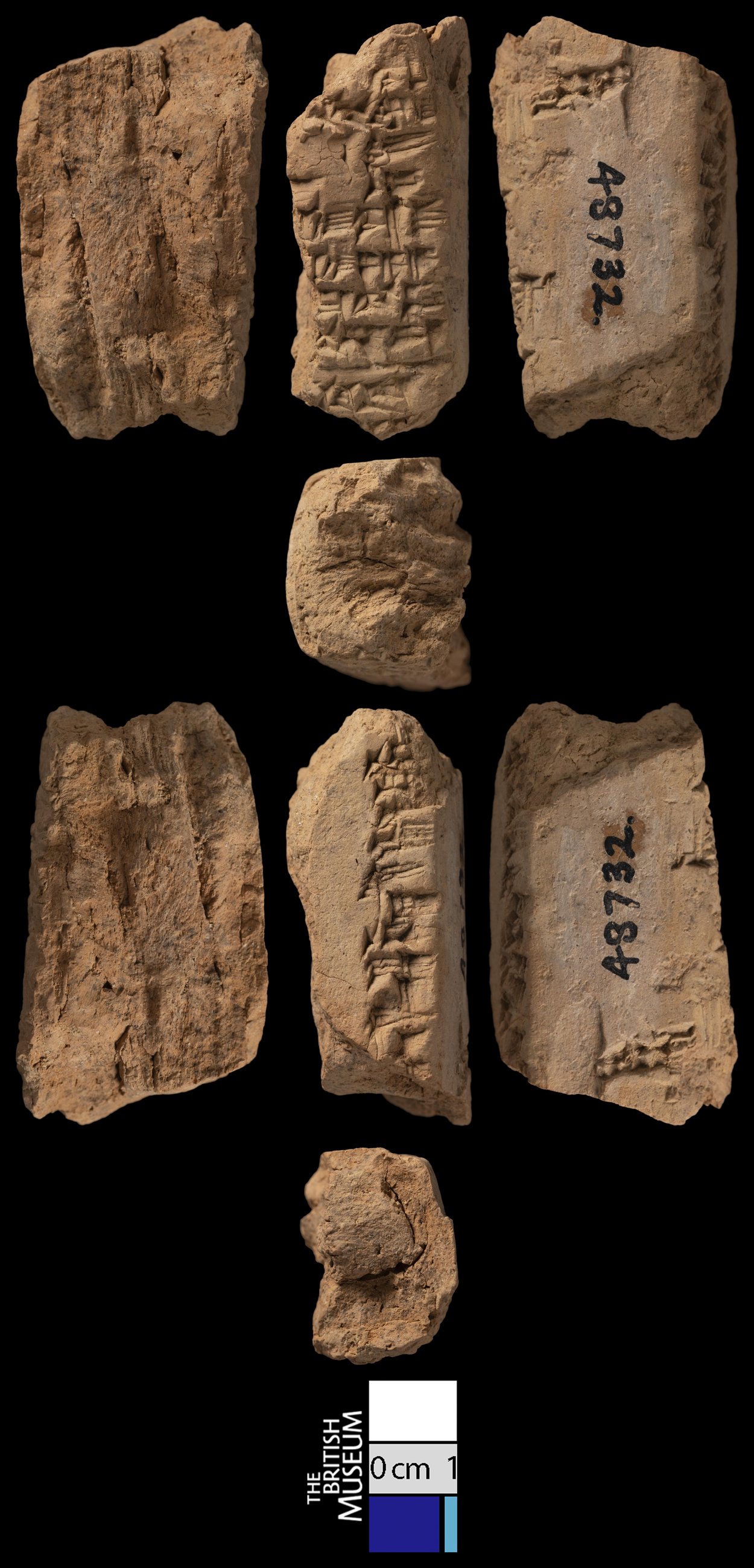
Where on the image
British Museum BM.48732: reverse, the tablet's own line 9'. eBL's corpus edition (https://www.ebl.lmu.de/corpus/L/2/2/SB/IV) attributes SB IV 1 to this manuscript at these column and line numbers. Photograph checked: obverse, reverse and edges of a narrow fragment, ink 48732. About 11 lines on one face and 8 or 9 on the other, consistent with eBL's obverse 13 and reverse 8 + 1. BM.48732, a copy of SB III, carries this line as its catch-line: the opening of the next tablet of the series, copied at the end of the previous one (eBL lists catch-lines among its quotations; unlike commentaries and quotations in other texts, a catch-line is the line itself on a copy of the work). On this tablet of line 1 only one to three signs survive. The English of this line translates eBL's composite text, so it includes words that are not preserved on this tablet but are restored from other manuscripts or by the editors. Square brackets in the English mark eBL's restorations in its composite text; words that survive on other tablets carry no brackets even where this tablet is broken.
1[x x x x x x x x x x x x u]š-ṭi-ib
1He drove out their distress and made their redness well.
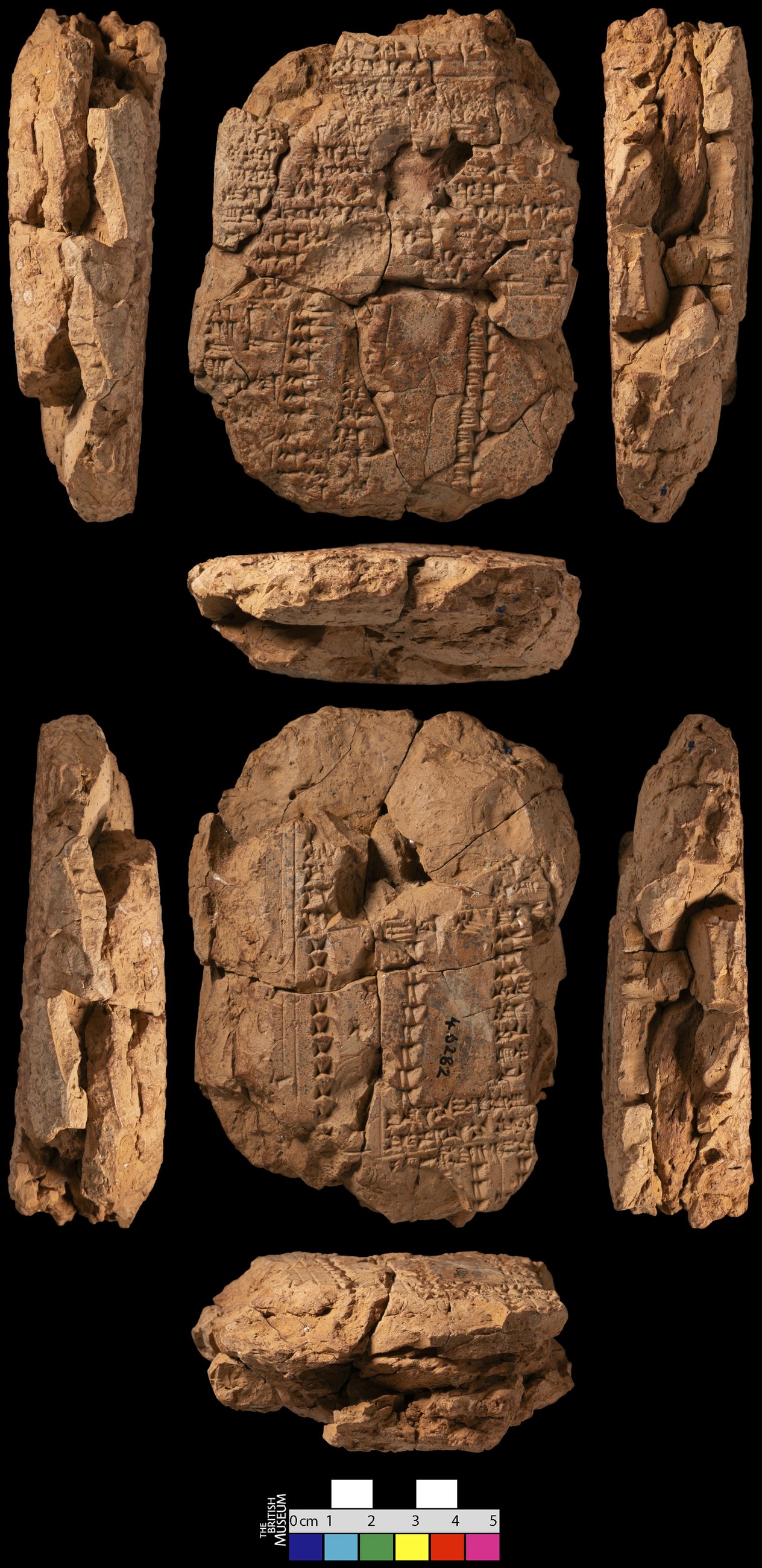
Where on the image
British Museum BM.46282: obverse, the tablet's own lines 3' to 12'. eBL's corpus edition (https://www.ebl.lmu.de/corpus/L/2/2/SB/IV) attributes SB IV a+13-a+23 to this manuscript at these column and line numbers. Photograph checked: obverse and reverse of a school tablet of several joined pieces, ink 46282 on the reverse. About 10 lines of running text across the upper obverse, with list entries in vertical columns below and on the reverse; consistent with eBL's obverse 10. eBL classes BM.46282 as a school tablet (a scribal exercise that copies an excerpt of the text), not a library copy of the whole work. It carries these lines as text (eBL's transliteration has no commentary or quotation markup), and it is used because no photographed library copy preserves these lines as well. On this tablet of lines a+13-a+14 only illegible traces (x) survive and lines a+15-a+21, a+23 are partly broken (square brackets and x in the Akkadian). The English of these lines translates eBL's composite text, so it includes words that are not preserved on this tablet but are restored from other manuscripts or by the editors. Square brackets in the English mark eBL's restorations in its composite text; words that survive on other tablets carry no brackets even where this tablet is broken. eBL gives no English for line(s) a+13, a+14, a+15, a+16, a+17, a+18, a+19, a+21, a+23. eBL line(s) a+22 fall within this run but are not on this tablet (they are listed among the lines not shown).
a+13[x x x (x)] x x [(x)] x [x x x (x)]
a+14[x x x x] x [x x x x (x)]
a+15[(x)] x x k[i-l]i ṣe-e-[t]u₄ i?#-x [x x (x x)]
a+16[e]k-le-[t]u₄ iš#-ku#-n[a a]-na# [n]a-[mir?-ti?]
a+17[u]š-par-di# e-ṭu#-ti [x x x] i?#-ri-[x (x)]
a+18ak-lu si#-mat UN-MEŠ u₂#-[ṭib] UGU# KA-i[a]
a+19u₂-da-[a]š₂-ši-ip# UGU# šap#-ti#-ia [lal-l]a-riš# na rat/hu an?#
a+20[i]m-š[u-u]š ma#-am#-m[e₂-e ru-uš?]-ša₂-šu u₂-zak#-ki#
a+21[u₂-ša₂]-an-biṭ# [x x x] GIM# si#-par#-ri
a+23[(x) x] x [x (x)] x [u]b-bi#-i[b?-a]n-ni
a+13(no English for this line in the eBL edition)
a+14(no English for this line in the eBL edition)
a+15(no English for this line in the eBL edition)
a+16(no English for this line in the eBL edition)
a+17(no English for this line in the eBL edition)
a+18(no English for this line in the eBL edition)
a+19(no English for this line in the eBL edition)
a+20He wiped off the grime, he cleared up its redness
a+21(no English for this line in the eBL edition)
a+23(no English for this line in the eBL edition)
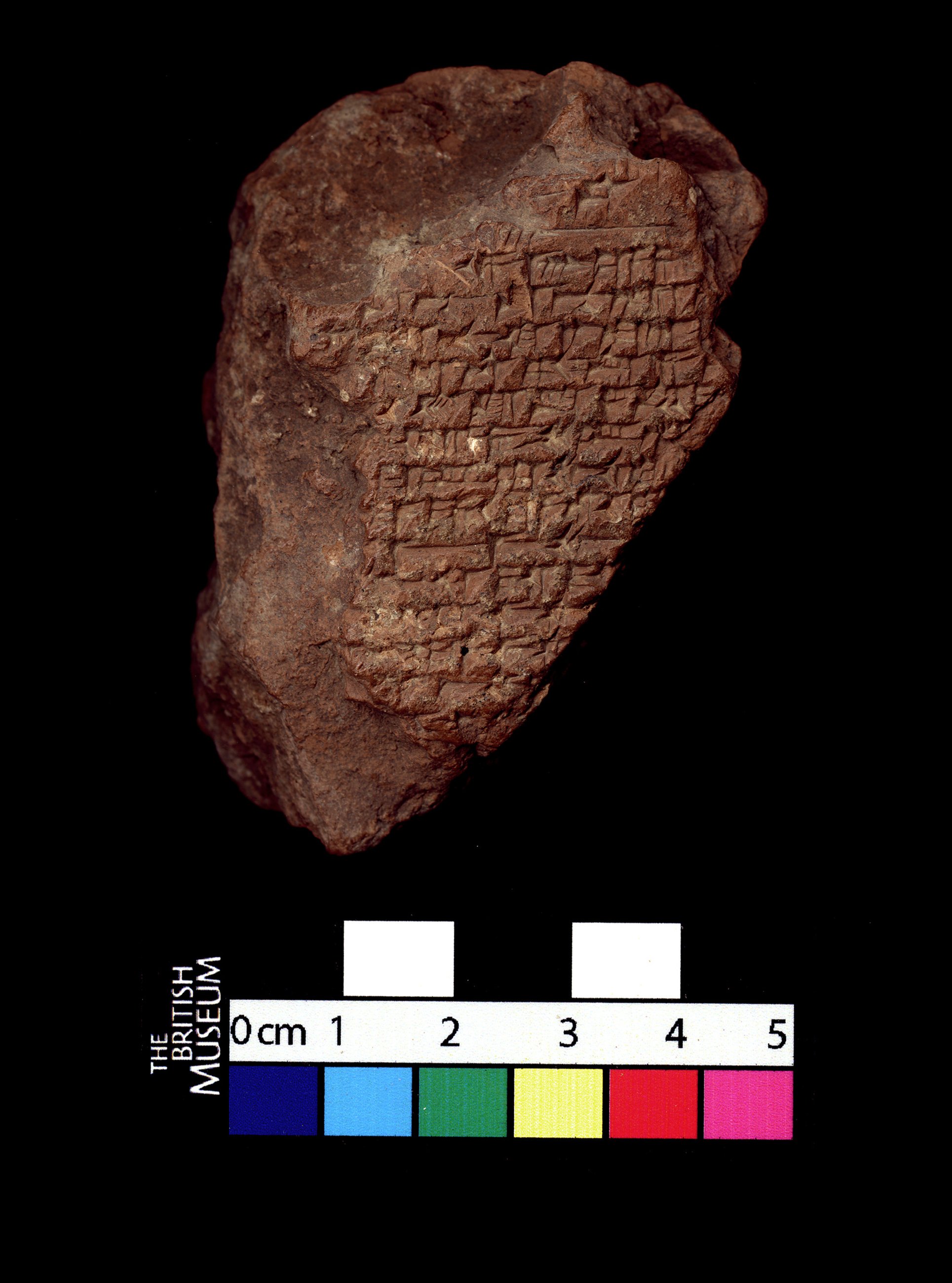
Where on the image
British Museum K.9724: the inscribed face, the tablet's own lines 1' to 17'. eBL's corpus edition (https://www.ebl.lmu.de/corpus/L/2/2/SB/IV) attributes SB IV c+1-c+17 to this manuscript at these column and line numbers. Photograph checked: one face only of a fragment about 4 cm high with about 15 lines; no ink number visible. Consistent with eBL's 17 lines (no column given). On this tablet of line c+1 only illegible traces (x) survive, of lines c+2-c+3, c+12-c+15, c+17 only one to three signs survive and lines c+4-c+11, c+16 are partly broken (square brackets and x in the Akkadian). The English of these lines translates eBL's composite text, so it includes words that are not preserved on this tablet but are restored from other manuscripts or by the editors. Square brackets in the English mark eBL's restorations in its composite text; words that survive on other tablets carry no brackets even where this tablet is broken.
c+1[x x x x (x x)] x (x x) [x x (x x)]
c+2[x x x (x x) š]a₂ kil [x x (x x)]
c+3[x x x (x)] x-MEŠ# [x x (x x)]
c+4[x x x (x)] KU₃-MEŠ e-n[i-x (x x)]
c+5[x x (x) DINGIR]-MEŠ*#-ku#-nu šu-nu šin-x [x (x x)]
c+6[x x (x) {d}i]š-tar#-ku#-nu ki-lal-la-an [x x (x x)]
c+7[x x (x) un-n]a-an-na šum-ru-ṣa x [x (x x)]
c+8[x x (x)] x-šu₂ bul-lu-ṭu ša₂-kin x [x (x x)]
c+9[(x x) u₂-bal-l]i-ṭan-ni še-ret-s[u x x (x x)]
c+10[x x x am]-ma-šid ab-bu-ut-t[a x x x]
c+11[x x x (x) al?-l]a-biš e-ri-i[n?-na? x x (x)]
c+12[x x x (x)] me šib-bu [x x x (x x)]
c+13[x x x (x)] x qa-da-da# [x x x (x x)]
c+14[x x x (x)] x x ši-g[u-u₂ x x (x x)]
c+15[x x x (x)] x x-ia# ši-g[u-u₂ x x (x x)]
c+16[ku-nu-uš-kad₃-r]u? ina pi-š[er₃-ti x x x]
c+17[x x x (x x)] u₂?# x [x x x x (x x x)]
c+1[…] … […]
c+2[…] … […]
c+3[…] … […]
c+4[…] pure […]
c+5[…] your god, they … […]
c+6[…] your goddess, both […]
c+7[…] supplication, the most painful […]
c+8[…] reviving, […] was placed
c+9[… he rev]ived me, […] his punishment
c+10I was stroked on the forehead, I was relieved of my slave mark.
c+11[…] …, the neck-[stock …]
c+12[…] … […]
c+13[…] bent over […]
c+14[…] a song of sorrow […]
c+15[…] a song of sorrow […]
c+16I proceeded along [Kunush-k]adru Street in a state of redemption.
c+17[…] … […]
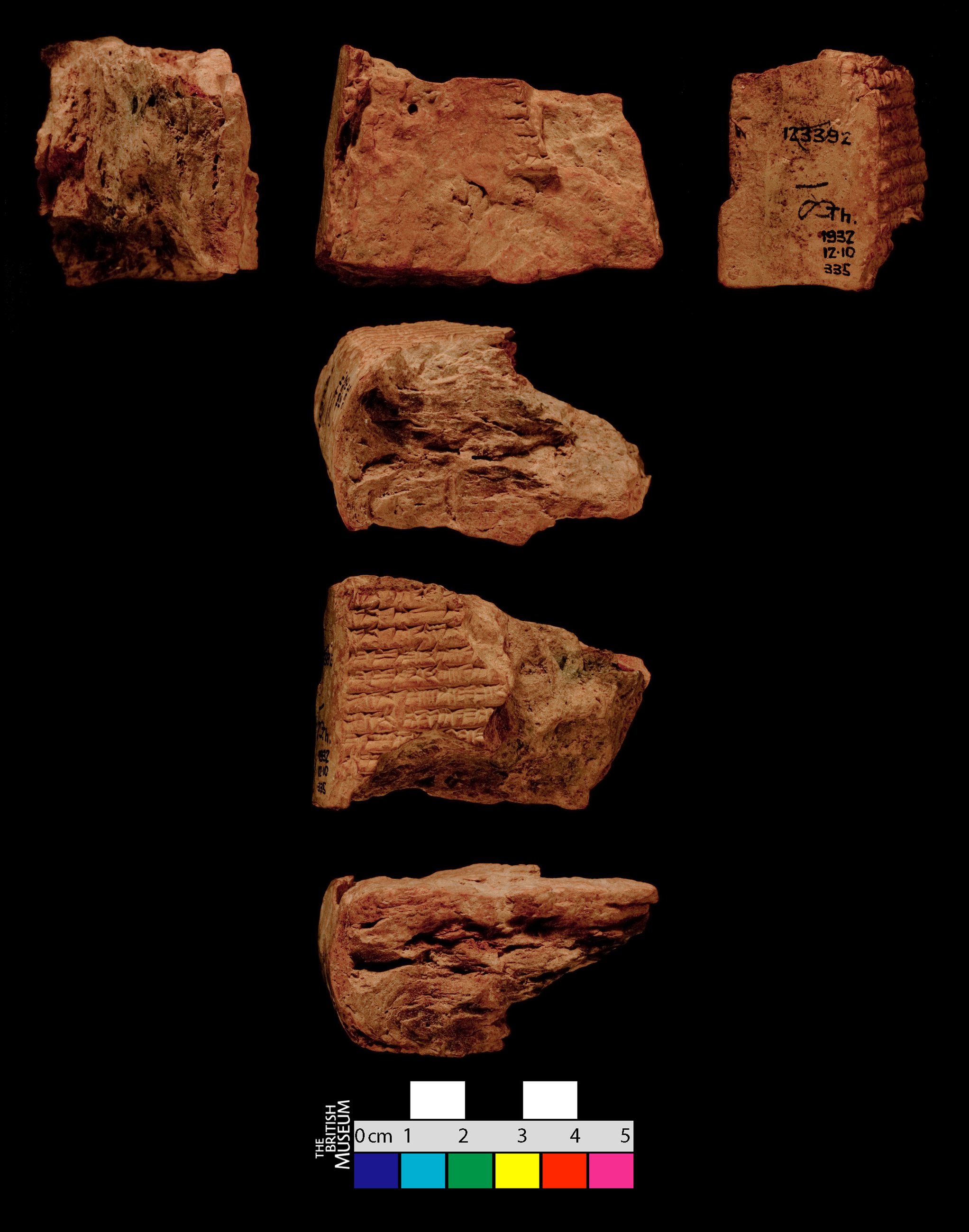
Where on the image
British Museum BM.123392: reverse, the tablet's own lines 1' to 10'. eBL's corpus edition (https://www.ebl.lmu.de/corpus/L/2/2/SB/IV) attributes SB IV d+1-d+10 to this manuscript at these column and line numbers. Photograph checked: all faces of a fragment about 5 cm wide, inks 123392 and Th 1932-12-10,335. About 10 lines on one face and a few signs on the other, consistent with eBL's uncertain reverse 10. On this tablet of line d+10 only illegible traces (x) survive, of line d+9 only one to three signs survive and lines d+1-d+8 are partly broken (square brackets and x in the Akkadian). The English of these lines translates eBL's composite text, so it includes words that are not preserved on this tablet but are restored from other manuscripts or by the editors. Square brackets in the English mark eBL's restorations in its composite text; words that survive on other tablets carry no brackets even where this tablet is broken.
d+1a#-na# {d#}zar#-p[a-ni-tu₄ ...]
d+2a-na DINGIR-M[U ...]
d+3a-na {d}15-M[U ...]
d+4la pa-li-ih D[INGIR-šu₂ ...]
d+5la pa-li-ih {d#}[15-šu₂ ...]
d+6ša₂ a-na e₂-sag-i[l₂ ...]
d+7ša₂ a-mat KA₂.DINGIR.RA{k[i} ...]
d+8ma-ru-uš#-tu₂# ep#-še-k[u? ...]
d+9še-re[t ...]
d+10x [...]
d+1To Zarp[anitu … ]
d+2To my god […]
d+3To my goddess […]
d+4The one who does not revere [his] god […]
d+5The one who does not revere [his goddess … ]
d+6He who has done wrong by Esagil, let him learn from me,
d+7He who has […] the word of Babylon […]
d+8The suffering [I] was made to undergo […]
d+9The punishment […]
d+10[…] … […]
Notes
- Akkadian: eBL transliteration of the signs on the photographed tablet (manuscript-level ATF), not a composite text.
- English: B. R. Foster's translation in the eBL edition; it renders eBL's composite text, including restorations from other tablets.
- Line numbers: eBL edition. Each section also gives the tablet's own column and line numbers.
- Signs in the Akkadian: [ ] broken away; x illegible sign; # damaged sign; ? uncertain reading; ! sign corrected by the editor; * collated sign; ... broken signs of unknown number; ( ) signs perhaps broken away; { } determinative; / alternative readings.
Cite
Sources
- Source: British Museum tablet photographs + eBL manuscript transliterations (eBL corpus edition L II.2, Righteous Sufferer (Ludlul bel nemeqi) (ed. A. Hätinen), SB IV) + English of the eBL edition (B. R. Foster (eBL edition)) (holding institution)
- Critical edition: electronic Babylonian Library, Righteous Sufferer (Ludlul bel nemeqi) (ed. A. Hätinen), manuscript transliterations
← previous · → next · v cycle view · l back to library