2 Kingdoms (2 Samuel), Chapter 4 (Codex Alexandrinus)
Introduction
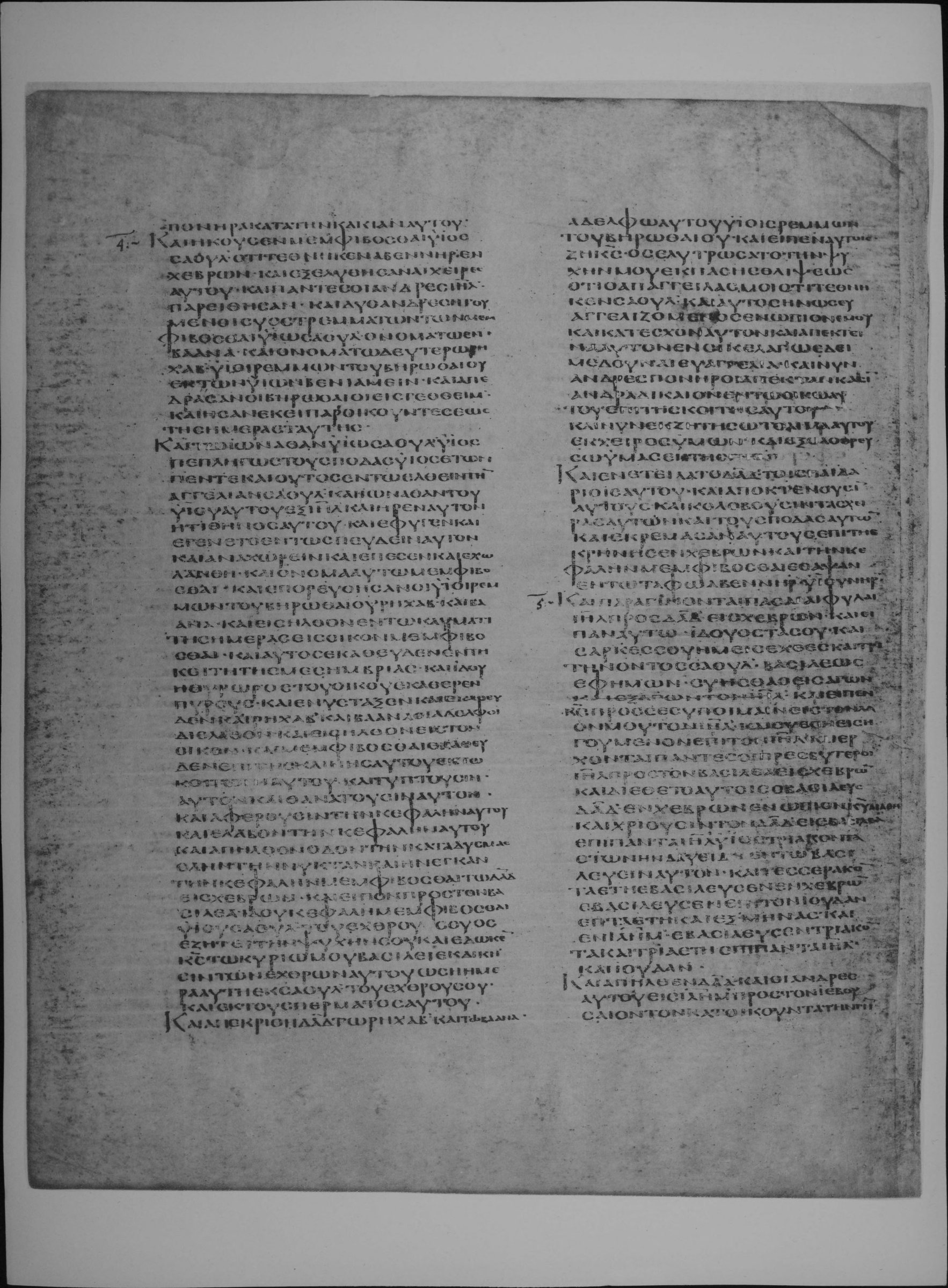
2 Kingdoms (2 Samuel) 4 in the Greek Old Testament (the Septuagint) as written in Codex Alexandrinus, a Greek Bible copied in the fifth century, probably in Egypt, and now in the British Library (Royal MS 1 D. V, the first of its four volumes). It is one of the three great early codices of the whole Greek Bible, with Codex Vaticanus and Codex Sinaiticus.
This entry meets the strict three-criteria standard of the Theosis Library:
- Manuscript scan: the page of Codex Alexandrinus carrying this chapter (fol. 184v), from the full-size photographic (autotype) facsimile published by the British Museum in 1879-1883, as digitised on the Internet Archive. The verse range of every page comes from the reduced photographic facsimile of 1930, which prints it beneath each plate, and the opening words of every page were read on the plate to confirm the page and the verse it begins with. Each section links to the page or pages that hold its verses. Folio numbers are those written at the head of each leaf and visible on the plates.
- Original text: Swete's edition, which here prints the text of Codex Vaticanus (Vat. gr. 1209), the base of his edition, and gives the readings of Alexandrinus only in his apparatus. The Greek column is therefore Vaticanus' text; where Alexandrinus differs, the plate shows what Alexandrinus reads.
- English translation: Sir Lancelot C. L. Brenton, The Septuagint Version of the Old Testament (1844; 1851 edition), a translation of the Greek, public domain, from the eBible.org text.
How was this verified? (Provenance)
Where on the image
2 Kingdoms (2 Samuel) 4:1-8 is on fol. 184v (full-size facsimile of 1879-83, Internet Archive codex-alexandrinus leaf 387). The 1930 reduced facsimile prints beneath this page: 2 Sam. iii. 39-v. 6. Checked on the plate: the page begins inside 2 Kingdoms (2 Samuel) 3:39 (first words read: ΠΟΝΗΡΑ ΚΑΤΑ ΤΗΝ ΚΑΚΙΑΝ ΑΥΤΟΥ ΚΑΙ ΗΚΟΥΣΕΝ ΜΕΜΦΙΒΟΣΘΕ ΥΙΟΣ ΣΑΟΥΛ).
1Καὶ ἤκουσεν Μεμφιβόσθε υἱὸς Σαοὺλ ὅτι τέθνηκεν Ἀβεννὴρ ἐν Χεβρών, καὶ ἐξελύθησαν αἱ χεῖρες αὐτοῦ, καὶ πάντες οἱ ἄνδρες Ἰσραὴλ παρείθησαν. 2καὶ δύο ἄνδρες ἡγούμενοι συστρεμμάτων τῷ Μεμφιβόσθε υἱῷ Σαούλ· ὄνομα τῷ ἑνὶ Βαανά, καὶ ὄνομα τῷ δευτέρῳ Ῥηχάβ, υἱοὶ Ῥεμμὼν τοῦ Βηρωθαίου ἐκ τῶν υἱῶν Βενιαμείν, ὅτι Βηρὼθ ἐλογίζετο τοῖς υἱοῖς Βενιαμείν. 3καὶ ἀπέδρασαν οἱ Βηρωθαῖοι εἰς Γεθθάι, καὶ ἦσαν ἐκεῖ παροικοῦντες ἕως τῆς ἡμέρας ταύτης. 4Καὶ τῷ Ἰωναθὰν υἱῷ Σαοὺλ υἱὸς πεπληγὼς τοὺς πόδας υἱὸς ἐτῶν πέντε, καὶ οὗτος ἐν τῷ ἐλθεῖν τὴν ἀγγελίαν Σαοὺλ καὶ Ἰωναθὰν τοῦ υἱοῦ αὐτοῦ ἐξ Ἰσραήλ, καὶ ἦρεν αὐτὸν ὁ τιθηνὸς αὐτοῦ καὶ ἔφυγεν· καὶ ἐγένετο ἐν τῷ σπεύδειν αὐτὸν καὶ ἀναχωρεῖν, καὶ ἔπεσεν καὶ ἐχωλάνθη· καὶ ὄνομα αὐτῷ Μεμφιβόσθε. 5Καὶ ἐπορεύθησαν υἱοὶ Ῥεμμὼν τοῦ Βηρωθαίου Ῥεκχὰ καὶ Βαὰμ καὶ εἰσῆλθον ἐν τῷ καύματι τῆς ἡμέρας εἰς οἶκον Μεμφιβόσθε, καὶ αὐτὸς ἐκάθευδεν ἐν τῇ κοίτῃ τῆς μεσημβρίας. 6καὶ ἰδοὺ ἡ θυρωρὸς τοῦ οἴκου ἐκάθαιρεν πυροὺς καὶ ἐνύσταξεν καὶ ἐκάθευδεν, καὶ Ῥεκχὰ καὶ Βαμμὰ οἱ ἀδελφοὶ διέλαθον 7καὶ εἰσῆλθον εἰς τὸν οἶκον, καὶ Μεμφιβόσθε ἐκάθευδεν ἐπὶ τῆς κλίνης αὐτοῦ ἐν τῷ κοιτῶνι αὐτοῦ· καὶ τύπτουσιν αὐτὸν καὶ θανατοῦσιν, καὶ ἀναφαιροῦσιν τὴν κεφαλὴν αὐτοῦ, καὶ ἔλαβον τὴν κεφαλὴν αὐτοῦ καὶ ἀπῆλθον ὁδὸν τὴν κατὰ δυσμὰς ὅλην τὴν νύκτα. 8καὶ ἤνεγκαν τὴν κεφαλὴν Μεμφιβόσθε τῷ Δαυεὶδ εἰς Χεβρών, καὶ εἶπαν πρὸς τὸν βασιλέα Ἰδοὺ ἡ κεφαλὴ Μεμφιβόσθε υἱοῦ Σαοὺλ τοῦ ἐχθροῦ σου, ὃς ἐζήτει τὴν ψυχήν σου· καὶ ἔδωκεν Κύριος τῷ κυρίῳ βασιλεῖ ἐκδίκησιν τῶν ἐχθρῶν αὐτοῦ ὡς ἡ ἡμέρα αὕτη, ἐκ Σαοὺλ τοῦ ἐχθροῦ σου καὶ ἐκ τοῦ σπέρματος αὐτοῦ.
1And Jebosthe the son of Saul heard that Abenner the son of Ner had died in Chebron; and his hands were paralysed, and all the men of Israel grew faint. 2And Jebosthe the son of Saul had two men that were captains of bands: the name of the one was Baana, and the name of the other Rechab, sons of Remmon the Berothite of the children of Benjamin; for Beroth was reckoned to the children of Benjamin. 3And the Berothites ran away to Gethaim, and were sojourners there until this day. 4And Jonathan Saul's son had a son lame of his feet, five years old, and he was in the way when the news of Saul and Jonathan his son came from Jezrael, and his nurse took him up, and fled; and it came to pass as he hasted and retreated, that he fell, and was lamed. And his name was Memphibosthe. 5And Rechab and Baana the sons of Remmon the Berothite went, and they came in the heat of the day into the house of Jebosthe; and he was sleeping on a bed at noon. 6And, behold, the porter of the house winnowed wheat, and he slumbered and slept: and the brothers Rechab and Baana went privily into the house: 7and Jebosthe was sleeping on his bed in his chamber: and they smite him, and slay him, and take off his head: and they took his head, and went all the night by the western road. 8And they brought the head of Jebosthe to David to Chebron, and they said to the king, Behold the head of Jebosthe the son of Saul thy enemy, who sought thy life; and the Lord has executed for my lord the king vengeance on his enemies, as it is this day: even on Saul thy enemy, and on his seed.
Where on the image
2 Kingdoms (2 Samuel) 4:9-12 is on fol. 184v (full-size facsimile of 1879-83, Internet Archive codex-alexandrinus leaf 387). The 1930 reduced facsimile prints beneath this page: 2 Sam. iii. 39-v. 6. Checked on the plate: the page begins inside 2 Kingdoms (2 Samuel) 3:39 (first words read: ΠΟΝΗΡΑ ΚΑΤΑ ΤΗΝ ΚΑΚΙΑΝ ΑΥΤΟΥ ΚΑΙ ΗΚΟΥΣΕΝ ΜΕΜΦΙΒΟΣΘΕ ΥΙΟΣ ΣΑΟΥΛ).
9καὶ ἀπεκρίθη Δαυεὶδ τῷ Ῥεκχὰ καὶ τῷ Βαὰμ ἀδελφῷ αὐτοῦ υἱοῖς Ῥεμμὼν τοῦ Βηρωθαίου καὶ εἶπεν αὐτοῖς Ζῇ Κύριος ὃς ἐλυτρώσατο τὴν ψυχήν μου ἐκ πάσης θλίψεως, 10ὅτι ὁ ἀπαγγείλας μοι ὅτι τέθνηκεν Σαοὺλ καὶ αὐτὸς ἦν ὡς εὐαγγελιζόμενος ἐνώπιόν μου, καὶ κατέσχον αὐτὸν καὶ ἀπέκτεινα ἐν Σεκελάκ, ᾧ ἔδει με δοῦναι εὐαγγέλια. 11καὶ νῦν ἄνδρες πονηροὶ ἀπεκτάνκασιν ἄνδρα δίκαιον ἐν τῷ οἴκῳ αὐτοῦ ἐπὶ τῆς κοίτης αὐτοῦ· καὶ νῦν ἐκζητήσω τὸ αἷμα αὐτοῦ ἐκ χειρὸς ὑμῶν καὶ ἐξολεθρεύσω ὑμᾶς ἐκ τῆς γῆς. 12καὶ ἐνετείλατο Δαυεὶδ τοῖς παιδαρίοις αὐτοῦ καὶ ἀποκτέννουσιν αὐτούς· καὶ κολοβοῦσιν τὰς χεῖρας αὐτῶν καὶ τοὺς πόδας αὐτῶν καὶ ἐκρέμασαν αὐτοὺς ἐπὶ τῆς κρήνης ἐν Χεβρών, καὶ τὴν κεφαλὴν Μεμφιβόσθε ἔθαψαν ἐν τῷ τάφῳ Ἀβεννὴρ υἱοῦ Νήρ.
9And David answered Rechab and Baana his brother, the sons of Remmon the Berothite, and said to them, As the Lord lives, who has redeemed my soul out of all affliction; 10he that reported to me that Saul was dead, even he was as one bringing glad tidings before me: but I seized him and slew him in Sekelac, to whom I ought, as he thought, to have given a reward for his tidings. 11And now evil men have slain a righteous man in his house on his bed: now then I will require his blood of your hand, and I will destroy you from off the earth. 12And David commanded his young men, and they slay them, and cut off their hands and their feet; and they hung them up at the fountain in Chebron: and they buried the head of Jebosthe in the tomb of Abenner the son of Ner.
Cite
Sources
- Source: Codex Alexandrinus (British Library Royal MS 1 D. V) via the British Museum photographic facsimiles of 1879-83 and 1930 (Internet Archive) + Swete's Septuagint + Brenton's English (holding institution)
- Critical edition: H. B. Swete, The Old Testament in Greek according to the Septuagint (1909)
← previous · → next · v cycle view · l back to library