2 Maccabees, Chapter 12 (Codex Alexandrinus)
Introduction
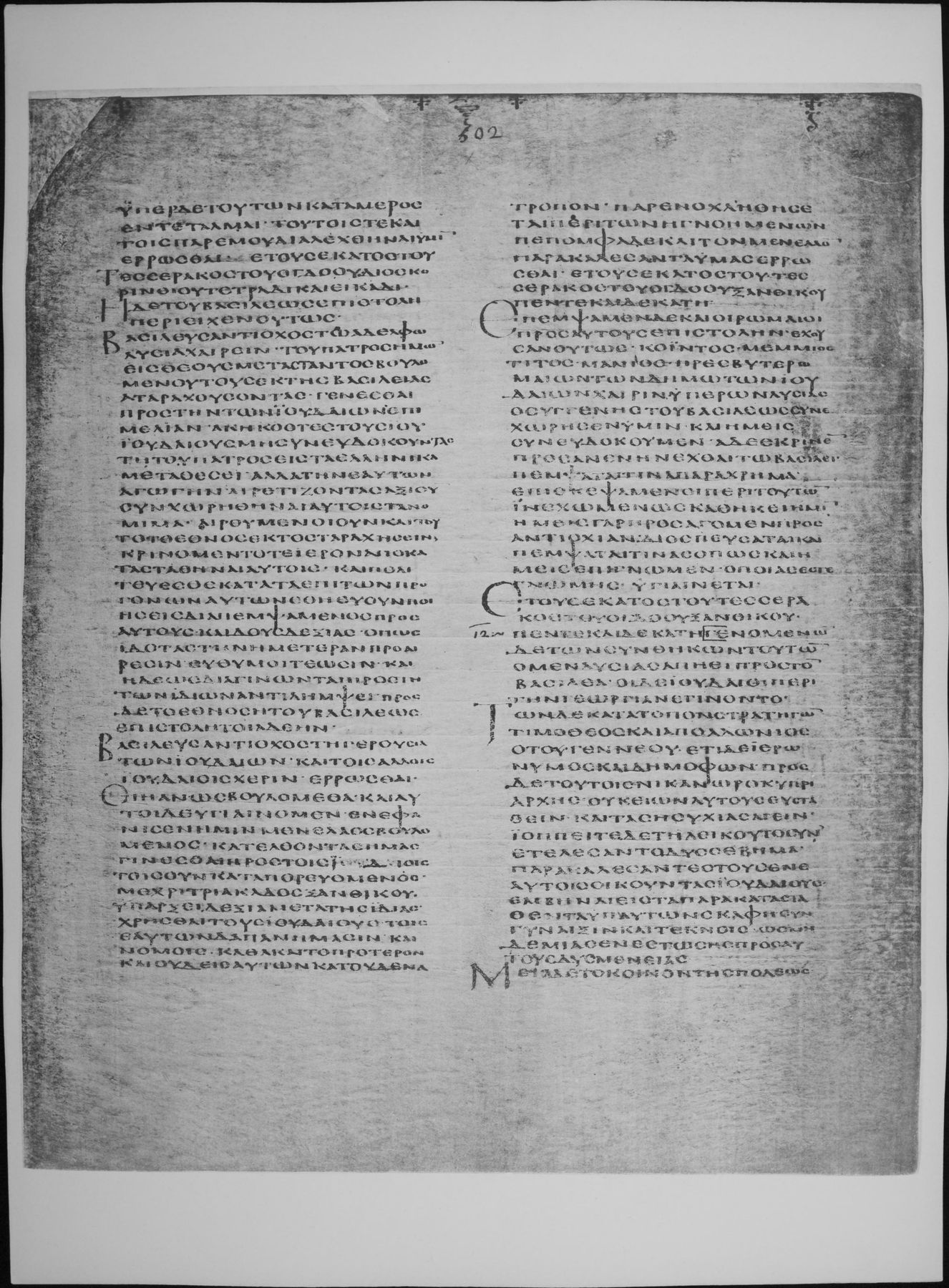
2 Maccabees 12 in the Greek Old Testament (the Septuagint) as written in Codex Alexandrinus, a Greek Bible copied in the fifth century, probably in Egypt, and now in the British Library (Royal MS 1 D. VI, the second of its four volumes). It is one of the three great early codices of the whole Greek Bible, with Codex Vaticanus and Codex Sinaiticus.
This entry meets the strict three-criteria standard of the Theosis Library:
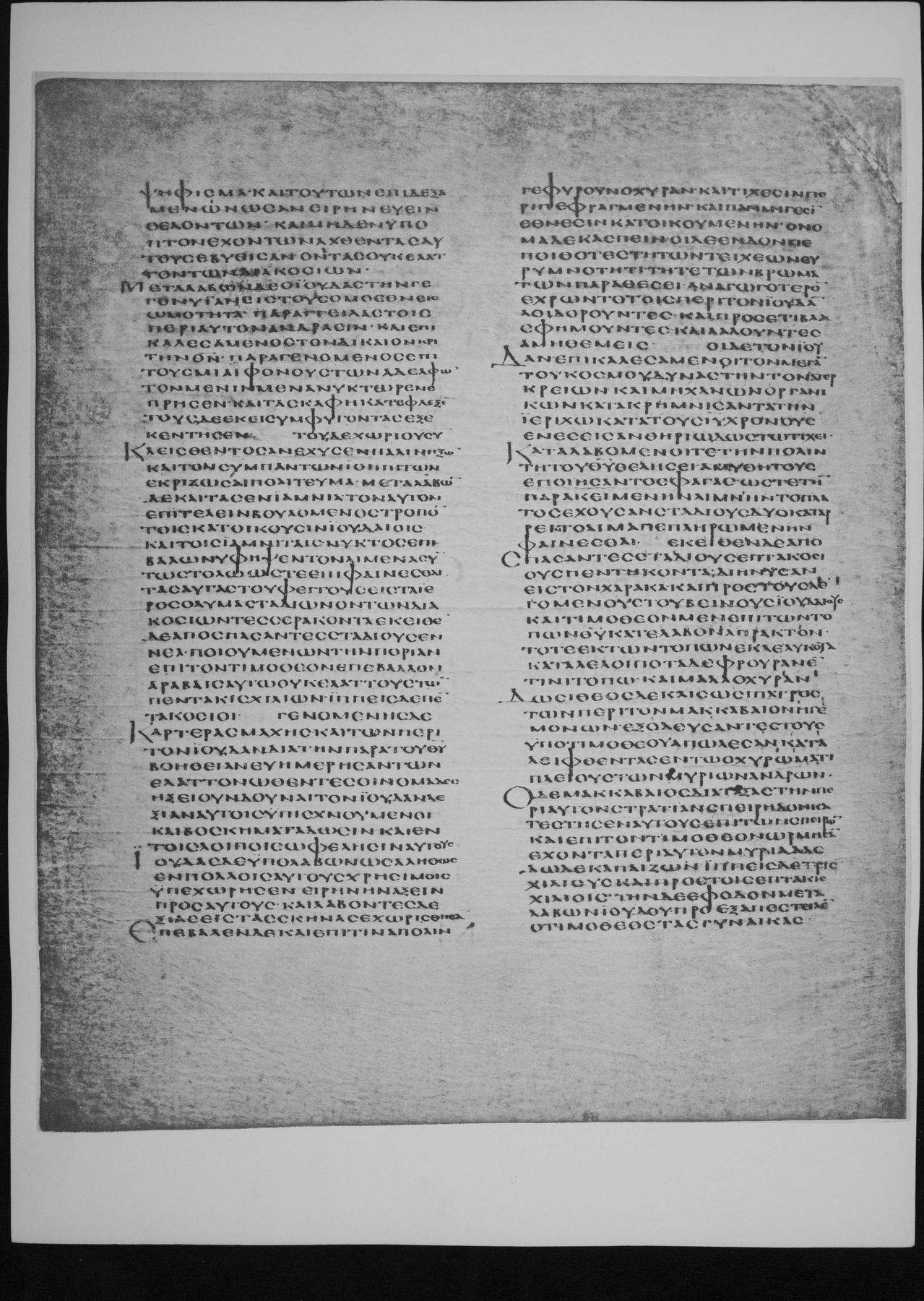
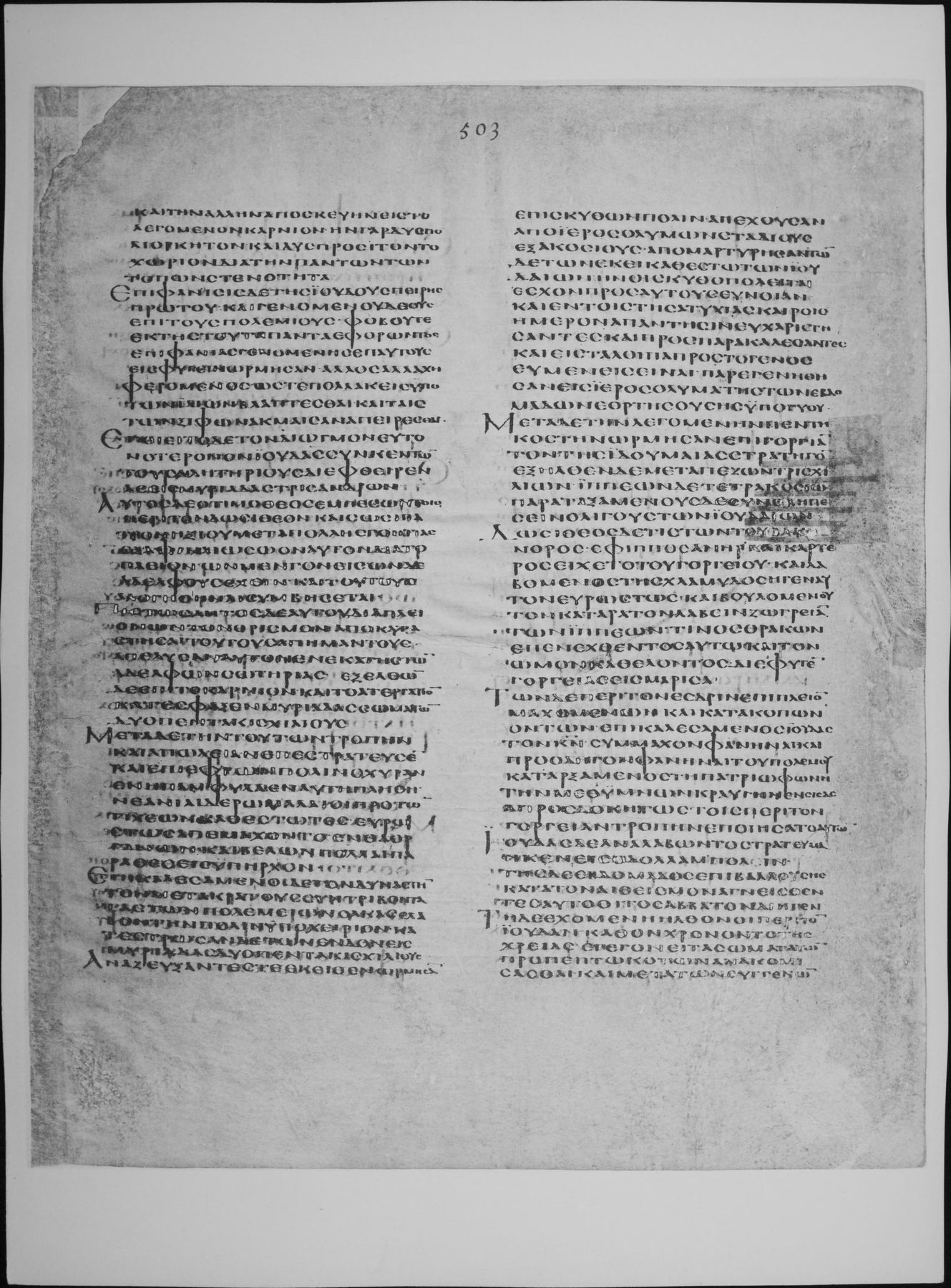
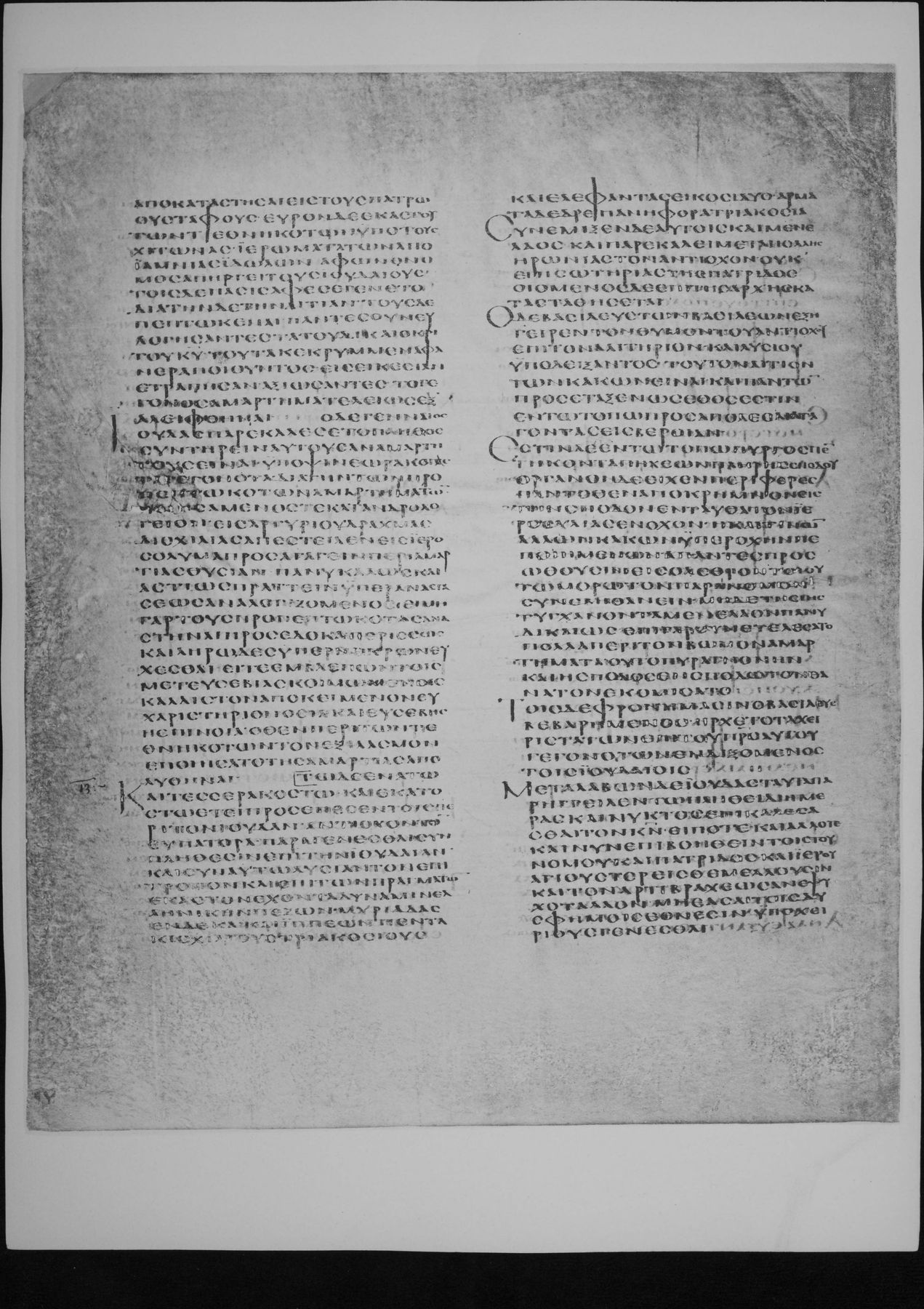
- Manuscript scan: the pages of Codex Alexandrinus carrying this chapter (fol. 502r, fol. 502v, fol. 503r, fol. 503v), from the full-size photographic (autotype) facsimile published by the British Museum in 1879-1883, as digitised on the Internet Archive. The verse range of every page comes from the reduced photographic facsimile of 1957, which prints it beneath each plate, and the opening words of every page were read on the plate to confirm the page and the verse it begins with. Each section links to the page or pages that hold its verses. Folio numbers are those written at the head of each leaf and visible on the plates.
- Original text: Swete's edition, which in the books of Maccabees prints the text of Codex Alexandrinus itself (Codex Vaticanus does not contain these books), with the readings of other manuscripts in his apparatus. Swete adds accents, breathings and punctuation and expands the abbreviated sacred names, so the plate shows the same text in unaccented capitals.
- English translation: Sir Lancelot C. L. Brenton, The Septuagint Version of the Old Testament (1844; 1851 edition), a translation of the Greek, public domain, from the eBible.org text.
How was this verified? (Provenance)
Where on the image
2 Maccabees 12:1-4 is on fol. 502r (full-size facsimile of 1879-83, Internet Archive codex-alexandrinus leaf 1010). The 1957 reduced facsimile prints beneath this page: 2 Maccabees xi. 20-xii. 4. Checked on the plate: the page begins at the start of 2 Maccabees 11:20 (first words read: ΥΠΕΡ ΔΕ ΤΟΥΤΩΝ ΚΑΤΑ ΜΕΡΟΣ ΕΝΤΕΤΑΛΜΑΙ ΤΟΥΤΟΙΣ ΤΕ ΚΑΙ ΤΟΙΣ ΠΑΡ ΕΜΟΥ ΔΙΑΛΕΧΘΗΝΑΙ ΥΜΙΝ). 2 Maccabees 12:4-8 is on fol. 502v (full-size facsimile of 1879-83, Internet Archive codex-alexandrinus leaf 1011). The 1957 reduced facsimile prints beneath this page: 2 Maccabees xii. 4-xii. 21. Checked on the plate: the page begins inside 2 Maccabees 12:4 (first words read: ΨΗΦΙΣΜΑ ΚΑΙ ΤΟΥΤΩΝ ΕΠΙΔΕΞΑΜΕΝΩΝ ΩΣ ΑΝ ΕΙΡΗΝΕΥΕΙΝ ΘΕΛΟΝΤΩΝ).
1Γενομένων δὲ τῶν συνθηκῶν τούτων, ὁ μὲν Λυσίας ἀπῄει πρὸς τὸν βασιλέα, οἱ δὲ Ἰουδαῖοι περὶ τὴν γεωργίαν ἐγίνοντο. 2τῶν δὲ κατὰ τόπον στρατηγῶν Τιμόθεος καὶ Ἀπολλώνιος ὁ τοῦ Γενναίου, ἔτι δὲ Ἱερώνυμος καὶ Δημοφών, πρὸς δὲ τούτοις Νικάνωρ ὁ Κυπριάρχης, οὐκ εἴων αὐτοὺς εὐσταθεῖν καὶ τὰς ἡσυχίας ἄγειν. 3Ἰοππεῖται δὲ τηλικοῦτο συνετελέσαντο δυσσέβημα, παρακαλέσαντες τοὺς ἐν ἑαυτοῖς οἰκοῦντας Ἰουδαίους ἐμβῆναι εἰς τὰ παρακατασταθέντα ὑπ᾽ αὐτῶν σκάφη σὺν γυναιξὶν καὶ τέκνοις, ὡς μηδεμιᾶς ἐνεστώσης πρὸς αὐτοὺς δυσμενείας· 4μετὰ δὲ τὸ κοινὸν τῆς πόλεως ψήφισμα καὶ τούτων ἐπιδεξαμένων, ὡς ἂν εἰρηνεύειν θελόντων καὶ μηδὲν ὕποπτον ἐχόντων, ἀχθέντας αὐτοὺς ἐβύθισαν ὄντας οὐκ ἔλαττον τῶν διακοσίων. 5μεταλαβὼν δὲ ὁ Ἰούδας τὴν γεγονυῖαν εἰς τοὺς ὁμοεθνεῖς ὠμότητα, παραγγείλας τοῖς περὶ αὐτὸν ἀνδράσιν 6καὶ ἐπικαλεσάμενος τὸν δίκαιον κριτὴν θεόν, παραγενόμενος ἐπὶ τοὺς μιαιφόνους τῶν ἀδελφῶν, τὸν μὲν λιμένα νύκτωρ ἐνέπρησεν καὶ τὰ σκάφη κατέφλεξεν, τοὺς δὲ ἐκεῖ συμφυγόντας ἐξεκέντησεν. 7τοῦ δὲ χωρίου συνκλεισθέντος, ἀνέλυσεν, πάλιν ἥξων καὶ τὸ σύμπαν τῶν Ἰοππιτῶν ἐκριζῶσαι πολίτευμα. 8μεταλαβὼν δὲ καὶ τοὺς ἐν Ἰαμνίᾳ τὸν αὐτὸν ἐπιτελεῖν βουλομένους τρόπον τοῖς κατοικοῦσιν Ἰουδαίοις,
1When these covenants were made, Lysias went unto the king, and the Jews were about their husbandry. 2But of the governors of several places, Timotheus, and Apollonius the son of Genneus, also Hieronymus, and Demophon, and beside them Nicanor the governor of Cyprus, would not suffer them to be quiet, and live in peace. 3The men of Joppe also did such an ungodly deed: they prayed the Jews that dwelt among them to go with their wives and children into the boats which they had prepared, as though they had meant them no hurt. 4Who accepted of it according to the common decree of the city, as being desirous to live in peace and suspecting nothing: but when they were gone forth into the deep, they drowned no less than two hundred of them. 5When Judas heard of this cruelty done unto his countrymen, he commanded those that were with him to make them ready. 6And calling upon God the righteous Judge, he came against those murderers of his brethren, and burnt the haven by night, and set the boats on fire, and those that fled thither he slew. 7And when the town was shut up, he went backward, as if he would return to root out all them of the city of Joppe. 8But when he heard that the Jamnites were minded to do in like manner unto the Jews that dwelt among them,
Where on the image
2 Maccabees 12:9-16 is on fol. 502v (full-size facsimile of 1879-83, Internet Archive codex-alexandrinus leaf 1011). The 1957 reduced facsimile prints beneath this page: 2 Maccabees xii. 4-xii. 21. Checked on the plate: the page begins inside 2 Maccabees 12:4 (first words read: ΨΗΦΙΣΜΑ ΚΑΙ ΤΟΥΤΩΝ ΕΠΙΔΕΞΑΜΕΝΩΝ ΩΣ ΑΝ ΕΙΡΗΝΕΥΕΙΝ ΘΕΛΟΝΤΩΝ).
9καὶ τοῖς Ἰαμνίταις νυκτὸς ἐπιβαλὼν ὑφῆψεν τὸν λιμένα σὺν τῷ στόλῳ, ὥστε ἐπιφαίνεσθαι τὰς αὐγὰς τοῦ φέγγους εἰς τὰ Ἰεροσόλυμα, σταδίων ὄντων διακοσίων τεσσεράκοντα. 10Ἐκεῖθεν δὲ ἀποσπάσαντες σταδίους ἐννέα, ποιουμένων τὴν πορίαν ἐπὶ τὸν Τιμόθεον, ἐπέβαλλον Ἄραβες αὐτῷ οὐκ ἐλάττους τῶν πεντακισχιλίων, ἱππεῖς δὲ πεντακόσιοι. 11γενομένης δὲ καρτερᾶς μάχης καὶ τῶν περὶ τὸν Ἰούδαν διὰ τὴν παρὰ τοῦ θεοῦ βοήθειαν εὐημερησάντων, ἐλαττονωθέντες οἱ νομάδες ἠξίουν δοῦναι τὸν Ἰούδαν δεξιὰν αὐτοῖς, ὑπισχνούμενοι καὶ βοσκήματα δώσειν καὶ ἐν τοῖς λοιποῖς ὠφελήσειν αὐτούς. 12Ἰούδας δὲ ὑπολαβὼν ὡς ἀληθῶς ἐν πολλοῖς αὐτοὺς χρησίμους, ὑπεχώρησεν εἰρήνην ἄξειν πρὸς αὐτούς· καὶ λαβόντες δεξιὰς εἰς τὰς σκηνὰς ἐχωρίσθησαν. 13Ἐπέβαλεν δὲ καὶ ἐπί τινα πόλιν γεφυροῦν, ὀχυρὰν καὶ τείχεσιν περιπεφραγμένην καὶ πανμιγέσιν ἔθνεσιν κατοικουμένην, ὄνομα δὲ Κασπείν. 14οἱ δὲ ἔνδον πεποιθότες τῇ τῶν τειχέων ἐρυμνότητι τῇ τε τῶν βρωμάτων παραθέσει, ἀναγωγότερον ἐχρῶντο τοῖς περὶ τὸν Ἰούδαν, λοιδοροῦντες, καὶ προσέτι βλασφημοῦντες καὶ λαλοῦντες ἃ μὴ θέμις. 15οἱ δὲ περὶ τὸν Ἰούδαν ἐπικαλεσάμενοι τὸν μέγαν τοῦ κόσμου δυνάστην, τὸν ἄτερ κριῶν καὶ μηχανῶν ὀργανικῶν κατακρημνίσαντα τὴν Ἰεριχὼ κατὰ τοὺς Ἰησοῦ χρόνους, ἐνέσεισαν θηριωδῶς τῷ τείχει· 16καταλαβόμενοί τε τὴν πόλιν τῇ τοῦ θεοῦ θελήσει ἀμυθήτους ἐποιήσαντο σφαγάς, ὥστε τὴν παρακειμένην λίμνην τὸ πλάτος ἔχουσαν σταδίους δύο καταρρεῖν τὸ αἷμα πεπληρωμένην φαίνεσθαι.
9he came upon the Jamnites also by night, and set fire on the haven and the navy, so that the light of the fire was seen at Jerusalem two hundred and forty furlongs off. 10Now when they were gone from thence nine furlongs in their journey toward Timotheus, no fewer than five thousand men on foot and five hundred horsemen of the Arabians set upon him. 11Whereupon there was a very sore battle; but Judas' side by the help of God got the victory; so that the Nomades of Arabia, being overcome, besought Judas for peace, promising both to give him cattle, and to pleasure him otherwise. 12Then Judas, thinking indeed that they would be profitable in many things, granted them peace: whereupon they shook hands, and so they departed to their tents. 13He went also about to make a bridge to a certain strong city, which was fenced about with walls, and inhabited by people of divers countries; and the name of it was Caspis. 14But they that were within it put such trust in the strength of the walls and provision of victuals, that they behaved themselves rudely toward them that were with Judas, railing and blaspheming, and uttering such words as were not to be spoken. 15Wherefore Judas with his company, calling upon the great Lord of the world, who without any rams or engines of war did cast down Jericho in the time of Joshua, gave a fierce assault against the walls, 16and took the city by the will of God, and made unspeakable slaughters, insomuch that a lake two furlongs broad near adjoining thereunto, being filled full, was seen running with blood.
Where on the image
2 Maccabees 12:17-21 is on fol. 502v (full-size facsimile of 1879-83, Internet Archive codex-alexandrinus leaf 1011). The 1957 reduced facsimile prints beneath this page: 2 Maccabees xii. 4-xii. 21. Checked on the plate: the page begins inside 2 Maccabees 12:4 (first words read: ΨΗΦΙΣΜΑ ΚΑΙ ΤΟΥΤΩΝ ΕΠΙΔΕΞΑΜΕΝΩΝ ΩΣ ΑΝ ΕΙΡΗΝΕΥΕΙΝ ΘΕΛΟΝΤΩΝ). 2 Maccabees 12:21-24 is on fol. 503r (full-size facsimile of 1879-83, Internet Archive codex-alexandrinus leaf 1012). The 1957 reduced facsimile prints beneath this page: 2 Maccabees xii. 21-xii. 39. Checked on the plate: the page begins inside 2 Maccabees 12:21 (first words read: ΚΑΙ ΤΗΝ ΑΛΛΗΝ ΑΠΟΣΚΕΥΗΝ ΕΙΣ ΤΟ ΛΕΓΟΜΕΝΟΝ ΚΑΡΝΙΟΝ ΗΝ ΓΑΡ ΔΥΣΠΟΛΙΟΡΚΗΤΟΝ).
17Ἐκεῖθεν δὲ ἀποσπάσαντες σταδίους ἑπτακοσίους πεντήκοντα διήνυσαν εἰς τὸν χάρακα καὶ πρὸς τοὺς λεγομένους Τουβεινοὺς Ἰουδαίους. 18καὶ Τιμόθεον μὲν ἐπὶ τῶν τόπων οὐ κατέλαβον, ἄπρακτον τότε ἐκ τῶν τόπων ἐκλελυκότα, καταλελοιπότα δὲ φρουρὰν ἔν τινι τόπῳ καὶ μάλα ὀχυράν. 19Δωσίθεος δὲ καὶ Σωσίπατρος, τῶν περὶ τὸν Μακκαβαῖον ἡγεμόνων, ἐξοδεύσαντες τοὺς ὑπὸ Τιμοθέου ἀπώλεσαν καταλειφθέντας ἐν τῷ ὀχυρώματι, πλείους τῶν μυρίων ἀνδρῶν· 20ὁ δὲ Μακκαβαῖος, διατάξας τὴν περὶ αὐτὸν στρατιὰν σπειρηδόν, κατέστησεν αὐτοὺς ἐπὶ τῶν σπειρῶν· καὶ ἐπὶ τὸν Τιμόθεον ὥρμησαν ἔχοντα περὶ αὐτὸν μυριάδας δώδεκα πεζῶν, ἱππεῖς δὲ δισχιλίους καὶ πρὸς τοῖς ἑπτακισχιλίοις. 21τὴν δὲ ἔφοδον μεταλαβὼν Ἰούδου, προεξαπέστειλεν ὁ Τιμόθεος τὰς γυναῖκας καὶ τὴν ἄλλην ἀποσκευὴν εἰς τὸ λεγόμενον Κάρνιον· ἦν γὰρ δυσπολιόρκητον καὶ δυσπρόσιτον τὸ χωρίον διὰ τὴν πάντων τῶν τόπων στενότητα. 22ἐπιφανείσης δὲ τῆς Ἰούδου σπείρης πρώτου, καὶ γενομένου δέους ἐπὶ τοὺς πολεμίους, φόβου τε ἐκ τῆς τοῦ τὰ πάντα ἐφορῶντος ἐπιφανίας γενομένης ἐπ᾽ αὐτούς, εἰς φυγὴν ὥρμησαν ἄλλος ἀλλαχῇ φερόμενος, ὥστε πολλάκις ὑπὸ τῶν ἰδίων βλάπτεσθαι καὶ ταῖς τῶν ξιφῶν ἀκμαῖς ἀναπείρεσθαι. 23ἐποιεῖτο δὲ τὸν διωγμὸν εὐτονώτερον Ἰούδας, συνκεντῶν τοὺς ἀλιτηρίους, διέφθειρεν δὲ εἰς μυριάδας τρεῖς ἀνδρῶν. 24αὐτὸς δὲ ὁ Τιμόθεος ἐμπεσὼν τοῖς περὶ τὸν Δωσίθεον καὶ Σωσίπατρον ἠξίου μετὰ πολλῆς γοητίας ἐξαφεῖναι ὡς σῷον αὐτόν, διὰ τὸ πλειόνων μὲν γονεῖς, ὧν δὲ ἀδελφοὺς ἔχειν, καὶ τούτους ἀλογηθῆναι συμβήσεται·
17Then departed they from thence seven hundred and fifty furlongs, and came to Characa unto the Jews that are called Tubieni. 18But as for Timotheus, they found him not in the places: for before he had dispatched any thing, he departed from thence, having left a very strong garrison in a certain hold. 19Howbeit Dositheus and Sosipater, who were of Maccabeus' captains, went forth, and slew those that Timotheus had left in the fortress, above ten thousand men. 20And Maccabeus ranged his army by bands, and set them over the bands, and went against Timotheus, who had about him an hundred and twenty thousand men of foot, and two thousand and five hundred horsemen. 21Now when Timotheus had knowledge of Judas' coming, he sent the women and children and the other baggage unto a fortress called Carnion: for the town was hard to besiege, and uneasy to come unto, by reason of the straitness of all the places. 22But when Judas his first band came in sight, the enemies, being smitten with fear and terror through the appearing of him that seeth all things, fled amain, one running this way, another that way, so as that they were often hurt of their own men, and wounded with the points of their own swords. 23Judas also was very earnest in pursuing them, killing those wicked wretches, of whom he slew about thirty thousand men. 24Moreover Timotheus himself fell into the hands of Dositheus and Sosipater, whom he besought with much craft to let him go with his life, because he had many of the Jews' parents, and the brethren of some of them, who, if they put him to death, should not be regarded.
Where on the image
2 Maccabees 12:25-32 is on fol. 503r (full-size facsimile of 1879-83, Internet Archive codex-alexandrinus leaf 1012). The 1957 reduced facsimile prints beneath this page: 2 Maccabees xii. 21-xii. 39. Checked on the plate: the page begins inside 2 Maccabees 12:21 (first words read: ΚΑΙ ΤΗΝ ΑΛΛΗΝ ΑΠΟΣΚΕΥΗΝ ΕΙΣ ΤΟ ΛΕΓΟΜΕΝΟΝ ΚΑΡΝΙΟΝ ΗΝ ΓΑΡ ΔΥΣΠΟΛΙΟΡΚΗΤΟΝ).
25πιστώσαντος δὲ αὐτοῦ διὰ πλειόνων τὸν ὁρισμὸν ἀποκαταστῆσαι τούτους ἀπημάντους, ἀπέλυσαν αὐτὸν ἕνεκα τῆς τῶν ἀδελφῶν σωτηρίας. 26Ἐξελθὼν δὲ ἐπὶ τὸ Κάρνιον καὶ τὸ Ἀτεργάτιον, κατέσφαξεν μυριάδας σωμάτων δύο πεντακισχιλίους. 27μετὰ δὲ τὴν τούτων τροπὴν καὶ ἀπώλειαν ἐπεστράτευσεν καὶ ἐπὶ Ἐφρών, πόλιν ὀχυράν, ἐν ᾗ πάμφυλα ἐν αὐτῇ πλήθη· νεανίαι δὲ ῥωμαλέοι πρὸ τῶν τειχέων καθεστῶτες εὐρώστως ἀπεμάχοντο· ἔνθα ὀργάνων καὶ βελῶν πολλαὶ παραθέσεις ὑπῆρχον. 28ἐπικαλεσάμενοι δὲ τὸν δυνάστην τὸν μετὰ κράτους συντρίβοντα τὰς τῶν πολεμίων ὁλκάς, ἔλαβον τὴν πόλιν ὑποχείριον, κατέστρωσαν δὲ τῶν ἔνδον εἰς μυριάδας δύο πεντακισχιλίους. 29ἀναζεύξαντές τε ἐκεῖθεν, ὥρμησαν ἐπὶ Σκυθῶν πόλιν, ἀπέχουσαν ἀπὸ Ἰεροσολύμων σταδίους ἑξακοσίους. 30ἀπομαρτυρησάντων δὲ τῶν ἐκεῖ καθεστώτων Ἰουδαίων ἣν οἱ Σκυθοπολεῖται ἔσχον πρὸς αὐτοὺς εὔνοιαν, καὶ ἐν τοῖς τῆς ἀτυχίας καιροῖς ἥμερον ἀπάντησιν, 31εὐχαριστήσαντες καὶ προσπαρακαλέσαντες καὶ εἰς τὰ λοιπὰ πρὸς τὸ γένος εὐμενεῖς εἶναι, παρεγενήθησαν εἰς Ἰεροσόλυμα, τῆς τῶν ἑβδομάδων ἑορτῆς οὔσης ὑπογύου. 32Μετὰ δὲ τὴν λεγομένην πεντηκοστὴν ὥρμησαν ἐπὶ Γοργίαν τὸν τῆς Ἰδουμαίας στρατηγόν.
25So when he had assured them with many words that he would restore them without hurt, according to the agreement, they let him go for the saving of their brethren. 26Then Maccabeus marched forth to Carnion, and to the temple of Atargatis, and there he slew five and twenty thousand persons. 27And after he had put to flight and destroyed them, Judas removed the host toward Ephron, a strong city, wherein Lysias abode, and a great multitude of divers nations, and the strong young men kept the walls, and defended them mightily: wherein also was great provision of engines and darts. 28But when Judas and his company had called upon Almighty God, who with his power breaketh the strength of his enemies, they won the city, and slew twenty and five thousand of them that were within. 29From thence they departed to Scythopolis, which lieth six hundred furlongs from Jerusalem. 30But when the Jews that dwelt there had testified that the Scythopolitans dealt lovingly with them, and entreated them kindly in the time of their adversity; 31they gave them thanks, desiring them to be friendly still unto them: and so they came to Jerusalem, the feast of the weeks approaching. 32And after the feast, called Pentecost, they went forth against Gorgias the governor of Idumea,
Where on the image
2 Maccabees 12:33-39 is on fol. 503r (full-size facsimile of 1879-83, Internet Archive codex-alexandrinus leaf 1012). The 1957 reduced facsimile prints beneath this page: 2 Maccabees xii. 21-xii. 39. Checked on the plate: the page begins inside 2 Maccabees 12:21 (first words read: ΚΑΙ ΤΗΝ ΑΛΛΗΝ ΑΠΟΣΚΕΥΗΝ ΕΙΣ ΤΟ ΛΕΓΟΜΕΝΟΝ ΚΑΡΝΙΟΝ ΗΝ ΓΑΡ ΔΥΣΠΟΛΙΟΡΚΗΤΟΝ). 2 Maccabees 12:39-40 is on fol. 503v (full-size facsimile of 1879-83, Internet Archive codex-alexandrinus leaf 1013). The 1957 reduced facsimile prints beneath this page: 2 Maccabees xii. 39-xiii. 11. Checked on the plate: the page begins inside 2 Maccabees 12:39 (first words read: ΑΠΟΚΑΤΑΣΤΗΣΑΙ ΕΙΣ ΤΟΥΣ ΠΑΤΡΩΟΥΣ ΤΑΦΟΥΣ ΕΥΡΟΝ ΔΕ ΕΚΑΣΤΟΥ ΤΩΝ ΤΕΘΝΗΚΟΤΩΝ).
33ἐξῆλθεν δὲ μετὰ πεζῶν τρισχιλίων, ἱππέων δὲ τετρακοσίων· 34παραταξαμένους δὲ συνέβη πεσεῖν ὀλίγους τῶν Ἰουδαίων. 35Δωσίθεος δέ τις τῶν τοῦ Βακήνορος, ἔφιππος ἀνὴρ καὶ καρτερός, εἴχετο τοῦ Γοργίου, καὶ λαβόμενος τῆς χλαμύδος, ἦγεν αὐτὸν εὐρώστως, καὶ βουλομένου τὸν κατάρατον λαβεῖν ζωγρείαν, τῶν ἱππέων τινὸς Θρᾳκῶν ἐπενεχθέντος αὐτῷ καὶ τὸν ὦμον καθελόντος, διέφυγεν Γοργίας εἰς Μαρισά. 36τῶν δὲ περὶ τὸν Ἔσδριν ἐπὶ πλεῖον μαχομένων καὶ κατακόπων ὄντων, ἐπικαλεσάμενος Ἰούδας τὸν κύριον σύμμαχον φανῆναι καὶ προοδηγὸν φανῆναι τοῦ πολέμου, 37καταρξάμενος τῇ πατρίῳ φωνῇ τὴν μεθ᾽ ὕμνων κραυγήν, ἐνσείσας ἀπροσδοκήτως τοῖς περὶ τὸν Γοργίαν τροπὴν ἐποιήσατο αὐτῶν. 38Ἰούδας δὲ ἀναλαβὼν τὸ στράτευμα ἧκεν εἰς Ὀδολλὰμ πόλιν· τῆς δὲ ἑβδομάδος ἐπιβαλλούσης, κατὰ τὸν ἐθισμὸν ἁγνισθέντες αὐτόθι τὸ σάββατον διῆγεν. 39τῇ δὲ ἐχομένῃ ἦλθον οἱ περὶ τὸν Ἰούδαν, καθ᾽ ὃν χρόνον τὸ τῆς χρείας ἐγεγόνει, τὰ σώματα τῶν προπεπτωκότων ἀνακομίσασθαι καὶ μετὰ τῶν συγγενῶν ἀποκαταστῆσαι εἰς τοὺς πατρῴους τάφους. 40εὗρον δὲ ἑκάστου τῶν τεθνηκότων ὑπὸ τοὺς χιτῶνας ἱερώματα τῶν ἀπὸ Ἰαμνίας εἰδώλων, ἀφ᾽ ὧν ὁ νόμος ἀπήργει τοὺς Ἰουδαίους· τοῖς δὲ πᾶσι σαφὲς ἐγένετο διὰ τήνδε τὴν αἰτίαν τούσδε πεπτωκέναι.
33who came out with three thousand men of foot and four hundred horsemen. 34And it happened that in their fighting together a few of the Jews were slain. 35At which time Dositheus, one of Bacenor's company, who was on horseback, and a strong man, was still upon Gorgias, and taking hold of his coat drew him by force; and when he would have taken that cursed man alive, a horseman of Thracia coming upon him smote off his shoulder, so that Gorgias fled unto Marisa. 36Now when they that were with Gorgias had fought long, and were weary, Judas called upon the Lord, that he would shew himself to be their helper and leader of the battle. 37And with that he began in his own language, and sung psalms with a loud voice, and rushing unawares upon Gorgias' men, he put them to flight. 38So Judas gathered his host, and came into the city of Odollam. And when the seventh day came, they purified themselves, as the custom was, and kept the sabbath in the same place. 39And upon the day following, as the use had been, Judas and his company came to take up the bodies of them that were slain, and to bury them with their kinsmen in their fathers' graves. 40Now under the coats of every one that was slain they found things consecrated to the idols of the Jamnites, which is forbidden the Jews by the law. Then every man saw that this was the cause wherefore they were slain.
Where on the image
2 Maccabees 12:41-45 is on fol. 503v (full-size facsimile of 1879-83, Internet Archive codex-alexandrinus leaf 1013). The 1957 reduced facsimile prints beneath this page: 2 Maccabees xii. 39-xiii. 11. Checked on the plate: the page begins inside 2 Maccabees 12:39 (first words read: ΑΠΟΚΑΤΑΣΤΗΣΑΙ ΕΙΣ ΤΟΥΣ ΠΑΤΡΩΟΥΣ ΤΑΦΟΥΣ ΕΥΡΟΝ ΔΕ ΕΚΑΣΤΟΥ ΤΩΝ ΤΕΘΝΗΚΟΤΩΝ).
41πάντες οὖν εὐλογήσαντες τὰ τοῦ δικαιοκρίτου κυρίου τοῦ τὰ κεκρυμμένα φανερὰ ποιοῦντος, 42εἰς ἱκεσίαν ἐτράπησαν, ἀξιώσαντες τὸ γεγονὸς ἁμάρτημα τελείως ἐξαλειφθῆναι· ὁ δὲ γενναῖος Ἰούδας παρεκάλεσε τὸ πλῆθος συντηρεῖν αὑτοὺς ἀναμαρτήτους εἶναι, ὑπ᾽ ὄψιν ἑωρακότας τὰ γεγονότα διὰ τὴν τῶν προπεπτωκότων ἁμαρτίαν. 43ποιησάμενός τε κατ᾽ ἀνδρολογεῖον εἰς ἀργυρίου δραχμὰς δισχιλίας ἀπέστειλεν εἰς Ἰεροσόλυμα προσαγαγεῖν περὶ ἁμαρτίας θυσίαν, πάνυ καλῶς καὶ ἀστείως πράττων, ὑπὲρ ἀναστάσεως ἀναλογιζόμενος. 44εἰ μὴ γὰρ τοὺς προπεπτωκότας ἀναστῆναι προσεδόκα, περισσὸν καὶ ληρῶδες ὑπὲρ νεκρῶν εὔχεσθαι· 45εἴτε ἐμβλέπων τοῖς μετ᾽ εὐσεβίας κοιμωμένοις κάλλιστον ἀποκείμενον εὐχαριστήριον, ὁσία καὶ εὐσεβὴς ἡ ἐπίνοια. ὅθεν περὶ τῶν τεθνηκότων τὸν ἐξιλασμὸν ἐποιήσατο, τῆς ἁμαρτίας ἀπολυθῆναι.
41All men therefore praising the Lord, the righteous Judge, who had opened the things that were hid, 42betook themselves unto prayer, and besought him that the sin committed might wholly be put out of remembrance. Besides, that noble Judas exhorted the people to keep themselves from sin, forsomuch as they saw before their eyes the things that came to pass for the sins of those that were slain. 43And when he had made a gathering throughout the company to the sum of two thousand drachms of silver, he sent it to Jerusalem to offer a sin offering, doing therein very well and honestly, in that he was mindful of the resurrection: 44for if he had not hoped that they that were slain should have risen again, it had been superfluous and vain to pray for the dead. 45And also in that he perceived that there was great favour laid up for those that died godly, it was an holy and good thought. Whereupon he made a reconciliation for the dead, that they might be delivered from sin.
Cite
Sources
- Source: Codex Alexandrinus (British Library Royal MS 1 D. VI) via the British Museum photographic facsimiles of 1879-83 and 1957 (Internet Archive) + Swete's Septuagint + Brenton's English (holding institution)
- Critical edition: H. B. Swete, The Old Testament in Greek according to the Septuagint (1909)
← previous · → next · v cycle view · l back to library