2 Maccabees, Chapter 7 (Codex Alexandrinus)
Introduction
2 Maccabees 7 in the Greek Old Testament (the Septuagint) as written in Codex Alexandrinus, a Greek Bible copied in the fifth century, probably in Egypt, and now in the British Library (Royal MS 1 D. VI, the second of its four volumes). It is one of the three great early codices of the whole Greek Bible, with Codex Vaticanus and Codex Sinaiticus.
This entry meets the strict three-criteria standard of the Theosis Library:
- Manuscript scan: the pages of Codex Alexandrinus carrying this chapter (fol. 497r, fol. 497v, fol. 498r), from the full-size photographic (autotype) facsimile published by the British Museum in 1879-1883, as digitised on the Internet Archive. The verse range of every page comes from the reduced photographic facsimile of 1957, which prints it beneath each plate, and the opening words of every page were read on the plate to confirm the page and the verse it begins with. Each section links to the page or pages that hold its verses. Folio numbers are those written at the head of each leaf and visible on the plates.
- Original text: Swete's edition, which in the books of Maccabees prints the text of Codex Alexandrinus itself (Codex Vaticanus does not contain these books), with the readings of other manuscripts in his apparatus. Swete adds accents, breathings and punctuation and expands the abbreviated sacred names, so the plate shows the same text in unaccented capitals.
- English translation: Sir Lancelot C. L. Brenton, The Septuagint Version of the Old Testament (1844; 1851 edition), a translation of the Greek, public domain, from the eBible.org text.
How was this verified? (Provenance)
Where on the image
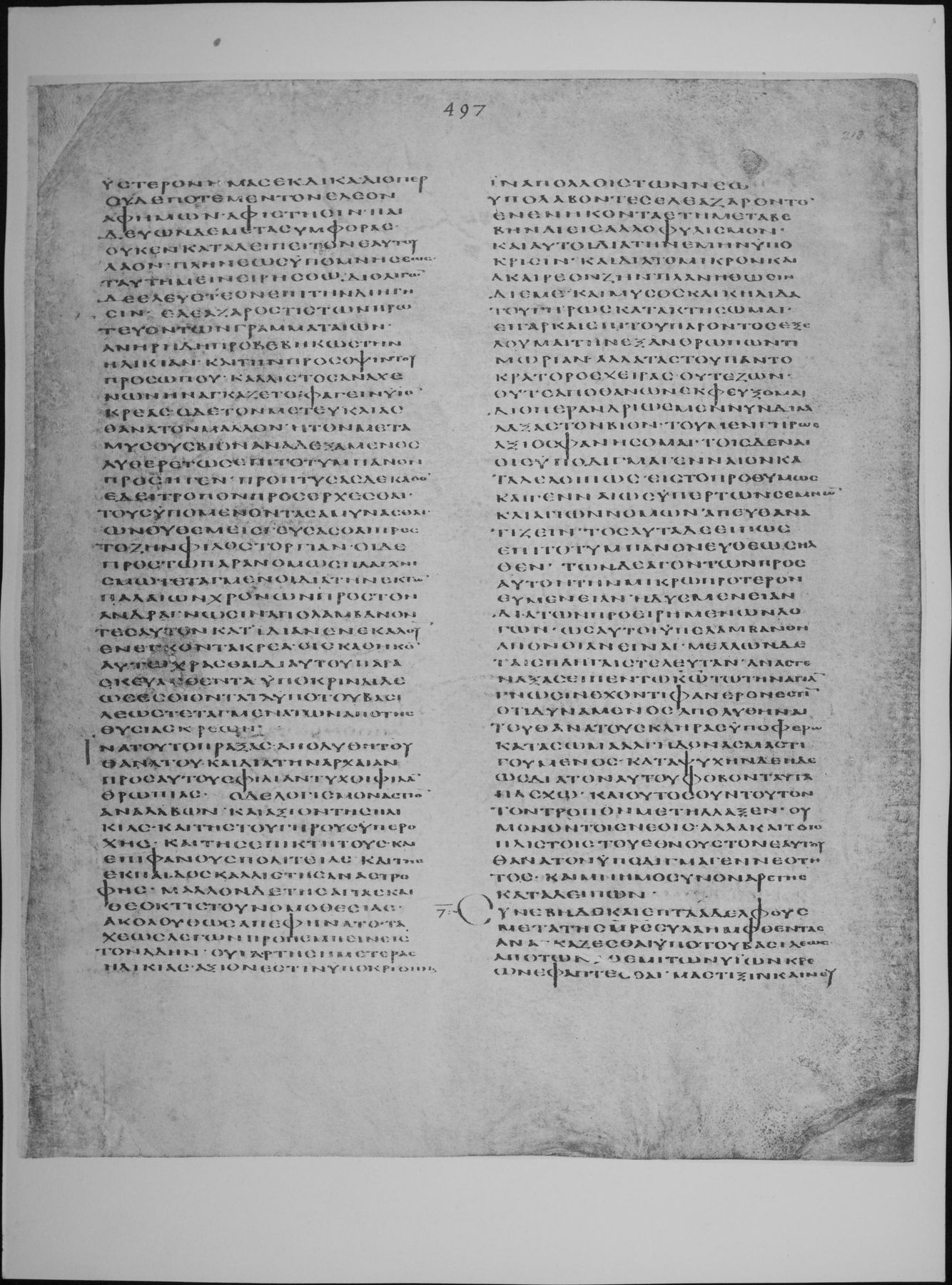
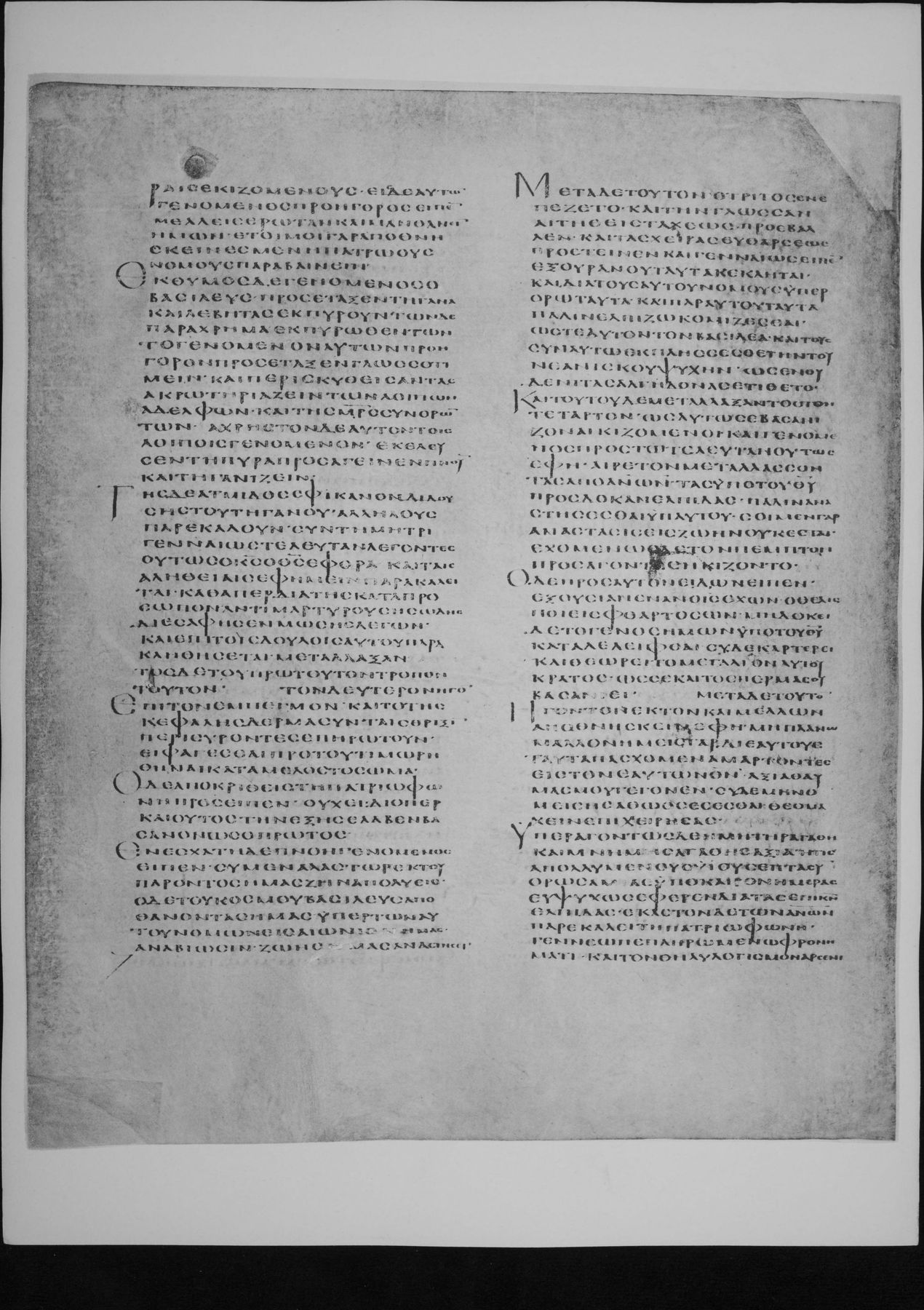
2 Maccabees 7:1 is on fol. 497r (full-size facsimile of 1879-83, Internet Archive codex-alexandrinus leaf 1000). The 1957 reduced facsimile prints beneath this page: 2 Maccabees vi. 15-vii. 1. Checked on the plate: the page begins inside 2 Maccabees 6:15 (first words read: ΥΣΤΕΡΟΝ ΗΜΑΣ ΕΚΔΙΚΑ ΔΙΟΠΕΡ ΟΥΔΕ ΠΟΤΕ ΜΕΝ ΤΟΝ ΕΛΕΟΝ ΑΦ ΗΜΩΝ ΑΦΙΣΤΗΣΙΝ). 2 Maccabees 7:1-8 is on fol. 497v (full-size facsimile of 1879-83, Internet Archive codex-alexandrinus leaf 1001). The 1957 reduced facsimile prints beneath this page: 2 Maccabees vii. 1-vii. 21. Checked on the plate: the page begins inside 2 Maccabees 7:1 (first words read: ΡΑΙΣ ΑΙΚΙΖΟΜΕΝΟΥΣ ΕΙΣ ΔΕ ΑΥΤΩΝ ΓΕΝΟΜΕΝΟΣ Ο ΠΡΟΗΓΟΡΟΣ).
1Συνέβη δὲ καὶ ἑπτὰ ἀδελφοὺς μετὰ τῆς μητρὸς συλλημφθέντας ἀναγκάζεσθαι ὑπὸ τοῦ βασιλέως ἀπὸ τῶν ἀθεμίτων ὑείων κρεῶν ἐφάπτεσθαι, μάστιξιν καὶ νευραῖς αἰκιζομένους. 2εἷς δὲ αὐτῶν γενόμενος προήγορος εἶπεν Μέλλεις ἐρωτᾷν καὶ μανθάνειν ἡμῶν; ἕτοιμοι γὰρ ἀποθνήσκειν ἐσμὲν ἢ πατρῴους νόμους παραβαίνειν. 3ἔκθυμος δὲ γενόμενος ὁ βασιλεὺς προσέταξεν τήγανα καὶ λέβητας ἐκπυροῦν. 4τῶν δὲ παραχρῆμα ἐκπυρωθέντων, τὸν γενόμενον αὐτῶν προήγορον προσέταξεν γλωσσοτομεῖν, καὶ περισκυθίσαντας ἀκρωτηριάζειν, τῶν λοιπῶν ἀδελφῶν καὶ τῆς μητρὸς συνορώντων. 5ἄχρηστον δὲ αὐτὸν τοῖς λοιποῖς γενόμενον ἐκέλευσεν τῇ πυρᾷ προσάγειν ἔνπνουν καὶ τηγανίζειν. τῆς δὲ ἀτμίδος ἐφ᾽ ἱκανὸν διδούσης τοῦ τηγάνου ἀλλήλους παρεκάλουν σὺν τῇ μητρὶ γενναίως τελευτᾷν, λέγοντες οὕτως 6Ὁ κύριος ὁ θεὸς ἐφορᾷ, καὶ ταῖς ἀληθείαις ἐφ᾽ ἡμῖν παρακαλεῖται, καθάπερ διὰ τῆς κατὰ πρόσωπον ἀντιμαρτυρούσης ᾠδῆς διεσάφησεν Μωσῆς, λέγων Καὶ ἐπὶ τοῖς δούλοις αὐτοῦ παρακληθήσεται. 7Μεταλλάξαντος δὲ τοῦ πρώτου τὸν τρόπον τοῦτον, τὸν δεύτερον ἦγον ἐπὶ τὸν ἐμπαιγμόν· καὶ τὸ τῆς κεφαλῆς δέρμα σὺν ταῖς θριξὶν περισύροντες ἐπηρώτων Εἰ φάγεσθαι πρὸ τοῦ τιμωρηθῆναι κατὰ μέλος τὸ σῶμα; 8ὁ δὲ ἀποκριθεὶς τῇ πατρίῳ φωνῇ προσεῖπεν Οὐχί. διόπερ καὶ οὗτος τὴν ἑξῆς ἔλαβεν βάσανον, ὡς ὁ πρῶτος.
1It came to pass also, that seven brethren with their mother were taken, and compelled by the king against the law to taste swine's flesh, and were tormented with scourges and whips. 2But one of them that spake first said thus, What wouldest thou ask or learn of us? we are ready to die, rather than to transgress the laws of our fathers. 3Then the king, being in a rage, commanded pans and caldrons to be made hot: 4which forthwith being heated, he commanded to cut out the tongue of him that spake first, and to cut off the utmost parts of his body, the rest of his brethren and his mother looking on. 5Now when he was thus maimed in all his members, he commanded him being yet alive to be brought to the fire, and to be fried in the pan: and as the vapour of the pan was for a good space dispersed, they exhorted one another with the mother to die manfully, saying thus, 6The Lord God looketh upon us, and in truth hath comfort in us, as Moses in his song, which witnessed to their faces, declared, saying, And he shall be comforted in his servants. 7So when the first was dead after this manner, they brought the second to make him a mocking stock: and when they had pulled off the skin of his head with the hair, they asked him, Wilt thou eat, before thou be punished throughout every member of thy body? 8But he answered in his own language, and said, No. Wherefore he also received the next torment in order, as the former did.
Where on the image
2 Maccabees 7:9-16 is on fol. 497v (full-size facsimile of 1879-83, Internet Archive codex-alexandrinus leaf 1001). The 1957 reduced facsimile prints beneath this page: 2 Maccabees vii. 1-vii. 21. Checked on the plate: the page begins inside 2 Maccabees 7:1 (first words read: ΡΑΙΣ ΑΙΚΙΖΟΜΕΝΟΥΣ ΕΙΣ ΔΕ ΑΥΤΩΝ ΓΕΝΟΜΕΝΟΣ Ο ΠΡΟΗΓΟΡΟΣ).
9ἐν ἐσχάτῃ δὲ πνοῇ γενόμενος εἶπεν Σὺ μέν, ἀλάστωρ, ἐκ τοῦ παρόντος ἡμᾶς ζῇν ἀπολύεις, ὁ δὲ τοῦ κόσμου βασιλεὺς ἀποθανόντας ἡμᾶς ὑπὲρ τῶν αὐτοῦ νόμων εἰς αἰώνιον ἀναβίωσιν ζωῆς ἡμᾶς ἀναστήσει. 10Μετὰ δὲ τοῦτον ὁ τρίτος ἐνεπαίζετο, καὶ τὴν γλῶσσαν αἰτηθεὶς ταχέως προέβαλλεν καὶ τὰς χεῖρας εὐθαρσέως προέτεινεν· 11καὶ γενναίως εἶπεν Ἐξ οὐρανοῦ ταῦτα κέκληται, καὶ διὰ τοὺς αὐτοῦ νόμους ὑπερορῶ ταῦτα, καὶ παρ᾽ αὐτοῦ ταῦτα πάλιν ἐλπίζω κομίζεσθαι. 12ὥστε αὐτὸν τὸν βασιλέα καὶ τοὺς σὺν αὐτῷ ἐκπλήσσεσθαι τὴν τοῦ νεανίσκου ψυχήν, ὡς ἐν οὐδενὶ τὰς ἀλγηδόνας ἐτίθετο. 13Καὶ τούτου δὲ μεταλλάξαντος τὸν τέταρτον ὡσαύτως ἐβασάνιζον αἰκιζόμενοι. 14καὶ γενόμενος πρὸς τῷ τελευτᾷν οὕτως ἔφη Αἱρετὸν μεταλλάσσοντας ἀπὸ ἀνθρώπων τὰς ὑπὸ τοῦ θεοῦ προσδοκᾷν ἐλπίδας πάλιν ἀναστὴσεσθαι ὑπ᾽ αὐτοῦ· σοὶ μὲν γὰρ ἀνάστασις εἰς ζωὴν οὐκ ἔσται. 15Ἐχομένως δὲ τὸν πέμπτον προσάγοντες ᾐκίζοντο. 16ὁ δὲ πρὸς αὐτὸν ἰδὼν εἶπεν Ἐξουσίαν ἐν ἀνθρώποις ἔχων ὃ θέλεις ποιεῖς, φθαρτὸς ὤν· μὴ δόκει δὲ τὸ γένος ἡμῶν ὑπὸ τοῦ θεοῦ καταλελεῖφθαι.
9And when he was at the last gasp, he said, Thou like a fury takest us out of this present life, but the King of the world shall raise us up, who have died for his laws, unto everlasting life. 10After him was the third made a mocking stock: and when he was required he put out his tongue, and that right soon, holding forth his hands manfully, 11and said courageously, These I had from heaven; and for his laws I despise them; and from him I hope to receive them again. 12Insomuch that the king, and they that were with him, marvelled at the young man's courage, for that he nothing regarded the pains. 13Now when this man was dead also, they tormented and mangled the fourth in like manner. 14So when he was ready to die he said thus, It is good, being put to death by men, to look for hope from God to be raised up again by him: as for thee, thou shalt have no resurrection to life. 15Afterward they brought the fifth also, and mangled him. 16Then looked he unto the king, and said, Thou hast power over men, thou art corruptible, thou doest what thou wilt; yet think not that our nation is forsaken of God;
Where on the image
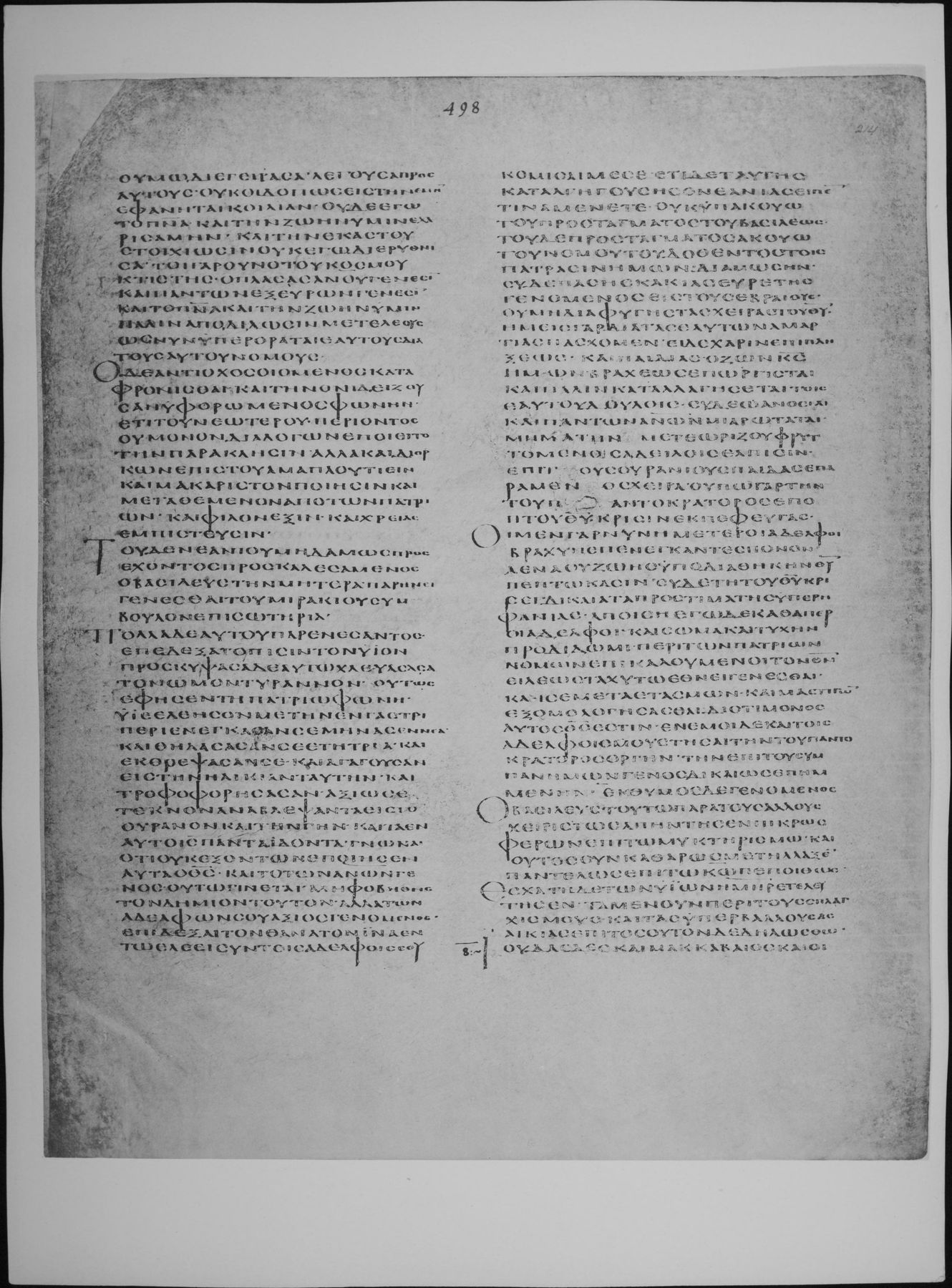
2 Maccabees 7:17-21 is on fol. 497v (full-size facsimile of 1879-83, Internet Archive codex-alexandrinus leaf 1001). The 1957 reduced facsimile prints beneath this page: 2 Maccabees vii. 1-vii. 21. Checked on the plate: the page begins inside 2 Maccabees 7:1 (first words read: ΡΑΙΣ ΑΙΚΙΖΟΜΕΝΟΥΣ ΕΙΣ ΔΕ ΑΥΤΩΝ ΓΕΝΟΜΕΝΟΣ Ο ΠΡΟΗΓΟΡΟΣ). 2 Maccabees 7:21-24 is on fol. 498r (full-size facsimile of 1879-83, Internet Archive codex-alexandrinus leaf 1002). The 1957 reduced facsimile prints beneath this page: 2 Maccabees vii. 21-viii. 1. Checked on the plate: the page begins inside 2 Maccabees 7:21 (first words read: ΘΥΜΩ ΔΙΕΓΕΙΡΑΣΑ ΛΕΓΟΥΣΑ ΠΡΟΣ ΑΥΤΟΥΣ ΟΥΚ ΟΙΔ ΟΠΩΣ ΕΙΣ ΤΗΝ ΕΜΗΝ ΕΦΑΝΗΤΕ ΚΟΙΛΙΑΝ).
17σὺ δὲ καρτέρει, καὶ θεώρει τὸ μεγαλεῖον αὐτοῦ κράτος, ὡς σὲ καὶ τὸ σπέρμα σου βασανιεῖ. 18Μετὰ δὲ τοῦτον ἦγον τὸν ἕκτον, καὶ μέλλων ἀποθνήσκειν ἔφη Μὴ πλανῶ μᾶλλον, ἡμεῖς γὰρ δι᾽ ἑαυτοὺς ταῦτα πάσχομεν, ἁμαρτόντες εἰς τὸν ἑαυτῶν θεόν· ἄξια θαυμασμοῦ γέγονεν· 19σὺ δὲ μὴ νομίσῃς ἀθῷος ἔσεσθαι θεομαχεῖν ἐπιχειρήσας. 20Ὑπεραγόντως δὲ ἡ μήτηρ ἀγαθὴ καὶ μνήμης ἀγαθῆς ἀξία, ἥτις ἀπολλυμένους υἱοὺς ἑπτὰ συνορῶσα μιᾶς ὑπὸ καιρὸν ἡμέρας εὐψύχως ἔφερεν διὰ τὰς ἐπὶ Κύριον ἐλπίδας. 21ἕκαστον δὲ τῶν ἀνθρώπων παρεκάλει τῇ πατρίῳ φωνῇ, γενναίῳ πεπληρωμένη φρονήματι καὶ τὸν θῆλυν λογισμὸν ἄρσενι θυμῷ διεγείρασα, λέγουσα πρὸς αὐτούς 22Οὐκ οἶδ᾽ ὅπως εἰς τὴν ἐμὴν ἐφάνητε κοιλίαν, οὐδὲ ἐγὼ τὸ πνεῦμα καὶ τὴν ζωὴν ὑμῖν ἐχαρισάμην, καὶ τὴν ἑκάστου στοιχείωσιν οὐκ ἐγὼ διερύθμισα. 23τοιγαροῦν ὁ τοῦ κόσμου κτίστης, ὁ πλάσας ἀνθρώπου γένεσιν καὶ πάντων ἐξευρὼν γένεσιν, καὶ τὸ πνεῦμα καὶ τὴν ζωὴν ὑμῖν πάλιν ἀποδίδωσιν μετ᾽ ἐλέους, ὡς νῦν ὑπερορᾶτε ἑαυτοὺς διὰ τοὺς αὐτοῦ νόμους. 24Ὁ δὲ Ἀντίοχος οἰόμενος καταφρονεῖσθαι καὶ τὴν ὀνειδίζουσαν ὑφορώμενος φωνήν, ἔτι τοῦ νεωτέρου περιόντος, οὐ μόνον διὰ λόγων ἐποιεῖτο τὴν παράκλησιν, ἀλλὰ καὶ δι᾽ ὅρκων ἐπίστου ἅμα πλουτιεῖν καὶ μακαριστὸν ποιήσειν καὶ μεταθέμενον ἀπὸ τῶν πατρίων, καὶ φίλον ἕξειν καὶ χρείας ἐμπιστεύσειν.
17but abide a while, and behold his great power, how he will torment thee and thy seed. 18After him also they brought the sixth, who being ready to die said, Be not deceived without cause: for we suffer these things for ourselves, having sinned against our God: therefore marvellous things are done unto us. 19But think not thou, that takest in hand to strive against God, that thou shall escape unpunished. 20But the mother was marvellous above all, and worthy of honourable memory: for when she saw her seven sons slain within the space of one day, she bare it with a good courage, because of the hope she had in the Lord. 21Yea, she exhorted every one of them in her own language, filled with courageous spirits; and stirring up her womanish thoughts with a manly stomach, she said unto them, 22I cannot tell how ye came into my womb; for I neither gave you breath nor life, neither was it I that formed the members of every one of you; 23but doubtless the Creator of the world, who formed the generation of man, and found out the beginning of all things, will also of his own mercy give you breath and life again, as ye now regard not your own selves for his laws' sake. 24Now Antiochus, thinking himself despised, and suspecting it to be a reproachful speech, whilst the youngest was yet alive, did not only exhort him by words, but also assured him with oaths, that he would make him both a rich and a happy man, if he would turn from the laws of his fathers; and that also he would take him for his friend, and trust him with affairs.
Where on the image
2 Maccabees 7:25-32 is on fol. 498r (full-size facsimile of 1879-83, Internet Archive codex-alexandrinus leaf 1002). The 1957 reduced facsimile prints beneath this page: 2 Maccabees vii. 21-viii. 1. Checked on the plate: the page begins inside 2 Maccabees 7:21 (first words read: ΘΥΜΩ ΔΙΕΓΕΙΡΑΣΑ ΛΕΓΟΥΣΑ ΠΡΟΣ ΑΥΤΟΥΣ ΟΥΚ ΟΙΔ ΟΠΩΣ ΕΙΣ ΤΗΝ ΕΜΗΝ ΕΦΑΝΗΤΕ ΚΟΙΛΙΑΝ).
25τοῦ δὲ νεανίου μηδαμῶς προσέχοντος, προσκαλεσάμενος ὁ βασιλεὺς τὴν μητέρα παρῄνει γενέσθαι τοῦ μειρακίου σύμβουλον ἐπὶ σωτηρίᾳ. 26πολλὰ δὲ αὐτοῦ παραινέσαντος, ἐπεδέξατο πείσειν τὸν υἱόν. 27προσκύψασα δὲ αὐτῷ, χλευάσασα τὸν ὠμὸν τύραννον, οὕτως ἔφησεν τῇ πατρίῳ φωνῇ Υἱέ, ἐλέησόν με τὴν ἐν γαστρὶ περιενέγκασάν σε μῆνας ἐννέα, καὶ θηλάσασάν σε ἔτη τρία, καὶ ἐκθρέψασάν σε καὶ ἀγαγοῦσαν εἰς τὴν ἡλικίαν ταύτην καὶ τροφοφορήσασαν. 28ἀξιῶ σε, τέκνον, ἀναβλέψαντα εἰς τὸν οὐρανὸν καὶ τὴν γῆν καὶ τὰ ἐν αὐτοῖς πάντα ἰδόντα γνῶναι, ὅτι οὐκ ἐξ ὄντων ἐποίησεν αὐτὰ ὁ θεός, καὶ τὸ τῶν ἀνθρώπων γένος οὕτω γίνεται. 29μὴ φοβηθῇς τὸν δήμιον τοῦτον, ἀλλὰ τῶν ἀδελφῶν σου ἄξιος γενόμενος ἐπίδεξαι τὸν θάνατον, ἵνα ἐν τῷ ἐλέει σὺν τοῖς ἀδελφοῖς σου κομίσωμαί σε. 30Ἔτι δὲ ταύτης καταληγούσης ὁ νεανίας εἶπεν Τίνα μένετε; οὐχ ὑπακούω τοῦ προστάγματος τοῦ βασιλέως· τοῦ δὲ προστάγματος ἀκούω τοῦ νόμου τοῦ δοθέντος τοῖς πατράσιν ἡμῶν διὰ Μωσῆ. 31σὺ δὲ πάσης κακίας εὑρετὴς γενόμενος εἰς τοὺς Ἐβραίους οὐ μὴ διαφύγῃς τὰς χεῖρας τοῦ θεοῦ. 32ἡμεῖς γὰρ διὰ τὰς ἑαυτῶν ἁμαρτίας πάσχομεν·
25But when the young man would in no case hearken unto him, the king called his mother, and exhorted her that she would counsel the young man to save his life. 26And when he had exhorted her with many words, she promised him that she would counsel her son. 27But she bowing herself toward him, laughing the cruel tyrant to scorn, spake in her country language on this manner; O my son, have pity upon me that bare thee nine months in my womb, and gave thee suck three years, and nourished thee, and brought thee up unto this age, and endured the troubles of education. 28I beseech thee, my son, look upon the heaven and the earth, and all that is therein, and consider that God made them of things that were not; and so was mankind made likewise. 29Fear not this tormentor, but, being worthy of thy brethren, take thy death, that I may receive thee again in mercy with thy brethren. 30Whiles she was yet speaking these words, the young man said, Whom wait ye for? I will not obey the king's commandment: but I will obey the commandment of the law that was given unto our fathers by Moses. 31And thou, that hast been the author of all mischief against the Hebrews, shalt not escape the hands of God. 32For we suffer because of our sins.
Where on the image
2 Maccabees 7:33-42 is on fol. 498r (full-size facsimile of 1879-83, Internet Archive codex-alexandrinus leaf 1002). The 1957 reduced facsimile prints beneath this page: 2 Maccabees vii. 21-viii. 1. Checked on the plate: the page begins inside 2 Maccabees 7:21 (first words read: ΘΥΜΩ ΔΙΕΓΕΙΡΑΣΑ ΛΕΓΟΥΣΑ ΠΡΟΣ ΑΥΤΟΥΣ ΟΥΚ ΟΙΔ ΟΠΩΣ ΕΙΣ ΤΗΝ ΕΜΗΝ ΕΦΑΝΗΤΕ ΚΟΙΛΙΑΝ).
33εἰ δὲ χάριν ἐπιπλήξεως καὶ παιδίας ὁ ζῶν κύριος ἡμῶν βραχέως ἐπώργισται, καὶ πάλιν καταλλαγήσεται τοῖς ἑαυτοῦ δούλοις. 34σὺ δέ, ὦ ἀνόσιε καὶ πάντων ἀνθρώπων μιαρώτατε, μὴ μάτην μετεωρίζου φρυττόμενος ἀδήλοις ἐλπίσιν, ἐπὶ τοὺς οὐρανίους παῖδας ἐπαράμενος χεῖρα· 35οὔπω γὰρ τὴν τοῦ παντοκράτορος ἐπόπτου θεοῦ κρίσιν ἐκπέφευγας. 36οἱ μὲν γὰρ νῦν ἡμέτεροι ἀδελφοὶ βραχὺν ἐπενέγκαντες πόνον ἀενάου ζωῆς ὑπὸ διαθήκην θεοῦ πεπτώκασιν· σὺ δὲ τῇ τοῦ θεοῦ κρίσει δίκαια τὰ πρόστιμα τῆς ὑπερηφανίας ἀποίσῃ. 37ἐγὼ δὲ καθάπερ οἱ ἀδελφοὶ καὶ σῶμα καὶ τύχην προδίδωμι περὶ τῶν πατρίων νόμων, ἐπικαλούμενοι τὸν θεὸν ἵλεων ταχὺ τῷ ἔθνει γενέσθαι, καὶ σὲ μετὰ ἐτασμῶν καὶ μαστίγων ἐξομολογήσασθαι διότι μόνος αὐτὸς θεός ἐστιν· 38ἐν ἐμοὶ δὲ καὶ τοῖς ἀδελφοῖς μου στῆσαι τὴν τοῦ παντοκράτορος ὀργὴν τὴν ἐπὶ τὸ σύμπαν ἡμῶν γένος δικαίως ἐπημμένην. 39ἔκθυμος δὲ γενόμενος ὁ βασιλεὺς τούτῳ παρὰ τοὺς ἄλλους χειρίστως ἀπήντησεν, πικρῶς φέρων ἐπὶ τῷ μυκτηρισμῷ. 40καὶ οὗτος οὖν καθαρῶς μετήλλαξεν, παντελῶς ἐπὶ τῷ κυρίῳ πεποιθώς. 41ἐσχάτη δὲ τῶν υἱῶν ἡ μήτηρ ἐτελεύτησεν. 42Τὰ μὲν οὖν περὶ τοὺς σπλαγχνισμοὺς καὶ τὰς ὑπερβαλλούσας αἰκίας ἐπὶ τοσοῦτον δεδηλώσθω.
33And though the living Lord be angry with us a little while for our chastening and correction, yet shall he be at one again with his servants. 34But thou, O godless man, and of all other most wicked, be not lifted up without a cause, nor puffed up with uncertain hopes, lifting up thy hand against the servants of God: 35for thou hast not yet escaped the judgment of Almighty God, who seeth all things. 36For our brethren, who now have suffered a short pain, are dead under God's covenant of everlasting life: but thou, through the judgment of God, shalt receive just punishment for thy pride. 37But I, as my brethren, offer up my body and life for the laws of our fathers, beseeching God that he would speedily be merciful unto our nation; and that thou by torments and plagues mayest confess, that he alone is God; 38and that in me and my brethren the wrath of the Almighty, which is justly brought upon all our nation, may cease. 39Then the king, being in a rage, handled him worse than all the rest, and took it grievously that he was mocked. 40So this man died undefiled, and put his whole trust in the Lord. 41Last of all after the sons the mother died. 42Let this be enough now to have spoken concerning the idolatrous feasts, and the extreme tortures.
Cite
Sources
- Source: Codex Alexandrinus (British Library Royal MS 1 D. VI) via the British Museum photographic facsimiles of 1879-83 and 1957 (Internet Archive) + Swete's Septuagint + Brenton's English (holding institution)
- Critical edition: H. B. Swete, The Old Testament in Greek according to the Septuagint (1909)
← previous · → next · v cycle view · l back to library