3 Kingdoms (1 Kings), Chapter 12 (Codex Alexandrinus)
Introduction
3 Kingdoms (1 Kings) 12 in the Greek Old Testament (the Septuagint) as written in Codex Alexandrinus, a Greek Bible copied in the fifth century, probably in Egypt, and now in the British Library (Royal MS 1 D. V, the first of its four volumes). It is one of the three great early codices of the whole Greek Bible, with Codex Vaticanus and Codex Sinaiticus.
Verses not in Swete's text: Swete's Greek (Codex Vaticanus) has no verse numbered 2, 17 in this chapter. In the books of Kingdoms and Chronicles Codex Alexandrinus often follows the Hebrew text more closely and may have text at such points; any such lines on the pages shown have no Greek column here. Brenton, translating a Vaticanus-type text, mostly lacks them too.
Numbering: Swete's Greek and Brenton's English number or divide some verses of this chapter differently (Swete 12:32-33 = Brenton 12:32-33). Each column keeps its own verse numbers, and sections are cut only where the two texts agree, so each section holds the same passage in both languages.
This entry meets the strict three-criteria standard of the Theosis Library:
- Manuscript scan: the pages of Codex Alexandrinus carrying this chapter (fol. 211v, fol. 212r, fol. 212v), from the full-size photographic (autotype) facsimile published by the British Museum in 1879-1883, as digitised on the Internet Archive. The verse range of every page comes from the reduced photographic facsimile of 1930, which prints it beneath each plate, and the opening words of every page were read on the plate to confirm the page and the verse it begins with. Each section links to the page or pages that hold its verses. Folio numbers are those written at the head of each leaf and visible on the plates.
- Original text: Swete's edition, which here prints the text of Codex Vaticanus (Vat. gr. 1209), the base of his edition, and gives the readings of Alexandrinus only in his apparatus. The Greek column is therefore Vaticanus' text; where Alexandrinus differs, the plate shows what Alexandrinus reads.
- English translation: Sir Lancelot C. L. Brenton, The Septuagint Version of the Old Testament (1844; 1851 edition), a translation of the Greek, public domain, from the eBible.org text.
How was this verified? (Provenance)
Where on the image
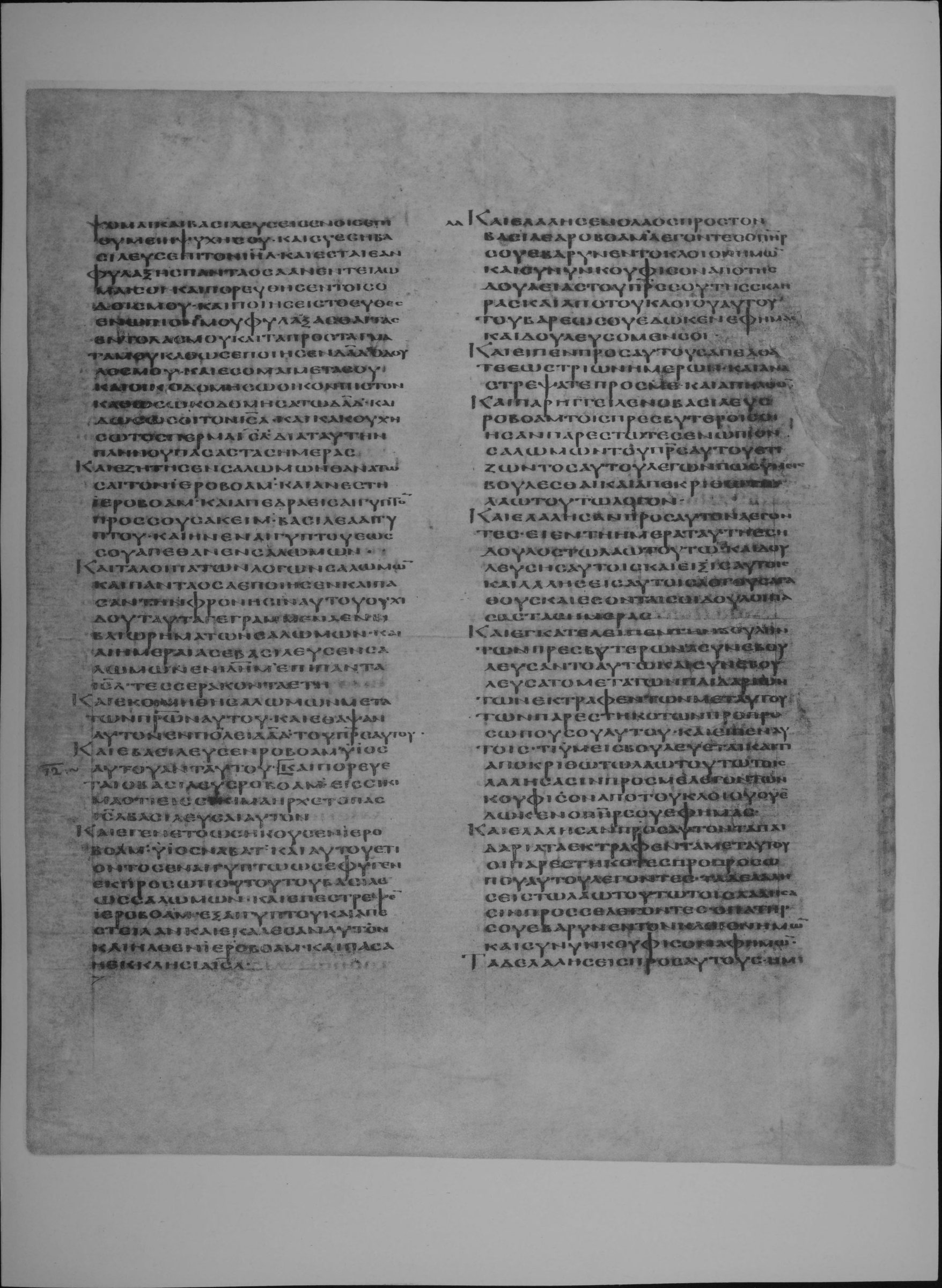
3 Kingdoms (1 Kings) 12:1-9 is on fol. 211v (full-size facsimile of 1879-83, Internet Archive codex-alexandrinus leaf 441). The 1930 reduced facsimile prints beneath this page: 1 Kings xi. 37-xii. 10. Checked on the plate: the page begins inside 3 Kingdoms (1 Kings) 11:37 (first words read: ΚΑΙ ΒΑΣΙΛΕΥΣΕΙΣ ΕΝ ΟΙΣ ΕΠΙΘΥΜΕΙ Η ΨΥΧΗ ΣΟΥ ΚΑΙ ΣΥ ΕΣΗ ΒΑΣΙΛΕΥΣ ΕΠΙ ΙΣΡΑΗΛ).
1Καὶ πορεύεται βασιλεὺς Ῥοβοὰμ εἰς Σίκιμα, ὅτι εἰς Σίκιμα ἤρχοντο πᾶς Ἰσραὴλ βασιλεῦσαι αὐτόν. 3καὶ ἐλάλησεν ὁ λαὸς πρὸς τὸν βασιλέα Ῥοβοὰμ λέγοντες 4Ὁ πατήρ σου ἐβάρυνεν τὸν κλοιὸν ἡμῶν· καὶ σὺ νῦν κούφισον ἀπὸ τῆς δουλείας τοῦ πατρός σου τῆς σκληρᾶς καὶ ἀπὸ τοῦ κλοιοῦ αὐτοῦ τοῦ βαρέως οὗ ἔδωκεν ἐφ᾽ ἡμᾶς, καὶ δουλεύσομέν σοι. 5καὶ εἶπεν πρὸς αὐτούς Ἀπέλθετε ἕως ἡμερῶν τριῶν, καὶ ἀναστρέψατε πρὸς μέ· καὶ ἀπῆλθον. 6καὶ παρήγγειλεν ὁ βασιλεὺς τοῖς πρεσβυτέροις, οἳ ἦσαν παρεστῶτες ἐνώπιον Σαλωμὼν τοῦ πατρὸς αὐτοῦ ἔτι ζῶντος αὐτοῦ, λέγων Πῶς ὑμεῖς βουλεύεσθε καὶ ἀποκριθῶ τῷ λαῷ τούτῳ λόγον; 7καὶ ἐλάλησαν πρὸς αὐτὸν λέγοντες Εἰ ἐν τῇ ἡμέρᾳ ταύτῃ ἔσῃ δοῦλος τῷ λαῷ τούτῳ, καὶ δουλεύσῃς αὐτοῖς καὶ λαλήσῃς αὐτοῖς λόγους ἀγαθούς, καὶ ἔσονταί σοι δοῦλοι πάσας τὰς ἡμέρας. 8καὶ ἑνκατέλιπεν τὴν βουλὴν τῶν πρεσβυτέρων ἃ συνεβουλεύσαντο αὐτῷ, καὶ συνεβουλεύσατο μετὰ τῶν παιδαρίων τῶν ἐκτραφέντων μετ᾽ αὐτοῦ τῶν παρεστηκότων πρὸ προσώπου αὐτοῦ 9καὶ εἶπεν αὐτοῖς Τί ὑμεῖς συμβουλεύετε; καὶ τί ἀποκριθῶ τῷ λαῷ τούτῳ τοῖς λέγουσι πρὸς μὲ λεγόντων Κούφισον ἀπὸ τοῦ κλοιοῦ οὗ ἔδωκεν ὁ πατήρ σου ἐφ᾽ ἡμᾶς;
1And king Roboam goes to Sikima; for all Israel were coming to Sikima to make him king. 3And the people spoke to king Roboam, saying, Thy father made our yoke heavy; 4but do thou now lighten somewhat of the hard service of thy father, and of his heavy yoke which he put upon us, and we will serve thee. 5And he said to them, Depart for three days, and return to me. And they departed. 6And the king referred the matter to the elders, who stood before Solomon his father while he was yet living, saying, How do ye advise that I should answer this people? 7And they spoke to him, saying, If thou wilt this day be a servant to this people, and wilt serve them, and wilt speak to them good words, then will they be thy servants continually. 8But he forsook the counsel of the old men which they gave him, and consulted with the young men who were brought up with him, who stood in his presence. 9And he said to them, What counsel do ye give? And what shall I answer to this people who speak to me, saying, Lighten somewhat of the yoke which thy father has put upon us?
Where on the image
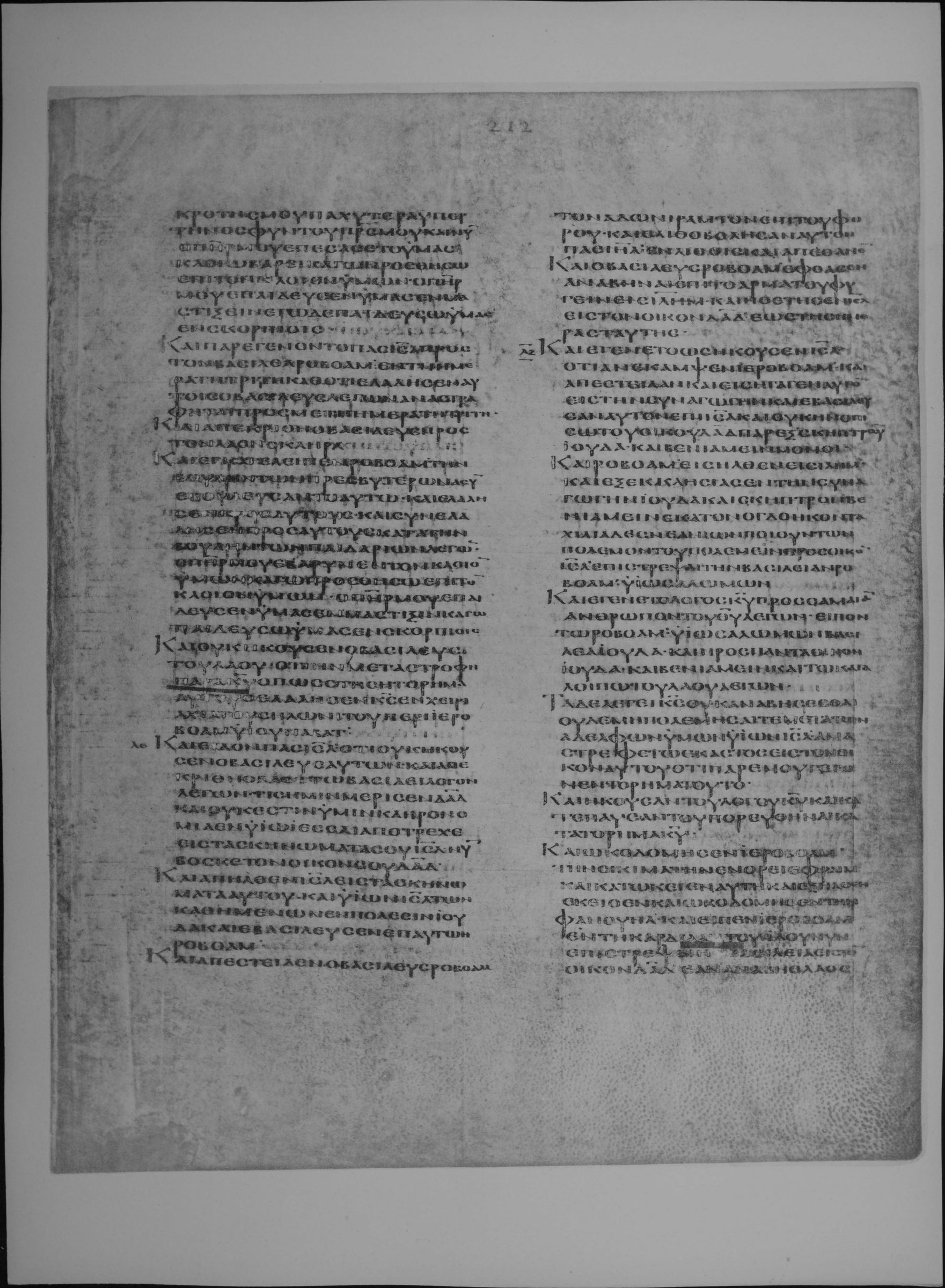
3 Kingdoms (1 Kings) 12:10 is on fol. 211v (full-size facsimile of 1879-83, Internet Archive codex-alexandrinus leaf 441). The 1930 reduced facsimile prints beneath this page: 1 Kings xi. 37-xii. 10. Checked on the plate: the page begins inside 3 Kingdoms (1 Kings) 11:37 (first words read: ΚΑΙ ΒΑΣΙΛΕΥΣΕΙΣ ΕΝ ΟΙΣ ΕΠΙΘΥΜΕΙ Η ΨΥΧΗ ΣΟΥ ΚΑΙ ΣΥ ΕΣΗ ΒΑΣΙΛΕΥΣ ΕΠΙ ΙΣΡΑΗΛ). 3 Kingdoms (1 Kings) 12:10-18 is on fol. 212r (full-size facsimile of 1879-83, Internet Archive codex-alexandrinus leaf 442). The 1930 reduced facsimile prints beneath this page: 1 Kings xii. 10-27. Checked on the plate: the page begins inside 3 Kingdoms (1 Kings) 12:10 (first words read: ΚΡΟΤΗΣ ΜΟΥ ΠΑΧΥΤΕΡΑ ΥΠΕΡ ΤΗΝ ΟΣΦΥΝ ΤΟΥ ΠΡΣ ΜΟΥ).
10καὶ ἐλάλησαν πρὸς αὐτὸν τὰ παιδάρια τὰ ἐκτραφέντα μετ᾽ αὐτοῦ, οἱ παρεστηκότες πρὸ προσώπου αὐτοῦ, λέγοντες Τάδε λαλήσεις τῷ λαῷ τούτῳ τοῖς λαλήσασι πρὸς σὲ λέγοντες Ὁ πατήρ σου ἐβάρυνεν τὸν κλοιὸν ἡμῶν, καὶ σὺ νῦν κούφισον ἀφ᾽ ἡμῶν· τάδε λαλήσεις πρὸς αὐτούς Ἡ μικρότης μου παχυτέρα τῆς ὀσφύος τοῦ πατρός μου. 11καὶ νῦν ὁ πατήρ μου ἐπεσάσσετο ὑμᾶς κλοιῷ βαρεῖ, κἀγὼ προσθήσω ἐπὶ τὸν κλοιὸν ὑμῶν· ὁ πατήρ μου ἐπαίδευσεν ὑμᾶς ἐν μάστιγξιν, ἐγὼ δὲ παιδεύσω ὑμᾶς ἐν σκορπίοις. 12καὶ παρεγένοντο πᾶς Ἰσραὴλ πρὸς τὸν βασιλέα Ῥοβοὰμ ἐν τῇ ἡμέρᾳ τῇ τρίτῃ, καθότι ἐλάλησεν αὐτοῖς ὁ βασιλεὺς λέγων Ἀναστράφητε πρὸς μὲ τῇ ἡμέρᾳ τῇ τρίτῃ. 13καὶ ἀπεκρίθη ὁ βασιλεὺς πρὸς τὸν λαὸν σκληρά, καὶ ἐνκατέλιπεν Ῥοβοὰμ τὴν βουλὴν τῶν πρεσβυτέρων ἃ συνεβουλεύσαντο αὐτῷ, 14καὶ ἐλάλησεν πρὸς αὐτοὺς κατὰ τὴν βουλὴν τῶν παιδαρίων λέγων Ὁ πατήρ μου ἐβάρυνεν τὸν κλοιὸν ὑμῶν, κἀγὼ προσθήσω ἐπὶ τὸν κλοιὸν ὑμῶν· ὁ πατήρ μου ἐπαίδευσεν ὑμᾶς ἐν μάστιγξιν, κἀγὼ παιδεύσω ὑμᾶς ἐν σκορπίοις. 15καὶ οὐκ ἤκουσεν ὁ βασιλεὺς τοῦ λαοῦ, ὅτι ἦν μεταστροφὴ παρὰ Κυρίου, ὅπως στήσῃ τὸ ῥῆμα αὐτοῦ ὃ ἐλάλησεν ἐν χειρὶ Ἀχειὰ τοῦ Σηλωνείτου περὶ Ἰεροβοὰμ υἱοῦ Ναβάτ. 16καὶ εἶδον πᾶς Ἰσραὴλ ὅτι οὐκ ἤκουσεν ὁ βασιλεὺς αὐτῶν· καὶ ἀπεκρίθη ὁ λαὸς τῷ βασιλεῖ λέγων Τίς ἡμῖν μερὶς ἐν Δαυείδ; καὶ οὐκ ἔστιν ἡμῖν κληρονομία ἐν υἱῷ Ἰεσσαί· ἀπότρεχε, Ἰσραήλ, εἰς τὰ σκηνώματά σου· νῦν βόσκε τὸν οἶκόν σου, Δαυείδ. καὶ ἀπῆλθεν Ἰσραὴλ εἰς τὰ σκηνώματα αὐτοῦ. 18καὶ ἀπέστειλεν ὁ βασιλεὺς τὸν Ἀρὰμ τὸν ἐπὶ τοῦ φόρου, καὶ ἐλιθοβόλησαν αὐτὸν ἐν λίθοις καὶ ἀπέθανεν· καὶ ὁ βασιλεὺς Ῥοβοὰμ ἔφθασεν ἀναβῆναι τοῦ φυγεῖν εἰς Ἰερουσαλήμ.
10And the young men who had been brought up with him, who stood before his face, spoke to him, saying, Thus shalt thou say to this people who have spoken to thee, saying, Thy father made our yoke heavy, and do thou now lighten it from off us: thus shalt thou say to them, My little finger shall be thicker than my father's loins. 11And whereas my father did lade you with a heavy yoke, I also will add to your yoke: my father chastised you with whips, but I will chastise you with scorpions. 12And all Israel came to king Roboam on the third day, as the king spoke to them, saying, Return to me on the third day. 13And the king answered the people harshly; and Roboam forsook the counsel of the old men which they counselled him. 14And he spoke to them according to the counsel of the young men, saying, My father made your yoke heavy, and I will add to your yoke: my father chastised you with whips, but I will chastise you with scorpions. 15And the king hearkened not to the people, because the change was from the Lord, that he might establish his word which he spoke by Achia the Selonite concerning Jeroboam the son of Nabat. 16And all Israel saw that the king did not hearken to them: and the people answered the king, saying, What portion have we in David? neither have we any inheritance in the son of Jessæ. Depart, O Israel, to thy tents: now feed thine own house, David. So Israel departed to his tents. 18And the king sent Adoniram who was over the tribute; and they stoned him with stones, and he died: and king Roboam made haste to rise to flee to Jerusalem.
Where on the image
3 Kingdoms (1 Kings) 12:19-26 is on fol. 212r (full-size facsimile of 1879-83, Internet Archive codex-alexandrinus leaf 442). The 1930 reduced facsimile prints beneath this page: 1 Kings xii. 10-27. Checked on the plate: the page begins inside 3 Kingdoms (1 Kings) 12:10 (first words read: ΚΡΟΤΗΣ ΜΟΥ ΠΑΧΥΤΕΡΑ ΥΠΕΡ ΤΗΝ ΟΣΦΥΝ ΤΟΥ ΠΡΣ ΜΟΥ).
19καὶ ἠθέτησεν Ἰσραὴλ εἰς τὸν οἶκον Δαυεὶδ ἕως τῆς ἡμέρας ταύτης. 20καὶ ἐγένετο ὡς ἤκουσεν πᾶς Ἰσραὴλ ὅτι ἀνέκαμψεν Ῥοβοάμ, καὶ ἀπέστειλεν καὶ ἐκάλεσεν αὐτὸν εἰς τὴν συναγωγήν, καὶ ἐβασίλευσαν αὐτὸν ἐπὶ Ἰσραήλ· καὶ οὐκ ἦν ὀπίσω Δαυεὶδ παρὲξ σκήπτρου Ἰούδα καὶ Βενιαμείν, μόνοι. 21Καὶ Ῥοβοὰμ εἰσῆλθεν εἰς Ἰερουσαλήμ, καὶ ἐξεκλησίασεν τὴν συναγωγὴν Ἰούδα καὶ σκῆπτρον Βενιαμείν, ἑκατὸν καὶ εἴκοσι χιλιάδες νεανιῶν ποιούντων πόλεμον, τοῦ πολεμεῖν πρὸς οἶκον Ἰσραήλ, ἐπιστρέψαι τὴν βασιλείαν Ῥοβοὰμ υἱῷ Σαλωμών. 22καὶ ἐγένετο λόγος Κυρίου πρὸς Σαμαίαν ἄνθρωπον τοῦ θεοῦ λέγων 23Εἰπὸν τῷ Ῥοβοὰμ υἱῷ Σαλωμὼν βασιλεῖ Ἰούδα καὶ πρὸς πάντα οἶκον Ἰούδα καὶ Βενιαμεὶν καὶ τῷ καταλοίπῳ τοῦ λαοῦ λέγων 24Τάδε λέγει Κύριος Οὐκ ἀναβήσεσθε οὐδὲ πολεμήσετε μετὰ τῶν ἀδελφῶν ὑμῶν υἱῶν Ἰσραήλ· ἀποστρεφέτω ἕκαστος εἰς τὸν οἶκον ἑαυτοῦ, ὅτι παρ᾽ ἐμοῦ γέγονεν τὸ ῥῆμα τοῦτο. καὶ ἤκουσαν τοῦ λόγου Κυρίου, καὶ κατέπαυσαν τοῦ πορευθῆναι κατὰ τὸ ῥῆμα Κυρίου. [1] Καὶ ὁ βασιλεὺς Σαλωμὼν κοιμᾶται μετὰ τῶν πατέρων αὐτοῦ, καὶ θάπτεται μετὰ τῶν πατέρων αὐτοῦ ἐν πόλει Δαυείδ· καὶ ἐβασίλευσεν Ῥοβοὰμ υἱὸς αὐτοῦ ἀντ᾽ αὐτοῦ ἐν Ἰερουσαλήμ, υἱὸς ὢν ἑκκαίδεκα ἐτῶν ἐν τῷ βασιλεύειν αὐτόν· καὶ δώδεκα ἔτη ἐβασίλευσεν ἐν Ἰερουσαλήμ. καὶ ὄνομα τῆς μητρὸς αὐτοῦ Ναανάν, θυγάτηρ Ἀνὰ υἱοῦ Ναὰς βασιλέως Ἀμμών· καὶ ἐποίησεν τὸ πονηρὸν ἐνώπιον Κυρίου καὶ οὐκ ἐπορεύθη ἐν ὁδῷ Δαυεὶδ τοῦ πατρὸς αὐτοῦ. [2] Καὶ ἦν ἄνθρωπος ἐξ ὄρους Ἐφράιμ δοῦλος τῷ Σαλωμών, καὶ ὄνομα αὐτῷ Ἰεροβοάμ, καὶ ὄνομα τῆς μητρὸς αὐτοῦ Σαρεισά, πόρνη· καὶ ἔδωκεν αὐτὸν Σαλωμὼν εἰς ἄρχοντα σκυτάλης ἐπὶ τὰς ἄρσεις οἴκου Ἰωσήφ. καὶ ᾠκοδόμησεν Σαλωμὼν τὴν Σαρειρὰ τὴν ἐν ὄρει Ἐφράιμ, καὶ ἦσαν αὐτῷ ἅρματα τριακόσια ἵππων· οὗτος ᾠκοδόμησεν τὴν ἄκραν ἐν ταῖς ἄρσεσιν οἴκου Ἐφράιμ· οὗτος συνέκλεισεν τὴν πόλιν Δαυείδ, καὶ ἦν ἐπαιρόμενος ἐπὶ τὴν βασιλείαν. [3] καὶ ἐζήτει Σαλωμὼν θανατῶσαι αὐτόν· καὶ ἐφοβήθη καὶ ἀπέδρα αὐτὸς πρὸς Σουσακεὶμ βασιλέα Αἰγύπτου, καὶ ἦν μετ᾽ αὐτοῦ ἕως ἀπέθανεν Σαλωμών. [4] καὶ ἤκουσεν Ἰεροβοὰμ ἐν Αἰγύπτῳ ὅτι τέθνηκεν Σαλωμών, καὶ ἐλάλησεν εἰς τὰ ὦτα Σουσακεὶμ βασιλέως Αἰγύπτου λέγων Ἐξαπόστειλόν με, καὶ ἀπελεύσομαι ἐγὼ εἰς τὴν γῆν μου· καὶ εἶπεν αὐτῷ Σουσακείμ Αἴτησαί τι αἴτημα καὶ δώσω σοι. [5] καὶ Σουσακεὶμ ἔδωκεν τῷ Ἰεροβοὰμ τὴν Ἀνὼ ἀδελφὴν Θεκεμείνας τὴν πρεσβυτέραν τῆς γυναικὸς αὐτοῦ αὐτῷ εἰς γυναῖκα· αὕτη ἡ μεγάλη ἐν μέσῳ τῶν θυγατέρων τοῦ βασιλέως, καὶ ἔτεκεν τῷ Ἰεροβοὰμ τὸν Ἀβιὰ υἱὸν αὐτοῦ. [6] καὶ εἶπεν Ἰεροβοὰμ πρὸς Σουσακείμ Ὄντως ἐξαπόστειλόν με, καὶ ἀπελεύσομαι. καὶ ἐξῆλθεν Ἰεροβοὰμ ἐξ Αἰγύπτου, καὶ ἦλθεν εἰς γῆν Σαρειρὰ τὴν ἐν ὄρει Ἐφράιμ· καὶ συνάγεται ἐκεῖ πᾶν σκῆπτρον Ἐφράιμ· καὶ ᾠκοδόμησεν Ἰεροβοὰμ ἐκεῖ χάρακα. [7] Καὶ ἠρρώστησε τὸ παιδάριον αὐτοῦ ἀρρωστίᾳ κραταιᾷ σφόδρα· καὶ ἐπορεύθη Ἰεροβοὰμ ἐπερωτῆσαι ὑπὲρ τοῦ παιδαρίου· καὶ εἶπε πρὸς Ἀνὼ τὴν γυναῖκα αὐτοῦ Ἀνάστηθι, πορεύου· ἐπερώτησον τὸν θεὸν ὑπὲρ τοῦ παιδαρίου, εἰ ζήσεται ἐκ τῆς ἀρρωστίας αὐτοῦ. [8] καὶ ἄνθρωπος ἦν ἐν Σηλὼ καὶ ὄνομα αὐτῷ Ἀχειά, καὶ οὗτος ἦν υἱὸς ἑξήκοντα ἐτῶν, καὶ ῥῆμα Κυρίου μετ᾽ αὐτοῦ. καὶ εἶπεν Ἰεροβοὰμ πρὸς τὴν γυναῖκα αὐτοῦ Ἀνάστηθι καὶ λάβε εἰς τὴν χεῖρά σου τῷ ἀνθρώπῳ τοῦ θεοῦ ἄρτους καὶ κολλύρια τοῖς τέκνοις αὐτοῦ καὶ σταφυλὴν καὶ στάμνον μέλιτος. [9] καὶ ἀνέστη ἡ γυνή, καὶ ἔλαβεν εἰς τὴν χεῖρα αὐτῆς ἄρτους καὶ δύο κολλύρια καὶ σταφυλὴν καὶ στάμνον μέλιτος τῷ Ἀχειά· καὶ ὁ ἄνθρωπος πρεσβύτερος, καὶ οἱ ὀφθαλμοὶ αὐτοῦ ἠμβλυώπουν τοῦ ἰδεῖν. [11] καὶ ἀνέστη ἐκ Σαρειρὰ καὶ πορεύεται· καὶ ἐγένετο ἐλθούσης αὐτῆς εἰς τὴν πόλιν πρὸς Ἀχειὰ τὸν Σηλωνείτην, καὶ εἶπεν Ἀχειὰ τῷ παιδαρίῳ αὐτοῦ Ἔξελθε δὴ εἰς ἀπαντὴν Ἀνὼ τῇ γυναικὶ Ἰεροβοὰμ καὶ ἐρεῖς αὐτῇ Εἴσελθε καὶ μὴ στῇς, ὅτι τάδε λέγει Κύριος Σκληρὰ ἐγὼ ἐπαποστέλλω ἐπὶ σέ. [12] καὶ εἰσῆλθεν Ἀνὼ πρὸς τὸν ἄνθρωπον τοῦ θεοῦ, καὶ κολλύρια καὶ στάμνον μέλιτος; τάδε λέγει Κύριος Ἰδοὺ σὺ ἀπελεύσῃ ἀπ᾽ ἐμοῦ, καὶ ἔσται εἰσελθούσης σου τὴν πύλην εἰς Σαρειρά, καὶ τὰ κοράσιά σου ἐξελεύσονταί σοι εἰς συνάντησιν καὶ ἐροῦσίν σοι Τὸ παιδάριον τέθνηκεν. [13] ὅτι τάδε λέγει Κύριος Ἰδοὺ ἐγὼ ἐξολεθρεύσω τοῦ Ἰεροβοὰμ οὐροῦντα πρὸς τοῖχον, καὶ ἔσονται οἱ τεθνηκότες τοῦ Ἰεροβοὰμ ἐν τῇ πόλει, καταφάγονται οἱ κύνες, καὶ τὸν τεθνηκότα ἐν τῷ ἀγρῷ καταφάγεται τὰ πετεινὰ τοῦ οὐρανοῦ. καὶ τὸ παιδάριον κόψεται Οὐαὶ κύριε, ὅτι εὑρέθη ἐν αὐτῷ ῥῆμα καλὸν περὶ τοῦ κυρίου. [14] καὶ ἀπῆλθεν ἡ γυνὴ ὡς ἤκουσεν· καὶ ἐγένετο ὡς εἰσῆλθεν εἰς τὴν Σαρειρά, καὶ τὸ παιδάριον ἀπέθανεν, καὶ ἐξῆλθεν ἡ κραυγὴ εἰς ἀπαντήν. Καὶ ἐπορεύθη Ἰεροβοὰμ εἰς Σίκιμα τὴν ἐν ὄρει Ἐφράιμ καὶ συνήθροισεν ἐκεῖ τὰς φυλὰς τοῦ Ἰσραήλ, καὶ ἀνέβη ἐκεῖ Ῥοβοὰμ υἱὸς Σαλωμών. [15] καὶ λόγος Κυρίου ἐγένετο πρὸς Σαμαίαν τὸν Ἐνλαμεὶ λέγων Λάβε σεαυτῷ ἱμάτιον καινὸν τὸ οὐκ εἰσεληλυθὸς εἰς ὕδωρ, καὶ ῥῆξον αὐτὸ δώδεκα ῥήγματα· καὶ δώσεις τῷ Ἰεροβοάμ, καὶ ἐρεῖς αὐτῷ Τάδε λέγει Κύριος Λάβε σεαυτῷ δώδεκα ῥήγματα τοῦ περιβαλέσθαι σε. καὶ ἔλαβεν Ἰεροβοάμ· καὶ εἶπεν Σαμαίας Τάδε λέγει Κύριος ἐπὶ τὰς δέκα φυλὰς τοῦ Ἰσραήλ. [16] Καὶ εἶπεν ὁ λαὸς πρὸς Ῥοβοὰμ υἱὸν Σαλωμών Ὁ πατήρ σου ἐβάρυνεν τὸν κλοιὸν αὐτοῦ ἐφ᾽ ἡμᾶς, καὶ ἐβάρυνεν τὰ βρώματα τῆς τραπέζης αὐτοῦ· καὶ νυνὶ κουφιεῖς σὺ ἐφ᾽ ἡμᾶς, καὶ δουλεύσομέν σοι. καὶ εἶπεν Ῥοβοὰμ πρὸς τὸν λαόν Ἔτι τριῶν ἡμερῶν καὶ ἀποκριθήσομαι ὑμῖν ῥῆμα. [17] καὶ εἶπεν Ῥοβοάμ Εἰσαγάγετέ μοι τοὺς πρεσβυτέρους, καὶ συμβουλεύσομαι μετ᾽ αὐτῶν τί ἀποκριθῶ τῷ λαῷ ῥῆμα ἐν τῇ ἡμέρᾳ τῇ τρίτῃ. καὶ ἐλάλησεν Ῥοβοὰμ εἰς τὰ ὦτα αὐτῶν καθὼς ἀπέστειλεν ὁ λαὸς πρὸς αὐτόν· καὶ εἶπον οἱ πρεσβύτεροι τοῦ λαοῦ Οὕτως ἐλάλησεν πρὸς σὲ ὁ λαός. [18] καὶ διεσκέδασεν Ῥοβοὰμ τὴν βουλὴν αὐτῶν, καὶ οὐκ ἤρεσεν ἐνώπιον αὐτοῦ· καὶ ἀπέστειλεν καὶ εἰσήγαγεν τοὺς συντρόφους αὐτοῦ, καὶ ἐλάλησεν αὐτοῖς τὰ αὐτά Καὶ ταῦτα ἀπέστειλεν πρὸς μὲ λέγων ὁ λαός. καὶ εἶπαν οἱ σύντροφοι αὐτοῦ Οὕτως λαλήσεις πρὸς τὸν λαὸν λέγων Ἡ μικρότης μου παχυτέρα ὑπὲρ τὴν ὀσφὺν τοῦ πατρός μου· ὁ πατήρ μου ἐμαστίγου ὑμᾶς μάστιγξιν, ἐγὼ δὲ κατάρξω ὑμᾶς ἐν σκορπίοις. [19] καὶ ἤρεσεν τὸ ῥῆμα ἐνώπιον Ῥοβοάμ· καὶ ἀπεκρίθη τῷ λαῷ καθὼς συνεβούλευσαν αὐτῷ οἱ σύντροφοι αὐτοῦ τὰ παιδάρια. [20] καὶ εἶπεν πᾶς ὁ λαὸς ὡς ἀνὴρ εἷς ἕκαστος τῷ πλησίον αὐτοῦ, καὶ ἀνέκραξαν ἅπαντες λέγοντες Οὐ μερὶς ἡμῖν ἐν Δαυεὶδ οὐδὲ κληρονομία ἐν υἱῷ Ἰεσσαί· εἰς τὰ σκηνώματά σου, Ἰσραήλ, ὅτι οὗτος ὁ ἄνθρωπος οὐκ εἰς ἄρχοντα οὐδὲ εἰς ἡγούμενον. [21] καὶ διεσπάρη πᾶς ὁ λαὸς ἐκ Σικίμων, καὶ ἀπῆλθεν ἕκαστος εἰς τὸ σκήνωμα αὐτοῦ. καὶ κατεκράτησεν Ῥοβοάμ, καὶ ἀπῆλθεν καὶ ἀνέβη ἐπὶ τὸ ἅρμα αὐτοῦ καὶ εἰσῆλθεν εἰς Ἰερουσαλήμ· καὶ πορεύονται ὀπίσω αὐτοῦ πᾶν σκῆπτρον Ἰούδα καὶ πᾶν σκῆπτρον Βενιαμείν. [24] Καὶ ἐγένετο ἐνισταμένου τοῦ ἐνιαυτοῦ καὶ συνήθροισεν Ῥοβοὰμ πάντα ἄνδρα Ἰούδα καὶ Βενιαμείν, καὶ ἀνέβη τοῦ πολεμεῖν πρὸς Ἰεροβοὰμ εἰς Σίκιμα. [25] καὶ ἐγένετο ῥῆμα Κυρίου πρὸς Σαμαίαν ἄνθρωπον τοῦ θεοῦ Εἰπὸν τῷ Ῥοβοὰμ βασιλεῖ Ἰούδα καὶ πρὸς πάντα οἶκον Ἰούδα καὶ Βενιαμεὶν καὶ πρὸς τὸ κατάλειμμα τοῦ λαοῦ λέγων Τάδε λέγει Κύριος Οὐκ ἀναβήσεσθε οὐδὲ πολεμήσετε πρὸς τοὺς ἀδελφοὺς ὑμῶν υἱοὺς Ἰσραήλ· ἀναστρέφετε ἕκαστος εἰς τὸν οἶκον αὐτοῦ, ὅτι παρ᾽ ἐμοῦ γέγονεν τὸ ῥῆμα τοῦτο. [26] καὶ ἤκουσαν τοῦ λόγου Κυρίου, καὶ ἀνέσχον τοῦ πορευθῆναι, κατὰ τὸ ῥῆμα Κυρίου. 25Καὶ ᾠκοδόμησεν Ἰεροβοὰμ τὴν Σίκιμα τὴν ἐν ὄρει Ἐφράιμ, καὶ κατῴκει ἐν αὐτῇ· καὶ ἐξῆλθεν ἐκεῖθεν καὶ ᾠκοδόμησεν τὴν Φανουήλ. 26καὶ εἶπεν Ἰεροβοὰμ ἐν τῂ καρδίᾳ αὐτοῦ Ἰδοὺ νῦν ἐπιστρέψει ἡ βασιλεία ἐν οἴκῳ Δαυείδ·
19So Israel rebelled against the house of David until this day. 20And it came to pass when all Israel heard that Jeroboam had returned out of Egypt, that they sent and called him to the assembly, and they made him king over Israel: and none followed the house of David except the tribe of Juda and Benjamin only. 21And Roboam went into Jerusalem, and he assembled the congregation of Juda, and the tribe of Benjamin, a hundred and twenty thousand young men, warriors, to fight against the house of Israel, to recover the kingdom to Roboam the son of Solomon. 22And the word of the Lord came to Samaia the man of God, saying, 23Speak to Roboam the son of Solomon, king of Juda, and to all the house of Juda and Benjamin, and to the remnant of the people, saying, 24Thus saith the Lord, Ye shall not go up, neither shall ye fight with your brethren the sons of Israel: return each man to his own home; for this thing is from me; and they hearkened to the word of the Lord, and they ceased from going up, according to the word of the Lord. So king Solomon sleeps with his fathers, and is buried with his fathers in the city of David; and Roboam his son reigned in his stead in Jerusalem, being sixteen years old when he began to reign, and he reigned twelve years in Jerusalem: and his mother's name was Naanan, daughter of Ana son of Naas king of the children of Ammon. And he did that which was evil in the sight of the Lord, and walked not in the way of David his father. And there was a man of mount Ephraim, a servant to Solomon, and his name was Jeroboam; and the name of his mother was Sarira, a harlot; and Solomon made him head of the levies of the house of Joseph: and he built for Solomon Sarira in mount Ephraim; and he had three hundred chariots of horses: he built the citadel with the levies of the house of Ephraim; he fortified the city of David, and aspired to the kingdom. And Solomon sought to kill him; and he was afraid, and escaped to Susakim king of Egypt, and was with him until Solomon died. And Jeroboam heard in Egypt that Solomon was dead; and he spoke in the ears of Susakim king of Egypt, saying, Let me go, and I will depart into my land; and Susakim said to him, Ask any request, and I will grant it thee. And Susakim gave to Jeroboam Ano the eldest sister of Thekemina his wife, to be his wife: she was great among the daughters of the king, and she bore to Jeroboam Abia his son: and Jeroboam said to Susakim, Let me indeed go, and I will depart. And his young child was sick with a very severe sickness; and Jeroboam went to enquire concerning the child: and he said to Ano his wife, Arise, go, enquire of God concerning the child, whether he shall recover from his sickness. Now there was a man in Selom, and his name was Achia: and he was sixty years old, and the word of the Lord was with him. And Jeroboam said to his wife, Arise, and take in thine hand loaves for the man of God, and cakes for his children, and grapes, and a pot of honey. And the woman arose, and took in her hand bread, and two cakes, and grapes, and a pot of honey, for Achia: and the man was old, and his eyes were dim, so that he could not see. And she arose up from Sarira and went; and it came to pass when she had come into the city to Achia the Selonite, that Achia said to his servant, Go out now to meet Ano the wife of Jeroboam, and thou shalt say to her, Come in, and stand not still: for thus saith the Lord, I send grievous tidings to thee. And Ano went in to the man of God; and Achia said to her, Why hast thou brought me bread and grapes, and cakes, and a pot of honey? Thus saith the Lord, Behold, thou shalt depart from me, and it shall come to pass when thou hast entered into the city, even into Sarira, that thy maidens shall come out to meet thee, and shall say to thee, The child is dead: for thus saith the Lord, Behold, I will destroy every male of Jeroboam, and there shall be the dead of Jeroboam in the city, them the dogs shall eat, and him that has died in the field shall the birds of the air eat, and he shall lament for the child, saying, Woe is me, Lord! for there has been found in him some good thing touching the Lord. And the woman departed, when she heard this: and it came to pass as she entered into Sarira, that the child died; and there came forth a wailing to meet her. And Jeroboam went to Sikima in mount Ephraim, and assembled there the tribes of Israel; and Roboam the son of Solomon went up thither. And the word of the Lord came to Samaias son of Enlami, saying, Take to thyself a new garment which has not gone into the water, and rend it into twelve pieces; and thou shalt give some to Jeroboam, and shalt say to him, Thus saith the Lord, Take to thyself ten pieces to cover thee: and Jeroboam took them: and Samaias said, Thus saith the Lord concerning the ten tribes of Israel. And the people said to Roboam the son of Solomon, Thy father made his yoke heavy upon us, and made the meat of his table heavy; and now thou shalt lighten them upon us, and we will serve thee. And Roboam said to the people, Wait three days, and I will return you an answer: and Roboam said, Bring in to me the elders, and I will take counsel with them what I shall answer to the people on the third day. So Roboam spoke in their ears, as the people sent to him to say: and the elders of the people said, Thus the people have spoken to thee. And Roboam rejected their counsel, and it pleased him not: and he sent and brought in those who had been brought up with him; and he said to them, Thus and thus has the people sent to me to say: and they that had been brought up with him said, Thus shalt thou speak to the people, saying, My little finger shall be thicker than my father's loins; my father scourged you with whips, but I will rule you with scorpions. And the saying pleased Roboam, and he answered the people as the young men, they that were brought up with him, counselled him: and all the people spoke as one man, every one to his neighbour, and they cried out all together, saying, We have no part in David, nor inheritance in the son of Jessæ: to thy tents, O Israel, every one; for this man is not for a prince or a ruler over us. And all the people was dispersed from Sikima, and they departed every one to his tent: and Roboam strengthened himself and departed, and mounted his chariot, and entered into Jerusalem: and there follow him the whole tribe of Juda, and the whole tribe of Benjamin. And it came to pass at the beginning of the year, that Roboam gathered all the men of Juda and Benjamin, and went up to fight with Jeroboam at Sikima. And the word of the Lord came to Samæas the man of God, saying, Speak to Roboam king of Juda, and to all the house of Juda and Benjamin, and to the remnant of the people, saying, Thus saith the Lord, Ye shall not go up, neither shall ye fight with your brethren the sons of Israel: return every man to his house, for this thing is from me. And they hearkened to the word of the Lord, and forbore to go up, according to the word of the Lord. 25And Jeroboam built Sikima in mount Ephraim and dwelt in it, and went forth thence and built Phanuel. 26And Jeroboam said in his heart, Behold, now the kingdom will return to the house of David.
Where on the image
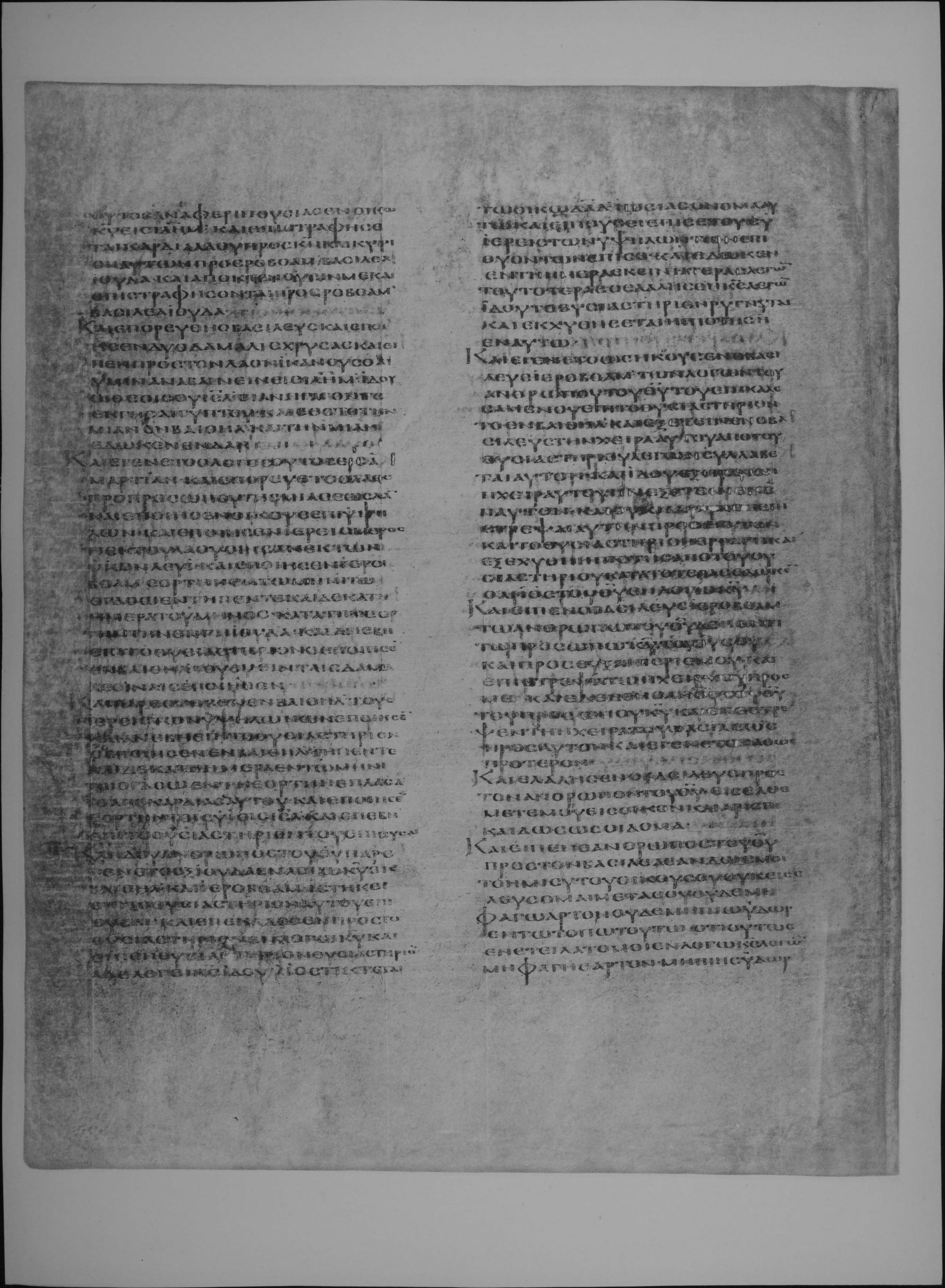
3 Kingdoms (1 Kings) 12:27 is on fol. 212r (full-size facsimile of 1879-83, Internet Archive codex-alexandrinus leaf 442). The 1930 reduced facsimile prints beneath this page: 1 Kings xii. 10-27. Checked on the plate: the page begins inside 3 Kingdoms (1 Kings) 12:10 (first words read: ΚΡΟΤΗΣ ΜΟΥ ΠΑΧΥΤΕΡΑ ΥΠΕΡ ΤΗΝ ΟΣΦΥΝ ΤΟΥ ΠΡΣ ΜΟΥ). 3 Kingdoms (1 Kings) 12:27-33 is on fol. 212v (full-size facsimile of 1879-83, Internet Archive codex-alexandrinus leaf 443). The 1930 reduced facsimile prints beneath this page: 1 Kings xii. 27-xiii. 9. Checked on the plate: the page begins inside 3 Kingdoms (1 Kings) 12:27 (first words read: ΚΑΙ ΕΠΙΣΤΡΑΦΗΣΕΤΑΙ ΚΑΡΔΙΑ ΤΟΥ ΛΑΟΥ ΠΡΟΣ ΚΝ).
27ἐὰν ἀναβῇ ὁ λαὸς οὗτος ἀναφέρειν θυσίαν ἐν οἴκῳ Κυρίου εἰς Ἰερουσαλήμ, καὶ ἐπιστραφήσεται καρδία τοῦ λαοῦ πρὸς Κύριον καὶ κύριον αὐτῶν, πρὸς Ῥοβοὰμ βασιλέα Ἰούδα, καὶ ἀποκτενοῦσίν με. 28καὶ ἐβουλεύσατο ὁ βασιλεύς, καὶ ἐπορεύθη καὶ ἐποίησεν δύο δαμάλις χρυσᾶς, καὶ εἶπεν πρὸς τὸν λαόν Ἱκανούσθω ὑμῖν ἀναβαίνειν εἰς Ἰερουσαλήμ· ἰδοὺ θεοί σου, Ἰσραήλ, οἱ ἀναγαγόντες σε ἐκ γῆς Αἰγύπτου. 29καὶ ἔθετο τὴν μίαν εἰς Βαιθήλ, καὶ τὴν μίαν ἔδωκεν ἐν Δάν. 30καὶ ἐγένετο ὁ λόγος οὗτος εἰς ἁμαρτίαν· καὶ ἐπορεύετο ὁ λαὸς πρὸ προσώπου τῆς μιᾶς ἕως Δάν. 31καὶ ἐποίησεν οἴκους ἐφ᾽ ὑψηλῶν, καὶ ἐποίησεν ἱερεῖς μέρος τι ἐκ τοῦ λαοῦ οἳ οὐκ ἦσαν ἐκ τῶν υἱῶν Λευεί. 32καὶ ἐποίησεν Ἰεροβοὰμ ἑορτὴν ἐν τῷ μηνὶ τῷ ὀγδόῳ ἐν τῇ πεντεκαιδεκάτῃ ἡμέρᾳ τοῦ μηνὸς κατὰ τὴν ἑορτὴν τὴν ἐν γῇ Ἰούδα, καὶ ἀνέβη ἐπὶ τὸ θυσιαστήριον ὃ ἐποίησεν ἐν Βαιθὴλ τοῦ θύειν ταῖς δαμάλεσιν αἷς ἐποίησεν, καὶ παρέστησεν ἐν Βαιθὴλ τοὺς ἱερεῖς τῶν ὑψηλῶν ὧν ἐποίησεν. 33καὶ ἀνέβη ἐπὶ τὸ θυσιαστήριον ὃ ἐποίησεν τῇ πεντεκαιδεκάτῃ ἡμέρᾳ ἐν τῷ μηνὶ τῷ ὀγδόῳ, ἐν τῇ ἑορτῇ ᾗ ἐπλάσατο ἀπὸ καρδίας αὐτοῦ, καὶ ἐποίησεν ἑορτὴν τοῖς υἱοῖς Ἰσραήλ. καὶ ἀνέβη ἐπὶ τὸ θυσιαστήριον τοῦ ἐπιθῦσαι.
27If this people shall go up to offer sacrifice in the house of the Lord at Jerusalem, then the heart of the people will return to the Lord, and to their master, to Roboam king of Juda, and they will slay me. 28And the king took counsel, and went, and made two golden heifers, and said to the people, Let it suffice you to have gone hitherto to Jerusalem: behold thy gods, O Israel, who brought thee up out of the land of Egypt. 29And he put one in Bethel, and he put the other in Dan. 30And this thing became a sin; and the people went before one as far as Dan, and left the house of the Lord. 31And he made houses on the high places, and made priests of any part of the people, who were not of the sons of Levi. 32And Jeroboam appointed a feast in the eighth month, on the fifteenth day of the month, according to the feast in the land of Juda; 33and went up to the altar which he made in Bæthel to sacrifice to the heifers which he made, and he placed in Bæthel the priests of the high places which he had made. And he went up to the altar which he had made, on the fifteenth day in the eighth month, at the feast which he devised out of his own heart; and he made a feast to the children of Israel, and went up to the altar to sacrifice.
Cite
Sources
- Source: Codex Alexandrinus (British Library Royal MS 1 D. V) via the British Museum photographic facsimiles of 1879-83 and 1930 (Internet Archive) + Swete's Septuagint + Brenton's English (holding institution)
- Critical edition: H. B. Swete, The Old Testament in Greek according to the Septuagint (1909)
← previous · → next · v cycle view · l back to library