3 Kingdoms (1 Kings), Chapter 14 (Codex Alexandrinus)
Introduction
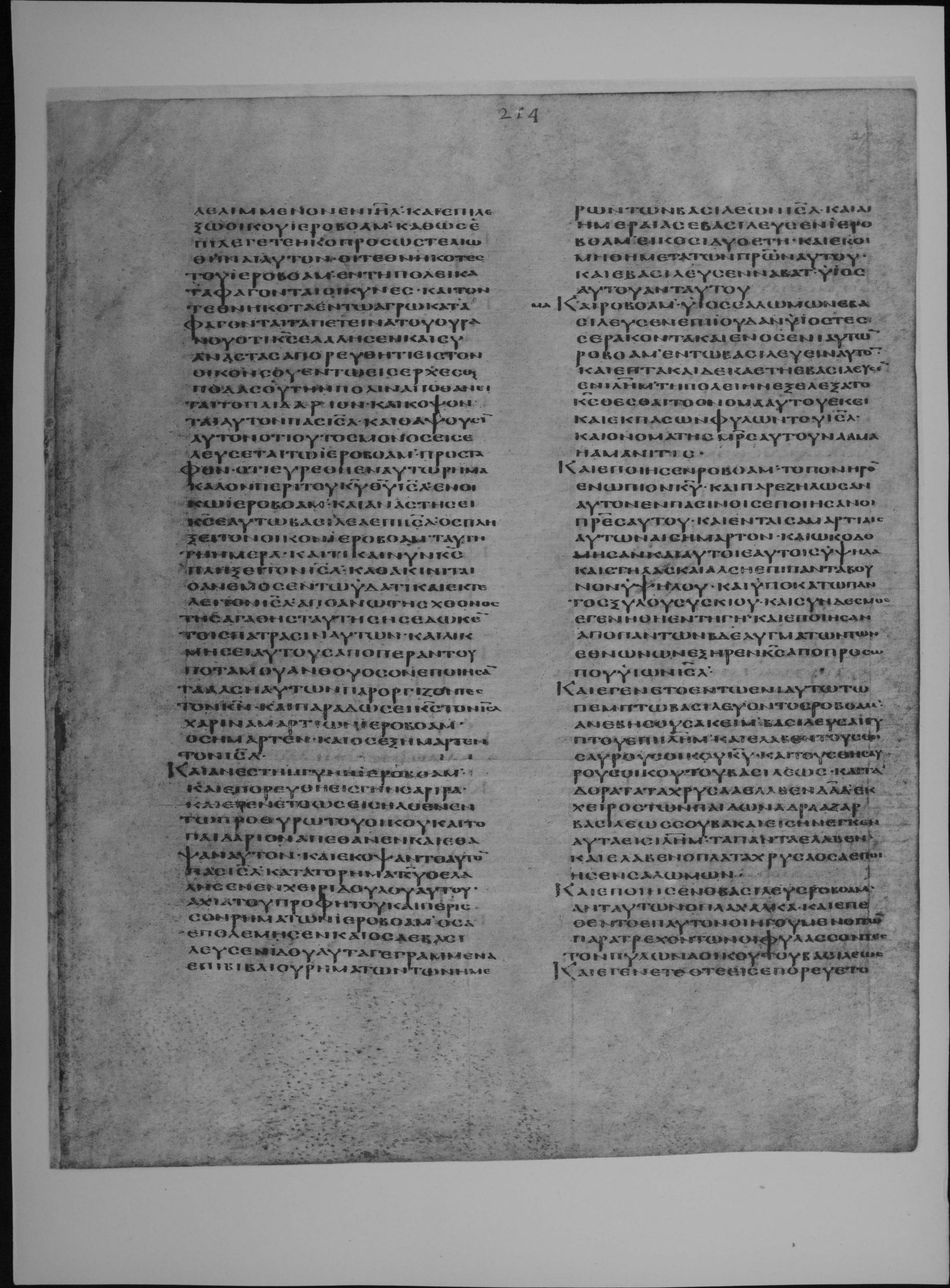
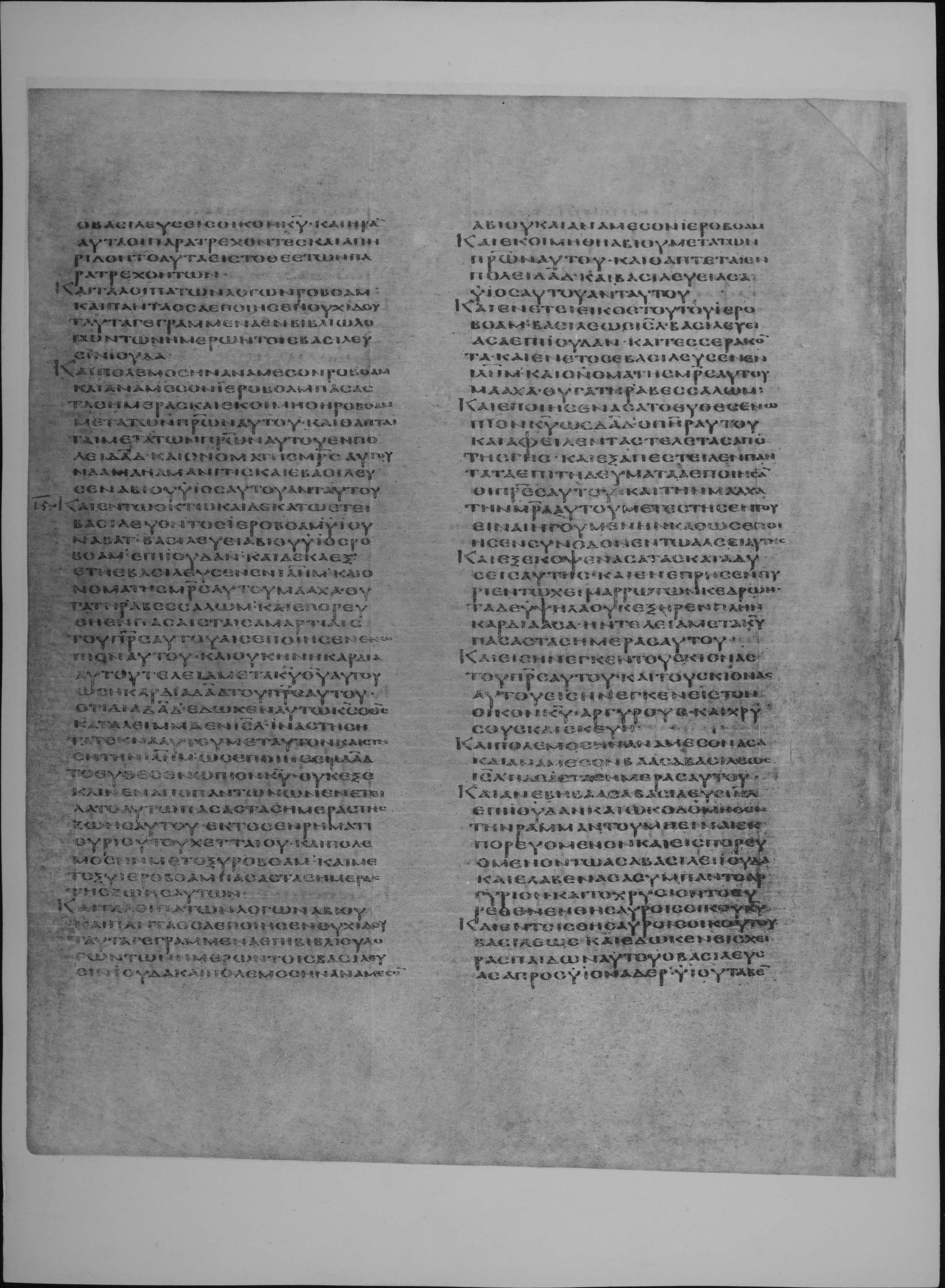
3 Kingdoms (1 Kings) 14 in the Greek Old Testament (the Septuagint) as written in Codex Alexandrinus, a Greek Bible copied in the fifth century, probably in Egypt, and now in the British Library (Royal MS 1 D. V, the first of its four volumes). It is one of the three great early codices of the whole Greek Bible, with Codex Vaticanus and Codex Sinaiticus.
Verses not in Swete's text: Swete's Greek (Codex Vaticanus) has no verse numbered 1, 2, 3, 4, 5, 6, 7, 8, 9, 10, 11, 12, 13, 14, 15, 16, 17, 18, 19, 20 in this chapter. In the books of Kingdoms and Chronicles Codex Alexandrinus often follows the Hebrew text more closely and may have text at such points; any such lines on the pages shown have no Greek column here. Brenton, translating a Vaticanus-type text, mostly lacks them too.
This entry meets the strict three-criteria standard of the Theosis Library:
- Manuscript scan: the pages of Codex Alexandrinus carrying this chapter (fol. 214r, fol. 214v), from the full-size photographic (autotype) facsimile published by the British Museum in 1879-1883, as digitised on the Internet Archive. The verse range of every page comes from the reduced photographic facsimile of 1930, which prints it beneath each plate, and the opening words of every page were read on the plate to confirm the page and the verse it begins with. Each section links to the page or pages that hold its verses. Folio numbers are those written at the head of each leaf and visible on the plates.
- Original text: Swete's edition, which here prints the text of Codex Vaticanus (Vat. gr. 1209), the base of his edition, and gives the readings of Alexandrinus only in his apparatus. The Greek column is therefore Vaticanus' text; where Alexandrinus differs, the plate shows what Alexandrinus reads.
- English translation: Sir Lancelot C. L. Brenton, The Septuagint Version of the Old Testament (1844; 1851 edition), a translation of the Greek, public domain, from the eBible.org text.
How was this verified? (Provenance)
Where on the image
3 Kingdoms (1 Kings) 14:21-28 is on fol. 214r (full-size facsimile of 1879-83, Internet Archive codex-alexandrinus leaf 446). The 1930 reduced facsimile prints beneath this page: 1 Kings xiv. 10-28. Checked on the plate: the page begins at the start of 3 Kingdoms (1 Kings) 14:21 (first words read: ΑΠΟΛΕΛΕΙΜΜΕΝΟΝ ΕΝ ΙΣΡΑΗΛ ΚΑΙ ΕΠΙΛΕΞΩ ΟΠΙΣΩ ΟΙΚΟΥ ΙΕΡΟΒΟΑΜ ΚΑΘΩΣ ΕΠΙΛΕΓΕΤΑΙ Η ΚΟΠΡΟΣ). Note: the page begins inside 3 Kgdms 14:10, in the passage 14:1-20 that Codex Alexandrinus contains but Codex Vaticanus, and therefore Swete's Greek, lacks; the first verse of Swete's text on this page is 14:21. 3 Kingdoms (1 Kings) 14:28 is on fol. 214v (full-size facsimile of 1879-83, Internet Archive codex-alexandrinus leaf 447). The 1930 reduced facsimile prints beneath this page: 1 Kings xiv. 28-xv. 18. Checked on the plate: the page begins inside 3 Kingdoms (1 Kings) 14:28 (first words read: Ο ΒΑΣΙΛΕΥΣ ΕΙΣ ΟΙΚΟΝ ΚΥ ΚΑΙ ΗΡΟΝ ΑΥΤΑ ΟΙ ΠΑΡΑΤΡΕΧΟΝΤΕΣ).
21Καὶ Ῥοβοὰμ υἱὸς Σαλωμὼν ἐβασίλευσεν ἐπὶ Ἰουδά· υἱὸς τεσσεράκοντα καὶ ἑνὸς ἐνιαυτῶν Ῥοβοὰμ ἐν τῷ βασιλεύειν αὐτόν· καὶ δέκα ἑπτὰ ἔτη ἐβασίλευσεν ἐν Ἰερουσαλήμ, τῇ πόλει ἣν ἐξελέξατο Κύριος θέσθαι τὸ ὄνομα αὐτοῦ ἐκεῖ ἐκ πασῶν φυλῶν τοῦ Ἰσραήλ. καὶ τὸ ὄνομα τῆς μητρὸς αὐτοῦ Μααχὰμ Ἀμμανεῖτις. 22καὶ ἐποίησεν Ῥοβοὰμ τὸ πονηρὸν ἐνώπιον Κυρίου· καὶ παρεζήλωσεν αὐτὸν ἐν πᾶσιν οἷς ἐποίησαν οἱ πατέρες αὐτῶν ἐν ταῖς ἁμαρτίαις αὐτῶν αἷς ἥμαρτον. 23καὶ ᾠκοδόμησαν ἑαυτοῖς ὑψηλὰ καὶ στήλας καὶ ἄλση ἐπὶ πάντα βουνὸν ὑψηλὸν καὶ ὑποκάτω παντὸς ξύλου συσκίου. 24καὶ σύνδεσμος ἐγενήθη ἐν τῇ γῇ, καὶ ἐποίησαν ἀπὸ πάντων τῶν βδελυγμάτων τῶν ἐθνῶν ὧν ἐξῆρεν Κύριος ἀπὸ προσώπου υἱῶν Ἰσραήλ. 25Καὶ ἐγένετο ἐν τῷ ἐνιαυτῷ τῷ πέμπτῳ βασιλεύοντος Ῥοβοὰμ ἀνέβη Σουσακεὶμ βασιλεὺς Αἰγύπτου ἐπὶ Ἰερουσαλήμ, 26καὶ ἔλαβεν πάντας τοὺς θησαυροὺς οἴκου Κυρίου καὶ τοὺς θησαυροὺς οἴκου τοῦ βασιλέως καὶ τὰ δόρατα τὰ χρυσᾶ ἃ ἔλαβεν Δαυεὶδ ἐκ χειρὸς τῶν παίδων Ἁδραάζαρ βασιλέως Σουβὰ καὶ εἰσήνεγκεν αὐτὰ εἰς Ἰερουσαλήμ, τὰ πάντα ἃ ἔλαβεν ὅπλα τὰ χρυσᾶ. 27καὶ ἐποίησεν Ῥοβοὰμ ὁ βασιλεὺς ὅπλα χαλκᾶ ἀντ᾽ αὐτῶν· καὶ ἐπέθεντο ἐπ᾽ αὐτὸν οἱ ἡγούμενοι τῶν παρατρεχόντων, οἱ φυλάσσοντες τὸν πυλῶνα οἴκου βασιλέως. 28καὶ ἐγένετο ὅτε εἰσεπορεύετο ὁ βασιλεὺς εἰς οἶκον Κυρίου, καὶ ᾖρον αὐτὰ οἱ παρατρέχοντες καὶ ἀπηρείδοντο αὐτὰ εἰς τὸ θεὲ τῶν παρατρεχόντων.
21And Roboam son of Solomon ruled over Juda. Roboam was forty and one years old when he began to reign, and he reigned seventeen years in the city Jerusalem, which the Lord chose to put his name there out of all the tribes of Israel: and his mother's name was Naama the Ammonitess. 22And Roboam did evil in the sight of the Lord; and he provoked him in all the things which their fathers did in their sins which they sinned. 23And they built for themselves high places, and pillars, and planted groves on every high hill, and under every shady tree. 24And there was a conspiracy in the land, and they did according to all the abominations of the nations which the Lord removed from before the children of Israel. 25And it came to pass in the fifth year of the reign of Roboam, Susakim king of Egypt came up against Jerusalem; 26and took all the treasures of the house of the Lord, and the treasures of the king's house, and the golden spears which David took out of the hand of the sons of Adrazaar king of Suba, and brought them into Jerusalem, even all that he took, and the golden shields which Solomon had made, [and carried them away into Egypt.] 27And king Roboam made brazen shields instead of them; and the chiefs of the body guard, who kept the gate of the house of the king, were placed in charge over them. 28And it came to pass when the king went into the house of the Lord, that the body guard took them up, and fixed them in the chamber of the body guard.
Where on the image
3 Kingdoms (1 Kings) 14:29-31 is on fol. 214v (full-size facsimile of 1879-83, Internet Archive codex-alexandrinus leaf 447). The 1930 reduced facsimile prints beneath this page: 1 Kings xiv. 28-xv. 18. Checked on the plate: the page begins inside 3 Kingdoms (1 Kings) 14:28 (first words read: Ο ΒΑΣΙΛΕΥΣ ΕΙΣ ΟΙΚΟΝ ΚΥ ΚΑΙ ΗΡΟΝ ΑΥΤΑ ΟΙ ΠΑΡΑΤΡΕΧΟΝΤΕΣ).
29Καὶ τὰ λοιπὰ τῶν λόγων Ῥοβοὰμ καὶ πάντα ἃ ἐποίησεν, οὐκ ἰδοὺ ταῦτα γεγραμμένα ἐν βιβλίῳ λὸγων τῶν ἡμερῶν τοῖς βασιλεῦσιν Ἰούδα; 30καὶ πόλεμος ἦν ἀνὰ μέσον Ῥοβοὰμ καὶ ἀνὰ μέσον Ἰεροβοὰμ πάσας τὰς ἡμέρας. 31καὶ ἐκοιμήθη Ῥοβοὰμ μετὰ τῶν πατέρων αὐτοῦ, καὶ θάπτεται μετὰ τῶν πατέρων αὐτοῦ ἐν πόλει Δαυείδ· καὶ ἐβασίλευσεν Ἀβιοὺ υἱὸς αὐτοῦ ἀντ᾽ αὐτοῦ.
29And the rest of the history of Roboam, and all that he did, behold, are they not written in the book of the chronicles of the kings of Juda? 30And there was war between Roboam and Jeroboam continually. 31And Roboam slept with his fathers, and was buried with his fathers in the city of David: and Abiu his son reigned in his stead.
Cite
Sources
- Source: Codex Alexandrinus (British Library Royal MS 1 D. V) via the British Museum photographic facsimiles of 1879-83 and 1930 (Internet Archive) + Swete's Septuagint + Brenton's English (holding institution)
- Critical edition: H. B. Swete, The Old Testament in Greek according to the Septuagint (1909)
← previous · → next · v cycle view · l back to library