4 Kingdoms (2 Kings), Chapter 25 (Codex Alexandrinus)
Introduction
4 Kingdoms (2 Kings) 25 in the Greek Old Testament (the Septuagint) as written in Codex Alexandrinus, a Greek Bible copied in the fifth century, probably in Egypt, and now in the British Library (Royal MS 1 D. V, the first of its four volumes). It is one of the three great early codices of the whole Greek Bible, with Codex Vaticanus and Codex Sinaiticus.
Verses not in Swete's text: Swete's Greek (Codex Vaticanus) has no verse numbered 10 in this chapter. In the books of Kingdoms and Chronicles Codex Alexandrinus often follows the Hebrew text more closely and may have text at such points; any such lines on the pages shown have no Greek column here. Brenton, translating a Vaticanus-type text, mostly lacks them too.
Numbering: Swete's Greek and Brenton's English number or divide some verses of this chapter differently (Swete 25:11 = Brenton 25:10-11). Each column keeps its own verse numbers, and sections are cut only where the two texts agree, so each section holds the same passage in both languages.
This entry meets the strict three-criteria standard of the Theosis Library:
- Manuscript scan: the pages of Codex Alexandrinus carrying this chapter (fol. 240r, fol. 240v), from the full-size photographic (autotype) facsimile published by the British Museum in 1879-1883, as digitised on the Internet Archive. The verse range of every page comes from the reduced photographic facsimile of 1930, which prints it beneath each plate, and the opening words of every page were read on the plate to confirm the page and the verse it begins with. Each section links to the page or pages that hold its verses. Folio numbers are those written at the head of each leaf and visible on the plates.
- Original text: Swete's edition, which here prints the text of Codex Vaticanus (Vat. gr. 1209), the base of his edition, and gives the readings of Alexandrinus only in his apparatus. The Greek column is therefore Vaticanus' text; where Alexandrinus differs, the plate shows what Alexandrinus reads.
- English translation: Sir Lancelot C. L. Brenton, The Septuagint Version of the Old Testament (1844; 1851 edition), a translation of the Greek, public domain, from the eBible.org text.
How was this verified? (Provenance)
Where on the image
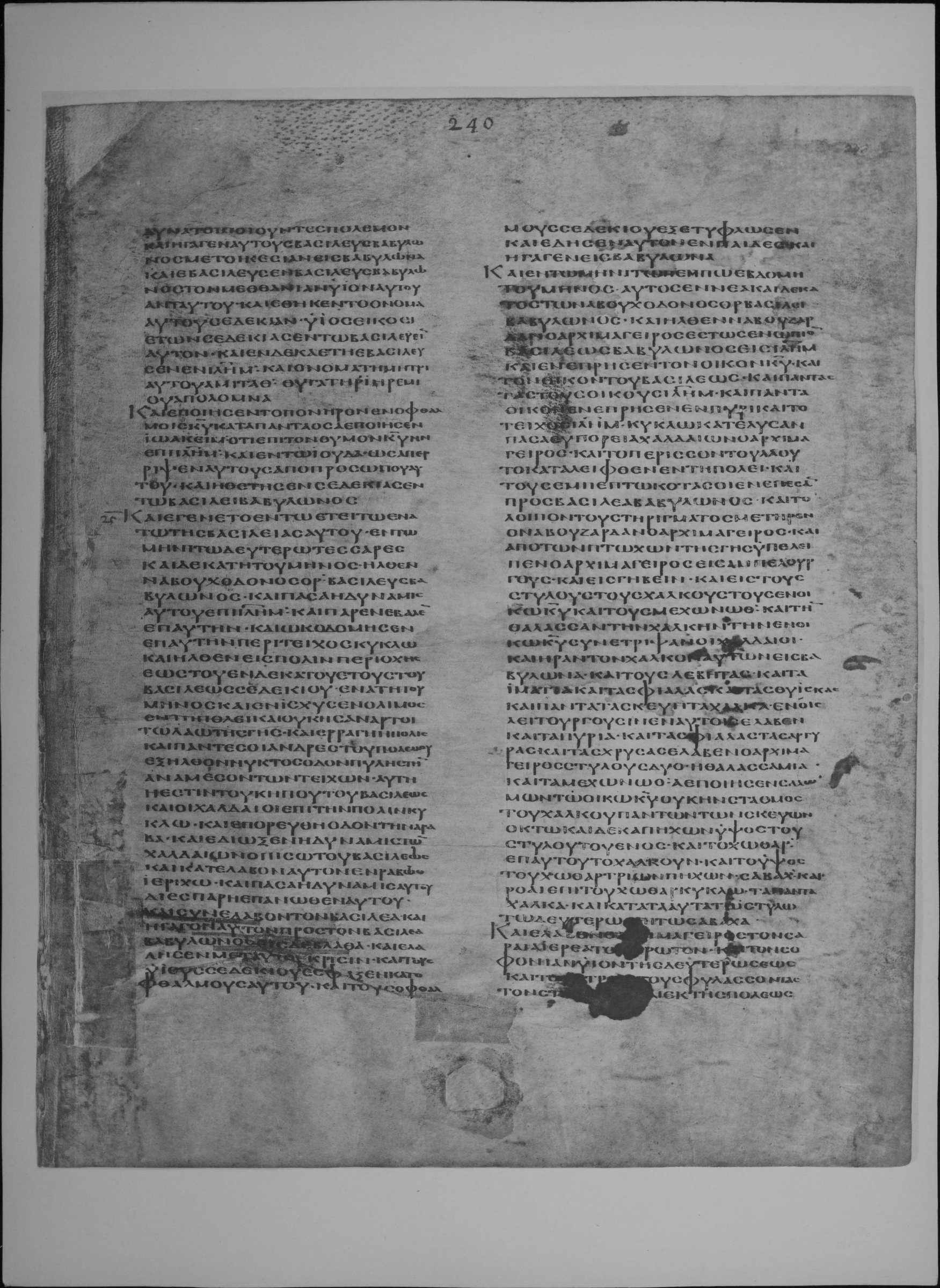
4 Kingdoms (2 Kings) 25:1-8 is on fol. 240r (full-size facsimile of 1879-83, Internet Archive codex-alexandrinus leaf 498). The 1930 reduced facsimile prints beneath this page: 2 Kings xxiv. 16-xxv. 19. Checked on the plate: the page begins inside 4 Kingdoms (2 Kings) 24:16 (first words read: ΔΥΝΑΤΟΙ ΠΟΙΟΥΝΤΕΣ ΠΟΛΕΜΟΝ ΚΑΙ ΗΓΑΓΕΝ ΑΥΤΟΥΣ Ο ΒΑΣΙΛΕΥΣ ΒΑΒΥΛΩΝΟΣ ΜΕΤΟΙΚΕΣΙΑΝ ΕΙΣ ΒΑΒΥΛΩΝΑ).
1καὶ ἐγενήθη ἐν τῷ ἔτει τῷ ἐνάτῳ τῆς βασιλείας αὐτοῦ ἐν τῷ μηνὶ τῷ δεκάτῳ ἦλθεν Ναβουχοδονοσὸρ βασιλεὺς Βαβυλῶνος καὶ πᾶσα ἡ δύναμις αὐτοῦ ἐπὶ Ἰερουσαλήμ, καὶ παρενέβαλεν ἐπ᾽ αὐτήν, καὶ ᾠκοδόμησεν ἐπ᾽ αὐτὴν περίτειχος κύκλῳ. 2καὶ ἦλθεν ἡ πόλις ἐν περιοχῇ ἕως τοῦ ἑνδεκάτου ἔτους τοῦ βασιλέως Σεδεκίου, ἐνάτῃ τοῦ μηνός· 3καὶ ἐνίσχυσεν ὁ λιμὸς ἐν τῇ πόλει, καὶ οὐκ ἦσαν ἄρτοι τῷ λαῷ τῆς γῆς. 4καὶ ἐρράγη ἡ πόλις, καὶ πάντες οἱ ἄνδρες τοῦ πολέμου ἐξῆλθον νυκτὸς ὁδὸν πύλης τῆς ἀνὰ μέσον τῶν τειχέων, αὕτη ἥ ἐστιν τοῦ κήπου τοῦ βασιλέως, καὶ οἱ Χαλδαῖοι ἐπὶ τὴν πόλιν κύκλῳ. καὶ ἐπορεύθη ὁδὸν τὴν Ἀραβά, 5καὶ ἐδίωξεν ἡ δύναμις τῶν Χαλδαίων ὀπίσω τοῦ βασιλέως, καὶ κατέλαβον αὐτὸν ἐν ἀραβὼθ Ἰερειχώ, καὶ πᾶσα ἡ δύναμις αὐτοῦ διεσπάρη ἐπάνωθεν αὐτοῦ. 6καὶ συνέλαβον τὸν βασιλέα, καὶ ἤγαγον αὐτὸν πρὸς βασιλέα Βαβυλῶνος Ἰερδεβλάθαν· καὶ ἐλάλησεν μετ᾽ αὐτοῦ κρίσιν. 7καὶ τοὺς υἱοὺς Σεδεκίου ἔσφαξεν κατ᾽ ὀφθαλμοὺς αὐτοῦ, καὶ τοὺς ὀφθαλμοὺς Σεδεκίου ἐξετύφλωσεν· καὶ ἔδησεν αὐτὸν ἐν πέδαις καὶ ἤγαγεν εἰς Βαβυλῶνα. 8Καὶ ἐν τῷ μηνὶ τῷ πέμπτῳ, ἑβδόμῃ τοῦ μηνός, αὐτὸς ἐνιαυτὸς ἐννεακαιδέκατος τῷ Ναβουχοδονοσὸρ βασιλεῖ Βαβυλῶνος, ἦλθεν Ναβουζαρδὰν ὁ ἀρχιμάγειρος ἑστὼς ἐνώπιον βασιλέως Βαβυλῶνος εἰς Ἰερουσαλήμ.
1And it came to pass in the ninth year of his reign, in the tenth month, that Nabuchodonosor king of Babylon came, and all his host, against Jerusalem; and he encamped against it, and built a mound against it. 2And the city was besieged until the eleventh year of king Sedekias on the ninth day of the month. 3And the famine prevailed in the city, and there was no bread for the people of the land. 4And the city was broken up, and all the men of war went forth by night, by the way of the gate between the walls, this is the gate of the king's garden: and the Chaldeans were set against the city round about: and the king went by the way of the plain. 5And the force of the Chaldeans pursued the king, and overtook him in the plains of Jericho: and all his army was dispersed from about him. 6And they took the king, and brought him to the king of Babylon to Reblatha; and he gave judgment upon him. 7And he slew the sons of Sedekias before his eyes, and put out the eyes of Sedekias, and bound him in fetters, and brought him to Babylon. 8And in the fifth month, on the seventh day of the month (this is the nineteenth year of Nabuchodonosor king of Babylon), came Nabuzardan, captain of the guard, who stood before the king of Babylon, to Jerusalem.
Where on the image
4 Kingdoms (2 Kings) 25:9-17 is on fol. 240r (full-size facsimile of 1879-83, Internet Archive codex-alexandrinus leaf 498). The 1930 reduced facsimile prints beneath this page: 2 Kings xxiv. 16-xxv. 19. Checked on the plate: the page begins inside 4 Kingdoms (2 Kings) 24:16 (first words read: ΔΥΝΑΤΟΙ ΠΟΙΟΥΝΤΕΣ ΠΟΛΕΜΟΝ ΚΑΙ ΗΓΑΓΕΝ ΑΥΤΟΥΣ Ο ΒΑΣΙΛΕΥΣ ΒΑΒΥΛΩΝΟΣ ΜΕΤΟΙΚΕΣΙΑΝ ΕΙΣ ΒΑΒΥΛΩΝΑ).
9καὶ ἐνέπρησεν τὸν οἶκον Κυρίου καὶ τὸν οἶκον τοῦ βασιλέως καὶ πάντας τοὺς οἴκους Ἰερουσαλήμ, καὶ πᾶν οἶκον ἐνέπρησεν ὁ ἀρχιμάγειρος. 11καὶ τὸ περισσὸν τοῦ λαοῦ τὸ καταλειφθὲν ἐν τῇ πόλει καὶ τοὺς ἐνπεπτωκότας οἳ ἐνέπεσον πρὸς βασιλέα Βαβυλῶνος καὶ τὸ λοιπὸν τοῦ στηρίγματος μετῆρεν Ναβουζαρδὰν ὁ ἀρχιμάγειρος. 12καὶ ἀπὸ τῶν πτωχῶν τῆς γῆς ὑπέλιπεν ὁ ἀρχιμάγειρος εἰς ἀμπελουργοὺς καὶ εἰς ταβείν. 13καὶ τοὺς στύλους τοὺς χαλκοῦς τοὺς ἐν οἴκῳ Κυρίου καὶ τοὺς μεχωνὼθ καὶ τὴν θάλασσαν τὴν χαλκῆν τὴν ἐν οἴκῳ Κυρίου συνέτριψαν οἱ Χαλδαῖοι, καὶ ἦραν τὸν χαλκὸν αὐτῶν εἰς Βαβυλῶνα. 14καὶ τοὺς λέβητας καὶ τὰ ἰαμεὶν καὶ τὰς φιάλας καὶ τὰς θυίσκας καὶ πάντα τὰ σκεύη τὰ χαλκᾶ ἐν οἷς λειτουργοῦσιν ἐν αὐτοῖς ἔλαβεν· 15καὶ τὰ πυρεῖα καὶ τὰς φιάλας τὰς χρυσᾶς καὶ τὰς ἀργυρᾶς ἔλαβεν ὁ ἀρχιμάγειρος, 16στύλους δύο, ἡ θάλασσα ἡ μία, καὶ τὰ μεχωνὼθ ἃ ἐποίησεν Σαλωμὼν τῷ οἴκῳ Κυρίου· οὐκ ἦν σταθμὸς τοῦ χαλκοῦ πάντων τῶν σκευῶν. 17ὀκτὼ καὶ δέκα πήχεων ὕψος τοῦ στύλου τοῦ ἑνός, καὶ τὸ χωθὰρ ἐπ᾽ αὐτοῦ τὸ χαλκοῦν, καὶ τὸ ὕψος τοῦ χωθὰρ τριῶν πήχεων σακαχαρθαὶ ἐπὶ τοῦ χωθὰρ κύκλῳ, τὰ πάντα χαλκᾶ· καὶ κατὰ τὰ αὐτὰ τῷ στύλῳ τῷ δευτέρῳ ἐπὶ τῷ γαβαχά.
9And he burnt the house of the Lord, and the king's house, and all the houses of Jerusalem, even every house did the captain of the guard burn. 10And the force of the Chaldeans pulled down the wall of Jerusalem round about. 11And Nabuzardan the captain of the guard removed the rest of the people that were left in the city, and the men who had deserted to the king of Babylon, and the rest of the multitude. 12But the captain of the guard left of the poor of the land to be vine-dressers and husbandmen. 13And the Chaldeans broke to pieces the brazen pillars that were in the house of the Lord, and the bases, and the brazen sea that was in the house of the Lord, and carried their brass to Babylon. 14And the caldrons, and the shovels, and the bowls, and the censers, and all the brazen vessels with which they minister, he took. 15And the captain of the guard took the fire-pans, and the gold and silver bowls. 16Two pillars, and one sea, and the bases which Solomon made for the house of the Lord: there was no weight of the brass of all the vessels. 17The height of one pillar was eighteen cubits, and the chapiter upon it was of brass: and the height of the chapiter was three cubits: the border, and the pomegranates on the chapiter round about were all of brass: and so it was with the second pillar with its border.
Where on the image
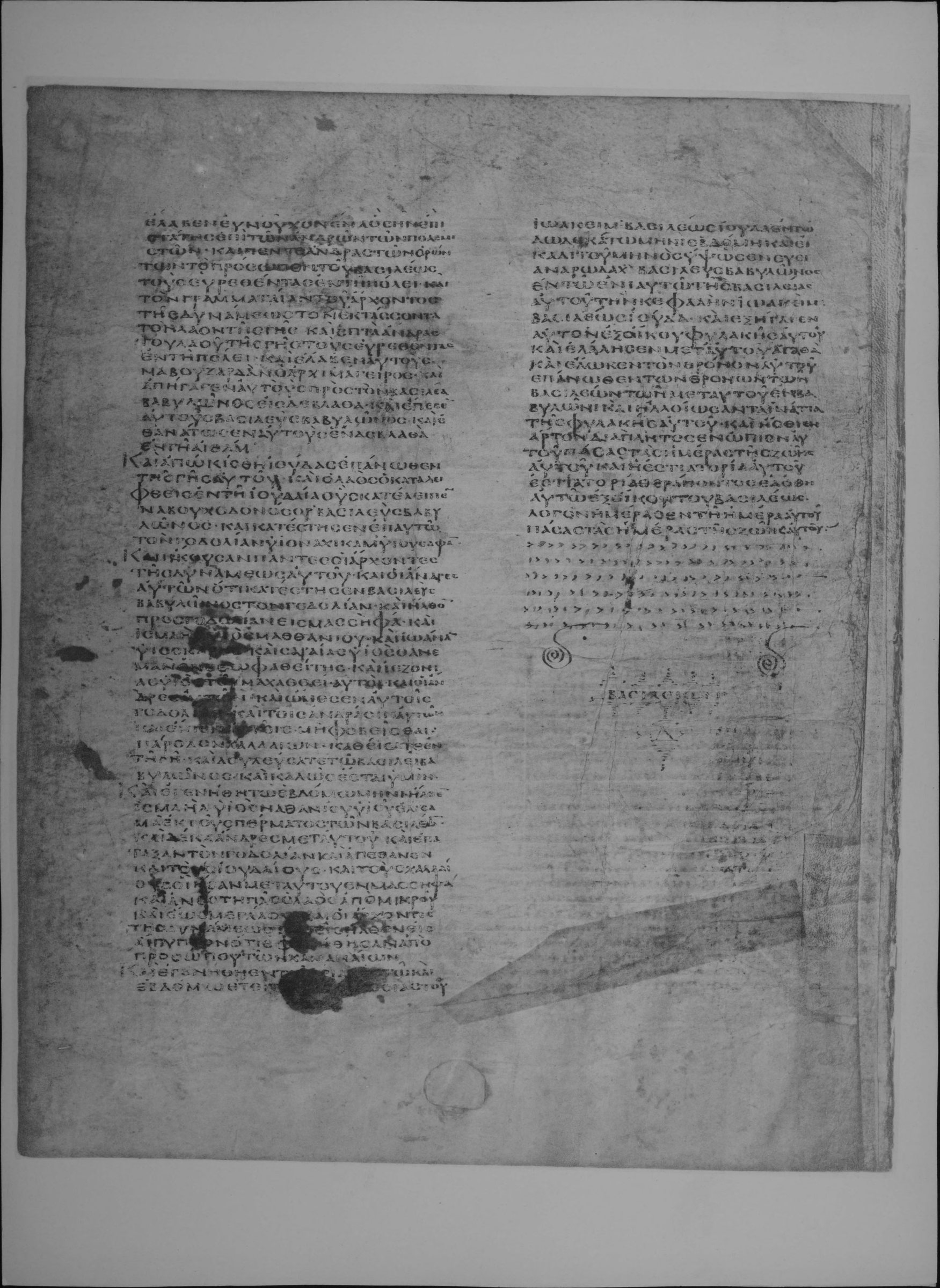
4 Kingdoms (2 Kings) 25:18-19 is on fol. 240r (full-size facsimile of 1879-83, Internet Archive codex-alexandrinus leaf 498). The 1930 reduced facsimile prints beneath this page: 2 Kings xxiv. 16-xxv. 19. Checked on the plate: the page begins inside 4 Kingdoms (2 Kings) 24:16 (first words read: ΔΥΝΑΤΟΙ ΠΟΙΟΥΝΤΕΣ ΠΟΛΕΜΟΝ ΚΑΙ ΗΓΑΓΕΝ ΑΥΤΟΥΣ Ο ΒΑΣΙΛΕΥΣ ΒΑΒΥΛΩΝΟΣ ΜΕΤΟΙΚΕΣΙΑΝ ΕΙΣ ΒΑΒΥΛΩΝΑ). 4 Kingdoms (2 Kings) 25:19-25 is on fol. 240v (full-size facsimile of 1879-83, Internet Archive codex-alexandrinus leaf 499). The 1930 reduced facsimile prints beneath this page: 2 Kings xxv. 19-30. Checked on the plate: the page begins inside 4 Kingdoms (2 Kings) 25:19 (first words read: ΕΛΑΒΕΝ ΕΥΝΟΥΧΟΝ ΕΝΑ ΟΣ ΗΝ ΕΠΙΣΤΑΤΗΣ ΤΩΝ ΑΝΔΡΩΝ ΤΩΝ ΠΟΛΕΜΙΣΤΩΝ ΚΑΙ ΠΕΝΤΕ ΑΝΔΡΑΣ).
18καὶ ἔλαβεν ὁ ἀρχιμάγειρος τὸν Σαραίαν ἱερέα τὸν πρῶτον καὶ τὸν Σοφονίαν υἱὸν τῆς δευτερώσεως καὶ τοὺς τρεῖς τοὺς φυλάσσοντας τὸν σταθμόν· 19καὶ ἐκ τῆς πόλεως ἔλαβεν εὐνοῦχον ἕνα ὅς ἦν ἐπιστάτης τῶν ἀνδρῶν τῶν πολεμιστῶν, καὶ πέντε ἄνδρας τῶν ὁρώντων τὸ πρόσωπον τοῦ βασιλέως τοὺς εὑρεθέντας ἐν τῇ πόλει, καὶ τὸν γραμματέα τοῦ ἄρχοντος τῆς δυνάμεως τὸν ἐκτάσσοντα τὸν λαὸν τῆς γῆς, καὶ ἑξήκοντα ἄνδρας τοῦ λαοῦ τῆς γῆς τοὺς εὑρεθέντας ἐν τῇ πόλει· 20καὶ ἔλαβεν αὐτοὺς Ναβουζαρδὰν ὁ ἀρχιμάγειρος καὶ ἀπήγαγεν αὐτοὺς πρὸς τὸν βασιλέα Βαβυλῶνος εἰς Δεβλάθα. 21καὶ ἔπαισεν αὐτοὺς βασιλεὺς Βαβυλῶνος καὶ ἐθανάτωσεν αὐτοὺς ἐν Ῥεβλάθα ἐν γῇ Αἱμάθ· καὶ ἀπῳκίσθη Ἰούδας ἐπάνωθεν τῆς γῆς αὐτοῦ. 22καὶ ὁ λαὸς ὁ καταλειφθεὶς ἐν τῇ γῇ Ἰούδα οὓς κατέιλπεν Ναβουχοδονοσὸρ βασιλεὺς Βαβυλῶνος, καὶ κατέστησεν ἐπ᾽ αὐτῶν τὸν Γοδολίαν υἱὸν Ἀχεικὰμ υἱὸν Σαφάν. 23Καὶ ἤκουσαν πάντες οἱ ἄρχοντες τῆς δυνάμεως, αὐτοὶ καὶ οἱ ἄνδρες αὐτῶν, ὅτι κατέστησεν βασιλεὺς Βαβυλῶνος τὸν Γοδολίαν· καὶ ἦλθον πρὸς Γοδολίαν εἰς Μασσηφάθ, καὶ Ἰσμαὴλ υἱὸς Ναθανίου καὶ Ἰωνὰ υἱὸς Καρὴθ καὶ Σαραίας υἱὸς Θανέμαθ ὁ Νεφφαθιείτης καὶ Ὀζονίας υἱὸς τοῦ Ἀχαθεί, αὐτοὶ καὶ οἱ ἄνδρες αὐτῶν. 24καὶ ὤμοσεν Γοδολίας αὐτοῖς καὶ τοῖς ἀνδράσιν αὐτῶν, καὶ εἶπεν αὐτοῖς Μὴ φοβεῖσθε πάροδον τῶν Χαλδαίων· καθίσατε ἐν τῇ γῇ καὶ δουλεύσατε τῷ βασιλεῖ Βαβυλῶνος, καὶ καλῶς ἔσται ὑμῖν. 25καὶ ἐγενήθη ἐν τῷ ἑβδόμῳ μηνὶ ἦλθεν Μαναὴλ υἱὸς Ναθανίου υἱὸς Ἐλεισαμὰ ἐκ τοῦ σπέρματος τῶν βασιλέων, καὶ ἄνδρες μετ᾽ αὐτοῦ· καὶ ἐπάταξεν τὸν Γοδολίαν καὶ ἀπέθανεν, καὶ τοὺς Ἰουδαίους καὶ τοὺς Χαλδαίους οἳ ἦσαν μετ᾽ αὐτοῦ εἰς Μασσηφάθ.
18And the captain of the guard took Saraias the high-priest, and Sophonias the second in order, and the three door-keepers. 19And they took out of the city one eunuch who was commander of the men of war, and five men that saw the face of the king, that were found in the city, and the secretary of the commander-in-chief, who took account of the people of the land, and sixty men of the people of the land that were found in the city. 20And Nabuzardan the captain of the guard took them, and brought them to the king of Babylon to Reblatha. 21And the king of Babylon smote them and slew them at Reblatha in the land of Æmath. So Juda was carried away from his land. 22And as for the people that were left in the land of Juda, whom Nabuchodonosor king of Babylon left, even over them he set Godolias son of Achicam son of Saphan. 23And all the captains of the host, they and their men, heard that the king of Babylon had thus appointed Godolias, and they came to Godolias to Massephath, both Ismael the son of Nathanias, and Jona son of Careth, and Saraias, son of Thanamath the Netophathite, and Jezonias son of a Machathite, they and their men. 24And Godolias swore to them and their men, and said to them, Fear not the incursion of the Chaldeans; dwell in the land, and serve the king of Babylon, and it shall be well with you. 25And it came to pass in the seventh month that Ismael son of Nathanias son of Helisama, of the seed royal, came, and ten men with him, and he smote Godolias, that he died, him and the Jews and the Chaldeans that were with him in Massepha.
Where on the image
4 Kingdoms (2 Kings) 25:26-30 is on fol. 240v (full-size facsimile of 1879-83, Internet Archive codex-alexandrinus leaf 499). The 1930 reduced facsimile prints beneath this page: 2 Kings xxv. 19-30. Checked on the plate: the page begins inside 4 Kingdoms (2 Kings) 25:19 (first words read: ΕΛΑΒΕΝ ΕΥΝΟΥΧΟΝ ΕΝΑ ΟΣ ΗΝ ΕΠΙΣΤΑΤΗΣ ΤΩΝ ΑΝΔΡΩΝ ΤΩΝ ΠΟΛΕΜΙΣΤΩΝ ΚΑΙ ΠΕΝΤΕ ΑΝΔΡΑΣ).
26καὶ ἀνέστη πᾶς ὁ λαὸς ἀπὸ μικροῦ καὶ ἕως μεγάλου καὶ οἱ ἄρχοντες τῶν δυνάμεων καὶ εἰσῆλθον εἰς Αἴγυπτον, ὅτι ἐφοβήθησαν ἀπὸ προσώπου τῶν Χαλδαίων. 27Καὶ ἐγενήθη ἐν τῷ τριακοστῷ ἑβδόμῳ ἔτει τῆς ἀποικίας τοῦ Ἰωακεὶμ βασιλέως Ἰούδα, ἐν τῷ δωδεκάτῳ μηνὶ ἑβδόμῃ καὶ εἰκάδι τοῦ μηνός, ὕψωσεν Εὐειαλμαρωδὲκ βασιλεὺς Βαβυλῶνος ἐν τῷ ἐνιαυτῷ τῆς βασιλείας αὐτοῦ τὴν κεφαλὴν Ἰωακεὶμ τοῦ βασιλέως Ἰούδα, καὶ ἐξήγαγεν αὐτὸν ἐξ οἴκου φυλακῆς αὐτοῦ. 28καὶ ἐλάλησεν μετ᾽ αὐτοῦ ἀγαθά, καὶ ἔδωκεν τὸν θρόνον αὐτοῦ ἐπάνωθεν τῶν θρόνων τῶν βασιλέων τῶν μετ᾽ αὐτοῦ ἐν Βαβυλῶνι. 29καὶ ἠλλοίωσεν τὰ ἱμάτια τῆς φυλακῆς αὐτοῦ, καὶ ἤσθιεν ἄρτον διὰ παντὸς ἐνώπιον αὐτοῦ πάσας τὰς ἡμέρας τῆς ζωῆς αὐτοῦ. 30καὶ ἡ ἑστιατορεία αὐτοῦ ἑστιατορεία διὰ παντός· ἐδόθη αὐτῷ ἐξ οἴκου τοῦ βασιλέως, λόγον ἡμέρας ἐν τῇ ἡμέρᾳ αὐτοῦ, πάσας τὰς ἡμέρας τῆς ζωῆς αὐτοῦ.
26And all the people, great and small rose up, they and the captains of the forces, and went into Egypt; because they were afraid of the Chaldeans. 27And it came to pass in the thirty-seventh year of the carrying away of Joachim king of Juda, in the twelfth month, on the twenty-seventh day of the month, that Evialmarodec king of Babylon in the first year of his reign lifted up the head of Joachim king of Juda, and brought him out of his prison-house. 28And he spoke kindly to him, and set his throne above the thrones of the kings that were with him in Babylon; 29and changed his prison garments: and he ate bread continually before him all the days of his life. 30And his portion, a continual portion, was given him out of the house of the king, a daily rate for every day all the days of his life.
Cite
Sources
- Source: Codex Alexandrinus (British Library Royal MS 1 D. V) via the British Museum photographic facsimiles of 1879-83 and 1930 (Internet Archive) + Swete's Septuagint + Brenton's English (holding institution)
- Critical edition: H. B. Swete, The Old Testament in Greek according to the Septuagint (1909)
← previous · → next · v cycle view · l back to library