Deuteronomy, Chapter 20 (Codex Alexandrinus)
Introduction
Deuteronomy 20 in the Greek Old Testament (the Septuagint) as written in Codex Alexandrinus, a Greek Bible copied in the fifth century, probably in Egypt, and now in the British Library (Royal MS 1 D. V, the first of its four volumes). It is one of the three great early codices of the whole Greek Bible, with Codex Vaticanus and Codex Sinaiticus, and for Genesis 1:1-46:28, which Codex Vaticanus has lost, it is the oldest surviving complete Greek text (older papyri such as the Berlin Genesis papyrus and Chester Beatty 961 survive only in part).
This entry meets the strict three-criteria standard of the Theosis Library:
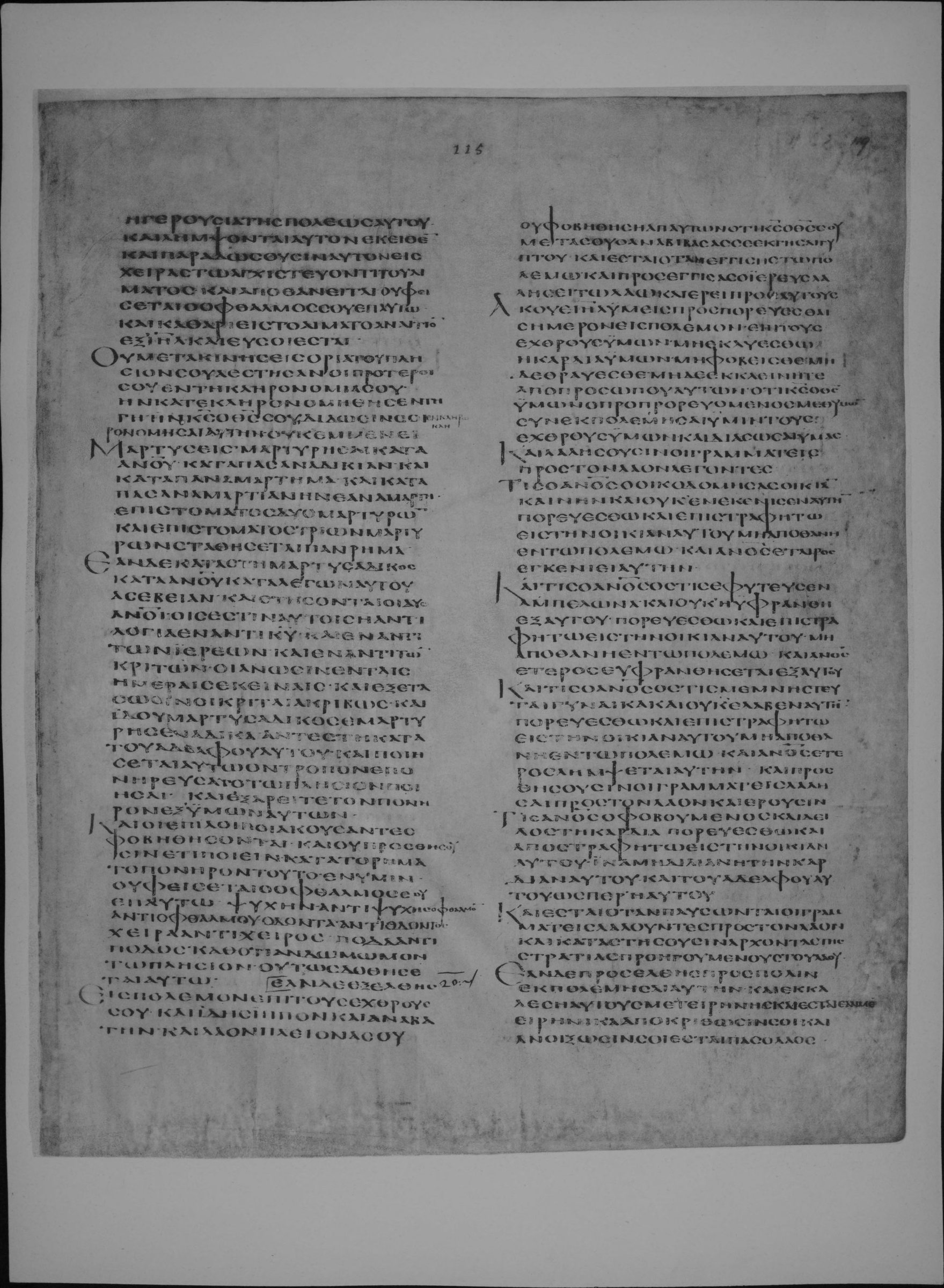
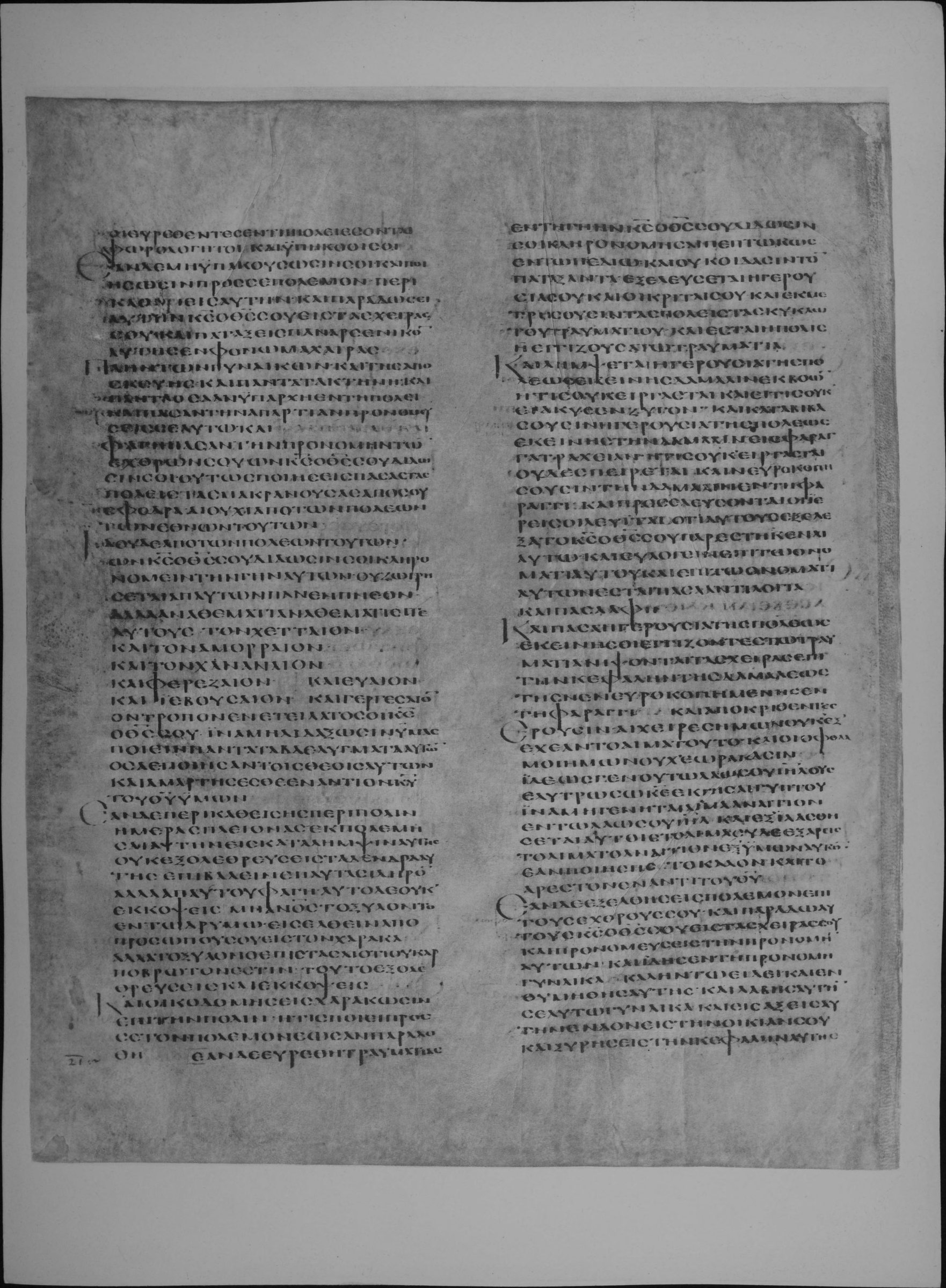
- Manuscript scan: the pages of Codex Alexandrinus carrying this chapter (fol. 115r, fol. 115v), from the full-size photographic (autotype) facsimile published by the British Museum in 1879-1883, as digitised on the Internet Archive. The verse range of every page comes from the reduced photographic facsimile of 1915, which prints it beneath each plate, and the opening words of every page were read on the plate to confirm the page and the verse it begins with. Each section links to the page or pages that hold its verses. Folio numbers are those written at the head of each leaf and visible on the plates.
- Original text: Swete's edition, which here prints the text of Codex Vaticanus (Vat. gr. 1209), the base of his edition, and gives the readings of Alexandrinus only in his apparatus. The Greek column is therefore Vaticanus' text; where Alexandrinus differs, the plate shows what Alexandrinus reads.
- English translation: Sir Lancelot C. L. Brenton, The Septuagint Version of the Old Testament (1844; 1851 edition), a translation of the Greek, public domain, from the eBible.org text.
How was this verified? (Provenance)
Where on the image
Deuteronomy 20:1-8 is on fol. 115r (full-size facsimile of 1879-83, Internet Archive codex-alexandrinus leaf 250). The 1915 reduced facsimile prints beneath this page: Deut. xix. 12-xx. 11. Checked on the plate: the page begins inside Deuteronomy 19:12 (first words read: Η ΓΕΡΟΥΣΙΑ ΤΗΣ ΠΟΛΕΩΣ ΑΥΤΟΥ ΚΑΙ ΛΗΜΨΟΝΤΑΙ ΑΥΤΟΝ ΕΚΕΙΘΕΝ ΚΑΙ ΠΑΡΑΔΩΣΟΥΣΙΝ ΑΥΤΟΝ).
1Ἐὰν δὲ ἐξέλθῃς εἰς πόλεμον ἐπὶ τοὺς ἐχθρούς σου, καὶ ἴδῃς ἵππον καὶ ἀναβάτην καὶ λαὸν πλείονά σου, οὐ φοβηθήσῃ ἀπ᾽ αὐτῶν· ὅτι Κύριος ὁ θεός σου μετὰ σοῦ, ὁ ἀναβιβάσας σε ἐκ γῆς Αἰγύπτου. 2καὶ ἔσται ὅταν ἐγγίσῃς τῷ πολέμῳ, καὶ προσεγγίσας ὁ ἱερεὺς λαλήσει τῷ λαῷ 3καὶ ἐρεῖ πρὸς αὐτούς Ἄκουε, Ἰσραήλ· ὑμεῖς πορεύεσθε σήμερον εἰς τὸν πόλεμον ἐπὶ τοὺς ἐχθροὺς ὑμῶν, μὴ ἐκλυέσθω ἡ καρδία ὑμῶν, μὴ φοβεῖσθε μηδὲ θραύεσθε μηδὲ ἐκκλίνετε ἀπὸ προσώπου αὐτῶν· 4ὅτι Κύριος ὁ θεὸς ὑμῶν ὁ προπορευόμενος μεθ᾽ ὑμῶν, συνεκπολεμῆσαι ὑμῖν τοὺς ἐχθροὺς ὑμῶν, διασῶσαι ὑμᾶς. 5καὶ λαλήσουσιν οἱ γραμματεῖς πρὸς τὸν λαὸν λέγοντες Τίς ὁ ἄνθρωπος ὁ οἰκοδομήσας οἰκίαν καινὴν καὶ οὐκ ἐνεκαίνισεν αὐτήν; πορευέσθω καὶ ἀποστραφήτω εἰς τὴν οἰκίαν αὐτοῦ, μὴ ἀποθάνῃ ἐν τῷ πολέμῳ καὶ ἄνθρωπος ἕτερος ἐνκαινιεῖ αὐτήν. 6καὶ τίς ὁ ἄνθρωπος ὅστις ἐφύτευσεν ἀμπελῶνα καὶ οὐκ εὐφράνθη ἐξ αὐτοῦ; πορευέσθω καὶ ἀποστραφήτω εἰς τὴν οἰκίαν αὐτοῦ, μὴ ἀποθάνῃ ἐν τῷ πολέμῳ καὶ ἄνθρωπος ἕτερος εὐφρανθήσεται ἐξ αὐτοῦ. 7καὶ τίς ὁ ἄνθρωπος ὅστις μεμνήστευται γυναῖκα καὶ οὐκ ἔλαβεν αὐτήν; πορευέσθω καὶ ἀποστραφήτω εἰς τὴν οἰκίαν αὐτοῦ, μὴ ἀποθάνῃ ἐν τῷ πολέμῳ καὶ ἄνθρωπος ἕτερος λήμψεται αὐτήν. 8καὶ προσθήσουσιν οἱ γραμματεῖς λαλῆσαι πρὸς τὸν λαὸν καὶ ἐροῦσιν Τίς ὁ ἄνθρωπος ὁ φοβούμενος καὶ δειλὸς τῇ καρδίᾳ; πορευέσθω καὶ ἀποστραφήτω εἰς τὴν οἰκίαν αὐτοῦ, ἵνα μὴ δειλιάνῃ τὴν καρδίαν τοῦ ἀδελφοῦ αὐτοῦ ὥσπερ ἡ αὐτοῦ.
1And if thou shouldest go forth to war against thine enemies, and shouldest see horse, and rider, and a people more numerous than thyself; thou shalt not be afraid of them, for the Lord thy God is with thee, who brought thee up out of the land of Egypt. 2And it shall come to pass whenever thou shalt draw nigh to battle, that the priest shall draw nigh and speak to the people, and shall say to them, 3Hear, O Israel; ye are going this day to battle against your enemies: let not your heart faint, fear not, neither be confounded, neither turn aside from their face. 4For it is the Lord your God who advances with you, to fight with you against your enemies, and to save you. 5And the scribes shall speak to the people, saying, What man is he that has built a new house, and has not dedicated it? let him go and return to his house, lest he die in the war, and another man dedicate it. 6And what man is he that has planted a vineyard, and not been made merry with it? let him go and return to his house, lest he die in the battle, and another man be made merry with it. 7And what man is he that has betrothed a wife, and has not taken her? let him go and return to his house, lest he die in the battle, and another man take her. 8And the scribes shall speak further to the people, and say, What man is he that fears and is cowardly in his heart? Let him go and return to his house, lest he make the heart of his brother fail, as his own.
Where on the image
Deuteronomy 20:9-11 is on fol. 115r (full-size facsimile of 1879-83, Internet Archive codex-alexandrinus leaf 250). The 1915 reduced facsimile prints beneath this page: Deut. xix. 12-xx. 11. Checked on the plate: the page begins inside Deuteronomy 19:12 (first words read: Η ΓΕΡΟΥΣΙΑ ΤΗΣ ΠΟΛΕΩΣ ΑΥΤΟΥ ΚΑΙ ΛΗΜΨΟΝΤΑΙ ΑΥΤΟΝ ΕΚΕΙΘΕΝ ΚΑΙ ΠΑΡΑΔΩΣΟΥΣΙΝ ΑΥΤΟΝ). Deuteronomy 20:11-16 is on fol. 115v (full-size facsimile of 1879-83, Internet Archive codex-alexandrinus leaf 251). The 1915 reduced facsimile prints beneath this page: Deut. xx. 11-xxi. 12. Checked on the plate: the page begins inside Deuteronomy 20:11 (first words read: ΟΙ ΕΥΡΕΘΕΝΤΕΣ ΕΝ ΑΥΤΗ ΕΣΟΝΤΑΙ ΣΟΙ ΦΟΡΟΛΟΓΗΤΟΙ ΚΑΙ ΥΠΗΚΟΟΙ ΣΟΥ ΕΑΝ ΔΕ ΜΗ ΥΠΑΚΟΥΣΩΣΙΝ).
9καὶ ἔσται ὅταν παύσωνται οἱ γραμματεῖς λαλοῦντες πρὸς τὸν λαόν, καὶ καταστήσουσιν ἄρχοντας τῆς στρατιᾶς προηγουμένους τοῦ λαοῦ. 10Ἐὰν δὲ προσέλθῃς πρὸς πόλιν ἐκπολεμῆσαι αὐτούς, καὶ ἐκκάλεσαι αὐτοὺς μετ᾽ εἰρήνης. 11ἐὰν μὲν εἰρηνικὰ ἀποκριθῶσίν σοι καὶ ἀνοίξωσίν σοι, ἔσται πᾶς ὁ λαός, οἱ εὑρεθέντες ἐν αὐτῇ, ἔσονταί σοι φορολόγητοι καὶ ὑπήκοοί σου· 12ἐὰν δὲ μὴ ὑπακούσωσίν σοι καὶ ποιῶσιν πρὸς σὲ πόλεμον, περικαθιεῖς αὐτήν, 13ἕως ἂν παραδῷ σοι αὐτὴν Κύριος ὁ θεός σου εἰς τὰς χεῖράς σου, καὶ πατάξεις πᾶν ἀρσενικὸν αὐτῆς ἐν φόνῳ μαχαίρας, 14πλὴν τῶν γυναικῶν καὶ τῆς ἀποσκευῆς· καὶ ὅσα ἂν ὑπάρχῃ ἐν τῇ πόλει καὶ πᾶσαν τὴν ἀπαρτίαν προνομεύσεις σεαυτῷ, καὶ φάγῃ πᾶσαν τὴν προνομὴν τῶν ἐχθρῶν σου ὧν Κύριος ὁ θεός σου δίδωσίν σοι. 15οὕτως ποιήσεις πάσας τὰς πόλεις τὰς μακρὰν οὔσας σου σφόδρα· οὐχὶ ἐκ τῶν πόλεων τῶν ἐθνῶν τούτων 16ὧν Κύριος ὁ θεός σου δίδωσίν σοι κληρονομεῖν τὴν γῆν αὐτῶν, οὐ ζωγρήσετε πᾶν ἐνπνέον,
9And it shall come to pass when the scribes shall have ceased speaking to the people, that they shall appoint generals of the army to be leaders of the people. 10And if thou shalt draw nigh to a city to overcome them by war, then call them out peaceably. 11If then they should answer peaceably to thee, and open to thee, it shall be that all the people found in it shall be tributary and subject to thee. 12But if they will not hearken to thee, but wage war against thee, thou shalt invest it; 13until the Lord thy God shall deliver it into thy hands, and thou shalt smite every male of it with the edge of the sword: 14except the women and the stuff: and all the cattle, and whatsoever shall be in the city, and all the plunder thou shalt take as spoil for thyself, and shalt eat all the plunder of thine enemies whom the Lord thy God gives thee. 15Thus shalt thou do to all the cities that are very far off from thee, not being of the cities of these nations which the Lord thy God gives thee to inherit their land. 16Of these ye shall not take any thing alive;
Where on the image
Deuteronomy 20:17-20 is on fol. 115v (full-size facsimile of 1879-83, Internet Archive codex-alexandrinus leaf 251). The 1915 reduced facsimile prints beneath this page: Deut. xx. 11-xxi. 12. Checked on the plate: the page begins inside Deuteronomy 20:11 (first words read: ΟΙ ΕΥΡΕΘΕΝΤΕΣ ΕΝ ΑΥΤΗ ΕΣΟΝΤΑΙ ΣΟΙ ΦΟΡΟΛΟΓΗΤΟΙ ΚΑΙ ΥΠΗΚΟΟΙ ΣΟΥ ΕΑΝ ΔΕ ΜΗ ΥΠΑΚΟΥΣΩΣΙΝ).
17ἀλλ᾽ ἢ ἀναθέματι ἀναθεματιεῖτε αὐτούς, τὸν Χετταῖον καὶ Ἀμορραῖον καὶ Χαναναῖον καὶ Φερεζαῖον καὶ Εὑαῖον καὶ Ἰεβουσαῖον, ὃν τρόπον ἐνετείλατό σοι Κύριος ὁ θεός σου· 18ἵνα μὴ διδάξωσιν ὑμᾶς ποιεῖν πάντα τὰ βδελύγματα αὐτῶν ὅσα ἐποίησαν τοῖς θεοῖς αὐτῶν, καὶ ἁμαρτήσεσθε ἐναντίον Κυρίου τοῦ θεοῦ ὑμῶν. 19Ἐὰν δὲ περικαθίσῃς περὶ πόλιν μίαν ἡμέρας πλείους ἐκπολεμῆσαι αὐτὴν εἰς κατάλημψιν αὐτῆς, οὐχὶ ἐξολεθρεύσεις τὰ δένδρα αὐτῆς ἐπιβαλεῖν ἐπ᾽ αὐτὰ σίδηρον· ἀλλ᾽ ἢ ἀπ᾽ αὐτοῦ φάγῃ, αὐτὸ δὲ οὐκ ἐκκόψεις. μὴ ἄνθρωπος τὸ ξύλον τὸ ἐν τῷ ἀγρῷ, εἰσελθεῖν ἀπὸ προσώπου σου εἰς τὸν χάρακα; 20ἀλλὰ ξύλον ὃ ἐπίστασαι ὅτι οὐ καρπόβρωτόν ἐστιν, τοῦτο ὀλεθρεύσεις καὶ ἐκκόψεις καὶ οἰκοδομήσεις χαράκωσιν ἐπὶ τὴν πόλιν ἥτις ποιεῖ πρὸς σὲ τὸν πόλεμον, ἕως ἂν παραδοθῇ.
17but ye shall surely curse them, the Chettite, and the Amorite, and the Chananite, and the Pherezite, and the Evite, and the Jebusite, and the Gergesite; as the Lord thy God commanded thee: 18that they may not teach you to do all their abominations, which they did to their gods, and so ye should sin before the Lord your God. 19And if thou shouldest besiege a city many days to prevail against it by war to take it, thou shalt not destroy its trees, by applying an iron tool to them, but thou shalt eat of it, and shalt not cut it down: Is the tree that is in the field a man, to enter before thee into the work of the siege? 20But the tree which thou knowest to be not fruit-bearing, this thou shalt destroy and cut down; and thou shalt construct a mound against the city, which makes war against thee, until it be delivered up.
Cite
Sources
- Source: Codex Alexandrinus (British Library Royal MS 1 D. V) via the British Museum photographic facsimiles of 1879-83 and 1915 (Internet Archive) + Swete's Septuagint + Brenton's English (holding institution)
- Critical edition: H. B. Swete, The Old Testament in Greek according to the Septuagint (1909)
← previous · → next · v cycle view · l back to library