Epistle of Jeremiah, Chapter 1 (Codex Alexandrinus)
Introduction
Epistle of Jeremiah 1 in the Greek Old Testament (the Septuagint) as written in Codex Alexandrinus, a Greek Bible copied in the fifth century, probably in Egypt, and now in the British Library (Royal MS 1 D. VI, the second of its four volumes). It is one of the three great early codices of the whole Greek Bible, with Codex Vaticanus and Codex Sinaiticus.
Numbering: Swete's Greek and Brenton's English number or divide some verses of this chapter differently (Swete 1:1 = Brenton 1:1-2; Swete 1:2-6 = Brenton 1:3-7; Swete 1:7-8 = Brenton 1:8; Swete 1:9 = Brenton 1:9-10; Swete 1:10-37 = Brenton 1:11-38; Swete 1:38-39 = Brenton 1:39; Swete 1:50 = Brenton 1:50-51; Swete 1:51-72 = Brenton 1:52-73). Each column keeps its own verse numbers, and sections are cut only where the two texts agree, so each section holds the same passage in both languages.
This entry meets the strict three-criteria standard of the Theosis Library:
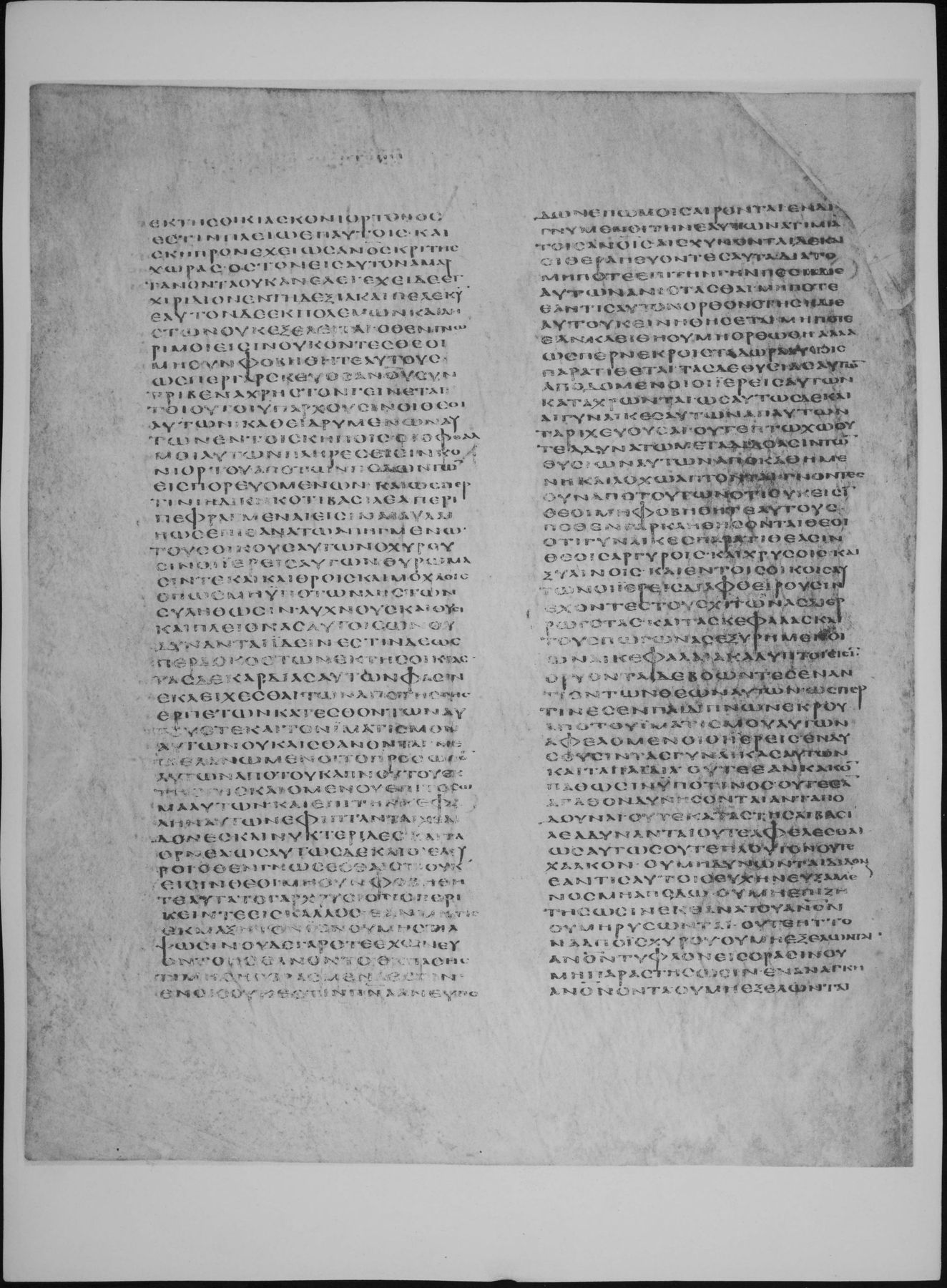
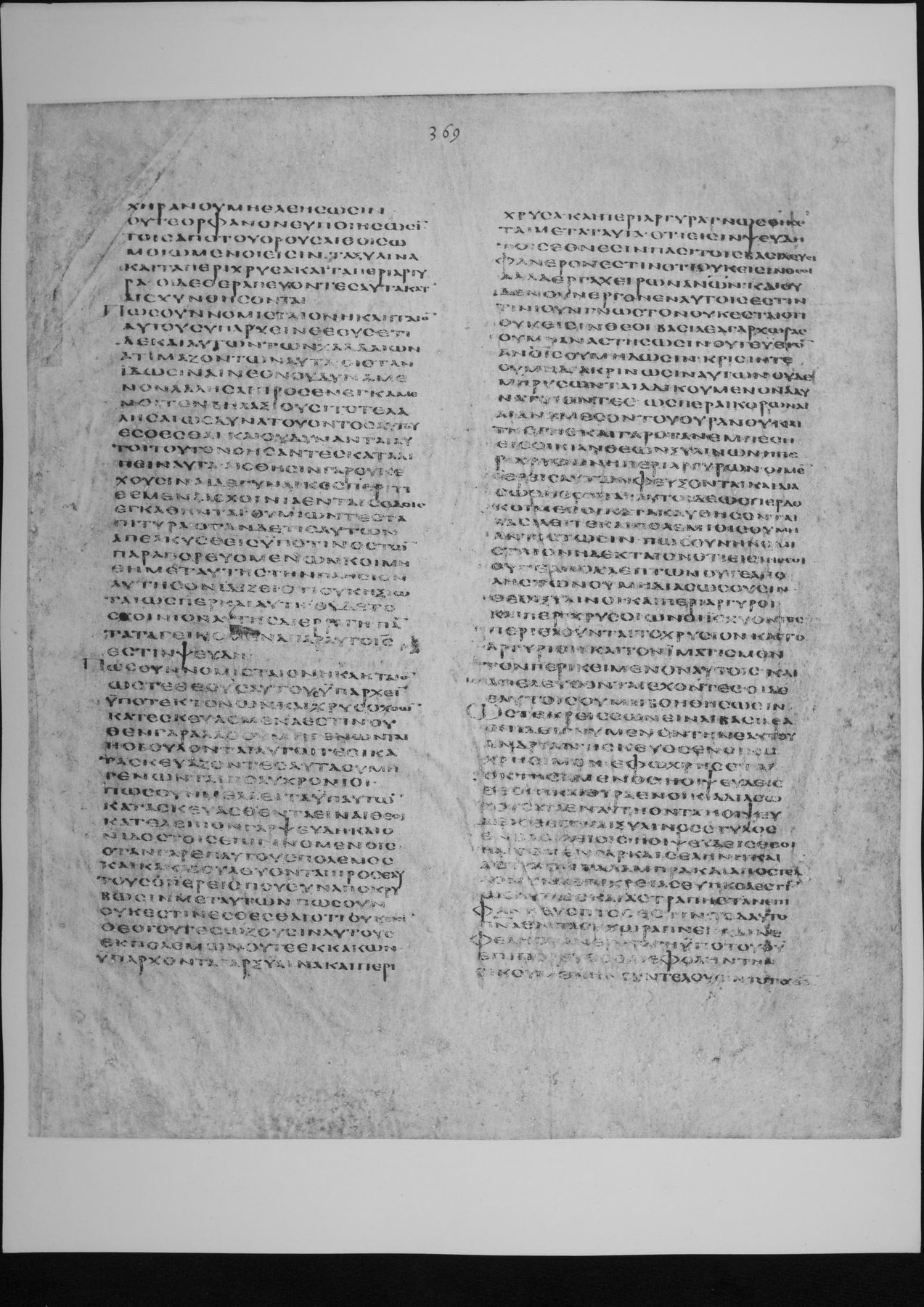
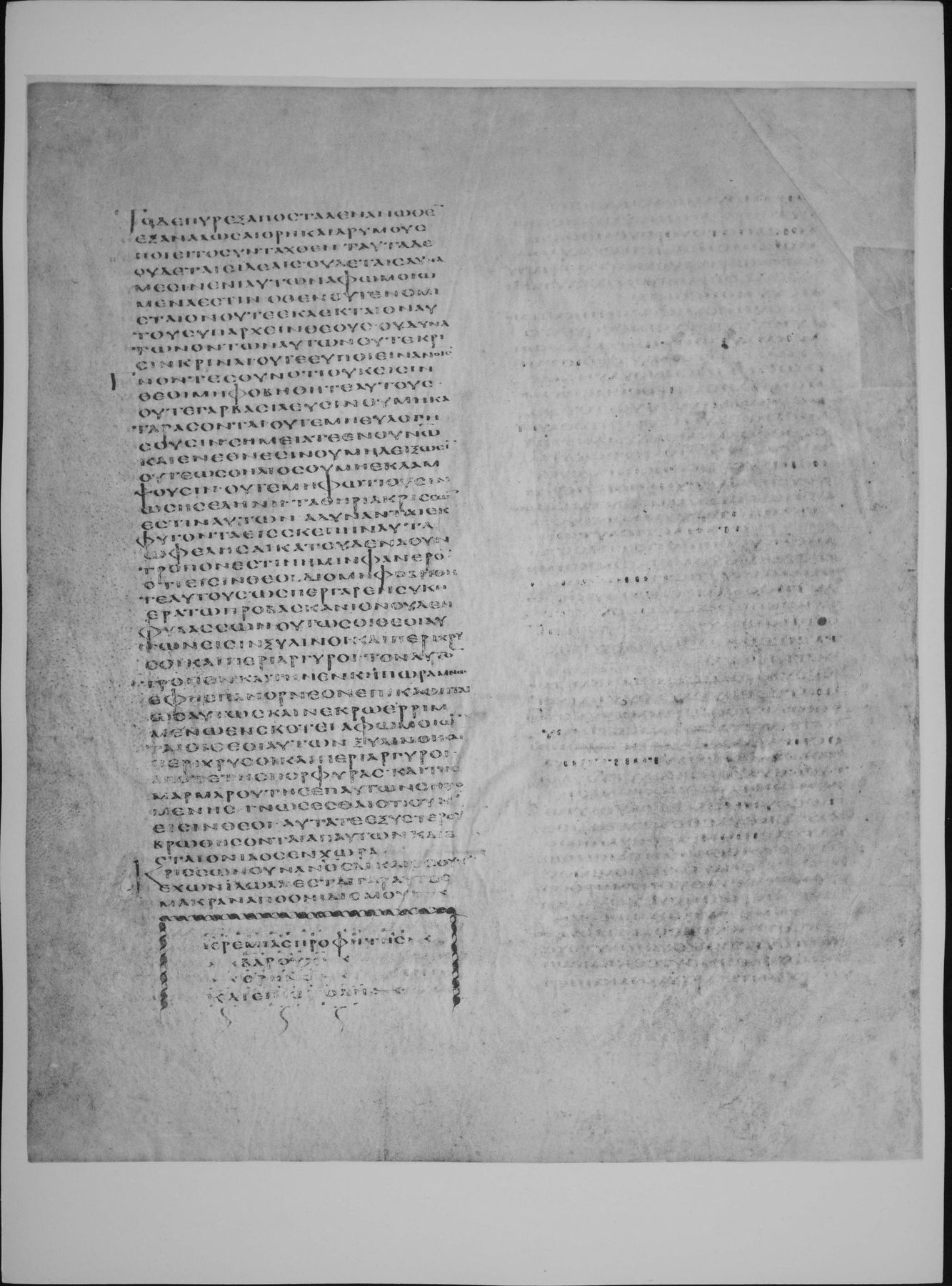
- Manuscript scan: the pages of Codex Alexandrinus carrying this chapter (fol. 368r, fol. 368v, fol. 369r, fol. 369v), from the full-size photographic (autotype) facsimile published by the British Museum in 1879-1883, as digitised on the Internet Archive. The verse range of every page comes from the reduced photographic facsimile of 1936, which prints it beneath each plate, and the opening words of every page were read on the plate to confirm the page and the verse it begins with. Each section links to the page or pages that hold its verses. Folio numbers are those written at the head of each leaf and visible on the plates.
- Original text: Swete's edition, which here prints the text of Codex Vaticanus (Vat. gr. 1209), the base of his edition, and gives the readings of Alexandrinus only in his apparatus. The Greek column is therefore Vaticanus' text; where Alexandrinus differs, the plate shows what Alexandrinus reads.
- English translation: Sir Lancelot C. L. Brenton, The Septuagint Version of the Old Testament (1844; 1851 edition), a translation of the Greek, public domain, from the eBible.org text.
How was this verified? (Provenance)
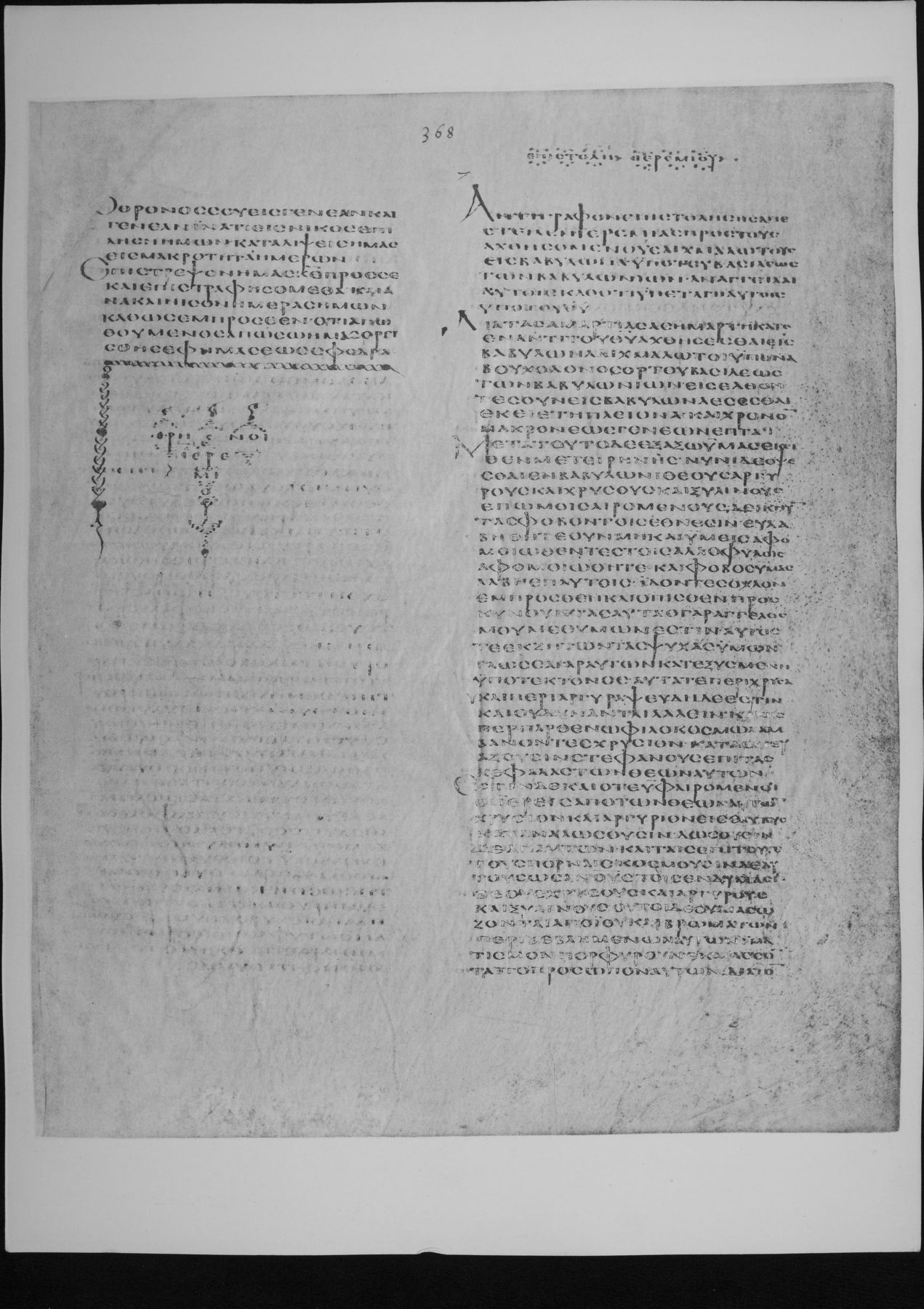
Where on the image
Epistle of Jeremiah 1:1-8 is on fol. 368r (full-size facsimile of 1879-83, Internet Archive codex-alexandrinus leaf 760). The 1936 reduced facsimile prints beneath this page: Lam. v. 19-22, Ep. of Jer. (= Bar. vi.) 1-12. Checked on the plate: the page begins inside Lam 5:19 (first words read: Ο ΘΡΟΝΟΣ ΣΟΥ ΕΙΣ ΓΕΝΕΑΝ ΚΑΙ ΓΕΝΕΑΝ ΙΝΑ ΤΙ ΕΙΣ ΝΙΚΟΣ ΕΠΙΛΗΣΗ ΗΜΩΝ).
1ΑΝΤΙΓΡΑΦΟΝ ἐπιστολῆς ἧς ἀπέστειλεν Ἰερεμίας πρὸς τοὺς ἀχθησομένους αἰχμαλώτους εἰς Βαβυλῶνα ὑπὸ τοῦ βασιλέως τῶν Βαβυλωνίων, ἀναγγεῖλαι αὐτοῖς καθότι ἐπετάγη αὐτῷ ὑπὸ τοῦ θεοῦ. Διὰ τὰς ἁμαρτίας ὑμῶν ἃς ἡμαρτήκατε ἐναντίον τοῦ θεοῦ ἀχθήσεσθε εἰς Βαβυλῶνα αἰχμάλωτοι ὑπὸ Ναβουχοδονοσὸρ βασιλέως τῶν Βαβυλωνίων. 2εἰσελθόντες οὖν εἰς Βαβυλῶνα ἔσεσθε ἐκεῖ ἔτη πλείονα καὶ χρόνον μακρὸν ἕως γενεῶν ἑπτά· μετὰ τοῦτο δὲ ἐξάξω ὑμᾶς ἐκεῖθεν μετ᾽ εἰρήνης. 3νυνὶ δὲ ὄψεσθε ἐν Βαβυλῶνι θεοὺς ἀργυροῦς καὶ χρυσοῦς καὶ ξυλίνους ἐπ᾽ ὤμοις αἰρομένους, δεικνύντας φόβον τοῖς ἔθνεσιν. 4εὐλαβήθητε οὖν μὴ καὶ ὑμεῖς ἀφομοιωθέντες τοῖς ἀλλοφύλοις ἀφομοιωθῆτε, καὶ φόβος ὑμᾶς λάβῃ ἐπ᾽ αὐτοῖς, 5ἰδόντας ὄχλον ἔμπροσθεν καὶ ὄπισθεν αὐτῶν προσκυνοῦντας αὐτά· εἴπατε δὲ τῇ διανοίᾳ Σοὶ δεῖ προσκυνεῖν, Δέσποτα. 6ὁ γὰρ ἄγγελός μου μεθ᾽ ὑμῶν ἐστίν, αὐτός τε ἐκζητῶν τὰς ψυχὰς ὑμῶν. 7Γλῶσσα γὰρ αὐτῶν ἐστὶν κατεξυσμένη ὑπὸ τέκτονος, αὐτά τε περίχρυσα καὶ περιάργυρα, ψευδῆ δ᾽ ἐστὶν καὶ οὐ δύνανται λαλεῖν. 8καὶ ὥσπερ παρθένῳ φιλοκόσμῳ λαμβάνοντες χρυσίον
1A copy of an epistle, which Jeremy sent unto them which were to be led captives into Babylon by the king of the Babylonians, to certify them, as it was commanded him of God. 2Because of the sins which ye have committed before God, ye shall be led away captives into Babylon by Nabuchodonosor king of the Babylonians. 3So when ye be come unto Babylon, ye shall remain there many years, and for a long season, namely, seven generations: and after that I will bring you away peaceably from thence. 4Now shall ye see in Babylon gods of silver, and of gold, and of wood, borne upon shoulders, which cause the nations to fear. 5Beware therefore that ye in no wise be like to strangers, neither be ye afraid of them, when ye see the multitude before them and behind them, worshipping them. 6But say ye in your hearts, O Lord, we must worship thee. 7For mine angel is with you, and I myself caring for your souls. 8As for their tongue, it is polished by the workman, and they themselves are gilded and laid over with gold; yet are they but false, and cannot speak.
Where on the image
Epistle of Jeremiah 1:9-12 is on fol. 368r (full-size facsimile of 1879-83, Internet Archive codex-alexandrinus leaf 760). The 1936 reduced facsimile prints beneath this page: Lam. v. 19-22, Ep. of Jer. (= Bar. vi.) 1-12. Checked on the plate: the page begins inside Lam 5:19 (first words read: Ο ΘΡΟΝΟΣ ΣΟΥ ΕΙΣ ΓΕΝΕΑΝ ΚΑΙ ΓΕΝΕΑΝ ΙΝΑ ΤΙ ΕΙΣ ΝΙΚΟΣ ΕΠΙΛΗΣΗ ΗΜΩΝ). Epistle of Jeremiah 1:12-16 is on fol. 368v (full-size facsimile of 1879-83, Internet Archive codex-alexandrinus leaf 761). The 1936 reduced facsimile prints beneath this page: Ep. of Jer. (= Bar. vi.) 12-36. Checked on the plate: the page begins inside Epistle of Jeremiah 1:12 (first words read: ΕΚ ΤΗΣ ΟΙΚΙΑΣ ΚΟΝΙΟΡΤΟΝ ΟΣ ΕΣΤΙΝ ΠΛΕΙΩΝ ΕΠ ΑΥΤΟΙΣ).
9κατασκευάζουσιν στεφάνους ἐπὶ τὰς κεφαλὰς τῶν θεῶν αὐτῶν· ἔστι δὲ καὶ ὅτε ὑφαιρούμενοι οἱ ἱερεῖς ἀπὸ τῶν θεῶν αὐτῶν χρυσίον καὶ ἀργύριον εἰς ἑαυτοὺς καταναλοῦσιν, 10δώσουσιν δὲ ἀπ᾽ αὐτῶν καὶ ταῖς ἐπὶ τοῦ στέγους πόρναις. κοσμοῦσί τε αὐτοὺς ὡς ἀνθρώπους τοῖς ἐνδύμασιν, θεοὺς ἀργυροῦς καὶ θεοὺς χρυσοῦς καὶ ξυλίνους. 11οὗτοι δὲ οὐ διασώζονται ἀπὸ ἰοῦ καὶ βρωμάτων, περιβεβλημένων αὐτῶν ἱματισμὸν πορφυροῦν. 12ἐκμάσσονται τὸ πρόσωπον αὐτῶν διὰ τὸν ἐκ τῆς οἰκίας κονιορτόν, ὅς ἐστιν πλείω ἐπ᾽ αὐτοῖς. 13καὶ σκῆπτρον ἔχει ὡς ἄνθρωπος κριτὴς χώρας, ὃς τὸν εἰς αὐτὸν ἁμαρτάνοντα οὐκ ἀνελεῖ. 14ἔχει δὲ ἐνχειρίδιον δεξιᾷ καὶ πέλεκυν, ἑαυτὸν δὲ ἐκ πολέμου καὶ λῃστῶν οὐκ ἐξελεῖται. ὅθεν γνώριμοί εἰσιν οὐκ ὄντες θεοί· μὴ οὖν φοβηθῆτε αὐτούς. 15Ὥσπερ γὰρ σκεῦος ἀνθρώπου συντριβὲν ἀχρεῖον γίνεται, 16τοιοῦτοι ὑπάρχουσιν οἱ θεοὶ αὐτῶν, καθιδρυμένων αὐτῶν ἐν τοῖς οἴκοις. οἱ ὀφθαλμοὶ αὐτῶν πλήρεις εἰσὶν κονιορτοῦ ἀπὸ τῶν ποδῶν τῶν εἰσπορευομένων.
9And taking gold, as it were for a virgin that loveth to go gay, they make crowns for the heads of their gods. 10Sometimes also the priests convey from their gods gold and silver, and bestow it upon themselves. 11Yea, they will give thereof to the common harlots, and deck them as men with garments, [being] gods of silver, and gods of gold, and wood. 12Yet cannot these gods save themselves from rust and moths, though they be covered with purple raiment. 13They wipe their faces because of the dust of the temple, when there is much upon them. 14And he that cannot put to death one that offendeth him holdeth a sceptre, as though he were a judge of the country. 15He hath also in his right hand a dagger and an axe: but cannot deliver himself from war and thieves. 16Whereby they are known not to be gods: therefore fear them not. 17For like as a vessel that a man useth is nothing worth when it is broken; even so it is with their gods: when they be set up in the temple, their eyes be full of dust through the feet of them that come in.
Where on the image
Epistle of Jeremiah 1:17-24 is on fol. 368v (full-size facsimile of 1879-83, Internet Archive codex-alexandrinus leaf 761). The 1936 reduced facsimile prints beneath this page: Ep. of Jer. (= Bar. vi.) 12-36. Checked on the plate: the page begins inside Epistle of Jeremiah 1:12 (first words read: ΕΚ ΤΗΣ ΟΙΚΙΑΣ ΚΟΝΙΟΡΤΟΝ ΟΣ ΕΣΤΙΝ ΠΛΕΙΩΝ ΕΠ ΑΥΤΟΙΣ).
17καὶ ὥσπερ τινὶ ἠδικηκότι βασιλέα περιπεφραγμέναι εἰσὶν αἱ αὐλαί, ὡς ἐπὶ θανάτῳ ἀπηγμένῳ, τοὺς οἴκους αὐτῶν ὀχυροῦσιν οἱ ἱερεῖς θυρώμασίν τε καὶ κλείθροις καὶ μοχλοῖς, ὅπως ὑπὸ τῶν λῃστῶν μὴ συληθῶσι. 18λύχνους καίουσιν καὶ πλείους ἢ ἑαυτοῖς, ὧν οὐδένα δύνανται ἰδεῖν. 19ἔστιν μὲν ὥσπερ δοκὸς τῶν ἐκ τῆς οἰκίας, τὰς δὲ καρδίας αὐτῶν φασὶν ἐκλείχεσθαι· τῶν ἀπὸ τῆς γῆς ἑρπετῶν κατεσθόντων αὐτούς τε καὶ τὸν ἱματισμὸν αὐτῶν οὐκ αἰσθάνονται. 20μεμελανωμένοι τὸ πρόσωπον αὐτῶν ἀπὸ τοῦ καπνοῦ τοῦ ἐκ τῆς οἰκίας. 21ἐπὶ τὸ σῶμα αὐτῶν καὶ ἐπὶ τὴν κεφαλὴν ἐφίπτανται νυκτερίδες, χελιδόνες καὶ τὰ ὄρνεα, ὡσαύτως δὲ καὶ οἱ αἴλουροι. 22ὅθεν γνώσεσθε ὅτι οὐκ εἰσὶν θεοί· μὴ οὖν φοβεῖσθε αὐτά. 23Τὸ γὰρ χρυσίον ὃ περίκεινται εἰς κάλλος, ἐὰν μή τις ἐκμάξῃ τὸν ἰόν, οὐ μὴ στίλψωσιν· οὐδὲ γὰρ ὅτε ἐχωνεύοντο ᾐσθάνοντο. 24ἐκ πάσης τιμῆς ἠγορασμένα ἐστίν, ἐν οἷς οὐκ ἔστιν πνεῦμα.
18And as the doors are made sure on every side upon him that offendeth the king, as being committed to suffer death; even so the priests make fast their temples with doors, with locks, and bars, lest their gods be spoiled with robbers. 19They light them candles, yea, more than for themselves, whereof they cannot see one. 20They are as one of the beams of the temple, yet they say their hearts are gnawed upon by things creeping out of the earth; and when they eat them and their clothes, they feel it not. 21Their faces are blacked through the smoke that cometh out of the temple. 22Upon their bodies and heads sit bats, swallows, and birds, and the cats also. 23By this ye may know that they are no gods: therefore fear them not. 24Notwithstanding the gold that is about them to make them beautiful, except they wipe off the rust, they will not shine: for neither when they were molten did they feel it. 25The things wherein there is no breath are bought for a most high price.
Where on the image
Epistle of Jeremiah 1:25-32 is on fol. 368v (full-size facsimile of 1879-83, Internet Archive codex-alexandrinus leaf 761). The 1936 reduced facsimile prints beneath this page: Ep. of Jer. (= Bar. vi.) 12-36. Checked on the plate: the page begins inside Epistle of Jeremiah 1:12 (first words read: ΕΚ ΤΗΣ ΟΙΚΙΑΣ ΚΟΝΙΟΡΤΟΝ ΟΣ ΕΣΤΙΝ ΠΛΕΙΩΝ ΕΠ ΑΥΤΟΙΣ).
25ἄνευ ποδῶν ἐπ᾽ ὤμοις φέρονται ἐνδεικνύμενοι τὴν ἑαυτῶν ἀτιμίαν τοῖς ἀνθρώποις, αἰσχύνονταί τε καὶ οἱ θεραπεύοντες αὐτά, 26διὰ τό, μή ποτε ἐπὶ τὴν γῆν πέσῃ, δι᾽ αὐτῶν ἀνίστασθαι· μήτε ἐάν τις αὐτὸ ὀρθὸν στήσῃ, δι᾽ ἑαυτοῦ κινηθήσεται, μήτε ἐὰν κλιθῇ, οὐ μὴ ὀρθωθῇ, ἀλλ᾽ ὥσπερ νεκροῖς τὰ δῶρα αὐτοῖς παρατίθεται. 27τὰς δὲ θυσίας αὐτῶν ἀποδόμενοι οἱ ἱερεῖς αὐτῶν καταχρῶνται· ὡσαύτως δὲ καὶ αἱ γυναῖκες ἀπ᾽ αὐτῶν ταριχεύουσαι οὔτε πτωχῷ οὔτε ἀδυνάτῳ μὴ μεταδῶσιν· 28τῶν θυσιῶν αὐτῶν ἀποκαθημένη καὶ λεχὼς ἅπτονται. γνὸντες οὖν ἀπὸ τούτων ὅτι οὐκ εἰσὶν θεοί, μὴ φοβηθῆτε αὐτούς. 29Πόθεν γὰρ κληθείησαν θεοί; ὅτι γυναῖκες παρατιθέασιν θεοῖς ἀργυροῖς καὶ χρυσοῖς καὶ ξυλίνοις· 30καὶ ἐν τοῖς οἴκοις αὐτῶν οἱ ἱερεῖς διφρεύουσιν, ἔχοντες τοὺς χιτῶνας διερρωγότας καὶ τὰς κεφαλὰς καὶ τοὺς πώγωνας ἐξυρημένους, ὧν αἱ κεφαλαὶ ἀκάλυπτοί εἰσιν, 31ὠρύονται δὲ βοῶντες ἐναντίον τῶν θεῶν αὐτῶν ὥσπερ τινὲς ἐν περιδείπνῳ νεκροῦ. 32ἀπὸ τοῦ ἱματισμοῦ αὐτῶν ἀφελόμενοι οἱ ἱερεῖς ἐνδύσουσιν τὰς γυναῖκας αὐτῶν καὶ τὰ παιδία·
26They are borne upon shoulders, having no feet, whereby they declare unto men that they be nothing worth. 27They also that serve them are ashamed: for if they fall to the ground at any time, they cannot rise up again of themselves: neither, if one set them upright, can they move of themselves: neither, if they be bowed down, can they make themselves straight: but they set gifts before them, as unto dead men. 28As for the things that are sacrificed unto them, their priests sell and abuse; in like manner their wives lay up part thereof in salt; but unto the poor and impotent they give nothing of it. 29Menstruous women and women in childbed eat their sacrifices: by these things ye may know that they are no gods: fear them not. 30For how can they be called gods? because women set meat before the gods of silver, gold, and wood. 31And the priests sit in their temples, having their clothes rent, and their heads and beards shaven, and nothing upon their heads. 32They roar and cry before their gods, as men do at the feast when one is dead. 33The priests also take off their garments, and clothe their wives and children.
Where on the image
Epistle of Jeremiah 1:33-36 is on fol. 368v (full-size facsimile of 1879-83, Internet Archive codex-alexandrinus leaf 761). The 1936 reduced facsimile prints beneath this page: Ep. of Jer. (= Bar. vi.) 12-36. Checked on the plate: the page begins inside Epistle of Jeremiah 1:12 (first words read: ΕΚ ΤΗΣ ΟΙΚΙΑΣ ΚΟΝΙΟΡΤΟΝ ΟΣ ΕΣΤΙΝ ΠΛΕΙΩΝ ΕΠ ΑΥΤΟΙΣ). Epistle of Jeremiah 1:37-40 is on fol. 369r (full-size facsimile of 1879-83, Internet Archive codex-alexandrinus leaf 762). The 1936 reduced facsimile prints beneath this page: Ep. of Jer. (= Bar. vi.) 37-61. Checked on the plate: the page begins at the start of Epistle of Jeremiah 1:37 (first words read: ΧΗΡΑΝ ΟΥ ΜΗ ΕΛΕΗΣΩΣΙΝ ΟΥΤΕ ΟΡΦΑΝΟΝ ΕΥ ΠΟΙΗΣΩΣΙΝ).
33οὔτε ἐὰν κακὸν πάθωσιν ὑπό τινος οὔτε ἐὰν ἀγαθόν, δυνήσονται ἀνταποδοῦναι· οὔτε καταστῆσαι βασιλέα δύνανται οὔτε ἀφελέσθαι. 34ὡσαύτως οὔτε πλοῦτον οὔτε χαλκὸν οὐ μὴ δύνωνται διδόναι· ἐάν τις αὐτοῖς εὐχὴν εὐξάμενος μὴ ἀποδῷ, οὐ μὴ ἐπιζητήσωσιν· 35ἐκ θανάτου ἄνθρωπον οὐ μὴ ῥύσωνται, οὔτε ἥττονα ἀπὸ ἰσχυροῦ μὴ ἐξέλωνται· 36ἄνθρωπον τυφλὸν εἰς ὅρασιν οὐ μὴ περιστήσωσιν, ἐν ἀνάγκῃ ἄνθρωπον ὄντα οὐ μὴ ἐξέλωνται· 37χήραν οὐ μὴ ἐλεήσωσιν, οὔτε ὀρφανὸν εὖ ποιήσουσιν. 38τοῖς ἀπὸ τοῦ ὄρους λίθοις ὡμοιωμένοι εἰσὶν τὰ ξύλινα καὶ τὰ περίχρυσα καὶ τὰ περιάργυρα, οἱ δὲ θεραπεύοντες αὐτὰ καταισχυνθήσονται. 39πῶς οὖν νομιστέον ἢ κλητέον αὐτοὺς ὑπάρχειν θεούς; 40Ἔτι δὲ καὶ αὐτῶν τῶν Χαλδαίων ἀτιμαζόντων αὐτά, οἳ ὅταν ἴδωσιν ἐνεὸν οὐ δυνάμενον λαλῆσαι, προσενεγκάμενοι τὸν Βῆλον ἀξιοῦσιν φωνῆσαι, ὡς δυνατοῦ ὄντος αὐτοῦ αἰσθέσθαι,
34Whether it be evil that one doeth unto them, or good, they are not able to recompense it: they can neither set up a king, nor put him down. 35In like manner, they can neither give riches nor money: though a man make a vow unto them, and keep it not, they will not require it. 36They can save no man from death, neither deliver the weak from the mighty. 37They cannot restore a blind man to his sight, nor help any man in his distress. 38They can shew no mercy to the widow, nor do good to the fatherless. 39Their gods of wood, and which are overlaid with gold and silver, are like the stones that be hewn out of the mountain: they that worship them shall be confounded. 40How should a man then think and say that they are gods, when even the Chaldeans themselves dishonour them?
Where on the image
Epistle of Jeremiah 1:41-48 is on fol. 369r (full-size facsimile of 1879-83, Internet Archive codex-alexandrinus leaf 762). The 1936 reduced facsimile prints beneath this page: Ep. of Jer. (= Bar. vi.) 37-61. Checked on the plate: the page begins at the start of Epistle of Jeremiah 1:37 (first words read: ΧΗΡΑΝ ΟΥ ΜΗ ΕΛΕΗΣΩΣΙΝ ΟΥΤΕ ΟΡΦΑΝΟΝ ΕΥ ΠΟΙΗΣΩΣΙΝ).
41καὶ οὐ δύνανται αὐτοὶ νοήσαντες καταλιπεῖν αὐτά, αἴσθησιν γὰρ οὐκ ἔχουσιν. 42αἱ δὲ γυναῖκες περιθέμεναι σχοινία ἐν ταῖς ὁδοῖς ἐνκάθηνται, θυμιῶσαι τὰ πίτυρα· 43ὅταν δέ τις αὐτῶν ἐφελκυσθεῖσα ὑπό τινος τῶν παραπορευομένων κοιμηθῇ, τὴν πλησίον ὀνειδίζει, ὅτι οὐκ ἠξίωται ὥσπερ καὶ αὐτὴ οὔτε τὸ σχοινίον αὐτῆς διερράγη. 44πάντα τὰ γενόμενα αὐτοῖς ἐστὶν ψευδῆ. πῶς οὖν νομιστέον ἢ κλητέον ὡς θεοὺς αὐτοὺς ὑπάρχειν; 45Ὑπὸ τεκτόνων καὶ χρυσοχόων κατασκευασμένα εἰσίν· οὐθὲν ἄλλο μὴ γένηται ἢ ὃ βούλονται οἱ τεχνῖται αὐτὰ γενέσθαι. 46αὐτοί τε οἱ κατασκευάζοντες αὐτὰ οὐ μὴ γένωνται πολυχρόνιοι· 47πῶς τε δὴ μέλλει τὰ ὑπ᾽ αὐτῶν κατασκευασθέντα; κατέλιπον γὰρ ψεύδη καὶ ὄνειδος τοῖς ἐπιγινομένοις. 48ὅταν γὰρ ἐπέλθῃ ἐπ᾽ αὐτὰ πόλεμος καὶ κακά, βουλεύονται πρὸς ἑαυτοὺς οἱ ἱερεῖς ποῦ συναποκρυβῶσι μετ᾽ αὐτῶν.
41Who if they shall see one dumb that cannot speak, they bring him, and intreat Bel that he may speak, as though he were able to understand. 42Yet they cannot understand this themselves, and leave them: for they have no knowledge. 43The women also with cords about them, sitting in the ways, burn bran for perfume: but if any of them, drawn by some that passeth by, lie with him, she reproacheth her fellow, that she was not thought as worthy as herself, nor her cord broken. 44Whatsoever is done among them is false: how may it then be thought or said that they are gods? 45They are made of carpenters and goldsmiths: they can be nothing else than the workmen will have them to be. 46And they themselves that made them can never continue long; how should then the things that are made of them be gods? 47For they left lies and reproaches to them that come after. 48For when there cometh any war or plague upon them, the priests consult with themselves, where they may be hidden with them.
Where on the image
Epistle of Jeremiah 1:49-56 is on fol. 369r (full-size facsimile of 1879-83, Internet Archive codex-alexandrinus leaf 762). The 1936 reduced facsimile prints beneath this page: Ep. of Jer. (= Bar. vi.) 37-61. Checked on the plate: the page begins at the start of Epistle of Jeremiah 1:37 (first words read: ΧΗΡΑΝ ΟΥ ΜΗ ΕΛΕΗΣΩΣΙΝ ΟΥΤΕ ΟΡΦΑΝΟΝ ΕΥ ΠΟΙΗΣΩΣΙΝ).
49πῶς οὖν οὐκ ἔστιν αἰσθέσθαι ὅτι οὐκ εἰσὶν θεοί, οἳ οὔτε σώζουσιν ἑαυτοὺς ἐκ πολέμου οὔτε ἐκ κακῶν; 50ὑπάρχοντα γὰρ ξύλινα καὶ περίχρυσα καὶ περιάργυρα γνωσθήσεται μετὰ ταῦτα ὅτι ἐστὶν ψευδῆ· τοῖς ἔθνεσι πᾶσι τοῖς τε βασιλεῦσι φανερὸν ἔσται ὅτι οὐκ εἰσὶ θεοὶ ἀλλὰ ἔργα χειρῶν ἀνθρώπων, καὶ οὐδὲν θεοῦ ἔργον ἐν αὐτοῖς ἐστίν. 51Τίνι οὖν γνωστέον ἐστὶν ὅτι οὐκ εἰσὶν θεοί; 52βασιλέα γὰρ χώρας οὐ μὴ ἀναστήσωσιν, οὔτε ὑετὸν ἀνθρώποις οὐ μὴ δῶσιν, 53κρίσιν τε οὐ μὴ διακρίνωσιν ἑαυτῶν, οὐδὲ μὴ ῥύσωνται ἀδίκημα, ἀδύνατοι ὄντες· 54ὥσπερ γὰρ κορῶναι ἀνὰ μέσον τοῦ οὐρανοῦ καὶ τῆς γῆς. καὶ γὰρ ὅταν ἐμπέσῃ εἰς οἰκίαν θεῶν ξυλίνων ἢ περιχρύσων ἢ περιαργύρων πῦρ, οἱ μὲν ἱερεῖς αὐτῶν φεύξονται καὶ διασωθήσονται, αὐτοὶ δὲ ὥσπερ δοκοὶ μέσοι κατακαυθήσονται. 55βασιλεῖ δὲ καὶ πολεμίοις οὐ μὴ ἀντιστῶσιν. 56πῶς οὖν ἐκδεκτέον ἢ νομιστέον ὅτι εἰσὶν θεοί; Οὔτε ἀπὸ κλεπτῶν οὔτε ἀπὸ λῃστῶν οὐ μὴ διαθῶσιν, θεοὶ ξύλινοι καὶ περιάργυροι καὶ περίχρυσοι·
49How then cannot men perceive that they be no gods, which can neither save themselves from war, nor from plague? 50For seeing they be but of wood, and overlaid with silver and gold, it shall be known hereafter that they are false: 51and it shall manifestly appear to all nations and kings that they are no gods, but the works of men's hands, and that there is no work of God in them. 52Who then may not know that they are no gods? 53For neither can they set up a king in the land, nor give rain unto men. 54Neither can they judge their own cause, nor redress a wrong, being unable: for they are as crows between heaven and earth. 55Whereupon when fire falleth upon the house of gods of wood, or laid over with gold or silver, their priests will flee away, and escape: but they themselves shall be burned asunder like beams. 56Moreover they cannot withstand any king or enemies: how can it then be thought or said that they be gods? 57Neither are those gods of wood, and laid over with silver or gold, able to escape either from thieves or robbers.
Where on the image
Epistle of Jeremiah 1:57-62 is on fol. 369r (full-size facsimile of 1879-83, Internet Archive codex-alexandrinus leaf 762). The 1936 reduced facsimile prints beneath this page: Ep. of Jer. (= Bar. vi.) 37-61. Checked on the plate: the page begins at the start of Epistle of Jeremiah 1:37 (first words read: ΧΗΡΑΝ ΟΥ ΜΗ ΕΛΕΗΣΩΣΙΝ ΟΥΤΕ ΟΡΦΑΝΟΝ ΕΥ ΠΟΙΗΣΩΣΙΝ). Epistle of Jeremiah 1:62-64 is on fol. 369v (full-size facsimile of 1879-83, Internet Archive codex-alexandrinus leaf 763). The 1936 reduced facsimile prints beneath this page: Ep. of Jer. (= Bar. vi.) 62-72. Checked on the plate: the page begins inside Epistle of Jeremiah 1:62 (first words read: ΜΕΝΑ ΕΣΤΙΝ ΟΘΕΝ ΟΥΤΕ ΝΟΜΙΣΤΕΟΝ ΟΥΤΕ ΚΛΗΤΕΟΝ ΥΠΑΡΧΕΙΝ ΑΥΤΟΥΣ). Note: the caption gives vi. 62-72 and the preceding caption ends at vi. 61, but this page begins inside verse 62 (ΜΕΝΑ ΕΣΤΙΝ, the last words of Swete's verse 62), so verse 62 is credited to both pages.
57ὧν οἱ ἰσχύοντες περιελοῦνται τὸ χρυσίον καὶ τὸ ἀργύριον, καὶ τὸν ἱματισμὸν τὸν περικείμενον αὐτοῖς ἀπελεύσονται ἔχοντες, οὔτε ἑαυτοῖς οὐ μὴ βοηθήσωσιν. 58ὥστε κρεῖσσον εἶναι βασιλέα ἐπιδεικνύμενον τὴν ἑαυτοῦ ἀνδρείαν ἢ σκεῦος ἐν οἰκίᾳ χρήσιμον, ἐφ ᾧ κεχρήσεται ὁ κεκτημένος, ἢ οἱ ψευδεῖς θεοί· ἢ καὶ θύρα ἐν οἰκίᾳ διασώζουσα τὰ ἐν αὐτῇ ὄντα ἢ οἱ ψευδεῖς θεοί, καὶ ξύλινος στύλος ἐν βασιλείοις ἢ οἱ ψευδεῖς θεοί. 59ἥλιος μὲν γὰρ καὶ σελήνη καὶ ἄστρα ὄντα λαμπρὰ καὶ ἀποστελλόμενα ἐπὶ χρείας εὐήκοά εἰσιν. 60ὡσαύτως καὶ ἀστραπὴ ὅταν ἐπιφανῇ εὔοπτός ἐστιν· τὸ δ᾽ αὐτὸ καὶ πνεῦμα ἐν πάσῃ χώρᾳ πνεῖ· 61καὶ νεφέλαις ὅταν ἐπιταγῇ ὑπὸ τοῦ θεοῦ ἐπιπορεύεσθαι ἐφ᾽ ὅλην τὴν οἰκουμένην, συντελοῦσι τὸ ταχθέν· 62τό τε πῦρ ἐξαποσταλὲν ἄνωθεν ἐξαναλῶσαι ὄρη καὶ δρυμοὺς ποιεῖ τὸ συνταχθέν. ταῦτα δὲ οὔτε ταῖς εἰδέαις οὔτε ταῖς δυνάμεσιν αὐτῶν ἀφωμοιωμένα ἐστίν. 63ὅθεν οὔτε νομιστέον οὔτε κλητέον ὑπάρχειν αὐτοὺς θεούς, οὐ δυνατῶν ὄντων αὐτῶν οὔτε κρίσιν κρῖναι οὔτε εὖ ποιεῖν ἀνθρώποις. 64γνόντες οὖν ὅτι οὐκ εἰσὶν θεοί, μὴ φοβηθῆτε αὐτούς.
58Whose gold, and silver, and garments wherewith they are clothed, they that are strong do take, and go away withal: neither are they able to help themselves. 59Therefore it is better to be a king that sheweth his power, or else a profitable vessel in an house, which the owner shall have use of, than such false gods; or to be a door in an house, to keep such things safe as be therein, than such false gods; or a pillar of wood in a palace, than such false gods. 60For sun, moon, and stars, being bright, and sent to do their offices, are obedient. 61In like manner the lightning when it breaketh forth is easy to be seen: and after the same manner the wind bloweth in every country. 62And when God commandeth the clouds to go over the whole world, they do as they are bidden. 63And the fire sent from above to consume hills and woods doeth as it is commanded: but these are like unto them neither in shew nor power. 64Wherefore it is neither to be supposed nor said that they are gods, seeing they are able neither to judge causes, nor to do good unto men. 65Knowing therefore that they are no gods, fear them not.
Where on the image
Epistle of Jeremiah 1:65-72 is on fol. 369v (full-size facsimile of 1879-83, Internet Archive codex-alexandrinus leaf 763). The 1936 reduced facsimile prints beneath this page: Ep. of Jer. (= Bar. vi.) 62-72. Checked on the plate: the page begins inside Epistle of Jeremiah 1:62 (first words read: ΜΕΝΑ ΕΣΤΙΝ ΟΘΕΝ ΟΥΤΕ ΝΟΜΙΣΤΕΟΝ ΟΥΤΕ ΚΛΗΤΕΟΝ ΥΠΑΡΧΕΙΝ ΑΥΤΟΥΣ). Note: the caption gives vi. 62-72 and the preceding caption ends at vi. 61, but this page begins inside verse 62 (ΜΕΝΑ ΕΣΤΙΝ, the last words of Swete's verse 62), so verse 62 is credited to both pages.
65Οὔτε γὰρ βασιλεῦσιν οὐ μὴ καταράσωνται οὔτε μὴ εὐλογήσωσι. 66σημεῖά τε ἐν ἔθνεσιν ἐν οὐρανῷ οὐ μὴ δείξωσιν, οὐδὲ ὡς ὁ ἥλιος λάμψουσιν, οὐδὲ φωτίσουσιν ὡς σελήνη. 67τὰ θηρία ἐστὶν κρείττω αὐτῶν, ἃ δύνανται ἐκφυγόντα εἰς σκέπην αὑτὰ ὠφελῆσαι. 68κατ᾽ οὐδένα οὖν τρόπον ἐστὶν ἡμῖν φανερὸν ὅτι εἰσὶν θεοί· διὸ μὴ φοβηθῆτε αὐτούς. 69Ὥσπερ γὰρ ἐν σικυηράτῳ προβασκάνιον οὐδὲν φυλάσσον, οὕτως οἱ θεοὶ αὐτῶν εἰσὶν ξύλινοι καὶ περίχρυσοι καὶ περιάργυροι. 70τὸν αὐτὸν τρόπον καὶ τῇ ἐν κήπῳ ῥάμνῳ, ἐφ᾽ ἧς πᾶν ὄρνεον ἐπικάθηται, ὡσαύτως δὲ καὶ νεκρῷ ἐρριμμένῳ ἐν σκότει ἀφωμοίωνται οἱ θεοὶ αὐτῶν ξύλινοι καὶ περίχρυσοι καὶ περιάργυροι. 71ἀπό τε τῆς πορφύρας καὶ τῆς μαρμάρου τῆς ἐπ᾽ αὐτοὺς σηπομένης γνωσθήσεται ὅτι οὐκ εἰσὶν θεοί· αὐτά τε ἐξ ὑστέρου βρωθήσονται, καὶ ἔσται ὄνειδος ἐν τῇ χώρᾳ. 72κρείσσων οὖν ἄνθρωπος δίκαιος οὐκ ἔχων εἴδωλα, ἔσται γὰρ μακρὰν ἀπὸ ὀνειδισμοῦ.
66For they can neither curse nor bless kings: 67neither can they shew signs in the heavens among the heathen, nor shine as the sun, nor give light as the moon. 68The beasts are better than they: for they can get under a covert, and help themselves. 69It is then by no means manifest unto us that they are gods: therefore fear them not. 70For as a scarecrow in a garden of cucumbers keepeth nothing: so are their gods of wood, and laid over with silver and gold. 71And likewise their gods of wood, and laid over with silver and gold, are like to a white thorn in an orchard, that every bird sitteth upon; as also to a dead body, that is cast into the dark. 72And ye shall know them to be no gods by the bright purple that rotteth upon them: and they themselves afterward shall be eaten, and shall be a reproach in the country. 73Better therefore is the just man that hath no idols: for he shall be far from reproach.
Cite
Sources
- Source: Codex Alexandrinus (British Library Royal MS 1 D. VI) via the British Museum photographic facsimiles of 1879-83 and 1936 (Internet Archive) + Swete's Septuagint + Brenton's English (holding institution)
- Critical edition: H. B. Swete, The Old Testament in Greek according to the Septuagint (1909)
← previous · → next · v cycle view · l back to library