Esther, Chapter 1 (Codex Alexandrinus)
Introduction
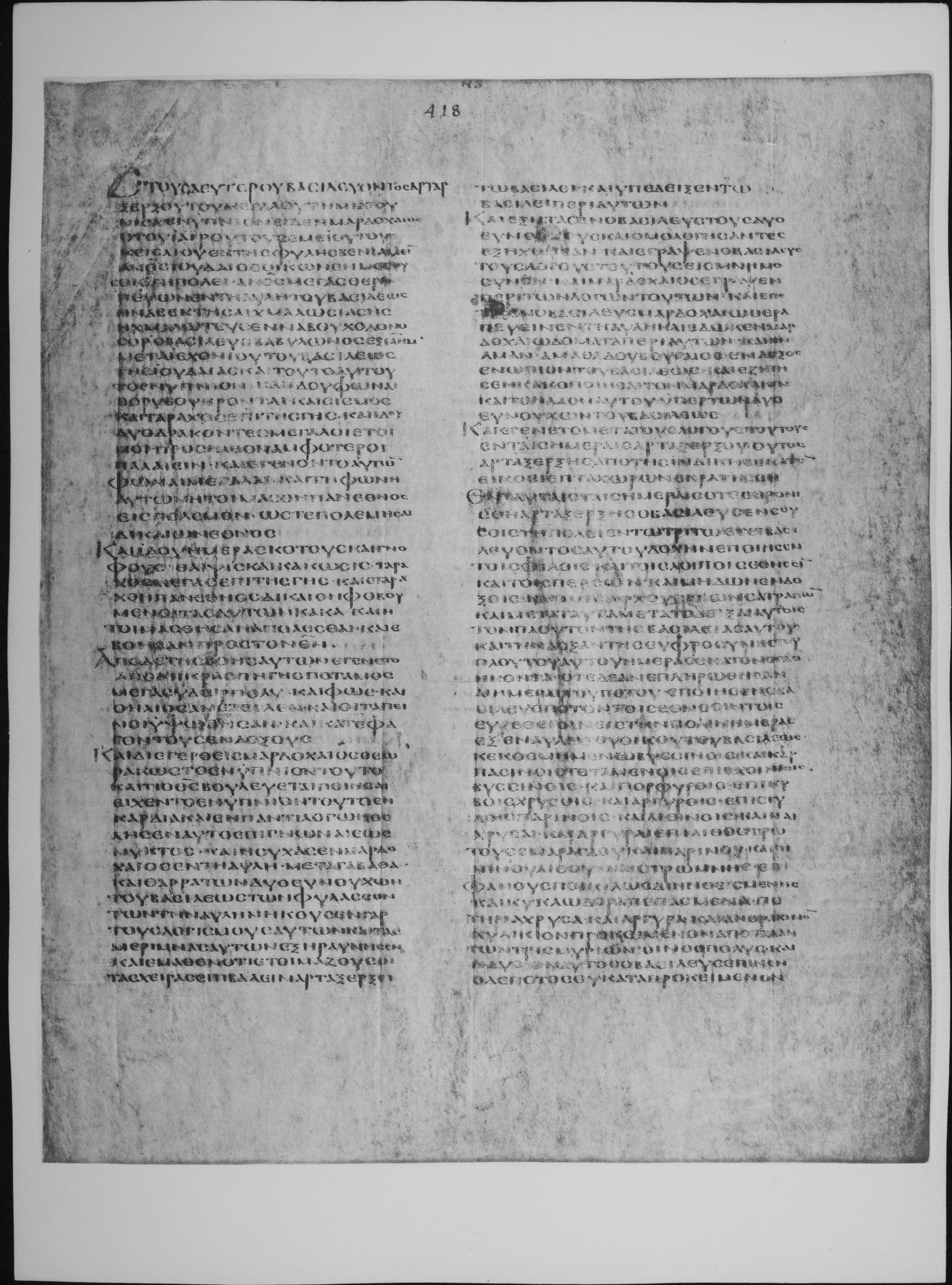
Esther 1 in the Greek Old Testament (the Septuagint) as written in Codex Alexandrinus, a Greek Bible copied in the fifth century, probably in Egypt, and now in the British Library (Royal MS 1 D. VI, the second of its four volumes). It is one of the three great early codices of the whole Greek Bible, with Codex Vaticanus and Codex Sinaiticus.
The Greek additions: the Greek book of Esther has six passages that the Hebrew book lacks (often lettered A to F; in the Latin Bible they are gathered as 10:4-16:24). Swete prints them in their places in the story, inside the verses they follow (1:1, 3:13, 4:17, 5:1-2, 8:12 and 10:3), marking their own verses with numbers in square brackets, and Brenton's English does the same. The captions of the 1936 facsimile name them by letter and by their Latin chapter and verse.
This entry meets the strict three-criteria standard of the Theosis Library:
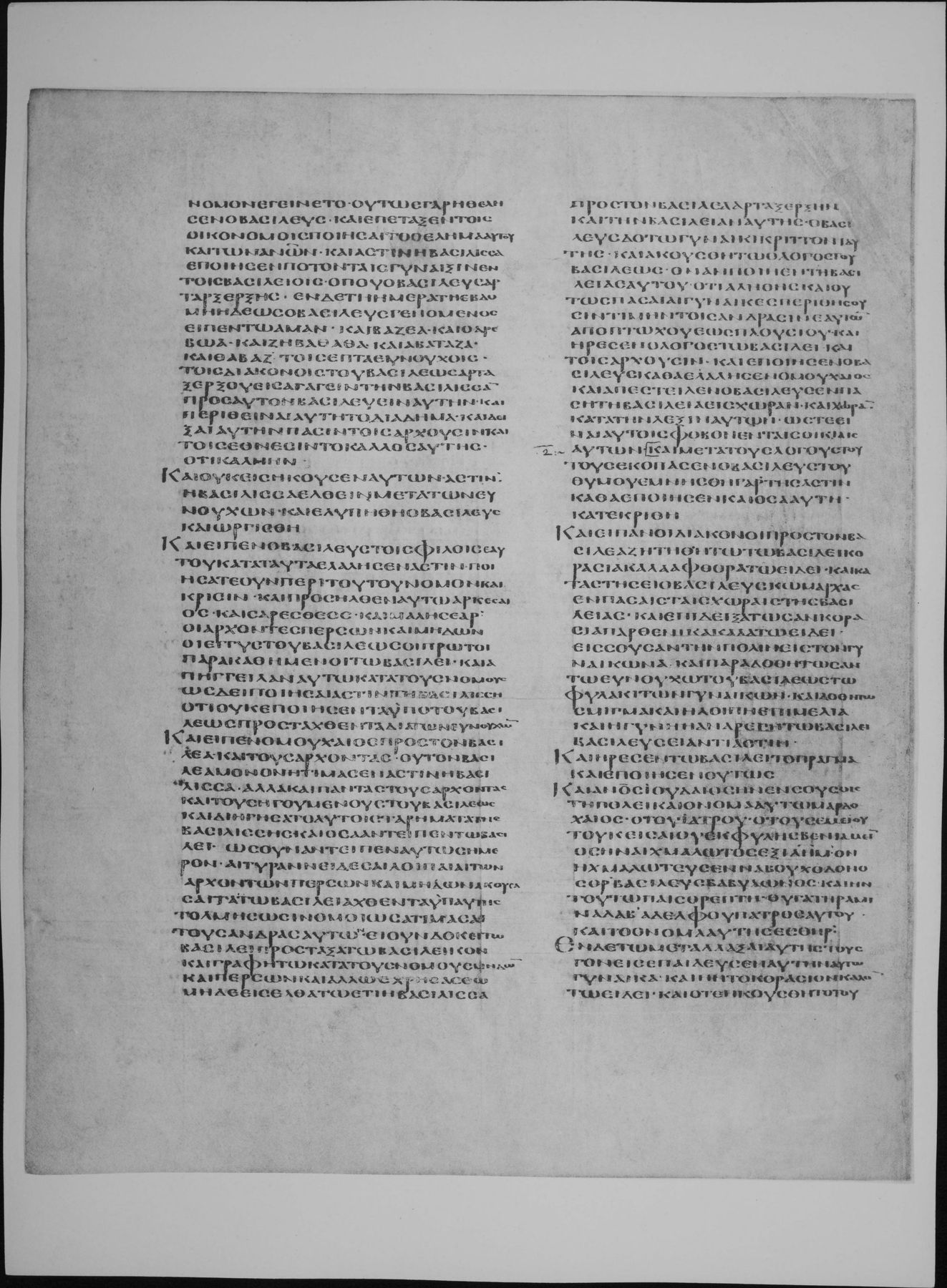
- Manuscript scan: the pages of Codex Alexandrinus carrying this chapter (fol. 418r, fol. 418v), from the full-size photographic (autotype) facsimile published by the British Museum in 1879-1883, as digitised on the Internet Archive. The verse range of every page comes from the reduced photographic facsimile of 1936, which prints it beneath each plate, and the opening words of every page were read on the plate to confirm the page and the verse it begins with. Each section links to the page or pages that hold its verses. Folio numbers are those written at the head of each leaf and visible on the plates.
- Original text: Swete's edition, which here prints the text of Codex Vaticanus (Vat. gr. 1209), the base of his edition, and gives the readings of Alexandrinus only in his apparatus. The Greek column is therefore Vaticanus' text; where Alexandrinus differs, the plate shows what Alexandrinus reads.
- English translation: Sir Lancelot C. L. Brenton, The Septuagint Version of the Old Testament (1844; 1851 edition), a translation of the Greek, public domain, from the eBible.org text.
How was this verified? (Provenance)
Where on the image
Esther 1:1-8 is on fol. 418r (full-size facsimile of 1879-83, Internet Archive codex-alexandrinus leaf 860). The 1936 reduced facsimile prints beneath this page: Esther [A=xi. 2-xii. 6], i. 1-8. Checked on the plate: the page begins at the start of Esther 1:1 (first words read: ΕΤΟΥΣ ΔΕΥΤΕΡΟΥ ΒΑΣΙΛΕΥΟΝΤΟΣ ΑΡΤΑΞΕΡΞΟΥ ΤΟΥ ΜΕΓΑΛΟΥ). Esther 1:8 is on fol. 418v (full-size facsimile of 1879-83, Internet Archive codex-alexandrinus leaf 861). The 1936 reduced facsimile prints beneath this page: Esther i. 8-ii. 8. Checked on the plate: the page begins inside Esther 1:8 (first words read: ΝΟΜΟΝ ΕΓΕΙΝΕΤΟ ΟΥΤΩΣ ΓΑΡ ΗΘΕΛΗΣΕΝ Ο ΒΑΣΙΛΕΥΣ ΚΑΙ ΕΠΕΤΑΞΕΝ ΤΟΙΣ ΟΙΚΟΝΟΜΟΙΣ).
1[1] ΕΤΟΥΣ δευτέρου βασιλεύοντος Ἀρταξέρξου τοῦ μεγάλου βασιλέως τῇ μιᾷ τοῦ Νεισὰ ἐνύπνιον ἴδεν Μαρδοχαῖος ὁ τοῦ Ἰαείρου τοῦ Σεμεείου τοῦ Κεισαίου ἐκ φυλῆς Βενιαμείν, [2] ἄνθρωπος Ἰουδαῖος οἰκῶν ἐν Σούσοις τῇ πόλει, ἄνθρωπος μέγας, θεραπεύων ἐν τῇ αὐλῇ τοῦ βασιλέως· [3] ἦν δὲ ἐκ τῆς αἰχμαλωσίας ἧς ᾐχμαλώτευσεν Ναβουχοδονοσὸρ βασιλεὺς Βαβυλῶνος ἐξ Ἰερουσαλὴμ μετὰ Ἰεχονίου τοῦ βασιλέως τῆς Ἰουδαίας. [4] καὶ τοῦτο αὐτοῦ τὸ ἐνύπνιον· καὶ ἰδοὺ φωναὶ καὶ θόρυβος, βρονταὶ καὶ σεισμός, τάραχος ἐπὶ τῆς γῆς. [5] καὶ ἰδοὺ δύο δράκοντες μέγαλοι ἕτοιμοι προῆλθον ἀμφότεροι παλαίειν· καὶ ἐγένετο αὐτῶν φωνὴ μεγάλη, [6] καὶ τῇ φωνῇ αὐτῶν ἡτοιμάσθη πᾶν ἔθνος εἰς πόλεμον ὥστε πολεμῆσαι δικαίων ἔθνος. [7] καὶ ἰδοὺ ἡμέρα σκότους καὶ γνόφου, θλίψις καὶ στενοχωρία, κάκωσις καὶ τάραχος μέγας ἐπὶ τῆς γῆς· [8] καὶ ἐταράχθη δίκαιον πᾶν ἔθνος, φοβούμενοι τὰ ἑαυτῶν κακά, καὶ ἡτοιμάσθησαν ἀπολέσθαι· [9] καὶ ἐβόησαν πρὸς τὸν θεόν. ἀπὸ δὲ τῆς βοῆς αὐτῶν ἐγένετο ὡσανεὶ ἀπὸ μικρᾶς πηγῆς ποταμὸς μέγας, ὕδωρ πολύ· [10] φῶς καὶ ὁ ἥλιος ἀνέτειλεν, καὶ οἱ ταπεινοὶ ὑψώθησαν καὶ κατέφαγον τοὺς ἐνδόξους. [11] καὶ διεγερθεὶς Μαρδοχαῖος ἑωρακὼς τὸ ἐνύπνιον τοῦτο, καὶ τί ὁ θεὸς βεβούλευται ποιῆσαι, εἶχεν αὐτὸ ἐν τῇ καρδίᾳ, καὶ ἐν παντὶ λόγῳ ἤθελεν ἐπιγνῶναι αὐτὸ ἕως τῆς νυκτός. [12] καὶ ἡσύχασεν Μαρδοχαῖος ἐν τῇ αὐλῇ μετὰ Γαβάθα καὶ Θαρρὰ τῶν δύο εὐνούχων τοῦ βασιλέως τῶν φυλασσόντων τὴν αὐλήν, [13] ἤκουσέν τε αὐτῶν τοὺς λογισμοὺς καὶ τὰς μερίμνας αὐτῶν ἐξηραύνησεν, καὶ ἔμαθεν ὅτι ἑτοιμάζουσιν τὰς χεῖρας ἐπιβαλεῖν Ἀρταξέρξῃ τῷ βασιλεῖ. καὶ ὑπέδειξεν τῷ βασιλεῖ περὶ αὐτῶν· [14] καὶ ἐξήτασεν ὁ βασιλεὺς τοὺς δύο εὐνούχους, καὶ ὁμολογήσαντες ἀπήχθησαν, [15] καὶ ἔγραψεν ὁ βασιλεὺς τοὺς λόγους τούτους εἰς μνημόσυνον, καὶ Μαρδοχαῖος ἔγραψεν περὶ τῶν λόγων τούτων· [16] καὶ ἐπέταξεν ὁ βασιλεὺς Μαρδοχαίῳ θεραπεύειν ἐν τῇ αὐλῇ, καὶ ἔδωκεν αὐτῷ δόματα περὶ τούτων. [17] καὶ ἦν Ἁμὰν Ἁμαδάθου Βουγαῖος ἔνδοξος ἐνώπιον τοῦ βασιλέως, καὶ ἐζήτησεν κακοποιῆσαι τὸν Μαρδοχαῖον καὶ τὸν λαὸν αὐτοῦ ὑπὲρ τῶν δύο εὐνούχων τοῦ βασιλέως. [18] Καὶ ἐγένετο μετὰ τοὺς λόγους τούτους ἐν ταῖς ἡμέραις Ἀρταξέρξου, οὗτος ὁ Ἀρταξέρξης ἀπὸ τῆς Ἰνδικῆς ἑκατὸν εἴκοσι ἑπτὰ χωρῶν ἐκράτησεν. 2ἐν αὐταῖς ταῖς ἡμέραις ὅτε ἐθρονίσθη ὁ βασιλεὺς, Ἀρταξέρξης ἐν Σούσοις τῇ πόλει, 3ἐν τῷ τρίτῳ ἔτει βασιλεύοντος αὐτοῦ, δοχὴν ἐποίησεν τοῖς φίλοις καὶ τοῖς λοιποῖς ἔθνεσιν καὶ τοῖς Περσῶν καὶ Μήδων ἐνδόξοις καὶ τοῖς ἄρχουσιν τῶν σατραπῶν. 4καὶ μετὰ ταῦτα μετὰ τὸ δεῖξαι αὐτοῖς τὸν πλοῦτον τῆς βασιλείας αὐτοῦ καὶ τὴν δόξαν τῆς εὐφροσύνης τοῦ πλούτου αὐτοῦ ἐν ἡμέραις ἑκατὸν ὀγδοήκοντα· 5ὅτε δὲ ἀνεπληρώθησαν αἱ ἡμέραι τοῦ γάμου, ἐποίησεν ὁ βασιλεὺς πότον τοῖς ἔθνεσιν τοῖς εὑρεθεῖσιν εἰς τὴν πόλιν ἐπὶ ἡμέρας ἓξ ἐν αὐλῇ οἴκου τοῦ βασιλέως, 6κεκοσμημένῃ βυσσίνοις καὶ καρπασίνοις τεταμένοις ἐπὶ σχοινίοις βυσσίνοις καὶ πορφυροῖς, ἐπὶ κύβοις χρυσοῖς καὶ ἀργυροῖς, ἐπὶ στύλοις παρίνοις καὶ λιθίνοις· κλίναι χρυσαῖ καὶ ἀργυραῖ ἐπὶ λιθοστρώτου σμαραγδίτου λίθου καὶ πιννίνου καὶ παρίνου λίθου, καὶ στρωμναὶ διαφανεῖς ποικίλως διηνθισμέναι, κύκλῳ ῥόδα πεπασμένα· 7ποτήρια χρυσᾶ καὶ ἀργυρᾶ, καὶ ἀνθράκινον κυλίκιον προκείμενον ἀπὸ ταλάντων τρισμυρίων· οἶνος πολὺς καὶ ἡδύς, ὃν αὐτὸς ὁ βασιλεὺς ἔπινεν. 8ὁ δὲ πότος οὗτος οὐ κατὰ προκείμενον νόμον ἐγένετο· οὕτως δὲ ἠθέλησεν ὁ βασιλεύς, καὶ ἐπέταξεν τοῖς οἰκονόμοις ποιῆσαι τὸ θέλημα αὐτοῦ καὶ τῶν ἀνθρώπων.
1[ In the second year of the reign of Artaxerxes the great king, on the first day of Nisan, Mardochæus the son of Jairus, the son of Semeias, the son of Cisæus, of the tribe of Benjamin, a Jew dwelling in the city Susa, a great man, serving in the king's palace, saw a vision. Now he was of the captivity which Nabuchodonosor king of Babylon had carried captive from Jerusalem, with Jechonias the king of Judea. And this was his dream: Behold, voices and a noise, thunders and earthquake, tumult upon the earth. And, behold, two great serpents came forth, both ready for conflict, and there came from them a great voice, and by their voice every nation was prepared for battle, even to fight against the nation of the just. And, behold, a day of darkness and blackness, tribulation and anguish, affliction and great tumult upon the earth. And all the righteous nation was troubled, fearing their own afflictions; and they prepared to die, and cried to God: and from their cry there came as it were a great river from a little fountain, even much water. And light and the sun arose, and the lowly were exalted, and devoured the honourable. And Mardochæus who had seen this vision and what God designed to do, having awoke, kept it in his heart, and desired by all means to interpret it, even till night. And Mardochæus rested quiet in the palace with Gabatha and Tharrha the king's two chamberlains, eunuchs who guarded the palace. And he heard their reasonings and searched out their plans, and learnt that they were preparing to lay hands on king Artaxerxes: and he informed the king concerning them. And the king examined the two chamberlains, and they confessed, and were executed. And the king wrote these things for a memorial; also Mardochæus wrote concerning these matters. And the king commanded Mardochæus to attend in the palace, and gave him gifts for this service. And Aman the son of Amadathes the Bugæan was honourable in the sight of the king, and he endeavoured to hurt Mardochæus and his people, because of the two chamberlains of the king.] And it came to pass after these things in the days of Artaxerxes,—(this Artaxerxes ruled over a hundred and twenty-seven provinces from India)— 2in those days, when king Artaxerxes was on the throne in the city of Susa, 3in the third year of his reign, he made a feast to his friends, and the other nations, and to the nobles of the Persians and Medes, and the chief of the satraps. 4And after this, after he had shewn to them the wealth of his kingdom, and the abundant glory of his wealth during a hundred and eighty days, 5when, I say, the days of the marriage feast were completed, the king made a banquet to the nations who were present in the city six days, in the court of the king's house, 6which was adorned with hangings of fine linen and flax on cords of fine linen and purple, fastened to golden and silver studs, on pillars of Parian marble and stone: there were golden and silver couches on a pavement of emerald stone, and of pearl, and of Parian stone, and open-worked coverings variously flowered, having roses worked round about; 7gold and silver cups, and a small cup of carbuncle set out of the value of thirty thousand talents, abundant and sweet wine, which the king himself drank. 8And this banquet was not according to the appointed law; but so the king would have it: and he charged the stewards to perform his will and that of the company.
Where on the image
Esther 1:9-16 is on fol. 418v (full-size facsimile of 1879-83, Internet Archive codex-alexandrinus leaf 861). The 1936 reduced facsimile prints beneath this page: Esther i. 8-ii. 8. Checked on the plate: the page begins inside Esther 1:8 (first words read: ΝΟΜΟΝ ΕΓΕΙΝΕΤΟ ΟΥΤΩΣ ΓΑΡ ΗΘΕΛΗΣΕΝ Ο ΒΑΣΙΛΕΥΣ ΚΑΙ ΕΠΕΤΑΞΕΝ ΤΟΙΣ ΟΙΚΟΝΟΜΟΙΣ).
9καὶ Ἀστὶν ἡ βασίλισσα ἐποίησε πότον ταῖς γυναιξὶν ἐν τοῖς βασιλείοις ὅπου ὁ βασιλεὺς Ἀρταξέρξης. 10ἐν δὲ τῇ ἡμέρᾳ τῇ ἑβδόμῃ ἡδέως γενόμενος ὁ βασιλεὺς εἶπεν τῷ Ἁμὰν καὶ Μαζὰν καὶ Θαρρὰ καὶ Βωραζὴ καὶ Ζαθολθὰ καὶ Ἀβαταζὰ καὶ Θαραβά, τοῖς ἑπτὰ εὐνούχοις τοῖς διακόνοις τοῦ βασιλέως Ἀρταξέρξου, 11εἰσαγαγεῖν τὴν βασίλισσαν πρὸς αὐτόν, βασιλεύειν αὐτὴν καὶ περιθεῖναι αὐτῇ τὸ διάδημα καὶ δεῖξαι αὐτὴν τοῖς ἄρχουσιν καὶ τοῖς ἔθνεσιν τὸ κάλλος αὐτῆς· ὅτι καλὴ ἦν. 12καὶ οὐκ εἰσήκουσεν αὐτοῦ Ἀστὶν ἡ βασίλισσα ἐλθεῖν μετὰ τῶν εὐνούχων· καὶ ἐλυπήθη ὁ βασιλεὺς καὶ ὠργίσθη, 13καὶ εἶπεν τοῖς φίλοις αὐτοῦ Κατὰ ταῦτα ἐλάλησεν Ἀστίν, ποιήσατε οὖν περὶ τούτου νόμον καὶ κρίσιν. 14καὶ προσῆλθεν αὐτῷ Ἁρκεσαῖος καὶ Σαρσαθαῖος καὶ Μαλησεὰρ οἱ ἄρχοντες Περσῶν καὶ Μήδων οἱ ἐγγὺς τοῦ βασιλέως, οἱ πρῶτοι παρακαθήμενοι τῷ βασιλεῖ, 15καὶ ἀπήγγειλαν αὐτῷ κατὰ τοὺς νόμους ὡς δεῖ ποιῆσαι Ἀστὶν τῇ βασιλίσσῃ, ὅτι οὐκ ἐποίησεν τὰ ὑπὸ τοῦ βασιλέως προσταχθέντα διὰ τῶν εὐνούχων. 16καὶ εἶπεν ὁ Μουχαῖος πρὸς τὸν βασιλέα καὶ τοὺς ἄρχοντας Οὐ τὸν βασιλέα μόνον ἠδίκησεν Ἀστὶν ἡ βασίλισσα, ἀλλὰ καὶ πάντας τοὺς ἄρχοντας καὶ τοὺς ἡγουμένους τοῦ βασιλέως.
9Also Astin the queen made a banquet for the women in the palace where king Artaxerxes dwelt. 10Now on the seventh day the king, being merry, told Aman, and Bazan, and Tharrha, and Barazi, and Zatholtha, and Abataza, and Tharaba, the seven chamberlains, servants of king Artaxerxes, 11to bring in the queen to him, to enthrone her, and crown her with the diadem, and to shew her to the princes, and her beauty to the nations: for she was beautiful. 12But queen Astin hearkened not to him to come with the chamberlains: so the king was grieved and angered. 13And he said to his friends, Thus has Astin spoken: pronounce therefore upon this case law and judgment. 14So Arkesæus, and Sarsathæus, and Malisear, the princes of the Persians and Medes, who were near the king, who sat chief in rank by the king, drew near to him, 15and reported to him according to the laws how it was proper to do to queen Astin, because she had not done the things commanded of the king by the chamberlains. 16And Muchæus said to the king and to the princes, Queen Astin has not wronged the king only, but also all the king's rulers and princes:
Where on the image
Esther 1:17-22 is on fol. 418v (full-size facsimile of 1879-83, Internet Archive codex-alexandrinus leaf 861). The 1936 reduced facsimile prints beneath this page: Esther i. 8-ii. 8. Checked on the plate: the page begins inside Esther 1:8 (first words read: ΝΟΜΟΝ ΕΓΕΙΝΕΤΟ ΟΥΤΩΣ ΓΑΡ ΗΘΕΛΗΣΕΝ Ο ΒΑΣΙΛΕΥΣ ΚΑΙ ΕΠΕΤΑΞΕΝ ΤΟΙΣ ΟΙΚΟΝΟΜΟΙΣ).
17καὶ γὰρ διηγήσατο αὐτοῖς τὰ ῥήματα τῆς βασιλίσσης, καὶ ὡς ἀντεῖπεν τῷ βασιλεῖ. ὡς οὖν ἀντεῖπεν τῷ βασιλεῖ Ἀρταξέρξῃ, 18οὕτως σήμερον αἱ τυραννίδες αἱ λοιπαὶ τῶν ἀρχόντων Περσῶν καὶ Μήδων ἀκούσασαι τὰ τῷ βασιλεῖ λεχθέντα ὑπ᾽ αὐτῆς τολμήσουσιν ὁμοίως ἀτιμάσαι τοὺς ἄνδρας αὐτῶν. 19εἰ οὖν δοκεῖ τῷ βασιλεῖ, προσταξάτω βασιλικὸν καὶ γραφήτω κατὰ τοὺς νόμους Μήδων καὶ Περσῶν, καὶ μὴ ἄλλως χρησάσθω, μηδὲ εἰσελθάτω ἔτι ἡ βασίλισσα πρὸς αὐτόν, καὶ τὴν βασιλείαν αὐτῆς δότω ὁ βασιλεὺς γυναικὶ κρείττονι αὐτῆς. 20καὶ ἀκουσθήτω ὁ νόμος ὁ ὑπὸ τοῦ βασιλέως ὃν ἐὰν ποιῇ ἐν τῇ βασιλείᾳ αὐτοῦ· καὶ οὕτως πᾶσαι αἱ γυναῖκες περιθήσουσιν τιμὴν τοῖς ἀνδράσιν ἑαυτῶν, ἀπὸ πτωχοῦ ἕως πλουσίου. 21καὶ ἤρεσεν ὁ λόγος τῷ βασιλεῖ καὶ τοῖς ἄρχουσι· καὶ ἐποίησεν ὁ βασιλεὺς καθὰ ἐλάλησεν ὁ Μουχαῖος, 22καὶ ἀπέστειλεν εἰς πᾶσαν τὴν βασιλείαν κατὰ χώραν, κατὰ τὴν λέξιν αὐτῶν, ὥστε εἶναι φόβον αὐτοῖς ἐν ταῖς οἰκίαις αὐτῶν.
17for he has told them the words of the queen, and how she disobeyed the king. As then, said he, she refused to obey king Artaxerxes, 18so this day shall the other ladies of the chiefs of the Persians and Medes, having heard what she said to the king, dare in the same way to dishonour their husbands. 19If then it seem good to the king, let him make a royal decree, and let it be written according to the laws of the Medes and Persians, and let him not alter it: and let not the queen come in to him any more; and let the king give her royalty to a woman better than she. 20And let the law of the king which he shall have made, be widely proclaimed, in his kingdom: and so shall all the women give honour to their husbands, from the poor even to the rich. 21And the saying pleased the king and the princes; and the king did as Muchæus had said, 22and sent into all his kingdom through the several provinces, according to their language, in order that men might be feared in their own houses.
Cite
Sources
- Source: Codex Alexandrinus (British Library Royal MS 1 D. VI) via the British Museum photographic facsimiles of 1879-83 and 1936 (Internet Archive) + Swete's Septuagint + Brenton's English (holding institution)
- Critical edition: H. B. Swete, The Old Testament in Greek according to the Septuagint (1909)
← previous · → next · v cycle view · l back to library