Genesis, Chapter 10 (Codex Alexandrinus)
Introduction
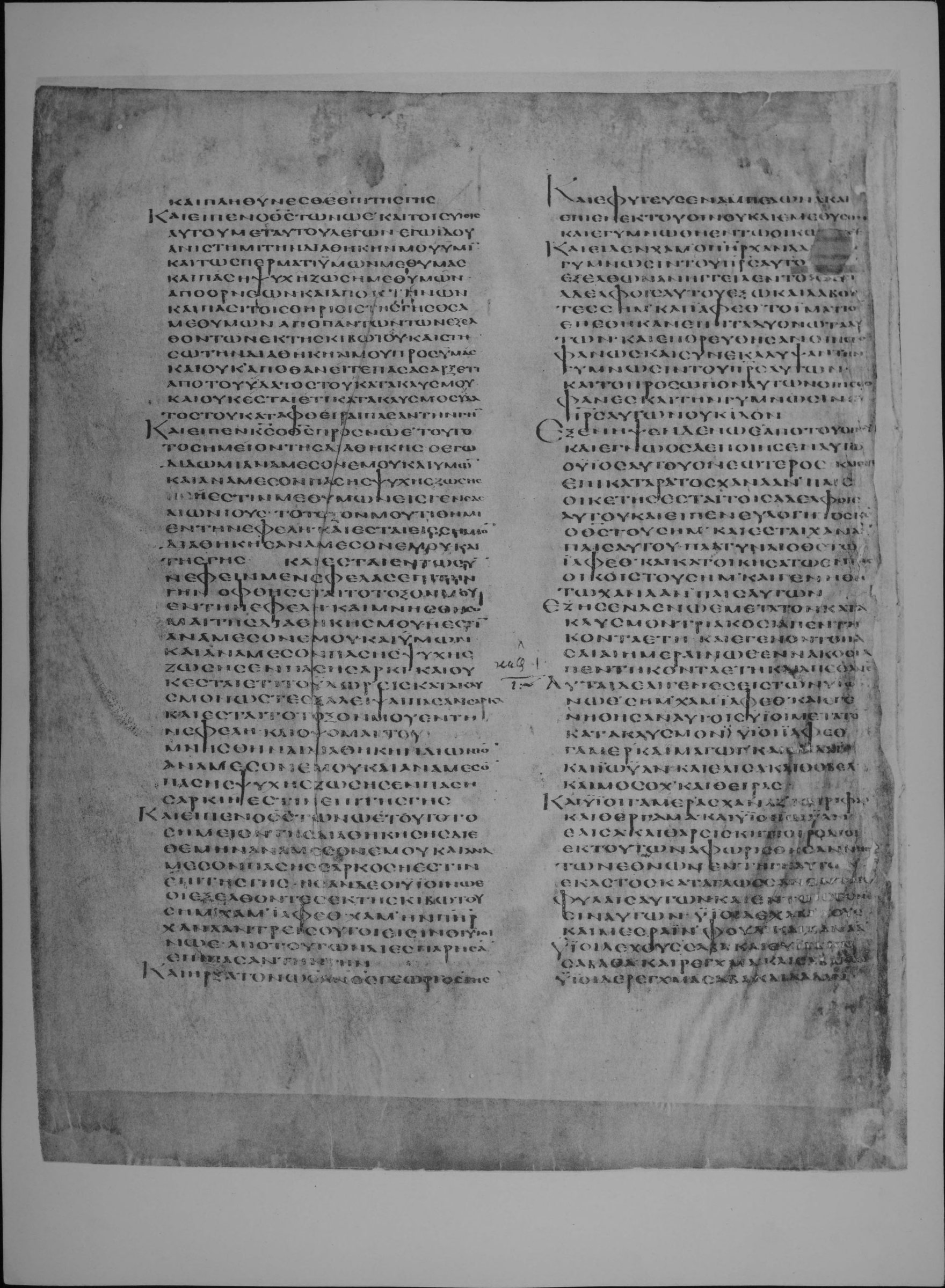
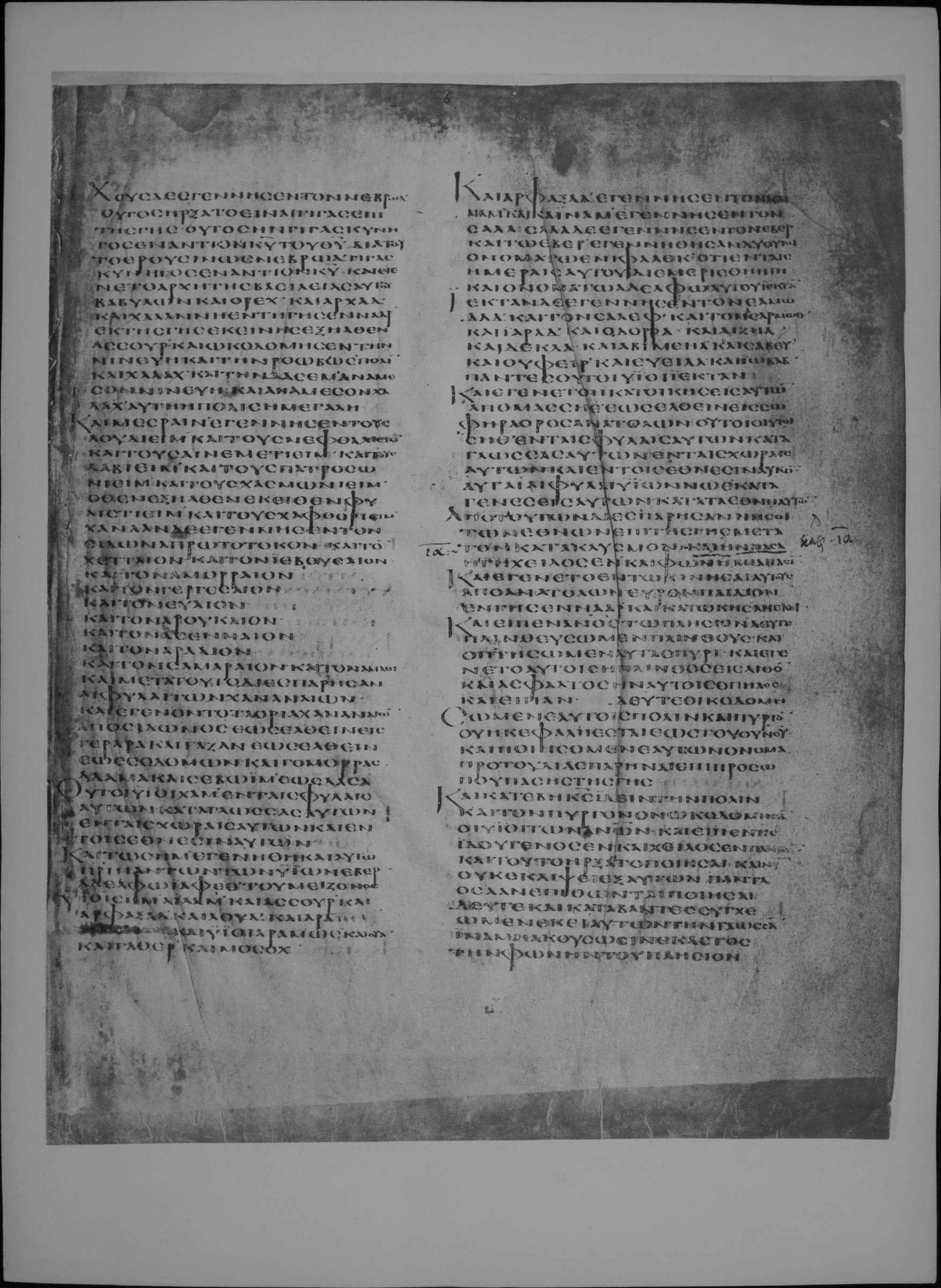
Genesis 10 in the Greek Old Testament (the Septuagint) as written in Codex Alexandrinus, a Greek Bible copied in the fifth century, probably in Egypt, and now in the British Library (Royal MS 1 D. V, the first of its four volumes). It is one of the three great early codices of the whole Greek Bible, with Codex Vaticanus and Codex Sinaiticus, and for Genesis 1:1-46:28, which Codex Vaticanus has lost, it is the oldest surviving complete Greek text (older papyri such as the Berlin Genesis papyrus and Chester Beatty 961 survive only in part).
This entry meets the strict three-criteria standard of the Theosis Library:
- Manuscript scan: the pages of Codex Alexandrinus carrying this chapter (fol. 5v, fol. 6r), from the full-size photographic (autotype) facsimile published by the British Museum in 1879-1883, as digitised on the Internet Archive. The verse range of every page comes from the reduced photographic facsimile of 1915, which prints it beneath each plate, and the opening words of every page were read on the plate to confirm the page and the verse it begins with. Each section links to the page or pages that hold its verses. Folio numbers are those written at the head of each leaf and visible on the plates.
- Original text: Swete's edition, which in Genesis 1:1-46:28 prints the text of Codex Alexandrinus itself (Codex Vaticanus has lost these chapters), with the spelling of A for the most part. Swete adds accents, breathings and punctuation and expands the abbreviated sacred names, so the plate shows the same text in unaccented capitals.
- English translation: Sir Lancelot C. L. Brenton, The Septuagint Version of the Old Testament (1844; 1851 edition), a translation of the Greek, public domain, from the eBible.org text.
How was this verified? (Provenance)
Where on the image
Genesis 10:1-7 is on fol. 5v (full-size facsimile of 1879-83, Internet Archive codex-alexandrinus leaf 31). The 1915 reduced facsimile prints beneath this page: Gen. ix. 7-x. 7. Checked on the plate: the page begins inside Genesis 9:7 (first words read: ΚΑΙ ΠΛΗΘΥΝΕΣΘΕ ΕΠΙ ΤΗΣ ΓΗΣ ΚΑΙ ΕΙΠΕΝ Ο ΘΣ ΤΩ ΝΩΕ). Genesis 10:8 is on fol. 6r (full-size facsimile of 1879-83, Internet Archive codex-alexandrinus leaf 32). The 1915 reduced facsimile prints beneath this page: Gen. x. 8-xi. 7. Checked on the plate: the page begins at the start of Genesis 10:8 (first words read: ΧΟΥΣ ΔΕ ΕΓΕΝΝΗΣΕΝ ΤΟΝ ΝΕΒΡΩΔ).
1Αὗται δὲ αἱ γενέσεις τῶν υἱῶν Νῶε, Σήμ, Χάμ, Ἰάφεθ· καὶ ἐγενήθησαν αὐτοῖς υἱοὶ μετὰ τὸν κατακλυσμόν. 2Υἱοὶ Ἰάφεθ· Γάμερ καὶ Μαγὼγ καὶ Μαδαὶ καὶ Ἰωυὰν καὶ Ἐλισὰ καὶ Θοβὲλ καὶ Μόσοχ καὶ Θειράς. 3καὶ υἱοὶ Γάμερ· Ἀσχανὰζ καὶ Ῥιφὰθ καὶ Θεργαμά. 4καὶ υἱοὶ Ἰωυάν· Ἐλισὰ καὶ Θαρσίς, Κήτιοι, Ῥόδιοι. 5ἐκ τούτων ἀφωρίσθησαν νῆσοι τῶν ἐθνῶν ἐν τῇ γῇ αὐτῶν· ἕκαστος κατὰ γλῶσσαν ἐν ταῖς φυλαῖς αὐτῶν καὶ ἐν τοῖς ἔθνεσιν αὐτῶν. 6Υἱοὶ δὲ Χάμ· Χοὺς καὶ Μεσράιν, Φοὺδ καὶ Χανάαν. 7υἱοὶ δὲ Χούς· Σαβὰ καὶ Εὑιλὰ καὶ Σαβαθὰ καὶ Ῥεγχμὰ καὶ Σαβακαθά. υἱοὶ δὲ Ῥεγχμά· Σαβὰ καὶ Δαδάν. 8Χοὺς δὲ ἐγέννησεν τὸν Νεβρώδ· οὗτος ἤρξατο εἶναι γίγας ἐπὶ τῆς γῆς.
1Now these are the generations of the sons of Noe, Sem, Cham, Japheth; and sons were born to them after the flood. 2The sons of Japheth, Gamer, and Magog, and Madoi, and Jovan, and Elisa, and Thobel, and Mosoch, and Thiras. 3And the sons of Gamer, Aschanaz, and Riphath, and Thorgama. 4And the sons of Jovan, Elisa, and Tharseis, Cetians, Rhodians. 5From these were the islands of the Gentiles divided in their land, each according to his tongue, in their tribes and in their nations. 6And the sons of Cham, Chus, and Mesrain, Phud, and Chanaan. 7And the sons of Chus, Saba, and Evila, and Sabatha, and Rhegma, and Sabathaca. And the sons of Rhegma, Saba, and Dadan. 8And Chus begot Nebrod: he began to be a giant upon the earth.
Where on the image
Genesis 10:9-16 is on fol. 6r (full-size facsimile of 1879-83, Internet Archive codex-alexandrinus leaf 32). The 1915 reduced facsimile prints beneath this page: Gen. x. 8-xi. 7. Checked on the plate: the page begins at the start of Genesis 10:8 (first words read: ΧΟΥΣ ΔΕ ΕΓΕΝΝΗΣΕΝ ΤΟΝ ΝΕΒΡΩΔ).
9οὗτος ἦν γίγας κυνηγὸς ἐναντίον Κυρίου τοῦ θεοῦ· διὰ τοῦτο ἐροῦσιν Ὡς Νεβρὼδ γίγας κυνηγὸς ἐναντίον Κυρίου. 10καὶ ἐγένετο ἀρχὴ τῆς βασιλείας αὐτοῦ Βαβυλὼν καὶ Ὄρεχ καὶ Ἀρχὰδ καὶ Χαλαννὴ ἐν τῇ γῇ Σενναάρ. 11ἐκ τῆς γῆς ἐκείνης ἐξῆλθεν Ἀσσούρ· καὶ ᾠκοδόμησεν τὴν Νινευὴ καὶ την Ῥοωβὼς πόλιν καὶ Χάλαχ, 12καὶ τὴν Δάσεμ, ἀνὰ μέσον Νινευὴ καὶ ἀνὰ μέσον Χάλαχ· αὕτη ἡ πόλις ἡ μεγάλη. 13καὶ Μεσράιν ἐγέννησεν τοὺς Λουδιεὶμ καὶ τοὺς Νεφθαλιεὶμ καὶ τοὺς Αἰνεμετιεὶμ καὶ τοὺς Λαβιεὶμ 14καὶ τοὺς Πατροσωνιεὶμ καὶ τοὺς Χασμωνιείμ, ὅθεν ἐξῆλθεν ἐκεῖθεν Φυλιστιείμ, καὶ τοὺς Χαφθοριείμ. 15Χανάαν δὲ ἐγέννησεν τὸν Σιδῶνα πρωτότοκον, καὶ τὸν Χετταῖον 16καὶ τὸν Ἰεβουσαῖον καὶ τὸν Ἀμορραῖον καὶ τὸν Γεργεσαῖον
9He was a giant hunter before the Lord God; therefore they say, As Nebrod the giant hunter before the Lord. 10And the beginning of his kingdom was Babylon, and Orech, and Archad, and Chalanne, in the land of Senaar. 11Out of that land came Assur, and built Ninevi, and the city Rhooboth, and Chalach, 12and Dase between Ninevi and Chalach: this is the great city. 13And Mesrain begot the Ludiim, and the Nephthalim, and the Enemetiim, and the Labiim, 14and the Patrosoniim, and the Chasmoniim (whence came forth Phylistiim) and the Gaphthoriim. 15And Chanaan begot Sidon his first-born, and the Chettite, 16and the Jebusite, and the Amorite, and the Girgashite,
Where on the image
Genesis 10:17-24 is on fol. 6r (full-size facsimile of 1879-83, Internet Archive codex-alexandrinus leaf 32). The 1915 reduced facsimile prints beneath this page: Gen. x. 8-xi. 7. Checked on the plate: the page begins at the start of Genesis 10:8 (first words read: ΧΟΥΣ ΔΕ ΕΓΕΝΝΗΣΕΝ ΤΟΝ ΝΕΒΡΩΔ).
17καὶ τὸν Εὑαῖον καὶ τὸν Ἀρουκαῖον καὶ τὸν Ἁσενναῖον 18καὶ τὸν Ἀράδιον καὶ τὸν Σαμαραῖον καὶ τὸν Ἁμαθί. καὶ μετὰ τοῦτο διεσπάρησαν αἱ φυλαὶ τῶν Χαναναίων. 19καὶ ἐγένοντο τὰ ὅρια Χαναναίων ἀπὸ Σιδῶνος ἕως ἐλθεῖν εἰς Γέραρα καὶ Γάζαν, ἕως ἐλθεῖν ἕως Σοδόμων καὶ Γομόρρας, Ἀδαμὰ καὶ Σεβωὶμ ἕως Δασά. 20οὗτοι υἱοὶ Χὰμ ἐν ταῖς φυλαῖς αὐτῶν, κατὰ γλώσσας αὐτῶν, ἐν ταῖς χώραις αὐτῶν καὶ ἐν τοῖς ἔθνεσιν αὐτῶν. 21Καὶ τῷ Σὴμ ἐγενήθη καὶ αὐτῷ, πατρὶ πάντων τῶν υἱῶν Ἔβερ, ἀδελφῷ Ἰάφεθ τοῦ μείζονος. 22υἱοὶ Σήμ· Αἰλὰμ καὶ Ἀσσοὺρ καὶ Ἀρφαξὰδ καὶ Λοὺδ καὶ Ἀράμ. 23καὶ υἱοὶ Ἀράμ· Ὢς καὶ Οὓλ καὶ Γάθερ καὶ Μόσοχ. 24καὶ Ἀρφαξὰδ ἐγέννησεν τὸν Καινάμ, καὶ Καινὰμ ἐγέννησεν τὸν Σάλα, Σάλα δὲ ἐγέννησεν τὸν Ἔβερ.
17and the Evite, and the Arukite, and the Asennite, 18and the Aradian, and the Samarean, and the Amathite; and after this the tribes of the Chananites were dispersed. 19And the boundaries of the Chananites were from Sidon till one comes to Gerara and Gaza, till one comes to Sodom and Gomorrha, Adama and Seboim, as far as Dasa. 20These were the sons of Cham in their tribes according to their tongues, in their countries, and in their nations. 21And to Sem himself also were children born, the father of all the sons of Heber, the brother of Japheth the elder. 22Sons of Sem, Elam, and Assur, and Arphaxad, and Lud, and Aram, and Cainan. 23And sons of Aram, Uz, and Ul, and Gater, and Mosoch. 24And Arphaxad begot Cainan, and Cainan begot Sala. And Sala begot Heber.
Where on the image
Genesis 10:25-32 is on fol. 6r (full-size facsimile of 1879-83, Internet Archive codex-alexandrinus leaf 32). The 1915 reduced facsimile prints beneath this page: Gen. x. 8-xi. 7. Checked on the plate: the page begins at the start of Genesis 10:8 (first words read: ΧΟΥΣ ΔΕ ΕΓΕΝΝΗΣΕΝ ΤΟΝ ΝΕΒΡΩΔ).
25καί τῷ Ἔβερ ἐγεννήθησαν δύο υἱοί· ὄνομα τῷ ἑνὶ Φάλεκ, ὅτι ἐν ταῖς ἡμέραις αὐτοῦ διεμερίσθη ἡ γῆ, καὶ ὄνομα τῷ ἀδελφῷ αὐτοῦ Ἰεκτάν. 26Ἰεκτάν δὲ ἐγέννησεν τὸν Ἐλμωδὰδ καὶ τὸν Σάλεφ καὶ τὸν Ἁσαρμὼθ καὶ Ἰάραδ 27καὶ Ὁδορρὰ καὶ Αἰζὴλ καὶ Δεκλὰ 28καὶ Ἀβιμεὴλ καὶ Σαβεῦ 29καὶ Οὐφεὶρ καὶ Εὑειλὰ καὶ Ἰωβάβ. πάντες οὗτοι υἱοὶ Ἰεκτάν. 30καὶ ἐγένετο ἡ κατοίκησις αὐτῶν ἀπὸ Μασσηὲ ἕως ἐλθεῖν εἰς Σωφήρα, ὄρος ἀνατολῶν. 31οὗτοι οἱ υἱοὶ Σὴμ ἐν ταῖς φυλαῖς αὐτῶν, κατὰ γλώσσας αὐτῶν, ἐν ταῖς χώραις αὐτῶν καὶ ἐν τοῖς ἔθνεσιν αὐτῶν. 32Αὗται αἱ φυλαὶ υἱῶν Νῶε κατὰ γενέσεις αὐτῶν, κατὰ τὰ ἔθνη αὐτῶν· ἀπὸ τούτων διεσπάρησαν νῆσοι τῶν ἐθνῶν ἐπὶ τῆς γῆς μετὰ τὸν κατακλυσμόν.
25And to Heber were born two sons, the name of the one, Phaleg, because in his days the earth was divided, and the name of his brother Jektan. 26And Jektan begot Elmodad, and Saleth, and Sarmoth, and Jarach, 27and Odorrha, and Aibel, and Decla, 28and Eval, and Abimael, and Saba, 29and Uphir, and Evila, and Jobab, all these were the sons of Jektan. 30And their dwelling was from Masse, till one comes to Saphera, a mountain of the east. 31These were the sons of Sem in their tribes, according to their tongues, in their countries, and in their nations. 32These are the tribes of the sons of Noe, according to their generations, according to their nations: of them were the islands of the Gentiles scattered over the earth after the flood.
Cite
Sources
- Source: Codex Alexandrinus (British Library Royal MS 1 D. V) via the British Museum photographic facsimiles of 1879-83 and 1915 (Internet Archive) + Swete's Septuagint + Brenton's English (holding institution)
- Critical edition: H. B. Swete, The Old Testament in Greek according to the Septuagint (1909)
← previous · → next · v cycle view · l back to library