Genesis, Chapter 11 (Codex Alexandrinus)
Introduction
Genesis 11 in the Greek Old Testament (the Septuagint) as written in Codex Alexandrinus, a Greek Bible copied in the fifth century, probably in Egypt, and now in the British Library (Royal MS 1 D. V, the first of its four volumes). It is one of the three great early codices of the whole Greek Bible, with Codex Vaticanus and Codex Sinaiticus, and for Genesis 1:1-46:28, which Codex Vaticanus has lost, it is the oldest surviving complete Greek text (older papyri such as the Berlin Genesis papyrus and Chester Beatty 961 survive only in part).
This entry meets the strict three-criteria standard of the Theosis Library:
- Manuscript scan: the pages of Codex Alexandrinus carrying this chapter (fol. 6r, fol. 6v, fol. 7r), from the full-size photographic (autotype) facsimile published by the British Museum in 1879-1883, as digitised on the Internet Archive. The verse range of every page comes from the reduced photographic facsimile of 1915, which prints it beneath each plate, and the opening words of every page were read on the plate to confirm the page and the verse it begins with. Each section links to the page or pages that hold its verses. Folio numbers are those written at the head of each leaf and visible on the plates.
- Original text: Swete's edition, which in Genesis 1:1-46:28 prints the text of Codex Alexandrinus itself (Codex Vaticanus has lost these chapters), with the spelling of A for the most part. Swete adds accents, breathings and punctuation and expands the abbreviated sacred names, so the plate shows the same text in unaccented capitals.
- English translation: Sir Lancelot C. L. Brenton, The Septuagint Version of the Old Testament (1844; 1851 edition), a translation of the Greek, public domain, from the eBible.org text.
How was this verified? (Provenance)
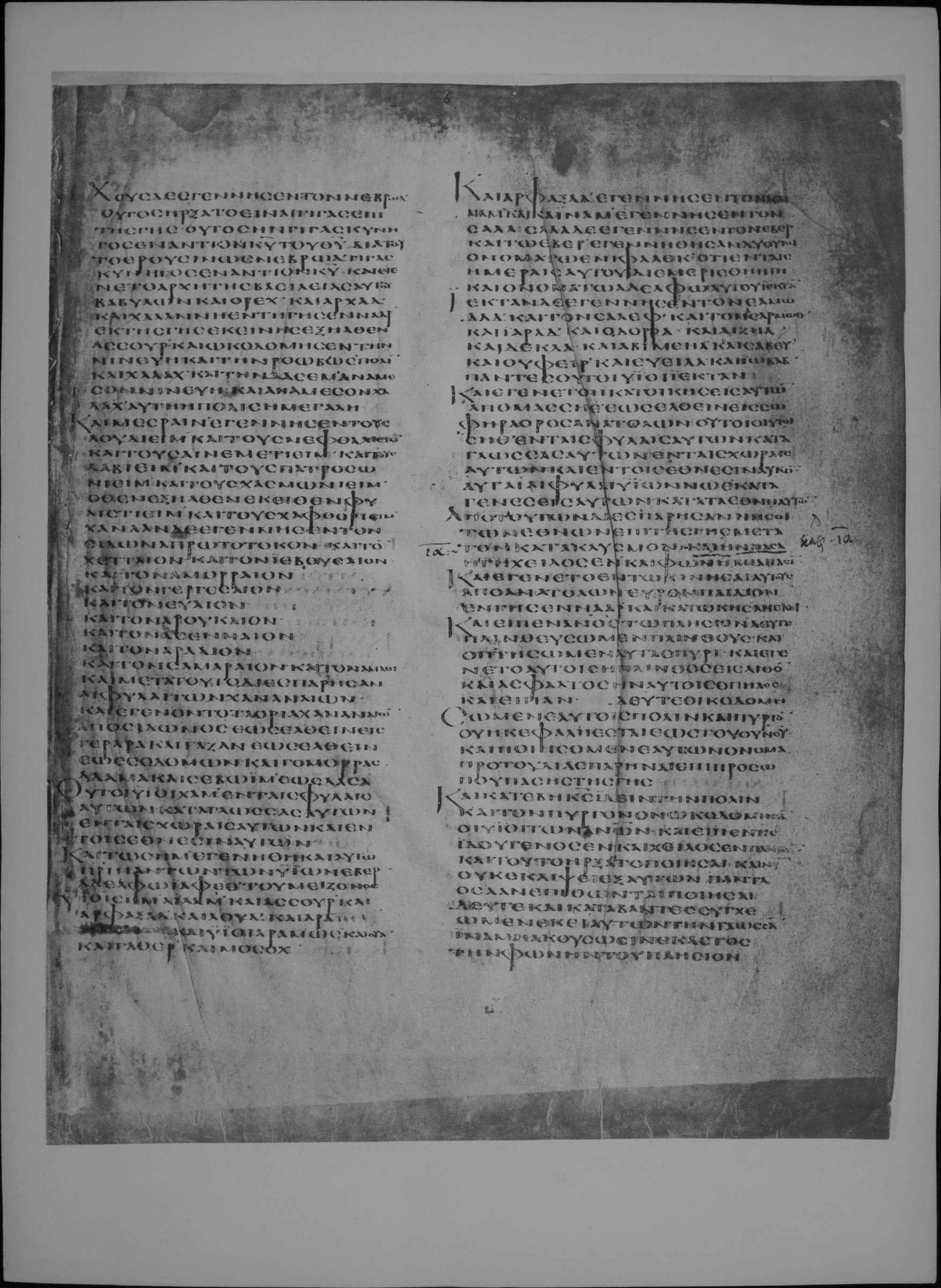
Where on the image
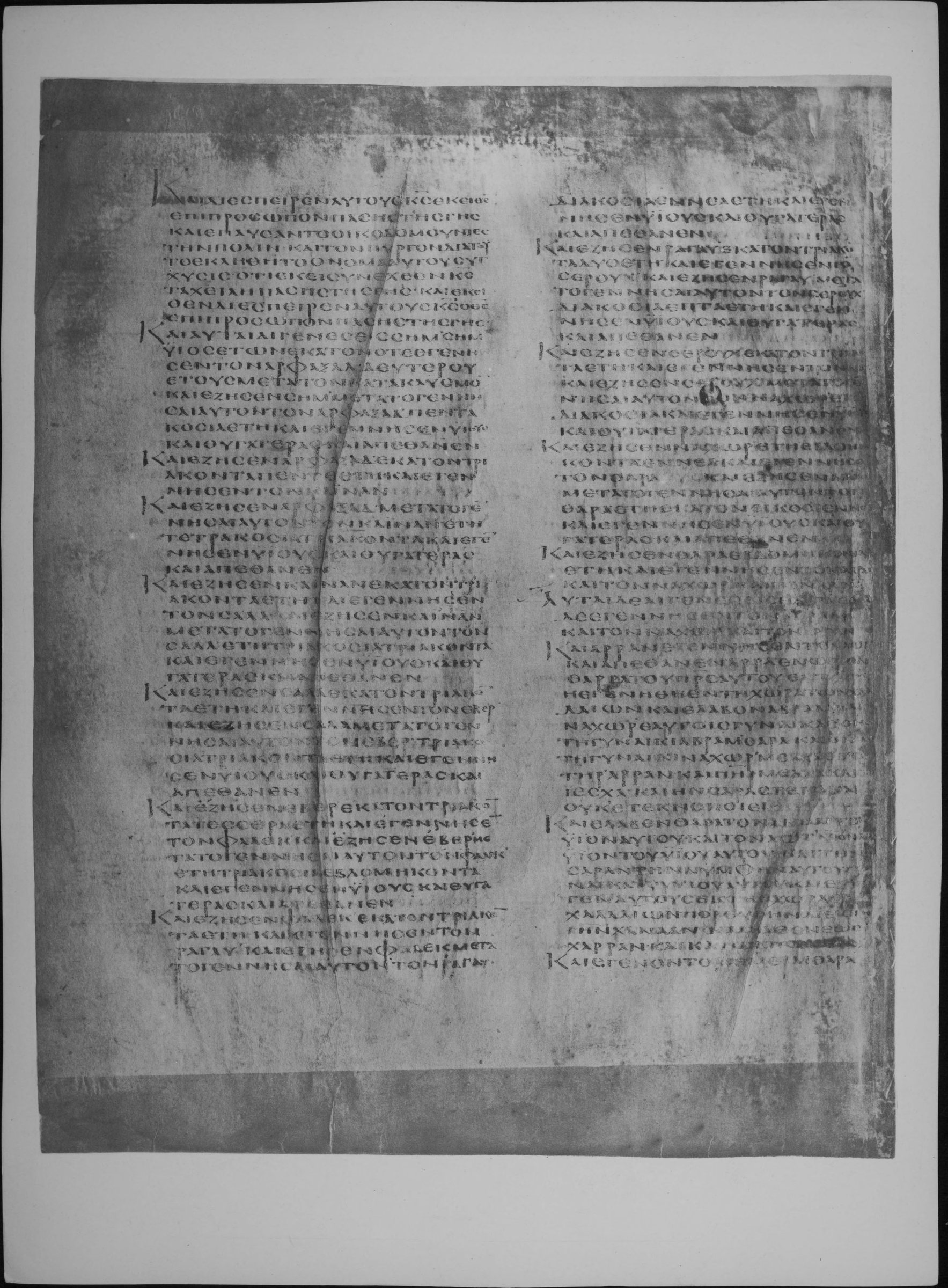
Genesis 11:1-7 is on fol. 6r (full-size facsimile of 1879-83, Internet Archive codex-alexandrinus leaf 32). The 1915 reduced facsimile prints beneath this page: Gen. x. 8-xi. 7. Checked on the plate: the page begins at the start of Genesis 10:8 (first words read: ΧΟΥΣ ΔΕ ΕΓΕΝΝΗΣΕΝ ΤΟΝ ΝΕΒΡΩΔ). Genesis 11:8 is on fol. 6v (full-size facsimile of 1879-83, Internet Archive codex-alexandrinus leaf 33). The 1915 reduced facsimile prints beneath this page: Gen. xi. 8-32. Checked on the plate: the page begins at the start of Genesis 11:8 (first words read: ΚΑΙ ΔΙΕΣΠΕΙΡΕΝ ΑΥΤΟΥΣ ΚΣ ΕΚΕΙΘΕΝ ΕΠΙ ΠΡΟΣΩΠΟΝ ΠΑΣΗΣ ΤΗΣ ΓΗΣ).
1Καὶ ἦν πᾶσα ἡ γῆ χεῖλος ἕν, καὶ φωνὴ μία πᾶσιν. 2καὶ ἐγένετο ἐν τῷ κινῆσαι αὐτοὺς ἀπὸ ἀνατολῶν εὗρον πεδίον ἐν γῇ Σενναὰρ καὶ κατῴκησαν ἐκεῖ. 3καὶ εἶπεν ἄνθρωπος τῷ πλησίον Δεῦτε πλινθεύσωμεν πλίνθους καὶ ὀπτήσωμεν αὐτὰς πυρί. καὶ ἐγένετο αὐτοῖς ἡ πλίνθος εἰς λίθον, καὶ ἄσφαλτος ἦν αὐτοῖς ὁ πηλός. 4καὶ εἶπαν Δεῦτε οἰκοδομήσωμεν ἑαυτοῖς πόλιν καὶ πύργον, οὗ ἡ κεφαλὴ ἔσται ἕως τοῦ οὐρανοῦ, καὶ ποιήσομεν ἑαυτῶν ὄνομα πρὸ τοῦ διασπαρῆναι ἐπὶ προσώπου πάσης τῆς γῆς. 5καὶ κατέβη Κύριος ἰδεῖν τὴν πόλιν καὶ τὸν πύργον ὃν ᾠκοδόμησαν οἱ υἱοὶ τῶν ἀνθρώπων. 6καὶ εἶπεν Κύριος Ἰδοὺ γένος ἓν καὶ χεῖλος ἓν πάντων· καὶ τοῦτο ἤρξαντο ποιῆσαι, καὶ νῦν οὐκ ἐκλείψει ἐξ αὐτῶν πάντα ὅσα ἂν ἐπιθῶνται ποιῆσαι. 7δεῦτε καὶ καταβάντες συγχέωμεν ἐκεῖ αὐτῶν τὴν γλῶσσαν, ἵνα μὴ ἀκούσωσιν ἕκαστος τὴν φωνὴν τοῦ πλησίον. 8καὶ διέσπειρεν αὐτοὺς Κύριος ἐκεῖθεν ἐπὶ πρόσωπον πάσης τῆς γῆς, καὶ ἐπαύσαντο οἰκοδομοῦντες τὴν πόλιν καὶ τὸν πύργον.
1And all the earth was one lip, and there was one language to all. 2And it came to pass as they moved from the east, they found a plain in the land of Senaar, and they dwelt there. 3And a man said to his neighbour, Come, let us make bricks and bake them with fire. And the brick was to them for stone, and their mortar was bitumen. 4And they said, Come, let us build to ourselves a city and tower, whose top shall be to heaven, and let us make to ourselves a name, before we are scattered abroad upon the face of all the earth. 5And the Lord came down to see the city and the tower, which the sons of men built. 6And the Lord said, Behold, there is one race, and one lip of all, and they have begun to do this, and now nothing shall fail from them of all that they may have undertaken to do. 7Come, and having gone down let us there confound their tongue, that they may not understand each the voice of his neighbour. 8And the Lord scattered them thence over the face of all the earth, and they left off building the city and the tower.
Where on the image
Genesis 11:9-16 is on fol. 6v (full-size facsimile of 1879-83, Internet Archive codex-alexandrinus leaf 33). The 1915 reduced facsimile prints beneath this page: Gen. xi. 8-32. Checked on the plate: the page begins at the start of Genesis 11:8 (first words read: ΚΑΙ ΔΙΕΣΠΕΙΡΕΝ ΑΥΤΟΥΣ ΚΣ ΕΚΕΙΘΕΝ ΕΠΙ ΠΡΟΣΩΠΟΝ ΠΑΣΗΣ ΤΗΣ ΓΗΣ).
9διὰ τοῦτο ἐκλήθη τὸ ὄνομα αὐτοῦ Σύγχυσις, ὅτι ἐκεῖ συνέχεεν Κύριος τὰ χείλη πάσης τῆς γῆς, καὶ ἐκεῖθεν διέσπειρεν αὐτοὺς Κύριος ὁ θεὸς ἐπὶ πρόσωπον πάσης τῆς γῆς. 10Καὶ αὗται αἱ γενέσεις Σήμ. Σὴμ υἱὸς ἐτῶν ἑκατὸν ὅτε ἐγέννησεν τὸν Ἀρφαξάδ, δευτέρου ἔτους μετὰ τὸν κατακλυσμόν. 11καὶ ἔζησεν Σὴμ μετὰ τὸ γεννῆσαι αὐτὸν τὸν Ἀρφαξὰδ πεντακόσια ἔτη, καὶ ἐγέννησεν υἱοὺς καὶ θυγατέρας, καὶ ἀπέθανεν. 12Καὶ ἔζησεν Ἀρφαξὰδ ἑκατὸν τριάκοντα πέντε ἔτη, καὶ ἐγέννησεν τὸν Καινάν. 13καὶ ἔζησεν Ἀρφαξὰδ μετὰ τὸ γεννῆσαι αὐτὸν τὸν Καινὰν ἔτη τετρακόσια τριάκοντα, καὶ ἐγέννησεν υἱοὺς καὶ θυγατέρας, καὶ ἀπέθανεν. Καὶ ἔζησεν Καινὰν ἑκατον τριάκοντα ἔτη, καὶ ἐγέννησεν τὸν Σάλα. καὶ ἔζησεν Καινὰν μετὰ τὸ γεννῆσαι αὐτὸν τὸν Σάλα ἔτη τριακόσια τριάκοντα, καὶ ἐγέννησεν υἱοὺς καὶ θυγατέρας, καὶ ἀπέθανεν. 14Καὶ ἔζησεν Σάλα ἑκατὸν τριάκοντα ἔτη, καὶ ἐγέννησεν τὸν Ἔβερ. 15καὶ ἔζησεν Σάλα μετὰ τὸ γεννῆσαι αὐτὸν τὸν Ἔβερ τριακόσια τριάκοντα ἔτη, καὶ ἐγέννησεν υἱοὺς καὶ θυγατέρας, καὶ ἀπέθανεν. 16Καὶ ἔζησεν Ἔβερ ἑκατὸν τριάκοντα τέσσερα ἔτη, καὶ ἐγέννησεν τὸν Φάλεκ.
9On this account its name was called Confusion, because there the Lord confounded the languages of all the earth, and thence the Lord scattered them upon the face of all the earth. 10And these are the generations of Sem: and Sem was a hundred years old when he begot Arphaxad, the second year after the flood. 11And Sem lived, after he had begotten Arphaxad, five hundred years, and begot sons and daughters, and died. 12And Arphaxad lived a hundred and thirty-five years, and begot Cainan. 13And Arphaxad lived after he had begotten Cainan, four hundred years, and begot sons and daughters, and died. And Cainan lived a hundred and thirty years and begot Sala; and Cainan lived after he had begotten Sala, three hundred and thirty years, and begot sons and daughters, and died. 14And Sala lived an hundred and thirty years, and begot Heber. 15And Sala lived after he had begotten Heber, three hundred and thirty years, and begot sons and daughters, and died. 16And Heber lived an hundred and thirty-four years, and begot Phaleg.
Where on the image
Genesis 11:17-24 is on fol. 6v (full-size facsimile of 1879-83, Internet Archive codex-alexandrinus leaf 33). The 1915 reduced facsimile prints beneath this page: Gen. xi. 8-32. Checked on the plate: the page begins at the start of Genesis 11:8 (first words read: ΚΑΙ ΔΙΕΣΠΕΙΡΕΝ ΑΥΤΟΥΣ ΚΣ ΕΚΕΙΘΕΝ ΕΠΙ ΠΡΟΣΩΠΟΝ ΠΑΣΗΣ ΤΗΣ ΓΗΣ).
17καὶ ἔζησεν Ἔβερ μετὰ τὸ γεννῆσαι αὐτὸν τὸν Φάλεκ ἔτη τριακόσια ἑβδομήκοντα, καὶ ἐγέννησεν υἱοὺς καὶ θυγατέρας, καὶ ἀπέθανεν. 18Καὶ ἔζησεν Φάλεκ ἑκατὸν τριάκοντα ἔτη, καὶ ἐγέννησεν τὸν Ῥαγαὺ. 19καὶ ἔζησεν Φάλεκ μετὰ τὸ γεννῆσαι αὐτὸν τὸν Ῥαγαὺ διακόσια ἐννέα ἔτη, καὶ ἐγέννησεν υἱοὺς καὶ θυγατέρας, καὶ ἀπέθανεν. 20Καὶ ἔζησεν Ῥαγαὺ ἑκατὸν τριάκοντα δύο ἔτη, καὶ ἐγέννησεν τὸν Σερούχ. 21καὶ ἔζησεν Ῥαγαὺ μετὰ τὸ γεννῆσαι αὐτὸν τὸν Σεροὺχ διακόσια ἑπτὰ ἔτη, καὶ ἐγέννησεν υἱοὺς καὶ θυγατέρας, καὶ ἀπέθανεν. 22καὶ ἔζησεν Σεροὺχ ἑκατὸν τριάκοντα ἔτη, καὶ ἐγέννησεν τὸν Ναχώρ. 23καὶ ἔζησεν Σεροὺχ μετὰ τὸ γεννῆσαι αὐτὸν τὸν Ναχὼρ ἔτη διακόσια, καὶ ἐγέννησεν υἱοὺς καὶ θυγατέρας, καὶ ἀπέθανεν. 24Καὶ ἔζησεν Ναχὼρ ἔτη ἑβδομήκοντα ἐννέα, καὶ ἐγέννησεν τὸν Θάρα.
17And Heber lived after he had begotten Phaleg two hundred and seventy years, and begot sons and daughters, and died. 18And Phaleg lived an hundred and thirty years, and begot Ragau. 19And Phaleg lived after he had begotten Ragau, two hundred and nine years, and begot sons and daughters, and died. 20And Ragau lived an hundred thirty and two years, and begot Seruch. 21And Ragau lived after he had begotten Seruch, two hundred and seven years, and begot sons and daughters, and died. 22And Seruch lived a hundred and thirty years, and begot Nachor. 23And Seruch lived after he had begotten Nachor, two hundred years, and begot sons and daughters, and died. 24And Nachor lived a hundred and seventy-nine years, and begot Tharrha.
Where on the image
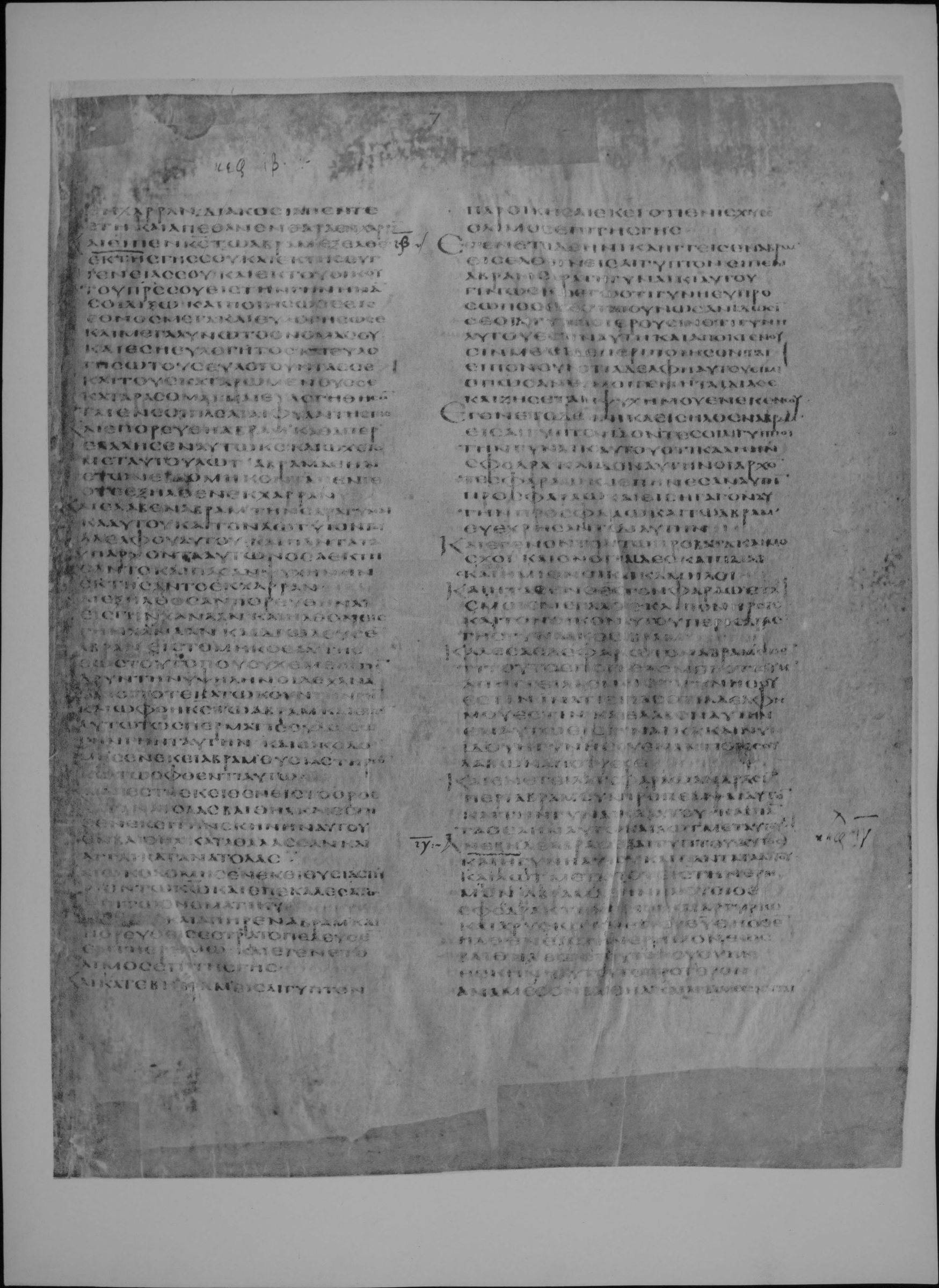
Genesis 11:25-32 is on fol. 6v (full-size facsimile of 1879-83, Internet Archive codex-alexandrinus leaf 33). The 1915 reduced facsimile prints beneath this page: Gen. xi. 8-32. Checked on the plate: the page begins at the start of Genesis 11:8 (first words read: ΚΑΙ ΔΙΕΣΠΕΙΡΕΝ ΑΥΤΟΥΣ ΚΣ ΕΚΕΙΘΕΝ ΕΠΙ ΠΡΟΣΩΠΟΝ ΠΑΣΗΣ ΤΗΣ ΓΗΣ). Genesis 11:32 is on fol. 7r (full-size facsimile of 1879-83, Internet Archive codex-alexandrinus leaf 34). The 1915 reduced facsimile prints beneath this page: Gen. xi. 32-xiii. 3. Checked on the plate: the page begins inside Genesis 11:32 (first words read: ΕΝ ΧΑΡΡΑΝ ΔΙΑΚΟΣΙΑ ΠΕΝΤΕ ΕΤΗ ΚΑΙ ΑΠΕΘΑΝΕΝ ΘΑΡΡΑ).
25καὶ ἔζησεν Ναχὼρ μετὰ τὸ γεννῆσαι αὐτὸν τὸν Θάρα ἔτη ἑκατὸν εἴκοσι ἐννέα, καὶ ἐγέννησεν υἱοὺς καὶ θυγατέρας, καὶ ἀπέθανεν. 26Καὶ ἔζησεν Θάρα ἑβδομήκοντα ἔτη, καὶ ἐγέννησεν τὸν Ἀβρὰμ καὶ τὸν Ναχὼρ καὶ τὸν Ἁρράν. 27Αὗται δὲ αἱ γενέσεις Θάρα· Θάρα δὲ ἐγέννησεν τὸν Ἀβρὰμ καὶ τὸν Ναχὼρ καὶ τὸν Ἁρράν, καὶ Ἁρρὰν ἐγέννησεν τὸν Λώτ. 28καὶ ἀπέθανεν Ἁρρὰν ἐνώπιον Θάρα τοῦ πατρὸς αὐτοῦ ἐν τῇ γῇ ᾗ ἐγενήθη, ἐν τῇ χώρᾳ τῶν Χαλδαίων. 29καὶ ἔλαβον Ἀβρὰμ καὶ Ναχὼρ ἑαυτοῖς γυναῖκας· ὄνομα τῇ γυναικὶ Ἀβρὰμ Σάρα, καὶ ὄνομα τῇ γυναικὶ Ναχὼρ Μελχά, θυγάτηρ Ἁρράν, καὶ πατὴρ Μελχὰ καὶ πατὴρ Ἰεσχά. 30καὶ ἦν Σάρα στεῖρα καὶ οὐκ ἐτεκνοποίει. 31καὶ ἔλαβεν Θάρα τὸν Ἀβρὰμ τὸν υἱὸν αὐτοῦ καὶ τὸν Λὼτ υἱὸν Ἁρράν, υἱὸν τοῦ υἱοῦ αὐτοῦ, καὶ τὴν Σάραν τὴν νύμφην αὐτοῦ, γυναῖκα τοῦ υἱοῦ αὐτοῦ, καὶ ἐξήγαγεν αὐτοὺς ἐκ τῆς χώρας τῶν Χαλδαίων πορευθῆναι εἰς τὴν γῆν Χανάαν· καὶ ἦλθεν ἕως Χαρράν, καὶ κατῴκησεν ἐκεῖ. 32καὶ ἐγένοντο αἱ ἡμέραι Θάρα ἐν Χαρρὰν διακόσια πέντε ἔτη· καὶ ἀπέθανεν Θάρα ἐν Χαρράν.
25And Nachor lived after he had begotten Tharrha, an hundred and twenty-five years, and begot sons and daughters, and he died. 26And Tharrha lived seventy years, and begot Abram, and Nachor, and Arrhan. 27And these are the generations of Tharrha. Tharrha begot Abram and Nachor, and Arrhan; and Arrhan begot Lot. 28And Arrhan died in the presence of Tharrha his father, in the land in which he was born, in the country of the Chaldees. 29And Abram and Nachor took to themselves wives, the name of the wife of Abram was Sara, and the name of the wife of Nachor, Malcha, daughter of Arrhan, and he was the father of Malcha, the father of Jescha. 30And Sara was barren, and did not bear children. 31And Tharrha took Abram his son, and Lot the son of Arrhan, the son of his son, and Sara his daughter-in-law, the wife of Abram his son, and led them forth out of the land of the Chaldees, to go into the land of Chanaan, and they came as far as Charrhan, and he dwelt there. 32And all the days of Tharrha in the land of Charrhan were two hundred and five years, and Tharrha died in Charrhan.
Cite
Sources
- Source: Codex Alexandrinus (British Library Royal MS 1 D. V) via the British Museum photographic facsimiles of 1879-83 and 1915 (Internet Archive) + Swete's Septuagint + Brenton's English (holding institution)
- Critical edition: H. B. Swete, The Old Testament in Greek according to the Septuagint (1909)
← previous · → next · v cycle view · l back to library