Genesis, Chapter 2 (Codex Alexandrinus)
Introduction
Genesis 2 in the Greek Old Testament (the Septuagint) as written in Codex Alexandrinus, a Greek Bible copied in the fifth century, probably in Egypt, and now in the British Library (Royal MS 1 D. V, the first of its four volumes). It is one of the three great early codices of the whole Greek Bible, with Codex Vaticanus and Codex Sinaiticus, and for Genesis 1:1-46:28, which Codex Vaticanus has lost, it is the oldest surviving complete Greek text (older papyri such as the Berlin Genesis papyrus and Chester Beatty 961 survive only in part).
Verse division: the digital Swete text prints 2:25 at the head of 3:1; it is shown here as 2:25, as Brenton numbers it.
This entry meets the strict three-criteria standard of the Theosis Library:
- Manuscript scan: the pages of Codex Alexandrinus carrying this chapter (fol. 1v, fol. 2r), from the full-size photographic (autotype) facsimile published by the British Museum in 1879-1883, as digitised on the Internet Archive. The verse range of every page comes from the reduced photographic facsimile of 1915, which prints it beneath each plate, and the opening words of every page were read on the plate to confirm the page and the verse it begins with. Each section links to the page or pages that hold its verses. Folio numbers are those written at the head of each leaf and visible on the plates.
- Original text: Swete's edition, which in Genesis 1:1-46:28 prints the text of Codex Alexandrinus itself (Codex Vaticanus has lost these chapters), with the spelling of A for the most part. Swete adds accents, breathings and punctuation and expands the abbreviated sacred names, so the plate shows the same text in unaccented capitals.
- English translation: Sir Lancelot C. L. Brenton, The Septuagint Version of the Old Testament (1844; 1851 edition), a translation of the Greek, public domain, from the eBible.org text.
How was this verified? (Provenance)
Where on the image
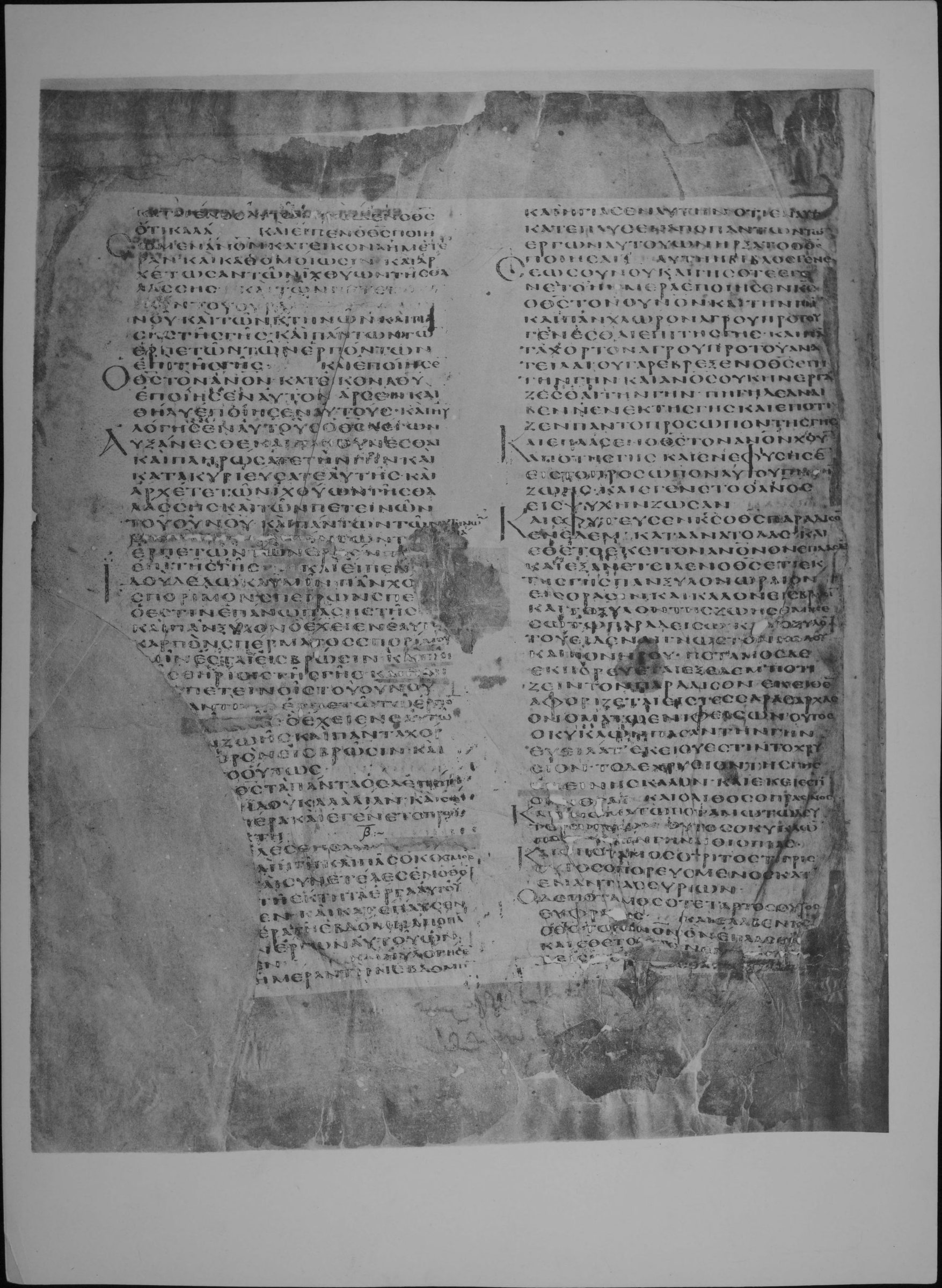
Genesis 2:1-8 is on fol. 1v (full-size facsimile of 1879-83, Internet Archive codex-alexandrinus leaf 23). The 1915 reduced facsimile prints beneath this page: Gen. i. 25-ii. 15. Checked on the plate: the page begins inside Genesis 1:25 (first words read: ΚΑΙ ΕΙΔΕΝ Ο ΘΣ ΟΤΙ ΚΑΛΑ ΚΑΙ ΕΙΠΕΝ Ο ΘΣ ΠΟΙΗΣΩΜΕΝ ΑΝΘΡΩΠΟΝ). The first leaf of the codex is damaged. Letters in square brackets are lost on the leaf and supplied by Swete.
1[Καὶ συνετε]λέσθησαν [ὁ οὐρανὸς κ]αὶ ἡ γῆ καὶ πᾶς ὁ κόσμος [αὐτῶν. 2κ]αὶ συνετέλεσεν ὁ θεὸς [ἐν τῇ ἡμέρᾳ] τῇ ἕκτῃ τὰ ἔργα αὐτοῦ [ἃ ἐποίησ]εν· καὶ κατέπαυσεν [τῇ ἡμ]έρᾳ τῇ ἑβδόμῃ ἀπὸ πάν[των τῶ]ν ἔργων αὐτοῦ ὧν [ἐποίησ]εν. 3καὶ ηὐλόγησεν [ὁ θεὸς τὴν] ἡμέραν τὴν ἑβδόμην καὶ ἡγίασεν αὐτήν, ὅτι ἐν αὐτῇ κατέπαυσεν ἀπὸ πάντων τῶν ἔργων αὐτοῦ ὧν ἤρξατο ὁ θεὸς ποιῆσαι. 4Αὕτη ἡ βίβλος γενέσεως οὐρανοῦ καὶ γῆς, ὅτε ἐγένετο· ᾗ ἡμέρᾳ ἐποίησεν Κύριος ὁ θεὸς τὸν οὐρανὸν καὶ τὴν γῆν, 5καὶ πᾶν χλωρὸν ἀγροῦ πρὸ τοῦ γενέσθαι ἐπὶ τῆς γῆς, καὶ πάντα χόρτον ἀγροῦ πρὸ τοῦ ἀνατεῖλαι. οὐ γὰρ ἔβρεξεν ὁ θεὸς ἐπὶ τὴν γῆν, καὶ ἄνθρωπος οὐκ ἦν ἐργάζεσθαι τὴν γῆν· 6πηγὴ δὲ ἀνέβαινεν ἐκ τῆς γῆς καὶ ἐπότιζεν πᾶν τὸ πρόσωπον τῆς γῆς. 7καὶ ἔπλασεν ὁ θεὸς τὸν ἄνθρωπον χοῦν ἀπὸ τῆς γῆς· καὶ ἐνεφύσησεν εἰς τὸ πρόσωπον αὐτοῦ πνοὴν ζωῆς, καὶ ἐγένετο ὁ ἄνθρωπος εἰς ψυχὴν ζῶσαν. 8Καὶ ἐφύτευσεν Κύριος ὁ θεὸς παράδεισον ἐν Ἔδεμ κατὰ ἀνατολάς, καὶ ἔθετο ἐκεῖ τὸν ἄνθρωπον ὃν ἔπλασεν.
1And the heavens and the earth were finished, and the whole world of them. 2And God finished on the sixth day his works which he made, and he ceased on the seventh day from all his works which he made. 3And God blessed the seventh day and sanctified it, because in it he ceased from all his works which God began to do. 4This is the book of the generation of heaven and earth, when they were made, in the day in which the Lord God made the heaven and the earth, 5and every herb of the field before it was on the earth, and all the grass of the field before it sprang up, for God had not rained on the earth, and there was not a man to cultivate it. 6But there rose a fountain out of the earth, and watered the whole face of the earth. 7And God formed the man of dust of the earth, and breathed upon his face the breath of life, and the man became a living soul. 8And God planted a garden eastward in Edem, and placed there the man whom he had formed.
Where on the image
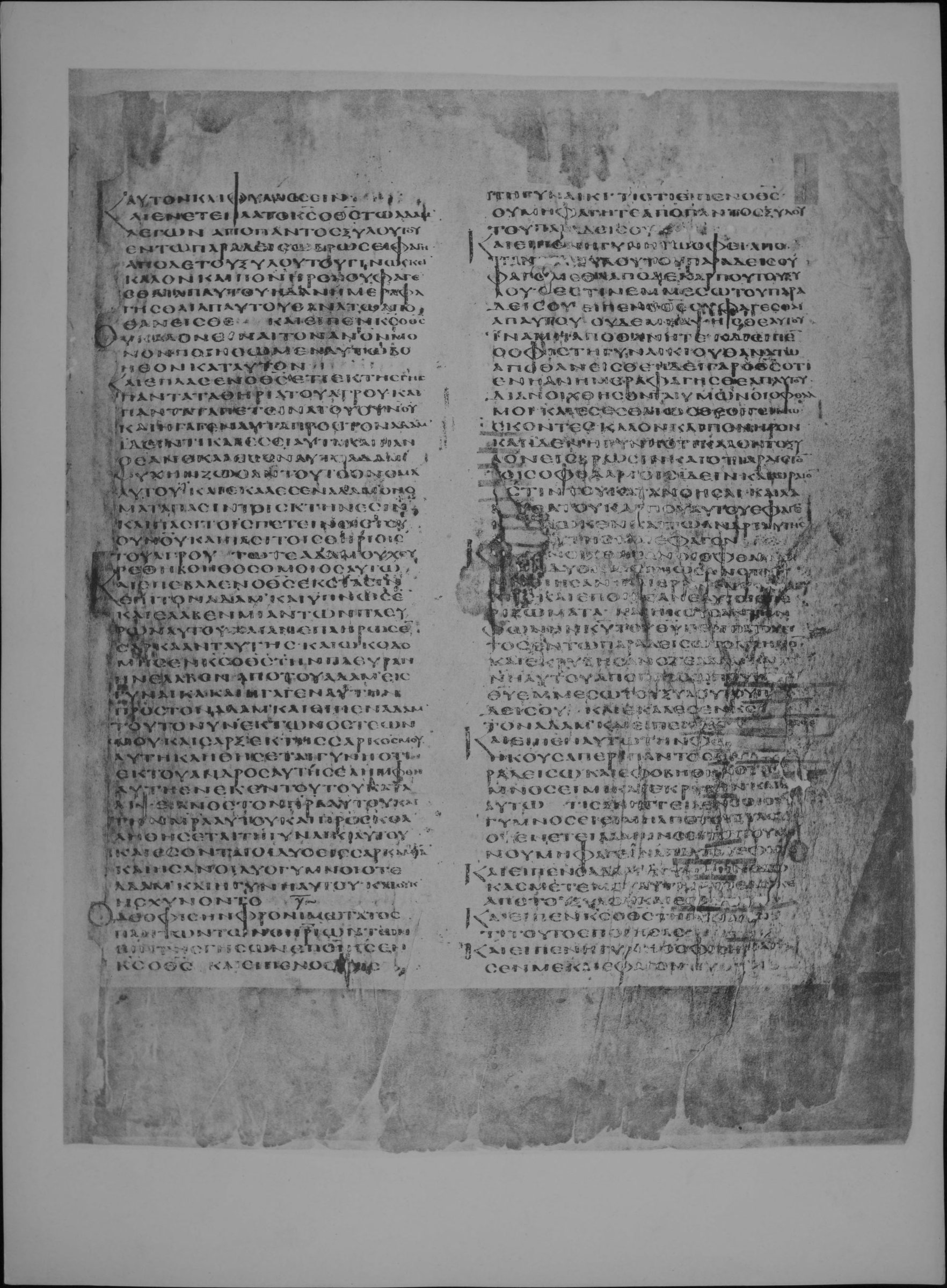
Genesis 2:9-15 is on fol. 1v (full-size facsimile of 1879-83, Internet Archive codex-alexandrinus leaf 23). The 1915 reduced facsimile prints beneath this page: Gen. i. 25-ii. 15. Checked on the plate: the page begins inside Genesis 1:25 (first words read: ΚΑΙ ΕΙΔΕΝ Ο ΘΣ ΟΤΙ ΚΑΛΑ ΚΑΙ ΕΙΠΕΝ Ο ΘΣ ΠΟΙΗΣΩΜΕΝ ΑΝΘΡΩΠΟΝ). Genesis 2:15-16 is on fol. 2r (full-size facsimile of 1879-83, Internet Archive codex-alexandrinus leaf 24). The 1915 reduced facsimile prints beneath this page: Gen. ii. 15-iii. 13. Checked on the plate: the page begins inside Genesis 2:15 (first words read: ΑΥΤΟΝ ΚΑΙ ΦΥΛΑΣΣΕΙΝ ΚΑΙ ΕΝΕΤΕΙΛΑΤΟ ΚΣ Ο ΘΣ ΤΩ ΑΔΑΜ ΛΕΓΩΝ).
9καὶ ἐξανέτειλεν ὁ θεὸς ἔτι ἐκ τῆς γῆς πᾶν ξύλον ὡραῖον εἰς ὅρασιν καὶ καλὸν εἰς βρῶσιν· καὶ τὸ ξύλον τῆς ζωῆς ἐν μέσῳ τῷ παραδείσῳ, καὶ τὸ ξύλον τοῦ εἰδέναι γνωστὸν καλοῦ καὶ πονηροῦ. 10ποταμὸς δὲ ἐκπορεύεται ἐξ Ἔδεμ ποτίζειν τὸν παράδεισον· ἐκεῖθεν ἀφορίζεται εἰς τέσσαρας ἀρχάς. 11ὄνομα τῷ ἑνὶ Φεισών· οὗτος ὁ κυκλῶν πᾶσαν τὴν γῆν Εὑειλάτ, ἐκεῖ οὗ ἐστιν τὸ χρυσίον· 12τὸ δὲ χρυσίον τῆς γῆς ἐκείνης καλόν· καὶ ἐκεῖ ἐστιν ὁ ἄνθραξ καὶ ὁ λίθος ὁ πράσινος. 13καὶ ὄνομα τῷ ποταμῷ τῷ δευτέρῳ Γηών· οὗτος ὁ κυκλῶν πᾶσαν τὴν γῆν Αἰθιοπίας. 14καὶ ὁ ποταμὸς ὁ τρίτος Τίγρις· οὗτος ὁ πορευόμενος κατέναντι Ἀσσυρίων. ὁ δὲ ποταμὸς ὁ τέταρτος, οὗτος Εὐφράτης. 15καὶ ἔλαβεν Κύριος ὁ θεὸς τὸν ἄνθρωπον ὃν ἔπλασεν καὶ ἔθετο αὐτὸν ἐν τῷ παραδείσῳ, ἐργάζεσθαι αὐτὸν καὶ φυλάσσειν. 16καὶ ἐνετείλατο Κύριος ὁ θεὸς τῷ Ἀδὰμ λέγων Ἀπὸ παντὸς ξύλου τοῦ ἐν τῷ παραδείσῳ βρώσει φάγῃ·
9And God made to spring up also out of the earth every tree beautiful to the eye and good for food, and the tree of life in the midst of the garden, and the tree of learning the knowledge of good and evil. 10And a river proceeds out of Edem to water the garden, thence it divides itself into four heads. 11The name of the one, Phisom, this it is which encircles the whole land of Evilat, where there is gold. 12And the gold of that land is good, there also is carbuncle and emerald. 13And the name of the second river is Geon, this it is which encircles the whole land of Ethiopia. 14And the third river is Tigris, this is that which flows forth over against the Assyrians. And the fourth river is Euphrates. 15And the Lord God took the man whom he had formed, and placed him in the garden of Delight, to cultivate and keep it. 16And the Lord God gave a charge to Adam, saying, Of every tree which is in the garden thou mayest freely eat,
Where on the image
Genesis 2:17-25 is on fol. 2r (full-size facsimile of 1879-83, Internet Archive codex-alexandrinus leaf 24). The 1915 reduced facsimile prints beneath this page: Gen. ii. 15-iii. 13. Checked on the plate: the page begins inside Genesis 2:15 (first words read: ΑΥΤΟΝ ΚΑΙ ΦΥΛΑΣΣΕΙΝ ΚΑΙ ΕΝΕΤΕΙΛΑΤΟ ΚΣ Ο ΘΣ ΤΩ ΑΔΑΜ ΛΕΓΩΝ).
17ἀπὸ δὲ τοῦ ξύλου τοῦ γινώσκειν καλὸν καὶ πονηρόν, οὐ φάγεσθε ἀπ᾽ αὐτοῦ· ᾗ δ᾽ ἂν ἡμέρᾳ φάγησθε ἀπ᾽ αὐτοῦ, θανάτῳ ἀποθανεῖσθε. 18Καὶ εἶπεν Κύριος ὁ θεός Οὐ καλὸν εἶναι τὸν ἄνθρωπον μόνον· ποιήσωμεν αὐτῷ βοηθὸν κατ᾽ αὐτόν. 19καὶ ἔπλασεν ὁ θεὸς ἔτι ἐκ τῆς γῆς πάντα τὰ θηρία τοῦ ἀγροῦ καὶ πάντα τὰ πετεινὰ τοῦ οὐρανοῦ, καὶ ἤγαγεν αὐτὰ πρὸς τὸν Ἀδὰμ ἰδεῖν τί καλέσει αὐτά· καὶ πᾶν ὃ ἐὰν ἐκάλεσεν αὐτὸ Ἀδὰμ ψυχὴν ζῶσαν, τοῦτο ὄνομα αὐτοῦ. 20καὶ ἐκάλεσεν Ἀδὰμ ὀνόματα πᾶσιν τοῖς κτήνεσιν καὶ πᾶσι τοῖς πετεινοῖς τοῦ οὐρανοῦ καὶ πᾶσι τοῖς θηρίοις τοῦ ἀγροῦ· τῷ τε Ἀδὰμ οὐχ εὑρέθη βοηθὸς ὅμοιος αὐτῷ. 21καὶ ἐπέβαλεν ὁ θεὸς ἔκστασιν ἐπὶ τὸν Ἀδάμ, καὶ ὕπνωσεν· καὶ ἔλαβεν μίαν τῶν πλευρῶν αὐτοῦ καὶ ἀνεπλήρωσεν σάρκα ἀντ᾽ αὐτῆς. 22καὶ ᾠκοδόμησεν Κύριος ὁ θεὸς τὴν πλευράν, ἣν ἔλαβεν ἀπὸ τοῦ Ἀδάμ, εἰς γυναῖκα· καὶ ἤγαγεν αὐτὴν πρὸς τὸν Ἀδάμ. 23καὶ εἶπεν Ἀδάμ Τοῦτο νῦν ὀστοῦν ἐκ τῶν ὀστέων μου καὶ σὰρξ ἐκ τῆς σαρκός μου· αὕτη κληθήσεται Γυνή, ὅτι ἐκ τοῦ ἀνδρὸς αὐτῆς ἐλήμφθη αὕτη. 24ἕνεκεν τούτου καταλείψει ἄνθρωπος τὸν πατέρα αὐτοῦ καὶ τὴν μητέρα αὐτοῦ, καὶ προσκολληθήσεται τῇ γυναικὶ αὐτοῦ· καὶ ἔσονται οἱ δύο εἰς σάρκα μίαν. 25καὶ ἦσαν οἱ δύο γυμνοί, ὅ τε Ἀδὰμ καὶ ἡ γυνὴ αὐτοῦ, καὶ οὐκ ᾐσχύνοντο.
17but of the tree of the knowledge of good and evil—of it ye shall not eat, but in whatsoever day ye eat of it, ye shall surely die. 18And the Lord God said, It is not good that the man should be alone, let us make for him a help suitable to him. 19And God formed yet farther out of the earth all the wild beasts of the field, and all the birds of the sky, and he brought them to Adam, to see what he would call them, and whatever Adam called any living creature, that was the name of it. 20And Adam gave names to all the cattle and to all the birds of the sky, and to all the wild beasts of the field, but for Adam there was not found a help like to himself. 21And God brought a trance upon Adam, and he slept, and he took one of his ribs, and filled up the flesh instead thereof. 22And God formed the rib which he took from Adam into a woman, and brought her to Adam. 23And Adam said, This now is bone of my bones, and flesh of my flesh; she shall be called woman, because she was taken out of her husband. 24Therefore shall a man leave his father and his mother and shall cleave to his wife, and they two shall be one flesh. 25And the two were naked, both Adam and his wife, and were not ashamed.
Cite
Sources
- Source: Codex Alexandrinus (British Library Royal MS 1 D. V) via the British Museum photographic facsimiles of 1879-83 and 1915 (Internet Archive) + Swete's Septuagint + Brenton's English (holding institution)
- Critical edition: H. B. Swete, The Old Testament in Greek according to the Septuagint (1909)
← previous · → next · v cycle view · l back to library