Hosea, Chapter 3 (Codex Alexandrinus)
Introduction
Hosea 3 in the Greek Old Testament (the Septuagint) as written in Codex Alexandrinus, a Greek Bible copied in the fifth century, probably in Egypt, and now in the British Library (Royal MS 1 D. VI, the second of its four volumes). It is one of the three great early codices of the whole Greek Bible, with Codex Vaticanus and Codex Sinaiticus.
This entry meets the strict three-criteria standard of the Theosis Library:
- Manuscript scan: the page of Codex Alexandrinus carrying this chapter (fol. 277v), from the full-size photographic (autotype) facsimile published by the British Museum in 1879-1883, as digitised on the Internet Archive. The verse range of every page comes from the reduced photographic facsimile of 1936, which prints it beneath each plate, and the opening words of every page were read on the plate to confirm the page and the verse it begins with. Each section links to the page or pages that hold its verses. Folio numbers are those written at the head of each leaf and visible on the plates.
- Original text: Swete's edition, which here prints the text of Codex Vaticanus (Vat. gr. 1209), the base of his edition, and gives the readings of Alexandrinus only in his apparatus. The Greek column is therefore Vaticanus' text; where Alexandrinus differs, the plate shows what Alexandrinus reads.
- English translation: Sir Lancelot C. L. Brenton, The Septuagint Version of the Old Testament (1844; 1851 edition), a translation of the Greek, public domain, from the eBible.org text.
How was this verified? (Provenance)
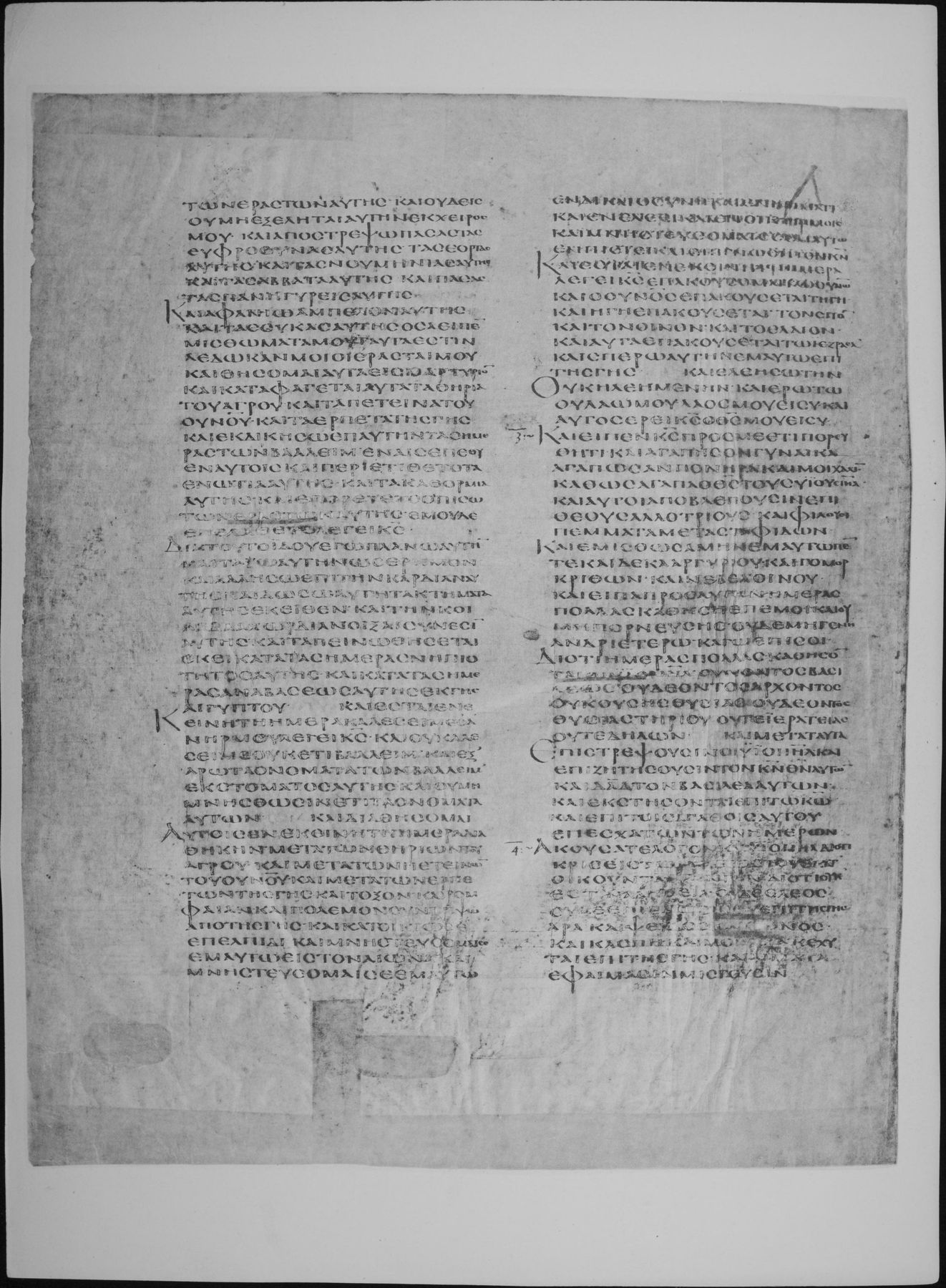
Where on the image
Hosea 3:1-5 is on fol. 277v (full-size facsimile of 1879-83, Internet Archive codex-alexandrinus leaf 579). The 1936 reduced facsimile prints beneath this page: Hos. ii. 10-iv. 2. Checked on the plate: the page begins inside Hosea 2:10 (first words read: ΤΩΝ ΕΡΑΣΤΩΝ ΑΥΤΗΣ ΚΑΙ ΟΥΔΕΙΣ ΟΥ ΜΗ ΕΞΕΛΗΤΑΙ ΑΥΤΗΝ ΕΚ ΧΕΙΡΟΣ ΜΟΥ ΚΑΙ ΑΠΟΣΤΡΕΨΩ ΠΑΣΑΣ ΤΑΣ ΕΥΦΡΟΣΥΝΑΣ).
1Καὶ εἶπεν Κύριος πρὸς μέ Ἔτι πορεύθητι καὶ ἀγάπησον γυναῖκα ἀγαπῶσαν πονηρὰ καὶ μοιχαλίν, καθὼς ἀγαπᾷ ὁ θεὸς τοὺς υἱοὺς Ἰσραήλ, καὶ αὐτοὶ ἐπιβλέπουσιν ἐπὶ θεοὺς ἀλλοτρίους καὶ φιλοῦσιν πέμματα μετὰ σταφίδος. 2καὶ ἐμισθωσάμην ἐμαυτῷ πέντε καὶ δέκα ἀργυρίου καὶ γόμορ κριθῶν καὶ νέβελ οἴνου, 3καὶ εἶπα πρὸς αὐτήν Ἡμέρας πολλὰς καθήσῃ ἐπ᾽ ἐμοί, καὶ οὐ μὴ πορνεύσῃς οὐδὲ μὴ γένῃ ἀνδρί, καὶ ἐγὼ ἐπὶ σοί. 4διότι ἡμέρας πολλὰς καθήσονται οἱ υἱοὶ Ἰσραὴλ οὐκ ὄντος βασιλέως οὐδὲ ὄντος ἄρχοντος οὐδὲ οὔσης θυσίας οὐδὲ ὄντος θυσιαστηρίου οὐδὲ ἱερατίας οὐδὲ δήλων. 5καὶ μετὰ ταῦτα ἐπιστρέψουσιν οἱ υἱοὶ Ἰσραὴλ καὶ ἐπιζητήσουσιν Κύριον τὸν θεὸν αὐτῶν καὶ Δαυεὶδ τὸν βασιλέα αὐτῶν, καὶ ἐκστήσονται ἐπὶ τῷ κυρίῳ καὶ ἐπὶ τοῖς ἀγαθοῖς αὐτοῦ ἐπ᾽ ἐσχάτων τῶν ἡμερῶν.
1And the Lord said to me, Go yet, and love a woman that loves evil things, and an adulteress, even as the Lord loves the children of Israel, and they have respect to strange gods, and love cakes of dried grapes. 2So I hired her to myself for fifteen pieces of silver, and a homer of barley, and a flagon of wine. 3And I said unto her, Thou shalt wait for me many days; and thou shalt not commit fornication, neither shalt thou be for another man; and I will be for thee. 4For the children of Israel shall abide many days without a king, and without a prince, and without a sacrifice, and without an altar, and without a priesthood, and without manifestations. 5And afterward shall the children of Israel return, and shall seek the Lord their God, and David their king; and shall be amazed at the Lord and at his goodness in the latter days.
Cite
Sources
- Source: Codex Alexandrinus (British Library Royal MS 1 D. VI) via the British Museum photographic facsimiles of 1879-83 and 1936 (Internet Archive) + Swete's Septuagint + Brenton's English (holding institution)
- Critical edition: H. B. Swete, The Old Testament in Greek according to the Septuagint (1909)
← previous · → next · v cycle view · l back to library