Isaiah, Chapter 18 (Codex Alexandrinus)
Introduction
Isaiah 18 in the Greek Old Testament (the Septuagint) as written in Codex Alexandrinus, a Greek Bible copied in the fifth century, probably in Egypt, and now in the British Library (Royal MS 1 D. VI, the second of its four volumes). It is one of the three great early codices of the whole Greek Bible, with Codex Vaticanus and Codex Sinaiticus.
This entry meets the strict three-criteria standard of the Theosis Library:
- Manuscript scan: the page of Codex Alexandrinus carrying this chapter (fol. 309v), from the full-size photographic (autotype) facsimile published by the British Museum in 1879-1883, as digitised on the Internet Archive. The verse range of every page comes from the reduced photographic facsimile of 1936, which prints it beneath each plate, and the opening words of every page were read on the plate to confirm the page and the verse it begins with. Each section links to the page or pages that hold its verses. Folio numbers are those written at the head of each leaf and visible on the plates.
- Original text: Swete's edition, which here prints the text of Codex Vaticanus (Vat. gr. 1209), the base of his edition, and gives the readings of Alexandrinus only in his apparatus. The Greek column is therefore Vaticanus' text; where Alexandrinus differs, the plate shows what Alexandrinus reads.
- English translation: Sir Lancelot C. L. Brenton, The Septuagint Version of the Old Testament (1844; 1851 edition), a translation of the Greek, public domain, from the eBible.org text.
How was this verified? (Provenance)
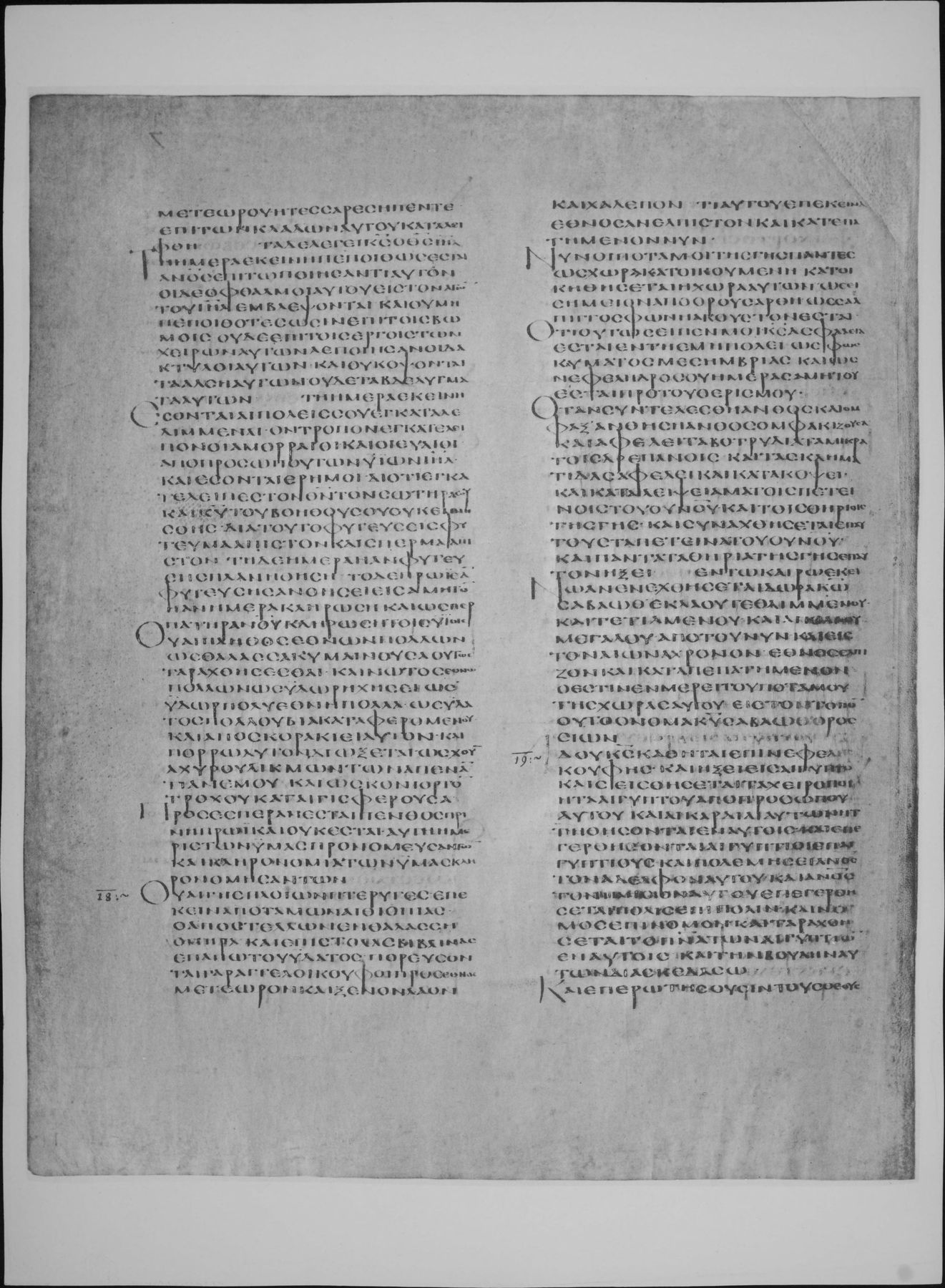
Where on the image
Isaiah 18:1-7 is on fol. 309v (full-size facsimile of 1879-83, Internet Archive codex-alexandrinus leaf 643). The 1936 reduced facsimile prints beneath this page: Is. xvii. 6-xix. 3. Checked on the plate: the page begins inside Isaiah 17:6 (first words read: ΜΕΤΕΩΡΟΥ Η ΤΕΣΣΑΡΕΣ Η ΠΕΝΤΕ ΕΠΙ ΤΩΝ ΚΛΑΔΩΝ ΑΥΤΟΥ ΚΑΤΑΛΕΙΦΘΗ).
1Οὐαὶ γῆς πλοίων πτέρυγες ἐπέκεινα ποταμῶν Αἰθιοπίας, 2ὁ ἀποστέλλων ἐν θαλάσσῃ ὅμηρα καὶ ἐπιστολὰς βυβλίνας ἐπάνω τοῦ ὕδατος. πορεύσονται γὰρ ἄγγελοι κοῦφοι πρὸς ἔθνος μετέωρον, καὶ ξένον λαὸν καὶ χαλεπόν· τίς αὐτοῦ ἐπέκεινα; ἔθνος ἀνέλπιστον καὶ καταπεπατημένον. νῦν οἱ ποταμοὶ τῆς γῆς 3πάντες ὡς χώρα κατοικουμένη κατοικηθήσεται· ἡ χώρα αὐτῶν ὡς εἰς σημεῖον ἀπὸ ὄρους ἀρθῇ, ὡς σάλπιγγος φωνὴ ἀκουστὸν ἔσται. 4διότι οὕτως μοι εἶπεν Κύριος Ἀσφάλεια ἔσται ἐν τῇ ἐμῇ πόλει ὡς φῶς καύματος μεσημβρίας, καὶ ὡς νεφέλη δρόσου ἡμέρας ἀμήτου ἔσται. 5πρὸ τοῦ θερισμοῦ, ὅταν συντελεσθῇ ἄνθος, καὶ ὄμφαξ ἀνθήσει ἄνθος ὀμφακίζουσα· καὶ ἀφελεῖ τὰ βοτρύδια τὰ μικρὰ τοῖς δρεπάνοις, καὶ τὰς κληματίδας ἀφελεῖ καὶ ἀποκόψει, 6καὶ καταλείψει ἅμα τοῖς πετεινοῖς τοῦ οὐρανοῦ καὶ τοῖς θηρίοις τῆς γῆς· καὶ συναχθήσεται ἐπ᾽ αὐτοὺς τὰ πετεινὰ τοῦ οὐρανοῦ, καὶ πάντα τὰ θηρία τῆς γῆς ἐπ᾽ αὐτὸν ἥξει. 7ἐν τῷ καιρῷ ἐκείνῳ ἀνενεχθήσεται δῶρα Κυρίῳ σαβαὼθ ἐκ λαοῦ τεθλιμμένου καὶ τετιλμένου, καὶ ἀπὸ λαοῦ μεγάλου ἀπὸ τοῦ νῦν καὶ εἰς τὸν αἰῶνα χρόνον· ἔθνος ἐλπίζον καὶ καταπεπατημένον, ὅ ἐστιν ἐν μέρει ποταμοῦ τῆς χώρας αὐτοῦ, εἰς τὸν τόπον οὗ τὸ ὄνομα Κυρίου σαβαώθ, ὄρος Σειών.
1Woe to you, ye wings of the land of ships, beyond the rivers of Ethiopia. 2He sends messengers by the sea, and paper letters on the water: for swift messengers shall go to a lofty nation, and to a strange and harsh people. Who is beyond it? a nation not looked for, and trodden down. 3Now all the rivers of the land shall be inhabited as an inhabited country; their land shall be as when a signal is raised from a mountain; it shall be audible as the sound of a trumpet. 4For thus said the Lord to me, There shall be security in my city, as the light of noonday heat, and it shall be as a cloud of dew in the day of harvest. 5Before the reaping time, when the flower has been completely formed, and the unripe grape has put forth its flower and blossomed, then shall he take away the little clusters with pruning-hooks, and shall take away the small branches, and cut them off; 6and he shall leave them together to the birds of the sky, and to the wild beasts of the earth: and the fowls of the sky shall be gathered upon them, and all the beasts of the land shall come upon him. 7In that time shall presents be brought to the Lord of hosts from a people afflicted and peeled, and from a people great from henceforth and for ever; a nation hoping and yet trodden down, which is in a part of a river of his land, to the place where is the name of the Lord of hosts, the mount Sion.
Cite
Sources
- Source: Codex Alexandrinus (British Library Royal MS 1 D. VI) via the British Museum photographic facsimiles of 1879-83 and 1936 (Internet Archive) + Swete's Septuagint + Brenton's English (holding institution)
- Critical edition: H. B. Swete, The Old Testament in Greek according to the Septuagint (1909)
← previous · → next · v cycle view · l back to library