Isaiah, Chapter 17 (Codex Alexandrinus)
Introduction
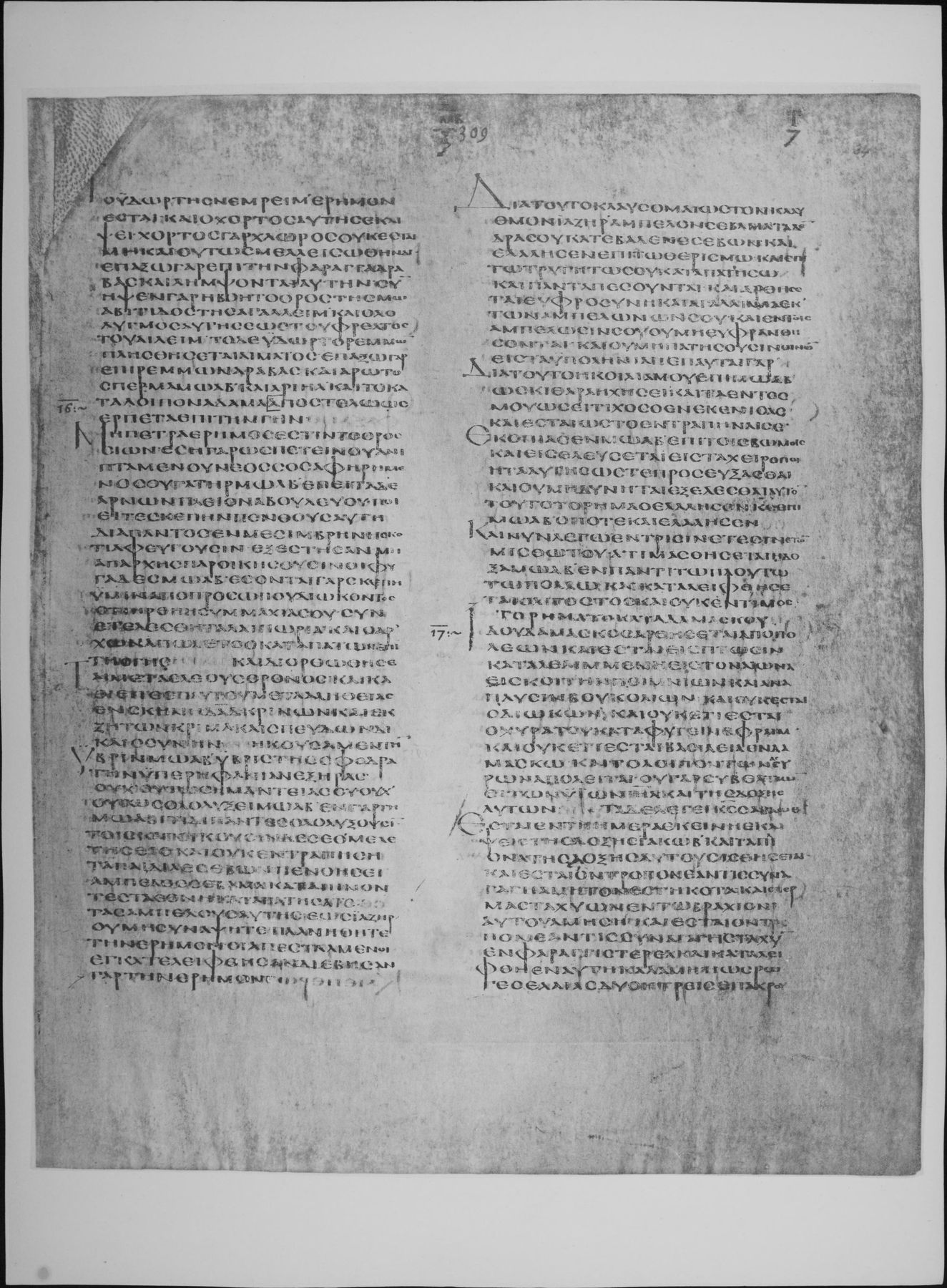
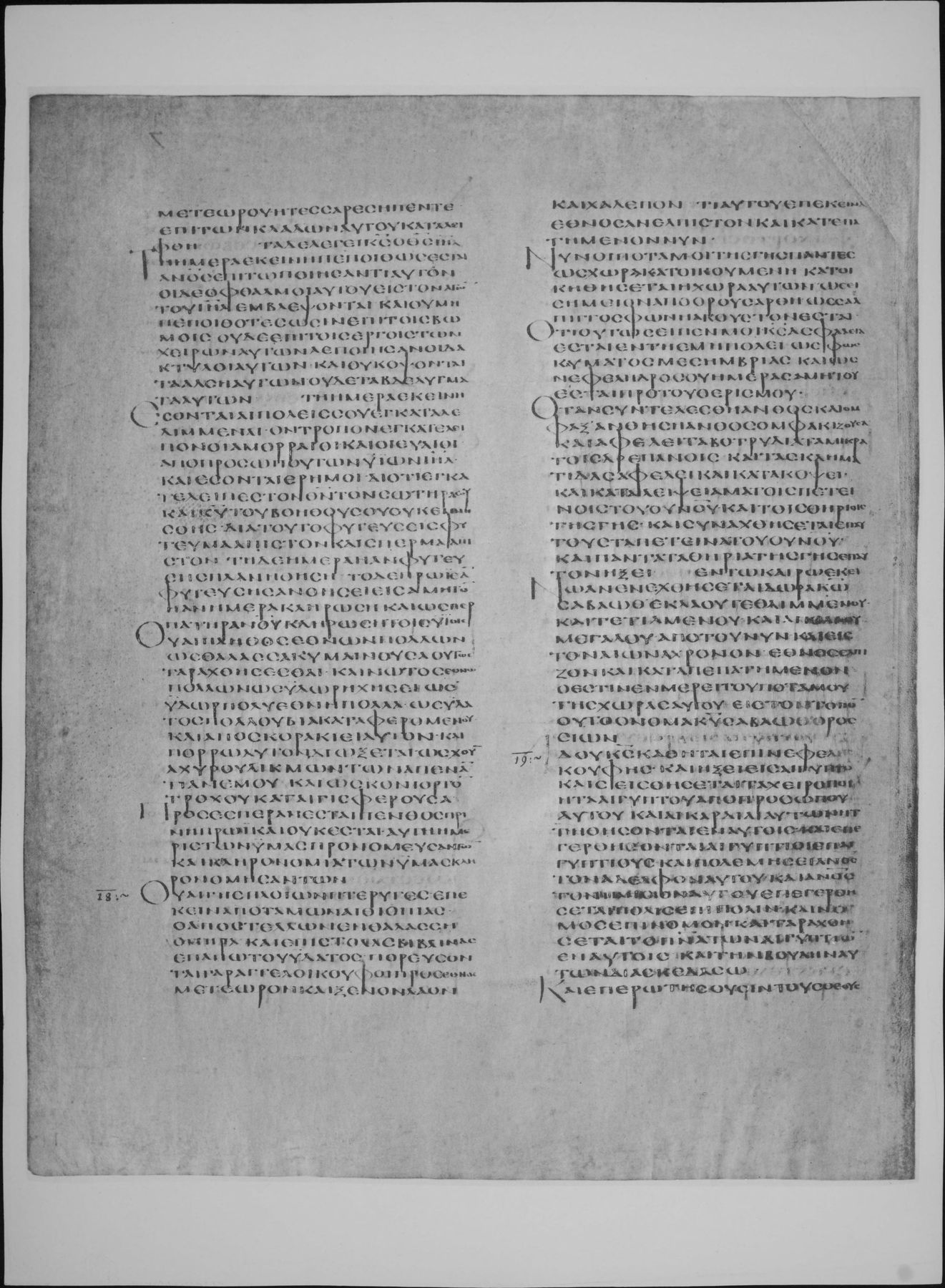
Isaiah 17 in the Greek Old Testament (the Septuagint) as written in Codex Alexandrinus, a Greek Bible copied in the fifth century, probably in Egypt, and now in the British Library (Royal MS 1 D. VI, the second of its four volumes). It is one of the three great early codices of the whole Greek Bible, with Codex Vaticanus and Codex Sinaiticus.
Numbering: Swete's Greek and Brenton's English number or divide some verses of this chapter differently (Swete 17:1-2 = Brenton 17:1-2). Each column keeps its own verse numbers, and sections are cut only where the two texts agree, so each section holds the same passage in both languages.
This entry meets the strict three-criteria standard of the Theosis Library:
- Manuscript scan: the pages of Codex Alexandrinus carrying this chapter (fol. 309r, fol. 309v), from the full-size photographic (autotype) facsimile published by the British Museum in 1879-1883, as digitised on the Internet Archive. The verse range of every page comes from the reduced photographic facsimile of 1936, which prints it beneath each plate, and the opening words of every page were read on the plate to confirm the page and the verse it begins with. Each section links to the page or pages that hold its verses. Folio numbers are those written at the head of each leaf and visible on the plates.
- Original text: Swete's edition, which here prints the text of Codex Vaticanus (Vat. gr. 1209), the base of his edition, and gives the readings of Alexandrinus only in his apparatus. The Greek column is therefore Vaticanus' text; where Alexandrinus differs, the plate shows what Alexandrinus reads.
- English translation: Sir Lancelot C. L. Brenton, The Septuagint Version of the Old Testament (1844; 1851 edition), a translation of the Greek, public domain, from the eBible.org text.
How was this verified? (Provenance)
Where on the image
Isaiah 17:1-6 is on fol. 309r (full-size facsimile of 1879-83, Internet Archive codex-alexandrinus leaf 642). The 1936 reduced facsimile prints beneath this page: (caption not legible in the scan; range bounded by the captions of leaves 69 and 71). Checked on the plate: the page begins at the start of Isaiah 15:6 (first words read: ΤΟ ΥΔΩΡ ΤΟΥ ΝΕΜΡΕΙΜ ΕΡΗΜΟΝ ΕΣΤΑΙ ΚΑΙ Ο ΧΟΡΤΟΣ ΑΥΤΗΣ ΕΚΛΕΙΨΕΙ). Isaiah 17:6-8 is on fol. 309v (full-size facsimile of 1879-83, Internet Archive codex-alexandrinus leaf 643). The 1936 reduced facsimile prints beneath this page: Is. xvii. 6-xix. 3. Checked on the plate: the page begins inside Isaiah 17:6 (first words read: ΜΕΤΕΩΡΟΥ Η ΤΕΣΣΑΡΕΣ Η ΠΕΝΤΕ ΕΠΙ ΤΩΝ ΚΛΑΔΩΝ ΑΥΤΟΥ ΚΑΤΑΛΕΙΦΘΗ).
1Τὸ ῥῆμα τὸ κατὰ Δαμασκοῦ. Ἰδοὺ Δαμασκὸς ἀρθήσεται ἀπὸ πόλεων, καὶ ἔσται εἰς πτῶσιν, 2καταλελιμμένη εἰς τὸν αἰῶνα, εἰς κοίτην ποιμνίων καὶ ἀνάπαυσιν, καὶ οὐκ ἔσται ὁ διώκων· 3καὶ οὐκέτι ἔσται ὀχυρὰ τοῦ καταφυγεῖν Ἐφράιμ· καὶ οὐκέτι βασιλεία ἐν Δαμασκῷ καὶ τὸ λοιπὸν τῶν Σύρων· οὐ γὰρ σὺ βελτίων εἶ τῶν υἱῶν Ἰσραὴλ καὶ τῆς δόξης αὐτῶν. 4Τάδε λέγει Κύριος σαβαώθ Ἔσται ἐν τῇ ἡμέρᾳ ἐκείνῃ ἔκλειψις δόξης Ἰακώβ, καὶ τὰ πίονα τῆς δόξης αὐτοῦ σεισθήσεται. 5καὶ ἔσται ὃν τρόπον ἐάν τις συναγάγῃ ἀμητὸν ἑστηκότα καὶ σπέρμα σταχύων ἀμήσῃ, καὶ ἔσται ὃν τρόπον ἐάν τις συναγάγῃ στάχυν ἐν φάραγγι στερεᾷ, 6καὶ καταλειφθῇ ἐν αὐτῇ καλάμη, ἢ ὡς ῥῶγες ἐλαίας δύο ἢ τρεῖς ἐπ᾽ ἄκρου μετεώρου, ἢ τέσσαρες ἢ πέντε ἐπὶ τῶν κλάδων αὐτῶν καταλειφθῇ. τάδε λέγει Κύριος ὁ θεὸς Ἰσραήλ. 7τῇ ἡμέρᾳ ἐκείνῃ πεποιθὼς ἔσται ὁ ἄνθρωπος ἐπὶ τῷ ποιήσαντι αὐτόν, οἱ δὲ ὀφθαλμοὶ αὐτοῦ εἰς τὸν ἅγιον τοῦ Ἰσραὴλ ἐμβλέψονται, 8καὶ οὐ μὴ πεποιθότες ὦσιν ἐπὶ τοῖς βωμοῖς οὐδὲ ἐπὶ τοῖς ἔργοις τῶν χειρῶν αὐτῶν ἃ ἐποίησαν οἱ δάκτυλοι αὐτῶν, καὶ οὐκ ὄψονται τὰ δένδρα οὐδὲ τὰ βδελύγματα αὐτῶν.
1The Word against Damascus. 2abandoned for ever, to be a fold and resting-place for flocks, and there shall be none to go after them. 3And she shall no longer be a strong place for Ephraim to flee to, and there shall no longer be a kingdom in Damascus, or a remnant of Syrians; for thou art no better than the children of Israel, even than their glory; thus saith the Lord of hosts. 4There shall be in that day a failure of the glory of Jacob, and the riches of his glory shall be shaken. 5And it shall be as if one should gather standing corn, and reap the grain of the ears; and it shall be as if one should gather ears in a rich valley; 6and as if there should be left stubble therein, or as it were the berries of an olive tree, two or three on the topmost bough, or as if four or five should be left on their branches; thus saith the Lord, the God of Israel. 7In that day a man shall trust in him that made him, and his eyes shall have respect to the Holy One of Israel. 8And they shall not at all trust in their altars, nor in the works of their hands, which their fingers made; and they shall not look to the trees, nor to their abominations.
Where on the image
Isaiah 17:9-14 is on fol. 309v (full-size facsimile of 1879-83, Internet Archive codex-alexandrinus leaf 643). The 1936 reduced facsimile prints beneath this page: Is. xvii. 6-xix. 3. Checked on the plate: the page begins inside Isaiah 17:6 (first words read: ΜΕΤΕΩΡΟΥ Η ΤΕΣΣΑΡΕΣ Η ΠΕΝΤΕ ΕΠΙ ΤΩΝ ΚΛΑΔΩΝ ΑΥΤΟΥ ΚΑΤΑΛΕΙΦΘΗ).
9τῇ ἡμέρᾳ ἐκείνῃ ἔσονται αἱ πόλεις σου ἐγκαταλελιμμέναι ὃν τρόπον κατέλιπον οἱ Ἀμορραῖοι καὶ οἱ Εὑαῖοι ἀπὸ προσώπου τῶν υἱῶν Ἰσραήλ, καὶ ἔσονται ἔρημοι· 10διότι κατέλιπες τὸν θεὸν τὸν σωτῆρά σου, καὶ Κυρίου τοῦ βοηθοῦ σου οὐκ ἐμνήσθης. διὰ τοῦτο φυτεύσεις φύτευμα ἄπιστον καὶ σπέρμα ἄπιστον· 11τῇ δὲ ἡμέρᾳ ᾗ ἂν φυτεύσῃς, πλανηθήσῃ· τὸ δὲ πρωὶ ἐὰν σπείρῃς, ἀνθήσει εἰς ἀμητὸν ᾗ ἂν ἡμέρᾳ κληρώσῃ, καὶ ὡς πατὴρ ἀνθρώπου κληρώσῃ τοῖς υἱοῖς σου. 12Οὐαὶ πλῆθος ἐθνῶν πολλῶν· ὡς θάλασσα κυμαίνουσα, οὕτως ταραχθήσεσθε, καὶ νῶτος ἐθνῶν πολλῶν ὡς ὕδωρ ἠχήσει· 13ὡς ὕδωρ πολὺ ἔθνη πολλά, ὡς ὕδατος πολλοῦ βίᾳ φερομένου. καὶ ἀποσκορακιεῖ αὐτόν, καὶ πόρρω αὐτὸν διώξεται ὡς χνοῦν ἀχύρου λικμώντων ἀπέναντι ἀνέμου, καὶ ὡς κονιορτὸν τροχοῦ καταιγὶς φέρουσα. 14πρὸς ἑσπέραν, καὶ ἔσται πένθος· πρὶν ἢ πρωί, καὶ οὐκ ἔσται. αὕτη ἡ μερὶς τῶν ὑμᾶς προνομευσάντων, καὶ κληρονομία τοῖς ὑμᾶς κληρονομήσασιν.
9In that day thy cities shall be deserted, as the Amorites and the Evæans deserted theirs, because of the children of Israel; and they shall be desolate. 10Because thou hast forsaken God thy Saviour, and hast not been mindful of the Lord thy helper; therefore shalt thou plant a false plant, and a false seed. 11In the day wherein thou shalt plant thou shalt be deceived; but if thou sow in the morning, the seed shall spring up for a crop in the day wherein thou shalt obtain an inheritance, and as a man's father, thou shalt obtain an inheritance for thy sons. 12Woe to the multitude of many nations, as the swelling sea, so shall ye be confounded; and the force of many nations shall sound like water; 13many nations like much water, as when much water rushes violently: and they shall drive him away, and pursue him afar, as the dust of chaff when men winnow before the wind, and as a storm whirling the dust of the wheel. 14Toward evening, and there shall be grief; before the morning, and he shall not be. This is the portion of them that spoiled you, and the inheritance to them that robbed you of your inheritance.
Cite
Sources
- Source: Codex Alexandrinus (British Library Royal MS 1 D. VI) via the British Museum photographic facsimiles of 1879-83 and 1936 (Internet Archive) + Swete's Septuagint + Brenton's English (holding institution)
- Critical edition: H. B. Swete, The Old Testament in Greek according to the Septuagint (1909)
← previous · → next · v cycle view · l back to library