Isaiah, Chapter 21 (Codex Alexandrinus)
Introduction
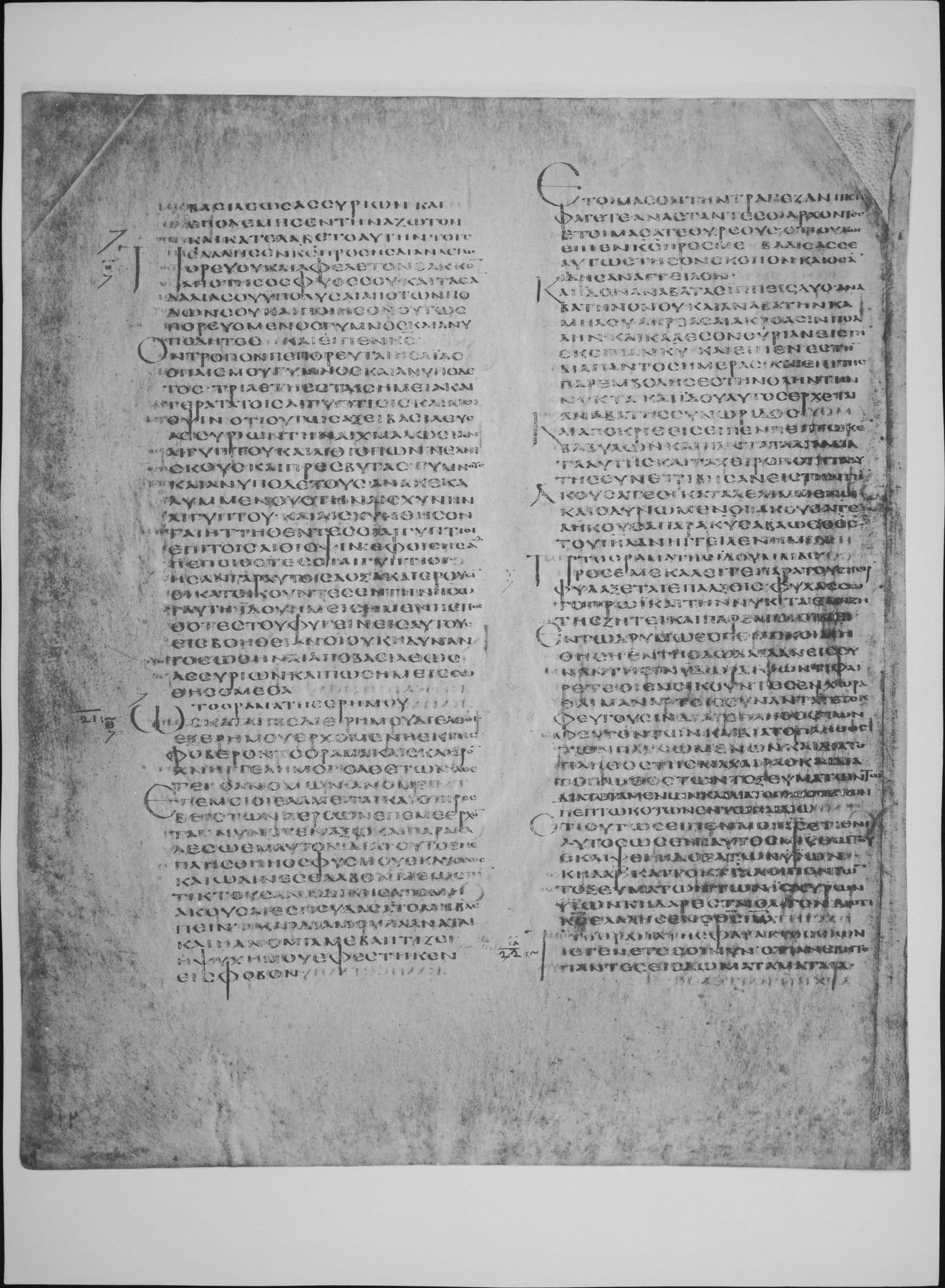
Isaiah 21 in the Greek Old Testament (the Septuagint) as written in Codex Alexandrinus, a Greek Bible copied in the fifth century, probably in Egypt, and now in the British Library (Royal MS 1 D. VI, the second of its four volumes). It is one of the three great early codices of the whole Greek Bible, with Codex Vaticanus and Codex Sinaiticus.
Numbering: Swete's Greek and Brenton's English number or divide some verses of this chapter differently (Swete 21:1-2 = Brenton 21:1-2; Swete 21:10-11 = Brenton 21:10-11). Each column keeps its own verse numbers, and sections are cut only where the two texts agree, so each section holds the same passage in both languages.
This entry meets the strict three-criteria standard of the Theosis Library:
- Manuscript scan: the page of Codex Alexandrinus carrying this chapter (fol. 310v), from the full-size photographic (autotype) facsimile published by the British Museum in 1879-1883, as digitised on the Internet Archive. The verse range of every page comes from the reduced photographic facsimile of 1936, which prints it beneath each plate, and the opening words of every page were read on the plate to confirm the page and the verse it begins with. Each section links to the page or pages that hold its verses. Folio numbers are those written at the head of each leaf and visible on the plates.
- Original text: Swete's edition, which here prints the text of Codex Vaticanus (Vat. gr. 1209), the base of his edition, and gives the readings of Alexandrinus only in his apparatus. The Greek column is therefore Vaticanus' text; where Alexandrinus differs, the plate shows what Alexandrinus reads.
- English translation: Sir Lancelot C. L. Brenton, The Septuagint Version of the Old Testament (1844; 1851 edition), a translation of the Greek, public domain, from the eBible.org text.
How was this verified? (Provenance)
Where on the image
Isaiah 21:1-8 is on fol. 310v (full-size facsimile of 1879-83, Internet Archive codex-alexandrinus leaf 645). The 1936 reduced facsimile prints beneath this page: Is. xx. 1-xxii. 1. Checked on the plate: the page begins inside Isaiah 20:1 (first words read: ΒΑΣΙΛΕΩΣ ΑΣΣΥΡΙΩΝ ΚΑΙ ΕΠΟΛΕΜΗΣΕΝ ΤΗΝ ΑΖΩΤΟΝ ΚΑΙ ΚΑΤΕΛΑΒΕΤΟ ΑΥΤΗΝ).
1Τὸ ὅραμα τῆς ἐρήμου. Ὡς καταιγὶς δι᾽ ἐρήμου διέλθοι, ἐξ ἐρήμου ἐρχομένη ἐκ γῆς· φοβερὸν 2τὸ ὅραμα καὶ σκληρὸν ἀνηγγέλη μοι. ὁ ἀθετῶν ἀθετεῖ, ὁ ἀνομῶν ἀνομεῖ. ἐπ᾽ ἐμοὶ οἱ Ἐλαμεῖται, καὶ οἱ πρέσβεις τῶν Περσῶν ἐπ᾽ ἐμὲ ἔρχονται. νῦν στενάξω καὶ παρακαλέσω ἐμαυτόν. 3διὰ τοῦτο ἐνεπλήσθη ἡ ὀσφύς μου ἐκλύσεως, καὶ ὠδῖνες ἔλαβόν με ὡς τὴν τίκτουσαν· ἠδίκησα τὸ μὴ ἀκοῦσαι, ἐσπούδασα τοῦ μὴ βλέπειν. 4ἡ καρδία μου πλανᾶται καὶ ἡ ἀνομία με βαπτίζει, ἡ ψυχή μου ἐφέστηκεν εἰς φόβον. 5ἑτοίμασον τὴν τράπεζαν, φάγετε, πίετε· ἀναστάντες οἱ ἄρχοντες ἑτοιμάσατε θυρεούς, 6ὅτι οὕτως εἶπεν πρὸς μὲ Κύριος Βαδίσας σεαυτῷ στῆσον σκοπόν, καὶ ὃ ἂν ἴδῃς ἀνάγγειλον. 7καὶ εἶδον ἀναβάτας ἱππεῖς δύο, καὶ ἀναβάτην ὄνου καὶ ἀναβάτην καμήλου. ἀκρόασαι ἀκρόασιν πολλήν, 8καὶ κάλεσον Οὐρείαν εἰς τὴν σκοπιάν. Κύριος εἶπεν Ἔστην διὰ παντὸς ἡμέρας, καὶ ἐπὶ τῆς παρεμβολῆς ἐγὼ ἔστην ὅλην τὴν νύκτα,
1The Vision of the Desert. 2so a fearful and a grievous vision was declared to me: he that is treacherous deals treacherously, the transgressor transgresses. The Elamites are upon me, and the ambassadors of the Persians come against me: now will I groan and comfort myself. 3Therefore are my loins filled with feebleness, and pangs have seized me as a travailing woman: I dealt wrongfully that I might not hear; I hasted that I might not see. 4My heart wanders, and transgression overwhelms me; my soul is occupied with fear. 5Prepare the table, eat, drink: arise, ye princes, and prepare your shields. 6For thus said the Lord to me, Go and station a watchman for thyself, and declare whatever thou shalt see. 7And I saw two mounted horsemen, and a rider on an ass, and a rider on a camel. 8Hearken with great attention, and call thou Urias to the watch-tower: the Lord has spoken. I stood continually during the day, and I stood in the camp all the night:
Where on the image
Isaiah 21:9-17 is on fol. 310v (full-size facsimile of 1879-83, Internet Archive codex-alexandrinus leaf 645). The 1936 reduced facsimile prints beneath this page: Is. xx. 1-xxii. 1. Checked on the plate: the page begins inside Isaiah 20:1 (first words read: ΒΑΣΙΛΕΩΣ ΑΣΣΥΡΙΩΝ ΚΑΙ ΕΠΟΛΕΜΗΣΕΝ ΤΗΝ ΑΖΩΤΟΝ ΚΑΙ ΚΑΤΕΛΑΒΕΤΟ ΑΥΤΗΝ).
9καὶ ἰδοὺ αὐτὸς ἔρχεται ἀναβάτης συνωρίδος. καὶ ἀποκριθεὶς εἶπεν Πέπτωκεν πέπτωκεν Βαβυλών, καὶ πάντα τὰ ἀγάλματα αὐτῆς καὶ τὰ χειροποίητα αὐτῆς συνετρίβη εἰς τὴν γῆν. 10ἀκούσατε οἱ καταλελιμμένοι καὶ οἱ ὀδυνώμενοι, ἀκούσατε ἃ ἤκουσα παρὰ Κυρίου σαβαώθ· ὁ θεὸς τοῦ Ἰσραὴλ ἀνήγγειλεν ἡμῖν. 11Τὸ ὅραμα τῆς Ἰδουμαίας. Πρὸς ἐμὲ καλεῖ παρὰ τοῦ Σηείρ Φυλάσσετε ἐπάλξεις. 12φυλάσσω τὸ πρωὶ καὶ τὴν νύκτα· ἐὰν ζητῇς ζήτει, καὶ παρ᾽ ἐμοὶ οἴκει, 13ἐν τῷ δρυμῷ ἑσπέρας κοιμηθήσῃ, ἐν τῇ ὁδῷ Δαιδάν. 14εἰς συνάντησιν διψῶντι ὕδωρ φέρετε, οἱ ἐνοικοῦντες ἐν χώρᾳ Θαιμάν, ἄρτοις συναντᾶτε τοῖς φεύγουσιν 15διὰ τὸ πλῆθος τῶν πεφονευμένων καὶ διὰ τὸ πλῆθος τῶν πλανωμένων καὶ διὰ τὸ πλῆθος τῆς μαχαίρας καὶ διὰ τὸ πλῆθος τῶν τοξευμάτων τῶν διατεταμένων καὶ διὰ τὸ πλῆθος τῶν πεπτωκότων ἐν τῷ πολέμῳ. 16διότι οὕτως εἶπέν μοι Κύριος Ἔτι ἐνιαυτὸς ὡς ἐνιαυτὸς μισθωτοῦ, ἐκλείψει ἡ δόξα τῶν υἱῶν Κηδάρ, 17καὶ τὸ κατάλοιπον τῶν τοξευμάτων τῶν ἰσχυρῶν υἱῶν Κηδὰρ ἔσται ὀλίγον, ὅτι Κύριος ὁ θεὸς Ἰσραὴλ ἐλάλησεν.
9and, behold, he comes riding in a chariot and pair: and he answered and said, Babylon is fallen, is fallen; and all her images and her idols have been crushed to the ground. 10Hear, ye that are left, and ye that are in pain, hear what things I have heard of the Lord of hosts which the God of Israel has declared to us. 11The Vision of Idumea. 12I watch in the morning and the night: if thou wouldest enquire, enquire, and dwell by me. 13Thou mayest lodge in the forest in the evening, or in the way of Dædan. 14Ye that dwell in the country of Thæman, bring water to meet him that is thirsty; 15meet the fugitives with bread, because of the multitude of the slain, and because of the multitude of them that lose their way, and because of the multitude of swords, and because of the multitude of bent bows, and because of the multitude of them that have fallen in war. 16For thus said the Lord to me, Yet a year, as the year of an hireling, and the glory of the sons of Kedar shall fail: 17and the remnant of the strong bows of the sons of Kedar shall be small: for the Lord God of Israel has spoken it.
Cite
Sources
- Source: Codex Alexandrinus (British Library Royal MS 1 D. VI) via the British Museum photographic facsimiles of 1879-83 and 1936 (Internet Archive) + Swete's Septuagint + Brenton's English (holding institution)
- Critical edition: H. B. Swete, The Old Testament in Greek according to the Septuagint (1909)
← previous · → next · v cycle view · l back to library