Isaiah, Chapter 23 (Codex Alexandrinus)
Introduction
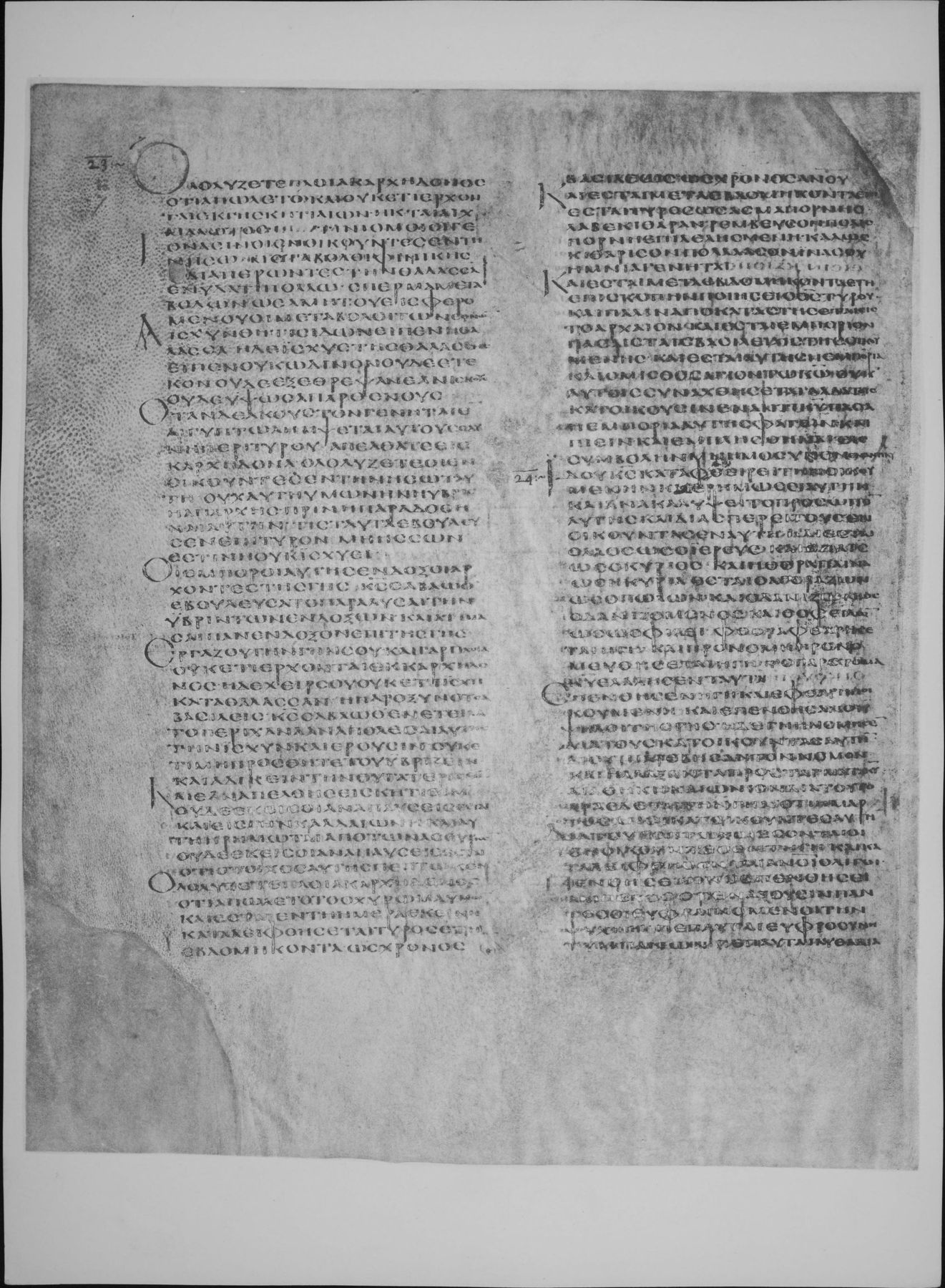
Isaiah 23 in the Greek Old Testament (the Septuagint) as written in Codex Alexandrinus, a Greek Bible copied in the fifth century, probably in Egypt, and now in the British Library (Royal MS 1 D. VI, the second of its four volumes). It is one of the three great early codices of the whole Greek Bible, with Codex Vaticanus and Codex Sinaiticus.
Numbering: Swete's Greek and Brenton's English number or divide some verses of this chapter differently (Swete 23:1-2 = Brenton 23:1-2; Swete 23:16-17 = Brenton 23:16-17). Each column keeps its own verse numbers, and sections are cut only where the two texts agree, so each section holds the same passage in both languages.
This entry meets the strict three-criteria standard of the Theosis Library:
- Manuscript scan: the page of Codex Alexandrinus carrying this chapter (fol. 311v), from the full-size photographic (autotype) facsimile published by the British Museum in 1879-1883, as digitised on the Internet Archive. The verse range of every page comes from the reduced photographic facsimile of 1936, which prints it beneath each plate, and the opening words of every page were read on the plate to confirm the page and the verse it begins with. Each section links to the page or pages that hold its verses. Folio numbers are those written at the head of each leaf and visible on the plates.
- Original text: Swete's edition, which here prints the text of Codex Vaticanus (Vat. gr. 1209), the base of his edition, and gives the readings of Alexandrinus only in his apparatus. The Greek column is therefore Vaticanus' text; where Alexandrinus differs, the plate shows what Alexandrinus reads.
- English translation: Sir Lancelot C. L. Brenton, The Septuagint Version of the Old Testament (1844; 1851 edition), a translation of the Greek, public domain, from the eBible.org text.
How was this verified? (Provenance)
Where on the image
Isaiah 23:1-8 is on fol. 311v (full-size facsimile of 1879-83, Internet Archive codex-alexandrinus leaf 647). The 1936 reduced facsimile prints beneath this page: Is. xxiii. 1-xxiv. 8. Checked on the plate: the page begins at the start of Isaiah 23:1 (first words read: ΟΛΟΛΥΖΕΤΕ ΠΛΟΙΑ ΚΑΡΧΗΔΟΝΟΣ ΟΤΙ ΑΠΩΛΕΤΟ ΚΑΙ ΟΥΚΕΤΙ ΕΡΧΟΝΤΑΙ). Note: the page begins at Isa. 23:1 (ΟΛΟΛΥΖΕΤΕ ΠΛΟΙΑ ΚΑΡΧΗΔΟΝΟΣ), as the captions show (xxii. 25 ends the preceding page); Swete's verse 23:1 also includes the heading Τὸ ὅραμα Τύρου.
1Τὸ ῥῆμα Τύρου. Ὀλολύξατε, πλοῖα Καρχηδόνος, ὅτι ἀπώλετο, καὶ οὐκέτι ἔρχονται ἐκ γῆς Κιτιαίων· ἦκται αἰχμάλωτος. 2τίνι ὅμοιοι γεγόνασιν οἱ ἐνοικοῦντες ἐν τῇ νήσῳ, μεταβόλοι Φοινίκης, διαπερῶντες τὴν θάλασσαν 3ἐν ὕδατι πολλῷ, σπέρμα μεταβόλων; ὡς ἀμητοῦ εἰσφερομένου οἱ μεταβόλοι τῶν ἐθνῶν. 4αἰσχύνθητι, Σειδών, εἶπεν ἡ θάλασσα· ἡ δὲ ἰσχὺς τῆς θαλάσσης εἶπεν Οὐκ ὤδινον οὐδ᾽ ἔτεκον, οὐδὲ ἐξέθρεψα νεανίσκους οὐδὲ ὕψωσα παρθένους. 5ὅταν δὲ ἀκουστὸν γένηται Αἰγύπτῳ, λήμψεται αὐτοὺς ὀδύνη περὶ Τύρου. 6ἀπέλθατε εἰς Καρχηδόνα, ὀλολύξατε, οἱ κατοικοῦντες ἐν τῇ νήσῳ ταύτῃ. 7οὐχ αὕτη ἦν ὑμῶν ἡ ὕβρις ἀπ᾽ ἀρχῆς πρὶν ἢ παραδοθῆναι αὐτήν; 8τίς ταῦτα ἐβούλευσεν ἐπὶ Τύρον; μὴ ἥσσων ἐστίν, ἢ οὐκ ἰσχύει; οἱ ἔμποροι αὐτῆς ἔνδοξοι, ἄρχοντες τῆς γῆς.
1The Word concerning Tyre. 2To whom are the dwellers in the island become like, the merchants of Phœnice, passing over the sea 3in great waters, a generation of merchants? as when the harvest is gathered in, so are these traders with the nations. 4Be ashamed, O Sidon: the sea has said, yea, the strength of the sea has said, I have not travailed, nor brought forth, nor have I brought up young men, nor reared virgins. 5Moreover when it shall be heard in Egypt, sorrow shall seize them for Tyre. 6Depart ye to Carthage; howl, ye that dwell in this island. 7Was not this your pride from the beginning, before she was given up? 8Who has devised this counsel against Tyre? Is she inferior? or has she no strength? her merchants were the glorious princes of the earth.
Where on the image
Isaiah 23:9-18 is on fol. 311v (full-size facsimile of 1879-83, Internet Archive codex-alexandrinus leaf 647). The 1936 reduced facsimile prints beneath this page: Is. xxiii. 1-xxiv. 8. Checked on the plate: the page begins at the start of Isaiah 23:1 (first words read: ΟΛΟΛΥΖΕΤΕ ΠΛΟΙΑ ΚΑΡΧΗΔΟΝΟΣ ΟΤΙ ΑΠΩΛΕΤΟ ΚΑΙ ΟΥΚΕΤΙ ΕΡΧΟΝΤΑΙ). Note: the page begins at Isa. 23:1 (ΟΛΟΛΥΖΕΤΕ ΠΛΟΙΑ ΚΑΡΧΗΔΟΝΟΣ), as the captions show (xxii. 25 ends the preceding page); Swete's verse 23:1 also includes the heading Τὸ ὅραμα Τύρου.
9Κύριος σαβαὼθ ἐβουλεύσατο παραλῦσαι πᾶσαν τὴν ὕβριν τῶν ἐνδόξων καὶ ἀτιμάσαι πᾶν ἔνδοξον ἐπὶ τῆς γῆς. 10ἐργάζου τὴν γῆν σου, καὶ γὰρ πλοῖα οὐκέτι ἔρχεται ἐκ Καρχηδόνος. 11ἡ δὲ χείρ σου οὐκέτι ἰσχύει κατὰ θάλασσαν, ἡ παροξύνουσα βασιλεῖς· Κύριος σαβαὼθ ἐνετείλατο περὶ Χανάαν ἀπολέσαι αὐτῆς τὴν ἰσχύν. 12καὶ ἐροῦσιν Οὐκέτι μὴ προστεθῆτε τοῦ ὑβρίζειν καὶ ἀδικεῖν τὴν θυγατέρα Σειδῶνος· καὶ ἐὰν ἀπέλθῃς εἰς Κιτιεῖς, οὐδὲ ἐκεῖ ἀνάπαυσις ἔσται σοι· 13καὶ εἰς γῆν Χαλδαίων, καὶ αὕτη ἠρήμωται ἀπὸ τῶν Ἀσσυρίων, ὁ τοῖχος αὐτῆς πέπτωκεν. 14ὀλολύξατε, πλοῖα Καρχηδόνος, ὅτι ἀπόλωλε τὸ ὀχύρωμα ὑμῶν. 15καὶ ἔσται ἐν τῇ ἡμέρᾳ ἐκείνῃ καταλειφθήσεται Τύρος ἑβδομήκοντα ἔτη, ὡς χρόνος βασιλέως, ὡς χρόνος ἀνθρώπου· καὶ ἔσται μετὰ ἑβδομήκοντα ἔτη ἔσται Τύρος ὡς ᾆσμα πόρνης. 16λάβε κιθάραν, ῥέμβευσον πόλεις πόρνη ἐπιλελησμένη, καλῶς κιθάρισον, πολλὰ ᾆσον, ἵνα σου μνεία γένηται. καὶ ἔσται μετὰ τὰ ἑβδομήκοντα ἔτη ἐπισκοπὴν ποιήσει ὁ θεὸς Τύρου, καὶ πάλιν ἀποκαταστήσεται εἰς τὸ ἀρχαῖον, 17καὶ ἔσται ἐμπόριον πάσαις ταῖς βασιλείαις τῆς οἰκουμένης ἐπὶ πρόσωπον τῆς γῆς. 18καὶ ἔσται ἡ ἐμπορία αὐτῆς καὶ ὁ μισθὸς ἅγιον Κυρίῳ, οὐκ αὐτοῖς συναχθήσεται ἀλλὰ τοῖς κατοικοῦσιν ἔναντι Κυρίου, πᾶσα ἡ ἐμπορία αὐτῆς, φαγεῖν καὶ πιεῖν καὶ ἐμπλησθῆναι, καὶ εἰς συμβολὴν μνημόσυνον ἔναντι Κυρίου.
9The Lord of hosts has purposed to bring down all the pride of the glorious ones, and to disgrace every glorious thing on the earth. 10Till thy land; for ships no more come out of Carthage. 11And thy hand prevails no more by sea, which troubled kings: the Lord of hosts has given a command concerning Chanaan, to destroy the strength thereof. 12And men shall say, Ye shall no longer at all continue to insult and injure the daughter of Sidon: and if thou depart to the Citians, neither there shalt thou have rest. 13And if thou depart to the land of the Chaldeans, this also is laid waste by the Assyrians, for her wall is fallen. 14Howl, ye ships of Carthage: for your strong hold is destroyed. 15And it shall come to pass in that day, that Tyre shall be left seventy years, as the time of a king, as the time of a man: and it shall come to pass after seventy years, that Tyre shall be as the song of a harlot. 16Take a harp, go about, O city, thou harlot that hast been forgotten; play well on the harp, sing many songs, that thou mayest be remembered. 17And it shall come to pass after the seventy years, that God will visit Tyre, and she shall be again restored to her primitive state, and she shall be a mart for all the kingdoms of the world on the face of the earth. 18And her trade and her gain shall be holiness to the Lord: it shall not be gathered for them, but for those that dwell before the Lord, even all her trade, to eat and drink and be filled, and for a covenant and a memorial before the Lord.
Cite
Sources
- Source: Codex Alexandrinus (British Library Royal MS 1 D. VI) via the British Museum photographic facsimiles of 1879-83 and 1936 (Internet Archive) + Swete's Septuagint + Brenton's English (holding institution)
- Critical edition: H. B. Swete, The Old Testament in Greek according to the Septuagint (1909)
← previous · → next · v cycle view · l back to library