Isaiah, Chapter 31 (Codex Alexandrinus)
Introduction
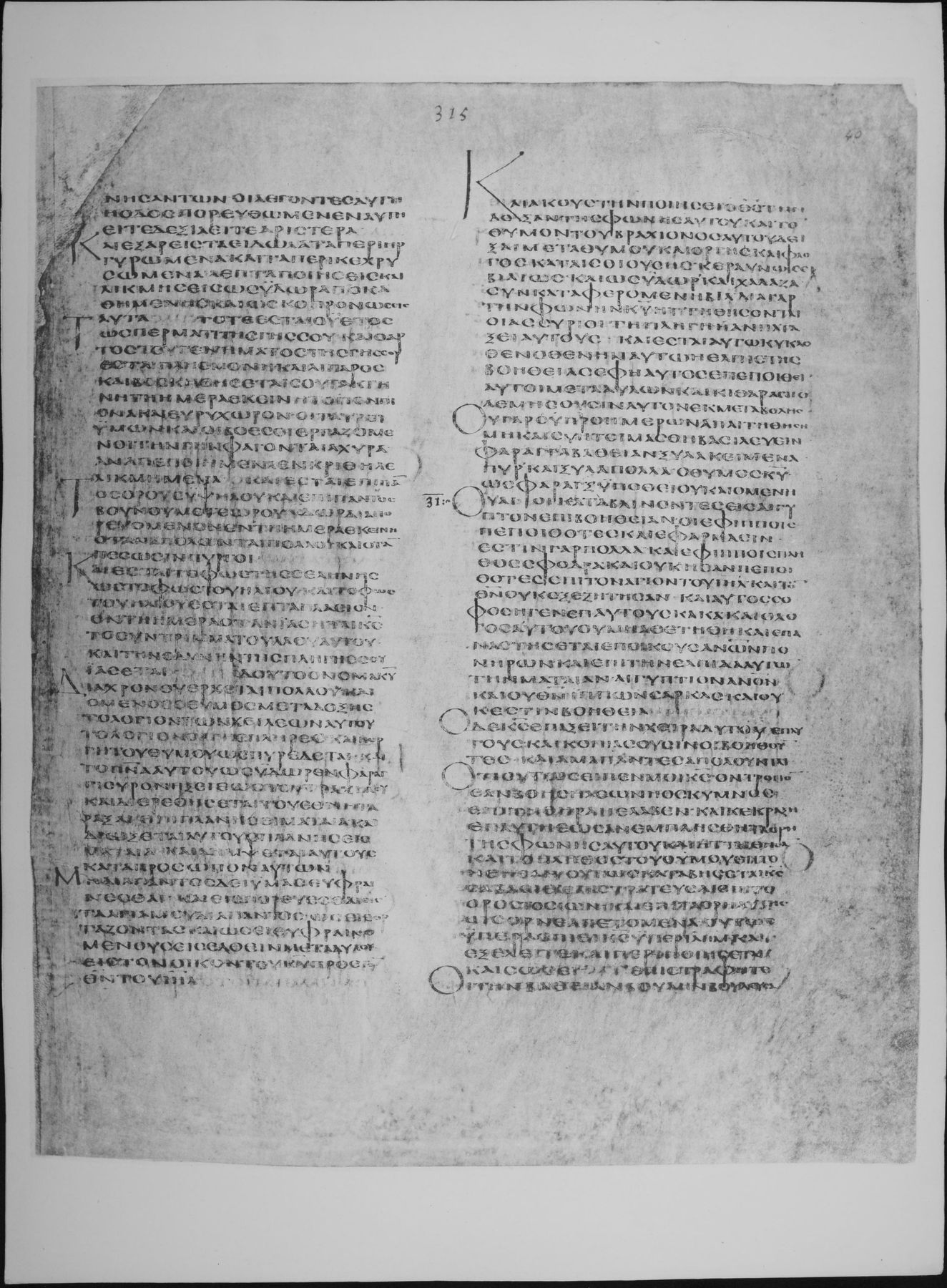
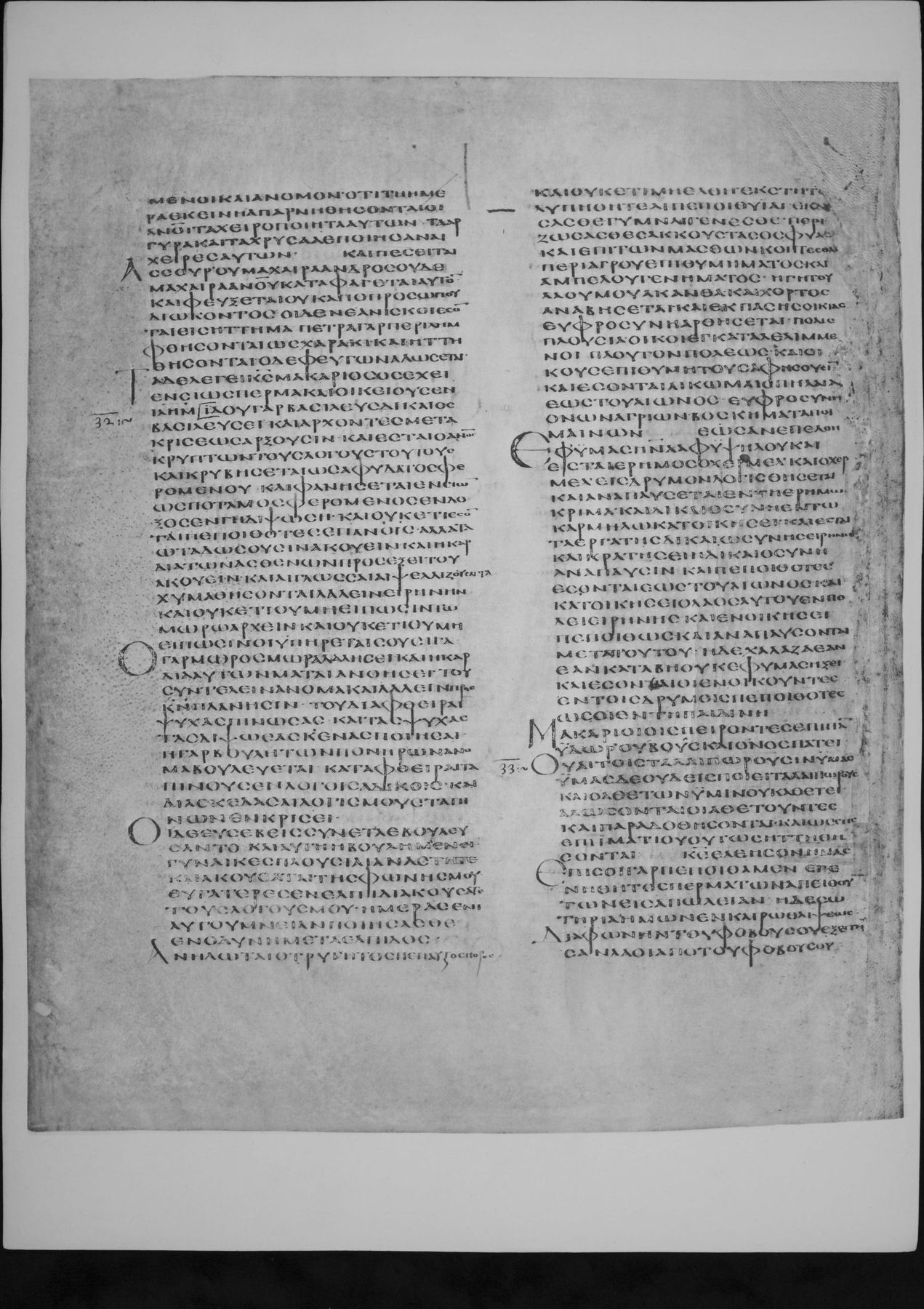
Isaiah 31 in the Greek Old Testament (the Septuagint) as written in Codex Alexandrinus, a Greek Bible copied in the fifth century, probably in Egypt, and now in the British Library (Royal MS 1 D. VI, the second of its four volumes). It is one of the three great early codices of the whole Greek Bible, with Codex Vaticanus and Codex Sinaiticus.
This entry meets the strict three-criteria standard of the Theosis Library:
- Manuscript scan: the pages of Codex Alexandrinus carrying this chapter (fol. 315r, fol. 315v), from the full-size photographic (autotype) facsimile published by the British Museum in 1879-1883, as digitised on the Internet Archive. The verse range of every page comes from the reduced photographic facsimile of 1936, which prints it beneath each plate, and the opening words of every page were read on the plate to confirm the page and the verse it begins with. Each section links to the page or pages that hold its verses. Folio numbers are those written at the head of each leaf and visible on the plates.
- Original text: Swete's edition, which here prints the text of Codex Vaticanus (Vat. gr. 1209), the base of his edition, and gives the readings of Alexandrinus only in his apparatus. The Greek column is therefore Vaticanus' text; where Alexandrinus differs, the plate shows what Alexandrinus reads.
- English translation: Sir Lancelot C. L. Brenton, The Septuagint Version of the Old Testament (1844; 1851 edition), a translation of the Greek, public domain, from the eBible.org text.
How was this verified? (Provenance)
Where on the image
Isaiah 31:1-6 is on fol. 315r (full-size facsimile of 1879-83, Internet Archive codex-alexandrinus leaf 654). The 1936 reduced facsimile prints beneath this page: Is. xxx. 21-xxxi. 6. Checked on the plate: the page begins inside Isaiah 30:21 (first words read: ΠΛΑΝΗΘΕΝΤΩΝ ΟΙ ΛΕΓΟΝΤΕΣ ΑΥΤΗ Η ΟΔΟΣ ΠΟΡΕΥΘΩΜΕΝ ΕΝ ΑΥΤΗ ΕΙΤΕ ΔΕΞΙΑ ΕΙΤΕ ΑΡΙΣΤΕΡΑ). Isaiah 31:6-9 is on fol. 315v (full-size facsimile of 1879-83, Internet Archive codex-alexandrinus leaf 655). The 1936 reduced facsimile prints beneath this page: Is. xxxi. 6-xxxiii. 3. Checked on the plate: the page begins inside Isaiah 31:6 (first words read: ΚΑΙ ΑΝΟΜΟΝ ΟΤΙ ΤΗ ΗΜΕΡΑ ΕΚΕΙΝΗ ΑΠΑΡΝΗΣΟΝΤΑΙ ΟΙ ΑΝΘΡΩΠΟΙ ΤΑ ΧΕΙΡΟΠΟΙΗΤΑ ΑΥΤΩΝ).
1Οὐαὶ οἱ καταβαίνοντες εἰς Αἴγυπτον ἐπὶ βοήθειαν, οἱ ἐφ᾽ ἵπποις πεποιθότες καὶ ἐφ᾽ ἅρμασιν· ἔστιν γὰρ πολλά, καὶ ἐφ᾽ ἵπποις πλῆθος σφόδρα· καὶ οὐκ ἦσαν πεποιθότες ἐπὶ τὸν ἅγιον τοῦ Ἰσραήλ, καὶ τὸν κύριον οὐκ ἐζήτησαν. 2καὶ αὐτὸς σοφὸς ἦγεν ἐπ᾽ αὐτοὺς κακά, καὶ ὁ λόγος αὐτοῦ οὐ μὴ ἀθετηθῇ, καὶ ἐπαναστήσεται ἐπ᾽ οἴκους ἀνθρώπων πονηρῶν καὶ ἐπὶ τὴν ἐλπίδα αὐτῶν τὴν ματαίαν, 3Αἰγύπτιον ἄνθρωπον καὶ οὐ θεόν, ἵππων σάρκας καὶ οὐκ ἔστιν βοήθεια· ὁ δὲ κύριος ἐπάξει τὴν χεῖρα αὐτοῦ ἐπ᾽ αὐτούς, καὶ κοπιάσουσιν οἱ βοηθοῦντες, καὶ ἅμα πάντες ἀπολοῦνται. 4ὅτι οὕτως εἶπέν μοι Κύριος Ὃν τρόπον βοήσῃ ὁ λέων ἢ ὁ σκύμνος ἐπὶ τῇ θήρᾳ ᾗ ἔλαβεν, καὶ κεκράξῃ ἐπ᾽ αὐτῇ ἕως ἐμπλησθῇ τὰ ὄρη τῆς φωνῆς αὐτοῦ, καὶ ἡττήθησαν καὶ τὸ πλῆθος τοῦ θυμοῦ ἐπτοήθησαν, οὕτως καταβήσεται Κύριος σαβαὼθ ἐπιστρατεῦσαι ἐπὶ τὸ ὄρος τὸ Σειών, ἐπὶ τὰ ὄρη αὐτῆς. 5ὡς ὄρνεα πετόμενα, οὕτως ὑπερασπιεῖ Κύριος σαβαώθ, ὑπὲρ Ἰερουσαλὴμ ὑπερασπιεῖ καὶ ἐξελεῖται, καὶ περιποιήσεται καὶ σώσει. 6ἐπιστράφητε, οἱ τὴν βαθεῖαν βουλὴν βουλευόμενοι καὶ ἄνομον υἱοὶ Ἰσραήλ. 7ὅτι τῇ ἡμέρᾳ ἐκείνῃ ἀπαρνήσονται οἱ ἄνθρωποι τὰ χειροποίητα αὐτῶν τὰ ἀργυρᾶ καὶ τὰ χειροποίητα τὰ χρυσᾶ ἃ ἐποίησαν αἱ χεῖρες αὐτῶν. 8καὶ πεσεῖται Ἀσσούρ· οὐ μάχαιρα ἀνδρὸς οὐδὲ μάχαιρα ἀνθρώπου καταφάγεται αὐτόν, καὶ φεύξεται οὐκ ἀπὸ προσώπου μαχαίρας· οἱ δὲ νεανίσκοι ἔσονται εἰς ἥττημα, 9πέτρᾳ γὰρ περιλημφθήσονται ὡς χάρακι καὶ ἡττηθήσονται, ὁ δὲ φεύγων ἁλώσεται. Τάδε λέγει Κύριος Μακάριος ὃς ἔχει ἐν Σειὼν σπέρμα καὶ οἰκείους ἐν Ἰερουσαλήμ.
1Woe to them that go down to Egypt for help, who trust in horses and chariots, for they are many; and in horses, which are a great multitude; and have not trusted in the Holy One of Israel, and have not sought the Lord. 2Therefore he has wisely brought evils upon them, and his word shall not be frustrated; and he shall rise up against the houses of wicked men, and against their vain hope, 3even an Egyptian, a man, and not God; the flesh of horses, and there is no help in them: but the Lord shall bring his hand upon them, and the helpers shall fail, and all shall perish together. 4For thus said the Lord to me, As a lion would roar, or a lion's whelp over prey which he has taken, and cry over it, until the mountains are filled with his voice, and the animals are awe-struck and tremble at the fierceness of his wrath: so the Lord of hosts shall descend to fight upon the mount Sion, even upon her mountains. 5As birds flying, so shall the Lord of hosts defend; he shall defend Jerusalem, and he shall rescue, and save and deliver. 6Turn, ye children of Israel, who devise a deep and sinful counsel. 7For in that day men shall renounce their silver idols and their golden idols, which their hands made. 8And the Assyrian shall fall: not the sword of a great man, nor the sword of a mean man shall devour him; neither shall he flee from the face of the sword: but the young men shall be overthrown: 9for they shall be compassed with rocks as with a trench, and shall be worsted; and he that flees shall be taken. Thus saith the Lord, Blessed is he that has a seed in Sion, and household friends in Jerusalem.
Cite
Sources
- Source: Codex Alexandrinus (British Library Royal MS 1 D. VI) via the British Museum photographic facsimiles of 1879-83 and 1936 (Internet Archive) + Swete's Septuagint + Brenton's English (holding institution)
- Critical edition: H. B. Swete, The Old Testament in Greek according to the Septuagint (1909)
← previous · → next · v cycle view · l back to library