Isaiah, Chapter 39 (Codex Alexandrinus)
Introduction
Isaiah 39 in the Greek Old Testament (the Septuagint) as written in Codex Alexandrinus, a Greek Bible copied in the fifth century, probably in Egypt, and now in the British Library (Royal MS 1 D. VI, the second of its four volumes). It is one of the three great early codices of the whole Greek Bible, with Codex Vaticanus and Codex Sinaiticus.
This entry meets the strict three-criteria standard of the Theosis Library:
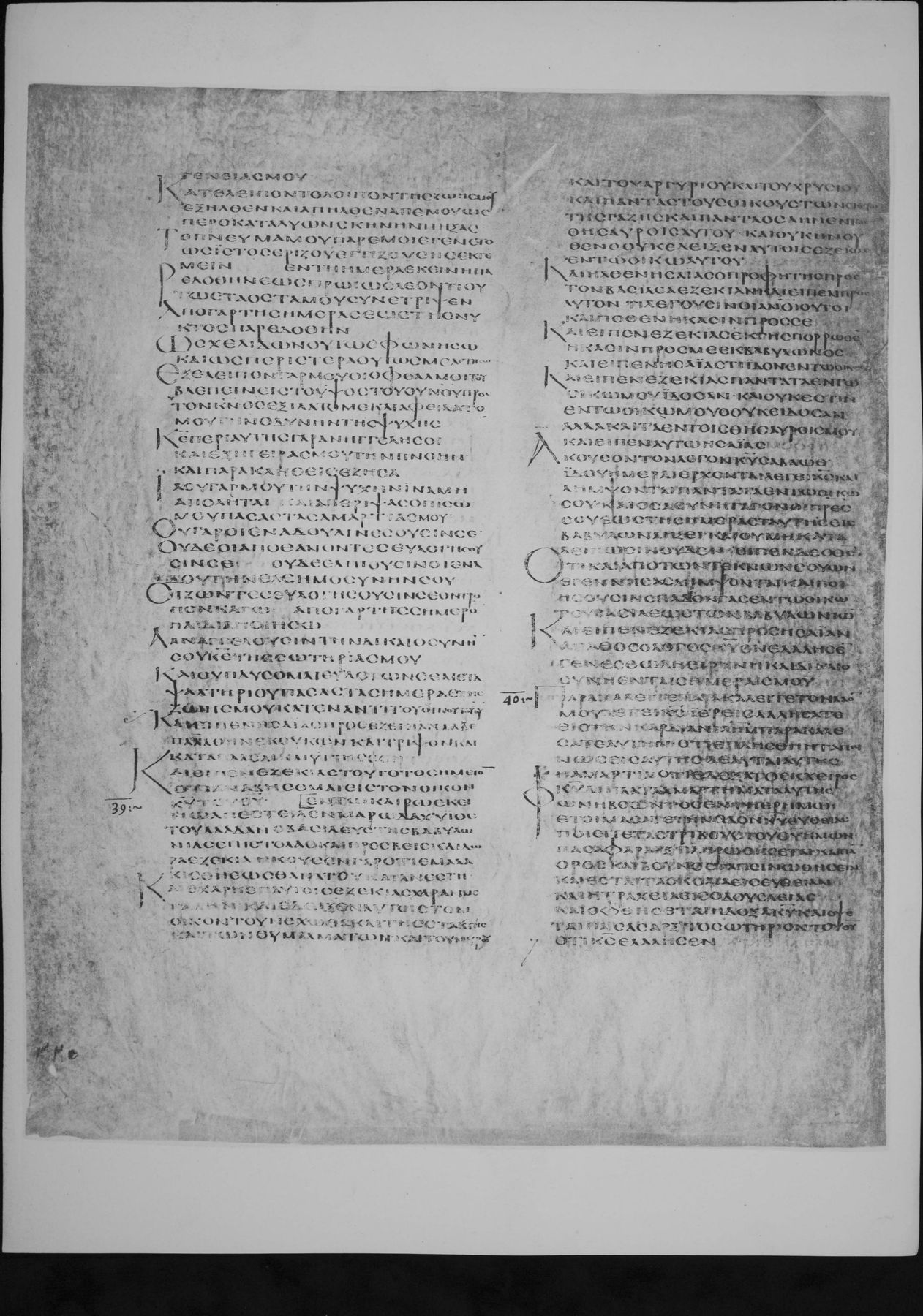
- Manuscript scan: the page of Codex Alexandrinus carrying this chapter (fol. 318v), from the full-size photographic (autotype) facsimile published by the British Museum in 1879-1883, as digitised on the Internet Archive. The verse range of every page comes from the reduced photographic facsimile of 1936, which prints it beneath each plate, and the opening words of every page were read on the plate to confirm the page and the verse it begins with. Each section links to the page or pages that hold its verses. Folio numbers are those written at the head of each leaf and visible on the plates.
- Original text: Swete's edition, which here prints the text of Codex Vaticanus (Vat. gr. 1209), the base of his edition, and gives the readings of Alexandrinus only in his apparatus. The Greek column is therefore Vaticanus' text; where Alexandrinus differs, the plate shows what Alexandrinus reads.
- English translation: Sir Lancelot C. L. Brenton, The Septuagint Version of the Old Testament (1844; 1851 edition), a translation of the Greek, public domain, from the eBible.org text.
How was this verified? (Provenance)
Where on the image
Isaiah 39:1-8 is on fol. 318v (full-size facsimile of 1879-83, Internet Archive codex-alexandrinus leaf 661). The 1936 reduced facsimile prints beneath this page: Is. xxxviii. 12-xl. 5. Checked on the plate: the page begins inside Isaiah 38:12 (first words read: ΓΕΝΕΙΑΣ ΜΟΥ ΕΞΗΛΘΕΝ ΚΑΙ ΑΠΗΛΘΕΝ ΑΠ ΕΜΟΥ ΩΣ Ο ΚΑΤΑΛΥΩΝ ΣΚΗΝΗΝ ΠΗΞΑΣ).
1Ἐν τῷ καιρῷ ἐκείνῳ ἀπέστειλεν Μαρωδὰχ Βαλαδὰν ὁ υἱὸς τοῦ Βαλαδὰν ὁ βασιλεὺς τῆς Βαβυλωνίας ἐπιστολὰς καὶ πρέσβεις καὶ δῶρα· ἤκουσεν γὰρ ὅτι ἐμαλακίσθη ἕως θανάτου καὶ ἀνέστη. 2καὶ ἐχάρη ἐπ᾽ αὐτοῖς Ἑζεκίας, καὶ ἔδειξεν αὐτοῖς τὸν οἶκον τοῦ νεχωθὰ καὶ τοῦ ἀργυρίου καὶ τοῦ χρυσίου καὶ τῆς στακτῆς καὶ τῶν θυμιαμάτων καὶ τοῦ μύρου, καὶ πάντας τοὺς οἴκους τῶν σκευῶν τῆς γάζης, καὶ πάντα ὅσα ἦν ἐν τοῖς θησαυροῖς αὐτοῦ· καὶ οὐκ ἦν οὐθὲν ὃ οὐκ ἔδειξεν Ἑζεκίας ἐν τῷ οἴκῳ αὐτοῦ. 3καὶ ἦλθεν Ἠσαίας ὁ προφήτης πρὸς τὸν βασιλέα Ἑζεκίαν καὶ εἶπεν πρὸς αὐτόν Τί λέγουσιν οἱ ἄνθρωποι οὗτοι, καὶ πόθεν ἥκασιν πρὸς σέ; καὶ εἶπεν Ἑζεκίας Ἐκ γῆς πόρρωθεν ἥκασιν πρὸς μέ, ἐκ Βαβυλῶνος. 4καὶ εἶπεν Ἠσαίας Τί εἴδοσαν ἐν τῷ οἴκῳ σου; καὶ εἶπεν Ἑζεκίας Πάντα τὰ ἐν τῷ οἴκῳ μου εἴδοσαν, καὶ οὐκ ἔστιν ἐν τῷ οἴκῳ μου ὃ οὐκ εἴδοσαν, ἀλλὰ καὶ τὰ ἐν τοῖς θησαυροῖς μου. 5καὶ εἶπεν Ἠσαίας αὐτῷ Ἄκουσον τὸν λόγον Κυρίου σαβαώθ 6Ἰδοὺ ἡμέραι ἔρχονται καὶ λήμψονται πάντα τὰ ἐν τῷ οἴκῳ σου, καὶ ὅσα συνήγαγον οἱ πατέρες σου ἕως τῆς ἡμέρας ταύτης εἰς Βαβυλῶνα ἥξει, καὶ οὐδὲν οὐ μὴ καταλίπωσιν· εἶπεν δὲ ὁ θεὸς 7ὅτι Καὶ ἀπὸ τῶν τέκνων σου ὧν γεννήσεις λήμψονται, καὶ ποιήσουσιν σπάδοντας ἐν τῷ οἴκῳ τοῦ βασιλέως τῶν Βαβυλωνίων. 8καὶ εἶπεν Ἑζεκίας Ἠσαίᾳ Ἀγαθὸς λόγος Κυρίου ὃν ἐλάλησεν· γενέσθω δὴ εἰρήνη καὶ δικαιοσύνη ἐν ταῖς ἡμέραις μου.
1At that time Marodach Baladan, the son of Baladan, the king of Babylonia, sent letters and ambassadors and gifts to Ezekias: for he had heard that he had been sick even to death, and was recovered. 2And Ezekias was glad of their coming, and he shewed them the house of his spices, and of silver, and gold, and myrrh, and incense, and ointment, and all the houses of his treasures, and all that he had in his stores: and there was nothing in his house, nor in all his dominion, which Ezekias did not shew. 3And Esaias the prophet came to king Ezekias, and said to him, What say these men? and whence came they to thee? and Ezekias said, They are come to me from a land afar off, from Babylon. 4And Esaias said, What have they seen in thine house? and Ezekias said, They have seen everything in my house; and there is nothing in my house which they have not seen: yea, also the possessions in my treasuries. 5And Esaias said to him, Hear the word of the Lord of hosts: 6Behold, the days come, when they shall take all the things that are in thine house, and all that thy fathers have gathered until this day, shall go to Babylon; and they shall not leave anything at all: and God hath said, 7that they shall take also of thy children whom thou shalt beget; and they shall make them eunuchs in the house of the king of the Babylonians. 8And Ezekias said to Esaias, Good is the word of the Lord, which he hath spoken: let there, I pray, be peace and righteousness in my days.
Cite
Sources
- Source: Codex Alexandrinus (British Library Royal MS 1 D. VI) via the British Museum photographic facsimiles of 1879-83 and 1936 (Internet Archive) + Swete's Septuagint + Brenton's English (holding institution)
- Critical edition: H. B. Swete, The Old Testament in Greek according to the Septuagint (1909)
← previous · → next · v cycle view · l back to library