Jonah, Chapter 2 (Codex Alexandrinus)
Introduction
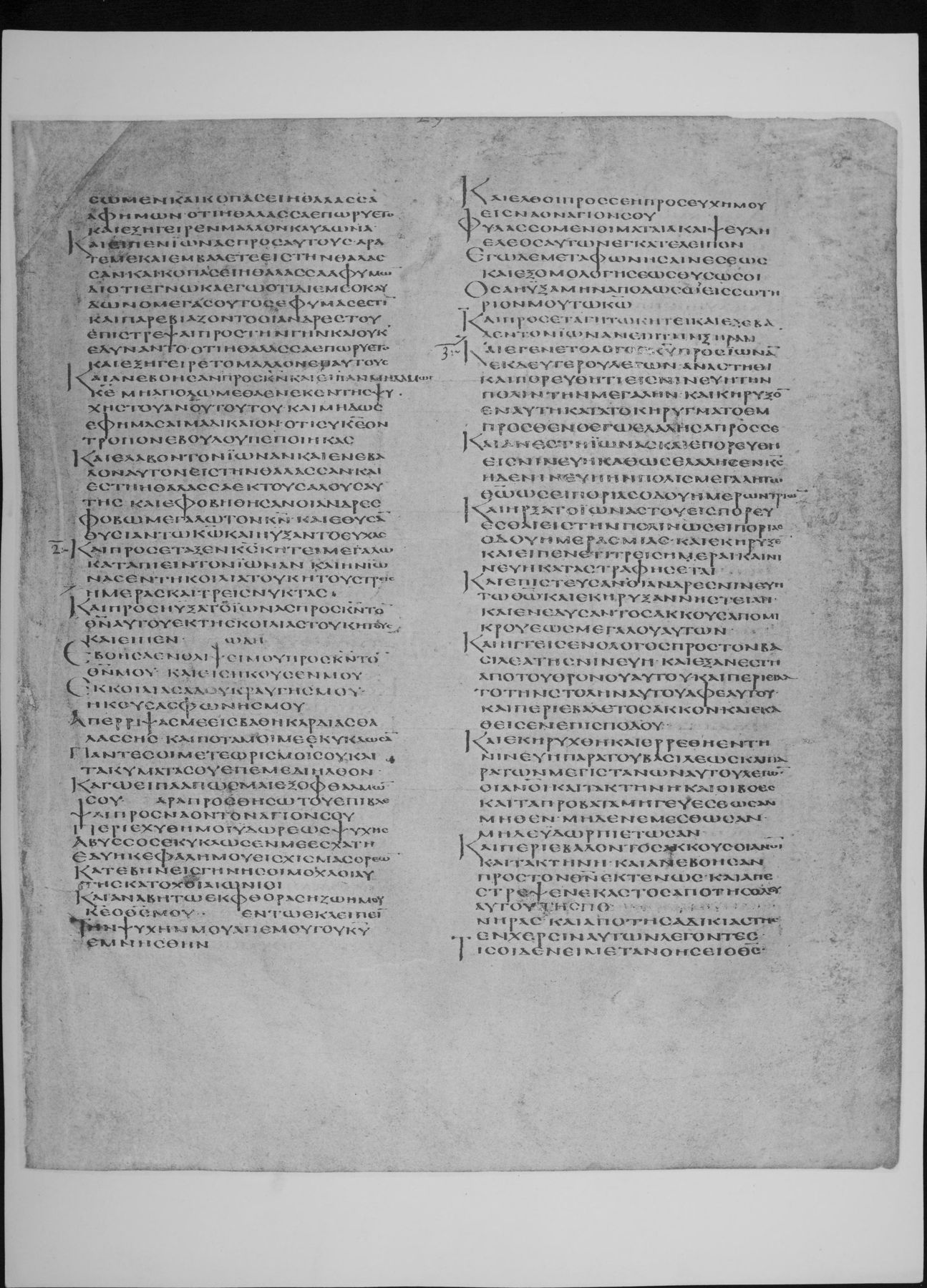
Jonah 2 in the Greek Old Testament (the Septuagint) as written in Codex Alexandrinus, a Greek Bible copied in the fifth century, probably in Egypt, and now in the British Library (Royal MS 1 D. VI, the second of its four volumes). It is one of the three great early codices of the whole Greek Bible, with Codex Vaticanus and Codex Sinaiticus.
Numbering: Swete's Greek and Brenton's English number or divide some verses of this chapter differently (Swete 2:3-4 = Brenton 2:3-4). Each column keeps its own verse numbers, and sections are cut only where the two texts agree, so each section holds the same passage in both languages.
This entry meets the strict three-criteria standard of the Theosis Library:
- Manuscript scan: the page of Codex Alexandrinus carrying this chapter (fol. 290r), from the full-size photographic (autotype) facsimile published by the British Museum in 1879-1883, as digitised on the Internet Archive. The verse range of every page comes from the reduced photographic facsimile of 1936, which prints it beneath each plate, and the opening words of every page were read on the plate to confirm the page and the verse it begins with. Each section links to the page or pages that hold its verses. Folio numbers are those written at the head of each leaf and visible on the plates.
- Original text: Swete's edition, which here prints the text of Codex Vaticanus (Vat. gr. 1209), the base of his edition, and gives the readings of Alexandrinus only in his apparatus. The Greek column is therefore Vaticanus' text; where Alexandrinus differs, the plate shows what Alexandrinus reads.
- English translation: Sir Lancelot C. L. Brenton, The Septuagint Version of the Old Testament (1844; 1851 edition), a translation of the Greek, public domain, from the eBible.org text.
How was this verified? (Provenance)
Where on the image
Jonah 2:1-8 is on fol. 290r (full-size facsimile of 1879-83, Internet Archive codex-alexandrinus leaf 604). The 1936 reduced facsimile prints beneath this page: Jonah i. 11-iii. 9. Checked on the plate: the page begins inside Jonah 1:11 (first words read: ΣΩΜΕΝ ΚΑΙ ΚΟΠΑΣΕΙ Η ΘΑΛΑΣΣΑ ΑΦ ΗΜΩΝ ΟΤΙ Η ΘΑΛΑΣΣΑ ΕΠΟΡΕΥΕΤΟ ΚΑΙ ΕΞΗΓΕΙΡΕΝ ΜΑΛΛΟΝ ΚΛΥΔΩΝΑ).
1Καὶ προσέταξεν Κύριος κήτει μεγάλῳ καταπιεῖν τὸν Ἰωνᾶν· καὶ ἦν Ἰωνᾶς ἐν τῇ κοιλίᾳ τοῦ κήτους τρεῖς ἡμέρας καὶ τρεῖς νύκτας. 2καὶ προσηύξατο Ἰωνᾶς πρὸς Κύριον τὸν θεὸν αὐτοῦ ἐκ τῆς κοιλίας τοῦ κήτους, 3καὶ εἶπεν Ἐβόησα ἐν θλίψει μου πρὸς Κύριον τὸν θεόν μου, καὶ εἰσήκουσέν μου. ἐκ κοιλίας ᾅδου κραυγῆς μου ἤκουσας φωνῆς μου· 4ἀπέρριψάς με εἰς βάθη καρδίας θαλάσσης, καὶ ποταμοί με ἐκύκλωσαν, πάντες οἱ μετεωρισμοί σου καὶ τὰ κύματά σου ἐπ᾽ ἐμὲ διῆλθον. 5καὶ ἐγώ εἶπα Ἀπῶσμαι ἐξ ὀφθαλμῶν σου· ἄρα προσθήσω τοῦ ἐπιβλέψαι πρὸς τὸν ναὸν τὸν ἅγιόν σου· 6περιεχύθη ὕδωρ μοι ἕως ψυχῆς, ἄβυσσος ἐκύκλωσέν με ἐσχάτη, ἔδυ ἡ κεφαλή μου εἰς σχισμὰς ὀρέων, 7κατέβην εἰς γῆν ἧς οἱ μοχλοὶ αὐτῆς κάτοχοι αἰώνιοι· καὶ ἀναβήτω φθορὰ ζωῆς μου, Κύριε ὁ θεός μου, 8ἐν τῷ ἐκλιπεῖν ἀπ᾽ ἐμοῦ τὴν ψυχήν μου τοῦ κυρίου ἐμνήσθην, καὶ ἔλθοι πρὸς σὲ ἡ εὐχή μου εἰς ναὸν ἅγιόν σου.
1Now the Lord had commanded a great whale to swallow up Jonas: and Jonas was in the belly of the whale three days and three nights. 2And Jonas prayed to the Lord his God out of the belly of the whale, 3and said, 4Thou didst cast me into the depths of the heart of the sea, and the floods compassed me: all thy billows and thy waves have passed upon me. 5And I said, I am cast out of thy presence: shall I indeed look again toward thy holy temple? 6Water was poured around me to the soul: the lowest deep compassed me, my head went down 7to the clefts of the mountains; I went down into the earth, whose bars are the everlasting barriers: yet, O Lord my God, let my ruined life be restored. 8When my soul was failing me, I remembered the Lord; and may my prayer come to thee into thy holy temple.
Where on the image
Jonah 2:9-11 is on fol. 290r (full-size facsimile of 1879-83, Internet Archive codex-alexandrinus leaf 604). The 1936 reduced facsimile prints beneath this page: Jonah i. 11-iii. 9. Checked on the plate: the page begins inside Jonah 1:11 (first words read: ΣΩΜΕΝ ΚΑΙ ΚΟΠΑΣΕΙ Η ΘΑΛΑΣΣΑ ΑΦ ΗΜΩΝ ΟΤΙ Η ΘΑΛΑΣΣΑ ΕΠΟΡΕΥΕΤΟ ΚΑΙ ΕΞΗΓΕΙΡΕΝ ΜΑΛΛΟΝ ΚΛΥΔΩΝΑ).
9φυλασσόμενοι μάταια καὶ ψευδῆ ἔλεος αὐτῶν ἐγκατέλιπον. 10ἐγὼ δὲ μετὰ φωνῆς αἰνέσεως καὶ ἐξομολογήσεως θύσω σοι, ὅσα ηὐξάμην ἀποδώσω σοι σωτηρίου τῷ κυρίῳ. 11Καὶ προσετάγη τῷ κήτει, καὶ ἐξέβαλεν τὸν Ἰωνᾶν ἐπὶ τὴν ξηράν.
9They that observe vanities and lies have forsaken their own mercy. 10But I will sacrifice to thee with the voice of praise and thanksgiving: all that I have vowed I will pay to thee, the Lord of my salvation. 11And the whale was commanded by the Lord, and it cast up Jonas on the dry land.
Cite
Sources
- Source: Codex Alexandrinus (British Library Royal MS 1 D. VI) via the British Museum photographic facsimiles of 1879-83 and 1936 (Internet Archive) + Swete's Septuagint + Brenton's English (holding institution)
- Critical edition: H. B. Swete, The Old Testament in Greek according to the Septuagint (1909)
← previous · → next · v cycle view · l back to library