Joshua, Chapter 12 (Codex Alexandrinus)
Introduction
Joshua 12 in the Greek Old Testament (the Septuagint) as written in Codex Alexandrinus, a Greek Bible copied in the fifth century, probably in Egypt, and now in the British Library (Royal MS 1 D. V, the first of its four volumes). It is one of the three great early codices of the whole Greek Bible, with Codex Vaticanus and Codex Sinaiticus, and for Genesis 1:1-46:28, which Codex Vaticanus has lost, it is the oldest surviving complete Greek text (older papyri such as the Berlin Genesis papyrus and Chester Beatty 961 survive only in part).
Numbering: Swete's Greek and Brenton's English number or divide some verses of this chapter differently (Swete 12:21 = Brenton 12:21-22). Each column keeps its own verse numbers, and sections are cut only where the two texts agree, so each section holds the same passage in both languages.
This entry meets the strict three-criteria standard of the Theosis Library:
- Manuscript scan: the pages of Codex Alexandrinus carrying this chapter (fol. 132v, fol. 133r), from the full-size photographic (autotype) facsimile published by the British Museum in 1879-1883, as digitised on the Internet Archive. The verse range of every page comes from the reduced photographic facsimile of 1915, which prints it beneath each plate, and the opening words of every page were read on the plate to confirm the page and the verse it begins with. Each section links to the page or pages that hold its verses. Folio numbers are those written at the head of each leaf and visible on the plates.
- Original text: Swete's edition, which here prints the text of Codex Vaticanus (Vat. gr. 1209), the base of his edition, and gives the readings of Alexandrinus only in his apparatus. The Greek column is therefore Vaticanus' text; where Alexandrinus differs, the plate shows what Alexandrinus reads.
- English translation: Sir Lancelot C. L. Brenton, The Septuagint Version of the Old Testament (1844; 1851 edition), a translation of the Greek, public domain, from the eBible.org text.
How was this verified? (Provenance)
Where on the image
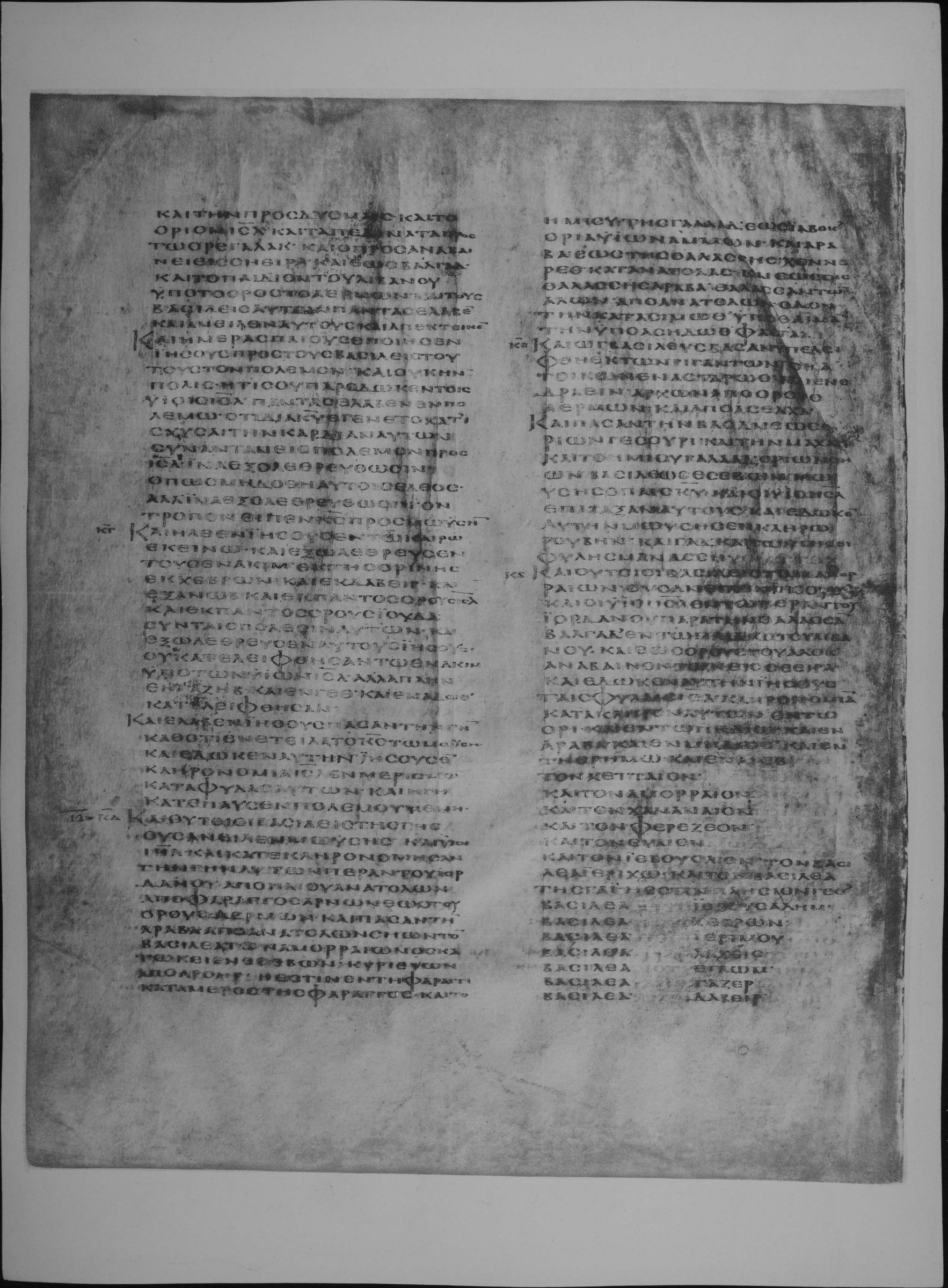
Joshua 12:1-8 is on fol. 132v (full-size facsimile of 1879-83, Internet Archive codex-alexandrinus leaf 285). The 1915 reduced facsimile prints beneath this page: Jos. xi. 16-xii. 13. Checked on the plate: the page begins inside Joshua 11:16 (first words read: ΚΑΙ ΤΗΝ ΠΡΟΣ ΔΥΣΜΑΙΣ ΚΑΙ ΤΟ ΟΡΟΣ ΙΣΡΑΗΛ ΚΑΙ ΤΑ ΤΑΠΕΙΝΑ ΤΑ ΠΡΟΣ ΤΩ ΟΡΕΙ).
1Καὶ οὗτοι οἱ βασιλεῖς τῆς γῆς οὓς ἀνεῖλον οἱ υἱοὶ Ἰσρηὰλ καὶ κατεκληρονόμησαν τὴν γῆν αὐτῶν πέραν τοῦ Ἰορδάνου ἀφ᾽ ἡλίου ἀνατολῶν, ἀπὸ φάραγγος Ἀρνὼν ἕως τοῦ ὄρους Ἁερμών, καὶ πᾶσαν τὴν γῆν Ἁραβὰ ἀπ᾽ ἀνατολῶν· 2Σηὼν τὸν βασιλέα τῶν Ἁμορραίων, ὃς κατῴκει ἐν Ἐσεβών, κυριεύων ἀπὸ Ἀρνών, ἥ ἐστιν ἐν τῇ φάραγγι κατὰ μέρος τῆς φάραγγος, καὶ τὸ ἥμισυ τῆς Γαλαὰδ ἕως Ἰαβόκ, ὅρια υἱῶν Ἀμμών, 3καὶ Ἀραβὰ ἕως τῆς θαλάσσης Χενέρεθ κατ᾽ ἀνατολὰς καὶ ἕως τῆς θαλάσσης Ἀραβά, θάλασσαν τῶν ἁλῶν ἀπὸ ἀνατολῶν ὁδὸν τὴν κατὰ Ἁσειμώθ, ἀπὸ Θαιμὰν τὴν ὑπὸ Μηδὼθ Φασγά· 4καὶ Ὢγ βασιλεὺς Βασὰ ὑπελείφθη ἐκ τῶν γιγάντων, ὁ κατοικῶν ἐν Ἀσταρὼθ καὶ ἐν Ἐδράειν, 5ἄρχων ἀπὸ ὄρους Ἁερμὼν καὶ ἀπὸ Σεκχαί, καὶ πᾶσαν τὴν Βασὰν ἕως ὁρίων Γεργεσεὶ καὶ τὴν Μαχεὶ καὶ τὸ ἥμισυ Γαλαάδ, ὁρίων Σηὼν βασιλέως Ἑσεβών. 6Μωυσῆς ὁ παῖς Κυρίου καὶ οἱ υἱοὶ Ἰσραὴλ ἐπάταξαν αὐτούς· καὶ ἔδωκεν αὐτὴν Μωυσῆς ἐν κληρονομίᾳ Ῥουβὴν καὶ Γὰδ καὶ τῷ ἡμίσει φυλῆς Μανασσή. 7Καὶ οὗτοι οἱ βασιλεῖς τῶν Ἀμορραίων οὓς ἀνεῖλεν Ἰησοῦς καὶ οἱ υἱοὶ Ἰσραὴλ ἐν τῷ πέραν τοῦ Ἰορδάνου παρὰ θάλασσαν Βαλαγαδὰ ἐν πεδίῳ Λιβάνῳ καὶ ἕως τοῦ ὄρους Χελχὰ ἀναβαινόντων εἰς Σηείρ, καὶ ἔδωκεν αὐτὸν Ἰησοῦς ταῖς φυλαῖς Ἰσραὴλ κληρονομεῖν κατὰ κλῆρον αὐτῶν, 8ἐν τῷ ὄρει καὶ ἐν τῷ πεδίῳ καὶ ἐν Ἀραβὰ καὶ ἐν Ἀσηδὼθ καὶ ἐν τῇ ἐρήμῳ καὶ Νάγεβ, τὸν Χετταῖον καὶ τὸν Ἀμορραῖον καὶ τὸν Χαναναῖον καὶ τὸν Φερεζαῖον καὶ τὸν Εὑαῖον καὶ τὸν Ἰεβουσαῖον·
1And these are the kings of the land, whom the children of Israel slew, and inherited their land beyond Jordan from the east, from the valley of Arnon to the mount of Aermon, and all the land of Araba on the east. 2Seon king of the Amorites, who dwelt in Esebon, ruling from Arnon, which is in the valley, on the side of the valley, and half of Galaad as far as Jaboc, the borders of the children of Ammon. 3And Araba as far as the sea of Chenereth eastward, and as far as the sea of Araba; the salt sea eastward by the way to Asimoth, from Thæman under Asedoth Phasga. 4And Og king of Basan, who dwelt in Astaroth and in Edrain, was left of the giants 5ruling from mount Aermon and from Secchai, and over all the land of Basan to the borders of Gergesi, and Machi, and the half of Galaad of the borders of Seon king of Esebon. 6Moses the servant of the Lord and the children of Israel smote them; and Moses gave them by way of inheritance to Ruben, and Gad, and to the half tribe of Manasse. 7And these are the kings of the Amorites, whom Joshua and the children of Israel slew beyond Jordan by the sea of Balagad in the plain of Libanus, and as far as the mountain of Chelcha, as men go up to Seir: and Joshua gave it to the tribes of Israel to inherit according to their portion; 8in the mountain, and in the plain, and in Araba, and in Asedoth, and in the wilderness, and Nageb; the Chettite, and the Amorite, and the Chananite, and the Pherezite, and the Evite, and the Jebusite.
Where on the image
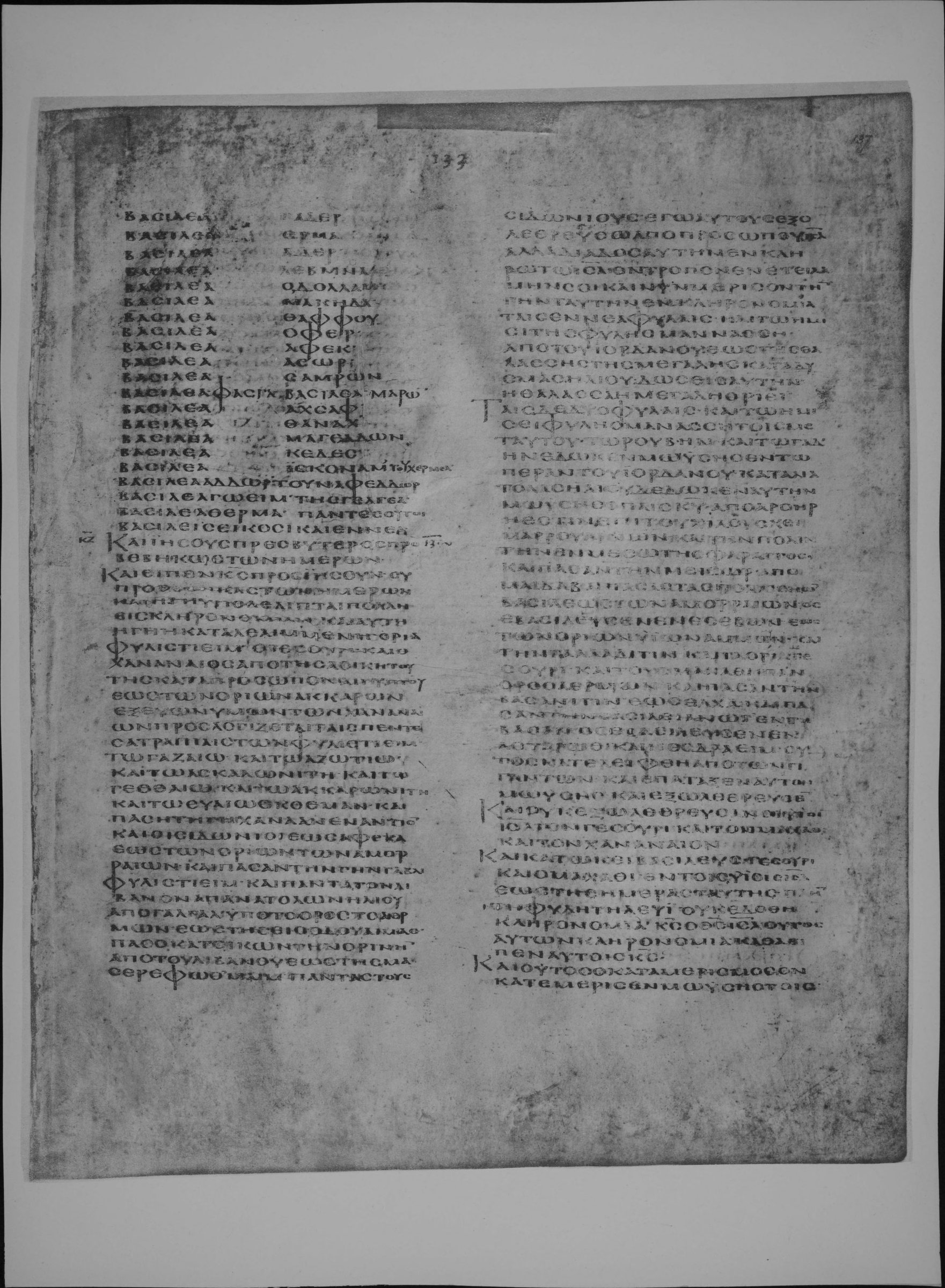
Joshua 12:9-13 is on fol. 132v (full-size facsimile of 1879-83, Internet Archive codex-alexandrinus leaf 285). The 1915 reduced facsimile prints beneath this page: Jos. xi. 16-xii. 13. Checked on the plate: the page begins inside Joshua 11:16 (first words read: ΚΑΙ ΤΗΝ ΠΡΟΣ ΔΥΣΜΑΙΣ ΚΑΙ ΤΟ ΟΡΟΣ ΙΣΡΑΗΛ ΚΑΙ ΤΑ ΤΑΠΕΙΝΑ ΤΑ ΠΡΟΣ ΤΩ ΟΡΕΙ). Joshua 12:13-16 is on fol. 133r (full-size facsimile of 1879-83, Internet Archive codex-alexandrinus leaf 286). The 1915 reduced facsimile prints beneath this page: Jos. xii. 13-xiii. 14. Checked on the plate: the page begins inside Joshua 12:13 (first words read: ΒΑΣΙΛΕΑ ΔΑΒΕΙΡ ΒΑΣΙΛΕΑ ΕΡΜΑ ΒΑΣΙΛΕΑ ΓΑΔΕΡ ΒΑΣΙΛΕΑ ΛΕΒΝΑ ΒΑΣΙΛΕΑ ΟΔΟΛΛΑΜ). Note: the list of kings in Josh. 12 is written in two narrow columns and its order differs from Swete's; both captions name xii. 13, so the verse is given to both pages.
9καὶ τὸν βασιλέα Ἰερειχὼ καὶ τὸν βασιλέα τῆς Γαί, ἥ ἐστιν πλησίον Βαιθήλ, 10βασιλέα Ἰερουσαλήμ, βασιλέα Χεβρών, 11βασιλέα Ἰερειμούθ, βασιλέα Λαχείς, 12βασιλέα Αἰλάμ, βασιλέα Γάζερ, 13βασιλέα Δαβείρ, βασιλέα Ἄσει, 14βασιλέα Ἑρμάθ, βασιλέα Αἰράθ, βασιλέα Ἀράθ, 15βασιλέα Λεβνά, βασιλέα Ὀδολλάμ, 16βασιλέα Ἠλάδ,
9The king of Jericho, and the king of Gai, which is near Bæthel; 10the king of Jerusalem, the king of Chebron, 11the king of Jerimuth, the king of Lachis; 12the king of Ælam, the king of Gazer; 13the king of Dabir, the king of Gader: 14the king of Hermath, the king of Ader; 15the king of Lebna, the king of Odollam, 16the king of Elath,
Where on the image
Joshua 12:17-24 is on fol. 133r (full-size facsimile of 1879-83, Internet Archive codex-alexandrinus leaf 286). The 1915 reduced facsimile prints beneath this page: Jos. xii. 13-xiii. 14. Checked on the plate: the page begins inside Joshua 12:13 (first words read: ΒΑΣΙΛΕΑ ΔΑΒΕΙΡ ΒΑΣΙΛΕΑ ΕΡΜΑ ΒΑΣΙΛΕΑ ΓΑΔΕΡ ΒΑΣΙΛΕΑ ΛΕΒΝΑ ΒΑΣΙΛΕΑ ΟΔΟΛΛΑΜ). Note: the list of kings in Josh. 12 is written in two narrow columns and its order differs from Swete's; both captions name xii. 13, so the verse is given to both pages.
17βασιλέα Ἀταφόυτ, βασιλέα Ὅφερ, 18βασιλέα Ὀφὲκ τῆς Ἀρώκ, 19βασιλέα Ἁσόμ, 20βασιλέα Συμοών, βασιλέα Μαμρώθ, βασιλέα Ἀζείφ, 21βασιλέα Κάδης, βασιλέα Ζακάχ, βασιλέα Μαρεδὼθ καὶ βασιλέα Ἰεκὸμ τοῦ Χερμέλ, 23βασιλέα Ἐλδὼμ τοῦ Φεννεδδώρ, βασιλέα Γεεὶ τῆς Γαλειλαίας, 24βασιλέα Θαρσά· πάντες οὗτοι βασιλεῖς εἴκοσι ἐννέα.
17the king of Taphut, the king of Opher, 18the king of Ophec of Aroc, 19the king of Asom, 20the king of Symoön, the king of Mambroth, the king of Aziph, 21the king of Cades, the king of Zachac, 22the king of Maredoth, the king of Jecom of Chermel, 23the king of Odollam belonging to Phennealdor, the king of Gei of Galilee: 24the king of Thersa: all these were twenty-nine kings.
Cite
Sources
- Source: Codex Alexandrinus (British Library Royal MS 1 D. V) via the British Museum photographic facsimiles of 1879-83 and 1915 (Internet Archive) + Swete's Septuagint + Brenton's English (holding institution)
- Critical edition: H. B. Swete, The Old Testament in Greek according to the Septuagint (1909)
← previous · → next · v cycle view · l back to library