Joshua, Chapter 13 (Codex Alexandrinus)
Introduction
Joshua 13 in the Greek Old Testament (the Septuagint) as written in Codex Alexandrinus, a Greek Bible copied in the fifth century, probably in Egypt, and now in the British Library (Royal MS 1 D. V, the first of its four volumes). It is one of the three great early codices of the whole Greek Bible, with Codex Vaticanus and Codex Sinaiticus, and for Genesis 1:1-46:28, which Codex Vaticanus has lost, it is the oldest surviving complete Greek text (older papyri such as the Berlin Genesis papyrus and Chester Beatty 961 survive only in part).
Numbering: Swete's Greek and Brenton's English number or divide some verses of this chapter differently (Swete 13:7-8 = Brenton 13:7-8). Each column keeps its own verse numbers, and sections are cut only where the two texts agree, so each section holds the same passage in both languages.
This entry meets the strict three-criteria standard of the Theosis Library:
- Manuscript scan: the pages of Codex Alexandrinus carrying this chapter (fol. 133r, fol. 133v), from the full-size photographic (autotype) facsimile published by the British Museum in 1879-1883, as digitised on the Internet Archive. The verse range of every page comes from the reduced photographic facsimile of 1915, which prints it beneath each plate, and the opening words of every page were read on the plate to confirm the page and the verse it begins with. Each section links to the page or pages that hold its verses. Folio numbers are those written at the head of each leaf and visible on the plates.
- Original text: Swete's edition, which here prints the text of Codex Vaticanus (Vat. gr. 1209), the base of his edition, and gives the readings of Alexandrinus only in his apparatus. The Greek column is therefore Vaticanus' text; where Alexandrinus differs, the plate shows what Alexandrinus reads.
- English translation: Sir Lancelot C. L. Brenton, The Septuagint Version of the Old Testament (1844; 1851 edition), a translation of the Greek, public domain, from the eBible.org text.
How was this verified? (Provenance)
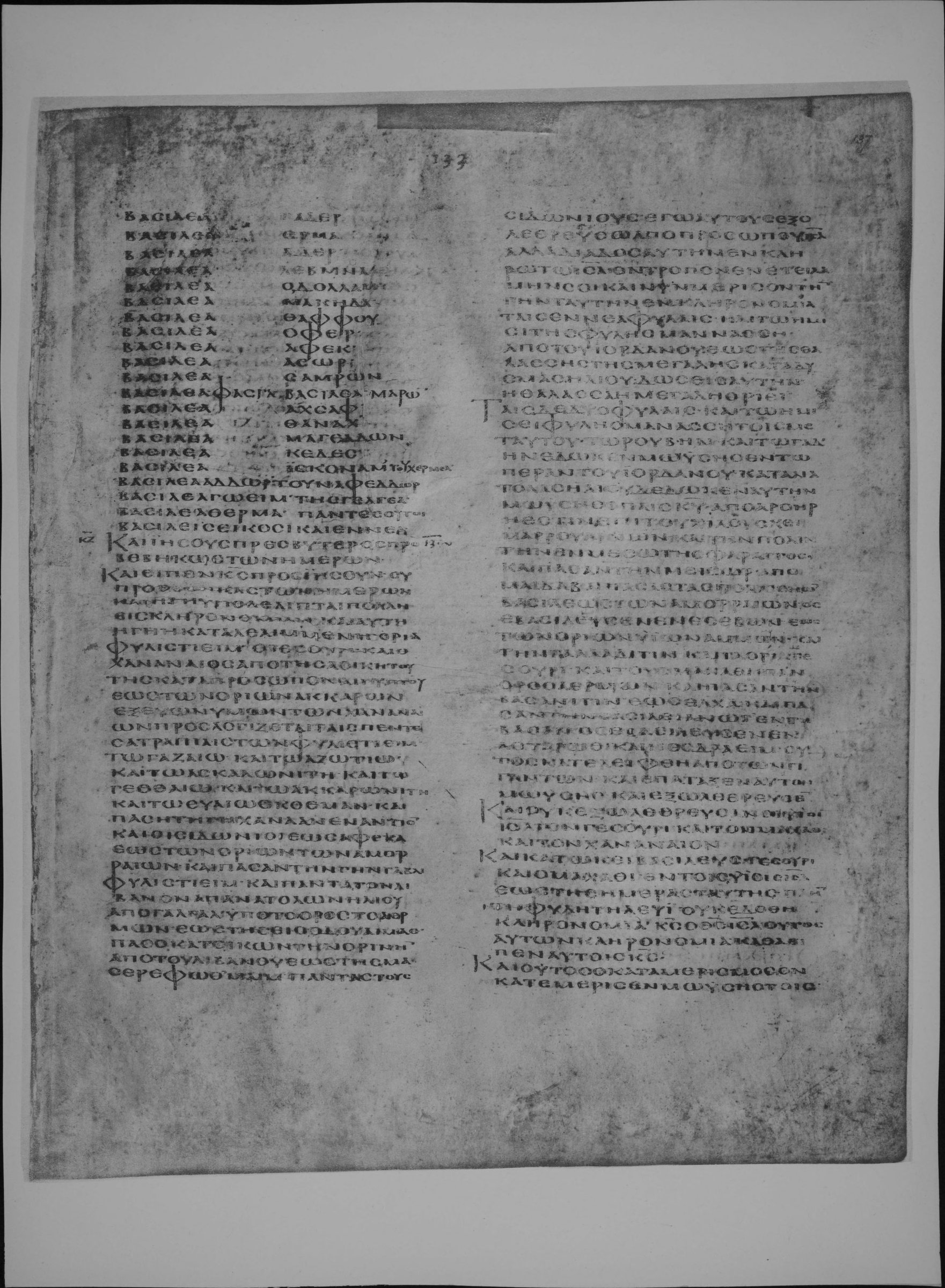
Where on the image
Joshua 13:1-8 is on fol. 133r (full-size facsimile of 1879-83, Internet Archive codex-alexandrinus leaf 286). The 1915 reduced facsimile prints beneath this page: Jos. xii. 13-xiii. 14. Checked on the plate: the page begins inside Joshua 12:13 (first words read: ΒΑΣΙΛΕΑ ΔΑΒΕΙΡ ΒΑΣΙΛΕΑ ΕΡΜΑ ΒΑΣΙΛΕΑ ΓΑΔΕΡ ΒΑΣΙΛΕΑ ΛΕΒΝΑ ΒΑΣΙΛΕΑ ΟΔΟΛΛΑΜ). Note: the list of kings in Josh. 12 is written in two narrow columns and its order differs from Swete's; both captions name xii. 13, so the verse is given to both pages.
1Καὶ Ἰησοῦς πρεσβύτερος προβεβηκὼς τῶν ἡμερῶν. καὶ εἶπεν Κύριος πρὸς Ἰησοῦν Σὺ προβέβηκας τῶν ἡμερῶν, καὶ ἡ γῆ ὑπολέλειπται πολλὴ εἰς κληρονομίαν. 2καὶ αὕτη ἡ γῆ καταλελιμμένη· ὅρια Φυλιστιείμ, ὁ Γεσειρεὶ καὶ ὁ Χαναναῖος· 3ἀπὸ τῆς ἀοικήτου τῆς κατὰ πρόσωπον Αἰγύπτου ἕως τῶν ὁρίων Ἀκκαρὼν ἐξ εὐωνύμων τῶν Χαναναίων προσλογίζεται ταῖς πέντε σατραπίαις τῶν Φυλιστιέμ, τῷ Γαζαίῳ καὶ τῷ Ἀζωτείῳ καὶ τῷ Ἀσκαλωνείτῃ καὶ τῷ Γεθθαίῳ καὶ τῷ Ακκαρωνείτῃ καὶ τῷ Εὐαίῳ· 4ἐκ Θαιμὰν καὶ πάσῃ γῇ Χανάααν ἐναντίον Γάζης, καὶ οἱ Σιδώνιοι ἕως Ταφὲκ ἕως τῶν ὁρίων τῶν Ἀμορραίων· 5καὶ πᾶσαν τὴν γῆν Γαλιὰθ Φυλιστιεὶμ καὶ πάντα τὸν Λίβανον ἀπὸ ἀνατολῶν ἡλίου, ἀπὸ Γαλγαὰ ὑπὸ τὸ ὄρος τὸ Ἁερμὼν ἕως τῆς εἰσόδου Ἑμάθ· 6πᾶς ὁ κατοικῶν τὴν ὀρεινὴν ἀπὸ τοῦ Λιβάνου ἕως τῆς Μασερεθμεμφωνμάιμ, πάντας τοὺς Σιδωνίους, ἐγὼ αὐτοὺς ἐξολεθρεύσω ἀπὸ προσώπου Ἰσραήλ· ἀλλὰ διάδος αὐτὴν ἐν κλήρῳ τῷ Ἰσραήλ, ὃν τρόπον σοι ἐνετειλάμην. 7καὶ νῦν μέρισον τὴν γῆν ταύτην ἐν κληρονομίᾳ ταῖς ἐννέα φυλαῖς καὶ τῷ ἡμίσει φυλῆς Μανασσή, ἀπὸ τοῦ Ἰσρδάνου ἕως τῆς θαλάσσης τῆς μεγάλης κατὰ δυσμὰς ἡλίου δώσεις αὐτήν· ἡ θάλασσα ἡ μεγάλη ὁριεῖ. 8ταῖς φυλαῖς καὶ τῷ ἡμίσει φυλῆς Μανασσή, τῷ Ῥουβὴν καὶ τῷ Γάδ, ἔδωκεν Μωυσῆς ἐν τῷ πέραν τῷ Ἰορδάνῃ· κατ᾽ ἀνατολὰς ἡλίου δέδωκεν αὐτῷ Μωυσῆς ὁ παῖς Κυρίου,
1And Joshua was old and very advanced in years; and the Lord said to Joshua, Thou art advanced in years, and there is much land left to inherit. 2And this is the land that is left: the borders of the Phylistines, the Gesirite, and the Chananite, 3from the wilderness before Egypt, as far as the borders of Accaron on the left of the Chananites the land is reckoned to the five principalities of the Phylistines, to the inhabitant of Gaza, and of Azotus, and of Ascalon, and of Geth, and of Accaron, and to the Evite; 4from Thæman even to all the land of Chanaan before Gaza, and the Sidonians as far as Aphec, as far as the borders of the Amorites. 5And all the land of Galiath of the Phylistines, and all Libanus eastward from Galgal, under the mountain Aermon as far as the entering in of Emath; 6every one that inhabits the hill country from Libanus as far as Masereth Memphomaim. All the Sidonians, I will destroy them from before Israel; but do thou give them by inheritance to Israel, as I charged thee. 7And now divide this land by lot to the nine tribes, and to the half tribe of Manasse. 8From Jordan to the great sea westward thou shalt give it them: the great sea shall be the boundary. But to the two tribes and to the half tribe of Manasse, to Ruben and to Gad Moses gave an inheritance beyond Jordan: Moses the servant of the Lord gave it to them eastward,
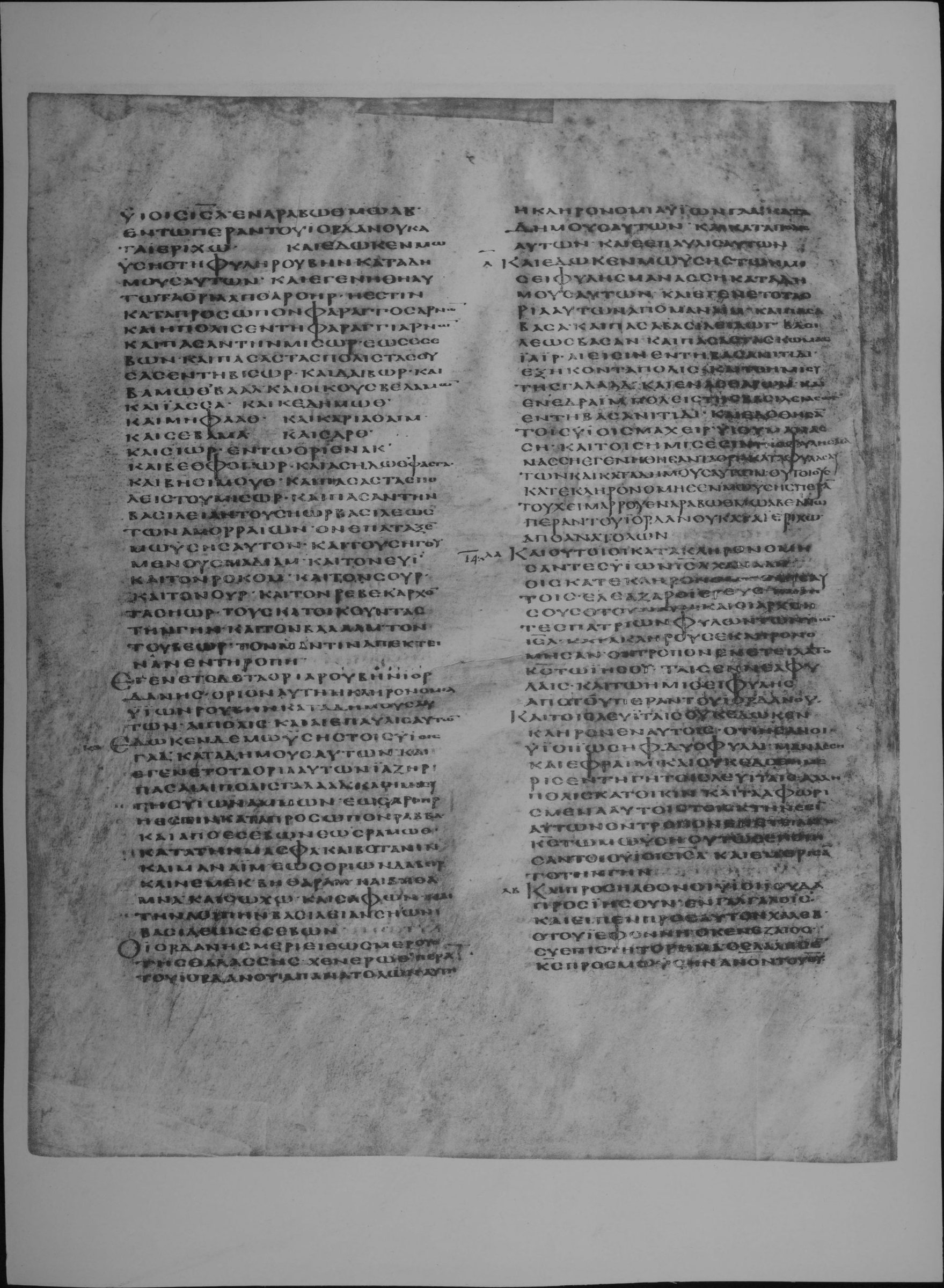
Where on the image
Joshua 13:9-14 is on fol. 133r (full-size facsimile of 1879-83, Internet Archive codex-alexandrinus leaf 286). The 1915 reduced facsimile prints beneath this page: Jos. xii. 13-xiii. 14. Checked on the plate: the page begins inside Joshua 12:13 (first words read: ΒΑΣΙΛΕΑ ΔΑΒΕΙΡ ΒΑΣΙΛΕΑ ΕΡΜΑ ΒΑΣΙΛΕΑ ΓΑΔΕΡ ΒΑΣΙΛΕΑ ΛΕΒΝΑ ΒΑΣΙΛΕΑ ΟΔΟΛΛΑΜ). Note: the list of kings in Josh. 12 is written in two narrow columns and its order differs from Swete's; both captions name xii. 13, so the verse is given to both pages. Joshua 13:14-16 is on fol. 133v (full-size facsimile of 1879-83, Internet Archive codex-alexandrinus leaf 287). The 1915 reduced facsimile prints beneath this page: Jos. xiii. 14-xiv. 6. Checked on the plate: the page begins inside Joshua 13:14 (first words read: ΥΙΟΙΣ ΙΣΡΑΗΛ ΕΝ ΑΡΑΒΩΘ ΜΩΑΒ ΕΝ ΤΩ ΠΕΡΑΝ ΤΟΥ ΙΟΡΔΑΝΟΥ ΙΕΡΙΧΩ ΚΑΙ ΕΔΩΚΕΝ ΜΩΥΣΗΣ ΤΗ ΦΥΛΗ ΡΟΥΒΗΝ).
9ἀπὸ Ἀροήρ, ἥ ἐστιν ἐπὶ τοῦ χείλους χειμάρρου Ἀρνών, καὶ τὴν πόλιν τὴν ἐν μέσῳ τῆς φάραγγος, καὶ πᾶσαν τὴν Μεισὼρ ἀπὸ Δαιδαβάν· 10πάσας τὰς πόλεις Σηὼν βασιλέως Ἀμορραίων, ὃς ἐβασίλευσεν ἐν Ἑσεβών, ἕως τῶν ὁρίων υἱῶν Ἀμμών· 11καὶ τὴν Γαλααδείτιδα καὶ τὰ ὅρια Γεσειρεὶ καὶ τοῦ Μαχατεί, πᾶν ὄρος Ἁερμών, καὶ πᾶσαν τὴν Βασανεῖτιν ἕως Ἀχά· 12πᾶσαν τὴν βασιλείαν Ὢγ ἐν τῇ Βασανείτιδι, ὃς ἐβασίλευσεν ἐν Ἐδράειν καὶ ἐν Ἀσταρώθ· οὗτος κατελείφθη ἀπὸ τῶν γιγάντων, καὶ ἐπάταξεν αὐτὸν Μωυσῆς καὶ ἐξωλέθρευσεν. 13καὶ οὐκ ἐξωλέθρευσαν οἱ υἱοὶ Ἰσραὴλ τὸν Γεσειρεὶ καὶ τὸν Μαχατεὶ καὶ τὸν Χαναναῖον· καὶ κατῴκει βασιλεὺς Γεσειρεὶ καὶ ὁ Μαχατεὶ ἐν τοῖς υἱοῖς Ἰσραὴλ ἕως τῆς σήμερον ἡμέρας. 14πλὴν τῆς φυλῆς Λευεὶ οὐκ ἐδόθη κληρονομία· Κύριος ὁ θεὸς Ἰσραήλ, οὗτος αὐτῶν κληρονομία, καθὰ εἶπεν αὐτοῖς Κυρίος. καὶ οὗτος ὁ καταμερισμὸς ὃν κατεμέρισεν Μωυσῆς τοῖς υἱοῖς Ἰσραὴλ ἐν ἀραβὼθ Μωὰβ ἐν τῷ πέραν τοῦ Ἰορδάνου κατὰ Ἰερειχώ. 15Καὶ ἔδωκεν Μωυσῆς τῇ φυλῇ Ῥουβὴν κατὰ δήμους αὐτῶν. 16καὶ ἐγενήθη αὐτῶν τὰ ὅρια ἀπὸ Ἀροήρ, ἥ ἐστιν κατὰ πρόσωπον φάραγγος Ἀρνών, καὶ ἡ πόλις ἡ ἐν τῇ φάραγγι Ἀρνών· καὶ πᾶσαν τὴν Μεισὼρ
9from Aroer, which is on the bank of the brook of Arnon, and the city in the midst of the valley, and all Misor from Mædaban. 10All the cities of Seon king of the Amorites, who reigned from Esebon to the coasts of the children of Ammon; 11and the region of Galaad, and the borders of the Gesirites and the Machatites, the whole mount of Aermon, and all the land of Basan to Acha. 12All the kingdom of Og in the region of Basan, who reigned in Astaroth and in Edrain: he was left of the giants; and Moses smote him, and destroyed him. 13But the children of Israel destroyed not the Gesirite and the Machatite and the Chananite; and the king of the Gesiri and the Machatite dwelt among the children of Israel until this day. 14Only no inheritance was given to the tribe of Levi: the Lord God of Israel, he is their inheritance, as the Lord said to them; and this is the division which Moses made to the children of Israel in Araboth Moab, on the other side of Jordan, by Jericho. 15And Moses gave the land to the tribe of Ruben according to their families. 16And their borders were from Aroer, which is opposite the brook of Arnon, and theirs is the city that is in the valley of Arnon; and all Misor,
Where on the image
Joshua 13:17-24 is on fol. 133v (full-size facsimile of 1879-83, Internet Archive codex-alexandrinus leaf 287). The 1915 reduced facsimile prints beneath this page: Jos. xiii. 14-xiv. 6. Checked on the plate: the page begins inside Joshua 13:14 (first words read: ΥΙΟΙΣ ΙΣΡΑΗΛ ΕΝ ΑΡΑΒΩΘ ΜΩΑΒ ΕΝ ΤΩ ΠΕΡΑΝ ΤΟΥ ΙΟΡΔΑΝΟΥ ΙΕΡΙΧΩ ΚΑΙ ΕΔΩΚΕΝ ΜΩΥΣΗΣ ΤΗ ΦΥΛΗ ΡΟΥΒΗΝ).
17ἕως Ἑσεβών, καὶ πάσας τὰς πόλεις τὰς οὔσας ἐν τῇ Μεισώρ, καὶ Δαιβὼν καὶ Βαιμὼν Βάαλ καὶ οἴκου Μεελβὼθ 18καὶ Βάσαν καὶ Βακεδμὼθ καὶ Μαιφάαθ, 19καὶ Καριαθάιμ καὶ Σεβαμὰ καὶ Σεραδὰ καὶ Σείων ἐν τῷ ὄρει Ἔναβ, 20καὶ Βαιθφογὼρ καὶ Ἀσηδὼθ Φασγὰ καὶ Βαιθθασεινώθ, 21καὶ πάσας τὰς πόλεις τοῦ Μεισώρ, καὶ πᾶσαν τὴν βασιλείαν τοῦ Σηὼν βασιλέως τῶν Ἀμορραίων, ὃν ἐπάταξεν Μωυσῆς αὐτὸν καὶ τοὺς ἡγουμένους Μαδιάμ, καὶ τὸν Εὐεὶ καὶ τὸν Ῥόβοκ καὶ τὸν Σοὺρ καὶ τὸν Οὓρ καὶ τὸν Ῥόβε ἄρχοντα, ἔναρα Σειών, καὶ τοὺς κατοικοῦντας Σειών. 22καὶ τὸν Βαλαὰμ τὸν τοῦ Βεὼρ τὸν μάντιν ἀπέκτειναν ἐν τῇ ῥοπῇ. 23ἐγένετο δὲ τὰ ὅρια Ῥουβήν, Ἰορδάνης ὅριον. αὕτη ἡ κληρονομία υἱῶν Ῥουβὴν κατὰ δὴμους αὐτῶν, αἱ πόλεις αὐτῶν καὶ αἱ ἐπαύλεις αὐτῶν. 24Ἔδωκεν δὲ Μωυσῆς τοῖς υἱοῖς Γὰδ κατὰ δήμους αὐτῶν.
17to Esebon, and all the cities in Misor, and Dæbon, and Bæmon-Baal, and the house of Meelboth; 18and Basan, and Bakedmoth, and Mæphaad, 19and Kariathaim, and Sebama, and Serada, and Sion in mount Enab; 20and Bæthphogor, and Asedoth Phasga, and Bætthasinoth, 21and all the cities of Misor, and all the kingdom of Seon king of the Amorites, whom Moses smote, even him and the princes of Madian, and Evi, and Roboc, and Sur, and Ur, and Robe prince of the spoils of Sion, and the inhabitants of Sion. 22And Balaam the son of Bæor the prophet they slew in the battle. 23And the borders of Ruben were— even Jordan was the boundary; this is the inheritance of the children of Ruben according to their families, these were their cities and their villages. 24And Moses gave inheritance to the sons of Gad according to their families.
Where on the image
Joshua 13:25-32 is on fol. 133v (full-size facsimile of 1879-83, Internet Archive codex-alexandrinus leaf 287). The 1915 reduced facsimile prints beneath this page: Jos. xiii. 14-xiv. 6. Checked on the plate: the page begins inside Joshua 13:14 (first words read: ΥΙΟΙΣ ΙΣΡΑΗΛ ΕΝ ΑΡΑΒΩΘ ΜΩΑΒ ΕΝ ΤΩ ΠΕΡΑΝ ΤΟΥ ΙΟΡΔΑΝΟΥ ΙΕΡΙΧΩ ΚΑΙ ΕΔΩΚΕΝ ΜΩΥΣΗΣ ΤΗ ΦΥΛΗ ΡΟΥΒΗΝ).
25καὶ ἐγένετο τὰ ὅρια αὐτῶν Ἰαζήρ, πᾶσαι αἱ πόλεις Γαλαὰδ καὶ τὸ ἥμισυ γῆς υἱῶν Ἀμμὼν ἕως Ἀραβά, ἥ ἐστιν κατὰ πρόσωπον Ἀράδ, 26καὶ ἀπὸ Ἑσεβὼν ἕως ἀραβὼθ κατὰ τὴν Μασσηφά, καὶ Βοτανεὶ καὶ Βαὰν ἕως τῶν ὁρίων Δαιβών, 27καὶ Ἐναδὼμ καὶ Ὀθαργαεὶ καὶ Βαινθαναβρὰ καὶ Σοκχωθὰ καὶ Σαφὰν καὶ τὴν λοιπὴν βασιλείαν Σηὼν βασιλέως Ἑσεβών· καὶ ὁ Ἰορδάνης ὁριεῖ ἕως μέρους τῆς θαλάσσης Χενέρεθ πέραν τοῦ Ἰορδάνου ἀπ᾽ ἀνατολῶν. 28αὕτη ἡ κληρονομία υἱῶν Γὰδ κατὰ δήμους αὐτῶν· αὐχένα ἐπιστρέψουσιν ἐναντίον τῶν ἐχθρῶν αὐτῶν· ὅτι ἐγενήθη κατὰ δήμους αὐτῶν· αἱ πόλεις αὐτῶν καὶ αἱ ἐπαύλεις αὐτῶν. 29Καὶ ἔδωκεν Μωυσῆς τῷ ἡμίσει φυλῆς Μανασσὴ κατὰ δήμους αὐτῶν. 30καὶ ἐγένετο τὰ ὅρια αὐτῶν ἀπὸ Μαανὰ καὶ πᾶσα βασιλεία Βασανεὶ καὶ πᾶσα βασιλεία Ὤγ βασιλέως Βασάν, καὶ πάσας τὰς κώμας Ἰαεὶρ αἵ εἰσιν ἐν τῇ Βασανείτιδι, ἑξήκοντα πόλεις· 31καὶ τὸ ἥμισυ τῆς Γαλαάδ, καὶ ἐν Ἀσταρὼθ καὶ ἐν Ἐδράειν πόλεις βασιλείας Ὤγ ἐν Βασανείτιδι, τοῖς Μαχεὶρ υἱοῖς Μανασσὴ καὶ τοῖς ἡμίσεσιν υἱοῖς Μαχεὶρ υἱοῖς Μανασσὴ κατὰ δήμους αὐτῶν. 32Οὗτοι οὕς κατεκληρονόμησεν Μωυσῆς πέραν τοῦ Ἰορδάνου ἐν ἀραβὼθ Μωάβ, ἐν τῷ πέραν τοῦ Ἰορδάνου τοῦ κατὰ Ἰερειχὼ ἐπ᾽ ἀνατολῶν.
25And their borders were Jazer, all the cities of Galaad, and half the land of the children of Ammon to Araba, which is before Arad. 26And from Esebon to Araboth by Massepha, and Botanim, and Maan to the borders of Dæbon, 27and Enadom, and Othargai, and Bænthanabra, and Soccotha, and Saphan, and the rest of the kingdom of Seon king of Esebon: and Jordan shall be the boundary as far as part of the sea of Chenereth beyond Jordan eastward. 28This is the inheritance of the children of Gad according to their families and according to their cities: according to their families they will turn their backs before their enemies, because their cities and their villages were according to their families. 29And Moses gave to half the tribe of Manasse according to their families. 30And their borders were from Maan, and all the kingdom of Basan, and all the kingdom of Og king of Basan, and all the villages of Jair, which are in the region of Basan, sixty cities: 31and the half of Galaad, and in Astaroth, and in Edrain, royal cities of Og in the land of Basan, Moses gave to the sons of Machir the sons of Manasse, even to the half-tribe sons of Machir the sons of Manasse, according to their families. 32These are they whom Moses caused to inherit beyond Jordan in Araboth Moab, beyond Jordan by Jericho eastward.
Cite
Sources
- Source: Codex Alexandrinus (British Library Royal MS 1 D. V) via the British Museum photographic facsimiles of 1879-83 and 1915 (Internet Archive) + Swete's Septuagint + Brenton's English (holding institution)
- Critical edition: H. B. Swete, The Old Testament in Greek according to the Septuagint (1909)
← previous · → next · v cycle view · l back to library