Joshua, Chapter 17 (Codex Alexandrinus)
Introduction
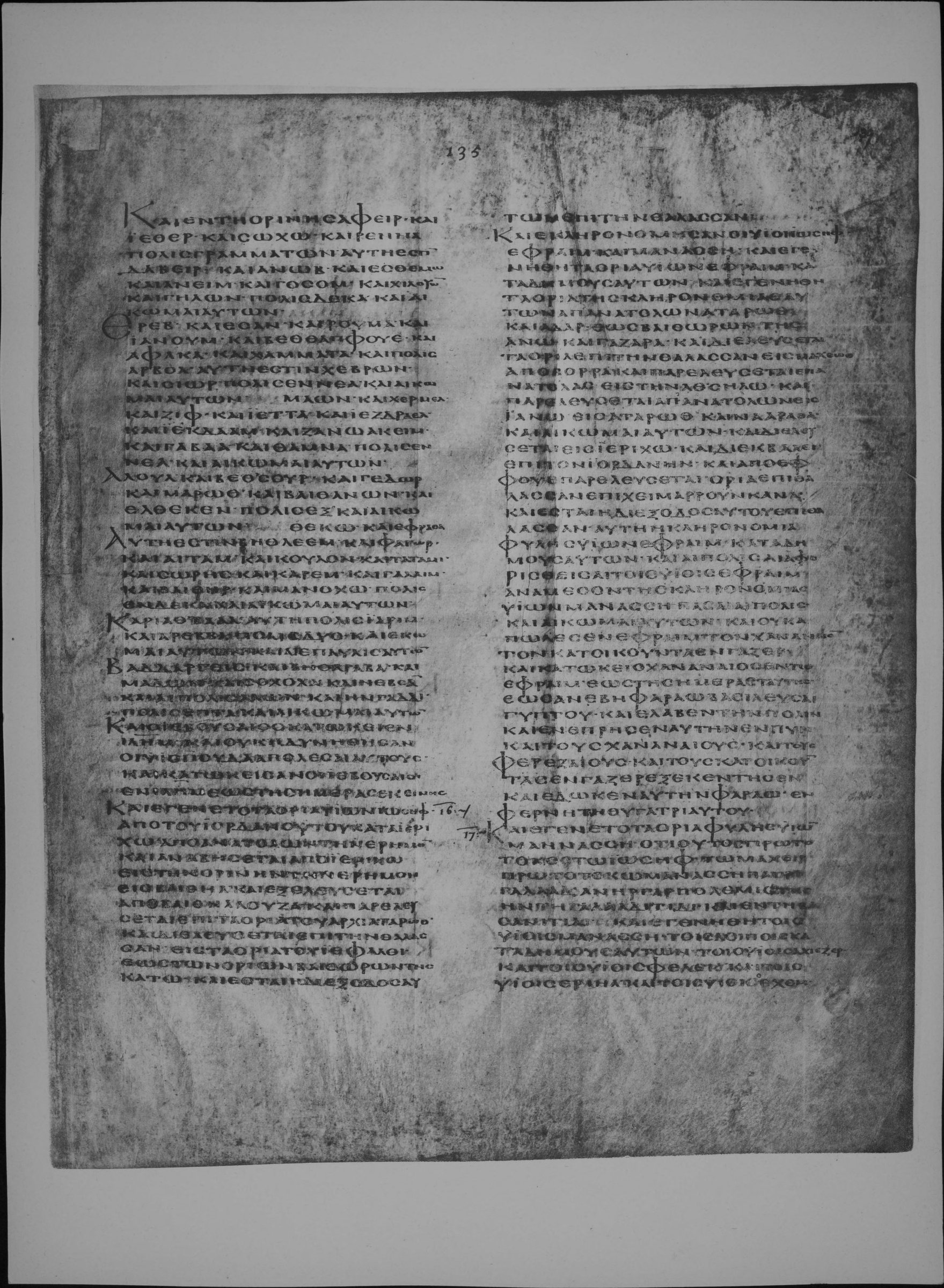
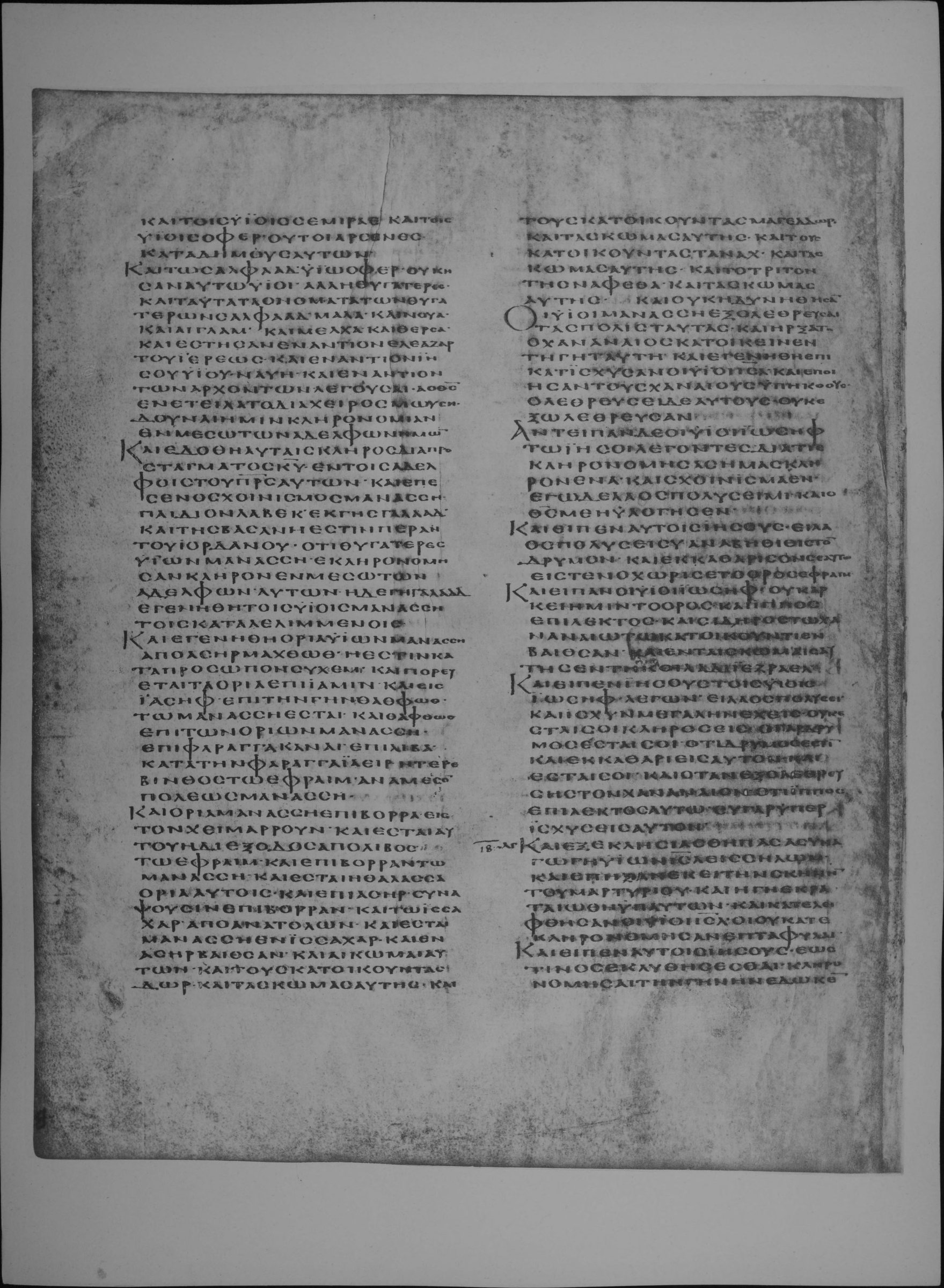
Joshua 17 in the Greek Old Testament (the Septuagint) as written in Codex Alexandrinus, a Greek Bible copied in the fifth century, probably in Egypt, and now in the British Library (Royal MS 1 D. V, the first of its four volumes). It is one of the three great early codices of the whole Greek Bible, with Codex Vaticanus and Codex Sinaiticus, and for Genesis 1:1-46:28, which Codex Vaticanus has lost, it is the oldest surviving complete Greek text (older papyri such as the Berlin Genesis papyrus and Chester Beatty 961 survive only in part).
This entry meets the strict three-criteria standard of the Theosis Library:
- Manuscript scan: the pages of Codex Alexandrinus carrying this chapter (fol. 135r, fol. 135v), from the full-size photographic (autotype) facsimile published by the British Museum in 1879-1883, as digitised on the Internet Archive. The verse range of every page comes from the reduced photographic facsimile of 1915, which prints it beneath each plate, and the opening words of every page were read on the plate to confirm the page and the verse it begins with. Each section links to the page or pages that hold its verses. Folio numbers are those written at the head of each leaf and visible on the plates.
- Original text: Swete's edition, which here prints the text of Codex Vaticanus (Vat. gr. 1209), the base of his edition, and gives the readings of Alexandrinus only in his apparatus. The Greek column is therefore Vaticanus' text; where Alexandrinus differs, the plate shows what Alexandrinus reads.
- English translation: Sir Lancelot C. L. Brenton, The Septuagint Version of the Old Testament (1844; 1851 edition), a translation of the Greek, public domain, from the eBible.org text.
How was this verified? (Provenance)
Where on the image
Joshua 17:1-2 is on fol. 135r (full-size facsimile of 1879-83, Internet Archive codex-alexandrinus leaf 290). The 1915 reduced facsimile prints beneath this page: (caption not legible in the scan; range bounded by the captions of leaves 278 and 280). Checked on the plate: the page begins at the start of Joshua 15:48 (first words read: ΚΑΙ ΕΝ ΤΗ ΟΡΕΙΝΗ ΣΑΦΕΙΡ ΚΑΙ ΓΕΘΕΡ ΚΑΙ ΣΩΧΩ ΚΑΙ ΡΕΝΝΑ ΠΟΛΙΣ ΓΡΑΜΜΑΤΩΝ ΑΥΤΗ ΕΣΤΙΝ ΔΑΒΕΙΡ). Note: the caption under this plate is not legible in the scan; the range is bounded by the captions of leaves 278 (xv. 9-47) and 280 (xvii. 2-xviii. 3), and the first line was read on the plate. Joshua 17:2-8 is on fol. 135v (full-size facsimile of 1879-83, Internet Archive codex-alexandrinus leaf 291). The 1915 reduced facsimile prints beneath this page: Jos. xvii. 2-xviii. 3. Checked on the plate: the page begins inside Joshua 17:2 (first words read: ΚΑΙ ΤΟΙΣ ΥΙΟΙΣ ΟΦΕΡ ΟΥΤΟΙ ΑΡΣΕΝΕΣ ΚΑΤΑ ΔΗΜΟΥΣ ΑΥΤΩΝ ΚΑΙ ΤΩ ΣΑΛΦΑΑΔ ΥΙΩ ΟΦΕΡ ΟΥΚ ΗΝ).
1Καὶ ἐγένετο τὰ ὅρια φυλῆς υἱῶν Μανασσή, ὅτι οὗτος πρωτότοκος τῷ Ἰωσήφ· τῷ Μαχεὶρ πρωτοτόκῳ Μανασσὴ πατρὶ Γαλαάδ, ἀνὴρ γὰρ πολεμιστὴς ἦν, ἐν τῇ Γαλααδείτιδι καὶ ἐν τῇ Βασανείτιδι. 2καὶ ἐγενήθη τοῖς υἱοῖς Μανασσὴ τοῖς λοιποῖς κατὰ δήμους αὐτῶν, τοῖς υἱοῖς Ἰέζει καὶ τοῖς υἱοῖς Κέλεζ καὶ τοῖς υἱοῖς Ἰεζειὴλ καὶ τοῖς υἱοῖς Σύχεμ καὶ τοῖς υἱοῖς Συμαρεὶμ καὶ τοῖς υἱοῖς Ὅφερ· οὗτοι οἱ ἄρσενες κατὰ δήμους αὐτῶν. 3καὶ τῷ Σαλπαὰδ υἱῷ Ὅφερ, οὐκ ἦσαν αὐτῷ υἱοὶ ἀλλ᾽ ἢ θυγατέρες· καὶ ταῦτα τὰ ὀνόματα τῶν θυγατέρων Σαλπαάδ· Μααλὰ καὶ Νουὰ καὶ Ἑγλὰ καὶ Μελχὰ καὶ Θερσά. 4καὶ ἔστησαν ἐναντίον Ἐλεαζὰρ τοῦ ἱερέως καὶ ἐναντίον Ἰησοῦ καὶ ἐναντίον τῶν ἀρχόντων λέγουσαι Ὁ θεὸς ἐνετείλατο διὰ χειρὸς Μωυσῆ δοῦναι ἡμῖν κληρονομίαν ἐν μέσῳ τῶν ἀδελφῶν ἡμῶν. καὶ ἐδόθη αὐταῖς διὰ προστάγματος Κυρίου κλῆρος ἐν τοῖς ἀδελφοῖς τοῦ πατρὸς αὐτῶν. 5καὶ ἔπεσεν ὁ σχοινισμὸς αὐτῶν ἀπὸ Ἀνασσά, καὶ πεδίον Λαβὲκ ἐκ τῆς Γαλαὰδ ἥ ἐστιν πέραν τοῦ Ἰορδάνου· 6ὅτι θυγατέρες υἱῶν Μανασσὴ ἐκληρονόμησαν κλῆρον ἐν μέσῳ τῶν ἀδελφῶν αὐτῶν. ἡ δὲ γῆ Γαλαὰδ ἐγενήθη τοῖς υἱοῖς Μανασσὴ τοῖς καταλελιμμένοις. 7καὶ ἐγενήθη ὅρια υἱῶν Μανασσὴ Δηλανάθ, ἥ ἐστιν κατὰ πρόσωπον υἱῶν Ἀνάθ, καὶ πορεύεται ἐπὶ τὰ ὅρια ἐπὶ Ἱαμεὶν καὶ Ἰασσεὶβ ἐπὶ πηγὴν Θαφθώθ· 8τῷ Μανασσὴ ἔσται, καὶ Θαφὲθ ἐπὶ τῶν ὁρίων Μανασσὴ τοῖς υἱοῖς Ἐφράιμ.
1And the borders of the tribe of the children of Manasse, (for he was the first-born of Joseph,) assigned to Machir the first-born of Manasse the father of Galaad, for he was a warrior, were in the land of Galaad and of Basan. 2And there was land assigned to the other sons of Manasse according to their families; to the sons of Jezi, and to the sons of Kelez, and to the sons of Jeziel, and to the sons of Sychem, and to the sons of Symarim, and to the sons of Opher: these are the males according to their families. 3And Salpaad the son of Opher had no sons but daughters: and these are the names of the daughters of Salpaad; Maala, and Nua, and Egla, and Melcha, and Thersa. 4And they stood before Eleazar the priest, and before Joshua, and before the rulers, saying, God gave a charge by the hand of Moses, to give us an inheritance in the midst of our brethren: so there was given to them by the command of the Lord an inheritance among the brethren of their father. 5And their lot fell to them from Anassa, and to the plain of Labec of the land of Galaad, which is beyond Jordan. 6For the daughters of the sons of Manasse inherited a portion in the midst of their brethren, and the land of Galaad was assigned to the remainder of the sons of Manasse. 7And the borders of the sons of Manasse were Delanath, which is before the sons of Anath, and it proceeds to the borders even to Jamin and Jassib to the fountain of Thaphthoth. 8It shall belong to Manasse, and Thapheth on the borders of Manasse shall belong to the sons of Ephraim.
Where on the image
Joshua 17:9-18 is on fol. 135v (full-size facsimile of 1879-83, Internet Archive codex-alexandrinus leaf 291). The 1915 reduced facsimile prints beneath this page: Jos. xvii. 2-xviii. 3. Checked on the plate: the page begins inside Joshua 17:2 (first words read: ΚΑΙ ΤΟΙΣ ΥΙΟΙΣ ΟΦΕΡ ΟΥΤΟΙ ΑΡΣΕΝΕΣ ΚΑΤΑ ΔΗΜΟΥΣ ΑΥΤΩΝ ΚΑΙ ΤΩ ΣΑΛΦΑΑΔ ΥΙΩ ΟΦΕΡ ΟΥΚ ΗΝ).
9καὶ καταβήσεται τὰ ὅρια ἐπὶ φάραγγα Καρανὰ ἐπὶ λίβα κατὰ φάραγγα Ἰαριήλ, τερέμινθος τῷ Ἐφράιμ ἀνὰ μέσον πόλεως Μανασσή· καὶ ὅρια Μανασσὴ ἐπὶ τὸν βορρᾶν εἰς τὸν χειμάρρουν. καὶ ἔσται αὐτοῦ ἡ διέξοδος θάλασσα 10ἀπὸ λιβὸς τῷ Ἐφράιμ, καὶ ἐπὶ βορρᾶν Μανασσή· καὶ ἔσται ἡ θάλασσα ὅρια αὐτοῖς· καὶ ἐπὶ Ἰασὴβ συνάψουσιν ἐπὶ βορρᾶν, καὶ τῷ Ἰσσαχὰρ ἀπ᾽ ἀνατολῶν. 11καὶ ἔσται Μανασσὴ ἐν Ἰσσαχὰρ καὶ ἐν Ἀσὴρ Καιθοὰν καὶ αἱ κῶμαι αὐτῶν, καὶ τοὺς κατοικοῦντας Δὼρ καὶ τὰς κώμας αὐτῆς, καὶ τοὺς κατοικοῦντας Μαγεδδὼ καὶ τὰς κώμας αὐτῆς, καὶ τὸ τρίτον τῆς Μαφετὰ καὶ τὰς κώμας αὐτῆς. 12καὶ οὐκ ἠδυνάσθησαν οἱ υἱοὶ Μανασσὴ ἐξολεθρεῦσαι τὰς πόλεις ταύτας· καὶ ἤρχετο ὁ Χαναναῖος κατοικεῖν ἐν τῇ γῇ ταύτῃ. 13καὶ ἐγενήθη καὶ ἐπεὶ κατίσχυσαν οἱ υἱοὶ Ἰσραήλ, καὶ ἐποίησαν τοὺς Χαναναίους ὑπηκόους, ἐξολεθρεῦσαι δὲ αὐτοὺς οὐκ ἐξωλέθρευσαν. 14Ἀντεῖπαν δὲ οἱ υἱοὶ Ἰωσὴφ τῷ Ἰησοῦ λέγοντες Διὰ τί ἐκληρονόμησας ἡμᾶς κλῆρον ἕνα καὶ σχοίνισμα ἕν; ἐγὼ δὲ λαὸς πολύς εἰμι, καὶ ὁ θεὸς εὐλόγησέν με. 15καὶ εἶπεν αὐτοῖς Ἰησοῦς Εἰ λαὸς πολὺς εἶ, ἀνάβηθι εἰς τὸν δρυμὸν καὶ ἐκκάθαρον σεαυτῷ, εἰ στενοχωρεῖ σε τὸ ὄρος τὸ Ἐφράιμ. 16καὶ εἶπαν Οὐκ ἀρέσκει ἡμῖν τὸ ὄρος τὸ Ἐφράιμ· καὶ ἵππος ἐπίλεκτος καὶ σίδηρος τῷ Χαναναίῳ τῷ κατοικοῦντι ἐν αὐτῷ ἐν Βαιθαισὰν καὶ ἐν ταῖς κώμαις αὐτῆς, ἐν τῇ κοιλάδι Ἰσραήλ. 17καὶ εἶπεν Ἰησοῦς τοῖς υἱοῖς Ἰωσήφ Εἰ λαὸς πολὺς εἶ καὶ ἰσχὺν μεγάλην ἔχεις, οὐκ ἔσται σοι κλῆρος εἷς· 18ὁ γὰρ δρυμὸς ἔσται σοι, ὅτι δρυμός ἐστιν, καὶ ἐκκαθαριεῖς αὐτόν, καὶ ἔσται σοι· καὶ ὅταν ἐξολεθρεύσῃς τὸν Χαναναῖον, ὅτι ἵππος ἐπίλεκτός ἐστιν αὐτῷ· σὺ γὰρ ὑπερισχύεις αὐτοῦ.
9And the borders shall go down to the valley of Carana southward by the valley of Jariel, ( there is a turpentine tree belonging to Ephraim between that and the city of Manasse:) and the borders of Manasse are northward to the brook; and the sea shall be its termination. 10Southward the land belongs to Ephraim, and northward to Manasse; and the sea shall be their coast; and northward they shall border upon Aseb, and eastward upon Issachar. 11And Manasses shall have in the portion of Issachar and Aser Bæthsan and their villages, and the inhabitants of Dor, and its villages, and the inhabitants of Mageddo, and its villages, and the third part of Mapheta, and its villages. 12And the sons of Manasse were not able to destroy these cities; and the Chananite began to dwell in that land. 13And it came to pass that when the children of Israel were strong, they made the Chananites subject, but they did not utterly destroy them. 14And the sons of Joseph answered Joshua, saying, Wherefore hast thou caused us to inherit one inheritance, and one line? whereas I am a great people, and God has blessed me. 15And Joshua said to them, If thou be a great people, go up to the forest, and clear the land for thyself, if mount Ephraim be too little for thee. 16And they said, The mount of Ephraim does not please us, and the Chananite dwelling in it in Bæthsan, and in its villages, and in the valley of Jezrael, has choice cavalry and iron. 17And Joshua said to the sons of Joseph, If thou art a great people, and hast great strength, thou shalt not have only one inheritance. 18For thou shalt have the wood, for there is a wood, and thou shalt clear it, and the land shall be thine; even when thou shalt have utterly destroyed the Chananite, for he has chosen cavalry; yet thou art stronger than he.
Cite
Sources
- Source: Codex Alexandrinus (British Library Royal MS 1 D. V) via the British Museum photographic facsimiles of 1879-83 and 1915 (Internet Archive) + Swete's Septuagint + Brenton's English (holding institution)
- Critical edition: H. B. Swete, The Old Testament in Greek according to the Septuagint (1909)
← previous · → next · v cycle view · l back to library