Joshua, Chapter 16 (Codex Alexandrinus)
Introduction
Joshua 16 in the Greek Old Testament (the Septuagint) as written in Codex Alexandrinus, a Greek Bible copied in the fifth century, probably in Egypt, and now in the British Library (Royal MS 1 D. V, the first of its four volumes). It is one of the three great early codices of the whole Greek Bible, with Codex Vaticanus and Codex Sinaiticus, and for Genesis 1:1-46:28, which Codex Vaticanus has lost, it is the oldest surviving complete Greek text (older papyri such as the Berlin Genesis papyrus and Chester Beatty 961 survive only in part).
This entry meets the strict three-criteria standard of the Theosis Library:
- Manuscript scan: the page of Codex Alexandrinus carrying this chapter (fol. 135r), from the full-size photographic (autotype) facsimile published by the British Museum in 1879-1883, as digitised on the Internet Archive. The verse range of every page comes from the reduced photographic facsimile of 1915, which prints it beneath each plate, and the opening words of every page were read on the plate to confirm the page and the verse it begins with. Each section links to the page or pages that hold its verses. Folio numbers are those written at the head of each leaf and visible on the plates.
- Original text: Swete's edition, which here prints the text of Codex Vaticanus (Vat. gr. 1209), the base of his edition, and gives the readings of Alexandrinus only in his apparatus. The Greek column is therefore Vaticanus' text; where Alexandrinus differs, the plate shows what Alexandrinus reads.
- English translation: Sir Lancelot C. L. Brenton, The Septuagint Version of the Old Testament (1844; 1851 edition), a translation of the Greek, public domain, from the eBible.org text.
How was this verified? (Provenance)
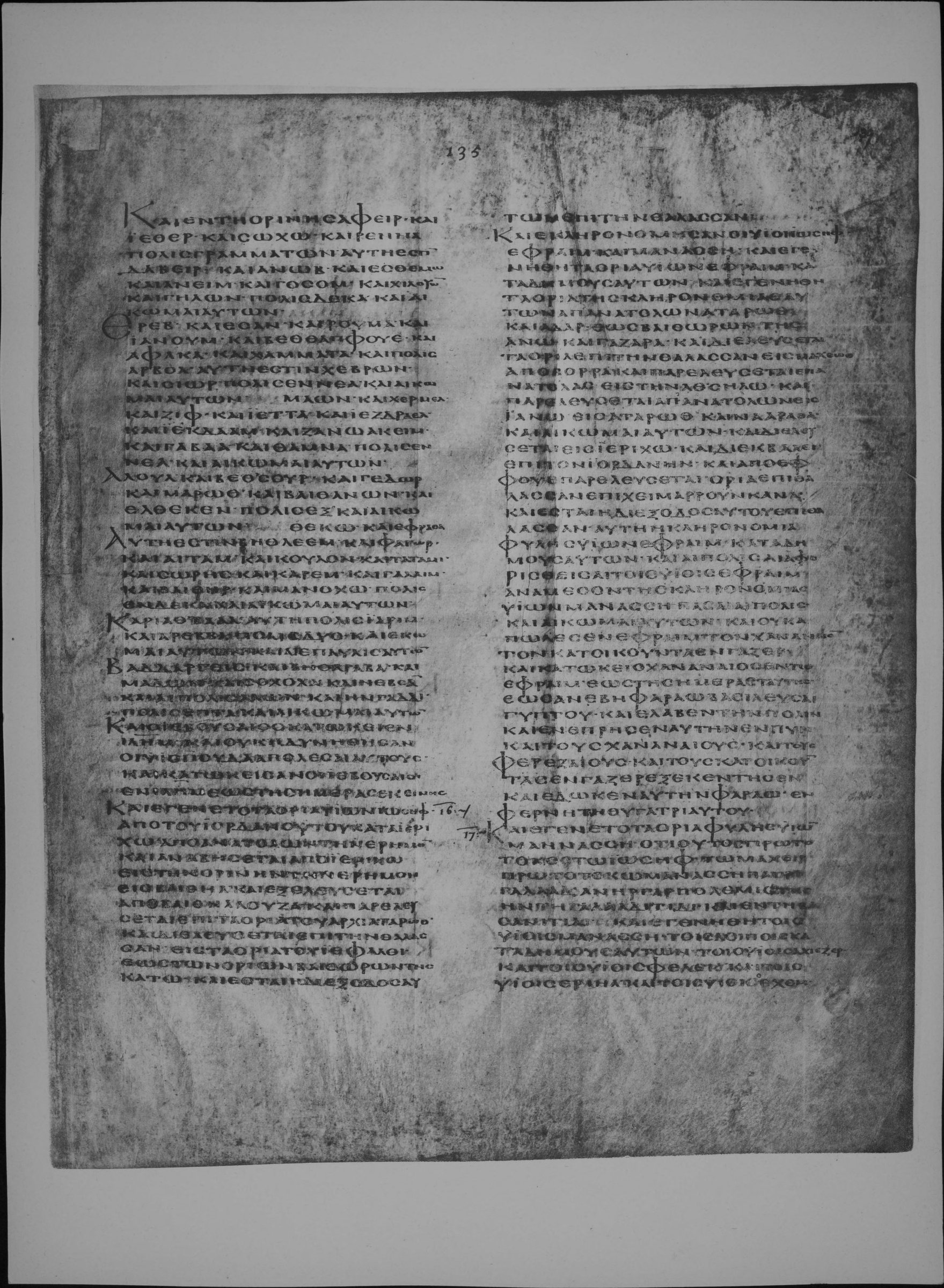
Where on the image
Joshua 16:1-10 is on fol. 135r (full-size facsimile of 1879-83, Internet Archive codex-alexandrinus leaf 290). The 1915 reduced facsimile prints beneath this page: (caption not legible in the scan; range bounded by the captions of leaves 278 and 280). Checked on the plate: the page begins at the start of Joshua 15:48 (first words read: ΚΑΙ ΕΝ ΤΗ ΟΡΕΙΝΗ ΣΑΦΕΙΡ ΚΑΙ ΓΕΘΕΡ ΚΑΙ ΣΩΧΩ ΚΑΙ ΡΕΝΝΑ ΠΟΛΙΣ ΓΡΑΜΜΑΤΩΝ ΑΥΤΗ ΕΣΤΙΝ ΔΑΒΕΙΡ). Note: the caption under this plate is not legible in the scan; the range is bounded by the captions of leaves 278 (xv. 9-47) and 280 (xvii. 2-xviii. 3), and the first line was read on the plate.
1Καὶ ἐγένετο τὰ ὅρια υἱῶν Ἰωσὴφ ἀπὸ τοῦ Ἰορδάνου τοῦ κατὰ Ἰερειχὼ ἀπ᾽ ἀνατολῶν, καὶ ἀναβήσεται ἀπὸ Ἰερειχὼ εἰς τὴν ὀρεινὴν τὴν ἔρημον εἰς Βαιθὴλ Λοῦζα, 2καὶ ἐξελεύσεται εἰς Βαιθήλ, καὶ παρελεύσεται ἐπὶ τὰ ὅρια τοῦ Χαταρωθεί, 3καὶ διελεύσεται ἐπὶ τὴν θάλασσαν ἐπὶ τὰ ὅρια Ἁπταλεὶμ ἕως τῶν ὁρίων Βαιθωρὼν τὴν κάτω, καὶ ἔσται ἡ διέξοδος αὐτῶν ἐπὶ τὴν θάλασσαν. 4καὶ ἐκληρονόμησαν οἱ υἱοὶ Ἰωσήφ, Ἐφράιμ καὶ Μανασσή. 5Καὶ ἐγενήθη ὅρια υἱῶν Ἐφράιμ κατὰ δήμους αὐτῶν· καὶ ἐγενήθη τὰ ὅρια τῆς κληρονομίας αὐτῶν ἀπὸ ἀνατολῶν Ἀσταρὼθ καὶ Ἐρὸκ ἕως Βαιθωρὼν τὴν ἄνω καὶ Γαζαρά. 6καὶ ἐλεύσεται τὰ ὅρια ἐπὶ τὴν θάλασσαν εἰς Ἱκασμὼν ἀπὸ βορρᾶ Θερμά· περιελεύσεται εἰς ἀνατολὰς εἰς Θηνασὰ καὶ Σελλησά, καὶ παρελεύσεται ἀπ᾽ ἀνατολῶν εἰς Ἰανῶκα 7καὶ εἰς Μαχὼ καὶ Ἀσταρώθ, καὶ αἱ κῶμαι αὐτῶν· καὶ ἐλεύσεται ἐπὶ Ἰερειχώ, καὶ διεκβαλεῖ ἐπὶ τὸν Ἰορδάνην. 8καὶ ἀπὸ Ταφοὺ πορεύσεται τὰ ὅρια ἐπὶ θάλασσαν ἐπὶ Χελκανά, καὶ ἔσται ἡ διέξοδος αὐτῶν ἐπὶ θάλασσαν· αὕτη ἡ κληρονομία φυλῆς Ἐφράιμ κατὰ δήμους αὐτῶν. 9καὶ αἱ πόλεις αἱ ἀφορισθεῖσαι τοῖς υἱοῖς Ἐφράιμ ἀνὰ μέσον τῆς κληρονομίας υἱῶν Μανασσή, πᾶσαι αἱ πόλεις καὶ αἱ κῶμαι αὐτῶν. 10καὶ οὐκ ἀπώλεσεν Ἐφράιμ τὸν Χαναναῖον τὸν κατοικοῦντα ἐν Γάζερ· καὶ κατῴκει ὁ Χαναναῖος ἐν τῷ Ἐφράιμ ἕως τῆς ἡμέρας ταύτης, ἕως ἀνέβη Φαραὼ βασιλεὺς Αἰγύπτου καὶ ἔλαβεν αὐτὴν καὶ ἐνέπρησεν αὐτὴν ἐν πυρί, καὶ τοὺς Χαναναίους καὶ τοὺς Φερεζαίους καὶ τοὺς κατοικοῦντας ἐν Γάζερ ἐξεκέντησαν· καὶ ἔδωκεν αὐτὴν Φαραὼ ἐν φερνῇ τῇ θυγατρὶ αὐτοῦ.
1And the borders of the children of Joseph were from Jordan by Jericho eastward; and they will go up from Jericho to the hill country, to the wilderness, to Bæthel Luza. 2And they will go out to Bæthel, and will proceed to the borders of Achatarothi. 3And they will go across to the sea to the borders of Aptalim, as far as the borders of Bæthoron the lower, and the going forth of them shall be to the sea. 4And the sons of Joseph, Ephraim and Manasse, took their inheritance. 5And the borders of the children of Ephraim were according to their families, and the borders of their inheritance were eastward to Ataroth, and Eroc as far as Bæthoron the upper, and Gazara. 6And the borders will proceed to the sea to Icasmon north of Therma; they will go round eastward to Thenasa, and Selles, and will pass on eastward to Janoca, 7and to Macho, and Ataroth, and these are their villages; and they will come to Jericho, and will issue at Jordan. 8And the borders will proceed from Tapho to the sea to Chelcana; and their termination will be at the sea; this is the inheritance of the tribe of Ephraim according to their families. 9And the cities separated to the sons of Ephraim were in the midst of the inheritance of the sons of Manasse, all the cities and their villages. 10And Ephraim did not destroy the Chananite who dwelt in Gazer; and the Chananite dwelt in Ephraim until this day, until Pharao the king of Egypt went up and took it, and burnt it with fire; and the Chananites, and Pherezites, and the dwellers in Gaza they destroyed, and Pharao gave them for a dowry to his daughter.
Cite
Sources
- Source: Codex Alexandrinus (British Library Royal MS 1 D. V) via the British Museum photographic facsimiles of 1879-83 and 1915 (Internet Archive) + Swete's Septuagint + Brenton's English (holding institution)
- Critical edition: H. B. Swete, The Old Testament in Greek according to the Septuagint (1909)
← previous · → next · v cycle view · l back to library