Micah, Chapter 7 (Codex Alexandrinus)
Introduction
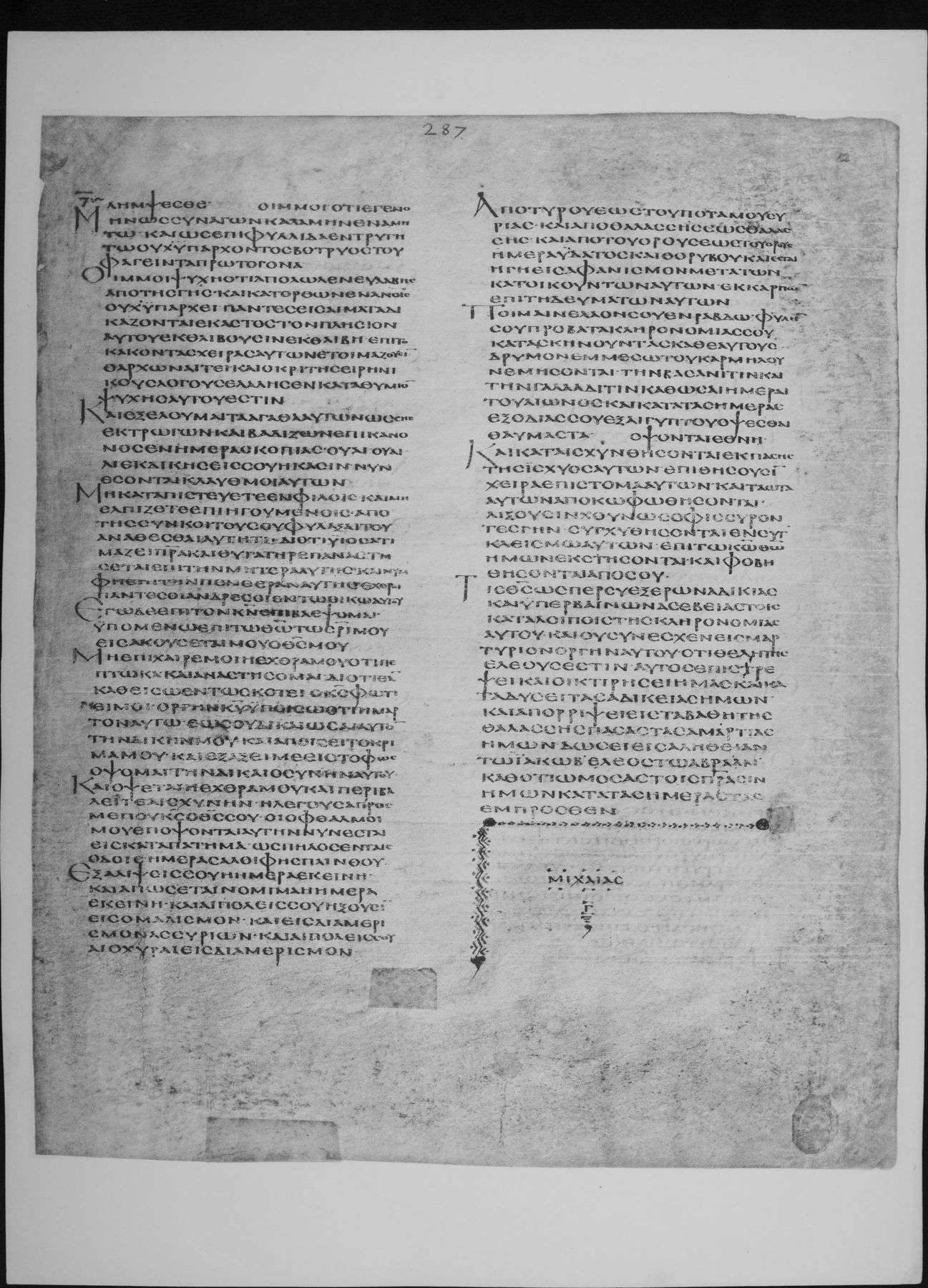
Micah 7 in the Greek Old Testament (the Septuagint) as written in Codex Alexandrinus, a Greek Bible copied in the fifth century, probably in Egypt, and now in the British Library (Royal MS 1 D. VI, the second of its four volumes). It is one of the three great early codices of the whole Greek Bible, with Codex Vaticanus and Codex Sinaiticus.
This entry meets the strict three-criteria standard of the Theosis Library:
- Manuscript scan: the page of Codex Alexandrinus carrying this chapter (fol. 287r), from the full-size photographic (autotype) facsimile published by the British Museum in 1879-1883, as digitised on the Internet Archive. The verse range of every page comes from the reduced photographic facsimile of 1936, which prints it beneath each plate, and the opening words of every page were read on the plate to confirm the page and the verse it begins with. Each section links to the page or pages that hold its verses. Folio numbers are those written at the head of each leaf and visible on the plates.
- Original text: Swete's edition, which here prints the text of Codex Vaticanus (Vat. gr. 1209), the base of his edition, and gives the readings of Alexandrinus only in his apparatus. The Greek column is therefore Vaticanus' text; where Alexandrinus differs, the plate shows what Alexandrinus reads.
- English translation: Sir Lancelot C. L. Brenton, The Septuagint Version of the Old Testament (1844; 1851 edition), a translation of the Greek, public domain, from the eBible.org text.
How was this verified? (Provenance)
Where on the image
Micah 7:1-8 is on fol. 287r (full-size facsimile of 1879-83, Internet Archive codex-alexandrinus leaf 598). The 1936 reduced facsimile prints beneath this page: Mic. vi. 16-vii. 20. Checked on the plate: the page begins inside Micah 6:16 (first words read: ΛΗΜΨΕΣΘΕ ΟΙΜΜΟΙ ΟΤΙ ΕΓΕΝΟΜΗΝ ΩΣ ΣΥΝΑΓΩΝ ΚΑΛΑΜΗΝ ΕΝ ΑΜΗΤΩ).
1Οἴμοι ὅτι ἐγενήθην ὡς συνάγων καλάμην ἐν ἀμήτῳ καὶ ὡς ἐπιφυλλίδα ἐν τρυγήτῳ, οὐχ ὑπάρχοντος βότρυος τοῦ φαγεῖν τὰ πρωτόγονα. οἴμοι ψυχή, 2ὅτι ἀπόλωλεν εὐσεβὴς ἀπὸ τῆς γῆς, καὶ κατορθῶν ἐν ἀνθρώποις οὐχ ὑπάρχει· πάντες εἰς αἵματα δικάζονται, ἕκαστος τὸν πλησίον αὐτοῦ ἐκθλίβουσιν ἐκθλιβῇ, 3ἐπὶ τὸ κακὸν τὰς χεῖρας αὐτῶν ἑτοιμάζουσιν· ὁ ἄρχων αἰτεῖ, καὶ ὁ κριτὴς εἰρηνικοὺς λόγους ἐλάλησεν, καταθύμιον ψυχῆς αὐτοῦ ἐστιν. καὶ ἐξελοῦμαι τὰ ἀγαθὰ αὐτῶν 4ὡς σὴς ἐκτρώγων καὶ βαδίζων ἐπὶ κανόνος ἐν ἡμέρᾳ σκοπιᾶς. οὐαὶ οὐαί, αἱ ἐκδικήσεις σου ἥκασιν, νῦν ἔσονται κλαυθμοὶ αὐτῶν. 5μὴ καταπιστεύετε ἐν φίλοις, καὶ μὴ ἐλπίζετε ἐπὶ ἡγουμένοις, ἀπὸ τῆς συνκοίτου σου φύλαξαι τοῦ ἀναθέσθαι τι αὐτῇ· 6διότι υἱὸς ἀτιμάζει πατέρα, θυγάτηρ ἐπαναστήσεται ἐπὶ τὴν μητέρα αὐτῆς, νύμφη ἐπὶ τὴν πενθερὰν αὐτῆς, ἐχθροὶ πάντες ἀνδρὸς οἱ ἐν τῷ οἴκῳ αὐτοῦ. 7Ἐγὼ δὲ ἐπὶ τὸν κύριον ἐπιβλέψομαι, ὑπομενῶ ἐπὶ τῷ θεῷ τῷ σωτῆρί μου, εἰσακούσεταί μου ὁ θεός μου. 8μὴ ἐπίχαιρέ μοι ἡ ἐχθρά μου ὅτι πέπτωκα, καὶ ἀναστήσομαι· διότι ἐὰν καθίσω ὠν τῷ σκότει, Κύριος φωτιεῖ μοι.
1Alas for me! for I am become as one gathering straw in harvest, and as one gathering grape-gleanings in the vintage, when there is no cluster for me to eat the first-ripe fruit: alas my soul! 2For the godly is perished from the earth; and there is none among men that orders his way aright: they all quarrel even to blood: they grievously afflict every one his neighbour: 3they prepare their hands for mischief, the prince asks a reward, and the judge speaks flattering words; it is the desire of their soul: 4therefore I will take away their goods as a devouring moth, and as one who acts by a rigid rule in a day of visitation. Woe, woe, thy times of vengeance are come; now shall be their lamentations. 5Trust not in friends, and confide not in guides: beware of thy wife, so as not to commit anything to her. 6For the son dishonours his father, the daughter will rise up against her mother, the daughter-in-law against her mother-in-law: those in his house shall be all a man's enemies. 7But I will look to the Lord; I will wait upon God my Saviour: my God will hearken to me. 8Rejoice not against me, mine enemy; for I have fallen yet shall arise; for though I should sit in darkness, the Lord shall be a light to me.
Where on the image
Micah 7:9-16 is on fol. 287r (full-size facsimile of 1879-83, Internet Archive codex-alexandrinus leaf 598). The 1936 reduced facsimile prints beneath this page: Mic. vi. 16-vii. 20. Checked on the plate: the page begins inside Micah 6:16 (first words read: ΛΗΜΨΕΣΘΕ ΟΙΜΜΟΙ ΟΤΙ ΕΓΕΝΟΜΗΝ ΩΣ ΣΥΝΑΓΩΝ ΚΑΛΑΜΗΝ ΕΝ ΑΜΗΤΩ).
9ὀργὴν Κυρίου ὑποίσω ὅτι ἥμαρτον αὐτῷ, ἕως τοῦ δικαιῶσαι αὐτὸν τὴν δίκην μου· καὶ ποιήσει τὸ κρίμα μου καὶ ἐξάξεις με εἰς τὸ φῶς, ὄψομαι τὴν δικαιοσύνην αὐτοῦ· 10καὶ ὄψεται ἡ ἐχθρά μου καὶ περιβαλεῖται αἰσχύνην, ἡ λέγουσα πρὸς μέ Ποῦ Κύριος ὁ θεός σου; οἱ ὀφθαλμοί μου ἐπόψονται αὐτήν, νῦν ἔσται εἰς καταπάτημα ὡς πηλὸς ἐν ταῖς ὁδοῖς. 11ἡμέρας ἀλοιφῆς πλίνθου, ἐξάλειψίς σου ἡ ἡμέρα ἐκείνη, καὶ ἀποτρίψεται νόμιμά σου ἡ ἡμέρα ἐκείνη· 12καὶ αἱ πόλεις σου εἴξουσιν εἰς ὁμαλισμὸν καὶ εἰς διαμερισμὸν Ἀσσυρίων, καὶ αἱ πόλεις σου αἱ ὀχυραὶ εἰς διαμερισμὸν ἀπὸ Τύρου ἕως τοῦ ποταμοῦ, καὶ ἀπὸ θαλάσσης ἕως θαλάσσης, καὶ ἀπὸ ὄρους ἕως τοῦ ὄρους· 13καὶ ἔσται ἡ γῆ εἰς ἀφανισμὸν σὺν τοῖς κατοικοῦσιν αὐτήν, ἀπὸ καρπῶν ἐπιτηδευμάτων αὐτῶν. 14Ποίμαινε λαόν σου ἐν ῥάβδῳ σου, πρόβατα κληρονομίας σου, κατασκηνοῦντας καθ᾽ ἑαυτοὺς δρυμὸν ἐν μέσῳ τοῦ Καρμήλου· νεμήσονται τὴν Βασανεῖτιν καὶ τὴν Γαλααδεῖτιν καθὼς αἱ ἡμέραι τοῦ αἰῶνος. 15καὶ κατὰ τὰς ἡμέρας ἐξοδίας σου ἐξ Αἰγύπτου ὄψεσθε θαυμαστά· 16ὄψονται ἔθνη καὶ καταισχυνθήσονται καὶ ἐκ πάσης τῆς ἰσχύος αὐτῶν, ἐπιθήσουσιν χεῖρας ἐπὶ τὸ στόμα αὐτῶν, τὰ ὦτα αὐτῶν ἀποκωφωθήσονται,
9I will bear the indignation of the Lord, because I have sinned against him, until he make good my cause: he also shall maintain my right, and shall bring me out to the light, and I shall behold his righteousness. 10And she that is mine enemy shall see it, and shall clothe herself with shame, who says, Where is the Lord thy God? mine eyes shall look upon her: now shall she be for trampling as mire in the ways. 11It is the day of making of brick; that day shall be thine utter destruction, and that day shall utterly abolish thine ordinances. 12And thy cities shall be levelled, and parted among the Assyrians; and thy strong cities shall be parted from Tyre to the river, and from sea to sea, and from mountain to mountain. 13And the land shall be utterly desolate together with them that inhabit it, because of the fruit of their doings. 14Tend thy people with thy rod, the sheep of thine inheritance, those that inhabit by themselves the thicket in the midst of Carmel: they shall feed in the land of Basan, and in the land of Galaad, as in the days of old. 15And according to the days of thy departure out of Egypt shall ye see marvellous things. 16The nations shall see and be ashamed; and at all their might they shall lay their hands upon their mouth, their ears shall be deafened.
Where on the image
Micah 7:17-20 is on fol. 287r (full-size facsimile of 1879-83, Internet Archive codex-alexandrinus leaf 598). The 1936 reduced facsimile prints beneath this page: Mic. vi. 16-vii. 20. Checked on the plate: the page begins inside Micah 6:16 (first words read: ΛΗΜΨΕΣΘΕ ΟΙΜΜΟΙ ΟΤΙ ΕΓΕΝΟΜΗΝ ΩΣ ΣΥΝΑΓΩΝ ΚΑΛΑΜΗΝ ΕΝ ΑΜΗΤΩ).
17λίξουσιν χοῦν ὡς ὄφις σύροντες γῆν, συγχυθήσονται ἐν συνκλεισμῷ αὐτῶν· ἐπὶ τῷ κυρίῳ θεῷ ἡμῶν ἐκστήσονται, καὶ φοβηθήσονται ἀπὸ σοῦ. 18Τίς θεὸς ὥσπερ σύ; ἐξαίρων ἀνομίας καὶ ὑπερβαίνων ἀσεβείας τοῖς καταλοίποις τῆς κληρονομίας αὐτοῦ· καὶ οὐ συνέσχεν εἰς μαρτύριον ὀργὴν αὐτοῦ, ὅτι θελητὴς ἐλέους ἐστίν. 19ἐπιστρέψει καὶ οἰκτειρήσει ἡμᾶς, καταδύσει τὰς ἀδικίας ἡμῶν καὶ ἀποριφήσονται εἰς τὰ βάθη τῆς θαλάσσης, πάσας τὰς ἁμαρτίας ἡμῶν. 20δώσει εἰς ἀλήθειαν τῷ Ἰακώβ, ἔλεον τῷ Ἀβραάμ, καθότι ὤμοσας τοῖς πατράσιν ἡμῶν κατὰ τὰς ἡμέρας τὰς ἔμπροσθεν.
17They shall lick the dust as serpents crawling on the earth, they shall be confounded in their holes; they shall be amazed at the Lord our God, and will be afraid of thee. 18Who is a God like thee, cancelling iniquities, and passing over the sins of the remnant of his inheritance? and he has not kept his anger for a testimony, for he delights in mercy. 19He will return and have mercy upon us; he will sink our iniquities, and they shall be cast into the depths of the sea, even all our sins. 20He shall give blessings truly to Jacob, and mercy to Abraam, as thou swarest to our fathers, according to the former days.
Cite
Sources
- Source: Codex Alexandrinus (British Library Royal MS 1 D. VI) via the British Museum photographic facsimiles of 1879-83 and 1936 (Internet Archive) + Swete's Septuagint + Brenton's English (holding institution)
- Critical edition: H. B. Swete, The Old Testament in Greek according to the Septuagint (1909)
← previous · → next · v cycle view · l back to library