Tobit, Chapter 12 (Codex Alexandrinus)
Introduction
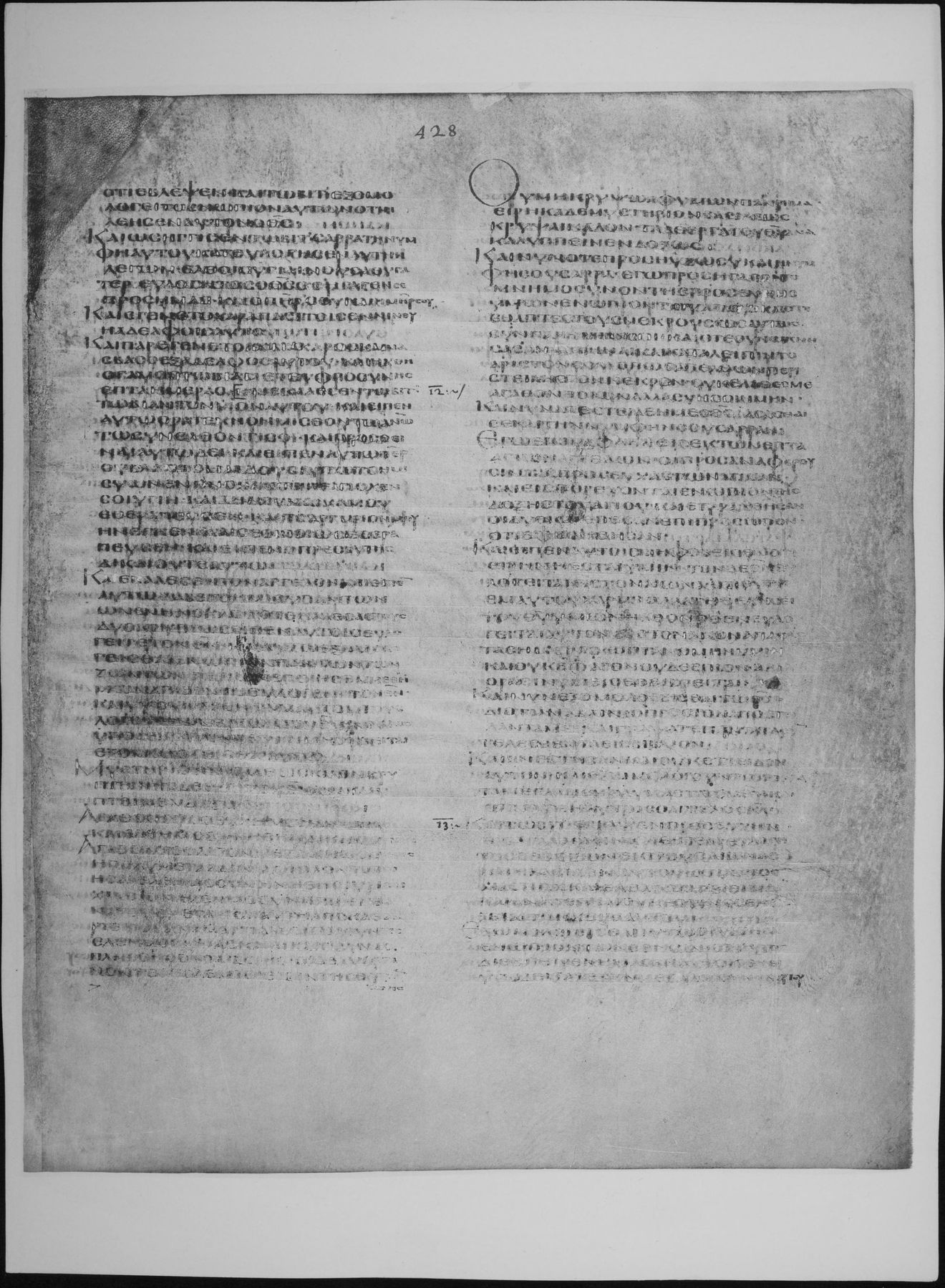
Tobit 12 in the Greek Old Testament (the Septuagint) as written in Codex Alexandrinus, a Greek Bible copied in the fifth century, probably in Egypt, and now in the British Library (Royal MS 1 D. VI, the second of its four volumes). It is one of the three great early codices of the whole Greek Bible, with Codex Vaticanus and Codex Sinaiticus.
Two Greek forms of Tobit: Tobit survives in a shorter and a longer Greek form. Codex Alexandrinus, like Codex Vaticanus, has the shorter form, which Swete prints from Vaticanus as his main text (he prints the longer form of Codex Sinaiticus beneath it; that form is not used here). Brenton's English also translates the shorter form.
This entry meets the strict three-criteria standard of the Theosis Library:
- Manuscript scan: the page of Codex Alexandrinus carrying this chapter (fol. 428r), from the full-size photographic (autotype) facsimile published by the British Museum in 1879-1883, as digitised on the Internet Archive. The verse range of every page comes from the reduced photographic facsimile of 1936, which prints it beneath each plate, and the opening words of every page were read on the plate to confirm the page and the verse it begins with. Each section links to the page or pages that hold its verses. Folio numbers are those written at the head of each leaf and visible on the plates.
- Original text: Swete's edition, which here prints the text of Codex Vaticanus (Vat. gr. 1209), the base of his edition, and gives the readings of Alexandrinus only in his apparatus. The Greek column is therefore Vaticanus' text; where Alexandrinus differs, the plate shows what Alexandrinus reads.
- English translation: Sir Lancelot C. L. Brenton, The Septuagint Version of the Old Testament (1844; 1851 edition), a translation of the Greek, public domain, from the eBible.org text.
How was this verified? (Provenance)
Where on the image
Tobit 12:1-8 is on fol. 428r (full-size facsimile of 1879-83, Internet Archive codex-alexandrinus leaf 880). The 1936 reduced facsimile prints beneath this page: Tobit xi. 17-xiii. 4. Checked on the plate: the page begins inside Tobit 11:16 (first words read: ΟΤΙ ΕΒΛΕΨΕΝ ΚΑΙ ΤΩΒΙΤ ΕΞΩΜΟΛΟΓΕΙΤΟ). Note: the caption gives xi. 17, but the page begins with ΟΤΙ ΕΒΛΕΨΕΝ, the last words of Swete's verse 11:16, so verse 11:16 is credited to both pages.
1Καὶ ἐκάλεσεν Τωβεὶτ Τωβείαν τὸν υἱὸν αὐτοῦ καὶ εἶπεν αὐτῷ Ὅρα, τέκνον, μισθὸν τῷ ἀνθρώπῳ τῷ συνελθόντι σοι, καὶ προσθεῖναι αὐτῷ δεῖ. 2καὶ εἶπεν Πάτερ, οὐ βλάπτομαι δοὺς αὐτῷ τὸ ἥμισυ ὧν ἐνήνοχα, 3ὅτι με ἀγίοχέν σοι ὑγιῆ, καὶ τὴν γυναῖκά μου ἐθεράπευσεν καὶ τὸ ἀργύριόν μου ἤνεγκεν, καὶ σὲ ὁμοίως ἐθεράπευσεν. 4καὶ εἶπεν ὁ πρεσβύτης Δικαιοῦται αὐτῷ. 5καὶ ἐκάλεσεν τὸν ἄγγελον καὶ εἶπεν αὐτῷ Λάβε τὸ ἥμισυ πάντων ὧν ἐνηνόχατε. 6καὶ καλέσας τοὺς δύο κρυπτῶς εἶπεν αὐτοῖς Εὐλογεῖτε τὸν θεὸν καὶ αὐτῷ ἐξομολογεῖσθε, μεγαλωσύνην δίδοτε αὐτῷ, καὶ ἐξομολογεῖσθε αὐτῷ ἐνώπιον πάντων τῶν ζώντων περὶ ὧν ἐποίησεν μεθ᾽ ὑμῶν. ἀγαθὸν τὸ εὐλογεῖν τὸν θεὸν καὶ ὑψοῖν τὸ ὄνομα αὐτοῦ, τοὺς λόγους τῶν ἔργων τοῦ θεοῦ ἐντίμως ὑποδεικνύοντες· καὶ μὴ ὀκνεῖτε ἐξομολογεῖσθαι αὐτῷ. 7μυστήριον βασιλέως καλὸν κρύψαι, τὰ δὲ ἔργα τοῦ θεοῦ ἀνακαλύπτειν ἐνδόξως. ἀγαθὸν ποιήσατε, καὶ κακὸν οὐχ εὑρήσει ὑμᾶς. 8ἀγαθὸν προσευχὴ μετὰ νηστείας καὶ ἐλεημοσύνης καὶ δικαιοσύνης· ἀγαθὸν τὸ ὀλίγον μετὰ δικαιοσύνης ἢ πολὺ μετὰ ἀδικίας· καλὸν ποιῆσαι ἐλεημοσύνην ἢ θησαυρίσαι χρυσίον.
1Then Tobit called his son Tobias, and said unto him, My son, see that the man have his wages, which went with thee, and thou must give him more. 2And Tobias said unto him, O father, it is no harm to me to give him half of those things which I have brought: 3for he hath brought me again to thee in safety, and made whole my wife, and brought me the money, and likewise healed thee. 4Then the old man said, It is due unto him. 5So he called the angel, and he said unto him, Take half of all that ye have brought, and go away in safety. 6Then he took them both apart, and said unto them, Bless God, praise him, and magnify him, and praise him for the things which he hath done unto you in the sight of all that live. It is good to praise God, and exalt his name, and honourably to shew forth the works of God; therefore be not slack to praise him. 7It is good to keep close the secret of a king, but it is honourable to reveal the works of God. Do that which is good, and no evil shall touch you. 8Prayer is good with fasting and alms and righteousness. A little with righteousness is better than much with unrighteousness. It is better to give alms than to lay up gold:
Where on the image
Tobit 12:9-16 is on fol. 428r (full-size facsimile of 1879-83, Internet Archive codex-alexandrinus leaf 880). The 1936 reduced facsimile prints beneath this page: Tobit xi. 17-xiii. 4. Checked on the plate: the page begins inside Tobit 11:16 (first words read: ΟΤΙ ΕΒΛΕΨΕΝ ΚΑΙ ΤΩΒΙΤ ΕΞΩΜΟΛΟΓΕΙΤΟ). Note: the caption gives xi. 17, but the page begins with ΟΤΙ ΕΒΛΕΨΕΝ, the last words of Swete's verse 11:16, so verse 11:16 is credited to both pages.
9ἐλεημοσύνη ἐκ θανάτου ῥύεται, καὶ αὕτη ἀποκαθαριεῖ πᾶσαν ἁμαρτίαν· οἱ ποιοῦντες ἐλεημοσύνας καὶ δικαιοσύνας πλησθήσονται ζωῆς· 10οἱ δὲ ἁμαρτάνοντες πολέμιοί εἰσιν τῆς ἑαυτῶν ζωῆς. 11οὐ μὴ κρύψω ἀφ᾽ ὑμῶν πᾶν ῥῆμα· εἴρηκα δὴ μυστήριον βασιλέως κρύψαι καλόν, τὰ δὲ ἔργα τοῦ θεοῦ ἀνακαλύπτειν ἐνδόξως. 12καὶ νῦν ὅτε προσηύξω σὺ καὶ ἡ νύμφη σου Σάρρα, ἐγὼ προσήγαγον τὸ μνημόσυνον τῆς προσευχῆς ὑμῶν ἐνώπιον τοῦ ἁγίου· καὶ ὅτε ἔθαπτες τοὺς νεκρούς, ὡσαύτως συμπαρήμην σοι. 13καὶ ὅτε οὐκ ὤκνησας ἀναστῆναι καὶ καταλιπεῖν τὸ ἄριστόν σου ὅπως ἀπελθὼν περιστείλῃς τὸν νεκρόν, οὐκ ἔλαθές με ἀγαθοποιῶν, ἀλλὰ σὺν σοὶ ἤμην. 14καὶ νῦν ἀπέστειλέν με ὁ θεὸς ἰάσασθαί σε καὶ τὴν νύμφην σου Σάρραν. 15ἐγώ εἰμι Ῥαφαήλ, εἷς ἐκ τῶν ἑπτὰ ἁγίων ἀγγέλων οἳ προσαναφέρουσιν τὰς προσευχὰς τῶν ἁγίων καὶ εἰσπορεύονται ἐνώπιον τῆς δόξης τοῦ ἁγίου. 16Καὶ ἐταράχθησαν οἱ δύο καὶ ἔπεσον ἐπὶ πρόσωπον, ὅτι ἐφοβήθησαν.
9for alms doth deliver from death, and shall purge away all sin. Those that exercise alms and righteousness shall be filled with life: 10but they that sin are enemies to their own life. 11Surely I will keep close nothing from you. For I said, It was good to keep close the secret of a king, but that it was honourable to reveal the works of God. 12Now therefore, when thou didst pray, and Sara thy daughter in law, I did bring the remembrance of your prayers before the Holy One: and when thou didst bury the dead, I was with thee likewise. 13And when thou didst not delay to rise up, and leave thy dinner, to go and cover the dead, thy good deed was not hid from me: but I was with thee. 14And now God hath sent me to heal thee and Sara thy daughter in law. 15I am Raphael, one of the seven holy angels, which present the prayers of the saints, and which go in and out before the glory of the Holy One. 16Then they were both troubled, and fell upon their faces: for they feared.
Where on the image
Tobit 12:17-22 is on fol. 428r (full-size facsimile of 1879-83, Internet Archive codex-alexandrinus leaf 880). The 1936 reduced facsimile prints beneath this page: Tobit xi. 17-xiii. 4. Checked on the plate: the page begins inside Tobit 11:16 (first words read: ΟΤΙ ΕΒΛΕΨΕΝ ΚΑΙ ΤΩΒΙΤ ΕΞΩΜΟΛΟΓΕΙΤΟ). Note: the caption gives xi. 17, but the page begins with ΟΤΙ ΕΒΛΕΨΕΝ, the last words of Swete's verse 11:16, so verse 11:16 is credited to both pages.
17καὶ εἶπεν αὐτοῖς Μὴ φοβεῖσθε, εἰρήνη ὑμῖν ἔσται· τὸν δὲ θεὸν εὐλογεῖτε εἰς τὸν αἰῶνα, 18ὅτι οὐ τῇ ἐμαυτοῦ χάριτι ἀλλὰ τῇ θελήσει τοῦ θεοῦ ὑμῶν· ὅθεν εὐλογεῖτε αὐτὸν εἰς τὸν αἰῶνα. 19πάσας τὰς ἡμέρας ὠπτανόμην ὑμῖν, καὶ οὐκ ἔφαγον οὐδὲ ἔπιον, ἀλλὰ ὅρασιν ὑμεῖς ἐθεωρεῖτε. 20καὶ νῦν ἐξομολογεῖσθε τῷ θεῷ, διότι ἀναβαίνω πρὸς τὸν ἀποστείλαντά με, καὶ γράψατε πάντα τὰ συντελεσθέντα εἰς βιβλίον. 21καὶ ἀνέστησαν, καὶ οὐκ εἶδον αὐτόν. 22καὶ ἐξομολογοῦντο τὰ ἔργα τὰ μεγάλα καὶ θαυμαστὰ αὐτοῦ, ὡς ὤφθη αὐτοῖς ἄγγελος Κυρίου.
17But he said unto them, Fear not, for it shall go well with you; praise God therefore. 18For not of any favour of mine, but by the will of our God I came; wherefore praise him for ever. 19All these days I did appear unto you; but I did neither eat nor drink, but ye did see a vision. 20Now therefore give God thanks: for I go up to him that sent me; but write all things which are done in a book. 21And when they arose, they saw him no more. 22Then they confessed the great and wonderful works of God, and how the angel of the Lord had appeared unto them.
Cite
Sources
- Source: Codex Alexandrinus (British Library Royal MS 1 D. VI) via the British Museum photographic facsimiles of 1879-83 and 1936 (Internet Archive) + Swete's Septuagint + Brenton's English (holding institution)
- Critical edition: H. B. Swete, The Old Testament in Greek according to the Septuagint (1909)
← previous · → next · v cycle view · l back to library