Manetho on the Hyksos (Josephus, Against Apion 1.73-105)
Introduction
Manetho, an Egyptian priest of Sebennytus, wrote a history of Egypt in Greek (the Aegyptiaca, in three books) under Ptolemy II, around 280 BCE. The work is lost. Its longest surviving passages of continuous narrative are the quotations made by the Jewish historian Flavius Josephus in his treatise Against Apion (written in the 90s AD).
In 1.73-105 Josephus quotes Manetho's second book on an invasion of Egypt 'from the regions of the east' by people of obscure race, the Hyksos, a name Manetho explains as 'shepherd kings'. He names six of their rulers (Salitis, Bnon, Apachnan, Apophis, Iannas, Assis), their fortress of Avaris in the eastern Delta, their expulsion after 511 years, and their march through the desert to Syria, where, Manetho says, they built Jerusalem. Josephus then quotes Manetho's list of the kings who followed, down to Sethos (Sethosis), whom Manetho identifies with the Aegyptus of Greek legend, and his brother Harmais (Danaus). Josephus identifies the shepherds with the ancestors of the Jews; modern historians see in the passage a memory of the Hyksos rulers of the Fifteenth Dynasty (c. 1650-1550 BCE) and of the New Kingdom kings of the Eighteenth and Nineteenth Dynasties.
The manuscript is Florence, Biblioteca Medicea Laurenziana, Plut. 69.22, a small parchment book of the 10th century (37 folios) that contains only Against Apion. It is the oldest Greek copy of the work. The passage runs from fol. 6v to fol. 8v. Each section below covers the Niese sections written on one page; three sections that run across a page break show both pages. Every section start was read on the page image and is recorded with its line number. The copyist marks Manetho's quoted words with strokes in the left margin, and two variant readings from 'another copy' are written in the margins of fols. 7v and 8r.
The Greek is Niese's critical text, which follows this manuscript closely but not letter for letter. The English is William Whiston's translation (1737), which in a few places follows a different Greek text (for example 'thirteen years' for Salitis, where Niese prints nineteen).
How was this verified? (Provenance)
Where on the image
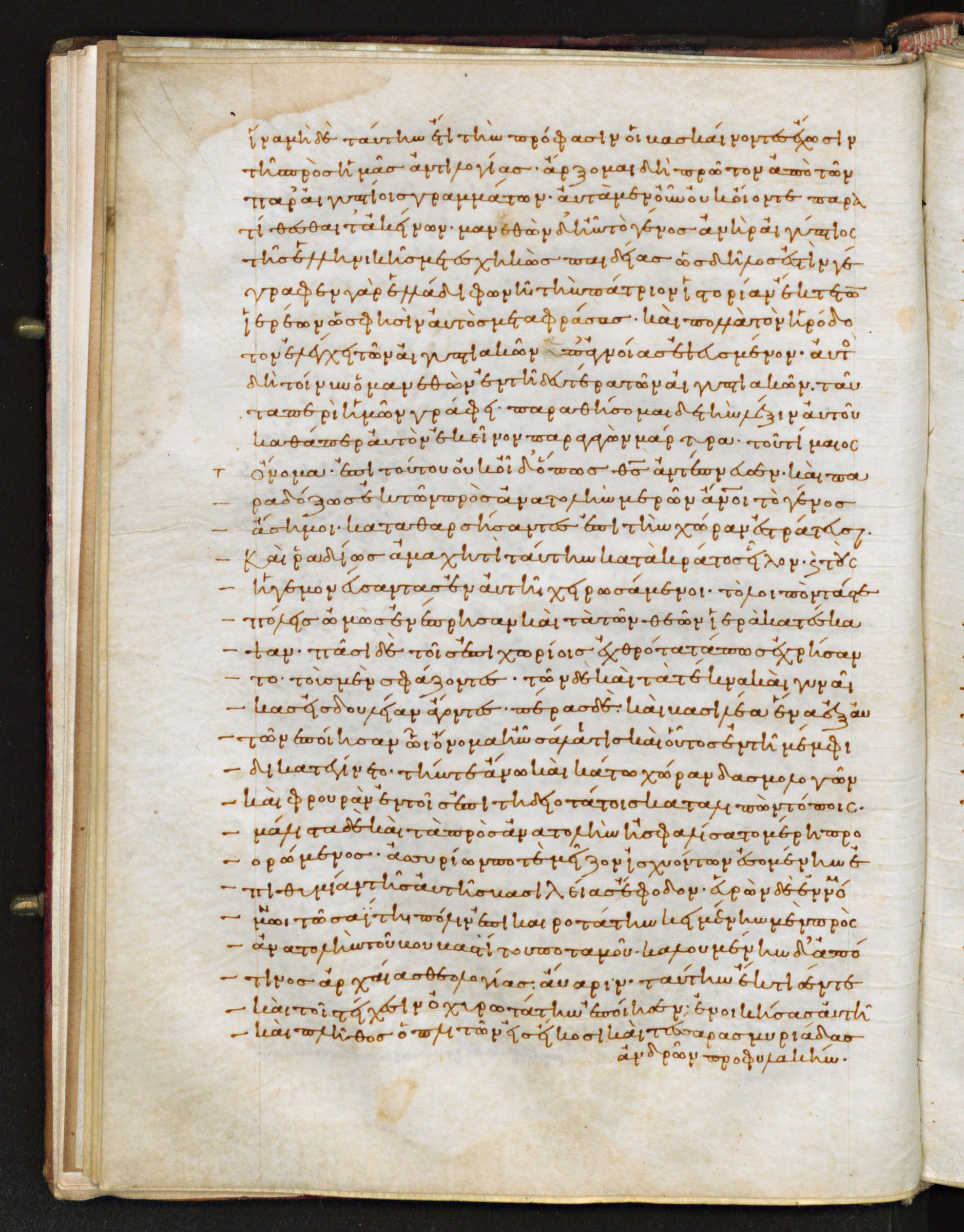
Fol. 6v, lines 2-32 (31 full lines and a short closing line). Line 1 ends Against Apion 1.72. 1.73 begins at line 2 'ἄρξομαι δὴ πρῶτον ἀπὸ τῶν'; 1.74 begins at the end of line 8 (the manuscript spells the name Μανεθών); the quotation from Manetho (1.75) begins at the end of line 11 'τοῦ Τίμαιος' / line 12 'ὄνομα'; from line 12 onward the quoted words are marked by strokes in the left margin. 1.76 begins line 15 'καὶ τοὺς', 1.77 line 20 'πέρας δὲ', 1.78 line 26 'εὑρὼν δὲ'. The page ends with 1.78 'ἀνδρῶν προφυλακήν' (line 32). In line 27 the manuscript reads 'ἐν νομῷ τῷ Σαΐτῃ' (the Saite nome), which Whiston translates; Niese prints the emendation Σεθροΐτῃ. Viewer: https://tecabml.contentdm.oclc.org/digital/collection/plutei/id/1350351 . Greek shown is Niese's critical text; the copyist's spelling differs in small details.
73Ἄρξομαι δὲ πρῶτον ἀπὸ τῶν παρʼ Αἰγυπτίοις γραμμάτων. αὐτὰ μὲν οὖν οὐχ οἷόν τε παρατίθεσθαι τἀκείνων, Μάνεθως δʼ ἦν τὸ γένος Αἰγύπτιος ἀνὴρ τῆς Ἑλληνικῆς μετεσχηκὼς παιδείας, ὡς δῆλός ἐστιν· γέγραφεν γὰρ Ἑλλάδι φωνῇ τὴν πάτριον ἱστορίαν ἔκ τε τῶν ἱερῶν, ὥς φησιν αὐτός, μεταφράσας καὶ πολλὰ τὸν Ἡρόδοτον ἐλέγχει τῶν Αἰγυπτιακῶν ὑπʼ ἀγνοίας ἐψευσμένον. 74οὗτος δὴ τοίνυν ὁ Μάνεθως ἐν τῇ δευτέρᾳ τῶν Αἰγυπτιακῶν ταῦτα περὶ ἡμῶν γράφει. παραθήσομαι δὲ τὴν λέξιν αὐτοῦ καθάπερ αὐτὸν ἐκεῖνον παραγαγὼν μάρτυρα· 75τοῦ τίμαιος ὄνομα. ἐπὶ τούτου οὐκ οἶδʼ ὅπως θεὸς ἀντέπνευσεν καὶ παραδόξως ἐκ τῶν πρὸς ἀνατολὴν μερῶν ἄνθρωποι τὸ γένος ἄσημοι καταθαρρήσαντες ἐπὶ τὴν χώραν ἐστράτευσαν καὶ ῥᾳδίως ἀμαχητὶ ταύτην κατὰ κράτος εἷλον, 76καὶ τοὺς ἡγεμονεύσαντας ἐν αὐτῇ χειρωσάμενοι τὸ λοιπὸν τάς τε πόλεις ὠμῶς ἐνέπρησαν καὶ τὰ τῶν θεῶν ἱερὰ κατέσκαψαν, πᾶσι δὲ τοῖς ἐπιχωρίοις ἐχθρότατά πως ἐχρήσαντο τοὺς μὲν σφάζοντες, τῶν δὲ καὶ τὰ τέκνα καὶ γυναῖκας εἰς δουλείαν ἄγοντες. 77πέρας δὲ καὶ βασιλέα ἕνα ἐξ αὐτῶν ἐποίησαν, ᾧ ὄνομα ἦν Σάλιτις. καὶ οὗτος ἐν τῇ Μέμφιδι κατεγίνετο τήν τε ἄνω καὶ κάτω χώραν δασμολογῶν καὶ φρουρὰν ἐν τοῖς ἐπιτηδειοτάτοις καταλιπὼν τόποις. μάλιστα δὲ καὶ τὰ πρὸς ἀνατολὴν ἠσφαλίσατο μέρη προορώμενος Ἀσσυρίων ποτὲ μεῖζον ἰσχυόντων ἐσομένην ἐπιθυμίᾳ τῆς αὐτοῦ βασιλείας ἔφοδον. 78εὑρὼν δὲ ἐν νομῷ τῷ Σεθροΐτῃ πόλιν ἐπικαιροτάτην, κειμένην μὲν πρὸς ἀνατολὴν τοῦ Βουβαστίτου ποταμοῦ, καλουμένην δʼ ἀπό τινος ἀρχαίας θεολογίας Αὔαριν, ταύτην ἔκτισέν τε καὶ τοῖς τείχεσιν ὀχυρωτάτην ἐποίησεν ἐνοικίσας αὐτῇ καὶ πλῆθος ὁπλιτῶν εἰς εἴκοσι καὶ τέσσαρας μυριάδας ἀνδρῶν προφυλακήν.
73I shall begin with the writings of the Egyptians; not indeed of those that have written in the Egyptian language, which it is impossible for me to do. But Manetho was a man who was by birth an Egyptian, yet had he made himself master of the Greek learning, as is very evident; for he wrote the history of his own country in the Greek tongue, by translating it, as he saith himself, out of their sacred records; he also finds great fault with Herodotus for his ignorance and false relations of Egyptian affairs. 74Now this Manetho, in the second book of his Egyptian History, writes concerning us in the following manner. I will set down his very words, as if I were to bring the very man himself into a court for a witness: 75There was a king of ours whose name was Timaus. Under him it came to pass, I know not how, that God was averse to us, and there came, after a surprising manner, men of ignoble birth out of the eastern parts, and had boldness enough to make an expedition into our country, and with ease subdued it by force, yet without our hazarding a battle with them. 76So when they had gotten those that governed us under their power, they afterwards burnt down our cities, and demolished the temples of the gods, and used all the inhabitants after a most barbarous manner; nay, some they slew, and led their children and their wives into slavery. 77At length they made one of themselves king, whose name was Salatis; he also lived at Memphis, and made both the upper and lower regions pay tribute, and left garrisons in places that were the most proper for them. He chiefly aimed to secure the eastern parts, as fore-seeing that the Assyrians, who had then the greatest power, would be desirous of that kingdom, and invade them; 78and as he found in the Saite Nomos, [Sethroite,] a city very proper for this purpose, and which lay upon the Bubastic channel, but with regard to a certain theologic notion was called Avaris, this he rebuilt, and made very strong by the walls he built about it, and by a most numerous garrison of two hundred and forty thousand armed men whom he put into it to keep it.
Where on the image
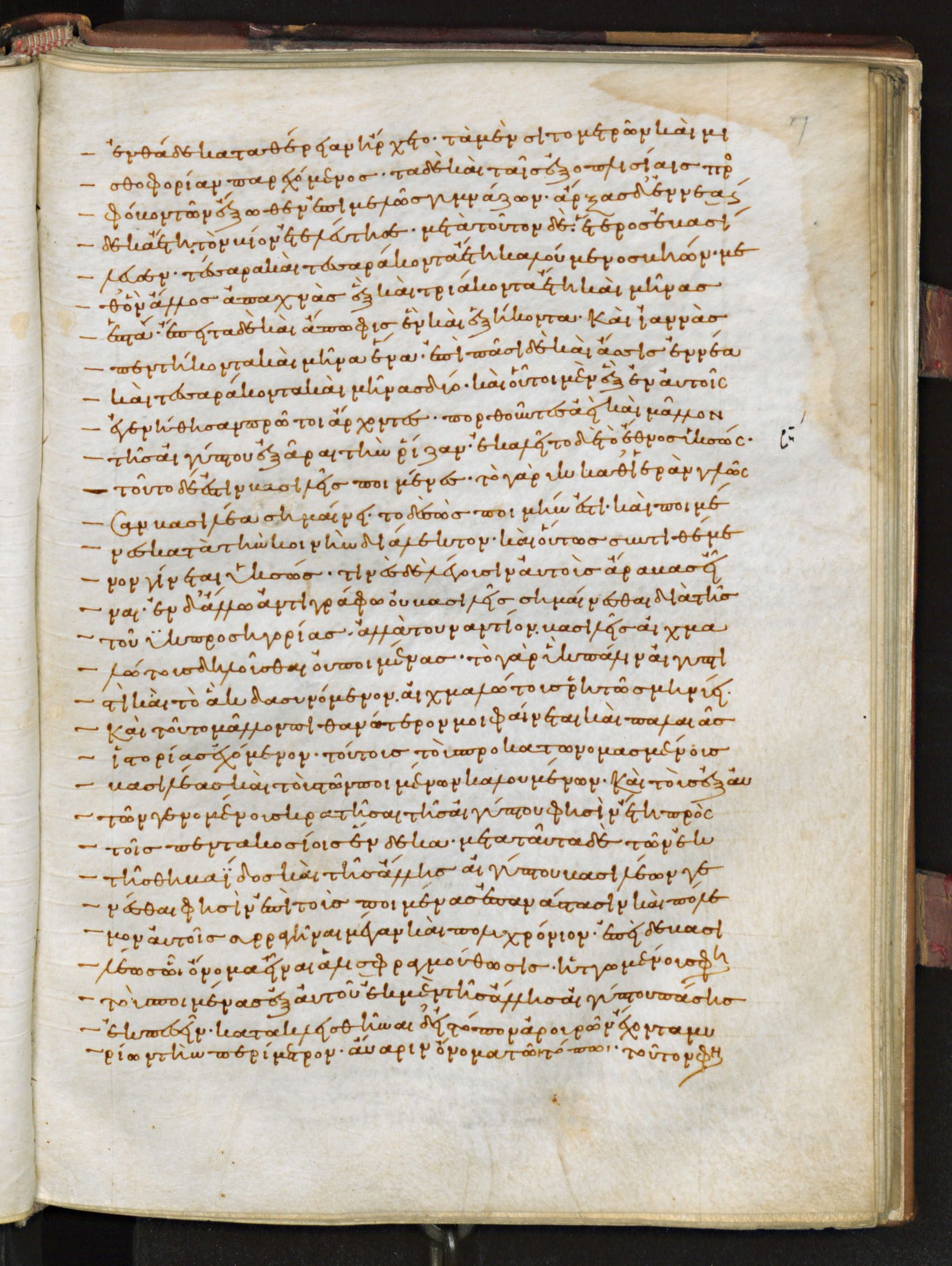
Fol. 7r, lines 1-31 (31 lines), all marked as quotation in the left margin. 1.79 begins line 1 'ἔνθα δὲ κατὰ θέρειαν'; 1.80 line 4 'μετὰ τοῦτον δὲ ἕτερος'; 1.81 line 8 'ἐπὶ πᾶσι δὲ καὶ Ἄσσις'; 1.82 line 11 'ἐκαλεῖτο δὲ τὸ σύμπαν ἔθνος'; 1.83 line 15 'τινὲς δὲ λέγουσιν'; 1.84 line 21 'τούτους τοὺς προκατωνομασμένους'; 1.85 line 24 'μετὰ ταῦτα δὲ'; 1.86 line 27 'ἐπὶ δὲ βασιλέως'. Line 31 ends with the first words of 1.87 'τοῦτον φη-', which continues on fol. 7v. Viewer: https://tecabml.contentdm.oclc.org/digital/collection/plutei/id/1350351 . Greek shown is Niese's critical text; the copyist's spelling differs in small details.
79ἔνθα δὲ κατὰ θέρειαν ἤρχετο τὰ μὲν σιτομετρῶν καὶ μισθοφορίαν παρεχόμενος τὰ δὲ καὶ ταῖς ἐξοπλισίαις πρὸς φόβον τῶν ἔξωθεν ἐπιμελῶς γυμνάζων. ἄρξας δʼ ἐννεακαίδεκα ἔτη τὸν βίον ἐτελεύτησε. 80μετὰ τοῦτον δὲ ἕτερος ἐβασίλευσεν τέσσαρα καὶ τεσσαράκοντα ἔτη καλούμενος Βηών. μεθʼ ὃν ἄλλος Ἀπαχνὰς ἓξ καὶ τριάκοντα ἔτη καὶ μῆνας ἑπτά. ἔπειτα δὲ καὶ Ἄπωφις ἓν καὶ ἑξήκοντα καὶ Ἰαννὰς πεντήκοντα καὶ μῆνα ἕνα. 81ἐπὶ πᾶσι δὲ καὶ Ἄσσις ἐννέα καὶ τεσσαράκοντα καὶ μῆνας δύο. καὶ οὗτοι μὲν ἓξ ἐν αὐτοῖς ἐγενήθησαν πρῶτοι ἄρχοντες ποθοῦντες ἀεὶ καὶ μᾶλλον τῆς Αἰγύπτου ἐξᾶραι τὴν ῥίζαν. 82ἐκαλεῖτο δὲ τὸ σύμπαν αὐτῶν ἔθνος Ὑκσώς, τοῦτο δέ ἐστιν βασιλεῖς ποιμένες· τὸ γὰρ υκ καθʼ ἱερὰν γλῶσσαν βασιλέα σημαίνει, τὸ δὲ σὼς ποιμήν ἐστι καὶ ποιμένες κατὰ τὴν κοινὴν διάλεκτον, καὶ οὕτως συντιθέμενον γίνεται Ὑκσώς. 83τινὲς δὲ λέγουσιν αὐτοὺς Ἄραβας εἶναι. ἐν δʼ ἄλλῳ ἀντιγράφῳ οὐ βασιλεῖς σημαίνεσθαι διὰ τῆς ϋκ προσηγορίας, ἀλλὰ τοὐναντίον αἰχμαλώτους δηλοῦσθαι ποιμένας· τὸ γὰρ ὓκ πάλιν Αἰγυπτιστὶ καὶ τὸ ἃκ δασυνόμενον αἰχμαλώτους ῥητῶς μηνύει. καὶ τοῦτο μᾶλλον πιθανώτερόν μοι φαίνεται καὶ παλαιᾶς ἱστορίας ἐχόμενον. 84τούτους τοὺς προκατωνομασμένους βασιλέας καὶ τοὺς τῶν ποιμένων καλουμένων καὶ τοὺς ἐξ αὐτῶν γενομένους κρατῆσαι τῆς Αἰγύπτου φησὶν ἔτη πρὸς τοῖς πεντακοσίοις ἕνδεκα. 85μετὰ ταῦτα δὲ τῶν ἐκ τῆς Θηβαΐδος καὶ τῆς ἄλλης Αἰγύπτου βασιλέων γενέσθαι φησὶν ἐπὶ τοὺς ποιμένας ἐπανάστασιν καὶ πόλεμον συρραγῆναι μέγαν καὶ πολυχρόνιον. 86ἐπὶ δὲ βασιλέως, ᾧ ὄνομα εἶναι Μισφραγμούθωσις, ἡττωμένους φησὶ τοὺς ποιμένας ἐκ μὲν τῆς ἄλλης Αἰγύπτου πάσης ἐκπεσεῖν, κατακλεισθῆναι δʼ εἰς τόπον ἀρουρῶν ἔχοντα μυρίων τὴν περίμετρον· Αὔαριν ὄνομα τῷ τόπῳ.
79Thither Salatis came in summer time, partly to gather his corn, and pay his soldiers their wages, and partly to exercise his armed men, and thereby to terrify foreigners. When this man had reigned thirteen years, 80after him reigned another, whose name was Beon, for forty-four years; after him reigned another, called Apachnas, thirty-six years and seven months; after him Apophis reigned sixty-one years, and then Janins fifty years and one month; 81after all these reigned Assis forty-nine years and two months. And these six were the first rulers among them, who were all along making war with the Egyptians, and were very desirous gradually to destroy them to the very roots. 82This whole nation was styled HYCSOS, that is, Shepherd-kings: for the first syllable HYC, according to the sacred dialect, denotes a king, as is SOS a shepherd; but this according to the ordinary dialect; and of these is compounded HYCSOS: 83but some say that these people were Arabians. Now in another copy it is said that this word does not denote Kings, but, on the contrary, denotes Captive Shepherds, and this on account of the particle HYC; for that HYC, with the aspiration, in the Egyptian tongue again denotes Shepherds, and that expressly also; and this to me seems the more probable opinion, and more agreeable to ancient history. 84[But Manetho goes on]: These people, whom we have before named kings, and called shepherds also, and their descendants, as he says, kept possession of Egypt five hundred and eleven years. 85After these, he says, That the kings of Thebais and the other parts of Egypt made an insurrection against the shepherds, and that there a terrible and long war was made between them. 86He says further, That under a king, whose name was Alisphragmuthosis, the shepherds were subdued by him, and were indeed driven out of other parts of Egypt, but were shut up in a place that contained ten thousand acres; this place was named Avaris.
Where on the image
1.87 straddles the page break: it begins at the end of fol. 7r line 31 'τοῦτον φη-' and continues on fol. 7v lines 1-3 '-σιν ὁ Μανεθὼν ἅπαντα τείχει τε μεγάλῳ ... καὶ τὴν λείαν τὴν ἑαυτῶν'. Viewer: https://tecabml.contentdm.oclc.org/digital/collection/plutei/id/1350351 . Greek shown is Niese's critical text; the copyist's spelling differs in small details.
87τοῦτόν φησιν ὁ Μάνεθως ἅπαντα τείχει τε μεγάλῳ καὶ ἰσχυρῷ περιβαλεῖν τοὺς ποιμένας, ὅπως τήν τε κτῆσιν ἅπασαν ἔχωσιν ἐν ὀχυρῷ καὶ τὴν λείαν τὴν ἑαυτῶν.
87Manetho says, That the shepherds built a wall round all this place, which was a large and a strong wall, and this in order to keep all their possessions and their prey within a place of strength,
Where on the image
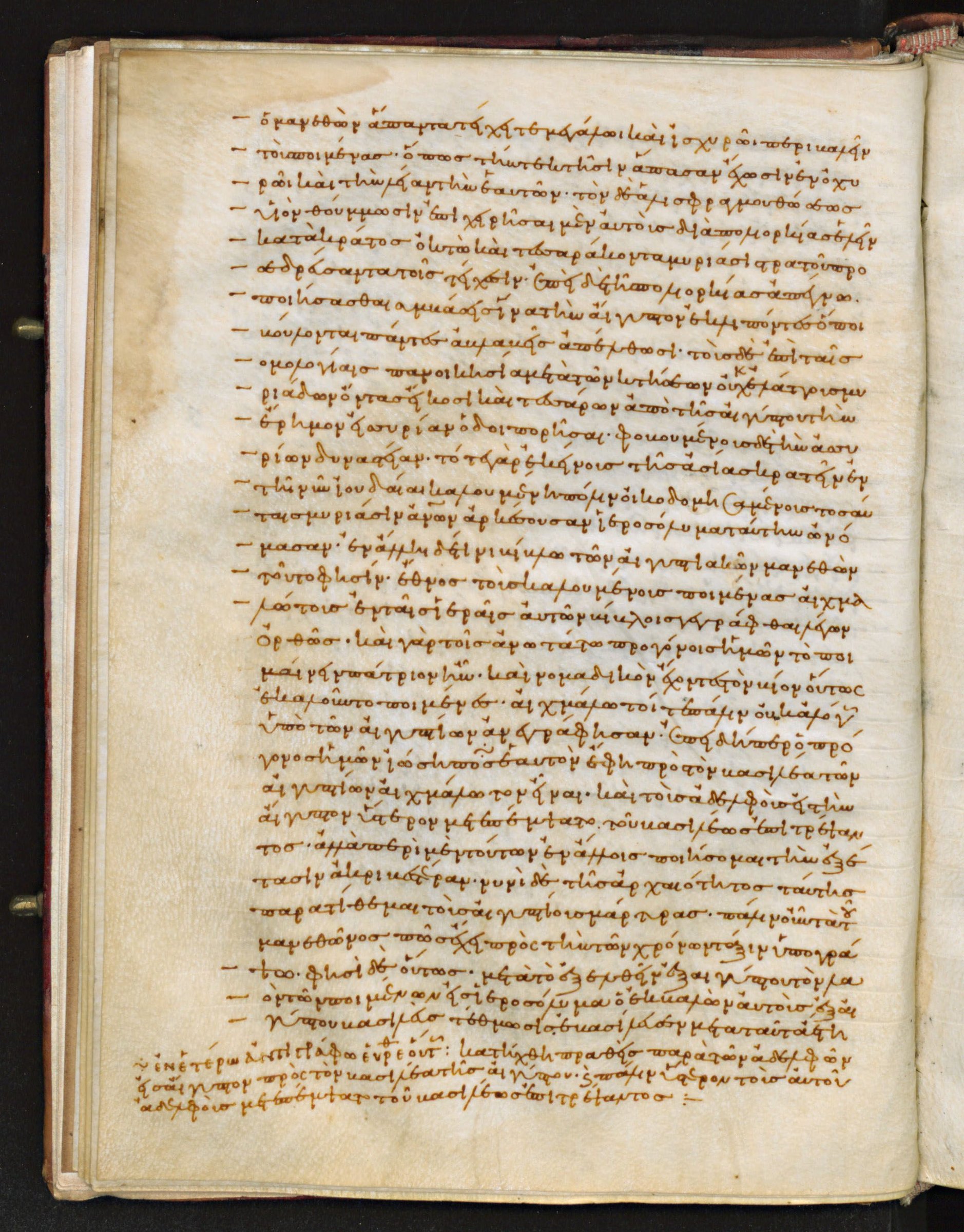
Fol. 7v (31 lines of text). 1.88 begins at the end of line 3 'τὸν δὲ Μισφραγμουθώσεως'; 1.89 line 8 'τοὺς δὲ ἐπὶ ταῖς'; 1.90 line 11 'φοβουμένους δὲ'; 1.91 line 15 'ἐν ἄλλῃ δέ τινι βίβλῳ'; 1.92 line 20 'αἰχμάλωτοί τε πάλιν'; 1.93 line 26 'νυνὶ δὲ τῆς ἀρχαιότητος'. Josephus' own comments (lines 18-28) carry no quotation strokes in the margin. Three lines written below the text block, introduced 'ἐν ἑτέρῳ ἀντιγράφῳ' ('in another copy'), give a variant wording of 1.92 about Joseph sold by his brothers; they are not part of the printed text. Viewer: https://tecabml.contentdm.oclc.org/digital/collection/plutei/id/1350351 . Greek shown is Niese's critical text; the copyist's spelling differs in small details.
88τὸν δὲ Μισφραγμουθώσεως υἱὸν Θούμμωσιν ἐπιχειρῆσαι μὲν αὐτοὺς διὰ πολιορκίας ἑλεῖν κατὰ κράτος ὀκτὼ καὶ τεσσαράκοντα μυριάσι στρατοῦ προσεδρεύσαντα τοῖς τείχεσιν· ἐπεὶ δὲ τὴν πολιορκίαν ἀπέγνω, ποιήσασθαι συμβάσεις, ἵνα τὴν Αἴγυπτον ἐκλιπόντες ὅποι βούλονται πάντες ἀβλαβεῖς ἀπέλθωσι. 89τοὺς δὲ ἐπὶ ταῖς ὁμολογίαις πανοικησίᾳ μετὰ τῶν κτήσεων οὐκ ἐλάττους μυριάδων ὄντας εἴκοσι καὶ τεσσάρων ἀπὸ τῆς Αἰγύπτου τὴν ἔρημον εἰς Συρίαν διοδοιπορῆσαι. 90φοβουμένους δὲ τὴν Ἀσσυρίων δυναστείαν, τότε γὰρ ἐκείνους τῆς Ἀσίας κρατεῖν, ἐν τῇ νῦν Ἰουδαίᾳ καλουμένῃ πόλιν οἰκοδομησαμένους τοσαύταις μυριάσιν ἀνθρώπων ἀρκέσουσαν Ἱεροσόλυμα ταύτην ὀνομάσαι. 91ἐν ἄλλῃ δέ τινι βίβλῳ τῶν Αἰγυπτιακῶν Μάνεθως τοῦτό φησιν τὸ ἔθνος τοὺς καλουμένους ποιμένας αἰχμαλώτους ἐν ταῖς ἱεραῖς αὐτῶν βίβλοις γεγράφθαι λέγων ὀρθῶς· καὶ γὰρ τοῖς ἀνωτάτω προγόνοις ἡμῶν τὸ ποιμαίνειν πάτριον ἦν καὶ νομαδικὸν ἔχοντες τὸν βίον οὕτως ἐκαλοῦντο ποιμένες. 92αἰχμάλωτοί τε πάλιν οὐκ ἀλόγως ὑπὸ τῶν Αἰγυπτίων ἀνεγράφησαν, ἐπειδήπερ ὁ πρόγονος ἡμῶν Ἰώσηπος ἑαυτὸν ἔφη πρὸς τὸν βασιλέα τῶν Αἰγυπτίων αἰχμάλωτον εἶναι, καὶ τοὺς ἀδελφοὺς εἰς τὴν Αἴγυπτον ὕστερον μετεπέμψατο τοῦ βασιλέως ἐπιτρέψαντος. ἀλλὰ περὶ μὲν τούτων ἐν ἄλλοις ποιήσομαι τὴν ἐξέτασιν ἀκριβεστέραν. 93Νυνὶ δὲ τῆς ἀρχαιότητος ταύτης παρατίθεμαι τοὺς Αἰγυπτίους μάρτυρας. πάλιν οὖν τὰ τοῦ Μανέθω πῶς ἔχει πρὸς τὴν τῶν χρόνων τάξιν ὑπογράψω.
88but that Thummosis the son of Alisphragmuthosis made an attempt to take them by force and by siege, with four hundred and eighty thousand men to lie round about them, but that, upon his despair of taking the place by that siege, they came to a composition with them, that they should leave Egypt, and go, without any harm to be done to them, whithersoever they would; 89and that, after this composition was made, they went away with their whole families and effects, not fewer in number than two hundred and forty thousand, and took their journey from Egypt, through the wilderness, for Syria; 90but that as they were in fear of the Assyrians, who had then the dominion over Asia, they built a city in that country which is now called Judea, and that large enough to contain this great number of men, and called it Jerusalem. 91Now Manetho, in another book of his, says, That this nation, thus called Shepherds, were also called Captives, in their sacred books. And this account of his is the truth; for feeding of sheep was the employment of our forefathers in the most ancient ages; and as they led such a wandering life in feeding sheep, they were called Shepherds. 92Nor was it without reason that they were called Captives by the Egyptians, since one of our ancestors, Joseph, told the king of Egypt that he was a captive, and afterward sent for his brethren into Egypt by the king's permission. But as for these matters, I shall make a more exact inquiry about them elsewhere. 93But now I shall produce the Egyptians as witnesses to the antiquity of our nation. I shall therefore here bring in Manetho again, and what he writes as to the order of the times in this case;
Where on the image
1.94 straddles the page break: it begins on fol. 7v line 29 'φησὶ δὲ οὕτως· μετὰ τὸ ἐξελθεῖν ἐξ Αἰγύπτου' and runs to the end of the page ('ἐβασίλευσε μετὰ ταῦτα ἔτη', line 31), then continues on fol. 8r lines 1-2 'εἴκοσι πέντε καὶ μῆνας τέσσαρας ... Χέβρων ἔτη δεκατρία'. Viewer: https://tecabml.contentdm.oclc.org/digital/collection/plutei/id/1350351 . Greek shown is Niese's critical text; the copyist's spelling differs in small details.
94φησὶ δὲ οὕτως· μετὰ τὸ ἐξελθεῖν ἐξ Αἰγύπτου τὸν λαὸν τῶν ποιμένων εἰς Ἱεροσόλυμα ὁ ἐκβαλὼν αὐτοὺς ἐξ Αἰγύπτου βασιλεὺς Τέθμωσις ἐβασίλευσεν μετὰ ταῦτα ἔτη εἰκοσιπέντε καὶ μῆνας τέσσαρας καὶ ἐτελεύτησεν, καὶ παρέλαβεν τὴν ἀρχὴν ὁ αὐτοῦ υἱὸς Χέβρων ἔτη δεκατρία.
94and thus he speaks: When this people or shepherds were gone out of Egypt to Jerusalem, Tethmosis the king of Egypt, who drove them out, reigned afterward twenty-five years and four months, and then died; after him his son Chebron took the kingdom for thirteen years;
Where on the image
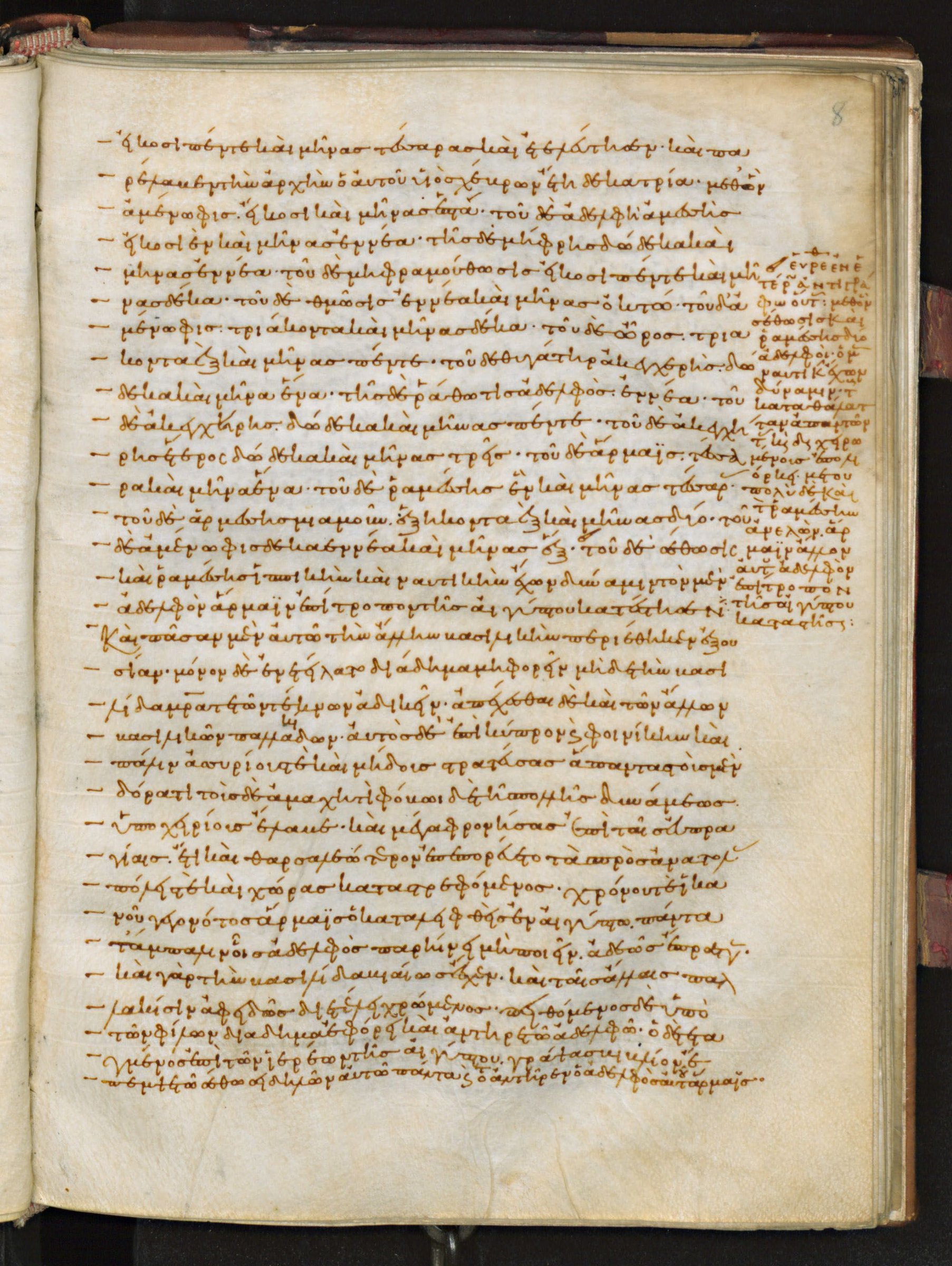
Fol. 8r (32 lines). 1.95 begins at the end of line 2 'μεθ’ ὃν' / line 3 'Ἀμένωφις'; 1.96 line 6 'τοῦ δὲ Θμῶσις'; 1.97 line 10 'τοῦ δὲ Ἀκεγχήρης'; 1.98 line 14 'δὲ Ἀμένωφις'; 1.99 line 20 'αὐτὸς δὲ ἐπὶ Κύπρον'; 1.100 line 25 'χρόνου τε ἱκανοῦ'. The variant that Whiston gives in square brackets in 1.98 ('In another copy it stood thus...') is written in the right margin beside lines 5-17, beginning 'ἐν ἑτέρῳ ἀντιγράφῳ οὕτως· μεθ’ ὃν Σέθως καὶ Ῥαμέσσης δύο ἀδελφοί'. Viewer: https://tecabml.contentdm.oclc.org/digital/collection/plutei/id/1350351 . Greek shown is Niese's critical text; the copyist's spelling differs in small details.
95μεθʼ ὃν Ἀμένωφις εἴκοσι καὶ μῆνας ἑπτά. τοῦ δὲ ἀδελφὴ Ἀμεσσὴς εἰκοσιὲν καὶ μῆνας ἐννέα. τῆς δὲ Μήφρης δώδεκα καὶ μῆνας ἐννέα. τοῦ δὲ Μηφραμούθωσις εἰκοσιπέντε καὶ μῆνας δέκα. 96τοῦ δὲ Θμῶσις ἐννέα καὶ μῆνας ὀκτώ. τοῦ δʼ Ἀμένωφις τριάκοντα καὶ μῆνας δέκα. τοῦ δὲ Ὦρος τριακονταὲξ καὶ μῆνας πέντε. τοῦ δὲ θυγάτηρ Ἀκεγχερὴς δώδεκα καὶ μῆνα ἕνα. τῆς δὲ Ῥάθωτις ἀδελφὸς ἐννέα. 97τοῦ δὲ Ἀκεγχήρης δώδεκα καὶ μῆνας πέντε. τοῦ δὲ Ἀκεγχήρης ἕτερος δώδεκα καὶ μῆνας τρεῖς. τοῦ δὲ Ἅρμαϊς τέσσαρα καὶ μῆνα ἕνα. τοῦ δὲ Ῥαμέσσης ἓν καὶ μῆνας τέσσαρας. τοῦ δὲ Ἁρμέσσης Μιαμοῦν ἑξηκονταὲξ καὶ μῆνας δύο. 98τοῦ δὲ Ἀμένωφις δεκαεννέα καὶ μῆνας ἕξ. τοῦ δὲ Σέθως ὁ καὶ Ῥαμέσσης ἱππικὴν καὶ ναυτικὴν ἔχων δύναμιν τὸν μὲν ἀδελφὸν Ἅρμαϊν ἐπίτροπον τῆς Αἰγύπτου κατέστησεν καὶ πᾶσαν μὲν αὐτῷ τὴν ἄλλην βασιλικὴν περιέθηκεν ἐξουσίαν, μόνον δὲ ἐνετείλατο διάδημα μὴ φορεῖν μηδὲ τὴν βασιλίδα μητέρα τε τῶν τέκνων ἀδικεῖν, ἀπέχεσθαι δὲ καὶ τῶν ἄλλων βασιλικῶν παλλακίδων. 99αὐτὸς δὲ ἐπὶ Κύπρον καὶ Φοινίκην καὶ πάλιν Ἀσσυρίους τε καὶ Μήδους στρατεύσας ἅπαντας τοὺς μὲν δόρατι, τοὺς δὲ ἀμαχητὶ φόβῳ δὲ τῆς πολλῆς δυνάμεως ὑποχειρίους ἔλαβε καὶ μέγα φρονήσας ἐπὶ ταῖς εὐπραγίαις ἔτι καὶ θαρσαλεώτερον ἐπεπορεύετο τὰς πρὸς ἀνατολὰς πόλεις τε καὶ χώρας καταστρεφόμενος. 100χρόνου τε ἱκανοῦ γεγονότος Ἅρμαϊς ὁ καταλειφθεὶς ἐν Αἰγύπτῳ πάντα τἄμπαλιν οἷς ἀδελφὸς παρῄνει μὴ ποιεῖν ἀδεῶς ἔπραττεν· καὶ γὰρ τὴν βασιλίδα βιαίως ἔσχεν καὶ ταῖς ἄλλαις παλλακίσιν ἀφειδῶς διετέλει χρώμενος, πειθόμενος δὲ ὑπὸ τῶν φίλων διάδημα ἐφόρει καὶ ἀντῆρε τῷ ἀδελφῷ.
95after whom came Amenophis, for twenty years and seven months; then came his sister Amesses, for twenty-one years and nine months; after her came Mephres, for twelve years and nine months; after him was Mephramuthosis, for twenty-five years and ten months; 96after him was Thmosis, for nine years and eight months; after him came Amenophis, for thirty years and ten months; after him came Orus, for thirty-six years and five months; then came his daughter Acenchres, for twelve years and one month; then was her brother Rathotis, for nine years; 97then was Acencheres, for twelve years and five months; then came another Acencheres, for twelve years and three months; after him Armais, for four years and one month; after him was Ramesses, for one year and four months; after him came Armesses Miammoun, for sixty-six years and two months; 98after him Amenophis, for nineteen years and six months; after him came Sethosis, and Ramesses, who had an army of horse, and a naval force. This king appointed his brother, Armais, to be his deputy over Egypt. [In another copy it stood thus: After him came Sethosis, and Ramesses, two brethren, the former of whom had a naval force, and in a hostile manner destroyed those that met him upon the sea; but as he slew Ramesses in no long time afterward, so he appointed another of his brethren to be his deputy over Egypt.] He also gave him all the other authority of a king, but with these only injunctions, that he should not wear the diadem, nor be injurious to the queen, the mother of his children, and that he should not meddle with the other concubines of the king; 99while he made an expedition against Cyprus, and Phoenicia, and besides against the Assyrians and the Medes. He then subdued them all, some by his arms, some without fighting, and some by the terror of his great army; and being puffed up by the great successes he had had, he went on still the more boldly, and overthrew the cities and countries that lay in the eastern parts. 100But after some considerable time, Armais, who was left in Egypt, did all those very things, by way of opposition, which his brother had forbid him to do, without fear; for he used violence to the queen, and continued to make use of the rest of the concubines, without sparing any of them; nay, at the persuasion of his friends he put on the diadem, and set up to oppose his brother.
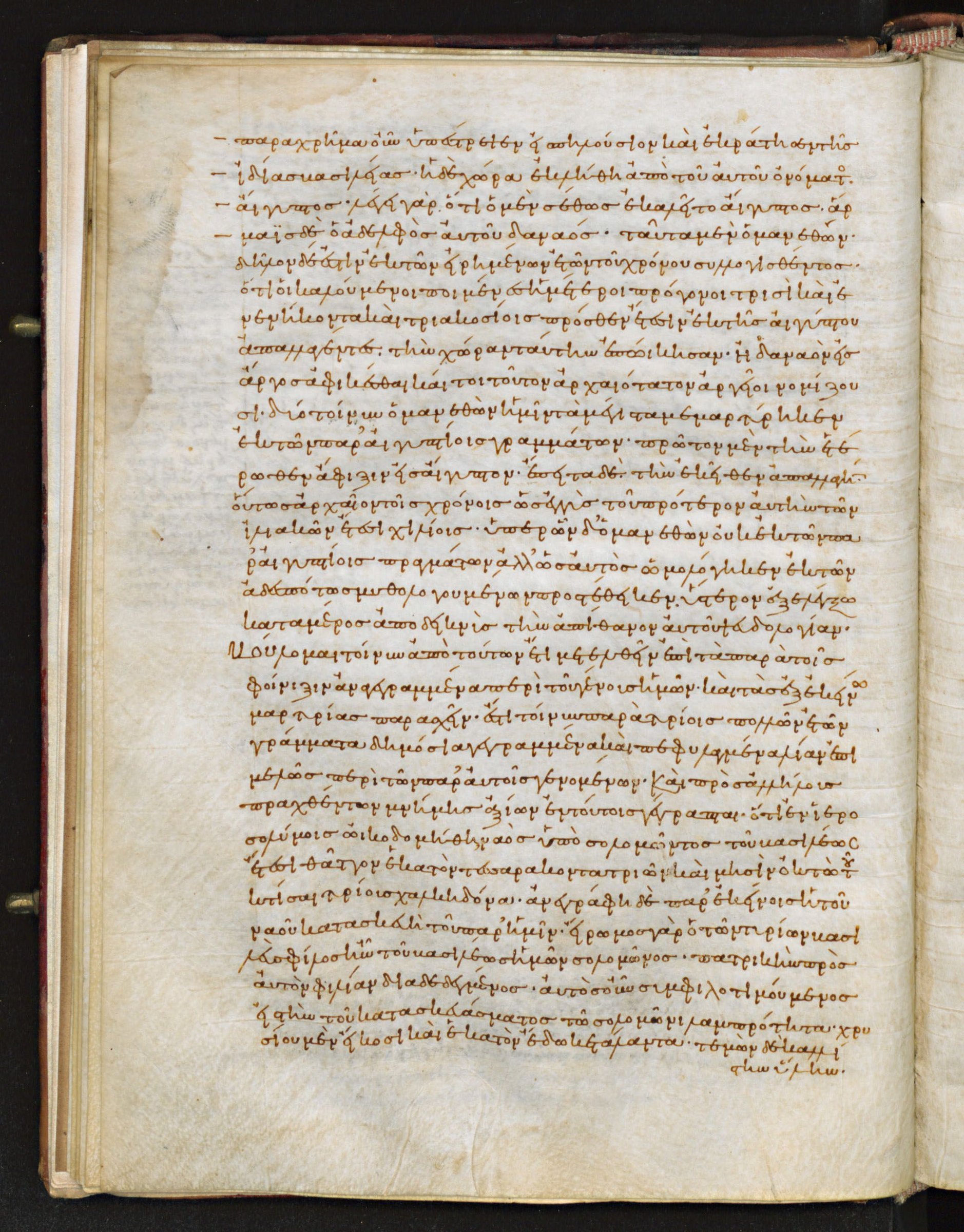
Where on the image
1.101 straddles the page break: it begins at the end of fol. 8r line 30 'ὁ δὲ τε-' and fills lines 31-32 to 'ὁ ἀδελφὸς αὐτοῦ Ἅρμαϊς'; the rest ('παραχρῆμα οὖν ὑπέστρεψεν εἰς Πηλούσιον ... τῆς ἰδίας βασιλείας') is fol. 8v lines 1-2. Viewer: https://tecabml.contentdm.oclc.org/digital/collection/plutei/id/1350351 . Greek shown is Niese's critical text; the copyist's spelling differs in small details.
101ὁ δὲ τεταγμένος ἐπὶ τῶν ἱερέων τῆς Αἰγύπτου γράψας βιβλίον ἔπεμψε τῷ Σεθώσει δηλῶν αὐτῷ πάντα καὶ ὅτι ἀντῆρεν ὁ ἀδελφὸς αὐτοῦ Ἅρμαϊς. παραχρῆμα οὖν ὑπέστρεψεν εἰς Πηλούσιον καὶ ἐκράτησεν τῆς ἰδίας βασιλείας.
101But then he who was set over the priests of Egypt wrote letters to Sethosis, and informed him of all that had happened, and how his brother had set up to oppose him: he therefore returned back to Pelusium immediately, and recovered his kingdom again.
Where on the image
Fol. 8v lines 2-17. 1.102 begins line 2 'ἡ δὲ χώρα ἐκλήθη'; Manetho's quotation ends line 4 'Δαναός' (margin strokes stop there); 1.103 begins line 4 'ταῦτα μὲν ὁ Μανεθῶν'; 1.104 line 10 'δύο τοίνυν'; 1.105 line 14 'ὑπὲρ ὧν δ’ ὁ Μανεθών'; it ends line 17 'τὴν ἀπίθανον αὐτοῦ ψευδολογίαν'. Line 18 begins 1.106 'Βούλομαι τοίνυν' with an enlarged initial. Viewer: https://tecabml.contentdm.oclc.org/digital/collection/plutei/id/1350351 . Greek shown is Niese's critical text; the copyist's spelling differs in small details.
102ἡ δὲ χώρα ἐκλήθη ἀπὸ τοῦ αὐτοῦ ὀνόματος Αἴγυπτος· λέγει γάρ, ὅτι ὁ μὲν Σέθως ἐκαλεῖτο Αἴγυπτος, Ἅρμαϊς δὲ ὁ ἀδελφὸς αὐτοῦ Δαναός. 103Ταῦτα μὲν ὁ Μάνεθως. δῆλον δέ ἐστιν ἐκ τῶν εἰρημένων ἐτῶν τοῦ χρόνου συλλογισθέντος, ὅτι οἱ καλούμενοι ποιμένες ἡμέτεροι δὲ πρόγονοι τρισὶ καὶ ἐνενήκοντα καὶ τριακοσίοις πρόσθεν ἔτεσιν ἐκ τῆς Αἰγύπτου ἀπαλλαγέντες τὴν χώραν ταύτην ἐπῴκησαν ἢ Δαναὸν εἰς Ἄργος ἀφικέσθαι· καίτοι τοῦτον ἀρχαιότατον Ἀργεῖοι νομίζουσι. 104δύο τοίνυν ὁ Μάνεθως ἡμῖν τὰ μέγιστα μεμαρτύρηκεν ἐκ τῶν παρʼ Αἰγυπτίοις γραμμάτων, πρῶτον μὲν τὴν ἑτέρωθεν ἄφιξιν εἰς Αἴγυπτον, ἔπειτα δὲ τὴν ἐκεῖθεν ἀπαλλαγὴν οὕτως ἀρχαίαν τοῖς χρόνοις, ὡς ἐγγύς που προτερεῖν αὐτὴν τῶν Ἰλιακῶν ἔτεσι χιλίοις. 105ὑπὲρ ὧν δʼ ὁ Μάνεθως οὐκ ἐκ τῶν παρʼ Αἰγυπτίοις γραμμάτων, ἀλλʼ ὡς αὐτὸς ὡμολόγηκεν ἐκ τῶν ἀδεσπότως μυθολογουμένων προστέθεικεν, ὕστερον ἐξελέγξω κατὰ μέρος ἀποδεικνὺς τὴν ἀπίθανον αὐτοῦ ψευδολογίαν.
102The country also was called from his name Egypt; for Manetho says, that Sethosis was himself called Egyptus, as was his brother Armais called Danaus. 103This is Manetho's account. And evident it is from the number of years by him set down belonging to this interval, if they be summed up together, that these shepherds, as they are here called, who were no other than our forefathers, were delivered out of Egypt, and came thence, and inhabited this country, three hundred and ninety-three years before Danaus came to Argos; although the Argives look upon him as their most ancient king. 104Manetho, therefore, bears this testimony to two points of the greatest consequence to our purpose, and those from the Egyptian records themselves. In the first place, that we came out of another country into Egypt; and that withal our deliverance out of it was so ancient in time as to have preceded the siege of Troy almost a thousand years; 105but then, as to those things which Manetho adds, not from the Egyptian records, but, as he confesses himself, from some stories of an uncertain original, I will disprove them hereafter particularly, and shall demonstrate that they are no better than incredible fables.
Notes
- Greek: Benedikt Niese, Flavii Iosephi opera vol. 5 (Berlin 1889), Perseus canonical-greekLit tlg0526.tlg003.perseus-grc2. At 1.75 the manuscript and Niese's text read 'τοῦ Τίμαιος ὄνομα', a corruption of the king's name (Tutimaeus), which Whiston renders 'Timaus'.
- English: William Whiston (1737), Perseus tlg0526.tlg003.perseus-eng2. Whiston's paragraphs were divided at the sentences that render each Niese section; his footnotes are omitted. Five digitization slips were corrected against the printed 1860 Whiston (archive.org worksofflaviusjo00jose_0, pp. 635-636): 'Tethtoosis' to 'Tethmosis', 'rotund' to 'round', 'king Manetho, therefore, hears' to 'king. Manetho, therefore, bears', 'Manetbo' to 'Manetho', and a semicolon lost after 'ancient ages' (1.91).
- Whiston's square brackets ('[Sethroite,]', '[But Manetho goes on]', '[In another copy it stood thus ...]') are his own.
Cite
Sources
- Source: Laur. Plut. 69.22 (10th c.), fols. 6v-8v, via BML Teca Digitale IIIF + Niese Greek (Perseus) + Whiston English (Perseus) (holding institution)
- Critical edition: Niese 1889 (Josephus, via Perseus)
← previous · → next · v cycle view · l back to library