Manetho on Osarseph and the Lepers (Josephus, Against Apion 1.227-251)
Introduction
After quoting Manetho on the Hyksos (Against Apion 1.73-105, a separate entry), Josephus returns to him in 1.227-251 to refute a second story, which he says Manetho took 'from tales of uncertain origin' rather than from the temple records. In it a king Amenophis wishes to see the gods, as his predecessor Or (Horus) had done; his namesake the seer Amenophis son of Paapis tells him to purge Egypt of lepers and other polluted people. Eighty thousand are sent to the stone quarries east of the Nile, and are then given the empty Hyksos city of Avaris. There they choose as leader a priest of Heliopolis, Osarseph, who gives them laws against the Egyptian gods and sacred animals, and calls in the shepherds from Jerusalem. Amenophis withdraws to Ethiopia with the sacred animals for the thirteen years the seer had foretold, while the invaders burn towns and temples. At the end Manetho says that Osarseph changed his name to Moses, and that Amenophis and his son returned and drove the invaders to the borders of Syria.
Historians read the story as a late Egyptian tradition shaped by memories of the Hyksos, of the religious upheaval of the Amarna period, and of later foreign rule; it is one of the oldest surviving hostile accounts of the Exodus. Josephus quotes part of it word for word (from 1.237) and summarises the rest.
The manuscript is Florence, Biblioteca Medicea Laurenziana, Plut. 69.22, a 10th-century copy of Against Apion. The passage runs from fol. 16r to the top of fol. 18r. Each section covers the Niese sections on one page, and sections that run across a page break show both pages. Every section start was read on the page image and is recorded with its line number; from 1.237 the copyist marks the quoted words with strokes in the margin. The entry stops at 1.251, where Josephus ends his report of Manetho; his refutation follows.
How was this verified? (Provenance)
Where on the image
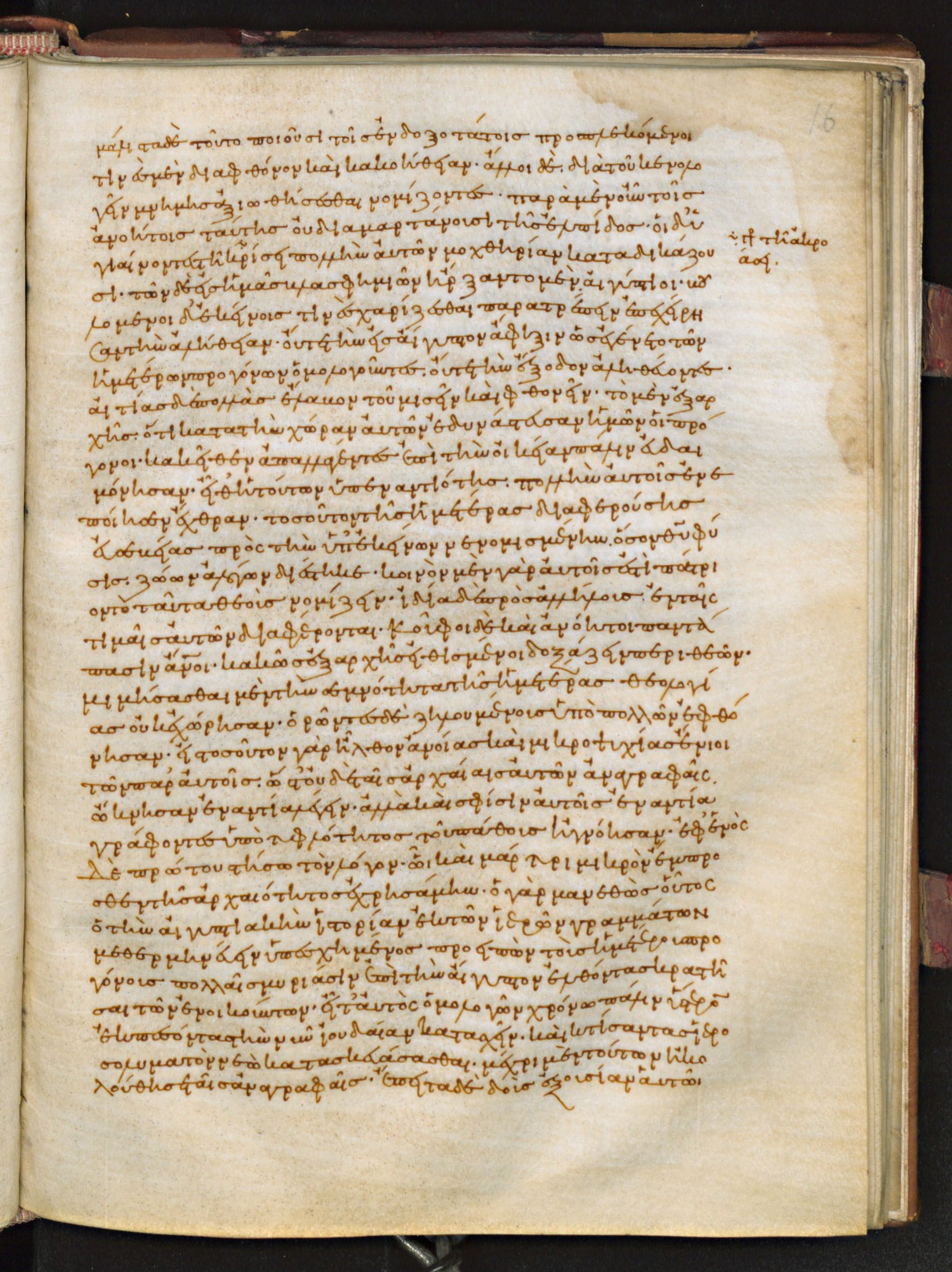
Fol. 16r, lines 25-34. 1.227 begins at the end of line 25 'ἐφ' ἑνὸς' / line 26 'δὲ πρώτου στήσω τὸν λόγον'; 1.228 begins in line 27 'ὁ γὰρ Μανεθὼς οὗτος ὁ τὴν Αἰγυπτιακὴν ἱστορίαν' and ends in line 34 'ἠκολούθησε ταῖς ἀναγραφαῖς'. Viewer: https://tecabml.contentdm.oclc.org/digital/collection/plutei/id/1350351 . Greek shown is Niese's critical text; the copyist's spelling differs in small details.
227Ἐφʼ ἑνὸς δὲ πρώτου στήσω τὸν λόγον, ᾧ καὶ μάρτυρι μικρὸν ἔμπροσθεν τῆς ἀρχαιότητος ἐχρησάμην. 228ὁ γὰρ Μανεθὼς οὗτος ὁ τὴν Αἰγυπτιακὴν ἱστορίαν ἐκ τῶν ἱερῶν γραμμάτων μεθερμηνεύειν ὑπεσχημένος, προειπὼν τοὺς ἡμετέρους προγόνους πολλαῖς μυριάσιν ἐπὶ τὴν Αἴγυπτον ἐλθόντας κρατῆσαι τῶν ἐνοικούντων, εἶτʼ αὐτὸς ὁμολογῶν χρόνῳ πάλιν ὕστερον ἐκπεσόντας τὴν νῦν Ἰουδαίαν κατασχεῖν καὶ κτίσαντας Ἱεροσόλυμα τὸν νεὼ κατασκευάσασθαι, μέχρι μὲν τούτων ἠκολούθησε ταῖς ἀναγραφαῖς.
227And now I will turn my discourse to one of their principal writers, whom I have a little before made use of as a witness to our antiquity; I mean Manetho. 228He promised to interpret the Egyptian history out of their sacred writings, and premised this: that our people had come into Egypt, many ten thousands in number, and subdued its inhabitants; and when he had further confessed that we went out of that country afterward, and settled in that country which is now called Judea, and there built Jerusalem and its temple. Now thus far he followed his ancient records;
Where on the image
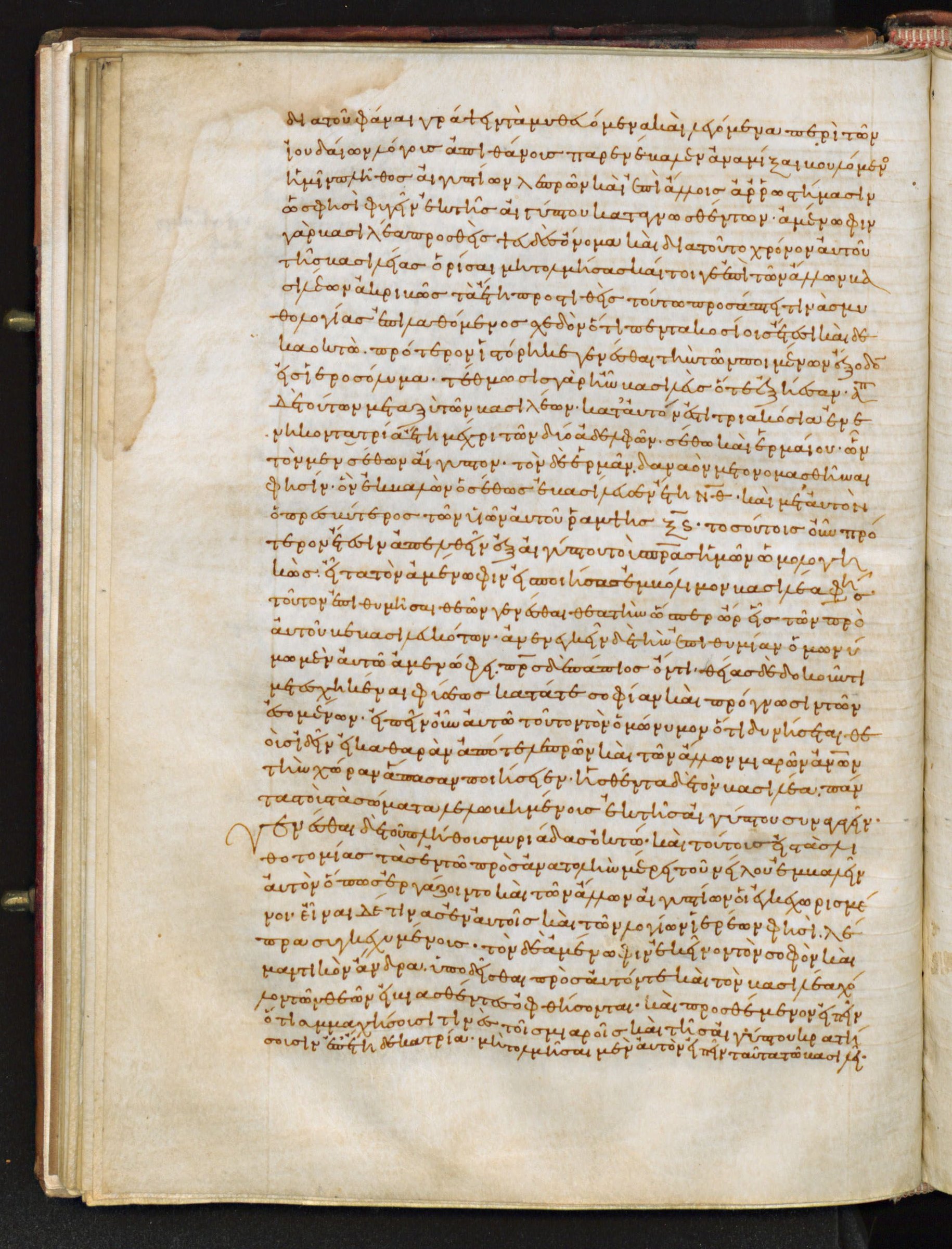
1.229 straddles the page break: it begins at the end of fol. 16r line 34 'ἔπειτα δὲ δοὺς ἐξουσίαν αὑτῷ' and continues on fol. 16v lines 1-4 'διὰ τοῦ φάναι γράψειν τὰ μυθευόμενα ...' to 'φυγεῖν ἐκ τῆς Αἰγύπτου καταγνωσθέντων'. Viewer: https://tecabml.contentdm.oclc.org/digital/collection/plutei/id/1350351 . Greek shown is Niese's critical text; the copyist's spelling differs in small details.
229ἔπειτα δὲ δοὺς ἐξουσίαν αὑτῷ διὰ τοῦ φάναι γράψειν τὰ μυθευόμενα καὶ λεγόμενα περὶ τῶν Ἰουδαίων λόγους ἀπιθάνους παρενέβαλεν, ἀναμῖξαι βουλόμενος ἡμῖν πλῆθος Αἰγυπτίων λεπρῶν καὶ ἐπὶ ἄλλοις ἀρρωστήμασιν, ὥς φησι, φυγεῖν ἐκ τῆς Αἰγύπτου καταγνωσθέντων.
229but after this he permits himself, in order to appear to have written what rumors and reports passed abroad about the Jews, and introduces incredible narrations, as if he would have the Egyptian multitude, that had the leprosy and other distempers, to have been mixed with us, as he says they were, and that they were condemned to fly out of Egypt together;
Where on the image
Fol. 16v (34 lines). 1.230 begins at the end of line 4 'Ἀμένωφιν' / line 5 'γὰρ βασιλέα προσθεὶς ψευδὲς ὄνομα'; 1.231 line 10 'Τέθμωσις γὰρ ἦν βασιλεύς'; 1.232 line 15 'τοσούτοις οὖν πρότερον'; 1.233 line 22 'εἰπεῖν οὖν αὐτῷ'; 1.234 line 24 'ἡσθέντα δὲ τὸν βασιλέα'; 1.235 line 26 (enlarged initial at the line start 'γενέσθαι δὲ τοῦ πλήθους μυριάδας ὀκτώ', then 'καὶ τούτους εἰς τὰς λιθοτομίας'), ending line 30 'λέπρᾳ συγκεχυμένους'. In line 15 the manuscript writes Rhampses' years as ξς'. Viewer: https://tecabml.contentdm.oclc.org/digital/collection/plutei/id/1350351 . Greek shown is Niese's critical text; the copyist's spelling differs in small details.
230Ἀμένωφιν γὰρ βασιλέα προσθεὶς ψευδὲς ὄνομα καὶ διὰ τοῦτο χρόνον αὐτοῦ τῆς βασιλείας ὁρίσαι μὴ τολμήσας, καίτοι γε ἐπὶ τῶν ἄλλων βασιλέων ἀκριβῶς τὰ ἔτη προστιθείς, τούτῳ προσάπτει τινὰς μυθολογίας ἐπιλαθόμενος σχεδόν, ὅτι πεντακοσίοις ἔτεσι καὶ δεκαοκτὼ πρότερον ἱστόρηκε γενέσθαι τὴν τῶν ποιμένων ἔξοδον εἰς Ἱεροσόλυμα. 231Τέθμωσις γὰρ ἦν βασιλεὺς ὅτε ἐξῄεσαν, ἀπὸ δὲ τούτων μεταξὺ τῶν βασιλέων κατʼ αὐτόν ἐστι τριακόσια ἐνενηκοντατρία ἔτη μέχρι τῶν δύο ἀδελφῶν Σέθω καὶ Ἑρμαίου, ὧν τὸν μὲν Σέθων Αἴγυπτον, τὸν δὲ Ἕρμαιον Δαναὸν μετονομασθῆναί φησιν, ὃν ἐκβαλὼν ὁ Σέθως ἐβασίλευσεν ἔτη νθ καὶ μετʼ αὐτὸν ὁ πρεσβύτερος τῶν υἱῶν αὐτοῦ Ῥάμψης ξϛ. 232τοσούτοις οὖν πρότερον ἔτεσιν ἀπελθεῖν ἐξ Αἰγύπτου τοὺς πατέρας ἡμῶν ὡμολογηκὼς εἶτα τὸν Ἀμένωφιν εἰσποιήσας ἐμβόλιμον βασιλέα φησὶν τοῦτον ἐπιθυμῆσαι θεῶν γενέσθαι θεατήν ὥσπερ Ὢρ εἷς τῶν πρὸ αὐτοῦ βεβασιλευκότων, ἀνενεγκεῖν δὲ τὴν ἐπιθυμίαν ὁμωνύμῳ μὲν αὐτῷ Ἀμενώφει πατρὸς δὲ Πάπιος ὄντι, θείας δὲ δοκοῦντι μετεσχηκέναι φύσεως κατά τε σοφίαν καὶ πρόγνωσιν τῶν ἐσομένων. 233εἰπεῖν οὖν αὐτῷ τοῦτον τὸν ὁμώνυμον, ὅτι δυνήσεται θεοὺς ἰδεῖν, εἰ καθαρὰν ἀπό τε λεπρῶν καὶ τῶν ἄλλων μιαρῶν ἀνθρώπων τὴν χώραν ἅπασαν ποιήσειεν. 234ἡσθέντα δὲ τὸν βασιλέα πάντας τοὺς τὰ σώματα λελωβημένους ἐκ τῆς Αἰγύπτου συναγαγεῖν γενέσθαι δὲ τοῦ πλήθους μυριάδας ὀκτώ· 235καὶ τούτους εἰς τὰς λιθοτομίας τὰς ἐν τῷ πρὸς ἀνατολὴν μέρει τοῦ Νείλου ἐμβαλεῖν αὐτόν, ὅπως ἐργάζοιντο καὶ τῶν ἄλλων Αἰγυπτίων οἱ ἐγκεχωρισμένοι. εἶναι δέ τινας ἐν αὐτοῖς καὶ τῶν λογίων ἱερέων φησὶ λέπρᾳ συγκεχυμένους.
230for he mentions Amenophis, a fictitious king's name, though on that account he durst not set down the number of years of his reign, which yet he had accurately done as to the other kings he mentions; he then ascribes certain fabulous stories to this king, as having in a manner forgotten how he had already related that the departure of the shepherds for Jerusalem had been five hundred and eighteen years before; 231for Tethmosis was king when they went away. Now, from his days, the reigns of the intermediate kings, according to Manetho, amounted to three hundred and ninety-three years, as he says himself, till the two brothers Sethos and Hermeus; the one of whom, Sethos, was called by that other name of Egyptus, and the other, Hermeus, by that of Danaus. He also says that Sethos cast the other out of Egypt, and reigned fifty-nine years, as did his eldest son Rhampses reign after him sixty-six years. 232When Manetho therefore had acknowledged that our forefathers were gone out of Egypt so many years ago, he introduces his fictitious king Amenophis, and says thus: This king was desirous to become a spectator of the gods, as had Orus, one of his predecessors in that kingdom, desired the same before him; he also communicated that his desire to his namesake Amenophis, who was the son of Papis, and one that seemed to partake of a divine nature, both as to wisdom and the knowledge of futurities. 233Manetho adds, how this namesake of his told him that he might see the gods, if he would clear the whole country of the lepers and of the other impure people; 234that the king was pleased with this injunction, and got together all that had any defect in their bodies out of Egypt; and that their number was eighty thousand; 235whom he sent to those quarries which are on the east side of the Nile, that they might work in them, and might be separated from the rest of the Egyptians. He says further, that there were some of the learned priests that were polluted with the leprosy;
Where on the image
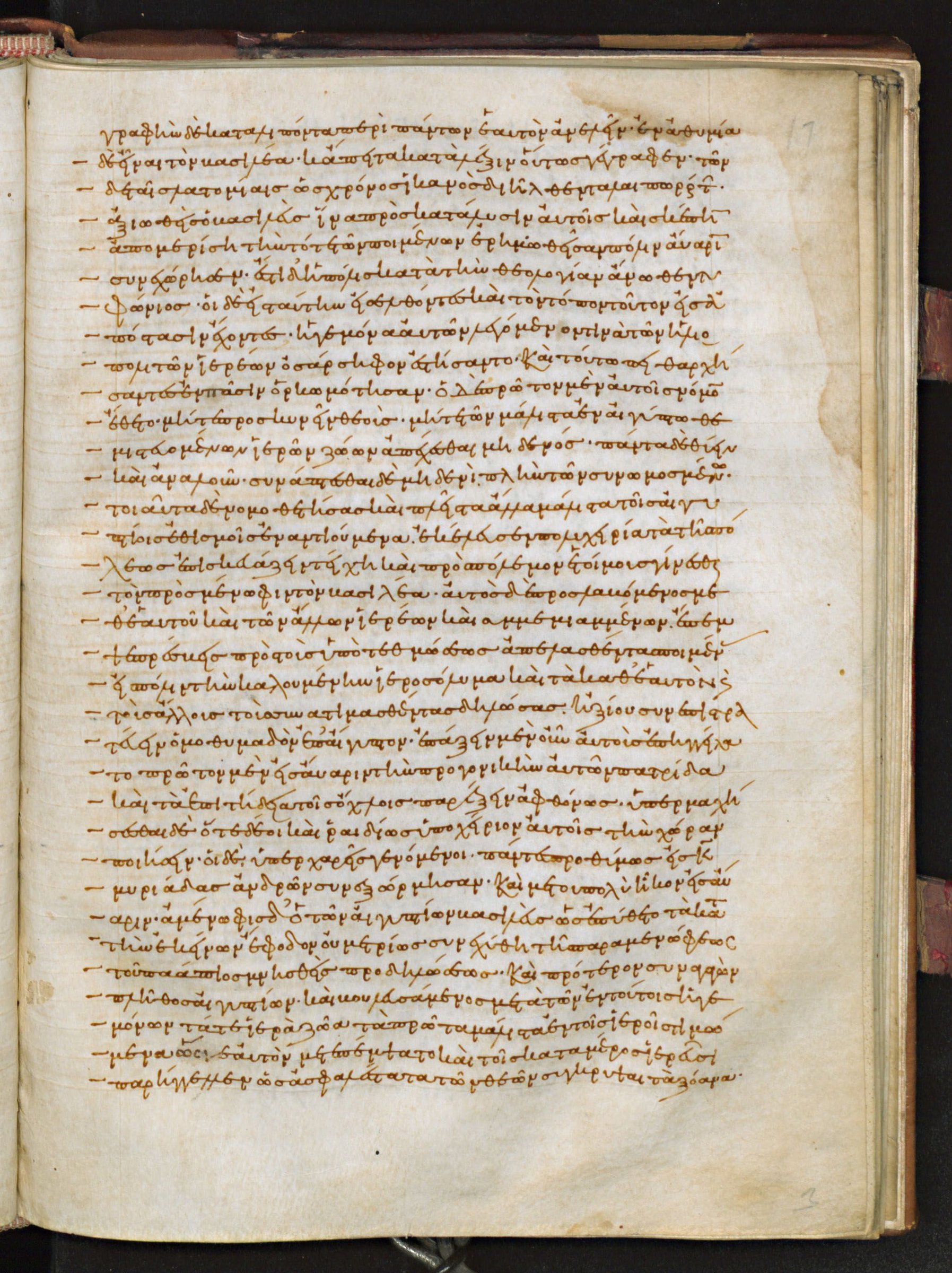
1.236 straddles the page break: fol. 16v lines 30-34 'τὸν δὲ Ἀμένωφιν ἐκεῖνον τὸν σοφὸν καὶ μαντικὸν ἄνδρα' to 'μὴ τολμῆσαι μὲν αὐτὸν εἰπεῖν ταῦτα τῷ βασιλεῖ'; fol. 17r lines 1-2 'γραφὴν δὲ καταλιπόντα περὶ πάντων ἑαυτὸν ἀνελεῖν' to 'ἐν ἀθυμίᾳ δὲ εἶναι τὸν βασιλέα'. Viewer: https://tecabml.contentdm.oclc.org/digital/collection/plutei/id/1350351 . Greek shown is Niese's critical text; the copyist's spelling differs in small details.
236τὸν δὲ Ἀμένωφιν ἐκεῖνον, τὸν σοφὸν καὶ μαντικὸν ἄνδρα, ὑποδεῖσαι πρὸς αὐτόν τε καὶ τὸν βασιλέα χόλον τῶν θεῶν, εἰ βιασθέντες ὀφθήσονται. καὶ προσθέμενον εἰπεῖν, ὅτι συμμαχήσουσί τινες τοῖς μιαροῖς καὶ τῆς Αἰγύπτου κρατήσουσιν ἐπʼ ἔτη δεκατρία, μὴ τολμῆσαι μὲν αὐτὸν εἰπεῖν ταῦτα τῷ βασιλεῖ, γραφὴν δὲ καταλιπόντα περὶ πάντων ἑαυτὸν ἀνελεῖν, ἐν ἀθυμίᾳ δὲ εἶναι τὸν βασιλέα.
236but that still this Amenophis, the wise man and the prophet, was afraid that the gods would be angry at him and at the king, if there should appear to have been violence offered them; who also added this further, [out of his sagacity about futurities,] that certain people would come to the assistance of these polluted wretches, and would conquer Egypt, and keep it in their possession thirteen years; that, however, he durst not tell the king of these things, but that he left a writing behind him about all those matters, and then slew himself, which made the king disconsolate.
Where on the image
Fol. 17r (34 lines). Manetho's verbatim quotation begins in line 2 'κἄπειτα κατὰ λέξιν οὕτως γέγραφεν· τῶν δ' ἐν ταῖς λατομίαις' and from here every line is marked with a stroke in the left margin. 1.238 line 7 'οἱ δὲ εἰς ταύτην εἰσελθόντες'; 1.239 line 10 'ὁ δὲ πρῶτον μὲν αὐτοῖς νόμον ἔθετο'; 1.240 line 14 'τοιαῦτα δὲ νομοθετήσας'; 1.241 line 17 'αὐτὸς δὲ προσλαβόμενος'; 1.242 line 22 'ἐπάξειν μὲν οὖν αὐτούς'; 1.243 line 26 'οἱ δὲ ὑπερχαρεῖς γενόμενοι'; 1.244 line 30 'καὶ πρότερον συναγαγών', ending line 34 'συγκρύψαι τὰ ξόανα'. The manuscript has the words Niese brackets in 1.237 (πρὸς), 1.238 (εἰς) and 1.244 (πρῶτα), and spells the leader's name Ὀσάρσιφον in line 9. Viewer: https://tecabml.contentdm.oclc.org/digital/collection/plutei/id/1350351 . Greek shown is Niese's critical text; the copyist's spelling differs in small details.
237κἄπειτα κατὰ λέξιν οὕτως γέγραφεν· τῶν δʼ ἐν ταῖς λατομίαις ὡς χρόνος ἱκανὸς διῆλθεν ταλαιπωρούντων, ἀξιωθεὶς ὁ βασιλεύς, ἵνα [πρὸς] κατάλυσιν αὐτοῖς καὶ σκέπην ἀπομερίσῃ, τὴν τότε τῶν ποιμένων ἐρημωθεῖσαν πόλιν Αὔαριν συνεχώρησεν· ἔστι δʼ ἡ πόλις κατὰ τὴν θεολογίαν ἄνωθεν Τυφώνιος. 238οἱ δὲ εἰς ταύτην εἰσελθόντες καὶ τὸν τόπον τοῦτον [εἰς] ἀπόστασιν ἔχοντες ἡγεμόνα αὐτῶν λεγόμενόν τινα τῶν Ἡλιοπολιτῶν ἱερέων Ὀσάρσηφον ἐστήσαντο καὶ τούτῳ πειθαρχήσοντες ἐν πᾶσιν ὡρκωμότησαν. 239ὁ δὲ πρῶτον μὲν αὐτοῖς νόμον ἔθετο μήτε προσκυνεῖν θεοὺς μήτε τῶν μάλιστα ἐν Αἰγύπτῳ θεμιστευομένων ἱερῶν ζῴων ἀπέχεσθαι μηδενός, πάντα δὲ θύειν καὶ ἀναλοῦν, συνάπτεσθαι δὲ μηδενὶ πλὴν τῶν συνομωμοσμένων. 240τοιαῦτα δὲ νομοθετήσας καὶ πλεῖστα ἄλλα μάλιστα τοῖς Αἰγυπτίοις ἐθισμοῖς ἐναντιούμενα ἐκέλευσεν πολυχειρίᾳ τὰ τῆς πόλεως ἐπισκευάζειν τείχη καὶ πρὸς πόλεμον ἑτοίμους γίνεσθαι τὸν πρὸς Ἀμένωφιν τὸν βασιλέα. 241αὐτὸς δὲ προσλαβόμενος μεθʼ ἑαυτοῦ καὶ τῶν ἄλλων ἱερέων καὶ συμμεμιαμμένων ἔπεμψε πρέσβεις πρὸς τοὺς ὑπὸ Τεθμώσεως ἀπελαθέντας ποιμένας εἰς πόλιν τὴν καλουμένην Ἱεροσόλυμα, καὶ τὰ καθʼ ἑαυτὸν καὶ τοὺς ἄλλους τοὺς συνατιμασθέντας δηλώσας ἠξίου συνεπιστρατεύειν ὁμοθυμαδὸν ἐπʼ Αἴγυπτον. 242ἐπάξειν μὲν οὖν αὐτοὺς ἐπηγγείλατο πρῶτον μὲν εἰς Αὔαριν τὴν προγονικὴν αὐτῶν πατρίδα καὶ τὰ ἐπιτήδεια τοῖς ὄχλοις παρέξειν ἀφθόνως, ὑπερμαχήσεσθαι δὲ ὅτε δέοι καὶ ῥᾳδίως ὑποχείριον αὐτοῖς τὴν χώραν ποιήσειν. 243οἱ δὲ ὑπερχαρεῖς γενόμενοι πάντες προθύμως εἰς κ μυριάδας ἀνδρῶν συνεξώρμησαν καὶ μετʼ οὐ πολὺ ἧκον εἰς Αὔαριν. Ἀμένωφις δʼ ὁ τῶν Αἰγυπτίων βασιλεὺς ὡς ἐπύθετο τὰ κατὰ τὴν ἐκείνων ἔφοδον, οὐ μετρίως συνεχύθη τῆς παρὰ Ἀμενώφεως τοῦ Παάπιος μνησθεὶς προδηλώσεως. 244καὶ πρότερον συναγαγὼν πλῆθος Αἰγυπτίων καὶ βουλευσάμενος μετὰ τῶν ἐν τούτοις ἡγεμόνων τά τε ἱερὰ ζῷα τὰ [πρῶτα] μάλιστα ἐν τοῖς ἱεροῖς τιμώμενα ὥς γʼ ἑαυτὸν μετεπέμψατο καὶ τοῖς κατὰ μέρος ἱερεῦσι παρήγγελλεν ὡς ἀσφαλέστατα τῶν θεῶν συγκρύψαι τὰ ξόανα.
237After which he writes thus verbatim: After those that were sent to work in the quarries had continued in that miserable state for a long while, the king was desired that he would set apart the city Avaris, which was then left desolate of the shepherds, for their habitation and protection; which desire he granted them. Now this city, according to the ancient theology, was Typho's city. 238But when these men were gotten into it, and found the place fit for a revolt, they appointed themselves a ruler out of the priests of Heliopolis, whose name was Osarsiph, and they took their oaths that they would be obedient to him in all things. 239He then, in the first place, made this law for them, That they should neither worship the Egyptian gods, nor should abstain from any one of those sacred animals which they have in the highest esteem, but kill and destroy them all; that they should join themselves to nobody but to those that were of this confederacy. 240When he had made such laws as these, and many more such as were mainly opposite to the customs of the Egyptians, he gave order that they should use the multitude of the hands they had in building walls about their city, and make themselves ready for a war with king Amenophis, 241while he did himself take into his friendship the other priests, and those that were polluted with them, and sent ambassadors to those shepherds who had been driven out of the land by Tethmosis to the city called Jerusalem; whereby he informed them of his own affairs, and of the state of those others that had been treated after such an ignominious manner, and desired that they would come with one consent to his assistance in this war against Egypt. 242He also promised that he would, in the first place, bring them back to their ancient city and country Avaris, and provide a plentiful maintenance for their multitude; that he would protect them and fight for them as occasion should require, and would easily reduce the country under their dominion. 243These shepherds were all very glad of this message, and came away with alacrity all together, being in number two hundred thousand men; and in a little time they came to Avaris. And now Amenophis the king of Egypt, upon his being informed of their invasion, was in great confusion, as calling to mind what Amenophis, the son of Papis, had foretold him; 244and, in the first place, he assembled the multitude of the Egyptians, and took counsel with their leaders, and sent for their sacred animals to him, especially for those that were principally worshipped in their temples, and gave a particular charge to the priests distinctly, that they should hide the images of their gods with the utmost care.
Where on the image
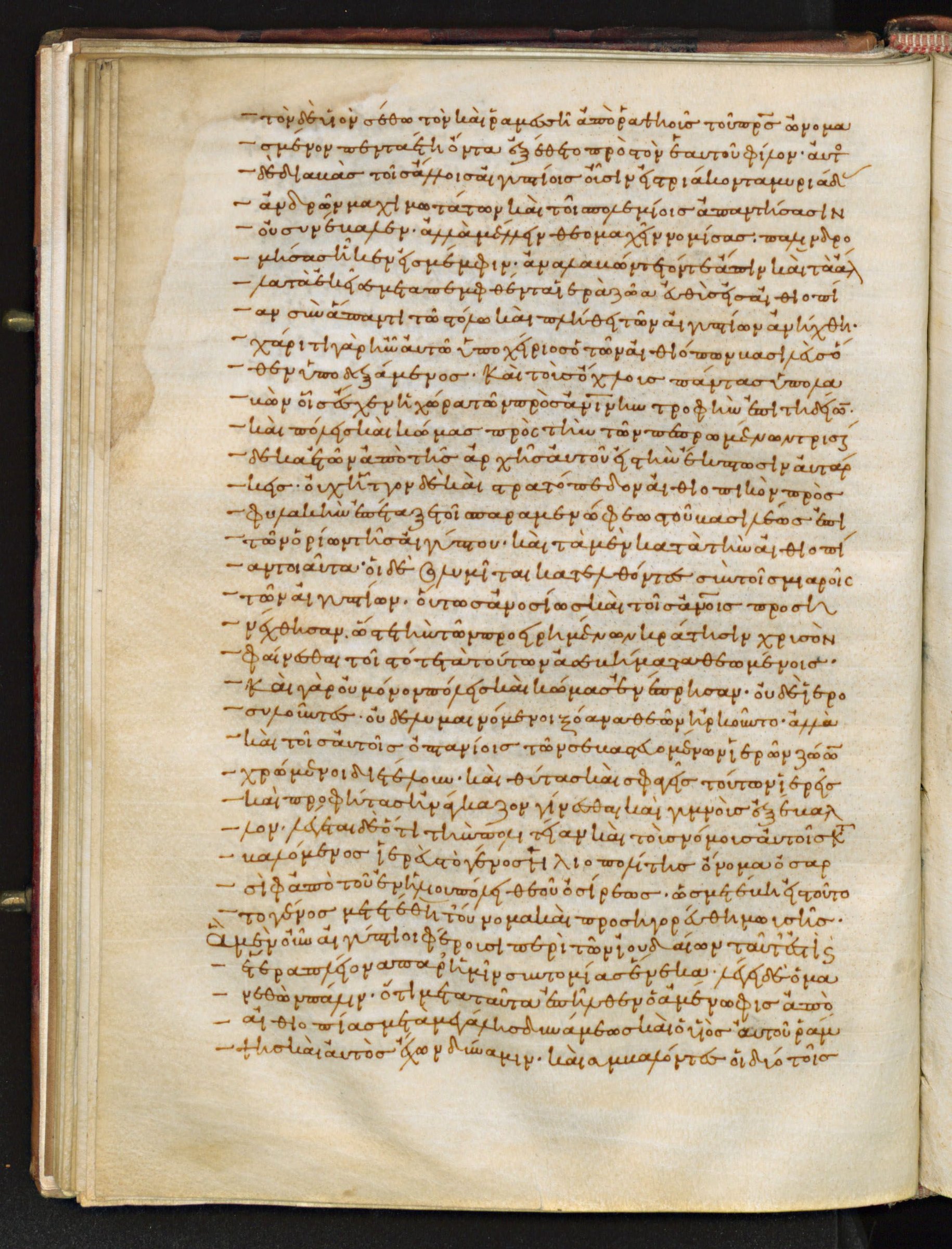
Fol. 17v, lines 1-29, all marked as quotation. 1.245 begins line 1 'τὸν δὲ υἱὸν Σέθω τὸν καὶ Ῥαμεσσῆ'; 1.246 line 5 'ἀλλὰ μέλλειν θεομαχεῖν'; 1.247 at the end of line 9 'ὃς' / line 10 'ὑποδεξάμενος'; 1.248 line 16 'καὶ τὰ μὲν κατὰ τὴν Αἰθιοπίαν'; 1.249 line 21 (enlarged initial) 'καὶ γὰρ οὐ μόνον πόλεις'; 1.250 line 26 'λέγεται δὲ ὅτι τὴν πολιτείαν', ending line 29 'καὶ προσηγορεύθη Μωϋσῆς'. Viewer: https://tecabml.contentdm.oclc.org/digital/collection/plutei/id/1350351 . Greek shown is Niese's critical text; the copyist's spelling differs in small details.
245τὸν δὲ υἱὸν Σέθω τὸν καὶ Ῥαμεσσῆ ἀπὸ Ῥαψηοῦς τοῦ πατρὸς ὠνομασμένον πενταέτη ὄντα ἐξέθετο πρὸς τὸν ἑαυτοῦ φίλον. αὐτὸς δὲ διαβὰς τοῖς ἄλλοις Αἰγυπτίοις οὖσιν εἰς τριάκοντα μυριάδας ἀνδρῶν μαχιμωτάτων καὶ τοῖς πολεμίοις ἀπαντήσας οὐ συνέβαλεν, 246ἀλλὰ μέλλειν θεομαχεῖν νομίσας παλινδρομήσας ἧκεν εἰς Μέμφιν ἀναλαβών τε τόν τε Ἆπιν καὶ τὰ ἄλλα τὰ ἐκεῖσε μεταπεμφθέντα ἱερὰ ζῷα εὐθὺς εἰς Αἰθιοπίαν σὺν ἅπαντι τῷ στόλῳ καὶ πλήθει τῶν Αἰγυπτίων ἀνήχθη· χάριτι γὰρ ἦν αὐτῷ ὑποχείριος ὁ τῶν Αἰθιόπων βασιλεύς. 247ὃς ὑποδεξάμενος καὶ τοὺς ὄχλους πάντας ὑπολαβὼν οἷς ἔσχεν ἡ χώρα τῶν πρὸς ἀνθρωπίνην τροφὴν ἐπιτηδείων, καὶ πόλεις καὶ κώμας πρὸς τὴν τῶν πεπρωμένων τρισκαίδεκα ἐτῶν ἀπὸ τῆς ἀρχῆς αὐτοῦ [εἰς τὴν] ἔκπτωσιν αὐτάρκεις, οὐχ ἧττον δὲ καὶ στρατόπεδον Αἰθιοπικὸν πρὸς φυλακὴν ἐπέταξε τοῖς παρʼ Ἀμενώφεως τοῦ βασιλέως ἐπὶ τῶν ὁρίων τῆς Αἰγύπτου. 248καὶ τὰ μὲν κατὰ τὴν Αἰθιοπίαν τοιαῦτα. οἱ δὲ Σολυμῖται κατελθόντες σὺν τοῖς μιαροῖς τῶν Αἰγυπτίων οὕτως ἀνοσίως καὶ τοῖς ἀνθρώποις προσηνέχθησαν, ὥστε τὴν τῶν προειρημένων κράτησιν χρυσὸν φαίνεσθαι τοῖς τότε τὰ τούτων ἀσεβήματα θεωμένοις· 249καὶ γὰρ οὐ μόνον πόλεις καὶ κώμας ἐνέπρησαν οὐδὲ ἱεροσυλοῦντες οὐδὲ λυμαινόμενοι ξόανα θεῶν ἠρκοῦντο, ἀλλὰ καὶ τοῖς αὐτοῖς ὀπτανίοις τῶν σεβαστευομένων ἱερῶν ζῴων χρώμενοι διετέλουν καὶ θύτας καὶ σφαγεῖς τούτων ἱερεῖς καὶ προφήτας ἠνάγκαζον γίνεσθαι καὶ γυμνοὺς ἐξέβαλλον. 250λέγεται δέ, ὅτι τὴν πολιτείαν καὶ τοὺς νόμους αὐτοῖς καταβαλόμενος ἱερεὺς τὸ γένος Ἡλιοπολίτης ὄνομα Ὀσαρσὶφ ἀπὸ τοῦ ἐν Ἡλιουπόλει θεοῦ Ὀσίρεως, ὡς μετέβη εἰς τοῦτο τὸ γένος, μετετέθη τοὔνομα καὶ προσηγορεύθη Μωυσῆς.
245He also sent his son Sethos, who was also named Ramesses, from his father Rhampses, being but five years old, to a friend of his. He then passed on with the rest of the Egyptians, being three hundred thousand of the most warlike of them, against the enemy, who met them. Yet did he not join battle with them; 246but thinking that would be to fight against the gods, he returned back and came to Memphis, where he took Apis and the other sacred animals which he had sent for to him, and presently marched into Ethiopia, together with his whole army and multitude of Egyptians; for the king of Ethiopia was under an obligation to him, 247on which account he received him, and took care of all the multitude that was with him, while the country supplied all that was necessary for the food of the men. He also allotted cities and villages for this exile, that was to be from its beginning during those fatally determined thirteen years. Moreover, he pitched a camp for his Ethiopian army, as a guard to king Amenophis, upon the borders of Egypt. 248And this was the state of things in Ethiopia. But for the people of Jerusalem, when they came down together with the polluted Egyptians, they treated the men in such a barbarous manner, that those who saw how they subdued the forementioned country, and the horrid wickedness they were guilty of, thought it a most dreadful thing; 249for they did not only set the cities and villages on fire but were not satisfied till they had been guilty of sacrilege, and destroyed the images of the gods, and used them in roasting those sacred animals that used to be worshipped, and forced the priests and prophets to be the executioners and murderers of those animals, and then ejected them naked out of the country. 250It was also reported that the priest, who ordained their polity and their laws, was by birth of Heliopolis, and his name Osarsiph, from Osyris, who was the god of Heliopolis; but that when he was gone over to these people, his name was changed, and he was called Moses.
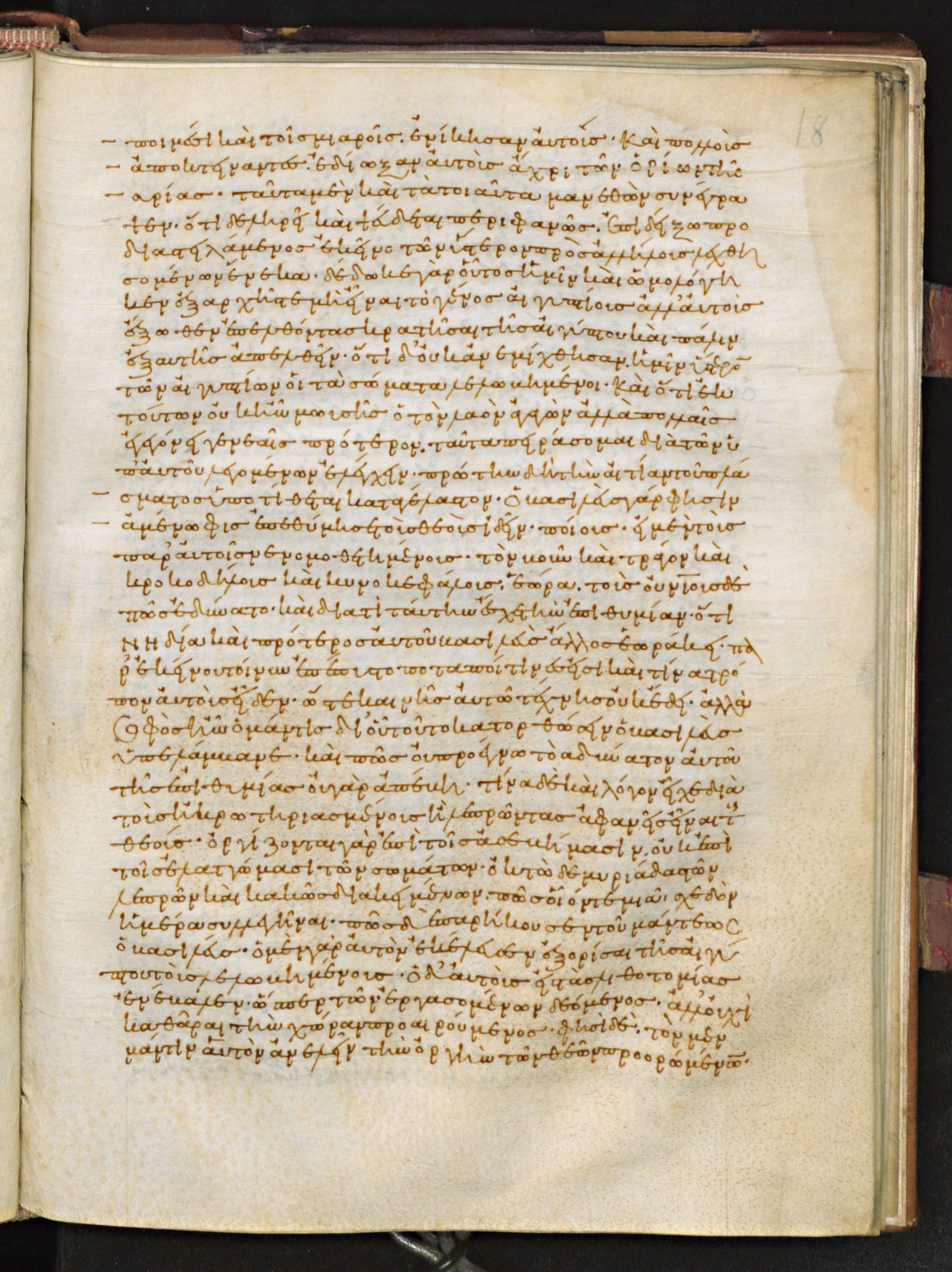
Where on the image
1.251 straddles the page break: Josephus' own words begin on fol. 17v line 30 with an enlarged initial 'ἃ μὲν οὖν Αἰγύπτιοι φέρουσι', then 'λέγει δὲ ὁ Μανεθὼν πάλιν' (line 31) to the end of the page; the passage ends on fol. 18r lines 1-3 'ποιμέσι καὶ τοῖς μιαροῖς ἐνίκησαν αὐτούς' to 'ἄχρι τῶν ὁρίων τῆς Συρίας'. Line 3 continues with 1.252 'ταῦτα μὲν καὶ τὰ τοιαῦτα Μανεθὼν συνέγραψεν'. Viewer: https://tecabml.contentdm.oclc.org/digital/collection/plutei/id/1350351 . Greek shown is Niese's critical text; the copyist's spelling differs in small details.
251Ἃ μὲν οὖν Αἰγύπτιοι φέρουσι περὶ τῶν Ἰουδαίων ταῦτʼ ἐστὶ καὶ ἕτερα πλείονα, ἃ παρίημι συντομίας ἕνεκα. λέγει δὲ ὁ Μανεθὼς πάλιν, ὅτι μετὰ ταῦτα ἐπῆλθεν ὁ Ἀμένωφις ἀπὸ Αἰθιοπίας μετὰ μεγάλης δυνάμεως καὶ ὁ υἱὸς αὐτοῦ Ῥάμψης καὶ αὐτὸς ἔχων δύναμιν, καὶ συμβαλόντες οἱ δύο τοῖς ποιμέσι καὶ τοῖς μιαροῖς ἐνίκησαν αὐτοὺς καὶ πολλοὺς ἀποκτείναντες ἐδίωξαν αὐτοὺς ἄχρι τῶν ὁρίων τῆς Συρίας.
251This is what the Egyptians relate about the Jews, with much more, which I omit for the sake of brevity. But still Manetho goes on, that after this, Amenophis returned back from Ethiopia with a great army, as did his son Rhampses with another army also, and that both of them joined battle with the shepherds and the polluted people, and beat them, and slew a great many of them, and pursued them to the bounds of Syria.
Notes
- Greek: Benedikt Niese, Flavii Iosephi opera vol. 5 (Berlin 1889), Perseus canonical-greekLit tlg0526.tlg003.perseus-grc2; the stigma numeral in 1.231, encoded in the Perseus file as '[στιγμα]', is printed as ϛ.
- English: William Whiston (1737), Perseus tlg0526.tlg003.perseus-eng2, footnotes omitted, divided at the sentences that render each Niese section. Eleven digitization slips were corrected against the printed 1860 Whiston (archive.org worksofflaviusjo00jose_0, pp. 642-643): 'Manethe' (three times) to 'Manetho', 'east' to 'cast', 'Hellopolis/Hellopolls' (three times) to 'Heliopolis', 'City' to 'city', 'Tefilmosis' to 'Tethmosis', a lost full stop before 'He also sent', and 'Ahampses' to 'Rhampses'.
- Whiston's square brackets ('[out of his sagacity about futurities,]') are his own.
Cite
Sources
- Source: Laur. Plut. 69.22 (10th c.), fols. 16r-18r, via BML Teca Digitale IIIF + Niese Greek (Perseus) + Whiston English (Perseus, checked against the 1860 printing) (holding institution)
- Critical edition: Niese 1889 (Josephus, via Perseus)
← previous · → next · v cycle view · l back to library