Homer, Odyssey, Book 12: The Sirens, Scylla and Charybdis, the cattle of the Sun
Introduction
The Odyssey, composed around 700 BCE and attributed to Homer, tells of Odysseus' ten-year journey home from Troy and his return to Ithaca. Book 12 (453 lines): The Sirens, Scylla and Charybdis, the cattle of the Sun.
The page photographs are from Florence, Biblioteca Medicea Laurenziana, Plut. 32.24 (parchment, 10th century, 234 folios; the oldest manuscript of the Odyssey with published images), in the Biblioteca Medicea Laurenziana's Teca Digitale. This book is on fol. 116r-125r; each section below is one page, with its first and last line as read on the photograph. Many pages carry interlinear glosses and a few marginal notes in later hands.
The Greek is A. T. Murray's Loeb text (1919) via Perseus, not a transcription of this manuscript, whose wording differs in places. The English is Murray's prose translation (1919), divided every five lines; at a page break a five-line block goes with the page holding most of it, except at the page breaks where a section's note says the English is cut at the end of Murray's sentence. Each section's note gives its English line range.
Where the scribe left out a line, wrote one in the margin, changed the order or added a line not in Murray's text, the section's note on the photograph says so; the Greek and English shown are Murray's full text for the page's range.
How was this verified? (Provenance)
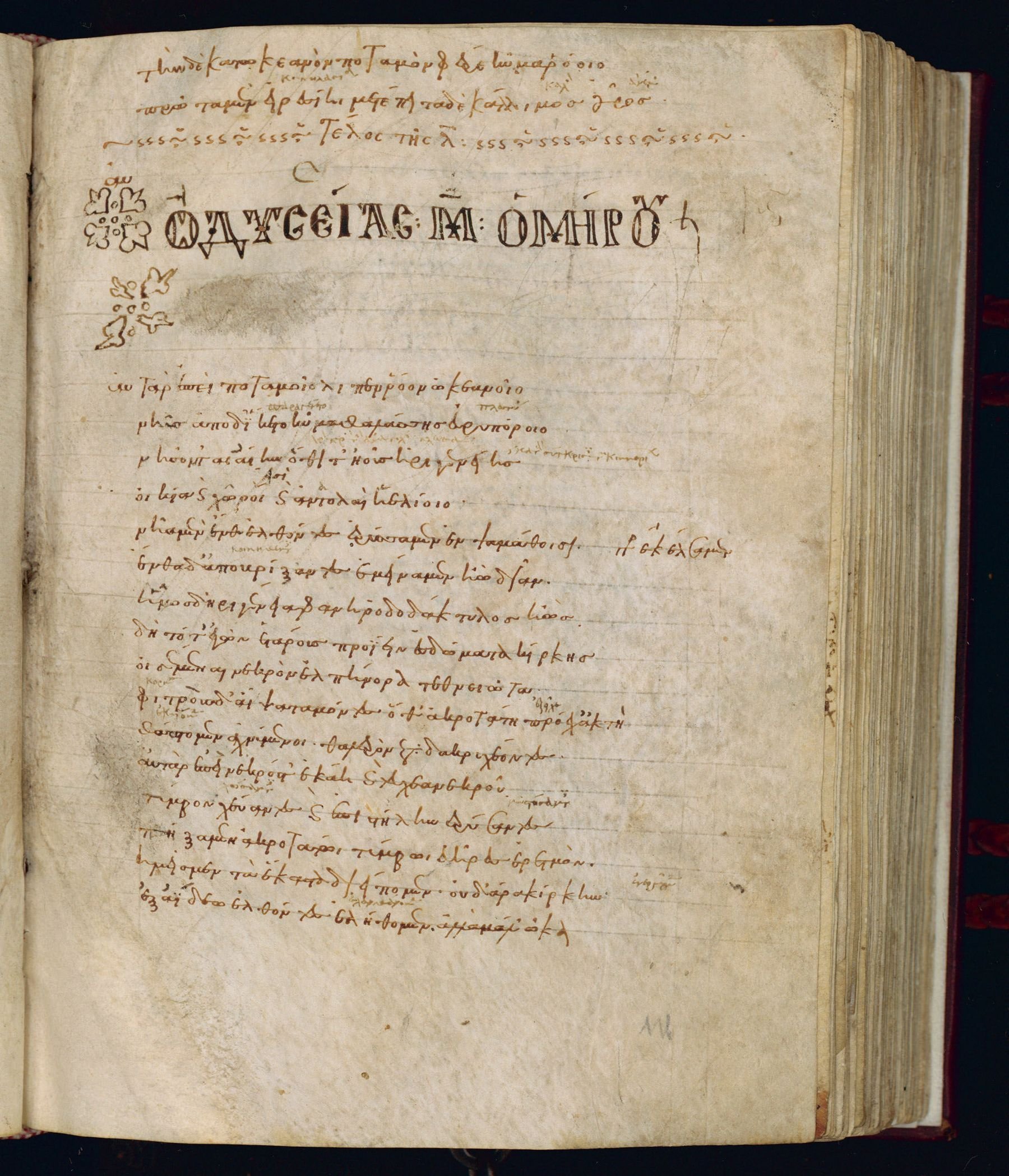
Where on the image
Laur. Plut. 32.24, fol. 116r: Odyssey 12.1-17, begins ‹αὐτὰρ ἐπεὶ ποταμοῖο λίπεν›, ends ‹ἐλήθομεν, ἀλλὰ μάλʼ ὦκα›. Checked on the image: first and last lines read and matched to the Greek. Fol. 116v begins with 12.18. The page holds 11.639-640, 12.1-17. Book 11 ends with 11.640, followed by a line of ornament with τέλος τῆς λ; the heading ὀδυσσείας μ ὁμήρου follows in capitals between floral ornaments, and book 12 begins after a space. 12.6 is not in the text column; it is written in the right margin beside 12.5 (16 lines for 17 verses). English blocks here: 1-4, 5-9, 10-14, 15-19.
1αὐτὰρ ἐπεὶ ποταμοῖο λίπεν ῥόον Ὠκεανοῖο
2νηῦς, ἀπὸ δʼ ἵκετο κῦμα θαλάσσης εὐρυπόροιο
3νῆσόν τʼ Αἰαίην, ὅθι τʼ Ἠοῦς ἠριγενείης
4οἰκία καὶ χοροί εἰσι καὶ ἀντολαὶ Ἠελίοιο,
5νῆα μὲν ἔνθʼ ἐλθόντες ἐκέλσαμεν ἐν ψαμάθοισιν,
6ἐκ δὲ καὶ αὐτοὶ βῆμεν ἐπὶ ῥηγμῖνι θαλάσσης·
7ἔνθα δʼ ἀποβρίξαντες ἐμείναμεν Ἠῶ δῖαν.
8ἦμος δʼ ἠριγένεια φάνη ῥοδοδάκτυλος Ἠώς,
9δὴ τότʼ ἐγὼν ἑτάρους προΐειν ἐς δώματα Κίρκης
10οἰσέμεναι νεκρόν, Ἐλπήνορα τεθνηῶτα.
11φιτροὺς δʼ αἶψα ταμόντες, ὅθʼ ἀκροτάτη πρόεχʼ ἀκτή,
12θάπτομεν ἀχνύμενοι θαλερὸν κατὰ δάκρυ χέοντες.
13αὐτὰρ ἐπεὶ νεκρός τʼ ἐκάη καὶ τεύχεα νεκροῦ,
14τύμβον χεύαντες καὶ ἐπὶ στήλην ἐρύσαντες
15πήξαμεν ἀκροτάτῳ τύμβῳ ἐυῆρες ἐρετμόν.
16ἡμεῖς μὲν τὰ ἕκαστα διείπομεν· οὐδʼ ἄρα Κίρκην
17ἐξ Ἀίδεω ἐλθόντες ἐλήθομεν, ἀλλὰ μάλʼ ὦκα
1“Now after our ship had left the stream of the river Oceanus and had come to the wave of the broad sea, and the Aeaean isle, where is the dwelling of early Dawn and her dancing-lawns, and the risings of the sun, 5there on our coming we beached our ship on the sands, and ourselves went forth upon the shore of the sea, and there we fell asleep, and waited for the bright Dawn. “As soon as early Dawn appeared, the rosy-fingered, then I sent forth my comrades to the house of Circe 10to fetch the body of the dead Elpenor. Straightway then we cut billets of wood and gave him burial where the headland runs furthest out to sea, sorrowing and shedding big tears. But when the dead man was burned, and the armour of the dead, we heaped up a mound and dragged on to it a pillar, 15and on the top of the mound we planted his shapely oar. “We then were busied with these several tasks, howbeit Circe was not unaware of our coming forth from the house of Hades, but speedily she arrayed herself and came, and her handmaids brought with her bread and meat in abundance and flaming red wine.
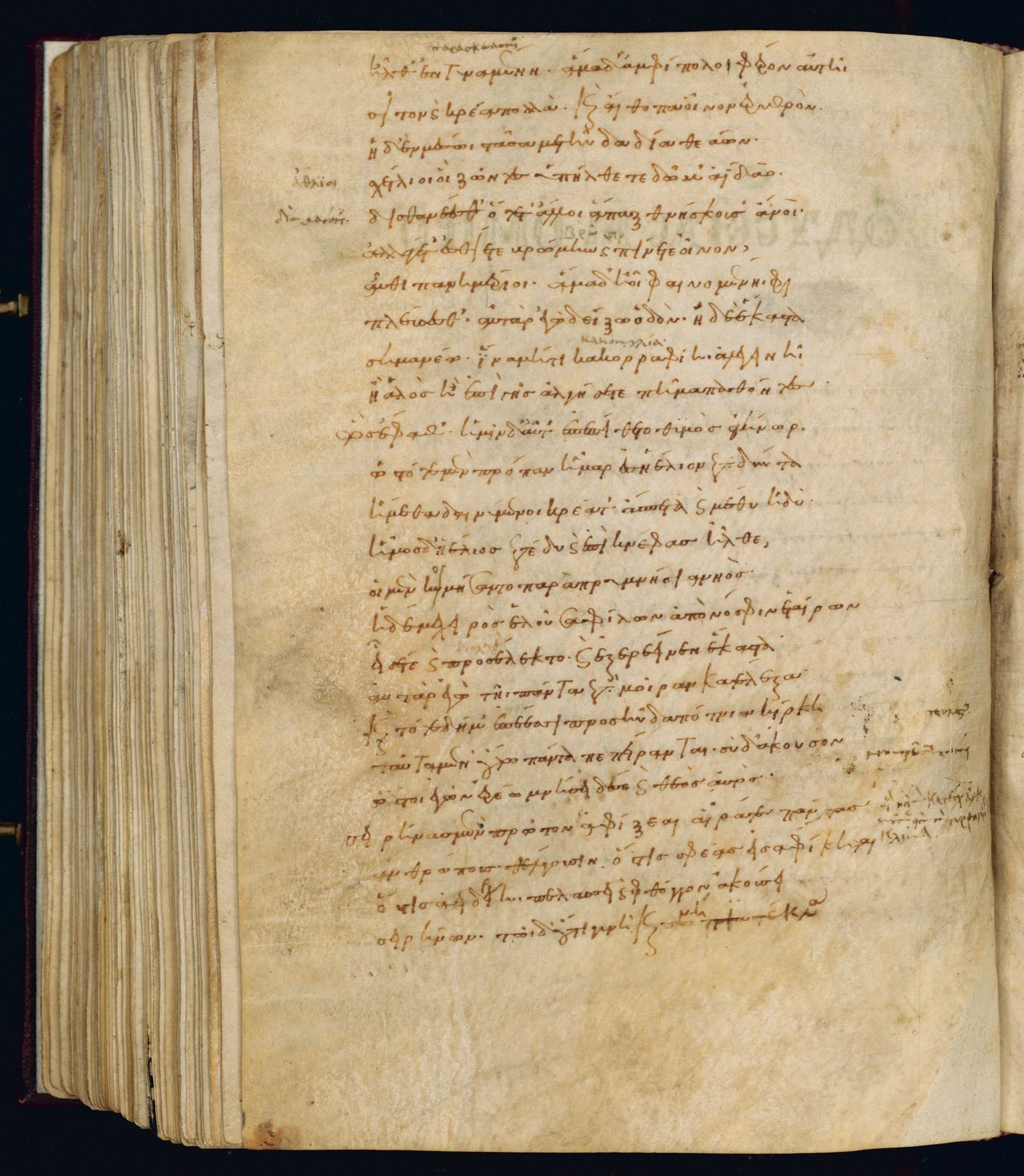
Where on the image
Laur. Plut. 32.24, fol. 116v: Odyssey 12.18-42, begins ‹ἦλθʼ ἐντυναμένη· ἅμα δʼ›, ends ‹γυνὴ καὶ νήπια τέκνα›. Checked on the image: first and last lines read and matched to the Greek. Fol. 116r ends with 12.17. Fol. 117r begins with 12.43. English blocks here: 20-24, 25-29, 30-34, 35-35, 36-39, 40-44.
18ἦλθʼ ἐντυναμένη· ἅμα δʼ ἀμφίπολοι φέρον αὐτῇ
19σῖτον καὶ κρέα πολλὰ καὶ αἴθοπα οἶνον ἐρυθρόν.
20ἡ δʼ ἐν μέσσῳ στᾶσα μετηύδα δῖα θεάων·
21σχέτλιοι, οἳ ζώοντες ὑπήλθετε δῶμʼ Ἀίδαο,
22δισθανέες, ὅτε τʼ ἄλλοι ἅπαξ θνῄσκουσʼ ἄνθρωποι.
23ἀλλʼ ἄγετʼ ἐσθίετε βρώμην καὶ πίνετε οἶνον
24αὖθι πανημέριοι· ἅμα δʼ ἠοῖ φαινομένηφι
25πλεύσεσθʼ· αὐτὰρ ἐγὼ δείξω ὁδὸν ἠδὲ ἕκαστα
26σημανέω, ἵνα μή τι κακορραφίῃ ἀλεγεινῇ
27ἢ ἁλὸς ἢ ἐπὶ γῆς ἀλγήσετε πῆμα παθόντες.
28ὣς ἔφαθʼ, ἡμῖν δʼ αὖτʼ ἐπεπείθετο θυμὸς ἀγήνωρ.
29ὣς τότε μὲν πρόπαν ἦμαρ ἐς ἠέλιον καταδύντα
30ἥμεθα δαινύμενοι κρέα τʼ ἄσπετα καὶ μέθυ ἡδύ·
31ἦμος δʼ ἠέλιος κατέδυ καὶ ἐπὶ κνέφας ἦλθεν,
32οἱ μὲν κοιμήσαντο παρὰ πρυμνήσια νηός,
33ἡ δʼ ἐμὲ χειρὸς ἑλοῦσα φίλων ἀπονόσφιν ἑταίρων
34εἷσέ τε καὶ προσέλεκτο καὶ ἐξερέεινεν ἕκαστα·
35αὐτὰρ ἐγὼ τῇ πάντα κατὰ μοῖραν κατέλεξα.
36καὶ τότε δή μʼ ἐπέεσσι προσηύδα πότνια Κίρκη·
37ταῦτα μὲν οὕτω πάντα πεπείρανται, σὺ δʼ ἄκουσον,
38ὥς τοι ἐγὼν ἐρέω, μνήσει δέ σε καὶ θεὸς αὐτός.
39Σειρῆνας μὲν πρῶτον ἀφίξεαι, αἵ ῥά τε πάντας
40ἀνθρώπους θέλγουσιν, ὅτις σφεας εἰσαφίκηται.
41ὅς τις ἀιδρείῃ πελάσῃ καὶ φθόγγον ἀκούσῃ
42Σειρήνων, τῷ δʼ οὔ τι γυνὴ καὶ νήπια τέκνα
20And the beautiful goddess stood in our midst, and spoke among us, saying: “‘Rash men, who have gone down alive to the house of Hades to meet death twice, while other men die but once. Nay, come, eat food and drink wine here this whole day through; but at the coming of Dawn 25ye shall set sail, and I will point out the way and declare to you each thing, in order that ye may not suffer pain and woes through wretched ill-contriving either by sea or on land.’ “So she spoke, and our proud hearts consented. So then all day long till set of sun 30we sat feasting on abundant flesh and sweet wine. But when the sun set and darkness came on, they lay down to rest beside the stern cables of the ship; but Circe took me by the hand, and leading me apart from my dear comrades, made me to sit, and herself lay down close at hand and asked me all the tale. 35And I told her all in due order. 36Then queenly Circe spoke to me and said: “All these things have thus found an end; but do thou hearken as I shall tell thee, and a god shall himself bring it to thy mind. To the Sirens first shalt thou come, who 40beguile all men whosoever comes to them. Whoso in ignorance draws near to them and hears the Sirens' voice, he nevermore returns, that his wife and little children may stand at his side rejoicing, but the Sirens beguile him with their clear-toned song,
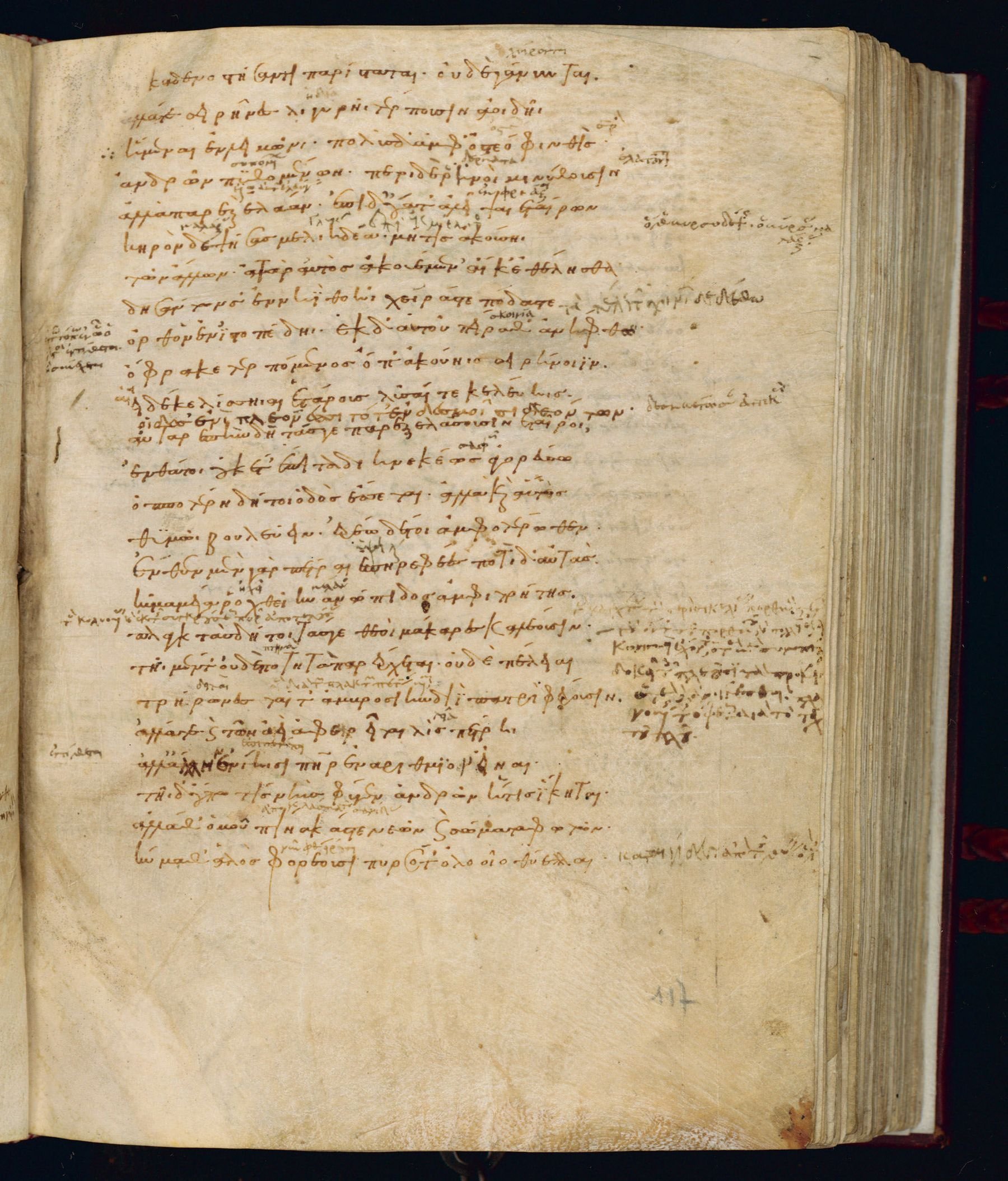
Where on the image
Laur. Plut. 32.24, fol. 117r: Odyssey 12.43-68, begins ‹οἴκαδε νοστήσαντι παρίσταται οὐδὲ›, ends ‹πυρός τʼ ὀλοοῖο θύελλαι.›. Checked on the image: first and last lines read and matched to the Greek. Fol. 116v ends with 12.42. Fol. 117v begins with 12.69. 12.55 is written in smaller letters squeezed in below 12.54 (25 full lines for 26 verses). Scholia in the margins. English blocks here: 45-49, 50-54, 55-59, 60-64, 65-69.
43οἴκαδε νοστήσαντι παρίσταται οὐδὲ γάνυνται,
44ἀλλά τε Σειρῆνες λιγυρῇ θέλγουσιν ἀοιδῇ
45ἥμεναι ἐν λειμῶνι, πολὺς δʼ ἀμφʼ ὀστεόφιν θὶς
46ἀνδρῶν πυθομένων, περὶ δὲ ῥινοὶ μινύθουσι.
47ἀλλὰ παρεξελάαν, ἐπὶ δʼ οὔατʼ ἀλεῖψαι ἑταίρων
48κηρὸν δεψήσας μελιηδέα, μή τις ἀκούσῃ
49τῶν ἄλλων· ἀτὰρ αὐτὸς ἀκουέμεν αἴ κʼ ἐθέλῃσθα,
50δησάντων σʼ ἐν νηὶ θοῇ χεῖράς τε πόδας τε
51ὀρθὸν ἐν ἱστοπέδῃ, ἐκ δʼ αὐτοῦ πείρατʼ ἀνήφθω,
52ὄφρα κε τερπόμενος ὄπʼ ἀκούσῃς Σειρήνοιιν.
53εἰ δέ κε λίσσηαι ἑτάρους λῦσαί τε κελεύῃς,
54οἱ δέ σʼ ἔτι πλεόνεσσι τότʼ ἐν δεσμοῖσι διδέντων.
55αὐτὰρ ἐπὴν δὴ τάς γε παρὲξ ἐλάσωσιν ἑταῖροι,
56ἔνθα τοι οὐκέτʼ ἔπειτα διηνεκέως ἀγορεύσω,
57ὁπποτέρη δή τοι ὁδὸς ἔσσεται, ἀλλὰ καὶ αὐτὸς
58θυμῷ βουλεύειν· ἐρέω δέ τοι ἀμφοτέρωθεν.
59ἔνθεν μὲν γὰρ πέτραι ἐπηρεφέες, προτὶ δʼ αὐτὰς
60κῦμα μέγα ῥοχθεῖ κυανώπιδος Ἀμφιτρίτης·
61Πλαγκτὰς δή τοι τάς γε θεοὶ μάκαρες καλέουσι.
62τῇ μέν τʼ οὐδὲ ποτητὰ παρέρχεται οὐδὲ πέλειαι
63τρήρωνες, ταί τʼ ἀμβροσίην Διὶ πατρὶ φέρουσιν,
64ἀλλά τε καὶ τῶν αἰὲν ἀφαιρεῖται λὶς πέτρη·
65ἀλλʼ ἄλλην ἐνίησι πατὴρ ἐναρίθμιον εἶναι.
66τῇ δʼ οὔ πώ τις νηῦς φύγεν ἀνδρῶν, ἥ τις ἵκηται,
67ἀλλά θʼ ὁμοῦ πίνακάς τε νεῶν καὶ σώματα φωτῶν
68κύμαθʼ ἁλὸς φορέουσι πυρός τʼ ὀλοοῖο θύελλαι.
45as they sit in a meadow, and about them is a great heap of bones of mouldering men, and round the bones the skin is shrivelling. But do thou row past them, and anoint the ears of thy comrades with sweet wax, which thou hast kneaded, lest any of the rest may hear. But if thou thyself hast a will to listen, 50let them bind thee in the swift ship hand and foot upright in the step of the mast, and let the ropes be made fast at the ends to the mast itself, that with delight thou mayest listen to the voice of the two Sirens. And if thou shalt implore and bid thy comrades to loose thee, then let them bind thee with yet more bonds. 55But when thy comrades shall have rowed past these, thereafter I shall not fully say on which side thy course is to lie, but do thou thyself ponder it in mind, and I will tell thee of both ways. For on the one hand are beetling crags, and against them 60roars the great wave of dark-eyed Amphitrite; the Planctae do the blessed gods call these. Thereby not even winged things may pass, no, not the timorous doves that bear ambrosia to father Zeus, but the smooth rock ever snatches away one even of these, 65and the father sends in another to make up the tale. And thereby has no ship of men ever yet escaped that has come thither, but the planks of ships and bodies of men are whirled confusedly by the waves of the sea and the blasts of baneful fire. One seafaring ship alone has passed thereby,
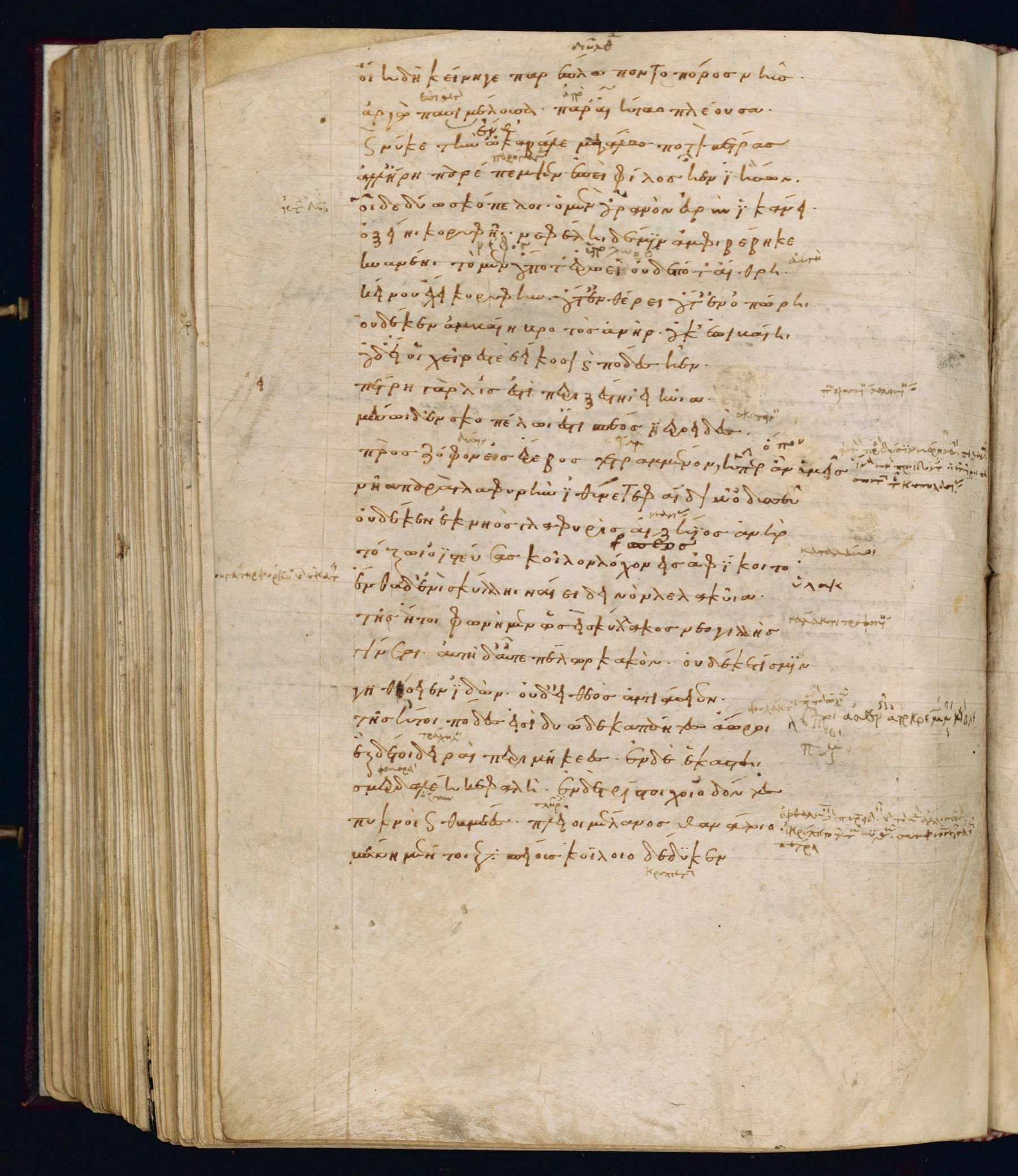
Where on the image
Laur. Plut. 32.24, fol. 117v: Odyssey 12.69-93, begins ‹οἴη δὴ κείνη γε›, ends ‹κατὰ σπείους κοίλοιο δέδυκεν,›. Checked on the image: first and last lines read and matched to the Greek. Fol. 117r ends with 12.68. Fol. 118r begins with 12.94. English blocks here: 70-72, 73-74, 75-79, 80-84, 85-89, 90-94.
69οἴη δὴ κείνη γε παρέπλω ποντοπόρος νηῦς,
70Ἀργὼ πᾶσι μέλουσα, παρʼ Αἰήταο πλέουσα.
71καὶ νύ κε τὴν ἔνθʼ ὦκα βάλεν μεγάλας ποτὶ πέτρας,
72ἀλλʼ Ἥρη παρέπεμψεν, ἐπεὶ φίλος ἦεν Ἰήσων.
73οἱ δὲ δύω σκόπελοι ὁ μὲν οὐρανὸν εὐρὺν ἱκάνει
74ὀξείῃ κορυφῇ, νεφέλη δέ μιν ἀμφιβέβηκε
75κυανέη· τὸ μὲν οὔ ποτʼ ἐρωεῖ, οὐδέ ποτʼ αἴθρη
76κείνου ἔχει κορυφὴν οὔτʼ ἐν θέρει οὔτʼ ἐν ὀπώρῃ.
77οὐδέ κεν ἀμβαίη βροτὸς ἀνὴρ οὐδʼ ἐπιβαίη,
78οὐδʼ εἴ οἱ χεῖρές τε ἐείκοσι καὶ πόδες εἶεν·
79πέτρη γὰρ λίς ἐστι, περιξεστῇ ἐικυῖα.
80μέσσῳ δʼ ἐν σκοπέλῳ ἔστι σπέος ἠεροειδές,
81πρὸς ζόφον εἰς Ἔρεβος τετραμμένον, ᾗ περ ἂν ὑμεῖς
82νῆα παρὰ γλαφυρὴν ἰθύνετε, φαίδιμʼ Ὀδυσσεῦ.
83οὐδέ κεν ἐκ νηὸς γλαφυρῆς αἰζήιος ἀνὴρ
84τόξῳ ὀιστεύσας κοῖλον σπέος εἰσαφίκοιτο.
85ἔνθα δʼ ἐνὶ Σκύλλη ναίει δεινὸν λελακυῖα.
86τῆς ἦ τοι φωνὴ μὲν ὅση σκύλακος νεογιλῆς
87γίγνεται, αὐτὴ δʼ αὖτε πέλωρ κακόν· οὐδέ κέ τίς μιν
88γηθήσειεν ἰδών, οὐδʼ εἰ θεὸς ἀντιάσειεν.
89τῆς ἦ τοι πόδες εἰσὶ δυώδεκα πάντες ἄωροι,
90ἓξ δέ τέ οἱ δειραὶ περιμήκεες, ἐν δὲ ἑκάστῃ
91σμερδαλέη κεφαλή, ἐν δὲ τρίστοιχοι ὀδόντες
92πυκνοὶ καὶ θαμέες, πλεῖοι μέλανος θανάτοιο.
93μέσση μέν τε κατὰ σπείους κοίλοιο δέδυκεν,
70that Argo famed of all, on her voyage from Aeetes, and even her the wave would speedily have dashed there against the great crags, had not Here sent her through, for that Jason was dear to her. 73“‘Now on the other path are two cliffs, one of which reaches with its sharp peak to the broad heaven, and a dark cloud surrounds it. 75This never melts away, nor does clear sky ever surround that peak in summer or in harvest time. No mortal man could scale it or set foot upon the top, not though he had twenty hands and feet; for the rock is smooth, as if it were polished. 80And in the midst of the cliff is a dim cave, turned to the West, toward Erebus, even where you shall steer your hollow ship, glorious Odysseus. Not even a man of might could shoot an arrow from the hollow ship so as to reach into that vaulted cave. 85Therein dwells Scylla, yelping terribly. Her voice is indeed but as the voice of a new-born whelp, but she herself is an evil monster, nor would anyone be glad at sight of her, no, not though it were a god that met her. Verily she has twelve feet, all misshapen, 90and six necks, exceeding long, and on each one an awful head, and therein three rows of teeth, thick and close, and full of black death. Up to her middle she is hidden in the hollow cave, but she holds her head out beyond the dread chasm,
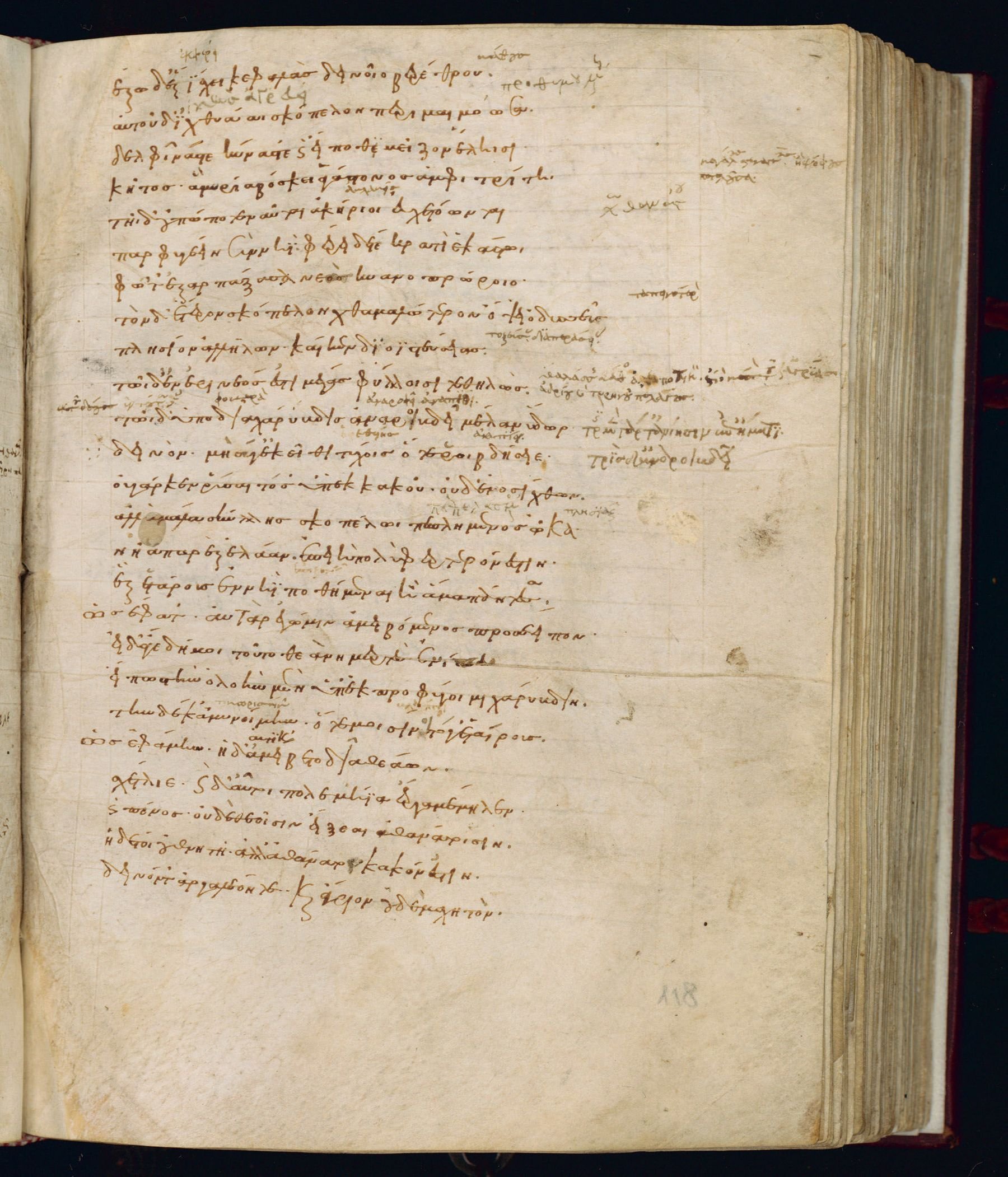
Where on the image
Laur. Plut. 32.24, fol. 118r: Odyssey 12.94-119, begins ‹ἔξω δʼ ἐξίσχει κεφαλὰς›, ends ‹καὶ ἄγριον οὐδὲ μαχητόν·›. Checked on the image: first and last lines read and matched to the Greek. Fol. 117v ends with 12.93. Fol. 118v begins with 12.120. 12.105 is not in the text column; it is written in the right margin beside 12.104 (the column has 25 lines). English blocks here: 95-99, 100-104, 105-109, 110-110, 111-114, 115-119.
94ἔξω δʼ ἐξίσχει κεφαλὰς δεινοῖο βερέθρου,
95αὐτοῦ δʼ ἰχθυάᾳ, σκόπελον περιμαιμώωσα,
96δελφῖνάς τε κύνας τε, καὶ εἴ ποθι μεῖζον ἕλῃσι
97κῆτος, ἃ μυρία βόσκει ἀγάστονος Ἀμφιτρίτη.
98τῇ δʼ οὔ πώ ποτε ναῦται ἀκήριοι εὐχετόωνται
99παρφυγέειν σὺν νηί· φέρει δέ τε κρατὶ ἑκάστῳ
100φῶτʼ ἐξαρπάξασα νεὸς κυανοπρῴροιο.
101τὸν δʼ ἕτερον σκόπελον χθαμαλώτερον ὄψει, Ὀδυσσεῦ.
102πλησίον ἀλλήλων· καί κεν διοϊστεύσειας.
103τῷ δʼ ἐν ἐρινεὸς ἔστι μέγας, φύλλοισι τεθηλώς·
104τῷ δʼ ὑπὸ δῖα Χάρυβδις ἀναρροιβδεῖ μέλαν ὕδωρ.
105τρὶς μὲν γάρ τʼ ἀνίησιν ἐπʼ ἤματι, τρὶς δʼ ἀναροιβδεῖ
106δεινόν· μὴ σύ γε κεῖθι τύχοις, ὅτε ῥοιβδήσειεν·
107οὐ γάρ κεν ῥύσαιτό σʼ ὑπὲκ κακοῦ οὐδʼ ἐνοσίχθων.
108ἀλλὰ μάλα Σκύλλης σκοπέλῳ πεπλημένος ὦκα
109νῆα παρὲξ ἐλάαν, ἐπεὶ ἦ πολὺ φέρτερόν ἐστιν
110ἓξ ἑτάρους ἐν νηὶ ποθήμεναι ἢ ἅμα πάντας.
111ὣς ἔφατʼ, αὐτὰρ ἐγώ μιν ἀμειβόμενος προσέειπον·
112εἰ δʼ ἄγε δή μοι τοῦτο, θεά, νημερτὲς ἐνίσπες,
113εἴ πως τὴν ὀλοὴν μὲν ὑπεκπροφύγοιμι Χάρυβδιν,
114τὴν δέ κʼ ἀμυναίμην, ὅτε μοι σίνοιτό γʼ ἑταίρους.
115ὣς ἐφάμην, ἡ δʼ αὐτίκʼ ἀμείβετο δῖα θεάων·
116σχέτλιε, καὶ δὴ αὖ τοι πολεμήια ἔργα μέμηλε
117καὶ πόνος· οὐδὲ θεοῖσιν ὑπείξεαι ἀθανάτοισιν;
118ἡ δέ τοι οὐ θνητή, ἀλλʼ ἀθάνατον κακόν ἐστι,
119δεινόν τʼ ἀργαλέον τε καὶ ἄγριον οὐδὲ μαχητόν·
95and fishes there, eagerly searching around the rock for dolphins and sea-dogs and whatever greater beast she may haply catch, such creatures as deep-moaning Amphitrite rears in multitudes past counting. By her no sailors yet may boast that they have fled unscathed in their ship, for with each head she carries off 100a man, snatching him from the dark-prowed ship. “‘But the other cliff, thou wilt note, Odysseus, is lower—they are close to each other; thou couldst even shoot an arrow across—and on it is a great fig tree with rich foliage, but beneath this divine Charybdis sucks down the black water. 105Thrice a day she belches it forth, and thrice she sucks it down terribly. Mayest thou not be there when she sucks it down, for no one could save thee from ruin, no, not the Earth-shaker. Nay, draw very close to Scylla's cliff, and drive thy ship past quickly; for it is better far 110to mourn six comrades in thy ship than all together.’ 111“So she spoke, but I made answer and said:‘Come, I pray thee, goddess, tell me this thing truly, if in any wise I might escape from fell Charybids, and ward off that other, when she works harm to my comrades.’ 115“So I spoke, and the beautiful goddess answered and said: ‘Rash man, lo, now again thy heart is set on the deeds of war and on toil. Wilt thou not yield even to the immortal gods? She is not mortal, but an immortal bane, dread, and dire, and fierce, and not to be fought with;
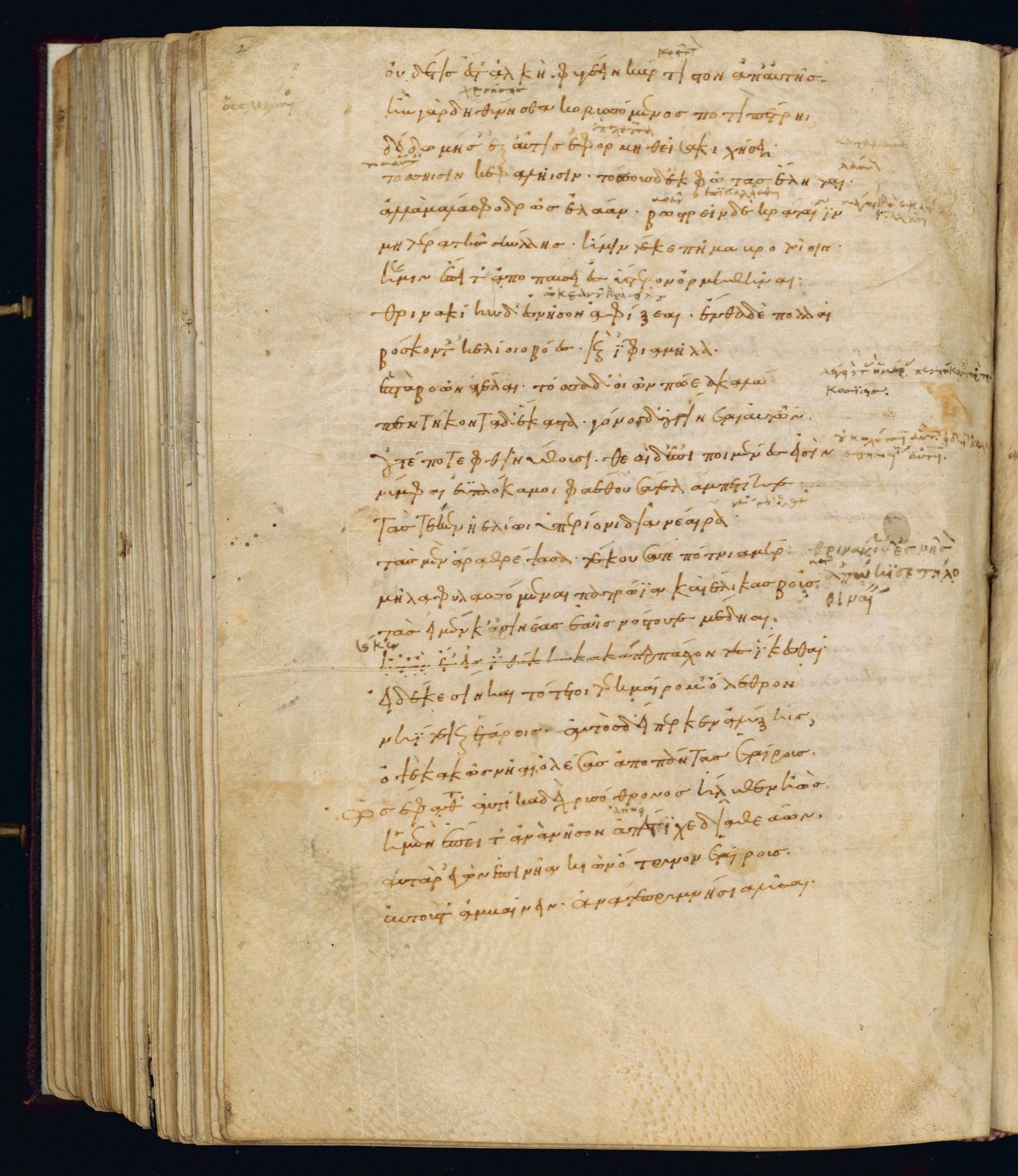
Where on the image
Laur. Plut. 32.24, fol. 118v: Odyssey 12.120-145, begins ‹οὐδέ τις ἔστʼ ἀλκή·›, ends ‹ἀνά τε πρυμνήσια λῦσαι·›. Checked on the image: first and last lines read and matched to the Greek. Fol. 118r ends with 12.119. Fol. 119r begins with 12.146. English blocks here: 120-124, 125-129, 130-134, 135-139, 140-144.
120οὐδέ τις ἔστʼ ἀλκή· φυγέειν κάρτιστον ἀπʼ αὐτῆς.
121ἢν γὰρ δηθύνῃσθα κορυσσόμενος παρὰ πέτρῃ,
122δείδω, μή σʼ ἐξαῦτις ἐφορμηθεῖσα κίχῃσι
123τόσσῃσιν κεφαλῇσι, τόσους δʼ ἐκ φῶτας ἕληται.
124ἀλλὰ μάλα σφοδρῶς ἐλάαν, βωστρεῖν δὲ Κράταιιν,
125μητέρα τῆς Σκύλλης, ἥ μιν τέκε πῆμα βροτοῖσιν·
126ἥ μιν ἔπειτʼ ἀποπαύσει ἐς ὕστερον ὁρμηθῆναι.
127Θρινακίην δʼ ἐς νῆσον ἀφίξεαι· ἔνθα δὲ πολλαὶ
128βόσκοντʼ Ἠελίοιο βόες καὶ ἴφια μῆλα,
129ἑπτὰ βοῶν ἀγέλαι, τόσα δʼ οἰῶν πώεα καλά,
130πεντήκοντα δʼ ἕκαστα. γόνος δʼ οὐ γίγνεται αὐτῶν,
131οὐδέ ποτε φθινύθουσι. θεαὶ δʼ ἐπιποιμένες εἰσίν,
132νύμφαι ἐυπλόκαμοι, Φαέθουσά τε Λαμπετίη τε,
133ἃς τέκεν Ἠελίῳ Ὑπερίονι δῖα Νέαιρα.
134τὰς μὲν ἄρα θρέψασα τεκοῦσά τε πότνια μήτηρ
135Θρινακίην ἐς νῆσον ἀπῴκισε τηλόθι ναίειν,
136μῆλα φυλασσέμεναι πατρώια καὶ ἕλικας βοῦς.
137τὰς εἰ μέν κʼ ἀσινέας ἐάᾳς νόστου τε μέδηαι,
138ἦ τʼ ἂν ἔτʼ εἰς Ἰθάκην κακά περ πάσχοντες ἵκοισθε·
139εἰ δέ κε σίνηαι, τότε τοι τεκμαίρομʼ ὄλεθρον,
140νηί τε καὶ ἑτάροις· αὐτὸς δʼ εἴ πέρ κεν ἀλύξῃς,
141ὀψὲ κακῶς νεῖαι, ὀλέσας ἄπο πάντας ἑταίρους.
142ὣς ἔφατʼ, αὐτίκα δὲ χρυσόθρονος ἤλυθεν Ἠώς.
143ἡ μὲν ἔπειτʼ ἀνὰ νῆσον ἀπέστιχε δῖα θεάων·
144αὐτὰρ ἐγὼν ἐπὶ νῆα κιὼν ὤτρυνον ἑταίρους
145αὐτούς τʼ ἀμβαίνειν ἀνά τε πρυμνήσια λῦσαι·
120there is no defence; to flee from her is bravest. For if thou tarriest to arm thyself by the cliff, I fear lest she may again dart forth and attack thee with as many heads and seize as many men as before. Nay, row past with all thy might, and call upon Crataiis, 125the mother of Scylla, who bore her for a bane to mortals. Then will she keep her from darting forth again. “‘And thou wilt come to the isle Thrinacia. There in great numbers feed the kine of Helios and his goodly flocks, seven herds of kine and as many fair flocks of sheep, 130and fifty in each. These bear no young, nor do they ever die, and goddesses are their shepherds, fair-tressed nymphs, Phaethusa and Lampetie, whom beautiful Neaera bore to Helios Hyperion. These their honored mother, when she had borne and reared them, 135sent to the isle Thrinacia to dwell afar, and keep the flocks of their father and his sleek kine. If thou leavest these unharmed and heedest thy homeward way, verily ye may yet reach Ithaca, though in evil plight. But if thou harmest them, then I foretell ruin 140for thy ship and for thy comrades, and even if thou shalt thyself escape, late shalt thou come home and in evil case, after losing all thy comrades.’ “So she spoke, and presently came golden-throned Dawn. Then the beautiful goddess departed up the island, but I went to the ship and roused my comrades
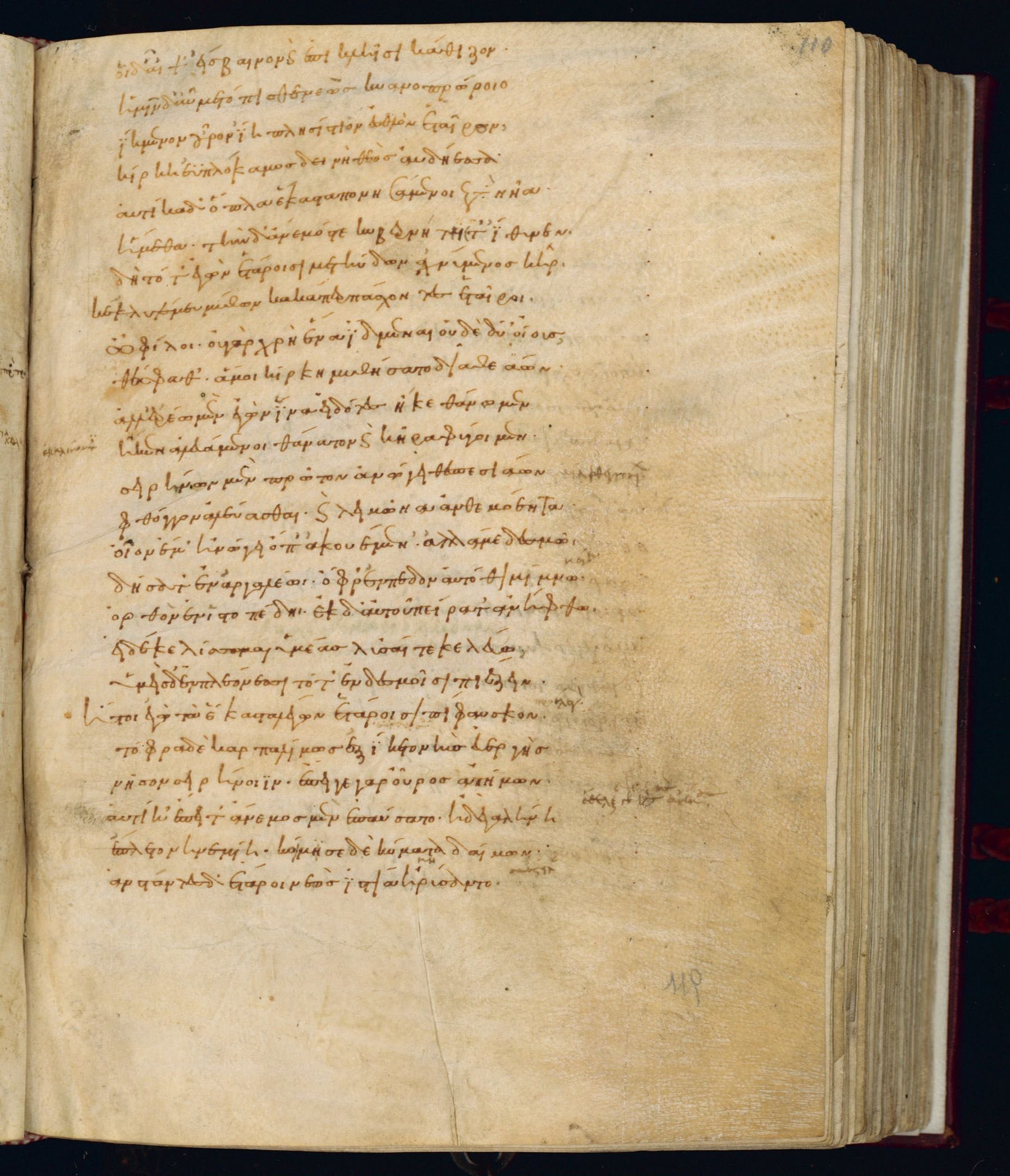
Where on the image
Laur. Plut. 32.24, fol. 119r: Odyssey 12.146-170, begins ‹οἱ δʼ αἶψʼ εἴσβαινον›, ends ‹ἕταροι νεὸς ἱστία μηρύσαντο›. Checked on the image: first and last lines read and matched to the Greek. Fol. 118v ends with 12.145. Fol. 119v begins with 12.171. English blocks here: 145-149, 150-152, 153-154, 155-159, 160-164, 165-169.
146οἱ δʼ αἶψʼ εἴσβαινον καὶ ἐπὶ κληῖσι καθῖζον.
147ἑξῆς δʼ ἑζόμενοι πολιὴν ἅλα τύπτον ἐρετμοῖς.
148ἡμῖν δʼ αὖ κατόπισθε νεὸς κυανοπρῴροιο
149ἴκμενον οὖρον ἵει πλησίστιον, ἐσθλὸν ἑταῖρον,
150Κίρκη ἐυπλόκαμος, δεινὴ θεὸς αὐδήεσσα.
151αὐτίκα δʼ ὅπλα ἕκαστα πονησάμενοι κατὰ νῆα
152ἥμεθα· τὴν δʼ ἄνεμός τε κυβερνήτης τʼ ἴθυνε.
153δὴ τότʼ ἐγὼν ἑτάροισι μετηύδων ἀχνύμενος κῆρ·
154ὦ φίλοι, οὐ γὰρ χρὴ ἕνα ἴδμεναι οὐδὲ δύʼ οἴους
155θέσφαθʼ ἅ μοι Κίρκη μυθήσατο, δῖα θεάων·
156ἀλλʼ ἐρέω μὲν ἐγών, ἵνα εἰδότες ἤ κε θάνωμεν
157ἤ κεν ἀλευάμενοι θάνατον καὶ κῆρα φύγοιμεν.
158Σειρήνων μὲν πρῶτον ἀνώγει θεσπεσιάων
159φθόγγον ἀλεύασθαι καὶ λειμῶνʼ ἀνθεμόεντα.
160οἶον ἔμʼ ἠνώγει ὄπʼ ἀκουέμεν· ἀλλά με δεσμῷ
161δήσατʼ ἐν ἀργαλέῳ, ὄφρʼ ἔμπεδον αὐτόθι μίμνω,
162ὀρθὸν ἐν ἱστοπέδῃ, ἐκ δʼ αὐτοῦ πείρατʼ ἀνήφθω.
163εἰ δέ κε λίσσωμαι ὑμέας λῦσαί τε κελεύω,
164ὑμεῖς δὲ πλεόνεσσι τότʼ ἐν δεσμοῖσι πιέζειν.
165ἦ τοι ἐγὼ τὰ ἕκαστα λέγων ἑτάροισι πίφαυσκον·
166τόφρα δὲ καρπαλίμως ἐξίκετο νηῦς ἐυεργὴς
167νῆσον Σειρήνοιιν· ἔπειγε γὰρ οὖρος ἀπήμων.
168αὐτίκʼ ἔπειτʼ ἄνεμος μὲν ἐπαύσατο ἠδὲ γαλήνη
169ἔπλετο νηνεμίη, κοίμησε δὲ κύματα δαίμων.
170ἀνστάντες δʼ ἕταροι νεὸς ἱστία μηρύσαντο
145themselves to embark and to loose the stern cables. So they went on board straightway and sat down upon the benches, and sitting well in order smote the grey sea with their oars. And for our aid in the wake of our dark-prowed ship a fair wind that filled the sail, a goodly comrade, was sent 150by fair-tressed Circe, dread goddess of human speech. So when we had straightway made fast all the tackling throughout the ship we sat down, but the wind and the helmsman guided the ship. 153“Then verily I spoke among my comrades, grieved at heart: ‘Friends, since it is not right that one or two alone should know 155the oracles that Circe, the beautiful goddess, told me, therefore will I tell them, in order that knowing them we may either die or, shunning death and fate, escape. First she bade us avoid the voice of the wondrous Sirens, and their flowery meadow. 160Me alone she bade to listen to their voice; but do ye bind me with grievous bonds, that I may abide fast where I am, upright in the step of the mast, and let the ropes be made fast at the ends to the mast itself; and if I implore and bid you to loose me, then do ye tie me fast with yet more bonds.’ 165“Thus I rehearsed all these things and told them to my comrades. Meanwhile the well-built ship speedily came to the isle of the two Sirens, for a fair and gentle wind bore her on. Then presently the wind ceased and there was a windless calm, and a god lulled the waves to sleep.
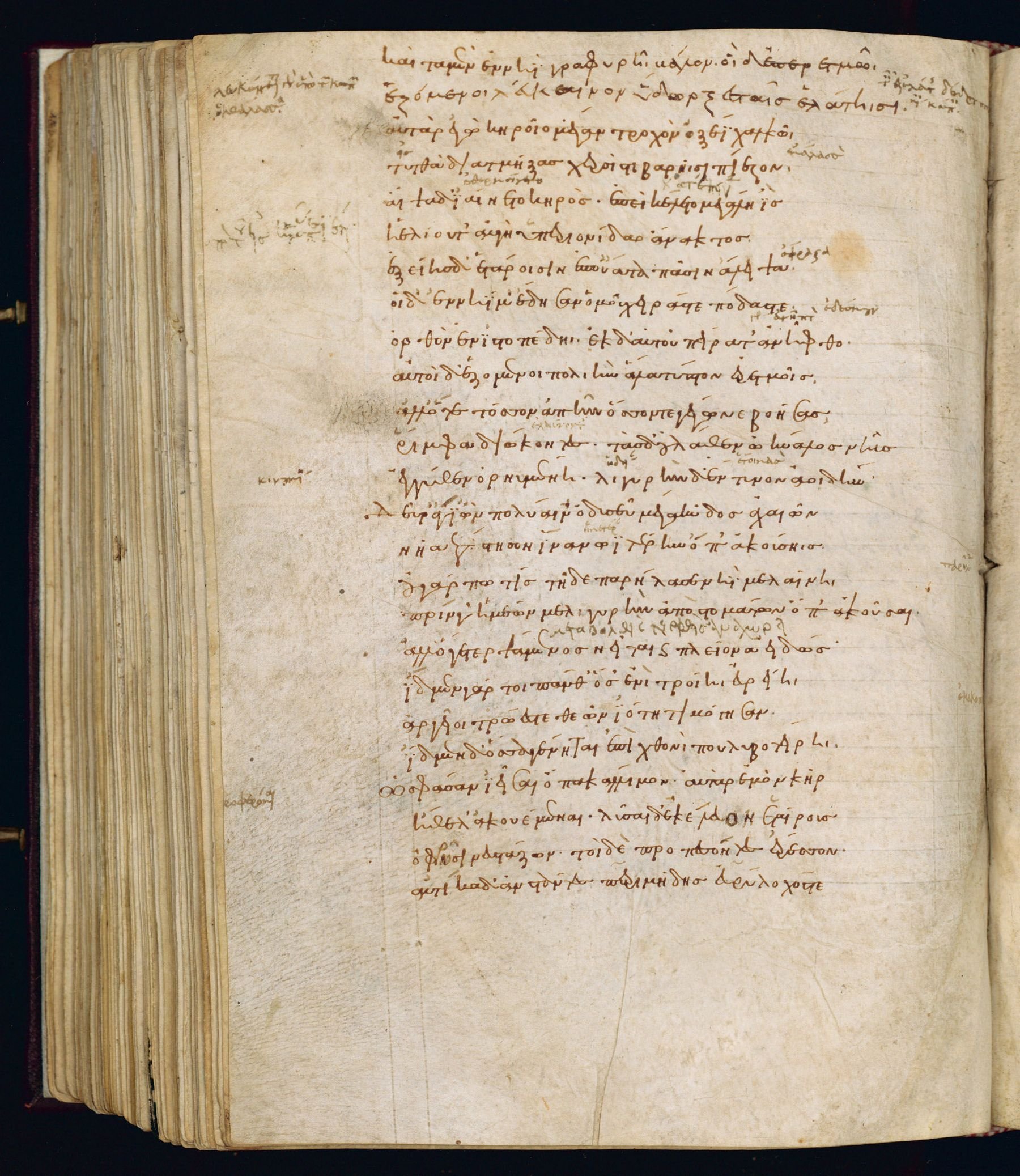
Where on the image
Laur. Plut. 32.24, fol. 119v: Odyssey 12.171-195, begins ‹καὶ τὰ μὲν ἐν›, ends ‹ἀνστάντες Περιμήδης Εὐρύλοχός τε›. Checked on the image: first and last lines read and matched to the Greek. Fol. 119r ends with 12.170. Fol. 120r begins with 12.196. English blocks here: 170-174, 175-179, 180-184, 185-189, 190-191, 192-194.
171καὶ τὰ μὲν ἐν νηὶ γλαφυρῇ θέσαν, οἱ δʼ ἐπʼ ἐρετμὰ
172ἑζόμενοι λεύκαινον ὕδωρ ξεστῇς ἐλάτῃσιν.
173αὐτὰρ ἐγὼ κηροῖο μέγαν τροχὸν ὀξέι χαλκῷ
174τυτθὰ διατμήξας χερσὶ στιβαρῇσι πίεζον·
175αἶψα δʼ ἰαίνετο κηρός, ἐπεὶ κέλετο μεγάλη ἲς
176Ἠελίου τʼ αὐγὴ Ὑπεριονίδαο ἄνακτος·
177ἑξείης δʼ ἑτάροισιν ἐπʼ οὔατα πᾶσιν ἄλειψα.
178οἱ δʼ ἐν νηί μʼ ἔδησαν ὁμοῦ χεῖράς τε πόδας τε
179ὀρθὸν ἐν ἱστοπέδῃ, ἐκ δʼ αὐτοῦ πείρατʼ ἀνῆπτον·
180αὐτοὶ δʼ ἑζόμενοι πολιὴν ἅλα τύπτον ἐρετμοῖς.
181ἀλλʼ ὅτε τόσσον ἀπῆμεν ὅσον τε γέγωνε βοήσας,
182ῥίμφα διώκοντες, τὰς δʼ οὐ λάθεν ὠκύαλος νηῦς
183ἐγγύθεν ὀρνυμένη, λιγυρὴν δʼ ἔντυνον ἀοιδήν·
184δεῦρʼ ἄγʼ ἰών, πολύαινʼ Ὀδυσεῦ, μέγα κῦδος Ἀχαιῶν,
185νῆα κατάστησον, ἵνα νωιτέρην ὄπ ἀκούσῃς.
186οὐ γάρ πώ τις τῇδε παρήλασε νηὶ μελαίνῃ,
187πρίν γʼ ἡμέων μελίγηρυν ἀπὸ στομάτων ὄπʼ ἀκοῦσαι,
188ἀλλʼ ὅ γε τερψάμενος νεῖται καὶ πλείονα εἰδώς.
189ἴδμεν γάρ τοι πάνθʼ ὅσʼ ἐνὶ Τροίῃ εὐρείῃ
190Ἀργεῖοι Τρῶές τε θεῶν ἰότητι μόγησαν,
191ἴδμεν δʼ, ὅσσα γένηται ἐπὶ χθονὶ πουλυβοτείρῃ.
192ὣς φάσαν ἱεῖσαι ὄπα κάλλιμον· αὐτὰρ ἐμὸν κῆρ
193ἤθελʼ ἀκουέμεναι, λῦσαί τʼ ἐκέλευον ἑταίρους
194ὀφρύσι νευστάζων· οἱ δὲ προπεσόντες ἔρεσσον.
195αὐτίκα δʼ ἀνστάντες Περιμήδης Εὐρύλοχός τε
170But my comrades rose up and furled the sail and stowed it in the hollow ship, and thereafter sat at the oars and made the water white with their polished oars of fir. But I with my sharp sword cut into small bits a great round cake of wax, and kneaded it with my strong hands, 175and soon the wax grew warm, forced by the strong pressure and the rays of the lord Helios Hyperion. Then I anointed with this the ears of all my comrades in turn; and they bound me in the ship hand and foot, upright in the step of the mast, and made the ropes fast at the ends to the mast itself; 180and themselves sitting down smote the grey sea with their oars. But when we were as far distant as a man can make himself heard when he shouts, driving swiftly on our way, the Sirens failed not to note the swift ship as it drew near, and they raised their clear-toned song: “‘Come hither, as thou farest, renowned Odysseus, great glory of the Achaeans; 185stay thy ship that thou mayest listen to the voice of us two. For never yet has any man rowed past this isle in his black ship until he has heard the sweet voice from our lips. Nay, he has joy of it, and goes his way a wiser man. For we know all the toils that in wide Troy 190the Argives and Trojans endured through the will of the gods, and we know all things that come to pass upon the fruitful earth.’ 192“So they spoke, sending forth their beautiful voice, and my heart was fain to listen, and I bade my comrades loose me, nodding to them with my brows; but they fell to their oars and rowed on.
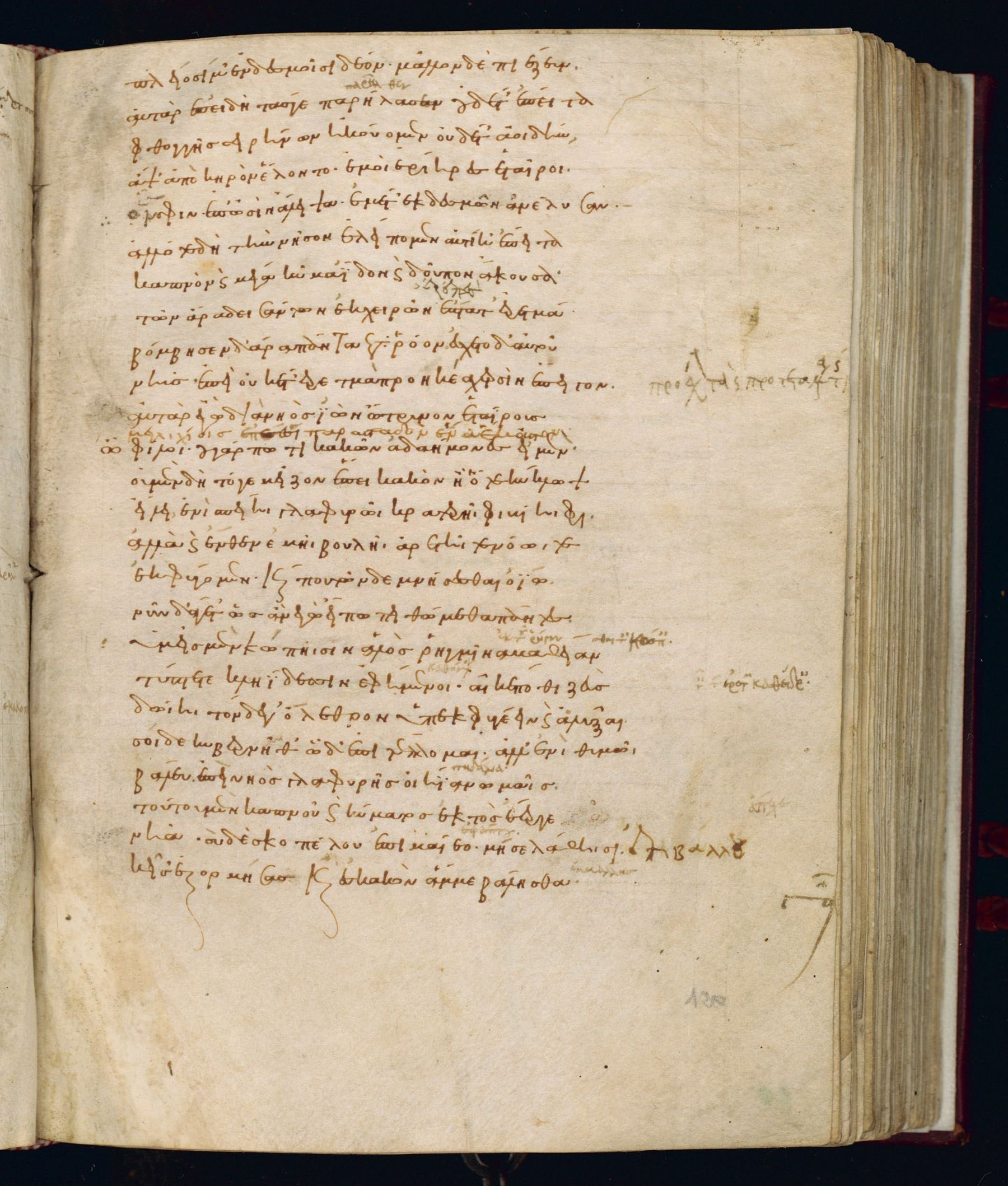
Where on the image
Laur. Plut. 32.24, fol. 120r: Odyssey 12.196-221, begins ‹πλείοσί μʼ ἐν δεσμοῖσι›, ends ‹ἐς κακὸν ἄμμε βάλῃσθα.›. Checked on the image: first and last lines read and matched to the Greek. Fol. 119v ends with 12.195. Fol. 120v begins with 12.222. 12.207 is written in smaller letters squeezed in below 12.206 (25 full lines for 26 verses). English blocks here: 195-199, 200-204, 205-209, 210-214, 215-219.
196πλείοσί μʼ ἐν δεσμοῖσι δέον μᾶλλόν τε πίεζον.
197αὐτὰρ ἐπεὶ δὴ τάς γε παρήλασαν, οὐδʼ ἔτʼ ἔπειτα
198φθογγῆς Σειρήνων ἠκούομεν οὐδέ τʼ ἀοιδῆς,
199αἶψʼ ἀπὸ κηρὸν ἕλοντο ἐμοὶ ἐρίηρες ἑταῖροι,
200ὅν σφιν ἐπʼ ὠσὶν ἄλειψʼ, ἐμέ τʼ ἐκ δεσμῶν ἀνέλυσαν.
201ἀλλʼ ὅτε δὴ τὴν νῆσον ἐλείπομεν, αὐτίκʼ ἔπειτα
202καπνὸν καὶ μέγα κῦμα ἴδον καὶ δοῦπον ἄκουσα.
203τῶν δʼ ἄρα δεισάντων ἐκ χειρῶν ἔπτατʼ ἐρετμά,
204βόμβησαν δʼ ἄρα πάντα κατὰ ῥόον· ἔσχετο δʼ αὐτοῦ
205νηῦς, ἐπεὶ οὐκέτʼ ἐρετμὰ προήκεα χερσὶν ἔπειγον.
206αὐτὰρ ἐγὼ διὰ νηὸς ἰὼν ὤτρυνον ἑταίρους
207μειλιχίοις ἐπέεσσι παρασταδὸν ἄνδρα ἕκαστον·
208ὦ φίλοι, οὐ γάρ πώ τι κακῶν ἀδαήμονές εἰμεν·
209οὐ μὲν δὴ τόδε μεῖζον ἕπει κακόν, ἢ ὅτε Κύκλωψ
210εἴλει ἐνὶ σπῆι γλαφυρῷ κρατερῆφι βίηφιν·
211ἀλλὰ καὶ ἔνθεν ἐμῇ ἀρετῇ, βουλῇ τε νόῳ τε,
212ἐκφύγομεν, καί που τῶνδε μνήσεσθαι ὀίω.
213νῦν δʼ ἄγεθʼ, ὡς ἂν ἐγὼ εἴπω, πειθώμεθα πάντες.
214ὑμεῖς μὲν κώπῃσιν ἁλὸς ῥηγμῖνα βαθεῖαν
215τύπτετε κληίδεσσιν ἐφήμενοι, αἴ κέ ποθι Ζεὺς
216δώῃ τόνδε γʼ ὄλεθρον ὑπεκφυγέειν καὶ ἀλύξαι·
217σοὶ δέ, κυβερνῆθʼ, ὧδʼ ἐπιτέλλομαι· ἀλλʼ ἐνὶ θυμῷ
218βάλλευ, ἐπεὶ νηὸς γλαφυρῆς οἰήια νωμᾷς.
219τούτου μὲν καπνοῦ καὶ κύματος ἐκτὸς ἔεργε
220νῆα, σὺ δὲ σκοπέλου ἐπιμαίεο, μή σε λάθῃσι
221κεῖσʼ ἐξορμήσασα καὶ ἐς κακὸν ἄμμε βάλῃσθα.
195And presently Perimedes and Eurylochus arose and bound me with yet more bonds and drew them tighter. But when they had rowed past the Sirens, and we could no more hear their voice or their song, then straightway my trusty comrades took away the 200wax with which I had anointed their ears and loosed me from my bonds. “But when we had left the island, I presently saw smoke and a great billow, and heard a booming. Then from the hands of my men in their terror the oars flew, and splashed one and all in the swirl, and 205the ship stood still where it was, when they no longer plied with their hands the tapering oars. But I went through the ship and cheered my men with gentle words, coming up to each man in turn: “‘Friends, hitherto we have been in no wise ignorant of sorrow; surely this evil that besets us now is no greater than when the Cyclops 210penned us in his hollow cave by brutal strength; yet even thence we made our escape through my valor and counsel and wit; these dangers, too, methinks we shall some day remember. But now come, as I bid, let us all obey. Do you keep your seats on the benches 215and smite with your oars the deep surf of the sea, in the hope that Zeus may grant us to escape and avoid this death. And to thee, steersman, I give this command, and do thou lay it to heart, since thou wieldest the steering oar of the hollow ship. From this smoke and surf keep
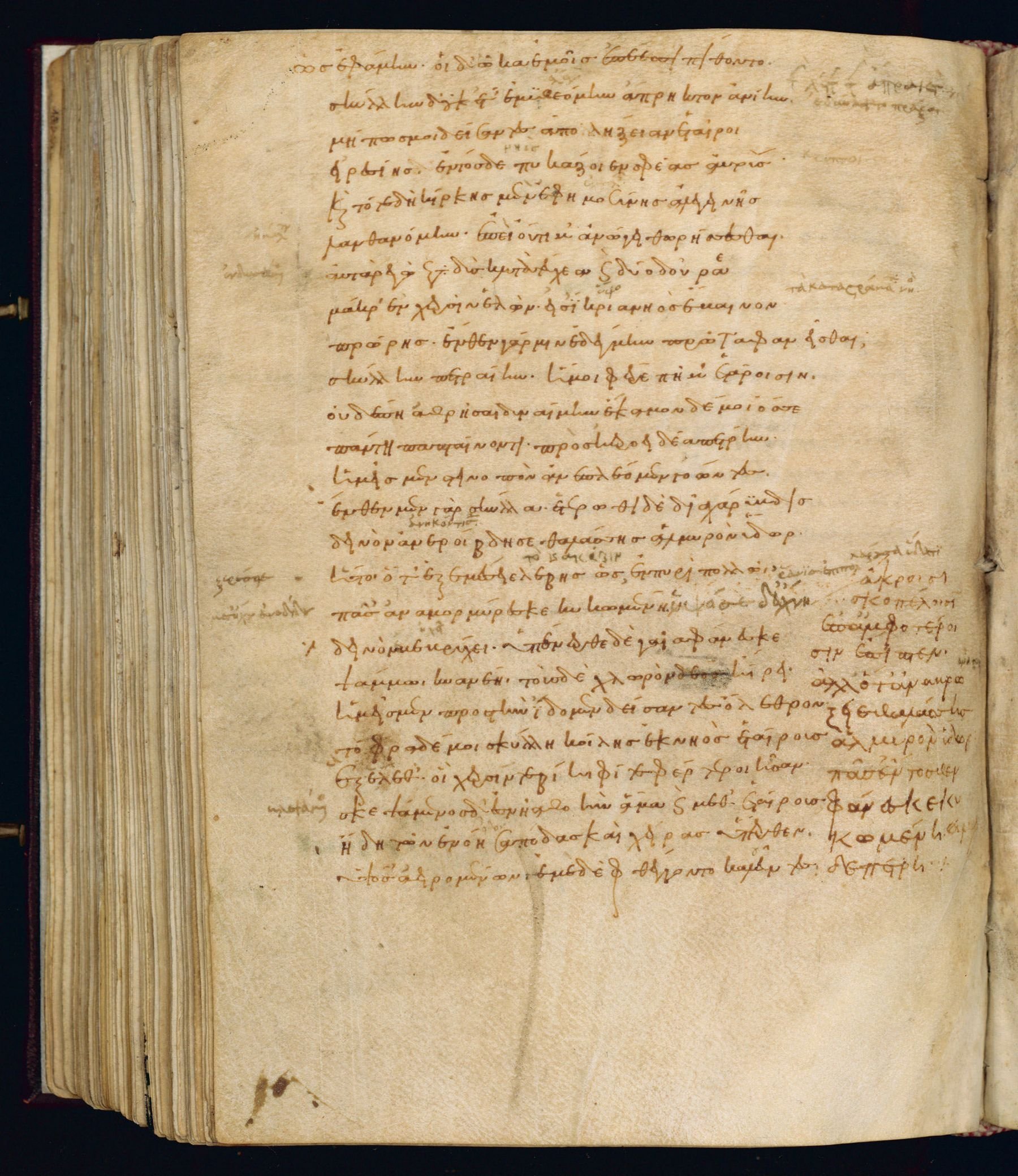
Where on the image
Laur. Plut. 32.24, fol. 120v: Odyssey 12.222-249, begins ‹ὣς ἐφάμην, οἱ δʼ›, ends ‹ἐμὲ δὲ φθέγγοντο καλεῦντες›. Checked on the image: first and last lines read and matched to the Greek. Fol. 120r ends with 12.221. Fol. 121r begins with 12.250. 12.239-241 are not in the text column; they are written in the right margin beside 12.238-242 (the column has 25 lines). English blocks here: 220-224, 225-229, 230-233, 234-234, 235-239, 240-244, 245-249.
222ὣς ἐφάμην, οἱ δʼ ὦκα ἐμοῖς ἐπέεσσι πίθοντο.
223Σκύλλην δʼ οὐκέτʼ ἐμυθεόμην, ἄπρηκτον ἀνίην,
224μή πώς μοι δείσαντες ἀπολλήξειαν ἑταῖροι
225εἰρεσίης, ἐντὸς δὲ πυκάζοιεν σφέας αὐτούς.
226καὶ τότε δὴ Κίρκης μὲν ἐφημοσύνης ἀλεγεινῆς
227λανθανόμην, ἐπεὶ οὔ τί μʼ ἀνώγει θωρήσσεσθαι·
228αὐτὰρ ἐγὼ καταδὺς κλυτὰ τεύχεα καὶ δύο δοῦρε
229μάκρʼ ἐν χερσὶν ἑλὼν εἰς ἴκρια νηὸς ἔβαινον
230πρῴρης· ἔνθεν γάρ μιν ἐδέγμην πρῶτα φανεῖσθαι
231Σκύλλην πετραίην, ἥ μοι φέρε πῆμʼ ἑτάροισιν.
232οὐδέ πῃ ἀθρῆσαι δυνάμην, ἔκαμον δέ μοι ὄσσε
233πάντῃ παπταίνοντι πρὸς ἠεροειδέα πέτρην.
234ἡμεῖς μὲν στεινωπὸν ἀνεπλέομεν γοόωντες·
235ἔνθεν μὲν Σκύλλη, ἑτέρωθι δὲ δῖα Χάρυβδις
236δεινὸν ἀνερροίβδησε θαλάσσης ἁλμυρὸν ὕδωρ.
237ἦ τοι ὅτʼ ἐξεμέσειε, λέβης ὣς ἐν πυρὶ πολλῷ
238πᾶσʼ ἀναμορμύρεσκε κυκωμένη, ὑψόσε δʼ ἄχνη
239ἄκροισι σκοπέλοισιν ἐπʼ ἀμφοτέροισιν ἔπιπτεν·
240ἀλλʼ ὅτʼ ἀναβρόξειε θαλάσσης ἁλμυρὸν ὕδωρ,
241πᾶσʼ ἔντοσθε φάνεσκε κυκωμένη, ἀμφὶ δὲ πέτρη
242δεινὸν ἐβεβρύχει, ὑπένερθε δὲ γαῖα φάνεσκε
243ψάμμῳ κυανέη· τοὺς δὲ χλωρὸν δέος ᾕρει.
244ἡμεῖς μὲν πρὸς τὴν ἴδομεν δείσαντες ὄλεθρον·
245τόφρα δέ μοι Σκύλλη γλαφυρῆς ἐκ νηὸς ἑταίρους
246ἓξ ἕλεθʼ, οἳ χερσίν τε βίηφί τε φέρτατοι ἦσαν.
247σκεψάμενος δʼ ἐς νῆα θοὴν ἅμα καὶ μεθʼ ἑταίρους
248ἤδη τῶν ἐνόησα πόδας καὶ χεῖρας ὕπερθεν
249ὑψόσʼ ἀειρομένων· ἐμὲ δὲ φθέγγοντο καλεῦντες
220the ship well away and hug the cliff, lest, ere thou know it, the ship swerve off to the other side and thou cast us into destruction.’ “So I spoke, and they quickly hearkened to my words. But of Scylla I went not on to speak, a cureless bane, lest haply my comrades, seized with fear, should cease 225from rowing and huddle together in the hold. Then verily I forgot the hard command of Circe, whereas she bade me in no wise to arm myself; but when I had put on my glorious armour and grasped in my hand two long spears, I went to the fore-deck of the ship, 230whence I deemed that Scylla of the rock would first be seen, who was to bring ruin upon my comrades. But nowhere could I descry her, and my eyes grew weary as I gazed everywhere toward the misty rock. 234“We then sailed on up the narrow strait with wailing. 235For on one side lay Scylla and on the other divine Charybdis terribly sucked down the salt water of the sea. Verily whenever she belched it forth, like a cauldron on a great fire she would seethe and bubble in utter turmoil, and high over head the spray would fall on the tops of both the cliffs. 240But as often as she sucked down the salt water of the sea, within she could all be seen in utter turmoil, and round about the rock roared terribly, while beneath the earth appeared black with sand; and pale fear seized my men. So we looked toward her and feared destruction; 245but meanwhile Scylla seized from out the hollow ship six of my comrades who were the best in strength and in might. Turning my eyes to the swift ship and to the company of my men, even then I noted above me their feet and hands as they were raised aloft. To me they cried aloud, calling upon me
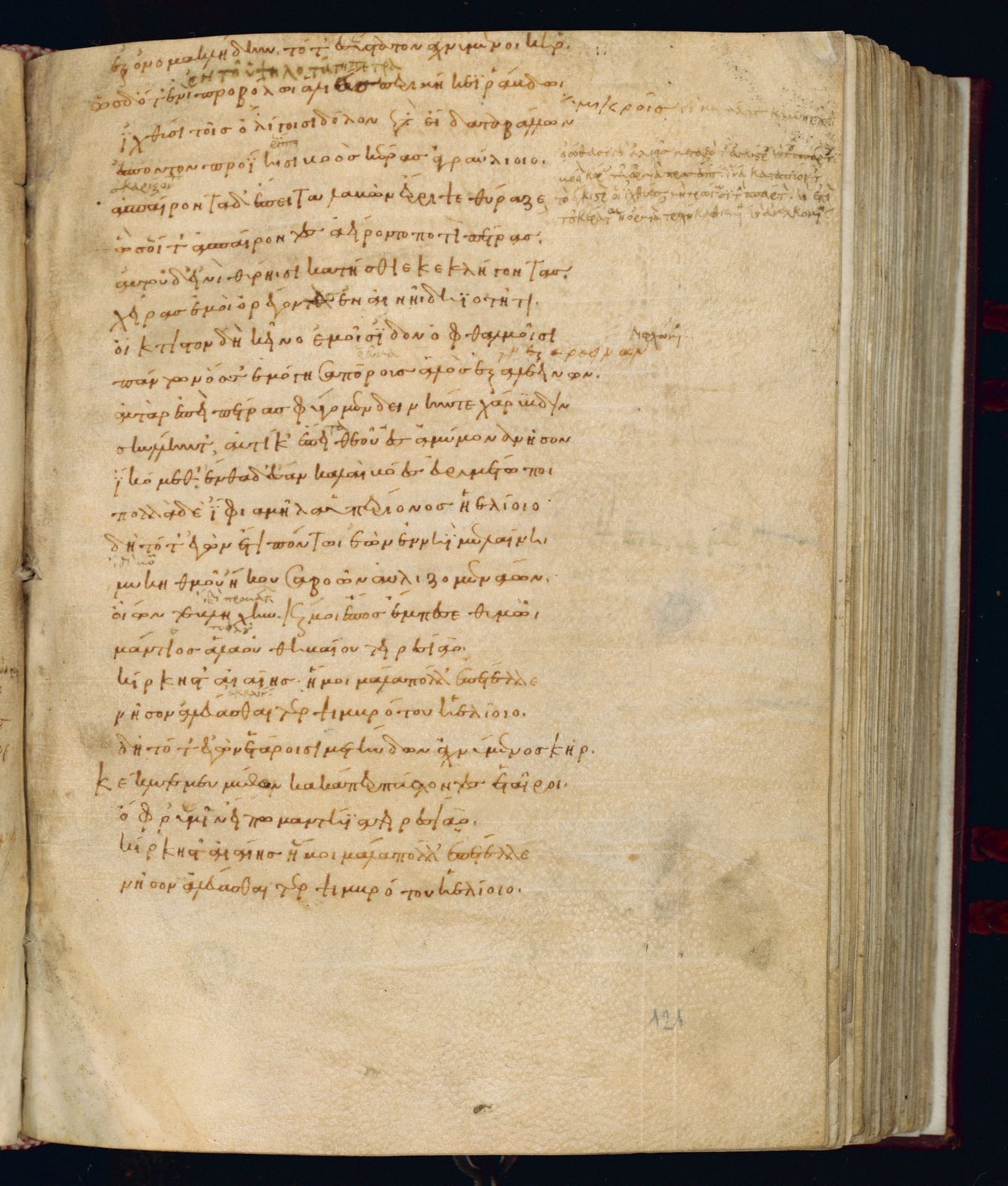
Where on the image
Laur. Plut. 32.24, fol. 121r: Odyssey 12.250-274, begins ‹ἐξονομακλήδην, τότε γʼ ὕστατον,›, ends ‹νῆσον ἀλεύασθαι τερψιμβρότου Ἠελίοιο·›. Checked on the image: first and last lines read and matched to the Greek. Fol. 120v ends with 12.249. Fol. 121v begins with 12.275. English blocks here: 250-254, 255-259, 260-264, 265-269, 270-274.
250ἐξονομακλήδην, τότε γʼ ὕστατον, ἀχνύμενοι κῆρ.
251ὡς δʼ ὅτʼ ἐπὶ προβόλῳ ἁλιεὺς περιμήκεϊ ῥάβδῳ
252ἰχθύσι τοῖς ὀλίγοισι δόλον κατὰ εἴδατα βάλλων
253ἐς πόντον προΐησι βοὸς κέρας ἀγραύλοιο,
254ἀσπαίροντα δʼ ἔπειτα λαβὼν ἔρριψε θύραζε,
255ὣς οἵ γʼ ἀσπαίροντες ἀείροντο προτὶ πέτρας·
256αὐτοῦ δʼ εἰνὶ θύρῃσι κατήσθιε κεκληγῶτας
257χεῖρας ἐμοὶ ὀρέγοντας ἐν αἰνῇ δηιοτῆτι·
258οἴκτιστον δὴ κεῖνο ἐμοῖς ἴδον ὀφθαλμοῖσι
259πάντων, ὅσσʼ ἐμόγησα πόρους ἁλὸς ἐξερεείνων.
260αὐτὰρ ἐπεὶ πέτρας φύγομεν δεινήν τε Χάρυβδιν
261Σκύλλην τʼ, αὐτίκʼ ἔπειτα θεοῦ ἐς ἀμύμονα νῆσον
262ἱκόμεθʼ· ἔνθα δʼ ἔσαν καλαὶ βόες εὐρυμέτωποι,
263πολλὰ δὲ ἴφια μῆλʼ Ὑπερίονος Ἠελίοιο.
264δὴ τότʼ ἐγὼν ἔτι πόντῳ ἐὼν ἐν νηὶ μελαίνῃ
265μυκηθμοῦ τʼ ἤκουσα βοῶν αὐλιζομενάων
266οἰῶν τε βληχήν· καί μοι ἔπος ἔμπεσε θυμῷ
267μάντηος ἀλαοῦ, Θηβαίου Τειρεσίαο,
268Κίρκης τʼ Αἰαίης, ἥ μοι μάλα πόλλʼ ἐπέτελλε
269νῆσον ἀλεύασθαι τερψιμβρότου Ἠελίοιο.
270δὴ τότʼ ἐγὼν ἑτάροισι μετηύδων ἀχνύμενος κῆρ·
271κέκλυτέ μευ μύθων κακά περ πάσχοντες ἑταῖροι,
272ὄφρʼ ὑμῖν εἴπω μαντήια Τειρεσίαο
273Κίρκης τʼ Αἰαίης, ἥ μοι μάλα πόλλʼ ἐπέτελλε
274νῆσον ἀλεύασθαι τερψιμβρότου Ἠελίοιο·
250by name for that last time in anguish of heart. And as a fisher on a jutting rock, when he casts in his baits as a snare to the little fishes, with his long pole lets down into the sea the horn of an ox of the steading, and then as he catches a fish flings it writhing ashore, 255even so were they drawn writhing up towards the cliffs. Then at her doors she devoured them shrieking and stretching out their hands toward me in their awful death-struggle. Most piteous did mine eyes behold that thing of all that I bore while I explored the paths of the sea. 260“Now when we had escaped the rocks, and dread Charybdis and Scylla, presently then we came to the goodly island of the god, where were the fair kine, broad of brow, and the many goodly flocks of Helios Hyperion. Then while I was still out at sea in my black ship, 265I heard the lowing of the cattle that were being stalled and the bleating of the sheep, and upon my mind fell the words of the blind seer, Theban Teiresias, and of Aeaean Circe, who very straitly charged me to shun the island of Helios, who gives joy to mortals. 270Then verily I spoke among my comrades, grieved at heart: “‘Hear my words, comrades, for all your evil plight, that I may tell you the oracles of Teiresias and of Aeaean Circe, who very straitly charged me to shun the island of Helios, who gives joy to mortals;
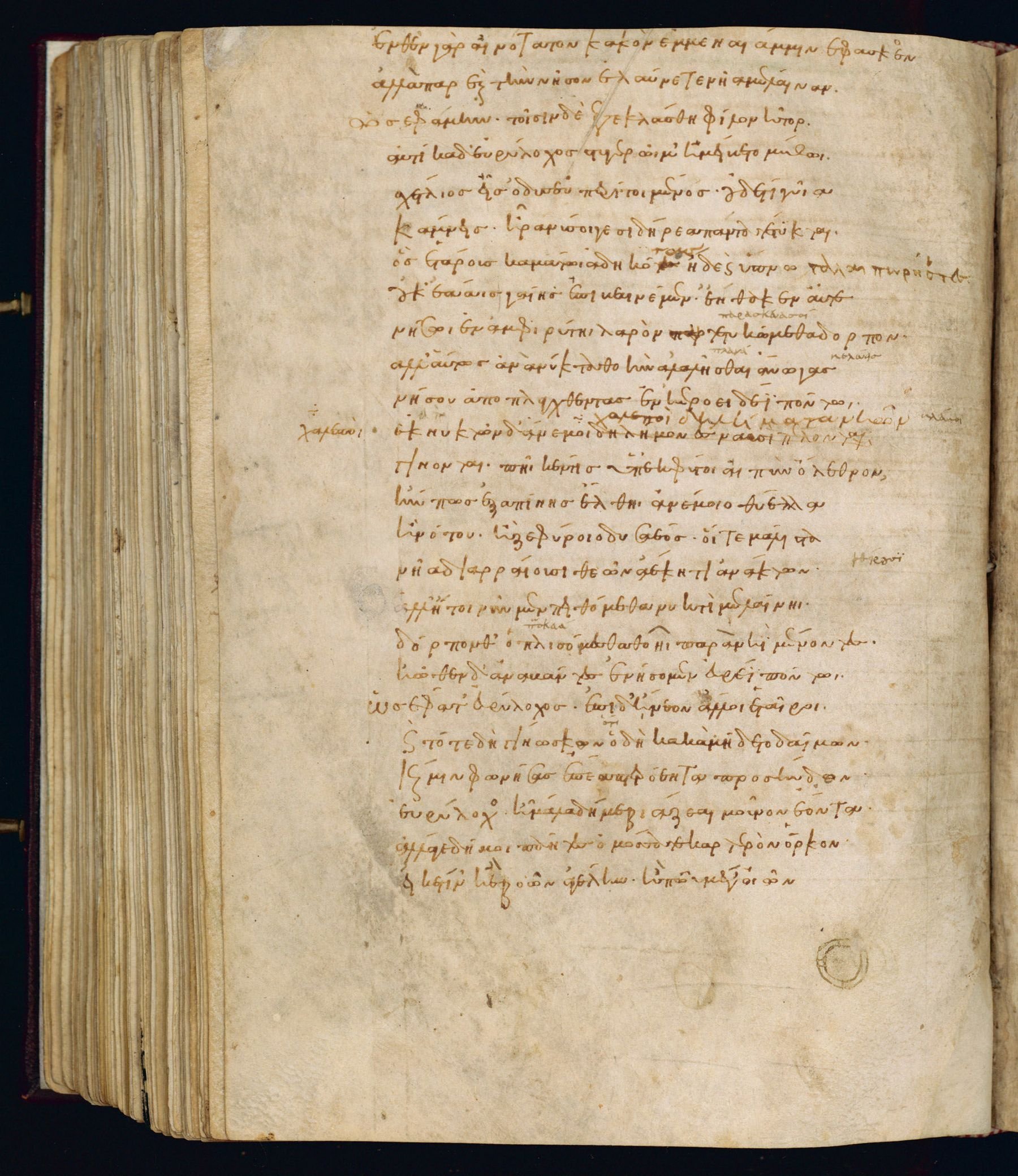
Where on the image
Laur. Plut. 32.24, fol. 121v: Odyssey 12.275-299, begins ‹ἔνθα γὰρ αἰνότατον κακὸν›, ends ‹ἢ πῶυ μέγʼ οἰῶν›. Checked on the image: first and last lines read and matched to the Greek. Fol. 121r ends with 12.274. Fol. 122r begins with 12.300. English blocks here: 275-276, 277-279, 280-284, 285-289, 290-294, 295-299.
275ἔνθα γὰρ αἰνότατον κακὸν ἔμμεναι ἄμμιν ἔφασκεν.
276ἀλλὰ παρὲξ τὴν νῆσον ἐλαύνετε νῆα μέλαιναν.
277ὣς ἐφάμην, τοῖσιν δὲ κατεκλάσθη φίλον ἦτορ.
278αὐτίκα δʼ Εὐρύλοχος στυγερῷ μʼ ἠμείβετο μύθῳ·
279σχέτλιός εἰς, Ὀδυσεῦ· περί τοι μένος, οὐδέ τι γυῖα
280κάμνεις· ἦ ῥά νυ σοί γε σιδήρεα πάντα τέτυκται,
281ὅς ῥʼ ἑτάρους καμάτῳ ἁδηκότας ἠδὲ καὶ ὕπνῳ
282οὐκ ἐάᾳς γαίης ἐπιβήμεναι, ἔνθα κεν αὖτε
283νήσῳ ἐν ἀμφιρύτῃ λαρὸν τετυκοίμεθα δόρπον,
284ἀλλʼ αὔτως διὰ νύκτα θοὴν ἀλάλησθαι ἄνωγας
285νήσου ἀποπλαγχθέντας ἐν ἠεροειδέι πόντῳ.
286ἐκ νυκτῶν δʼ ἄνεμοι χαλεποί, δηλήματα νηῶν,
287γίγνονται· πῇ κέν τις ὑπεκφύγοι αἰπὺν ὄλεθρον,
288ἤν πως ἐξαπίνης ἔλθῃ ἀνέμοιο θύελλα,
289ἢ Νότου ἢ Ζεφύροιο δυσαέος, οἵ τε μάλιστα
290νῆα διαρραίουσι θεῶν ἀέκητι ἀνάκτων.
291ἀλλʼ ἦ τοι νῦν μὲν πειθώμεθα νυκτὶ μελαίνῃ
292δόρπον θʼ ὁπλισόμεσθα θοῇ παρὰ νηὶ μένοντες,
293ἠῶθεν δʼ ἀναβάντες ἐνήσομεν εὐρέι πόντῳ.
294ὣς ἔφατʼ Εὐρύλοχος, ἐπὶ δʼ ᾔνεον ἄλλοι ἑταῖροι.
295καὶ τότε δὴ γίγνωσκον ὃ δὴ κακὰ μήδετο δαίμων,
296καί μιν φωνήσας ἔπεα πτερόεντα προσηύδων·
297Εὐρύλοχʼ, ἦ μάλα δή με βιάζετε μοῦνον ἐόντα.
298ἀλλʼ ἄγε νῦν μοι πάντες ὀμόσσατε καρτερὸν ὅρκον·
299εἴ κέ τινʼ ἠὲ βοῶν ἀγέλην ἢ πῶυ μέγʼ οἰῶν
275for there, she said, was our most terrible bane. Nay, row the black ship out past the island.’ 277“So I spoke, but their spirit was broken within them, and straightway Eurylochus answered me with hateful words: “‘Hardy art thou, Odysseus; thou hast strength beyond that of other men and thy limbs never 280grow weary. Verily thou art wholly wrought of iron, seeing that thou sufferest not thy comrades, worn out with toil and drowsiness, to set foot on shore, where on this sea-girt isle we might once more make ready a savoury supper; but thou biddest us even as we are to wander on through the swift night, 285driven away from the island over the misty deep. It is from the night that fierce winds are born, wreckers of ships. How could one escape utter destruction, if haply there should suddenly come a blast of the South Wind or the blustering West Wind, which oftenest 290wreck ships in despite of the sovereign gods? Nay, verily for this time let us yield to black night and make ready our supper, remaining by the swift ship, and in the morning we will go aboard, and put out into the broad sea.’ “So spoke Eurylochus, and the rest of my comrades gave assent. 295Then verily I knew that some god was assuredly devising ill, and I spoke and addressed him with winged words: “‘Eurylochus, verily ye constrain me, who stand alone. But come now, do ye all swear to me a mighty oath, to the end that, if we haply find a herd of kine or a great flock of sheep,
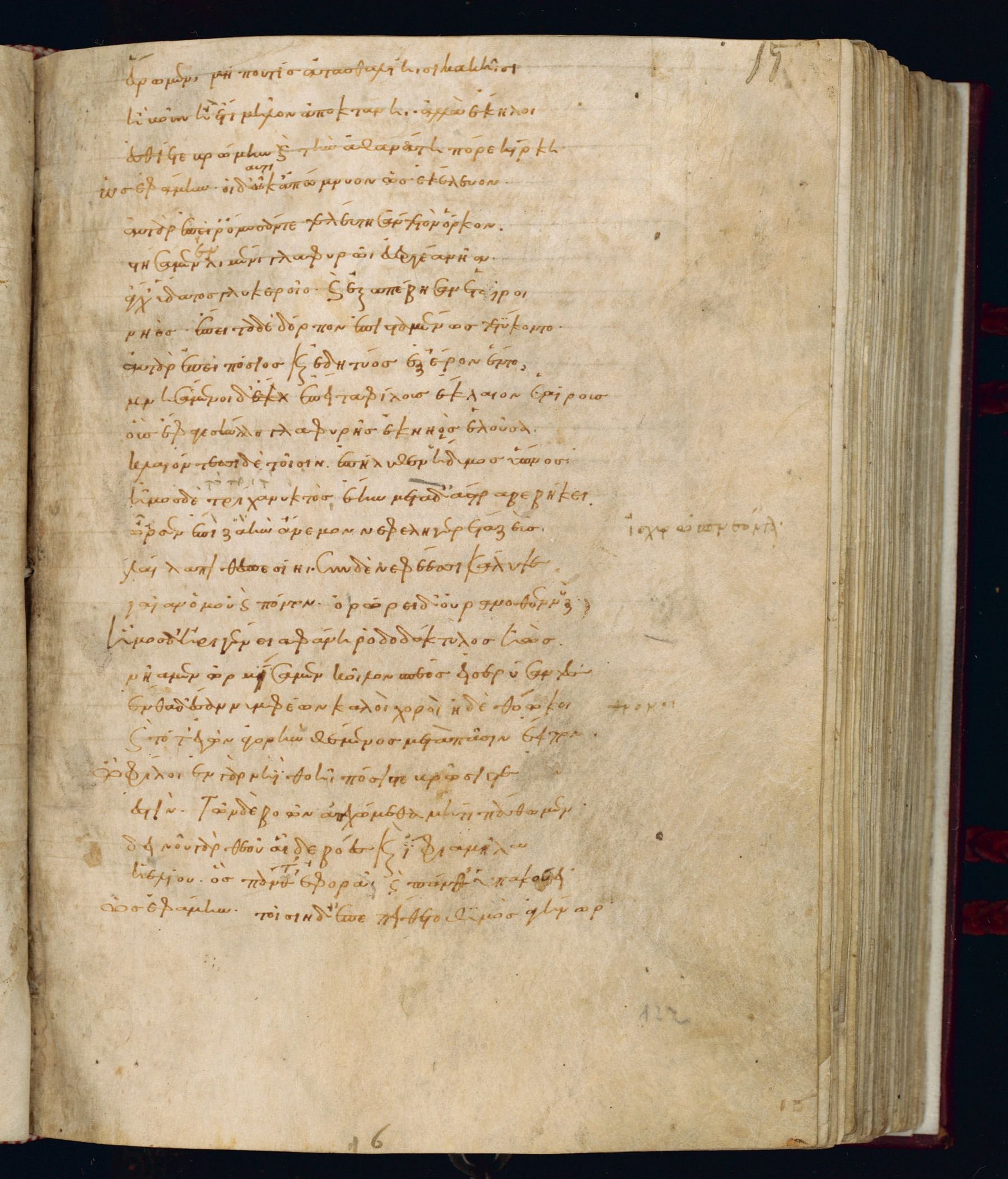
Where on the image
Laur. Plut. 32.24, fol. 122r: Odyssey 12.300-324, begins ‹εὕρωμεν, μή πού τις›, ends ‹δʼ ἐπεπείθετο θυμὸς ἀγήνωρ.›. Checked on the image: first and last lines read and matched to the Greek. Fol. 121v ends with 12.299. Fol. 122v begins with 12.325. English blocks here: 300-304, 305-309, 310-314, 315-319, 320-324.
300εὕρωμεν, μή πού τις ἀτασθαλίῃσι κακῇσιν
301ἢ βοῦν ἠέ τι μῆλον ἀποκτάνῃ· ἀλλὰ ἕκηλοι
302ἐσθίετε βρώμην, τὴν ἀθανάτη πόρε Κίρκη.
303ὣς ἐφάμην, οἱ δʼ αὐτίκʼ ἀπώμνυον, ὡς ἐκέλευον.
304αὐτὰρ ἐπεί ῥʼ ὄμοσάν τε τελεύτησάν τε τὸν ὅρκον,
305στήσαμεν ἐν λιμένι γλαφυρῷ ἐυεργέα νῆα
306ἄγχʼ ὕδατος γλυκεροῖο, καὶ ἐξαπέβησαν ἑταῖροι
307νηός, ἔπειτα δὲ δόρπον ἐπισταμένως τετύκοντο.
308αὐτὰρ ἐπεὶ πόσιος καὶ ἐδητύος ἐξ ἔρον ἕντο,
309μνησάμενοι δὴ ἔπειτα φίλους ἔκλαιον ἑταίρους,
310οὓς ἔφαγε Σκύλλη γλαφυρῆς ἐκ νηὸς ἑλοῦσα·
311κλαιόντεσσι δὲ τοῖσιν ἐπήλυθε νήδυμος ὕπνος.
312ἦμος δὲ τρίχα νυκτὸς ἔην, μετὰ δʼ ἄστρα βεβήκει,
313ὦρσεν ἔπι ζαῆν ἄνεμον νεφεληγερέτα Ζεὺς
314λαίλαπι θεσπεσίῃ, σὺν δὲ νεφέεσσι κάλυψε
315γαῖαν ὁμοῦ καὶ πόντον· ὀρώρει δʼ οὐρανόθεν νύξ.
316ἦμος δʼ ἠριγένεια φάνη ῥοδοδάκτυλος Ἠώς,
317νῆα μὲν ὡρμίσαμεν κοῖλον σπέος εἰσερύσαντες.
318ἔνθα δʼ ἔσαν νυμφέων καλοὶ χοροὶ ἠδὲ θόωκοι·
319καὶ τότʼ ἐγὼν ἀγορὴν θέμενος μετὰ μῦθον ἔειπον·
320ὦ φίλοι, ἐν γὰρ νηὶ θοῇ βρῶσίς τε πόσις τε
321ἔστιν, τῶν δὲ βοῶν ἀπεχώμεθα, μή τι πάθωμεν·
322δεινοῦ γὰρ θεοῦ αἵδε βόες καὶ ἴφια μῆλα,
323Ἠελίου, ὃς πάντʼ ἐφορᾷ καὶ πάντʼ ἐπακούει.
324ὣς ἐφάμην, τοῖσιν δʼ ἐπεπείθετο θυμὸς ἀγήνωρ.
300no man may slay either cow or sheep in the blind folly of his mind; but be content to eat the food which immortal Circe gave.’ “So I spoke; and they straightway swore that they would not, even as I bade them. But when they had sworn and made an end of the oath, 305we moored our well-built ship in the hollow harbor near a spring of sweet water, and my comrades went forth from the ship and skilfully made ready their supper. But when they had put from them the desire of food and drink, then they fell to weeping, as they remembered their dear comrades 310whom Scylla had snatched from out the hollow ship and devoured; and sweet sleep came upon them as they wept. But when it was the third watch of the night, and the stars had turned their course, Zeus, the cloud-gatherer, roused against us a fierce wind with a wondrous tempest, and hid with clouds 315the land and sea alike, and night rushed down from heaven. And as soon as early Dawn appeared, the rosy-fingered, we dragged our ship, and made her fast in a hollow cave, where were the fair dancing-floors and seats of the nymphs. Then I called my men together and spoke among them: 320“‘Friends, in our swift ship is meat and drink; let us therefore keep our hands from those kine lest we come to harm, for these are the cows and goodly sheep of a dread god, even of Helios, who oversees all things and overhears all things.’ “So I spoke, and their proud hearts consented.
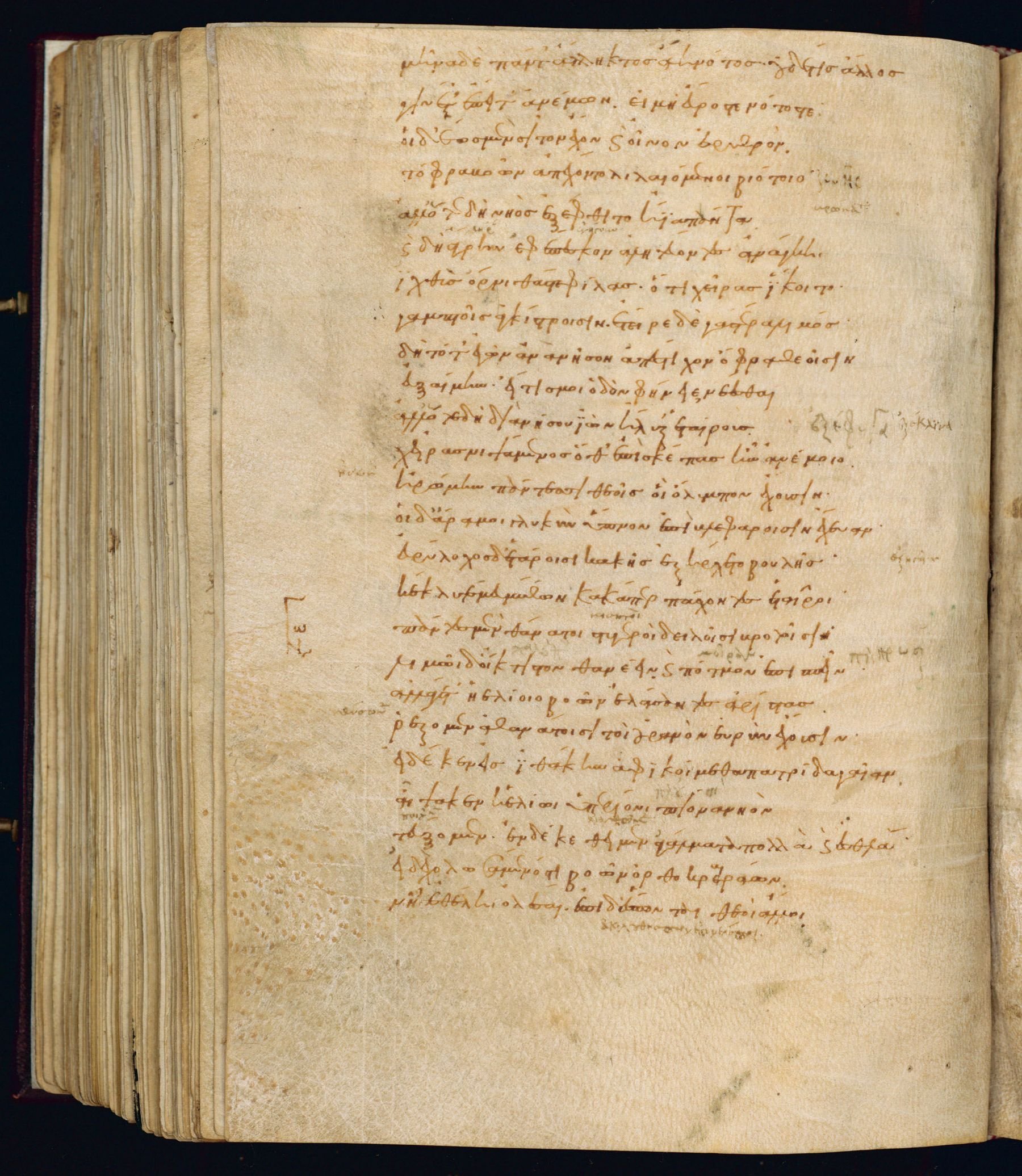
Where on the image
Laur. Plut. 32.24, fol. 122v: Odyssey 12.325-349, begins ‹μῆνα δὲ πάντʼ ἄλληκτος›, ends ‹δʼ ἕσπωνται θεοὶ ἄλλοι,›. Checked on the image: first and last lines read and matched to the Greek. Fol. 122r ends with 12.324. Fol. 123r begins with 12.350. English blocks here: 325-326, 327-329, 330-334, 335-339, 340-344, 345-349.
325μῆνα δὲ πάντʼ ἄλληκτος ἄη Νότος, οὐδέ τις ἄλλος
326γίγνετʼ ἔπειτʼ ἀνέμων εἰ μὴ Εὖρός τε Νότος τε.
327οἱ δʼ ἧος μὲν σῖτον ἔχον καὶ οἶνον ἐρυθρόν,
328τόφρα βοῶν ἀπέχοντο λιλαιόμενοι βιότοιο.
329ἀλλʼ ὅτε δὴ νηὸς ἐξέφθιτο ἤια πάντα,
330καὶ δὴ ἄγρην ἐφέπεσκον ἀλητεύοντες ἀνάγκῃ,
331ἰχθῦς ὄρνιθάς τε, φίλας ὅ τι χεῖρας ἵκοιτο,
332γναμπτοῖς ἀγκίστροισιν, ἔτειρε δὲ γαστέρα λιμός·
333δὴ τότʼ ἐγὼν ἀνὰ νῆσον ἀπέστιχον, ὄφρα θεοῖσιν
334εὐξαίμην, εἴ τίς μοι ὁδὸν φήνειε νέεσθαι.
335ἀλλʼ ὅτε δὴ διὰ νήσου ἰὼν ἤλυξα ἑταίρους,
336χεῖρας νιψάμενος, ὅθʼ ἐπὶ σκέπας ἦν ἀνέμοιο,
337ἠρώμην πάντεσσι θεοῖς οἳ Ὄλυμπον ἔχουσιν·
338οἱ δʼ ἄρα μοι γλυκὺν ὕπνον ἐπὶ βλεφάροισιν ἔχευαν.
339Εὐρύλοχος δʼ ἑτάροισι κακῆς ἐξήρχετο βουλῆς·
340κέκλυτέ μευ μύθων κακά περ πάσχοντες ἑταῖροι.
341πάντες μὲν στυγεροὶ θάνατοι δειλοῖσι βροτοῖσι,
342λιμῷ δʼ οἴκτιστον θανέειν καὶ πότμον ἐπισπεῖν.
343ἀλλʼ ἄγετʼ, Ἠελίοιο βοῶν ἐλάσαντες ἀρίστας
344ῥέξομεν ἀθανάτοισι, τοὶ οὐρανὸν εὐρὺν ἔχουσιν.
345εἰ δέ κεν εἰς Ἰθάκην ἀφικοίμεθα, πατρίδα γαῖαν,
346αἶψά κεν Ἠελίῳ Ὑπερίονι πίονα νηὸν
347τεύξομεν, ἐν δέ κε θεῖμεν ἀγάλματα πολλὰ καὶ ἐσθλά.
348εἰ δὲ χολωσάμενός τι βοῶν ὀρθοκραιράων
349νῆʼ ἐθέλῃ ὀλέσαι, ἐπὶ δʼ ἕσπωνται θεοὶ ἄλλοι,
325Then for a full month the South Wind blew unceasingly, nor did any other wind arise except the East and the South. 327“Now so long as my men had grain and red wine they kept their hands from the kine, for they were eager to save their lives. But when all the stores had been consumed from out the ship, 330and now they must needs roam about in search of game, fishes, and fowl, and whatever might come to their hands—fishing with bent hooks, for hunger pinched their bellies—then I went apart up the island that I might pray to the gods in the hope that one of them might show me a way to go. 335And when, as I went through the island, I had got away from my comrades, I washed my hands in a place where there was shelter from the wind, and prayed to all the gods that hold Olympus; but they shed sweet sleep upon my eyelids. And meanwhile Eurylochus began to give evil counsel to my comrades: 340“‘Hear my words, comrades, for all your evil plight. All forms of death are hateful to wretched mortals, but to die of hunger, and so meet one's doom, is the most pitiful. Nay, come, let us drive off the best of the kine of Helios and offer sacrifice to the immortals who hold broad heaven. 345And if we ever reach Ithaca, our native land, we will straightway build a rich temple to Helios Hyperion and put therein many goodly offerings. And if haply he be wroth at all because of his straight-horned kine, and be minded to destroy our ship, and the other gods consent,
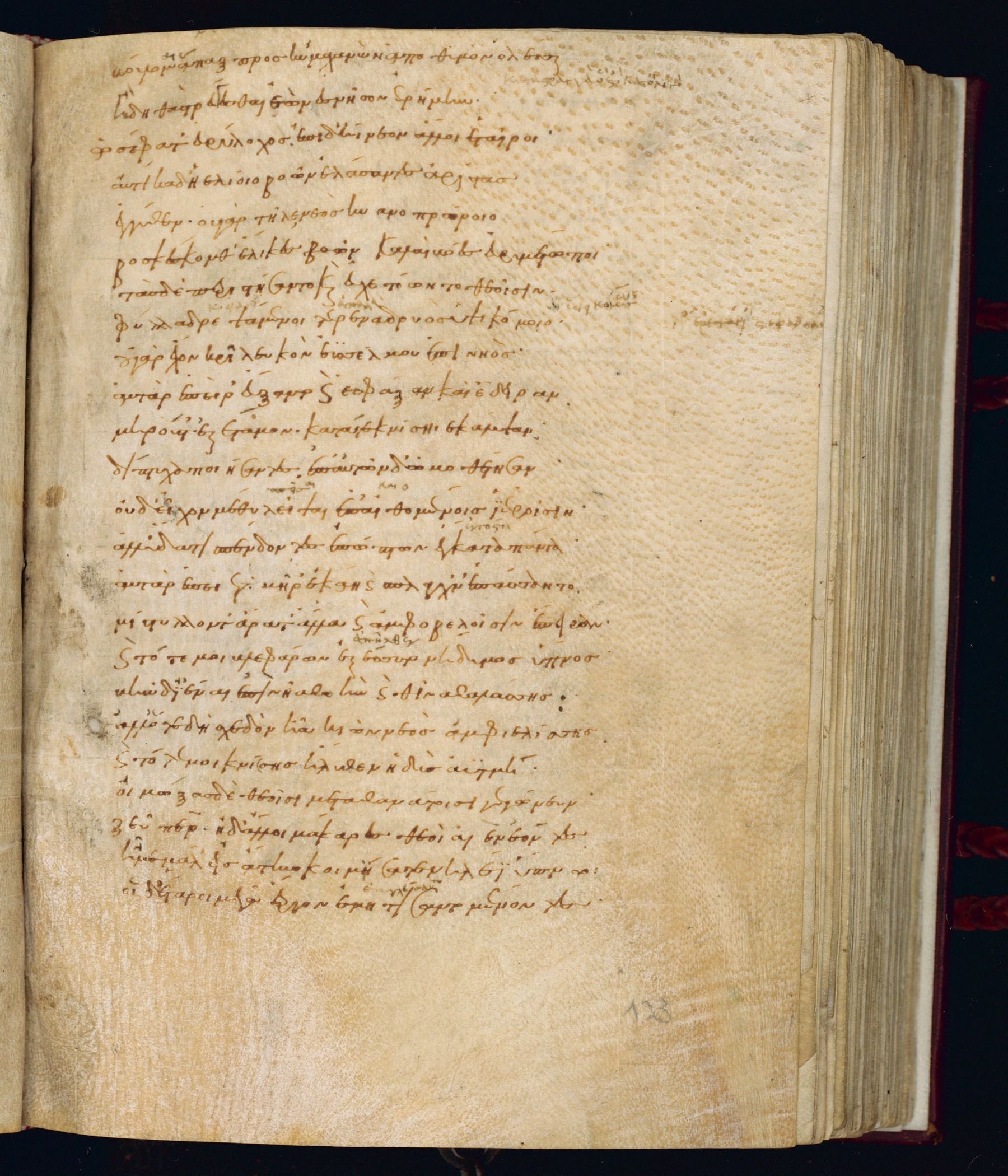
Where on the image
Laur. Plut. 32.24, fol. 123r: Odyssey 12.350-373, begins ‹βούλομʼ ἅπαξ πρὸς κῦμα›, ends ‹μέγα ἔργον ἐμητίσαντο μένοντες.›. Checked on the image: first and last lines read and matched to the Greek. Fol. 122v ends with 12.349. Fol. 123v begins with 12.374. English blocks here: 350-354, 355-359, 360-363, 364-364, 365-369, 370-374.
350βούλομʼ ἅπαξ πρὸς κῦμα χανὼν ἀπὸ θυμὸν ὀλέσσαι,
351ἢ δηθὰ στρεύγεσθαι ἐὼν ἐν νήσῳ ἐρήμῃ.
352ὣς ἔφατʼ Εὐρύλοχος, ἐπὶ δʼ ᾔνεον ἄλλοι ἑταῖροι.
353αὐτίκα δʼ Ἠελίοιο βοῶν ἐλάσαντες ἀρίστας
354ἐγγύθεν, οὐ γὰρ τῆλε νεὸς κυανοπρῴροιο
355βοσκέσκονθʼ ἕλικες καλαὶ βόες εὐρυμέτωποι·
356τὰς δὲ περίστησάν τε καὶ εὐχετόωντο θεοῖσιν,
357φύλλα δρεψάμενοι τέρενα δρυὸς ὑψικόμοιο·
358οὐ γὰρ ἔχον κρῖ λευκὸν ἐυσσέλμου ἐπὶ νηός.
359αὐτὰρ ἐπεί ῥʼ εὔξαντο καὶ ἔσφαξαν καὶ ἔδειραν,
360μηρούς τʼ ἐξέταμον κατά τε κνίσῃ ἐκάλυψαν
361δίπτυχα ποιήσαντες, ἐπʼ αὐτῶν δʼ ὠμοθέτησαν.
362οὐδʼ εἶχον μέθυ λεῖψαι ἐπʼ αἰθομένοις ἱεροῖσιν,
363ἀλλʼ ὕδατι σπένδοντες ἐπώπτων ἔγκατα πάντα.
364αὐτὰρ ἐπεὶ κατὰ μῆρʼ ἐκάη καὶ σπλάγχνα πάσαντο,
365μίστυλλόν τʼ ἄρα τἆλλα καὶ ἀμφʼ ὀβελοῖσιν ἔπειραν.
366καὶ τότε μοι βλεφάρων ἐξέσσυτο νήδυμος ὕπνος,
367βῆν δʼ ἰέναι ἐπὶ νῆα θοὴν καὶ θῖνα θαλάσσης.
368ἀλλʼ ὅτε δὴ σχεδὸν ἦα κιὼν νεὸς ἀμφιελίσσης,
369καὶ τότε με κνίσης ἀμφήλυθεν ἡδὺς ἀυτμή.
370οἰμώξας δὲ θεοῖσι μέγʼ ἀθανάτοισι γεγώνευν·
371Ζεῦ πάτερ ἠδʼ ἄλλοι μάκαρες θεοὶ αἰὲν ἐόντες,
372ἦ με μάλʼ εἰς ἄτην κοιμήσατε νηλέι ὕπνῳ.
373οἱ δʼ ἕταροι μέγα ἔργον ἐμητίσαντο μένοντες.
350rather would I lose my life once for all with a gulp at the wave, than pine slowly away in a desert isle.’ “So spoke Eurylochus, and the rest of my comrades gave assent. Straightway they drove off the best of the kine of Helios from near at hand, for not far from the dark-prowed ship 355were grazing the fair, sleek kine, broad of brow. Around these, then, they stood and made prayer to the gods, plucking the tender leaves from off a high-crested oak; for they had no white barley on board the well-benched ship. Now when they had prayed and had cut the throats of the kine and flayed them, 360they cut out the thigh-pieces and covered them with a double layer of fat and laid raw flesh upon them. They had no wine to pour over the blazing sacrifice, but they made libations with water, and roasted all the entrails over the fire. 364Now when the thighs were wholly burned and they had tasted the inner parts, 365they cut up the rest and spitted it. Then it was that sweet sleep fled from my eyelids, and I went my way to the swift ship and the shore of the sea. But when, as I went, I drew near to the curved ship, then verily the hot savour of the fat was wafted about me, 370and I groaned and cried aloud to the immortal gods: “‘Father Zeus and ye other blessed gods that are for ever, verily it was for my ruin that ye lulled me in pitiless sleep, while my comrades remaining behind have contrived a monstrous deed.’ “Swiftly then to Helios Hyperion came
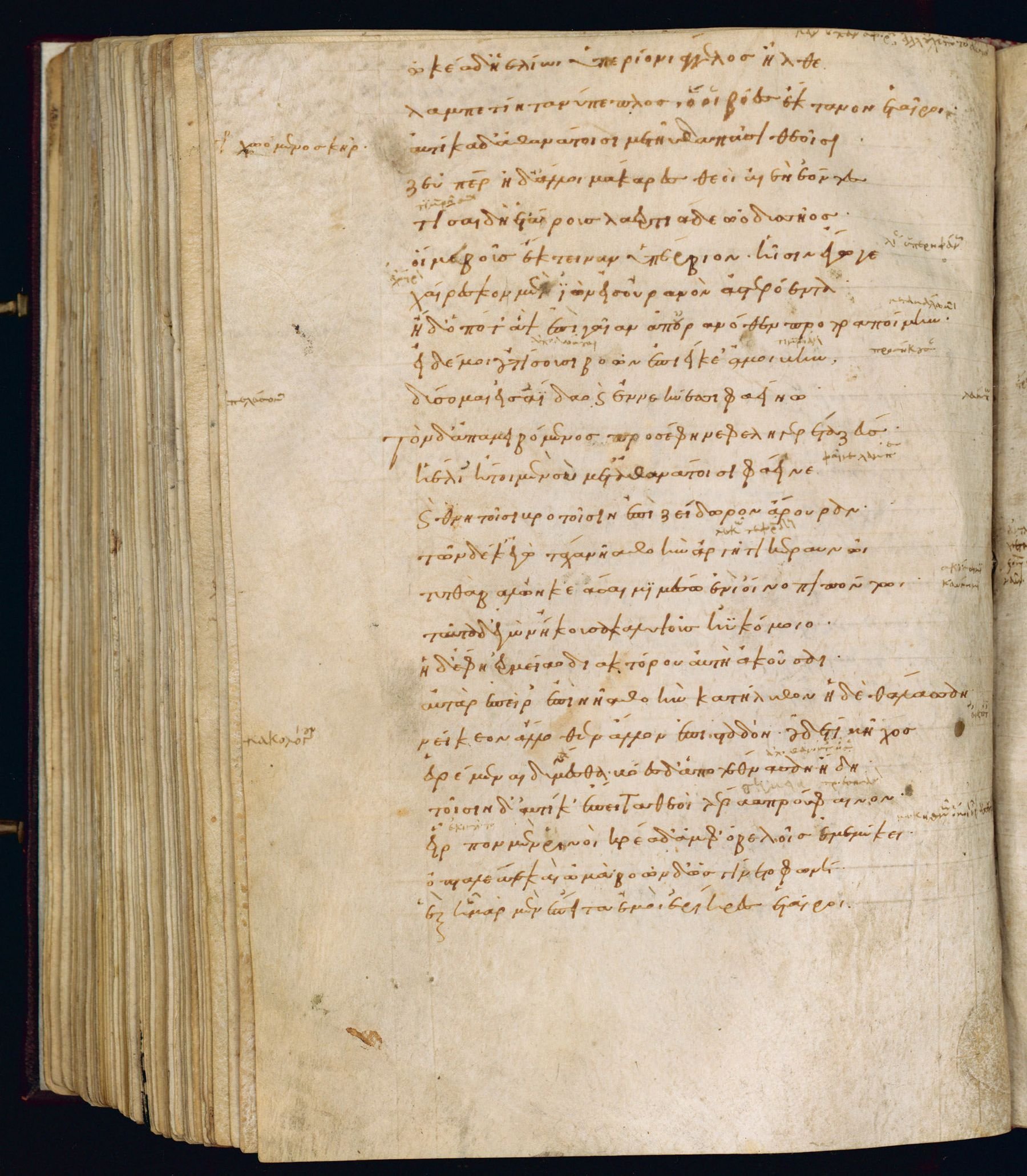
Where on the image
Laur. Plut. 32.24, fol. 123v: Odyssey 12.374-397, begins ‹ὠκέα δʼ Ἠελίῳ Ὑπερίονι›, ends ‹ἔπειτα ἐμοὶ ἐρίηρες ἑταῖροι›. Checked on the image: first and last lines read and matched to the Greek. Fol. 123r ends with 12.373. Fol. 124r begins with 12.398. English blocks here: 375-379, 380-384, 385-389, 390-394, 395-396.
374ὠκέα δʼ Ἠελίῳ Ὑπερίονι ἄγγελος ἦλθε
375Λαμπετίη τανύπεπλος, ὅ οἱ βόας ἔκταμεν ἡμεῖς.
376αὐτίκα δʼ ἀθανάτοισι μετηύδα χωόμενος κῆρ·
377Ζεῦ πάτερ ἠδʼ ἄλλοι μάκαρες θεοὶ αἰὲν ἐόντες,
378τῖσαι δὴ ἑτάρους Λαερτιάδεω Ὀδυσῆος,
379οἵ μευ βοῦς ἔκτειναν ὑπέρβιον, ᾗσιν ἐγώ γε
380χαίρεσκον μὲν ἰὼν εἰς οὐρανὸν ἀστερόεντα,
381ἠδʼ ὁπότʼ ἂψ ἐπὶ γαῖαν ἀπʼ οὐρανόθεν προτραποίμην.
382εἰ δέ μοι οὐ τίσουσι βοῶν ἐπιεικέʼ ἀμοιβήν,
383δύσομαι εἰς Ἀίδαο καὶ ἐν νεκύεσσι φαείνω.
384τὸν δʼ ἀπαμειβόμενος προσέφη νεφεληγερέτα Ζεύς·
385Ἠέλιʼ, ἦ τοι μὲν σὺ μετʼ ἀθανάτοισι φάεινε
386καὶ θνητοῖσι βροτοῖσιν ἐπὶ ζείδωρον ἄρουραν·
387τῶν δέ κʼ ἐγὼ τάχα νῆα θοὴν ἀργῆτι κεραυνῷ
388τυτθὰ βαλὼν κεάσαιμι μέσῳ ἐνὶ οἴνοπι πόντῳ.
389ταῦτα δʼ ἐγὼν ἤκουσα Καλυψοῦς ἠυκόμοιο·
390ἡ δʼ ἔφη Ἑρμείαο διακτόρου αὐτὴ ἀκοῦσαι.
391αὐτὰρ ἐπεί ῥʼ ἐπὶ νῆα κατήλυθον ἠδὲ θάλασσαν,
392νείκεον ἄλλοθεν ἄλλον ἐπισταδόν, οὐδέ τι μῆχος
393εὑρέμεναι δυνάμεσθα, βόες δʼ ἀποτέθνασαν ἤδη.
394τοῖσιν δʼ αὐτίκʼ ἔπειτα θεοὶ τέραα προύφαινον·
395εἷρπον μὲν ῥινοί, κρέα δʼ ἀμφʼ ὀβελοῖσι μεμύκει,
396ὀπταλέα τε καὶ ὠμά, βοῶν δʼ ὣς γίγνετο φωνή.
397ἑξῆμαρ μὲν ἔπειτα ἐμοὶ ἐρίηρες ἑταῖροι
375Lampetie of the long robes, bearing tidings that we had slain his kine; and straightway he spoke among the immortals, wroth at heart: “‘Father Zeus and ye other blessed gods that are for ever, take vengeance now on the comrades of Odysseus, son of Laertes, who have insolently slain my kine, in which I 380ever took delight, when I went toward the starry heaven and when I turned back again to earth from heaven. If they do not pay me fit atonement for the kine I will go down to Hades and shine among the dead.’ “Then Zeus, the cloud-gatherer, answered him and said: 385‘Helios, do thou verily shine on among the immortals and among mortal men upon the earth, the giver of grain. As for these men I will soon smite their swift ship with my bright thunder-bolt, and shatter it to pieces in the midst of the wine-dark sea.’ “This I heard from fair-haired Calypso, 390and she said that she herself had heard it from the messenger Hermes. “But when I had come down to the ship and to the sea I upbraided my men, coming up to each in turn, but we could find no remedy—the kine were already dead. For my men, then, the gods straightway shewed forth portents. 395The hides crawled, the flesh, both roast and raw, bellowed upon the spits, and there was a lowing as of kine.
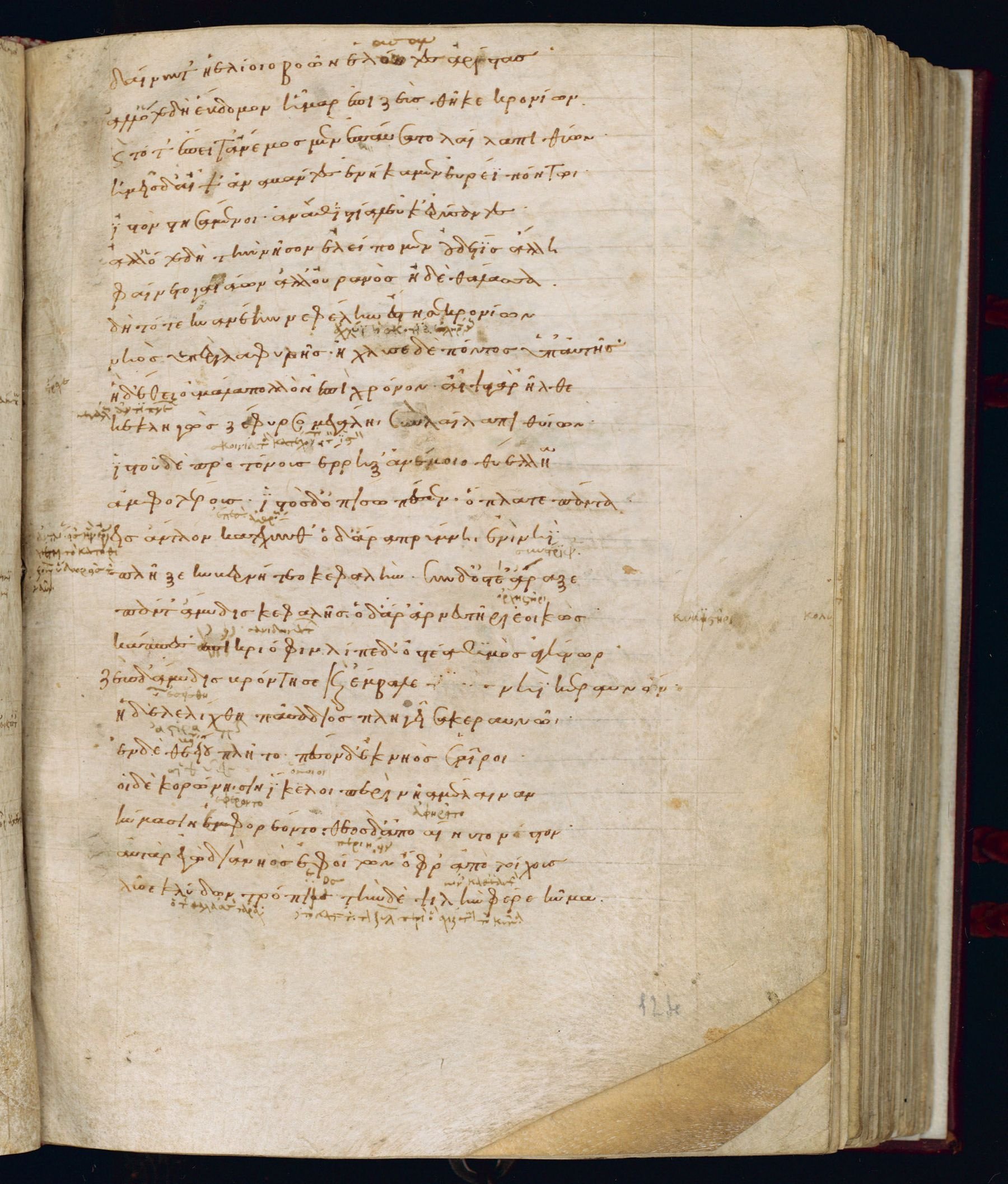
Where on the image
Laur. Plut. 32.24, fol. 124r: Odyssey 12.398-421, begins ‹δαίνυντʼ Ἠελίοιο βοῶν ἐλάσαντες›, ends ‹δὲ ψιλὴν φέρε κῦμα,›. Checked on the image: first and last lines read and matched to the Greek. Fol. 123v ends with 12.397. Fol. 124v begins with 12.422. English blocks here: 397-399, 400-404, 405-409, 410-414, 415-419.
398δαίνυντʼ Ἠελίοιο βοῶν ἐλάσαντες ἀρίστας·
399ἀλλʼ ὅτε δὴ ἕβδομον ἦμαρ ἐπὶ Ζεὺς θῆκε Κρονίων,
400καὶ τότʼ ἔπειτʼ ἄνεμος μὲν ἐπαύσατο λαίλαπι θύων,
401ἡμεῖς δʼ αἶψʼ ἀναβάντες ἐνήκαμεν εὐρέι πόντῳ,
402ἱστὸν στησάμενοι ἀνά θʼ ἱστία λεύκʼ ἐρύσαντες.
403ἀλλʼ ὅτε δὴ τὴν νῆσον ἐλείπομεν, οὐδέ τις ἄλλη
404φαίνετο γαιάων, ἀλλʼ οὐρανὸς ἠδὲ θάλασσα,
405δὴ τότε κυανέην νεφέλην ἔστησε Κρονίων
406νηὸς ὕπερ γλαφυρῆς, ἤχλυσε δὲ πόντος ὑπʼ αὐτῆς.
407ἡ δʼ ἔθει οὐ μάλα πολλὸν ἐπὶ χρόνον· αἶψα γὰρ ἦλθε
408κεκληγὼς Ζέφυρος μεγάλῃ σὺν λαίλαπι θύων,
409ἱστοῦ δὲ προτόνους ἔρρηξʼ ἀνέμοιο θύελλα
410ἀμφοτέρους· ἱστὸς δʼ ὀπίσω πέσεν, ὅπλα τε πάντα
411εἰς ἄντλον κατέχυνθʼ. ὁ δʼ ἄρα πρυμνῇ ἐνὶ νηὶ
412πλῆξε κυβερνήτεω κεφαλήν, σὺν δʼ ὀστέʼ ἄραξε
413πάντʼ ἄμυδις κεφαλῆς· ὁ δʼ ἄρʼ ἀρνευτῆρι ἐοικὼς
414κάππεσʼ ἀπʼ ἰκριόφιν, λίπε δʼ ὀστέα θυμὸς ἀγήνωρ.
415Ζεὺς δʼ ἄμυδις βρόντησε καὶ ἔμβαλε νηὶ κεραυνόν·
416ἡ δʼ ἐλελίχθη πᾶσα Διὸς πληγεῖσα κεραυνῷ,
417ἐν δὲ θεείου πλῆτο, πέσον δʼ ἐκ νηὸς ἑταῖροι.
418οἱ δὲ κορώνῃσιν ἴκελοι περὶ νῆα μέλαιναν
419κύμασιν ἐμφορέοντο, θεὸς δʼ ἀποαίνυτο νόστον.
420αὐτὰρ ἐγὼ διὰ νηὸς ἐφοίτων, ὄφρʼ ἀπὸ τοίχους
421λῦσε κλύδων τρόπιος, τὴν δὲ ψιλὴν φέρε κῦμα,
397“For six days, then, my trusty comrades feasted on the best of the kine of Helios which they had driven off. But when Zeus, the son of Cronos, brought upon us the seventh day, 400then the wind ceased to blow tempestuously, and we straightway went on board, and put out into the broad sea when we had set up the mast and hoisted the white sail. “But when we had left that island and no other land appeared, but only sky and sea, 405then verily the son of Cronos set a black cloud above the hollow ship, and the sea grew dark beneath it. She ran on for no long time, for straightway came the shrieking West Wind, blowing with a furious tempest, and the blast of the wind snapped both the fore-stays of the mast, 410so that the mast fell backward and all its tackling was strewn in the bilge. On the stern of the ship the mast struck the head of the pilot and crushed all the bones of his skull together, and like a diver he fell from the deck and his proud spirit left his bones. 415Therewith Zeus thundered and hurled his bolt upon the ship, and she quivered from stem to stern, smitten by the bolt of Zeus, and was filled with sulphurous smoke, and my comrades fell from out the ship. Like sea-crows they were borne on the waves about the black ship, and the god took from them their returning.
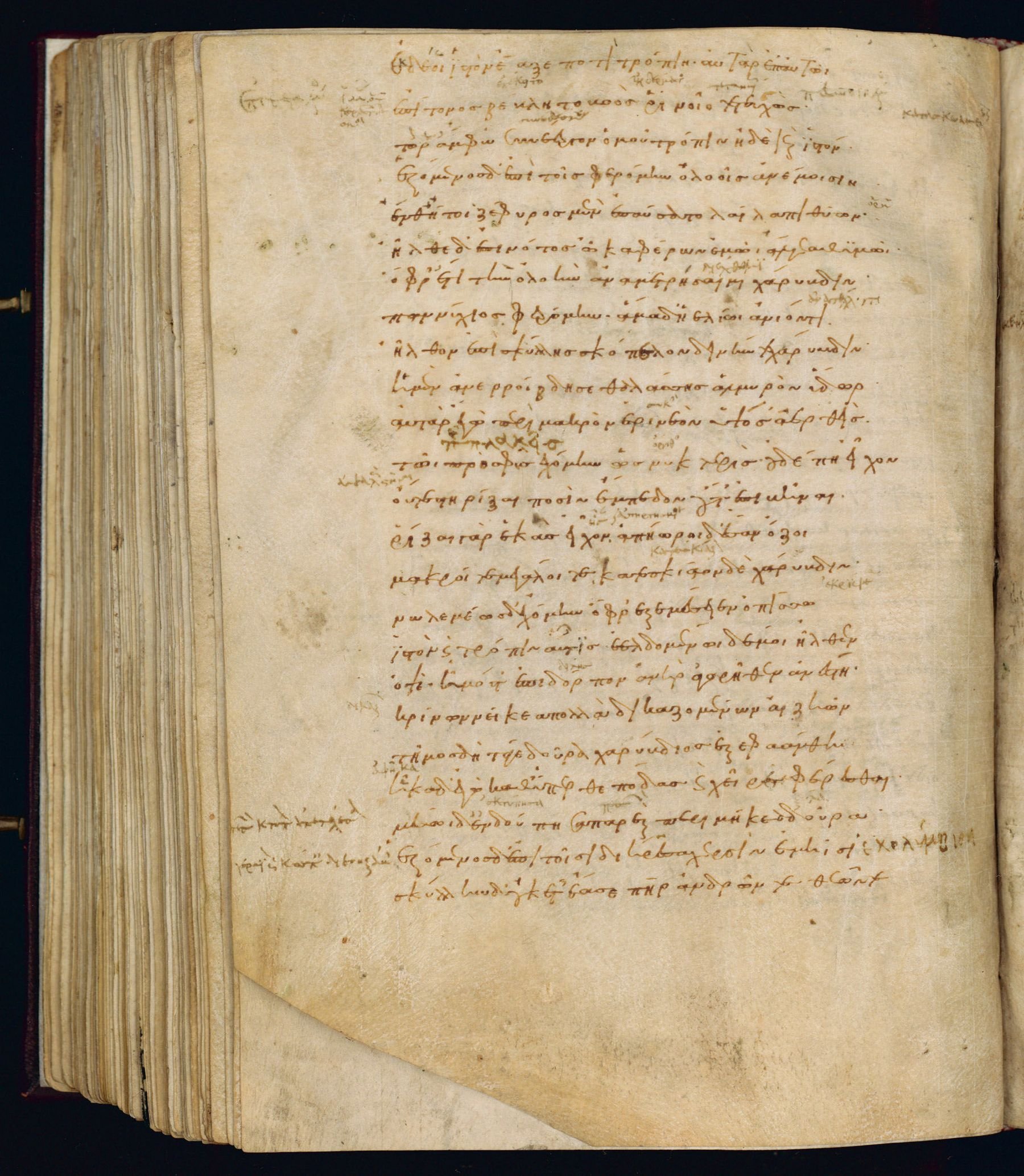
Where on the image
Laur. Plut. 32.24, fol. 124v: Odyssey 12.422-445, begins ‹ἐκ δέ οἱ ἱστὸν›, ends ‹ἀνδρῶν τε θεῶν τε›. Checked on the image: first and last lines read and matched to the Greek. Fol. 124r ends with 12.421. Fol. 125r begins with 12.446. English blocks here: 420-424, 425-425, 426-429, 430-434, 435-439, 440-444.
422ἐκ δέ οἱ ἱστὸν ἄραξε ποτὶ τρόπιν. αὐτὰρ ἐπʼ αὐτῷ
423ἐπίτονος βέβλητο, βοὸς ῥινοῖο τετευχώς·
424τῷ ῥʼ ἄμφω συνέεργον, ὁμοῦ τρόπιν ἠδὲ καὶ ἱστόν,
425ἑζόμενος δʼ ἐπὶ τοῖς φερόμην ὀλοοῖς ἀνέμοισιν.
426ἔνθʼ ἦ τοι Ζέφυρος μὲν ἐπαύσατο λαίλαπι θύων,
427ἦλθε δʼ ἐπὶ Νότος ὦκα, φέρων ἐμῷ ἄλγεα θυμῷ,
428ὄφρʼ ἔτι τὴν ὀλοὴν ἀναμετρήσαιμι Χάρυβδιν.
429παννύχιος φερόμην, ἅμα δʼ ἠελίῳ ἀνιόντι
430ἦλθον ἐπὶ Σκύλλης σκόπελον δεινήν τε Χάρυβδιν.
431ἡ μὲν ἀνερροίβδησε θαλάσσης ἁλμυρὸν ὕδωρ·
432αὐτὰρ ἐγὼ ποτὶ μακρὸν ἐρινεὸν ὑψόσʼ ἀερθείς,
433τῷ προσφὺς ἐχόμην ὡς νυκτερίς. οὐδέ πῃ εἶχον
434οὔτε στηρίξαι ποσὶν ἔμπεδον οὔτʼ ἐπιβῆναι·
435ῥίζαι γὰρ ἑκὰς εἶχον, ἀπήωροι δʼ ἔσαν ὄζοι,
436μακροί τε μεγάλοι τε, κατεσκίαον δὲ Χάρυβδιν.
437νωλεμέως δʼ ἐχόμην, ὄφρʼ ἐξεμέσειεν ὀπίσσω
438ἱστὸν καὶ τρόπιν αὖτις· ἐελδομένῳ δέ μοι ἦλθον
439ὄψʼ· ἦμος δʼ ἐπὶ δόρπον ἀνὴρ ἀγορῆθεν ἀνέστη
440κρίνων νείκεα πολλὰ δικαζομένων αἰζηῶν,
441τῆμος δὴ τά γε δοῦρα Χαρύβδιος ἐξεφαάνθη.
442ἧκα δʼ ἐγὼ καθύπερθε πόδας καὶ χεῖρε φέρεσθαι,
443μέσσῳ δʼ ἐνδούπησα παρὲξ περιμήκεα δοῦρα,
444ἑζόμενος δʼ ἐπὶ τοῖσι διήρεσα χερσὶν ἐμῇσι.
445Σκύλλην δʼ οὐκέτʼ ἔασε πατὴρ ἀνδρῶν τε θεῶν τε
420But I kept pacing up and down the ship till the surge tore the sides from the keel, and the wave bore her on dismantled and snapped the mast off at the keel; but over the mast had been flung the back-stay fashioned of ox-hide; with this I lashed the two together, both keel and mast, 425and sitting on these was borne by the direful winds. 426“Then verily the West Wind ceased to blow tempestuously, and swiftly the South Wind came, bringing sorrow to my heart, that I might traverse again the way to baneful Charybdis. All night long was I borne, and at the rising of the sun 430I came to the cliff of Scylla and to dread Charybdis. She verily sucked down the salt water of the sea, but I, springing up to the tall fig-tree, laid hold of it, and clung to it like a bat. Yet I could in no wise plant my feet firmly or climb upon the tree, 435for its roots spread far below and its branches hung out of reach above, long and great, and overshadowed Charybdis. There I clung steadfastly until she should vomit forth mast and keel again, and to my joy they came at length. At the hour when a man rises from the assembly for his supper, 440one that decides the many quarrels of young men that seek judgment, even at that hour those spars appeared from out Charybdis. And I let go hands and feet from above and plunged down into the waters out beyond the long spars, and sitting on these I rowed onward with my hands.
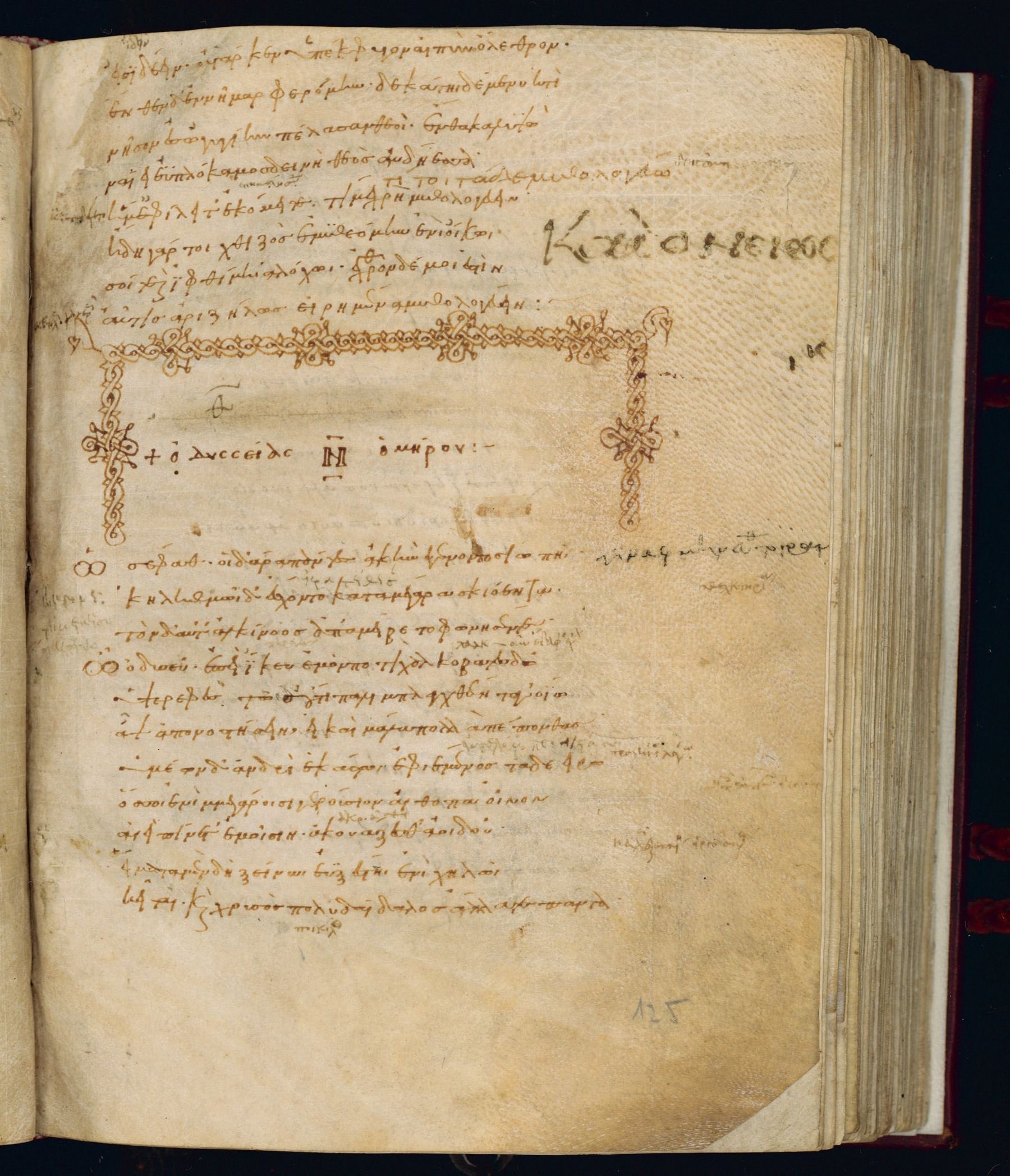
Where on the image
Laur. Plut. 32.24, fol. 125r: Odyssey 12.446-453, begins ‹εἰσιδέειν· οὐ γάρ κεν›, ends ‹αὖτις ἀριζήλως εἰρημένα μυθολογεύειν.›. Checked on the image: first and last lines read and matched to the Greek. Fol. 124v ends with 12.445. The page holds 12.446-453, 13.1-11. Book 12 ends with 12.453; book 13 begins under an interlace frame with the heading + ὀδυσσείας ν ὁμήρου. A later hand has written large letters in the right margin. English blocks here: 445-449, 450-453.
446εἰσιδέειν· οὐ γάρ κεν ὑπέκφυγον αἰπὺν ὄλεθρον.
447ἔνθεν δʼ ἐννῆμαρ φερόμην, δεκάτῃ δέ με νυκτὶ
448νῆσον ἐς Ὠγυγίην πέλασαν θεοί, ἔνθα Καλυψὼ
449ναίει ἐυπλόκαμος, δεινὴ θεὸς αὐδήεσσα,
450ἥ μʼ ἐφίλει τʼ ἐκόμει τε. τί τοι τάδε μυθολογεύω;
451ἤδη γάρ τοι χθιζὸς ἐμυθεόμην ἐνὶ οἴκῳ
452σοί τε καὶ ἰφθίμῃ ἀλόχῳ· ἐχθρὸν δέ μοί ἐστιν
453αὖτις ἀριζήλως εἰρημένα μυθολογεύειν.
445But as for Scylla, the father of gods and men did not suffer her again to catch sight of me, else should I never have escaped utter destruction. “Thence for nine days was I borne, and on the tenth night the gods brought me to Ogygia, where the fair-tressed Calypso dwells, dread goddess of human speech, 450who gave me welcome and tendance. But why should I tell thee this tale? For it was but yesterday that I told it in thy hall to thyself and to thy noble wife. It is an irksome thing, meseems, to tell again a plain-told tale.”
Notes
- Greek: A. T. Murray, Homer: The Odyssey (Loeb Classical Library, 1919), via Perseus.
- English: A. T. Murray's translation in the same edition; his footnotes are omitted.
Cite
Sources
- Source: Laur. Plut. 32.24 (BML Teca Digitale IIIF) + Murray Greek (Loeb 1919, Perseus) + Murray English (Loeb 1919, Perseus) (holding institution)
- Critical edition: Murray, Loeb 1919, via Perseus
← previous · → next · v cycle view · l back to library