Homer, Odyssey, Book 13: Odysseus reaches Ithaca
Introduction
The Odyssey, composed around 700 BCE and attributed to Homer, tells of Odysseus' ten-year journey home from Troy and his return to Ithaca. Book 13 (440 lines): Odysseus reaches Ithaca.
The page photographs are from Florence, Biblioteca Medicea Laurenziana, Plut. 32.24 (parchment, 10th century, 234 folios; the oldest manuscript of the Odyssey with published images), in the Biblioteca Medicea Laurenziana's Teca Digitale. This book is on fol. 125r-134r; each section below is one page, with its first and last line as read on the photograph. Many pages carry interlinear glosses and a few marginal notes in later hands.
The Greek is A. T. Murray's Loeb text (1919) via Perseus, not a transcription of this manuscript, whose wording differs in places. The English is Murray's prose translation (1919), divided every five lines; at a page break a five-line block goes with the page holding most of it, except at the page breaks where a section's note says the English is cut at the end of Murray's sentence. Each section's note gives its English line range.
Where the scribe left out a line, wrote one in the margin, changed the order or added a line not in Murray's text, the section's note on the photograph says so; the Greek and English shown are Murray's full text for the page's range.
How was this verified? (Provenance)
Where on the image
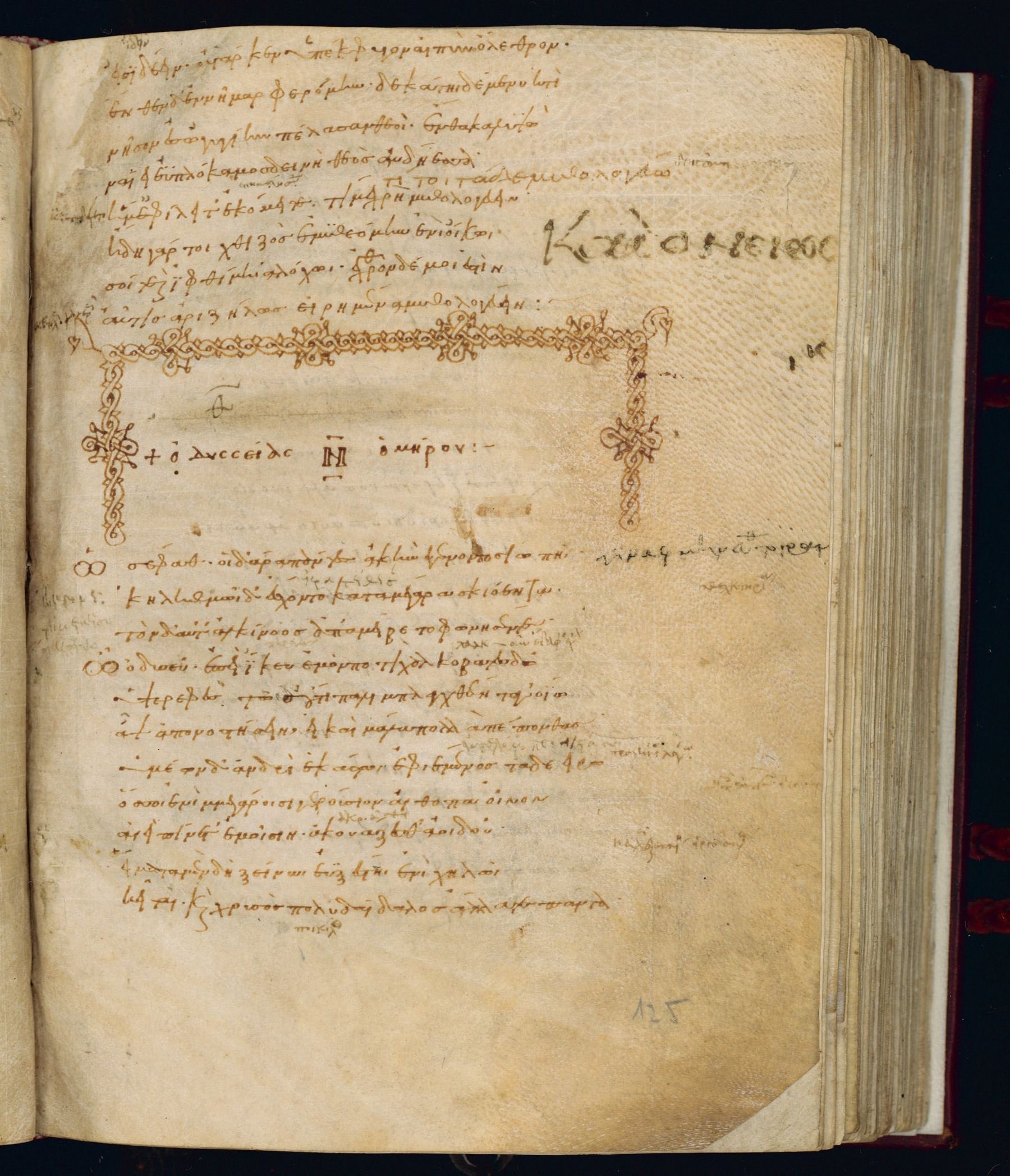
Laur. Plut. 32.24, fol. 125r: Odyssey 13.1-11, begins ‹ὣς ἔφαθʼ, οἱ δʼ›, ends ‹πολυδαίδαλος ἄλλα τε πάντα›. Checked on the image: first and last lines read and matched to the Greek. Fol. 125v begins with 13.12. The page holds 12.446-453, 13.1-11. Book 12 ends with 12.453; book 13 begins under an interlace frame with the heading + ὀδυσσείας ν ὁμήρου. A later hand has written large letters in the right margin. English blocks here: 1-4, 5-9.
1ὣς ἔφαθʼ, οἱ δʼ ἄρα πάντες ἀκὴν ἐγένοντο σιωπῇ,
2κηληθμῷ δʼ ἔσχοντο κατὰ μέγαρα σκιόεντα.
3τὸν δʼ αὖτʼ Ἀλκίνοος ἀπαμείβετο φώνησέν τε·
4ὦ Ὀδυσεῦ, ἐπεὶ ἵκευ ἐμὸν ποτὶ χαλκοβατὲς δῶ,
5ὑψερεφές, τῷ σʼ οὔ τι παλιμπλαγχθέντα γʼ ὀΐω
6ἂψ ἀπονοστήσειν, εἰ καὶ μάλα πολλὰ πέπονθας.
7ὑμέων δʼ ἀνδρὶ ἑκάστῳ ἐφιέμενος τάδε εἴρω,
8ὅσσοι ἐνὶ μεγάροισι γερούσιον αἴθοπα οἶνον
9αἰεὶ πίνετʼ ἐμοῖσιν, ἀκουάζεσθε δʼ ἀοιδοῦ.
10εἵματα μὲν δὴ ξείνῳ ἐϋξέστῃ ἐνὶ χηλῷ
11κεῖται καὶ χρυσὸς πολυδαίδαλος ἄλλα τε πάντα
1So he spoke, and they were all hushed in silence, and were spellbound throughout the shadowy halls. And Alcinous again answered him, and said: “Odysseus, since thou hast come to my 5high-roofed house with floor of brass, thou shalt not, methinks, be driven back, and return with baffled purpose, even though thou hast suffered much. And to each man of you that in my halls are ever wont to drink the flaming wine of the elders, and to listen to the minstrel, I speak, and give this charge.
Where on the image
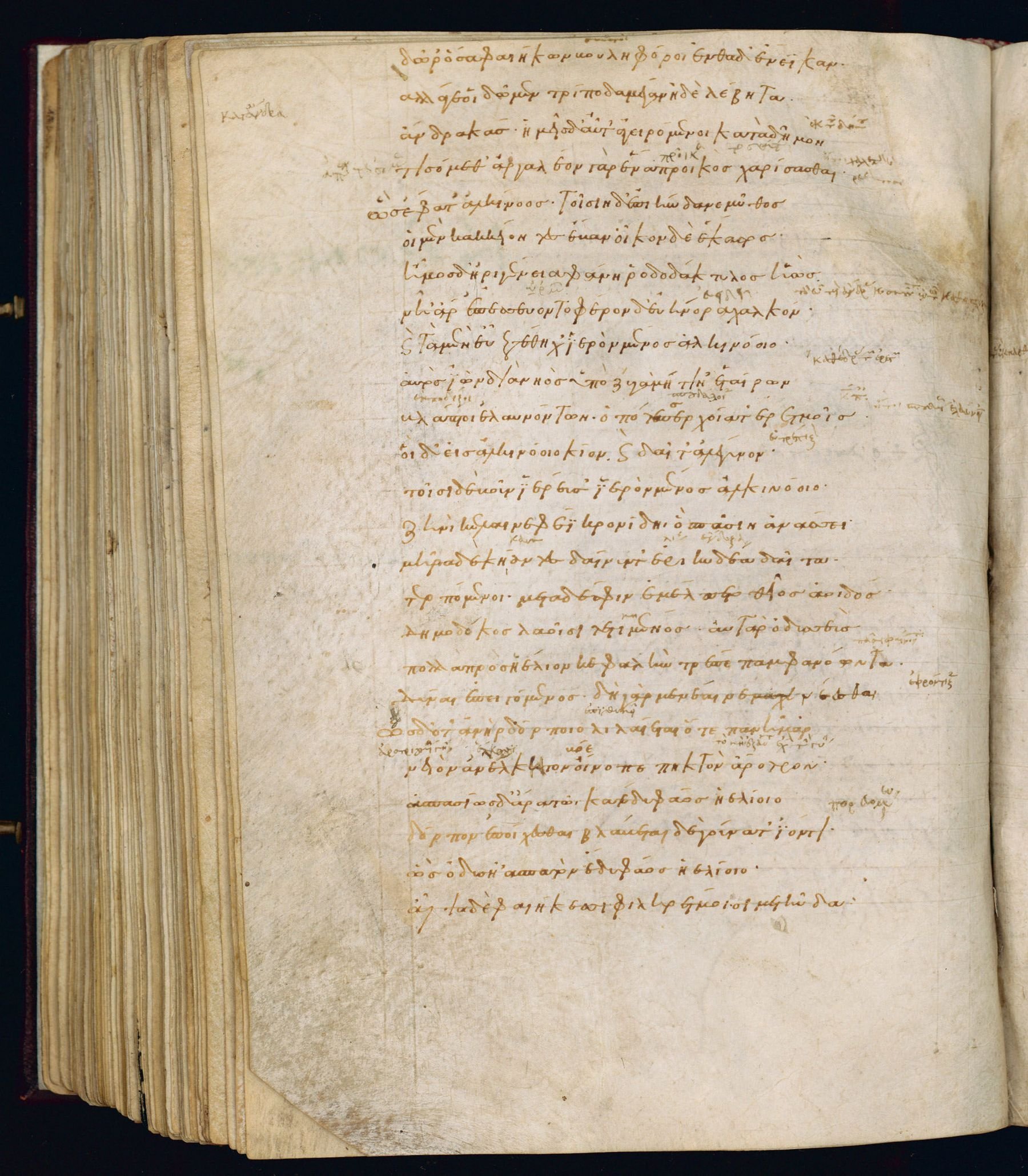
Laur. Plut. 32.24, fol. 125v: Odyssey 13.12-36, begins ‹δῶρʼ, ὅσα Φαιήκων βουληφόροι›, ends ‹δὲ Φαιήκεσσι φιληρέτμοισι μετηύδα,›. Checked on the image: first and last lines read and matched to the Greek. Fol. 125r ends with 13.11. Fol. 126r begins with 13.37. English blocks here: 10-14, 15-19, 20-24, 25-29, 30-34.
12δῶρʼ, ὅσα Φαιήκων βουληφόροι ἐνθάδʼ ἔνεικαν·
13ἀλλʼ ἄγε οἱ δῶμεν τρίποδα μέγαν ἠδὲ λέβητα
14ἀνδρακάς· ἡμεῖς δʼ αὖτε ἀγειρόμενοι κατὰ δῆμον
15τισόμεθʼ· ἀργαλέον γὰρ ἕνα προικὸς χαρίσασθαι.
16ὣς ἔφατʼ Ἀλκίνοος, τοῖσιν δʼ ἐπιήνδανε μῦθος.
17οἱ μὲν κακκείοντες ἔβαν οἶκόνδε ἕκαστος,
18ἦμος δʼ ἠριγένεια φάνη ῥοδοδάκτυλος Ἠώς,
19νῆάδʼ ἐπεσσεύοντο, φέρον δʼ εὐήνορα χαλκόν.
20καὶ τὰ μὲν εὖ κατέθηχʼ ἱερὸν μένος Ἀλκινόοιο,
21αὐτὸς ἰὼν διὰ νηὸς ὑπὸ ζυγά, μή τινʼ ἑταίρων
22βλάπτοι ἐλαυνόντων, ὁπότε σπερχοίατʼ ἐρετμοῖς.
23οἱ δʼ εἰς Ἀλκινόοιο κίον καὶ δαῖτʼ ἀλέγυνον.
24τοῖσι δὲ βοῦν ἱέρευσʼ ἱερὸν μένος Ἀλκινόοιο
25Ζηνὶ κελαινεφέϊ Κρονίδῃ, ὃς πᾶσιν ἀνάσσει.
26μῆρα δὲ κήαντες δαίνυντʼ ἐρικυδέα δαῖτα
27τερπόμενοι· μετὰ δέ σφιν ἐμέλπετο θεῖος ἀοιδός,
28Δημόδοκος, λαοῖσι τετιμένος. αὐτὰρ Ὀδυσσεὺς
29πολλὰ πρὸς ἠέλιον κεφαλὴν τρέπε παμφανόωντα,
30δῦναι ἐπειγόμενος· δὴ γὰρ μενέαινε νέεσθαι.
31ὡς δʼ ὅτʼ ἀνὴρ δόρποιο λιλαίεται, ᾧ τε πανῆμαρ
32νειὸν ἀνʼ ἕλκητον βόε οἴνοπε πηκτὸν ἄροτρον·
33ἀσπασίως δʼ ἄρα τῷ κατέδυ φάος ἠελίοιο
34δόρπον ἐποίχεσθαι, βλάβεται δέ τε γούνατʼ ἰόντι·
35ὣς Ὀδυσῆʼ ἀσπαστὸν ἔδυ φάος ἠελίοιο.
36αἶψα δὲ Φαιήκεσσι φιληρέτμοισι μετηύδα,
10Raiment for the stranger lies already stored in the polished chest, with gold curiously wrought and all the other gifts which the counsellors of the Phaeacians brought hither. But, come now, let us give him a great tripod and a cauldron, each man of us, and we in turn will gather the cost from among the people, 15and repay ourselves. It were hard for one man to give freely, without requital.” So spake Alcinous, and his word was pleasing to them. They then went, each man to his house, to take their rest; but as soon as early Dawn appeared, the rosy-fingered, they hastened to the ship and brought the bronze, that gives strength to men. 20And the strong and mighty Alcinous went himself throughout the ship, and carefully stowed the gifts beneath the benches, that they might not hinder any of the crew at their rowing, when they busily plied the oars. Then they went to the house of Alcinous, and prepared a feast. And for them the strong and mighty Alcinous sacrificed a bull 25to Zeus, son of Cronos, god of the dark clouds, who is lord of all. Then, when they had burned the thigh-pieces, they feasted a glorious feast, and made merry, and among them the divine minstrel Demodocus, held in honor by the people, sang to the lyre. But Odysseus would ever turn his head toward the blazing sun, 30eager to see it set, for verily he was eager to return home. And as a man longs for supper, for whom all day long a yoke of wine-dark oxen has drawn the jointed plough through fallow land, and gladly for him does the light of the sun sink, that he may busy him with his supper, and his knees grow weary as he goes;
Where on the image
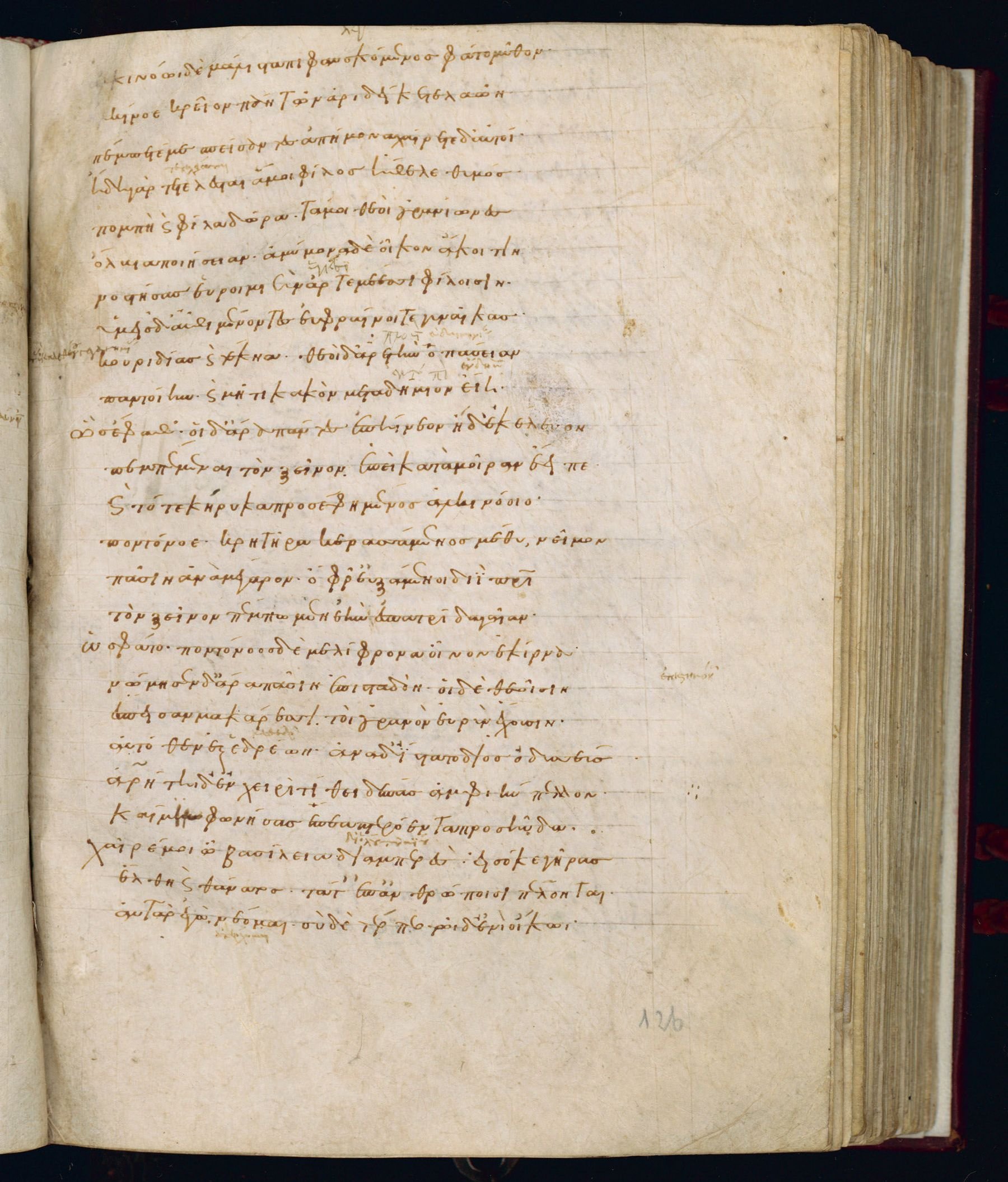
Laur. Plut. 32.24, fol. 126r: Odyssey 13.37-61, begins ‹Ἀλκινόῳ δὲ μάλιστα πιφαυσκόμενος›, ends ‹τέρπεο τῷδʼ ἐνὶ οἴκῳ›. Checked on the image: first and last lines read and matched to the Greek. Fol. 125v ends with 13.36. Fol. 126v begins with 13.62. English blocks here: 35-39, 40-44, 45-46, 47-49, 50-54, 55-59.
37Ἀλκινόῳ δὲ μάλιστα πιφαυσκόμενος φάτο μῦθον·
38Ἀλκίνοε κρεῖον, πάντων ἀριδείκετε λαῶν,
39πέμπετέ με σπείσαντες ἀπήμονα, χαίρετε δʼ αὐτοί·
40ἤδη γὰρ τετέλεσται ἅ μοι φίλος ἤθελε θυμός,
41πομπὴ καὶ φίλα δῶρα, τά μοι θεοὶ Οὐρανίωνες
42ὄλβια ποιήσειαν· ἀμύμονα δʼ οἴκοι ἄκοιτιν
43νοστήσας εὕροιμι σὺν ἀρτεμέεσσι φίλοισιν.
44ὑμεῖς δʼ αὖθι μένοντες ἐϋφραίνοιτε γυναῖκας
45κουριδίας καὶ τέκνα· θεοὶ δʼ ἀρετὴν ὀπάσειαν
46παντοίην, καὶ μή τι κακὸν μεταδήμιον εἴη.
47ὣς ἔφαθʼ, οἱ δʼ ἄρα πάντες ἐπῄνεον ἠδʼ ἐκέλευον
48πεμπέμεναι τὸν ξεῖνον, ἐπεὶ κατὰ μοῖραν ἔειπεν.
49καὶ τότε κήρυκα προσέφη μένος Ἀλκινόοιο·
50Ποντόνοε, κρητῆρα κερασσάμενος μέθυ νεῖμον
51πᾶσιν ἀνὰ μέγαρον, ὄφρʼ εὐξάμενοι Διὶ πατρὶ
52τὸν ξεῖνον πέμπωμεν ἑὴν ἐς πατρίδα γαῖαν.
53ὣς φάτο, Ποντόνοος δὲ μελίφρονα οἶνον ἐκίρνα,
54νώμησεν δʼ ἄρα πᾶσιν ἐπισταδόν· οἱ δὲ θεοῖσιν
55ἔσπεισαν μακάρεσσι, τοὶ οὐρανὸν εὐρὺν ἔχουσιν,
56αὐτόθεν ἐξ ἑδρέων. ἀνὰ δʼ ἵστατο δῖος Ὀδυσσεύς,
57Ἀρήτῃ δʼ ἐν χειρὶ τίθει δέπας ἀμφικύπελλον,
58καί μιν φωνήσας ἔπεα πτερόεντα προσηύδα·
59χαῖρέ μοι, ὦ βασίλεια, διαμπερές, εἰς ὅ κε γῆρας
60ἔλθῃ καὶ θάνατος, τά τʼ ἐπʼ ἀνθρώποισι πέλονται.
61αὐτὰρ ἐγὼ νέομαι· σὺ δὲ τέρπεο τῷδʼ ἐνὶ οἴκῳ
35even so gladly for Odysseus did the light of the sun sink. Straightway then he spoke among the Phaeacians, lovers of the oar, and to Alcinous above all he declared his word, and said: “Lord Alcinous, renowned above all men, pour libations now, and send ye me on my way in peace; and yourselves too—Farewell! 40For now all that my heart desired has been brought to pass: a convoy, and gifts of friendship. May the gods of heaven bless them to me, and on my return may I find in my home my peerless wife with those I love unscathed; and may you again, remaining here, make glad 45your wedded wives and children; and may the gods grant you prosperity of every sort, and may no evil come upon your people.” 47So he spoke, and they all praised his words, and bade send the stranger on his way, since he had spoken fittingly. Then the mighty Alcinous spoke to the herald, saying: 50“Pontonous, mix the bowl, and serve out wine to all in the hall, in order that, when we have made prayer to father Zeus, we may send forth the stranger to his own native land.” So he spoke, and Pontonous mixed the honey hearted wine and served out to all, coming up to each in turn; 55and they poured libations to the blessed gods, who hold broad heaven, from where they sat. But goodly Odysseus arose, and placed in the hand of Arete the two-handled cup, and spoke, and addressed her with winged words: “Fare thee well, O queen, throughout all the years, till old age
Where on the image
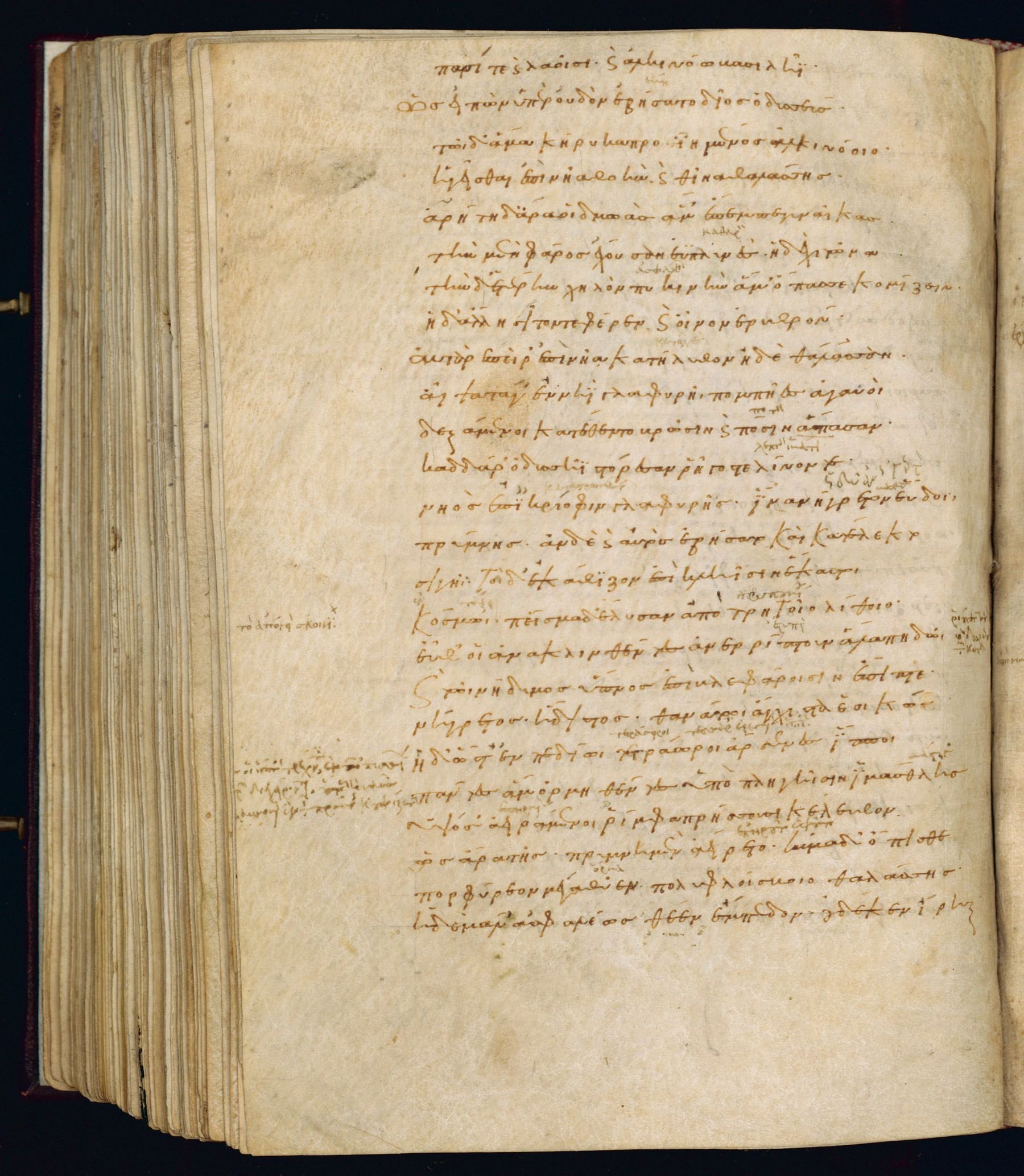
Laur. Plut. 32.24, fol. 126v: Odyssey 13.62-86, begins ‹παισί τε καὶ λαοῖσι›, ends ‹ἔμπεδον· οὐδέ κεν ἴρηξ›. Checked on the image: first and last lines read and matched to the Greek. Fol. 126r ends with 13.61. Fol. 127r begins with 13.87. English blocks here: 60-64, 65-69, 70-74, 75-79, 80-84.
62παισί τε καὶ λαοῖσι καὶ Ἀλκινόῳ βασιλῆϊ.
63ὣς εἰπὼν ὑπὲρ οὐδὸν ἐβήσετο δῖος Ὀδυσσεύς,
64τῷ δʼ ἅμα κήρυκα προΐει μένος Ἀλκινόοιο,
65ἡγεῖσθαι ἐπὶ νῆα θοὴν καὶ θῖνα θαλάσσης·
66Ἀρήτη δʼ ἄρα οἱ δμῳὰς ἅμʼ ἔπεμπε γυναῖκας,
67τὴν μὲν φᾶρος ἔχουσαν ἐϋπλυνὲς ἠδὲ χιτῶνα,
68τὴν δʼ ἑτέρην χηλὸν πυκινὴν ἅμʼ ὄπασσε κομίζειν·
69ἡ δʼ ἄλλη σῖτόν τʼ ἔφερεν καὶ οἶνον ἐρυθρόν.
70αὐτὰρ ἐπεί ῥʼ ἐπὶ νῆα κατήλυθον ἠδὲ θάλασσαν,
71αἶψα τά γʼ ἐν νηῒ γλαφυρῇ πομπῆες ἀγαυοὶ
72δεξάμενοι κατέθεντο, πόσιν καὶ βρῶσιν ἅπασαν·
73κὰδ δʼ ἄρʼ Ὀδυσσῆϊ στόρεσαν ῥῆγός τε λίνον τε
74νηὸς ἐπʼ ἰκριόφιν γλαφυρῆς, ἵνα νήγρετον εὕδοι,
75πρυμνῆς· ἂν δὲ καὶ αὐτὸς ἐβήσετο καὶ κατέλεκτο
76σιγῇ· τοὶ δὲ καθῖζον ἐπὶ κληῗσιν ἕκαστοι
77κόσμῳ, πεῖσμα δʼ ἔλυσαν ἀπὸ τρητοῖο λίθοιο.
78εὖθʼ οἱ ἀνακλινθέντες ἀνερρίπτουν ἅλα πηδῷ,
79καὶ τῷ νήδυμος ὕπνος ἐπὶ βλεφάροισιν ἔπιπτε,
80νήγρετος, ἥδιστος, θανάτῳ ἄγχιστα ἐοικώς.
81ἡ δʼ, ὥς τʼ ἐν πεδίῳ τετράοροι ἄρσενες ἵπποι,
82πάντες ἅμʼ ὁρμηθέντες ὑπὸ πληγῇσιν ἱμάσθλης,
83ὑψόσʼ ἀειρόμενοι ῥίμφα πρήσσουσι κέλευθον,
84ὣς ἄρα τῆς πρύμνη μὲν ἀείρετο, κῦμα δʼ ὄπισθε
85πορφύρεον μέγα θῦε πολυφλοίσβοιο θαλάσσης.
86ἡ δὲ μάλʼ ἀσφαλέως θέεν ἔμπεδον· οὐδέ κεν ἴρηξ
60and death come, which are the lot of mortals. As for me, I go my way, but do thou in this house have joy of thy children and thy people and Alcinous the king.” So the goodly Odysseus spake and passed over the threshold. And with him the mighty Alcinous sent forth a herald 65to lead him to the swift ship and the shore of the sea. And Arete sent with him slave women, one bearing a newly washed cloak and a tunic, and another again she bade follow to bear the strong chest, and yet another bore bread and red wine. 70But when they had come down to the ship and to the sea, straightway the lordly youths that were his escort took these things, and stowed them in the hollow ship, even all the food and drink. Then for Odysseus they spread a rug and a linen sheet on the deck of the hollow ship 75at the stern, that he might sleep soundly; and he too went aboard, and laid him down in silence. Then they sat down on the benches, each in order, and loosed the hawser from the pierced stone. And as soon as they leaned back, and tossed the brine with their oarblades, sweet sleep fell upon his eyelids, 80an unawakening sleep, most sweet, and most like to death. And as on a plain four yoked stallions spring forward all together beneath the strokes of the lash, and leaping on high swiftly accomplish their way, even so the stern of that ship leapt on high, and in her wake
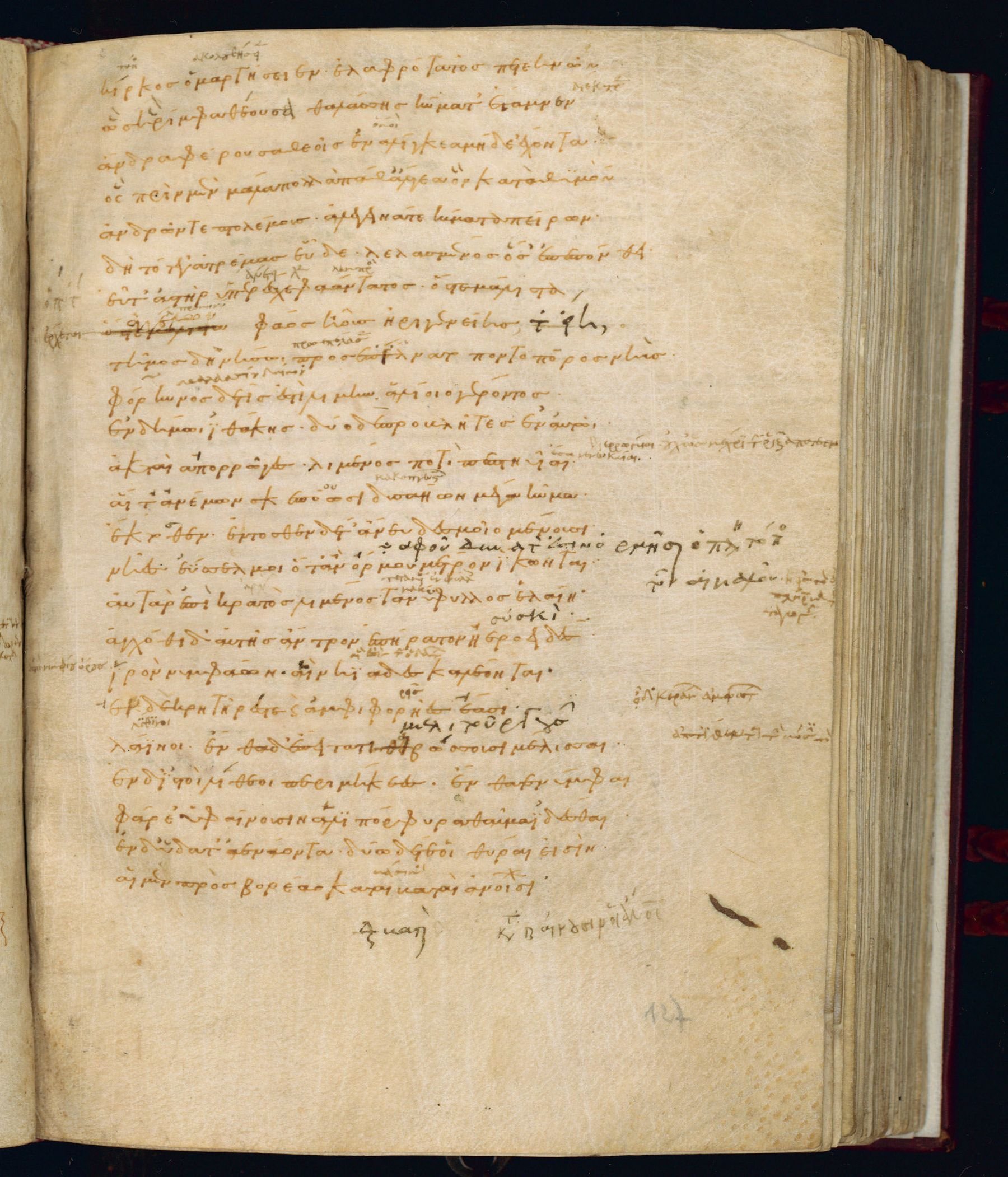
Where on the image
Laur. Plut. 32.24, fol. 127r: Odyssey 13.87-110, begins ‹κίρκος ὁμαρτήσειεν, ἐλαφρότατος πετεηνῶν.›, ends ‹πρὸς Βορέαο καταιβαταὶ ἀνθρώποισιν,›. Checked on the image: first and last lines read and matched to the Greek. Fol. 126v ends with 13.86. Fol. 127v begins with 13.111. Below the last verse there is a short note in a later hand. English blocks here: 85-89, 90-92, 93-94, 95-99, 100-104, 105-109.
87κίρκος ὁμαρτήσειεν, ἐλαφρότατος πετεηνῶν.
88ὣς ἡ ῥίμφα θέουσα θαλάσσης κύματʼ ἔταμνεν,
89ἄνδρα φέρουσα θεοῖς ἐναλίγκια μήδεʼ ἔχοντα·
90ὃς πρὶν μὲν μάλα πολλὰ πάθʼ ἄλγεα ὃν κατὰ θυμὸν
91ἀνδρῶν τε πτολέμους ἀλεγεινά τε κύματα πείρων,
92δὴ τότε γʼ ἀτρέμας εὗδε, λελασμένος ὅσσʼ ἐπεπόνθει.
93εὖτʼ ἀστὴρ ὑπερέσχε φαάντατος, ὅς τε μάλιστα
94ἔρχεται ἀγγέλλων φάος Ἠοῦς ἠριγενείης,
95τῆμος δὴ νήσῳ προσεπίλνατο ποντοπόρος νηῦς.
96Φόρκυνος δέ τίς ἐστι λιμήν, ἁλίοιο γέροντος,
97ἐν δήμῳ Ἰθάκης· δύο δὲ προβλῆτες ἐν αὐτῷ
98ἀκταὶ ἀπορρῶγες, λιμένος ποτιπεπτηυῖαι,
99αἵ τʼ ἀνέμων σκεπόωσι δυσαήων μέγα κῦμα
100ἔκτοθεν· ἔντοσθεν δέ τʼ ἄνευ δεσμοῖο μένουσι
101νῆες ἐΰσσελμοι, ὅτʼ ἂν ὅρμου μέτρον ἵκωνται.
102αὐτὰρ ἐπὶ κρατὸς λιμένος τανύφυλλος ἐλαίη,
103ἀγχόθι δʼ αὐτῆς ἄντρον ἐπήρατον ἠεροειδές,
104ἱρὸν νυμφάων αἳ νηϊάδες καλέονται.
105ἐν δὲ κρητῆρές τε καὶ ἀμφιφορῆες ἔασιν
106λάϊνοι· ἔνθα δʼ ἔπειτα τιθαιβώσσουσι μέλισσαι.
107ἐν δʼ ἱστοὶ λίθεοι περιμήκεες, ἔνθα τε νύμφαι
108φάρεʼ ὑφαίνουσιν ἁλιπόρφυρα, θαῦμα ἰδέσθαι·
109ἐν δʼ ὕδατʼ ἀενάοντα. δύω δέ τέ οἱ θύραι εἰσίν,
110αἱ μὲν πρὸς Βορέαο καταιβαταὶ ἀνθρώποισιν,
85the dark wave of the loud-sounding sea foamed mightily, and she sped safely and surely on her way; not even the circling hawk, the swiftest of winged things, could have kept pace with her. Thus she sped on swiftly and clove the waves of the sea, bearing a man the peer of the gods in counsel, 90one who in time past had suffered many griefs at heart in passing through wars of men and the grievous waves; but now he slept in peace, forgetful of all that he had suffered. 93Now when that brightest of stars rose which ever comes to herald the light of early Dawn, 95even then the seafaring ship drew near to the island. There is in the land of Ithaca a certain harbor of Phorcys, the old man of the sea, and at its mouth two projecting headlands sheer to seaward, but sloping down on the side toward the harbor. These keep back the great waves raised by heavy winds 100without, but within the benched ships lie unmoored when they have reached the point of anchorage. At the head of the harbor is a long-leafed olive tree, and near it a pleasant, shadowy cave sacred to the nymphs that are called Naiads. 105Therein are mixing bowls and jars of stone, and there too the bees store honey. And in the cave are long looms of stone, at which the nymphs weave webs of purple dye, a wonder to behold; and therein are also ever-flowing springs. Two doors there are to the cave,
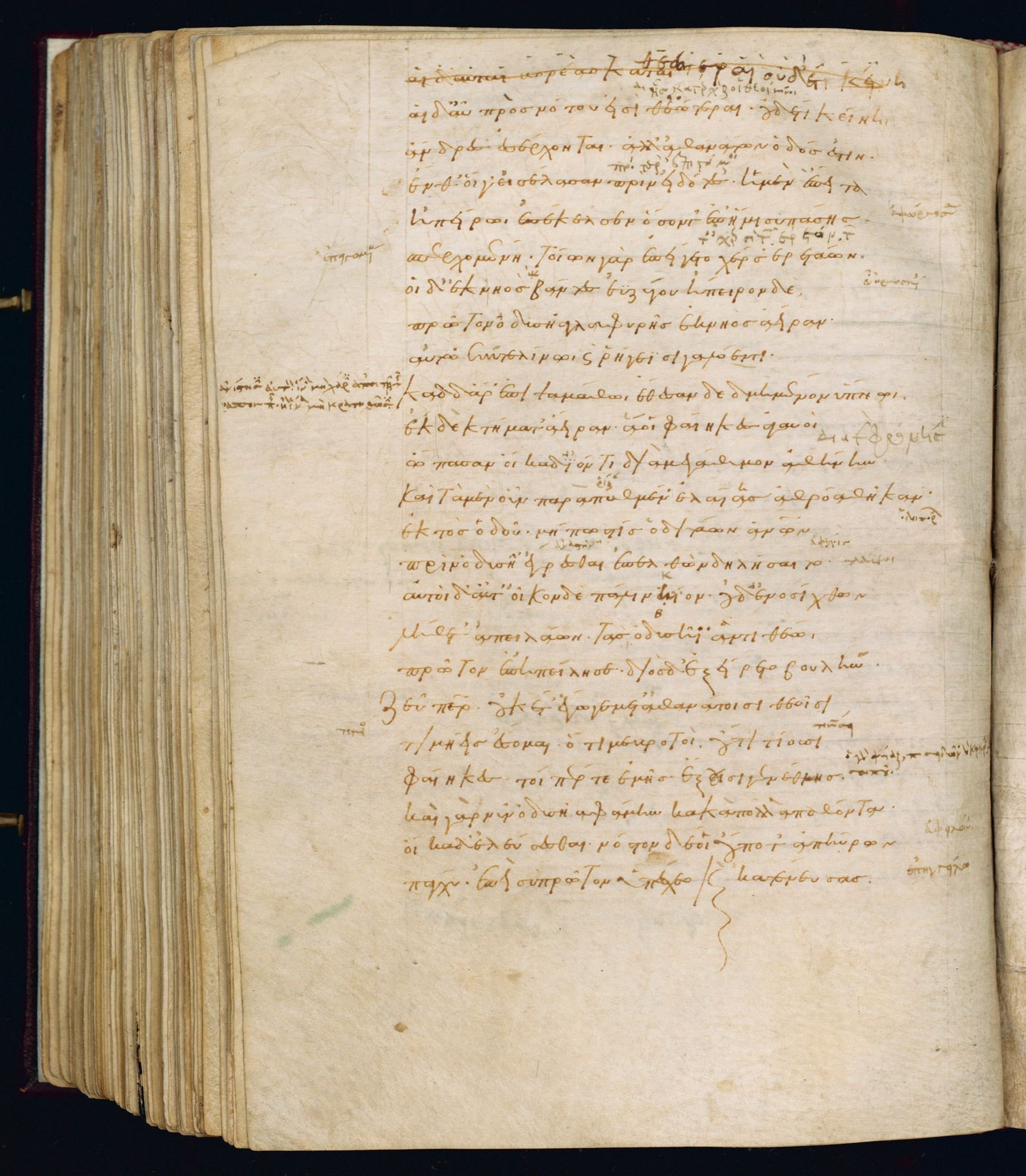
Where on the image
Laur. Plut. 32.24, fol. 127v: Odyssey 13.111-133, begins ‹αἱ δʼ αὖ πρὸς›, ends ‹πρῶτον ὑπέσχεο καὶ κατένευσας.›. Checked on the image: first and last lines read and matched to the Greek. Fol. 127r ends with 13.110. Fol. 128r begins with 13.134. The first line of the page is struck through (a false start of 13.111, corrected above); 13.111 then follows in full. English blocks here: 110-114, 115-119, 120-124, 125-129, 130-134.
111αἱ δʼ αὖ πρὸς Νότου εἰσὶ θεώτεραι· οὐδέ τι κείνῃ
112ἄνδρες ἐσέρχονται, ἀλλʼ ἀθανάτων ὁδός ἐστιν.
113ἔνθʼ οἵ γʼ εἰσέλασαν, πρὶν εἰδότες· ἡ μὲν ἔπειτα
114ἠπείρῳ ἐπέκελσεν, ὅσον τʼ ἐπὶ ἥμισυ πάσης,
115σπερχομένη· τοῖον γὰρ ἐπείγετο χέρσʼ ἐρετάων·
116οἱ δʼ ἐκ νηὸς βάντες ἐϋζύγου ἤπειρόνδε
117πρῶτον Ὀδυσσῆα γλαφυρῆς ἐκ νηὸς ἄειραν
118αὐτῷ σύν τε λίνῳ καὶ ῥήγεϊ σιγαλόεντι,
119κὰδ δʼ ἄρʼ ἐπὶ ψαμάθῳ ἔθεσαν δεδμημένον ὕπνῳ,
120ἐκ δὲ κτήματʼ ἄειραν, ἅ οἱ Φαίηκες ἀγαυοὶ
121ὤπασαν οἴκαδʼ ἰόντι διὰ μεγάθυμον Ἀθήνην.
122καὶ τὰ μὲν οὖν παρὰ πυθμένʼ ἐλαίης ἀθρόα θῆκαν
123ἐκτὸς ὁδοῦ, μή πώς τις ὁδιτάων ἀνθρώπων,
124πρίν γʼ Ὀδυσῆʼ ἔγρεσθαι, ἐπελθὼν δηλήσαιτο·
125αὐτοὶ δʼ αὖτʼ οἶκόνδε πάλιν κίον. οὐδʼ ἐνοσίχθων
126λήθετʼ ἀπειλάων, τὰς ἀντιθέῳ Ὀδυσῆϊ
127πρῶτον ἐπηπείλησε, Διὸς δʼ ἐξείρετο βουλήν·
128Ζεῦ πάτερ, οὐκέτʼ ἐγώ γε μετʼ ἀθανάτοισι θεοῖσι
129τιμήεις ἔσομαι, ὅτε με βροτοὶ οὔ τι τίουσιν,
130Φαίηκες, τοί πέρ τοι ἐμῆς ἔξ εἰσι γενέθλης.
131καὶ γὰρ νῦν Ὀδυσῆʼ ἐφάμην κακὰ πολλὰ παθόντα
132οἴκαδʼ ἐλεύσεσθαι· νόστον δέ οἱ οὔ ποτʼ ἀπηύρων
133πάγχυ, ἐπεὶ σὺ πρῶτον ὑπέσχεο καὶ κατένευσας.
110one toward the North Wind, by which men go down, but that toward the South Wind is sacred, nor do men enter thereby; it is the way of the immortals. Here they rowed in, knowing the place of old; and the ship ran full half her length on the shore 115in her swift course, at such pace was she driven by the arms of the rowers. Then they stepped forth from the benched ship upon the land, and first they lifted Odysseus out of the hollow ship, with the linen sheet and bright rug as they were, and laid him down on the sand, still overpowered by sleep. 120And they lifted out the goods which the lordly Phaeacians had given him, as he set out for home, through the favour of great-hearted Athena. These they set all together by the trunk of the olive tree, out of the path, lest haply some wayfarer, before Odysseus awoke, might come upon them and spoil them. 125Then they themselves returned home again. But the Shaker of the Earth did not forget the threats wherewith at the first he had threatened godlike Odysseus, and he thus enquired of the purpose of Zeus: “Father Zeus, no longer shall I, even I, be held in honor among the immortal gods, seeing that mortals honor me not a whit— 130even the Phaeacians, who, thou knowest, are of my own lineage. For I but now declared that Odysseus should suffer many woes ere he reached his home, though I did not wholly rob him of his return when once thou hadst promised it and confirmed it with thy nod; yet in his sleep these men have borne him in a swift ship over the sea
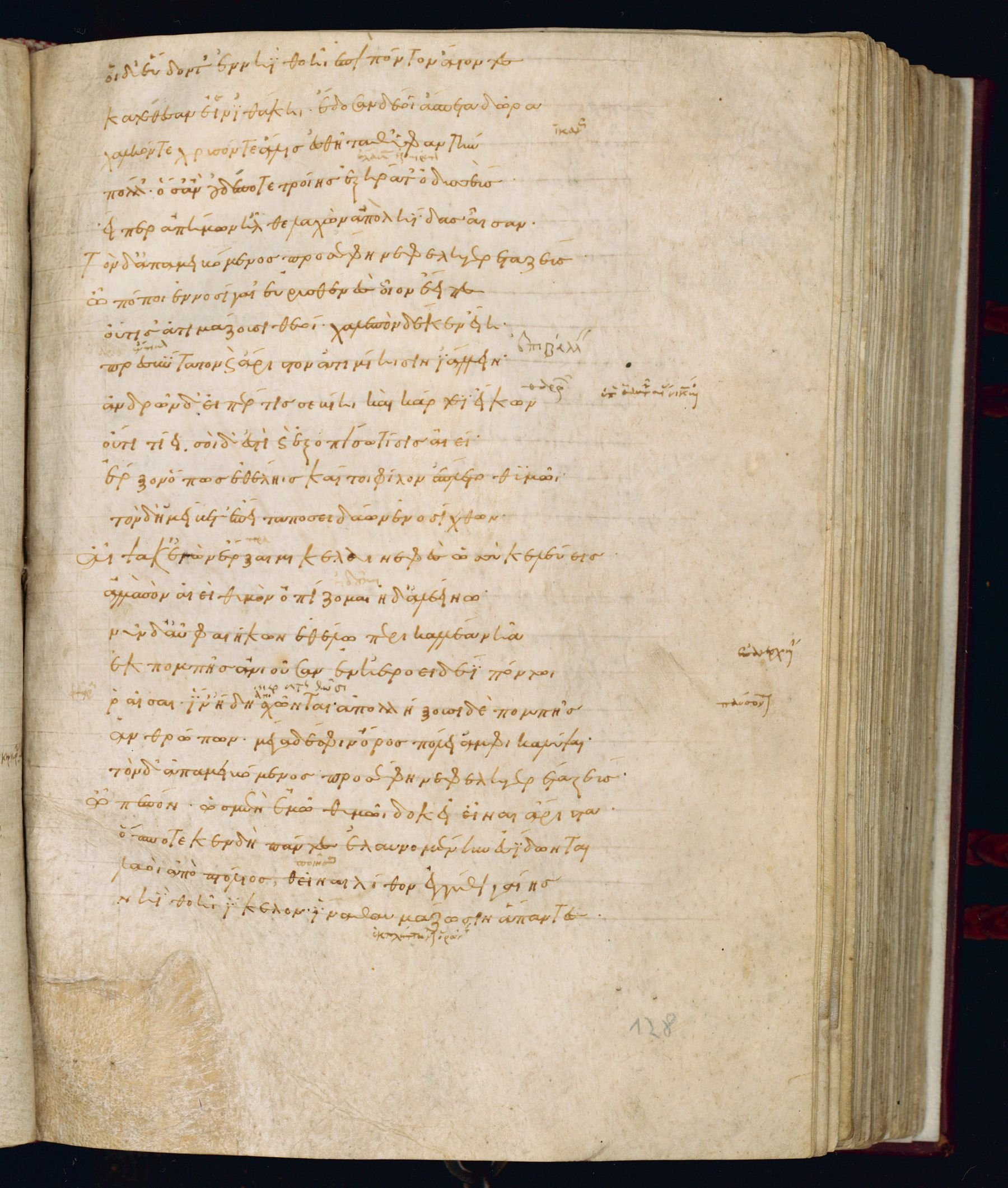
Where on the image
Laur. Plut. 32.24, fol. 128r: Odyssey 13.134-157, begins ‹οἱ δʼ εὕδοντʼ ἐν›, ends ‹ἴκελον, ἵνα θαυμάζωσιν ἅπαντες›. Checked on the image: first and last lines read and matched to the Greek. Fol. 127v ends with 13.133. Fol. 128v begins with 13.158. English blocks here: 135-138, 139-139, 140-144, 145-149, 150-154, 155-159.
134οἱ δʼ εὕδοντʼ ἐν νηῒ θοῇ ἐπὶ πόντον ἄγοντες
135κάτθεσαν εἰν Ἰθάκῃ, ἔδοσαν δέ οἱ ἄσπετα δῶρα,
136χαλκόν τε χρυσόν τε ἅλις ἐσθῆτά θʼ ὑφαντήν,
137πόλλʼ, ὅσʼ ἂν οὐδέ ποτε Τροίης ἐξήρατʼ Ὀδυσσεύς,
138εἴ περ ἀπήμων ἦλθε, λαχὼν ἀπὸ ληΐδος αἶσαν.
139τὸν δʼ ἀπαμειβόμενος προσέφη νεφεληγερέτα Ζεύς·
140ὢ πόποι, ἐννοσίγαιʼ εὐρυσθενές, οἷον ἔειπες.
141οὔ τί σʼ ἀτιμάζουσι θεοί· χαλεπὸν δέ κεν εἴη
142πρεσβύτατον καὶ ἄριστον ἀτιμίῃσιν ἰάλλειν.
143ἀνδρῶν δʼ εἴ πέρ τίς σε βίῃ καὶ κάρτεϊ εἴκων
144οὔ τι τίει. σοὶ δʼ ἐστὶ καὶ ἐξοπίσω τίσις αἰεί.
145ἔρξον ὅπως ἐθέλεις καί τοι φίλον ἔπλετο θυμῷ.
146τὸν δʼ ἠμείβετʼ ἔπειτα Ποσειδάων ἐνοσίχθων·
147αἶψά κʼ ἐγὼν ἔρξαιμι, κελαινεφές, ὡς ἀγορεύεις·
148ἀλλὰ σὸν αἰεὶ θυμὸν ὀπίζομαι ἠδʼ ἀλεείνω.
149νῦν αὖ Φαιήκων ἐθέλω περικαλλέα νῆα,
150ἐκ πομπῆς ἀνιοῦσαν, ἐν ἠεροειδέϊ πόντῳ
151ῥαῖσαι, ἵνʼ ἤδη σχῶνται, ἀπολλήξωσι δὲ πομπῆς
152ἀνθρώπων, μέγα δέ σφιν ὄρος πόλει ἀμφικαλύψαι.
153τὸν δʼ ἀπαμειβόμενος προσέφη νεφεληγερέτα Ζεύς·
154ὢ πέπον, ὡς μὲν ἐμῷ θυμῷ δοκεῖ εἶναι ἄριστα,
155ὁππότε κεν δὴ πάντες ἐλαυνομένην προΐδωνται
156λαοὶ ἀπὸ πτόλιος, θεῖναι λίθον ἐγγύθι γαίης
157νηῒ θοῇ ἴκελον, ἵνα θαυμάζωσιν ἅπαντες
135and set him down in Ithaca, and have given him gifts past telling, stores of bronze and gold and woven raiment, more than Odysseus would ever have won for himself from Troy, if he had returned unscathed with his due share of the spoil.” 139Then Zeus, the cloud-gatherer, answered him, and said: 140“Ah me, thou shaker of the earth, wide of sway, what a thing hast thou said! The gods do thee no dishonor; hard indeed would it be to assail with dishonor our eldest and best. But as for men, if any one, yielding to his might and strength, fails to do thee honor in aught, thou mayest ever take vengeance, even thereafter. 145Do as thou wilt, and as is thy good pleasure.” Then Poseidon, the earth-shaker, answered him: “Straightway should I have done as thou sayest, thou god of the dark clouds, but I ever dread and avoid thy wrath. But now I am minded to smite the fair ship of the Phaeacians, 150as she comes back from his convoy on the misty deep, that hereafter they may desist and cease from giving convoy to men, and to fling a great mountain about their city.” Then Zeus, the cloud-gatherer, answered him and said: “Lazy one, hear what seems best in my sight. 155When all the people are looking forth from the city upon her as she speeds on her way, then do thou turn her to stone hard by the land—a stone in the shape of a swift ship, that all men may marvel; and do thou fling a great mountain about their city.” Now when Poseidon, the earth-shaker, heard this
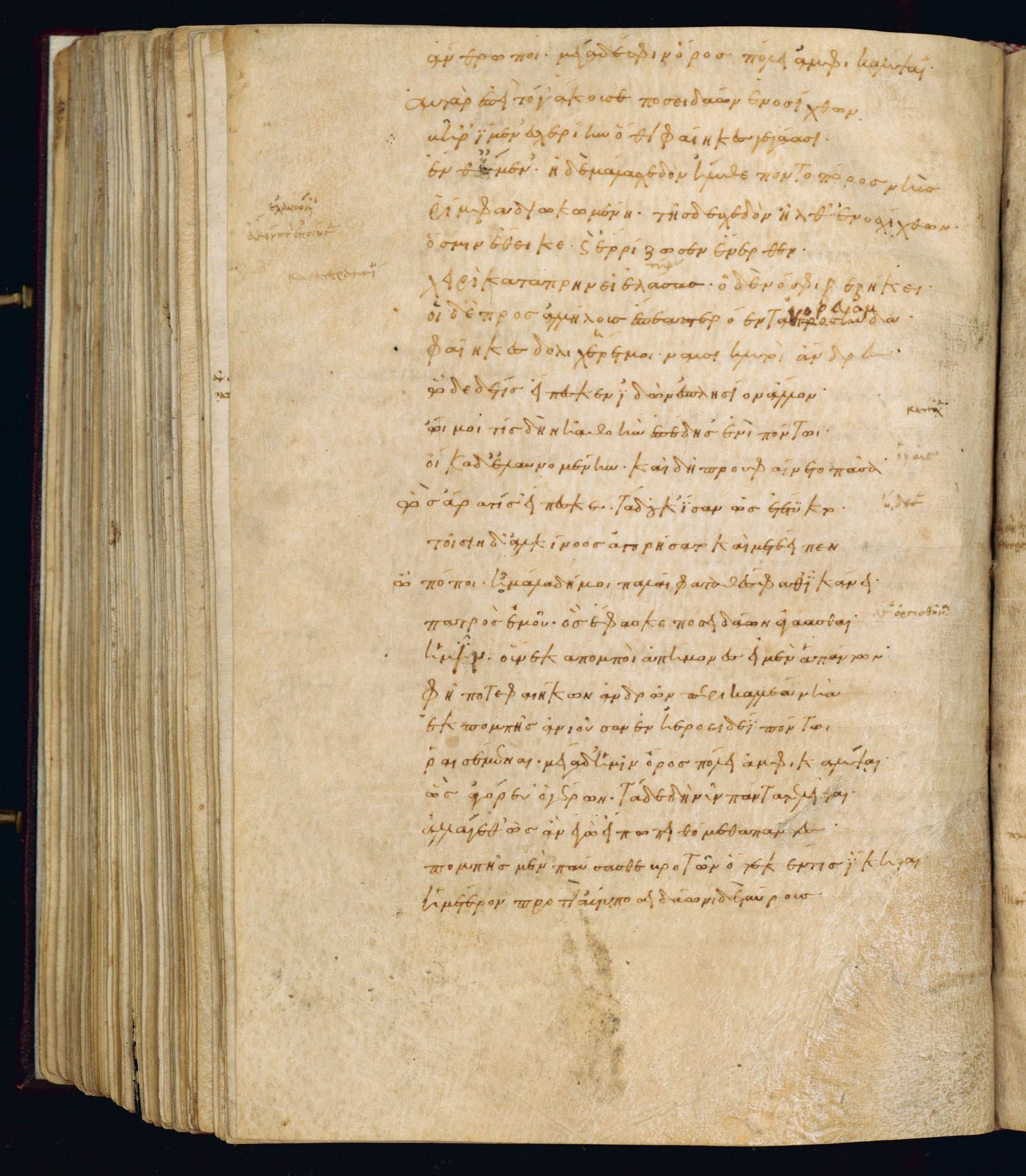
Where on the image
Laur. Plut. 32.24, fol. 128v: Odyssey 13.158-181, begins ‹ἄνθρωποι, μέγα δέ σφιν›, ends ‹ἄστυ· Ποσειδάωνι δὲ ταύρους›. Checked on the image: first and last lines read and matched to the Greek. Fol. 128r ends with 13.157. Fol. 129r begins with 13.182. English blocks here: 160-164, 165-169, 170-174, 175-179, 180-183.
158ἄνθρωποι, μέγα δέ σφιν ὄρος πόλει ἀμφικαλύψαι.
159αὐτὰρ ἐπεὶ τό γʼ ἄκουσε Ποσειδάων ἐνοσίχθων,
160βῆ ῥʼ ἴμεν ἐς Σχερίην, ὅθι Φαίηκες γεγάασιν.
161ἔνθʼ ἔμενʼ· ἡ δὲ μάλα σχεδὸν ἤλυθε ποντοπόρος νηῦς
162ῥίμφα διωκομένη· τῆς δὲ σχεδὸν ἦλθʼ ἐνοσίχθων,
163ὅς μιν λᾶαν ἔθηκε καὶ ἐρρίζωσεν ἔνερθε
164χειρὶ καταπρηνεῖ ἐλάσας· ὁ δὲ νόσφι βεβήκει.
165οἱ δὲ πρὸς ἀλλήλους ἔπεα πτερόεντʼ ἀγόρευον
166Φαίηκες δολιχήρετμοι, ναυσίκλυτοι ἄνδρες.
167ὧδε δέ τις εἴπεσκεν ἰδὼν ἐς πλησίον ἄλλον·
168ὤ μοι, τίς δὴ νῆα θοὴν ἐπέδησʼ ἐνὶ πόντῳ
169οἴκαδʼ ἐλαυνομένην; καὶ δὴ προὐφαίνετο πᾶσα.
170ὣς ἄρα τις εἴπεσκε· τὰ δʼ οὐκ ἴσαν ὡς ἐτέτυκτο.
171τοῖσιν δʼ Ἀλκίνοος ἀγορήσατο καὶ μετέειπεν·
172ὢ πόποι, ἦ μάλα δή με παλαίφατα θέσφαθʼ ἱκάνει
173πατρὸς ἐμοῦ, ὃς ἔφασκε Ποσειδάωνʼ ἀγάσασθαι
174ἡμῖν, οὕνεκα πομποὶ ἀπήμονές εἰμεν ἁπάντων.
175φῆ ποτὲ Φαιήκων ἀνδρῶν περικαλλέα, νῆα,
176ἐκ πομπῆς ἀνιοῦσαν, ἐν ἠεροειδέϊ πόντῳ
177ῥαισέμεναι, μέγα δʼ ἧμιν ὄρος πόλει ἀμφικαλύψειν.
178ὣς ἀγόρευʼ ὁ γέρων· τὰ δὲ δὴ νῦν πάντα τελεῖται.
179ἀλλʼ ἄγεθʼ, ὡς ἂν ἐγὼ εἴπω, πειθώμεθα πάντες·
180πομπῆς μὲν παύσασθε βροτῶν, ὅτε κέν τις ἵκηται
181ἡμέτερον προτὶ ἄστυ· Ποσειδάωνι δὲ ταύρους
160he went his way to Scheria, where the Phaeacians dwell, and there he waited. And she drew close to shore, the seafaring ship, speeding swiftly on her way. Then near her came the Earth-shaker and turned her to stone, and rooted her fast beneath by a blow of the flat of his hand, and then he was gone. 165But they spoke winged words to one another, the Phaeacians of the long oars, men famed for their ships. And thus would one speak, with a glance at his neighbor: “Ah me, who has now bound our swift ship on the sea as she sped homeward? Lo, she was in plain sight.” 170So would one of them speak, but they knew not how these things were to be. Then Alcinous addressed their company and said: “Lo now, verily the oracles of my father, uttered long ago, have come upon me. He was wont to say that Poseidon was wroth with us because we give safe convoy to all men. 175He said that some day, as a beautiful ship of the Phaeacians was returning from a convoy over the misty deep, Poseidon would smite her, and would fling a great mountain about our town. So that old man spoke, and lo, now all this is being brought to pass. But now come, as I bid let us all obey. 180Cease ye to give convoy to mortals, when anyone comes to our city, and let us sacrifice to Poseidon twelve choice bulls, if haply he may take pity, and not fling a lofty mountain about our town.”
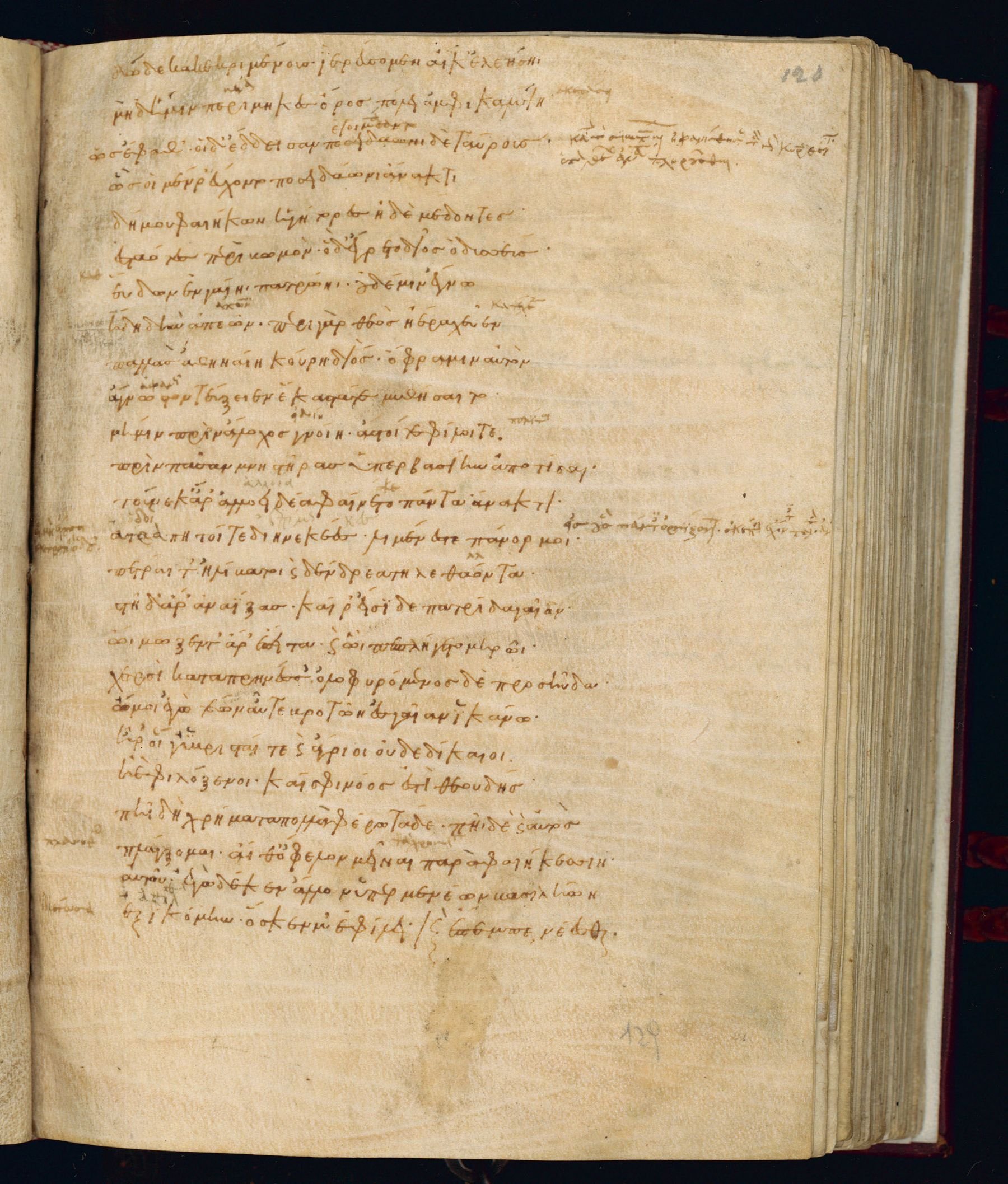
Where on the image
Laur. Plut. 32.24, fol. 129r: Odyssey 13.182-206, begins ‹δώδεκα κεκριμένους ἱερεύσομεν, αἴ›, ends ‹ἐφίλει καὶ ἔπεμπε νέεσθαι.›. Checked on the image: first and last lines read and matched to the Greek. Fol. 128v ends with 13.181. Fol. 129v begins with 13.207. English here: 13.184-206. At the break between fol. 129r (Greek to 13.206) and fol. 129v (Greek from 13.207) the English is cut where Murray's sentence for 13.207 begins (But now I know not where ...), the same line as the Greek. At the page's other break the English follows Murray's five-line marks (a block that crosses the break goes with the page holding its middle line).
182δώδεκα κεκριμένους ἱερεύσομεν, αἴ κʼ ἐλεήσῃ,
183μηδʼ ἡμῖν περίμηκες ὄρος πόλει ἀμφικαλύψῃ.
184ὣς ἔφαθʼ, οἱ δʼ ἔδεισαν, ἑτοιμάσσαντο δὲ ταύρους.
185ὣς οἱ μέν ῥʼ εὔχοντο Ποσειδάωνι ἄνακτι
186δήμου Φαιήκων ἡγήτορες ἠδὲ μέδοντες,
187ἑσταότες περὶ βωμόν. ὁ δʼ ἔγρετο δῖος Ὀδυσσεὺς
188εὕδων ἐν γαίῃ πατρωΐῃ, οὐδέ μιν ἔγνω,
189ἤδη δὴν ἀπεών· περὶ γὰρ θεὸς ἠέρα χεῦε
190Παλλὰς Ἀθηναίη, κούρη Διός, ὄφρα μιν αὐτὸν
191ἄγνωστον τεύξειεν ἕκαστά τε μυθήσαιτο,
192μή μιν πρὶν ἄλοχος γνοίη ἀστοί τε φίλοι τε,
193πρὶν πᾶσαν μνηστῆρας ὑπερβασίην ἀποτῖσαι.
194τοὔνεκʼ ἄρʼ ἀλλοειδέα φαινέσκετο πάντα ἄνακτι,
195ἀτραπιτοί τε διηνεκέες λιμένες τε πάνορμοι
196πέτραι τʼ ἠλίβατοι καὶ δένδρεα τηλεθόωντα.
197στῆ δʼ ἄρʼ ἀναΐξας καί ῥʼ εἴσιδε πατρίδα γαῖαν·
198ᾤμωξέν τʼ ἄρ ἔπειτα καὶ ὣ πεπλήγετο μηρὼ
199χερσὶ καταπρηνέσσʼ, ὀλοφυρόμενος δʼ ἔπος ηὔδα·
200ὤ μοι ἐγώ, τέων αὖτε βροτῶν ἐς γαῖαν ἱκάνω;
201ἦ ῥʼ οἵ γʼ ὑβρισταί τε καὶ ἄγριοι οὐδὲ δίκαιοι,
202ἦε φιλόξεινοι, καί σφιν νόος ἐστὶ θεουδής;
203πῇ δὴ χρήματα πολλὰ φέρω τάδε; πῇ τε καὶ αὐτὸς
204πλάζομαι; αἴθʼ ὄφελον μεῖναι παρὰ Φαιήκεσσιν
205αὐτοῦ· ἐγὼ δέ κεν ἄλλον ὑπερμενέων βασιλήων
206ἐξικόμην, ὅς κέν μʼ ἐφίλει καὶ ἔπεμπε νέεσθαι.
184So he spoke, and they were seized with fear and made ready the bulls. 185Thus they were praying to the lord Poseidon, the leaders and counsellors of the land of the Phaeacians, as they stood about the altar, but Odysseus awoke out of his sleep in his native land. Yet he knew it not after his long absence, for about him the goddess had shed a mist, 190even Pallas Athena, daughter of Zeus, that she might render him unknown, and tell him all things, so that his wife might not know him, nor his townsfolk, nor his friends, until the wooers had paid the full price of all their transgressions. Therefore all things seemed strange to their lord, 195the long paths, the bays offering safe anchorage, the sheer cliffs, and the luxuriant trees. So he sprang up and stood and looked upon his native land, and then he groaned and smote both of his thighs with the flat of his hands, and mournfully spoke, and said: 200“Woe is me, to the land of what mortals am I now come? Are they cruel, and wild, and unjust, or do they love strangers and fear the gods in their thoughts? Whither shall I bear all this wealth, or whither shall I myself go wandering on? Would that I had remained there among the Phaeacians, 205and had then come to some other of the mighty kings, who would have entertained me and sent me on my homeward way.
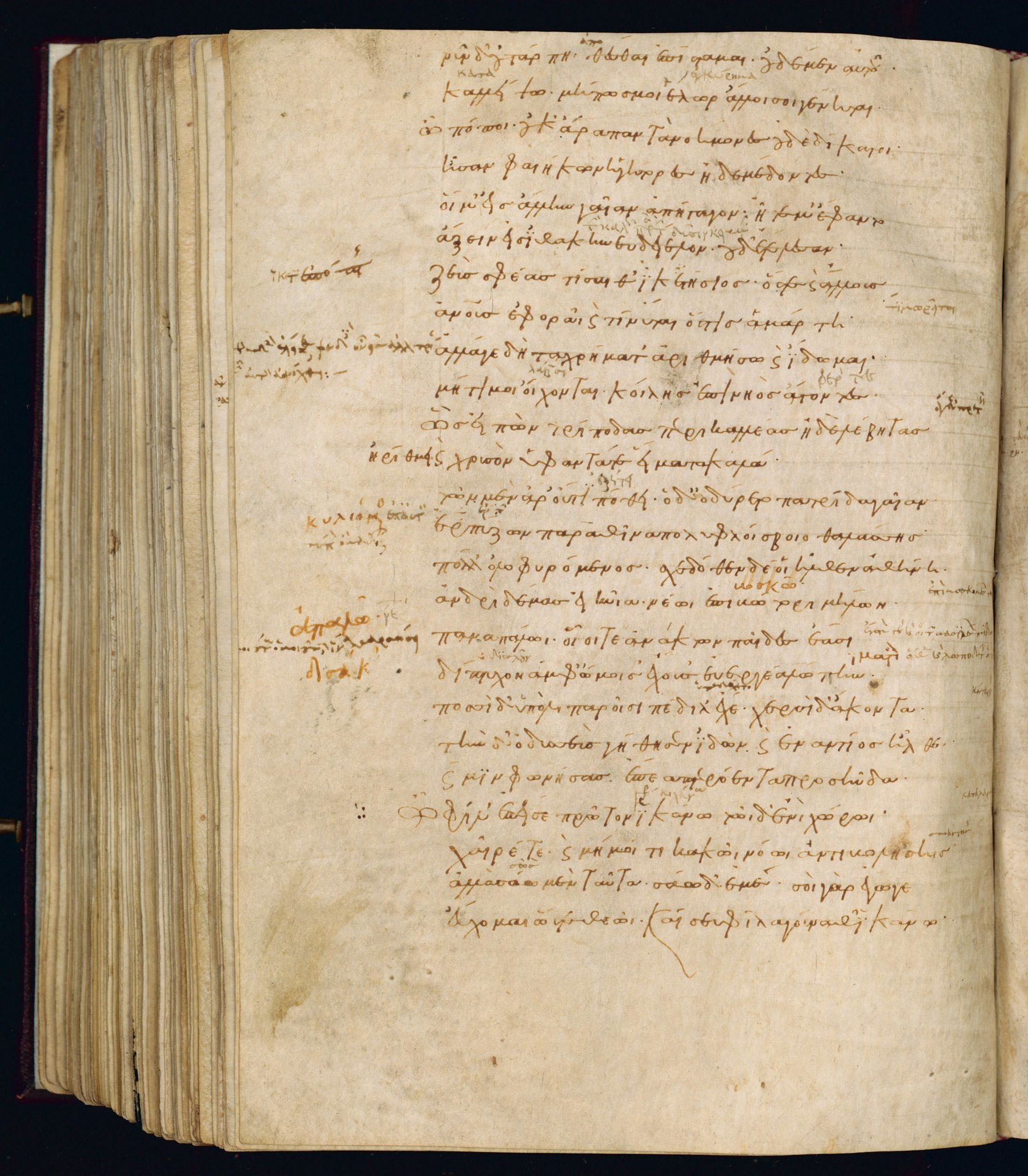
Where on the image
Laur. Plut. 32.24, fol. 129v: Odyssey 13.207-231, begins ‹νῦν δʼ οὔτʼ ἄρ›, ends ‹σευ φίλα γούναθʼ ἱκάνω.›. Checked on the image: first and last lines read and matched to the Greek. Fol. 129r ends with 13.206. Fol. 130r begins with 13.232. English here: 13.207-231. At the break between fol. 129r (Greek to 13.206) and fol. 129v (Greek from 13.207) the English is cut where Murray's sentence for 13.207 begins (But now I know not where ...), the same line as the Greek. At the break between fol. 129v (Greek to 13.231) and fol. 130r (Greek from 13.232) the English is cut where Murray's sentence for 13.232 begins (And tell me this also truly ...), the same line as the Greek.
207νῦν δʼ οὔτʼ ἄρ πῃ θέσθαι ἐπίσταμαι, οὐδὲ μὲν αὐτοῦ
208καλλείψω, μή πώς μοι ἕλωρ ἄλλοισι γένηται.
209ὢ πόποι, οὐκ ἄρα πάντα νοήμονες οὐδὲ δίκαιοι
210ἦσαν Φαιήκων ἡγήτορες ἠδὲ μέδοντες,
211οἵ μʼ εἰς ἄλλην γαῖαν ἀπήγαγον, ἦ τέ μʼ ἔφαντο
212ἄξειν εἰς Ἰθάκην εὐδείελον, οὐδʼ ἐτέλεσσαν.
213Ζεὺς σφέας τίσαιτο ἱκετήσιος, ὅς τε καὶ ἄλλους
214ἀνθρώπους ἐφορᾷ καὶ τίνυται ὅς τις ἁμάρτῃ.
215ἀλλʼ ἄγε δὴ τὰ χρήματʼ ἀριθμήσω καὶ ἴδωμαι,
216μή τί μοι οἴχωνται κοίλης ἐπὶ νηὸς ἄγοντες.
217ὣς εἰπὼν τρίποδας περικαλλέας ἠδὲ λέβητας
218ἠρίθμει καὶ χρυσὸν ὑφαντά τε εἵματα καλά.
219τῶν μὲν ἄρʼ οὔ τι πόθει· ὁ δʼ ὀδύρετο πατρίδα γαῖαν
220ἑρπύζων παρὰ θῖνα πολυφλοίσβοιο θαλάσσης,
221πόλλʼ ὀλοφυρόμενος. σχεδόθεν δέ οἱ ἦλθεν Ἀθήνη,
222ἀνδρὶ δέμας εἰκυῖα νέῳ, ἐπιβώτορι μήλων,
223παναπάλῳ, οἷοί τε ἀνάκτων παῖδες ἔασι,
224δίπτυχον ἀμφʼ ὤμοισιν ἔχουσʼ εὐεργέα λώπην·
225ποσσὶ δʼ ὑπὸ λιπαροῖσι πέδιλʼ ἔχε, χερσὶ δʼ ἄκοντα.
226τὴν δʼ Ὀδυσεὺς γήθησεν ἰδὼν καὶ ἐναντίος ἦλθε,
227καί μιν φωνήσας ἔπεα πτερόεντα προσηύδα·
228ὦ φίλʼ, ἐπεί σε πρῶτα κιχάνω τῷδʼ ἐνὶ χώρῳ,
229χαῖρέ τε καὶ μή μοί τι κακῷ νόῳ ἀντιβολήσαις,
230ἀλλὰ σάω μὲν ταῦτα, σάω δʼ ἐμέ· σοὶ γὰρ ἐγώ γε
231εὔχομαι ὥς τε θεῷ καί σευ φίλα γούναθʼ ἱκάνω.
207But now I know not where to bestow this wealth; yet here will I not leave it, lest haply it become the spoil of others to my cost. Out upon them; not wholly wise, it seems, nor just 210were the leaders and counsellors of the Phaeacians who have brought me to a strange land. Verily they said that they would bring me to clear-seen Ithaca, but they have not made good their word. May Zeus, the suppliant's god, requite them, who watches over all men, and punishes him that sins. 215But come, I will number the goods, and go over them, lest to my cost these men have carried off aught with them in the hollow ship.” 217So he spake, and set him to count the beautiful tripods, and the cauldrons, and the gold, and the fair woven raiment, and of these he missed nothing. Then, mournfully longing for his native land, 220he paced by the shore of the loud-sounding sea, uttering many a moan. And Athena drew near him in the form of a young man, a herdsman of sheep, one most delicate, as are the sons of princes. In a double fold about her shoulders she wore a well-wrought cloak, 225and beneath her shining feet she had sandals, and in her hands a spear. Then Odysseus was glad at sight of her, and came to meet her, and he spoke, and addressed her with winged words: “Friend, since thou art the first to whom I have come in this land, hail to thee, and mayst thou meet me with no evil mind. 230Nay, save this treasure, and save me; for to thee do I pray, as to a god, and am come to thy dear knees.
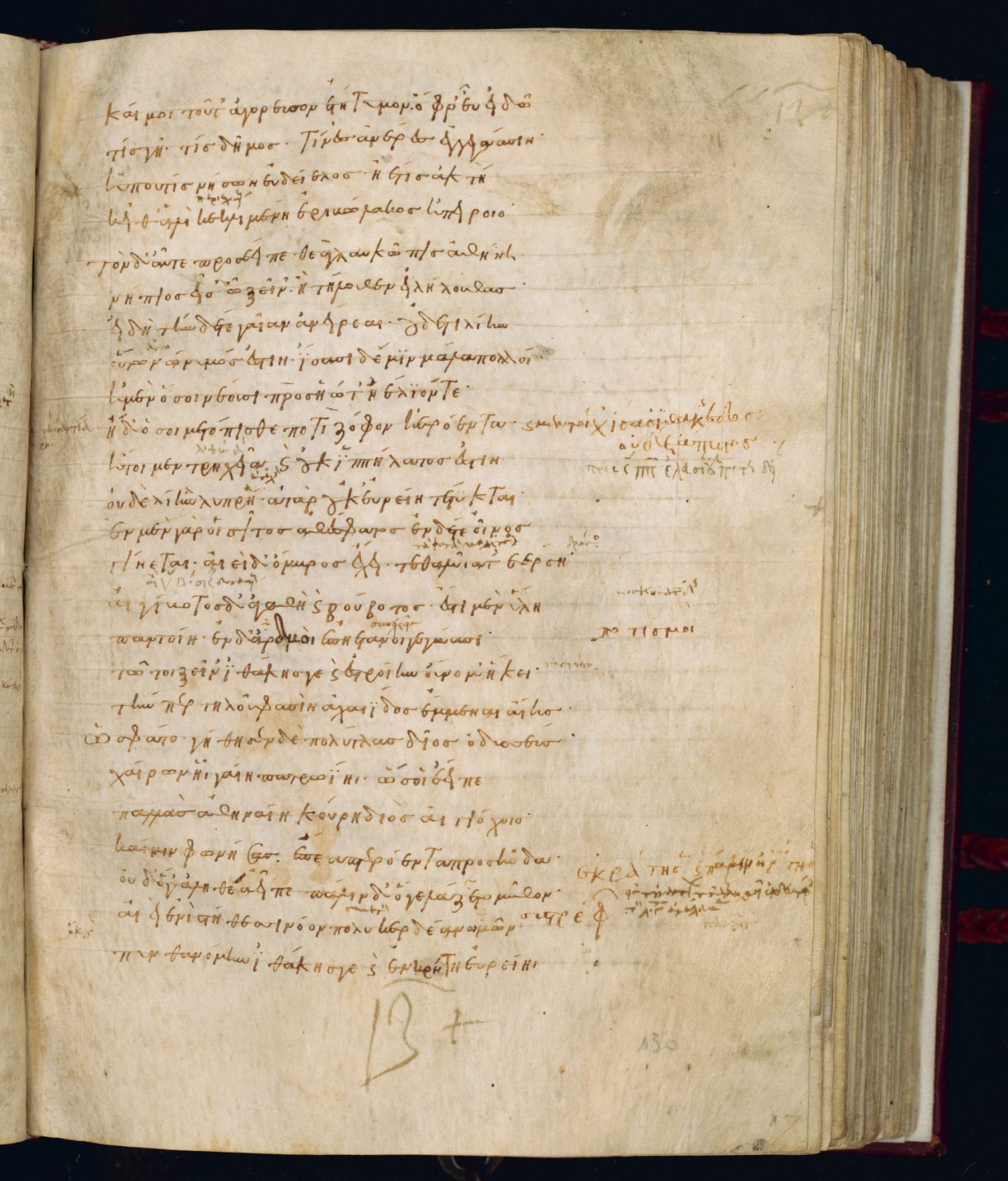
Where on the image
Laur. Plut. 32.24, fol. 130r: Odyssey 13.232-256, begins ‹καί μοι τοῦτʼ ἀγόρευσον›, ends ‹καὶ ἐν Κρήτῃ εὐρείῃ,›. Checked on the image: first and last lines read and matched to the Greek. Fol. 129v ends with 13.231. Fol. 130v begins with 13.257. English here: 13.232-254. At the break between fol. 129v (Greek to 13.231) and fol. 130r (Greek from 13.232) the English is cut where Murray's sentence for 13.232 begins (And tell me this also truly ...), the same line as the Greek. At the page's other break the English follows Murray's five-line marks (a block that crosses the break goes with the page holding its middle line).
232καί μοι τοῦτʼ ἀγόρευσον ἐτήτυμον, ὄφρʼ ἐῢ εἰδῶ·
233τίς γῆ, τίς δῆμος, τίνες ἀνέρες ἐγγεγάασιν;
234ἦ πού τις νήσων εὐδείελος, ἦέ τις ἀκτὴ
235κεῖθʼ ἁλὶ κεκλιμένη ἐριβώλακος ἠπείροιο;
236τὸν δʼ αὖτε προσέειπε θεὰ γλαυκῶπις Ἀθήνη·
237νήπιός εἰς, ὦ ξεῖνʼ, ἢ τηλόθεν εἰλήλουθας,
238εἰ δὴ τήνδε τε γαῖαν ἀνείρεαι. οὐδέ τι λίην
239οὕτω νώνυμός ἐστιν· ἴσασι δέ μιν μάλα πολλοί,
240ἠμὲν ὅσοι ναίουσι πρὸς ἠῶ τʼ ἠέλιόν τε,
241ἠδʼ ὅσσοι μετόπισθε ποτὶ ζόφον ἠερόεντα.
242ἦ τοι μὲν τρηχεῖα καὶ οὐχ ἱππήλατός ἐστιν,
243οὐδὲ λίην λυπρή, ἀτὰρ οὐδʼ εὐρεῖα τέτυκται.
244ἐν μὲν γάρ οἱ σῖτος ἀθέσφατος, ἐν δέ τε οἶνος
245γίγνεται· αἰεὶ δʼ ὄμβρος ἔχει τεθαλυῖά τʼ ἐέρση·
246αἰγίβοτος δʼ ἀγαθὴ καὶ βούβοτος· ἔστι μὲν ὕλη
247παντοίη, ἐν δʼ ἀρδμοὶ ἐπηετανοὶ παρέασι.
248τῷ τοι, ξεῖνʼ, Ἰθάκης γε καὶ ἐς Τροίην ὄνομʼ ἵκει,
249τήν περ τηλοῦ φασὶν Ἀχαιΐδος ἔμμεναι αἴης.
250ὣς φάτο, γήθησεν δὲ πολύτλας δῖος Ὀδυσσεύς,
251χαίρων ᾗ γαίῃ πατρωΐῃ, ὥς οἱ ἔειπε
252Παλλὰς Ἀθηναίη, κούρη Διὸς, αἰγιόχοιο·
253καί μιν φωνήσας ἔπεα πτερόεντα προσηύδα·
254οὐδʼ ὅ γʼ ἀληθέα εἶπε, πάλιν δʼ ὅ γε λάζετο μῦθον,
255αἰεὶ ἐνὶ στήθεσσι νόον πολυκερδέα νωμῶν·
256πυνθανόμην Ἰθάκης γε καὶ ἐν Κρήτῃ εὐρείῃ,
232And tell me this also truly, that I may know full well. What land, what people is this? What men dwell here? Is it some clear-seen island, or a shore 235of the deep-soiled mainland that lies resting on the sea?” Then the goddess, flashing-eyed Athena, answered him: “A fool art thou, stranger, or art come from far, if indeed thou askest of this land. Surely it is no wise so nameless, but full many know it, 240both all those who dwell toward the dawn and the sun, and all those that are behind toward the murky darkness. It is a rugged isle, not fit for driving horses, yet it is not utterly poor, though it be but narrow. Therein grows corn beyond measure, and the wine-grape as well, 245and the rain never fails it, nor the rich dew. It is a good land for pasturing goats and kine; there are trees of every sort, and in it also pools for watering that fail not the year through. Therefore, stranger, the name of Ithaca has reached even to the land of Troy which, they say, is far from this land of Achaea.” 250So she spake, and the much-enduring, goodly Odysseus was glad, and rejoiced in his land, the land of his fathers, as he heard the word of Pallas Athena, daughter of Zeus, who bears the aegis; and he spoke, and addressed her with winged words; yet he spoke not the truth, but checked the word ere it was uttered,
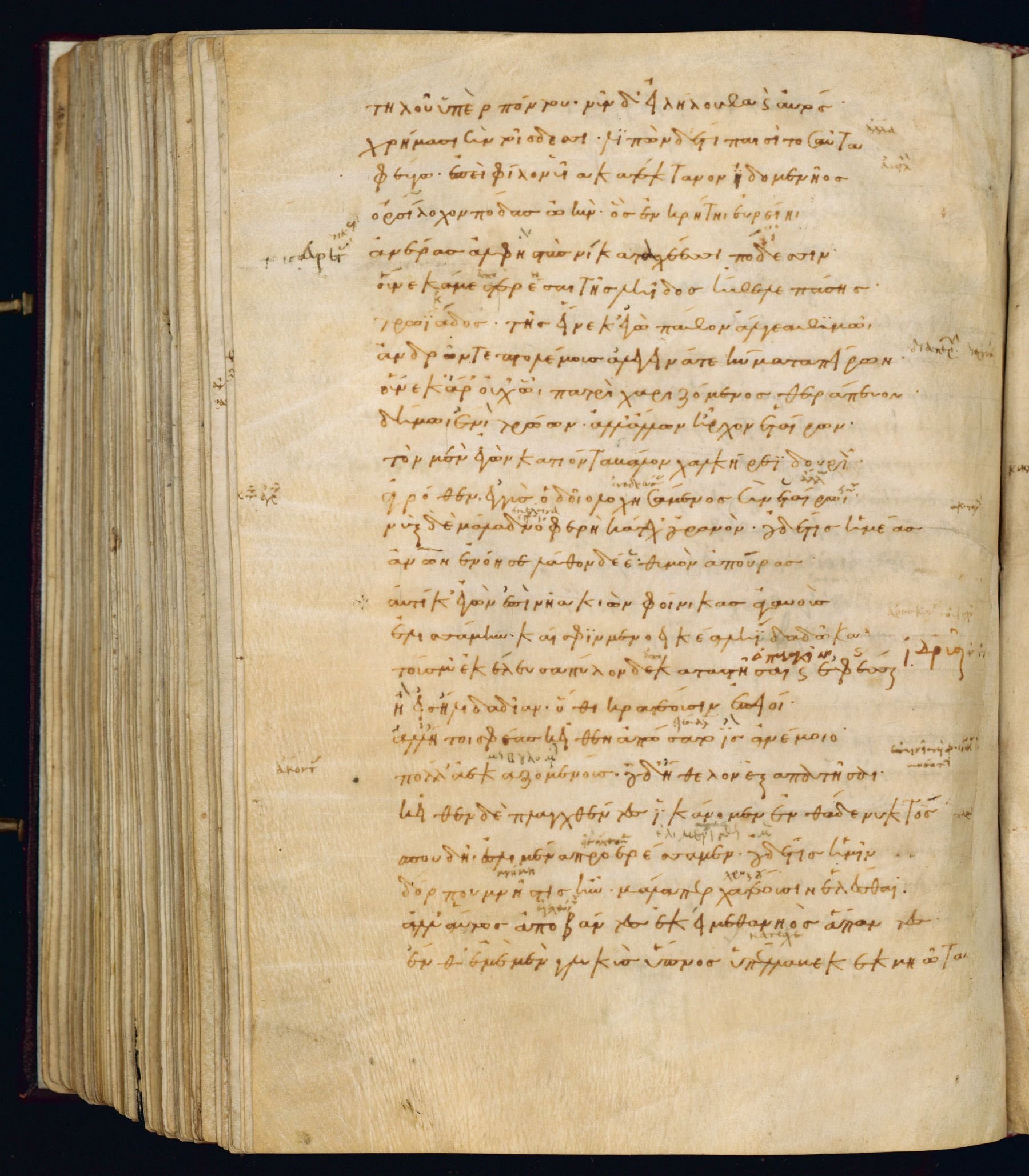
Where on the image
Laur. Plut. 32.24, fol. 130v: Odyssey 13.257-282, begins ‹τηλοῦ ὑπὲρ πόντου· νῦν›, ends ‹γλυκὺς ὕπνος ἐπήλυθε κεκμηῶτα,›. Checked on the image: first and last lines read and matched to the Greek. Fol. 130r ends with 13.256. Fol. 131r begins with 13.283. 13.271 (αὐτὰρ ἐπεὶ δὴ τόν γε κατέκτανον ...) is not on the page: the scribe passes from 13.270 to 13.272 (25 lines). English blocks here: 255-259, 260-264, 265-269, 270-274, 275-279, 280-284.
257τηλοῦ ὑπὲρ πόντου· νῦν δʼ εἰλήλουθα καὶ αὐτὸς
258χρήμασι σὺν τοίσδεσσι· λιπὼν δʼ ἔτι παισὶ τοσαῦτα
259φεύγω, ἐπεὶ φίλον υἷα κατέκτανον Ἰδομενῆος,
260Ὀρσίλοχον πόδας ὠκύν, ὃς ἐν Κρήτῃ εὐρείῃ
261ἀνέρας ἀλφηστὰς νίκα ταχέεσσι πόδεσσιν,
262οὕνεκά με στερέσαι τῆς ληΐδος ἤθελε πάσης
263Τρωϊάδος, τῆς εἵνεκʼ ἐγὼ πάθον ἄλγεα θυμῷ,
264ἀνδρῶν τε πτολέμους ἀλεγεινά τε κύματα πείρων,
265οὕνεκʼ ἄρʼ οὐχ ᾧ πατρὶ χαριζόμενος θεράπευον
266δήμῳ ἔνι Τρώων, ἀλλʼ ἄλλων ἦρχον ἑταίρων.
267τὸν μὲν ἐγὼ κατιόντα βάλον χαλκήρεϊ δουρὶ
268ἀγρόθεν, ἐγγὺς ὁδοῖο λοχησάμενος σὺν ἑταίρῳ·
269νὺξ δὲ μάλα δνοφερὴ κάτεχʼ οὐρανόν, οὐδέ τις ἡμέας
270ἀνθρώπων ἐνόησε, λάθον δέ ἑ θυμὸν ἀπούρας.
271αὐτὰρ ἐπεὶ δὴ τόν γε κατέκτανον ὀξέϊ χαλκῷ,
272αὐτίκʼ ἐγὼν ἐπὶ νῆα κιὼν Φοίνικας ἀγαυοὺς
273ἐλλισάμην, καί σφιν μενοεικέα ληΐδα δῶκα·
274τούς μʼ ἐκέλευσα Πύλονδε καταστῆσαι καὶ ἐφέσσαι
275ἢ εἰς Ἤλιδα δῖαν, ὅθι κρατέουσιν Ἐπειοί.
276ἀλλʼ ἦ τοι σφέας κεῖθεν ἀπώσατο ἲς ἀνέμοιο
277πόλλʼ ἀεκαζομένους, οὐδʼ ἤθελον ἐξαπατῆσαι.
278κεῖθεν δὲ πλαγχθέντες ἱκάνομεν ἐνθάδε νυκτός.
279σπουδῇ δʼ ἐς λιμένα προερέσσαμεν, οὐδέ τις ἡμῖν
280δόρπου μνῆστις ἔην, μάλα περ χατέουσιν ἑλέσθαι,
281ἀλλʼ αὔτως ἀποβάντες ἐκείμεθα νηὸς ἅπαντες.
282ἔνθʼ ἐμὲ μὲν γλυκὺς ὕπνος ἐπήλυθε κεκμηῶτα,
255ever revolving in his breast thoughts of great cunning: “I heard of Ithaca, even in broad Crete, far over the sea; and now have I myself come hither with these my goods. And I left as much more with my children, when I fled the land, after I had slain the dear son of Idomeneus, 260Orsilochus, swift of foot, who in broad Crete surpassed in fleetness all men that live by toil. Now he would have robbed me of all that booty of Troy, for which I had borne grief of heart, passing through wars of men and the grievous waves, 265for that I would not shew favour to his father, and serve as his squire in the land of the Trojans, but commanded other men of my own. So I smote him with my bronze-tipped spear as he came home from the field, lying in wait for him with one of my men by the roadside. A dark night covered the heavens, and no 270man was ware of us, but unseen I took away his life. Now when I had slain him with the sharp bronze, I went straightway to a ship, and made prayer to the lordly Phoenicians, giving them booty to satisfy their hearts. I bade them take me aboard and land me at Pylos , 275or at goodly Elis, where the Epeans hold sway. Yet verily the force of the wind thrust them away from thence, sore against their will, nor did they purpose to play me false; but driven wandering from thence we came hither by night. With eager haste we rowed on into the harbor, nor had we any 280thought of supper, sore as was our need of it, but even as we were we went forth from the ship and lay down, one and all. Then upon me came sweet sleep in my weariness, but they took my goods out of the hollow ship and set them where I myself lay on the sands.
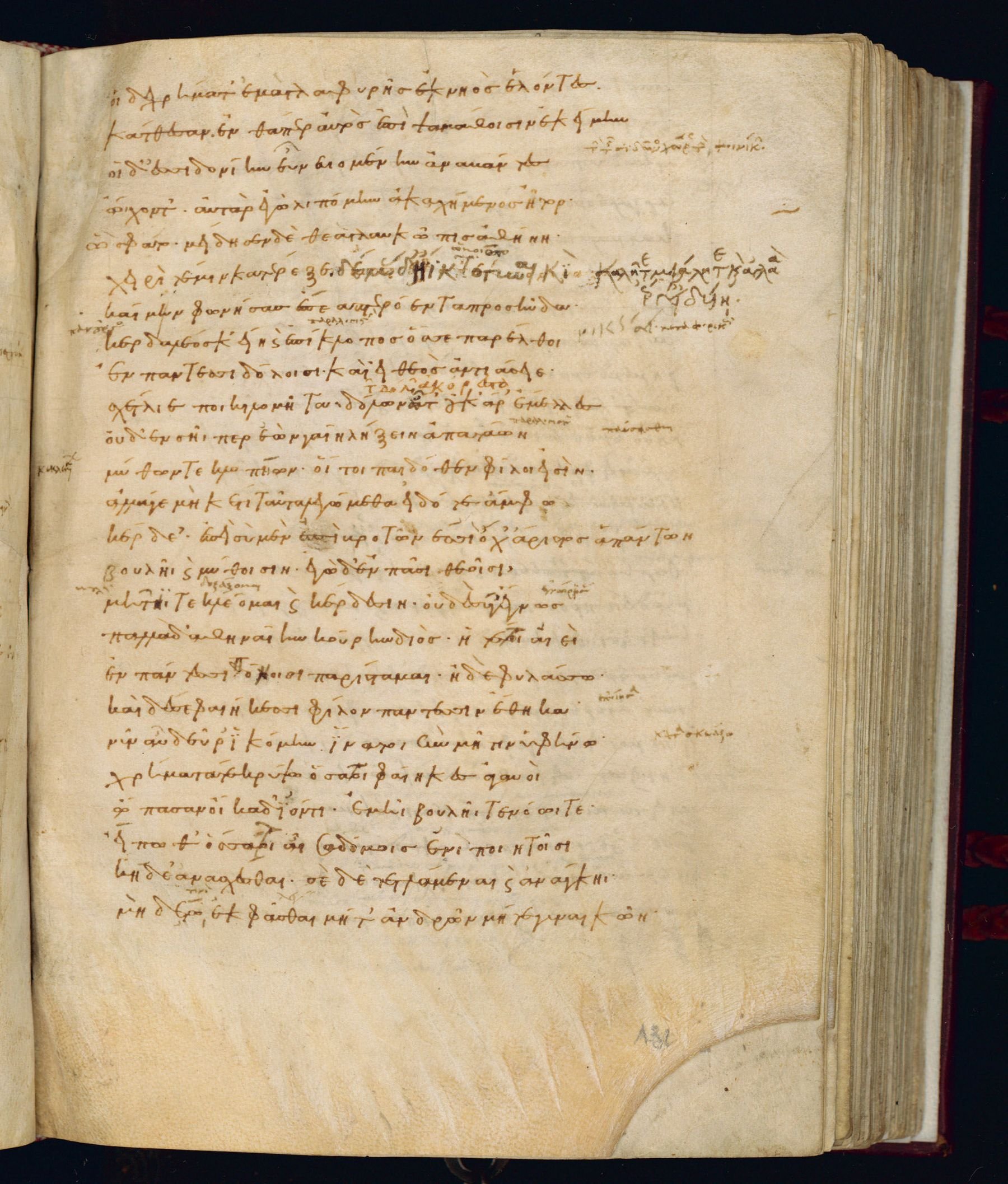
Where on the image
Laur. Plut. 32.24, fol. 131r: Odyssey 13.283-308, begins ‹οἱ δὲ χρήματʼ ἐμὰ›, ends ‹μήτʼ ἀνδρῶν μήτε γυναικῶν,›. Checked on the image: first and last lines read and matched to the Greek. Fol. 130v ends with 13.282. Fol. 131v begins with 13.309. 13.289 is not in the text column; it is written in the right margin beside 13.288 (the column has 25 lines). English blocks here: 285-286, 287-289, 290-294, 295-299, 300-304, 305-309.
283οἱ δὲ χρήματʼ ἐμὰ γλαφυρῆς ἐκ νηὸς ἑλόντες
284κάτθεσαν, ἔνθα περ αὐτὸς ἐπὶ ψαμάθοισιν ἐκείμην.
285οἱ δʼ ἐς Σιδονίην εὖ ναιομένην ἀναβάντες
286ᾤχοντʼ· αὐτὰρ ἐγὼ λιπόμην ἀκαχήμενος ἦτορ.
287ὣς φάτο, μείδησεν δὲ θεὰ γλαυκῶπις Ἀθήνη,
288χειρί τέ μιν κατέρεξε· δέμας δʼ ἤϊκτο γυναικὶ
289καλῇ τε μεγάλῃ τε καὶ ἀγλαὰ ἔργα ἰδυίῃ·
290καί μιν φωνήσασʼ ἔπεα πτερόεντα προσηύδα·
291κερδαλέος κʼ εἴη καὶ ἐπίκλοπος ὅς σε παρέλθοι
292ἐν πάντεσσι δόλοισι, καὶ εἰ θεὸς ἀντιάσειε.
293σχέτλιε, ποικιλομῆτα, δόλων ἆτʼ, οὐκ ἄρʼ ἔμελλες,
294οὐδʼ ἐν σῇ περ ἐὼν γαίῃ, λήξειν ἀπατάων
295μύθων τε κλοπίων, οἵ τοι πεδόθεν φίλοι εἰσίν.
296ἀλλʼ ἄγε, μηκέτι ταῦτα λεγώμεθα, εἰδότες ἄμφω
297κέρδεʼ, ἐπεὶ σὺ μέν ἐσσι βροτῶν ὄχʼ ἄριστος ἁπάντων
298βουλῇ καὶ μύθοισιν, ἐγὼ δʼ ἐν πᾶσι θεοῖσι
299μήτι τε κλέομαι καὶ κέρδεσιν· οὐδὲ σύ γʼ ἔγνως
300Παλλάδʼ Ἀθηναίην, κούρην Διός, ἥ τέ τοι αἰεὶ
301ἐν πάντεσσι πόνοισι παρίσταμαι ἠδὲ φυλάσσω,
302καὶ δέ σε Φαιήκεσσι φίλον πάντεσσιν ἔθηκα,
303νῦν αὖ δεῦρʼ ἱκόμην, ἵνα τοι σὺν μῆτιν ὑφήνω
304χρήματά τε κρύψω, ὅσα τοι Φαίηκες ἀγαυοὶ
305ὤπασαν οἴκαδʼ ἰόντι ἐμῇ βουλῇ τε νόῳ τε,
306εἴπω θʼ ὅσσα τοι αἶσα δόμοις ἔνι ποιητοῖσι
307κήδεʼ ἀνασχέσθαι· σὺ δὲ τετλάμεναι καὶ ἀνάγκῃ,
308μηδέ τῳ ἐκφάσθαι μήτʼ ἀνδρῶν μήτε γυναικῶν,
285And they went on board, and departed for the well-peopled land of Sidon; but I was left here, my heart sore troubled.” 287So he spoke, and the goddess, flashing-eyed Athena, smiled, and stroked him with her hand, and changed herself to the form of a woman, comely and tall, and skilled in glorious handiwork. 290And she spoke, and addressed him with winged words: “Cunning must he be and knavish, who would go beyond thee in all manner of guile, aye, though it were a god that met thee. Bold man, crafty in counsel, insatiate in deceit, not even in thine own land, it seems, wast thou to cease from guile 295and deceitful tales, which thou lovest from the bottom of thine heart. But come, let us no longer talk of this, being both well versed in craft, since thou art far the best of all men in counsel and in speech, and I among all the gods am famed for wisdom and craft. Yet thou didst not know 300Pallas Athena, daughter of Zeus, even me, who ever stand by thy side, and guard thee in all toils. Aye, and I made thee beloved by all the Phaeacians. And now am I come hither to weave a plan with thee, and to hide all the treasure, which the lordly Phaeacians 305gave thee by my counsel and will, when thou didst set out for home; and to tell thee all the measure of woe it is thy fate to fulfil in thy well-built house. But do thou be strong, for bear it thou must, and tell no man of them all nor any woman that thou hast come back from thy wanderings, but in silence
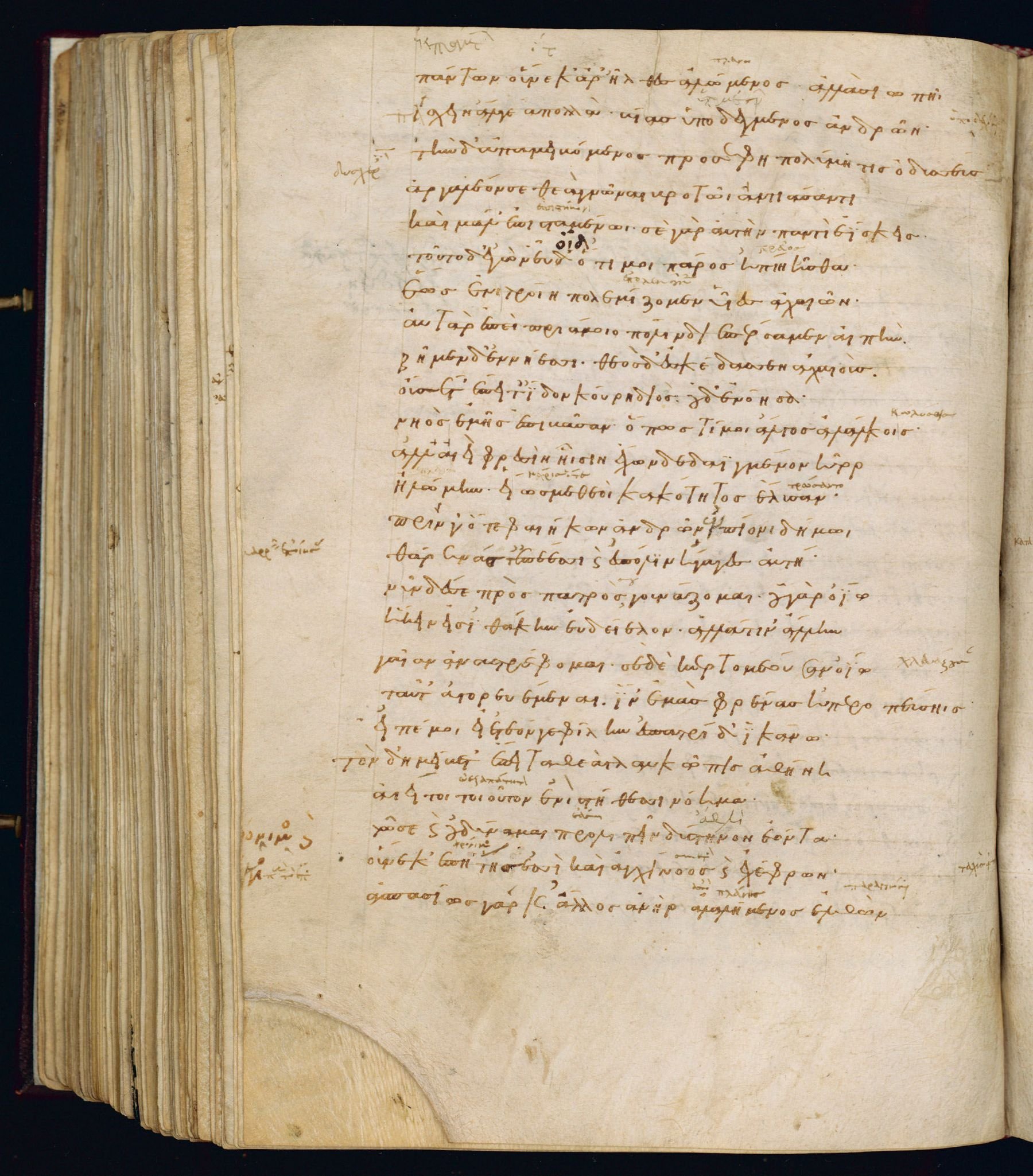
Where on the image
Laur. Plut. 32.24, fol. 131v: Odyssey 13.309-333, begins ‹πάντων, οὕνεκʼ ἄρʼ ἦλθες›, ends ‹ἄλλος ἀνὴρ ἀλαλήμενος ἐλθὼν›. Checked on the image: first and last lines read and matched to the Greek. Fol. 131r ends with 13.308. Fol. 132r begins with 13.334. English blocks here: 310-314, 315-319, 320-324, 325-328, 329-329, 330-334.
309πάντων, οὕνεκʼ ἄρʼ ἦλθες ἀλώμενος, ἀλλὰ σιωπῇ
310πάσχειν ἄλγεα πολλά, βίας ὑποδέγμενος ἀνδρῶν.
311τὴν δʼ ἀπαμειβόμενος προσέφη πολύμητις Ὀδυσσεύς·
312ἀργαλέον σε, θεά, γνῶναι βροτῷ ἀντιάσαντι,
313καὶ μάλʼ ἐπισταμένῳ· σὲ γὰρ αὐτὴν παντὶ ἐΐσκεις.
314τοῦτο δʼ ἐγὼν εὖ οἶδʼ, ὅτι μοι πάρος ἠπίη ἦσθα,
315ἧος ἐνὶ Τροίῃ πολεμίζομεν υἷες Ἀχαιῶν.
316αὐτὰρ ἐπεὶ Πριάμοιο πόλιν διεπέρσαμεν αἰπήν,
317βῆμεν δʼ ἐν νήεσσι, θεὸς δʼ ἐκέδασσεν Ἀχαιούς,
318οὔ σέ γʼ ἔπειτα ἴδον, κούρη Διός, οὐδʼ ἐνόησα
319νηὸς ἐμῆς ἐπιβᾶσαν, ὅπως τί μοι ἄλγος ἀλάλκοις.
320ἀλλʼ αἰεὶ φρεσὶν ᾗσιν ἔχων δεδαϊγμένον ἦτορ
321ἠλώμην, ἧός με θεοὶ κακότητος ἔλυσαν·
322πρίν γʼ ὅτε Φαιήκων ἀνδρῶν ἐν πίονι δήμῳ
323θάρσυνάς τε ἔπεσσι καὶ ἐς πόλιν ἤγαγες αὐτή.
324νῦν δέ σε πρὸς πατρὸς γουνάζομαι—οὐ γὰρ ὀΐω
325ἥκειν εἰς Ἰθάκην εὐδείελον, ἀλλά τινʼ ἄλλην
326γαῖαν ἀναστρέφομαι· σὲ δὲ κερτομέουσαν ὀΐω
327ταῦτʼ ἀγορευέμεναι, ἵνʼ ἐμὰς φρένας ἠπεροπεύσῃς—
328εἰπέ μοι εἰ ἐτεόν γε φίλην ἐς πατρίδʼ ἱκάνω.
329τὸν δʼ ἠμείβετʼ ἔπειτα θεὰ γλαυκῶπις Ἀθήνη·
330αἰεί τοι τοιοῦτον ἐνὶ στήθεσσι νόημα·
331τῷ σε καὶ οὐ δύναμαι προλιπεῖν δύστηνον ἐόντα,
332οὕνεκʼ ἐπητής ἐσσι καὶ ἀγχίνοος καὶ ἐχέφρων.
333ἀσπασίως γάρ κʼ ἄλλος ἀνὴρ ἀλαλήμενος ἐλθὼν
310endure thy many griefs, and submit to the violence of men.” Then Odysseus of many wiles answered her, and said: “Hard is it, goddess, for a mortal man to know thee when he meets thee, how wise soever he be, for thou takest what shape thou wilt. But this I know well, that of old thou wast kindly toward me, 315so long as we sons of the Achaeans were warring in the land of Troy. But after we had sacked the lofty city of Priam, and had gone away in our ships, and a god had scattered the Achaeans, never since then have I seen thee, daughter of Zeus, nor marked thee coming on board my ship, that thou mightest ward off sorrow from me. 320Nay, I ever wandered on, bearing in my breast a stricken heart, till the gods delivered me from evil, even until in the rich land of the Phaeacians thou didst cheer me with thy words, and thyself lead me to their city. But now I beseech thee by thy father—for I think not 325that I am come to clear-seen Ithaca; nay, it is some other land over which I roam, and thou, methinks, dost speak thus in mockery to beguile my mind—tell me whether in very truth I am come to my dear native land.” 329Then the goddess, flashing-eyed Athena, answered him: 330“Ever such is the thought in thy breast, and therefore it is that I cannot leave thee in thy sorrow, for thou art soft of speech, keen of wit, and prudent. Eagerly would another man on his return from wanderings have hastened to behold in his halls his children and his wife;
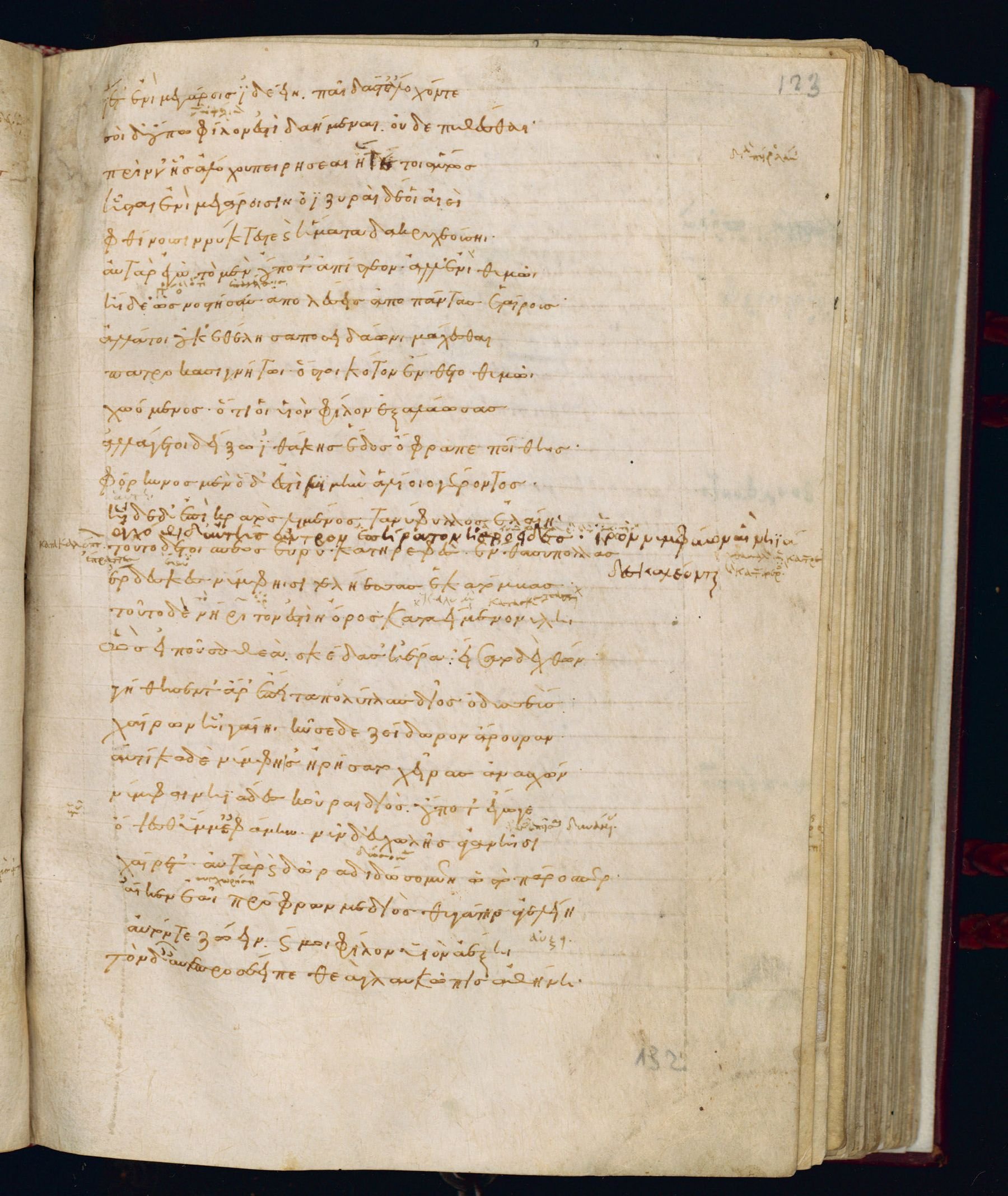
Where on the image
Laur. Plut. 32.24, fol. 132r: Odyssey 13.334-361, begins ‹ἵετʼ ἐνὶ μεγάροις ἰδέειν›, ends ‹προσέειπε θεὰ γλαυκῶπις Ἀθήνη·›. Checked on the image: first and last lines read and matched to the Greek. Fol. 131v ends with 13.333. Fol. 132v begins with 13.362. 13.347 and 13.348 are written as one smaller squeezed-in line between 13.346 and 13.349, running into the right margin. English blocks here: 335-339, 340-344, 345-349, 350-354, 355-359.
334ἵετʼ ἐνὶ μεγάροις ἰδέειν παῖδάς τʼ ἄλοχόν τε·
335σοὶ δʼ οὔ πω φίλον ἐστὶ δαήμεναι οὐδὲ πυθέσθαι,
336πρίν γʼ ἔτι σῆς ἀλόχου πειρήσεαι, ἥ τέ τοι αὔτως
337ἧσται ἐνὶ μεγάροισιν, ὀϊζυραὶ δέ οἱ αἰεὶ
338φθίνουσιν νύκτες τε καὶ ἤματα δάκρυ χεούσῃ.
339αὐτὰρ ἐγὼ τὸ μὲν οὔ ποτʼ ἀπίστεον, ἀλλʼ ἐνὶ θυμῷ
340ᾔδεʼ, ὃ νοστήσεις ὀλέσας ἄπο πάντας ἑταίρους·
341ἀλλά τοι οὐκ ἐθέλησα Ποσειδάωνι μάχεσθαι
342πατροκασιγνήτῳ, ὅς τοι κότον ἔνθετο θυμῷ,
343χωόμενος ὅτι οἱ υἱὸν φίλον ἐξαλάωσας.
344ἀλλʼ ἄγε τοι δείξω Ἰθάκης ἕδος, ὄφρα πεποίθῃς.
345Φόρκυνος μὲν ὅδʼ ἐστὶ λιμήν, ἁλίοιο γέροντος,
346ἥδε δʼ ἐπὶ κρατὸς λιμένος τανύφυλλος ἐλαίη·
347ἀγχόθι δʼ αὐτῆς ἄντρον ἐπήρατον ἠεροειδές,
348ἱρὸν νυμφάων, αἳ νηϊάδες καλέονται·
349τοῦτο δέ τοι σπέος ἐστὶ κατηρεφές, ἔνθα σὺ πολλὰς
350ἔρδεσκες νύμφῃσι τεληέσσας ἑκατόμβας·
351τοῦτο δὲ Νήριτόν ἐστιν ὄρος καταειμένον ὕλῃ.
352ὣς εἰποῦσα θεὰ σκέδασʼ ἠέρα, εἴσατο δὲ χθών·
353γήθησέν τʼ ἄρʼ ἔπειτα πολύτλας δῖος Ὀδυσσεύς,
354χαίρων ᾗ γαίῃ, κύσε δὲ ζείδωρον ἄρουραν.
355αὐτίκα δὲ νύμφῃς ἠρήσατο, χεῖρας ἀνασχών·
356νύμφαι νηϊάδες, κοῦραι Διός, οὔ ποτʼ ἐγώ γε
357ὄψεσθʼ ὔμμʼ ἐφάμην· νῦν δʼ εὐχωλῇς ἀγανῇσι
358χαίρετʼ· ἀτὰρ καὶ δῶρα διδώσομεν, ὡς τὸ πάρος περ,
359αἴ κεν ἐᾷ πρόφρων με Διὸς θυγάτηρ ἀγελείη
360αὐτόν τε ζώειν καί μοι φίλον υἱὸν ἀέξῃ.
361τὸν δʼ αὖτε προσέειπε θεὰ γλαυκῶπις Ἀθήνη·
335but thou art not yet minded to know or learn of aught, till thou hast furthermore proved thy wife, who abides as of old in her halls, and ever sorrowfully for her the nights and days wane, as she weeps. But as for me, I never doubted of this, but in my heart 340knew it well, that thou wouldest come home after losing all thy comrades. Yet, thou must know, I was not minded to strive against Poseidon, my father's brother, who laid up wrath in his heart against thee, angered that thou didst blind his dear son. But come, I will shew thee the land of Ithaca, that thou mayest be sure. 345This is the harbor of Phorcys, the old man of the sea, and here at the head of the harbor is the long-leafed olive tree, and near it is the pleasant, shadowy cave, sacred to the nymphs that are called Naiads. This, thou must know, is the vaulted cave in which thou 350wast wont to offer to the nymphs many hecatombs that bring fulfillment; and yonder is Mount Neriton, clothed with its forests.” So spake the goddess, and scattered the mist, and the land appeared. Glad then was the much-enduring, goodly Odysseus, rejoicing in his own land, and he kissed the earth, the giver of grain. 355And straightway he prayed to the nymphs with upstretched hands: “Ye Naiad Nymphs, daughters of Zeus, never did I think to behold you again, but now I hail you with loving prayers. Aye, and gifts too will I give, as aforetime, if the daughter of Zeus, she that drives the spoil, shall graciously grant me
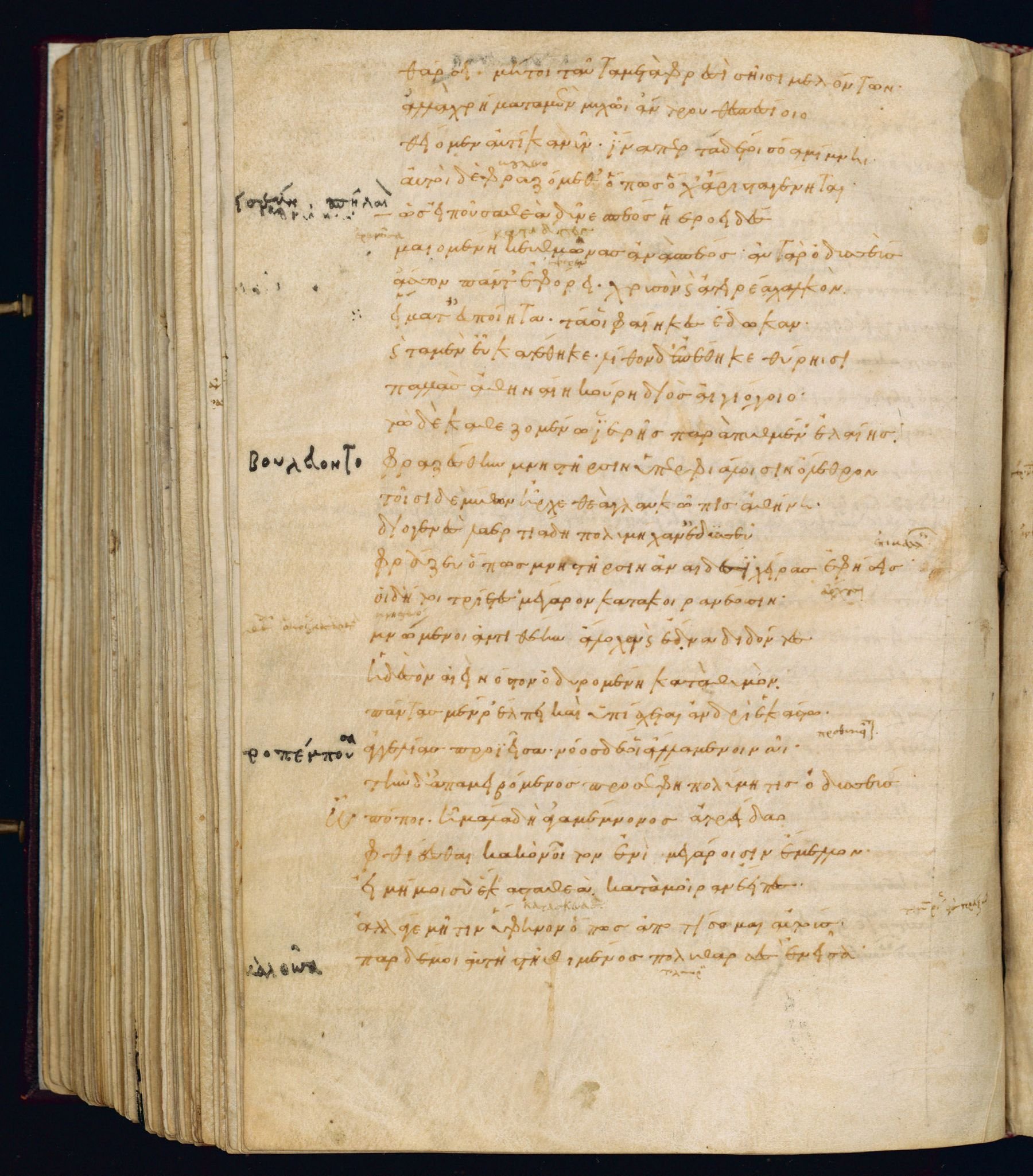
Where on the image
Laur. Plut. 32.24, fol. 132v: Odyssey 13.362-387, begins ‹θάρσει, μή τοι ταῦτα›, ends ‹στῆθι, μένος πολυθαρσὲς ἐνεῖσα,›. Checked on the image: first and last lines read and matched to the Greek. Fol. 132r ends with 13.361. Fol. 133r begins with 13.388. English blocks here: 360-364, 365-365, 366-369, 370-374, 375-379, 380-384, 385-389.
362θάρσει, μή τοι ταῦτα μετὰ φρεσὶ σῇσι μελόντων.
363ἀλλὰ χρήματα μὲν μυχῷ ἄντρου θεσπεσίοιο
364θείμεν αὐτίκα νῦν, ἵνα περ τάδε τοι σόα μίμνῃ·
365αὐτοὶ δὲ φραζώμεθʼ ὅπως ὄχʼ ἄριστα γένηται.
366ὣς εἰποῦσα θεὰ δῦνε σπέος ἠεροειδές,
367μαιομένη κευθμῶνας ἀνὰ σπέος· αὐτὰρ Ὀδυσσεὺς
368ἆσσον πάντʼ ἐφόρει, χρυσὸν καὶ ἀτειρέα χαλκὸν
369εἵματά τʼ εὐποίητα, τά οἱ Φαίηκες ἔδωκαν.
370καὶ τὰ μὲν εὖ κατέθηκε, λίθον δʼ ἐπέθηκε θύρῃσι
371Παλλὰς Ἀθηναίη, κούρη Διὸς αἰγιόχοιο.
372τὼ δὲ καθεζομένω ἱερῆς παρὰ πυθμένʼ ἐλαίης
373φραζέσθην μνηστῆρσιν ὑπερφιάλοισιν ὄλεθρον.
374τοῖσι δὲ μύθων ἦρχε θεὰ γλαυκῶπις Ἀθήνη·
375διογενὲς Λαερτιάδη, πολυμήχανʼ Ὀδυσσεῦ,
376φράζευ ὅπως μνηστῆρσιν ἀναιδέσι χεῖρας ἐφήσεις,
377οἳ δή τοι τρίετες μέγαρον κάτα κοιρανέουσι,
378μνώμενοι ἀντιθέην ἄλοχον καὶ ἕδνα διδόντες·
379ἡ δὲ σὸν αἰεὶ νόστον ὀδυρομένη κατὰ θυμὸν
380πάντας μέν ῥʼ ἔλπει καὶ ὑπίσχεται ἀνδρὶ ἑκάστῳ,
381ἀγγελίας προϊεῖσα, νόος δέ οἱ ἄλλα μενοινᾷ.
382τὴν δʼ ἀπαμειβόμενος προσέφη πολύμητις Ὀδυσσεύς·
383ὢ πόποι, ἦ μάλα δὴ Ἀγαμέμνονος Ἀτρεΐδαο
384φθίσεσθαι κακὸν οἶτον ἐνὶ μεγάροισιν ἔμελλον,
385εἰ μή μοι σὺ ἕκαστα, θεά, κατὰ μοῖραν ἔειπες.
386ἀλλʼ ἄγε μῆτιν ὕφηνον, ὅπως ἀποτίσομαι αὐτούς·
387πὰρ δέ μοι αὐτὴ στῆθι, μένος πολυθαρσὲς ἐνεῖσα,
360to live, and shall bring to manhood my dear son.” Then the goddess, flashing-eyed Athena, answered him again: “Be of good cheer, and let not these things distress thy heart. But let us now forthwith set thy goods in the innermost recess of the wondrous cave, where they may abide for thee in safety, 365and let us ourselves take thought how all may be far the best.” 366So saying, the goddess entered the shadowy cave and searched out its hiding-places. And Odysseus brought all the treasure thither, the gold and the stubborn bronze and the finely-wrought raiment, which the Phaeacians gave him. 370These things he carefully laid away, and Pallas Athena, daughter of Zeus, who bears the aegis, set a stone at the door. Then the two sat them down by the trunk of the sacred olive tree, and devised death for the insolent wooers. And the goddess, flashing-eyed Athena, was the first to speak, saying: 375“Son of Laertes, sprung from Zeus, Odysseus of many devices, take thought how thou mayest put forth thy hands on the shameless wooers, who now for three years have been lording it in thy halls, wooing thy godlike wife, and offering wooers' gifts. And she, as she mournfully looks for thy coming, 380offers hopes to all, and has promises for each man, sending them messages, but her mind is set on other things.” Then Odysseus of many wiles answered her, and said: “Lo now, of a surety I was like to have perished in my halls by the evil fate of Agamemnon, son of Atreus, 385hadst not thou, goddess, duly told me all. But come, weave some plan by which I may requite them; and stand thyself by my side, and endue me with dauntless courage, even as when we loosed the bright diadem of Troy. Wouldest thou but stand by my side, thou flashing-eyed one, as eager as thou wast then,
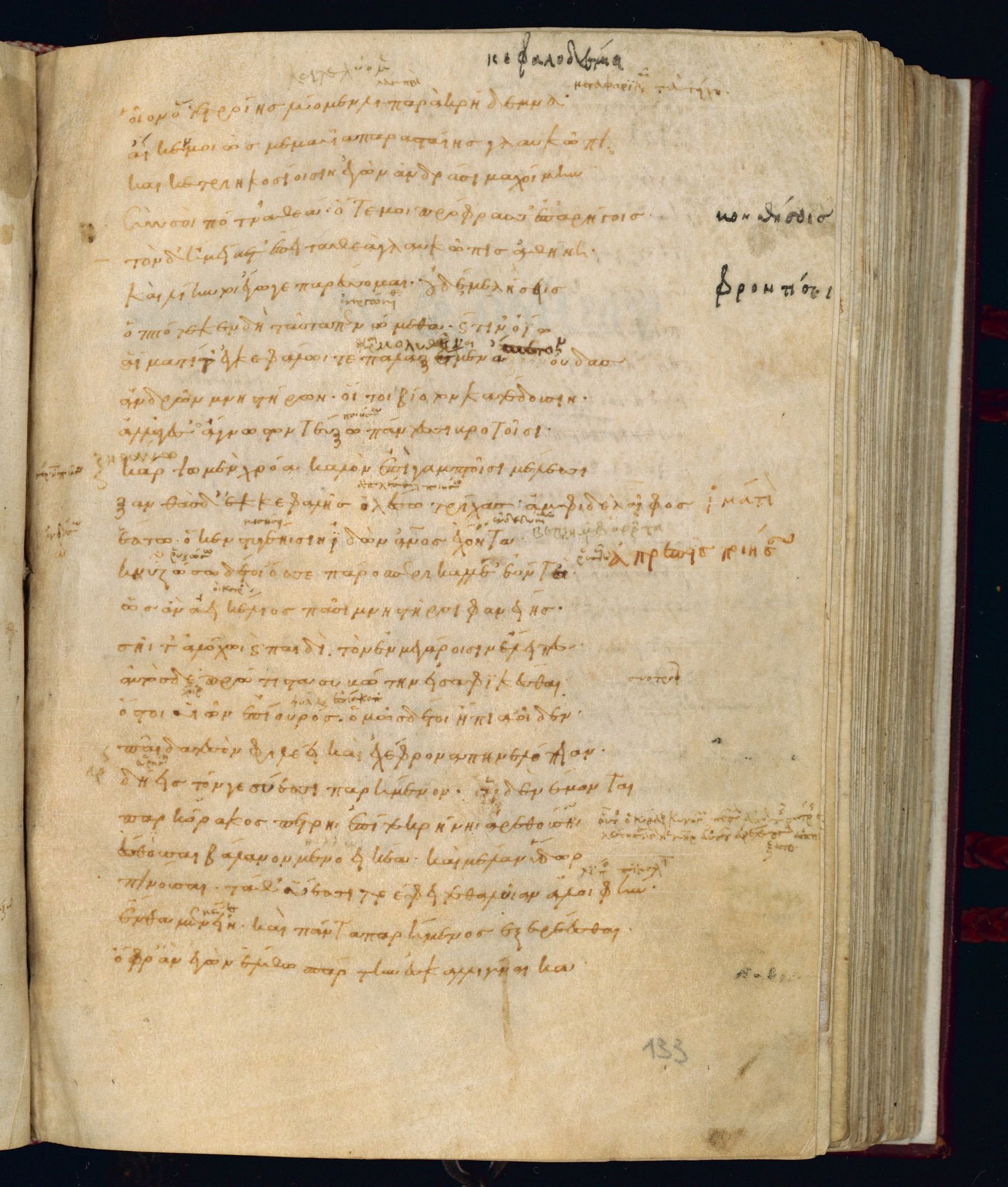
Where on the image
Laur. Plut. 32.24, fol. 133r: Odyssey 13.388-412, begins ‹οἷον ὅτε Τροίης λύομεν›, ends ‹ἔλθω Σπάρτην ἐς καλλιγύναικα›. Checked on the image: first and last lines read and matched to the Greek. Fol. 132v ends with 13.387. Fol. 133v begins with 13.413. A gloss (κεφαλόδεσμα) is written above the first line. English blocks here: 390-394, 395-399, 400-404, 405-409, 410-414.
388οἷον ὅτε Τροίης λύομεν λιπαρὰ κρήδεμνα.
389αἴ κέ μοι ὣς μεμαυῖα παρασταίης, γλαυκῶπι,
390καί κε τριηκοσίοισιν ἐγὼν ἄνδρεσσι μαχοίμην
391σὺν σοί, πότνα θεά, ὅτε μοι πρόφρασσʼ ἐπαρήγοις.
392τὸν δʼ ἠμείβετʼ ἔπειτα θεὰ γλαυκῶπις Ἀθήνη·
393καὶ λίην τοι ἐγώ γε παρέσσομαι, οὐδέ με λήσεις,
394ὁππότε κεν δὴ ταῦτα πενώμεθα· καί τινʼ ὀΐω
395αἵματί τʼ ἐγκεφάλῳ τε παλαξέμεν ἄσπετον οὖδας
396ἀνδρῶν μνηστήρων, οἵ τοι βίοτον κατέδουσιν.
397ἀλλʼ ἄγε σʼ ἄγνωστον τεύξω πάντεσσι βροτοῖσι·
398κάρψω μὲν χρόα καλὸν ἐνὶ γναμπτοῖσι μέλεσσι,
399ξανθὰς δʼ ἐκ κεφαλῆς ὀλέσω τρίχας, ἀμφὶ δὲ λαῖφος
400ἕσσω ὅ κε στυγέῃσιν ἰδὼν ἄνθρωπον ἔχοντα,
401κνυζώσω δέ τοι ὄσσε πάρος περικαλλέʼ ἐόντε,
402ὡς ἂν ἀεικέλιος πᾶσι μνηστῆρσι φανήῃς
403σῇ τʼ ἀλόχῳ καὶ παιδί, τὸν ἐν μεγάροισιν ἔλειπες.
404αὐτὸς δὲ πρώτιστα συβώτην εἰσαφικέσθαι,
405ὅς τοι ὑῶν ἐπίουρος, ὁμῶς δέ τοι ἤπια οἶδε,
406παῖδά τε σὸν φιλέει καὶ ἐχέφρονα Πηνελόπειαν.
407δήεις τόν γε σύεσσι παρήμενον· αἱ δὲ νέμονται
408πὰρ Κόρακος πέτρῃ ἐπί τε κρήνῃ Ἀρεθούσῃ,
409ἔσθουσαι βάλανον μενοεικέα καὶ μέλαν ὕδωρ
410πίνουσαι, τά θʼ ὕεσσι τρέφει τεθαλυῖαν ἀλοιφήν.
411ἔνθα μένειν καὶ πάντα παρήμενος ἐξερέεσθαι,
412ὄφρʼ ἂν ἐγὼν ἔλθω Σπάρτην ἐς καλλιγύναικα
390I would fight even against three hundred men, with thee, mighty goddess, if with a ready heart thou wouldest give me aid.” Then the goddess, flashing-eyed Athena, answered him: “Yea verily, I will be with thee, and will not forget thee, when we are busied with this work; and methinks many a one 395of the wooers that devour thy substance shall bespatter the vast earth with his blood and brains. But come, I will make thee unknown to all mortals. I will shrivel the fair skin on thy supple limbs, and destroy the flaxen hair from off thy head, and clothe thee in a ragged garment, 400such that one would shudder to see a man clad therein. And I will dim thy two eyes that were before so beautiful, that thou mayest appear mean in the sight of all the wooers, and of thy wife, and of thy son, whom thou didst leave in thy halls. And for thyself, do thou go first of all 405to the swineherd who keeps thy swine, and withal has a kindly heart towards thee, and loves thy son and constant Penelope. Thou wilt find him abiding by the swine, and they are feeding by the rock of Corax and the spring Arethusa, eating acorns to their heart's content and 410drinking the black water, things which cause the rich flesh of swine to wax fat. There do thou stay, and sitting by his side question him of all things, while I go to Sparta, the land of fair women, to summon thence Telemachus, thy dear son, Odysseus, who went to spacious Lacedaemon to the house of Menelaus,
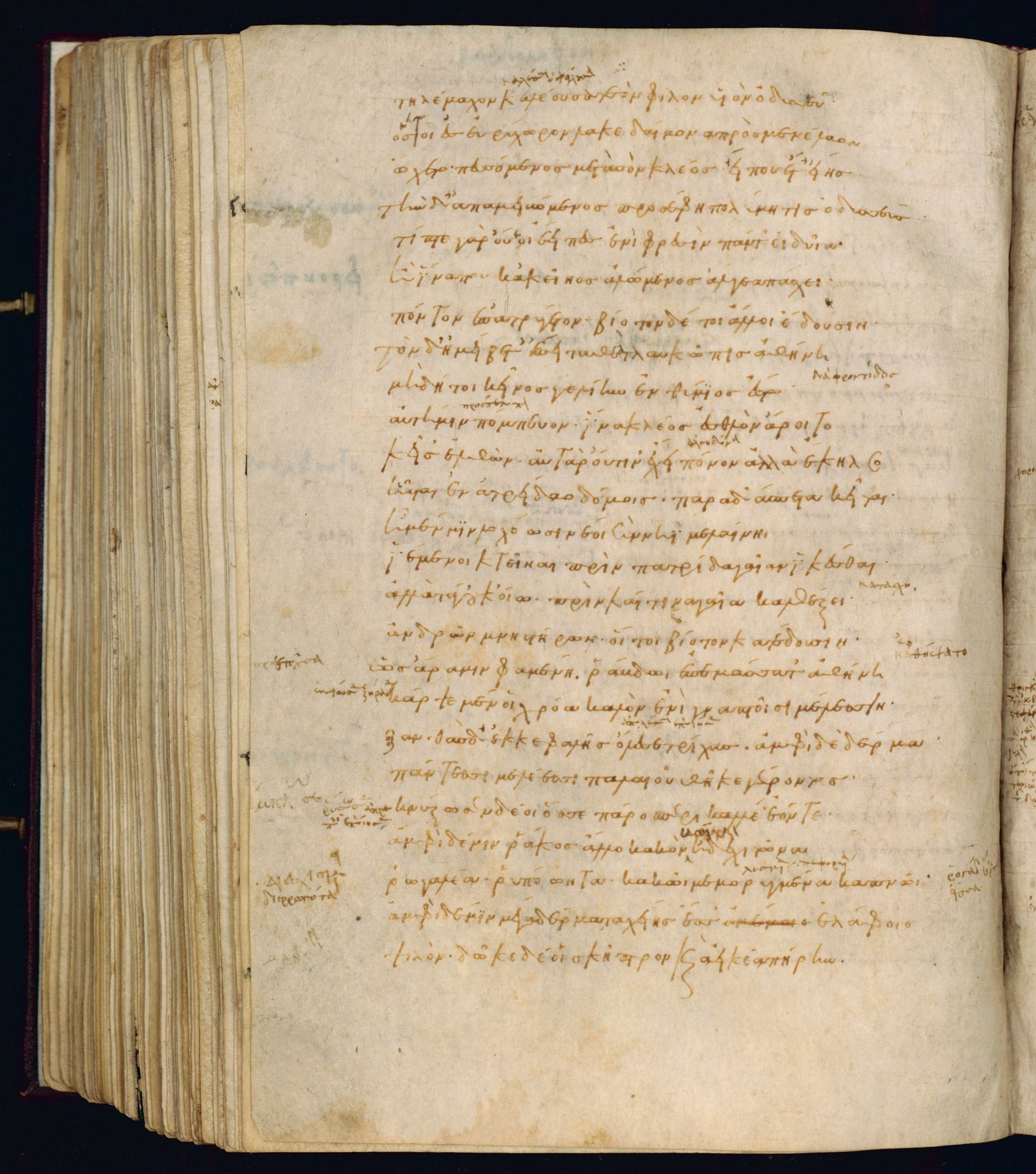
Where on the image
Laur. Plut. 32.24, fol. 133v: Odyssey 13.413-437, begins ‹Τηλέμαχον καλέουσα, τεὸν φίλον›, ends ‹σκῆπτρον καὶ ἀεικέα πήρην,›. Checked on the image: first and last lines read and matched to the Greek. Fol. 133r ends with 13.412. Fol. 134r begins with 13.438. English here: 13.415-438. Murray's sentence for 13.436-438 (And about him she cast ... slung by a twisted cord.) runs across the break between fol. 133v (Greek to 13.437) and fol. 134r (Greek from 13.438); it is given whole with fol. 133v, so the English of fol. 133v ends with 13.438 and that of fol. 134r begins with 13.439. At the page's other break the English follows Murray's five-line marks (a block that crosses the break goes with the page holding its middle line).
413Τηλέμαχον καλέουσα, τεὸν φίλον υἱόν, Ὀδυσσεῦ·
414ὅς τοι ἐς εὐρύχορον Λακεδαίμονα πὰρ Μενέλαον
415ᾤχετο πευσόμενος μετὰ σὸν κλέος, εἴ που ἔτʼ εἴης.
416τὴν δʼ ἀπαμειβόμενος προσέφη πολύμητις Ὀδυσσεύς·
417τίπτε τʼ ἄρʼ οὔ οἱ ἔειπες, ἐνὶ φρεσὶ πάντα ἰδυῖα;
418ἦ ἵνα που καὶ κεῖνος ἀλώμενος ἄλγεα πάσχῃ
419πόντον ἐπʼ ἀτρύγετον· βίοτον δέ οἱ ἄλλοι ἔδουσι;
420τὸν δʼ ἠμείβετʼ ἔπειτα θεὰ γλαυκῶπις Ἀθήνη·
421μὴ δή τοι κεῖνός γε λίην ἐνθύμιος ἔστω.
422αὐτή μιν πόμπευον, ἵνα κλέος ἐσθλὸν ἄροιτο
423κεῖσʼ ἐλθών· ἀτὰρ οὔ τινʼ ἔχει πόνον, ἀλλὰ ἕκηλος
424ἧσται ἐν Ἀτρεΐδαο δόμοις, παρὰ δʼ ἄσπετα κεῖται.
425ἦ μέν μιν λοχόωσι νέοι σὺν νηῒ μελαίνῃ,
426ἱέμενοι κτεῖναι, πρὶν πατρίδα γαῖαν ἱκέσθαι·
427ἀλλὰ τά γʼ οὐκ ὀΐω, πρὶν καί τινα γαῖα καθέξει
428ἀνδρῶν μνηστήρων, οἵ τοι βίοτον κατέδουσιν.
429ὣς ἄρα μιν φαμένη ῥάβδῳ ἐπεμάσσατʼ Ἀθήνη.
430κάρψεν μὲν χρόα καλὸν ἐνὶ γναμπτοῖσι μέλεσσι,
431ξανθὰς δʼ ἐκ κεφαλῆς ὄλεσε τρίχας, ἀμφὶ δὲ δέρμα
432πάντεσσιν μελέεσσι παλαιοῦ θῆκε γέροντος,
433κνύζωσεν δέ οἱ ὄσσε πάρος περικαλλέʼ ἐόντε·
434ἀμφὶ δέ μιν ῥάκος ἄλλο κακὸν βάλεν ἠδὲ χιτῶνα,
435ῥωγαλέα ῥυπόωντα, κακῷ μεμορυγμένα καπνῷ·
436ἀμφὶ δέ μιν μέγα δέρμα ταχείης ἕσσʼ ἐλάφοιο,
437ψιλόν· δῶκε δέ οἱ σκῆπτρον καὶ ἀεικέα πήρην,
415to seek tidings of thee, if thou wast still anywhere alive.” 416Then Odysseus of many wiles answered her: “Why then, I pray thee, didst thou not tell him, thou whose mind knows all things? Nay, was it haply that he too might suffer woes, wandering over the unresting sea, and that others might devour his substance?” 420Then the goddess, flashing-eyed Athena, answered him: “Nay verily, not for him be thy heart overmuch troubled. It was I that guided him, that he might win good report by going thither, and he has no toil, but sits in peace in the palace of the son of Atreus, and good cheer past telling is before him. 425Truly young men in a black ship lie in wait for him, eager to slay him before he comes to his native land, but methinks this shall not be. Ere that shall the earth cover many a one of the wooers that devour thy substance.” So saying, Athena touched him with her wand. 430She withered the fair flesh on his supple limbs, and destroyed the flaxen hair from off his head, and about all his limbs she put the skin of an aged old man. And she dimmed his two eyes that were before so beautiful, and clothed him in other raiment, 435a vile ragged cloak and a tunic, tattered garments and foul, begrimed with filthy smoke. And about him she cast the great skin of a swift hind, stripped of the hair, and she gave him a staff, and a miserable wallet, full of holes, slung by a twisted cord.
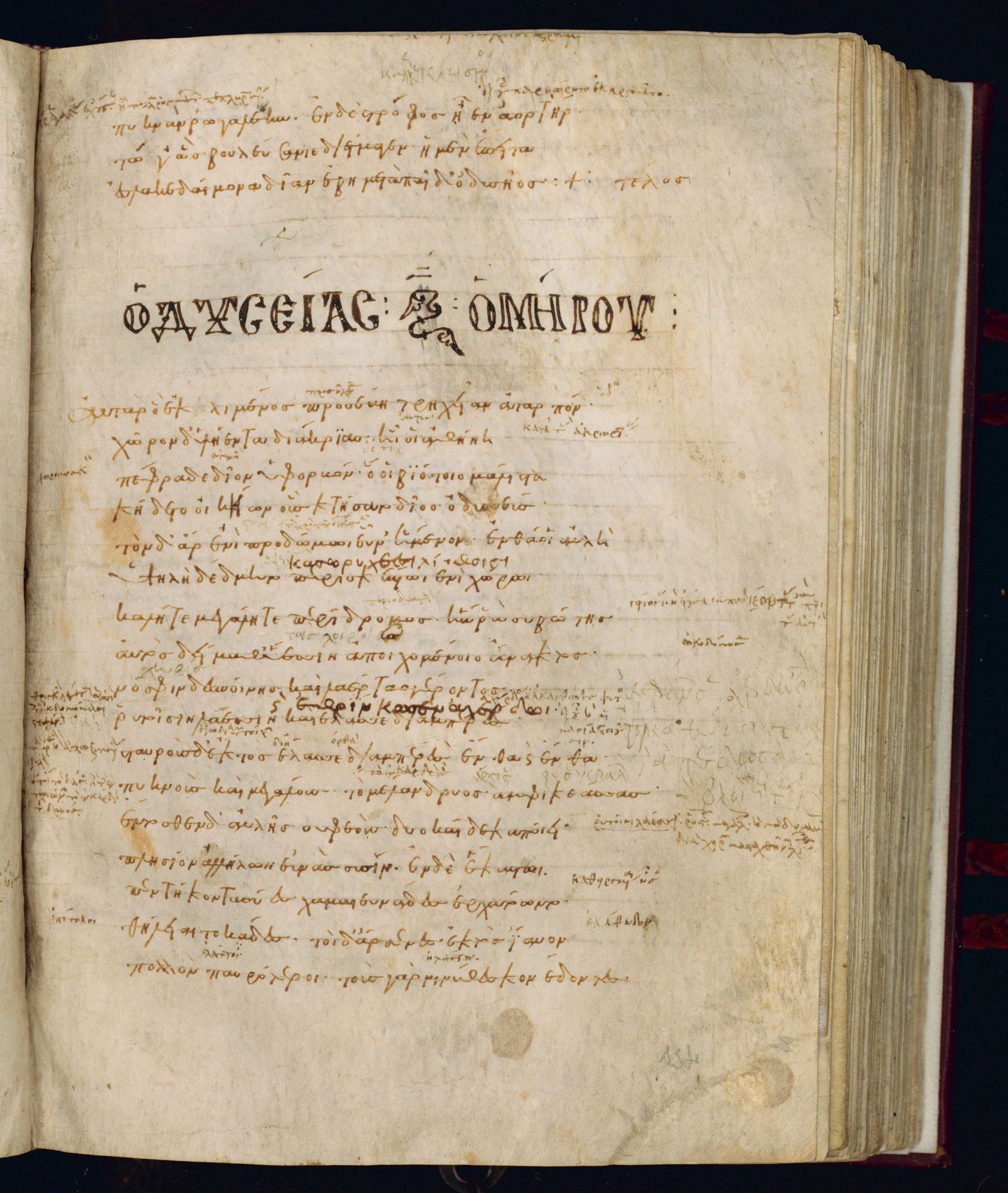
Where on the image
Laur. Plut. 32.24, fol. 134r: Odyssey 13.438-440, begins ‹πυκνὰ ῥωγαλέην· ἐν δὲ›, ends ‹ἔβη μετὰ παῖδʼ Ὀδυσῆος.›. Checked on the image: first and last lines read and matched to the Greek. Fol. 133v ends with 13.437. The page holds 13.438-440, 14.1-17. Book 13 ends with 13.440 and τέλος; the heading ὀδυσσείας ξ ὁμήρου follows in capitals after a space, and book 14 begins. A correction in a later hand is written above 14.10. English here: 13.439-440. Murray's sentence for 13.436-438 (And about him she cast ... slung by a twisted cord.) runs across the break between fol. 133v (Greek to 13.437) and fol. 134r (Greek from 13.438); it is given whole with fol. 133v, so the English of fol. 133v ends with 13.438 and that of fol. 134r begins with 13.439. At the page's other break the English follows Murray's five-line marks (a block that crosses the break goes with the page holding its middle line).
438πυκνὰ ῥωγαλέην· ἐν δὲ στρόφος ἦεν ἀορτήρ.
439τώ γʼ ὣς βουλεύσαντε διέτμαγεν. ἡ μὲν ἔπειτα
440ἐς Λακεδαίμονα δῖαν ἔβη μετὰ παῖδʼ Ὀδυσῆος.
439So when the two had thus taken counsel together, they parted; and thereupon the goddess 440went to goodly Lacedaemon to fetch the son of Odysseus.
Notes
- Greek: A. T. Murray, Homer: The Odyssey (Loeb Classical Library, 1919), via Perseus.
- English: A. T. Murray's translation in the same edition; his footnotes are omitted.
Cite
Sources
- Source: Laur. Plut. 32.24 (BML Teca Digitale IIIF) + Murray Greek (Loeb 1919, Perseus) + Murray English (Loeb 1919, Perseus) (holding institution)
- Critical edition: Murray, Loeb 1919, via Perseus
← previous · → next · v cycle view · l back to library