Homer, Odyssey, Book 15: Telemachus returns
Introduction
The Odyssey, composed around 700 BCE and attributed to Homer, tells of Odysseus' ten-year journey home from Troy and his return to Ithaca. Book 15 (557 lines): Telemachus returns.
The page photographs are from Florence, Biblioteca Medicea Laurenziana, Plut. 32.24 (parchment, 10th century, 234 folios; the oldest manuscript of the Odyssey with published images), in the Biblioteca Medicea Laurenziana's Teca Digitale. This book is on fol. 144v-155v; each section below is one page, with its first and last line as read on the photograph. Many pages carry interlinear glosses and a few marginal notes in later hands.
The Greek is A. T. Murray's Loeb text (1919) via Perseus, not a transcription of this manuscript, whose wording differs in places. The English is Murray's prose translation (1919), divided every five lines; at a page break a five-line block goes with the page holding most of it, except at the page breaks where a section's note says the English is cut at the end of Murray's sentence. Each section's note gives its English line range.
Where the scribe left out a line, wrote one in the margin, changed the order or added a line not in Murray's text, the section's note on the photograph says so; the Greek and English shown are Murray's full text for the page's range.
How was this verified? (Provenance)
Where on the image
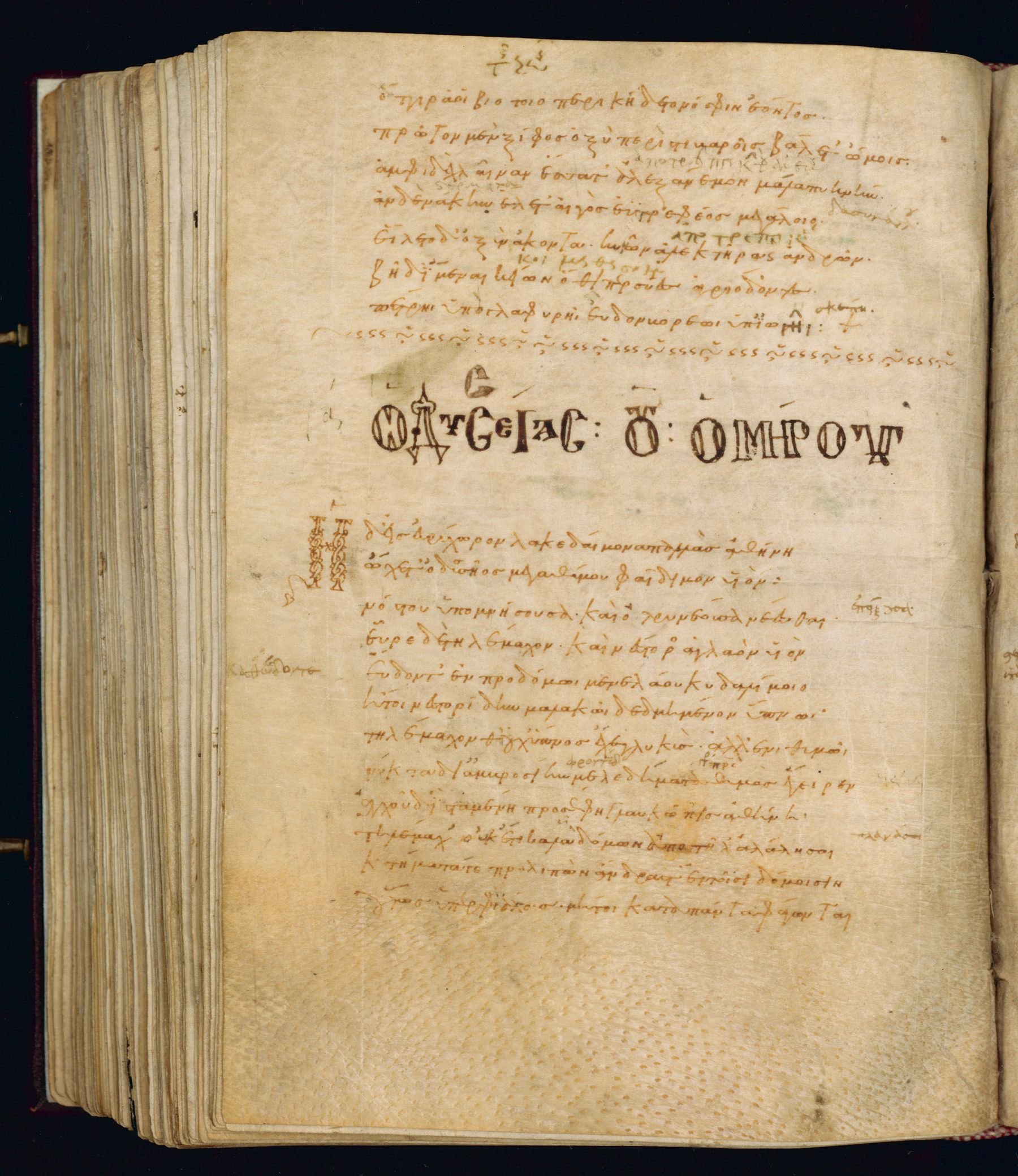
Laur. Plut. 32.24, fol. 144v: Odyssey 15.1-12, begins ‹ἡ δʼ εἰς εὐρύχορον›, ends ‹τοι κατὰ πάντα φάγωσι›. Checked on the image: first and last lines read and matched to the Greek. Fol. 145r begins with 15.13. The page holds 14.527-533, 15.1-12. Book 14 ends with 14.533, followed by a line of ornament with τέλος; the heading ὀδυσσείας ο ὁμήρου follows in capitals, and book 15 begins with a large decorated initial. English blocks here: 1-4, 5-9, 10-14.
1ἡ δʼ εἰς εὐρύχορον Λακεδαίμονα Παλλὰς Ἀθήνη
2ᾤχετʼ, Ὀδυσσῆος μεγαθύμου φαίδιμον υἱὸν
3νόστου ὑπομνήσουσα καὶ ὀτρυνέουσα νέεσθαι.
4εὗρε δὲ Τηλέμαχον καὶ Νέστορος ἀγλαὸν υἱὸν
5εὕδοντʼ ἐν προδόμῳ Μενελάου κυδαλίμοιο,
6ἦ τοι Νεστορίδην μαλακῷ δεδμημένον ὕπνῳ·
7Τηλέμαχον δʼ οὐχ ὕπνος ἔχε γλυκύς, ἀλλʼ ἐνὶ θυμῷ
8νύκτα διʼ ἀμβροσίην μελεδήματα πατρὸς ἔγειρεν.
9ἀγχοῦ δʼ ἱσταμένη προσέφη γλαυκῶπις Ἀθήνη·
10Τηλέμαχʼ, οὐκέτι καλὰ δόμων ἄπο τῆλʼ ἀλάλησαι,
11κτήματά τε προλιπὼν ἄνδρας τʼ ἐν σοῖσι δόμοισιν
12οὕτω ὑπερφιάλους· μή τοι κατὰ πάντα φάγωσι
1But Pallas Athena went to spacious Lacedaemon to remind the glorious son of great-hearted Odysseus of his return, and to hasten his coming. She found Telemachus and the noble son of Nestor 5lying in the fore-hall of the palace of glorious Menelaus. Now Nestor's son was overcome with soft sleep, but sweet sleep did not hold Telemachus, but all through the immortal night anxious thoughts for his father kept him wakeful. And flashing-eyed Athena stood near him, and said: 10“Telemachus, thou dost not well to wander longer far from thy home, leaving behind thee thy wealth and men in thy house so insolent, lest they divide and devour all thy possessions, and thou shalt have gone on a fruitless journey. Nay, rouse with all speed Menelaus, good at the war-cry,
Where on the image
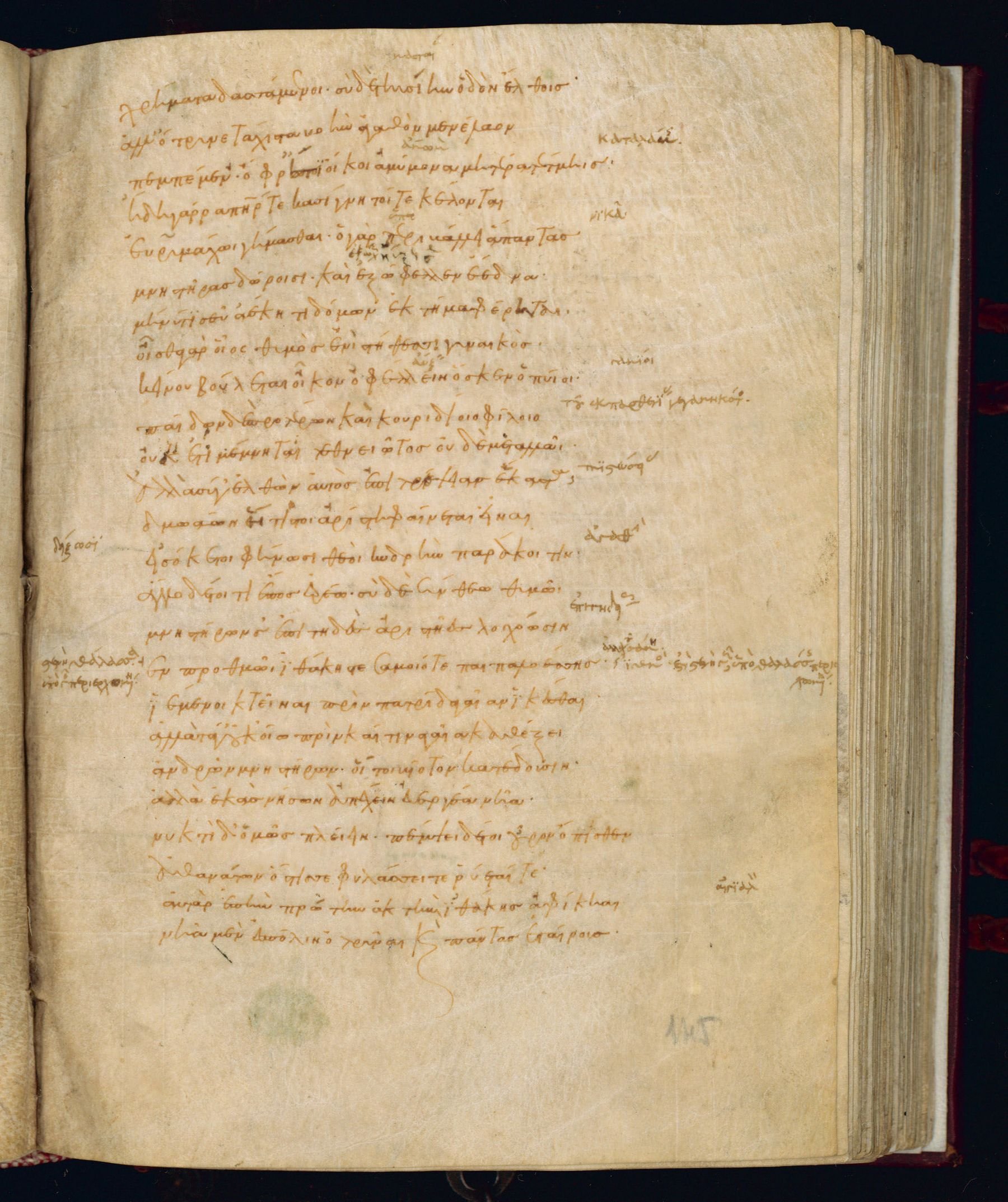
Laur. Plut. 32.24, fol. 145r: Odyssey 15.13-37, begins ‹κτήματα δασσάμενοι, σὺ δὲ›, ends ‹ὀτρῦναι καὶ πάντας ἑταίρους,›. Checked on the image: first and last lines read and matched to the Greek. Fol. 144v ends with 15.12. Fol. 145v begins with 15.38. English blocks here: 15-19, 20-24, 25-29, 30-34, 35-39.
13κτήματα δασσάμενοι, σὺ δὲ τηϋσίην ὁδὸν ἔλθῃς.
14ἀλλʼ ὄτρυνε τάχιστα βοὴν ἀγαθὸν Μενέλαον
15πεμπέμεν, ὄφρʼ ἔτι οἴκοι ἀμύμονα μητέρα τέτμῃς.
16ἤδη γάρ ῥα πατήρ τε κασίγνητοί τε κέλονται
17Εὐρυμάχῳ γήμασθαι· ὁ γὰρ περιβάλλει ἅπαντας
18μνηστῆρας δώροισι καὶ ἐξώφελλεν ἔεδνα·
19μή νύ τι σεῦ ἀέκητι δόμων ἐκ κτῆμα φέρηται.
20οἶσθα γὰρ οἷος θυμὸς ἐνὶ στήθεσσι γυναικός·
21κείνου βούλεται οἶκον ὀφέλλειν ὅς κεν ὀπυίῃ,
22παίδων δὲ προτέρων καὶ κουριδίοιο φίλοιο
23οὐκέτι μέμνηται τεθνηκότος οὐδὲ μεταλλᾷ.
24ἀλλὰ σύ γʼ ἐλθὼν αὐτὸς ἐπιτρέψειας ἕκαστα
25δμῳάων ἥ τίς τοι ἀρίστη φαίνεται εἶναι,
26εἰς ὅ κέ τοι φήνωσι θεοὶ κυδρὴν παράκοιτιν.
27ἄλλο δέ τοί τι ἔπος ἐρέω, σὺ δὲ σύνθεο θυμῷ.
28μνηστήρων σʼ ἐπιτηδὲς ἀριστῆες λοχόωσιν
29ἐν πορθμῷ Ἰθάκης τε Σάμοιό τε παιπαλοέσσης.
30ἱέμενοι κτεῖναι, πρὶν πατρίδα γαῖαν ἱκέσθαι.
31ἀλλὰ τά γʼ οὐκ ὀΐω· πρὶν καί τινα γαῖα καθέξει
32ἀνδρῶν μνηστήρων, οἵ τοι βίοτον κατέδουσιν.
33ἀλλὰ ἑκὰς νήσων ἀπέχειν εὐεργέα νῆα,
34νυκτὶ δʼ ὁμῶς πλείειν· πέμψει δέ τοι οὖρον ὄπισθεν
35ἀθανάτων ὅς τίς σε φυλάσσει τε ῥύεταί τε.
36αὐτὰρ ἐπὴν πρώτην ἀκτὴν Ἰθάκης ἀφίκηαι,
37νῆα μὲν ἐς πόλιν ὀτρῦναι καὶ πάντας ἑταίρους,
15to send thee on thy way, that thou mayest find thy noble mother still in her home. For now her father and her brothers bid her wed Eurymachus, for he surpasses all the wooers in his presents, and has increased his gifts of wooing. Beware lest she carry forth from thy halls some treasure against thy will. 20For thou knowest what sort of a spirit there is in a woman's breast; she is fain to increase the house of the man who weds her, but of her former children and of the lord of her youth she takes no thought, when once he is dead, and asks no longer concerning them. Nay, go, and thyself put all thy possessions in the charge of whatsoever one 25of the handmaids seems to thee the best, until the gods shall show thee a noble bride. And another thing will I tell thee, and do thou lay it to heart. The best men of the wooers lie in wait for thee of set purpose in the strait between Ithaca and rugged Samos, 30eager to slay thee before thou comest to thy native land. But methinks this shall not be; ere that shall the earth cover many a one of the wooers that devour thy substance. But do thou keep thy well-built ship far from the islands, and sail by night as well as by day, and that 35one of the immortals, who keeps and guards thee, will send a fair breeze in thy wake. But when thou hast reached the nearest shore of Ithaca, send thy ship and all thy comrades on to the city, but thyself go first of all to the swineherd who keeps thy swine, and withal has a kindly heart toward thee.
Where on the image
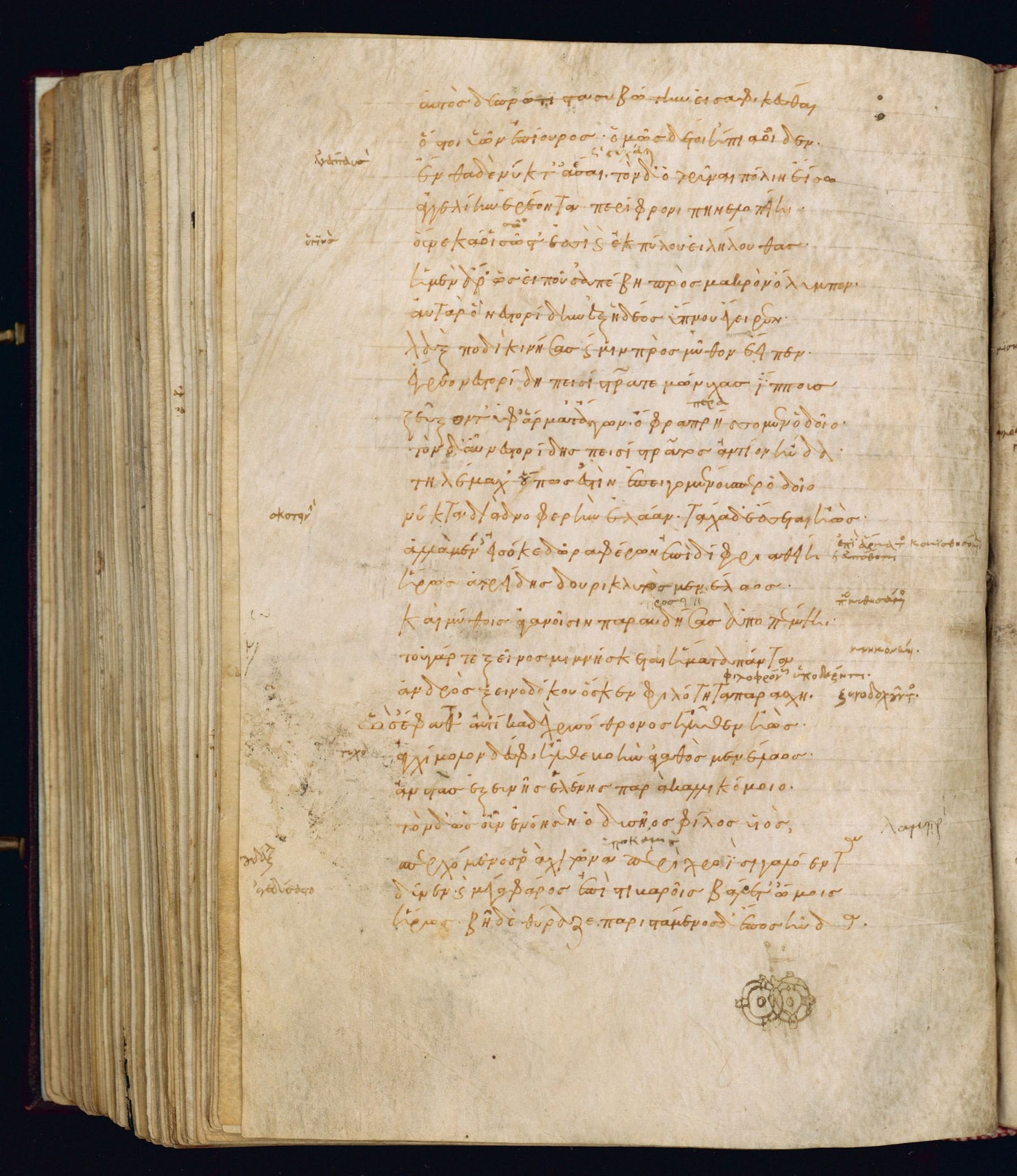
Laur. Plut. 32.24, fol. 145v: Odyssey 15.38-62, begins ‹αὐτὸς δὲ πρώτιστα συβώτην›, ends ‹θύραζε, παριστάμενος δὲ προσηύδα›. Checked on the image: first and last lines read and matched to the Greek. Fol. 145r ends with 15.37. Fol. 146r begins with 15.63. English blocks here: 40-44, 45-47, 48-49, 50-54, 55-59, 60-64.
38αὐτὸς δὲ πρώτιστα συβώτην εἰσαφικέσθαι,
39ὅς τοι ὑῶν ἐπίουρος, ὁμῶς δέ τοι ἤπια οἶδεν.
40ἔνθα δὲ νύκτʼ ἀέσαι· τὸν δʼ ὀτρῦναι πόλιν εἴσω
41ἀγγελίην ἐρέοντα περίφρονι Πηνελοπείῃ,
42οὕνεκά οἱ σῶς ἐσσὶ καὶ ἐκ Πύλου εἰλήλουθας.
43ἡ μὲν ἄρʼ ὣς εἰποῦσʼ ἀπέβη πρὸς μακρὸν Ὄλυμπον,
44αὐτὰρ ὁ Νεστορίδην ἐξ ἡδέος ὕπνου ἔγειρεν
45λὰξ ποδὶ κινήσας, καί μιν πρὸς μῦθον ἔειπεν·
46ἔγρεο, Νεστορίδη Πεισίστρατε, μώνυχας ἵππους
47ζεῦξον ὑφʼ ἅρματʼ ἄγων, ὄφρα πρήσσωμεν ὁδοῖο.
48τὸν δʼ αὖ Νεστορίδης Πεισίστρατος ἀντίον ηὔδα·
49Τηλέμαχʼ, οὔ πως ἔστιν ἐπειγομένους περ ὁδοῖο
50νύκτα διὰ δνοφερὴν ἐλάαν· τάχα δʼ ἔσσεται ἠώς.
51ἀλλὰ μένʼ εἰς ὅ κε δῶρα φέρων ἐπιδίφρια θήῃ
52ἥρως Ἀτρείδης, δουρικλειτὸς Μενέλαος,
53καὶ μύθοις ἀγανοῖσι παραυδήσας ἀποπέμψῃ.
54τοῦ γάρ τε ξεῖνος μιμνήσκεται ἤματα πάντα
55ἀνδρὸς ξεινοδόκου, ὅς κεν φιλότητα παράσχῃ.
56ὣς ἔφατʼ, αὐτίκα δὲ χρυσόθρονος ἤλυθεν Ἠώς.
57ἀγχίμολον δέ σφʼ ἦλθε βοὴν ἀγαθὸς Μενέλαος,
58ἀνστὰς ἐξ εὐνῆς, Ἑλένης πάρα καλλικόμοιο.
59τὸν δʼ ὡς οὖν ἐνόησεν Ὀδυσσῆος φίλος υἱός,
60σπερχόμενός ῥα χιτῶνα περὶ χροῒ σιγαλόεντα
61δῦνεν, καὶ μέγα φᾶρος ἐπὶ στιβαροῖς βάλετʼ ὤμοις
62ἥρως, βῆ δὲ θύραζε, παριστάμενος δὲ προσηύδα
40There do thou spend the night, and bid him to go to the city to bear word to wise Penelope that she has thee safe, and thou art come from Pylos.” So saying, she departed to high Olympus. But Telemachus woke the son of Nestor out of sweet sleep, 45rousing him with a touch of his heel, and spoke to him, saying: “Awake, Peisistratus, son of Nestor; bring up thy fiery-hoofed horses, and yoke them beneath the car, that we may speed on our way.” 48Then Peisistratus, son of Nestor, answered, and said: “Telemachus, in no wise may we 50drive through the dark night, how eager soever for our journey; and soon it will be dawn. Wait then, until the warrior son of Atreus, Menelaus, famed for his spear, shall bring gifts and set them on the car, and shall send us on our way with kindly words of farewell. For a guest remembers all his days 55the host who shews him kindness.” So he spoke, and presently came golden-throned Dawn. Up to them then came Menelaus, good at the war-cry, rising from his couch from beside fair-tressed Helen. And when the prince, the dear son of Odysseus, saw him, 60he made haste to put about him his bright tunic, and to fling over his mighty shoulders a great cloak, and went forth. Then Telemachus, the dear son of divine Odysseus, came up to Menelaus, and addressed him, saying: “Menelaus, son of Atreus, fostered of Zeus, leader of hosts,
Where on the image
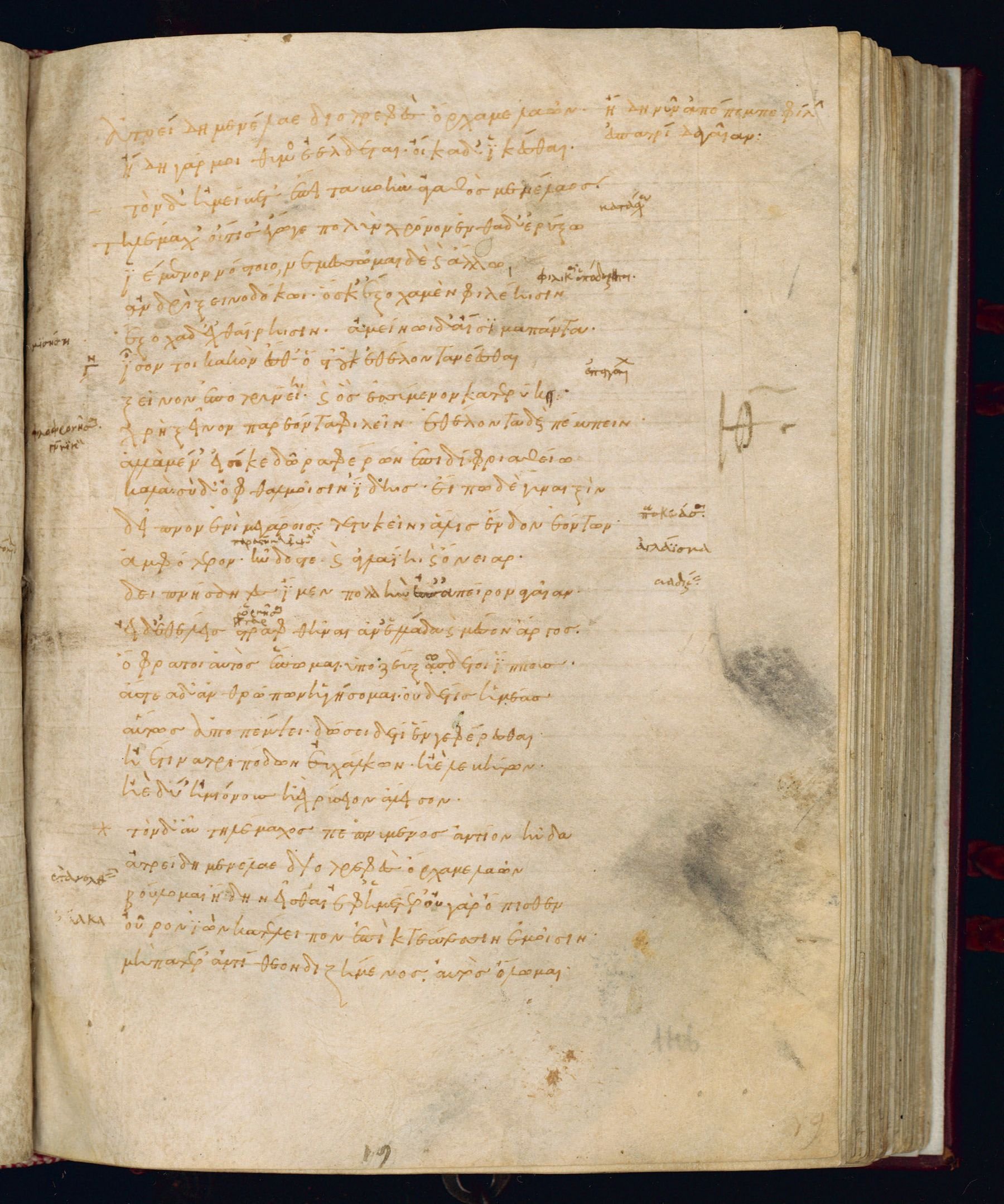
Laur. Plut. 32.24, fol. 146r: Odyssey 15.63-90, begins ‹Ἀτρεΐδη Μενέλαε διοτρεφές, ὄρχαμε›, ends ‹ἀντίθεον διζήμενος αὐτὸς ὄλωμαι,› (the first line written on the page is 15.64). Checked on the image: first and last lines read and matched to the Greek. Fol. 145v ends with 15.62. Fol. 146v begins with 15.91. 15.63 (Τηλέμαχος, φίλος υἱὸς Ὀδυσσῆος θείοιο) is not written on this page or on fol. 145v, which ends with 15.62: the scribe omits it; it is listed here with the following lines. The page begins with 15.64. 15.65 is not in the text column; it is written in the right margin beside 15.64 (the column has 26 lines). English blocks here: 65-69, 70-74, 75-79, 80-84, 85-89, 90-91.
63Τηλέμαχος, φίλος υἱὸς Ὀδυσσῆος θείοιο·
64Ἀτρεΐδη Μενέλαε διοτρεφές, ὄρχαμε λαῶν,
65ἤδη νῦν μʼ ἀπόπεμπε φίλην ἐς πατρίδα γαῖαν·
66ἤδη γάρ μοι θυμὸς ἐέλδεται οἴκαδʼ ἱκέσθαι.
67τὸν δʼ ἠμείβετʼ ἔπειτα βοὴν ἀγαθὸς Μενέλαος·
68Τηλέμαχʼ, οὔ τί σʼ ἐγώ γε πολὺν χρόνον ἐνθάδʼ ἐρύξω
69ἱέμενον νόστοιο· νεμεσσῶμαι δὲ καὶ ἄλλῳ
70ἀνδρὶ ξεινοδόκῳ, ὅς κʼ ἔξοχα μὲν φιλέῃσιν,
71ἔξοχα δʼ ἐχθαίρῃσιν· ἀμείνω δʼ αἴσιμα πάντα.
72ἶσόν τοι κακόν ἐσθʼ, ὅς τʼ οὐκ ἐθέλοντα νέεσθαι
73ξεῖνον ἐποτρύνει καὶ ὃς ἐσσύμενον κατερύκει.
74χρὴ ξεῖνον παρεόντα φιλεῖν, ἐθέλοντα δὲ πέμπειν.
75ἀλλὰ μένʼ εἰς ὅ κε δῶρα φέρων ἐπιδίφρια θείω
76καλά, σὺ δʼ ὀφθαλμοῖσιν ἴδῃς, εἴπω δὲ γυναιξὶ
77δεῖπνον ἐνὶ μεγάροις τετυκεῖν ἅλις ἔνδον ἐόντων.
78ἀμφότερον, κῦδός τε καὶ ἀγλαΐη καὶ ὄνειαρ,
79δειπνήσαντας ἴμεν πολλὴν ἐπʼ ἀπείρονα γαῖαν.
80εἰ δʼ ἐθέλεις τραφθῆναι ἀνʼ Ἑλλάδα καὶ μέσον Ἄργος,
81ὄφρα τοι αὐτὸς ἕπωμαι, ὑποζεύξω δέ τοι ἵππους,
82ἄστεα δʼ ἀνθρώπων ἡγήσομαι· οὐδέ τις ἡμέας
83αὔτως ἀππέμψει, δώσει δέ τι ἕν γε φέρεσθαι,
84ἠέ τινα τριπόδων εὐχάλκων ἠὲ λεβήτων,
85ἠὲ δύʼ ἡμιόνους ἠὲ χρύσειον ἄλεισον.
86τὸν δʼ αὖ Τηλέμαχος πεπνυμένος ἀντίον ηὔδα·
87Ἀτρεΐδη Μενέλαε διοτρεφές, ὄρχαμε λαῶν,
88βούλομαι ἤδη νεῖσθαι ἐφʼ ἡμέτερʼ· οὐ γὰρ ὄπισθεν
89οὖρον ἰὼν κατέλειπον ἐπὶ κτεάτεσσιν ἐμοῖσιν·
90μὴ πατέρʼ ἀντίθεον διζήμενος αὐτὸς ὄλωμαι,
65send me back now at length to my dear native land, for now my heart is eager to return home.” Then Menelaus, good at the war-cry, answered him: “Telemachus, I verily shall not hold thee here a long time, when thou art eager to return. Nay, I should blame another, 70who, as host, loves overmuch or hates overmuch; better is due measure in all things. 'Tis equal wrong if a man speed on a guest who is loath to go, and if he keep back one that is eager to be gone. One should make welcome the present guest, and send forth him that would go. 75But stay, till I bring fair gifts and put them on thy car, and thine own eyes behold them, and till I bid the women make ready a meal in the halls of the abundant store that is within. It is a double boon—honor and glory it brings, and profit withal—that the traveller should dine before he goes forth over the wide and boundless earth. 80And if thou art fain to journey through Hellas and mid-Argos, be it so, to the end that I may myself go with thee, and I will yoke for thee horses, and lead thee to the cities of men. Nor will any one send us away empty-handed, but will give us some one thing at least to bear with us, a fair brazen tripod or cauldron, 85or a pair of mules, or a golden cup.” Then wise Telemachus answered him: “Menelaus, son of Atreus, fostered of Zeus, leader of hosts, rather would I go at once to my home, for when I departed I left behind me no one to watch over my possessions. 90I would not that in seeking for my god-like father I myself should perish, or some goodly treasure be lost from my halls.”
Where on the image
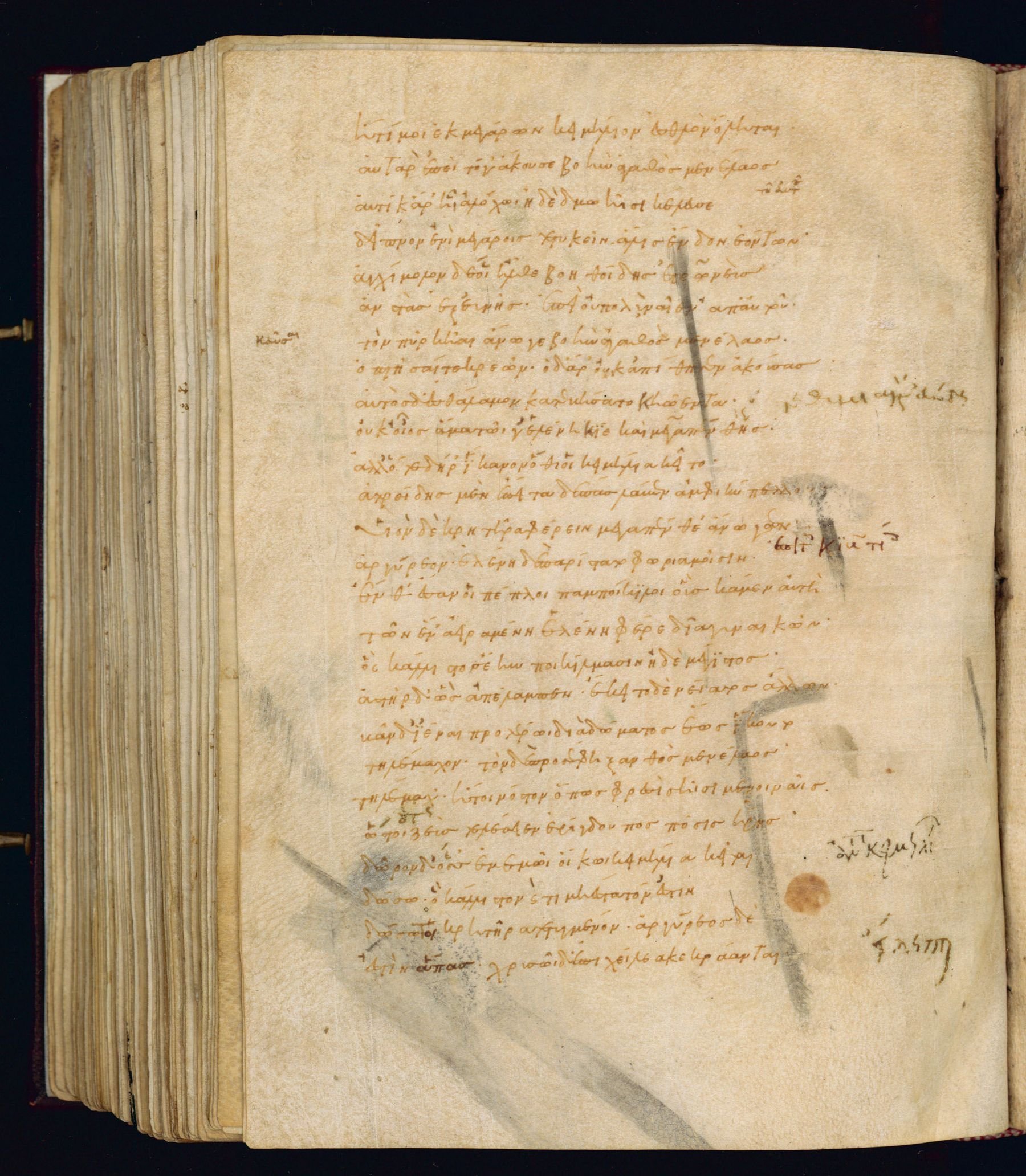
Laur. Plut. 32.24, fol. 146v: Odyssey 15.91-116, begins ‹ἤ τί μοι ἐκ›, ends ‹δʼ ἐπὶ χείλεα κεκράανται,›. Checked on the image: first and last lines read and matched to the Greek. Fol. 146r ends with 15.90. Fol. 147r begins with 15.117. English blocks here: 92-94, 95-99, 100-104, 105-109, 110-114.
91ἤ τί μοι ἐκ μεγάρων κειμήλιον ἐσθλὸν ὄληται.
92αὐτὰρ ἐπεὶ τό γʼ ἄκουσε βοὴν ἀγαθὸς Μενέλαος,
93αὐτίκʼ ἄρʼ ᾗ ἀλόχῳ ἠδὲ δμῳῇσι κέλευσε
94δεῖπνον ἐνὶ μεγάροις τετυκεῖν ἅλις ἔνδον ἐόντων.
95ἀγχίμολον δέ οἱ ἦλθε Βοηθοΐδης Ἐτεωνεύς,
96ἀνστὰς ἐξ εὐνῆς, ἐπεὶ οὐ πολὺ ναῖεν ἀπʼ αὐτοῦ·
97τὸν πῦρ κῆαι ἄνωγε βοὴν ἀγαθὸς Μενέλαος
98ὀπτῆσαί τε κρεῶν· ὁ δʼ ἄρʼ οὐκ ἀπίθησεν ἀκούσας.
99αὐτὸς δʼ ἐς θάλαμον κατεβήσετο κηώεντα,
100οὐκ οἶος, ἅμα τῷ γʼ Ἑλένη κίε καὶ Μεγαπένθης.
101ἀλλʼ ὅτε δή ῥʼ ἵκανον ὅθι κειμήλια κεῖτο,
102Ἀτρεΐδης μὲν ἔπειτα δέπας λάβεν ἀμφικύπελλον,
103υἱὸν δὲ κρητῆρα φέρειν Μεγαπένθεʼ ἄνωγεν
104ἀργύρεον· Ἑλένη δὲ παρίστατο φωριαμοῖσιν,
105ἔνθʼ ἔσαν οἱ πέπλοι παμποίκιλοι, οὓς κάμεν αὐτή.
106τῶν ἕνʼ ἀειραμένη Ἑλένη φέρε, δῖα γυναικῶν,
107ὃς κάλλιστος ἔην ποικίλμασιν ἠδὲ μέγιστος,
108ἀστὴρ δʼ ὣς ἀπέλαμπεν· ἔκειτο δὲ νείατος ἄλλων.
109βὰν δʼ ἰέναι προτέρω διὰ δώματος, ἧος ἵκοντο
110Τηλέμαχον· τὸν δὲ προσέφη ξανθὸς Μενέλαος·
111Τηλέμαχʼ, ἦ τοι νόστον, ὅπως φρεσὶ σῇσι μενοινᾷς,
112ὥς τοι Ζεὺς τελέσειεν, ἐρίγδουπος πόσις Ἥρης.
113δώρων δʼ, ὅσσʼ ἐν ἐμῷ οἴκῳ κειμήλια κεῖται,
114δώσω ὃ κάλλιστον καὶ τιμηέστατόν ἐστι.
115δώσω τοι κρητῆρα τετυγμένον· ἀργύρεος δὲ
116ἐστὶν ἅπας, χρυσῷ δʼ ἐπὶ χείλεα κεκράανται,
92Now when Menelaus, good in battle, heard this, he straightway bade his wife and her handmaids make ready a meal in the halls of the abundant store that was within. 95Up to him then came Eteoneus, son of Boethous, just risen from his bed, for he dwelt not far from him. Him Menelaus, good at the war-cry, bade kindle a fire and roast of the flesh; and he heard, and obeyed. And Menelaus himself went down to his vaulted treasure-chamber, 100not alone, for with him went Helen and Megapenthes. But when they came to the place where his treasures were stored, the son of Atreus took a two-handled cup, and bade his son Megapenthes bear a mixing bowl of silver. And Helen came up to the chests 105in which were her richly-broidered robes, that she herself had wrought. One of these Helen, the beautiful lady, lifted out and bore away, the one that was fairest in its broideries, and the amplest. It shone like a star, and lay beneath all the rest. Then they went forth through the house until they came to 110Telemachus; and fair-haired Menelaus spoke to him, and said: “Telemachus, may Zeus, the loud-thundering lord of Here, verily bring to pass for thee thy return, even as thy heart desires. And of all the gifts that lie stored as treasures in my house, I will give thee that one which is fairest and costliest.
Where on the image
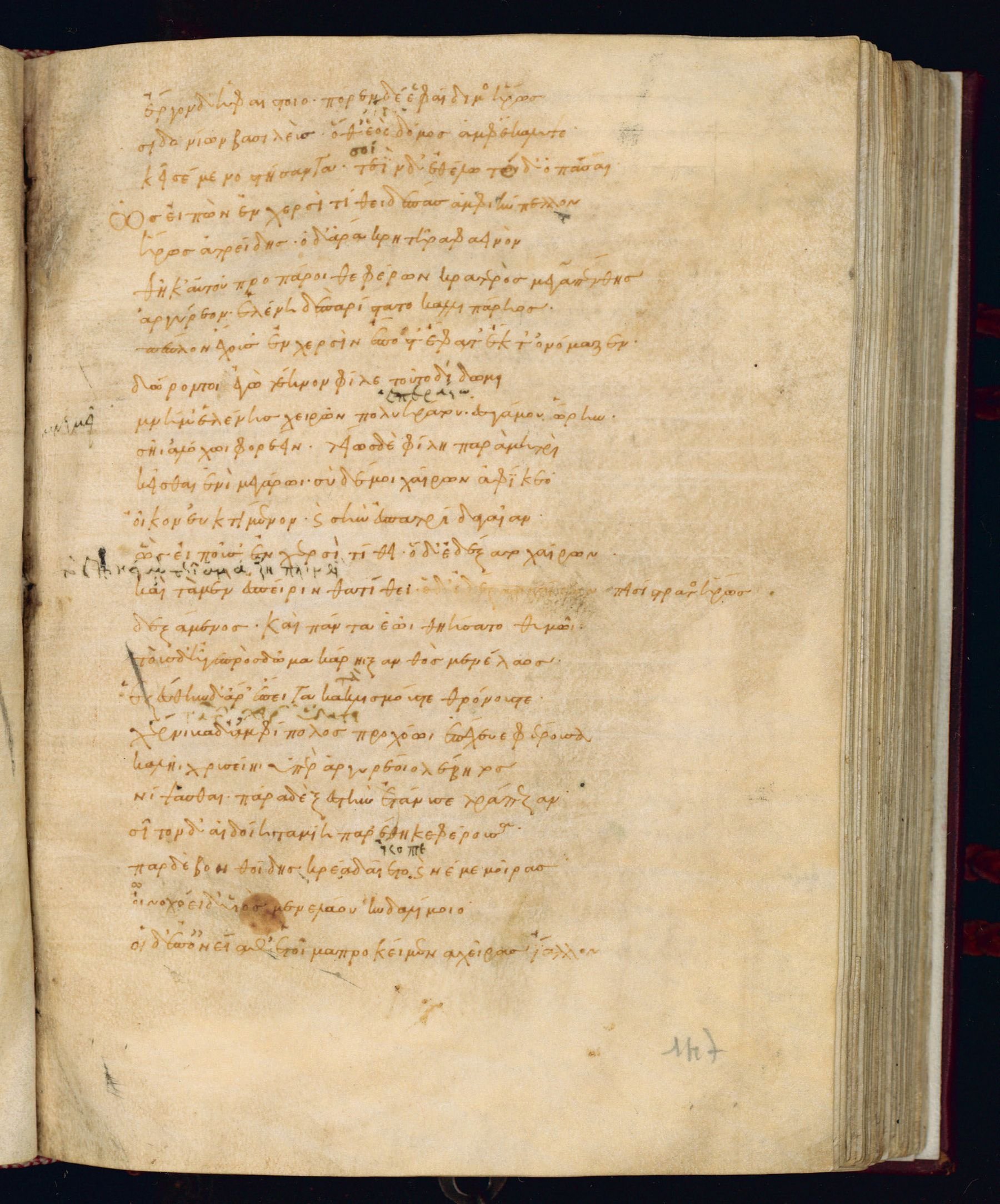
Laur. Plut. 32.24, fol. 147r: Odyssey 15.117-142, begins ‹ἔργον δʼ Ἡφαίστοιο· πόρεν›, ends ‹ἑτοῖμα προκείμενα χεῖρας ἴαλλον.›. Checked on the image: first and last lines read and matched to the Greek. Fol. 146v ends with 15.116. Fol. 147v begins with 15.143. 15.139 (εἴδατα πόλλʼ ἐπιθεῖσα ...) is not on the page: the scribe passes from 15.138 to 15.140 (25 lines). English blocks here: 115-119, 120-124, 125-129, 130-134, 135-139, 140-144.
117ἔργον δʼ Ἡφαίστοιο· πόρεν δέ ἑ Φαίδιμος ἥρως,
118Σιδονίων βασιλεύς, ὅθʼ ἑὸς δόμος ἀμφεκάλυψε
119κεῖσέ με νοστήσαντα· τεῒν δʼ ἐθέλω τόδʼ ὀπάσσαι.
120ὣς εἰπὼν ἐν χειρὶ τίθει δέπας ἀμφικύπελλον
121ἥρως Ἀτρεΐδης· ὁ δʼ ἄρα κρητῆρα φαεινὸν
122θῆκʼ αὐτοῦ προπάροιθε φέρων κρατερὸς Μεγαπένθης,
123ἀργύρεον· Ἑλένη δὲ παρίστατο καλλιπάρῃος
124πέπλον ἔχουσʼ ἐν χερσίν, ἔπος τʼ ἔφατʼ ἔκ τʼ ὀνόμαζε·
125δῶρόν τοι καὶ ἐγώ, τέκνον φίλε, τοῦτο δίδωμι,
126μνῆμʼ Ἑλένης χειρῶν, πολυηράτου ἐς γάμου ὥρην,
127σῇ ἀλόχῳ φορέειν· τῆος δὲ φίλῃ παρὰ μητρὶ
128κείσθω ἐνὶ μεγάρῳ. σὺ δέ μοι χαίρων ἀφίκοιο
129οἶκον ἐϋκτίμενον καὶ σὴν ἐς πατρίδα γαῖαν.
130ὣς εἰποῦσʼ ἐν χερσὶ τίθει, ὁ δʼ ἐδέξατο χαίρων.
131καὶ τὰ μὲν ἐς πείρινθα τίθει Πεισίστρατος ἥρως
132δεξάμενος, καὶ πάντα ἑῷ θηήσατο θυμῷ·
133τοὺς δʼ ἦγε πρὸς δῶμα κάρη ξανθὸς Μενέλαος.
134ἑζέσθην δʼ ἄρʼ ἔπειτα κατὰ κλισμούς τε θρόνους τε.
135χέρνιβα δʼ ἀμφίπολος προχόῳ ἐπέχευε φέρουσα
136καλῇ χρυσείῃ, ὑπὲρ ἀργυρέοιο λέβητος,
137νίψασθαι· παρὰ δὲ ξεστὴν ἐτάνυσσε τράπεζαν.
138σῖτον δʼ αἰδοίη ταμίη παρέθηκε φέρουσα·
139εἴδατα πόλλʼ ἐπιθεῖσα, χαριζομένη παρεόντων·
140πὰρ δὲ Βοηθοΐδης κρέα δαίετο καὶ νέμε μοίρας·
141οἰνοχόει δʼ υἱὸς Μενελάου κυδαλίμοιο.
142οἱ δʼ ἐπʼ ὀνείαθʼ ἑτοῖμα προκείμενα χεῖρας ἴαλλον.
115I will give thee a well-wrought mixing-bowl. It is all of silver, and with gold are the rims thereof gilded, the work of Hephaestus; and the warrior Phaedimus, king of the Sidonians, gave it me, when his house sheltered me as I came thither; and now I am minded to give it to thee.” 120So saying, the warrior, son of Atreus, placed the two-handled cup in his hands. And the strong Megapenthes brought the bright mixing-bowl of silver and set it before him, and fair-cheeked Helen came up with the robe in her hands, and spoke, and addressed him: 125“Lo, I too give thee this gift, dear child, a remembrance of the hands of Helen, against the day of thy longed-for marriage, for thy bride to wear it. But until then let it lie in thy halls in the keeping of thy dear mother. And for thyself I wish that with joy thou mayest reach thy well-built house and thy native land.” 130So saying, she placed it in his hands, and he took it gladly. And the prince Peisistratus took the gifts, and laid them in the box of the chariot, and gazed at them all wondering in his heart. Then fair-haired Menelaus led them to the house, and the two sat down on chairs and high seats. 135And a handmaid brought water for the hands in a fair pitcher of gold, and poured it over a silver basin for them to wash, and beside them drew up a polished table. And the grave housewife brought and set before them bread, and therewith meats in abundance, granting freely of her store. 140And hard by the son of Boethous carved the meat, and divided the portions, and the son of glorious Menelaus poured the wine. So they put forth their hands to the good cheer lying ready before them. But when they had put from them the desire of food and drink, then Telemachus and the glorious son of Nestor
Where on the image
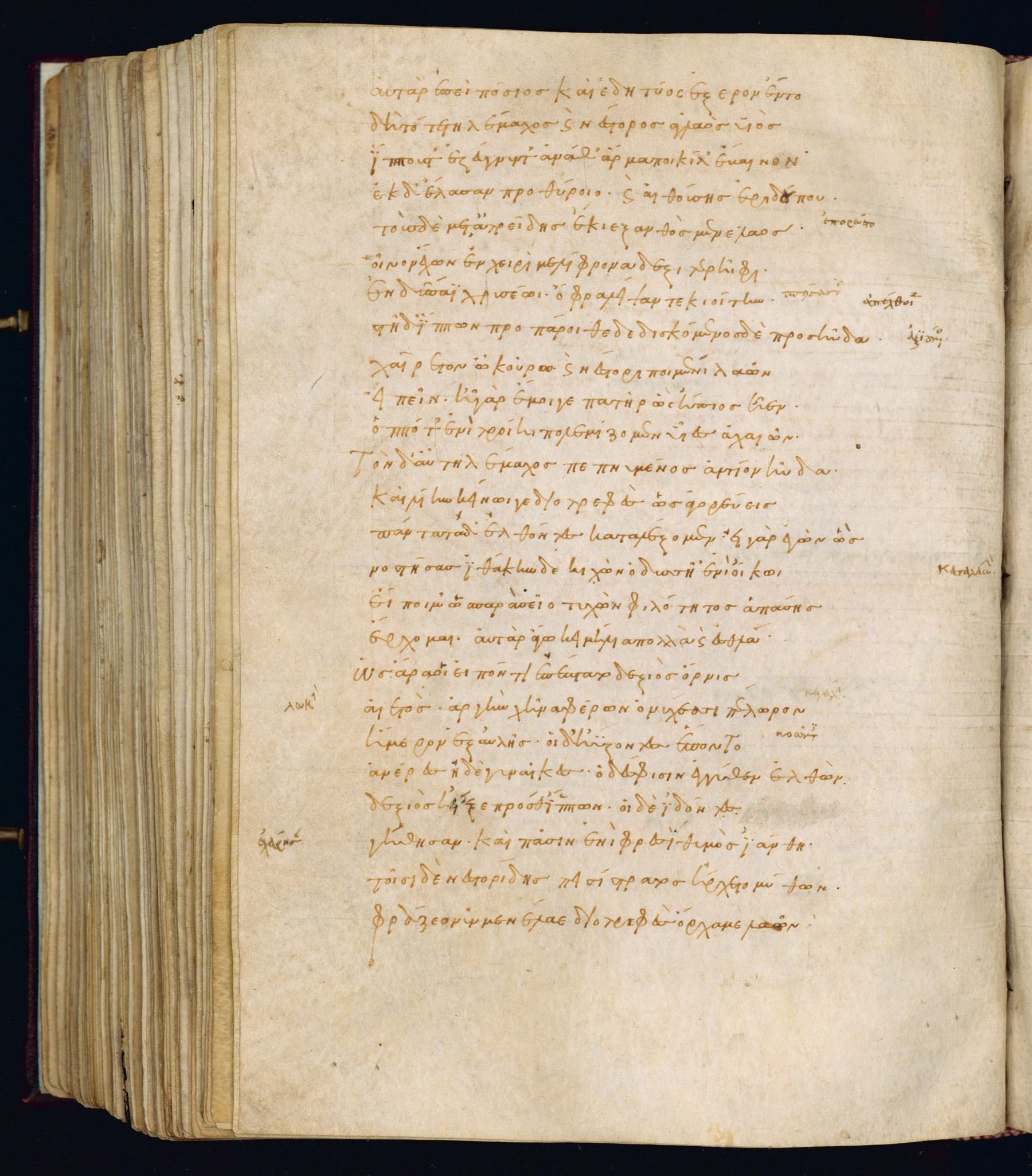
Laur. Plut. 32.24, fol. 147v: Odyssey 15.143-167, begins ‹αὐτὰρ ἐπεὶ πόσιος καὶ›, ends ‹Μενέλαε διοτρεφές, ὄρχαμε λαῶν,›. Checked on the image: first and last lines read and matched to the Greek. Fol. 147r ends with 15.142. Fol. 148r begins with 15.168. English blocks here: 145-149, 150-154, 155-159, 160-164, 165-169.
143αὐτὰρ ἐπεὶ πόσιος καὶ ἐδητύος ἐξ ἔρον ἕντο,
144δὴ τότε Τηλέμαχος καὶ Νέστορος ἀγλαὸς υἱὸς
145ἵππους τε ζεύγνυντʼ ἀνά θʼ ἅρματα ποικίλʼ ἔβαινον,
146ἐκ δʼ ἔλασαν προθύροιο καὶ αἰθούσης ἐριδούπου.
147τοὺς δὲ μετʼ Ἀτρεΐδης ἔκιε ξανθὸς Μενέλαος,
148οἶνον ἔχων ἐν χειρὶ μελίφρονα δεξιτερῆφι,
149ἐν δέπαϊ χρυσέῳ, ὄφρα λείψαντε κιοίτην.
150στῆ δʼ ἵππων προπάροιθε, δεδισκόμενος δὲ προσηύδα·
151χαίρετον, ὦ κούρω, καὶ Νέστορι ποιμένι λαῶν
152εἰπεῖν· ἦ γὰρ ἐμοί γε πατὴρ ὣς ἤπιος ἦεν,
153ἧος ἐνὶ Τροίῃ πολεμίζομεν υἷες Ἀχαιῶν.
154τὸν δʼ αὖ Τηλέμαχος πεπνυμένος ἀντίον ηὔδα·
155καὶ λίην κείνῳ γε, διοτρεφές, ὡς ἀγορεύεις,
156πάντα τάδʼ ἐλθόντες καταλέξομεν· αἲ γὰρ ἐγὼν ὣς
157νοστήσας Ἰθάκηνδε, κιχὼν Ὀδυσῆʼ ἐνὶ οἴκῳ,
158εἴποιμʼ ὡς παρὰ σεῖο τυχὼν φιλότητος ἁπάσης
159ἔρχομαι, αὐτὰρ ἄγω κειμήλια πολλὰ καὶ ἐσθλά.
160ὣς ἄρα οἱ εἰπόντι ἐπέπτατο δεξιὸς ὄρνις,
161αἰετὸς ἀργὴν χῆνα φέρων ὀνύχεσσι πέλωρον,
162ἥμερον ἐξ αὐλῆς· οἱ δʼ ἰΰζοντες ἕποντο
163ἀνέρες ἠδὲ γυναῖκες· ὁ δέ σφισιν ἐγγύθεν ἐλθὼν
164δεξιὸς ἤϊξε πρόσθʼ ἵππων· οἱ δὲ ἰδόντες
165γήθησαν, καὶ πᾶσιν ἐνὶ φρεσὶ θυμὸς ἰάνθη.
166τοῖσι δὲ Νεστορίδης Πεισίστρατος ἤρχετο μύθων·
167φράζεο δή, Μενέλαε διοτρεφές, ὄρχαμε λαῶν,
145yoked the horses and mounted the inlaid car, and drove forth from the gateway and the echoing portico. After them went the son of Atreus, fair-haired Menelaus, bearing in his right hand honey-hearted wine in a cup of gold, that they might pour libations ere they set out. 150And he took his stand before the horses, and pledged the youths, and said: “Fare ye well, young men, and bear greeting to Nestor, shepherd of the host, for verily he was kind as a father to me, while we sons of the Achaeans warred in the land of Troy.” Then wise Telemachus answered him: 155“Aye, verily, king, fostered of Zeus, to him will we tell all this on our coming, as thou dost bid. And I would that, when I return to Ithaca, I might as surely find Odysseus in his house, to tell him how I met with every kindness at thy hands, ere I departed and bring with me treasures many and goodly.” 160Even as he spoke a bird flew by on the right, an eagle, bearing in his talons a great, white goose, a tame fowl from the yard, and men and women followed shouting. But the eagle drew near to them, and darted off to the right in front of the horses; and 165they were glad as they saw it, and the hearts in the breasts of all were cheered. And among them Peisistratus, son of Nestor, was first to speak: “Consider, Menelaus, fostered of Zeus, leader of hosts, whether it was for us two that the god showed this sign, or for thyself.” so he spoke, and Menelaus, dear to Ares, pondered
Where on the image
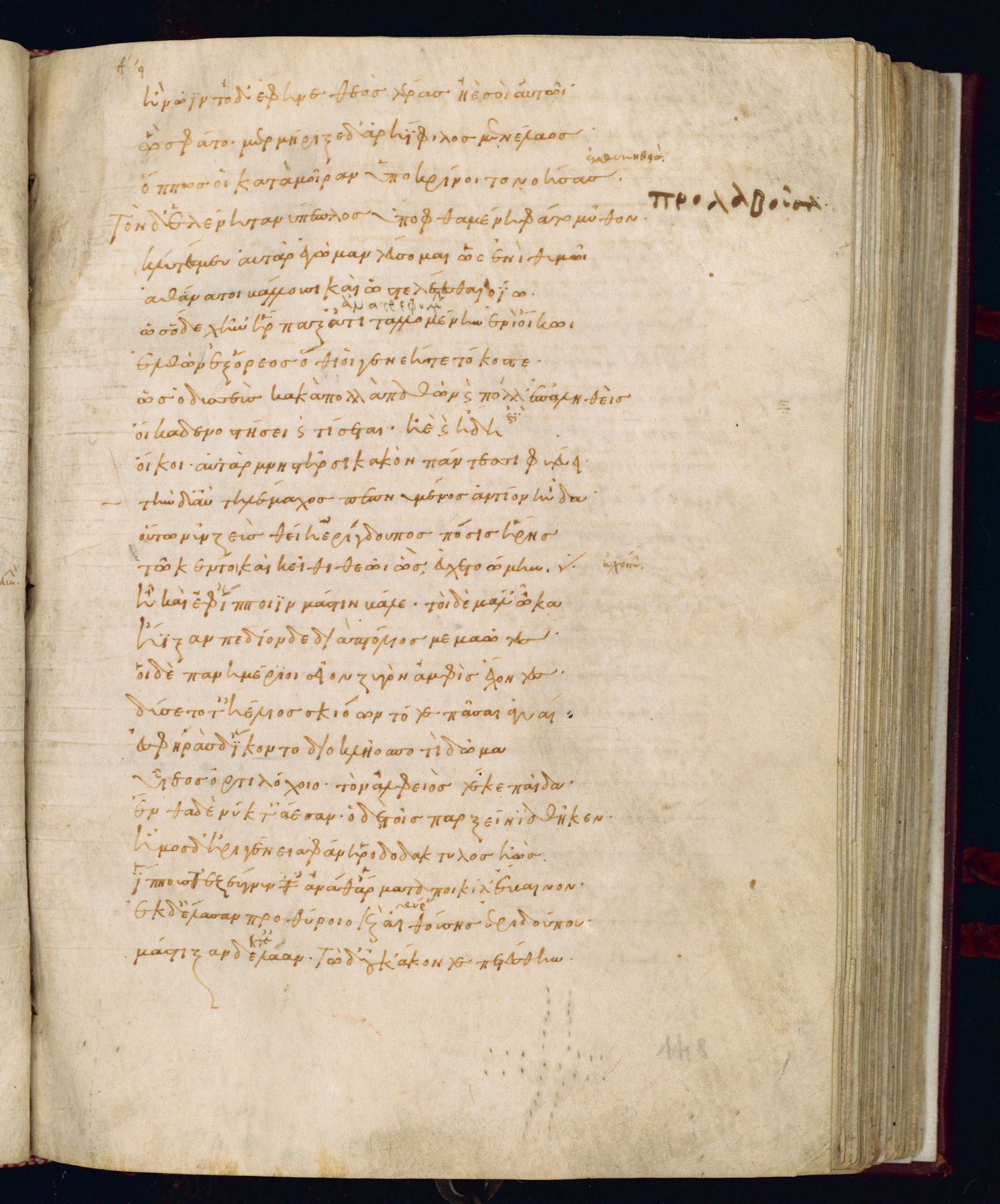
Laur. Plut. 32.24, fol. 148r: Odyssey 15.168-192, begins ‹ἢ νῶϊν τόδʼ ἔφηνε›, ends ‹δʼ οὐκ ἄκοντε πετέσθην.›. Checked on the image: first and last lines read and matched to the Greek. Fol. 147v ends with 15.167. Fol. 148v begins with 15.193. English blocks here: 170-174, 175-178, 179-179, 180-184, 185-189, 190-194.
168ἢ νῶϊν τόδʼ ἔφηνε θεὸς τέρας ἦε σοὶ αὐτῷ.
169ὣς φάτο, μερμήριξε δʼ ἀρηΐφιλος Μενέλαος,
170ὅππως οἱ κατὰ μοῖραν ὑποκρίναιτο νοήσας.
171τὸν δʼ Ἑλένη τανύπεπλος ὑποφθαμένη φάτο μῦθον·
172κλῦτέ μευ· αὐτὰρ ἐγὼ μαντεύσομαι, ὡς ἐνὶ θυμῷ
173ἀθάνατοι βάλλουσι καὶ ὡς τελέεσθαι ὀΐω.
174ὡς ὅδε χῆνʼ ἥρπαξʼ ἀτιταλλομένην ἐνὶ οἴκῳ
175ἐλθὼν ἐξ ὄρεος, ὅθι οἱ γενεή τε τόκος τε,
176ὣς Ὀδυσεὺς κακὰ πολλὰ παθὼν καὶ πόλλʼ ἐπαληθεὶς
177οἴκαδε νοστήσει καὶ τίσεται· ἠὲ καὶ ἤδη
178οἴκοι, ἀτὰρ μνηστῆρσι κακὸν πάντεσσι φυτεύει.
179τὴν δʼ αὖ Τηλέμαχος πεπνυμένος ἀντίον ηὔδα·
180οὕτω νῦν Ζεὺς θείη, ἐρίγδουπος πόσις Ἥρης·
181τῷ κέν τοι καὶ κεῖθι θεῷ ὣς εὐχετοῴμην.
182ἦ καὶ ἐφʼ ἵπποιϊν μάστιν βάλεν· οἱ δὲ μάλʼ ὦκα
183ἤϊξαν πεδίονδε διὰ πτόλιος μεμαῶτες.
184οἱ δὲ πανημέριοι σεῖον ζυγὸν ἀμφὶς ἔχοντες.
185δύσετό τʼ ἠέλιος σκιόωντό τε πᾶσαι ἀγυιαί·
186ἐς Φηρὰς δʼ ἵκοντο Διοκλῆος ποτὶ δῶμα,
187υἱέος Ὀρτιλόχοιο, τὸν Ἀλφειὸς τέκε παῖδα.
188ἔνθα δὲ νύκτʼ ἄεσαν ὁ δὲ τοῖς πὰρ ξείνια θῆκεν.
189ἦμος δʼ ἠριγένεια φάνη ῥοδοδάκτυλος Ἠώς,
190ἵππους τε ζεύγνυντʼ ἀνά θʼ ἅρματα ποικίλʼ ἔβαινον,
191ἐκ δʼ ἔλασαν προθύροιο καὶ αἰθούσης ἐριδούπου·
192μάστιξεν δʼ ἐλάαν, τὼ δʼ οὐκ ἄκοντε πετέσθην.
170how he might with understanding interpret the sign aright. But long-robed Helen took the word from him, and said: “Hear me, and I will prophesy as the immortals put it into my heart, and as I think it will be brought to pass. Even as this eagle came 175from the mountain, where are his kin, and where he was born, and snatched up the goose that was bred in the house, even so shall Odysseus return to his home after many toils and many wanderings, and shall take vengeance; or even now he is at home, and is sowing the seeds of evil for all the wooers.” 179Then again wise Telemachus answered her: 180“So may Zeus grant, the loud-thundering lord of Here; then will I even there ever pray to thee, as to a god.” He spoke, and touched the two horses with the lash, and they sped swiftly toward the plain, coursing eagerly through the city. So all day long they shook the yoke they bore about their necks. 185And the sun set, and all the ways grew dark. And they came to Pherae, to the house of Diocles, son of Ortilochus, whom Alpheus begot. There they spent the night, and before them he set the entertainment due to strangers. As soon as early Dawn appeared, the rosy-fingered, 190they yoked the horses, and mounted the inlaid car, and drove forth from the gateway and the echoing portico. Then Peisistratus touched the horses with the whip to start them, and nothing loath the pair sped onward, and soon thereafter they reached the steep citadel of Pylos. Then Telemachus spoke to the son of Nestor, saying:
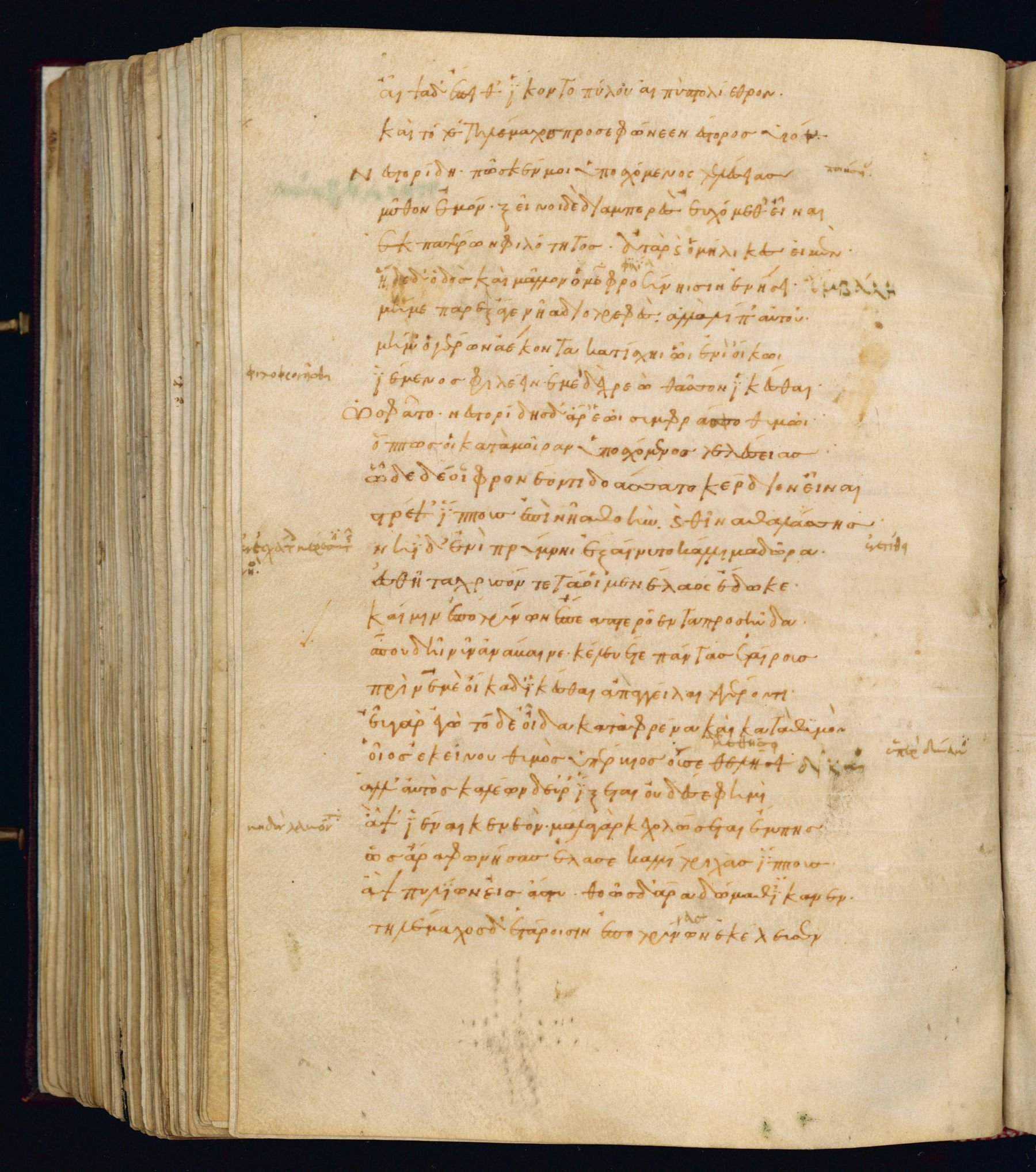
Where on the image
Laur. Plut. 32.24, fol. 148v: Odyssey 15.193-217, begins ‹αἶψα δʼ ἔπειθʼ ἵκοντο›, ends ‹δʼ ἑτάροισιν ἐποτρύνων ἐκέλευσεν·›. Checked on the image: first and last lines read and matched to the Greek. Fol. 148r ends with 15.192. Fol. 149r begins with 15.218. English blocks here: 195-199, 200-204, 205-209, 210-214, 215-219.
193αἶψα δʼ ἔπειθʼ ἵκοντο Πύλου αἰπὺ πτολίεθρον·
194καὶ τότε Τηλέμαχος προσεφώνεε Νέστορος υἱόν·
195Νεστορίδη, πῶς κέν μοι ὑποσχόμενος τελέσειας
196μῦθον ἐμόν; ξεῖνοι δὲ διαμπερὲς εὐχόμεθʼ εἶναι
197ἐκ πατέρων φιλότητος, ἀτὰρ καὶ ὁμήλικές εἰμεν·
198ἥδε δʼ ὁδὸς καὶ μᾶλλον ὁμοφροσύνῃσιν ἐνήσει.
199μή με παρὲξ ἄγε νῆα, διοτρεφές, ἀλλὰ λίπʼ αὐτοῦ,
200μή μʼ ὁ γέρων ἀέκοντα κατάσχῃ ᾧ ἐνὶ οἴκῳ
201ἱέμενος φιλέειν· ἐμὲ δὲ χρεὼ θᾶσσον ἱκέσθαι.
202ὣς φάτο, Νεστορίδης δʼ ἄρʼ ἑῷ συμφράσσατο θυμῷ,
203ὅππως οἱ κατὰ μοῖραν ὑποσχόμενος τελέσειεν.
204ὧδε δέ οἱ φρονέοντι δοάσσατο κέρδιον εἶναι·
205στρέψʼ ἵππους ἐπὶ νῆα θοὴν καὶ θῖνα θαλάσσης,
206νηῒ δʼ ἐνὶ πρύμνῃ ἐξαίνυτο κάλλιμα δῶρα,
207ἐσθῆτα χρυσόν τε, τά οἱ Μενέλαος ἔδωκε·
208καί μιν ἐποτρύνων ἔπεα πτερόεντα προσηύδα·
209σπουδῇ νῦν ἀνάβαινε κέλευέ τε πάντας ἑταίρους,
210πρὶν ἐμὲ οἴκαδʼ ἱκέσθαι ἀπαγγεῖλαί τε γέροντι.
211εὖ γὰρ ἐγὼ τόδε οἶδα κατὰ φρένα καὶ κατὰ θυμόν·
212οἷος κείνου θυμὸς ὑπέρβιος, οὔ σε μεθήσει,
213ἀλλʼ αὐτὸς καλέων δεῦρʼ εἴσεται, οὐδέ ἕ φημι
214ἂψ ἰέναι κενεόν· μάλα γὰρ κεχολώσεται ἔμπης.
215ὣς ἄρα φωνήσας ἔλασεν καλλίτριχας ἵππους
216ἂψ Πυλίων εἰς ἄστυ, θοῶς δʼ ἄρα δώμαθʼ ἵκανε.
217Τηλέμαχος δʼ ἑτάροισιν ἐποτρύνων ἐκέλευσεν·
195“Son of Nestor, wilt thou now make me a promise, and fulfil it, as I bid? Friends from of old we call ourselves by reason of our fathers' friendship, and we are moreover of the same age, and this journey shall yet more stablish us in oneness of heart. Lead me not past my ship, O thou fostered of Zeus, but leave me there, 200lest that old man keep me in his house against my will, fain to show me kindness, whereas I must needs hasten home.” So he spoke, and the son of Nestor took counsel with his heart, how he might duly give the promise and fulfil it. And, as he pondered, this seemed to him the better course. 205He turned his horses to the swift ship and the shore of the sea, and took out, and set in the stern of the ship the beautiful gifts, the raiment and gold, which Menelaus gave him. And he urged on Telemachus, and addressed him with winged words: “Make haste now to go on board, and bid all thy comrades to do likewise, 210before I reach home and bring the old man word. For well I know this in mind and heart, so masterful is his spirit he will not let thee go, but will himself come hither to bid thee to his house; and, I tell thee, he will not go back without thee; for very wroth will he be, despite of all.” 215So saying, he drove his horses with beautiful mane back to the city of the Pylians, and speedily reached the palace. And Telemachus called to his men, and gave command to them, saying: “Set all the gear in order, men, in the black ship, and let us go on board ourselves, that we may speed on our way.”
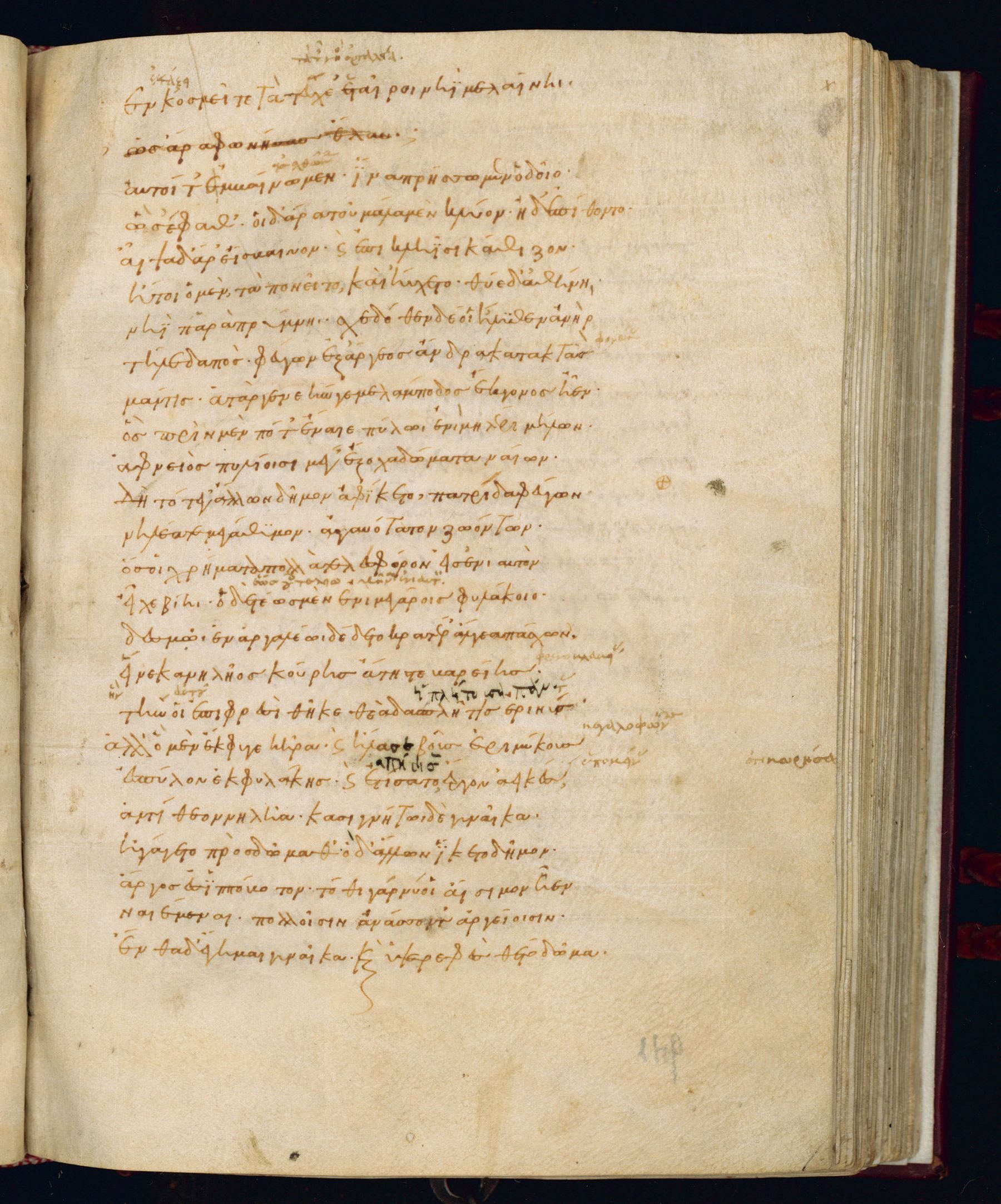
Where on the image
Laur. Plut. 32.24, fol. 149r: Odyssey 15.218-241, begins ‹ἐγκοσμεῖτε τὰ τεύχεʼ, ἑταῖροι,›, ends ‹καὶ ὑψερεφὲς θέτο δῶμα,›. Checked on the image: first and last lines read and matched to the Greek. Fol. 148v ends with 15.217. Fol. 149v begins with 15.242. The second line of the page is a false start (ὣς ἄρα φων...) struck through by the scribe; 15.219 follows (24 verses). English blocks here: 220-221, 222-224, 225-229, 230-234, 235-239.
218ἐγκοσμεῖτε τὰ τεύχεʼ, ἑταῖροι, νηῒ μελαίνῃ,
219αὐτοί τʼ ἀμβαίνωμεν, ἵνα πρήσσωμεν ὁδοῖο.
220ὣς ἔφαθʼ, οἱ δʼ ἄρα τοῦ μάλα μὲν κλύον ἠδʼ ἐπίθοντο,
221αἶψα δʼ ἄρʼ εἴσβαινον καὶ ἐπὶ κληῗσι καθῖζον.
222ἦ τοι ὁ μὲν τὰ πονεῖτο καὶ εὔχετο, θῦε δʼ Ἀθήνῃ
223νηῒ πάρα πρυμνῇ· σχεδόθεν δέ οἱ ἤλυθεν ἀνὴρ
224τηλεδαπός, φεύγων ἐξ Ἄργεος ἄνδρα κατακτάς,
225μάντις· ἀτὰρ γενεήν γε Μελάμποδος ἔκγονος ἦεν,
226ὃς πρὶν μέν ποτʼ ἔναιε Πύλῳ ἔνι, μητέρι μήλων,
227ἀφνειὸς Πυλίοισι μέγʼ ἔξοχα δώματα ναίων·
228δὴ τότε γʼ ἄλλων δῆμον ἀφίκετο, πατρίδα φεύγων
229Νηλέα τε μεγάθυμον, ἀγαυότατον ζωόντων,
230ὅς οἱ χρήματα πολλὰ τελεσφόρον εἰς ἐνιαυτὸν
231εἶχε βίῃ. ὁ δὲ τῆος ἐνὶ μεγάροις Φυλάκοιο
232δεσμῷ ἐν ἀργαλέῳ δέδετο, κρατέρʼ ἄλγεα πάσχων
233εἵνεκα Νηλῆος κούρης ἄτης τε βαρείης,
234τήν οἱ ἐπὶ φρεσὶ θῆκε θεὰ δασπλῆτις Ἐρινύς.
235ἀλλʼ ὁ μὲν ἔκφυγε κῆρα καὶ ἤλασε βοῦς ἐριμύκους
236ἐς Πύλον ἐκ Φυλάκης καὶ ἐτίσατο ἔργον ἀεικὲς
237ἀντίθεον Νηλῆα, κασιγνήτῳ δὲ γυναῖκα
238ἠγάγετο πρὸς δώμαθʼ. ὁ δʼ ἄλλων ἵκετο δῆμον,
239Ἄργος ἐς ἱππόβοτον· τόθι γάρ νύ οἱ αἴσιμον ἦεν
240ναιέμεναι πολλοῖσιν ἀνάσσοντʼ Ἀργείοισιν
241ἔνθα δʼ ἔγημε γυναῖκα καὶ ὑψερεφὲς θέτο δῶμα,
220So he spoke, and they readily hearkened and obeyed; and at once they went on board, and sat down upon the benches. 222He verily was busied thus, and was praying and offering sacrifice to Athena by the stern of the ship, when there drew nigh to him a man from a far land, one that was fleeing out of Argos because he had slain a man; 225and he was a seer. By lineage he was sprung from Melampus, who of old dwelt in Pylos, mother of flocks, a rich man and one that had a very wealthy house among the Pylians, but had afterward come to a land of strangers, fleeing from his country and from great-hearted Neleus, the lordliest of living men, 230who for a full year had kept much wealth from him by force. Now Melampus meanwhile lay bound with bitter bonds in the halls of Phylacus, suffering grievous pains because of the daughter of Neleus, and the terrible blindness of heart which the goddess, the Erinys, who brings houses to ruin, had laid upon him. 235Howbeit he escaped his fate, and drove off the deep-lowing kine from Phylace to Pylos, and avenged the cruel deed upon godlike Neleus, and brought the maiden home to be his own brother's wife. For himself, he went to the land of other men, to horse-pasturing Argos, for there it was appointed him
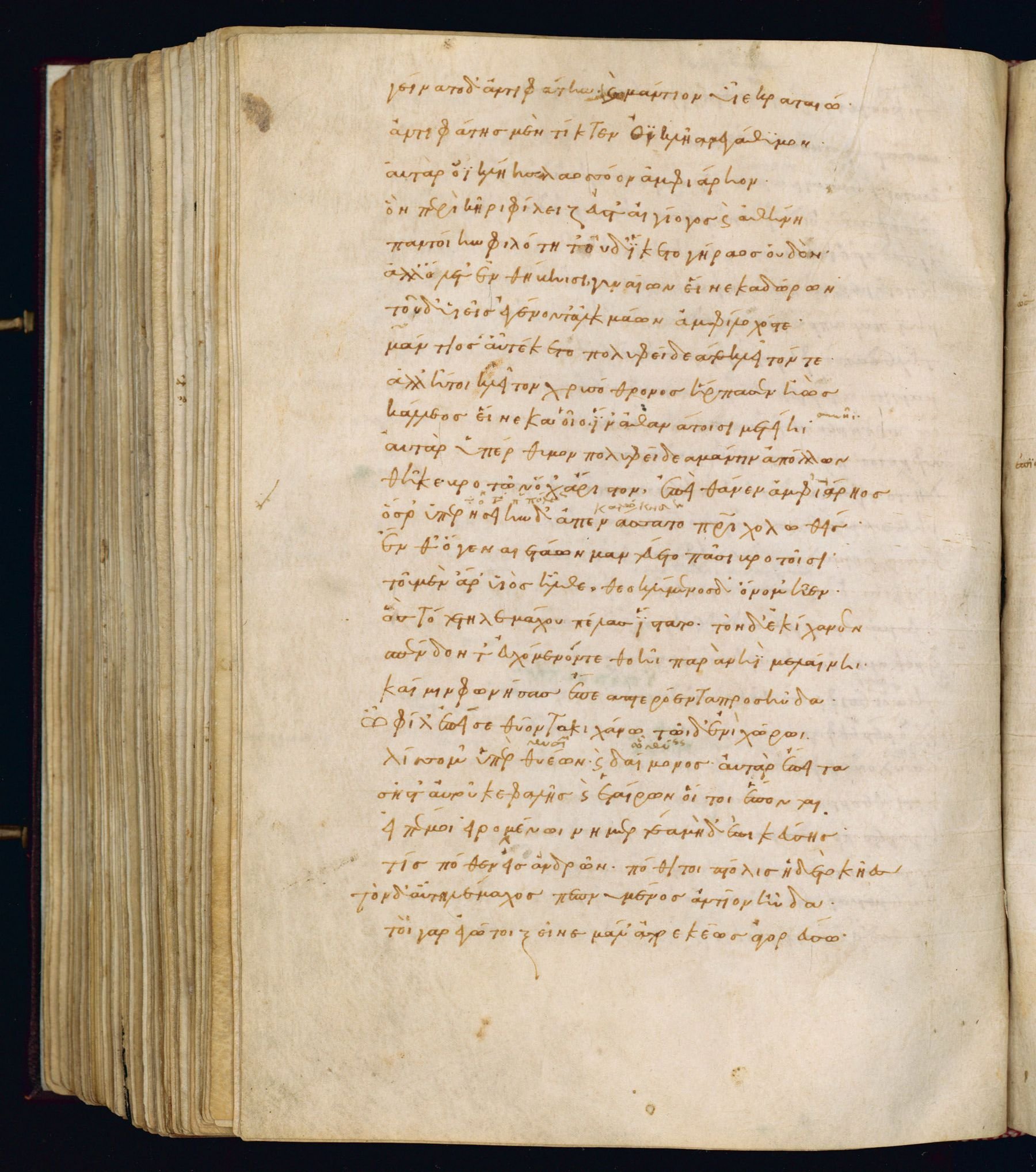
Where on the image
Laur. Plut. 32.24, fol. 149v: Odyssey 15.242-266, begins ‹γείνατο δʼ Ἀντιφάτην καὶ›, ends ‹ξεῖνε, μάλʼ ἀτρεκέως ἀγορεύσω.›. Checked on the image: first and last lines read and matched to the Greek. Fol. 149r ends with 15.241. Fol. 150r begins with 15.267. English blocks here: 240-244, 245-249, 250-254, 255-259, 260-264.
242γείνατο δʼ Ἀντιφάτην καὶ Μάντιον, υἷε κραταιώ.
243Ἀντιφάτης μὲν ἔτικτεν Ὀϊκλῆα μεγάθυμον,
244αὐτὰρ Ὀϊκλείης λαοσσόον Ἀμφιάραον,
245ὃν περὶ κῆρι φίλει Ζεύς τʼ αἰγίοχος καὶ Ἀπόλλων
246παντοίην φιλότητʼ· οὐδʼ ἵκετο γήραος οὐδόν,
247ἀλλʼ ὄλετʼ ἐν Θήβῃσι γυναίων εἵνεκα δώρων.
248τοῦ δʼ υἱεῖς ἐγένοντʼ Ἀλκμαίων Ἀμφίλοχός τε.
249Μάντιος αὖ τέκετο Πολυφείδεά τε Κλεῖτόν τε·
250ἀλλʼ ἦ τοι Κλεῖτον χρυσόθρονος ἥρπασεν Ἠὼς
251κάλλεος εἵνεκα οἷο, ἵνʼ ἀθανάτοισι μετείη·
252αὐτὰρ ὑπέρθυμον Πολυφείδεα μάντιν Ἀπόλλων
253θῆκε βροτῶν ὄχʼ ἄριστον, ἐπεὶ θάνεν Ἀμφιάραος·
254ὅς ῥʼ Ὑπερησίηνδʼ ἀπενάσσατο πατρὶ χολωθείς,
255ἔνθʼ ὅ γε ναιετάων μαντεύετο πᾶσι βροτοῖσιν.
256τοῦ μὲν ἄρʼ υἱὸς ἐπῆλθε, Θεοκλύμενος δʼ ὄνομʼ ἦεν,
257ὃς τότε Τηλεμάχου πέλας ἵστατο· τὸν δʼ ἐκίχανεν
258σπένδοντʼ εὐχόμενόν τε θοῇ παρὰ νηῒ μελαίνῃ,
259καί μιν φωνήσας ἔπεα πτερόεντα προσηύδα·
260ὦ φίλʼ, ἐπεί σε θύοντα κιχάνω τῷδʼ ἐνὶ χώρῳ,
261λίσσομʼ ὑπὲρ θυέων καὶ δαίμονος, αὐτὰρ ἔπειτα
262σῆς τʼ αὐτοῦ κεφαλῆς καὶ ἑταίρων, οἵ τοι ἕπονται,
263εἰπέ μοι εἰρομένῳ νημερτέα μηδʼ ἐπικεύσῃς·
264τίς πόθεν εἶς ἀνδρῶν; πόθι τοι πόλις ἠδὲ τοκῆες;
265τὸν δʼ αὖ Τηλέμαχος πεπνυμένος ἀντίον ηὔδα·
266τοιγὰρ ἐγώ τοι, ξεῖνε, μάλʼ ἀτρεκέως ἀγορεύσω.
240to dwell, bearing sway over many Argives. There he wedded a wife and built him a high-roofed house, and begot Antiphates and Mantius, two stalwart sons. Now Antiphates begot great-hearted Oicles, and Oicles Amphiaraus, the rouser of the host, 245whom Zeus, who bears the aegis, and Apollo heartily loved with all manner of love. Yet he did not reach the threshold of old age, but died in Thebe, because of a woman's gifts. To him were born sons, Alcmaeon and Amphilochus. And Mantius on his part begot Polypheides and Cleitus. 250Now Cleitus golden-throned Dawn snatched away by reason of his beauty, that he might dwell with the immortals; but of Polypheides, high of heart, Apollo made a seer, far the best of mortals, after that Amphiaraus was dead. He removed to Hyperesia, having waxed wroth with his father, 255and there he dwelt and prophesied to all men. His son it was, Theoclymenus by name, who now came and stood by Telemachus; and he found him pouring libations and praying by his swift, black ship, and he spoke, and addressed him with winged words: 260“Friend, since I find thee making burnt-offering in this place, I beseech thee by thine offerings and by the god, aye, and by thine own life and the lives of thy comrades who follow thee, tell me truly what I ask, and hide it not. Who art thou among men, and from whence? Where is thy city, and where thy parents?”
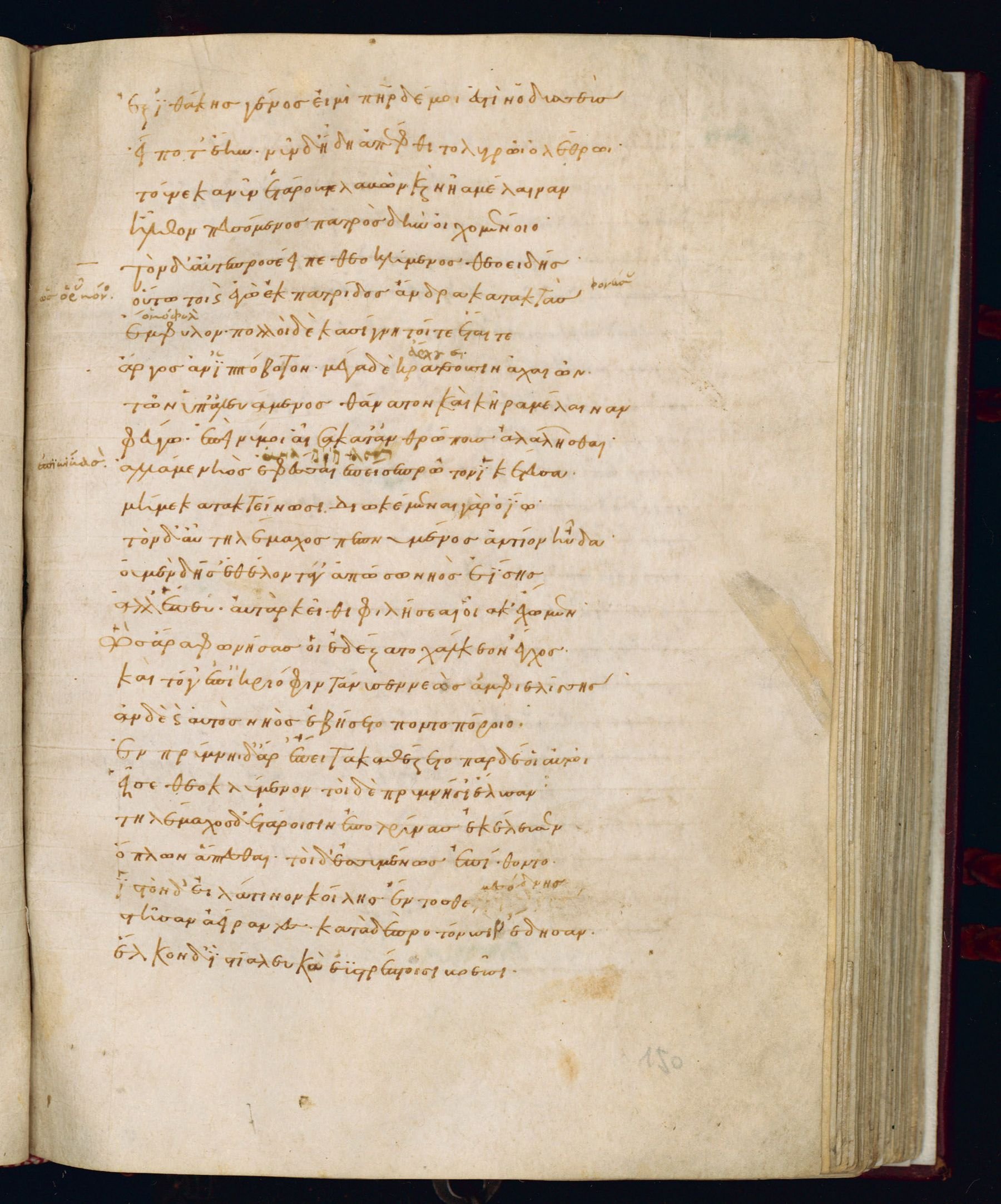
Where on the image
Laur. Plut. 32.24, fol. 150r: Odyssey 15.267-291, begins ‹ἐξ Ἰθάκης γένος εἰμί,›, ends ‹ἱστία λευκὰ ἐϋστρέπτοισι βοεῦσι.›. Checked on the image: first and last lines read and matched to the Greek. Fol. 149v ends with 15.266. Fol. 150v begins with 15.292. English blocks here: 265-269, 270-274, 275-279, 280-284, 285-289.
267ἐξ Ἰθάκης γένος εἰμί, πατὴρ δέ μοί ἐστιν Ὀδυσσεύς,
268εἴ ποτʼ ἔην· νῦν δʼ ἤδη ἀπέφθιτο λυγρῷ ὀλέθρῳ.
269τοὔνεκα νῦν ἑτάρους τε λαβὼν καὶ νῆα μέλαιναν
270ἦλθον πευσόμενος πατρὸς δὴν οἰχομένοιο.
271τὸν δʼ αὖτε προσέειπε Θεοκλύμενος θεοειδής·
272οὕτω τοι καὶ ἐγὼν ἐκ πατρίδος, ἄνδρα κατακτὰς
273ἔμφυλον· πολλοὶ δὲ κασίγνητοί τε ἔται τε
274Ἄργος ἀνʼ ἱππόβοτον, μέγα δὲ κρατέουσιν Ἀχαιῶν.
275τῶν ὑπαλευάμενος θάνατον καὶ κῆρα μέλαιναν
276φεύγω, ἐπεί νύ μοι αἶσα κατʼ ἀνθρώπους ἀλάλησθαι.
277ἀλλά με νηὸς ἔφεσσαι, ἐπεί σε φυγὼν ἱκέτευσα,
278μή με κατακτείνωσι· διωκέμεναι γὰρ ὀΐω.
279τὸν δʼ αὖ Τηλέμαχος πεπνυμένος ἀντίον ηὔδα·
280οὐ μὲν δή σʼ ἐθέλοντά γʼ ἀπώσω νηὸς ἐΐσης,
281ἀλλʼ ἕπευ· αὐτὰρ κεῖθι φιλήσεαι, οἷά κʼ ἔχωμεν.
282ὣς ἄρα φωνήσας οἱ ἐδέξατο χάλκεον ἔγχος,
283καὶ τό γʼ ἐπʼ ἰκριόφιν τάνυσεν νεὸς ἀμφιελίσσης·
284ἂν δὲ καὶ αὐτὸς νηὸς ἐβήσετο ποντοπόροιο.
285ἐν πρύμνῃ δʼ ἄρʼ ἔπειτα καθέζετο, πὰρ δὲ οἷ αὐτῷ
286εἷσε Θεοκλύμενον· τοὶ δὲ πρυμνήσιʼ ἔλυσαν.
287Τηλέμαχος δʼ ἑτάροισιν ἐποτρύνας ἐκέλευσεν
288ὅπλων ἅπτεσθαι· τοὶ δʼ ἐσσυμένως ἐπίθοντο.
289ἱστὸν δʼ εἰλάτινον κοίλης ἔντοσθε μεσόδμης
290στῆσαν ἀείραντες, κατὰ δὲ προτόνοισιν ἔδησαν,
291ἕλκον δʼ ἱστία λευκὰ ἐϋστρέπτοισι βοεῦσι.
265And wise Telemachus answered him: “Then verily, stranger, will I frankly tell thee all. Of Ithaca I am by birth, and my father is Odysseus, as sure as ever such a one there was; but now he has perished by a pitiful fate. Therefore have I now taken my comrades and a black ship, 270and am come to seek tidings of my father, that has long been gone.” Then godlike Theoclymenus answered him: “Even so have I, too, fled from my country, for that I slew a man, one of mine own kin. And many brethren and kinsmen of his there are in horse-pasturing Argos, and mightily do they bear sway over the Achaeans. 275It is to shun death and black fate at their hands that I flee, for, I ween, it is my lot to be a wanderer among men. But do thou set me on thy ship, since in my flight I have made prayer to thee, lest they utterly slay me; for methinks they are in pursuit.” And wise Telemachus answered him: 280“Then will I in no wise thrust thee from my shapely ship, since thou art eager to come. Nay, follow with us, and in our home shalt thou find entertainment such as we have.” So saying, he took from him his spear of bronze, and laid it at length on the deck of the curved ship, and himself went aboard the seafaring ship. 285Then he sat down in the stern and made Theoclymenus sit down beside him; and his men loosed the stern cables. And Telemachus called to his men and bade them lay hold of the tackling, and they quickly obeyed. The mast of fir
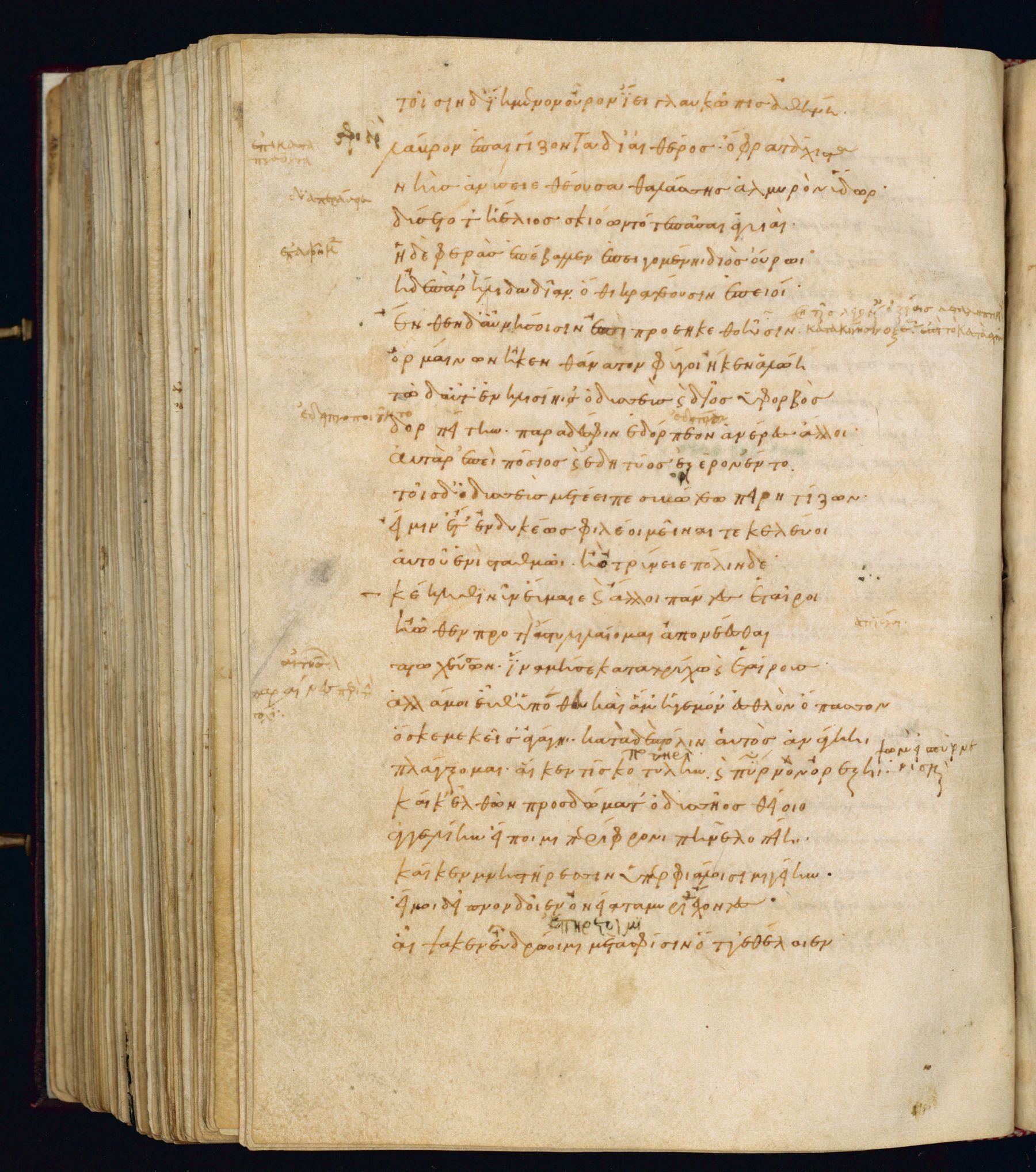
Where on the image
Laur. Plut. 32.24, fol. 150v: Odyssey 15.292-317, begins ‹τοῖσιν δʼ ἴκμενον οὖρον›, ends ‹μετὰ σφίσιν ἅσσʼ ἐθέλοιεν.›. Checked on the image: first and last lines read and matched to the Greek. Fol. 150r ends with 15.291. Fol. 151r begins with 15.318. 15.295 (βὰν δὲ παρὰ Κρουνοὺς ...) is not on the page: the scribe passes from 15.294 to 15.296 (25 lines). English blocks here: 290-294, 295-299, 300-300, 301-304, 305-309, 310-314, 315-319.
292τοῖσιν δʼ ἴκμενον οὖρον ἵει γλαυκῶπις Ἀθήνη,
293λάβρον ἐπαιγίζοντα διʼ αἰθέρος, ὄφρα τάχιστα
294νηῦς ἀνύσειε θέουσα θαλάσσης ἁλμυρὸν ὕδωρ.
295βὰν δὲ παρὰ Κρουνοὺς καὶ Χαλκίδα καλλιρέεθρον.
296δύσετό τʼ ἠέλιος σκιόωντό τε πᾶσαι ἀγυιαί·
297ἡ δὲ Φεὰς ἐπέβαλλεν ἐπειγομένη Διὸς οὔρῳ
298ἠδὲ παρʼ Ἤλιδα δῖαν, ὅθι κρατέουσιν Ἐπειοί.
299ἔνθεν δʼ αὖ νήσοισιν ἐπιπροέηκε θοῇσιν,
300ὁρμαίνων ἤ κεν θάνατον φύγοι ἦ κεν ἁλώῃ.
301τὼ δʼ αὖτʼ ἐν κλισίῃ Ὀδυσεὺς καὶ δῖος ὑφορβὸς
302δορπείτην· παρὰ δέ σφιν ἐδόρπεον ἀνέρες ἄλλοι.
303αὐτὰρ ἐπεὶ πόσιος καὶ ἐδητύος ἐξ ἔρον ἕντο,
304τοῖς δʼ Ὀδυσεὺς μετέειπε, συβώτεω πειρητίζων,
305ἤ μιν ἔτʼ ἐνδυκέως φιλέοι μεῖναί τε κελεύοι
306αὐτοῦ ἐνὶ σταθμῷ, ἦ ὀτρύνειε πόλινδε·
307κέκλυθι νῦν, Εὔμαιε, καὶ ἄλλοι πάντες ἑταῖροι·
308ἠῶθεν προτὶ ἄστυ λιλαίομαι ἀπονέεσθαι
309πτωχεύσων, ἵνα μή σε κατατρύχω καὶ ἑταίρους.
310ἀλλά μοι εὖ θʼ ὑπόθευ καὶ ἅμʼ ἡγεμόνʼ ἐσθλὸν ὄπασσον
311ὅς κέ με κεῖσʼ ἀγάγῃ· κατὰ δὲ πτόλιν αὐτὸς ἀνάγκῃ
312πλάγξομαι, αἴ κέν τις κοτύλην καὶ πύρνον ὀρέξῃ.
313καί κʼ ἐλθὼν πρὸς δώματʼ Ὀδυσσῆος θείοιο
314ἀγγελίην εἴποιμι περίφρονι Πηνελοπείῃ,
315καί κε μνηστήρεσσιν ὑπερφιάλοισι μιγείην,
316εἴ μοι δεῖπνον δοῖεν ὀνείατα μυρίʼ ἔχοντες.
317αἶψά κεν εὖ δρώοιμι μετὰ σφίσιν ἅσσʼ ἐθέλοιεν.
290they raised and set in the hollow socket, and made it fast with fore-stays, and hauled up the white sail with twisted thongs of oxhide. And flashing-eyed Athena sent them a favorable wind, blowing strongly through the sky, that, speeding swiftly, the ship might accomplish her way over the salt water of the sea. 295So they fared past Crouni and Chalcis, with its beautiful streams. Now the sun set and all the ways grew dark. And the ship drew near to Pheae, sped by the wind of Zeus, and on past goodly Elis, where the Epeans hold sway. From thence again he steered for the sharp isles 300pondering whether he should escape death or be taken. 301But the two, Odysseus and the goodly swineherd, were supping in the hut, and with them supped the other men. But when they had put from them the desire of food and drink, Odysseus spoke among them, making trial of the swineherd to see 305whether he would still entertain him with kindly care and bid him remain there at the farmstead, or send him forth to the city: “Hearken now, Eumaeus, and all ye other men. In the morning I am minded to go forth to the city to beg, that I may not be the ruin of thee and of thy men. Now then, give me good counsel, and send with me a trusty guide to lead me thither; 310but through the city will I wander by myself perforce, in the hope that one haply will give me a cup of water and a loaf. Aye, and I would go to the house of godlike Odysseus and bear tidings to the wise Penelope, 315and join the company of the insolent wooers, if perchance they may give me a meal, since they have good cheer in abundance. Straightway might I do good service among them in all that they would. For I will tell thee, and do thou give heed and hearken. By the favour of Hermes, the messenger, who
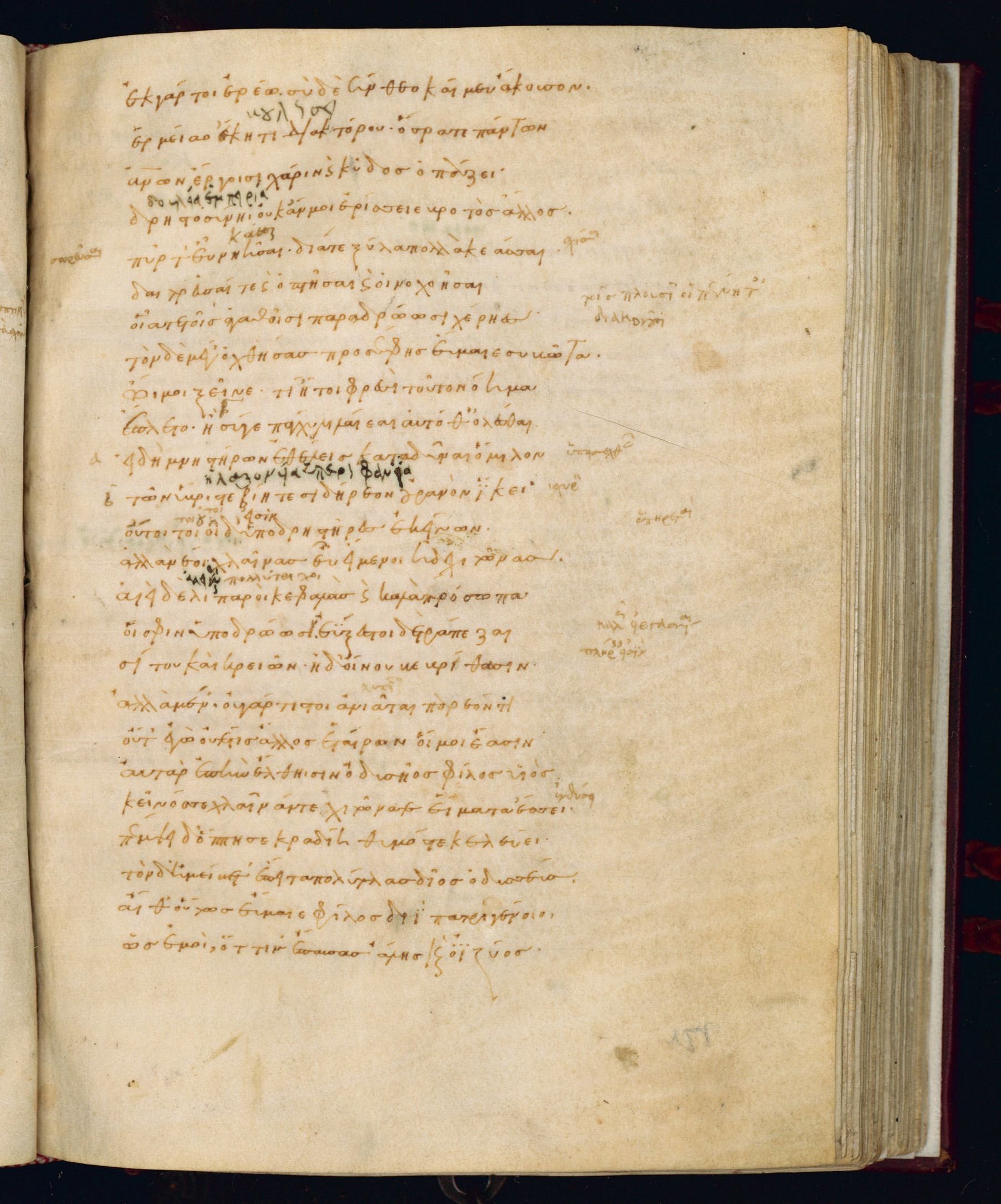
Where on the image
Laur. Plut. 32.24, fol. 151r: Odyssey 15.318-342, begins ‹ἐκ γάρ τοι ἐρέω,›, ends ‹ἄλης καὶ ὀϊζύος αἰνῆς.›. Checked on the image: first and last lines read and matched to the Greek. Fol. 150v ends with 15.317. Fol. 151v begins with 15.343. English blocks here: 320-324, 325-329, 330-334, 335-339, 340-344.
318ἐκ γάρ τοι ἐρέω, σὺ δὲ σύνθεο καί μευ ἄκουσον·
319Ἑρμείαο ἕκητι διακτόρου, ὅς ῥά τε πάντων
320ἀνθρώπων ἔργοισι χάριν καὶ κῦδος ὀπάζει,
321δρηστοσύνῃ οὐκ ἄν μοι ἐρίσσειε βροτὸς ἄλλος,
322πῦρ τʼ εὖ νηῆσαι διά τε ξύλα δανὰ κεάσσαι,
323δαιτρεῦσαί τε καὶ ὀπτῆσαι καὶ οἰνοχοῆσαι,
324οἷά τε τοῖς ἀγαθοῖσι παραδρώωσι χέρηες.
325τὸν δὲ μέγʼ ὀχθήσας προσέφης, Εὔμαιε συβῶτα·
326ὤ μοι, ξεῖνε, τίη τοι ἐνὶ φρεσὶ τοῦτο νόημα
327ἔπλετο; ἦ σύ γε πάγχυ λιλαίεαι αὐτόθʼ ὀλέσθαι.
328εἰ δὴ μνηστήρων ἐθέλεις καταδῦναι ὅμιλον,
329τῶν ὕβρις τε βίη τε σιδήρεον οὐρανὸν ἵκει.
330οὔ τοι τοιοίδʼ εἰσὶν ὑποδρηστῆρες ἐκείνων,
331ἀλλὰ νέοι, χλαίνας εὖ εἱμένοι ἠδὲ χιτῶνας,
332αἰεὶ δὲ λιπαροὶ κεφαλὰς καὶ καλὰ πρόσωπα,
333οἵ σφιν ὑποδρώωσιν· ἐΰξεστοι δὲ τράπεζαι
334σίτου καὶ κρειῶν ἠδʼ οἴνου βεβρίθασιν.
335ἀλλὰ μένʼ· οὐ γάρ τίς τοι ἀνιᾶται παρεόντι,
336οὔτʼ ἐγὼ οὔτε τις ἄλλος ἑταίρων, οἵ μοι ἔασιν.
337αὐτὰρ ἐπὴν ἔλθῃσιν Ὀδυσσῆος φίλος υἱός,
338κεῖνός σε χλαῖνάν τε χιτῶνά τε εἵματα ἕσσει,
339πέμψει δʼ ὅππη σε κραδίη θυμός τε κελεύει.
340τὸν δʼ ἠμείβετʼ ἔπειτα πολύτλας δῖος Ὀδυσσεύς·
341αἴθʼ οὕτως, Εὔμαιε, φίλος Διὶ πατρὶ γένοιο
342ὡς ἐμοί, ὅττι μʼ ἔπαυσας ἄλης καὶ ὀϊζύος αἰνῆς.
320lends grace and glory to all men's work, in the business of serving no man beside can vie with me, in piling well a fire, in splitting dry faggots, in carving and roasting meat, and in pouring wine —in all things in which meaner men serve the noble.” 325Then deeply moved didst thou speak to him, swineherd Eumaeus: “Ah me, stranger, why has such a thought come into thy mind? Verily thou art fain utterly to perish there, if thou wouldest indeed enter the throng of the wooers, whose wantonness and violence reach the iron heaven. 330Not such as thou are their serving men; nay, they that serve them are young men, well clad in cloaks and tunics, and ever are their heads and bright faces sleek; and polished tables are laden with bread, and meat, and wine. 335Nay, abide here; there is none that is vexed by thy presence, not I, nor any other of the men that are with me. But when the dear son of Odysseus comes, he will himself clothe thee in a cloak and a tunic as raiment, and will send thee whithersoever thy heart and spirit bid thee go.” 340Then the much-enduring, goodly Odysseus answered him: “Would, Eumaeus, that thou mightest be as dear to father Zeus as thou art to me, for that thou hast made me cease from wandering and from grievous hardships. Than roaming naught else is more evil for mortals; yet for their cursed belly's sake
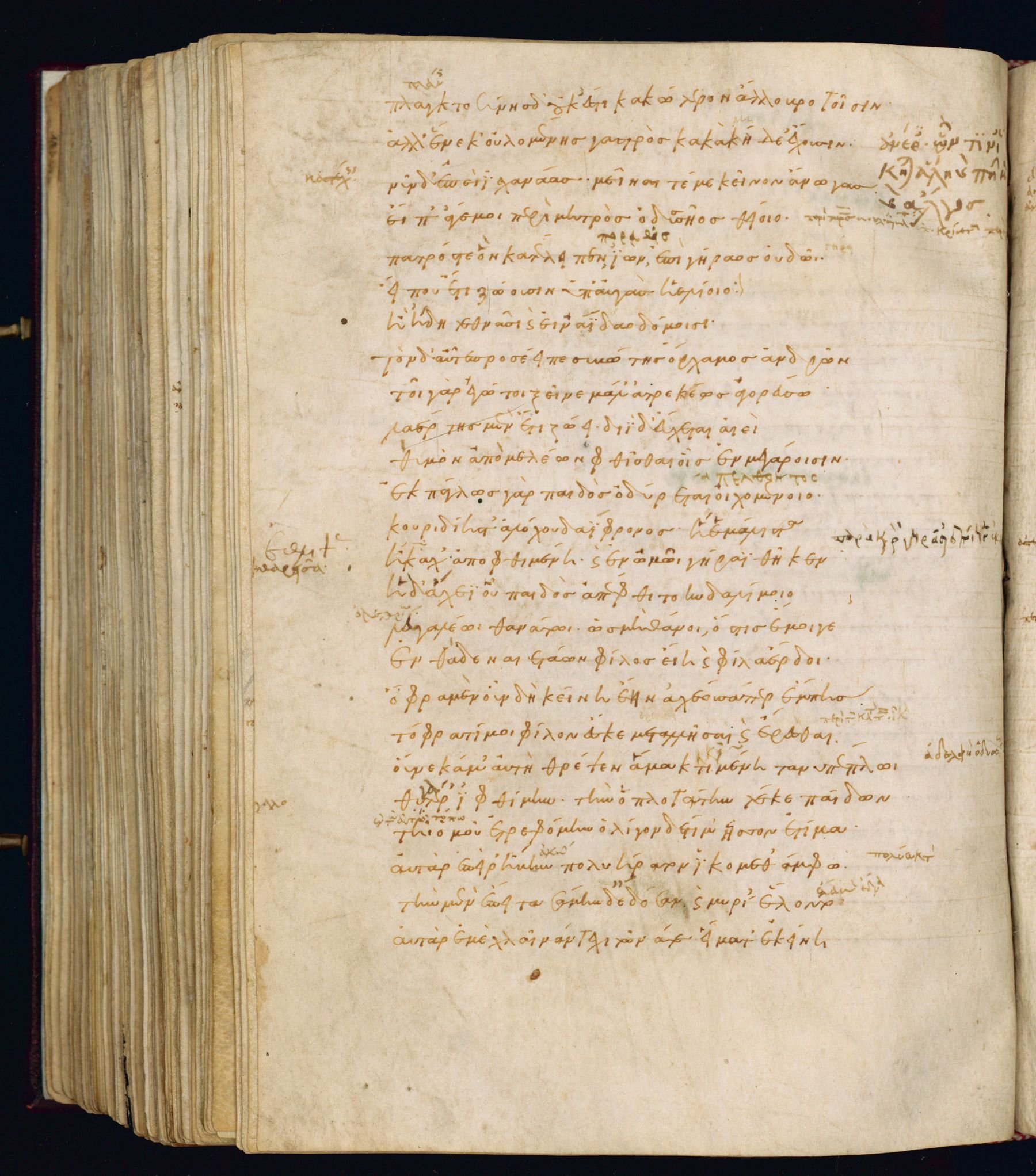
Where on the image
Laur. Plut. 32.24, fol. 151v: Odyssey 15.343-368, begins ‹πλαγκτοσύνης δʼ οὐκ ἔστι›, ends ‹χιτῶνά τε εἵματʼ ἐκείνη›. Checked on the image: first and last lines read and matched to the Greek. Fol. 151r ends with 15.342. Fol. 152r begins with 15.369. 15.345 is not in the text column; it is written in the right margin beside 15.344 (the column has 25 lines). English blocks here: 345-349, 350-354, 355-359, 360-364, 365-369.
343πλαγκτοσύνης δʼ οὐκ ἔστι κακώτερον ἄλλο βροτοῖσιν·
344ἀλλʼ ἕνεκʼ οὐλομένης γαστρὸς κακὰ κήδεʼ ἔχουσιν
345ἀνέρες, ὅν τινʼ ἵκηται ἄλη καὶ πῆμα καὶ ἄλγος.
346νῦν δʼ ἐπεὶ ἰσχανάᾳς μεῖναί τέ με κεῖνον ἄνωγας,
347εἴπʼ ἄγε μοι περὶ μητρὸς Ὀδυσσῆος θείοιο
348πατρός θʼ, ὃν κατέλειπεν ἰὼν ἐπὶ γήραος οὐδῷ,
349ἤ που ἔτι ζώουσιν ὑπʼ αὐγὰς ἠελίοιο,
350ἦ ἤδη τεθνᾶσι καὶ εἰν Ἀΐδαο δόμοισι.
351τὸν δʼ αὖτε προσέειπε συβώτης, ὄρχαμος ἀνδρῶν·
352τοιγὰρ ἐγώ τοι, ξεῖνε, μάλʼ ἀτρεκέως ἀγορεύσω.
353Λαέρτης μὲν ἔτι ζώει, Διὶ δʼ εὔχεται αἰεὶ
354θυμὸν ἀπὸ μελέων φθίσθαι οἷς ἐν μεγάροισιν·
355ἐκπάγλως γὰρ παιδὸς ὀδύρεται οἰχομένοιο
356κουριδίης τʼ ἀλόχοιο δαΐφρονος, ἥ ἑ μάλιστα
357ἤκαχʼ ἀποφθιμένη καὶ ἐν ὠμῷ γήραϊ θῆκεν.
358ἡ δʼ ἄχεϊ οὗ παιδὸς ἀπέφθιτο κυδαλίμοιο,
359λευγαλέῳ θανάτῳ, ὡς μὴ θάνοι ὅς τις ἐμοί γε
360ἐνθάδε ναιετάων φίλος εἴη καὶ φίλα ἔρδοι.
361ὄφρα μὲν οὖν δὴ κείνη ἔην, ἀχέουσά περ ἔμπης,
362τόφρα τί μοι φίλον ἔσκε μεταλλῆσαι καὶ ἐρέσθαι,
363οὕνεκά μʼ αὐτὴ θρέψεν ἅμα Κτιμένῃ τανυπέπλῳ,
364θυγατέρʼ ἰφθίμῃ, τὴν ὁπλοτάτην τέκε παίδων·
365τῇ ὁμοῦ ἐτρεφόμην, ὀλίγον δέ τί μʼ ἧσσον ἐτίμα.
366αὐτὰρ ἐπεί ῥʼ ἥβην πολυήρατον ἱκόμεθʼ ἄμφω,
367τὴν μὲν ἔπειτα Σάμηνδʼ ἔδοσαν καὶ μυρίʼ ἕλοντο,
368αὐτὰρ ἐμὲ χλαῖνάν τε χιτῶνά τε εἵματʼ ἐκείνη
345men endure evil woes, when wandering and sorrow and pain come upon them. But now, since thou keepest me here and biddest me await thy master, come, tell me of the mother of godlike Odysseus, and of the father, whom, when he went forth, he left behind him on the threshold of old age. Are they haply still living beneath the rays of the sun? 350or are they now dead and in the house of Hades?” Then the swineherd, a leader of men, answered him: “Then verily, stranger, will I frankly tell thee. Laertes still lives, but ever prays to Zeus that his life may waste away from his limbs within his halls. 355For wondrously does he grieve for his son that is gone, and for the wise lady, his wedded wife, whose death troubled him most of all, and brought him to untimely old age. But she died of grief for her glorious son by a miserable death, as I would that no man may die 360who dwells here as my friend and does me kindness. So long as she lived, though it was in sorrow, it was ever a pleasure to me to ask and enquire after her, for she herself had brought me up with long-robed Ctimene, her noble daughter, whom she bore as her youngest child. 365With her was I brought up, and the mother honored me little less than her own children. But when we both reached the longed-for prime of youth they sent her to Same to wed, and got themselves countless bridal gifts, but as for me, my lady clad me in a cloak and tunic, right goodly raiment, and gave me sandals for my feet
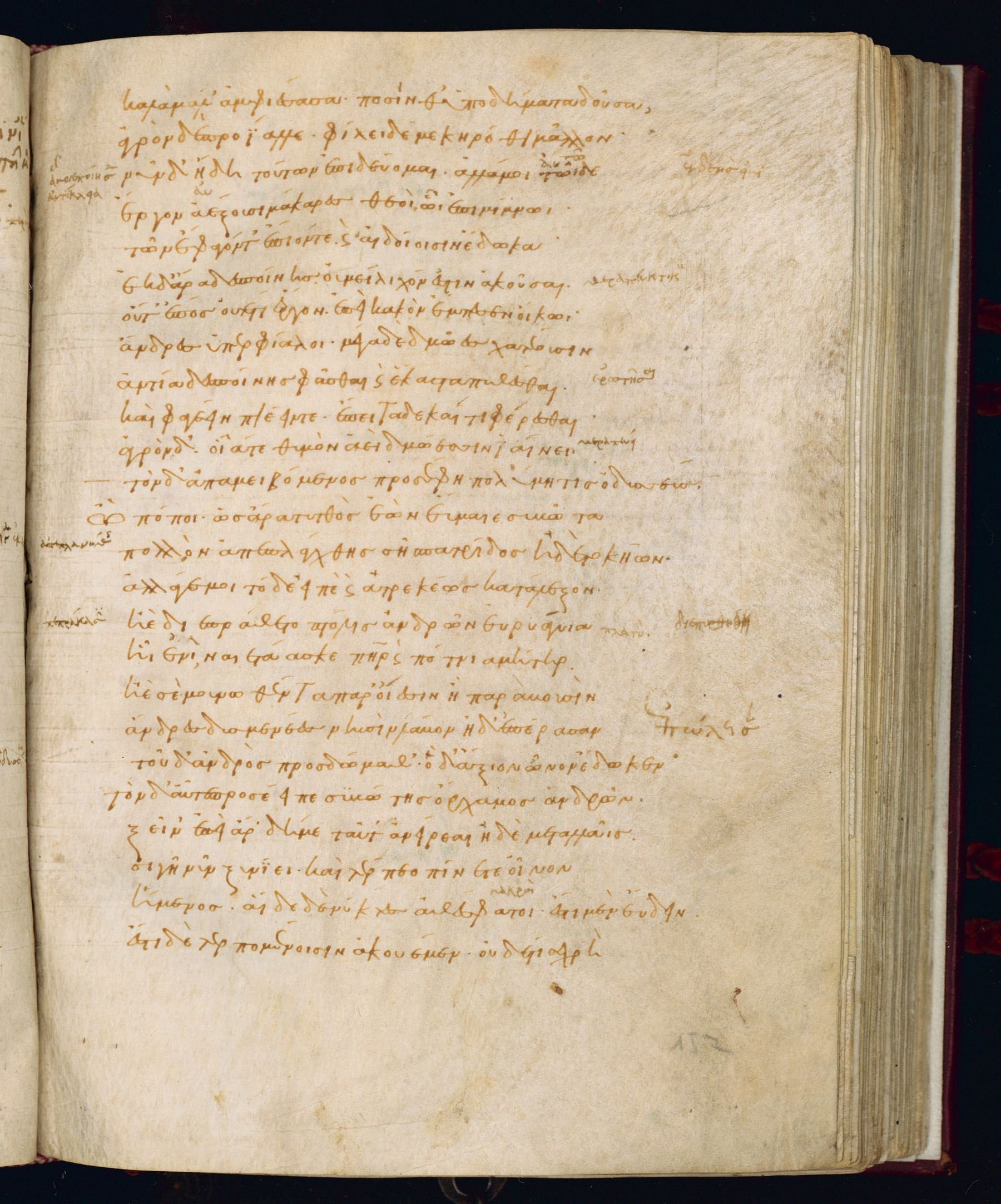
Where on the image
Laur. Plut. 32.24, fol. 152r: Odyssey 15.369-393, begins ‹καλὰ μάλʼ ἀμφιέσασα, ποσὶν›, ends ‹οὐδέ τί σε χρή,›. Checked on the image: first and last lines read and matched to the Greek. Fol. 151v ends with 15.368. Fol. 152v begins with 15.394. English blocks here: 370-374, 375-379, 380-384, 385-389, 390-394.
369καλὰ μάλʼ ἀμφιέσασα, ποσὶν δʼ ὑποδήματα δοῦσα
370ἀγρόνδε προΐαλλε· φίλει δέ με κηρόθι μᾶλλον.
371νῦν δʼ ἤδη τούτων ἐπιδεύομαι· ἀλλά μοι αὐτῷ
372ἔργον ἀέξουσιν μάκαρες θεοὶ ᾧ ἐπιμίμνω·
373τῶν ἔφαγόν τʼ ἔπιόν τε καὶ αἰδοίοισιν ἔδωκα.
374ἐκ δʼ ἄρα δεσποίνης οὐ μείλιχον ἔστιν ἀκοῦσαι
375οὔτʼ ἔπος οὔτε τι ἔργον, ἐπεὶ κακὸν ἔμπεσεν οἴκῳ,
376ἄνδρες ὑπερφίαλοι· μέγα δὲ δμῶες χατέουσιν
377ἀντία δεσποίνης φάσθαι καὶ ἕκαστα πυθέσθαι
378καὶ φαγέμεν πιέμεν τε, ἔπειτα δὲ καί τι φέρεσθαι
379ἀγρόνδʼ, οἷά τε θυμὸν ἀεὶ δμώεσσιν ἰαίνει.
380τὸν δʼ ἀπαμειβόμενος προσέφη πολύμητις Ὀδυσσεύς·
381ὢ πόποι, ὡς ἄρα τυτθὸς ἐών, Εὔμαιε συβῶτα,
382πολλὸν ἀπεπλάγχθης σῆς πατρίδος ἠδὲ τοκήων.
383ἀλλʼ ἄγε μοι τόδε εἰπὲ καὶ ἀτρεκέως κατάλεξον,
384ἠὲ διεπράθετο πτόλις ἀνδρῶν εὐρυάγυια,
385ᾗ ἔνι ναιετάασκε πατὴρ καὶ πότνια μήτηρ,
386ἦ σέ γε μουνωθέντα παρʼ οἴεσιν ἢ παρὰ βουσὶν
387ἄνδρες δυσμενέες νηυσὶν λάβον ἠδʼ ἐπέρασσαν
388τοῦδʼ ἀνδρὸς πρὸς δώμαθʼ, ὁ δʼ ἄξιον ὦνον ἔδωκε.
389τὸν δʼ αὖτε προσέειπε συβώτης, ὄρχαμος ἀνδρῶν·
390ξεῖνʼ, ἐπεὶ ἂρ δὴ ταῦτά μʼ ἀνείρεαι ἠδὲ μεταλλᾷς,
391σιγῇ νῦν ξυνίει καὶ τέρπεο, πῖνέ τε οἶνον
392ἥμενος. αἵδε δὲ νύκτες ἀθέσφατοι· ἔστι μὲν εὕδειν,
393ἔστι δὲ τερπομένοισιν ἀκούειν· οὐδέ τί σε χρή,
370and sent me forth to the field; but in her heart she loved me the more. But now I lack all this, though for my own part the blessed gods make to prosper the work to which I give heed. Therefrom have I eaten and drunk, and given to reverend strangers. But from my mistress I may hear naught pleasant, 375whether word or deed, for a plague has fallen upon the house, even overweening men. Yet greatly do servants long to speak before their mistress, and learn of all, and to eat and drink, and thereafter to carry off somewhat also to the fields, such things as ever make the heart of a servant to grow warm.” 380Then Odysseus of many wiles answered him, and said: “Lo now, surely when thou wast but a child, swineherd Eumaeus, thou didst wander far from thy country and thy parents. But come now, tell me this, and declare it truly. Was a broad-wayed city of men sacked, 385wherein thy father and honored mother dwelt? Or, when thou wast alone with thy sheep or cattle, did foemen take thee in their ships and bear thee for sale to the house of this thy master, who paid for thee a goodly price?” Then the swineherd, a leader of men, answered him: 390“Stranger, since thou dost ask and question me of this, hearken now in silence, and take thy joy, and drink thy wine, as thou sittest here. These nights are wondrous long. There is time for sleep, and there is time to take joy in hearing tales; thou needest not lay thee down till it be time; there is weariness even in too much sleep.
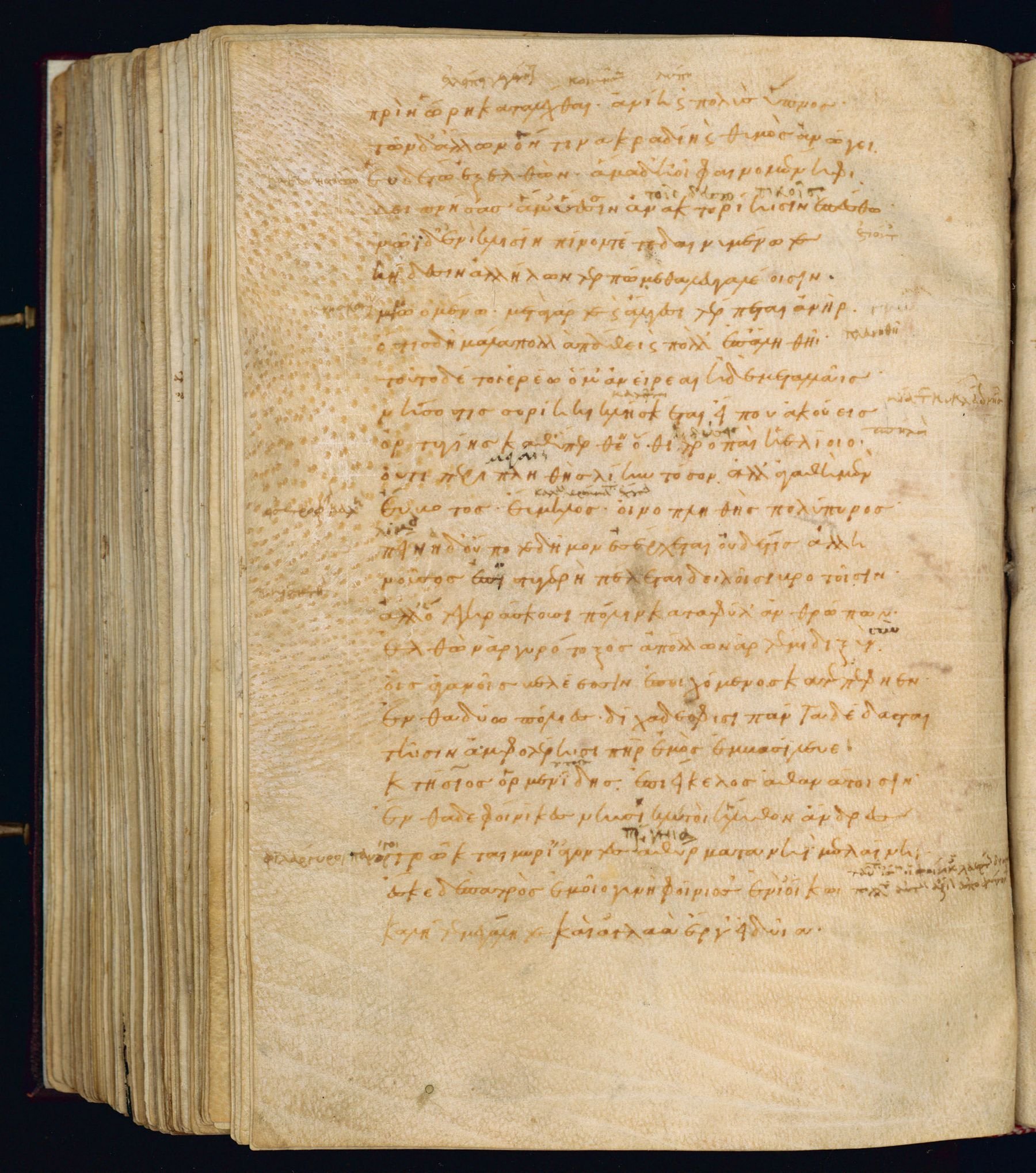
Where on the image
Laur. Plut. 32.24, fol. 152v: Odyssey 15.394-418, begins ‹πρὶν ὥρη, καταλέχθαι· ἀνίη›, ends ‹καὶ ἀγλαὰ ἔργα ἰδυῖα·›. Checked on the image: first and last lines read and matched to the Greek. Fol. 152r ends with 15.393. Fol. 153r begins with 15.419. English blocks here: 395-399, 400-404, 405-409, 410-414, 415-419.
394πρὶν ὥρη, καταλέχθαι· ἀνίη καὶ πολὺς ὕπνος.
395τῶν δʼ ἄλλων ὅτινα κραδίη καὶ θυμὸς ἀνώγει,
396εὑδέτω ἐξελθών· ἅμα δʼ ἠοῖ φαινομένηφι
397δειπνήσας ἅμʼ ὕεσσιν ἀνακτορίῃσιν ἑπέσθω.
398νῶϊ δʼ ἐνὶ κλισίῃ πίνοντέ τε δαινυμένω τε
399κήδεσιν ἀλλήλων τερπώμεθα λευγαλέοισι,
400μνωομένω· μετὰ γάρ τε καὶ ἄλγεσι τέρπεται ἀνήρ,
401ὅς τις δὴ μάλα πολλὰ πάθῃ καὶ πόλλʼ ἐπαληθῇ.
402τοῦτο δέ τοι ἐρέω ὅ μʼ ἀνείρεαι ἠδὲ μεταλλᾷς.
403νῆσός τις Συρίη κικλήσκεται, εἴ που ἀκούεις,
404Ὀρτυγίης καθύπερθεν, ὅθι τροπαὶ ἠελίοιο,
405οὔ τι περιπληθὴς λίην τόσον, ἀλλʼ ἀγαθὴ μέν,
406εὔβοτος, εὔμηλος, οἰνοπληθής, πολύπυρος.
407πείνη δʼ οὔ ποτε δῆμον ἐσέρχεται, οὐδέ τις ἄλλη
408νοῦσος ἐπὶ στυγερὴ πέλεται δειλοῖσι βροτοῖσιν·
409ἀλλʼ ὅτε γηράσκωσι πόλιν κάτα φῦλʼ ἀνθρώπων,
410ἐλθὼν ἀργυρότοξος Ἀπόλλων Ἀρτέμιδι ξὺν
411οἷς ἀγανοῖς βελέεσσιν ἐποιχόμενος κατέπεφνεν.
412ἔνθα δύω πόλιες, δίχα δέ σφισι πάντα δέδασται·
413τῇσιν δʼ ἀμφοτέρῃσι πατὴρ ἐμὸς ἐμβασίλευε,
414Κτήσιος Ὀρμενίδης, ἐπιείκελος ἀθανάτοισιν.
415ἔνθα δὲ Φοίνικες ναυσίκλυτοι ἤλυθον ἄνδρες,
416τρῶκται, μυρίʼ ἄγοντες ἀθύρματα νηῒ μελαίνῃ.
417ἔσκε δὲ πατρὸς ἐμοῖο γυνὴ Φοίνισσʼ ἐνὶ οἴκῳ,
418καλή τε μεγάλη τε καὶ ἀγλαὰ ἔργα ἰδυῖα·
395As for the rest, if any man's heart and spirit bid him, let him go forth and sleep, and at daybreak let him eat, and follow our master's swine. But we two will drink and feast in the hut, and will take delight each in the other's grievous woes, 400as we recall them to mind. For in after time a man finds joy even in woes, whosoever has suffered much, and wandered much. But this will I tell thee, of which thou dost ask and enquire. “There is an isle called Syria, if haply thou hast heard thereof, above Ortygia, where are the turning-places of the sun. 405It is not so very thickly settled, but it is a good land, rich in herds, rich in flocks, full of wine, abounding in wheat. Famine never comes into the land, nor does any hateful sickness besides fall on wretched mortals; but when the tribes of men grow old throughout the city, 410Apollo, of the silver bow, comes with Artemis, and assails them with his gentle shafts, and slays them. In that isle are two cities, and all the land is divided between them, and over both ruled as king my father, Ctesius, son of Ormenus, a man like to the immortals. 415“Thither came Phoenicians, men famed for their ships, greedy knaves, bringing countless trinkets in their black ship. Now there was in my father's house a Phoenician woman, comely and tall, and skilled in glorious handiwork. Her the wily Phoenicians beguiled.
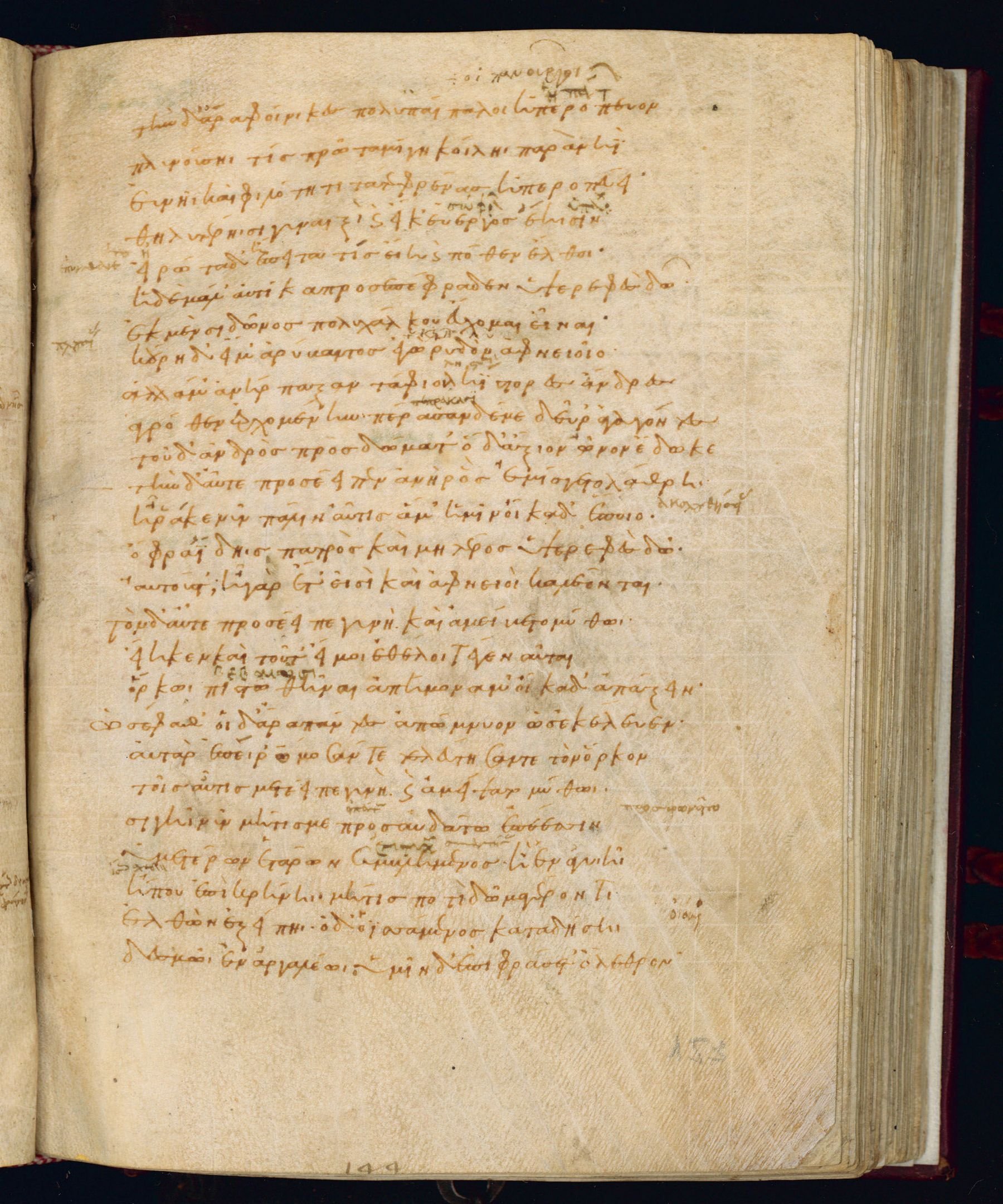
Where on the image
Laur. Plut. 32.24, fol. 153r: Odyssey 15.419-444, begins ‹τὴν δʼ ἄρα Φοίνικες›, ends ‹ὑμῖν δʼ ἐπιφράσσετʼ ὄλεθρον.›. Checked on the image: first and last lines read and matched to the Greek. Fol. 152v ends with 15.418. Fol. 153v begins with 15.445. English blocks here: 420-424, 425-429, 430-434, 435-439, 440-444.
419τὴν δʼ ἄρα Φοίνικες πολυπαίπαλοι ἠπερόπευον.
420πλυνούσῃ τις πρῶτα μίγη κοίλῃ παρὰ νηῒ
421εὐνῇ καὶ φιλότητι, τά τε φρένας ἠπεροπεύει
422θηλυτέρῃσι γυναιξί, καὶ ἥ κʼ εὐεργὸς ἔῃσιν.
423εἰρώτα δὴ ἔπειτα τίς εἴη καὶ πόθεν ἔλθοι·
424ἡ δὲ μάλʼ αὐτίκα πατρὸς ἐπέφραδεν ὑψερεφὲς δῶ·
425ἐκ μὲν Σιδῶνος πολυχάλκου εὔχομαι εἶναι,
426κούρη δʼ εἴμʼ Ἀρύβαντος ἐγὼ ῥυδὸν ἀφνειοῖο·
427ἀλλά μʼ ἀνήρπαξαν Τάφιοι ληΐστορες ἄνδρες
428ἀγρόθεν ἐρχομένην, πέρασαν δέ τε δεῦρʼ ἀγαγόντες
429τοῦδʼ ἀνδρὸς πρὸς δώμαθʼ· ὁ δʼ ἄξιον ὦνον ἔδωκε.
430τὴν δʼ αὖτε προσέειπεν ἀνήρ, ὃς ἐμίσγετο λάθρη·
431ἦ ῥά κε νῦν πάλιν αὖτις ἅμʼ ἡμῖν οἴκαδʼ ἕποιο,
432ὄφρα ἴδῃ πατρὸς καὶ μητέρος ὑψερεφὲς δῶ
433αὐτούς τʼ; ἦ γὰρ ἔτʼ εἰσὶ καὶ ἀφνειοὶ καλέονται.
434τὸν δʼ αὖτε προσέειπε γυνὴ καὶ ἀμείβετο μύθῳ·
435εἴη κεν καὶ τοῦτʼ, εἴ μοι ἐθέλοιτέ γε, ναῦται,
436ὅρκῳ πιστωθῆναι ἀπήμονά μʼ οἴκαδʼ ἀπάξειν.
437ὣς ἔφαθʼ, οἱ δʼ ἄρα πάντες ἐπώμνυον ὡς ἐκέλευεν.
438αὐτὰρ ἐπεί ῥʼ ὄμοσάν τε τελεύτησάν τε τὸν ὅρκον,
439τοῖς δʼ αὖτις μετέειπε γυνὴ καὶ ἀμείβετο μύθῳ·
440σιγῇ νῦν, μή τίς με προσαυδάτω ἐπέεσσιν
441ὑμετέρων ἑτάρων, ξυμβλήμενος ἢ ἐν ἀγυιῇ,
442ἤ που ἐπὶ κρήνῃ· μή τις ποτὶ δῶμα γέροντι
443ἐλθὼν ἐξείπῃ, ὁ δʼ ὀϊσάμενος καταδήσῃ
444δεσμῷ ἐν ἀργαλέῳ, ὑμῖν δʼ ἐπιφράσσετʼ ὄλεθρον.
420First, as she was washing clothes, one of them lay with her in love by the hollow ship; for this beguiles the minds of women, even though one be upright. Then he asked her who she was, and whence she came, and she straightway shewed him the high-roofed home of my father, and said: 425“‘Out of Sidon, rich in bronze, I declare that I come, and I am the daughter of Arybas, to whom wealth flowed in streams. But Taphian pirates seized me, as I was coming from the fields, and brought me hither, and sold me to the house of yonder man, and he paid for me a goodly price.’ 430“Then the man who had lain with her in secret answered her: ‘Wouldest thou then return again with us to thy home, that thou mayest see the high-roofed house of thy father and mother, and see them too? For of a truth they yet live, and are accounted rich.’ “Then the woman answered him, and said: 435‘This may well be, if you sailors will pledge yourselves by an oath, that you will bring me safely home.’ “So she spoke, and they all gave an oath thereto, as she bade them. But when they had sworn and made an end of the oath, the woman again spoke among them, and made answer: 440“‘Be silent now, and let no one of your company speak to me, if he meets me in the street or haply at the well, lest some one go to the palace and tell the old king, and he wax suspicious and bind me with grievous bonds, and devise death for you.
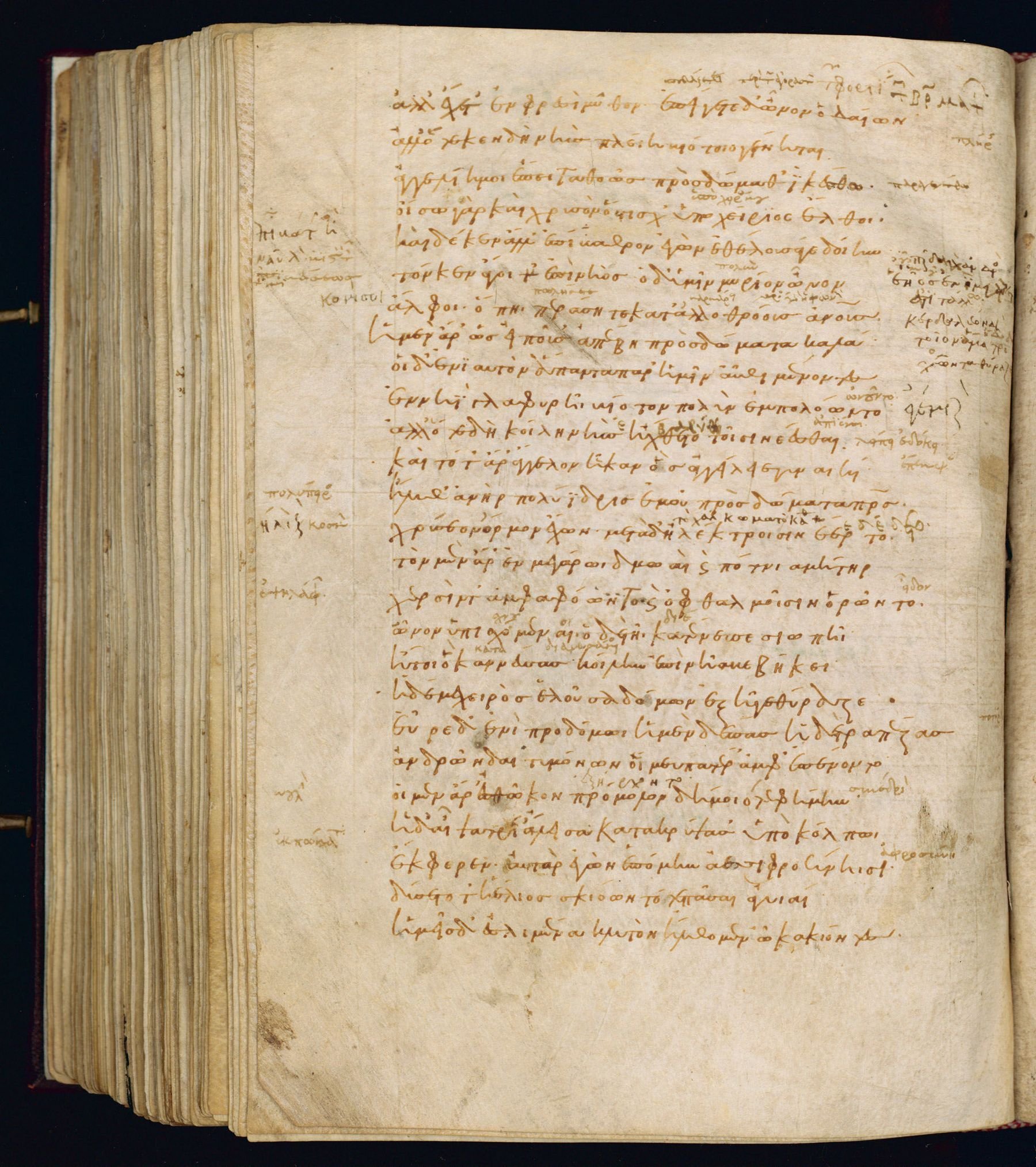
Where on the image
Laur. Plut. 32.24, fol. 153v: Odyssey 15.445-472, begins ‹ἀλλʼ ἔχετʼ ἐν φρεσὶ›, ends ‹κλυτὸν ἤλθομεν ὦκα κιόντες,›. Checked on the image: first and last lines read and matched to the Greek. Fol. 153r ends with 15.444. Fol. 154r begins with 15.473. 15.450-451 are not in the text column; they are written in the right margin beside 15.452-455 (the column has 26 lines). English blocks here: 445-449, 450-453, 454-454, 455-459, 460-464, 465-469, 470-474.
445ἀλλʼ ἔχετʼ ἐν φρεσὶ μῦθον, ἐπείγετε δʼ ὦνον ὁδαίων.
446ἀλλʼ ὅτε κεν δὴ νηῦς πλείη βιότοιο γένηται,
447ἀγγελίη μοι ἔπειτα θοῶς ἐς δώμαθʼ ἱκέσθω·
448οἴσω γὰρ καὶ χρυσόν, ὅτις χʼ ὑποχείριος ἔλθῃ·
449καὶ δέ κεν ἄλλʼ ἐπίβαθρον ἐγὼν ἐθέλουσά γε δοίην.
450παῖδα γὰρ ἀνδρὸς ἑῆος ἐνὶ μεγάροις ἀτιτάλλω,
451κερδαλέον δὴ τοῖον, ἅμα τροχόωντα θύραζε·
452τόν κεν ἄγοιμʼ ἐπὶ νηός, ὁ δʼ ὑμῖν μυρίον ὦνον
453ἄλφοι, ὅπῃ περάσητε κατʼ ἀλλοθρόους ἀνθρώπους.
454ἡ μὲν ἄρʼ ὣς εἰποῦσʼ ἀπέβη πρὸς δώματα καλά,
455οἱ δʼ ἐνιαυτὸν ἅπαντα παρʼ ἡμῖν αὖθι μένοντες
456ἐν νηῒ γλαφυρῇ βίοτον πολὺν ἐμπολόωντο.
457ἀλλʼ ὅτε δὴ κοίλη νηῦς ἤχθετο τοῖσι νέεσθαι,
458καὶ τότʼ ἄρʼ ἄγγελον ἧκαν, ὃς ἀγγείλειε γυναικί.
459ἤλυθʼ ἀνὴρ πολύϊδρις ἐμοῦ πρὸς δώματα πατρὸς
460χρύσεον ὅρμον ἔχων, μετὰ δʼ ἠλέκτροισιν ἔερτο.
461τὸν μὲν ἄρʼ ἐν μεγάρῳ δμῳαὶ καὶ πότνια μήτηρ
462χερσίν τʼ ἀμφαφόωντο καὶ ὀφθαλμοῖσιν ὁρῶντο,
463ὦνον ὑπισχόμεναι· ὁ δὲ τῇ κατένευσε σιωπῇ.
464ἦ τοι ὁ καννεύσας κοίλην ἐπὶ νῆα βεβήκει,
465ἡ δʼ ἐμὲ χειρὸς ἑλοῦσα δόμων ἐξῆγε θύραζε.
466εὗρε δʼ ἐνὶ προδόμῳ ἠμὲν δέπα ἠδὲ τραπέζας
467ἀνδρῶν δαιτυμόνων, οἵ μευ πατέρʼ ἀμφεπένοντο.
468οἱ μὲν ἄρʼ ἐς θῶκον πρόμολον, δήμοιό τε φῆμιν,
469ἡ δʼ αἶψα τρίʼ ἄλεισα κατακρύψασʼ ὑπὸ κόλπῳ
470ἔκφερεν· αὐτὰρ ἐγὼν ἑπόμην ἀεσιφροσύνῃσι.
471δύσετό τʼ ἠέλιος, σκιόωντό τε πᾶσαι ἀγυιαί·
472ἡμεῖς δʼ ἐς λιμένα κλυτὸν ἤλθομεν ὦκα κιόντες,
445Nay, keep my words in mind, and speed the barter of your wares. But, when your ship is laden with goods, let a message come quickly to me at the palace; for I will also bring whatever gold comes under my hand. Aye, and I would gladly give another thing for my passage. 450There is a child of my noble master, whose nurse I am in the palace, such a cunning child, who ever runs abroad with me. Him would I bring on board, and he would fetch you a vast price, wherever you might take him for sale among men of strange speech.’ 454“So saying, she departed to the fair palace. 455And they remained there in our land a full year, and got by trade much substance in their hollow ship. But when their hollow ship was laden for their return, then they sent a messenger to bear tidings to the woman. There came a man, well versed in guile, to my father's house 460with a necklace of gold, and with amber beads was it strung between. This the maidens in the hall and my honored mother were handling, and were gazing on it, and were offering him their price; but he nodded to the woman in silence. Then verily when he had nodded to her, he went his way to the hollow ship, 465but she took me by the hand, and led me forth from the house. Now in the fore-hall of the palace she found the cups and tables of the banqueters, who waited upon my father. They had gone forth to the council and the people's place of debate, but she quickly hid three goblets in her bosom, 470and bore them away; and I followed in my heedlessness. Then the sun set, and all the ways grew dark. And we made haste and came to the goodly harbor, where was the swift ship of the Phoenicians. Then they embarked,
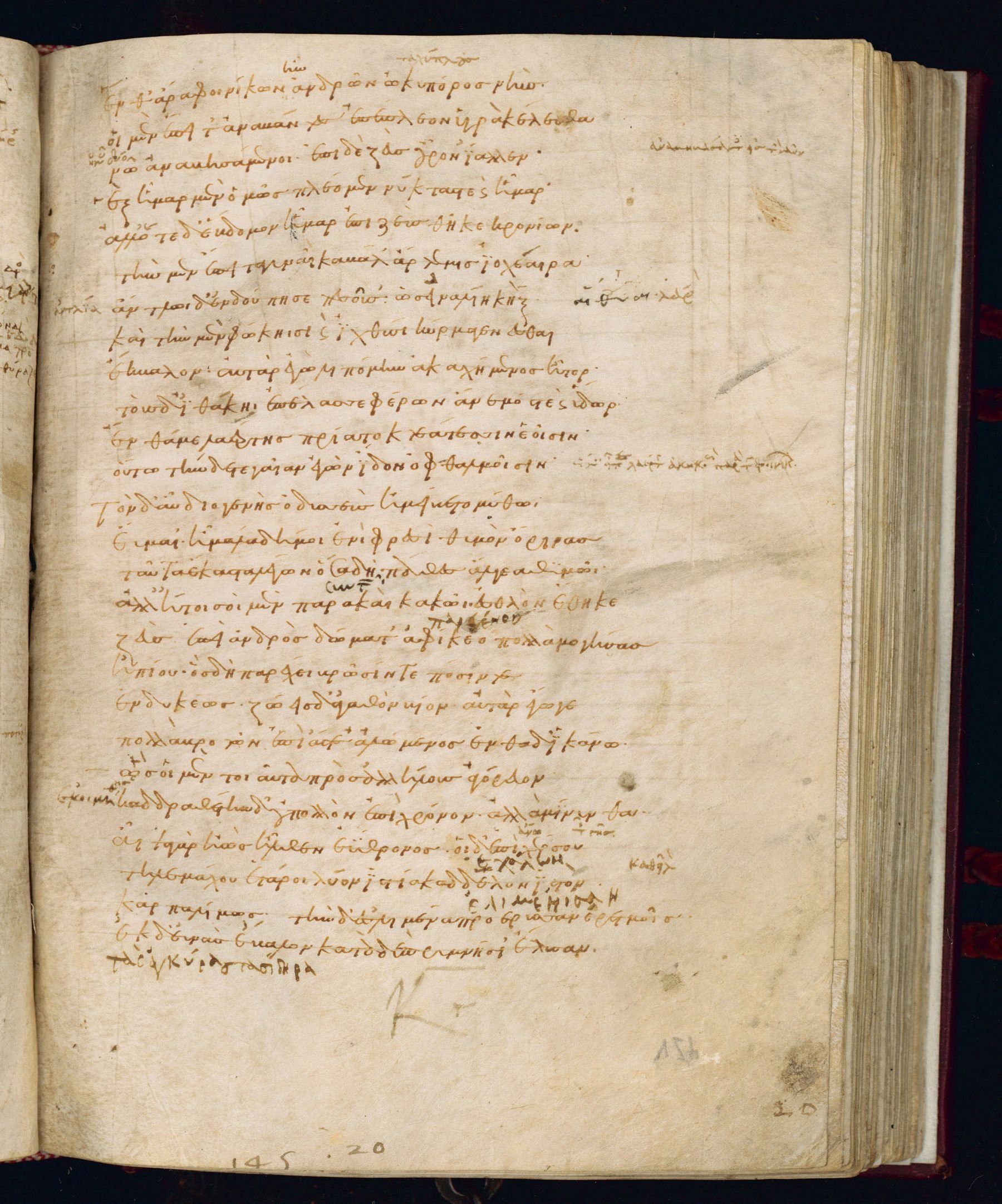
Where on the image
Laur. Plut. 32.24, fol. 154r: Odyssey 15.473-498, begins ‹ἔνθʼ ἄρα Φοινίκων ἀνδρῶν›, ends ‹κατὰ δὲ πρυμνήσιʼ ἔδησαν·›. Checked on the image: first and last lines read and matched to the Greek. Fol. 153v ends with 15.472. Fol. 154v begins with 15.499. English blocks here: 475-479, 480-484, 485-489, 490-492, 493-494, 495-499.
473ἔνθʼ ἄρα Φοινίκων ἀνδρῶν ἦν ὠκύαλος νηῦς.
474οἱ μὲν ἔπειτʼ ἀναβάντες ἐπέπλεον ὑγρὰ κέλευθα,
475νὼ ἀναβησάμενοι· ἐπὶ δὲ Ζεὺς οὖρον ἴαλλεν.
476ἑξῆμαρ μὲν ὁμῶς πλέομεν νύκτας τε καὶ ἦμαρ·
477ἀλλʼ ὅτε δὴ ἕβδομον ἦμαρ ἐπὶ Ζεὺς θῆκε Κρονίων,
478τὴν μὲν ἔπειτα γυναῖκα βάλʼ Ἄρτεμις ἰοχέαιρα,
479ἄντλῳ δʼ ἐνδούπησε πεσοῦσʼ ὡς εἰναλίη κήξ.
480καὶ τὴν μὲν φώκῃσι καὶ ἰχθύσι κύρμα γενέσθαι
481ἔκβαλον· αὐτὰρ ἐγὼ λιπόμην ἀκαχήμενος ἦτορ·
482τοὺς δʼ Ἰθάκῃ ἐπέλασσε φέρων ἄνεμός τε καὶ ὕδωρ,
483ἔνθα με Λαέρτης πρίατο κτεάτεσσιν ἑοῖσιν.
484οὕτω τήνδε τε γαῖαν ἐγὼν ἴδον ὀφθαλμοῖσι.
485τὸν δʼ αὖ διογενὴς Ὀδυσεὺς ἠμείβετο μύθῳ·
486Εὔμαιʼ, ἦ μάλα δή μοι ἐνὶ φρεσὶ θυμὸν ὄρινας
487ταῦτα ἕκαστα λέγων, ὅσα δὴ πάθες ἄλγεα θυμῷ.
488ἀλλʼ ἦ τοι σοὶ μὲν παρὰ καὶ κακῷ ἐσθλὸν ἔθηκε
489Ζεύς, ἐπεὶ ἀνδρὸς δώματʼ ἀφίκεο πολλὰ μογήσας
490ἠπίου, ὃς δή τοι παρέχει βρῶσίν τε πόσιν τε
491ἐνδυκέως, ζώεις δʼ ἀγαθὸν βίον· αὐτὰρ ἐγώ γε
492πολλὰ βροτῶν ἐπὶ ἄστεʼ ἀλώμενος ἐνθάδʼ ἱκάνω.
493ὣς οἱ μὲν τοιαῦτα πρὸς ἀλλήλους ἀγόρευον,
494καδδραθέτην δʼ οὐ πολλὸν ἐπὶ χρόνον, ἀλλὰ μίνυνθα·
495αἶψα γὰρ Ἠὼς ἦλθεν ἐΰθρονος. οἱ δʼ ἐπὶ χέρσου
496Τηλεμάχου ἕταροι λύον ἱστία, κὰδ δʼ ἕλον ἱστὸν
497καρπαλίμως, τὴν δʼ εἰς ὅρμον προέρυσσαν ἐρετμοῖς·
498ἐκ δʼ εὐνὰς ἔβαλον, κατὰ δὲ πρυμνήσιʼ ἔδησαν·
475putting both of us on board as well, and sailed over the watery ways, and Zeus sent them a favorable wind. For six days we sailed, night and day alike; but when Zeus, son of Cronos, brought upon us the seventh day, then Artemis, the archer, smote the woman, and she fell with a thud into the hold, as a sea bird plunges. 480Her they cast forth to be a prey to seals and fishes, but I was left, my heart sore stricken. Now the wind, as it bore them, and the wave, brought them to Ithaca, where Laertes bought me with his wealth. Thus it was that my eyes beheld this land.” 485To him then Zeus-born Odysseus made answer, and said: “Eumaeus, of a truth thou hast deeply stirred the heart in my breast in telling all this tale of the sorrow thou hast borne at heart. Yet verily in thy case Zeus has given good side by side with the evil, since after all thy toil thou hast come to the house of 490a kindly man, who gives thee food and drink, and that with kindness, and thou livest well; while as for me, it is while wandering through the many cities of men that I am come hither.” 493Thus they spoke to one another, and then lay down to sleep, for no long time, but for a little; 495for soon came fair-throned Dawn. But the comrades of Telemachus, drawing near the shore, furled the sail, and took down the mast quickly, and rowed the ship to her anchorage with their oars. Then they cast out the mooring-stones and made fast the stern cables, and themselves went forth upon the shore of the sea,
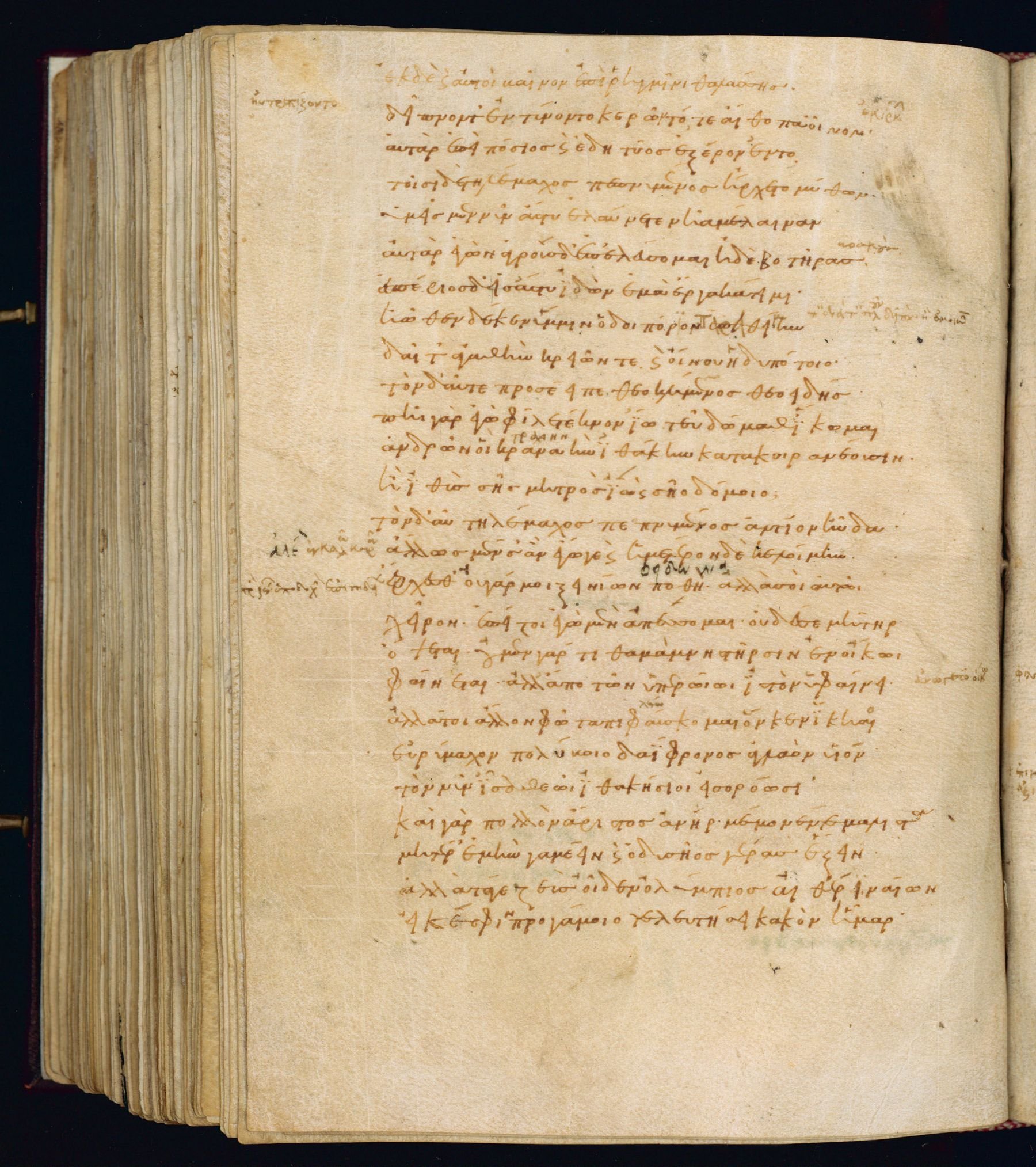
Where on the image
Laur. Plut. 32.24, fol. 154v: Odyssey 15.499-524, begins ‹ἐκ δὲ καὶ αὐτοὶ›, ends ‹γάμοιο τελευτήσει κακὸν ἦμαρ.›. Checked on the image: first and last lines read and matched to the Greek. Fol. 154r ends with 15.498. Fol. 155r begins with 15.525. English blocks here: 500-504, 505-509, 510-514, 515-519, 520-524.
499ἐκ δὲ καὶ αὐτοὶ βαῖνον ἐπὶ ῥηγμῖνι θαλάσσης,
500δεῖπνόν τʼ ἐντύνοντο κερῶντό τε αἴθοπα οἶνον.
501αὐτὰρ ἐπεὶ πόσιος καὶ ἐδητύος ἐξ ἔρον ἕντο,
502τοῖσι δὲ Τηλέμαχος πεπνυμένος ἤρχετο μύθων·
503ὑμεῖς μὲν νῦν ἄστυδʼ ἐλαύνετε νῆα μέλαιναν,
504αὐτὰρ ἐγὼν ἀγροὺς ἐπιείσομαι ἠδὲ βοτῆρας·
505ἑσπέριος δʼ εἰς ἄστυ ἰδὼν ἐμὰ ἔργα κάτειμι.
506ἠῶθεν δέ κεν ὔμμιν ὁδοιπόριον παραθείμην,
507δαῖτʼ ἀγαθὴν κρειῶν τε καὶ οἴνου ἡδυπότοιο.
508τὸν δʼ αὖτε προσέειπε Θεοκλύμενος θεοειδής·
509πῆ γὰρ ἐγώ, φίλε τέκνον, ἴω; τεῦ δώμαθʼ ἵκωμαι
510ἀνδρῶν οἳ κραναὴν Ἰθάκην κάτα κοιρανέουσιν;
511ἦ ἰθὺς σῆς μητρὸς ἴω καὶ σοῖο δόμοιο;
512τὸν δʼ αὖ Τηλέμαχος πεπνυμένος ἀντίον ηὔδα·
513ἄλλως μέν σʼ ἂν ἐγώ γε καὶ ἡμέτερόνδε κελοίμην
514ἔρχεσθʼ· οὐ γάρ τι ξενίων ποθή· ἀλλὰ σοὶ αὐτῷ
515χεῖρον, ἐπεί τοι ἐγὼ μὲν ἀπέσσομαι, οὐδέ σε μήτηρ
516ὄψεται· οὐ μὲν γάρ τι θαμὰ μνηστῆρσʼ ἐνὶ οἴκῳ
517φαίνεται, ἀλλʼ ἀπὸ τῶν ὑπερωΐῳ ἱστὸν ὑφαίνει.
518ἀλλά τοι ἄλλον φῶτα πιφαύσκομαι ὅν κεν ἵκοιο,
519Εὐρύμαχον, Πολύβοιο δαΐφρονος ἀγλαὸν υἱόν,
520τὸν νῦν ἶσα θεῷ Ἰθακήσιοι εἰσορόωσι·
521καὶ γὰρ πολλὸν ἄριστος ἀνὴρ μέμονέν τε μάλιστα
522μητέρʼ ἐμὴν γαμέειν καὶ Ὀδυσσῆος γέρας ἕξειν.
523ἀλλὰ τά γε Ζεὺς οἶδεν Ὀλύμπιος, αἰθέρι ναίων,
524εἴ κέ σφι πρὸ γάμοιο τελευτήσει κακὸν ἦμαρ.
500and made ready their meal and mixed the flaming wine. But when they had put from them the desire of food and drink, among them wise Telemachus was the first to speak, saying: “Do you now row the black ship to the city, but I will visit the fields and the herdsmen, 505and at evening will come to the city when I have looked over my lands. And in the morning I will set before you, as wages for your journey, a good feast of flesh and sweet wine.” Then godlike Theoclymenus answered him: “Whither shall I go, dear child? To whose house shall I come 510of those who rule in rocky Ithaca? Or shall I go straight to thy mother's house and thine?” Then wise Telemachus answered him: “Were things otherwise, I should bid thee go even to our house, for there is in no wise lack of entertainment for strangers, but 515it would be worse for thyself, since I shall be away, and my mother will not see thee. For she does not often appear before the wooers in the house, but apart from them weaves at her loom in an upper chamber. But I will tell thee of another man to whom thou mayest go, Eurymachus, glorious son of wise Polybus, 520whom now the men of Ithaca look upon as on a god. For he is by far the best man, and is most eager to marry my mother and to have the honor of Odysseus. Nevertheless Olympian Zeus, who dwells in the sky, knows this, whether or not before marriage he will fulfil for them the evil day.”
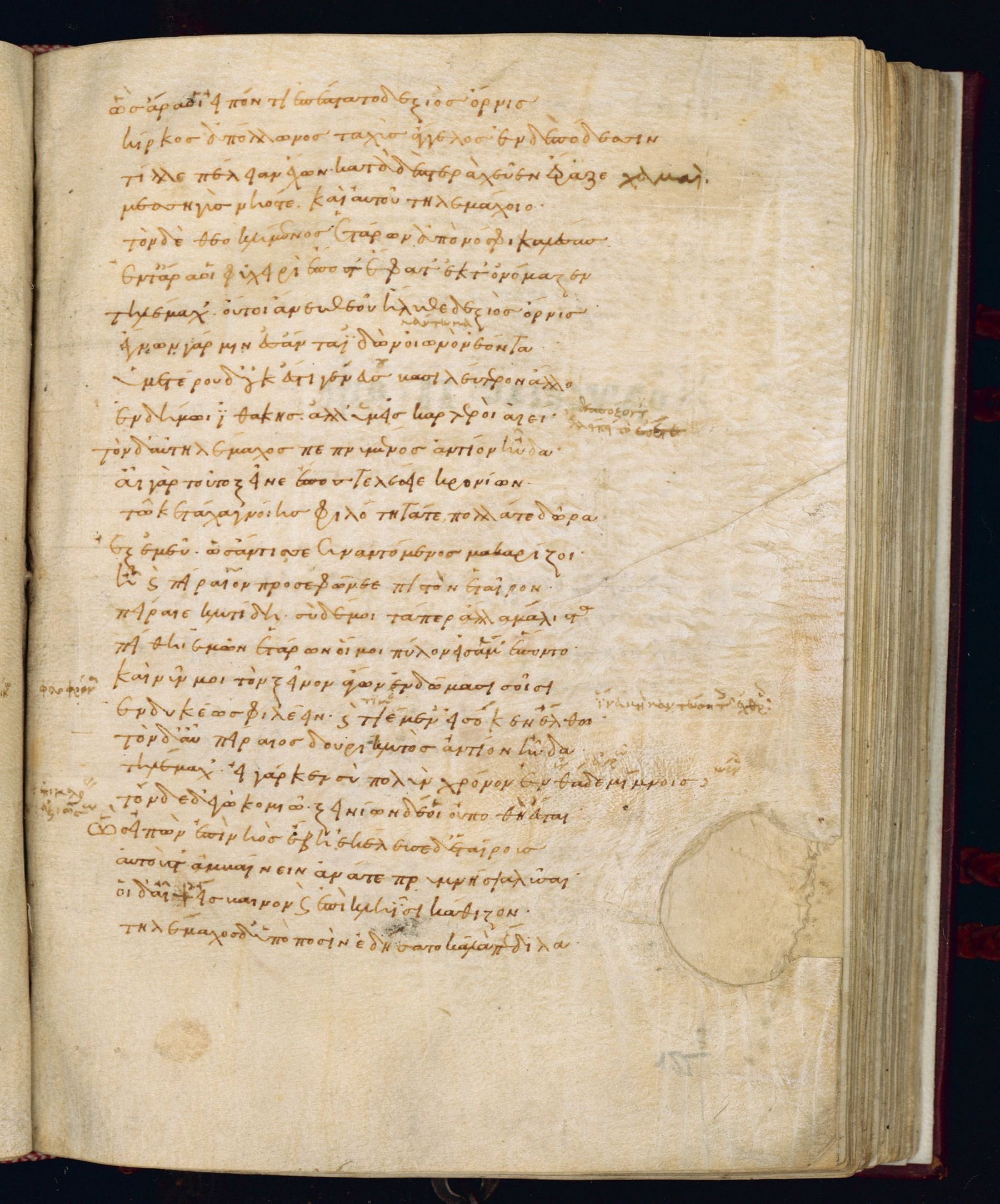
Where on the image
Laur. Plut. 32.24, fol. 155r: Odyssey 15.525-550, begins ‹ὣς ἄρα οἱ εἰπόντι›, ends ‹ποσσὶν ἐδήσατο καλὰ πέδιλα,›. Checked on the image: first and last lines read and matched to the Greek. Fol. 154v ends with 15.524. Fol. 155v begins with 15.551. English blocks here: 525-529, 530-534, 535-539, 540-544, 545-549.
525ὣς ἄρα οἱ εἰπόντι ἐπέπτατο δεξιὸς ὄρνις,
526κίρκος, Ἀπόλλωνος ταχὺς ἄγγελος· ἐν δὲ πόδεσσι
527τίλλε πέλειαν ἔχων, κατὰ δὲ πτερὰ χεῦεν ἔραζε
528μεσσηγὺς νηός τε καὶ αὐτοῦ Τηλεμάχοιο.
529τὸν δὲ Θεοκλύμενος ἑτάρων ἀπονόσφι καλέσσας
530ἔν τʼ ἄρα οἱ φῦ χειρὶ ἔπος τʼ ἔφατʼ ἔκ τʼ ὀνόμαζε·
531Τηλέμαχʼ, οὔ τοι ἄνευ θεοῦ ἔπτατο δεξιὸς ὄρνις
532ἔγνων γάρ μιν ἐσάντα ἰδὼν οἰωνὸν ἐόντα.
533ὑμετέρου δʼ οὐκ ἔστι γένος βασιλεύτερον ἄλλο
534ἐν δήμῳ Ἰθάκης, ἀλλʼ ὑμεῖς καρτεροὶ αἰεί.
535τὸν δʼ αὖ Τηλέμαχος πεπνυμένος ἀντίον ηὔδα·
536αἲ γὰρ τοῦτο, ξεῖνε, ἔπος τετελεσμένον εἴη·
537τῷ κε τάχα γνοίης φιλότητά τε πολλά τε δῶρα
538ἐξ ἐμεῦ, ὡς ἄν τίς σε συναντόμενος μακαρίζοι.
539ἦ καὶ Πείραιον προσεφώνεε, πιστὸν ἑταῖρον·
540Πείραιε Κλυτίδη, σὺ δέ μοι τά περ ἄλλα μάλιστα
541πείθῃ ἐμῶν ἑτάρων, οἵ μοι Πύλον εἰς ἅμʼ ἕποντο·
542καὶ νῦν μοι τὸν ξεῖνον ἄγων ἐν δώμασι σοῖσιν
543ἐνδυκέως φιλέειν καὶ τιέμεν, εἰς ὅ κεν ἔλθω.
544τὸν δʼ αὖ Πείραιος δουρικλυτὸς ἀντίον ηὔδα·
545Τηλέμαχʼ, εἰ γάρ κεν σὺ πολὺν χρόνον ἐνθάδε μίμνοι,
546τόνδε τʼ ἐγὼ κομιῶ, ξενίων δέ οἱ οὐ ποθὴ ἔσται.
547ὣς εἰπὼν ἐπὶ νηὸς ἔβη, ἐκέλευσε δʼ ἑταίρους
548αὐτούς τʼ ἀμβαίνειν ἀνά τε πρυμνήσια λῦσαι.
549οἱ δʼ αἶψʼ εἴσβαινον καὶ ἐπὶ κληῗσι καθῖζον.
550Τηλέμαχος δʼ ὑπὸ ποσσὶν ἐδήσατο καλὰ πέδιλα,
525Even as he spoke a bird flew forth upon the right, a hawk, the swift messenger of Apollo. In his talons he held a dove, and was plucking her and shedding the feathers down on the ground midway between the ship and Telemachus himself. Then Theoclymenus called him apart from his companions, 530and clasped his hand, and spoke, and addressed him: “Telemachus, surely not without a god's warrant has this bird flown forth upon our right, for I knew, as I looked upon him, that he was a bird of omen. Than yours is no other house in the land of Ithaca more kingly; nay, ye are ever supreme.” 535Then wise Telemachus answered him again: “Ah, stranger, I would that this word of thine might be fulfilled. Then shouldest thou straightway know of kindness and many a gift from me, so that one that met thee would call thee blessed.” Therewith he spoke to Peiraeus, his trusty comrade: 540“Peiraeus, son of Clytius, it is thou that in other matters art wont to hearken to me above all my comrades, who went with me to Pylos; so now do thou, I pray thee, take this stranger and give him kindly welcome in thy house, and show him honor until I come.” 545Then Peiraeus, the famous spearman, answered him: “Telemachus, though thou shouldest stay here long, I will entertain him, and he shall have no lack of what is due to strangers.” So saying, he went on board the ship, and bade his comrades themselves to embark and to loose the stern cables. So they went on board straightway, and sat down upon the benches.
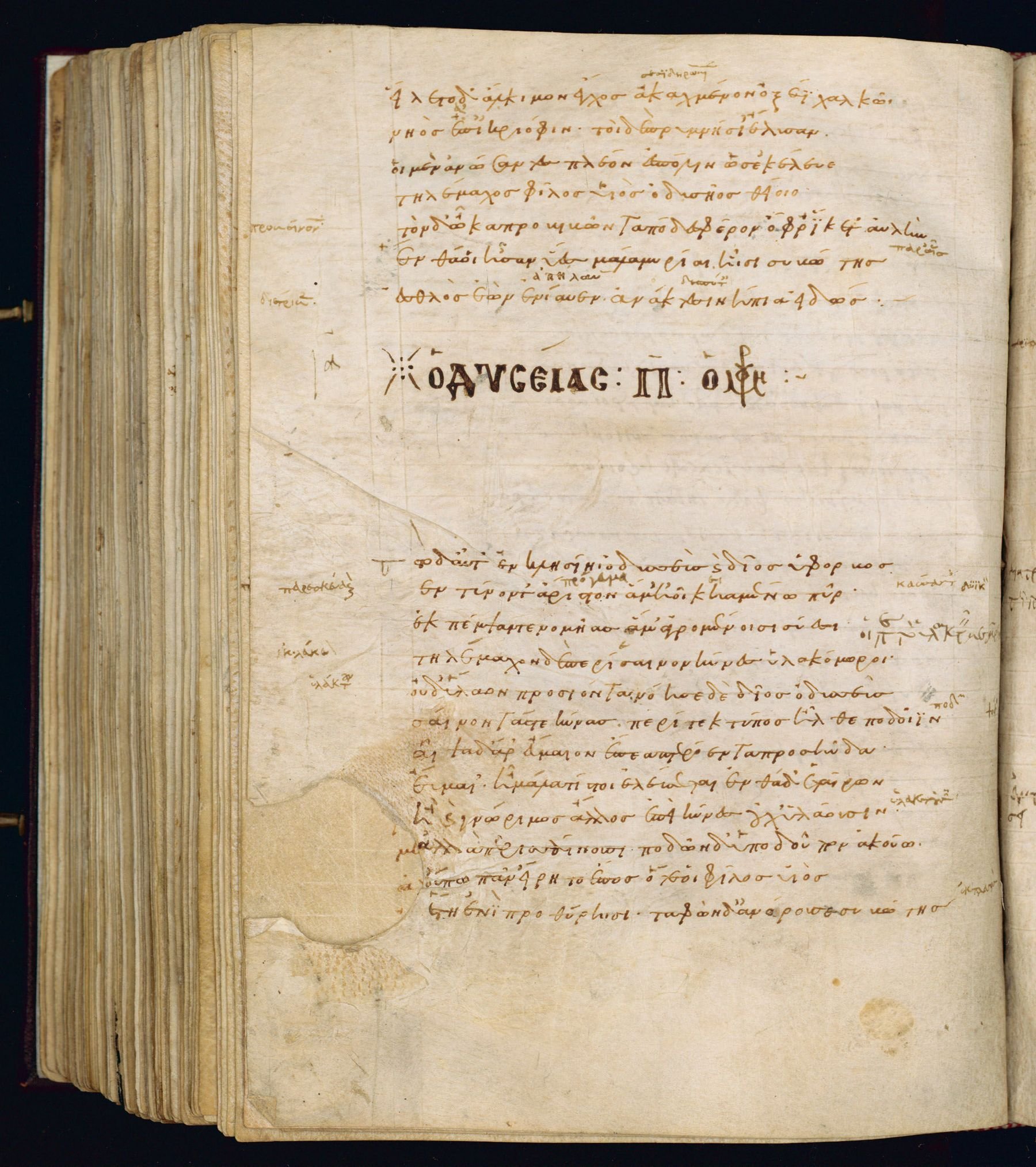
Where on the image
Laur. Plut. 32.24, fol. 155v: Odyssey 15.551-557, begins ‹εἵλετο δʼ ἄλκιμον ἔγχος,›, ends ‹ἐνίαυεν, ἀνάκτεσιν ἤπια εἰδώς.›. Checked on the image: first and last lines read and matched to the Greek. Fol. 155r ends with 15.550. The page holds 15.551-557, 16.1-12. Book 15 ends with 15.557; the heading ὀδυσσείας π ὁμήρου follows in capitals with space around it, and book 16 begins. English blocks here: 550-554, 555-557.
551εἵλετο δʼ ἄλκιμον ἔγχος, ἀκαχμένον ὀξέϊ χαλκῷ,
552νηὸς ἀπʼ ἰκριόφιν· τοὶ δὲ πρυμνήσιʼ ἔλυσαν.
553οἱ μὲν ἀνώσαντες πλέον ἐς πόλιν, ὡς ἐκέλευσε
554Τηλέμαχος, φίλος υἱὸς Ὀδυσσῆος θείοιο·
555τὸν δʼ ὦκα προβιβάντα πόδες φέρον, ὄφρʼ ἵκετʼ αὐλήν,
556ἔνθα οἱ ἦσαν ὕες μάλα μυρίαι, ᾗσι συβώτης
557ἐσθλὸς ἐὼν ἐνίαυεν, ἀνάκτεσιν ἤπια εἰδώς.
550But Telemachus bound beneath his feet his fair sandals, and took his mighty spear, tipped with sharp bronze, from the deck of the ship. Then the men loosed the stern cables, and thrusting off, sailed to the city, as Telemachus bade, the dear son of divine Odysseus. 555But his feet bore him swiftly on, as he strode forward, until he reached the farmstead where were his countless swine, among whom slept the worthy swineherd with a heart loyal to his masters.
Notes
- Greek: A. T. Murray, Homer: The Odyssey (Loeb Classical Library, 1919), via Perseus.
- English: A. T. Murray's translation in the same edition; his footnotes are omitted.
Cite
Sources
- Source: Laur. Plut. 32.24 (BML Teca Digitale IIIF) + Murray Greek (Loeb 1919, Perseus) + Murray English (Loeb 1919, Perseus) (holding institution)
- Critical edition: Murray, Loeb 1919, via Perseus
← previous · → next · v cycle view · l back to library