Homer, Odyssey, Book 14: In the hut of Eumaeus
Introduction
The Odyssey, composed around 700 BCE and attributed to Homer, tells of Odysseus' ten-year journey home from Troy and his return to Ithaca. Book 14 (533 lines): In the hut of Eumaeus.
The page photographs are from Florence, Biblioteca Medicea Laurenziana, Plut. 32.24 (parchment, 10th century, 234 folios; the oldest manuscript of the Odyssey with published images), in the Biblioteca Medicea Laurenziana's Teca Digitale. This book is on fol. 134r-144v; each section below is one page, with its first and last line as read on the photograph. Many pages carry interlinear glosses and a few marginal notes in later hands.
The Greek is A. T. Murray's Loeb text (1919) via Perseus, not a transcription of this manuscript, whose wording differs in places. The English is Murray's prose translation (1919), divided every five lines; at a page break a five-line block goes with the page holding most of it, except at the page breaks where a section's note says the English is cut at the end of Murray's sentence. Each section's note gives its English line range.
Where the scribe left out a line, wrote one in the margin, changed the order or added a line not in Murray's text, the section's note on the photograph says so; the Greek and English shown are Murray's full text for the page's range.
How was this verified? (Provenance)
Where on the image
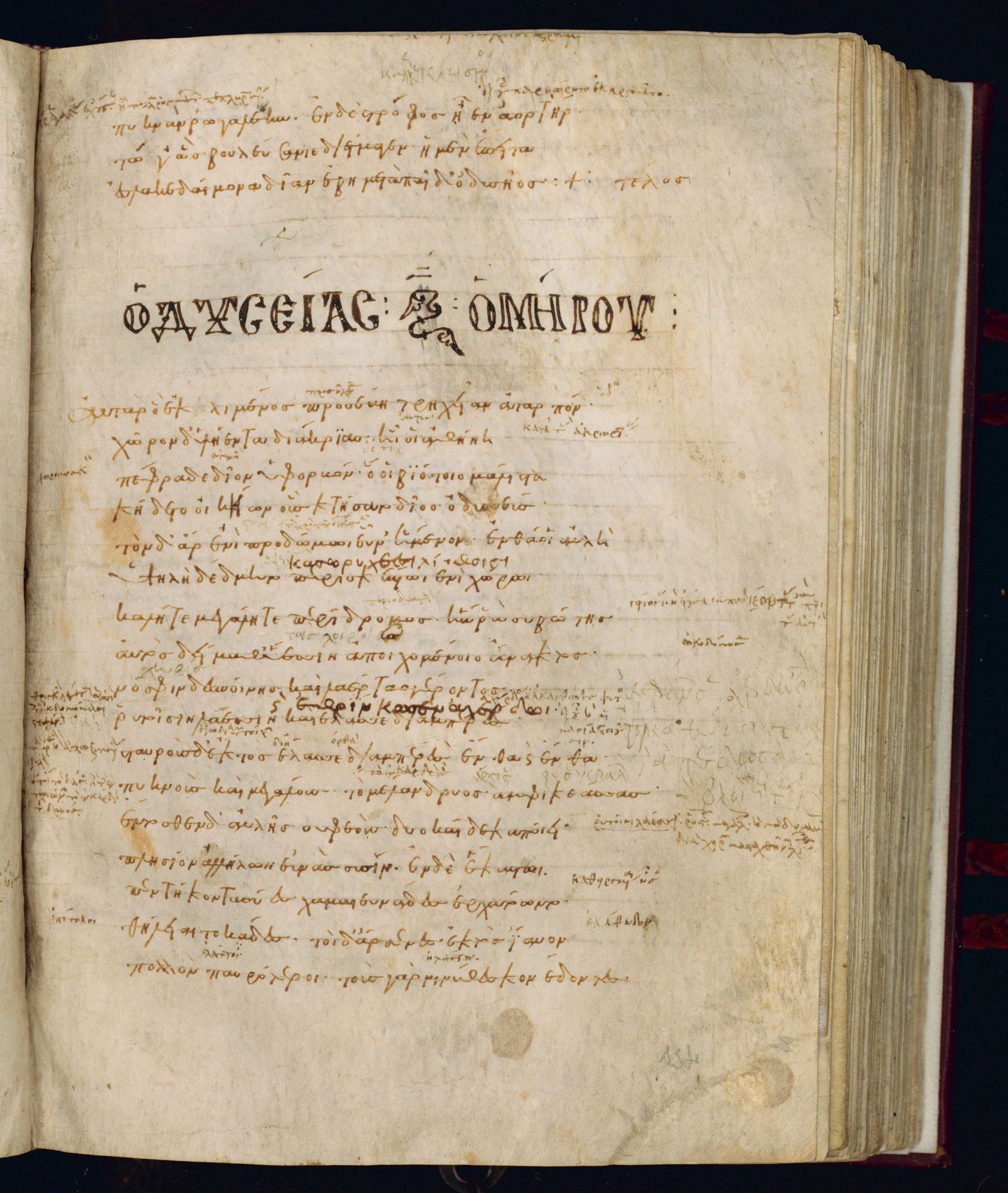
Laur. Plut. 32.24, fol. 134r: Odyssey 14.1-17, begins ‹αὐτὰρ ὁ ἐκ λιμένος›, ends ‹τοὺς γὰρ μινύθεσκον ἔδοντες›. Checked on the image: first and last lines read and matched to the Greek. Fol. 134v begins with 14.18. The page holds 13.438-440, 14.1-17. Book 13 ends with 13.440 and τέλος; the heading ὀδυσσείας ξ ὁμήρου follows in capitals after a space, and book 14 begins. A correction in a later hand is written above 14.10. English blocks here: 1-4, 5-9, 10-14, 15-19.
1αὐτὰρ ὁ ἐκ λιμένος προσέβη τρηχεῖαν ἀταρπὸν
2χῶρον ἀνʼ ὑλήεντα διʼ ἄκριας, ᾗ οἱ Ἀθήνη
3πέφραδε δῖον ὑφορβόν, ὅ οἱ βιότοιο μάλιστα
4κήδετο οἰκήων, οὓς κτήσατο δῖος Ὀδυσσεύς.
5τὸν δʼ ἄρʼ ἐνὶ προδόμῳ εὗρʼ ἥμενον, ἔνθα οἱ αὐλὴ
6ὑψηλὴ δέδμητο, περισκέπτῳ ἐνὶ χώρῳ,
7καλή τε μεγάλη τε, περίδρομος· ἥν ῥα συβώτης
8αὐτὸς δείμαθʼ ὕεσσιν ἀποιχομένοιο ἄνακτος,
9νόσφιν δεσποίνης καὶ Λαέρταο γέροντος,
10ῥυτοῖσιν λάεσσι καὶ ἐθρίγκωσεν ἀχέρδῳ·
11σταυροὺς δʼ ἐκτὸς ἔλασσε διαμπερὲς ἔνθα καὶ ἔνθα,
12πυκνοὺς καὶ θαμέας, τὸ μέλαν δρυὸς ἀμφικεάσσας·
13ἔντοσθεν δʼ αὐλῆς συφεοὺς δυοκαίδεκα ποίει
14πλησίον ἀλλήλων, εὐνὰς συσίν· ἐν δὲ ἑκάστῳ
15πεντήκοντα σύες χαμαιευνάδες ἐρχατόωντο,
16θήλειαι τοκάδες· τοὶ δʼ ἄρσενες ἐκτὸς ἴαυον,
17πολλὸν παυρότεροι· τοὺς γὰρ μινύθεσκον ἔδοντες
1But Odysseus went forth from the harbor by the rough path up over the woodland and through the heights to the place where Athena had shewed him that he should find the goodly swineherd, who cared for his substance above all the slaves that goodly Odysseus had gotten. 5He found him sitting in the fore-hall of his house, where his court was built high in a place of wide outlook, a great and goodly court with an open space around it. This the swineherd had himself built for the swine of his master, that was gone, without the knowledge of his mistress and the old man Laertes. 10With huge stones had he built it, and set on it a coping of thorn. Without he had driven stakes the whole length, this way and that, huge stakes, set close together, which he had made by splitting an oak to the black core; and within the court he had made twelve sties close by one another, as beds for the swine, and in each one 15were penned fifty wallowing swine, females for breeding; but the boars slept without. These were far fewer in numbers, for on them the godlike wooers feasted, and lessened them, for the swineherd ever sent in the best of all the fatted hogs,
Where on the image
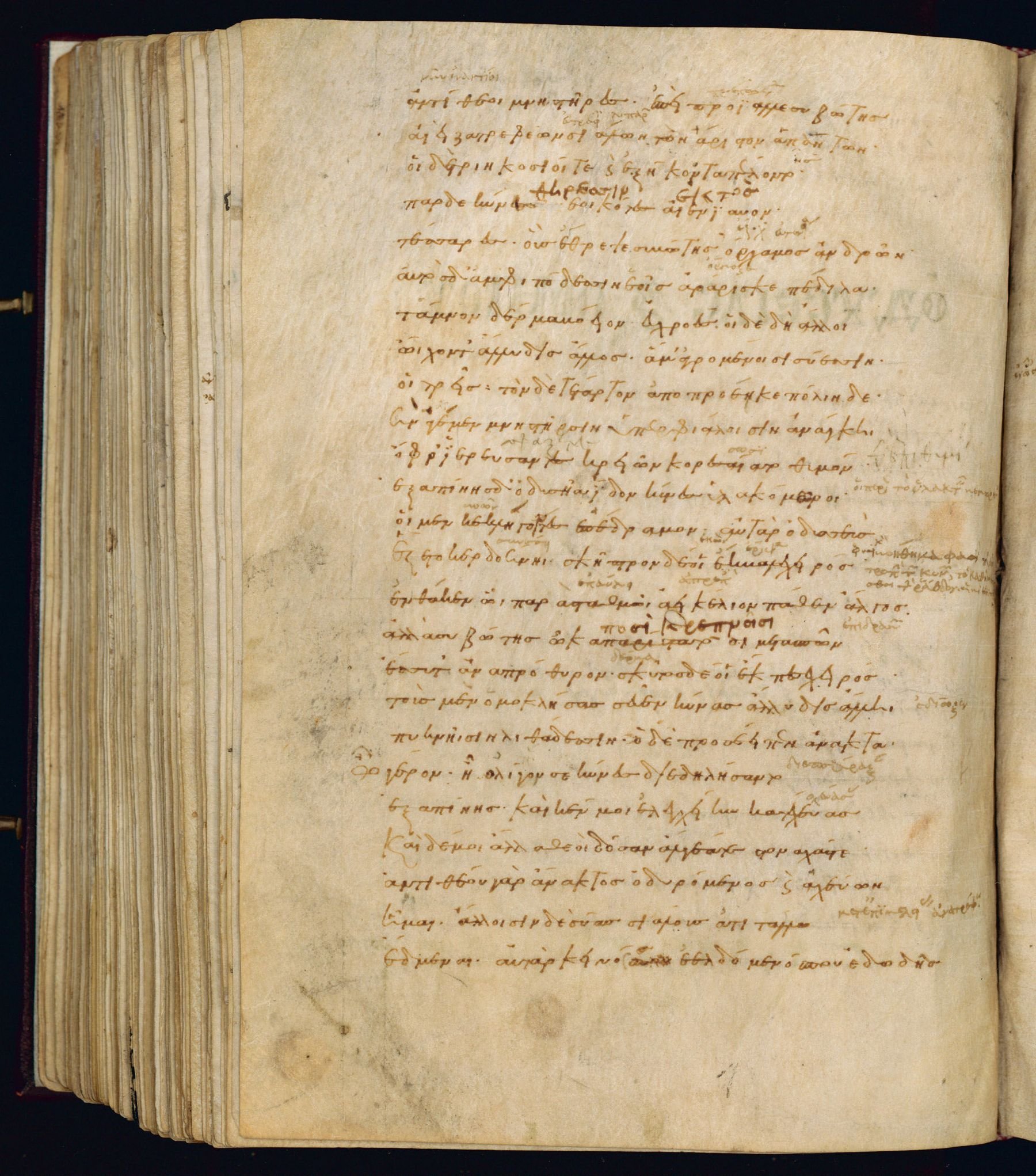
Laur. Plut. 32.24, fol. 134v: Odyssey 14.18-42, begins ‹ἀντίθεοι μνηστῆρες, ἐπεὶ προΐαλλε›, ends ‹κεῖνος ἐελδόμενός που ἐδωδῆς›. Checked on the image: first and last lines read and matched to the Greek. Fol. 134r ends with 14.17. Fol. 135r begins with 14.43. English blocks here: 20-24, 25-29, 30-34, 35-39, 40-44.
18ἀντίθεοι μνηστῆρες, ἐπεὶ προΐαλλε συβώτης
19αἰεὶ ζατρεφέων σιάλων τὸν ἄριστον ἁπάντων·
20οἱ δὲ τριηκόσιοί τε καὶ ἑξήκοντα πέλοντο.
21πὰρ δὲ κύνες, θήρεσσιν ἐοικότες αἰὲν ἴαυον
22τέσσαρες, οὓς ἔθρεψε συβώτης, ὄρχαμος ἀνδρῶν.
23αὐτὸς δʼ ἀμφὶ πόδεσσιν ἑοῖς ἀράρισκε πέδιλα,
24τάμνων δέρμα βόειον ἐϋχροές· οἱ δὲ δὴ ἄλλοι
25ᾤχοντʼ ἄλλυδις ἄλλος ἅμʼ ἀγρομένοισι σύεσσιν,
26οἱ τρεῖς· τὸν δὲ τέταρτον ἀποπροέηκε πόλινδε
27σῦν ἀγέμεν μνηστῆρσιν ὑπερφιάλοισιν ἀνάγκῃ,
28ὄφρʼ ἱερεύσαντες κρειῶν κορεσαίατο θυμόν.
29ἐξαπίνης δʼ Ὀδυσῆα ἴδον κύνες ὑλακόμωροι.
30οἱ μὲν κεκλήγοντες ἐπέδραμον· αὐτὰρ Ὀδυσσεὺς
31ἕζετο κερδοσύνῃ, σκῆπτρον δέ οἱ ἔκπεσε χειρός.
32ἔνθα κεν ᾧ πὰρ σταθμῷ ἀεικέλιον πάθεν ἄλγος·
33ἀλλὰ συβώτης ὦκα ποσὶ κραιπνοῖσι μετασπὼν
34ἔσσυτʼ ἀνὰ πρόθυρον, σκῦτος δέ οἱ ἔκπεσε χειρός.
35τοὺς μὲν ὁμοκλήσας σεῦεν κύνας ἄλλυδις ἄλλον
36πυκνῇσιν λιθάδεσσιν· ὁ δὲ προσέειπεν ἄνακτα·
37ὦ γέρον, ἦ ὀλίγου σε κύνες διεδηλήσαντο
38ἐξαπίνης, καί κέν μοι ἐλεγχείην κατέχευας.
39καὶ δέ μοι ἄλλα θεοὶ δόσαν ἄλγεά τε στοναχάς τε·
40ἀντιθέου γὰρ ἄνακτος ὀδυρόμενος καὶ ἀχεύων
41ἧμαι, ἄλλοισιν δὲ σύας σιάλους ἀτιτάλλω
42ἔδμεναι· αὐτὰρ κεῖνος ἐελδόμενός που ἐδωδῆς
20which numbered three hundred and sixty. By these ever slept four dogs, savage as wild beasts, which the swineherd had reared, a leader of men. But he himself was fitting boots about his feet, cutting an ox-hide of good color, while the others 25had gone, three of them, one here one there, with the droves of swine; and the fourth he had sent to the city to drive perforce a boar to the insolent wooers, that they might slay it and satisfy their souls with meat. Suddenly then the baying hounds caught sight of Odysseus, 30and rushed upon him with loud barking, but Odysseus sat down in his cunning, and the staff fell from his hand. Then even in his own farmstead would he have suffered cruel hurt, but the swineherd with swift steps followed after them, and hastened through the gateway, and the hide fell from his hand. 35He called aloud to the dogs, and drove them this way and that with a shower of stones, and spoke to his master, and said: “Old man, verily the dogs were like to have torn thee to pieces all of a sudden, and on me thou wouldest have shed reproach. Aye, and the gods have given me other griefs and sorrow. 40It is for a godlike master that I mourn and grieve, as I abide here, and rear fat swine for other men to eat, while he haply in want of food wanders over the land and city of men of strange speech, if indeed he still lives and sees the light of the sun.
Where on the image
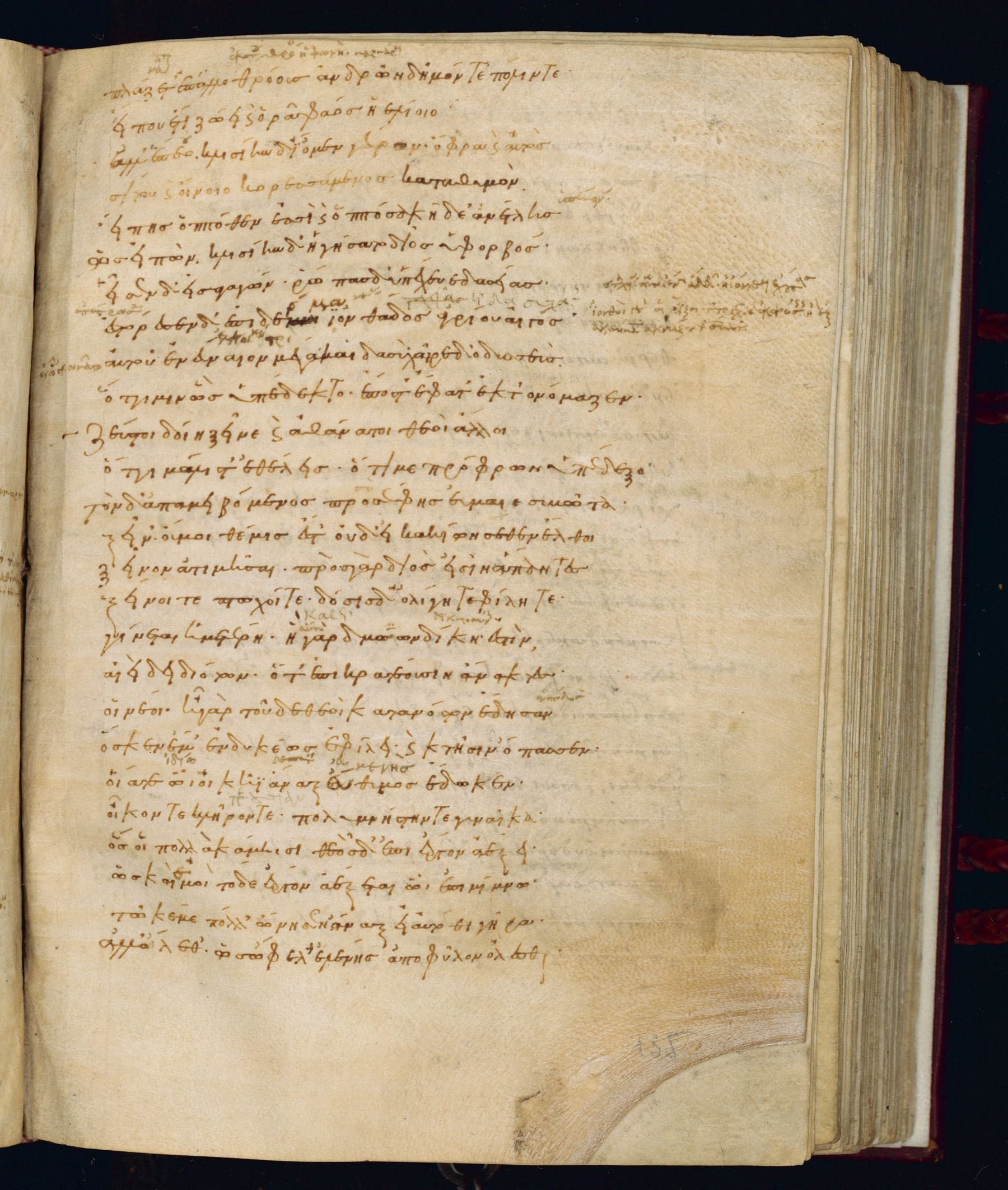
Laur. Plut. 32.24, fol. 135r: Odyssey 14.43-68, begins ‹πλάζετʼ ἐπʼ ἀλλοθρόων ἀνδρῶν›, ends ‹Ἑλένης ἀπὸ φῦλον ὀλέσθαι›. Checked on the image: first and last lines read and matched to the Greek. Fol. 134v ends with 14.42. Fol. 135v begins with 14.69. English blocks here: 45-47, 48-49, 50-54, 55-59, 60-64, 65-69.
43πλάζετʼ ἐπʼ ἀλλοθρόων ἀνδρῶν δῆμόν τε πόλιν τε,
44εἴ που ἔτι ζώει καὶ ὁρᾷ φάος ἠελίοιο.
45ἀλλʼ ἕπεο, κλισίηνδʼ ἴομεν, γέρον, ὄφρα καὶ αὐτός,
46σίτου καὶ οἴνοιο κορεσσάμενος κατὰ θυμόν,
47εἴπῃς ὁππόθεν ἐσσὶ καὶ ὁππόσα κήδεʼ ἀνέτλης.
48ὣς εἰπὼν κλισίηνδʼ ἡγήσατο δῖος ὑφορβός,
49εἷσεν δʼ εἰσαγαγών, ῥῶπας δʼ ὑπέχευε δασείας,
50ἐστόρεσεν δʼ ἐπὶ δέρμα ἰονθάδος ἀγρίου αἰγός,
51αὐτοῦ ἐνεύναιον, μέγα καὶ δασύ. χαῖρε δʼ Ὀδυσσεὺς
52ὅττι μιν ὣς ὑπέδεκτο, ἔπος τʼ ἔφατʼ ἔκ τʼ ὀνόμαζεν·
53Ζεύς τοι δοίη, ξεῖνε, καὶ ἀθάνατοι θεοὶ ἄλλοι
54ὅττι μάλιστʼ ἐθέλεις, ὅτι με πρόφρων ὑπέδεξο.
55τὸν δʼ ἀπαμειβόμενος προσέφης, Εὔμαιε συβῶτα·
56ξεῖνʼ, οὔ μοι θέμις ἔστʼ, οὐδʼ εἰ κακίων σέθεν ἔλθοι,
57ξεῖνον ἀτιμῆσαι· πρὸς γὰρ Διός εἰσιν ἅπαντες
58ξεῖνοί τε πτωχοί τε· δόσις δʼ ὀλίγη τε φίλη τε
59γίγνεται ἡμετέρη· ἡ γὰρ δμώων δίκη ἐστὶν
60αἰεὶ δειδιότων, ὅτʼ ἐπικρατέωσιν ἄνακτες
61οἱ νέοι. ἦ γὰρ τοῦ γε θεοὶ κατὰ νόστον ἔδησαν,
62ὅς κεν ἔμʼ ἐνδυκέως ἐφίλει καὶ κτῆσιν ὄπασσεν,
63οἷά τε ᾧ οἰκῆϊ ἄναξ εὔθυμος ἔδωκεν,
64οἶκόν τε κλῆρόν τε πολυμνήστην τε γυναῖκα,
65ὅς οἱ πολλὰ κάμῃσι, θεὸς δʼ ἐπὶ ἔργον ἀέξῃ,
66ὡς καὶ ἐμοὶ τόδε ἔργον ἀέξεται, ᾧ ἐπιμίμνω.
67τῷ κέ με πόλλʼ ὤνησεν ἄναξ, εἰ αὐτόθʼ ἐγήρα·
68ἀλλʼ ὄλεθʼ—ὡς ὤφελλʼ Ἑλένης ἀπὸ φῦλον ὀλέσθαι
45But come with me, let us go to the hut, old man, that when thou hast satisfied thy heart with food and wine, thou too mayest tell whence thou art, and all the woes thou hast endured.” 48So saying, the goodly swineherd led him to the hut, and brought him in, and made him sit, strowing beneath thick brushwood, 50and thereon spreading the skin of a shaggy wild goat, large and hairy, on which he was himself wont to sleep. And Odysseus was glad that he gave him such welcome, and spoke, and addressed him: “Stranger, may Zeus and the other immortal gods grant thee what most thou desirest, since thou with a ready heart hast given me welcome.” 55To him then, swineherd Eumaeus, didst thou make answer, and say: “Nay, stranger, it were not right for me, even though one meaner than thou were to come, to slight a stranger: for from Zeus are all strangers and beggars, and a gift, though small, is welcome from such as we; since this is the lot of slaves, 60ever in fear when over them as lords their masters hold sway—young masters such as ours. For verily the gods have stayed the return of him who would have loved me with all kindness, and would have given me possessions of my own, a house and a bit of land, and a wife, sought of many wooers, even such things as a kindly master gives to his thrall 65who has toiled much for him, and whose labour the god makes to prosper, even as this work of mine prospers, to which I give heed. Therefore would my master have richly rewarded me, if he had grown old here at home: but he perished—as I would all the kindred of Helen had perished in utter ruin, since she loosened the knees of many warriors.
Where on the image
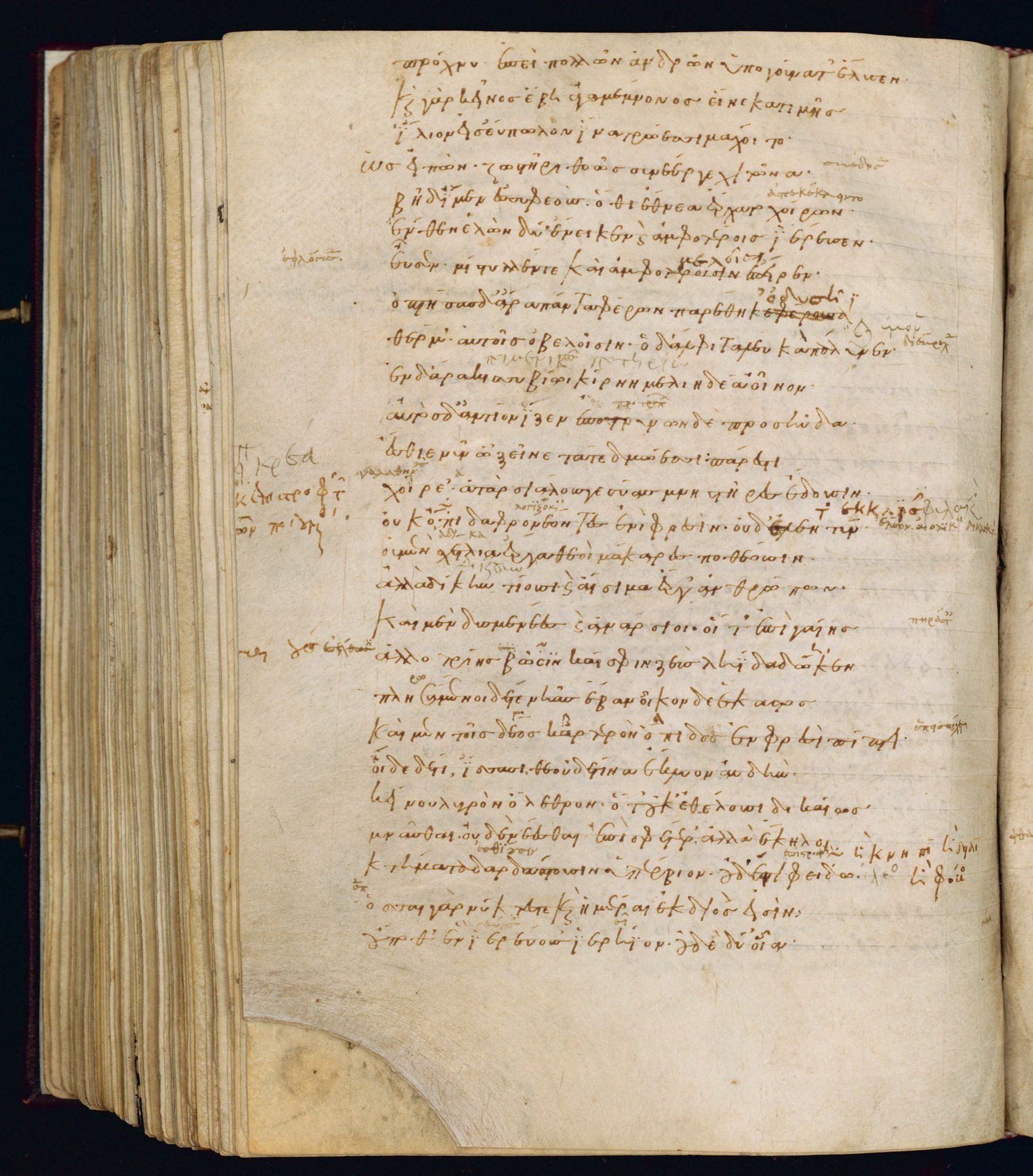
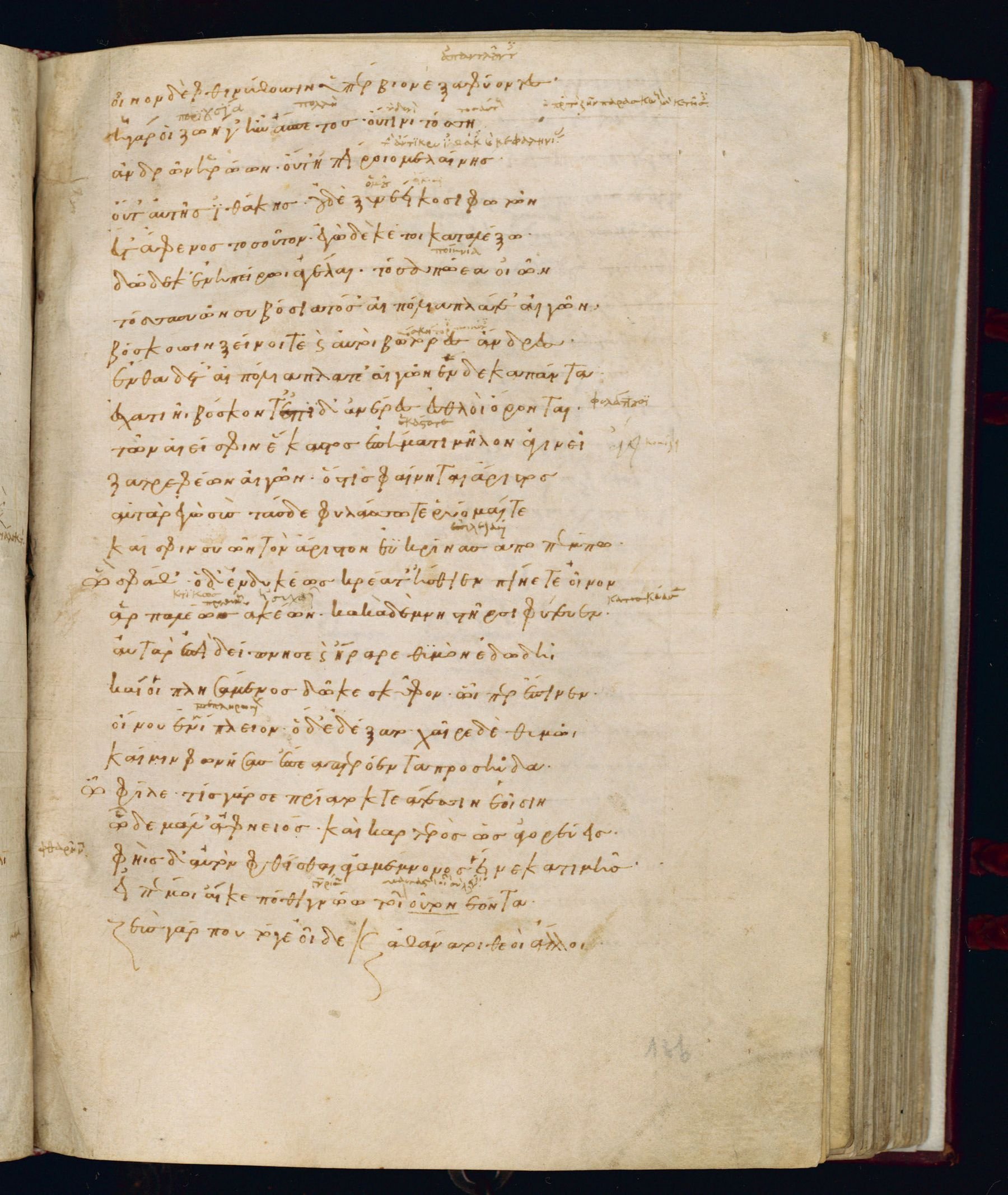
Laur. Plut. 32.24, fol. 135v: Odyssey 14.69-94, begins ‹πρόχνυ, ἐπεὶ πολλῶν ἀνδρῶν›, ends ‹ἱερήϊον, οὐδὲ δύʼ οἴω·›. Checked on the image: first and last lines read and matched to the Greek. Fol. 135r ends with 14.68. Fol. 136r begins with 14.95. English blocks here: 70-71, 72-74, 75-79, 80-84, 85-89, 90-94.
69πρόχνυ, ἐπεὶ πολλῶν ἀνδρῶν ὑπὸ γούνατʼ ἔλυσε·
70καὶ γὰρ κεῖνος ἔβη Ἀγαμέμνονος εἵνεκα τιμῆς
71Ἴλιον εἰς εὔπωλον, ἵνα Τρώεσσι μάχοιτο.
72ὣς εἰπὼν ζωστῆρι θοῶς συνέεργε χιτῶνα,
73βῆ δʼ ἴμεν ἐς συφεούς, ὅθι ἔθνεα ἔρχατο χοίρων.
74ἔνθεν ἑλὼν δύʼ ἔνεικε καὶ ἀμφοτέρους ἱέρευσεν,
75εὗσέ τε μίστυλλέν τε καὶ ἀμφʼ ὀβελοῖσιν ἔπειρεν.
76ὀπτήσας δʼ ἄρα πάντα φέρων παρέθηκʼ Ὀδυσῆϊ
77θέρμʼ αὐτοῖς ὀβελοῖσιν· ὁ δʼ ἄλφιτα λευκὰ πάλυνεν·
78ἐν δʼ ἄρα κισσυβίῳ κίρνη μελιηδέα οἶνον,
79αὐτὸς δʼ ἀντίον ἷζεν, ἐποτρύνων δὲ προσηύδα·
80ἔσθιε νῦν, ὦ ξεῖνε, τά τε δμώεσσι πάρεστι,
81χοίρεʼ· ἀτὰρ σιάλους γε σύας μνηστῆρες ἔδουσιν,
82οὐκ ὄπιδα φρονέοντες ἐνὶ φρεσὶν οὐδʼ ἐλεητύν.
83οὐ μὲν σχέτλια ἔργα θεοὶ μάκαρες φιλέουσιν,
84ἀλλὰ δίκην τίουσι καὶ αἴσιμα ἔργʼ ἀνθρώπων.
85καὶ μὲν δυσμενέες καὶ ἀνάρσιοι, οἵ τʼ ἐπὶ γαίης
86ἀλλοτρίης βῶσιν καί σφι Ζεὺς ληΐδα δώῃ,
87πλησάμενοι δέ τε νῆας ἔβαν οἶκόνδε νέεσθαι,
88καὶ μὲν τοῖς ὄπιδος κρατερὸν δέος ἐν φρεσὶ πίπτει.
89οἵδε δὲ καί τι ἴσασι, θεοῦ δέ τινʼ ἔκλυον αὐδήν,
90κείνου λυγρὸν ὄλεθρον, ὅτʼ οὐκ ἐθέλουσι δικαίως
91μνᾶσθαι οὐδὲ νέεσθαι ἐπὶ σφέτερʼ, ἀλλὰ ἕκηλοι
92κτήματα δαρδάπτουσιν ὑπέρβιον, οὐδʼ ἔπι φειδώ.
93ὅσσαι γὰρ νύκτες τε καὶ ἡμέραι ἐκ Διός εἰσιν,
94οὔ ποθʼ ἓν ἱρεύουσʼ ἱερήϊον, οὐδὲ δύʼ οἴω·
70For he too went forth to win recompense for Agamemnon to Ilios, famed for its horses, that he might fight with the Trojans.” 72So saying, he quickly bound up his tunic with his belt, and went to the sties, where the tribes of swine were penned. Choosing two from thence, he brought them in and slew them both, 75and singed, and cut them up, and spitted them. Then, when he had roasted all, he brought and set it before Odysseus, hot upon the spits, and sprinkled over it white barley meal. Then in a bowl of ivy wood he mixed honey-sweet wine, and himself sat down over against Odysseus, and bade him to his food, and said: 80“Eat now, stranger, such food as slaves have to offer, meat of young pigs; the fatted hogs the wooers eat, who reck not in their hearts of the wrath of the gods, nor have any pity. Verily the blessed gods love not reckless deeds, but they honor justice and the righteous deeds of men. 85Even cruel foemen that set foot on the land of others, and Zeus gives them booty, and they fill their ships and depart for home—even on the hearts of these falls great fear of the wrath of the gods. But these men here, look you, know somewhat, and have heard some voice of a god 90regarding my master's pitiful death, seeing that they will not woo righteously, nor go back to their own, but at their ease they waste our substance in insolent wise, and there is no sparing. For every day and night that comes from Zeus they sacrifice not one victim nor two alone,
Where on the image
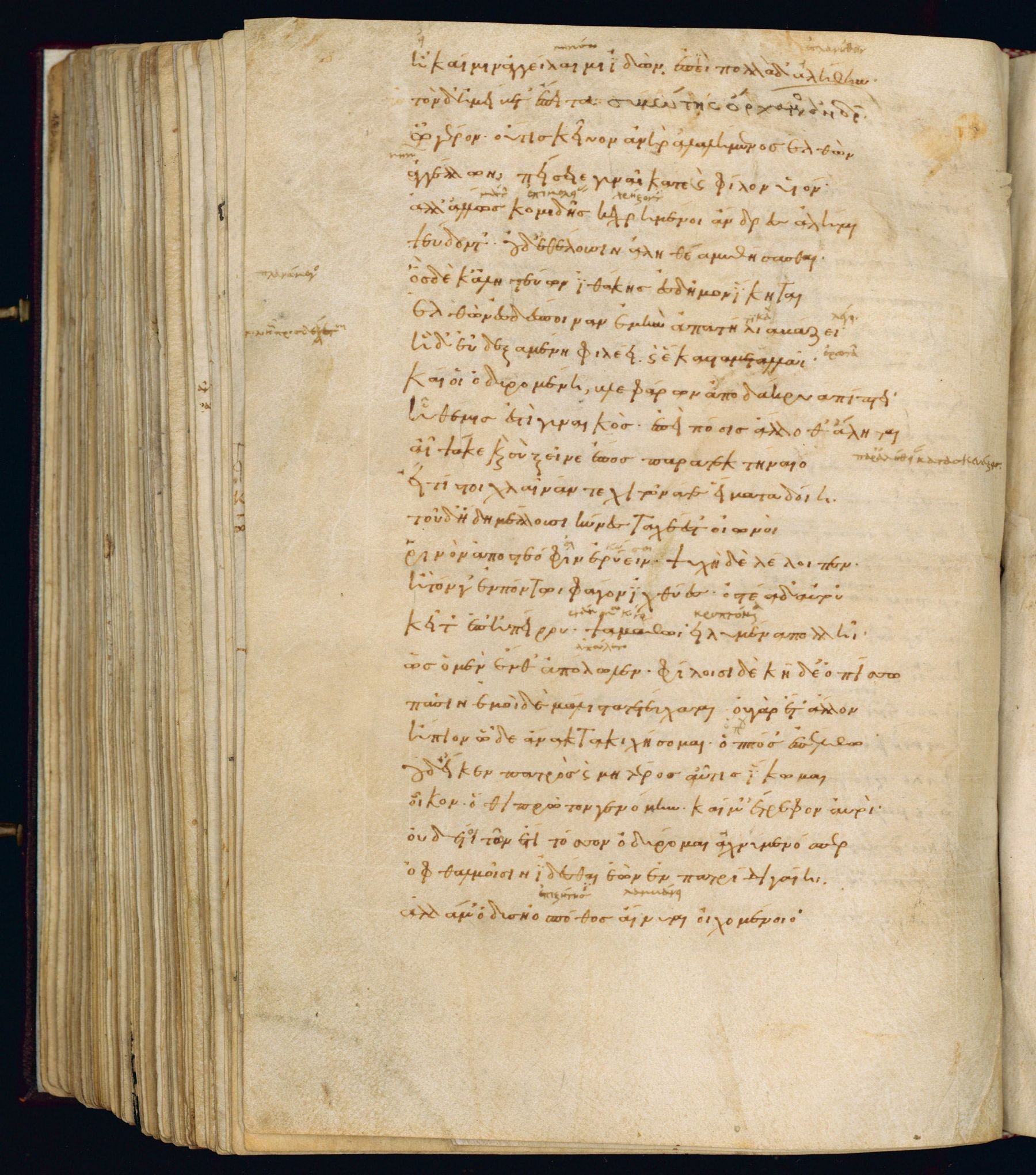
Laur. Plut. 32.24, fol. 136r: Odyssey 14.95-119, begins ‹οἶνον δὲ φθινύθουσιν ὑπέρβιον›, ends ‹καὶ ἀθάνατοι θεοὶ ἄλλοι,›. Checked on the image: first and last lines read and matched to the Greek. Fol. 135v ends with 14.94. Fol. 136v begins with 14.120. English blocks here: 95-99, 100-104, 105-108, 109-109, 110-114, 115-119.
95οἶνον δὲ φθινύθουσιν ὑπέρβιον ἐξαφύοντες.
96ἦ γάρ οἱ ζωή γʼ ἦν ἄσπετος· οὔ τινι τόσση
97ἀνδρῶν ἡρώων, οὔτʼ ἠπείροιο μελαίνης
98οὔτʼ αὐτῆς Ἰθάκης· οὐδὲ ξυνεείκοσι φωτῶν
99ἔστʼ ἄφενος τοσσοῦτον· ἐγὼ δέ κέ τοι καταλέξω.
100δώδεκʼ ἐν ἠπείρῳ ἀγέλαι· τόσα πώεα οἰῶν,
101τόσσα συῶν συβόσια, τόσʼ αἰπόλια πλατέʼ αἰγῶν
102βόσκουσι ξεῖνοί τε καὶ αὐτοῦ βώτορες ἄνδρες.
103ἐνθάδε δʼ αἰπόλια πλατέʼ αἰγῶν ἕνδεκα πάντα
104ἐσχατιῇ βόσκοντʼ, ἐπὶ δʼ ἀνέρες ἐσθλοὶ ὄρονται.
105τῶν αἰεί σφιν ἕκαστος ἐπʼ ἤματι μῆλον ἀγινεῖ,
106ζατρεφέων αἰγῶν ὅς τις φαίνηται ἄριστος.
107αὐτὰρ ἐγὼ σῦς τάσδε φυλάσσω τε ῥύομαί τε,
108καί σφι συῶν τὸν ἄριστον ἐῢ κρίνας ἀποπέμπω.
109ὣς φάθʼ, ὁ δʼ ἐνδυκέως κρέα τʼ ἤσθιε πῖνέ τε οἶνον
110ἁρπαλέως ἀκέων, κακὰ δὲ μνηστῆρσι φύτευεν.
111αὐτὰρ ἐπεὶ δείπνησε καὶ ἤραρε θυμὸν ἐδωδῇ,
112καί οἱ πλησάμενος δῶκε σκύφον, ᾧ περ ἔπινεν,
113οἴνου ἐνίπλειον· ὁ δʼ ἐδέξατο, χαῖρε δὲ θυμῷ,
114καί μιν φωνήσας ἔπεα πτερόεντα προσηύδα·
115ὦ φίλε, τίς γάρ σε πρίατο κτεάτεσσιν ἑοῖσιν,
116ὧδε μάλʼ ἀφνειὸς καὶ καρτερὸς ὡς ἀγορεύεις;
117φῆς δʼ αὐτὸν φθίσθαι Ἀγαμέμνονος εἵνεκα τιμῆς.
118εἰπέ μοι, αἴ κέ ποθι γνώω τοιοῦτον ἐόντα.
119Ζεὺς γάρ που τό γε οἶδε καὶ ἀθάνατοι θεοὶ ἄλλοι,
95and they draw forth wine, and waste it in insolent wise. Verily his substance was great past telling, so much has no lord either on the dark mainland or in Ithaca itself; nay, not twenty men together have wealth so great. Lo, I will tell thee the tale thereof; 100twelve herds of kine has he on the mainland; as many flocks of sheep; as many droves of swine; as many packed herds of goats do herdsmen, both foreigners and of his own people, pasture. And here too graze roving herds of goats on the borders of the island, eleven in all, and over them trusty men keep watch. 105And each man of these ever drives up day by day one of his flock for the wooers, even that one of the fatted goats which seems to him the best. But as for me, I guard and keep these swine, and choose out with care and send them the best of the boars.” 109So he spoke, but Odysseus eagerly ate flesh and drank wine, 110greedily, in silence, and was sowing the seeds of evil for the wooers. But when he had dined, and satisfied his soul with food, then the swineherd filled the bowl from which he was himself wont to drink, and gave it him brim full of wine, and he took it, and was glad at heart; and he spoke, and addressed him with winged words: 115“Friend, who was it who bought thee with his wealth, a man so very rich and mighty, as thou tellest? Thou saidest that he died to win recompense for Agamemnon; tell me, if haply I may know him, being such an one. For Zeus, I ween, and the other immortal gods know
Where on the image
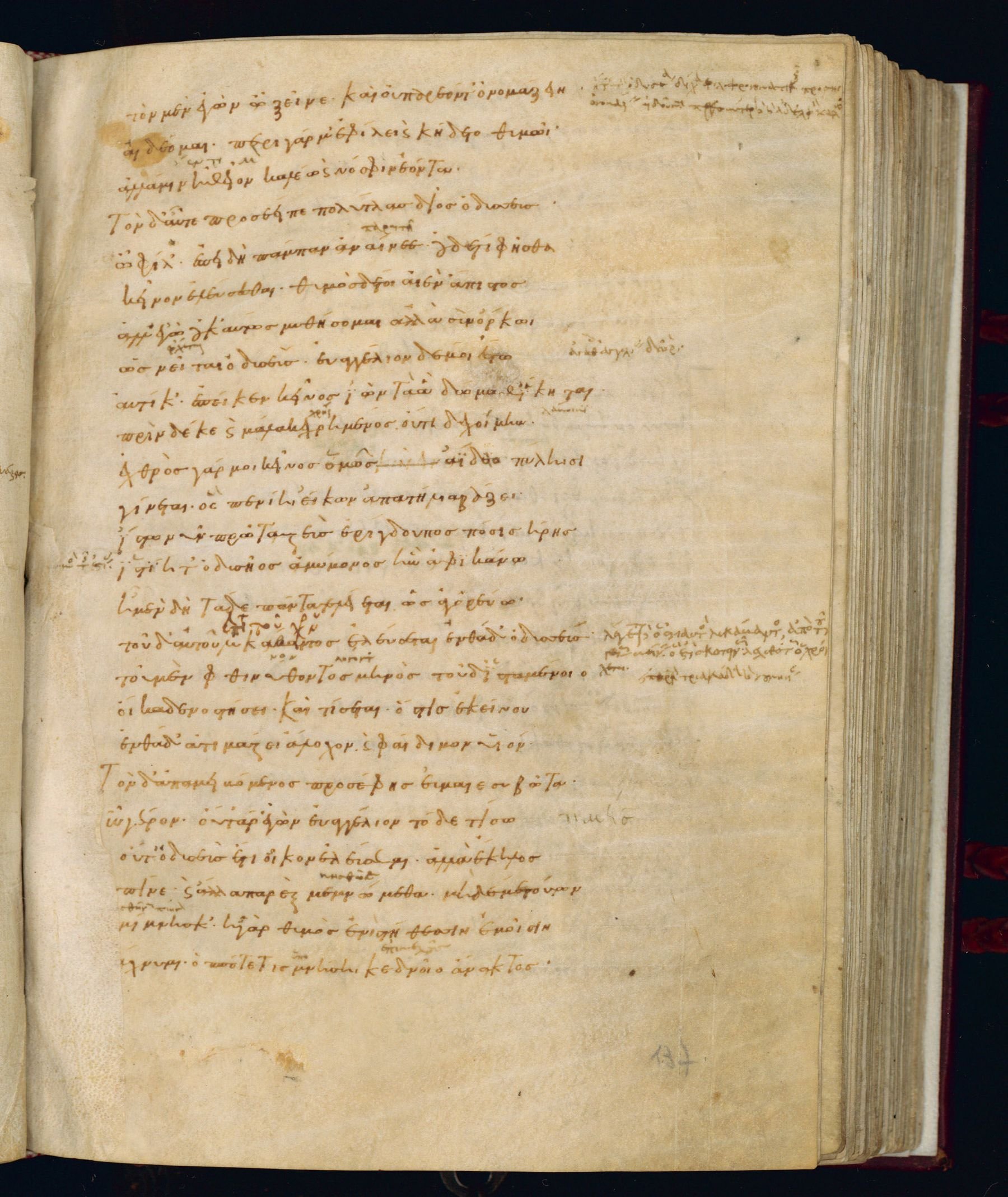
Laur. Plut. 32.24, fol. 136v: Odyssey 14.120-144, begins ‹εἴ κέ μιν ἀγγείλαιμι›, ends ‹Ὀδυσσῆος πόθος αἴνυται οἰχομένοιο.›. Checked on the image: first and last lines read and matched to the Greek. Fol. 136r ends with 14.119. Fol. 137r begins with 14.145. English blocks here: 120-124, 125-129, 130-134, 135-139, 140-144.
120εἴ κέ μιν ἀγγείλαιμι ἰδών· ἐπὶ πολλὰ δʼ ἀλήθην.
121τὸν δʼ ἠμείβετʼ ἔπειτα συβώτης, ὄρχαμος ἀνδρῶν·
122ὦ γέρον, οὔ τις κεῖνον ἀνὴρ ἀλαλήμενος ἐλθὼν
123ἀγγέλλων πείσειε γυναῖκά τε καὶ φίλον υἱόν,
124ἀλλʼ ἄλλως κομιδῆς κεχρημένοι ἄνδρες ἀλῆται
125ψεύδοντʼ, οὐδʼ ἐθέλουσιν ἀληθέα μυθήσασθαι.
126ὃς δέ κʼ ἀλητεύων Ἰθάκης ἐς δῆμον ἵκηται,
127ἐλθὼν ἐς δέσποιναν ἐμὴν ἀπατήλια βάζει·
128ἡ δʼ εὖ δεξαμένη φιλέει καὶ ἕκαστα μεταλλᾷ,
129καί οἱ ὀδυρομένῃ βλεφάρων ἄπο δάκρυα πίπτει,
130ἣ θέμις ἐστὶ γυναικός, ἐπὴν πόσις ἄλλοθʼ ὄληται.
131αἶψά κε καὶ σύ, γεραιέ, ἔπος παρατεκτήναιο.
132εἴ τίς τοι χλαῖνάν τε χιτῶνά τε εἵματα δοίη.
133τοῦ δʼ ἤδη μέλλουσι κύνες ταχέες τʼ οἰωνοὶ
134ῥινὸν ἀπʼ ὀστεόφιν ἐρύσαι, ψυχὴ δὲ λέλοιπεν·
135ἢ τόν γʼ ἐν πόντῳ φάγον ἰχθύες, ὀστέα δʼ αὐτοῦ
136κεῖται ἐπʼ ἠπείρου ψαμάθῳ εἰλυμένα πολλῇ.
137ὣς ὁ μὲν ἔνθʼ ἀπόλωλε, φίλοισι δὲ κήδεʼ ὀπίσσω
138πᾶσιν, ἐμοὶ δὲ μάλιστα, τετεύχαται· οὐ γὰρ ἔτʼ ἄλλον
139ἤπιον ὧδε ἄνακτα κιχήσομαι, ὁππόσʼ ἐπέλθω,
140οὐδʼ εἴ κεν πατρὸς καὶ μητέρος αὖτις ἵκωμαι
141οἶκον, ὅθι πρῶτον γενόμην καί μʼ ἔτρεφον αὐτοί.
142οὐδέ νυ τῶν ἔτι τόσσον ὀδύρομαι, ἱέμενός περ
143ὀφθαλμοῖσιν ἰδέσθαι ἐὼν ἐν πατρίδι γαίῃ·
144ἀλλά μʼ Ὀδυσσῆος πόθος αἴνυται οἰχομένοιο.
120whether I have seen him, and could bring tidings; for I have wandered far.” Then the swineherd, a leader of men, answered him: “Old man, no wanderer that came and brought tidings of him could persuade his wife and his dear son; nay, at random, when they have need of entertainment, do vagabonds 125lie, and are not minded to speak the truth. Whosoever in his wanderings comes to the land of Ithaca, goes to my mistress and tells a deceitful tale. And she, receiving him kindly, gives him entertainment, and questions him of all things, and the tears fall from her eyelids, while she weeps, 130as is the way of a woman, when her husband dies afar. And readily wouldest thou too, old man, fashion a story, if one would give thee a cloak and a tunic for raiment. But as for him, ere now dogs and swift birds are like to have torn the flesh from his bones, and his spirit has left him; 135or in the sea fishes have eaten him, and his bones lie there on the shore, wrapped in deep sand. Thus has he perished yonder, and to his friends grief is appointed for days to come, to all, but most of all to me. For never again shall I find a master so kind, how far soever I go, 140not though I come again to the house of my father and mother, where at the first I was born, and they reared me themselves. Yet it is not for them that I henceforth mourn so much, eager though I am to behold them with my eyes and to be in my native land; nay, it is longing for Odysseus, who is gone, that seizes me.
Where on the image
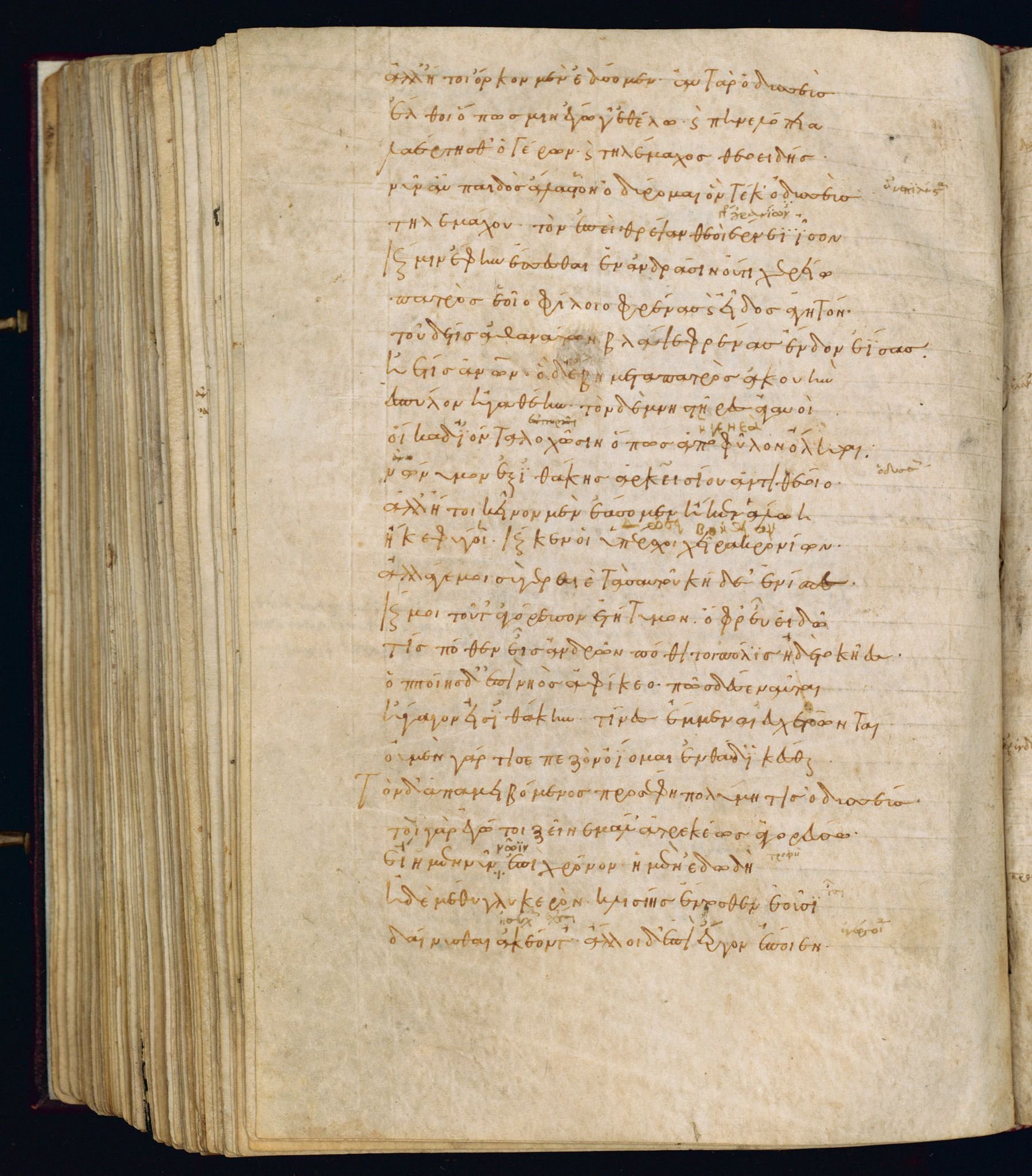
Laur. Plut. 32.24, fol. 137r: Odyssey 14.145-170, begins ‹τὸν μὲν ἐγών, ὦ›, ends ‹τις μνήσῃ κεδνοῖο ἄνακτος.›. Checked on the image: first and last lines read and matched to the Greek. Fol. 136v ends with 14.144. Fol. 137v begins with 14.171. 14.154 (ἕσσαι με χλαῖνάν τε χιτῶνά τε ...) is not on the page: the scribe passes from 14.153 to 14.155 (25 lines). English blocks here: 145-146, 147-149, 150-154, 155-159, 160-164, 165-169.
145τὸν μὲν ἐγών, ὦ ξεῖνε, καὶ οὐ παρεόντʼ ὀνομάζειν
146αἰδέομαι· πέρι γάρ μʼ ἐφίλει καὶ κήδετο θυμῷ·
147ἀλλά μιν ἠθεῖον καλέω καὶ νόσφιν ἐόντα.
148τὸν δʼ αὖτε προσέειπε πολύτλας δῖος Ὀδυσσεύς·
149ὦ φίλʼ, ἐπειδὴ πάμπαν ἀναίνεαι, οὐδʼ ἔτι φῇσθα
150κεῖνον ἐλεύσεσθαι, θυμὸς δέ τοι αἰὲν ἄπιστος·
151ἀλλʼ ἐγὼ οὐκ αὔτως μυθήσομαι, ἀλλὰ σὺν ὅρκῳ,
152ὡς νεῖται Ὀδυσεύς· εὐαγγέλιον δέ μοι ἔστω
153αὐτίκʼ, ἐπεί κεν κεῖνος ἰὼν τὰ ἃ δώμαθʼ ἵκηται·
154ἕσσαι με χλαῖνάν τε χιτῶνά τε, εἵματα καλά·
155πρὶν δέ κε, καὶ μάλα περ κεχρημένος, οὔ τι δεχοίμην.
156ἐχθρὸς γάρ μοι κεῖνος ὁμῶς Ἀΐδαο πύλῃσι
157γίγνεται, ὃς πενίῃ εἴκων ἀπατήλια βάζει.
158ἴστω νῦν Ζεὺς πρῶτα θεῶν, ξενίη τε τράπεζα,
159ἱστίη τʼ Ὀδυσῆος ἀμύμονος, ἣν ἀφικάνω·
160ἦ μέν τοι τάδε πάντα τελείεται ὡς ἀγορεύω.
161τοῦδʼ αὐτοῦ λυκάβαντος ἐλεύσεται ἐνθάδʼ Ὀδυσσεύς.
162τοῦ μὲν φθίνοντος μηνός, τοῦ δʼ ἱσταμένοιο,
163οἴκαδε νοστήσει, καὶ τίσεται ὅς τις ἐκείνου
164ἐνθάδʼ ἀτιμάζει ἄλοχον καὶ φαίδιμον υἱόν.
165τὸν δʼ ἀπαμειβόμενος προσέφης, Εὔμαιε συβῶτα·
166ὦ γέρον, οὔτʼ ἄρʼ ἐγὼν εὐαγγέλιον τόδε τίσω,
167οὔτʼ Ὀδυσεὺς ἔτι οἶκον ἐλεύσεται· ἀλλὰ ἕκηλος
168πῖνε, καὶ ἄλλα παρὲξ μεμνώμεθα, μηδέ με τούτων
169μίμνησκʼ· ἦ γὰρ θυμὸς ἐνὶ στήθεσσιν ἐμοῖσιν
170ἄχνυται, ὁππότε τις μνήσῃ κεδνοῖο ἄνακτος.
145His name, stranger, absent though he is, I speak with awe, for greatly did he love me and care for me at heart; but I call him my lord beloved, for all he is not here.” 147Then the much-enduring, goodly Odysseus answered him: “Friend, since thou dost utterly make denial, and declarest 150that he will never come again, and thy heart is ever unbelieving, therefore will I tell thee, not at random but with an oath, that Odysseus shall return. And let me have a reward for bearing good tidings, as soon as he shall come, and reach his home; clothe me in a cloak and tunic, goodly raiment. 155But ere that, how sore soever my need, I will accept naught; for hateful in my eyes as the gates of Hades is that man, who, yielding to stress of poverty, tells a deceitful tale. Now be my witness Zeus, above all gods, and this hospitable board, and the hearth of noble Odysseus to which I am come, 160that verily all these things shall be brought to pass even as I tell thee. In the course of this self-same day Odysseus shall come hither, as the old moon wanes, and the new appears. He shall return, and take vengeance on all those who here dishonor his wife and his glorious son.” 165To him then, swineherd Eumaeus, didst thou make answer, and say: “Old man, neither shall I, meseems, pay thee this reward for bearing good tidings, nor shall Odysseus ever come to his home. Nay, drink in peace, and let us turn our thoughts to other things, and do not thou recall this to my mind; for verily the heart in my breast
Where on the image
Laur. Plut. 32.24, fol. 137v: Odyssey 14.171-195, begins ‹ἀλλʼ ἦ τοι ὅρκον›, ends ‹δʼ ἐπὶ ἔργον ἕποιεν·›. Checked on the image: first and last lines read and matched to the Greek. Fol. 137r ends with 14.170. Fol. 138r begins with 14.196. English blocks here: 170-174, 175-179, 180-184, 185-189, 190-190, 191-194.
171ἀλλʼ ἦ τοι ὅρκον μὲν ἐάσομεν, αὐτὰρ Ὀδυσσεὺς
172ἔλθοι ὅπως μιν ἐγώ γʼ ἐθέλω καὶ Πηνελόπεια
173Λαέρτης θʼ ὁ γέρων καὶ Τηλέμαχος θεοειδής.
174νῦν αὖ παιδὸς ἄλαστον ὀδύρομαι, ὃν τέκʼ Ὀδυσσεύς,
175Τηλεμάχου· τὸν ἐπεὶ θρέψαν θεοὶ ἔρνεϊ ἶσον,
176καί μιν ἔφην ἔσσεσθαι ἐν ἀνδράσιν οὔ τι χέρηα
177πατρὸς ἑοῖο φίλοιο, δέμας καὶ εἶδος ἀγητόν,
178τὸν δέ τις ἀθανάτων βλάψε φρένας ἔνδον ἐΐσας
179ἠέ τις ἀνθρώπων· ὁ δʼ ἔβη μετὰ πατρὸς ἀκουὴν
180ἐς Πύλον ἠγαθέην· τὸν δὲ μνηστῆρες ἀγαυοὶ
181οἴκαδʼ ἰόντα λοχῶσιν, ὅπως ἀπὸ φῦλον ὄληται
182νώνυμον ἐξ Ἰθάκης Ἀρκεισίου ἀντιθέοιο.
183ἀλλʼ ἦ τοι κεῖνον μὲν ἐάσομεν, ἤ κεν ἁλώῃ
184ἦ κε φύγῃ καί κέν οἱ ὑπέρσχῃ χεῖρα Κρονίων.
185ἀλλʼ ἄγε μοι σύ, γεραιέ, τὰ σʼ αὐτοῦ κήδεʼ ἐνίσπες
186καί μοι τοῦτʼ ἀγόρευσον ἐτήτυμον, ὄφρʼ ἐῢ εἰδῶ·
187τίς πόθεν εἶς ἀνδρῶν; πόθι τοι πόλις ἠδὲ τοκῆες;
188ὁπποίης τʼ ἐπὶ νηὸς ἀφίκεο· πῶς δέ σε ναῦται
189ἤγαγον εἰς Ἰθάκην; τίνες ἔμμεναι εὐχετόωντο;
190οὐ μὲν γάρ τί σε πεζὸν ὀΐομαι ἐνθάδʼ ἱκέσθαι.
191τὸν δʼ ἀπαμειβόμενος προσέφη πολύμητις Ὀδυσσεύς
192τοιγὰρ ἐγώ τοι ταῦτα μάλʼ ἀτρεκέως ἀγορεύσω.
193εἴη μὲν νῦν νῶϊν ἐπὶ χρόνον ἠμὲν ἐδωδὴ
194ἠδὲ μέθυ γλυκερὸν κλισίης ἔντοσθεν ἐοῦσι,
195δαίνυσθαι ἀκέοντʼ, ἄλλοι δʼ ἐπὶ ἔργον ἕποιεν·
170is grieved whenever any one makes mention of my good master. But as for thy oath, we will let it be; yet I would that Odysseus might come, even as I desire, I, and Penelope, and the old man Laertes, and godlike Telemachus. But now it is for his son that I grieve unceasingly, 175even for Telemachus, whom Odysseus begot. When the gods had made him grow like a sapling, and I thought that he would be among men no whit worse than his dear father, glorious in form and comeliness, then some one of the immortals marred the wise spirit within him, or haply some man, and he went 180to sacred Pylos after tidings of his father. For him now the lordly wooers lie in wait on his homeward way, that the race of godlike Arceisius may perish out of Ithaca, and leave no name. But verily we will let him be; he may be taken, or he may escape, and the son of Cronos stretch forth his hand to guard him. 185But come, do thou, old man, tell me of thine own sorrows, and declare me this truly, that I may know full well. Who art thou among men, and from whence? Where is thy city, and where thy parents? On what manner of ship didst thou come, and how did sailors bring thee to Ithaca? Who did they declare themselves to be? 190For nowise, methinks, didst thou come hither on foot.” 191Then Odysseus of many wiles answered him, and said: “Then verily I will frankly tell thee all. Would that now we two might have food and sweet wine for the while,
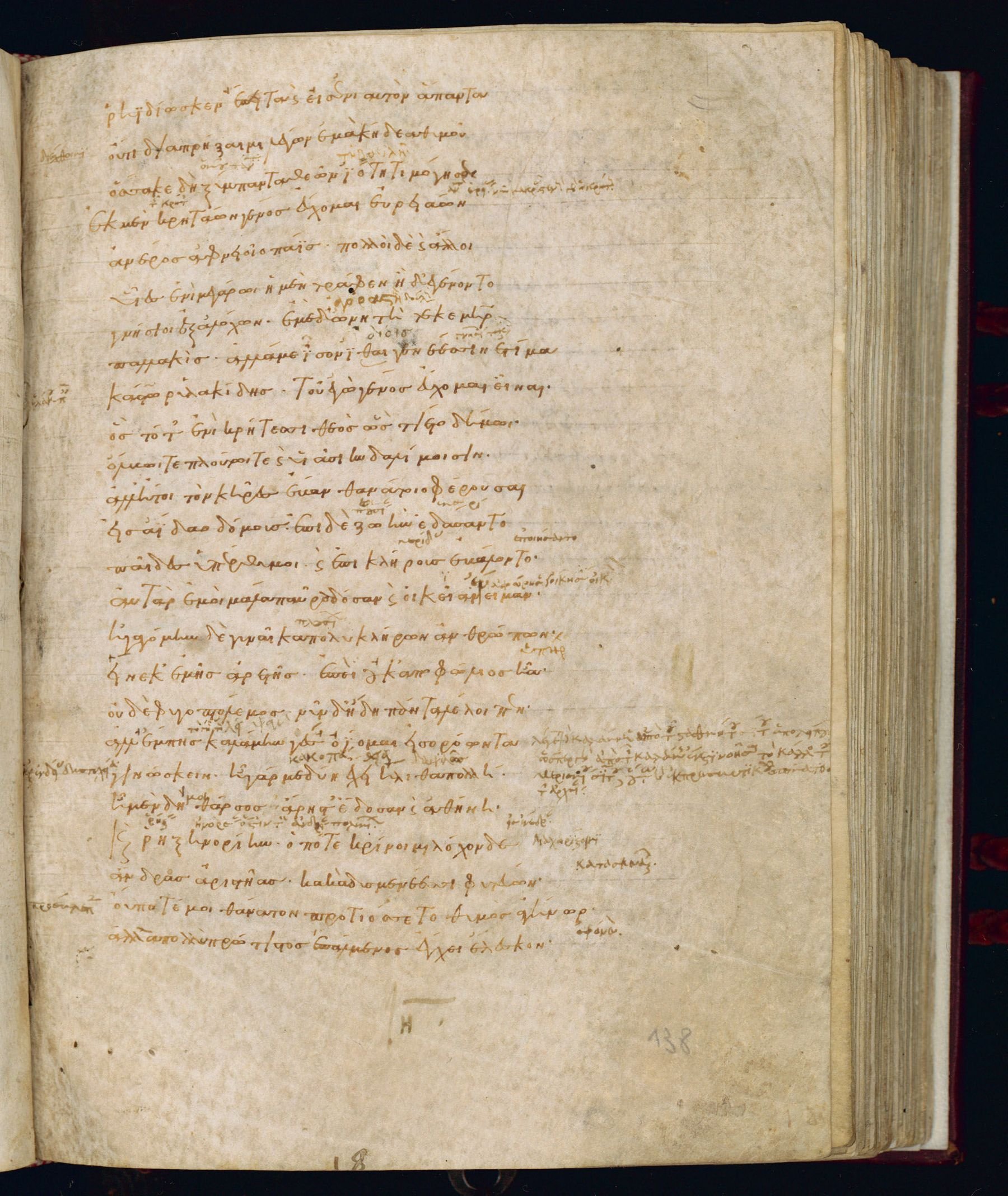
Where on the image
Laur. Plut. 32.24, fol. 138r: Odyssey 14.196-220, begins ‹ῥηϊδίως κεν ἔπειτα καὶ›, ends ‹πρώτιστος ἐπάλμενος ἔγχει ἕλεσκον›. Checked on the image: first and last lines read and matched to the Greek. Fol. 137v ends with 14.195. Fol. 138v begins with 14.221. English blocks here: 195-199, 200-204, 205-209, 210-214, 215-219.
196ῥηϊδίως κεν ἔπειτα καὶ εἰς ἐνιαυτὸν ἅπαντα
197οὔ τι διαπρήξαιμι λέγων ἐμὰ κήδεα θυμοῦ,
198ὅσσα γε δὴ ξύμπαντα θεῶν ἰότητι μόγησα.
199ἐκ μὲν Κρητάων γένος εὔχομαι εὐρειάων,
200ἀνέρος ἀφνειοῖο πάϊς· πολλοὶ δὲ καὶ ἄλλοι
201υἱέες ἐν μεγάρῳ ἠμὲν τράφεν ἠδʼ ἐγένοντο
202γνήσιοι ἐξ ἀλόχου· ἐμὲ δʼ ὠνητὴ τέκε μήτηρ
203παλλακίς, ἀλλά με ἶσον ἰθαιγενέεσσιν ἐτίμα
204Κάστωρ Ὑλακίδης, τοῦ ἐγὼ γένος εὔχομαι εἶναι
205ὃς τότʼ ἐνὶ Κρήτεσσι θεὸς ὣς τίετο δήμῳ
206ὄλβῳ τε πλούτῳ τε καὶ υἱάσι κυδαλίμοισιν.
207ἀλλʼ ἦ τοι τὸν κῆρες ἔβαν θανάτοιο φέρουσαι
208εἰς Ἀΐδαο δόμους· τοὶ δὲ ζωὴν ἐδάσαντο
209παῖδες ὑπέρθυμοι καὶ ἐπὶ κλήρους ἐβάλοντο,
210αὐτὰρ ἐμοὶ μάλα παῦρα δόσαν καὶ οἰκίʼ ἔνειμαν.
211ἠγαγόμην δὲ γυναῖκα πολυκλήρων ἀνθρώπων
212εἵνεκʼ ἐμῆς ἀρετῆς, ἐπεὶ οὐκ ἀποφώλιος ἦα
213οὐδὲ φυγοπτόλεμος· νῦν δʼ ἤδη πάντα λέλοιπεν
214ἀλλʼ ἔμπης καλάμην γέ σʼ ὀΐομαι εἰσορόωντα
215γιγνώσκειν· ἦ γάρ με δύη ἔχει ἤλιθα πολλή.
216ἦ μὲν δὴ θάρσος μοι Ἄρης τʼ ἔδοσαν καὶ Ἀθήνη
217καὶ ῥηξηνορίην· ὁπότε κρίνοιμι λόχονδε
218ἄνδρας ἀριστῆας, κακὰ δυσμενέεσσι φυτεύων,
219οὔ ποτέ μοι θάνατον προτιόσσετο θυμὸς ἀγήνωρ,
220ἀλλὰ πολὺ πρώτιστος ἐπάλμενος ἔγχει ἕλεσκον
195to feast on in quiet here in thy hut, and that others might go about their work; easily then might I tell on for a full year, and yet in no wise finish the tale of the woes of my spirit—even all the toils that I have endured by the will of the gods. “From broad Crete I declare that I am come by lineage, 200the son of a wealthy man. And many other sons too were born and bred in his halls, true sons of a lawful wife; but the mother that bore me was bought, a concubine. Yet Castor, son of Hylax, of whom I declare that I am sprung, honored me even as his true-born sons. 205He was at that time honored as a god among the Cretans in the land for his good estate, and his wealth, and his glorious sons. But the fates of death bore him away to the house of Hades, and his proud sons divided among them his substance, and cast lots therefor. 210To me they gave a very small portion, and allotted a dwelling. But I took unto me a wife from a house that had wide possessions, winning her by my valor; for I was no weakling, nor a coward in fight. Now all that strength is gone; yet even so, in seeing the stubble, methinks 215thou mayest judge what the grain was; for verily troubles in full measure encompass me. But then Ares and Athena gave me courage, and strength that breaks the ranks of men; and whenever I picked the best warriors for an ambush, sowing the seeds of evil for the foe, never did my proud spirit forbode death,
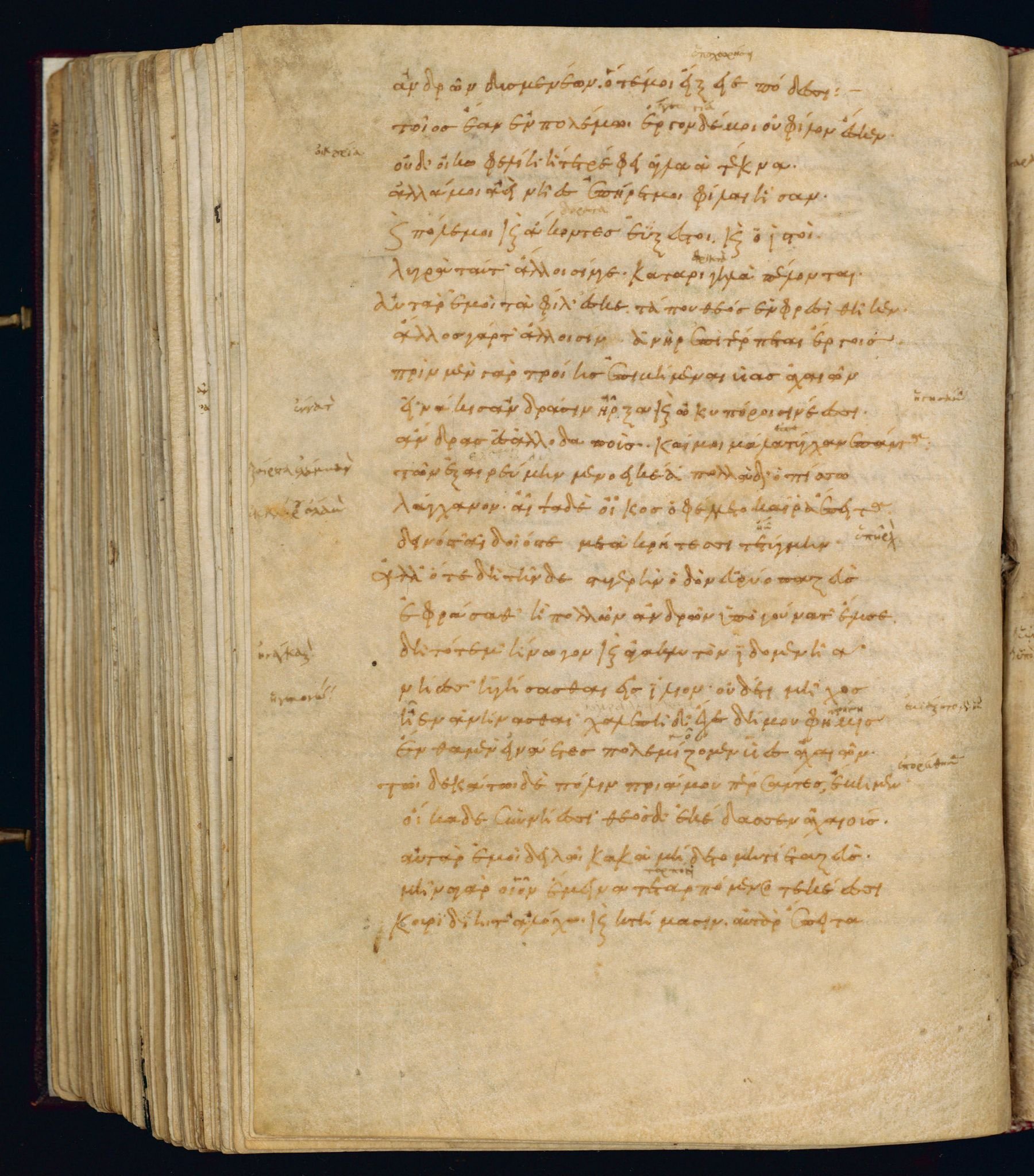
Where on the image
Laur. Plut. 32.24, fol. 138v: Odyssey 14.221-245, begins ‹ἀνδρῶν δυσμενέων ὅ τέ›, ends ‹καὶ κτήμασιν· αὐτὰρ ἔπειτα›. Checked on the image: first and last lines read and matched to the Greek. Fol. 138r ends with 14.220. Fol. 139r begins with 14.246. English blocks here: 220-224, 225-229, 230-234, 235-239, 240-244.
221ἀνδρῶν δυσμενέων ὅ τέ μοι εἴξειε πόδεσσιν.
222τοῖος ἔα ἐν πολέμῳ· ἔργον δέ μοι οὐ φίλον ἔσκεν
223οὐδʼ οἰκωφελίη, ἥ τε τρέφει ἀγλαὰ τέκνα,
224ἀλλά μοι αἰεὶ νῆες ἐπήρετμοι φίλαι ἦσαν
225καὶ πόλεμοι καὶ ἄκοντες ἐΰξεστοι καὶ ὀϊστοί,
226λυγρά, τά τʼ ἄλλοισίν γε καταριγηλὰ πέλονται.
227αὐτὰρ ἐμοὶ τὰ φίλʼ ἔσκε τά που θεὸς ἐν φρεσὶ θῆκεν·
228ἄλλος γάρ τʼ ἄλλοισιν ἀνὴρ ἐπιτέρπεται ἔργοις.
229πρὶν μὲν γὰρ Τροίης ἐπιβήμεναι υἷας Ἀχαιῶν
230εἰνάκις ἀνδράσιν ἦρξα καὶ ὠκυπόροισι νέεσσιν
231ἄνδρας ἐς ἀλλοδαπούς, καί μοι μάλα τύγχανε πολλά.
232τῶν ἐξαιρεύμην μενοεικέα, πολλὰ δʼ ὀπίσσω
233λάγχανον· αἶψα δὲ οἶκος ὀφέλλετο, καί ῥα ἔπειτα
234δεινός τʼ αἰδοῖός τε μετὰ Κρήτεσσι τετύγμην.
235ἀλλʼ ὅτε δὴ τήν γε στυγερὴν ὁδὸν εὐρύοπα Ζεὺς
236ἐφράσαθʼ, ἣ πολλῶν ἀνδρῶν ὑπὸ γούνατʼ ἔλυσε,
237δὴ τότʼ ἔμʼ ἤνωγον καὶ ἀγακλυτὸν Ἰδομενῆα
238νήεσσʼ ἡγήσασθαι ἐς Ἴλιον· οὐδέ τι μῆχος
239ἦεν ἀνήνασθαι, χαλεπὴ δʼ ἔχε δήμου φῆμις.
240ἔνθα μὲν εἰνάετες πολεμίζομεν υἷες Ἀχαιῶν,
241τῷ δεκάτῳ δὲ πόλιν Πριάμου πέρσαντες ἔβημεν
242οἴκαδε σὺν νήεσσι, θεὸς δʼ ἐκέδασσεν Ἀχαιούς.
243αὐτὰρ ἐμοὶ δειλῷ κακὰ μήδετο μητίετα Ζεύς·
244μῆνα γὰρ οἶον ἔμεινα τεταρπόμενος τεκέεσσιν
245κουριδίῃ τʼ ἀλόχῳ καὶ κτήμασιν· αὐτὰρ ἔπειτα
220but ever far the first did I leap forth, and slay with my spear whosoever of the foe gave way in flight before me. Such a man was I in war, but labour in the field was never to my liking, nor the care of a household, which rears goodly children, but oared ships were ever dear to me, 225and wars, and polished spears, and arrows,—grievous things, whereat others are wont to shudder. But those things, I ween, were dear to me, which a god put in my heart; for different men take joy in different works. For before the sons of the Achaeans set foot on the land of Troy , 230I had nine times led warriors and swift-faring ships against foreign folk, and great spoil had ever fallen to my hands. Of this I would choose what pleased my mind, and much I afterwards obtained by lot. Thus my house straightway grew rich, and thereafter I became one feared and honored among the Cretans. 235“But when Zeus, whose voice is borne afar, devised that hateful journey which loosened the knees of many a warrior, then they bade me and glorious Idomeneus to lead the ships to Ilios, nor was there any way to refuse, for the voice of the people pressed hard upon us. 240There for nine years we sons of the Achaeans warred, and in the tenth we sacked the city of Priam, and set out for home in our ships, and a god scattered the Achaeans. But for me, wretched man that I was, Zeus, the counsellor, devised evil. For a month only I remained, taking joy in my children,
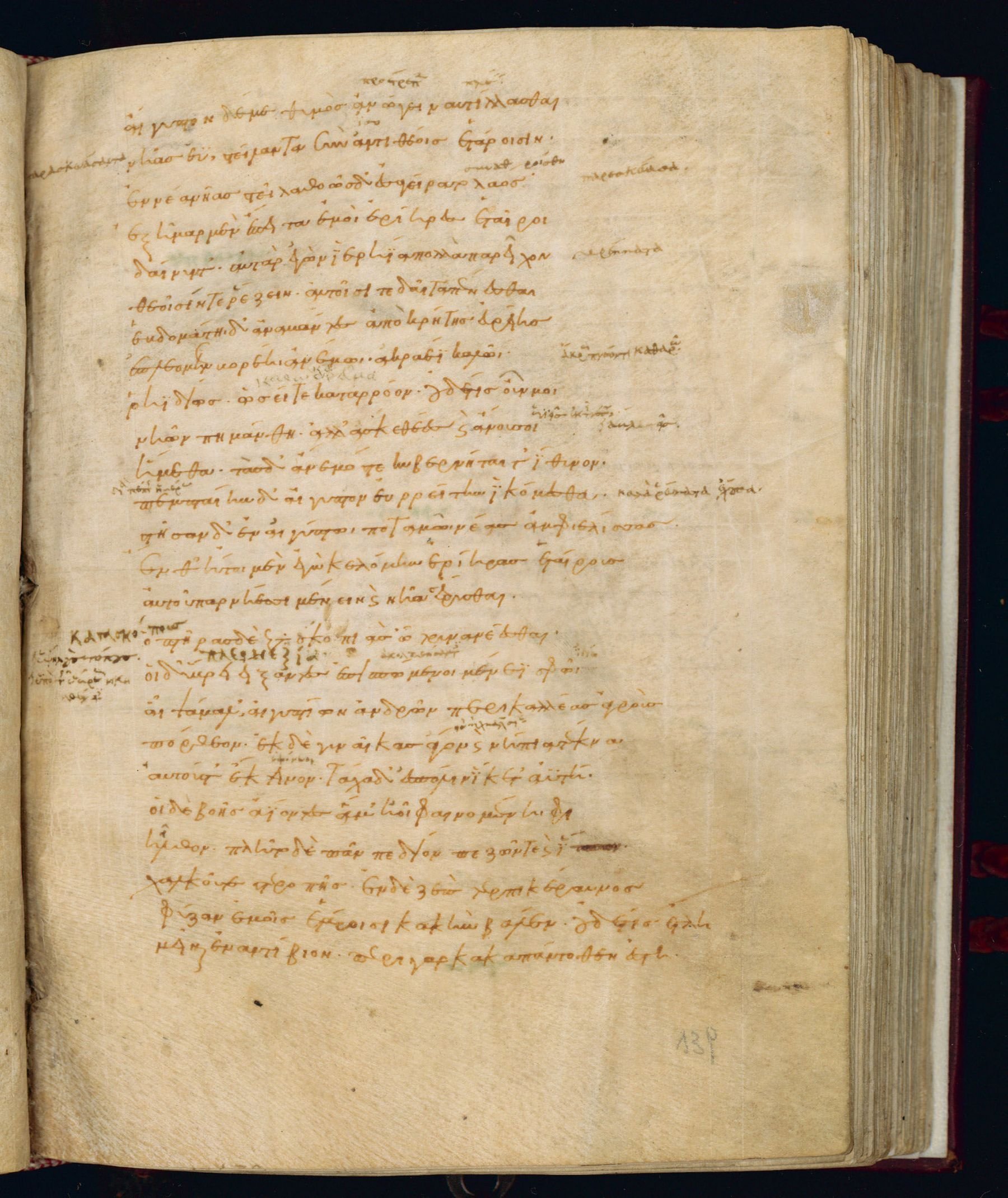
Where on the image
Laur. Plut. 32.24, fol. 139r: Odyssey 14.246-270, begins ‹Αἴγυπτόνδε με θυμὸς ἀνώγει›, ends ‹γὰρ κακὰ πάντοθεν ἔστη.›. Checked on the image: first and last lines read and matched to the Greek. Fol. 138v ends with 14.245. Fol. 139v begins with 14.271. The top edge is curled in the photograph; only part of the first line (14.246) is visible. English blocks here: 245-249, 250-254, 255-259, 260-264, 265-269.
246Αἴγυπτόνδε με θυμὸς ἀνώγει ναυτίλλεσθαι,
247νῆας ἐῢ στείλαντα σὺν ἀντιθέοις ἑτάροισιν.
248ἐννέα νῆας στεῖλα, θοῶς δʼ ἐσαγείρατο λαός.
249ἑξῆμαρ μὲν ἔπειτα ἐμοὶ ἐρίηρες ἑταῖροι
250δαίνυντʼ· αὐτὰρ ἐγὼν ἱερήϊα πολλὰ παρεῖχον
251θεοῖσίν τε ῥέζειν αὐτοῖσί τε δαῖτα πένεσθαι.
252ἑβδομάτῃ δʼ ἀναβάντες ἀπὸ Κρήτης εὐρείης
253ἐπλέομεν Βορέῃ ἀνέμῳ ἀκραέϊ καλῷ
254ῥηϊδίως, ὡς εἴ τε κατὰ ῥόον· οὐδέ τις οὖν μοι
255νηῶν πημάνθη, ἀλλʼ ἀσκηθέες καὶ ἄνουσοι
256ἥμεθα, τὰς δʼ ἄνεμός τε κυβερνῆταί τʼ ἴθυνον.
257πεμπταῖοι δʼ Αἴγυπτον ἐϋρρείτην ἱκόμεσθα,
258στῆσα δʼ ἐν Αἰγύπτῳ ποταμῷ νέας ἀμφιελίσσας.
259ἔνθʼ ἦ τοι μὲν ἐγὼ κελόμην ἐρίηρας ἑταίρους
260αὐτοῦ πὰρ νήεσσι μένειν καὶ νῆας ἔρυσθαι,
261ὀπτῆρας δὲ κατὰ σκοπιὰς ὤτρυνα νέεσθαι·
262οἱ δʼ ὕβρει εἴξαντες, ἐπισπόμενοι μένεϊ σφῷ,
263αἶψα μάλʼ Αἰγυπτίων ἀνδρῶν περικαλλέας ἀγροὺς
264πόρθεον, ἐκ δὲ γυναῖκας ἄγον καὶ νήπια τέκνα,
265αὐτούς τʼ ἔκτεινον· τάχα δʼ ἐς πόλιν ἵκετʼ ἀϋτή.
266οἱ δὲ βοῆς ἀΐοντες ἅμʼ ἠοῖ φαινομένηφιν
267ἦλθον· πλῆτο δὲ πᾶν πεδίον πεζῶν τε καὶ ἵππων
268χαλκοῦ τε στεροπῆς· ἐν δὲ Ζεὺς τερπικέραυνος
269φύζαν ἐμοῖς ἑτάροισι κακὴν βάλεν, οὐδέ τις ἔτλη
270μεῖναι ἐναντίβιον· περὶ γὰρ κακὰ πάντοθεν ἔστη.
245my wedded wife, and my wealth; and then to Egypt did my spirit bid me voyage with my godlike comrades, when I had fitted out my ships with care. Nine ships I fitted out, and the host gathered speedily. Then for six days my trusty comrades 250feasted, and I gave them many victims, that they might sacrifice to the gods, and prepare a feast for themselves; and on the seventh we embarked and set sail from broad Crete, with the North Wind blowing fresh and fair, and ran on easily as if down stream. No 255harm came to any of my ships, but free from scathe and from disease we sat, and the wind and the helmsman guided the ships. “On the fifth day we came to fair-flowing Aegyptus, and in the river Aegyptus I moored my curved ships. Then verily I bade my trusty comrades 260to remain there by the ships, and to guard the ships, and I sent out scouts to go to places of outlook. But my comrades, yielding to wantonness, and led on by their own might, straightway set about wasting the fair fields of the men of Egypt; and they carried off the women and little children, 265and slew the men; and the cry came quickly to the city. Then, hearing the shouting, the people came forth at break of day, and the whole plain was filled with footmen, and chariots and the flashing of bronze. But Zeus who hurls the thunderbolt cast an evil panic upon my comrades, and none had the courage
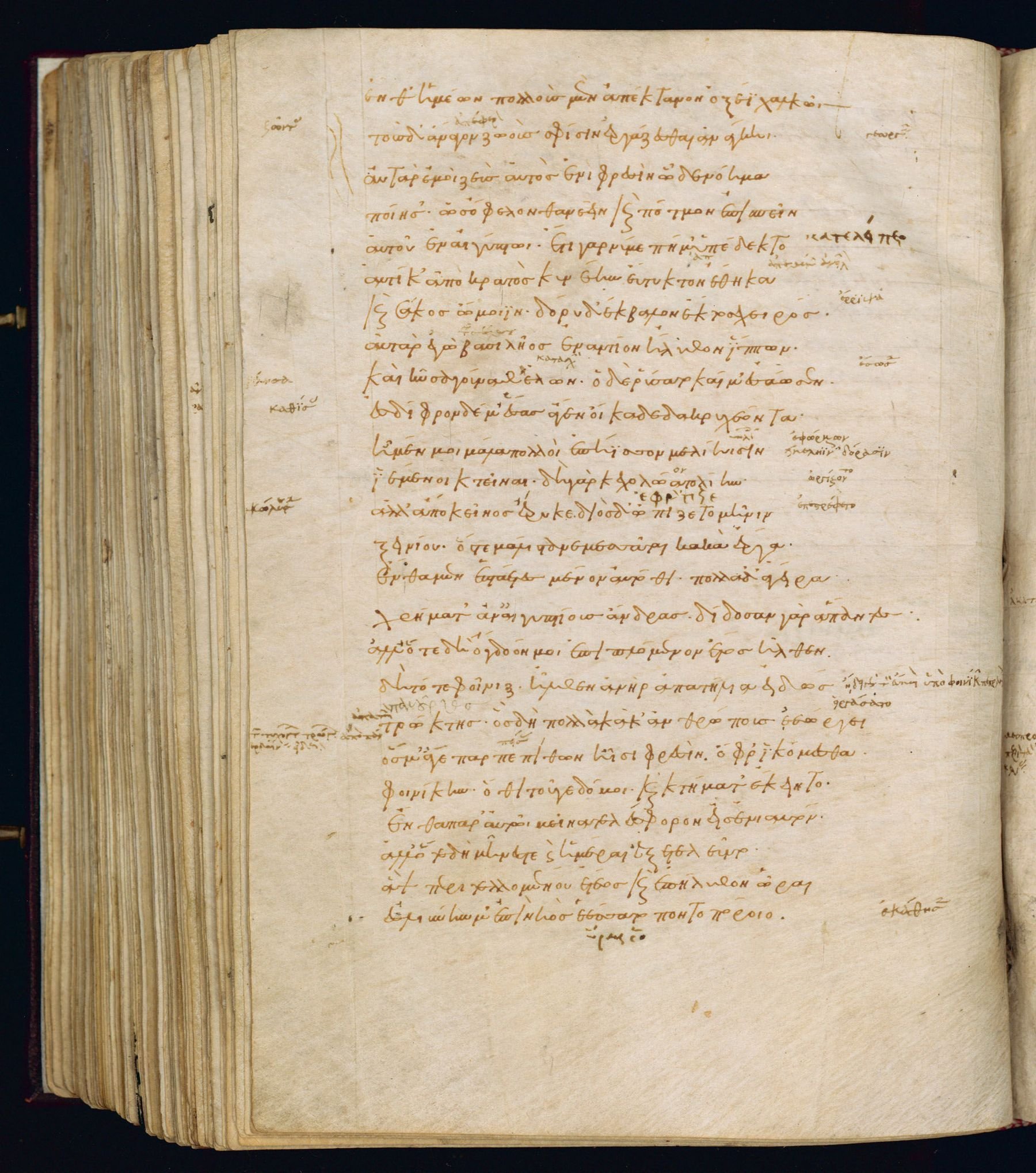
Where on the image
Laur. Plut. 32.24, fol. 139v: Odyssey 14.271-295, begins ‹ἔνθʼ ἡμέων πολλοὺς μὲν›, ends ‹ἐπὶ νηὸς ἐέσσατο ποντοπόροιο›. Checked on the image: first and last lines read and matched to the Greek. Fol. 139r ends with 14.270. Fol. 140r begins with 14.296. English blocks here: 270-274, 275-279, 280-284, 285-289, 290-294.
271ἔνθʼ ἡμέων πολλοὺς μὲν ἀπέκτανον ὀξέϊ χαλκῷ,
272τοὺς δʼ ἄναγον ζωούς, σφίσιν ἐργάζεσθαι ἀνάγκῃ.
273αὐτὰρ ἐμοὶ Ζεὺς αὐτὸς ἐνὶ φρεσὶν ὧδε νόημα
274ποίησʼ—ὡς ὄφελον θανέειν καὶ πότμον ἐπισπεῖν
275αὐτοῦ ἐν Αἰγύπτῳ· ἔτι γάρ νύ με πῆμʼ ὑπέδεκτο—
276αὐτίκʼ ἀπὸ κρατὸς κυνέην εὔτυκτον ἔθηκα
277καὶ σάκος ὤμοιϊν, δόρυ δʼ ἔκβαλον ἔκτοσε χειρός·
278αὐτὰρ ἐγὼ βασιλῆος ἐναντίον ἤλυθον ἵππων
279καὶ κύσα γούναθʼ ἑλών· ὁδʼ ἐρύσατο καί μʼ ἐλέησεν,
280ἐς δίφρον δέ μʼ ἕσας ἄγεν οἴκαδε δάκρυ χέοντα.
281ἦ μέν μοι μάλα πολλοὶ ἐπήϊσσον μελίῃσιν,
282ἱέμενοι κτεῖναι—δὴ γὰρ κεχολώατο λίην—
283ἀλλʼ ἀπὸ κεῖνος ἔρυκε, Διὸς δʼ ὠπίζετο μῆνιν
284ξεινίου, ὅς τε μάλιστα νεμεσσᾶται κακὰ ἔργα.
285ἔνθα μὲν ἑπτάετες μένον αὐτόθι, πολλὰ δʼ ἄγειρα
286χρήματʼ ἀνʼ Αἰγυπτίους ἄνδρας· δίδοσαν γὰρ ἅπαντες.
287ἀλλʼ ὅτε δὴ ὄγδοόν μοι ἐπιπλόμενον ἔτος ἦλθεν,
288δὴ τότε Φοῖνιξ ἦλθεν ἀνὴρ ἀπατήλια εἰδώς,
289τρώκτης, ὃς δὴ πολλὰ κάκʼ ἀνθρώποισιν ἐώργει·
290ὅς μʼ ἄγε παρπεπιθὼν ᾗσι φρεσίν, ὄφρʼ ἱκόμεσθα
291Φοινίκην, ὅθι τοῦ γε δόμοι καὶ κτήματʼ ἔκειτο.
292ἔνθα παρʼ αὐτῷ μεῖνα τελεσφόρον εἰς ἐνιαυτόν.
293ἀλλʼ ὅτε δὴ μῆνές τε καὶ ἡμέραι ἐξετελεῦντο
294ἄψ περιτελλομένου ἔτεος καὶ ἐπήλυθον ὧραι,
295ἐς Λιβύην μʼ ἐπὶ νηὸς ἐέσσατο ποντοπόροιο
270to hold his ground and face the foe; for evil surrounded us on every side. So then they slew many of us with the sharp bronze, and others they led up to their city alive, to work for them perforce. But in my heart Zeus himself put this thought—I would that I had rather died and met my fate 275there in Egypt, for still was sorrow to give me welcome. Straightway I put off from my head my well-wrought helmet, and the shield from off my shoulders, and let the spear fall from my hand, and went toward the chariot horses of the king. I clasped, and kissed his knees, and he delivered me, and took pity on me, 280and, setting me in his chariot, took me weeping to his home. Verily full many rushed upon me with their ashen spears, eager to slay me, for they were exceeding angry. But he warded them off, and had regard for the wrath of Zeus, the stranger's god, who above all others hath indignation at evil deeds. 285“There then I stayed seven years, and much wealth did I gather among the Egyptians, for all men gave me gifts. But when the eighth circling year was come, then there came a man of Phoenicia, well versed in guile, a greedy knave, who had already wrought much evil among men. 290He prevailed upon me by his cunning, and took me with him, until we reached Phoenicia, where lay his house and his possessions. There I remained with him for a full year. But when at length the months and the days were being brought to fulfillment, as the year rolled round and the seasons came on,
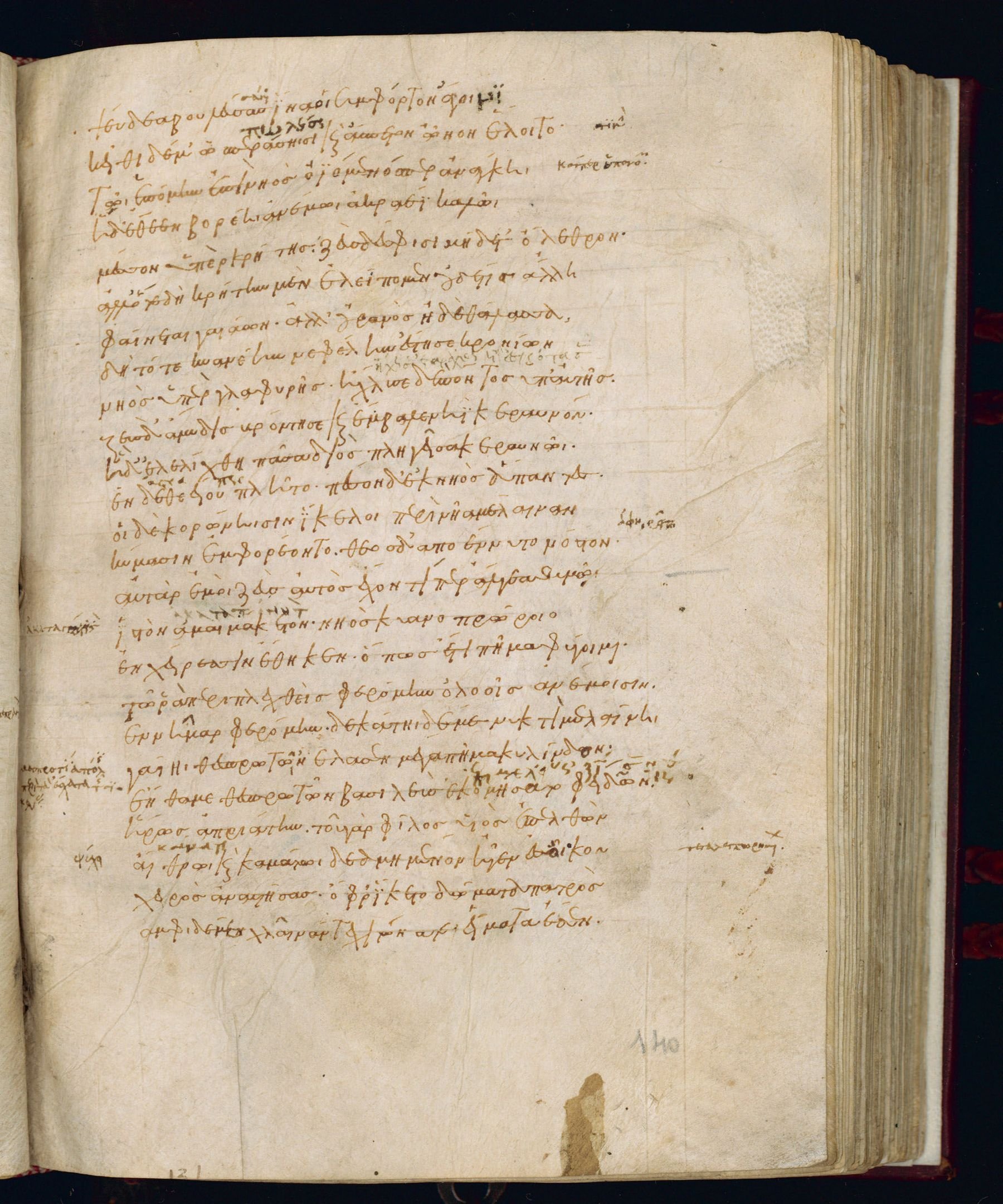
Where on the image
Laur. Plut. 32.24, fol. 140r: Odyssey 14.296-320, begins ‹ψεύδεα βουλεύσας, ἵνα οἱ›, ends ‹χιτῶνά τε εἵματα ἕσσεν.›. Checked on the image: first and last lines read and matched to the Greek. Fol. 139v ends with 14.295. Fol. 140v begins with 14.321. English blocks here: 295-299, 300-304, 305-309, 310-314, 315-319, 320-320.
296ψεύδεα βουλεύσας, ἵνα οἱ σὺν φόρτον ἄγοιμι,
297κεῖθι δέ μʼ ὡς περάσειε καὶ ἄσπετον ὦνον ἕλοιτο.
298τῷ ἑπόμην ἐπὶ νηός, ὀϊόμενός περ, ἀνάγκῃ.
299ἡ δʼ ἔθεεν Βορέῃ ἀνέμῳ ἀκραέϊ καλῷ,
300μέσσον ὑπὲρ Κρήτης· Ζεὺς δέ σφισι μήδετʼ ὄλεθρον.
301ἀλλʼ ὅτε δὴ Κρήτην μὲν ἐλείπομεν, οὐδέ τις ἄλλη
302φαίνετο γαιάων, ἀλλʼ οὐρανὸς ἠδὲ θάλασσα,
303δὴ τότε κυανέην νεφέλην ἔστησε Κρονίων
304νηὸς ὕπερ γλαφυρῆς, ἤχλυσε δὲ πόντος ὑπʼ αὐτῆς.
305Ζεὺς δʼ ἄμυδις βρόντησε καὶ ἔμβαλε νηῒ κεραυνόν·
306ἡ δʼ ἐλελίχθη πᾶσα Διὸς πληγεῖσα κεραυνῷ,
307ἐν δὲ θεείου πλῆτο· πέσον δʼ ἐκ νηὸς ἅπαντες.
308οἱ δὲ κορώνῃσιν ἴκελοι περὶ νῆα μέλαιναν
309κύμασιν ἐμφορέοντο· θεὸς δʼ ἀποαίνυτο νόστον.
310αὐτὰρ ἐμοὶ Ζεὺς αὐτός, ἔχοντί περ ἄλγεα θυμῷ,
311ἱστὸν ἀμαιμάκετον νηὸς κυανοπρῴροιο
312ἐν χείρεσσιν ἔθηκεν, ὅπως ἔτι πῆμα φύγοιμι.
313τῷ ῥα περιπλεχθεὶς φερόμην ὀλοοῖς ἀνέμοισιν.
314ἐννῆμαρ φερόμην, δεκάτῃ δέ με νυκτὶ μελαίνῃ
315γαίῃ Θεσπρωτῶν πέλασεν μέγα κῦμα κυλίνδον.
316ἔνθα με Θεσπρωτῶν βασιλεὺς ἐκομίσσατο Φείδων
317ἥρως ἀπριάτην· τοῦ γὰρ φίλος υἱὸς ἐπελθὼν
318αἴθρῳ καὶ καμάτῳ δεδμημένον ἦγεν ἐς οἶκον,
319χειρὸς ἀναστήσας, ὄφρʼ ἵκετο δώματα πατρός·
320ἀμφὶ δέ με χλαῖνάν τε χιτῶνά τε εἵματα ἕσσεν.
295he set me on a seafaring ship bound for Libya, having given lying counsel to the end that I should convey a cargo with him, but in truth that, when there, he might sell me and get a vast price. So I went with him on board the ship, suspecting his guile, yet perforce. And she ran before the North Wind, blowing fresh and fair, 300on a mid-sea course to the windward of Crete, and Zeus devised destruction for the men. But when we had left Crete, and no other land appeared, but only sky and sea, 305then verily the son of Cronos set a black cloud above the hollow ship, and the sea grew dark beneath it. Therewith Zeus thundered, and hurled his bolt upon the ship, and she quivered from stem to stern, smitten by the bolt of Zeus, and was filled with sulphurous smoke, and all the crew fell from out the ship. Like sea-crows they were borne on the waves about the black ship, and the god took from them their returning. 310But as for me, Zeus himself when my heart was compassed with woe, put into my hands the tossing mast of the dark-prowed ship, that I might again escape destruction. Around this I clung, and was borne by the direful winds. For nine days I was borne, but on the tenth black night 315the great rolling wave brought me to the land of the Thesprotians. There the king of the Thesprotians, lord Pheidon, took me in, and asked no ransom, for his dear son came upon me, overcome as I was with cold and weariness, and raised me by the hand, and led me until he came to his father's palace; 320and he clothed me in a cloak and tunic, as raiment.
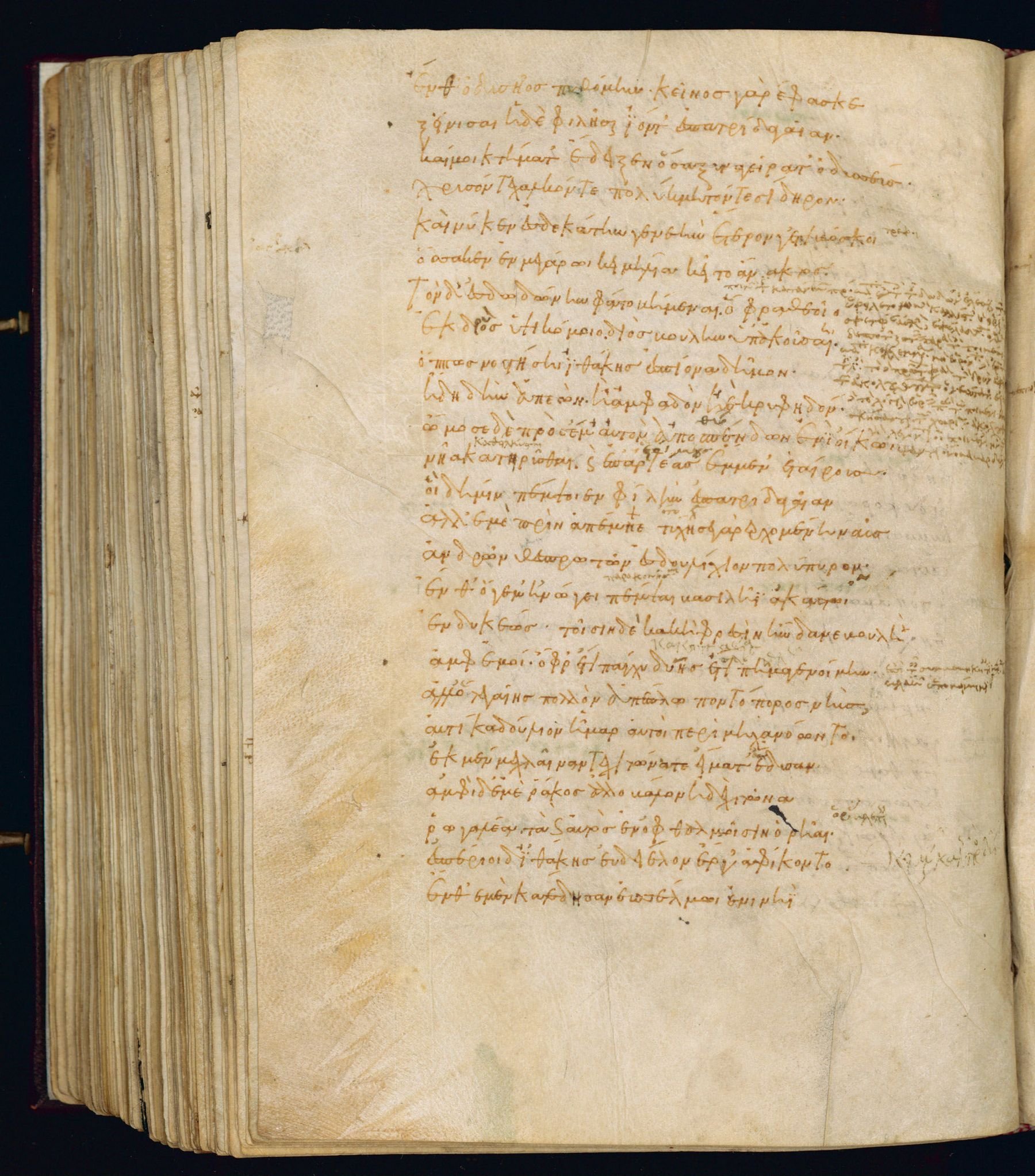
Where on the image
Laur. Plut. 32.24, fol. 140v: Odyssey 14.321-345, begins ‹ἔνθʼ Ὀδυσῆος ἐγὼ πυθόμην·›, ends ‹κατέδησαν ἐϋσσέλμῳ ἐνὶ νηῒ›. Checked on the image: first and last lines read and matched to the Greek. Fol. 140r ends with 14.320. Fol. 141r begins with 14.346. English blocks here: 321-324, 325-329, 330-334, 335-339, 340-344.
321ἔνθʼ Ὀδυσῆος ἐγὼ πυθόμην· κεῖνος γὰρ ἔφασκε
322ξεινίσαι ἠδὲ φιλῆσαι ἰόντʼ ἐς πατρίδα γαῖαν,
323καί μοι κτήματʼ ἔδειξεν ὅσα ξυναγείρατʼ Ὀδυσσεύς,
324χαλκόν τε χρυσόν τε πολύκμητόν τε σίδηρον.
325καί νύ κεν ἐς δεκάτην γενεὴν ἕτερόν γʼ ἔτι βόσκοι·
326τόσσα οἱ ἐν μεγάροις κειμήλια κεῖτο ἄνακτος.
327τὸν δʼ ἐς Δωδώνην φάτο βήμεναι, ὄφρα θεοῖο
328ἐκ δρυὸς ὑψικόμοιο Διὸς βουλὴν ἐπακούσαι,
329ὅππως νοστήσειʼ Ἰθάκης ἐς πίονα δῆμον
330ἤδη δὴν ἀπεών, ἢ ἀμφαδὸν ἦε κρυφηδόν.
331ὤμοσε δὲ πρὸς ἔμʼ αὐτόν, ἀποσπένδων ἐνὶ οἴκῳ,
332νῆα κατειρύσθαι καὶ ἐπαρτέας ἔμμεν ἑταίρους,
333οἳ δή μιν πέμψουσι φίλην ἐς πατρίδα γαῖαν.
334ἀλλʼ ἐμὲ πρὶν ἀπέπεμψε· τύχησε γὰρ ἐρχομένη νηῦς
335ἀνδρῶν Θεσπρωτῶν ἐς Δουλίχιον πολύπυρον.
336ἔνθʼ ὅ γέ μʼ ἠνώγει πέμψαι βασιλῆϊ Ἀκάστῳ
337ἐνδυκέως· τοῖσιν δὲ κακὴ φρεσὶν ἥνδανε βουλὴ
338ἀμφʼ ἐμοί, ὄφρʼ ἔτι πάγχυ δύης ἐπὶ πῆμα γενοίμην.
339ἀλλʼ ὅτε γαίης πολλὸν ἀπέπλω ποντοπόρος νηῦς,
340αὐτίκα δούλιον ἦμαρ ἐμοὶ περιμηχανόωντο.
341ἐκ μέν με χλαῖνάν τε χιτῶνά τε εἵματʼ ἔδυσαν,
342ἀμφὶ δέ μοι ῥάκος ἄλλο κακὸν βάλον ἠδὲ χιτῶνα,
343ῥωγαλέα, τὰ καὶ αὐτὸς ἐν ὀφθαλμοῖσιν ὅρηαι·
344ἑσπέριοι δʼ Ἰθάκης εὐδειέλου ἔργʼ ἀφίκοντο.
345ἔνθʼ ἐμὲ μὲν κατέδησαν ἐϋσσέλμῳ ἐνὶ νηῒ
321“There I learned of Odysseus, for the king said that he had entertained him, and given him welcome on his way to his native land. And he showed me all the treasure that Odysseus had gathered, bronze, and gold, and iron, wrought with toil; 325verily unto the tenth generation would it feed his children after him, so great was the wealth that lay stored for him in the halls of the king. But Odysseus, he said, had gone to Dodona, to hear the will of Zeus from the high-crested oak of the god, even how he might return to the rich land of Ithaca 330after so long an absence, whether openly or in secret. And moreover he swore in my own presence, as he poured libations in his house, that the ship was launched, and the men ready, who were to convey him to his dear native land. But me he sent forth first, for a ship 335of the Thesprotians chanced to be setting out for Dulichium, rich in wheat. Thither he bade them to convey me with kindly care, to king Acastus. But an evil counsel regarding me found favour in their hearts, that I might even yet be brought into utter misery. When the sea-faring ship had sailed far from the land, 340they presently sought to bring about for me the day of slavery. They stripped me of my garments, my cloak and tunic, and clothed me in other raiment, a vile ragged cloak and tunic, even the tattered garments which thou seest before thine eyes; and at evening they reached the tilled fields of clear-seen Ithaca.
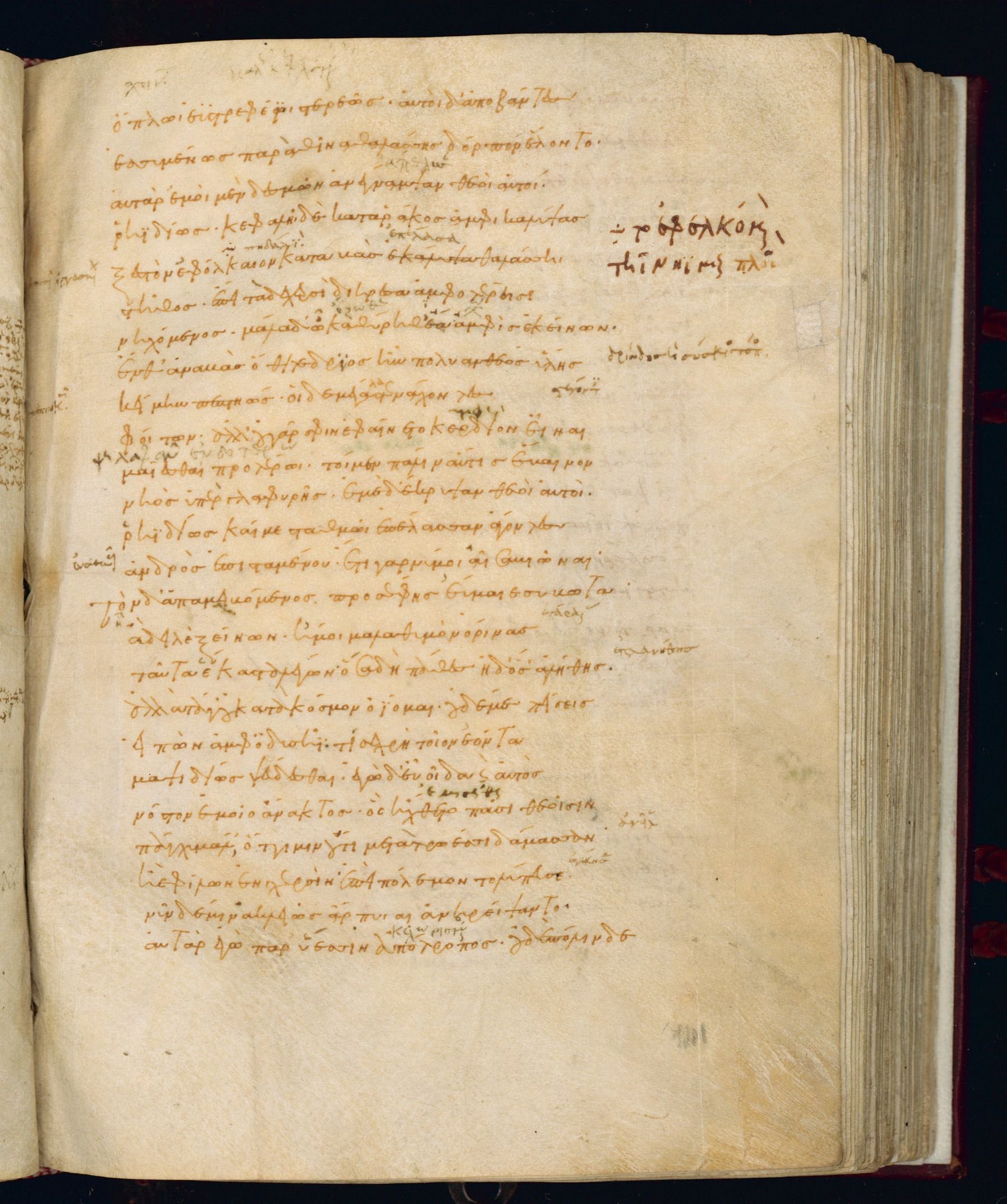
Where on the image
Laur. Plut. 32.24, fol. 141r: Odyssey 14.346-372, begins ‹ὅπλῳ ἐϋστρεφέϊ στερεῶς, αὐτοὶ›, ends ‹ὕεσσιν ἀπότροπος· οὐδὲ πόλινδε›. Checked on the image: first and last lines read and matched to the Greek. Fol. 140v ends with 14.345. Fol. 141v begins with 14.373. 14.369-370 (τῷ κέν οἱ τύμβον ... and ἠδέ κε καὶ ᾧ παιδὶ ...) are not on the page: the scribe passes from 14.368 to 14.371 (25 lines). English blocks here: 345-349, 350-354, 355-359, 360-364, 365-369, 370-374.
346ὅπλῳ ἐϋστρεφέϊ στερεῶς, αὐτοὶ δʼ ἀποβάντες
347ἐσσυμένως παρὰ θῖνα θαλάσσης δόρπον ἕλοντο.
348αὐτὰρ ἐμοὶ δεσμὸν μὲν ἀνέγναμψαν θεοὶ αὐτοὶ
349ῥηϊδίως· κεφαλῇ δὲ κατὰ ῥάκος ἀμφικαλύψας,
350ξεστὸν ἐφόλκαιον καταβὰς ἐπέλασσα θαλάσσῃ
351στῆθος, ἔπειτα δὲ χερσὶ διήρεσσʼ ἀμφοτέρῃσι
352νηχόμενος, μάλα δʼ ὦκα θύρηθʼ ἔα ἀμφὶς ἐκείνων.
353ἔνθʼ ἀναβάς, ὅθι τε δρίος ἦν πολυανθέος ὕλης,
354κείμην πεπτηώς. οἱ δὲ μεγάλα στενάχοντες
355φοίτων· ἀλλʼ οὐ γάρ σφιν ἐφαίνετο κέρδιον εἶναι
356μαίεσθαι προτέρω, τοὶ μὲν πάλιν αὖτις ἔβαινον
357νηὸς ἔπι γλαφυρῆς· ἐμὲ δʼ ἔκρυψαν θεοὶ αὐτοὶ
358ῥηϊδίως, καί με σταθμῷ ἐπέλασσαν ἄγοντες
359ἀνδρὸς ἐπισταμένου· ἔτι γάρ νύ μοι αἶσα βιῶναι.
360τὸν δʼ ἀπαμειβόμενος προσέφης, Εὔμαιε συβῶτα·
361ἆ δειλὲ ξείνων, ἦ μοι μάλα θυμὸν ὄρινας
362ταῦτα ἕκαστα λέγων, ὅσα δὴ πάθες ἠδʼ ὅσʼ ἀλήθης.
363ἀλλὰ τά γʼ οὐ κατὰ κόσμον ὀΐομαι, οὐδέ με πείσεις
364εἰπὼν ἀμφʼ Ὀδυσῆϊ· τί σε χρὴ τοῖον ἐόντα
365μαψιδίως ψεύδεσθαι; ἐγὼ δʼ εὖ οἶδα καὶ αὐτὸς
366νόστον ἐμοῖο ἄνακτος, ὅ τʼ ἤχθετο πᾶσι θεοῖσι
367πάγχυ μάλʼ, ὅττι μιν οὔ τι μετὰ Τρώεσσι δάμασσαν
368ἠὲ φίλων ἐν χερσίν, ἐπεὶ πόλεμον τολύπευσε.
369τῷ κέν οἱ τύμβον μὲν ἐποίησαν Παναχαιοί,
370ἠδέ κε καὶ ᾧ παιδὶ μέγα κλέος ἤρατʼ ὀπίσσω
371νῦν δέ μιν ἀκλειῶς ἅρπυιαι ἀνηρείψαντο.
372αὐτὰρ ἐγὼ παρʼ ὕεσσιν ἀπότροπος· οὐδὲ πόλινδε
345Then with a twisted rope they bound me fast in the benched ship, and themselves went ashore, and made haste to take their supper by the shore of the sea. But as for me, the gods themselves undid my bonds full easily, and, wrapping the tattered cloak about my head, 350I slid down the smooth lading-plank, and brought my breast to the sea, and then struck out with both hands, and swam, and very soon was out of the water, and away from them. Then I went up to a place where there was a thicket of leafy wood, and lay there crouching. 355And they went hither and thither with loud cries; but as there seemed to be no profit in going further in their search, they went back again on board their hollow ship. And the gods themselves hid me easily, and led me, and brought me to the farmstead of a wise man; for still haply it is my lot to live.” 360To him then, swineherd Eumaeus, didst thou make answer, and say: “Ah, wretched stranger, verily thou hast stirred my heart deeply in telling all the tale of thy sufferings and thy wanderings. But in this, methinks, thou hast not spoken aright, nor shalt thou persuade me with thy tale about Odysseus. Why shouldst thou, who art in such plight 365lie to no purpose? Nay, of myself I know well regarding the return of my master, that he was utterly hated of all the gods, in that they did not slay him among the Trojans, or in the arms of his friends, when he had wound up the skein of war. Then would the whole host of the Achaeans have made him a tomb, 370and for his son too he would have won great glory in days to come. But as it is the spirits of the storm have swept him away, and left no tidings. I, for my part, dwell aloof with the swine, nor do I go to the city, unless haply wise Penelope bids me thither, when tidings come to her from anywhere.
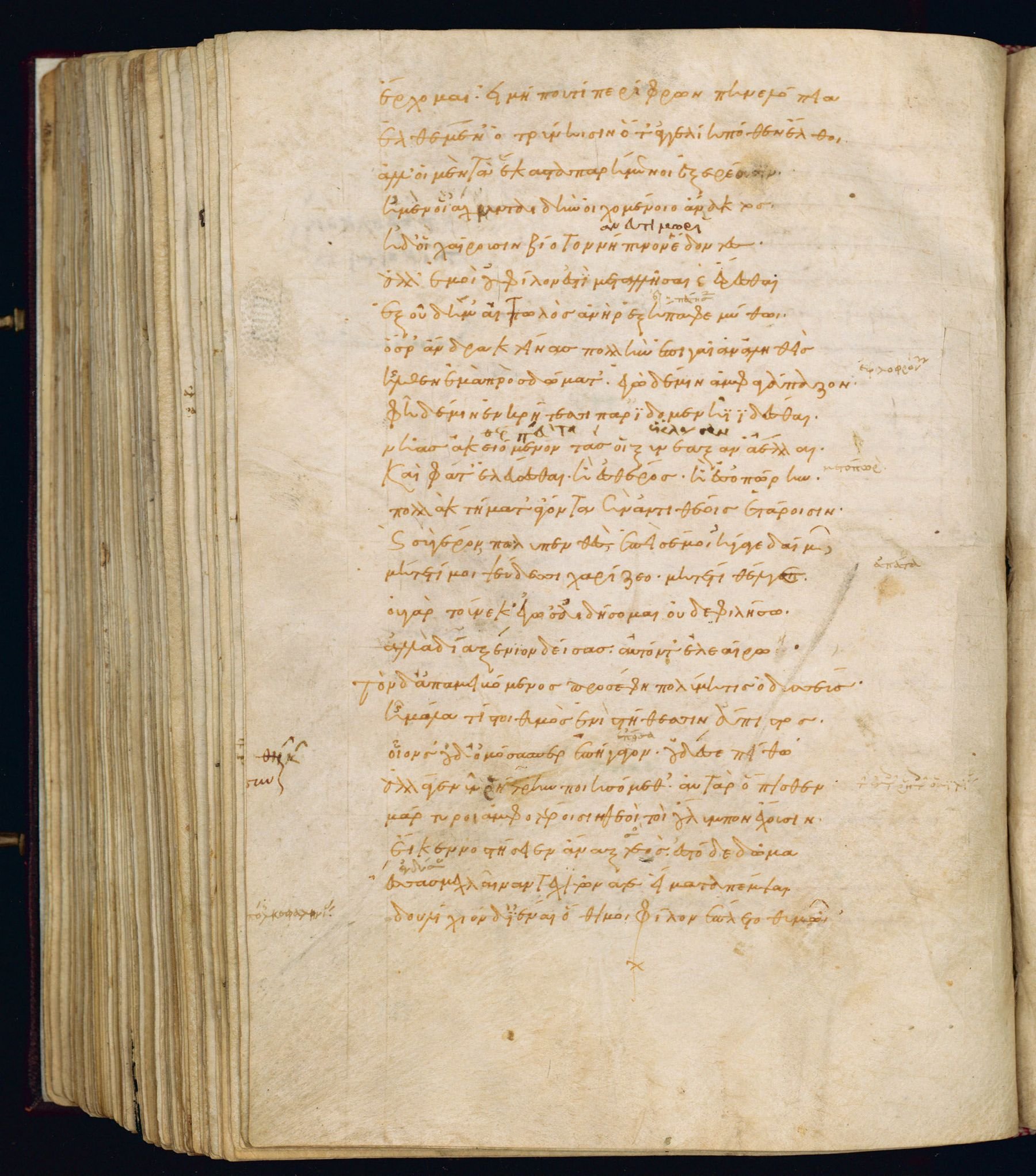
Where on the image
Laur. Plut. 32.24, fol. 141v: Odyssey 14.373-397, begins ‹ἔρχομαι, εἰ μή πού›, ends ‹μοι φίλον ἔπλετο θυμῷ·›. Checked on the image: first and last lines read and matched to the Greek. Fol. 141r ends with 14.372. Fol. 142r begins with 14.398. English blocks here: 375-379, 380-384, 385-389, 390-394, 395-399.
373ἔρχομαι, εἰ μή πού τι περίφρων Πηνελόπεια
374ἐλθέμεν ὀτρύνῃσιν, ὅτʼ ἀγγελίη ποθὲν ἔλθῃ.
375ἀλλʼ οἱ μὲν τὰ ἕκαστα παρήμενοι ἐξερέουσιν,
376ἠμὲν οἳ ἄχνυνται δὴν οἰχομένοιο ἄνακτος,
377ἠδʼ οἳ χαίρουσιν βίοτον νήποινον ἔδοντες·
378ἀλλʼ ἐμοὶ οὐ φίλον ἐστὶ μεταλλῆσαι καὶ ἐρέσθαι,
379ἐξ οὗ δή μʼ Αἰτωλὸς ἀνὴρ ἐξήπαφε μύθῳ,
380ὅς ῥʼ ἄνδρα κτείνας, πολλὴν ἐπὶ γαῖαν ἀληθείς,
381ἦλθεν ἐμὰ πρὸς δώματʼ· ἐγὼ δέ μιν ἀμφαγάπαζον.
382φῆ δέ μιν ἐν Κρήτεσσι παρʼ Ἰδομενῆϊ ἰδέσθαι
383νῆας ἀκειόμενον, τάς οἱ ξυνέαξαν ἄελλαι·
384καὶ φάτʼ ἐλεύσεσθαι ἢ ἐς θέρος ἢ ἐς ὀπώρην,
385πολλὰ χρήματʼ ἄγοντα, σὺν ἀντιθέοις ἑτάροισι.
386καὶ σύ, γέρον πολυπενθές, ἐπεί σέ μοι ἤγαγε δαίμων,
387μήτε τί μοι ψεύδεσσι χαρίζεο μήτε τι θέλγε·
388οὐ γὰρ τοὔνεκʼ ἐγώ σʼ αἰδέσσομαι οὐδὲ φιλήσω,
389ἀλλὰ Δία ξένιον δείσας αὐτόν τʼ ἐλεαίρων.
390τὸν δʼ ἀπαμειβόμενος προσέφη πολύμητις Ὀδυσσεύς
391ἦ μάλα τίς τοι θυμὸς ἐνὶ στήθεσσιν ἄπιστος,
392οἷόν σʼ οὐδʼ ὀμόσας περ ἐπήγαγον οὐδέ σε πείθω.
393ἀλλʼ ἄγε νῦν ῥήτρην ποιησόμεθʼ· αὐτὰρ ὄπισθε
394μάρτυροι ἀμφοτέροισι θεοί, τοὶ Ὄλυμπον ἔχουσιν.
395εἰ μέν κεν νοστήσῃ ἄναξ τεὸς ἐς τόδε δῶμα,
396ἕσσας με χλαῖνάν τε χιτῶνά τε εἵματα πέμψαι
397Δουλίχιόνδʼ ἰέναι, ὅθι μοι φίλον ἔπλετο θυμῷ·
375Then men sit around him that comes, and question him closely, both those that grieve for their lord, that has long been gone, and those who rejoice, as they devour his substance without atonement. But I care not to ask or enquire, since the time when an Aetolian beguiled me with his story, 380one that had killed a man, and after wandering over the wide earth came to my house, and I gave him kindly welcome. He said that he had seen Odysseus among the Cretans at the house of Idomeneus, mending his ships which storms had shattered. And he said that he would come either by summer or by harvest-time, 385bringing much treasure along with his godlike comrades. Thou too, old man of many sorrows, since a god has brought thee to me, seek not to win my favour by lies, nor in any wise to cajole me. It is not for this that I shall shew thee respect or kindness, but from fear of Zeus, the stranger's god, and from pity for thyself.” 390Then Odysseus of many wiles answered him, and said: “Verily thou hast in thy bosom a heart that is slow to believe, seeing that in such wise, even with an oath, I won thee not, neither persuade thee. But come now, let us make a covenant, and the gods who hold Olympus shall be witnesses for us both in time to come. 395If thy master returns to this house, clothe me in a cloak and tunic, as raiment, and send me on my way to Dulichium, where I desire to be. But if thy master does not come as I say, set the slaves upon me, and fling me down from a great cliff,
Where on the image
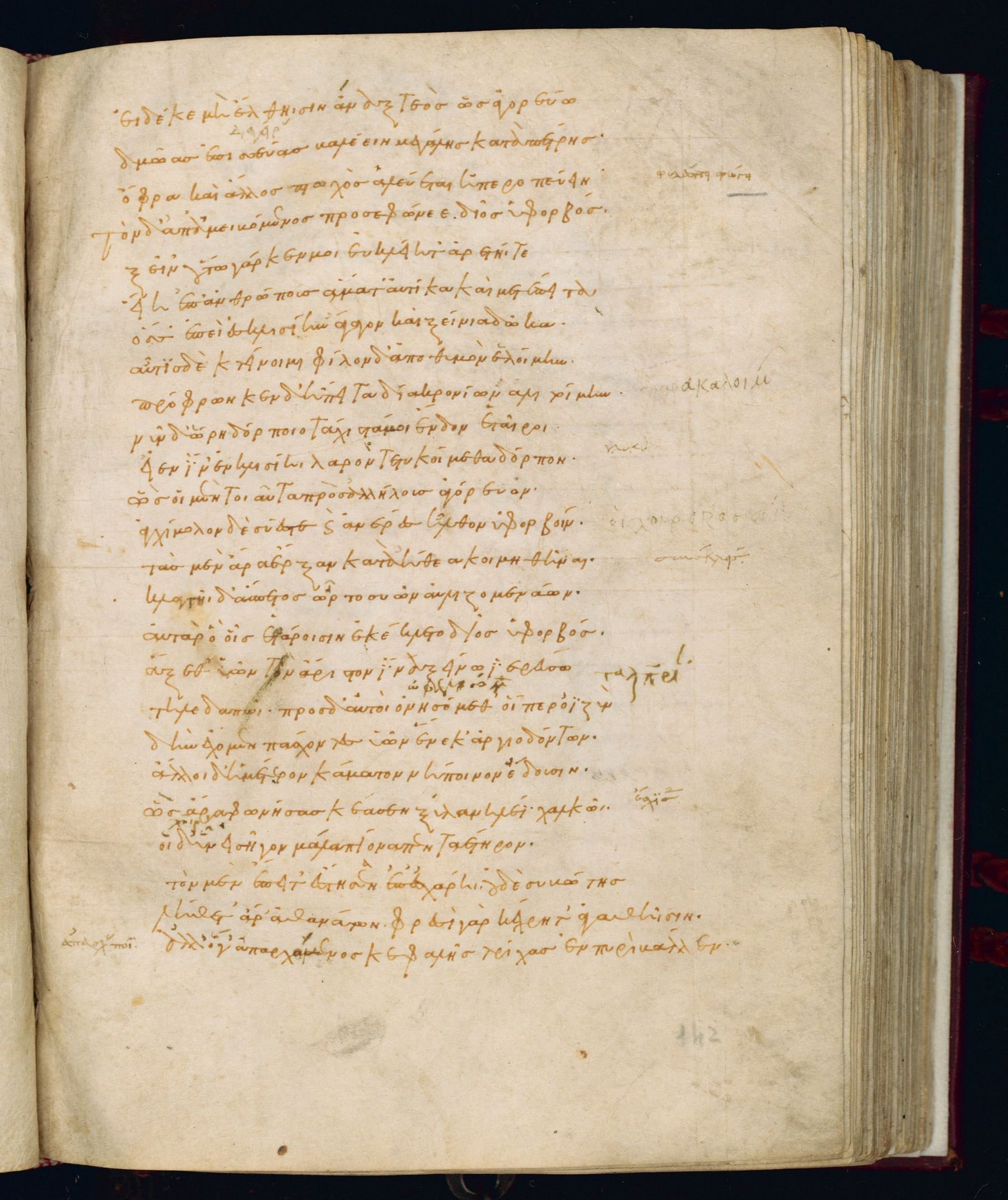
Laur. Plut. 32.24, fol. 142r: Odyssey 14.398-422, begins ‹εἰ δέ κε μὴ›, ends ‹τρίχας ἐν πυρὶ βάλλεν›. Checked on the image: first and last lines read and matched to the Greek. Fol. 141v ends with 14.397. Fol. 142v begins with 14.423. English blocks here: 400-400, 401-404, 405-409, 410-414, 415-419, 420-424.
398εἰ δέ κε μὴ ἔλθῃσιν ἄναξ τεὸς ὡς ἀγορεύω,
399δμῶας ἐπισσεύας βαλέειν μεγάλης κατὰ πέτρης,
400ὄφρα καὶ ἄλλος πτωχὸς ἀλεύεται ἠπεροπεύειν.
401τὸν δʼ ἀπαμειβόμενος προσεφώνεε δῖος ὑφορβός·
402ξεῖνʼ, οὕτω γάρ κέν μοι ἐϋκλείη τʼ ἀρετή τε
403εἴη ἐπʼ ἀνθρώπους ἅμα τʼ αὐτίκα καὶ μετέπειτα,
404ὅς σʼ ἐπεὶ ἐς κλισίην ἄγαγον καὶ ξείνια δῶκα,
405αὖτις δὲ κτείναιμι φίλον τʼ ἀπὸ θυμὸν ἑλοίμην·
406πρόφρων κεν δὴ ἔπειτα Δία Κρονίωνα λιτοίμην.
407νῦν δʼ ὥρη δόρποιο· τάχιστά μοι ἔνδον ἑταῖροι
408εἶεν, ἵνʼ ἐν κλισίῃ λαρὸν τετυκοίμεθα δόρπον.
409ὣς οἱ μὲν τοιαῦτα πρὸς ἀλλήλους ἀγόρευον,
410ἀγχίμολον δὲ σύες τε καὶ ἀνέρες ἦλθον ὑφορβοί.
411τὰς μὲν ἄρα ἔρξαν κατὰ ἤθεα κοιμηθῆναι,
412κλαγγὴ δʼ ἄσπετος ὦρτο συῶν αὐλιζομενάων
413αὐτὰρ ὁ οἷς ἑτάροισιν ἐκέκλετο δῖος ὑφορβός·
414ἄξεθʼ ὑῶν τὸν ἄριστον, ἵνα ξείνῳ ἱερεύσω
415τηλεδαπῷ· πρὸς δʼ αὐτοὶ ὀνησόμεθʼ, οἵ περ ὀϊζὺν
416δὴν ἔχομεν πάσχοντες ὑῶν ἕνεκʼ ἀργιοδόντων·
417ἄλλοι δʼ ἡμέτερον κάματον νήποινον ἔδουσιν.
418ὣς ἄρα φωνήσας κέασε ξύλα νηλέϊ χαλκῷ,
419οἱ δʼ ὗν εἰσῆγον μάλα πίονα πενταέτηρον.
420τὸν μὲν ἔπειτʼ ἔστησαν ἐπʼ ἐσχάρῃ· οὐδὲ συβώτης
421λήθετʼ ἄρʼ ἀθανάτων· φρεσὶ γὰρ κέχρητʼ ἀγαθῇσιν·
422ἀλλʼ ὅγʼ ἀπαρχόμενος κεφαλῆς τρίχας ἐν πυρὶ βάλλεν
400that another beggar may beware of deceiving.” 401And the goodly swineherd answered him, and said: “Aye, stranger, so should I indeed win fair fame and prosperity among men both now and hereafter, if I, who brought thee to my hut and gave thee entertainment, 405should then slay thee, and take away thy dear life. With a ready heart thereafter should I pray to Zeus, son of Cronos. But it is now time for supper, and may my comrades soon be here, that we may make ready a savoury supper in the hut.” Thus they spoke to one another, 410and the swine and the swineherds drew near. The sows they shut up to sleep in their wonted sties, and a wondrous noise arose from them, as they were penned. Then the goodly swineherd called to his comrades saying: “Bring forth the best of the boars, that I may slaughter him for the stranger 415who comes from afar, and we too shall have some profit therefrom, who have long borne toil and suffering for the sake of the white-tusked swine, while others devour our labour without atonement.” So saying, he split wood with the pitiless bronze, and the others brought in a fatted boar of five years old, 420and set him by the hearth. Nor did the swineherd forget the immortals, for he had an understanding heart, but as a first offering he cast into the fire bristles from the head of the white-tusked boar, and made prayer to all the gods that wise Odysseus might return to his own house.
Where on the image
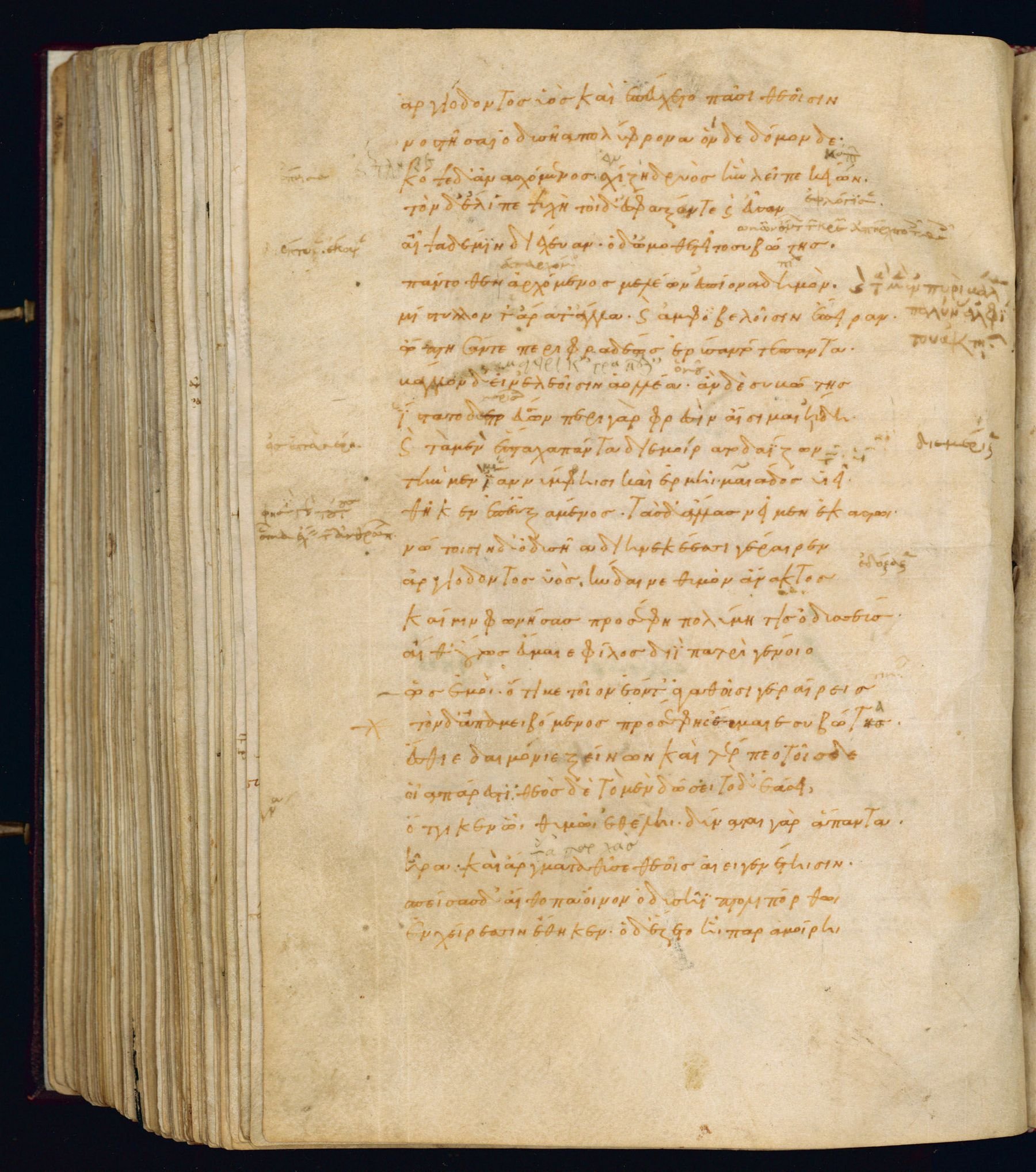
Laur. Plut. 32.24, fol. 142v: Odyssey 14.423-448, begins ‹ἀργιόδοντος ὑός, καὶ ἐπεύχετο›, ends ‹ἕζετο ᾗ παρὰ μοίρῃ.›. Checked on the image: first and last lines read and matched to the Greek. Fol. 142r ends with 14.422. Fol. 143r begins with 14.449. 14.429 is not in the text column; it is written in the right margin beside 14.428-430 (the column has 25 lines). English blocks here: 425-429, 430-434, 435-439, 440-444, 445-445, 446-449.
423ἀργιόδοντος ὑός, καὶ ἐπεύχετο πᾶσι θεοῖσιν
424νοστῆσαι Ὀδυσῆα πολύφρονα ὅνδε δόμονδε.
425κόψε δʼ ἀνασχόμενος σχίζῃ δρυός, ἣν λίπε κείων·
426τὸν δʼ ἔλιπε ψυχή. τοὶ δʼ ἔσφαξάν τε καὶ εὗσαν·
427αἶψα δέ μιν διέχευαν· ὁ δʼ ὠμοθετεῖτο συβώτης,
428πάντων ἀρχόμενος μελέων, ἐς πίονα δημόν,
429καὶ τὰ μὲν ἐν πυρὶ βάλλε, παλύνας ἀλφίτου ἀκτῇ,
430μίστυλλόν τʼ ἄρα τἆλλα καὶ ἀμφʼ ὀβελοῖσιν ἔπειραν,
431ὤπτησάν τε περιφραδέως ἐρύσαντό τε πάντα,
432βάλλον δʼ εἰν ἐλεοῖσιν ἀολλέα· ἂν δὲ συβώτης
433ἵστατο δαιτρεύσων· περὶ γὰρ φρεσὶν αἴσιμα ᾔδη.
434καὶ τὰ μὲν ἕπταχα πάντα διεμοιρᾶτο δαΐζων·
435τὴν μὲν ἴαν νύμφῃσι καὶ Ἑρμῇ, Μαιάδος υἱεῖ,
436θῆκεν ἐπευξάμενος, τὰς δʼ ἄλλας νεῖμεν ἑκάστῳ·
437νώτοισιν δʼ Ὀδυσῆα διηνεκέεσσι γέραιρεν
438ἀργιόδοντος ὑός, κύδαινε δὲ θυμὸν ἄνακτος·
439καί μιν φωνήσας προσέφη πολύμητις Ὀδυσσεύς·
440αἴθʼ οὕτως, Εὔμαιε, φίλος Διὶ πατρὶ γένοιο
441ὡς ἐμοί, ὅττι τε τοῖον ἐόντʼ ἀγαθοῖσι γεραίρεις.
442τὸν δʼ ἀπαμειβόμενος προσέφης, Εὔμαιε συβῶτα·
443ἔσθιε, δαιμόνιε ξείνων, καὶ τέρπεο τοῖσδε,
444οἷα πάρεστι· θεὸς δὲ τὸ μὲν δώσει, τὸ δʼ ἐάσει,
445ὅττι κεν ᾧ θυμῷ ἐθέλῃ· δύναται γὰρ ἅπαντα.
446ἦ ῥα καὶ ἄργματα θῦσε θεοῖς αἰειγενέτῃσι,
447σπείσας δʼ αἴθοπα οἶνον Ὀδυσσῆϊ πτολιπόρθῳ
448ἐν χείρεσσιν ἔθηκεν· ὁ δʼ ἕζετο ᾗ παρὰ μοίρῃ.
425Then he raised himself up, and smote the boar with a billet of oak, which he had left when splitting the wood, and the boar's life left him. And the others cut the boar's throat, and signed him, and quickly cut him up, and the swineherd took as first offerings bits of raw flesh from all the limbs, and laid them in the rich fat. These he cast into the fire, when he had sprinkled them with barley meal, 430but the rest they cut up and spitted, and roasted it carefully, and drew it all off the spits, and cast it in a heap on platters. Then the swineherd stood up to carve, for well did his heart know what was fair, and he cut up the mess and divided it into seven portions. 435One with a prayer he set aside for the nymphs and for Hermes, son of Maia, and the rest he distributed to each. And Odysseus he honored with the long chine of the white-tusked boar, and made glad the heart of his master; and Odysseus of many wiles spoke to him, and said: 440“Eumaeus, mayest thou be as dear to father Zeus as thou art to me, since thou honourest me with a good portion, albeit I am in such plight.” To him then, swineherd Eumaeus, didst thou make answer, and say: “Eat, unhappy stranger, and have joy of such fare as is here. It is the god that will give one thing and withhold another, 445even as seems good to his heart; for he can do all things.” 446He spoke, and sacrificed the firstling pieces to the gods that are for ever, and, when he had made libations of the flaming wine, he placed the cup in the hands of Odysseus, the sacker of cities, and took his seat by his own portion. And bread was served to them by Mesaulius, whom the swineherd
Where on the image
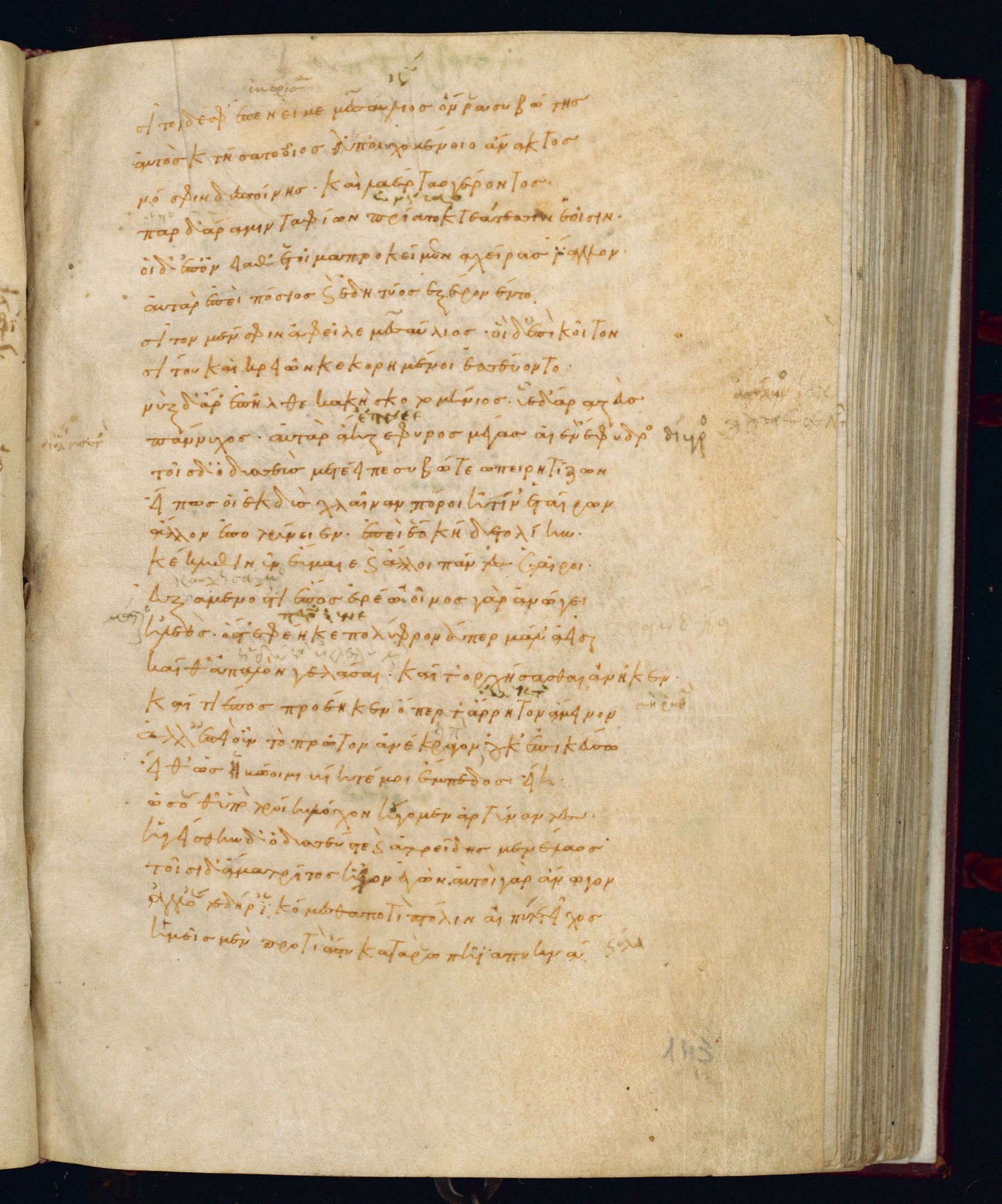
Laur. Plut. 32.24, fol. 143r: Odyssey 14.449-473, begins ‹σῖτον δέ σφιν ἔνειμε›, ends ‹ἄστυ κατὰ ῥωπήϊα πυκνά,›. Checked on the image: first and last lines read and matched to the Greek. Fol. 142v ends with 14.448. Fol. 143v begins with 14.474. English blocks here: 450-454, 455-459, 460-464, 465-469, 470-474.
449σῖτον δέ σφιν ἔνειμε Μεσαύλιος, ὅν ῥα συβώτης
450αὐτὸς κτήσατο οἶος ἀποιχομένοιο ἄνακτος,
451νόσφιν δεσποίνης καὶ Λαέρταο γέροντος·
452πὰρ δʼ ἄρα μιν Ταφίων πρίατο κτεάτεσσιν ἑοῖσιν.
453οἱ δʼ ἐπʼ ὀνείαθʼ ἑτοῖμα προκείμενα χεῖρας ἴαλλον.
454αὐτὰρ ἐπεὶ πόσιος καὶ ἐδητύος ἐξ ἔρον ἕντο,
455σῖτον μέν σφιν ἀφεῖλε Μεσαύλιος, οἱ δʼ ἐπὶ κοῖτον
456σίτου καὶ κρειῶν κεκορημένοι ἐσσεύοντο.
457νὺξ δʼ ἄρʼ ἐπῆλθε κακὴ σκοτομήνιος, ὗε δʼ ἄρα Ζεὺς
458πάννυχος, αὐτὰρ ἄη Ζέφυρος μέγας αἰὲν ἔφυδρος.
459τοῖς δʼ Ὀδυσεὺς μετέειπε, συβώτεω πειρητίζων,
460εἴ πώς οἱ ἐκδὺς χλαῖναν πόροι, ἤ τινʼ ἑταίρων
461ἄλλον ἐποτρύνειεν, ἐπεί ἑο κήδετο λίην·
462κέκλυθι νῦν, Εὔμαιε καὶ ἄλλοι πάντες ἑταῖροι,
463εὐξάμενός τι ἔπος ἐρέω· οἶνος γὰρ ἀνώγει
464ἠλεός, ὅς τʼ ἐφέηκε πολύφρονά περ μάλʼ ἀεῖσαι
465καί θʼ ἁπαλὸν γελάσαι, καί τʼ ὀρχήσασθαι ἀνῆκε,
466καί τι ἔπος προέηκεν ὅ περ τʼ ἄρρητον ἄμεινον.
467ἀλλʼ ἐπεὶ οὖν τὸ πρῶτον ἀνέκραγον, οὐκ ἐπικεύσω.
468εἴθʼ ὣς ἡβώοιμι βίη τέ μοι ἔμπεδος εἴη,
469ὡς ὅθʼ ὑπὸ Τροίην λόχον ἤγομεν ἀρτύναντες.
470ἡγείσθην δʼ Ὀδυσεύς τε καὶ Ἀτρεΐδης Μενέλαος,
471τοῖσι δʼ ἅμα τρίτος ἄρχον ἐγών· αὐτοὶ γὰρ ἄνωγον.
472ἀλλʼ ὅτε δή ῥʼ ἱκόμεσθα ποτὶ πτόλιν αἰπύ τε τεῖχος,
473ἡμεῖς μὲν περὶ ἄστυ κατὰ ῥωπήϊα πυκνά,
450had gotten by himself alone, while his master was gone, without the knowledge of his mistress or the old Laertes, buying him of the Taphians with his own goods. So they put forth their hands to the good cheer lying ready before them. But when they had put from them the desire of food and drink, 455Mesaulius took away the food, and they were fain to go to their rest, sated with bread and meat. Now the night came on, foul and without a moon, and Zeus rained the whole night through, and the West Wind, ever the rainy wind, blew strong. Then Odysseus spoke among them, making trial of the swineherd, 460to see whether he would strip off his own cloak and give it him, or bid some other of his comrades to do so, since he cared for him so greatly: “Hear me now, Eumaeus and all the rest of you, his men, with a wish in my heart will I tell a tale; for the wine bids me, befooling wine, which sets one, even though he be right wise, to singing 465and laughing softly, and makes him stand up and dance, aye, and brings forth a word which were better unspoken. Still, since I have once spoken out, I will hide nothing. Would that I were young and my strength firm as when we made ready our ambush, and led it beneath the walls of Troy. 470The leaders were Odysseus and Menelaus, son of Atreus, and with them I was third in command; for so had they ordered it themselves. Now when we had come to the city and the steep wall, round about the town in the thick brushwood among the needs and swamp-land
Where on the image
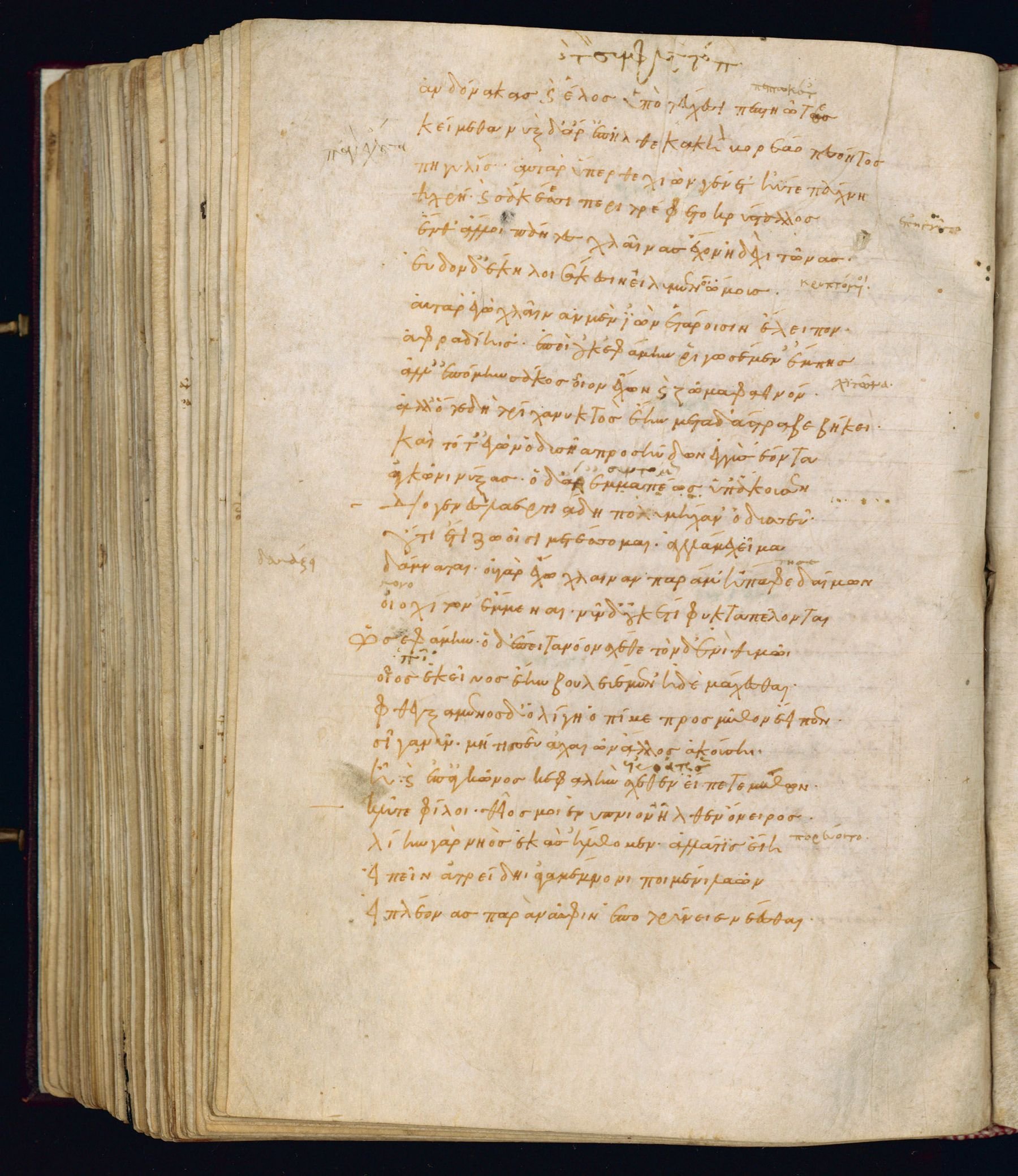
Laur. Plut. 32.24, fol. 143v: Odyssey 14.474-498, begins ‹ἂν δόνακας καὶ ἕλος,›, ends ‹παρὰ ναῦφιν ἐποτρύνειε νέεσθαι.›. Checked on the image: first and last lines read and matched to the Greek. Fol. 143r ends with 14.473. Fol. 144r begins with 14.499. English blocks here: 475-479, 480-484, 485-489, 490-493, 494-494, 495-499.
474ἂν δόνακας καὶ ἕλος, ὑπὸ τεύχεσι πεπτηῶτες
475κείμεθα. νὺξ δʼ ἄρʼ ἐπῆλθε κακὴ Βορέαο πεσόντος,
476πηγυλίς· αὐτὰρ ὕπερθε χιὼν γένετʼ ἠΰτε πάχνη,
477ψυχρή, καὶ σακέεσσι περιτρέφετο κρύσταλλος.
478ἔνθʼ ἄλλοι πάντες χλαίνας ἔχον ἠδὲ χιτῶνας,
479εὗδον δʼ εὔκηλοι, σάκεσιν εἰλυμένοι ὤμους·
480αὐτὰρ ἐγὼ χλαῖναν μὲν ἰὼν ἑτάροισιν ἔλειπον
481ἀφραδίῃς, ἐπεὶ οὐκ ἐφάμην ῥιγωσέμεν ἔμπης,
482ἀλλʼ ἑπόμην σάκος οἶον ἔχων καὶ ζῶμα φαεινόν.
483ἀλλʼ ὅτε δὴ τρίχα νυκτὸς ἔην, μετὰ δʼ ἄστρα βεβήκει,
484καὶ τότʼ ἐγὼν Ὀδυσῆα προσηύδων ἐγγὺς ἐόντα
485ἀγκῶνι νύξας· ὁ δʼ ἄρʼ ἐμμαπέως ὑπάκουσε·
486διογενὲς Λαερτιάδη, πολυμήχανʼ Ὀδυσσεῦ,
487οὔ τοι ἔτι ζωοῖσι μετέσσομαι, ἀλλά με χεῖμα
488δάμναται· οὐ γὰρ ἔχω χλαῖναν· παρά μʼ ἤπαφε δαίμων
489οἰοχίτωνʼ ἔμεναι· νῦν δʼ οὐκέτι φυκτὰ πέλονται.
490ὣς ἐφάμην, ὁ δʼ ἔπειτα νόον σχέθε τόνδʼ ἐνὶ θυμῷ,
491οἷος κεῖνος ἔην βουλευέμεν ἠδὲ μάχεσθαι·
492φθεγξάμενος δʼ ὀλίγῃ ὀπί με πρὸς μῦθον ἔειπε·
493σίγα νῦν, μή τίς σευ Ἀχαιῶν ἄλλος ἀκούσῃ.
494ἦ καὶ ἐπʼ ἀγκῶνος κεφαλὴν σχέθεν εἶπέ τε μῦθον·
495κλῦτε, φίλοι· θεῖός μοι ἐνύπνιον ἦλθεν ὄνειρος.
496λίην γὰρ νηῶν ἑκὰς ἤλθομεν· ἀλλά τις εἴη
497εἰπεῖν Ἀτρεΐδῃ Ἀγαμέμνονι, ποιμένι λαῶν,
498εἰ πλέονας παρὰ ναῦφιν ἐποτρύνειε νέεσθαι.
475we lay, crouching beneath our arms, and night came on, foul, when the North Wind had fallen, and frosty, and snow came down on us from above, covering us like rime, bitter cold, and ice formed upon our shields. Now all the rest had cloaks and tunics, and slept in peace, with their shields covering their shoulders, 480but I, when I set out, had left my cloak behind with my comrades in my folly, for I did not think that even so I should be cold, and had come with my shield alone and my bright kilt. But when it was the third watch of the night, and the stars had turned their course, then I spoke to Odysseus, who was near me, 485nudging him with my elbow; and he straightway gave ear: “Son of Laertes, sprung from Zeus, Odysseus of many devices, lo now, no longer shall I be among the living. Nay, the cold is killing me, for I have no cloak. Some god beguiled me to wear my tunic only, and now there is no more escape.’ 490“So I spoke, and he then devised this plan in his heart, such a man was he both to plan and to fight; and speaking in a low voice he said to me: ‘Be silent now, lest another of the Achaeans hear thee.’ 494“With this he raised his head upon his elbow, and spoke, saying: 495‘Hear me, friends; a dream from the gods came to me in my sleep. Lo, we have come very far from the ships, and I would that there were one to bear word to Agamemnon, son of Atreus, shepherd of the host, in the hope that he might bid more men to come from the ships.’ “So he spoke, and Thoas, son of Andraemon, sprang up
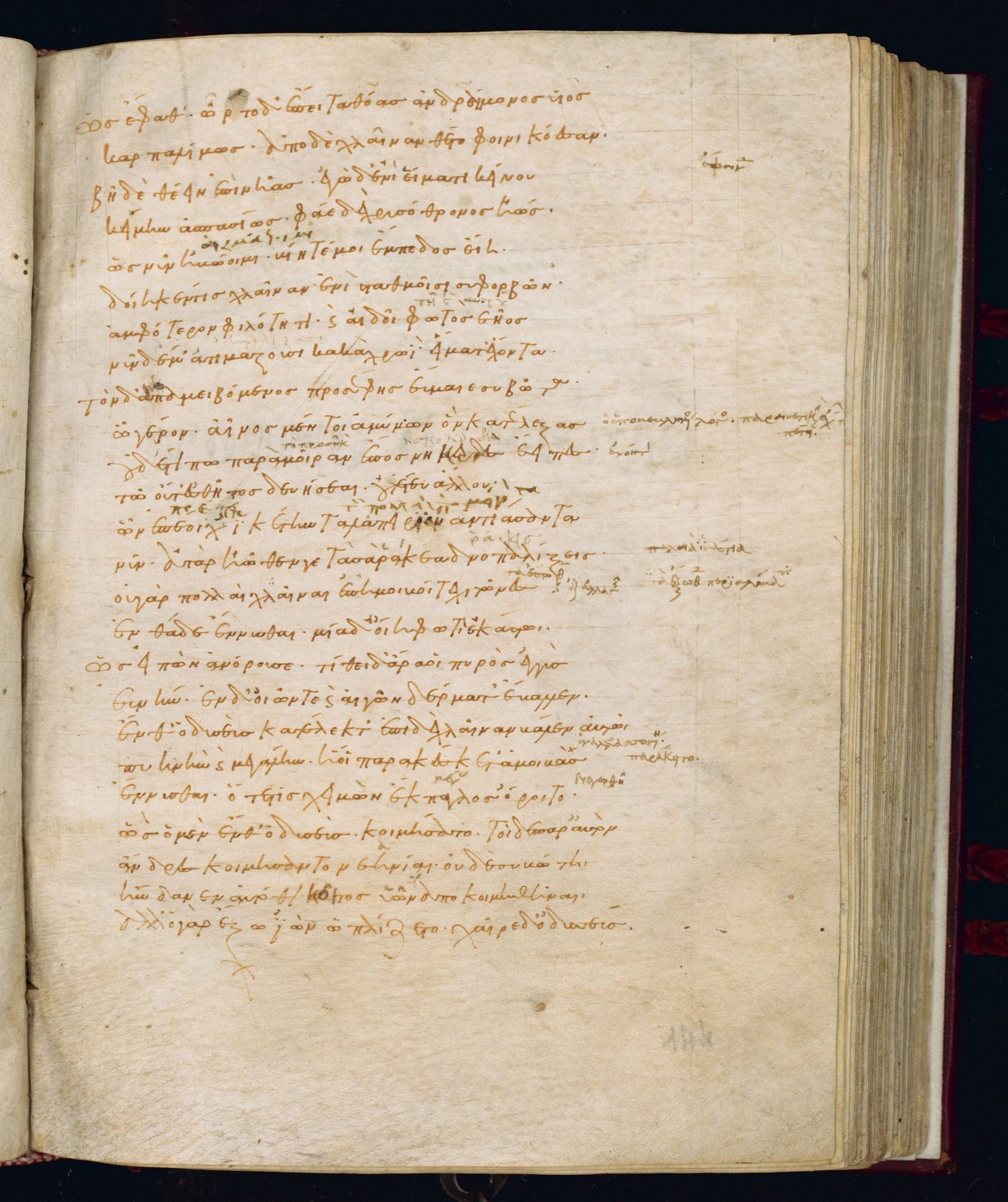
Where on the image
Laur. Plut. 32.24, fol. 144r: Odyssey 14.499-526, begins ‹ὣς ἔφατʼ, ὦρτο δʼ›, ends ‹ὡπλίζετο· χαῖρε δʼ Ὀδυσσεύς,›. Checked on the image: first and last lines read and matched to the Greek. Fol. 143v ends with 14.498. Fol. 144v begins with 14.527. 14.515-517 (αὐτὰρ ἐπὴν ἔλθῃσιν Ὀδυσσῆος φίλος υἱός ... πέμψει δʼ ὅππῃ σε κραδίη θυμός τε κελεύει) are not on the page: the scribe passes from 14.514 to 14.518 (25 lines). English blocks here: 500-504, 505-509, 510-514, 515-519, 520-524.
499ὣς ἔφατʼ, ὦρτο δʼ ἔπειτα Θόας, Ἀνδραίμονος υἱός,
500καρπαλίμως, ἀπὸ δὲ χλαῖναν θέτο φοινικόεσσαν,
501βῆ δὲ θέειν ἐπὶ νῆας· ἐγὼ δʼ ἐνὶ εἵματι κείνου
502κείμην ἀσπασίως, φάε δὲ χρυσόθρονος Ἠώς.
503ὣς νῦν ἡβώοιμι βίη τέ μοι ἔμπεδος εἴη·
504δοίη κέν τις χλαῖναν ἐνὶ σταθμοῖσι συφορβῶν,
505ἀμφότερον, φιλότητι καὶ αἰδοῖ φωτὸς ἑῆος·
506νῦν δέ μʼ ἀτιμάζουσι κακὰ χροῒ εἵματʼ ἔχοντα.
507τὸν δʼ ἀπαμειβόμενος προσέφης, Εὔμαιε συβῶτα·
508ὦ γέρον, αἶνος μέν τοι ἀμύμων, ὃν κατέλεξας,
509οὐδέ τί πω παρὰ μοῖραν ἔπος νηκερδὲς ἔειπες·
510τῷ οὔτʼ ἐσθῆτος δευήσεαι οὔτε τευ ἄλλου,
511ὧν ἐπέοιχʼ ἱκέτην ταλαπείριον ἀντιάσαντα,
512νῦν· ἀτὰρ ἠῶθέν γε τὰ σὰ ῥάκεα δνοπαλίξεις.
513οὐ γὰρ πολλαὶ χλαῖναι ἐπημοιβοί τε χιτῶνες
514ἐνθάδε ἕννυσθαι, μία δʼ οἴη φωτὶ ἑκάστῳ.
515αὐτὰρ ἐπὴν ἔλθῃσιν Ὀδυσσῆος φίλος υἱός,
516αὐτός τοι χλαῖνάν τε χιτῶνά τε εἵματα δώσει,
517πέμψει δʼ ὅππῃ σε κραδίη θυμός τε κελεύει.
518ὣς εἰπὼν ἀνόρουσε, τίθει δʼ ἄρα οἱ πυρὸς ἐγγὺς
519εὐνήν, ἐν δʼ ὀΐων τε καὶ αἰγῶν δέρματʼ ἔβαλλεν.
520ἔνθʼ Ὀδυσεὺς κατέλεκτʼ· ἐπὶ δὲ χλαῖναν βάλεν αὐτῷ
521πυκνὴν καὶ μεγάλην, ἥ οἱ παρεκέσκετʼ ἀμοιβάς,
522ἕννυσθαι ὅτε τις χειμὼν ἔκπαγλος ὄροιτο.
523ὣς ὁ μὲν ἔνθʼ Ὀδυσεὺς κοιμήσατο, τοὶ δὲ παρʼ αὐτὸν
524ἄνδρες κοιμήσαντο νεηνίαι· οὐδὲ συβώτῃ
525ἥνδανεν αὐτόθι κοῖτος, ὑῶν ἄπο κοιμηθῆναι,
526ἀλλʼ ὅ γʼ ἄρʼ ἔξω ἰὼν ὡπλίζετο· χαῖρε δʼ Ὀδυσσεύς,
500quickly, and from him flung his purple cloak, and set out to run to the ships. Then in his garment I gladly lay, and golden-throned Dawn appeared. Would that I were young as then, and my strength as firm; then would one of the swineherds in the farmstead give me a cloak 505both from kindness and from respect for a brave warrior. But as it is they scorn me, since I have foul raiment about me.” To him then, swineherd Eumaeus, didst thou make answer, and say: “Old man, the tale thou hast told is a good one, nor hast thou thus far spoken aught amiss or unprofitably. 510Wherefore thou shalt lack neither clothing nor aught else that a sore-tried suppliant should receive, when he meets one—for this night at least; but in the morning thou shalt shake about thee those rags of thine. For not many cloaks are here or changes of tunics to put on, but each man has one alone. 515But when the dear son of Odysseus comes, he will himself give thee a cloak and a tunic as raiment, and will send thee whithersoever thy heart and spirit bid thee go.” So saying, he sprang up and placed a bed for Odysseus near the fire, and cast upon it skins of sheep and goats. 520There Odysseus lay down, and the swineherd threw over him a great thick cloak, which he kept at hand for a change of clothing whenever a terrible storm should arise. So there Odysseus slept, and beside him slept the young men. But the swineherd
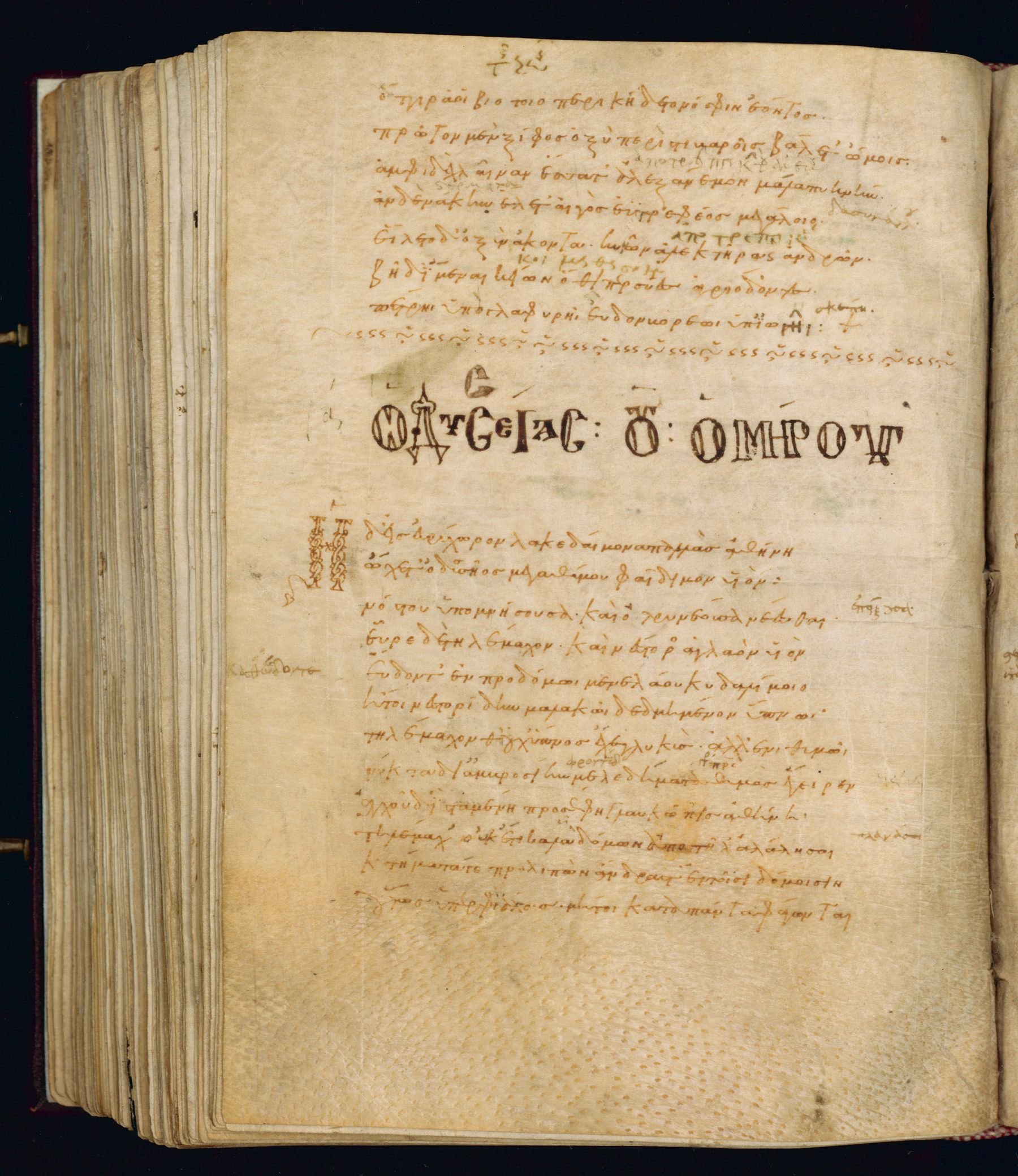
Where on the image
Laur. Plut. 32.24, fol. 144v: Odyssey 14.527-533, begins ‹ὅττι ῥά οἱ βιότου›, ends ‹εὗδον, Βορέω ὑπʼ ἰωγῇ.›. Checked on the image: first and last lines read and matched to the Greek. Fol. 144r ends with 14.526. The page holds 14.527-533, 15.1-12. Book 14 ends with 14.533, followed by a line of ornament with τέλος; the heading ὀδυσσείας ο ὁμήρου follows in capitals, and book 15 begins with a large decorated initial. English blocks here: 525-529, 530-533.
527ὅττι ῥά οἱ βιότου περικήδετο νόσφιν ἐόντος.
528πρῶτον μὲν ξίφος ὀξὺ περὶ στιβαροῖς βάλετʼ ὤμοις,
529ἀμφὶ δὲ χλαῖναν ἑέσσατʼ ἀλεξάνεμον, μάλα πυκνήν,
530ἂν δὲ νάκην ἕλετʼ αἰγὸς ἐϋτρεφέος μεγάλοιο,
531εἵλετο δʼ ὀξὺν ἄκοντα, κυνῶν ἀλκτῆρα καὶ ἀνδρῶν.
532βῆ δʼ ἴμεναι κείων ὅθι περ σύες ἀργιόδοντες
533πέτρῃ ὕπο γλαφυρῇ εὗδον, Βορέω ὑπʼ ἰωγῇ.
525liked not a bed in that place, that he should lay him down away from the boars; so he made ready to go outside. And Odysseus was glad that he took such care of his master's substance while he was afar. First Eumaeus flung his sharp sword over his strong shoulders, and then put about him a cloak, very thick, to keep off the wind; 530and he picked up the fleece of a large, well-fatted goat, took a sharp javelin to ward off dogs and men, and went forth to lie down to sleep where the white-tusked boars slept beneath a hollow rock, in a place sheltered from the North Wind.
Notes
- Greek: A. T. Murray, Homer: The Odyssey (Loeb Classical Library, 1919), via Perseus.
- English: A. T. Murray's translation in the same edition; his footnotes are omitted.
Cite
Sources
- Source: Laur. Plut. 32.24 (BML Teca Digitale IIIF) + Murray Greek (Loeb 1919, Perseus) + Murray English (Loeb 1919, Perseus) (holding institution)
- Critical edition: Murray, Loeb 1919, via Perseus
← previous · → next · v cycle view · l back to library