Homer, Odyssey, Book 17: Odysseus in his own hall as a beggar
Introduction
The Odyssey, composed around 700 BCE and attributed to Homer, tells of Odysseus' ten-year journey home from Troy and his return to Ithaca. Book 17 (606 lines): Odysseus in his own hall as a beggar.
The page photographs are from Florence, Biblioteca Medicea Laurenziana, Plut. 32.24 (parchment, 10th century, 234 folios; the oldest manuscript of the Odyssey with published images), in the Biblioteca Medicea Laurenziana's Teca Digitale. This book is on fol. 165r-177r; each section below is one page, with its first and last line as read on the photograph. Many pages carry interlinear glosses and a few marginal notes in later hands.
The Greek is A. T. Murray's Loeb text (1919) via Perseus, not a transcription of this manuscript, whose wording differs in places. The English is Murray's prose translation (1919), divided every five lines; at a page break a five-line block goes with the page holding most of it, except at the page breaks where a section's note says the English is cut at the end of Murray's sentence. Each section's note gives its English line range.
Where the scribe left out a line, wrote one in the margin, changed the order or added a line not in Murray's text, the section's note on the photograph says so; the Greek and English shown are Murray's full text for the page's range.
How was this verified? (Provenance)
Where on the image
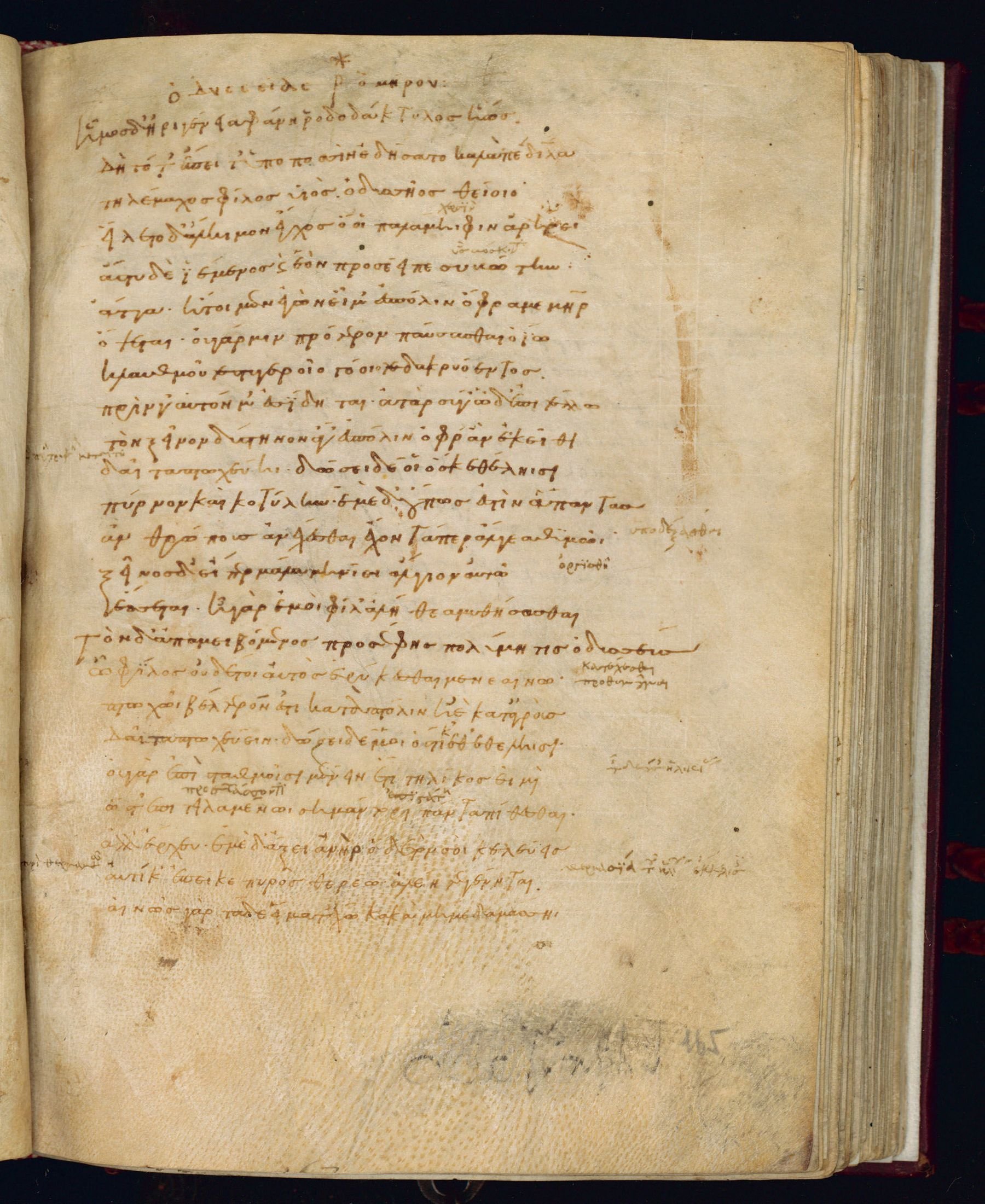
Laur. Plut. 32.24, fol. 165r: Odyssey 17.1-24, begins ‹ἦμος δʼ ἠριγένεια φάνη›, ends ‹κακά· μή με δαμάσσῃ›. Checked on the image: first and last lines read and matched to the Greek. Fol. 165v begins with 17.25. Book 17 begins at the top of the page under the heading ὀδυσσείας ρ ὁμήρου. English blocks here: 1-4, 5-9, 10-14, 15-19, 20-24.
1ἦμος δʼ ἠριγένεια φάνη ῥοδοδάκτυλος Ἠώς,
2δὴ τότʼ ἔπειθʼ ὑπὸ ποσσὶν ἐδήσατο καλὰ πέδιλα
3Τηλέμαχος, φίλος υἱὸς Ὀδυσσῆος θείοιο,
4εἵλετο δʼ ἄλκιμον ἔγχος, ὅ οἱ παλάμηφιν ἀρήρει,
5ἄστυδε ἱέμενος, καὶ ἑὸν προσέειπε συβώτην·
6ἄττʼ, ἦ τοι μὲν ἐγὼν εἶμʼ ἐς πόλιν, ὄφρα με μήτηρ
7ὄψεται· οὐ γάρ μιν πρόσθεν παύσεσθαι ὀΐω
8κλαυθμοῦ τε στυγεροῖο γόοιό τε δακρυόεντος,
9πρίν γʼ αὐτόν με ἴδηται· ἀτὰρ σοί γʼ ὧδʼ ἐπιτέλλω.
10τὸν ξεῖνον δύστηνον ἄγʼ ἐς πόλιν, ὄφρʼ ἂν ἐκεῖθι
11δαῖτα πτωχεύῃ· δώσει δέ οἱ ὅς κʼ ἐθέλῃσι
12πύρνον καὶ κοτύλην· ἐμὲ δʼ οὔ πως ἔστιν ἅπαντας
13ἀνθρώπους ἀνέχεσθαι, ἔχοντά περ ἄλγεα θυμῷ·
14ὁ ξεῖνος δʼ εἴ περ μάλα μηνίει, ἄλγιον αὐτῷ
15ἔσσεται· ἦ γὰρ ἐμοὶ φίλʼ ἀληθέα μυθήσασθαι.
16τὸν δʼ ἀπαμειβόμενος προσέφη πολύμητις Ὀδυσσεύς·
17ὦ φίλος, οὐδέ τοι αὐτὸς ἐρύκεσθαι μενεαίνω·
18πτωχῷ βέλτερόν ἐστι κατὰ πτόλιν ἠὲ κατʼ ἀγροὺς
19δαῖτα πτωχεύειν· δώσει δέ μοι ὅς κʼ ἐθέλῃσιν.
20οὐ γὰρ ἐπὶ σταθμοῖσι μένειν ἔτι τηλίκος εἰμί,
21ὥστʼ ἐπιτειλαμένῳ σημάντορι πάντα πιθέσθαι.
22ἀλλʼ ἔρχευ· ἐμὲ δʼ ἄξει ἀνὴρ ὅδε, τὸν σὺ κελεύεις,
23αὐτίκʼ ἐπεί κε πυρὸς θερέω ἀλέη τε γένηται.
24αἰνῶς γὰρ τάδε εἵματʼ ἔχω κακά· μή με δαμάσσῃ
1As soon as early Dawn appeared, the rosy-fingered, Telemachus, the dear son of divine Odysseus, bound beneath his feet his fair sandals and took his mighty spear, that fitted his grasp, 5hasting to the city; and he spoke to his swineherd, saying: “Father, I verily am going to the city, that my mother may see me, for, methinks, she will not cease from woeful wailing and tearful lamentation until she sees my very self. But to thee I give this charge. 10Lead this wretched stranger to the city, that there he may beg his food, and whoso will shall give him a loaf and a cup of water. For my part, I can in no wise burden myself with all men, seeing that I have grief at heart. But if the stranger is sore angered at this, 15it will be the worse for him. I verily love to speak the truth.” Then Odysseus of many wiles answered him, and said: “Friend, be sure I am not myself fain to be left here. For a beggar it is better to beg his food in the town than in the fields, and whoso will shall give it me. 20For I am no more of an age to remain at the farmstead, so as to obey in all things the command of an overseer. Nay, go thy way; this man that thou biddest will lead me as soon as I have warmed myself at the fire, and the sun has grown hot. For miserably poor are these garments which I wear, and I fear lest
Where on the image
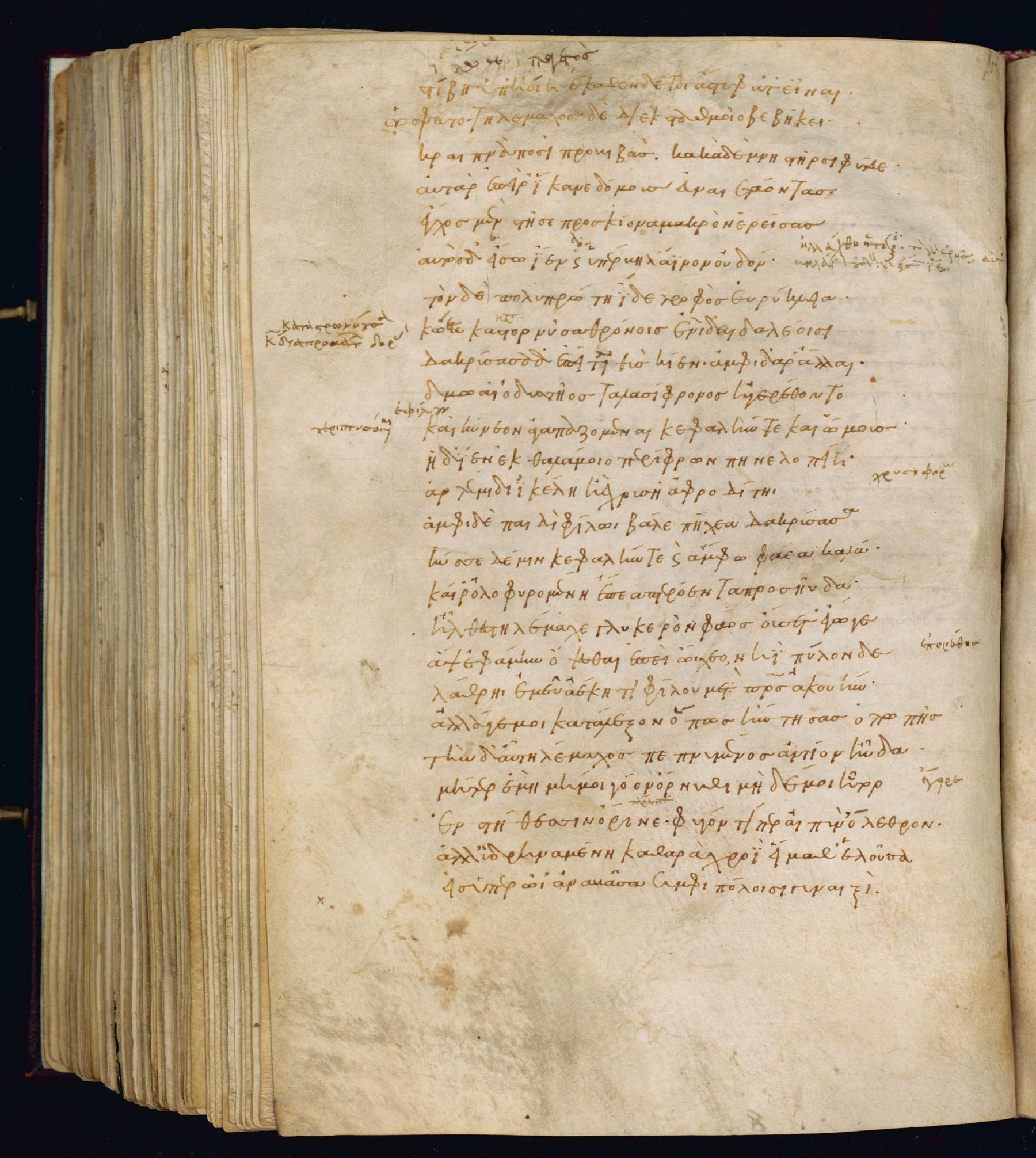
Laur. Plut. 32.24, fol. 165v: Odyssey 17.25-49, begins ‹στίβη ὑπηοίη· ἕκαθεν δέ›, ends ‹ἀναβᾶσα σὺν ἀμφιπόλοισι γυναιξὶν›. Checked on the image: first and last lines read and matched to the Greek. Fol. 165r ends with 17.24. Fol. 166r begins with 17.50. English blocks here: 25-29, 30-34, 35-39, 40-44, 45-49.
25στίβη ὑπηοίη· ἕκαθεν δέ τε ἄστυ φάτʼ εἶναι.
26ὣς φάτο, Τηλέμαχος δὲ διὰ σταθμοῖο βεβήκει,
27κραιπνὰ ποσὶ προβιβάς, κακὰ δὲ μνηστῆρσι φύτευεν.
28αὐτὰρ ἐπεί ῥʼ ἵκανε δόμους εὖ ναιετάοντας,
29ἔγχος μέν ῥʼ ἔστησε φέρων πρὸς κίονα μακρήν,
30αὐτὸς δʼ εἴσω ἴεν καὶ ὑπέρβη λάϊνον οὐδόν.
31τὸν δὲ πολὺ πρώτη εἶδε τροφὸς Εὐρύκλεια,
32κώεα καστορνῦσα θρόνοις ἔνι δαιδαλέοισι,
33δακρύσασα δʼ ἔπειτʼ ἰθὺς κίεν· ἀμφὶ δʼ ἄρʼ ἄλλαι
34δμῳαὶ Ὀδυσσῆος ταλασίφρονος ἠγερέθοντο,
35καὶ κύνεον ἀγαπαζόμεναι κεφαλήν τε καὶ ὤμους.
36ἡ δʼ ἴεν ἐκ θαλάμοιο περίφρων Πηνελόπεια,
37Ἀρτέμιδι ἰκέλη ἠὲ χρυσέῃ Ἀφροδίτῃ,
38ἀμφὶ δὲ παιδὶ φίλῳ βάλε πήχεε δακρύσασα,
39κύσσε δέ μιν κεφαλήν τε καὶ ἄμφω φάεα καλά,
40καί ῥʼ ὀλοφυρομένη ἔπεα πτερόεντα προσηύδα·
41ἦλθες, Τηλέμαχε, γλυκερὸν φάος. οὔ σʼ ἔτʼ ἐγώ γε
42ὄψεσθαι ἐφάμην, ἐπεὶ ᾤχεο νηῒ Πύλονδε
43λάθρη, ἐμεῦ ἀέκητι, φίλου μετὰ πατρὸς ἀκουήν.
44ἀλλʼ ἄγε μοι κατάλεξον ὅπως ἤντησας ὀπωπῆς.
45τὴν δʼ αὖ Τηλέμαχος πεπνυμένος ἀντίον ηὔδα·
46μῆτερ ἐμή, μή μοι γόον ὄρνυθι μηδέ μοι ἦτορ
47ἐν στήθεσσιν ὄρινε φυγόντι περ αἰπὺν ὄλεθρον·
48ἀλλʼ ὑδρηναμένη, καθαρὰ χροῒ εἵμαθʼ ἑλοῦσα,
49εἰς ὑπερῷʼ ἀναβᾶσα σὺν ἀμφιπόλοισι γυναιξὶν
25the morning frost may overcome me; and ye say it is far to the city.” So he spoke, and Telemachus passed out through the farmstead with rapid strides, and was sowing the seeds of evil for the wooers. But when he came to the stately house he set his spear in place, leaning it against a tall pillar, 30and himself went in and crossed the threshold of stone. Him the nurse Eurycleia was far the first to see, as she was spreading fleeces on the richly-wrought chairs. With a burst of tears she came straight toward him, and round about them gathered the other maids of Odysseus of the steadfast heart, 35and they kissed his head and shoulders in loving welcome. Then forth from her chamber came wise Penelope, like unto Artemis or golden Aphrodite, and bursting into tears she flung her arms about her dear son, and kissed his head and both his beautiful eyes; 40and with wailing she spoke to him winged words: “Thou art come, Telemachus, sweet light of my eyes; I thought I should never see thee more after thou hadst gone in thy ship to Pylos—secretly, and in my despite, to seek tidings of thy dear father. Come, then, tell me what sight thou hadst of him.” 45Then wise Telemachus answered her:“My mother, stir not lamentation, I pray thee, nor rouse the heart in my breast, seeing that I am escaped from utter destruction. Nay, bathe thyself, and take clean raiment for thy body, and then, going to thy upper chamber with thy handmaids,
Where on the image
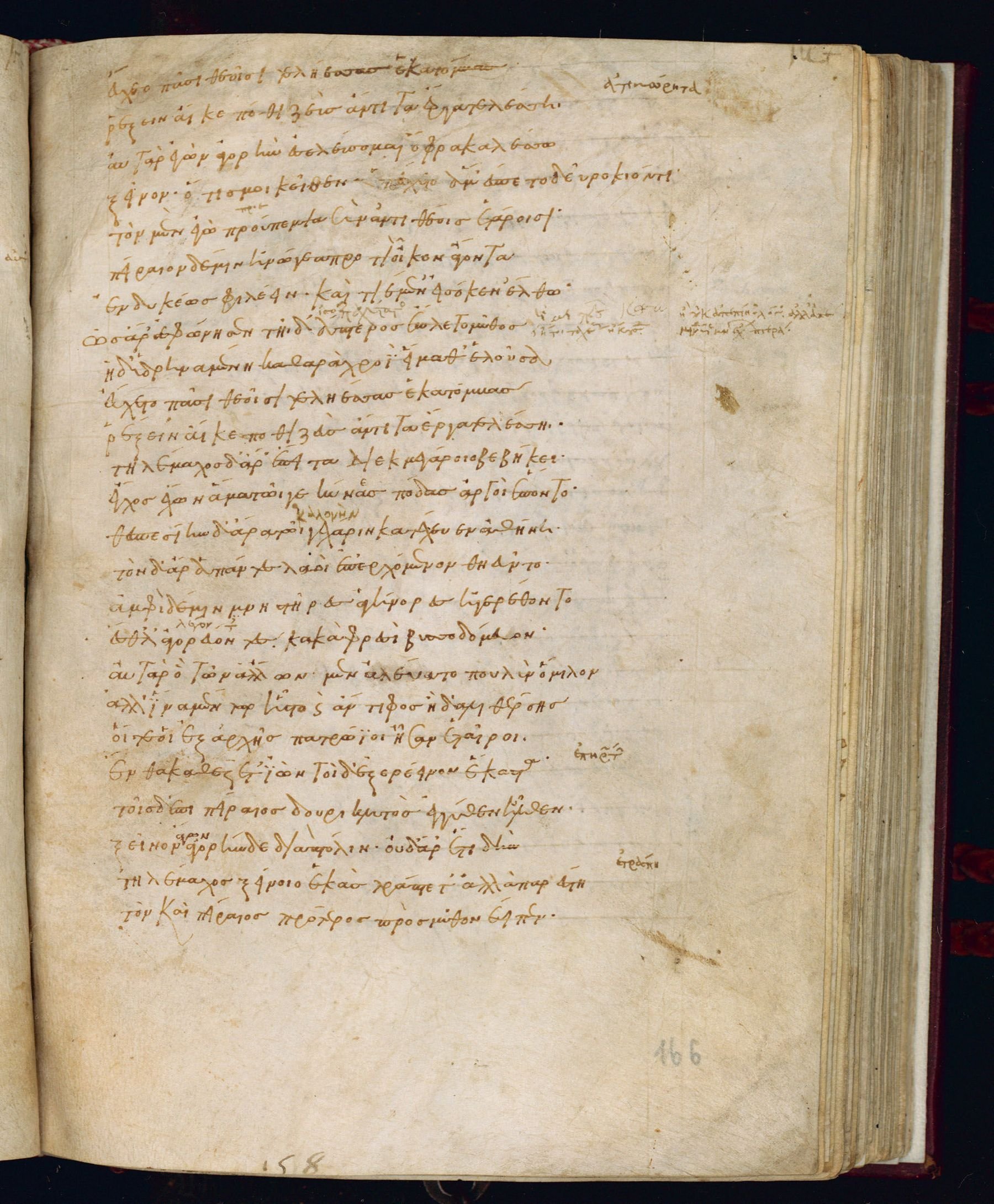
Laur. Plut. 32.24, fol. 166r: Odyssey 17.50-74, begins ‹εὔχεο πᾶσι θεοῖσι τεληέσσας›, ends ‹πρότερος πρὸς μῦθον ἔειπε·›. Checked on the image: first and last lines read and matched to the Greek. Fol. 165v ends with 17.49. Fol. 166v begins with 17.75. English blocks here: 50-54, 55-59, 60-64, 65-69, 70-74.
50εὔχεο πᾶσι θεοῖσι τεληέσσας ἑκατόμβας
51ῥέξειν, αἴ κέ ποθι Ζεὺς ἄντιτα ἔργα τελέσσῃ.
52αὐτὰρ ἐγὼν ἀγορὴν ἐσελεύσομαι, ὄφρα καλέσσω
53ξεῖνον, ὅτις μοι κεῖθεν ἅμʼ ἕσπετο δεῦρο κιόντι.
54τὸν μὲν ἐγὼ προὔπεμψα σὺν ἀντιθέοις ἑτάροισι,
55Πείραιον δέ μιν ἠνώγεα προτὶ οἶκον ἄγοντα
56ἐνδυκέως φιλέειν καὶ τιέμεν, εἰς ὅ κεν ἔλθω.
57ὣς ἄρʼ ἐφώνησεν, τῇ δʼ ἄπτερος ἔπλετο μῦθος.
58ἡ δʼ ὑδρηναμένη, καθαρὰ χροῒ εἵμαθʼ ἑλοῦσα,
59εὔχετο πᾶσι θεοῖσι τεληέσσας ἑκατόμβας
60ῥέξειν, αἴ κέ ποθι Ζεὺς ἄντιτα ἔργα τελέσσῃ.
61Τηλέμαχος δʼ ἄρʼ ἔπειτα διὲκ μεγάροιο βεβήκει
62ἔγχος ἔχων· ἅμα τῷ γε δύω κύνες ἀργοὶ ἕποντο.
63θεσπεσίην δʼ ἄρα τῷ γε χάριν κατέχευεν Ἀθήνη·
64τὸν δʼ ἄρα πάντες λαοὶ ἐπερχόμενον θηεῦντο.
65ἀμφὶ δέ μιν μνηστῆρες ἀγήνορες ἠγερέθοντο
66ἔσθλʼ ἀγορεύοντες, κακὰ δὲ φρεσὶ βυσσοδόμευον.
67αὐτὰρ ὁ τῶν μὲν ἔπειτα ἀλεύατο πουλὺν ὅμιλον,
68ἀλλʼ ἵνα Μέντωρ ἧστο καὶ Ἄντιφος ἠδʼ Ἁλιθέρσης,
69οἵ τε οἱ ἐξ ἀρχῆς πατρώϊοι ἦσαν ἑταῖροι,
70ἔνθα καθέζετʼ ἰών· τοὶ δʼ ἐξερέεινον ἕκαστα.
71τοῖσι δὲ Πείραιος δουρικλυτὸς ἐγγύθεν ἦλθεν
72ξεῖνον ἄγων ἀγορήνδε διὰ πτόλιν· οὐδʼ ἄρʼ ἔτι δὴν
73Τηλέμαχος ξείνοιο ἑκὰς τράπετʼ, ἀλλὰ παρέστη.
74τὸν καὶ Πείραιος πρότερος πρὸς μῦθον ἔειπε·
50vow to all the gods that thou wilt offer hecatombs that bring fulfillment, in the hope that Zeus may some day bring deeds of requital to pass. But I will go to the place of assembly that I may bid to our house a stranger who followed me from Pylos on my way hither. Him I sent forward with my godlike comrades, 55and I bade Peiraeus take him home and give him kindly welcome, and show him honor until I should come.” So he spoke, but her word remained unwinged. Then she bathed and took clean raiment for her body, and vowed to all the gods that she would offer hecatombs 60that bring fulfillment, in the hope that Zeus would some day bring deeds of requital to pass. But Telemachus thereafter went forth through the hall with his spear in his hand, and with him went two swift hounds. And wondrous was the grace that Athena shed upon him, and all the people marvelled at him as he came. 65Round about him the proud wooers thronged, speaking him fair, but pondering evil in the deep of their hearts. Howbeit he avoided the great throng of these men, but where Mentor sat, and Antiphus, and Halitherses, who were friends of his father's house of old, 70there he went and sat down, and they questioned him of each thing. Then Peiraeus, the famous spearman, drew near, leading the stranger through the city to the place of assembly; and Telemachus did not long turn away from his guest, but went up to him. Then Peiraeus was the first to speak, saying:
Where on the image
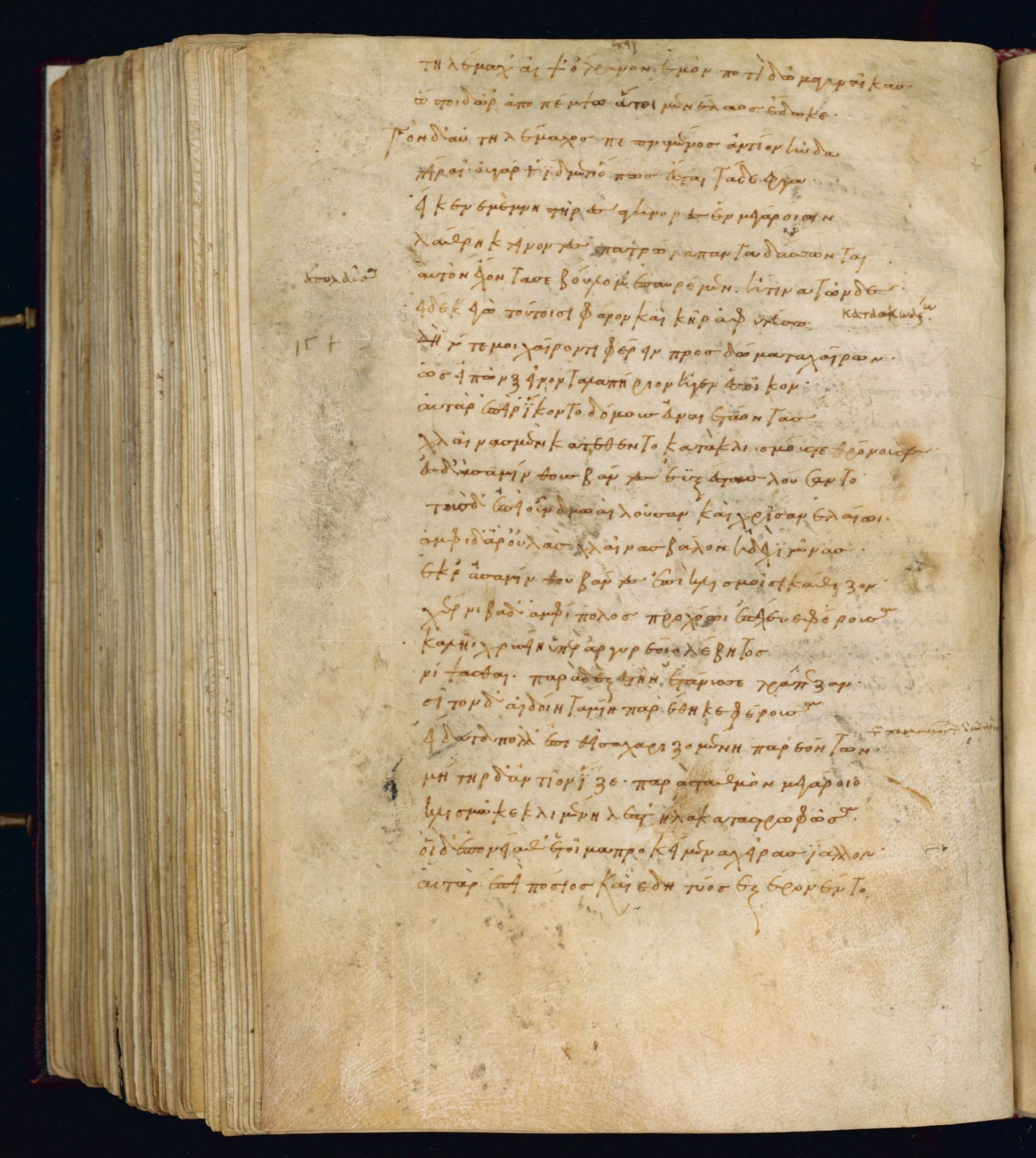
Laur. Plut. 32.24, fol. 166v: Odyssey 17.75-99, begins ‹Τηλέμαχʼ, αἶψʼ ὄτρυνον ἐμὸν›, ends ‹ἐδητύος ἐξ ἔρον ἕντο,›. Checked on the image: first and last lines read and matched to the Greek. Fol. 166r ends with 17.74. Fol. 167r begins with 17.100. English blocks here: 75-79, 80-83, 84-84, 85-89, 90-94, 95-99.
75Τηλέμαχʼ, αἶψʼ ὄτρυνον ἐμὸν ποτὶ δῶμα γυναῖκας,
76ὥς τοι δῶρʼ ἀποπέμψω, ἅ τοι Μενέλαος ἔδωκε.
77τὸν δʼ αὖ Τηλέμαχος πεπνυμένος ἀντίον ηὔδα·
78Πείραιʼ, οὐ γάρ τʼ ἴδμεν ὅπως ἔσται τάδε ἔργα.
79εἴ κεν ἐμὲ μνηστῆρες ἀγήνορες ἐν μεγάροισι
80λάθρη κτείναντες πατρώϊα πάντα δάσωνται,
81αὐτὸν ἔχοντά σε βούλομʼ ἐπαυρέμεν, ἤ τινα τῶνδε·
82εἰ δέ κʼ ἐγὼ τούτοισι φόνον καὶ κῆρα φυτεύσω,
83δὴ τότε μοι χαίροντι φέρειν πρὸς δώματα χαίρων.
84ὣς εἰπὼν ξεῖνον ταλαπείριον ἦγεν ἐς οἶκον.
85αὐτὰρ ἐπεί ῥʼ ἵκοντο δόμους εὖ ναιετάοντας,
86χλαίνας μὲν κατέθεντο κατὰ κλισμούς τε θρόνους τε,
87ἐς δʼ ἀσαμίνθους βάντες ἐϋξέστας λούσαντο.
88τοὺς δʼ ἐπεὶ οὖν δμῳαὶ λοῦσαν καὶ χρῖσαν ἐλαίῳ,
89ἀμφὶ δʼ ἄρα χλαίνας οὔλας βάλον ἠδὲ χιτῶνας,
90ἔκ ῥʼ ἀσαμίνθων βάντες ἐπὶ κλισμοῖσι καθῖζον.
91χέρνιβα δʼ ἀμφίπολος προχόῳ ἐπέχευε φέρουσα
92καλῇ χρυσείῃ, ὑπὲρ ἀργυρέοιο λέβητος,
93νίψασθαι· παρὰ δὲ ξεστὴν ἐτάνυσσε τράπεζαν.
94σῖτον δʼ αἰδοίη ταμίη παρέθηκε φέρουσα,
95εἴδατα πόλλʼ ἐπιθεῖσα, χαριζομένη παρεόντων.
96μήτηρ δʼ ἀντίον ἷζε παρὰ σταθμὸν μεγάροιο
97κλισμῷ κεκλιμένη, λέπτʼ ἠλάκατα στρωφῶσα.
98οἱ δʼ ἐπʼ ὀνείαθʼ ἑτοῖμα προκείμενα χεῖρας ἴαλλον,
99αὐτὰρ ἐπεὶ πόσιος καὶ ἐδητύος ἐξ ἔρον ἕντο,
75“Telemachus, quickly send women to my house, that I may send to thee the gifts which Menelaus gave thee.” Then wise Telemachus answered him: “Peiraeus, we know not how these things will be. If the proud wooers 80shall secretly slay me in my hall, and divide among them all the goods of my fathers, I would that thou shouldest keep and enjoy these things thyself rather than one of these. But if I shall sow for them the seeds of death and fate, then do thou bring all to my house gladly, as I shall be glad.” 84So saying, he led the sore-tired stranger to the house. 85Now when they had come to the stately house they laid their cloaks on the chairs and high seats, and went into the polished baths and bathed. And when the maids had bathed them and anointed them with oil, and had cast about them fleecy cloaks and tunics, 90they came forth from the baths and sat down upon the chairs. Then a handmaid brought water for the hands in a fair pitcher of gold, and poured it over a silver basin for them to wash, and beside them drew up a polished table. And the grave housewife brought and set before them bread, 95and therewith meats in abundance, granting freely of her store. And his mother sat over against Telemachus by the door-post of the hall, leaning against a chair and spinning fine threads of yarn. So they put forth their hands to the good cheer lying ready before them. But when they had put from them the desire of food and drink,
Where on the image
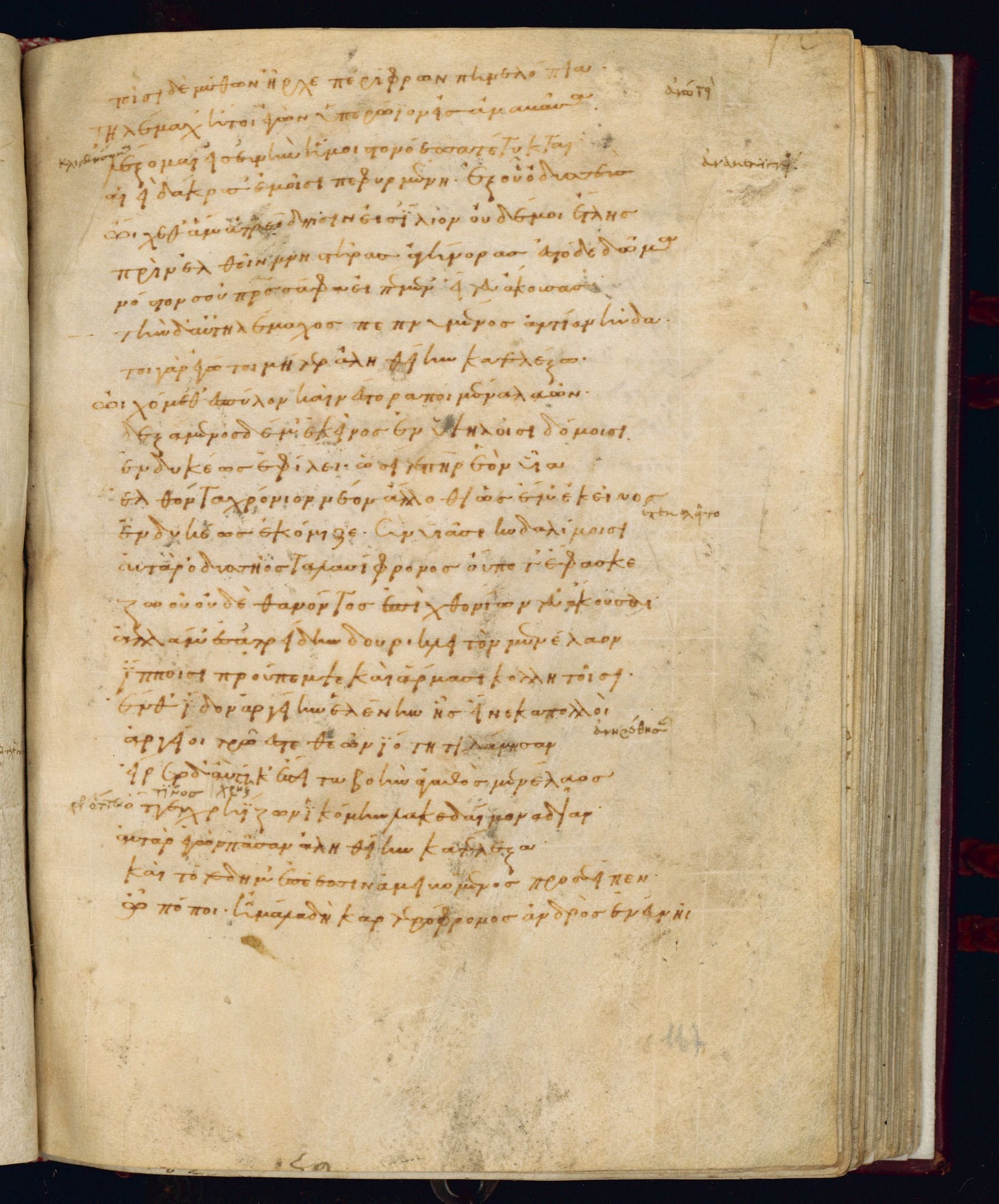
Laur. Plut. 32.24, fol. 167r: Odyssey 17.100-124, begins ‹τοῖσι δὲ μύθων ἦρχε›, ends ‹κρατερόφρονος ἀνδρὸς ἐν εὐνῇ›. Checked on the image: first and last lines read and matched to the Greek. Fol. 166v ends with 17.99. Fol. 167v begins with 17.125. English blocks here: 100-104, 105-109, 110-114, 115-119, 120-124.
100τοῖσι δὲ μύθων ἦρχε περίφρων Πηνελόπεια·
101Τηλέμαχʼ, ἦ τοι ἐγὼν ὑπερώϊον εἰσαναβᾶσα
102λέξομαι εἰς εὐνήν, ἥ μοι στονόεσσα τέτυκται,
103αἰεὶ δάκρυσʼ ἐμοῖσι πεφυρμένη, ἐξ οὗ Ὀδυσσεὺς
104ᾤχεθʼ ἅμʼ Ἀτρεΐδῃσιν ἐς Ἴλιον· οὐδέ μοι ἔτλης,
105πρὶν ἐλθεῖν μνηστῆρας ἀγήνορας ἐς τόδε δῶμα,
106νόστον σοῦ πατρὸς σάφα εἰπέμεν, εἴ που ἄκουσας.
107τὴν δʼ αὖ Τηλέμαχος πεπνυμένος ἀντίον ηὔδα·
108τοιγὰρ ἐγώ τοι, μῆτερ, ἀληθείην καταλέξω.
109ᾠχόμεθʼ ἔς τε Πύλον καὶ Νέστορα, ποιμένα λαῶν·
110δεξάμενος δέ με κεῖνος ἐν ὑψηλοῖσι δόμοισιν
111ἐνδυκέως ἐφίλει, ὡς εἴ τε πατὴρ ἑὸν υἱὸν
112ἐλθόντα χρόνιον νέον ἄλλοθεν· ὣς ἐμὲ κεῖνος
113ἐνδυκέως ἐκόμιζε σὺν υἱάσι κυδαλίμοισιν.
114αὐτὰρ Ὀδυσσῆος ταλασίφρονος οὔ ποτʼ ἔφασκεν,
115ζωοῦ οὐδὲ θανόντος, ἐπιχθονίων τευ ἀκοῦσαι·
116ἀλλά μʼ ἐς Ἀτρεΐδην, δουρικλειτὸν Μενέλαον,
117ἵπποισι προὔπεμψε καὶ ἅρμασι κολλητοῖσιν.
118ἔνθʼ ἴδον Ἀργείην Ἑλένην, ἧς εἵνεκα πολλὰ
119Ἀργεῖοι Τρῶές τε θεῶν ἰότητι μόγησαν.
120εἴρετο δʼ αὐτίκʼ ἔπειτα βοὴν ἀγαθὸς Μενέλαος
121ὅττευ χρηΐζων ἱκόμην Λακεδαίμονα δῖαν·
122αὐτὰρ ἐγὼ τῷ πᾶσαν ἀληθείην κατέλεξα·
123καὶ τότε δή με ἔπεσσιν ἀμειβόμενος προσέειπεν·
124ὢ πόποι, ἦ μάλα δὴ κρατερόφρονος ἀνδρὸς ἐν εὐνῇ
100the wise Penelope spoke first among them: “Telemachus, I truly will go to my upper chamber and lay me on my bed, which has become for me a bed of wailing, ever wet with my tears, since the day when Odysseus set forth with the sons of Atreus for Ilios. But thou tookest no care, 105before the proud wooers come into this house, to tell me plainly of the return of thy father, if haply thou heardest aught.” And wise Telemachus answered her: “Then verily, mother, I will tell thee all the truth. We went to Pylos and to Nestor, the shepherd of the people, 110and he received me in his lofty house and gave me kindly welcome, as a father might his own son who after a long time had newly come from a far: even so kindly he tended me with his glorious sons. Yet of Odysseus of the steadfast heart, 115whether living or dead, he said he had heard naught from any man on earth. But he sent me on my way with horses and jointed car to Menelaus, son of Atreus, the famous spearman. There I saw Argive Helen, for whose sake Argives and Trojans toiled much by the will of the gods. 120And straightway Menelaus, good at the war-cry, asked me in quest of what I had come to goodly Lacedaemon; and I told him all the truth. Then he made answer to me, and said: “‘Out upon them! for verily in the bed of a man of valiant heart
Where on the image
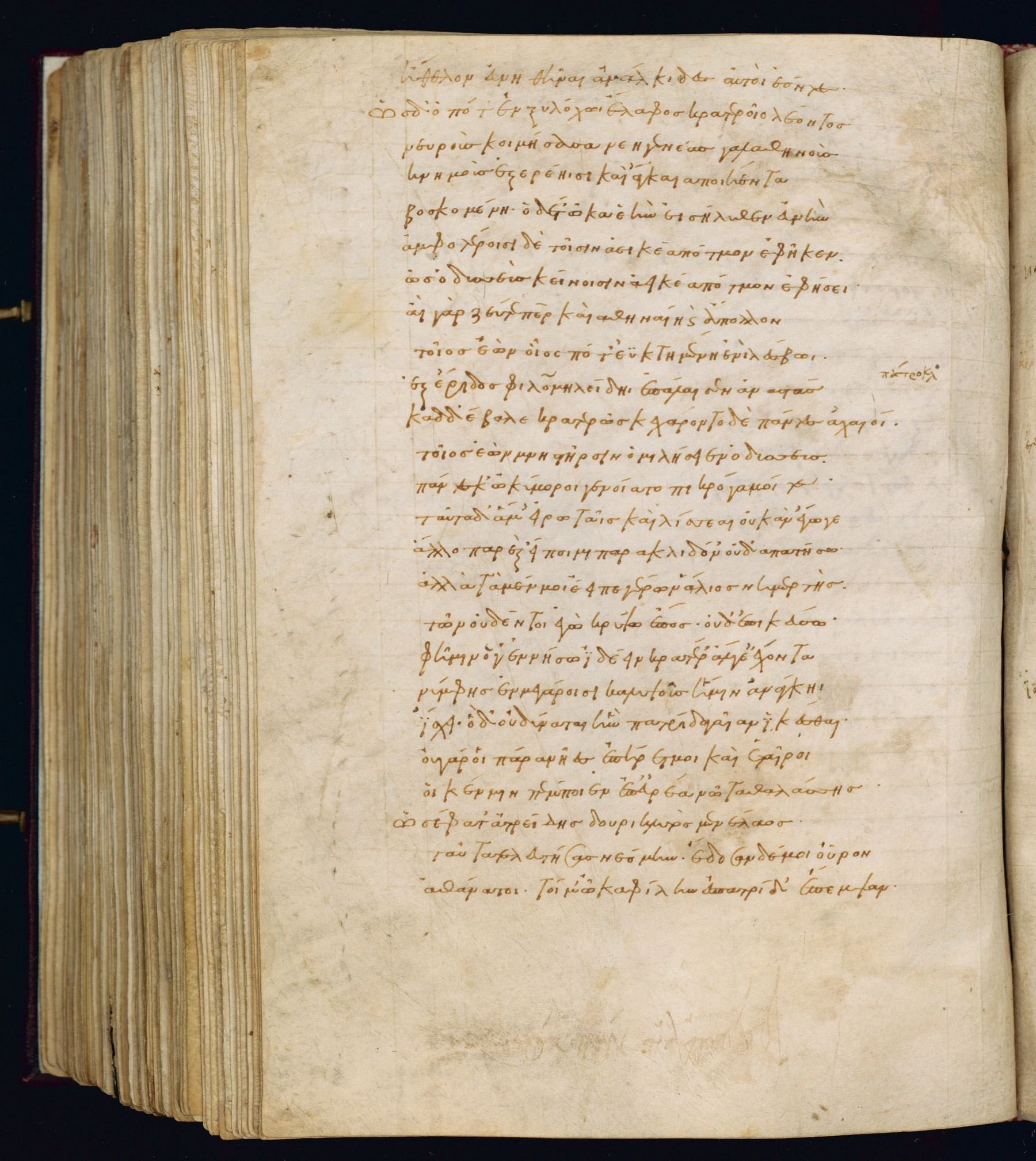
Laur. Plut. 32.24, fol. 167v: Odyssey 17.125-149, begins ‹ἤθελον εὐνηθῆναι, ἀνάλκιδες αὐτοὶ›, ends ‹φίλην ἐς πατρίδʼ ἔπεμψαν.›. Checked on the image: first and last lines read and matched to the Greek. Fol. 167r ends with 17.124. Fol. 168r begins with 17.150. English blocks here: 125-129, 130-134, 135-139, 140-144, 145-149.
125ἤθελον εὐνηθῆναι, ἀνάλκιδες αὐτοὶ ἐόντες.
126ὡς δʼ ὁπότʼ ἐν ξυλόχῳ ἔλαφος κρατεροῖο λέοντος
127νεβροὺς κοιμήσασα νεηγενέας γαλαθηνοὺς
128κνημοὺς ἐξερέῃσι καὶ ἄγκεα ποιήεντα
129βοσκομένη, ὁ δʼ ἔπειτα ἑὴν εἰσήλυθεν εὐνήν,
130ἀμφοτέροισι δὲ τοῖσιν ἀεικέα πότμον ἐφῆκεν,
131ὣς Ὀδυσεὺς κείνοισιν ἀεικέα πότμον ἐφήσει.
132αἲ γάρ, Ζεῦ τε πάτερ καὶ Ἀθηναίη καὶ Ἄπολλον,
133τοῖος ἐὼν οἷός ποτʼ ἐϋκτιμένῃ ἐνὶ Λέσβῳ
134ἐξ ἔριδος Φιλομηλεΐδῃ ἐπάλαισεν ἀναστάς,
135κὰδ δʼ ἔβαλε κρατερῶς, κεχάροντο δὲ πάντες Ἀχαιοί,
136τοῖος ἐὼν μνηστῆρσιν ὁμιλήσειεν Ὀδυσσεύς·
137πάντες κʼ ὠκύμοροί τε γενοίατο πικρόγαμοί τε.
138ταῦτα δʼ ἅ μʼ εἰρωτᾷς καὶ λίσσεαι, οὐκ ἂν ἐγώ γε
139ἄλλα παρὲξ εἴποιμι παρακλιδὸν οὐδʼ ἀπατήσω,
140ἀλλὰ τὰ μέν μοι ἔειπε γέρων ἅλιος νημερτής,
141τῶν οὐδέν τοι ἐγὼ κρύψω ἔπος οὐδʼ ἐπικεύσω.
142φῆ μιν ὅ γʼ ἐν νήσῳ ἰδέειν κρατέρʼ ἄλγεʼ ἔχοντα,
143νύμφης ἐν μεγάροισι Καλυψοῦς, ἥ μιν ἀνάγκῃ
144ἴσχει· ὁ δʼ οὐ δύναται ἣν πατρίδα γαῖαν ἱκέσθαι.
145οὐ γάρ οἱ πάρα νῆες ἐπήρετμοι καὶ ἑταῖροι,
146οἵ κέν μιν πέμποιεν ἐπʼ εὐρέα νῶτα θαλάσσης
147ὣς ἔφατʼ Ἀτρεΐδης, δουρικλειτὸς Μενέλαος.
148ταῦτα τελευτήσας νεόμην· ἔδοσαν δέ μοι οὖρον
149ἀθάνατοι, τοί μʼ ὦκα φίλην ἐς πατρίδʼ ἔπεμψαν.
125were they fain to lie, who are themselves cravens. Even as when in the thicket-lair of a mighty lion a hind has laid to sleep her new-born suckling fawns, and roams over the mountain slopes and grassy vales seeking pasture, and then the lion comes to his lair 130and upon the two lets loose a cruel doom, so will Odysseus let loose a cruel doom upon these men. I would, O father Zeus, and Athena, and Apollo, that in such strength, as when once in fair-stablished Lesbos he rose up and wrestled a match with Philomeleides 135and threw him mightily, and all the Achaeans rejoiced, even in such strength Odysseus might come among the wooers; then should they all find swift destruction and bitterness in their wooing. But in this matter of which thou dost ask and entreat me, verily I will not swerve aside to speak of other things, nor will I deceive thee; 140but of all that the unerring old man of the sea told me, not one thing will I hide from thee or conceal. He said that he had seen Odysseus in an island in grievous distress, in the halls of the nymph Calypso, who keeps him there perforce. And he cannot come to his own native land, for he has at hand no ships with oars, and no comrades, 145to send him on his way over the broad back of the sea.’ “So spoke Menelaus, son of Atreus, the famous spearman. Now when I had made an end of all this I set out for home, and the immortals gave me a fair wind and brought me quickly to my dear native land.”
Where on the image
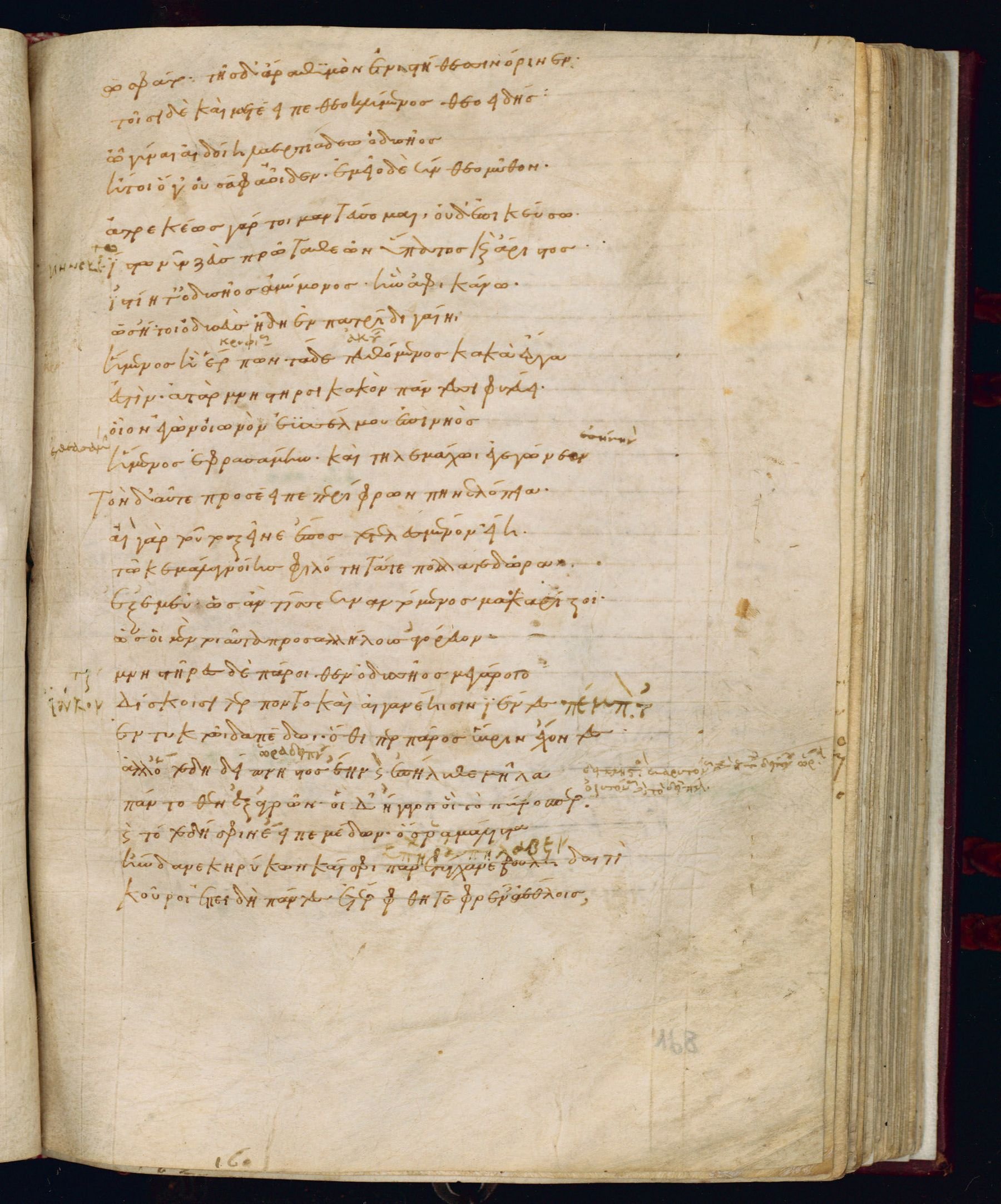
Laur. Plut. 32.24, fol. 168r: Odyssey 17.150-174, begins ‹ὣς φάτο, τῇ δʼ›, ends ‹πάντες ἐτέρφθητε φρένʼ ἀέθλοις,›. Checked on the image: first and last lines read and matched to the Greek. Fol. 167v ends with 17.149. Fol. 168v begins with 17.175. English blocks here: 150-154, 155-159, 160-164, 165-165, 166-169, 170-174.
150ὣς φάτο, τῇ δʼ ἄρα θυμὸν ἐνὶ στήθεσσιν ὄρινε.
151τοῖσι δὲ καὶ μετέειπε Θεοκλύμενος θεοειδής·
152ὦ γύναι αἰδοίη Λαερτιάδεω Ὀδυσῆος,
153ἦ τοι ὅ γʼ οὐ σάφα οἶδεν, ἐμεῖο δὲ σύνθεο μῦθον·
154ἀτρεκέως γάρ σοι μαντεύσομαι οὐδʼ ἐπικεύσω·
155ἴστω νῦν Ζεὺς πρῶτα θεῶν, ξενίη τε τράπεζα
156ἱστίη τʼ Ὀδυσῆος ἀμύμονος, ἣν ἀφικάνω,
157ὡς ἦ τοι Ὀδυσεὺς ἤδη ἐν πατρίδι γαίῃ,
158ἥμενος ἢ ἕρπων, τάδε πευθόμενος κακὰ ἔργα,
159ἔστιν, ἀτὰρ μνηστῆρσι κακὸν πάντεσσι φυτεύει·
160τοῖον ἐγὼν οἰωνὸν ἐϋσσέλμου ἐπὶ νηὸς
161ἥμενος ἐφρασάμην καὶ Τηλεμάχῳ ἐγεγώνευν.
162τὸν δʼ αὖτε προσέειπε περίφρων Πηνελόπεια·
163αἲ γὰρ τοῦτο, ξεῖνε, ἔπος τετελεσμένον εἴη·
164τῷ κε τάχα γνοίης φιλότητά τε πολλά τε δῶρα
165ἐξ ἐμεῦ, ὡς ἄν τίς σε συναντόμενος μακαρίζοι.
166ὣς οἱ μὲν τοιαῦτα πρὸς ἀλλήλους ἀγόρευον,
167μνηστῆρες δὲ πάροιθεν Ὀδυσσῆος μεγάροιο
168δίσκοισιν τέρποντο καὶ αἰγανέῃσιν ἱέντες,
169ἐν τυκτῷ δαπέδῳ, ὅθι περ πάρος ὕβριν ἔχοντες.
170ἀλλʼ ὅτε δὴ δείπνηστος ἔην καὶ ἐπήλυθε μῆλα
171πάντοθεν ἐξ ἀγρῶν, οἱ δʼ ἤγαγον οἳ τὸ πάρος περ,
172καὶ τότε δή σφιν ἔειπε Μέδων· ὃς γάρ ῥα μάλιστα
173ἥνδανε κηρύκων, καί σφιν παρεγίγνετο δαιτί·
174κοῦροι, ἐπεὶ δὴ πάντες ἐτέρφθητε φρένʼ ἀέθλοις,
150So he spoke, and stirred the heart in her breast. Then among them spoke also the godlike Theoclymenus, saying: “Honored wife of Odysseus, son of Laertes, he truly has no clear understanding; but do thou hearken to my words, for with certain knowledge will I prophesy to thee, and will hide naught. 155Be my witness Zeus above all gods, and this hospitable board and the hearth of noble Odysseus to which I am come, that verily Odysseus is even now in his native land, resting or moving, learning of these evil deeds, and he is sowing the seeds of evil for all the wooers. 160So plain a bird of omen did I mark as I sat on the benched ship, and I declared it to Telemachus.” Then wise Penelope answered him: “Ah, stranger, I would that this word of thine might be fulfilled. Then shouldest thou straightway know of kindness and many a gift 165from me, so that one who met thee would call the blessed.” 166Thus they spoke to one another. And the wooers meanwhile in front of the palace of Odysseus were making merry, throwing the discus and the javelin in a levelled place, as their wont was, in insolence of heart. 170But when it was the hour for dinner, and the flocks came in from all sides from the fields, and the men led them who were wont to lead, then Medon, who of all the heralds was most to their liking and was ever present at their feasts, spoke to them, saying: “Youths, now that you have all made glad your hearts with sport,
Where on the image
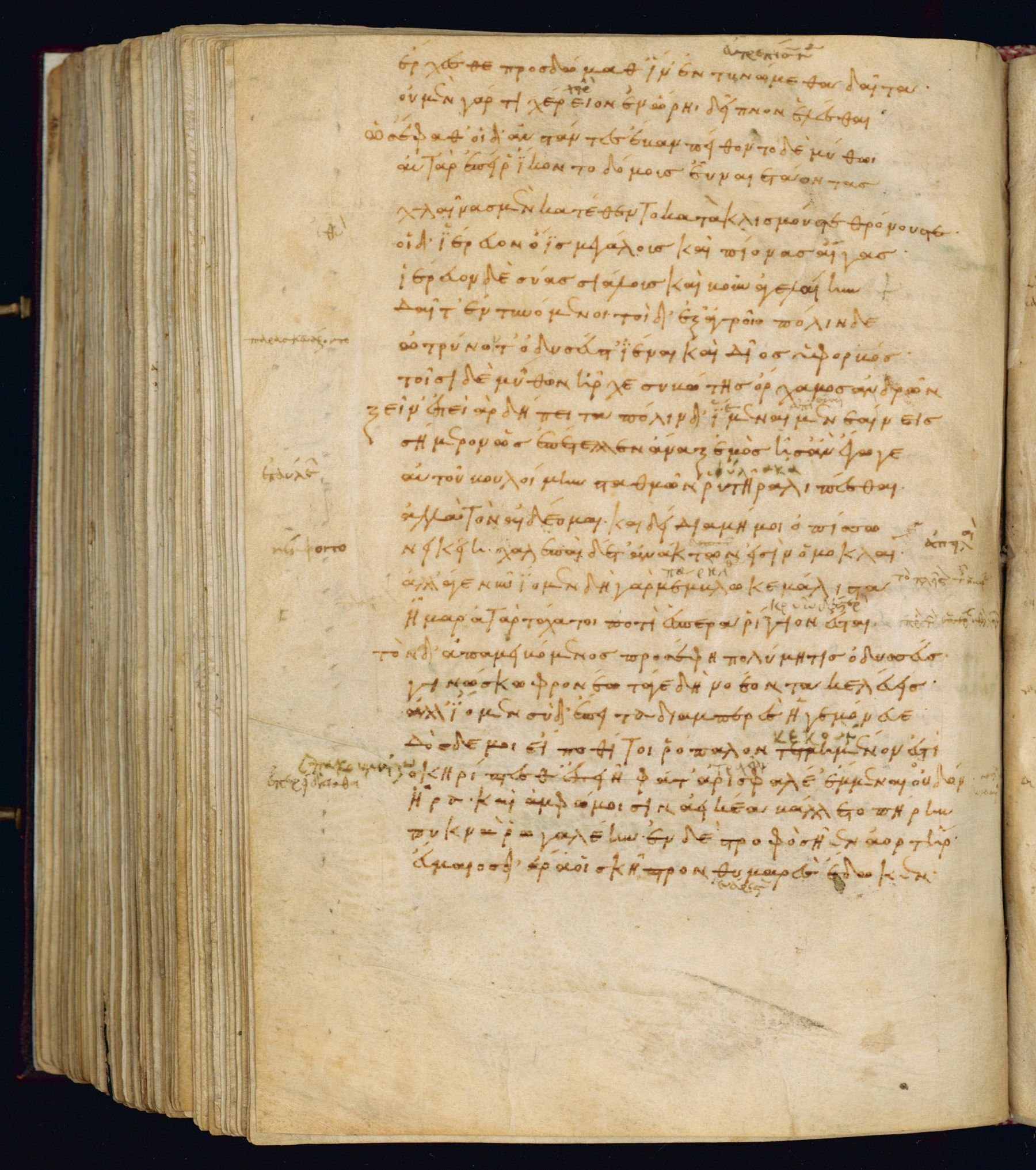
Laur. Plut. 32.24, fol. 168v: Odyssey 17.175-199, begins ‹ἔρχεσθε πρὸς δώμαθʼ, ἵνʼ›, ends ‹οἱ σκῆπτρον θυμαρὲς ἔδωκε.›. Checked on the image: first and last lines read and matched to the Greek. Fol. 168r ends with 17.174. Fol. 169r begins with 17.200. English blocks here: 175-179, 180-184, 185-189, 190-194, 195-199.
175ἔρχεσθε πρὸς δώμαθʼ, ἵνʼ ἐντυνώμεθα δαῖτα·
176οὐ μὲν γάρ τι χέρειον ἐν ὥρῃ δεῖπνον ἑλέσθαι.
177ὣς ἔφαθʼ, οἱ δʼ ἀνστάντες ἔβαν πείθοντό τε μύθῳ.
178αὐτὰρ ἐπεί ῥʼ ἵκοντο δόμους εὖ ναιετάοντας,
179χλαίνας μὲν κατέθεντο κατὰ κλισμούς τε θρόνους τε,
180οἱ δʼ ἱέρευον ὄϊς μεγάλους καὶ πίονας αἶγας,
181ἵρευον δὲ σύας σιάλους καὶ βοῦν ἀγελαίην,
182δαῖτʼ ἐντυνόμενοι. τοὶ δʼ ἐξ ἀγροῖο πόλινδε
183ὠτρύνοντʼ Ὀδυσεύς τʼ ἰέναι καὶ δῖος ὑφορβός.
184τοῖσι δὲ μύθων ἦρχε συβώτης, ὄρχαμος ἀνδρῶν·
185ξεῖνʼ, ἐπεὶ ἂρ δὴ ἔπειτα πόλινδʼ ἰέναι μενεαίνεις
186σήμερον, ὡς ἐπέτελλεν ἄναξ ἐμός—ἦ σʼ ἂν ἐγώ γε
187αὐτοῦ βουλοίμην σταθμῶν ῥυτῆρα λιπέσθαι·
188ἀλλὰ τὸν αἰδέομαι καὶ δείδια, μή μοι ὀπίσσω
189νεικείῃ· χαλεπαὶ δέ τʼ ἀνάκτων εἰσὶν ὁμοκλαί—
190ἀλλʼ ἄγε νῦν ἴομεν· δὴ γὰρ μέμβλωκε μάλιστα
191ἦμαρ, ἀτὰρ τάχα τοι ποτὶ ἕσπερα ῥίγιον ἔσται.
192τὸν δʼ ἀπαμειβόμενος προσέφη πολύμητις Ὀδυσσεύς·
193γιγνώσκω, φρονέω· τά γε δὴ νοέοντι κελεύεις.
194ἀλλʼ ἴομεν, σὺ δʼ ἔπειτα διαμπερὲς ἡγεμόνευε.
195δὸς δέ μοι, εἴ ποθί τοι ῥόπαλον τετμημένον ἐστίν,
196σκηρίπτεσθʼ, ἐπεὶ ἦ φατʼ ἀρισφαλέʼ ἔμμεναι οὐδόν.
197ἦ ῥα καὶ ἀμφʼ ὤμοισιν ἀεικέα βάλλετο πήρην,
198πυκνὰ ῥωγαλέην· ἐν δὲ στρόφος ἦεν ἀορτήρ·
199Εὔμαιος δʼ ἄρα οἱ σκῆπτρον θυμαρὲς ἔδωκε.
175come to the house that we may make ready a feast; for it is no bad thing to take one's dinner in season.” So he spoke, and they rose up and went, and hearkened to his word. And when they had come to the stately house they laid their cloaks on the chairs and high seats, 180and men fell to slaying great sheep and fat goats, aye, and fatted and swine, and a heifer of the herd, and so made ready the meal. But Odysseus and the goodly swineherd were making haste to go from the field to the city; and the swineherd, a leader of men, spoke first, and said: 185“Stranger, since thou art eager to go the city today, as my master bade—though for myself I would rather have thee left here to keep the farmstead; but I reverence and fear him, lest hereafter he chide me, and hard are the rebukes of masters— 190come now, let us go. The day is far spent, and soon thou wilt find it colder toward evening.” Then Odysseus of many wiles answered him, and said: “I see, I give heed; this thou biddest one with understanding. Come, let us go, and be thou my guide all the way. 195But give me a staff to lean upon, if thou hast one cut anywhere, for verily ye said that the way was treacherous.” He spoke, and flung about his shoulders his miserable wallet, full of holes, slung by a twisted cord, and Eumaeus gave him a staff to his liking.
Where on the image
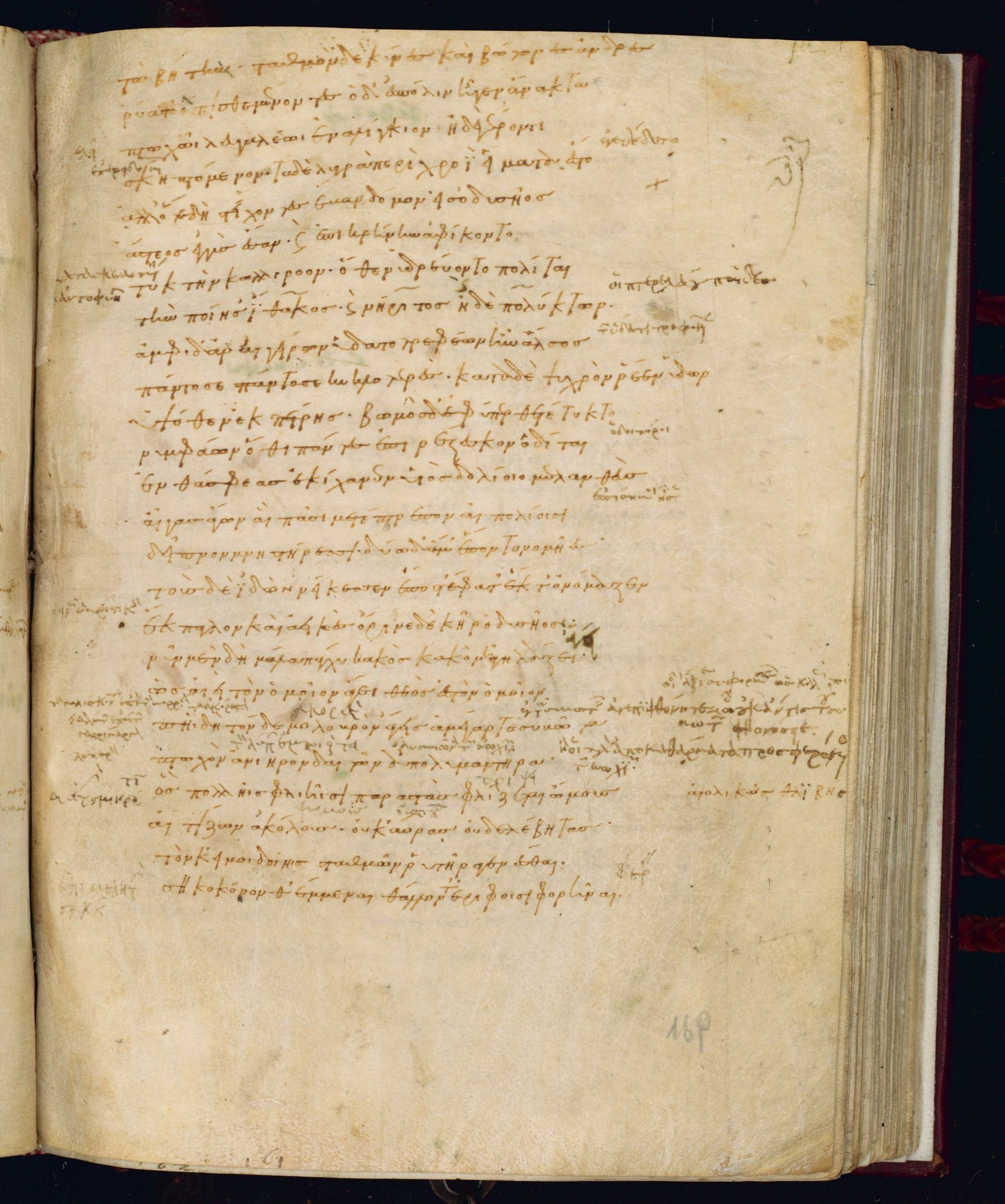
Laur. Plut. 32.24, fol. 169r: Odyssey 17.200-224, begins ‹τὼ βήτην, σταθμὸν δὲ›, ends ‹θαλλόν τʼ ἐρίφοισι φορῆναι,›. Checked on the image: first and last lines read and matched to the Greek. Fol. 168v ends with 17.199. Fol. 169v begins with 17.225. English blocks here: 200-203, 204-204, 205-209, 210-214, 215-219, 220-224.
200τὼ βήτην, σταθμὸν δὲ κύνες καὶ βώτορες ἄνδρες
201ῥύατʼ ὄπισθε μένοντες· ὁ δʼ ἐς πόλιν ἦγεν ἄνακτα
202πτωχῷ λευγαλέῳ ἐναλίγκιον ἠδὲ γέροντι,
203σκηπτόμενον· τὰ δὲ λυγρὰ περὶ χροῒ εἵματα ἕστο.
204ἀλλʼ ὅτε δὴ στείχοντες ὁδὸν κάτα παιπαλόεσσαν
205ἄστεος ἐγγὺς ἔσαν καὶ ἐπὶ κρήνην ἀφίκοντο
206τυκτὴν καλλίροον, ὅθεν ὑδρεύοντο πολῖται,
207τὴν ποίησʼ Ἴθακος καὶ Νήριτος ἠδὲ Πολύκτωρ·
208ἀμφὶ δʼ ἄρʼ αἰγείρων ὑδατοτρεφέων ἦν ἄλσος,
209πάντοσε κυκλοτερές, κατὰ δὲ ψυχρὸν ῥέεν ὕδωρ
210ὑψόθεν ἐκ πέτρης· βωμὸς δʼ ἐφύπερθε τέτυκτο
211νυμφάων, ὅθι πάντες ἐπιρρέζεσκον ὁδῖται·
212ἔνθα σφέας ἐκίχανʼ υἱὸς Δολίοιο Μελανθεὺς
213αἶγας ἄγων, αἳ πᾶσι μετέπρεπον αἰπολίοισι,
214δεῖπνον μνηστήρεσσι· δύω δʼ ἅμʼ ἕποντο νομῆες.
215τοὺς δὲ ἰδὼν νείκεσσεν ἔπος τʼ ἔφατʼ ἔκ τʼ ὀνόμαζεν,
216ἔκπαγλον καὶ ἀεικές· ὄρινε δὲ κῆρ Ὀδυσῆος·
217νῦν μὲν δὴ μάλα πάγχυ κακὸς κακὸν ἡγηλάζει,
218ὡς αἰεὶ τὸν ὁμοῖον ἄγει θεὸς ὡς τὸν ὁμοῖον.
219πῇ δὴ τόνδε μολοβρὸν ἄγεις, ἀμέγαρτε συβῶτα,
220πτωχὸν ἀνιηρόν δαιτῶν ἀπολυμαντῆρα;
221ὃς πολλῇς φλιῇσι παραστὰς θλίψεται ὤμους,
222αἰτίζων ἀκόλους, οὐκ ἄορας οὐδὲ λέβητας·
223τόν κʼ εἴ μοι δοίης σταθμῶν ῥυτῆρα γενέσθαι
224σηκοκόρον τʼ ἔμεναι θαλλόν τʼ ἐρίφοισι φορῆναι,
200So they two set forth, and the dogs and the herdsmen stayed behind to guard the farmstead; but the swineherd led his master to the city in the likeness of a woeful and aged beggar, leaning on a staff; and miserable was the raiment that he wore about his body. 204But when, as they went along the rugged path, 205they were near the city, and had come to a well-wrought, fair-flowing fountain, wherefrom the townsfolk drew water—this Ithacus had made, and Neritus, and Polyctor, and around was a grove of poplars, that grow by the waters, circling it on all sides, and down the cold water flowed 210from the rock above, and on the top was built an altar to the nymphs where all passers-by made offerings—there Melantheus, son of Dolius, met them as he was driving his she-goats, the best that were in all the herds, to make a feast for the wooers; and two herdsmen followed with him. 215As he saw them, he spoke and addressed them, and reviled them in terrible and unseemly words, and stirred the heart of Odysseus: “Lo, now, in very truth the vile leads the vile. As ever, the god is bringing like and like together. Whither, pray, art thou leading this filthy wretch, thou miserable swineherd, 220this nuisance of a beggar to mar our feasts? He is a man to stand and rub his shoulders on many doorposts, begging for scraps, not for swords or cauldrons. If thou wouldest give me this fellow to keep my farmstead, to sweep out the pens and to carry young shoots to the kids,
Where on the image
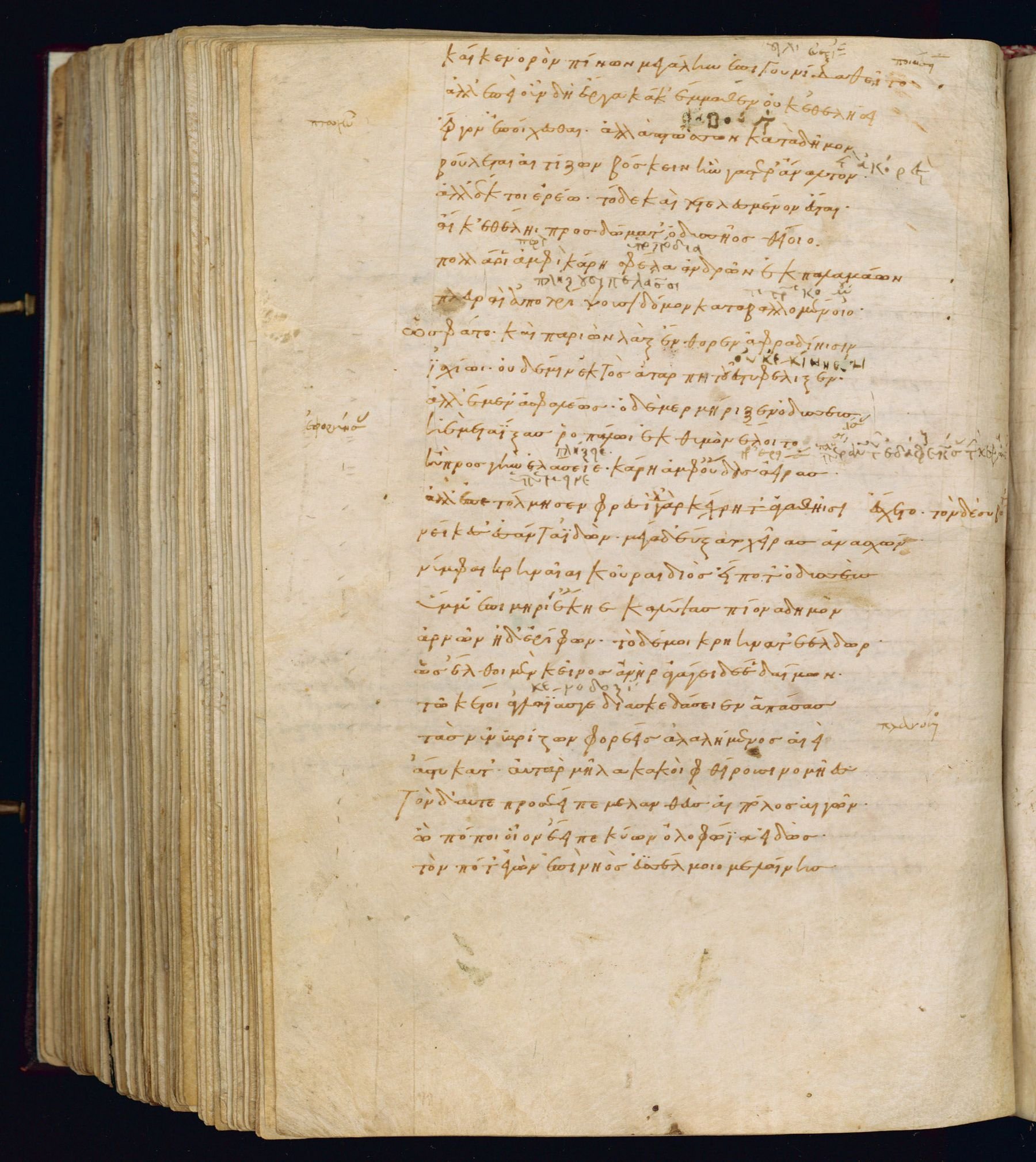
Laur. Plut. 32.24, fol. 169v: Odyssey 17.225-249, begins ‹καί κεν ὀρὸν πίνων›, ends ‹ἐπὶ νηὸς ἐϋσσέλμοιο μελαίνης›. Checked on the image: first and last lines read and matched to the Greek. Fol. 169r ends with 17.224. Fol. 170r begins with 17.250. English blocks here: 225-229, 230-234, 235-239, 240-244, 245-246, 247-249.
225καί κεν ὀρὸν πίνων μεγάλην ἐπιγουνίδα θεῖτο.
226ἀλλʼ ἐπεὶ οὖν δὴ ἔργα κάκʼ ἔμμαθεν, οὐκ ἐθελήσει
227ἔργον ἐποίχεσθαι, ἀλλὰ πτώσσων κατὰ δῆμον
228βούλεται αἰτίζων βόσκειν ἣν γαστέρʼ ἄναλτον.
229ἀλλʼ ἔκ τοι ἐρέω, τὸ δὲ καὶ τετελεσμένον ἔσται·
230αἴ κʼ ἔλθῃ πρὸς δώματʼ Ὀδυσσῆος θείοιο,
231πολλά οἱ ἀμφὶ κάρη σφέλα ἀνδρῶν ἐκ παλαμάων
232πλευραὶ ἀποτρίψουσι δόμον κάτα βαλλομένοιο.
233ὣς φάτο, καὶ παριὼν λὰξ ἔνθορεν ἀφραδίῃσιν
234ἰσχίῳ· οὐδέ μιν ἐκτὸς ἀταρπιτοῦ ἐστυφέλιξεν,
235ἀλλʼ ἔμενʼ ἀσφαλέως· ὁ δὲ μερμήριξεν Ὀδυσσεὺς
236ἠὲ μεταΐξας ῥοπάλῳ ἐκ θυμὸν ἕλοιτο,
237ἦ πρὸς γῆν ἐλάσειε κάρη ἀμφουδὶς ἀείρας.
238ἀλλʼ ἐπετόλμησε, φρεσὶ δʼ ἔσχετο· τὸν δὲ συβώτης
239νείκεσʼ ἐσάντα ἰδών, μέγα δʼ εὔξατο χεῖρας ἀνασχών·
240νύμφαι κρηναῖαι, κοῦραι Διός, εἴ ποτʼ Ὀδυσσεὺς
241ὔμμʼ ἐπὶ μηρίʼ ἔκηε, καλύψας πίονι δημῷ,
242ἀρνῶν ἠδʼ ἐρίφων, τόδε μοι κρηήνατʼ ἐέλδωρ,
243ὡς ἔλθοι μὲν κεῖνος ἀνήρ, ἀγάγοι δέ ἑ δαίμων·
244τῷ κέ τοι ἀγλαΐας γε διασκεδάσειεν ἁπάσας,
245τὰς νῦν ὑβρίζων φορέεις, ἀλαλήμενος αἰεὶ
246ἄστυ κάτʼ· αὐτὰρ μῆλα κακοὶ φθείρουσι νομῆες.
247τὸν δʼ αὖτε προσέειπε Μελάνθιος, αἰπόλος αἰγῶν·
248ὢ πόποι, οἷον ἔειπε κύων ὀλοφώϊα εἰδώς,
249τόν ποτʼ ἐγὼν ἐπὶ νηὸς ἐϋσσέλμοιο μελαίνης
225then by drinking whey he might get himself a sturdy thigh. But since he has learned only deeds of evil, he will not care to busy himself with work, but is minded rather to go skulking through the land, that by begging he may feed his insatiate belly. But I will speak out to thee, and this word shall verily be brought to pass. 230If he comes to the palace of divine Odysseus, many a footstool, hurled about his head by the hands of those that are men, shall be broken on his ribs as he is pelted through the house.” So he spoke, and as he passed he kicked Odysseus on the hip in his folly, yet he did not drive him from the path, 235but he stood steadfast. And Odysseus pondered whether he should leap upon him and take his life with his staff, or seize him round about, and lift him up, and dash his head upon the ground. Yet he endured, and stayed him from his purpose. And the swineherd looked the man in the face, and rebuked him, and lifted up his hands, and prayed aloud: 240“Nymphs of the fountain, daughters of Zeus, if ever Odysseus burned upon your altars pieces of the thighs of lambs or kids, wrapped in rich fat, fulfil for me this prayer; grant that he, my master, may come back, and that some god may guide him. Then would he scatter all the proud airs 245which now thou puttest on in thy insolence,ever roaming about the city, while evil herdsmen destroy the flock.” 247Then Melanthius, the goatherd, answered him: “Lo now, how the cur talks, his mind full of mischief. Him will I some day
Where on the image
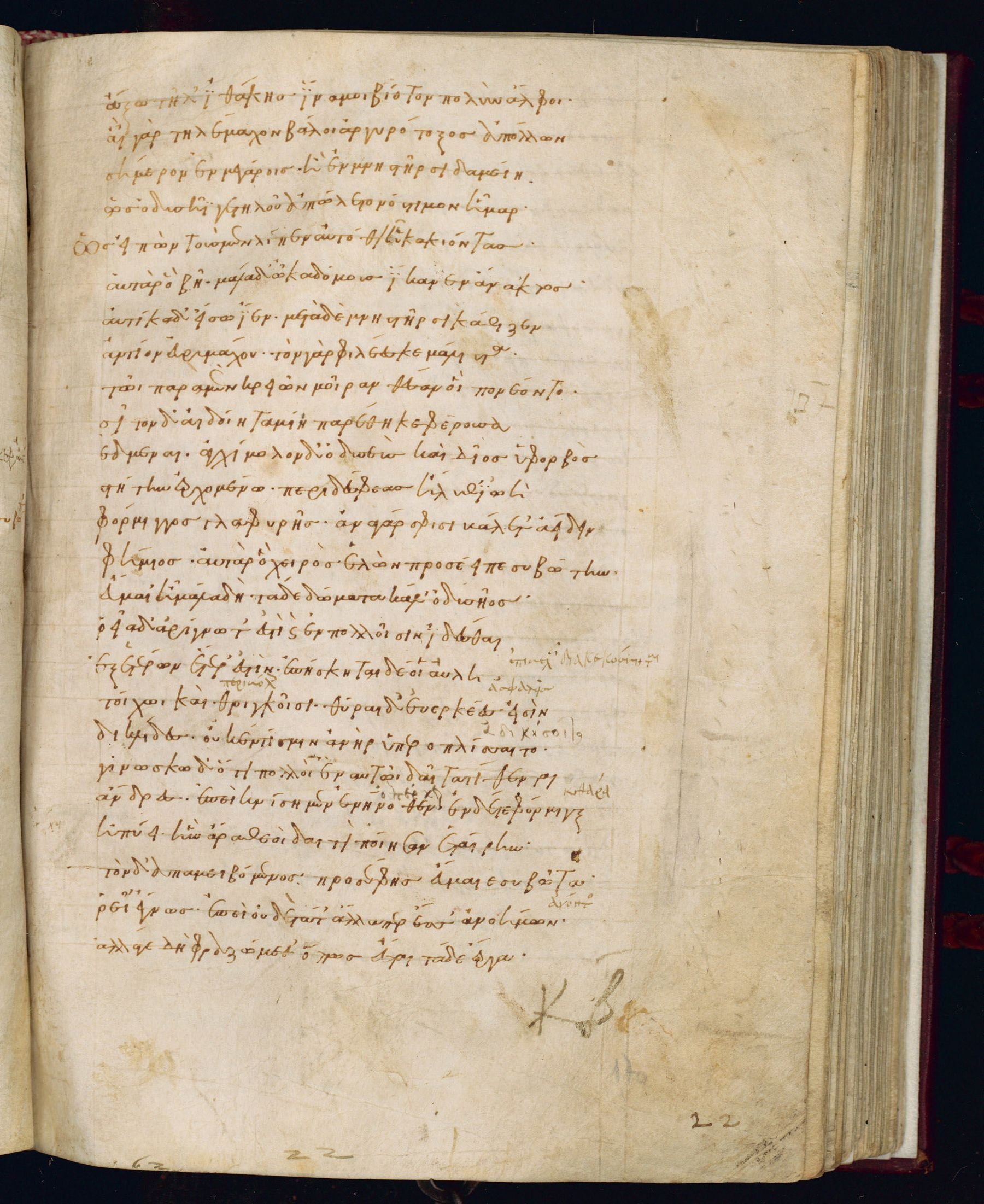
Laur. Plut. 32.24, fol. 170r: Odyssey 17.250-274, begins ‹ἄξω τῆλʼ Ἰθάκης, ἵνα›, ends ‹ὅπως ἔσται τάδε ἔργα.›. Checked on the image: first and last lines read and matched to the Greek. Fol. 169v ends with 17.249. Fol. 170v begins with 17.275. English blocks here: 250-254, 255-259, 260-264, 265-269, 270-274.
250ἄξω τῆλʼ Ἰθάκης, ἵνα μοι βίοτον πολὺν ἄλφοι.
251αἲ γὰρ Τηλέμαχον βάλοι ἀργυρότοξος Ἀπόλλων
252σήμερον ἐν μεγάροις, ἢ ὑπὸ μνηστῆρσι δαμείη,
253ὡς Ὀδυσῆΐ γε τηλοῦ ἀπώλετο νόστιμον ἦμαρ.
254ὣς εἰπὼν τοὺς μὲν λίπεν αὐτοῦ ἦκα κιόντας,
255αὐτὰρ ὁ βῆ, μάλα δʼ ὦκα δόμους ἵκανεν ἄνακτος.
256αὐτίκα δʼ εἴσω ἴεν, μετὰ δὲ μνηστῆρσι καθῖζεν,
257ἀντίον Εὐρυμάχου· τὸν γὰρ φιλέεσκε μάλιστα.
258τῷ πάρα μὲν κρειῶν μοῖραν θέσαν οἳ πονέοντο,
259σῖτον δʼ αἰδοίη ταμίη παρέθηκε φέρουσα
260ἔδμεναι. ἀγχίμολον δʼ Ὀδυσεὺς καὶ δῖος ὑφορβὸς
261στήτην ἐρχομένω, περὶ δέ σφεας ἤλυθʼ ἰωὴ
262φόρμιγγος γλαφυρῆς· ἀνὰ γάρ σφισι βάλλετʼ ἀείδειν
263Φήμιος· αὐτὰρ ὁ χειρὸς ἑλὼν προσέειπε συβώτην·
264Εὔμαιʼ, ἦ μάλα δὴ τάδε δώματα κάλʼ Ὀδυσῆος,
265ῥεῖα δʼ ἀρίγνωτʼ ἐστὶ καὶ ἐν πολλοῖσιν ἰδέσθαι.
266ἐξ ἑτέρων ἕτερʼ ἐστίν, ἐπήσκηται δέ οἱ αὐλὴ
267τοίχῳ καὶ θριγκοῖσι, θύραι δʼ εὐερκέες εἰσὶ
268δικλίδες· οὐκ ἄν τίς μιν ἀνὴρ ὑπεροπλίσσαιτο.
269γιγνώσκω δʼ ὅτι πολλοὶ ἐν αὐτῷ δαῖτα τίθενται
270ἄνδρες, ἐπεὶ κνίση μὲν ἀνήνοθεν, ἐν δέ τε φόρμιγξ
271ἠπύει, ἣν ἄρα δαιτὶ θεοὶ ποίησαν ἑταίρην.
272τὸν δʼ ἀπαμειβόμενος προσέφης, Εὔμαιε συβῶτα·
273ῥεῖʼ ἔγνως, ἐπεὶ οὐδὲ τά τʼ ἄλλα πέρ ἐσσʼ ἀνοήμων.
274ἀλλʼ ἄγε δὴ φραζώμεθʼ ὅπως ἔσται τάδε ἔργα.
250take on a black, benched ship far from Ithaca, that he may bring me in much wealth. Would that Apollo, of the silver bow, might smite Telemachus to-day in the halls, or that he might be slain by the wooers, as surely as for Odysseus in a far land the day of return has been lost.” So saying, he left them there, as they walked slowly on, 255but himself strode forward and right swiftly came to the palace of the king. Straightway he entered in and sat down among the wooers over against Eurymachus, for he loved him best of all. Then by him those that served set a portion of meat, and the grave housewife brought and set before him bread, 260for him to eat. And Odysseus and the goodly swineherd halted as they drew nigh, and about them rang the sound of the hollow lyre, for Phemius was striking the chords to sing before the wooers. Then Odysseus clasped the swineherd by the hand, and said: “Eumaeus, surely this is the beautiful house of Odysseus. 265Easily might it be known, though seen among many. There is building upon building, and the court is built with wall and coping, and the double gates are well-fenced; no man may scorn it. And I mark that in the house itself many 270men are feasting: for the savour of meat arises from it, and therewith resounds the voice of the lyre, which the gods have made the companion of the feast.” To him then, swineherd Eumaeus, didst thou make answer, and say: “Easily hast thou marked it, for in all things thou art ready of wit. But come, let us take thought how these things shall be.
Where on the image
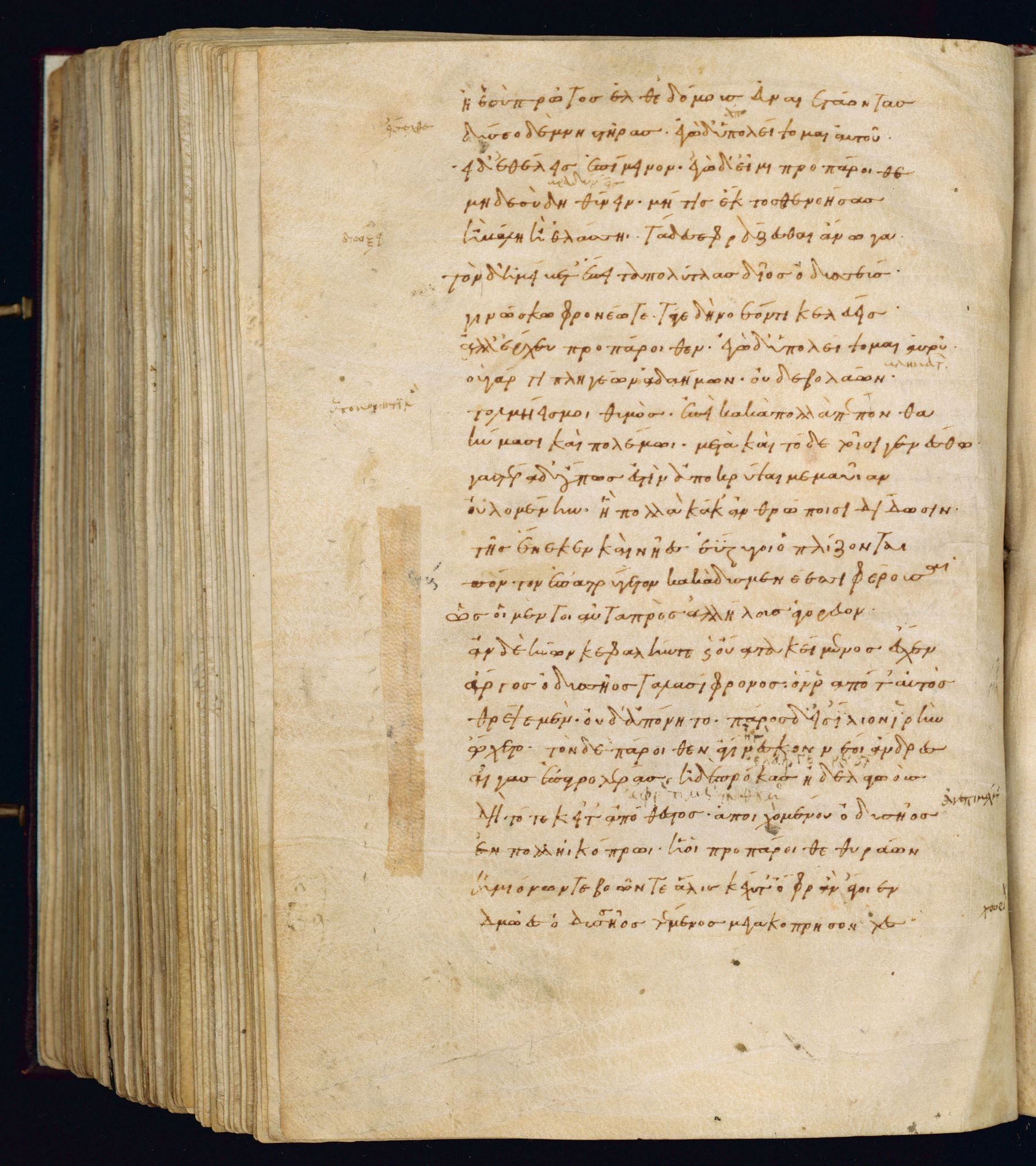
Laur. Plut. 32.24, fol. 170v: Odyssey 17.275-299, begins ‹ἠὲ σὺ πρῶτος ἔσελθε›, ends ‹Ὀδυσσῆος τέμενος μέγα κοπρήσοντες·›. Checked on the image: first and last lines read and matched to the Greek. Fol. 170r ends with 17.274. Fol. 171r begins with 17.300. English blocks here: 275-279, 280-284, 285-289, 290-294, 295-299.
275ἠὲ σὺ πρῶτος ἔσελθε δόμους εὖ ναιετάοντας,
276δύσεο δὲ μνηστῆρας, ἐγὼ δʼ ὑπολείψομαι αὐτοῦ·
277εἰ δʼ ἐθέλεις, ἐπίμεινον, ἐγὼ δʼ εἶμι προπάροιθε·
278μηδὲ σὺ δηθύνειν, μή τίς σʼ ἔκτοσθε νοήσας
279ἢ βάλῃ ἢ ἐλάσῃ· τὰ δέ σε φράζεσθαι ἄνωγα.
280τὸν δʼ ἠμείβετʼ ἔπειτα πολύτλας δῖος Ὀδυσσεύς·
281γιγνώσκω, φρονέω· τά γε δὴ νοέοντι κελεύεις.
282ἀλλʼ ἔρχευ προπάροιθεν, ἐγὼ δʼ ὑπολείψομαι αὐτοῦ.
283οὐ γάρ τι πληγέων ἀδαήμων οὐδὲ βολάων·
284τολμήεις μοι θυμός, ἐπεὶ κακὰ πολλὰ πέπονθα
285κύμασι καὶ πολέμῳ· μετὰ καὶ τόδε τοῖσι γενέσθω·
286γαστέρα δʼ οὔ πως ἔστιν ἀποκρύψαι μεμαυῖαν,
287οὐλομένην, ἣ πολλὰ κάκʼ ἀνθρώποισι δίδωσι,
288τῆς ἕνεκεν καὶ νῆες ἐΰζυγοι ὁπλίζονται
289πόντον ἐπʼ ἀτρύγετον, κακὰ δυσμενέεσσι φέρουσαι.
290ὣς οἱ μὲν τοιαῦτα πρὸς ἀλλήλους ἀγόρευον·
291ἂν δὲ κύων κεφαλήν τε καὶ οὔατα κείμενος ἔσχεν,
292Ἄργος, Ὀδυσσῆος ταλασίφρονος, ὅν ῥά ποτʼ αὐτὸς
293θρέψε μέν, οὐδʼ ἀπόνητο, πάρος δʼ εἰς Ἴλιον ἱρὴν
294ᾤχετο. τὸν δὲ πάροιθεν ἀγίνεσκον νέοι ἄνδρες
295αἶγας ἐπʼ ἀγροτέρας ἠδὲ πρόκας ἠδὲ λαγωούς·
296δὴ τότε κεῖτʼ ἀπόθεστος ἀποιχομένοιο ἄνακτος,
297ἐν πολλῇ κόπρῳ, ἥ οἱ προπάροιθε θυράων
298ἡμιόνων τε βοῶν τε ἅλις κέχυτʼ, ὄφρʼ ἂν ἄγοιεν
299δμῶες Ὀδυσσῆος τέμενος μέγα κοπρήσοντες·
275Either do thou go first into the stately palace, and enter the company of the wooers, and I will remain behind here, or, if thou wilt, remain thou here and I will go before thee. But do not thou linger long, lest some man see thee without and pelt thee or smite thee. Of this I bid thee take thought.” 280Then the much-enduring, goodly Odysseus answered him: “I see, I give heed: this thou biddest one with understanding. But go thou before, and I will remain behind here; for no whit unused am I to blows and peltings. Staunch is my heart, for much evil have I suffered 285amid the waves and in war; let this too be added to what has gone before. But a ravening belly may no man hide, an accursed plague that brings many evils upon men. Because of it are the benched ships also made ready, that bear evil to foemen over the unresting sea.” 290Thus they spoke to one another. And a hound that lay there raised his head and pricked up his ears, Argos, the hound of Odysseus, of the steadfast heart, whom of old he had himself bred, but had no joy of him, for ere that he went to sacred Ilios. In days past the young men were wont to take the hound to hunt 295the wild goats, and deer, and hares; but now he lay neglected, his master gone, in the deep dung of mules and cattle, which lay in heaps before the doors, till the slaves of Odysseus should take it away to dung his wide lands.
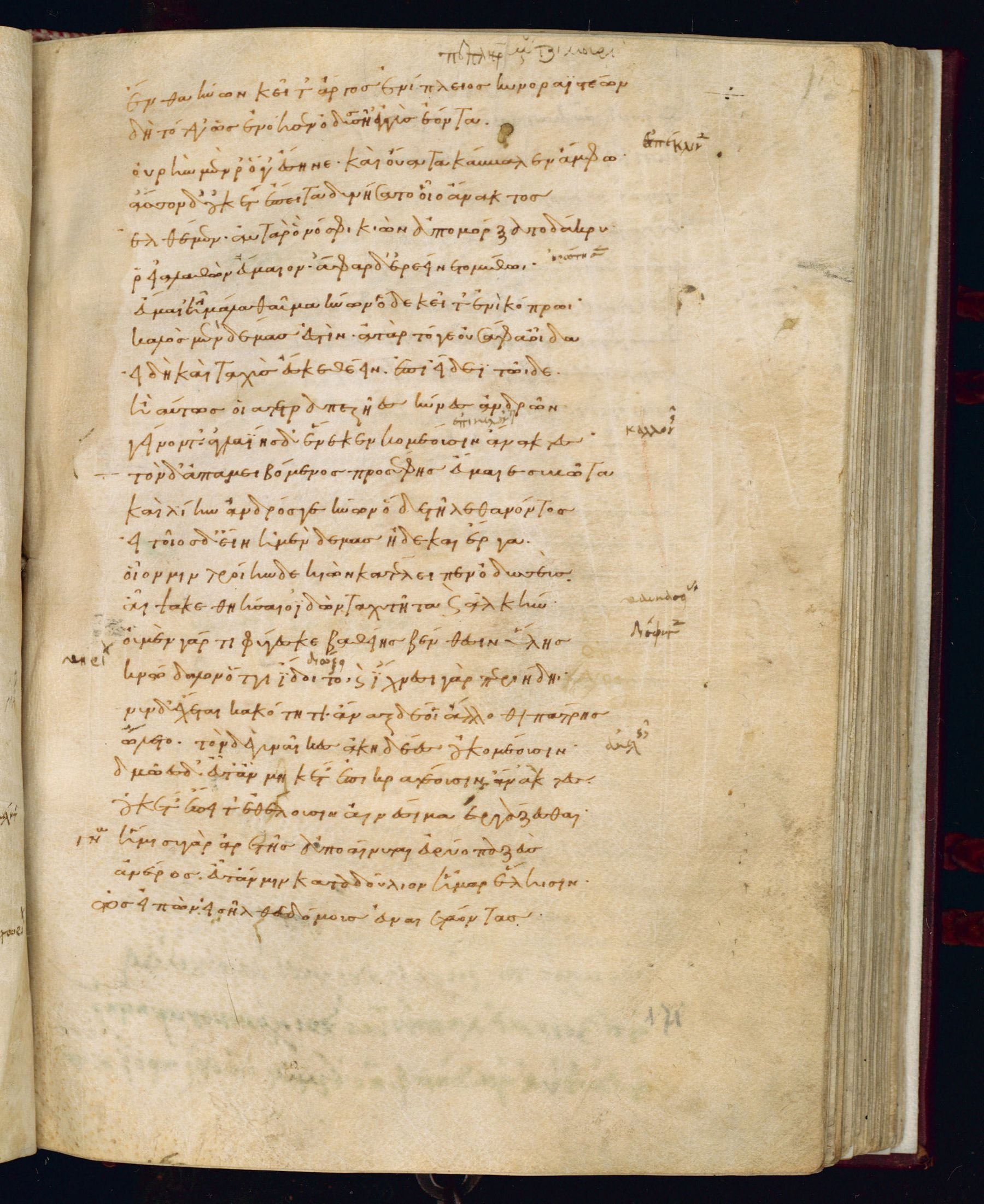
Where on the image
Laur. Plut. 32.24, fol. 171r: Odyssey 17.300-324, begins ‹ἔνθα κύων κεῖτʼ Ἄργος,›, ends ‹εἰσῆλθε δόμους εὖ ναιετάοντας,›. Checked on the image: first and last lines read and matched to the Greek. Fol. 170v ends with 17.299. Fol. 171v begins with 17.325. English blocks here: 300-304, 305-309, 310-314, 315-319, 320-324.
300ἔνθα κύων κεῖτʼ Ἄργος, ἐνίπλειος κυνοραιστέων.
301δὴ τότε γʼ, ὡς ἐνόησεν Ὀδυσσέα ἐγγὺς ἐόντα,
302οὐρῇ μέν ῥʼ ὅ γʼ ἔσηνε καὶ οὔατα κάββαλεν ἄμφω,
303ἆσσον δʼ οὐκέτʼ ἔπειτα δυνήσατο οἷο ἄνακτος
304ἐλθέμεν· αὐτὰρ ὁ νόσφιν ἰδὼν ἀπομόρξατο δάκρυ,
305ῥεῖα λαθὼν Εὔμαιον, ἄφαρ δʼ ἐρεείνετο μύθῳ·
306Εὔμαιʼ, ἦ μάλα θαῦμα, κύων ὅδε κεῖτʼ ἐνὶ κόπρῳ.
307καλὸς μὲν δέμας ἐστίν, ἀτὰρ τόδε γʼ οὐ σάφα οἶδα,
308εἰ δὴ καὶ ταχὺς ἔσκε θέειν ἐπὶ εἴδεϊ τῷδε,
309ἦ αὔτως οἷοί τε τραπεζῆες κύνες ἀνδρῶν
310γίγνοντʼ· ἀγλαΐης δʼ ἕνεκεν κομέουσιν ἄνακτες.
311τὸν δʼ ἀπαμειβόμενος προσέφης, Εὔμαιε συβῶτα·
312καὶ λίην ἀνδρός γε κύων ὅδε τῆλε θανόντος.
313εἰ τοιόσδʼ εἴη ἠμὲν δέμας ἠδὲ καὶ ἔργα,
314οἷόν μιν Τροίηνδε κιὼν κατέλειπεν Ὀδυσσεύς,
315αἶψά κε θηήσαιο ἰδὼν ταχυτῆτα καὶ ἀλκήν.
316οὐ μὲν γάρ τι φύγεσκε βαθείης βένθεσιν ὕλης
317κνώδαλον, ὅττι δίοιτο· καὶ ἴχνεσι γὰρ περιῄδη·
318νῦν δʼ ἔχεται κακότητι, ἄναξ δέ οἱ ἄλλοθι πάτρης
319ὤλετο, τὸν δὲ γυναῖκες ἀκηδέες οὐ κομέουσι.
320δμῶες δʼ, εὖτʼ ἂν μηκέτʼ ἐπικρατέωσιν ἄνακτες,
321οὐκέτʼ ἔπειτʼ ἐθέλουσιν ἐναίσιμα ἐργάζεσθαι·
322ἥμισυ γάρ τʼ ἀρετῆς ἀποαίνυται εὐρύοπα Ζεὺς
323ἀνέρος, εὖτʼ ἄν μιν κατὰ δούλιον ἦμαρ ἕλῃσιν.
324ὣς εἰπὼν εἰσῆλθε δόμους εὖ ναιετάοντας,
300There lay the hound Argos, full of vermin; yet even now, when he marked Odysseus standing near, he wagged his tail and dropped both his ears, but nearer to his master he had no longer strength to move. Then Odysseus looked aside and wiped away a tear, 305easily hiding from Eumaeus what he did; and straightway he questioned him, and said: “Eumaeus, verily it is strange that this hound lies here in the dung. He is fine of form, but I do not clearly know whether he has speed of foot to match this beauty or whether he is merely as table-dogs 310are, which their masters keep for show.” To him then, swineherd Eumaeus, didst thou make answer and say: “Aye, verily this is the hound of a man that has died in a far land. If he were but in form and in action such as he was when Odysseus left him and went to Troy, 315thou wouldest soon be amazed at seeing his speed and his strength. No creature that he started in the depths of the thick wood could escape him, and in tracking too he was keen of scent. But now he is in evil plight, and his master has perished far from his native land, and the heedless women give him no care. 320Slaves, when their masters lose their power, are no longer minded thereafter to do honest service: for Zeus, whose voice is borne afar, takes away half his worth from a man, when the day of slavery comes upon him.” So saying, he entered the stately house
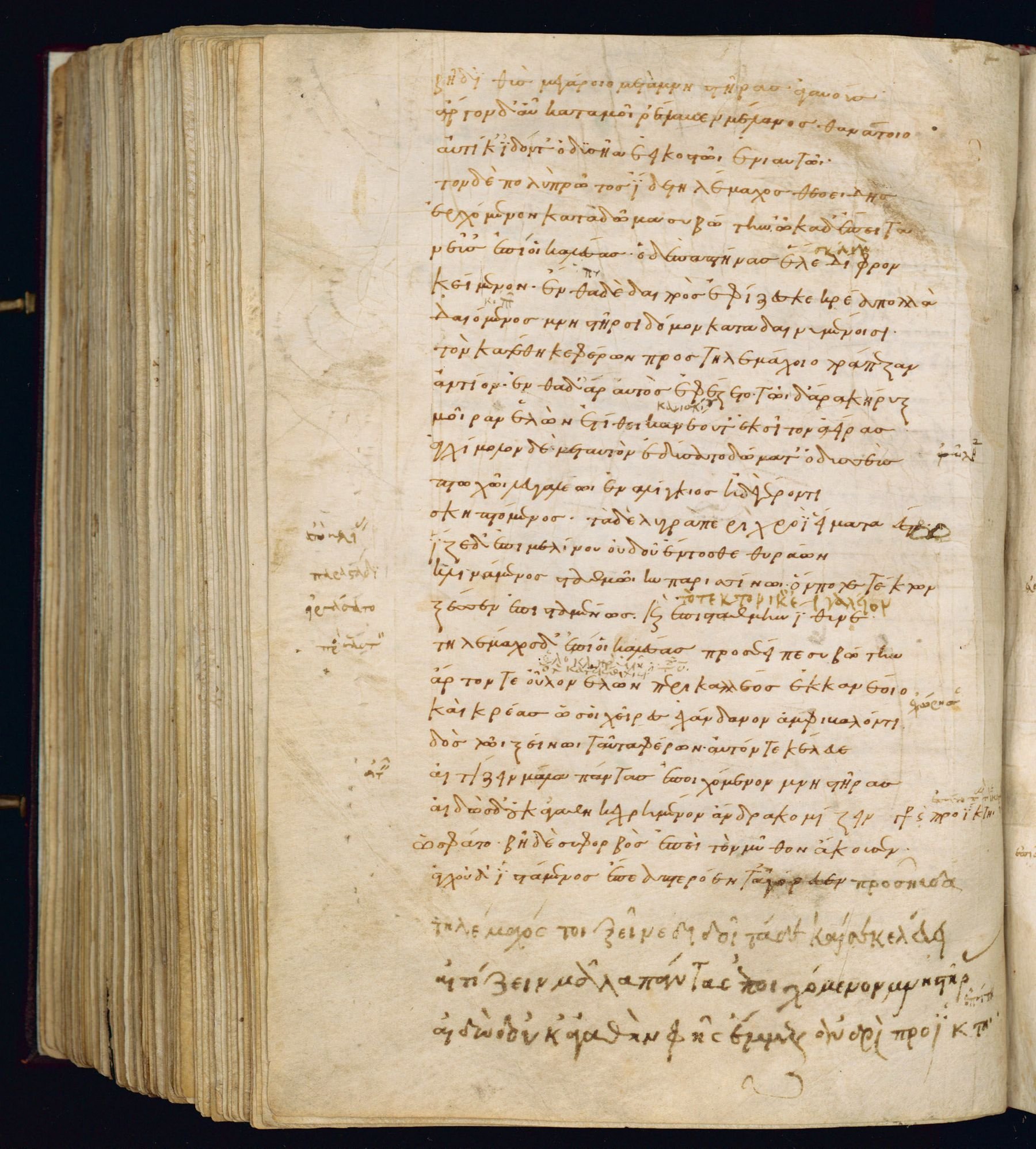
Where on the image
Laur. Plut. 32.24, fol. 171v: Odyssey 17.325-352, begins ‹βῆ δʼ ἰθὺς μεγάροιο›, ends ‹φησʼ ἔμμεναι ἀνδρὶ προΐκτῃ.›. Checked on the image: first and last lines read and matched to the Greek. Fol. 171r ends with 17.324. Fol. 172r begins with 17.353. English blocks here: 325-329, 330-334, 335-335, 336-339, 340-344, 345-349, 350-354.
325βῆ δʼ ἰθὺς μεγάροιο μετὰ μνηστῆρας ἀγαυούς.
326Ἄργον δʼ αὖ κατὰ μοῖρʼ ἔλαβεν μέλανος θανάτοιο,
327αὐτίκʼ ἰδόντʼ Ὀδυσῆα ἐεικοστῷ ἐνιαυτῷ.
328τὸν δὲ πολὺ πρῶτος ἴδε Τηλέμαχος θεοειδὴς
329ἐρχόμενον κατὰ δῶμα συβώτην, ὦκα δʼ ἔπειτα
330νεῦσʼ ἐπὶ οἷ καλέσας· ὁ δὲ παπτήνας ἕλε δίφρον
331κείμενον, ἔνθα τε δαιτρὸς ἐφίζεσκε κρέα πολλὰ
332δαιόμενος μνηστῆρσι δόμον κάτα δαινυμένοισι·
333τὸν κατέθηκε φέρων πρὸς Τηλεμάχοιο τράπεζαν
334ἀντίον, ἔνθα δʼ ἄρʼ αὐτὸς ἐφέζετο· τῷ δʼ ἄρα κῆρυξ
335μοῖραν ἑλὼν ἐτίθει κανέου τʼ ἐκ σῖτον ἀείρας.
336ἀγχίμολον δὲ μετʼ αὐτὸν ἐδύσετο δώματʼ Ὀδυσσεύς,
337πτωχῷ λευγαλέῳ ἐναλίγκιος ἠδὲ γέροντι,
338σκηπτόμενος· τὰ δὲ λυγρὰ περὶ χροΐ εἵματα ἕστο.
339ἷζε δʼ ἐπὶ μελίνου οὐδοῦ ἔντοσθε θυράων,
340κλινάμενος σταθμῷ κυπαρισσίνῳ, ὅν ποτε τέκτων
341ξέσσεν ἐπισταμένως καὶ ἐπὶ στάθμην ἴθυνεν.
342Τηλέμαχος δʼ ἐπὶ οἷ καλέσας προσέειπε συβώτην,
343ἄρτον τʼ οὖλον ἑλὼν περικαλλέος ἐκ κανέοιο
344καὶ κρέας, ὥς οἱ χεῖρες ἐχάνδανον ἀμφιβαλόντι·
345δὸς τῷ ξείνῳ ταῦτα φέρων αὐτόν τε κέλευε
346αἰτίζειν μάλα πάντας ἐποιχόμενον μνηστῆρας·
347αἰδὼς δʼ οὐκ ἀγαθὴ κεχρημένῳ ἀνδρὶ παρεῖναι.
348ὣς φάτο, βῆ δὲ συφορβός, ἐπεὶ τὸν μῦθον ἄκουσεν,
349ἀγχοῦ δʼ ἱστάμενος ἔπεα πτερόεντʼ ἀγόρευε·
350Τηλέμαχός τοι, ξεῖνε, διδοῖ τάδε, καί σε κελεύει
351αἰτίζειν μάλα πάντας ἐποιχόμενον μνηστῆρας·
352αἰδῶ δʼ οὐκ ἀγαθήν φησʼ ἔμμεναι ἀνδρὶ προΐκτῃ.
325and went straight to the hall to join the company of the lordly wooers. But as for Argos, the fate of black death seized him straightway when he had seen Odysseus in the twentieth year. Now as the swineherd came through the hall godlike Telemachus was far the first to see him, and quickly 330with a nod he called him and to his side. And Eumaeus looked about him and took a stool that lay near, on which the carver was wont to sit when carving for the wooers the many joints of meat, as they feasted in the hall. This he took and placed at the table of Telemachus, over against him, and there sat down himself. And a herald 335took a portion of meat and set it before him, and bread from out the basket. 336Night after him Odysseus entered the palace in the likeness of a woeful and aged beggar, leaning on a staff, and miserable was the raiment that he wore about his body. He sat down upon the ashen threshold within the doorway, 340leaning against a post of cypress wood, which of old a carpenter had skilfully planed, and made straight to the line. Then Telemachus called the swineherd to him, and, taking a whole loaf from out the beautiful basket, and all the meat his hands could hold in their grasp, spoke to him saying: 345“Take, and give this mess to yon stranger, and bid him go about himself and beg of the wooers one and all. Shame is no good comrade for a man that is in need.” So he spoke, and the swineherd went, when he had heard this saying, and coming up to Odysseus spoke to him winged words: 350“Stranger, Telemachus gives thee these, and bids thee go about and beg of the wooers one and all. Shame, he says, is no good thing in a beggar man.” Then Odysseus of many wiles answered him, and said, “King Zeus, grant, I pray thee, that Telemachus may be blest among men,
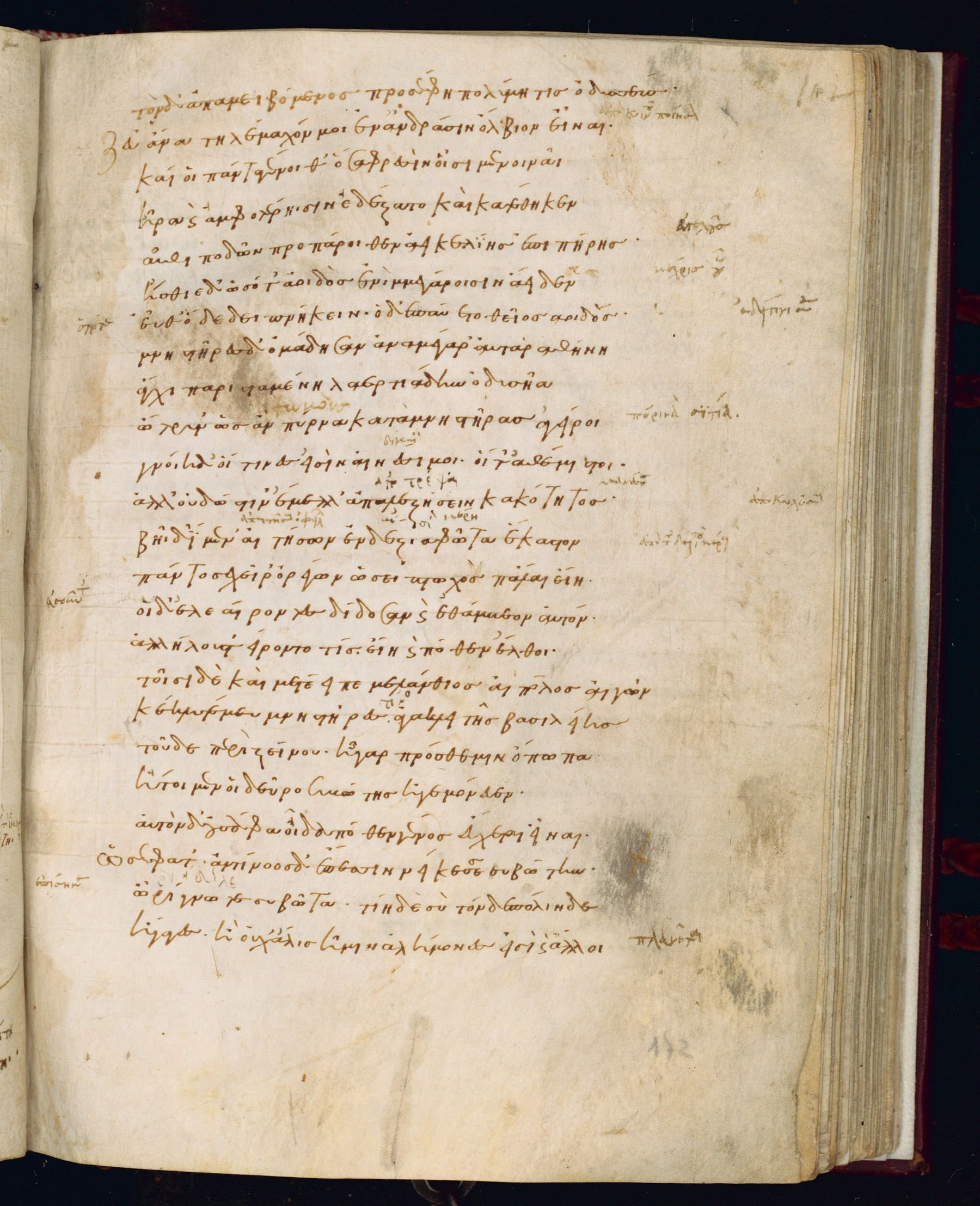
Where on the image
Laur. Plut. 32.24, fol. 172r: Odyssey 17.353-376, begins ‹τὸν δʼ ἀπαμειβόμενος προσέφη›, ends ‹ἀλήμονές εἰσι καὶ ἄλλοι,›. Checked on the image: first and last lines read and matched to the Greek. Fol. 171v ends with 17.352. Fol. 172v begins with 17.377. English blocks here: 355-359, 360-364, 365-369, 370-374.
353τὸν δʼ ἀπαμειβόμενος προσέφη πολύμητις Ὀδυσσεύς·
354Ζεῦ ἄνα, Τηλέμαχόν μοι ἐν ἀνδράσιν ὄλβιον εἶναι,
355καί οἱ πάντα γένοιθʼ ὅσσα φρεσὶν ᾗσι μενοινᾷ.
356ἦ ῥα καὶ ἀμφοτέρῃσιν ἐδέξατο καὶ κατέθηκεν
357αὖθι ποδῶν προπάροιθεν, ἀεικελίης ἐπὶ πήρης,
358ἤσθιε δʼ ἧος ἀοιδὸς ἐνὶ μεγάροισιν ἄειδεν·
359εὖθʼ ὁ δεδειπνήκειν, ὁ δʼ ἐπαύετο θεῖος ἀοιδός.
360μνηστῆρες δʼ ὁμάδησαν ἀνὰ μέγαρʼ. αὐτὰρ Ἀθήνη,
361ἄγχι παρισταμένη Λαερτιάδην Ὀδυσῆα
362ὤτρυνʼ, ὡς ἂν πύρνα κατὰ μνηστῆρας ἀγείροι,
363γνοίη θʼ οἵ τινές εἰσιν ἐναίσιμοι οἵ τʼ ἀθέμιστοι·
364ἀλλʼ οὐδʼ ὥς τινʼ ἔμελλʼ ἀπαλεξήσειν κακότητος.
365βῆ δʼ ἴμεν αἰτήσων ἐνδέξια φῶτα ἕκαστον,
366πάντοσε χεῖρʼ ὀρέγων, ὡς εἰ πτωχὸς πάλαι εἴη.
367οἱ δʼ ἐλεαίροντες δίδοσαν, καὶ ἐθάμβεον αὐτόν,
368ἀλλήλους τʼ εἴροντο τίς εἴη καὶ πόθεν ἔλθοι.
369τοῖσι δὲ καὶ μετέειπε Μελάνθιος, αἰπόλος αἰγῶν·
370κέκλυτέ μευ, μνηστῆρες ἀγακλειτῆς βασιλείης,
371τοῦδε περὶ ξείνου· ἦ γάρ μιν πρόσθεν ὄπωπα.
372ἦ τοι μέν οἱ δεῦρο συβώτης ἡγεμόνευεν,
373αὐτὸν δʼ οὐ σάφα οἶδα, πόθεν γένος εὔχεται εἶναι.
374ὣς ἔφατʼ, Ἀντίνοος δʼ ἔπεσιν νείκεσσε συβώτην·
375ὦ ἀρίγνωτε συβῶτα, τίη δὲ σὺ τόνδε πόλινδε
376ἤγαγες; ἦ οὐχ ἅλις ἧμιν ἀλήμονές εἰσι καὶ ἄλλοι,
355and may have all that his heart desires.” He spoke, and took the mess in both his hands and set it down there before his feet on his miserable wallet. Then he ate so long as the minstrel sang in the halls. But when he had dined and the divine minstrel was ceasing to sing, 360the wooers broke into uproar throughout the halls; but Athena drew close to the side of Odysseus, son of Laertes, and roused him to go among the wooers and gather bits of bread, and learn which of them were righteous and which lawless. Yet even so she was not minded to save one of them from ruin. 365So he set out to beg of every man, beginning on the right, stretching out his hand on every side, as though he had been long a beggar. And they pitied him and gave, and marvelled at him, asking one another who he was and whence he came. Then among them spoke Melanthius, the goatherd: 370“Hear me, wooers of the glorious queen, regarding this stranger, for verily I have seen him before. Truly it was the swineherd that led him hither, but of the man himself I know not surely from whence he declares his birth to be.” So he spoke, and Antinous rebuked the swineherd, saying:
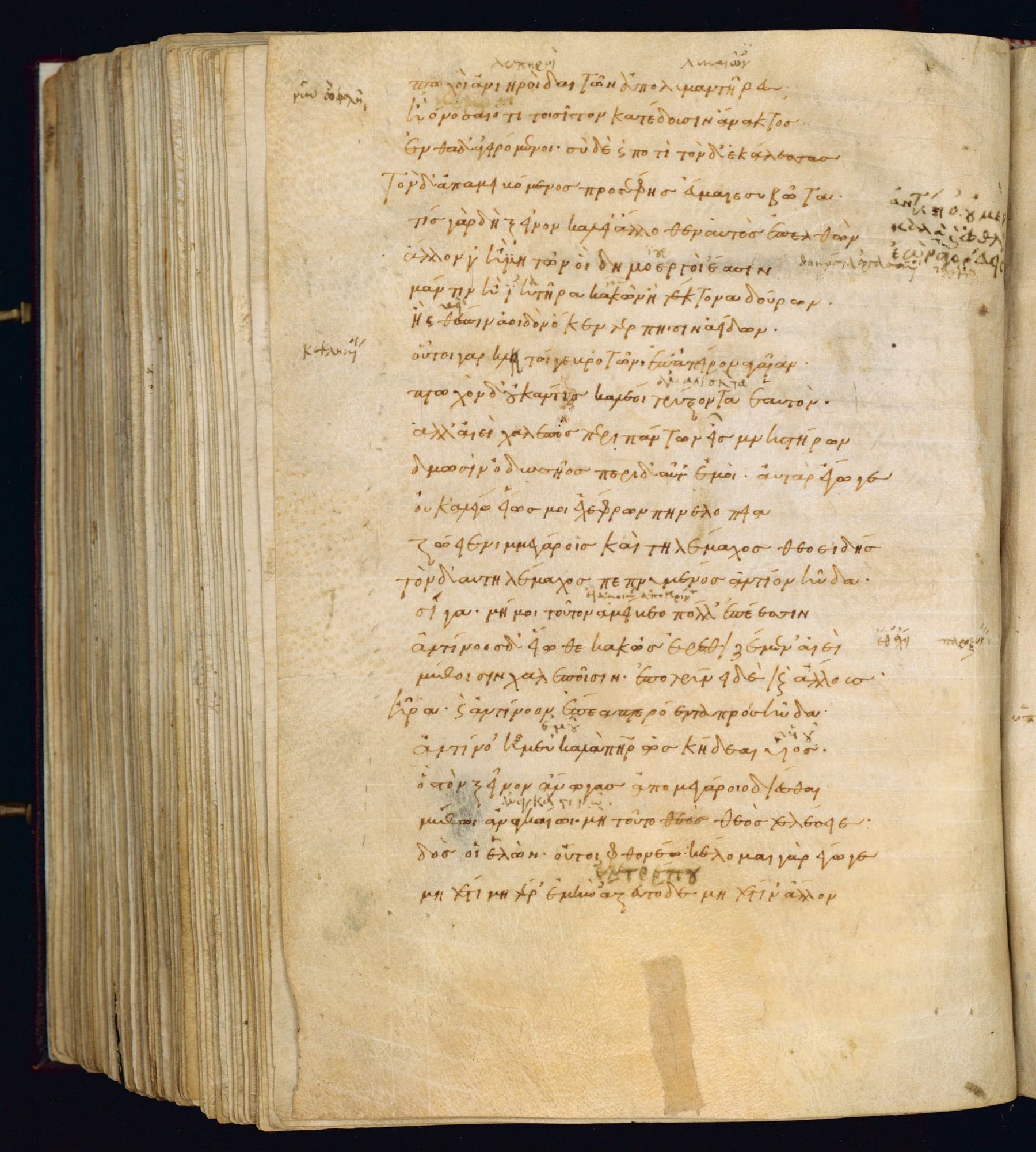
Where on the image
Laur. Plut. 32.24, fol. 172v: Odyssey 17.377-401, begins ‹πτωχοὶ ἀνιηροί, δαιτῶν ἀπολυμαντῆρες;›, ends ‹γε μήτε τινʼ ἄλλον›. Checked on the image: first and last lines read and matched to the Greek. Fol. 172r ends with 17.376. Fol. 173r begins with 17.402. 17.381 is not in the text column; it is written in the right margin beside 17.380-383 (the column has 24 lines). English blocks here: 375-379, 380-384, 385-389, 390-394, 395-399.
377πτωχοὶ ἀνιηροί, δαιτῶν ἀπολυμαντῆρες;
378ἦ ὄνοσαι ὅτι τοι βίοτον κατέδουσιν ἄνακτος
379ἐνθάδʼ ἀγειρόμενοι, σὺ δὲ καὶ προτὶ τόνδʼ ἐκάλεσσας;
380τὸν δʼ ἀπαμειβόμενος προσέφης, Εὔμαιε συβῶτα·
381Ἀντίνοʼ, οὐ μὲν καλὰ καὶ ἐσθλὸς ἐὼν ἀγορεύεις·
382τίς γὰρ δὴ ξεῖνον καλεῖ ἄλλοθεν αὐτὸς ἐπελθὼν
383ἄλλον γʼ, εἰ μὴ τῶν οἳ δημιοεργοὶ ἔασι,
384μάντιν ἢ ἰητῆρα κακῶν ἢ τέκτονα δούρων,
385ἢ καὶ θέσπιν ἀοιδόν, ὅ κεν τέρπῃσιν ἀείδων;
386οὗτοι γὰρ κλητοί γε βροτῶν ἐπʼ ἀπείρονα γαῖαν·
387πτωχὸν δʼ οὐκ ἄν τις καλέοι τρύξοντα ἓ αὐτόν.
388ἀλλʼ αἰεὶ χαλεπὸς περὶ πάντων εἶς μνηστήρων
389δμωσὶν Ὀδυσσῆος, πέρι δʼ αὖτʼ ἐμοί· αὐτὰρ ἐγώ γε
390οὐκ ἀλέγω, ἧός μοι ἐχέφρων Πηνελόπεια
391ζώει ἐνὶ μεγάροις καὶ Τηλέμαχος θεοειδής.
392τὸν δʼ αὖ Τηλέμαχος πεπνυμένος ἀντίον ηὔδα·
393σίγα, μή μοι τοῦτον ἀμείβεο πολλὰ ἔπεσσιν·
394Ἀντίνοος δʼ εἴωθε κακῶς ἐρεθιζέμεν αἰεὶ
395μύθοισιν χαλεποῖσιν, ἐποτρύνει δὲ καὶ ἄλλους.
396ἦ ῥα καὶ Ἀντίνοον ἔπεα πτερόεντα προσηύδα·
397Ἀντίνοʼ, ἦ μευ καλὰ πατὴρ ὣς κήδεαι υἷος,
398ὃς τὸν ξεῖνον ἄνωγας ἀπὸ μεγάροιο διέσθαι
399μύθῳ ἀναγκαίῳ· μὴ τοῦτο θεὸς τελέσειε.
400δός οἱ ἑλών· οὔ τοι φθονέω· κέλομαι γὰρ ἐγώ γε·
401μήτʼ οὖν μητέρʼ ἐμὴν ἅζευ τό γε μήτε τινʼ ἄλλον
375“Notorious swineherd, why, pray, didst thou bring this man to the city? Have we not vagabonds enough without him, nuisances of beggars to mar our feast? Dost thou not think it enough that they gather here and devour the substance of thy master, that thou dost bid this fellow too?” 380To him then, swineherd Eumaeus, didst thou make answer, and say: “Antinous, no fair words are these thou speakest, noble though thou art. Who pray, of himself ever seeks out and bids a stranger from abroad, unless it be one of those that are masters of some public craft, a prophet, or a healer of ills, or a builder, 385aye, or a divine minstrel, who gives delight with his song? For these men are bidden all over the boundless earth. Yet a beggar would no man bid to be burden to himself. But thou art ever harsh above all the wooers to the slaves of Odysseus, and most of all to me; yet I 390care not, so long as my lady, the constant Penelope, lives in the hall, and godlike Telemachus.” Then wise Telemachus answered him: “Be silent: do not, I bid thee, answer yonder man with many words, for Antinous is wont ever in evil wise to provoke to anger 395with harsh words, aye, and urges on the others too.” With this he spoke winged words to Antinous: “Antinous, truly thou carest well for me, as a father for his son, seeing that thou biddest me drive yonder stranger from the hall with a word of compulsion. May the god never bring such a thing to pass.
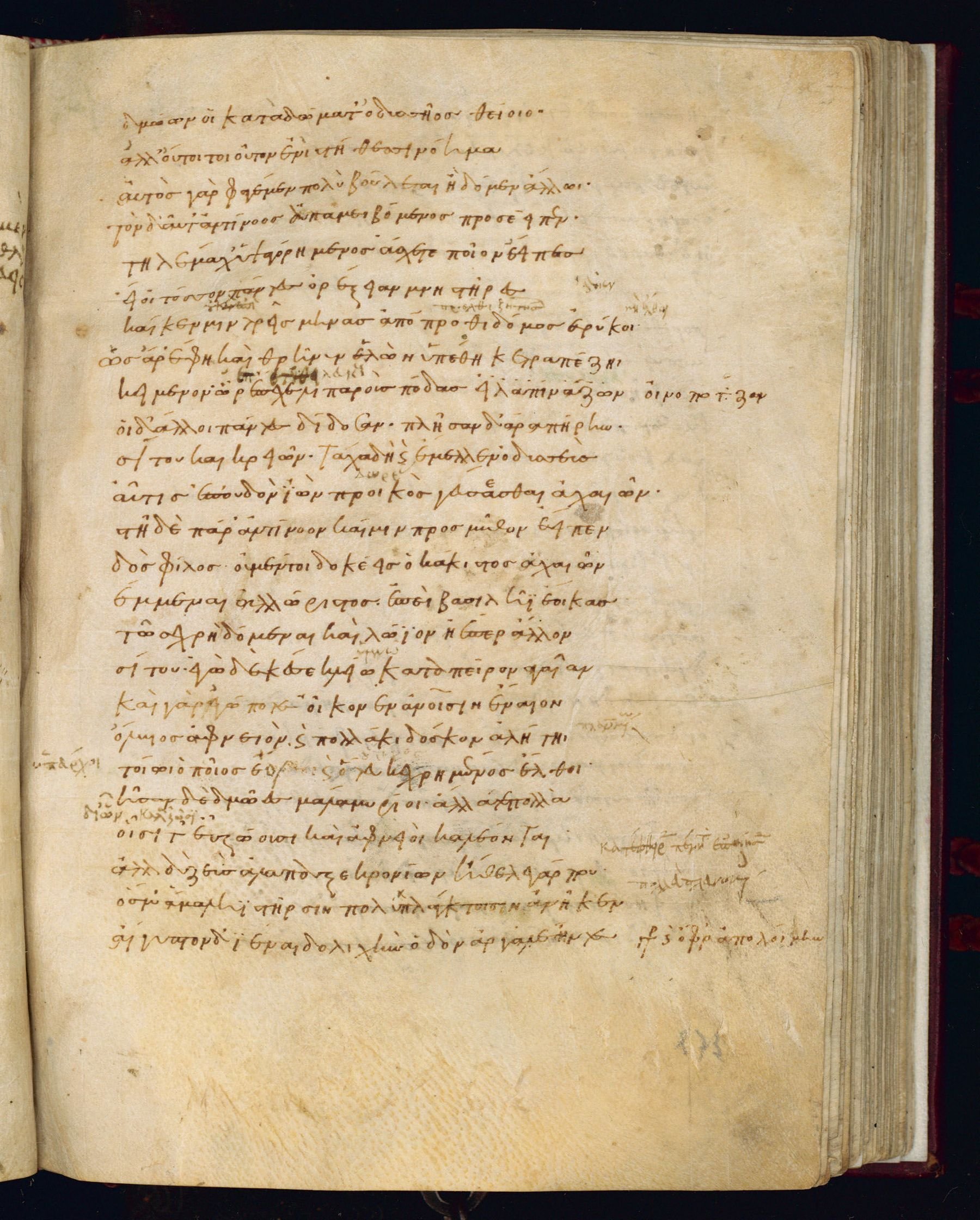
Where on the image
Laur. Plut. 32.24, fol. 173r: Odyssey 17.402-426, begins ‹δμώων, οἳ κατὰ δώματʼ›, ends ‹δολιχὴν ὁδόν, ὄφρʼ ἀπολοίμην.›. Checked on the image: first and last lines read and matched to the Greek. Fol. 172v ends with 17.401. Fol. 173v begins with 17.427. English blocks here: 400-404, 405-409, 410-414, 415-419, 420-423, 424-424.
402δμώων, οἳ κατὰ δώματʼ Ὀδυσσῆος θείοιο.
403ἀλλʼ οὔ τοι τοιοῦτον ἐνὶ στήθεσσι νόημα·
404αὐτὸς γὰρ φαγέμεν πολὺ βούλεαι ἢ δόμεν ἄλλῳ.
405τὸν δʼ αὖτʼ Ἀντίνοος ἀπαμειβόμενος προσέειπε·
406Τηλέμαχʼ ὑψαγόρη, μένος ἄσχετε, ποῖον ἔειπες.
407εἴ οἱ τόσσον ἅπαντες ὀρέξειαν μνηστῆρες,
408καί κέν μιν τρεῖς μῆνας ἀπόπροθεν οἶκος ἐρύκοι.
409ὣς ἄρʼ ἔφη, καὶ θρῆνυν ἑλὼν ὑπέφηνε τραπέζης
410κείμενον, ᾧ ῥʼ ἔπεχεν λιπαροὺς πόδας εἰλαπινάζων·
411οἱ δʼ ἄλλοι πάντες δίδοσαν, πλῆσαν δʼ ἄρα πήρην
412σίτου καὶ κρειῶν· τάχα δὴ καὶ ἔμελλεν Ὀδυσσεὺς
413αὖτις ἐπʼ οὐδὸν ἰὼν προικὸς γεύσεσθαι Ἀχαιῶν·
414στῆ δὲ παρʼ Ἀντίνοον, καί μιν πρὸς μῦθον ἔειπε·
415δός, φίλος· οὐ μέν μοι δοκέεις ὁ κάκιστος Ἀχαιῶν
416ἔμμεναι, ἀλλʼ ὤριστος, ἐπεὶ βασιλῆϊ ἔοικας.
417τῷ σε χρὴ δόμεναι καὶ λώϊον ἠέ περ ἄλλοι
418σίτου· ἐγὼ δέ κέ σε κλείω κατʼ ἀπείρονα γαῖαν.
419καὶ γὰρ ἐγώ ποτε οἶκον ἐν ἀνθρώποισιν ἔναιον
420ὄλβιος ἀφνειὸν καὶ πολλάκι δόσκον ἀλήτῃ,
421τοίῳ ὁποῖος ἔοι καὶ ὅτευ κεχρημένος ἔλθοι·
422ἦσαν δὲ δμῶες μάλα μυρίοι ἄλλα τε πολλὰ
423οἷσίν τʼ εὖ ζώουσι καὶ ἀφνειοὶ καλέονται.
424ἀλλὰ Ζεὺς ἀλάπαξε Κρονίων—ἤθελε γάρ που—
425ὅς μʼ ἅμα ληϊστῆρσι πολυπλάγκτοισιν ἀνῆκεν
426Αἴγυπτόνδʼ ἰέναι, δολιχὴν ὁδόν, ὄφρʼ ἀπολοίμην.
400Nay, take and give him somewhat: I begrudge it not, but rather myself bid thee give. In this matter regard not my mother, no, nor any of the slaves that are in the house of divine Odysseus. But verily far other is the thought in thy breast; for thou art far more fain thyself to eat than to give to another.” 405Then Antinous answered him, and said: “Telemachus, thou braggart, unrestrained in daring, what a thing hast thou said! If all the wooers would but hand him as much as I, for full three months' space this house would keep him at a distance.” So he spoke, and seized the footstool 410on which he was wont to rest his shining feet as he feasted, and shewed it from beneath the table, where it lay. But all the rest gave gifts, and filled the wallet with bread and bits of meat. And now Odysseus was like to have gone back again to the threshold, and to have made trial of the Achaeans without cost, but he paused by Antinous, and spoke to him, saying: 415“Friend, give me some gift; thou seemest not in my eyes to be the basest of the Achaeans, but rather the noblest, for thou art like a king. Therefore it is meet that thou shouldest give even a better portion of bread than the rest; so would I make thy fame known all over the boundless earth. For I too once dwelt in a house of my own among men, 420a rich man in a wealthy house, and full often I gave gifts to a wanderer, whosoever he was and with whatsoever need he came. Slaves too I had past counting, and all other things in abundance whereby men live well and are reputed wealthy. 424But Zeus, son of Cronos, brought all to naught—so, I ween, was his good pleasure—
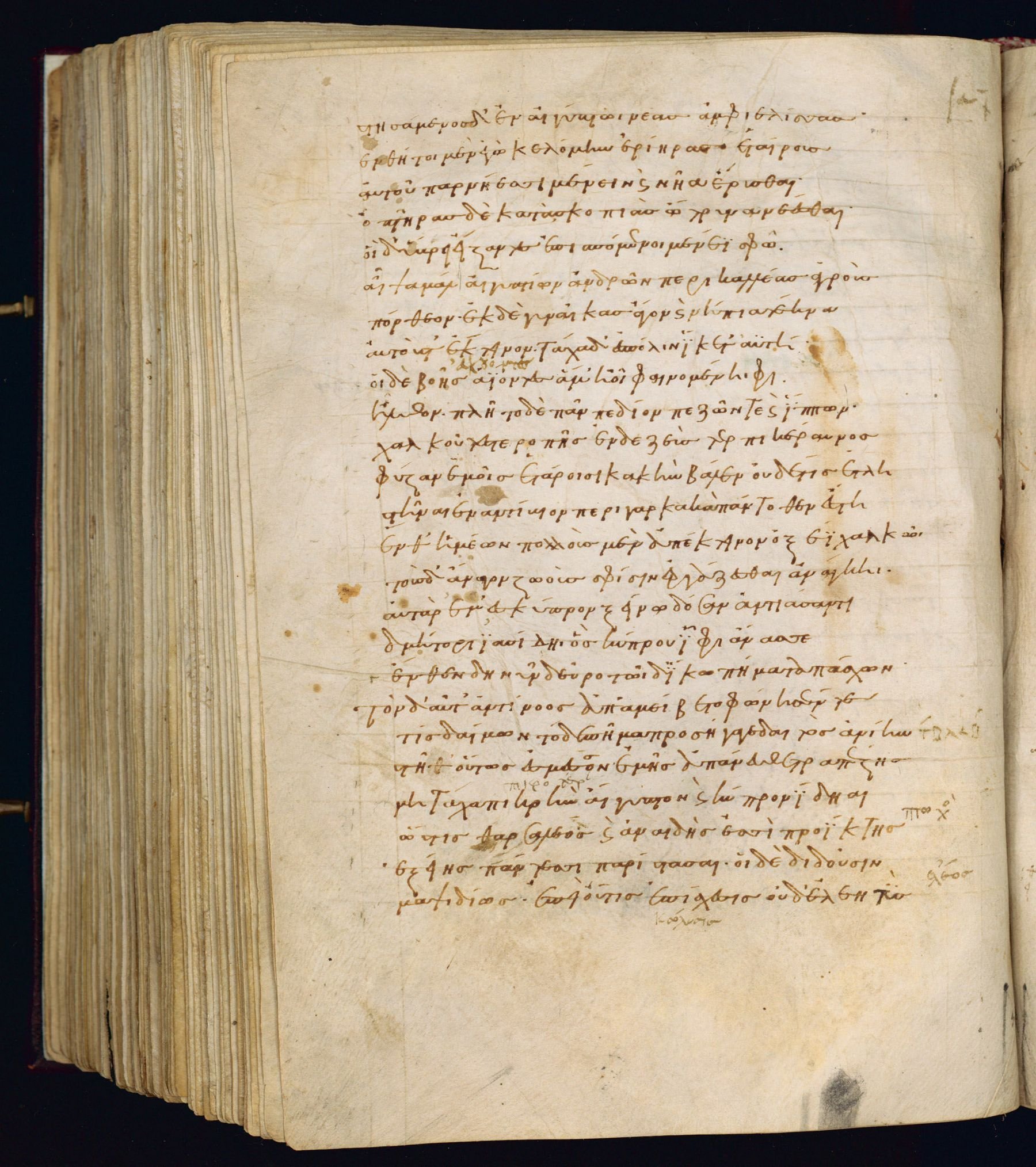
Where on the image
Laur. Plut. 32.24, fol. 173v: Odyssey 17.427-451, begins ‹στῆσα δʼ ἐν Αἰγύπτῳ›, ends ‹τις ἐπίσχεσις οὐδʼ ἐλεητὺς›. Checked on the image: first and last lines read and matched to the Greek. Fol. 173r ends with 17.426. Fol. 174r begins with 17.452. English blocks here: 425-429, 430-434, 435-439, 440-444, 445-449.
427στῆσα δʼ ἐν Αἰγύπτῳ ποταμῷ νέας ἀμφιελίσσας.
428ἔνθʼ ἦ τοι μὲν ἐγὼ κελόμην ἐρίηρας ἑταίρους
429αὐτοῦ πὰρ νήεσσι μένειν καὶ νῆας ἔρυσθαι,
430ὀπτῆρας δὲ κατὰ σκοπιὰς ὤτρυνα νέεσθαι.
431οἱ δʼ ὕβρει εἴξαντες, ἐπισπόμενοι μένεϊ σφῷ,
432αἶψα μάλʼ Αἰγυπτίων ἀνδρῶν περικαλλέας ἀγροὺς
433πόρθεον, ἐκ δὲ γυναῖκας ἄγον καὶ νήπια τέκνα,
434αὐτούς τʼ ἔκτεινον· τάχα δʼ ἐς πόλιν ἵκετʼ ἀϋτή.
435οἱ δὲ βοῆς ἀΐοντες ἅμʼ ἠοῖ φαινομένηφιν
436ἦλθον· πλῆτο δὲ πᾶν πεδίον πεζῶν τε καὶ ἵππων
437χαλκοῦ τε στεροπῆς· ἐν δὲ Ζεὺς τερπικέραυνος
438φύζαν ἐμοῖς ἑτάροισι κακὴν βάλεν, οὐδέ τις ἔτλη
439στῆναι ἐναντίβιον· περὶ γὰρ κακὰ πάντοθεν ἔστη.
440ἔνθʼ ἡμέων πολλοὺς μὲν ἀπέκτανον ὀξέϊ χαλκῷ,
441τοὺς δʼ ἄναγον ζωούς, σφίσιν ἐργάζεσθαι ἀνάγκῃ.
442αὐτὰρ ἔμʼ ἐς Κύπρον ξείνῳ δόσαν ἀντιάσαντι,
443Δμήτορι Ἰασίδῃ, ὃς Κύπρου ἶφι ἄνασσεν·
444ἔνθεν δὴ νῦν δεῦρο τόδʼ ἵκω πήματα πάσχων.
445τὸν δʼ αὖτʼ Ἀντίνοος ἀπαμείβετο φώνησέν τε·
446τίς δαίμων τόδε πῆμα προσήγαγε, δαιτὸς ἀνίην;
447στῆθʼ οὕτως ἐς μέσσον, ἐμῆς ἀπάνευθε τραπέζης,
448μὴ τάχα πικρὴν Αἴγυπτον καὶ Κύπρον ἵκηαι·
449ὥς τις θαρσαλέος καὶ ἀναιδής ἐσσι προΐκτης.
450ἑξείης πάντεσσι παρίστασαι· οἱ δὲ διδοῦσι
451μαψιδίως, ἐπεὶ οὔ τις ἐπίσχεσις οὐδʼ ἐλεητὺς
425who sent me forth with roaming pirates to go to Egypt, a far voyage, that I might meet my ruin; and in the river Aegyptus I moored my curved ships. Then verily I bade my trusty comrades to remain there by the ships and to guard the ships, 430and I sent out scouts to go to places of outlook. But my comrades, yielding to wantonness and led on by their own might, straightway set about wasting the fair fields of the men of Egypt; and they carried off the women and little children, and slew the men; and the cry came quickly to the city. 435Then, hearing the shouting, the people came forth at break of day, and the whole plain was filled with footmen and chariots and the flashing of bronze. And Zeus, who hurls the thunderbolt, cast an evil panic upon my comrades, and none had courage to take his stand and face the foe; for evil surrounded us on every side. 440So then they slew many of us with the sharp bronze, and others they led up to their city alive, to work for them perforce. But they gave me to a friend who met them to take to Cyprus, even to Dmetor, son of Iasus, who ruled mightily over Cyprus; and from thence am I now come hither, sore distressed.” 445Then Antinous answered him, and said: “What god has brought this bane hither to trouble our feast? Stand off yonder in the midst, away from my table, lest thou come presently to a bitter Egypt and a bitter Cyprus, seeing that thou art a bold and shameless beggar.
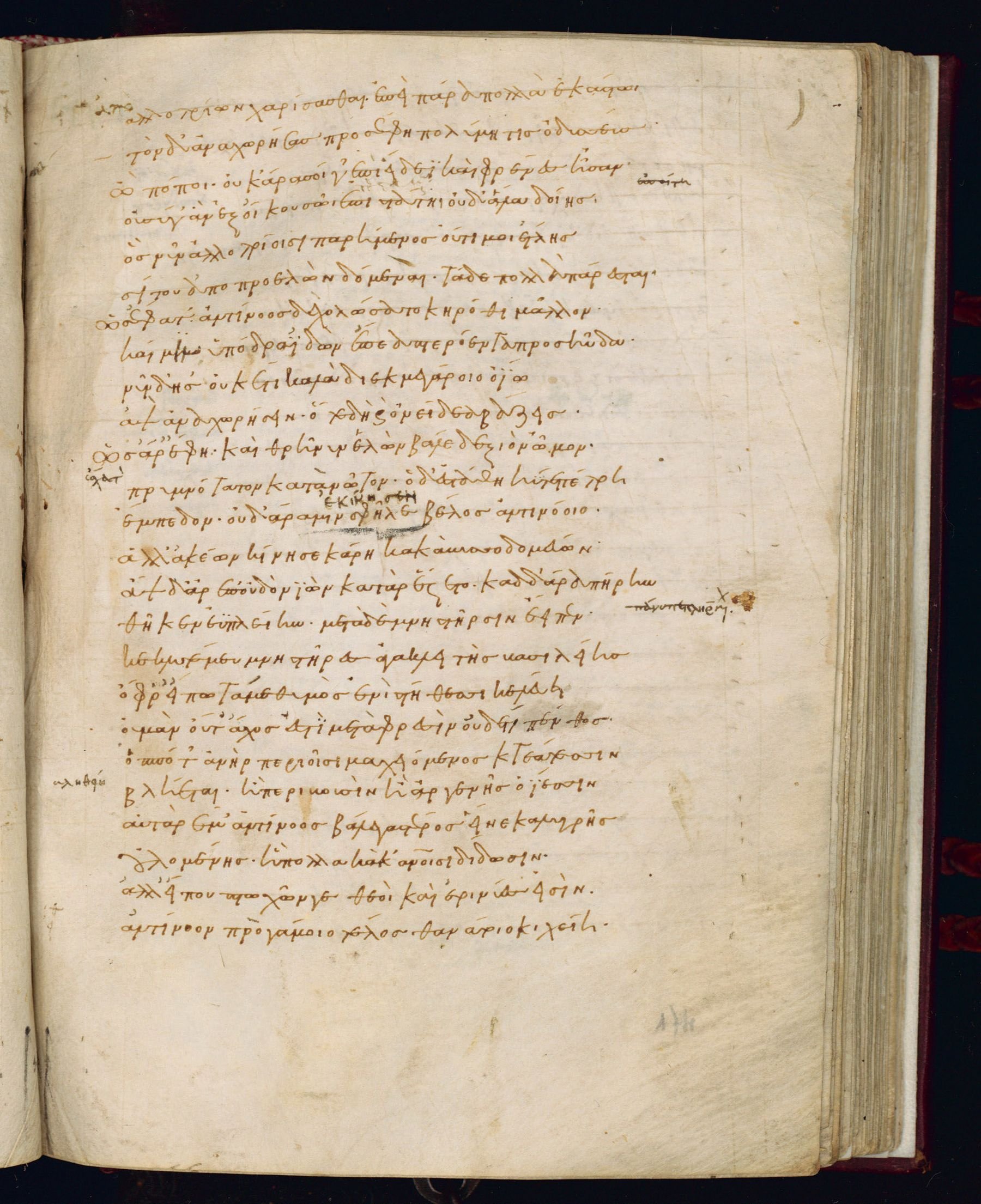
Where on the image
Laur. Plut. 32.24, fol. 174r: Odyssey 17.452-476, begins ‹ἀλλοτρίων χαρίσασθαι, ἐπεὶ πάρα›, ends ‹γάμοιο τέλος θανάτοιο κιχείη.›. Checked on the image: first and last lines read and matched to the Greek. Fol. 173v ends with 17.451. Fol. 174v begins with 17.477. English blocks here: 450-454, 455-459, 460-461, 462-464, 465-469, 470-474.
452ἀλλοτρίων χαρίσασθαι, ἐπεὶ πάρα πολλὰ ἑκάστῳ.
453τὸν δʼ ἀναχωρήσας προσέφη πολύμητις Ὀδυσσεύς·
454ὢ πόποι, οὐκ ἄρα σοί γʼ ἐπὶ εἴδεϊ καὶ φρένες ἦσαν·
455οὐ σύ γʼ ἂν ἐξ οἴκου σῷ ἐπιστάτῃ οὐδʼ ἅλα δοίης,
456ὃς νῦν ἀλλοτρίοισι παρήμενος οὔ τί μοι ἔτλης
457σίτου ἀποπροελὼν δόμεναι· τὰ δὲ πολλὰ πάρεστιν.
458ὣς ἔφατʼ, Ἀντίνοος δʼ ἐχολώσατο κηρόθι μᾶλλον,
459καί μιν ὑπόδρα ἰδὼν ἔπεα πτερόεντα προσηύδα·
460νῦν δή σʼ οὐκέτι καλὰ διὲκ μεγάροιό γʼ ὀΐω
461ἂψ ἀναχωρήσειν, ὅτε δὴ καὶ ὀνείδεα βάζεις.
462ὣς ἄρʼ ἔφη, καὶ θρῆνυν ἑλὼν βάλε δεξιὸν ὦμον,
463πρυμνότατον κατὰ νῶτον· ὁ δʼ ἐστάθη ἠΰτε πέτρη
464ἔμπεδον, οὐδʼ ἄρα μιν σφῆλεν βέλος Ἀντινόοιο,
465ἀλλʼ ἀκέων κίνησε κάρη, κακὰ βυσσοδομεύων.
466ἂψ δʼ ὅ γʼ ἐπʼ οὐδὸν ἰὼν κατʼ ἄρʼ ἕζετο, κὰδ δʼ ἄρα πήρην
467θῆκεν ἐϋπλείην, μετὰ δὲ μνηστῆρσιν ἔειπε·
468κέκλυτέ μευ, μνηστῆρες ἀγακλειτῆς βασιλείης,
469ὄφρʼ εἴπω τά με θυμὸς ἐνὶ στήθεσσι κελεύει.
470οὐ μὰν οὔτʼ ἄχος ἐστὶ μετὰ φρεσὶν οὔτε τι πένθος,
471ὁππότʼ ἀνὴρ περὶ οἷσι μαχειόμενος κτεάτεσσι
472βλήεται, ἢ περὶ βουσὶν ἢ ἀργεννῇς ὀΐεσσιν·
473αὐτὰρ ἔμʼ Ἀντίνοος βάλε γαστέρος εἵνεκα λυγρῆς,
474οὐλομένης, ἣ πολλὰ κάκʼ ἀνθρώποισι δίδωσιν.
475ἀλλʼ εἴ που πτωχῶν γε θεοὶ καὶ Ἐρινύες εἰσίν,
476Ἀντίνοον πρὸ γάμοιο τέλος θανάτοιο κιχείη.
450Thou comest up to every man in turn, and they give recklessly; for there is no restraint or scruple in giving freely of another's goods, since each man has plenty beside him.” Then Odysseus of many wiles drew back, and said to him: “Lo, now, it seems that thou at least hast not wits to match thy beauty. 455Thou wouldest not out of thine own substance give even a grain of salt to thy suppliant, thou who now, when sitting at another's table, hadst not the heart to take of the bread and give me aught. Yet here lies plenty at thy hand.” So he spoke, and Antinous waxed the more wroth at heart, and with an angry glance from beneath his brows spoke to him winged words: 460“Now verily, methinks, thou shalt no more go forth from the hall in seemly fashion, since thou dost even utter words of reviling.” 462So saying, he seized the footstool and flung it, and struck Odysseus on the base of the right shoulder, where it joins the back. But he stood firm as a rock, nor did the missile of Antinous make him reel; 465but he shook his head in silence, pondering evil in the deep of his heart. Then back to the threshold he went and sat down, and down he laid his well-filled wallet; and he spoke among the wooers: “Hear me, wooers of the glorious queen, that I may say what the heart in my breast bids me. 470Verily there is no pain of heart nor any grief when a man is smitten while fighting for his own possessions, whether for his cattle or for his white sheep; but Antinous has smitten me for my wretched belly's sake, an accursed plague that brings many evils upon men.
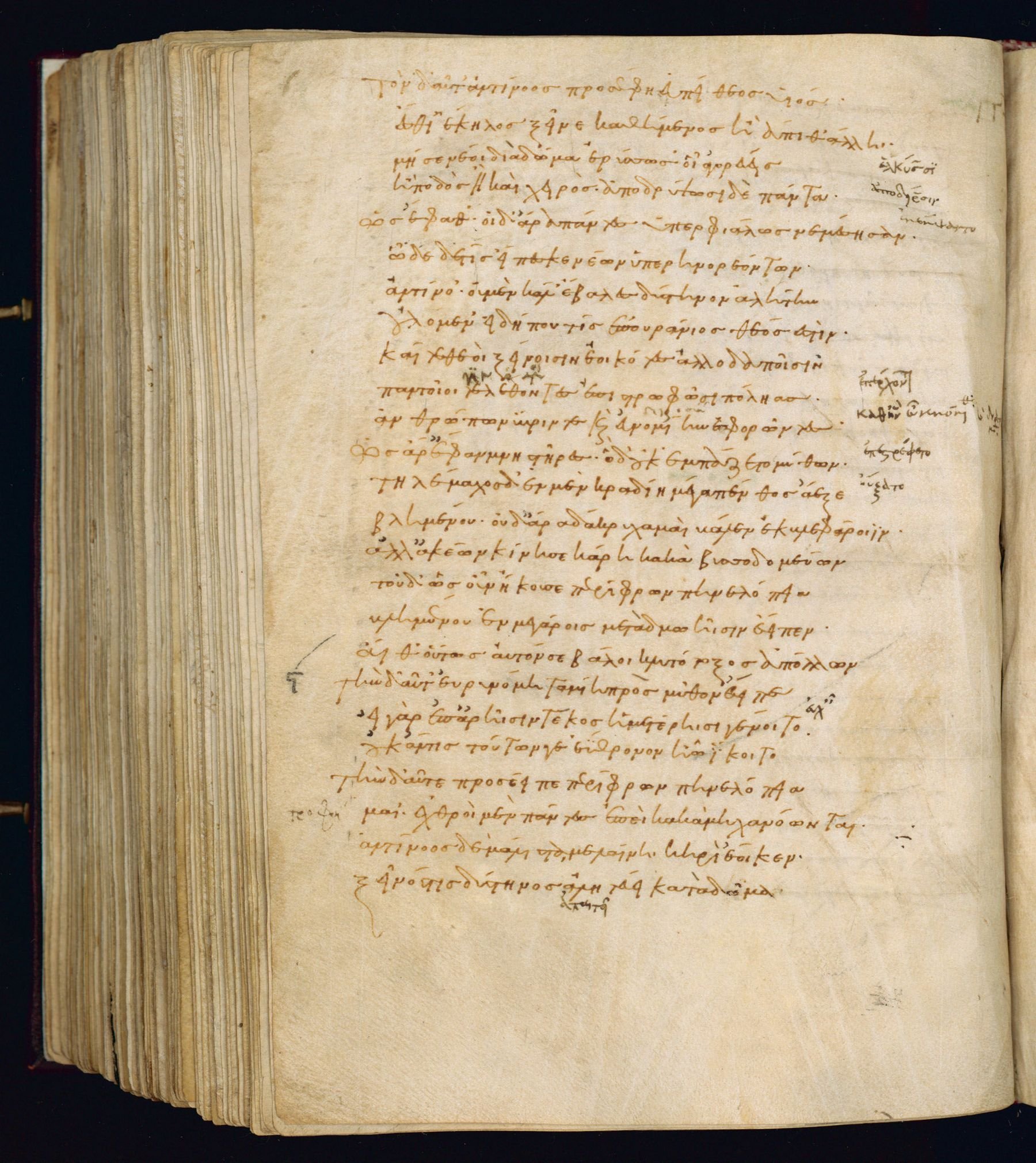
Where on the image
Laur. Plut. 32.24, fol. 174v: Odyssey 17.477-501, begins ‹τὸν δʼ αὖτʼ Ἀντίνοος›, ends ‹δύστηνος ἀλητεύει κατὰ δῶμα›. Checked on the image: first and last lines read and matched to the Greek. Fol. 174r ends with 17.476. Fol. 175r begins with 17.502. English blocks here: 475-479, 480-484, 485-489, 490-494, 495-499.
477τὸν δʼ αὖτʼ Ἀντίνοος προσέφη, Εὐπείθεος υἱός·
478ἔσθιʼ ἕκηλος, ξεῖνε, καθήμενος, ἢ ἄπιθʼ ἄλλῃ,
479μή σε νέοι διὰ δώματʼ ἐρύσσωσʼ, οἷʼ ἀγορεύεις,
480ἢ ποδὸς ἢ καὶ χειρός, ἀποδρύψωσι δὲ πάντα.
481ὣς ἔφαθʼ, οἱ δʼ ἄρα πάντες ὑπερφιάλως νεμέσησαν·
482ὧδε δέ τις εἴπεσκε νέων ὑπερηνορεόντων·
483Ἀντίνοʼ, οὐ μὲν κάλʼ ἔβαλες δύστηνον ἀλήτην,
484οὐλόμενʼ, εἰ δή πού τις ἐπουράνιος θεός ἐστιν.
485καί τε θεοὶ ξείνοισιν ἐοικότες ἀλλοδαποῖσι,
486παντοῖοι τελέθοντες, ἐπιστρωφῶσι πόληας,
487ἀνθρώπων ὕβριν τε καὶ εὐνομίην ἐφορῶντες.
488ὣς ἄρʼ ἔφαν μνηστῆρες, ὁ δʼ οὐκ ἐμπάζετο μύθων.
489Τηλέμαχος δʼ ἐν μὲν κραδίῃ μέγα πένθος ἄεξε
490βλημένου, οὐδʼ ἄρα δάκρυ χαμαὶ βάλεν ἐκ βλεφάροιϊν,
491ἀλλʼ ἀκέων κίνησε κάρη, κακὰ βυσσοδομεύων.
492τοῦ δʼ ὡς οὖν ἤκουσε περίφρων Πηνελόπεια
493βλημένου ἐν μεγάρῳ, μετʼ ἄρα δμῳῇσιν ἔειπεν·
494αἴθʼ οὕτως αὐτόν σε βάλοι κλυτότοξος Ἀπόλλων.
495τὴν δʼ αὖτʼ Εὐρυνόμη ταμίη πρὸς μῦθον ἔειπεν·
496εἰ γὰρ ἐπʼ ἀρῇσιν τέλος ἡμετέρῃσι γένοιτο·
497οὐκ ἄν τις τούτων γε ἐΰθρονον Ἠῶ ἵκοιτο.
498τὴν δʼ αὖτε προσέειπε περίφρων Πηνελόπεια·
499μαῖʼ, ἐχθροὶ μὲν πάντες, ἐπεὶ κακὰ μηχανόωνται·
500Ἀντίνοος δὲ μάλιστα μελαίνῃ κηρὶ ἔοικε.
501ξεῖνός τις δύστηνος ἀλητεύει κατὰ δῶμα
475Ah, if for beggars there are gods and avengers, may the doom of death come upon Antinous before his marriage.” Then Antinous, son of Eupeithes, answered him: “Sit still, and eat, stranger, or go elsewhere; lest the young men drag thee 480by hand or foot through the house for words like these, and strip off all thy skin.” So he spoke, but they all were filled with exceeding indignation, and thus would one of the proud youths speak: “Antinous, thou didst not well to strike the wretched wanderer. Doomed man that thou art, what if haply he be some god come down from heaven! 485Aye, and the gods in the guise of strangers from afar put on all manner of shapes, and visit the cities, beholding the violence and the righteousness of men.” So spoke the wooers, but Antinous paid no heed to their words. And Telemachus nursed in his heart great grief 490for the smiting, though he let no tear fall from his eyelids to the ground; but he shook his head in silence, pondering evil in the deep of his heart. Howbeit when wise Penelope heard of the man's being smitten in the hall, she spoke among her handmaids, and said: “Even so may thine own self be smitten by the famed archer Apollo.” 495And again the housewife Eurynome said to her: “Would that fulfillment might be granted to our prayers. So should not one of these men come to the fair-throned Dawn.” And wise Penelope answered her: “Nurse, enemies are they all, for they devise evil.
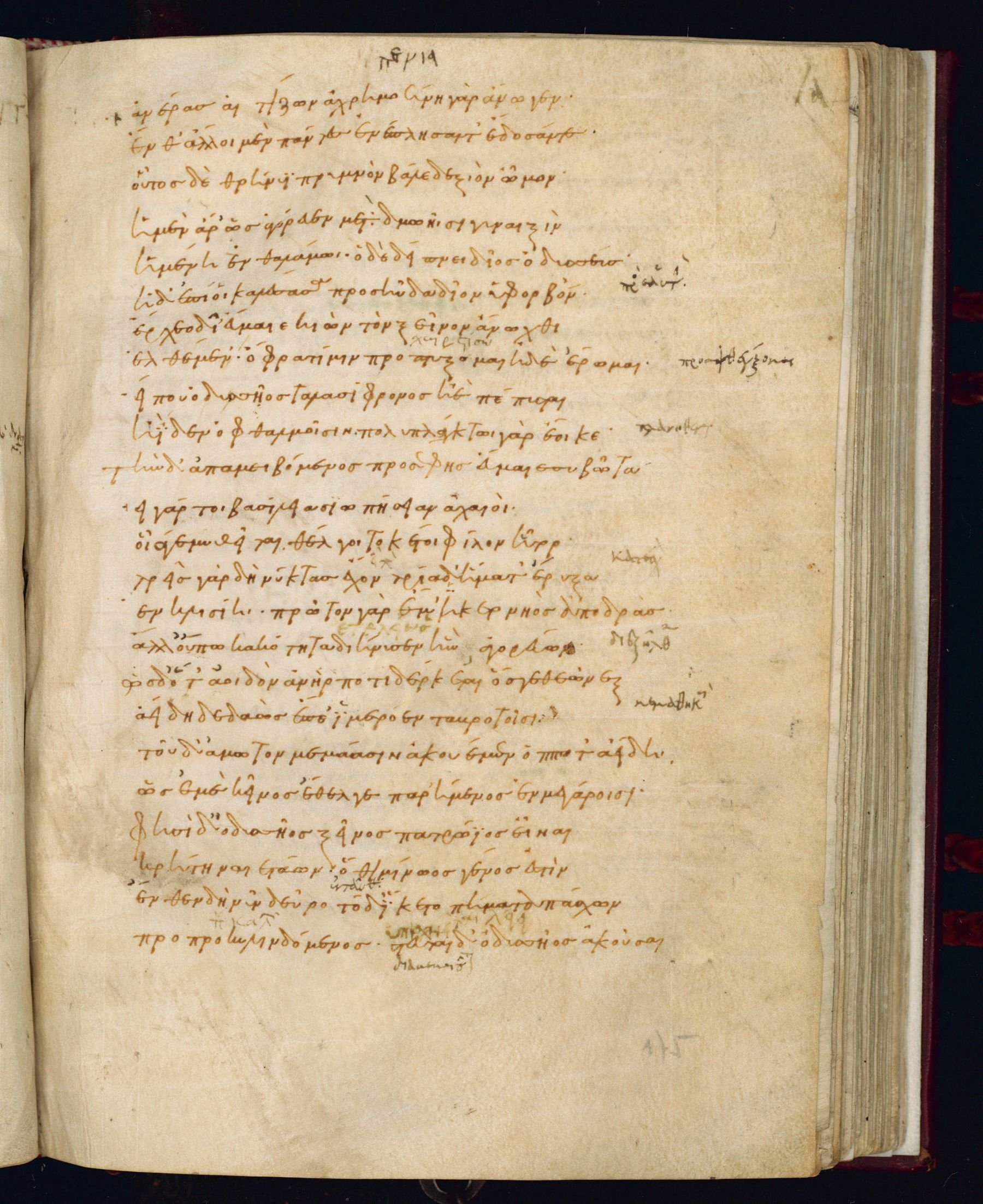
Where on the image
Laur. Plut. 32.24, fol. 175r: Odyssey 17.502-525, begins ‹ἀνέρας αἰτίζων· ἀχρημοσύνη γὰρ›, ends ‹στεῦται δʼ Ὀδυσῆος ἀκοῦσαι,›. Checked on the image: first and last lines read and matched to the Greek. Fol. 174v ends with 17.501. Fol. 175v begins with 17.526. English blocks here: 500-504, 505-509, 510-514, 515-519, 520-524.
502ἀνέρας αἰτίζων· ἀχρημοσύνη γὰρ ἀνώγει·
503ἔνθʼ ἄλλοι μὲν πάντες ἐνέπλησάν τʼ ἔδοσάν τε,
504οὗτος δὲ θρήνυι πρυμνὸν βάλε δεξιὸν ὦμον.
505ἡ μὲν ἄρʼ ὣς ἀγόρευε μετὰ δμῳῇσι γυναιξίν,
506ἡμένη ἐν θαλάμῳ· ὁ δʼ ἐδείπνεε δῖος Ὀδυσσεύς·
507ἡ δʼ ἐπὶ οἷ καλέσασα προσηύδα δῖον ὑφορβόν·
508ἔρχεο, δῖʼ Εὔμαιε, κιὼν τὸν ξεῖνον ἄνωχθι
509ἐλθέμεν, ὄφρα τί μιν προσπτύξομαι ἠδʼ ἐρέωμαι
510εἴ που Ὀδυσσῆος ταλασίφρονος ἠὲ πέπυσται
511ἢ ἴδεν ὀφθαλμοῖσι· πολυπλάγκτῳ γὰρ ἔοικε.
512τὴν δʼ ἀπαμειβόμενος προσέφης, Εὔμαιε συβῶτα
513εἰ γάρ τοι, βασίλεια, σιωπήσειαν Ἀχαιοί·
514οἷʼ ὅ γε μυθεῖται, θέλγοιτό κέ τοι φίλον ἦτορ.
515τρεῖς γὰρ δή μιν νύκτας ἔχον, τρία δʼ ἤματʼ ἔρυξα
516ἐν κλισίῃ· πρῶτον γὰρ ἔμʼ ἵκετο νηὸς ἀποδράς·
517ἀλλʼ οὔ πω κακότητα διήνυσεν ἣν ἀγορεύων.
518ὡς δʼ ὅτʼ ἀοιδὸν ἀνὴρ ποτιδέρκεται, ὅς τε θεῶν ἒξ
519ἀείδει δεδαὼς ἔπεʼ ἱμερόεντα βροτοῖσι,
520τοῦ δʼ ἄμοτον μεμάασιν ἀκουέμεν, ὁππότʼ ἀείδῃ·
521ὣς ἐμὲ κεῖνος ἔθελγε παρήμενος ἐν μεγάροισι.
522φησὶ δʼ Ὀδυσσῆος ξεῖνος πατρώϊος εἶναι,
523Κρήτῃ ναιετάων, ὅθι Μίνωος γένος ἐστίν.
524ἔνθεν δὴ νῦν δεῦρο τόδʼ ἵκετο πήματα πάσχων,
525προπροκυλινδόμενος· στεῦται δʼ Ὀδυσῆος ἀκοῦσαι,
500But Antinous more than all is like black fate. Some wretched stranger roams through the house, begging alms of the men, for want compels him, and all the others filled his wallet and gave him gifts, but Antinous flung a footstool and smote him at the base of the right shoulder.” 505So she spoke among her handmaids, sitting in her chamber, while goodly Odysseus was at meat. Then she called to her the goodly swineherd, and said: “Go, goodly Eumaeus, and bid the stranger come hither, that I may give him greeting, and ask him 510if haply he has heard of Odysseus of the steadfast heart, or has seen him with his eyes. He seems like one that has wandered far.” To her, then, swineherd Eumaeus, didst thou make answer, and say: “I would, O queen, that the Achaeans would keep silence, for he speaks such words as would charm thy very soul. 515Three nights I had him by me, and three days I kept him in my hut, for to me first he came when he fled by stealth from a ship, but he had not yet ended the tale of his sufferings. Even as when a man gazes upon a minstrel who sings to mortals songs of longing that the gods have taught him, 520and their desire to hear him has no end, whensoever he sings, even so he charmed me as he sat in my hall. He says that he is an ancestral friend of Odysseus, and that he dwells in Crete, where is the race of Minos. From thence has he now come on this journey hither, ever suffering woes
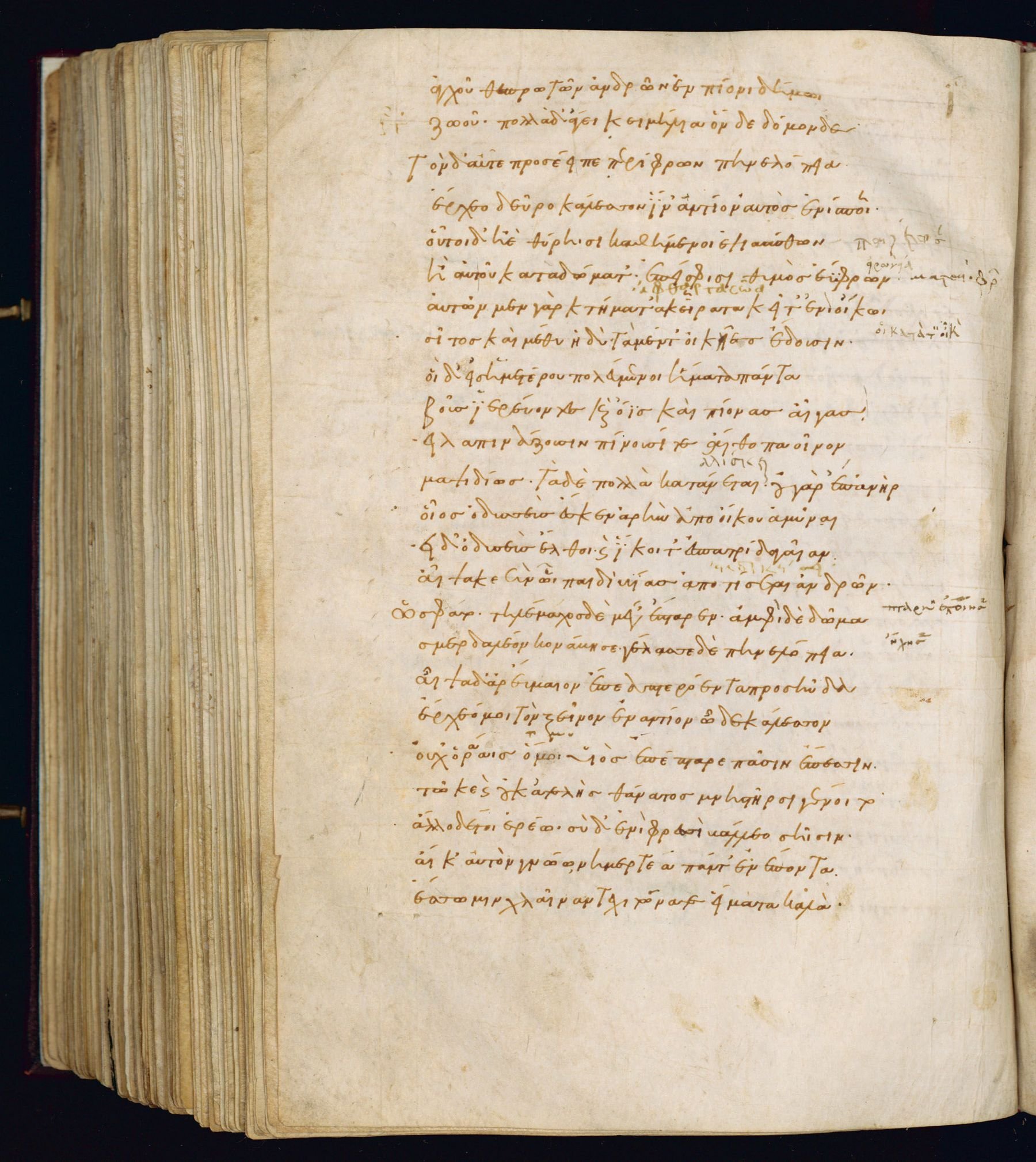
Where on the image
Laur. Plut. 32.24, fol. 175v: Odyssey 17.526-550, begins ‹ἀγχοῦ, Θεσπρωτῶν ἀνδρῶν ἐν›, ends ‹χιτῶνά τε, εἵματα καλά.›. Checked on the image: first and last lines read and matched to the Greek. Fol. 175r ends with 17.525. Fol. 176r begins with 17.551. 17.547 (πᾶσι μάλʼ, οὐδέ κέ τις θάνατον ...) is not on the page: the scribe passes from 17.546 to 17.548 (24 lines). English blocks here: 525-529, 530-534, 535-539, 540-544, 545-549.
526ἀγχοῦ, Θεσπρωτῶν ἀνδρῶν ἐν πίονι δήμῳ,
527ζωοῦ· πολλὰ δʼ ἄγει κειμήλια ὅνδε δόμονδε.
528τὸν δʼ αὖτε προσέειπε περίφρων Πηνελόπεια·
529ἔρχεο, δεῦρο κάλεσσον, ἵνʼ ἀντίον αὐτὸς ἐνίσπῃ.
530οὗτοι δʼ ἠὲ θύρῃσι καθήμενοι ἑψιαάσθων.
531ἢ αὐτοῦ κατὰ δώματʼ, ἐπεί σφισι θυμὸς ἐΰφρων.
532αὐτῶν μὲν γὰρ κτήματʼ ἀκήρατα κεῖτʼ ἐνὶ οἴκῳ,
533σῖτος καὶ μέθυ ἡδύ· τὰ μὲν οἰκῆες ἔδουσιν,
534οἱ δʼ εἰς ἡμέτερον πωλεύμενοι ἤματα πάντα,
535βοῦς ἱερεύοντες καὶ ὄϊς καὶ πίονας αἶγας,
536εἰλαπινάζουσιν πίνουσί τε αἴθοπα οἶνον,
537μαψιδίως· τὰ δὲ πολλὰ κατάνεται. οὐ γὰρ ἔπʼ ἀνήρ,
538οἷος Ὀδυσσεὺς ἔσκεν, ἀρὴν ἀπὸ οἴκου ἀμῦναι.
539εἰ δʼ Ὀδυσεὺς ἔλθοι καὶ ἵκοιτʼ ἐς πατρίδα γαῖαν,
540αἶψά κε σὺν ᾧ παιδὶ βίας ἀποτίσεται ἀνδρῶν.
541ὣς φάτο, Τηλέμαχος δὲ μέγʼ ἔπταρεν, ἀμφὶ δὲ δῶμα
542σμερδαλέον κονάβησε· γέλασσε δὲ Πηνελόπεια,
543αἶψα δʼ ἄρʼ Εὔμαιον ἔπεα πτερόεντα προσηύδα·
544ἔρχεό μοι, τὸν ξεῖνον ἐναντίον ὧδε κάλεσσον.
545οὐχ ὁράᾳς ὅ μοι υἱὸς ἐπέπταρε πᾶσιν ἔπεσσι;
546τῷ κε καὶ οὐκ ἀτελὴς θάνατος μνηστῆρσι γένοιτο
547πᾶσι μάλʼ, οὐδέ κέ τις θάνατον καὶ κῆρας ἀλύξει.
548ἄλλο δέ τοι ἐρέω, σὺ δʼ ἐνὶ φρεσὶ βάλλεο σῇσιν·
549αἴ κʼ αὐτὸν γνώω νημερτέα πάντʼ ἐνέποντα,
550ἕσσω μιν χλαῖνάν τε χιτῶνά τε, εἵματα καλά.
525as he wanders on and on. And he insists that he has heard tidings of Odysseus, near at hand in the rich land of the Thesprotians and yet alive; and he is bringing many treasures to his home.” Then wise Penelope answered him: “Go, call him hither, that he may himself tell me to my face. 530But as for these men, let them make sport as they sit in the doorway or here in the house, since their hearts are merry. For their own possessions lie untouched in their homes, bread and sweet wine, and on these do their servants feed. But themselves throng our house day after day, 535slaying our oxen, and sheep, and fat goats, and keep revel and drink the flaming wine recklessly, and havoc is made of all this wealth, for there is no man here such as Odysseus was to keep ruin from the house. But if Odysseus should come and return to his native land, 540straightway would he with his son take vengeance on these men for their violent deeds.” So she spoke, and Telemachus sneezed loudly, and all the room round about echoed wondrously. And Penelope laughed, and straightway spoke to Eumaeus winged words: “Go, pray, call the stranger here before me. 545Dost thou not note that my son has sneezed at all my words. Therefore shall utter death fall upon the wooers one and all, nor shall one of them escape death and the fates. And another thing will I tell thee, and do thou lay it to heart. If I find that he speaks all things truly,
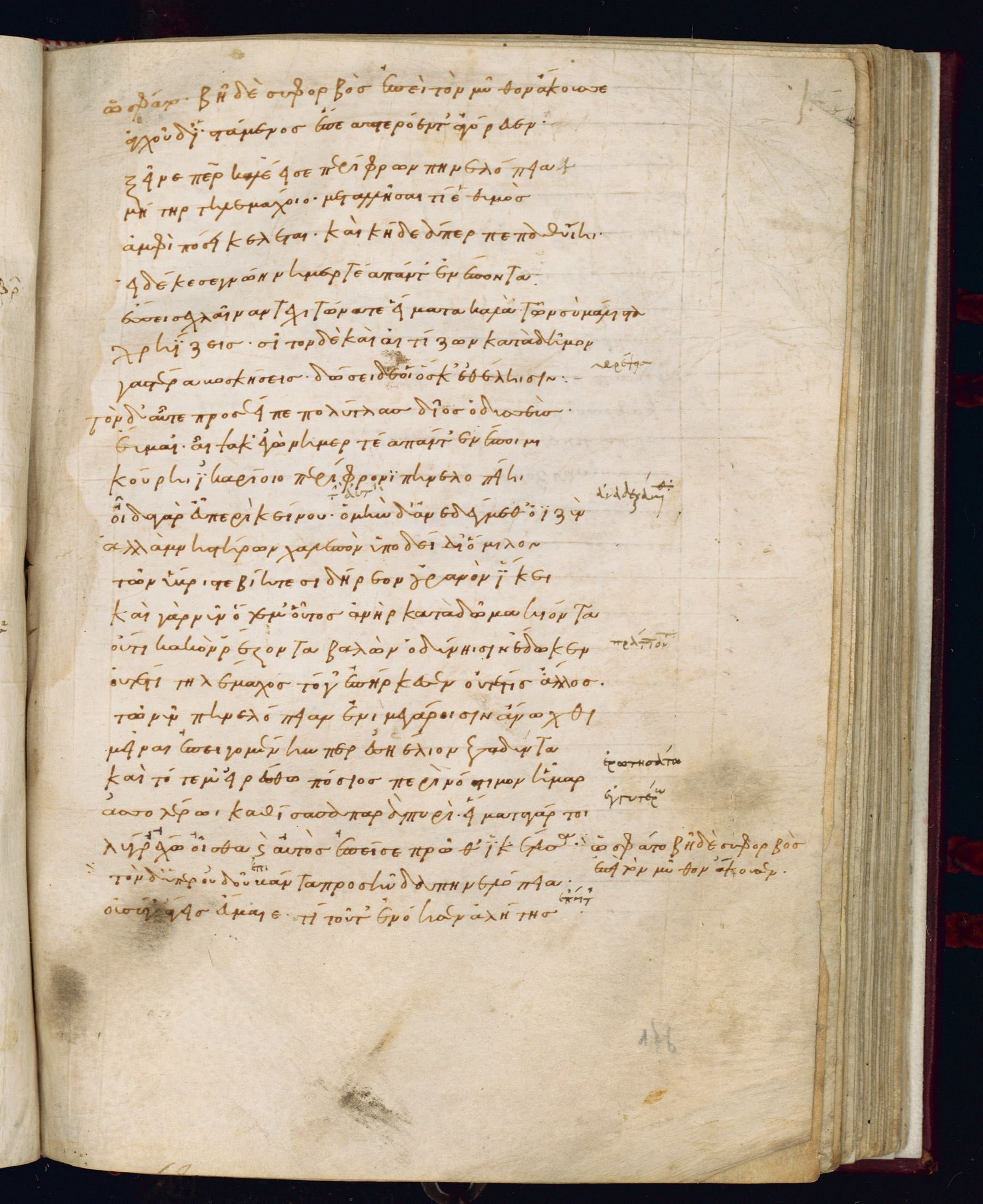
Where on the image
Laur. Plut. 32.24, fol. 176r: Odyssey 17.551-576, begins ‹ὣς φάτο, βῆ δὲ›, ends ‹τί τοῦτʼ ἐνόησεν ἀλήτης;›. Checked on the image: first and last lines read and matched to the Greek. Fol. 175v ends with 17.550. Fol. 176v begins with 17.577. 17.574 is written after 17.573 at the end of the same line (26 verses in 25 lines). English blocks here: 550-554, 555-559, 560-564, 565-569, 570-574.
551ὣς φάτο, βῆ δὲ συφορβός, ἐπεὶ τὸν μῦθον ἄκουσεν·
552ἀγχοῦ δʼ ἱστάμενος ἔπεα πτερόεντα προσηύδα·
553ξεῖνε πάτερ, καλέει σε περίφρων Πηνελόπεια,
554μήτηρ Τηλεμάχοιο· μεταλλῆσαί τί ἑ θυμὸς
555ἀμφὶ πόσει κέλεται, καὶ κήδεά περ πεπαθυίῃ.
556εἰ δέ κέ σε γνώῃ νημερτέα πάντʼ ἐνέποντα,
557ἕσσει σε χλαῖνάν τε χιτῶνά τε, τῶν σὺ μάλιστα
558χρηΐζεις· σῖτον δὲ καὶ αἰτίζων κατὰ δῆμον
559γαστέρα βοσκήσεις· δώσει δέ τοι ὅς κʼ ἐθέλῃσι.
560τὸν δʼ αὖτε προσέειπε πολύτλας δῖος Ὀδυσσεύς·
561Εὔμαιʼ, αἶψά κʼ ἐγὼ νημερτέα πάντʼ ἐνέποιμι
562κούρῃ Ἰκαρίοιο, περίφρονι Πηνελοπείῃ·
563οἶδα γὰρ εὖ περὶ κείνου, ὁμὴν δʼ ἀνεδέγμεθʼ ὀϊζύν.
564ἀλλὰ μνηστήρων χαλεπῶν ὑποδείδιʼ ὅμιλον,
565τῶν ὕβρις τε βίη τε σιδήρεον οὐρανὸν ἵκει.
566καὶ γὰρ νῦν, ὅτε μʼ οὗτος ἀνὴρ κατὰ δῶμα κιόντα
567οὔ τι κακὸν ῥέξαντα βαλὼν ὀδύνῃσιν ἔδωκεν,
568οὔτε τι Τηλέμαχος τό γʼ ἐπήρκεσεν οὔτε τις ἄλλος.
569τῷ νῦν Πηνελόπειαν ἐνὶ μεγάροισιν ἄνωχθι
570μεῖναι, ἐπειγομένην περ, ἐς ἠέλιον καταδύντα·
571καὶ τότε μʼ εἰρέσθω πόσιος πέρι νόστιμον ἦμαρ,
572ἀσσοτέρω καθίσασα παραὶ πυρί· εἵματα γάρ τοι
573λύγρʼ ἔχω· οἶσθα καὶ αὐτός, ἐπεί σε πρῶθʼ ἱκέτευσα.
574ὣς φάτο, βῆ δὲ συφορβός, ἐπεὶ τὸν μῦθον ἄκουσε.
575τὸν δʼ ὑπὲρ οὐδοῦ βάντα προσηύδα Πηνελόπεια·
576οὐ σύ γʼ ἄγεις, Εὔμαιε· τί τοῦτʼ ἐνόησεν ἀλήτης;
550I will clothe him in a cloak and tunic, fair raiment.” So she spoke, and the swineherd went when he had heard this saying; and coming up to Odysseus he spoke to him winged words: “Sir stranger, wise Penelope calls for thee, the mother of Telemachus, and her heart 555bids her make enquiry about her husband, though she has suffered many woes. And if she finds that thou speakest all things truly, she will clothe thee in a cloak and tunic, which thou needest most of all. As for thy food, thou shalt beg it through the land, and feed thy belly, and whoso will shall give it thee.” 560Then the much-enduring goodly Odysseus answered him: “Eumaeus, soon will I tell all the truth to the daughter of Icarius, wise Penelope. For well do I know of Odysseus, and in common have we borne affliction. But I have fear of this throng of harsh wooers, 565whose wantonness and violence reach the iron heaven. For even now, when, as I was going through the hall doing no evil, this man struck me and hurt me, neither Telemachus nor any other did aught to ward off the blow. Wherefore now bid Penelope 570to wait in the halls, eager though she be, till set of sun; and then let her ask me of her husband regarding the day of his return, giving me a seat nearer the fire, for lo, the raiment that I wear is mean, and this thou knowest of thyself, for to thee first did I make my prayer.” So he spoke, and the swineherd went when he had heard this saying.
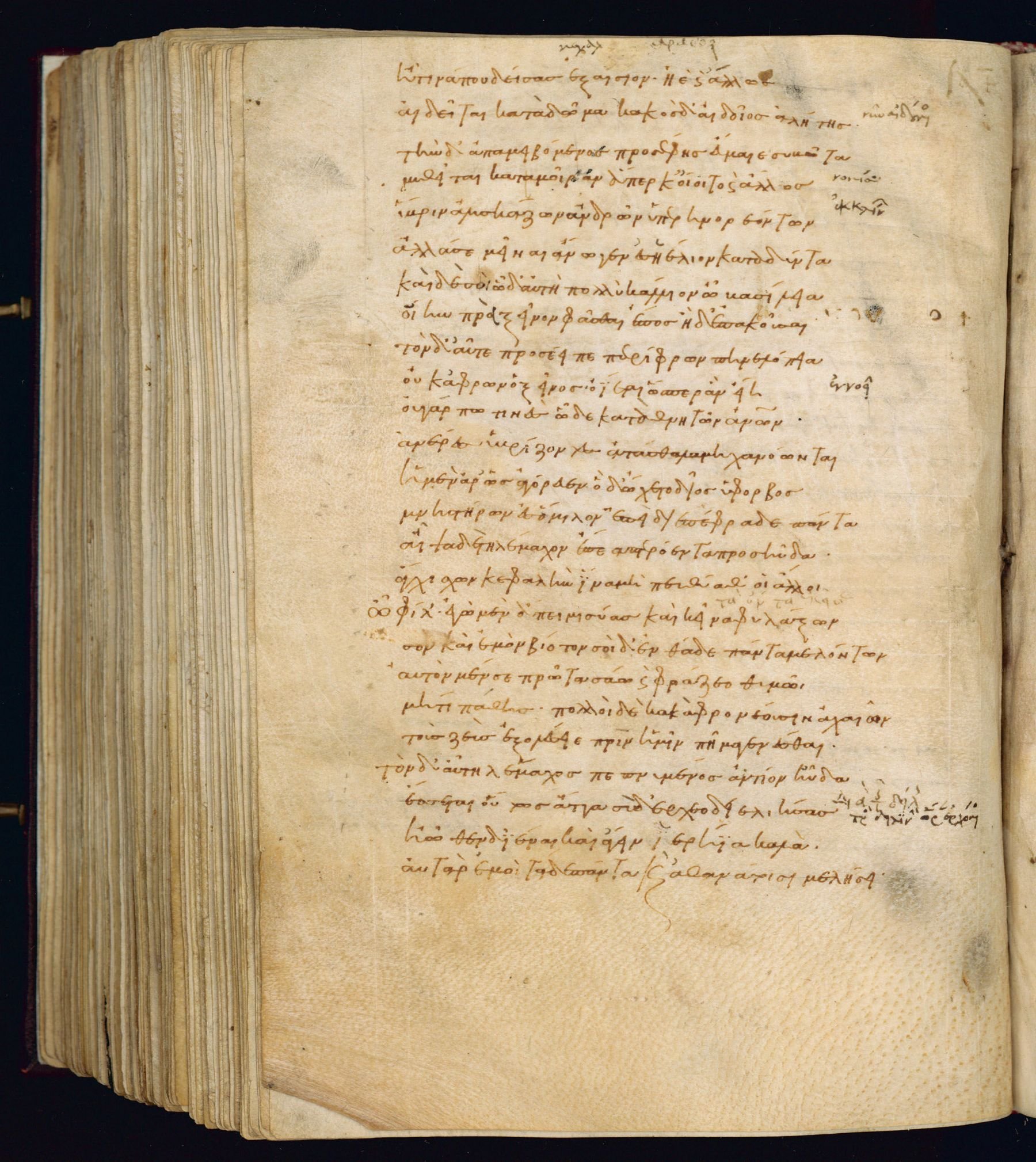
Where on the image
Laur. Plut. 32.24, fol. 176v: Odyssey 17.577-601, begins ‹ἦ τινά που δείσας›, ends ‹πάντα καὶ ἀθανάτοισι μελήσει.›. Checked on the image: first and last lines read and matched to the Greek. Fol. 176r ends with 17.576. Fol. 177r begins with 17.602. English blocks here: 575-579, 580-584, 585-589, 590-594, 595-599.
577ἦ τινά που δείσας ἐξαίσιον ἦε καὶ ἄλλως
578αἰδεῖται κατὰ δῶμα; κακὸς δʼ αἰδοῖος ἀλήτης.
579τὴν δʼ ἀπαμειβόμενος προσέφης, Εὔμαιε συβῶτα·
580μυθεῖται κατὰ μοῖραν, ἅ πέρ κʼ οἴοιτο καὶ ἄλλος,
581ὕβριν ἀλυσκάζων ἀνδρῶν ὑπερηνορεόντων.
582ἀλλά σε μεῖναι ἄνωγεν ἐς ἠέλιον καταδύντα.
583καὶ δὲ σοὶ ὧδʼ αὐτῇ πολὺ κάλλιον, ὦ βασίλεια,
584οἴην πρὸς ξεῖνον φάσθαι ἔπος ἠδʼ ἐπακοῦσαι.
585τὸν δʼ αὖτε προσέειπε περίφρων Πηνελόπεια·
586οὐκ ἄφρων ὁ ξεῖνος· ὀΐεται, ὥς περ ἂν εἴη·
587οὐ γάρ πού τινες ὧδε καταθνητῶν ἀνθρώπων
588ἀνέρες ὑβρίζοντες ἀτάσθαλα μηχανόωνται.
589ἡ μὲν ἄρʼ ὣς ἀγόρευεν, ὁ δʼ ᾤχετο δῖος ὑφορβὸς
590μνηστήρων ἐς ὅμιλον, ἐπεὶ διεπέφραδε πάντα.
591αἶψα δὲ Τηλέμαχον ἔπεα πτερόεντα προσηύδα,
592ἄγχι σχὼν κεφαλήν, ἵνα μὴ πευθοίαθʼ οἱ ἄλλοι·
593ὦ φίλʼ, ἐγὼ μὲν ἄπειμι, σύας καὶ κεῖνα φυλάξων,
594σὸν καὶ ἐμὸν βίοτον· σοὶ δʼ ἐνθάδε πάντα μελόντων.
595αὐτὸν μέν σε πρῶτα σάω, καὶ φράζεο θυμῷ
596μή τι πάθῃς· πολλοὶ δὲ κακὰ φρονέουσιν Ἀχαιῶν,
597τοὺς Ζεὺς ἐξολέσειε πρὶν ἡμῖν πῆμα γενέσθαι.
598τὸν δʼ αὖ Τηλέμαχος πεπνυμένος ἀντίον ηὔδα·
599ἔσσεται οὕτως, ἄττα· σὺ δʼ ἔρχεο δειελιήσας·
600ἠῶθεν δʼ ἰέναι καὶ ἄγειν ἱερήϊα καλά·
601αὐτὰρ ἐμοὶ τάδε πάντα καὶ ἀθανάτοισι μελήσει.
575And as he passed over the threshold Penelope said to him: “Thou dost not bring him, Eumaeus. What does the wanderer mean by this? Does he fear some one beyond measure, or does he idly feel ashamed in the house? 'Tis ill for a beggar to feel shame.” To her, then, swineherd Eumaeus, didst thou make answer and say: 580“He speaks rightly, even as any other man would deem, in seeking to shun the insolence of overweening men. But he bids thee to wait till set of sun. And for thyself, too, it is far more seemly, O queen, to speak to the stranger alone, and to hear his words.” 585Then wise Penelope answered him: “Not without wisdom is the stranger; he divines how it may be. There are no mortal men, methinks, who in wantonness devise such wicked folly as these.” So she spoke, and the goodly swineherd departed 590into the throng of the wooers when he had told her all. And straightway he spoke winged words to Telemachus, holding his head close to him that the others might not hear: “Friend, I am going forth to guard the swine and all things there, thy livelihood and mine; but have thou charge of all things here. 595Thine own self do thou keep safe first of all, and let thy mind beware lest some ill befall thee, for many of the Achaeans are devising evil, whom may Zeus utterly destroy before harm fall on us.” Then wise Telemachus answered him: “So shall it be, father; go thy way when thou hast supped.
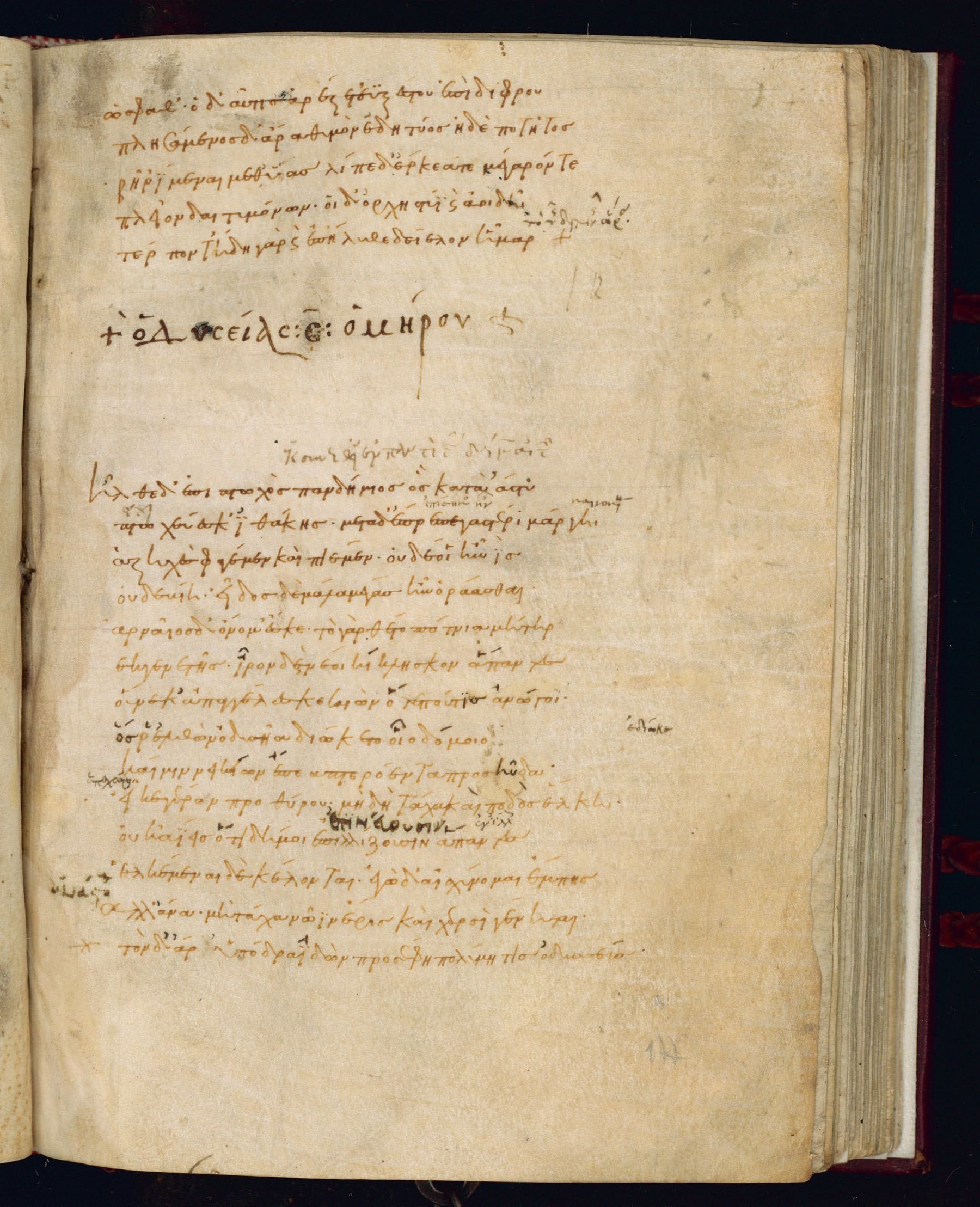
Where on the image
Laur. Plut. 32.24, fol. 177r: Odyssey 17.602-606, begins ‹ὣς φάθʼ, ὁ δʼ›, ends ‹καὶ ἐπήλυθε δείελον ἦμαρ.›. Checked on the image: first and last lines read and matched to the Greek. Fol. 176v ends with 17.601. The page holds 17.602-606, 18.1-14. Book 17 ends with 17.606 and a line of ornament; the heading + ὀδυσσείας σ ὁμήρου follows in capitals, and a short line in small script stands above 18.1, which has an enlarged initial. English blocks here: 600-604, 605-606.
602ὣς φάθʼ, ὁ δʼ αὖτις ἄρʼ ἕζετʼ ἐϋξέστου ἐπὶ δίφρου,
603πλησάμενος δʼ ἄρα θυμὸν ἐδητύος ἠδὲ ποτῆτος
604βῆ ῥʼ ἴμεναι μεθʼ ὕας, λίπε δʼ ἕρκεά τε μέγαρόν τε,
605πλεῖον δαιτυμόνων· οἱ δʼ ὀρχηστυῖ καὶ ἀοιδῇ
606τέρποντʼ· ἤδη γὰρ καὶ ἐπήλυθε δείελον ἦμαρ.
600And in the morning do thou come and bring goodly victims. But all matters here shall be a care to me and to the immortals.” So he spoke, and the swineherd sat down again on the polished chair. But when he had satisfied his heart with meat and drink, he went his way to the swine, and left the courts and the hall 605full of banqueters. And they were making merry with dance and song, for evening had now come on.
Notes
- Greek: A. T. Murray, Homer: The Odyssey (Loeb Classical Library, 1919), via Perseus.
- English: A. T. Murray's translation in the same edition; his footnotes are omitted.
Cite
Sources
- Source: Laur. Plut. 32.24 (BML Teca Digitale IIIF) + Murray Greek (Loeb 1919, Perseus) + Murray English (Loeb 1919, Perseus) (holding institution)
- Critical edition: Murray, Loeb 1919, via Perseus
← previous · → next · v cycle view · l back to library