Homer, Odyssey, Book 18: The beggar Irus
Introduction
The Odyssey, composed around 700 BCE and attributed to Homer, tells of Odysseus' ten-year journey home from Troy and his return to Ithaca. Book 18 (428 lines): The beggar Irus.
The page photographs are from Florence, Biblioteca Medicea Laurenziana, Plut. 32.24 (parchment, 10th century, 234 folios; the oldest manuscript of the Odyssey with published images), in the Biblioteca Medicea Laurenziana's Teca Digitale. This book is on fol. 177r-185r; each section below is one page, with its first and last line as read on the photograph. Many pages carry interlinear glosses and a few marginal notes in later hands.
The Greek is A. T. Murray's Loeb text (1919) via Perseus, not a transcription of this manuscript, whose wording differs in places. The English is Murray's prose translation (1919), divided every five lines; at a page break a five-line block goes with the page holding most of it, except at the page breaks where a section's note says the English is cut at the end of Murray's sentence. Each section's note gives its English line range.
Where the scribe left out a line, wrote one in the margin, changed the order or added a line not in Murray's text, the section's note on the photograph says so; the Greek and English shown are Murray's full text for the page's range.
How was this verified? (Provenance)
Where on the image
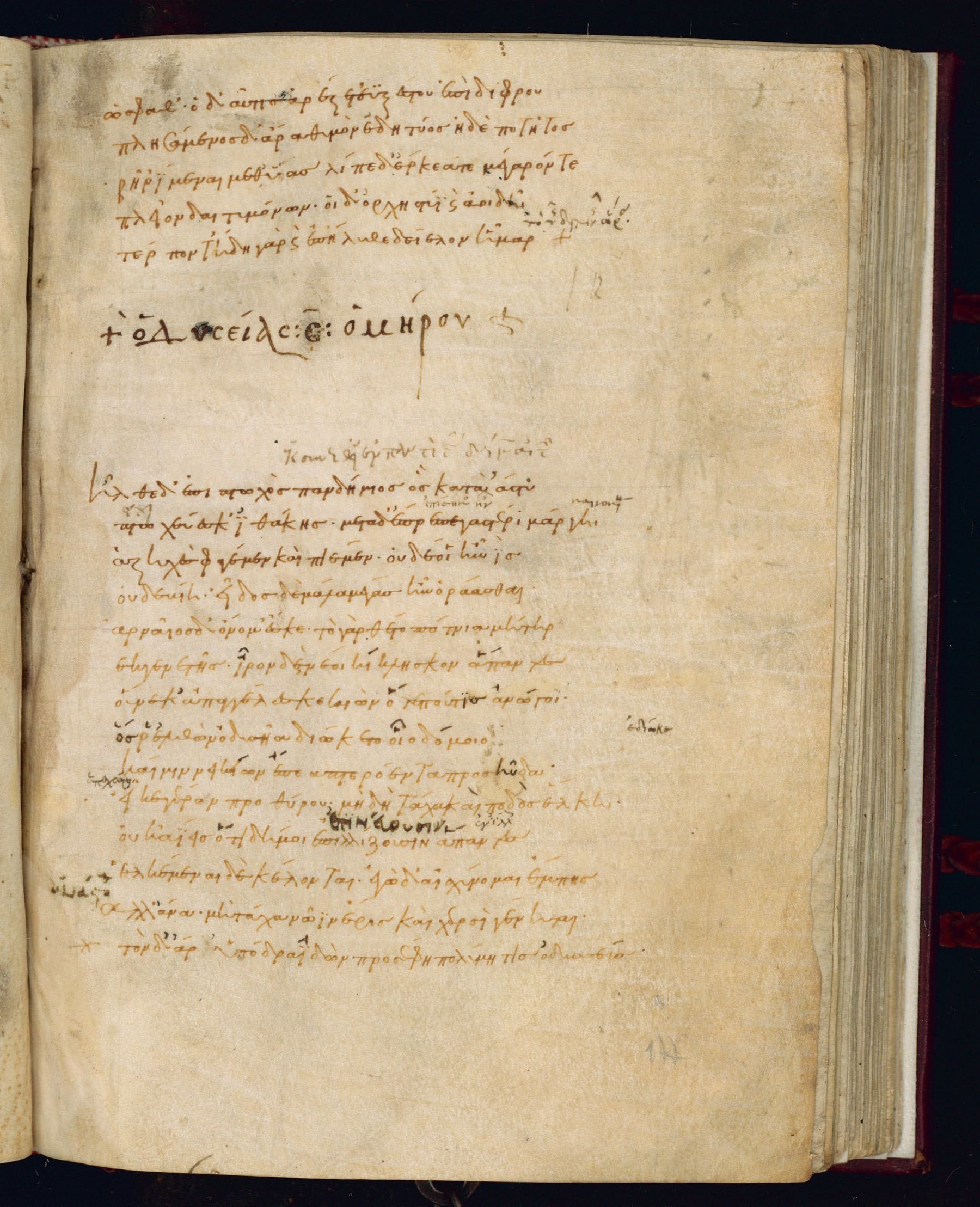
Laur. Plut. 32.24, fol. 177r: Odyssey 18.1-14, begins ‹ἦλθε δʼ ἐπὶ πτωχὸς›, ends ‹ἰδὼν προσέφη πολύμητις Ὀδυσσεύς·›. Checked on the image: first and last lines read and matched to the Greek. Fol. 177v begins with 18.15. The page holds 17.602-606, 18.1-14. Book 17 ends with 17.606 and a line of ornament; the heading + ὀδυσσείας σ ὁμήρου follows in capitals, and a short line in small script stands above 18.1, which has an enlarged initial. English blocks here: 1-4, 5-9, 10-14.
1ἦλθε δʼ ἐπὶ πτωχὸς πανδήμιος, ὃς κατὰ ἄστυ
2πτωχεύεσκʼ Ἰθάκης, μετὰ δʼ ἔπρεπε γαστέρι μάργῃ
3ἀζηχὲς φαγέμεν καὶ πιέμεν· οὐδέ οἱ ἦν ἲς
4οὐδὲ βίη, εἶδος δὲ μάλα μέγας ἦν ὁράασθαι.
5Ἀρναῖος δʼ ὄνομʼ ἔσκε· τὸ γὰρ θέτο πότνια μήτηρ
6ἐκ γενετῆς· Ἶρον δὲ νέοι κίκλησκον ἅπαντες,
7οὕνεκʼ ἀπαγγέλλεσκε κιών, ὅτε πού τις ἀνώγοι·
8ὅς ῥʼ ἐλθὼν Ὀδυσῆα διώκετο οἷο δόμοιο,
9καί μιν νεικείων ἔπεα πτερόεντα προσηύδα·
10εἶκε, γέρον, προθύρου, μὴ δὴ τάχα καὶ ποδὸς ἕλκῃ.
11οὐκ ἀΐεις ὅτι δή μοι ἐπιλλίζουσιν ἅπαντες,
12ἑλκέμεναι δὲ κέλονται; ἐγὼ δʼ αἰσχύνομαι ἔμπης.
13ἀλλʼ ἄνα, μὴ τάχα νῶϊν ἔρις καὶ χερσὶ γένηται.
14τὸν δʼ ἄρʼ ὑπόδρα ἰδὼν προσέφη πολύμητις Ὀδυσσεύς·
1Now there came up a public beggar who was wont to beg through the town of Ithaca, and was known for his greedy belly, eating and drinking without end. No strength had he nor might, but in bulk was big indeed to look upon. 5Arnaeus was his name, for this name his honored mother had given him at his birth; but Irus all the young men called him, because he used to run on errands when anyone bade him. He came now, and was for driving Odysseus from his own house; and he began to revile him, and spoke winged words: 10“Give way, old man, from the doorway, lest soon thou be even dragged out by the foot. Dost thou not see that all men are winking at me, and bidding me drag thee? Yet for myself, I am ashamed to do it. Nay, up with thee, lest our quarrel even come to blows.” Then with an angry glance from beneath his brows Odysseus of many wiles answered him:
Where on the image
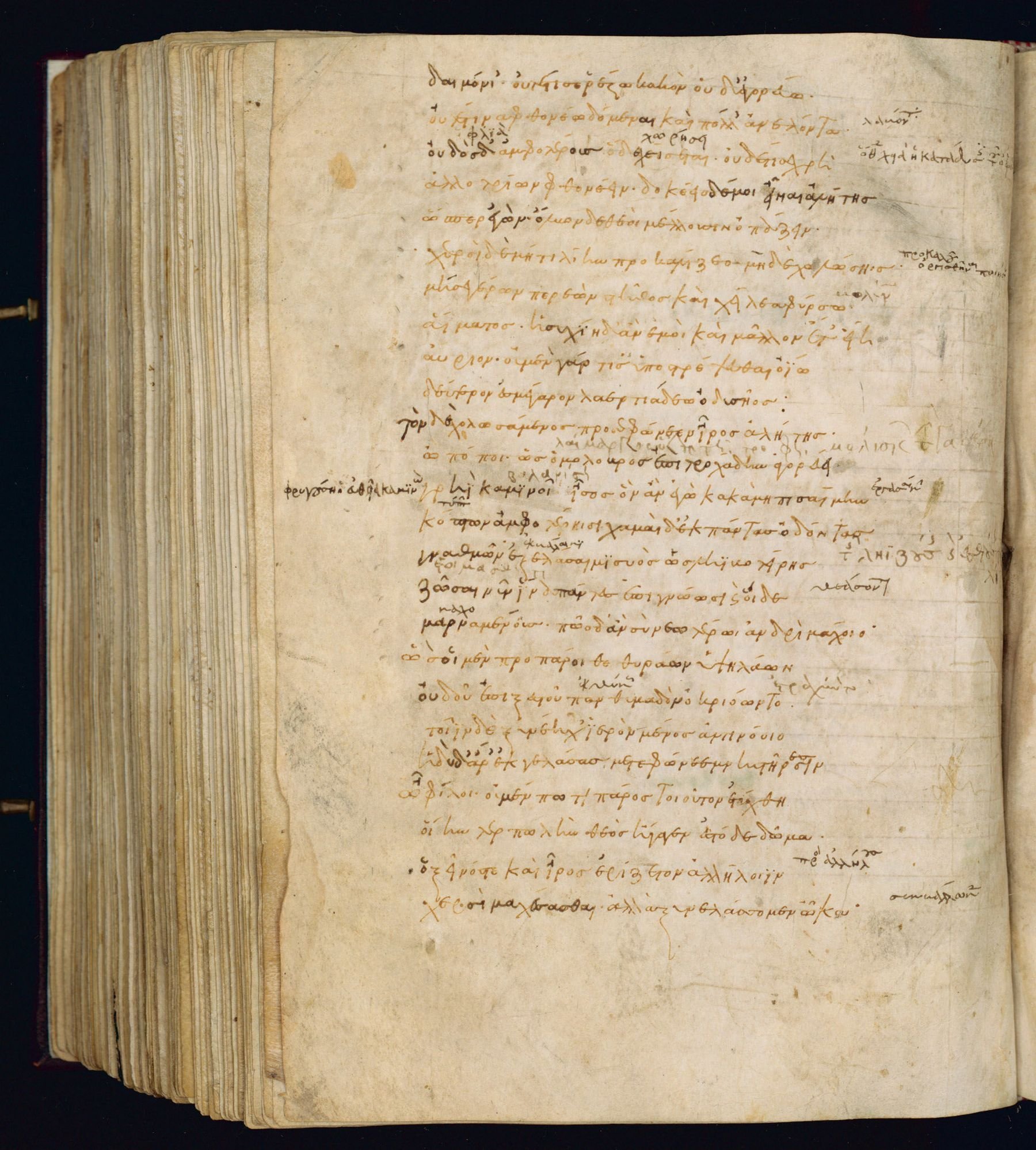
Laur. Plut. 32.24, fol. 177v: Odyssey 18.15-39, begins ‹δαιμόνιʼ, οὔτε τί σε›, ends ‹μαχέσσασθαι· ἀλλὰ ξυνελάσσομεν ὦκα.›. Checked on the image: first and last lines read and matched to the Greek. Fol. 177r ends with 18.14. Fol. 178r begins with 18.40. English blocks here: 15-19, 20-24, 25-29, 30-34, 35-39.
15δαιμόνιʼ, οὔτε τί σε ῥέζω κακὸν οὔτʼ ἀγορεύω,
16οὔτε τινὰ φθονέω δόμεναι καὶ πόλλʼ ἀνελόντα.
17οὐδὸς δʼ ἀμφοτέρους ὅδε χείσεται, οὐδέ τί σε χρὴ
18ἀλλοτρίων φθονέειν· δοκέεις δέ μοι εἶναι ἀλήτης
19ὥς περ ἐγών, ὄλβον δὲ θεοὶ μέλλουσιν ὀπάζειν.
20χερσὶ δὲ μή τι λίην προκαλίζεο, μή με χολώσῃς,
21μή σε γέρων περ ἐὼν στῆθος καὶ χείλεα φύρσω
22αἵματος· ἡσυχίη δʼ ἂν ἐμοὶ καὶ μᾶλλον ἔτʼ εἴη
23αὔριον· οὐ μὲν γάρ τί σʼ ὑποστρέψεσθαι ὀΐω
24δεύτερον ἐς μέγαρον Λαερτιάδεω Ὀδυσῆος.
25τὸν δὲ χολωσάμενος προσεφώνεεν Ἶρος ἀλήτης·
26ὢ πόποι, ὡς ὁ μολοβρὸς ἐπιτροχάδην ἀγορεύει,
27γρηῒ καμινοῖ ἶσος· ὃν ἂν κακὰ μητισαίμην
28κόπτων ἀμφοτέρῃσι, χαμαὶ δέ κε πάντας ὀδόντας
29γναθμῶν ἐξελάσαιμι συὸς ὣς ληϊβοτείρης.
30ζῶσαι νῦν, ἵνα πάντες ἐπιγνώωσι καὶ οἵδε
31μαρναμένους· πῶς δʼ ἂν σὺ νεωτέρῳ ἀνδρὶ μάχοιο;
32ὣς οἱ μὲν προπάροιθε θυράων ὑψηλάων
33οὐδοῦ ἔπι ξεστοῦ πανθυμαδὸν ὀκριόωντο.
34τοῖϊν δὲ ξυνέηχʼ ἱερὸν μένος Ἀντινόοιο,
35ἡδὺ δʼ ἄρʼ ἐκγελάσας μετεφώνει μνηστήρεσσιν·
36ὦ φίλοι, οὐ μέν πώ τι πάρος τοιοῦτον ἐτύχθη,
37οἵην τερπωλὴν θεὸς ἤγαγεν ἐς τόδε δῶμα.
38ὁ ξεῖνός τε καὶ Ἶρος ἐρίζετον ἀλλήλοιϊν
39χερσὶ μαχέσσασθαι· ἀλλὰ ξυνελάσσομεν ὦκα.
15“Good fellow, I harm thee not in deed or word, nor do I begrudge that any man should give thee, though the portion he took up were a large one. This threshold will hold us both, and thou hast no need to be jealous for the goods of other folk. Thou seemest to me to be a vagrant, even as I am; and as for happy fortune, it is the gods that are like to give us that. 20But with thy fists do not provoke me overmuch, lest thou anger me, and, old man though I am, I befoul thy breast and lips with blood. So should I have the greater peace tomorrow, for I deem not that thou shalt return a second time to the hall of Odysseus, son of Laertes.” 25Then, waxing wroth, the vagrant Irus said to him: “Now see how glibly the filthy wretch talks, like an old kitchen-wife. But I will devise evil for him, smiting him left and right, and will scatter on the ground all the teeth from his jaws, as though he were a swine wasting the corn. 30Gird thyself now, that these men, too, may all know our fighting. But how couldst thou fight with a younger man?” Thus on the polished threshold before the lofty doors they stirred one another's rage right heartily. And the strong and mighty Antinous heard the two, 35and, breaking into a merry laugh, he spoke among the wooers: “Friends, never before has such a thing come to pass, that a god has brought sport like this to this house. Yon stranger and Irus are provoking one another to blows. Come, let us quickly set them on.”
Where on the image
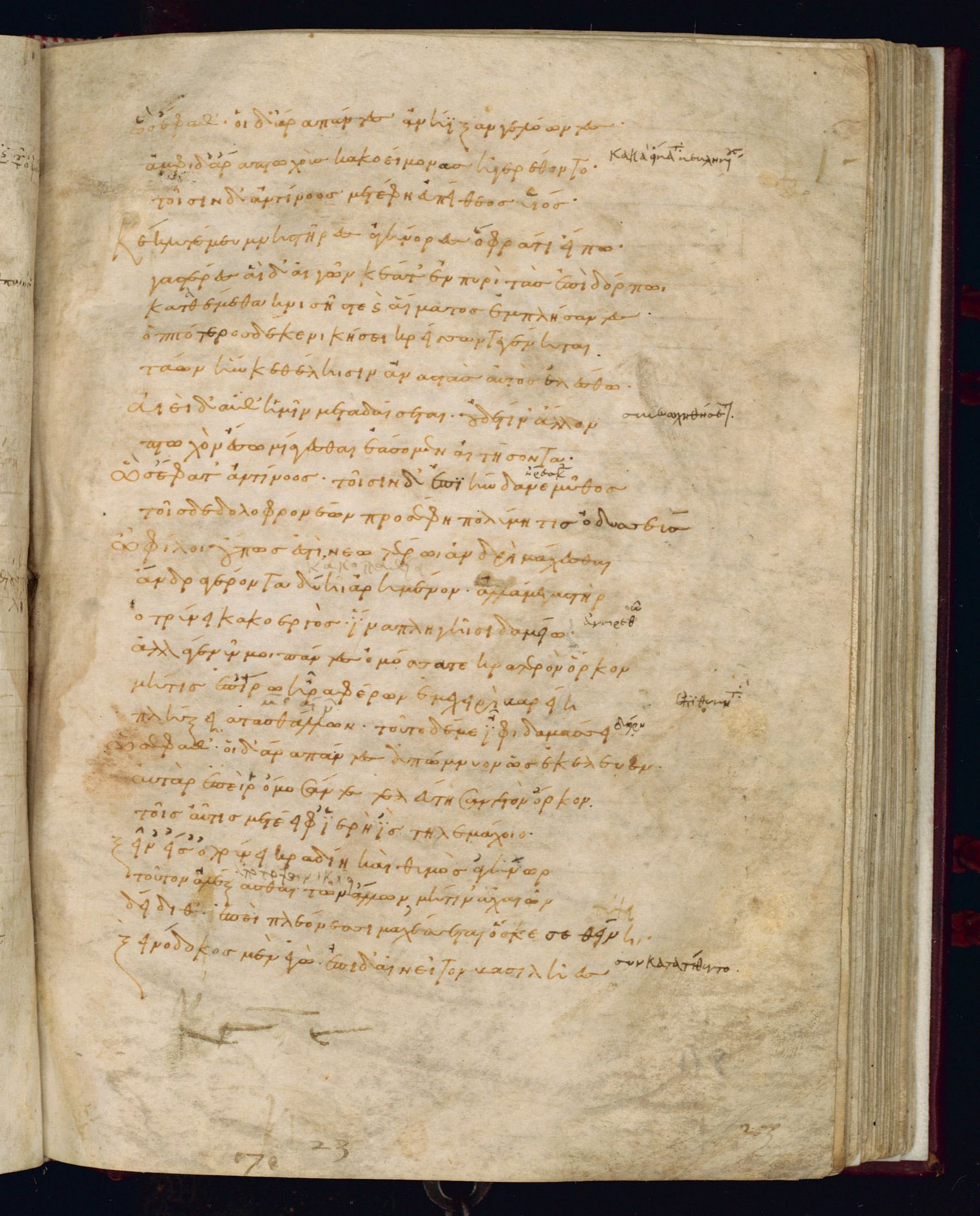
Laur. Plut. 32.24, fol. 178r: Odyssey 18.40-64, begins ‹ὣς ἔφαθʼ, οἱ δʼ›, ends ‹ἐπὶ δʼ αἰνεῖτον βασιλῆες,›. Checked on the image: first and last lines read and matched to the Greek. Fol. 177v ends with 18.39. Fol. 178v begins with 18.65. English blocks here: 40-44, 45-49, 50-54, 55-59, 60-64.
40ὣς ἔφαθʼ, οἱ δʼ ἄρα πάντες ἀνήϊξαν γελόωντες,
41ἀμφὶ δʼ ἄρα πτωχοὺς κακοείμονας ἠγερέθοντο.
42τοῖσιν δʼ Ἀντίνοος μετέφη, Εὐπείθεος υἱός·
43κέκλυτέ μευ, μνηστῆρες ἀγήνορες, ὄφρα τι εἴπω.
44γαστέρες αἵδʼ αἰγῶν κέατʼ ἐν πυρί, τὰς ἐπὶ δόρπῳ
45κατθέμεθα κνίσης τε καὶ αἵματος ἐμπλήσαντες·
46ὁππότερος δέ κε νικήσῃ κρείσσων τε γένηται,
47τάων ἥν κʼ ἐθέλῃσιν ἀναστὰς αὐτὸς ἑλέσθω·
48αἰεὶ αὖθʼ ἡμῖν μεταδαίσεται, οὐδέ τινʼ ἄλλον
49πτωχὸν ἔσω μίσγεσθαι ἐάσομεν αἰτήσοντα.
50ὣς ἔφατʼ Ἀντίνοος, τοῖσιν δʼ ἐπιήνδανε μῦθος.
51τοῖς δὲ δολοφρονέων μετέφη πολύμητις Ὀδυσσεύς·
52ὦ φίλοι, οὔ πως ἔστι νεωτέρῳ ἀνδρὶ μάχεσθαι
53ἄνδρα γέροντα, δύῃ ἀρημένον· ἀλλά με γαστὴρ
54ὀτρύνει κακοεργός, ἵνα πληγῇσι δαμείω.
55ἀλλʼ ἄγε νῦν μοι πάντες ὀμόσσατε καρτερὸν ὅρκον,
56μή τις ἐπʼ Ἴρῳ ἦρα φέρων ἐμὲ χειρὶ βαρείῃ
57πλήξῃ ἀτασθάλλων, τούτῳ δέ με ἶφι δαμάσσῃ.
58ὣς ἔφαθʼ, οἱ δʼ ἄρα πάντες ἀπώμνυον ὡς ἐκέλευεν.
59αὐτὰρ ἐπεί ῥʼ ὄμοσάν τε τελεύτησάν τε τὸν ὅρκον,
60τοῖς δʼ αὖτις μετέειφʼ ἱερὴ ἲς Τηλεμάχοιο·
61ξεῖνʼ, εἴ σʼ ὀτρύνει κραδίη καὶ θυμὸς ἀγήνωρ
62τοῦτον ἀλέξασθαι, τῶν δʼ ἄλλων μή τινʼ Ἀχαιῶν
63δείδιθʼ, ἐπεὶ πλεόνεσσι μαχήσεται ὅς κέ σε θείνῃ·
64ξεινοδόκος μὲν ἐγών, ἐπὶ δʼ αἰνεῖτον βασιλῆες,
40So he spoke, and they all sprang up laughing and gathered about the tattered beggars. And Antinous, son of Eupeithes, spoke among them, and said: “Hear me, ye proud wooers, that I may say somewhat. Here at the fire are goats' paunches lying, which 45we set there for supper, when we had filled them with fat and blood. Now whichever of the two wins and proves himself the better man, let him rise and choose for himself which one of these he will. And furthermore he shall always feast with us, nor will we suffer any other beggar to join our company and beg of us.” 50So spoke Antinous, and his word was pleasing to them. Then with crafty mind Odysseus of many wiles spoke among them: “Friends, in no wise may an old man that is overcome with woe fight with a younger. Howbeit my belly, that worker of evil, urges me on, that I may be overcome by his blows. 55But come now, do you all swear to me a mighty oath, to the end that no man, doing a favour to Irus, may deal me a foul blow with heavy hand, and so by violence subdue me to this fellow.” So he spoke, and they all gave the oath not to smite him, even as he bade. But when they had sworn and made an end of the oath, 60among them spoke again the strong and mighty Telemachus: “Stranger, if thy heart and thy proud spirit bid thee beat off this fellow, then fear not thou any man of all the Achaeans, for whoso strikes thee shall have to fight with more than thou. Thy host am I, and the princes assent hereto,
Where on the image
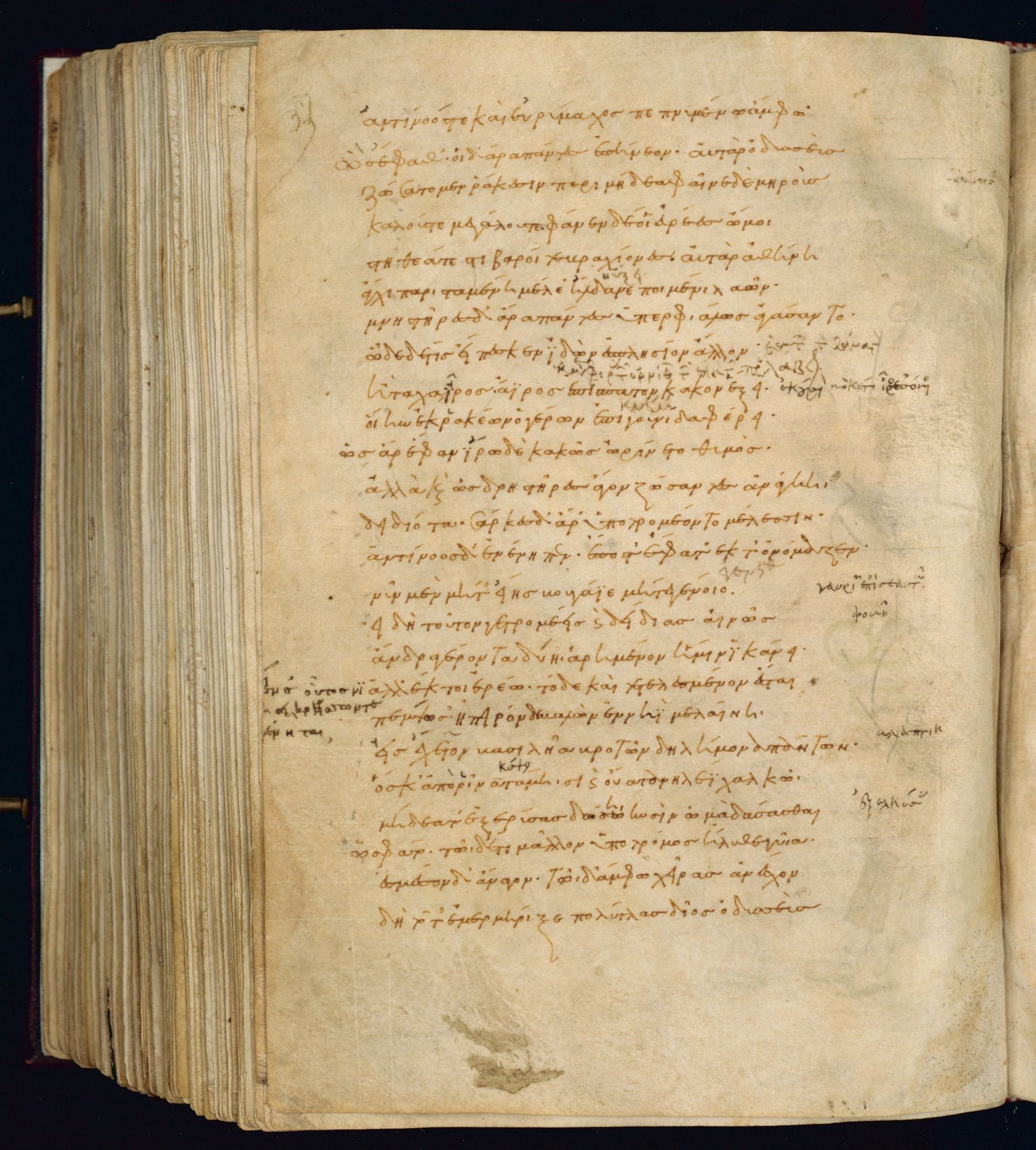
Laur. Plut. 32.24, fol. 178v: Odyssey 18.65-90, begins ‹Ἀντίνοός τε καὶ Εὐρύμαχος,›, ends ‹μερμήριξε πολύτλας δῖος Ὀδυσσεὺς›. Checked on the image: first and last lines read and matched to the Greek. Fol. 178r ends with 18.64. Fol. 179r begins with 18.91. 18.83 is not in the text column; it is written in the left margin beside 18.82 and 18.84 (the column has 25 lines). English blocks here: 65-69, 70-74, 75-79, 80-84, 85-87, 88-89.
65Ἀντίνοός τε καὶ Εὐρύμαχος, πεπνυμένω ἄμφω.
66ὣς ἔφαθʼ, οἱ δʼ ἄρα πάντες ἐπῄνεον· αὐτὰρ Ὀδυσσεὺς
67ζώσατο μὲν ῥάκεσιν περὶ μήδεα, φαῖνε δὲ μηροὺς
68καλούς τε μεγάλους τε, φάνεν δέ οἱ εὐρέες ὦμοι
69στήθεά τε στιβαροί τε βραχίονες· αὐτὰρ Ἀθήνη
70ἄγχι παρισταμένη μέλεʼ ἤλδανε ποιμένι λαῶν.
71μνηστῆρες δʼ ἄρα πάντες ὑπερφιάλως ἀγάσαντο·
72ὧδε δέ τις εἴπεσκεν ἰδὼν ἐς πλησίον ἄλλον·
73ἦ τάχα Ἶρος Ἄϊρος ἐπίσπαστον κακὸν ἕξει,
74οἵην ἐκ ῥακέων ὁ γέρων ἐπιγουνίδα φαίνει.
75ὣς ἄρʼ ἔφαν, Ἴρῳ δὲ κακῶς ὠρίνετο θυμός.
76ἀλλὰ καὶ ὣς δρηστῆρες ἄγον ζώσαντες ἀνάγκῃ
77δειδιότα· σάρκες δὲ περιτρομέοντο μέλεσσιν.
78Ἀντίνοος δʼ ἐνένιπεν ἔπος τʼ ἔφατʼ ἔκ τʼ ὀνόμαζεν·
79νῦν μὲν μήτʼ εἴης, βουγάϊε, μήτε γένοιο,
80εἰ δὴ τοῦτόν γε τρομέεις καὶ δείδιας αἰνῶς,
81ἄνδρα γέροντα, δύῃ ἀρημένον, ἥ μιν ἱκάνει.
82ἀλλʼ ἔκ τοι ἐρέω, τὸ δὲ καὶ τετελεσμένον ἔσται·
83αἴ κέν σʼ οὗτος νικήσῃ κρείσσων τε γένηται,
84πέμψω σʼ ἤπειρόνδε, βαλὼν ἐν νηὶ μελαίνῃ,
85εἰς Ἔχετον βασιλῆα, βροτῶν δηλήμονα πάντων,
86ὅς κʼ ἀπὸ ῥῖνα τάμῃσι καὶ οὔατα νηλέϊ χαλκῷ,
87μήδεά τʼ ἐξερύσας δώῃ κυσὶν ὠμὰ δάσασθαι.
88ὣς φάτο, τῷ δʼ ἔτι μᾶλλον ὑπὸ τρόμος ἔλλαβε γυῖα.
89ἐς μέσσον δʼ ἄναγον· τὼ δʼ ἄμφω χεῖρας ἀνέσχον.
90δὴ τότε μερμήριξε πολύτλας δῖος Ὀδυσσεὺς
65Antinous and Eurymachus, men of prudence both.” So he spoke, and they all praised his words. But Odysseus girded his rags about his loins and showed his thighs, comely and great, and his broad shoulders came to view, and his chest and mighty arms. And Athena 70drew nigh and made greater the limbs of the shepherd of the people. Then all the wooers marvelled exceedingly, and thus would one speak with a glance at his neighbor: “Right soon shall Irus, un-Irused, have a bane of his own bringing, such a thigh does yon old man show from beneath his rags.” 75So they spoke, and the mind of Irus was miserably shaken; yet even so the serving men girded him, and led him out perforce all filled with dread, and his flesh trembled on his limbs. Then Antinous rated him and spoke, and addressed him: “Better were it now, thou braggart, that thou wert not living, nor hadst ever been born, 80if thou quailest and art so terribly afraid of this fellow—a man that is old and overcome by the woe that has come upon him. But I will speak out to thee, and this word shall verily be brought to pass. If this fellow conquers thee and proves the better man, I will fling thee into a black ship and send thee to the mainland 85to King Echetus, the maimer of all men, who will cut off thy nose and ears with the pitiless bronze, and will draw forth thy vitals and give them raw to dogs to rend.” 88So he spoke, and thereat yet greater trembling seized the other's limbs, and they led him into the ring and both men put up their hands.
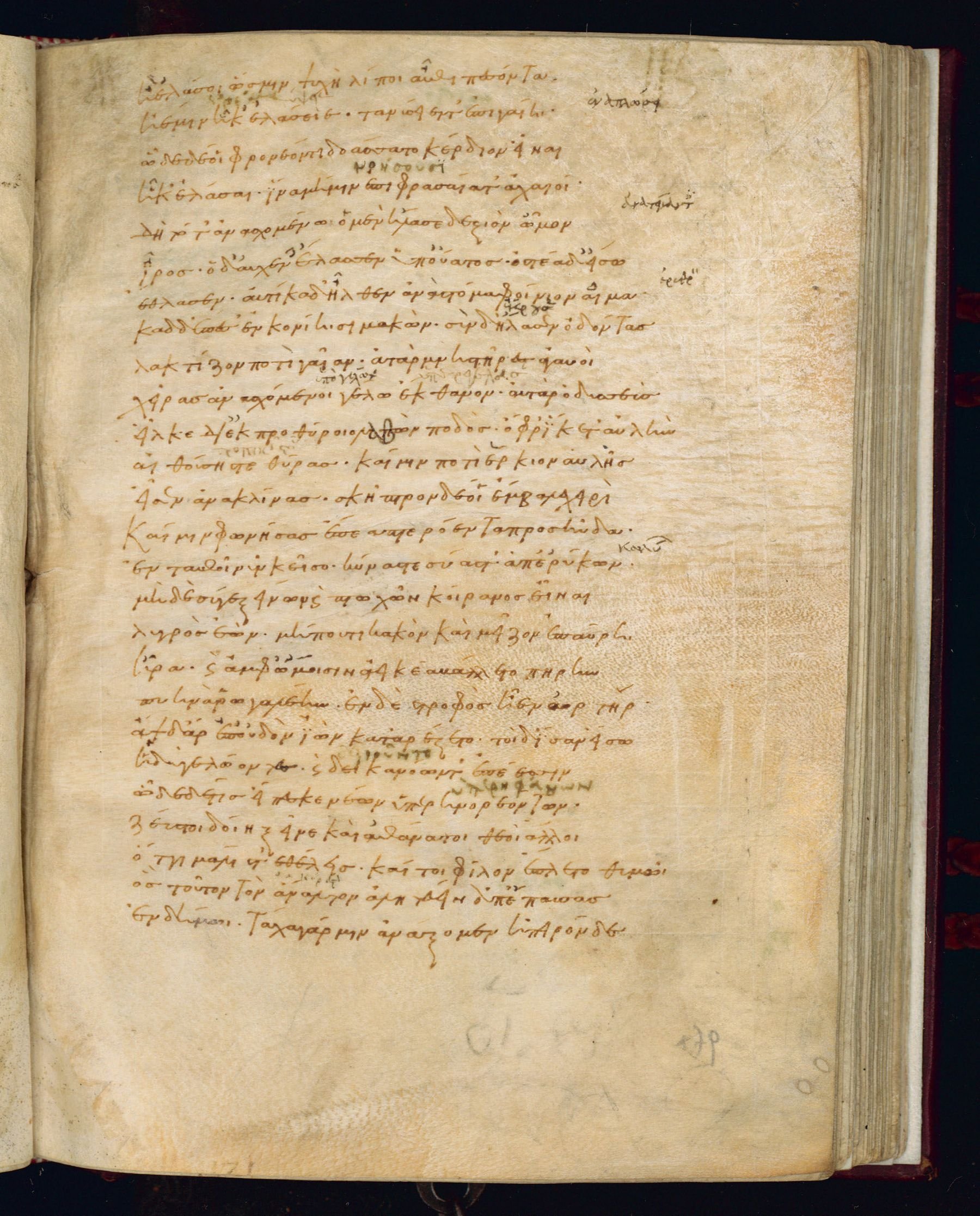
Where on the image
Laur. Plut. 32.24, fol. 179r: Odyssey 18.91-115, begins ‹ἢ ἐλάσειʼ ὥς μιν›, ends ‹γάρ μιν ἀνάξομεν ἤπειρόνδε›. Checked on the image: first and last lines read and matched to the Greek. Fol. 178v ends with 18.90. Fol. 179v begins with 18.116. The page has one verse not in Murray's text, between 18.111 and 18.112: ὧδε δέ τις εἴπεσκε νέων ὑπερηνορεόντων (26 lines for 25 edition verses). English blocks here: 90-94, 95-99, 100-104, 105-109, 110-114.
91ἢ ἐλάσειʼ ὥς μιν ψυχὴ λίποι αὖθι πεσόντα,
92ἦέ μιν ἦκʼ ἐλάσειε τανύσσειέν τʼ ἐπὶ γαίῃ.
93ὧδε δέ οἱ φρονέοντι δοάσσατο κέρδιον εἶναι,
94ἦκʼ ἐλάσαι, ἵνα μή μιν ἐπιφρασσαίατʼ Ἀχαιοί.
95δὴ τότʼ ἀνασχομένω ὁ μὲν ἤλασε δεξιὸν ὦμον
96Ἶρος, ὁ δʼ αὐχένʼ ἔλασσεν ὑπʼ οὔατος, ὀστέα δʼ εἴσω
97ἔθλασεν· αὐτίκα δʼ ἦλθε κατὰ στόμα φοίνιον αἷμα,
98κὰδ δʼ ἔπεσʼ ἐν κονίῃσι μακών, σὺν δʼ ἤλασʼ ὀδόντας
99λακτίζων ποσὶ γαῖαν· ἀτὰρ μνηστῆρες ἀγαυοὶ
100χεῖρας ἀνασχόμενοι γέλῳ ἔκθανον. αὐτὰρ Ὀδυσσεὺς
101ἕλκε διὲκ προθύροιο λαβὼν ποδός, ὄφρʼ ἵκετʼ αὐλήν,
102αἰθούσης τε θύρας· καί μιν ποτὶ ἑρκίον αὐλῆς
103εἷσεν ἀνακλίνας· σκῆπτρον δέ οἱ ἔμβαλε χειρί,
104καί μιν φωνήσας ἔπεα πτερόεντα προσηύδα·
105ἐνταυθοῖ νῦν ἧσο σύας τε κύνας τʼ ἀπερύκων,
106μηδὲ σύ γε ξείνων καὶ πτωχῶν κοίρανος εἶναι
107λυγρὸς ἐών, μή πού τι κακὸν καὶ μεῖζον ἐπαύρῃ.
108ἦ ῥα καὶ ἀμφʼ ὤμοισιν ἀεικέα βάλλετο πήρην,
109πυκνὰ ῥωγαλέην· ἐν δὲ στρόφος ἦεν ἀορτήρ.
110ἂψ δʼ ὅ γʼ ἐπʼ οὐδὸν ἰὼν κατʼ ἄρʼ ἕζετο· τοὶ δʼ ἴσαν εἴσω
111ἡδὺ γελώοντες καὶ δεικανόωντʼ ἐπέεσσι·
112Ζεύς τοι δοίη, ξεῖνε, καὶ ἀθάνατοι θεοὶ ἄλλοι,
113ὅττι μάλιστʼ ἐθέλεις καί τοι φίλον ἔπλετο θυμῷ,
114ὃς τοῦτον τὸν ἄναλτον ἀλητεύειν ἀπέπαυσας
115ἐν δήμῳ· τάχα γάρ μιν ἀνάξομεν ἤπειρόνδε
90Then the much-enduring, goodly Odysseus was divided in mind whether he should strike him so that life should leave him even there as he fell, or whether he should deal him a light blow and stretch him on the earth. And, as he pondered, this seemed to him the better course, to deal him a light blow, that the Achaeans might not take note of him. 95Then verily, when they had put up their hands, Irus let drive at the right shoulder, but Odysseus smote him on the neck beneath the ear and crushed in the bones, and straightway the red blood ran forth from his mouth, and down he fell in the dust with a moan, and he gnashed his teeth, kicking the ground with his feet. But the lordly wooers 100raised their hands, and were like to die with laughter. Then Odysseus seized him by the foot, and dragged him forth through the doorway until he came to the court and the gates of the portico. And he set him down and leaned him against the wall of the court, and thrust his staff into his hand and spoke, and addressed him with winged words: 105“Sit there now, and scare off swine and dogs, and do not thou be lord of strangers and beggars, miserable that thou art, lest haply thou meet with some worse thing to profit withal.” He spoke, and flung about his shoulders his miserable wallet, full of holes, and slung by a twisted cord. 110Then back to the threshold he went and sat down; and the wooers went within, laughing merrily, and they greeted him, saying: “May Zeus grant thee, stranger, and the other immortal gods what thou desirest most, and the dearest wish of thy heart, seeing that thou hast made this insatiate fellow to cease from begging
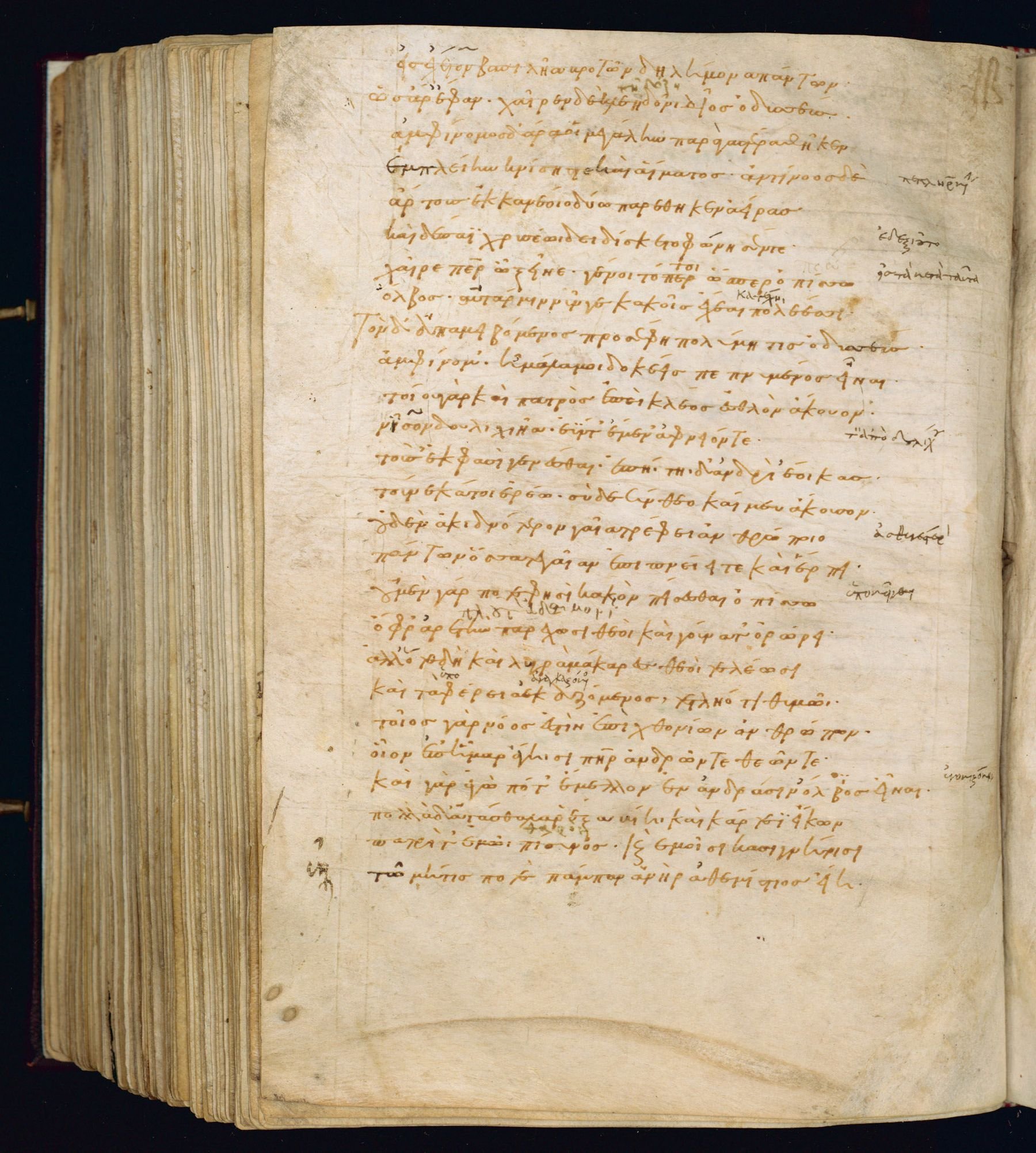
Where on the image
Laur. Plut. 32.24, fol. 179v: Odyssey 18.116-141, begins ‹εἰς Ἔχετον βασιλῆα, βροτῶν›, ends ‹πάμπαν ἀνὴρ ἀθεμίστιος εἴη,›. Checked on the image: first and last lines read and matched to the Greek. Fol. 179r ends with 18.115. Fol. 180r begins with 18.142. English blocks here: 115-119, 120-123, 124-124, 125-129, 130-134, 135-139.
116εἰς Ἔχετον βασιλῆα, βροτῶν δηλήμονα πάντων.
117ὣς ἄρʼ ἔφαν, χαῖρεν δὲ κλεηδόνι δῖος Ὀδυσσεύς.
118Ἀντίνοος δʼ ἄρα οἱ μεγάλην παρὰ γαστέρα θῆκεν,
119ἐμπλείην κνίσης τε καὶ αἵματος· Ἀμφίνομος δὲ
120ἄρτους ἐκ κανέοιο δύω παρέθηκεν ἀείρας
121καὶ δέπαϊ χρυσέῳ δειδίσκετο, φώνησέν τε·
122χαῖρε, πάτερ ὦ ξεῖνε, γένοιτό τοι ἔς περ ὀπίσσω
123ὄλβος· ἀτὰρ μὲν νῦν γε κακοῖς ἔχεαι πολέεσσι.
124τὸν δʼ ἀπαμειβόμενος προσέφη πολύμητις Ὀδυσσεύς·
125Ἀμφίνομʼ, ἦ μάλα μοι δοκέεις πεπνυμένος εἶναι·
126τοίου γὰρ καὶ πατρός, ἐπεὶ κλέος ἐσθλὸν ἄκουον,
127Νῖσον Δουλιχιῆα ἐΰν τʼ ἔμεν ἀφνειόν τε·
128τοῦ σʼ ἔκ φασι γενέσθαι, ἐπητῇ δʼ ἀνδρὶ ἔοικας.
129τοὔνεκά τοι ἐρέω, σὺ δὲ σύνθεο καί μευ ἄκουσον·
130οὐδὲν ἀκιδνότερον γαῖα τρέφει ἀνθρώποιο,
131πάντων ὅσσα τε γαῖαν ἔπι πνείει τε καὶ ἕρπει.
132οὐ μὲν γάρ ποτέ φησι κακὸν πείσεσθαι ὀπίσσω,
133ὄφρʼ ἀρετὴν παρέχωσι θεοὶ καὶ γούνατʼ ὀρώρῃ·
134ἀλλʼ ὅτε δὴ καὶ λυγρὰ θεοὶ μάκαρες τελέσωσι,
135καὶ τὰ φέρει ἀεκαζόμενος τετληότι θυμῷ·
136τοῖος γὰρ νόος ἐστὶν ἐπιχθονίων ἀνθρώπων
137οἷον ἐπʼ ἦμαρ ἄγησι πατὴρ ἀνδρῶν τε θεῶν τε.
138καὶ γὰρ ἐγώ ποτʼ ἔμελλον ἐν ἀνδράσιν ὄλβιος εἶναι,
139πολλὰ δʼ ἀτάσθαλʼ ἔρεξα βίῃ καὶ κάρτεϊ εἴκων,
140πατρί τʼ ἐμῷ πίσυνος καὶ ἐμοῖσι κασιγνήτοισι.
141τῷ μή τίς ποτε πάμπαν ἀνὴρ ἀθεμίστιος εἴη,
115in the land. For soon shall we take him to the mainland to King Echetus, the maimer of all men.” So they spoke, and goodly Odysseus was glad at the word of omen. And Antinous set before him the great paunch, filled with fat and blood, and Amphinomus 120took up two loaves from the basket and set them before him, and pledged him in a cup of gold, and said: “Hail, Sir stranger; may happy fortune be thine in time to come, though now thou art the thrall of many sorrows.” 124Then Odysseus of many wiles answered him, and said: 125“Amphinomus, verily thou seemest to me to be a man of prudence; and such a man, too, was thy father, for I have heard of his fair fame, that Nisus of Dulichium was a brave man and a wealthy. From him, they say, thou art sprung, and thou seemest a man soft of speech. Wherefore I will tell thee, and do thou give heed and hearken. 130Nothing feebler does earth nurture than man, of all things that on earth are breathing and moving. For he thinks that he will never suffer evil in time to come, so long as the gods give him prosperity and his knees are quick; but when again the blessed gods decree him sorrow, 135this too he bears in sore despite with steadfast heart; for the spirit of men upon the earth is even such as the day which the father of gods and men brings upon them. For I, too, was once like to be prosperous among men, but many deeds of wantonness I wrought, yielding to my might and my strength,
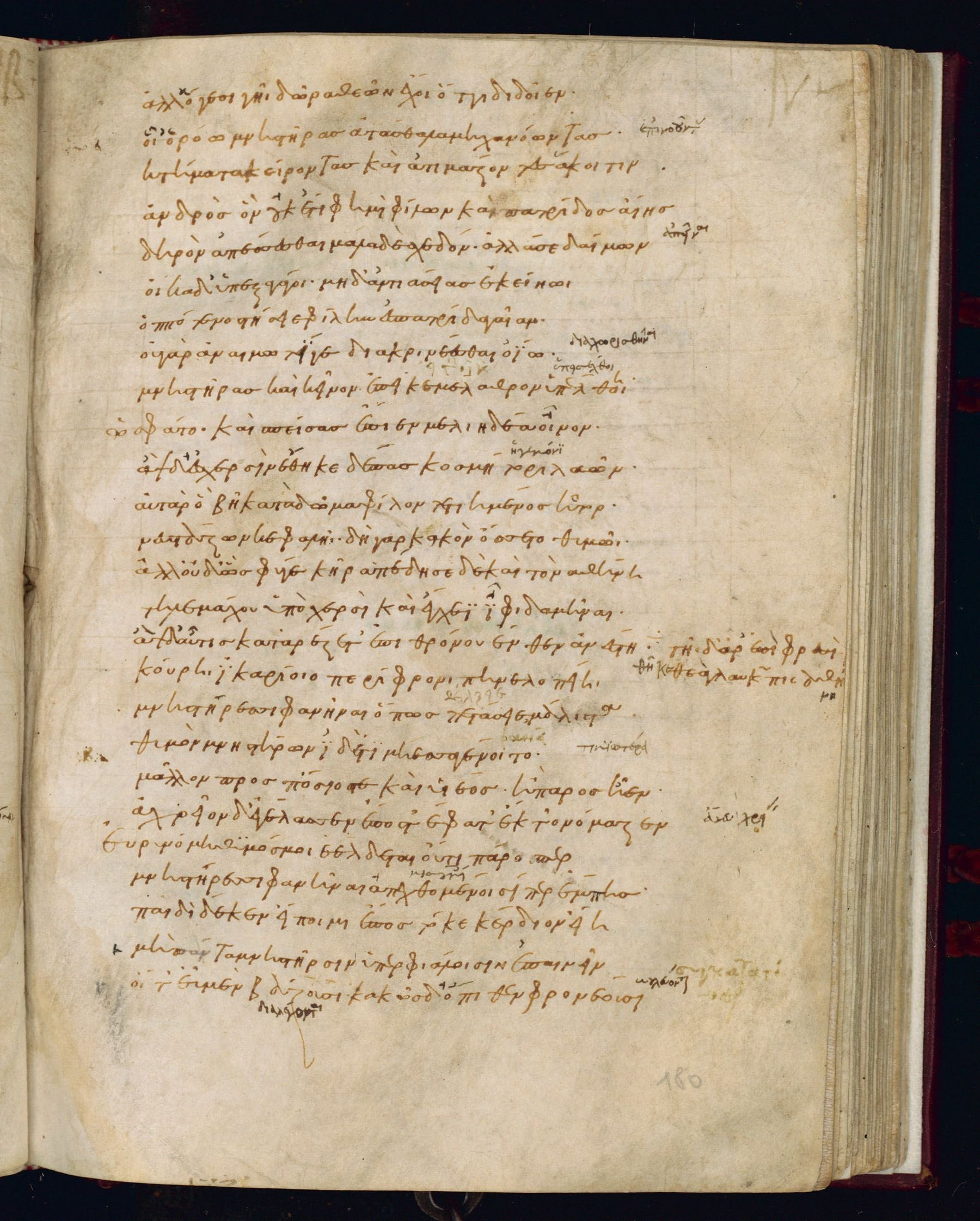
Where on the image
Laur. Plut. 32.24, fol. 180r: Odyssey 18.142-168, begins ‹ἀλλʼ ὅ γε σιγῇ›, ends ‹κακῶς δʼ ὄπιθεν φρονέουσι.›. Checked on the image: first and last lines read and matched to the Greek. Fol. 179v ends with 18.141. Fol. 180v begins with 18.169. 18.158 is not in the text column; it is written in the right margin beside 18.157 (the column has 26 lines). English blocks here: 140-144, 145-149, 150-154, 155-159, 160-164, 165-168.
142ἀλλʼ ὅ γε σιγῇ δῶρα θεῶν ἔχοι, ὅττι διδοῖεν.
143οἷʼ ὁρόω μνηστῆρας ἀτάσθαλα μηχανόωντας,
144κτήματα κείροντας καὶ ἀτιμάζοντας ἄκοιτιν
145ἀνδρός, ὃν οὐκέτι φημὶ φίλων καὶ πατρίδος αἴης
146δηρὸν ἀπέσσεσθαι· μάλα δὲ σχεδόν. ἀλλά σε δαίμων
147οἴκαδʼ ὑπεξαγάγοι, μηδʼ ἀντιάσειας ἐκείνῳ,
148ὁππότε νοστήσειε φίλην ἐς πατρίδα γαῖαν·
149οὐ γὰρ ἀναιμωτί γε διακρινέεσθαι ὀΐω
150μνηστῆρας καὶ κεῖνον, ἐπεί κε μέλαθρον ὑπέλθῃ.
151ὣς φάτο, καὶ σπείσας ἔπιεν μελιηδέα οἶνον,
152ἂψ δʼ ἐν χερσὶν ἔθηκε δέπας κοσμήτορι λαῶν.
153αὐτὰρ ὁ βῆ διὰ δῶμα φίλον τετιημένος ἦτορ,
154νευστάζων κεφαλῇ· δὴ γὰρ κακὸν ὄσσετο θυμός.
155ἀλλʼ οὐδʼ ὣς φύγε κῆρα· πέδησε δὲ καὶ τὸν Ἀθήνη
156Τηλεμάχου ὑπὸ χερσὶ καὶ ἔγχεϊ ἶφι δαμῆναι.
157ἂψ δʼ αὖτις κατʼ ἄρʼ ἕζετʼ ἐπὶ θρόνου ἔνθεν ἀνέστη.
158τῇ δʼ ἄρʼ ἐπὶ φρεσὶ θῆκε θεὰ γλαυκῶπις Ἀθήνη,
159κούρῃ Ἰκαρίοιο, περίφρονι Πηνελοπείῃ,
160μνηστήρεσσι φανῆναι, ὅπως πετάσειε μάλιστα
161θυμὸν μνηστήρων ἰδὲ τιμήεσσα γένοιτο
162μᾶλλον πρὸς πόσιός τε καὶ υἱέος ἢ πάρος ἦεν.
163ἀχρεῖον δʼ ἐγέλασσεν ἔπος τʼ ἔφατʼ ἔκ τʼ ὀνόμαζεν·
164Εὐρυνόμη, θυμός μοι ἐέλδεται, οὔ τι πάρος γε,
165μνηστήρεσσι φανῆναι, ἀπεχθομένοισί περ ἔμπης·
166παιδὶ δέ κεν εἴποιμι ἔπος, τό κε κέρδιον εἴη,
167μὴ πάντα μνηστῆρσιν ὑπερφιάλοισιν ὁμιλεῖν,
168οἵ τʼ εὖ μὲν βάζουσι, κακῶς δʼ ὄπιθεν φρονέουσι.
140and trusting in my father and my brethren. Wherefore let no man soever be lawless at any time, but let him keep in silence whatever gifts the gods give. Aye, for I see the wooers devising wantonness, wasting the wealth and dishonoring the wife 145of a man who, I tell thee, will not long be away from his friends and his native land; nay, he is very near. But may some god lead thee forth hence to thy home, and mayest thou not meet him when he comes home to his dear native land. For not without bloodshed, methinks, 150will the wooers and he part one from the other when once he comes beneath his roof.” So he spoke, and pouring a libation, drank of the honey-sweet wine, and then gave back the cup into the hands of the marshaller of the people. But Amphinomus went through the hall with a heavy heart, bowing his head; for his spirit boded bane. 155Yet even so he did not escape his fate, but him, too, did Athena set in bonds so that he might be slain outright at the hands of Telemachus and by his spear. So he sat down again on the chair from which he had risen. Then the goddess, flashing-eyed Athena, put it in the heart of the daughter of Icarius, wise Penelope, 160to show herself to the wooers, that she might set their hearts a-flutter and win greater honor from her husband and her son than heretofore. Then she laughed a meaningless laugh and spoke, and addressed the nurse: “Eurynome, my heart longs, though it has never longed before, 165to show myself to the wooers, hateful though they are. Also I would say a word to my son that will be for his profit, namely, that he should not consort ever with the overweening wooers, who speak him fair but have evil plans thereafter.”
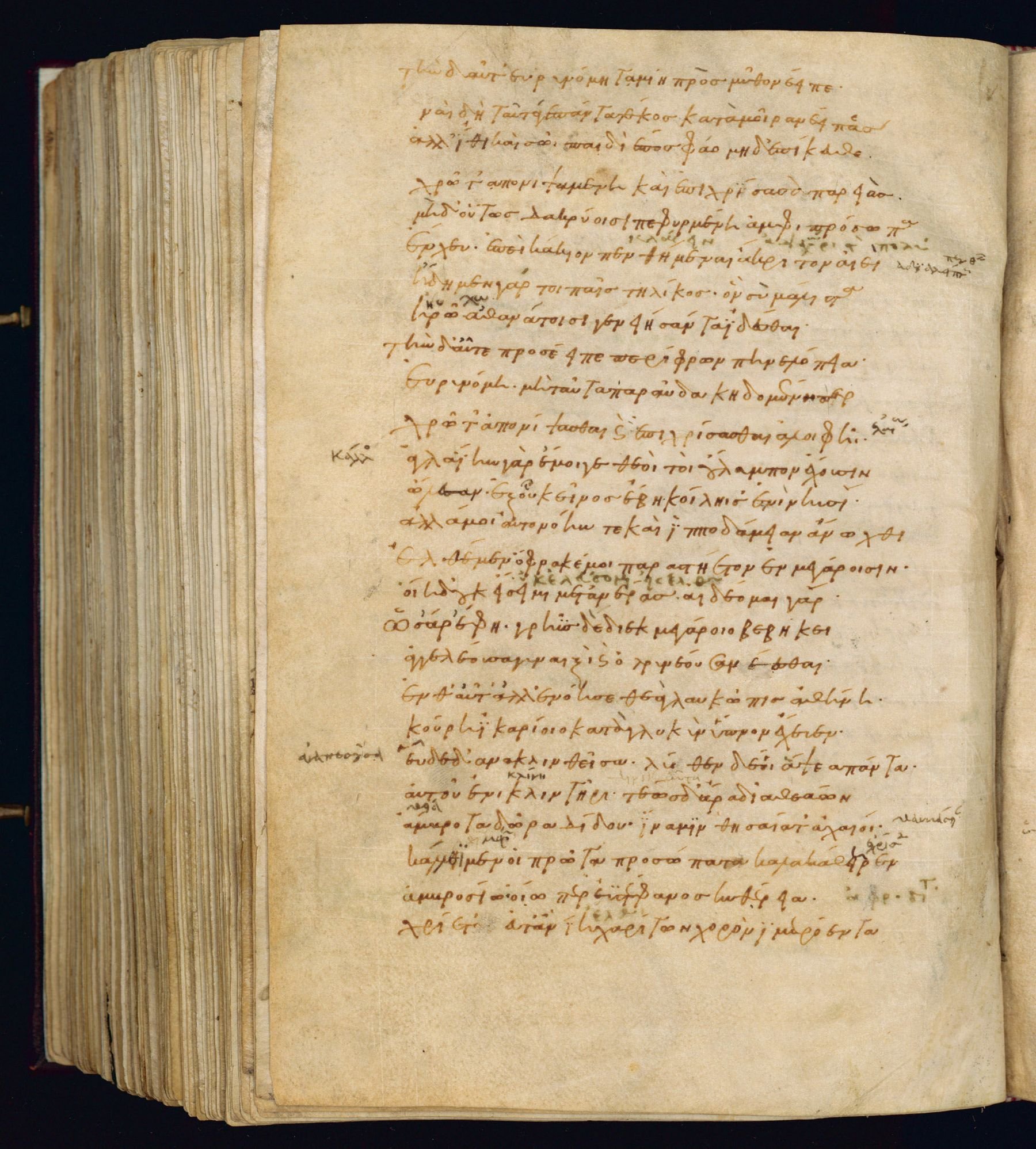
Where on the image
Laur. Plut. 32.24, fol. 180v: Odyssey 18.169-194, begins ‹τὴν δʼ αὖτʼ Εὐρυνόμη›, ends ‹ἴῃ Χαρίτων χορὸν ἱμερόεντα·›. Checked on the image: first and last lines read and matched to the Greek. Fol. 180r ends with 18.168. Fol. 181r begins with 18.195. English blocks here: 169-169, 170-174, 175-179, 180-184, 185-189, 190-194.
169τὴν δʼ αὖτʼ Εὐρυνόμη ταμίη πρὸς μῦθον ἔειπεν·
170ναὶ δὴ ταῦτά γε πάντα, τέκος, κατὰ μοῖραν ἔειπες.
171ἀλλʼ ἴθι καὶ σῷ παιδὶ ἔπος φάο μηδʼ ἐπίκευθε,
172χρῶτʼ ἀπονιψαμένη καὶ ἐπιχρίσασα παρειάς·
173μηδʼ οὕτω δακρύοισι πεφυρμένη ἀμφὶ πρόσωπα
174ἔρχευ, ἐπεὶ κάκιον πενθήμεναι ἄκριτον αἰεί.
175ἤδη μὲν γάρ τοι παῖς τηλίκος, ὃν σὺ μάλιστα
176ἠρῶ ἀθανάτοισι γενειήσαντα ἰδέσθαι.
177τὴν δʼ αὖτε προσέειπε περίφρων Πηνελόπεια·
178Εὐρυνόμη, μὴ ταῦτα παραύδα, κηδομένη περ,
179χρῶτʼ ἀπονίπτεσθαι καὶ ἐπιχρίεσθαι ἀλοιφῇ·
180ἀγλαΐην γὰρ ἐμοί γε θεοί, τοὶ Ὄλυμπον ἔχουσιν,
181ὤλεσαν, ἐξ οὗ κεῖνος ἔβη κοίλῃς ἐνὶ νηυσίν.
182ἀλλά μοι Αὐτονόην τε καὶ Ἱπποδάμειαν ἄνωχθι
183ἐλθέμεν, ὄφρα κέ μοι παρστήετον ἐν μεγάροισιν·
184οἴη δʼ οὐκ εἴσειμι μετʼ ἀνέρας· αἰδέομαι γάρ.
185ὣς ἄρʼ ἔφη, γρηῢς δὲ διὲκ μεγάροιο βεβήκει
186ἀγγελέουσα γυναιξὶ καὶ ὀτρυνέουσα νέεσθαι.
187ἔνθʼ αὖτʼ ἄλλʼ ἐνόησε θεὰ γλαυκῶπις Ἀθήνη·
188κούρῃ Ἰκαρίοιο κατὰ γλυκὺν ὕπνον ἔχευεν,
189εὗδε δʼ ἀνακλινθεῖσα, λύθεν δέ οἱ ἅψεα πάντα
190αὐτοῦ ἐνὶ κλιντῆρι· τέως δʼ ἄρα δῖα θεάων
191ἄμβροτα δῶρα δίδου, ἵνα μιν θησαίατʼ Ἀχαιοί.
192κάλλεϊ μέν οἱ πρῶτα προσώπατα καλὰ κάθηρεν
193ἀμβροσίῳ, οἵῳ περ ἐϋστέφανος Κυθέρεια
194χρίεται, εὖτʼ ἂν ἴῃ Χαρίτων χορὸν ἱμερόεντα·
169Then the housewife, Eurynome, spoke to her and said: 170“Aye, verily, child, all this hast thou spoken aright. Go, then, reveal thy word to thy son and hide it not; but first wash thy body and anoint thy face, and go not as thou art with both cheeks stained with tears. Go, for it is ill to grieve ever without ceasing. 175For now, behold, thy son is of such an age, and it has been thy dearest prayer to the immortals to see him a bearded man.” Then wise Penelope answered her again: “Eurynome, beguile me not thus in thy love to wash my body and anoint me with oil. 180All beauty of mine have the gods, that hold Olympus, destroyed since the day when my lord departed in the hollow ships. But bid Autonoe and Hippodameia come to me, that they may stand by my side in the hall. Alone I will not go among men, for I am ashamed.” 185So she spoke, and the old woman went forth through the chamber to bear tidings to the women, and bid them come. Then again the goddess, flashing-eyed Athena, took other counsel. On the daughter of Icarius she shed sweet sleep, and she leaned back and slept 190there on her couch, and all her joints were relaxed. And meanwhile the fair goddess was giving her immortal gifts, that the Achaeans might marvel at her. With balm she first made fair her beautiful face, with balm ambrosial, such as that wherewith Cytherea, of the fair crown, anoints herself when she goes into the lovely dance of the Graces;
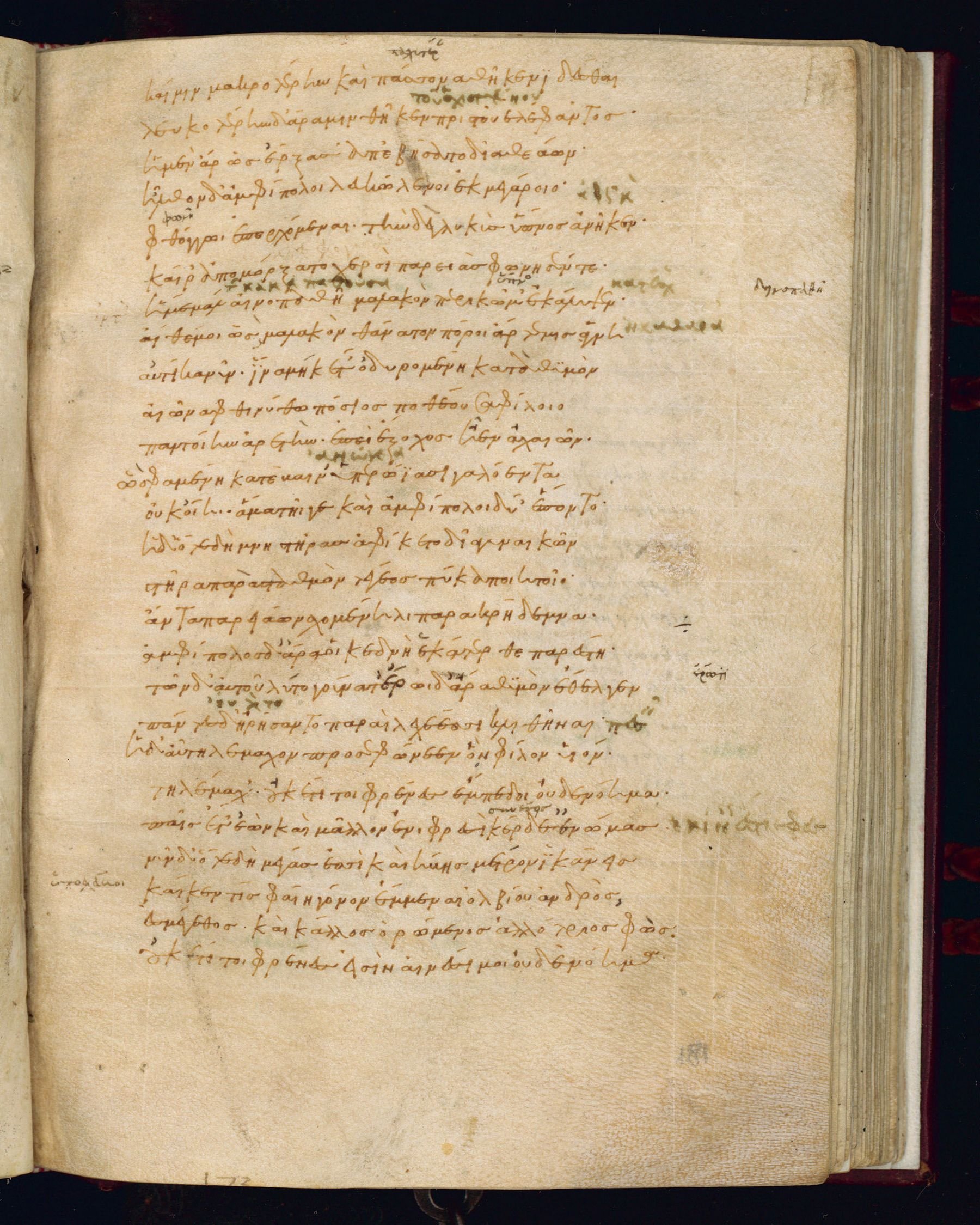
Where on the image
Laur. Plut. 32.24, fol. 181r: Odyssey 18.195-220, begins ‹καί μιν μακροτέρην καὶ›, ends ‹εἰσὶν ἐναίσιμοι οὐδὲ νόημα.›. Checked on the image: first and last lines read and matched to the Greek. Fol. 180v ends with 18.194. Fol. 181v begins with 18.221. English blocks here: 195-199, 200-204, 205-205, 206-209, 210-214, 215-219.
195καί μιν μακροτέρην καὶ πάσσονα θῆκεν ἰδέσθαι,
196λευκοτέρην δʼ ἄρα μιν θῆκε πριστοῦ ἐλέφαντος.
197ἡ μὲν ἄρʼ ὣς ἔρξασʼ ἀπεβήσετο δῖα θεάων,
198ἦλθον δʼ ἀμφίπολοι λευκώλενοι ἐκ μεγάροιο
199φθόγγῳ ἐπερχόμεναι· τὴν δὲ γλυκὺς ὕπνος ἀνῆκε,
200καί ῥʼ ἀπομόρξατο χερσὶ παρειὰς φώνησέν τε·
201ἦ με μάλʼ αἰνοπαθῆ μαλακὸν περὶ κῶμʼ ἐκάλυψεν.
202αἴθε μοι ὣς μαλακὸν θάνατον πόροι Ἄρτεμις ἁγνὴ
203αὐτίκα νῦν, ἵνα μηκέτʼ ὀδυρομένη κατὰ θυμὸν
204αἰῶνα φθινύθω, πόσιος ποθέουσα φίλοιο
205παντοίην ἀρετήν, ἐπεὶ ἔξοχος ἦεν Ἀχαιῶν.
206ὣς φαμένη κατέβαινʼ ὑπερώϊα σιγαλόεντα,
207οὐκ οἴη· ἅμα τῇ γε καὶ ἀμφίπολοι δύʼ ἕποντο.
208ἡ δʼ ὅτε δὴ μνηστῆρας ἀφίκετο δῖα γυναικῶν,
209στῆ ῥα παρὰ σταθμὸν τέγεος πύκα ποιητοῖο,
210ἄντα παρειάων σχομένη λιπαρὰ κρήδεμνα·
211ἀμφίπολος δʼ ἄρα οἱ κεδνὴ ἑκάτερθε παρέστη.
212τῶν δʼ αὐτοῦ λύτο γούνατʼ, ἔρῳ δʼ ἄρα θυμὸν ἔθελχθεν,
213πάντες δʼ ἠρήσαντο παραὶ λεχέεσσι κλιθῆναι.
214ἡ δʼ αὖ Τηλέμαχον προσεφώνεεν, ὃν φίλον υἱόν·
215Τηλέμαχʼ, οὐκέτι τοι φρένες ἔμπεδοι οὐδὲ νόημα·
216παῖς ἔτʼ ἐὼν καὶ μᾶλλον ἐνὶ φρεσὶ κέρδεʼ ἐνώμας·
217νῦν δʼ, ὅτε δὴ μέγας ἐσσὶ καὶ ἥβης μέτρον ἱκάνεις,
218καί κέν τις φαίη γόνον ἔμμεναι ὀλβίου ἀνδρός,
219ἐς μέγεθος καὶ κάλλος ὁρώμενος, ἀλλότριος φώς,
220οὐκέτι τοι φρένες εἰσὶν ἐναίσιμοι οὐδὲ νόημα.
195and she made her taller, too, and statelier to behold, and made her whiter than new-sawn ivory. Now when she had done this the fair goddess departed, and the white-armed handmaids came forth from the chamber and drew near with sound of talking. Then sweet sleep released Penelope, 200and she rubbed her cheeks with her hands, and said: “Ah, in my utter wretchedness soft slumber enfolded me. Would that pure Artemis would even now give so soft a death, that I might no more waste my life away with sorrow at heart, longing for 205the manifold excellence of my dear husband, for that he was pre-eminent among the Achaeans.” 206So saying, she went down from the bright upper chamber, not alone, for two handmaids attended her. Now when the fair lady reached the wooers she stood by the doorpost of the well-built hall, 210holding before her face her shining veil; and a faithful handmaid stood on either side of her. Straightway then the knees of the wooers were loosened and their hearts enchanted with love, and they all prayed, each that he might lie by her side. But she spoke to Telemachus, her dear son: 215“Telemachus, thy mind and thy thoughts are no longer steadfast as heretofore. When thou wast but a child thou wast wont to revolve in thy mind thoughts more cunning; but now that thou art grown and hast reached the bounds of manhood, and wouldest be called a rich man's son by one who looked only to thy stature and thy comeliness, being himself a stranger from afar,
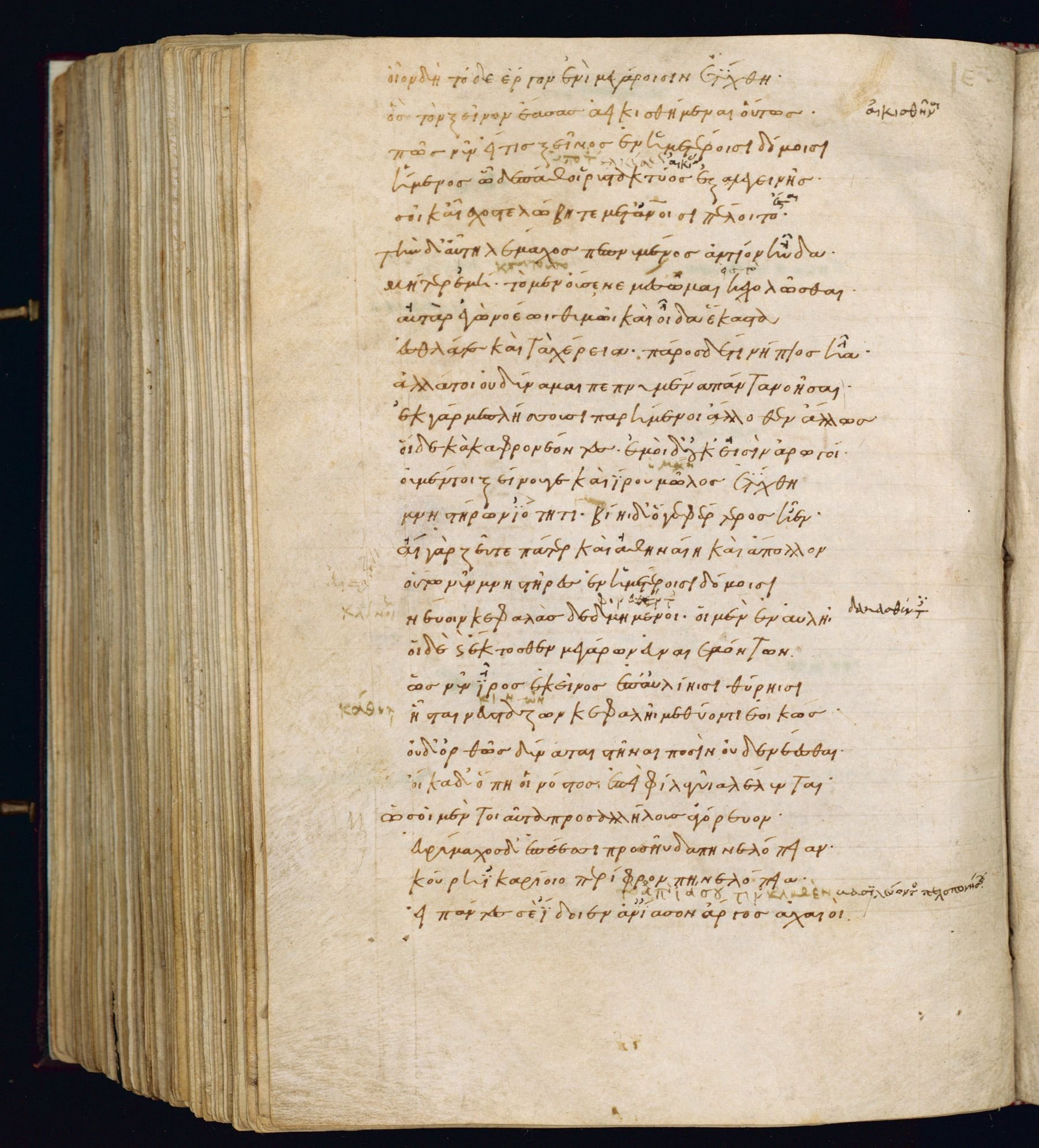
Where on the image
Laur. Plut. 32.24, fol. 181v: Odyssey 18.221-246, begins ‹οἷον δὴ τόδε ἔργον›, ends ‹ἀνʼ Ἴασον Ἄργος Ἀχαιοί,›. Checked on the image: first and last lines read and matched to the Greek. Fol. 181r ends with 18.220. Fol. 182r begins with 18.247. English blocks here: 220-224, 225-229, 230-234, 235-239, 240-244.
221οἷον δὴ τόδε ἔργον ἐνὶ μεγάροισιν ἐτύχθη,
222ὃς τὸν ξεῖνον ἔασας ἀεικισθήμεναι οὕτως.
223πῶς νῦν, εἴ τι ξεῖνος ἐν ἡμετέροισι δόμοισιν
224ἥμενος ὧδε πάθοι ῥυστακτύος ἐξ ἀλεγεινῆς;
225σοί κʼ αἶσχος λώβη τε μετʼ ἀνθρώποισι πέλοιτο.
226τὴν δʼ αὖ Τηλέμαχος πεπνυμένος ἀντίον ηὔδα·
227μῆτερ ἐμή, τὸ μὲν οὔ σε νεμεσσῶμαι κεχολῶσθαι·
228αὐτὰρ ἐγὼ θυμῷ νοέω καὶ οἶδα ἕκαστα,
229ἐσθλά τε καὶ τὰ χέρεια· πάρος δʼ ἔτι νήπιος ἦα.
230ἀλλά τοι οὐ δύναμαι πεπνυμένα πάντα νοῆσαι·
231ἐκ γάρ με πλήσσουσι παρήμενοι ἄλλοθεν ἄλλος
232οἵδε κακὰ φρονέοντες, ἐμοὶ δʼ οὐκ εἰσὶν ἀρωγοί.
233οὐ μέν τοι ξείνου γε καὶ Ἴρου μῶλος ἐτύχθη
234μνηστήρων ἰότητι, βίῃ δʼ ὅ γε φέρτερος ἦεν.
235αἲ γάρ, Ζεῦ τε πάτερ καὶ Ἀθηναίη καὶ Ἄπολλον,
236οὕτω νῦν μνηστῆρες ἐν ἡμετέροισι δόμοισι
237νεύοιεν κεφαλὰς δεδμημένοι, οἱ μὲν ἐν αὐλῇ,
238οἱ δʼ ἔντοσθε δόμοιο, λελῦτο δὲ γυῖα ἑκάστου,
239ὡς νῦν Ἶρος κεῖνος ἐπʼ αὐλείῃσι θύρῃσιν
240ἧσται νευστάζων κεφαλῇ, μεθύοντι ἐοικώς,
241οὐδʼ ὀρθὸς στῆναι δύναται ποσὶν οὐδὲ νέεσθαι
242οἴκαδʼ, ὅπη οἱ νόστος, ἐπεὶ φίλα γυῖα λέλυνται.
243ὣς οἱ μὲν τοιαῦτα πρὸς ἀλλήλους ἀγόρευον·
244Εὐρύμαχος δʼ ἐπέεσσι προσηύδα Πηνελόπειαν·
245κούρη Ἰκαρίοιο, περίφρον Πηνελόπεια,
246εἰ πάντες σε ἴδοιεν ἀνʼ Ἴασον Ἄργος Ἀχαιοί,
220thy mind and thy thoughts are no longer right as before. What a thing is this that has been done in these halls, that thou hast suffered yon stranger to be so maltreated! How now, if the stranger, while sitting thus in our house, should come to some harm through grievous mishandling? 225On thee, then, would fall shame and disgrace among men.” Then wise Telemachus answered her: “My mother, in this matter I take it not ill that thou art filled with anger. Yet of myself I know in my heart and understand each thing, the good and the evil, whereas heretofore I was but a child. 230But I am not able to plan all things wisely, for these men here thwart my will, keeping by me, one on this side and one on that, with evil purpose, and I have none to help me. Howbeit, I can tell thee, this battle between the stranger and Irus fell not out according to the mind of the wooers, but the stranger proved the better man. 235I would, O father Zeus, and Athena, and Apollo, that even now the wooers were thus subdued in our halls, and were hanging their heads, some in the court and some within the hall, and that each man's limbs were loosened, even as Irus now sits yonder by the gate of the court, 240hanging his head like a drunken man, and cannot stand erect upon his feet, or go home to whatsoever place he is wont to go, because his limbs are loosened.” Thus they spoke to one another. But Eurymachus addressed Penelope, and said:
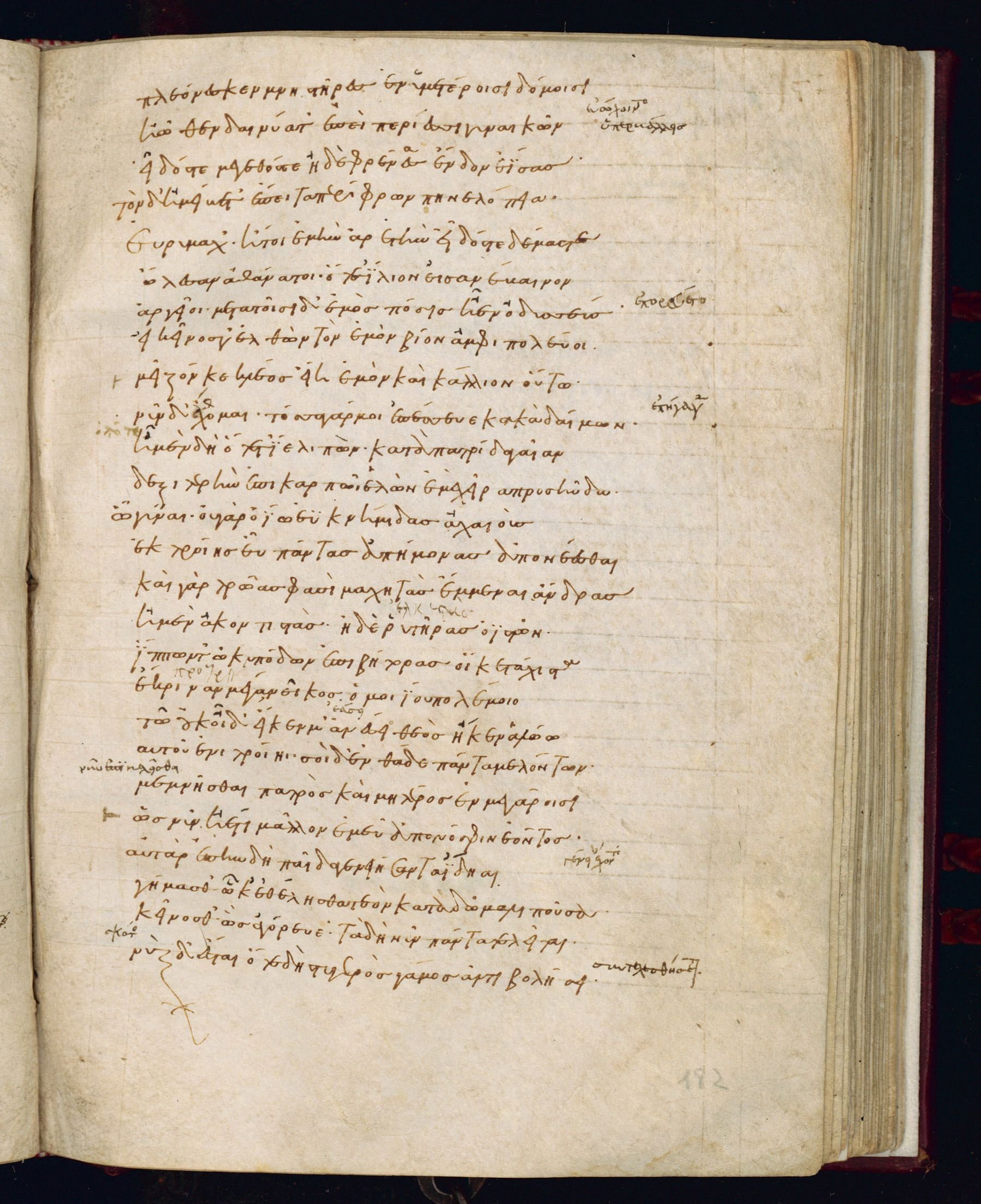
Where on the image
Laur. Plut. 32.24, fol. 182r: Odyssey 18.247-272, begins ‹πλέονές κε μνηστῆρες ἐν›, ends ‹δὴ στυγερὸς γάμος ἀντιβολήσει›. Checked on the image: first and last lines read and matched to the Greek. Fol. 181v ends with 18.246. Fol. 182v begins with 18.273. English blocks here: 245-249, 250-254, 255-259, 260-264, 265-269, 270-274.
247πλέονές κε μνηστῆρες ἐν ὑμετέροισι δόμοισιν
248ἠῶθεν δαινύατʼ, ἐπεὶ περίεσσι γυναικῶν
249εἶδός τε μέγεθός τε ἰδὲ φρένας ἔνδον ἐΐσας.
250τὸν δʼ ἠμείβετʼ ἔπειτα περίφρων Πηνελόπεια·
251Εὐρύμαχʼ, ἦ τοι ἐμὴν ἀρετὴν εἶδός τε δέμας τε
252ὤλεσαν ἀθάνατοι, ὅτε Ἴλιον εἰσανέβαινον
253Ἀργεῖοι, μετὰ τοῖσι δʼ ἐμὸς πόσις ᾖεν Ὀδυσσεύς.
254εἰ κεῖνός γʼ ἐλθὼν τὸν ἐμὸν βίον ἀμφιπολεύοι,
255μεῖζόν κε κλέος εἴη ἐμὸν καὶ κάλλιον οὕτως.
256νῦν δʼ ἄχομαι· τόσα γάρ μοι ἐπέσσευεν κακὰ δαίμων.
257ἦ μὲν δὴ ὅτε τʼ ᾖε λιπὼν κάτα πατρίδα γαῖαν,
258δεξιτερὴν ἐπὶ καρπῷ ἑλὼν ἐμὲ χεῖρα προσηύδα·
259ὦ γύναι, οὐ γὰρ ὀΐω ἐϋκνήμιδας Ἀχαιοὺς
260ἐκ Τροίης εὖ πάντας ἀπήμονας ἀπονέεσθαι·
261καὶ γὰρ Τρῶάς φασι μαχητὰς ἔμμεναι ἄνδρας,
262ἠμὲν ἀκοντιστὰς ἠδὲ ῥυτῆρας ὀϊστῶν
263ἵππων τʼ ὠκυπόδων ἐπιβήτορας, οἵ κε τάχιστα
264ἔκριναν μέγα νεῖκος ὁμοιΐου πολέμοιο.
265τῷ οὐκ οἶδʼ ἤ κέν μʼ ἀνέσει θεός, ἦ κεν ἁλώω
266αὐτοῦ ἐνὶ Τροίῃ· σοὶ δʼ ἐνθάδε πάντα μελόντων.
267μεμνῆσθαι πατρὸς καὶ μητέρος ἐν μεγάροισιν
268ὡς νῦν, ἢ ἔτι μᾶλλον ἐμεῦ ἀπονόσφιν ἐόντος·
269αὐτὰρ ἐπὴν δὴ παῖδα γενειήσαντα ἴδηαι,
270γήμασθʼ ᾧ κʼ ἐθέλῃσθα, τεὸν κατὰ δῶμα λιποῦσα.
271κεῖνος τὼς ἀγόρευε· τὰ δὴ νῦν πάντα τελεῖται.
272νὺξ δʼ ἔσται ὅτε δὴ στυγερὸς γάμος ἀντιβολήσει
245“Daughter of Icarius, wise Penelope, if all the Achaeans throughout Iasian Argos could see thee, even more wooers would be feasting in your halls from to-morrow on, for thou excellest all women in comeliness and stature, and in the wise heart within thee.” 250Then wise Penelope answered him: “Eurymachus, all excellence of mine, both of beauty and of form, the immortals destroyed on the day when the Argives embarked for Ilios, and with them went my husband Odysseus. If he might but come and watch over this life of mine, 255greater would be my fame and fairer. But now I am in sorrow, so many woes has some god brought upon me. Verily, when he went forth and left his native land, he clasped my right hand by the wrist, and said: “‘Wife, I deem not that the well-greaved Achaeans 260will all return from Troy safe and unscathed, for the Trojans, men say, are men of war, hurlers of the spear, and drawers of the bow, and drivers of swift horses, such as most quickly decide the great strife of equal war. 265Therefore I know not whether the god will bring me back, or whether I shall be cut off there in the land of Troy: so have thou charge of all things here. Be mindful of my father and my mother in the halls even as thou art now, or yet more, while I am far away. But when thou shalt see my son a bearded man, 270wed whom thou wilt, and leave thy house.’ “So he spoke, and now all this is being brought to pass. The night shall come when a hateful marriage shall fall to the lot of me accursed, whose happiness Zeus has taken away. But herein has bitter grief come upon my heart and soul,
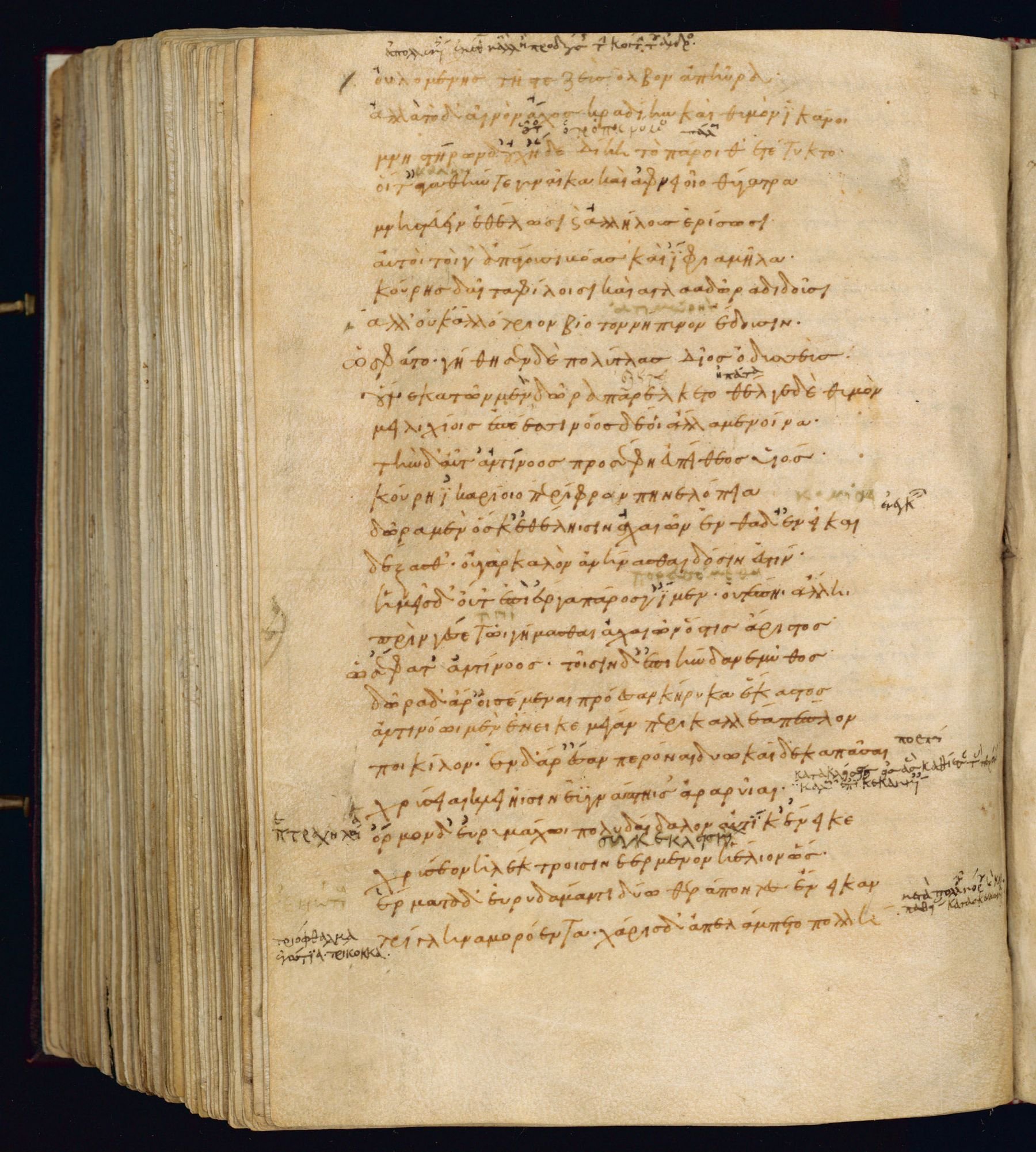
Where on the image
Laur. Plut. 32.24, fol. 182v: Odyssey 18.273-298, begins ‹οὐλομένης ἐμέθεν, τῆς τε›, ends ‹χάρις δʼ ἀπελάμπετο πολλή.›. Checked on the image: first and last lines read and matched to the Greek. Fol. 182r ends with 18.272. Fol. 183r begins with 18.299. English blocks here: 275-279, 280-284, 285-289, 290-294, 295-299.
273οὐλομένης ἐμέθεν, τῆς τε Ζεὺς ὄλβον ἀπηύρα.
274ἀλλὰ τόδʼ αἰνὸν ἄχος κραδίην καὶ θυμὸν ἱκάνει·
275μνηστήρων οὐχ ἥδε δίκη τὸ πάροιθε τέτυκτο·
276οἵ τʼ ἀγαθήν τε γυναῖκα καὶ ἀφνειοῖο θύγατρα
277μνηστεύειν ἐθέλωσι καὶ ἀλλήλοις ἐρίσωσιν,
278αὐτοὶ τοί γʼ ἀπάγουσι βόας καὶ ἴφια μῆλα,
279κούρης δαῖτα φίλοισι, καὶ ἀγλαὰ δῶρα διδοῦσιν·
280ἀλλʼ οὐκ ἀλλότριον βίοτον νήποινον ἔδουσιν.
281ὣς φάτο, γήθησεν δὲ πολύτλας δῖος Ὀδυσσεύς,
282οὕνεκα τῶν μὲν δῶρα παρέλκετο, θέλγε δὲ θυμὸν
283μειλιχίοις ἐπέεσσι, νόος δέ οἱ ἄλλα μενοίνα.
284τὴν δʼ αὖτʼ Ἀντίνοος προσέφη, Εὐπείθεος υἱός,
285κούρη Ἰκαρίοιο, περίφρον Πηνελόπεια,
286δῶρα μὲν ὅς κʼ ἐθέλῃσιν Ἀχαιῶν ἐνθάδʼ ἐνεῖκαι,
287δέξασθʼ. οὐ γὰρ καλὸν ἀνήνασθαι δόσιν ἐστίν·
288ἡμεῖς δʼ οὔτʼ ἐπὶ ἔργα πάρος γʼ ἴμεν οὔτε πῃ ἄλλῃ,
289πρίν γέ σε τῷ γήμασθαι Ἀχαιῶν ὅς τις ἄριστος.
290ὣς ἔφατʼ Ἀντίνοος, τοῖσιν δʼ ἐπιήνδανε μῦθος·
291δῶρα δʼ ἄρʼ οἰσέμεναι πρόεσαν κήρυκα ἕκαστος.
292Ἀντινόῳ μὲν ἔνεικε μέγαν περικαλλέα πέπλον,
293ποικίλον· ἐν δʼ ἀρʼ ἔσαν περόναι δυοκαίδεκα πᾶσαι
294χρύσειαι, κληῗσιν ἐϋγνάμπτοις ἀραρυῖαι.
295ὅρμον δʼ Εὐρυμάχῳ πολυδαίδαλον αὐτίκʼ ἔνεικε.
296χρύσεον, ἠλέκτροισιν ἐερμένον ἠέλιον ὥς.
297ἕρματα δʼ Εὐρυδάμαντι δύω θεράποντες ἔνεικαν,
298τρίγληνα μορόεντα· χάρις δʼ ἀπελάμπετο πολλή.
275for such as yours was never the way of wooers heretofore. They who are fain to woo a lady of worth and the daughter of a rich man and vie with one another, these bring of themselves cattle and goodly flocks, a banquet for the friends of the bride, and give to her glorious gifts; 280but they do not devour the livelihood of another without atonement.” So she spoke, and the much-enduring, goodly Odysseus was glad, because she drew from them gifts, and beguiled their souls with gentle words, but her mind was set on other things. Then Antinous, son of Eupeithes, spoke to her again, and said: 285“Daughter of Icarius, wise Penelope, as for gifts, if any man of the Achaeans is minded to bring them hither, do thou take them; for it is not well to refuse a gift. But for us, we will go neither to our lands nor elsewhither, until thou weddest him whosoever is best of the Achaeans.” 290So spoke Antinous, and his word was pleasing to them, and each man sent forth a herald to bring his gifts. For Antinous he brought a large and beautiful robe, richly broidered, and in it were golden brooches, twelve in all, fitted with curved clasps. 295And a chain did another straightway bring to Eurymachus, one cunningly wrought of gold, strung with amber beads, bright as the sun. A pair of earrings his squires brought to Eurydamas, with three clustering drops, and great grace shone therefrom. And out of the house of lord Peisander, son of Polyctor,
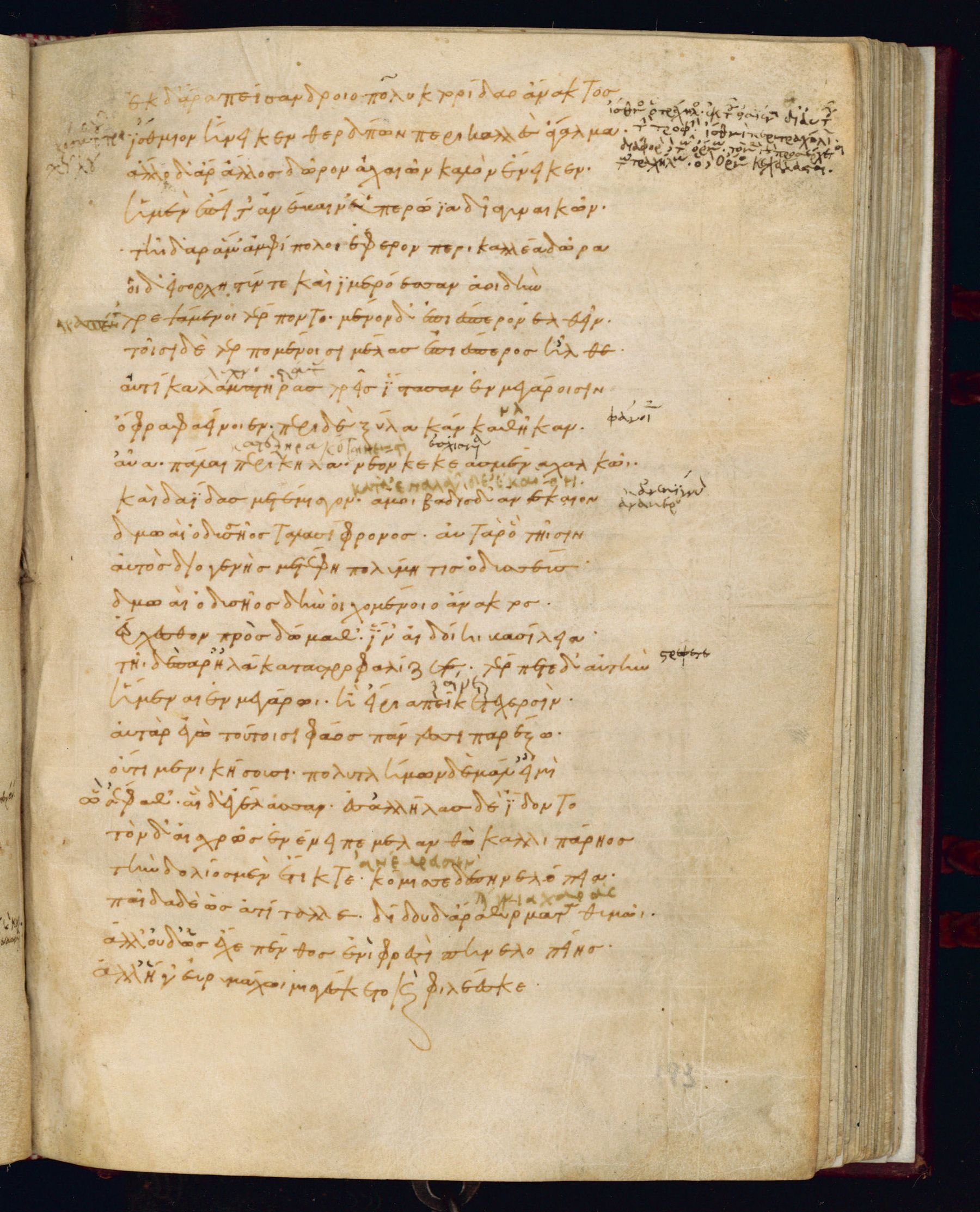
Where on the image
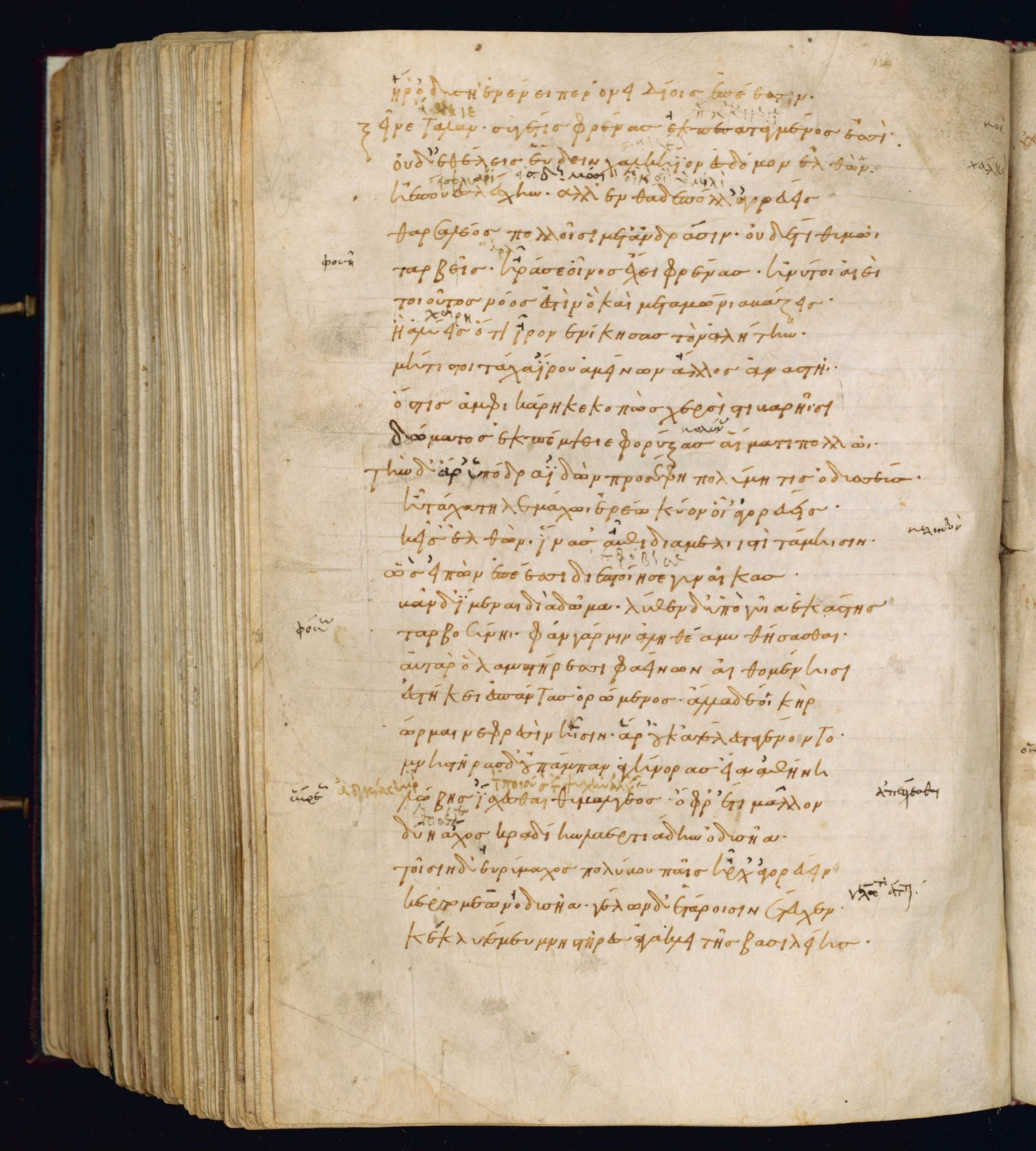
Laur. Plut. 32.24, fol. 183r: Odyssey 18.299-325, begins ‹ἐκ δʼ ἄρα Πεισάνδροιο›, ends ‹Εὐρυμάχῳ μισγέσκετο καὶ φιλέεσκεν.›. Checked on the image: first and last lines read and matched to the Greek. Fol. 182v ends with 18.298. Fol. 183v begins with 18.326. 18.318 (ἤν περ γάρ κʼ ἐθέλωσιν ἐΰθρονον Ἠῶ μίμνειν) is not on the page: the scribe passes from 18.317 to 18.319 (26 lines). English blocks here: 300-304, 305-309, 310-314, 315-319, 320-324.
299ἐκ δʼ ἄρα Πεισάνδροιο Πολυκτορίδαο ἄνακτος
300ἴσθμιον ἤνεικεν θεράπων, περικαλλὲς ἄγαλμα.
301ἄλλο δʼ ἄρʼ ἄλλος δῶρον Ἀχαιῶν καλὸν ἔνεικεν.
302ἡ μὲν ἔπειτʼ ἀνέβαινʼ ὑπερώϊα δῖα γυναικῶν,
303τῇ δʼ ἄρʼ ἅμʼ ἀμφίπολοι ἔφερον περικαλλέα δῶρα
304οἱ δʼ εἰς ὀρχηστύν τε καὶ ἱμερόεσσαν ἀοιδὴν
305τρεψάμενοι τέρποντο, μένον δʼ ἐπὶ ἕσπερον ἐλθεῖν.
306τοῖσι δὲ τερπομένοισι μέλας ἐπὶ ἕσπερος ἦλθεν.
307αὐτίκα λαμπτῆρας τρεῖς ἵστασαν ἐν μεγάροισιν,
308ὄφρα φαείνοιεν· περὶ δὲ ξύλα κάγκανα θῆκαν,
309αὖα πάλαι, περίκηλα, νέον κεκεασμένα χαλκῷ,
310καὶ δαΐδας μετέμισγον· ἀμοιβηδὶς δʼ ἀνέφαινον
311δμῳαὶ Ὀδυσσῆος ταλασίφρονος. αὐτὰρ ὁ τῇσιν
312αὐτὸς διογενῆς μετέφη πολύμητις Ὀδυσσεύς·
313δμῳαὶ Ὀδυσσῆος, δὴν οἰχομένοιο ἄνακτος,
314ἔρχεσθε πρὸς δώμαθʼ, ἵνʼ αἰδοίη βασίλεια·
315τῇ δὲ παρʼ ἠλάκατα στροφαλίζετε, τέρπετε δʼ αὐτὴν
316ἥμεναι ἐν μεγάρῳ, ἢ εἴρια πείκετε χερσίν·
317αὐτὰρ ἐγὼ τούτοισι φάος πάντεσσι παρέξω.
318ἤν περ γάρ κʼ ἐθέλωσιν ἐΰθρονον Ἠῶ μίμνειν,
319οὔ τί με νικήσουσι· πολυτλήμων δὲ μάλʼ εἰμί.
320ὣς ἔφαθʼ, αἱ δʼ ἐγέλασσαν, ἐς ἀλλήλας δὲ ἴδοντο.
321τὸν δʼ αἰσχρῶς ἐνένιπε Μελανθὼ καλλιπάρῃος,
322τὴν Δολίος μὲν ἔτικτε, κόμισσε δὲ Πηνελόπεια,
323παῖδα δὲ ὣς ἀτίταλλε, δίδου δʼ ἄρʼ ἀθύρματα θυμῷ·
324ἀλλʼ οὐδʼ ὣς ἔχε πένθος ἐνὶ φρεσὶ Πηνελοπείης,
325ἀλλʼ ἥ γʼ Εὐρυμάχῳ μισγέσκετο καὶ φιλέεσκεν.
300his squire brought a necklace, a jewel exceeding fair. So of the Achaeans one brought one fair gift and one another. But she thereafter, the fair lady, went up to her upper chamber, and her handmaids bare for her the beautiful gifts. But the wooers 305turned to dance and gladsome song, and made them merry, and waited for evening to come on. And as they made merry dark evening came upon them. Presently they set up three braziers in the hall to give them light, and round about them placed dry faggots, long since seasoned and hard, and newly split with the axe; 310and in the spaces between they set torches; and in turn the handmaids of Odysseus, of the steadfast heart, kindled the flame. Then Zeus-born Odysseus, of many wiles, himself spoke among the maids, and said: “Maidens of Odysseus, that has long been gone, go to the chambers where your honored queen abides, 315and twist the yarn by her side, and make glad her heart, as you sit in the chamber, or card the wool with your hands; but I will give light to all these men. For if they wish to wait for fair-throned Dawn, they shall in no wise outdo me. I am one that can endure much.” 320So he spoke, and the maids broke into a laugh, and glanced at one another. And fair-cheeked Melantho rated him shamefully, Melantho, whom Dolius begot, but whom Penelope had reared and cherished as her own child, and gave her playthings to her heart's desire. Yet even so she had at heart no sorrow for Penelope,
Where on the image
Laur. Plut. 32.24, fol. 183v: Odyssey 18.326-351, begins ‹ἥ ῥʼ Ὀδυσῆʼ ἐνένιπεν›, ends ‹μευ, μνηστῆρες ἀγακλειτῆς βασιλείης,›. Checked on the image: first and last lines read and matched to the Greek. Fol. 183r ends with 18.325. Fol. 184r begins with 18.352. English blocks here: 325-329, 330-334, 335-336, 337-339, 340-344, 345-349.
326ἥ ῥʼ Ὀδυσῆʼ ἐνένιπεν ὀνειδείοις ἐπέεσσιν·
327ξεῖνε τάλαν, σύ γέ τις φρένας ἐκπεπαταγμένος ἐσσί,
328οὐδʼ ἐθέλεις εὕδειν χαλκήϊον ἐς δόμον ἐλθών,
329ἠέ που ἐς λέσχην, ἀλλʼ ἐνθάδε πόλλʼ ἀγορεύεις,
330θαρσαλέως πολλοῖσι μετʼ ἀνδράσιν, οὐδέ τι θυμῷ
331ταρβεῖς· ἦ ῥά σε οἶνος ἔχει φρένας, ἤ νύ τοι αἰεὶ
332τοιοῦτος νόος ἐστίν· ὃ καὶ μεταμώνια βάζεις.
333ἦ ἀλύεις, ὅτι Ἶρον ἐνίκησας τὸν ἀλήτην;
334μή τίς τοι τάχα Ἴρου ἀμείνων ἄλλος ἀναστῇ,
335ὅς τίς σʼ ἀμφὶ κάρη κεκοπὼς χερσὶ στιβαρῇσι
336δώματος ἐκπέμψῃσι, φορύξας αἵματι πολλῷ.
337τὴν δʼ ἄρʼ ὑπόδρα ἰδὼν προσέφη πολύμητις Ὀδυσσεύς·
338ἦ τάχα Τηλεμάχῳ ἐρέω, κύον, οἷʼ ἀγορεύεις,
339κεῖσʼ ἐλθών, ἵνα σʼ αὖθι διὰ μελεϊστὶ τάμῃσιν.
340ὣς εἰπὼν ἐπέεσσι διεπτοίησε γυναῖκας.
341βὰν δʼ ἴμεναι διὰ δῶμα, λύθεν δʼ ὑπὸ γυῖα ἑκάστης
342ταρβοσύνῃ· φὰν γάρ μιν ἀληθέα μυθήσασθαι.
343αὐτὰρ ὁ πὰρ λαμπτῆρσι φαείνων αἰθομένοισιν
344ἑστήκειν ἐς πάντας ὁρώμενος· ἄλλα δέ οἱ κῆρ
345ὥρμαινε φρεσὶν ᾗσιν, ἅ ῥʼ οὐκ ἀτέλεστα γένοντο.
346μνηστῆρας δʼ οὐ πάμπαν ἀγήνορας εἴα Ἀθήνη
347λώβης ἴσχεσθαι θυμαλγέος, ὄφρʼ ἔτι μᾶλλον
348δύη ἄχος κραδίην Λαερτιάδεω Ὀδυσῆος.
349τοῖσιν δʼ Εὐρύμαχος, Πολύβου πάϊς, ἦρχʼ ἀγορεύειν,
350κερτομέων Ὀδυσῆα· γέλω δʼ ἑτάροισιν ἔτευχε.
351κέκλυτέ μευ, μνηστῆρες ἀγακλειτῆς βασιλείης,
325but she loved Eurymachus and was wont to lie with him. She then rated Odysseus with reviling words: “Wretched stranger, thou art but a crack-brained fellow, unwilling to go to a smithy to sleep, or to a common lodge, but pratest here continually, 330unabashed in the company of many lords, and hast no fear at heart. Surely wine has mastered thy wits, or else thy mind is ever thus, that thou dost babble idly. Art thou beside thyself because thou hast beaten that vagrant Irus? Beware, lest presently another better than Irus shall rise up against thee 335to beat thee about the head with heavy hands, and befoul thee with streams of blood, and send thee forth from the house.” 337Then with an angry glance from beneath his brows Odysseus of many wiles answered her: “Presently shall I go yonder, thou shameless thing, and tell Telemachus, since thou speakest thus, that on the spot he may cut thee limb from limb.” 340So he spoke, and with his words scattered the women, who fled through the hall, and the limbs of each were loosened beneath her in terror, for they thought that he spoke truth. But Odysseus took his stand by the burning braziers to give light, and looked upon all the men. 345Yet other things was the heart within him pondering—things that were not to be unfulfilled. But Athena would in no wise suffer the proud wooers to abstain from bitter outrage, that pain might sink yet deeper into the heart of Odysseus, son of Laertes. So among them Eurymachus, son of Polybus, began to speak,
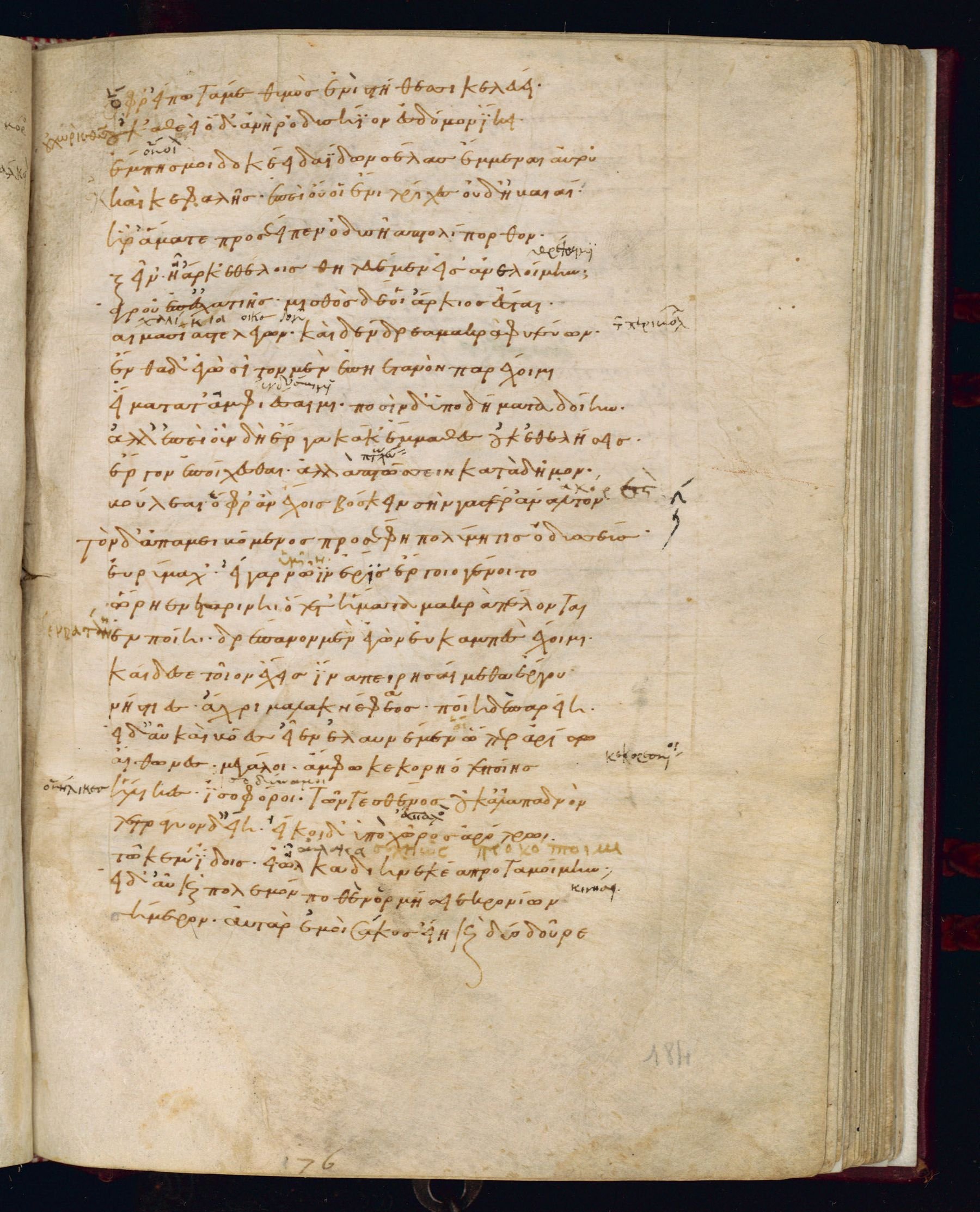
Where on the image
Laur. Plut. 32.24, fol. 184r: Odyssey 18.352-377, begins ‹ὄφρʼ εἴπω τά με›, ends ‹εἴη καὶ δύο δοῦρε›. Checked on the image: first and last lines read and matched to the Greek. Fol. 183v ends with 18.351. Fol. 184v begins with 18.378. English blocks here: 350-354, 355-359, 360-364, 365-369, 370-374, 375-379.
352ὄφρʼ εἴπω τά με θυμὸς ἐνὶ στήθεσσι κελεύει.
353οὐκ ἀθεεὶ ὅδʼ ἀνὴρ Ὀδυσήϊον ἐς δόμον ἵκει·
354ἔμπης μοι δοκέει δαίδων σέλας ἔμμεναι αὐτοῦ
355κὰκ κεφαλῆς, ἐπεὶ οὔ οἱ ἔνι τρίχες οὐδʼ ἠβαιαί.
356ἦ ῥʼ, ἅμα τε προσέειπεν Ὀδυσσῆα πτολίπορθον·
357ξεῖνʼ, ἦ ἄρ κʼ ἐθέλοις θητευέμεν, εἴ σʼ ἀνελοίμην,
358ἀγροῦ ἐπʼ ἐσχατιῆς—μισθὸς δέ τοι ἄρκιος ἔσται—
359αἱμασιάς τε λέγων καὶ δένδρεα μακρὰ φυτεύων;
360ἔνθα κʼ ἐγὼ σῖτον μὲν ἐπηετανὸν παρέχοιμι,
361εἵματα δʼ ἀμφιέσαιμι ποσίν θʼ ὑποδήματα δοίην.
362ἀλλʼ ἐπεὶ οὖν δὴ ἔργα κάκʼ ἔμμαθες, οὐκ ἐθελήσεις
363ἔργον ἐποίχεσθαι, ἀλλὰ πτώσσειν κατὰ δῆμον
364βούλεαι, ὄφρʼ ἄν ἔχῃς βόσκειν σὴν γαστέρʼ ἄναλτον.
365τὸν δʼ ἀπαμειβόμενος προσέφη πολύμητις Ὀδυσσεύς·
366Εὐρύμαχʼ, εἰ γὰρ νῶϊν ἔρις ἔργοιο γένοιτο
367ὥρῃ ἐν εἰαρινῇ, ὅτε τʼ ἤματα μακρὰ πέλονται,
368ἐν ποίῃ, δρέπανον μὲν ἐγὼν εὐκαμπὲς ἔχοιμι,
369καὶ δὲ σὺ τοῖον ἔχοις, ἵνα πειρησαίμεθα ἔργου
370νήστιες ἄχρι μάλα κνέφαος, ποίη δὲ παρείη.
371εἰ δʼ αὖ καὶ βόες εἶεν ἐλαυνέμεν, οἵ περ ἄριστοι,
372αἴθωνες, μεγάλοι, ἄμφω κεκορηότε ποίης,
373ἥλικες, ἰσοφόροι, τῶν τε σθένος οὐκ ἀλαπαδνόν,
374τετράγυον δʼ εἴη, εἴκοι δʼ ὑπὸ βῶλος ἀρότρῳ·
375τῷ κέ μʼ ἴδοις, εἰ ὦλκα διηνεκέα προταμοίμην.
376εἰ δʼ αὖ καὶ πόλεμόν ποθεν ὁρμήσειε Κρονίων
377σήμερον, αὐτὰρ ἐμοὶ σάκος εἴη καὶ δύο δοῦρε
350jeering at Odysseus, and making mirth for his companions: “Hear me, wooers of the glorious queen, that I may say what the heart in my breast bids me. Not without the will of the gods has this man come to the palace of Odysseus; in any case there is a glare of torches from him— 355from his head, for there is no hair on it, no, not a trace.” Therewith he called to Odysseus, sacker of cities: “Stranger, wouldest thou have a mind to serve for hire, if I should take thee into service on an outlying farm—thy pay shall be assured thee—gathering stones for walls, and planting tall trees? 360There would I provide thee with food the year through, and clothe thee with raiment and give thee sandals for thy feet. But since thou hast learned only deeds of evil, thou wilt not care to busy thyself with work, but art minded rather to go skulking through the land, that thou mayest have wherewith to feed thy insatiate belly.” 365Then Odysseus of many wiles answered him, and said: “Eurymachus, I would that we two might have a match in working in the season of spring, when the long days come, at mowing the grass, I with a curved scythe in my hands and thou with another like it, 370and that the grass might be in plenty that so we might test our work, fasting till late evening. Or I would again that there were oxen to drive—the best there are, tawny and large, both well fed with grass, of like age and like power to bear the yoke, tireless in strength—and that there were a field of four acres, and the soil should yield before the plough: 375then shouldest thou see me, whether or no I could cut a straight furrow to the end. Or I would again that this day the son of Cronos might bring war upon us from whence he would, and I had a shield and two spears and a helmet all of bronze, that fitted well my temples: then shouldest thou see me mingling amid the foremost fighters,
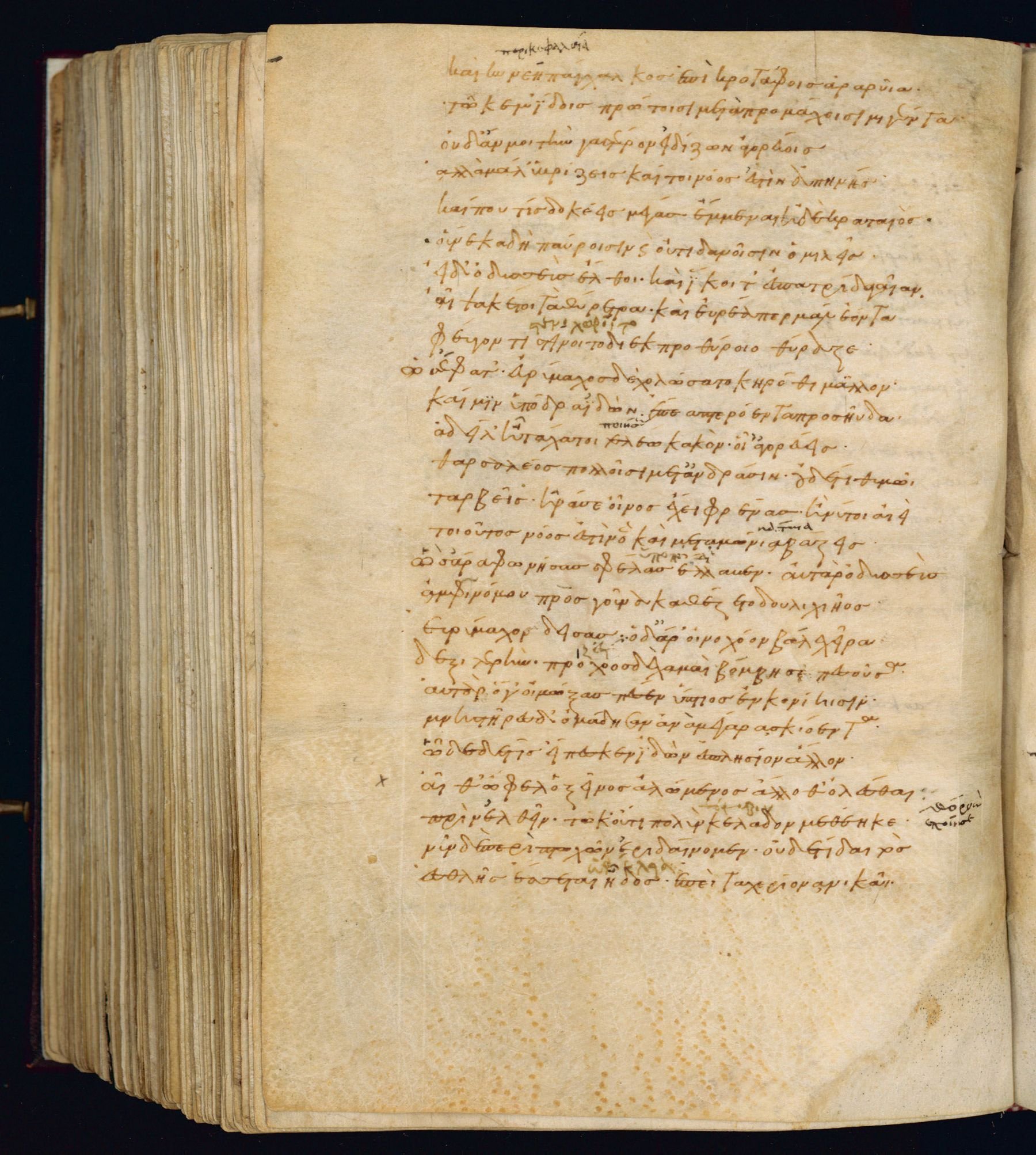
Where on the image
Laur. Plut. 32.24, fol. 184v: Odyssey 18.378-404, begins ‹καὶ κυνέη πάγχαλκος, ἐπὶ›, ends ‹ἐπεὶ τὰ χερείονα νικᾷ.›. Checked on the image: first and last lines read and matched to the Greek. Fol. 184r ends with 18.377. Fol. 185r begins with 18.405. 18.393 (ἦ ἀλύεις, ὅτι Ἶρον ἐνίκησας τὸν ἀλήτην;) is not on the page: the scribe passes from 18.392 to 18.394 (26 lines). A gloss stands above the first line. English blocks here: 380-384, 385-389, 390-393, 394-394, 395-399, 400-404.
378καὶ κυνέη πάγχαλκος, ἐπὶ κροτάφοις ἀραρυῖα,
379τῷ κέ μʼ ἴδοις πρώτοισιν ἐνὶ προμάχοισι μιγέντα,
380οὐδʼ ἄν μοι τὴν γαστέρʼ ὀνειδίζων ἀγορεύοις.
381ἀλλὰ μάλʼ ὑβρίζεις, καί τοι νόος ἐστὶν ἀπηνής·
382καί πού τις δοκέεις μέγας ἔμμεναι ἠδὲ κραταιός,
383οὕνεκα πὰρ παύροισι καὶ οὐκ ἀγαθοῖσιν ὁμιλεῖς.
384εἰ δʼ Ὀδυσεὺς ἔλθοι καὶ ἵκοιτʼ ἐς πατρίδα γαῖαν,
385αἶψά κέ τοι τὰ θύρετρα, καὶ εὐρέα περ μάλʼ ἐόντα,
386φεύγοντι στείνοιτο διὲκ προθύροιο θύραζε.
387ὣς ἔφατʼ, Εὐρύμαχος δʼ ἐχολώσατο κηρόθι μᾶλλον,
388καί μιν ὑπόδρα ἰδὼν ἔπεα πτερόεντα προσηύδα·
389ἆ δείλʼ, ἦ τάχα τοι τελέω κακόν, οἷʼ ἀγορεύεις
390θαρσαλέως πολλοῖσι μετʼ ἀνδράσιν, οὐδέ τι θυμῷ
391ταρβεῖς· ἦ ῥά σε οἶνος ἔχει φρένας, ἤ νύ τοι αἰεὶ
392τοιοῦτος νόος ἐστίν· ὃ καὶ μεταμώνια βάζεις.
393ἦ ἀλύεις, ὅτι Ἶρον ἐνίκησας τὸν ἀλήτην;
394ὣς ἄρα φωνήσας σφέλας ἔλλαβεν· αὐτὰρ Ὀδυσσεὺς
395Ἀμφινόμου πρὸς γοῦνα καθέζετο Δουλιχιῆος,
396Εὐρύμαχον δείσας· ὁ δʼ ἄρʼ οἰνοχόον βάλε χεῖρα
397δεξιτερήν· πρόχοος δὲ χαμαὶ βόμβησε πεσοῦσα,
398αὐτὰρ ὅ γʼ οἰμώξας πέσεν ὕπτιος ἐν κονίῃσι.
399μνηστῆρες δʼ ὁμάδησαν ἀνὰ μέγαρα σκιόεντα,
400ὧδε δέ τις εἴπεσκεν ἰδὼν ἐς πλησίον ἄλλον·
401αἴθʼ ὤφελλʼ ὁ ξεῖνος ἀλώμενος ἄλλοθʼ ὀλέσθαι
402πρὶν ἐλθεῖν· τῷ οὔ τι τόσον κέλαδον μετέθηκε.
403νῦν δὲ περὶ πτωχῶν ἐριδαίνομεν, οὐδέ τι δαιτὸς
404ἐσθλῆς ἔσσεται ἦδος, ἐπεὶ τὰ χερείονα νικᾷ.
380and wouldest not prate, taunting me with this belly of mine. But right insolent art thou, and thy heart is cruel, and forsooth thou thinkest thyself to be some great man and mighty, because thou consortest with few men and weak. If but Odysseus might return, and come to his native land, 385soon would yonder doors, right wide though they are, prove all too narrow for thee in thy flight out through the doorway.” So he spoke, and Eurymachus waxed the more wroth at heart, and with an angry glance from beneath his brows spoke to him winged words: “Wretch, presently will I work thee evil, that thou pratest thus, 390unabashed in the presence of many lords, and hast no fear at heart. Surely wine has mastered thy wits, or else thy mind is ever thus, that thou dost babble idly. Art thou beside thyself because thou hast beaten that vagrant Irus?” 394So saying, he seized a footstool, but Odysseus 395sat down at the knees of Amphinomus of Dulichium, in fear of Eurymachus. And so Eurymachus struck a cup-bearer on the right hand, and the wine-jug fell to the ground with a clang, and the bearer groaned, and fell backwards in the dust. Then the wooers broke into uproar throughout the shadowy halls, 400and thus would one man speak with a glance at his neighbor: “Would that yon stranger had perished elsewhere on his wanderings or ever he came hither; then should he never have brought among us all this tumult. But now we are brawling about beggars, nor shall there be any joy in our rich feast, since worse things prevail.”
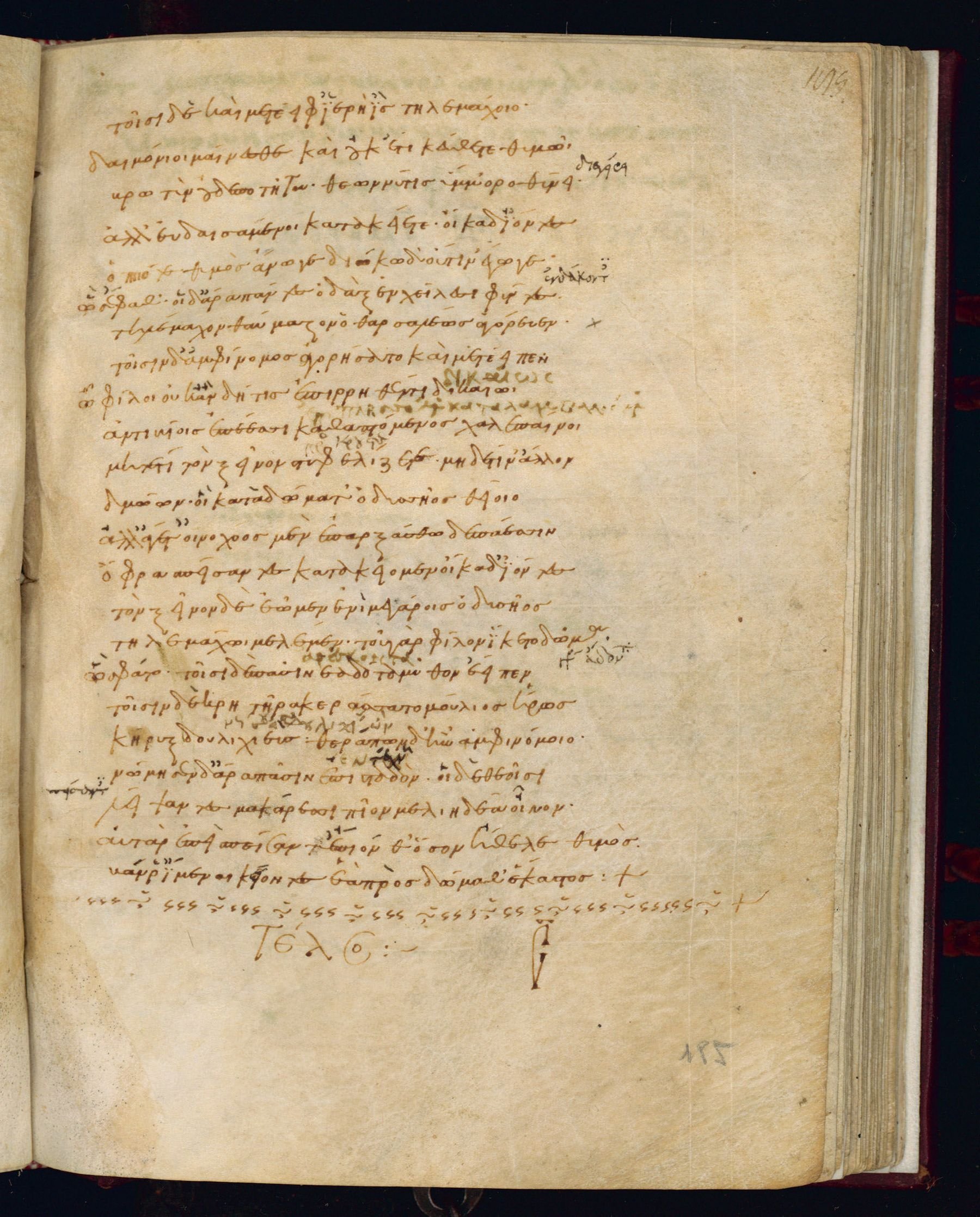
Where on the image
Laur. Plut. 32.24, fol. 185r: Odyssey 18.405-428, begins ‹τοῖσι δὲ καὶ μετέειφʼ›, ends ‹ἑὰ πρὸς δώμαθʼ ἕκαστος.›. Checked on the image: first and last lines read and matched to the Greek. Fol. 184v ends with 18.404. Book 18 ends with 18.428, followed by a line of ornament and τέλος; the rest of the page is blank. Book 19 begins on fol. 185v. English blocks here: 405-409, 410-414, 415-419, 420-424, 425-428.
405τοῖσι δὲ καὶ μετέειφʼ ἱερὴ ἲς Τηλεμάχοιο
406δαιμόνιοι, μαίνεσθε καὶ οὐκέτι κεύθετε θυμῷ
407βρωτὺν οὐδὲ ποτῆτα· θεῶν νύ τις ὔμμʼ ὀροθύνει.
408ἀλλʼ εὖ δαισάμενοι κατακείετε οἴκαδʼ ἰόντες,
409ὁππότε θυμὸς ἄνωγε· διώκω δʼ οὔ τινʼ ἐγώ γε.
410ὣς ἔφαθʼ, οἱ δʼ ἄρα πάντες ὀδὰξ ἐν χείλεσι φύντες
411Τηλέμαχον θαύμαζον, ὃ θαρσαλέως ἀγόρευε.
412τοῖσιν δʼ Ἀμφίνομος ἀγορήσατο καὶ μετέειπε
413Νίσου φαίδιμος υἱός, Ἀρητιάδαο ἄνακτος·
414ὦ φίλοι, οὐκ ἂν δή τις ἐπὶ ῥηθέντι δικαίῳ
415ἀντιβίοις ἐπέεσσι καθαπτόμενος χαλεπαίνοι·
416μήτε τι τὸν ξεῖνον στυφελίζετε μήτε τινʼ ἄλλον
417δμώων, οἳ κατὰ δώματʼ Ὀδυσσῆος θείοιο.
418ἀλλʼ ἄγετʼ, οἰνοχόος μὲν ἐπαρξάσθω δεπάεσσιν,
419ὄφρα σπείσαντες κατακείομεν οἴκαδʼ ἰόντες·
420τὸν ξεῖνον δὲ ἐῶμεν ἐνὶ μεγάροις Ὀδυσῆος
421Τηλεμάχῳ μελέμεν· τοῦ γὰρ φίλον ἵκετο δῶμα.
422ὣς φάτο, τοῖσι δὲ πᾶσιν ἑαδότα μῦθον ἔειπε.
423τοῖσιν δὲ κρητῆρα κεράσσατο Μούλιος ἥρως,
424κῆρυξ Δουλιχιεύς· θεράπων δʼ ἦν Ἀμφινόμοιο·
425νώμησεν δʼ ἄρα πᾶσιν ἐπισταδόν· οἱ δὲ θεοῖσι
426σπείσαντες μακάρεσσι πίον μελιηδέα οἶνον.
427αὐτὰρ ἐπεὶ σπεῖσάν τʼ ἔπιόν θʼ ὅσον ἤθελε θυμός,
428βάν ῥʼ ἴμεναι κείοντες ἑὰ πρὸς δώμαθʼ ἕκαστος.
405Then among them spoke the strong and mighty Telemachus: “Strange sirs, ye are mad, and no longer hide that ye have eaten and drunk; some god surely is moving you. Nay, now that you have well feasted, go to your homes and take your rest, when your spirits bid you. Yet do I drive no man forth.” 410So he spoke, and they all bit their lips, and marvelled at Telemachus, that he spoke boldly. But Amphinomus spoke, and addressed them—he was son of the noble prince Nisus, son of Aretias: “Friends, no man in answer to what has been fairly spoken 415would wax wroth and make reply with wrangling words. Abuse not any more this stranger nor any one of the slaves that are in the house of divine Odysseus. Nay, come, let the bearer pour drops for libation in the cups, that we may pour libations, and go home to take our rest. As for this stranger, 420let us leave him in the halls of Odysseus to be cared for by Telemachus; for to his house has he come.” So said he, and the words that he spoke were pleasing to all. Then a bowl was mixed for them by the lord Mulius, a herald from Dulichium, who was squire to Amphinomus. 425And he served out to all, coming up to each in turn; and they made libations to the blessed gods, and drank the honey-sweet wine. Then when they had made libations and had drunk to their heart's content, they went their way, each man to his own house, to take their rest.
Notes
- Greek: A. T. Murray, Homer: The Odyssey (Loeb Classical Library, 1919), via Perseus.
- English: A. T. Murray's translation in the same edition; his footnotes are omitted.
Cite
Sources
- Source: Laur. Plut. 32.24 (BML Teca Digitale IIIF) + Murray Greek (Loeb 1919, Perseus) + Murray English (Loeb 1919, Perseus) (holding institution)
- Critical edition: Murray, Loeb 1919, via Perseus
← previous · → next · v cycle view · l back to library