Homer, Odyssey, Book 21: The bow
Introduction
The Odyssey, composed around 700 BCE and attributed to Homer, tells of Odysseus' ten-year journey home from Troy and his return to Ithaca. Book 21 (434 lines): The bow.
The page photographs are from Florence, Biblioteca Medicea Laurenziana, Plut. 32.24 (parchment, 10th century, 234 folios; the oldest manuscript of the Odyssey with published images), in the Biblioteca Medicea Laurenziana's Teca Digitale. This book is on fol. 205v-214r; each section below is one page, with its first and last line as read on the photograph. Many pages carry interlinear glosses and a few marginal notes in later hands.
The Greek is A. T. Murray's Loeb text (1919) via Perseus, not a transcription of this manuscript, whose wording differs in places. The English is Murray's prose translation (1919), divided every five lines; at a page break a five-line block goes with the page holding most of it, except at the page breaks where a section's note says the English is cut at the end of Murray's sentence. Each section's note gives its English line range.
Where the scribe left out a line, wrote one in the margin, changed the order or added a line not in Murray's text, the section's note on the photograph says so; the Greek and English shown are Murray's full text for the page's range.
How was this verified? (Provenance)
Where on the image
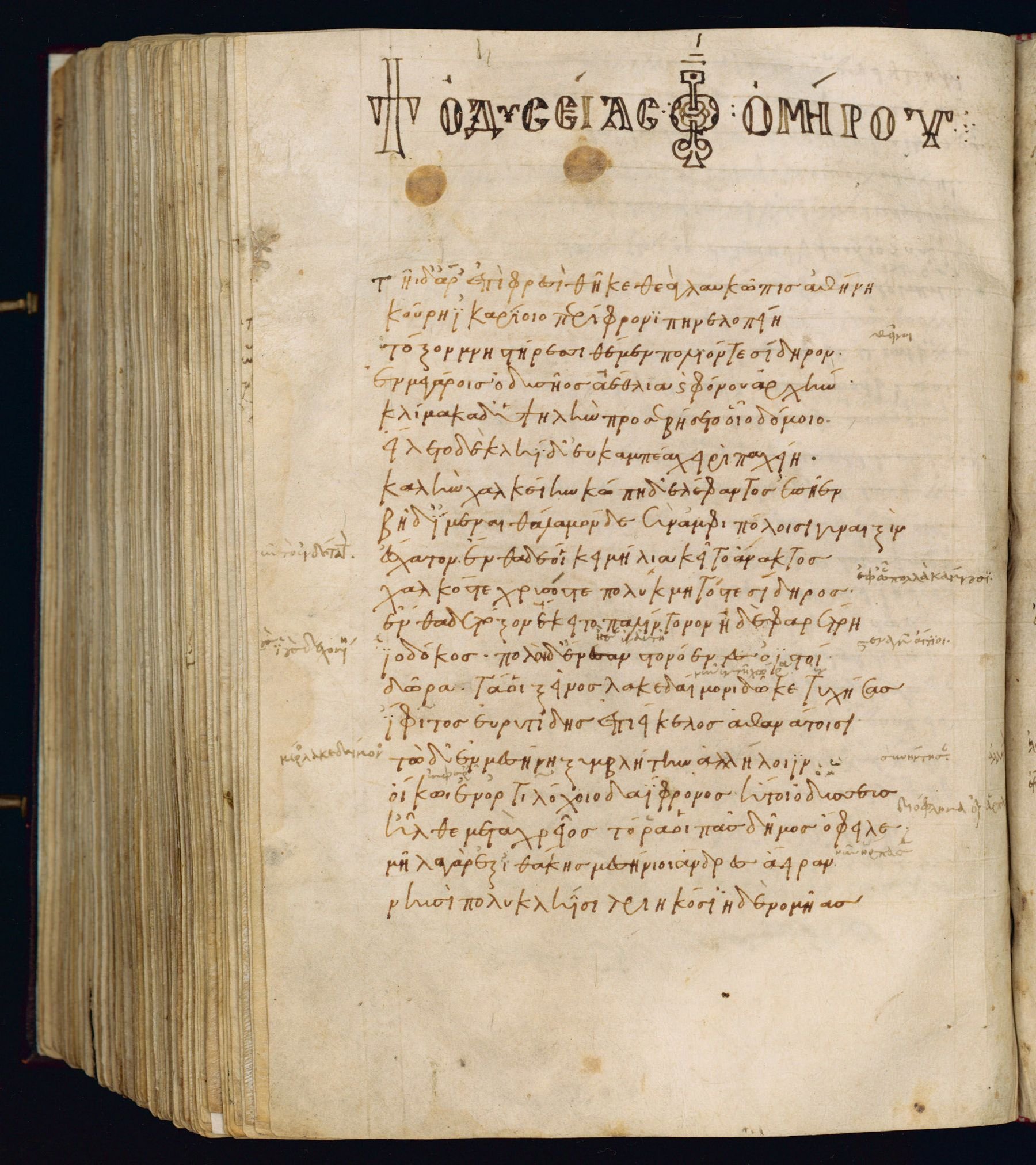
Laur. Plut. 32.24, fol. 205v: Odyssey 21.1-19, begins ‹τῇ δʼ ἄρʼ ἐπὶ›, ends ‹πολυκλήϊσι τριηκόσιʼ ἠδὲ νομῆας.›. Checked on the image: first and last lines read and matched to the Greek. Fol. 206r begins with 21.20. Book 21 begins below the heading ὀδυσσείας φ ὁμήρου in decorated capitals. English blocks here: 1-4, 5-9, 10-14, 15-19.
1τῇ δʼ ἄρʼ ἐπὶ φρεσὶ θῆκε θεὰ γλαυκῶπις Ἀθήνη,
2κούρῃ Ἰκαρίοιο, περίφρονι Πηνελοπείῃ,
3τόξον μνηστήρεσσι θέμεν πολιόν τε σίδηρον
4ἐν μεγάροις Ὀδυσῆος, ἀέθλια καὶ φόνου ἀρχήν.
5κλίμακα δʼ ὑψηλὴν προσεβήσετο οἷο δόμοιο,
6εἵλετο δὲ κληῗδʼ εὐκαμπέα χειρὶ παχείῃ
7καλὴν χαλκείην· κώπη δʼ ἐλέφαντος ἐπῆεν.
8βῆ δʼ ἴμεναι θάλαμόνδε σὺν ἀμφιπόλοισι γυναιξὶν
9ἔσχατον· ἔνθα δέ οἱ κειμήλια κεῖτο ἄνακτος,
10χαλκός τε χρυσός τε πολύκμητός τε σίδηρος.
11ἔνθα δὲ τόξον κεῖτο παλίντονον ἠδὲ φαρέτρη
12ἰοδόκος, πολλοὶ δʼ ἔνεσαν στονόεντες ὀϊστοί,
13δῶρα τά οἱ ξεῖνος Λακεδαίμονι δῶκε τυχήσας
14Ἴφιτος Εὐρυτίδης, ἐπιείκελος ἀθανάτοισι.
15τὼ δʼ ἐν Μεσσήνῃ ξυμβλήτην ἀλλήλοιϊν
16οἴκῳ ἐν Ὀρτιλόχοιο δαΐφρονος. ἦ τοι Ὀδυσσεὺς
17ἦλθε μετὰ χρεῖος, τό ῥά οἱ πᾶς δῆμος ὄφελλε·
18μῆλα γὰρ ἐξ Ἰθάκης Μεσσήνιοι ἄνδρες ἄειραν
19νηυσὶ πολυκλήϊσι τριηκόσιʼ ἠδὲ νομῆας.
1But the goddess, flashing-eyed Athena, put it into the heart of the daughter of Icarius, wise Penelope, to set before the wooers in the halls of Odysseus the bow and the gray iron, to be a contest and the beginning of death. 5She climbed the high stairway to her chamber, and took the bent key in her strong hand—a goodly key of bronze, and on it was a handle of ivory. And she went her way with her handmaidens to a store-room, far remote, where lay the treasures of her lord, 10bronze and gold and iron, wrought with toil. And there lay the back-bent bow and the quiver that held the arrows, and many arrows were in it, fraught with groanings—gifts which a friend of Odysseus had given him when he met him once in Lacedaemon, even Iphitus, son of Eurytus, a man like unto the immortals. 15They two had met one another in Messene in the house of wise Ortilochus. Odysseus verily had come to collect a debt which the whole people owed him, for the men of Messene had lifted from Ithaca in their benched ships three hundred sheep and the shepherds with them.
Where on the image
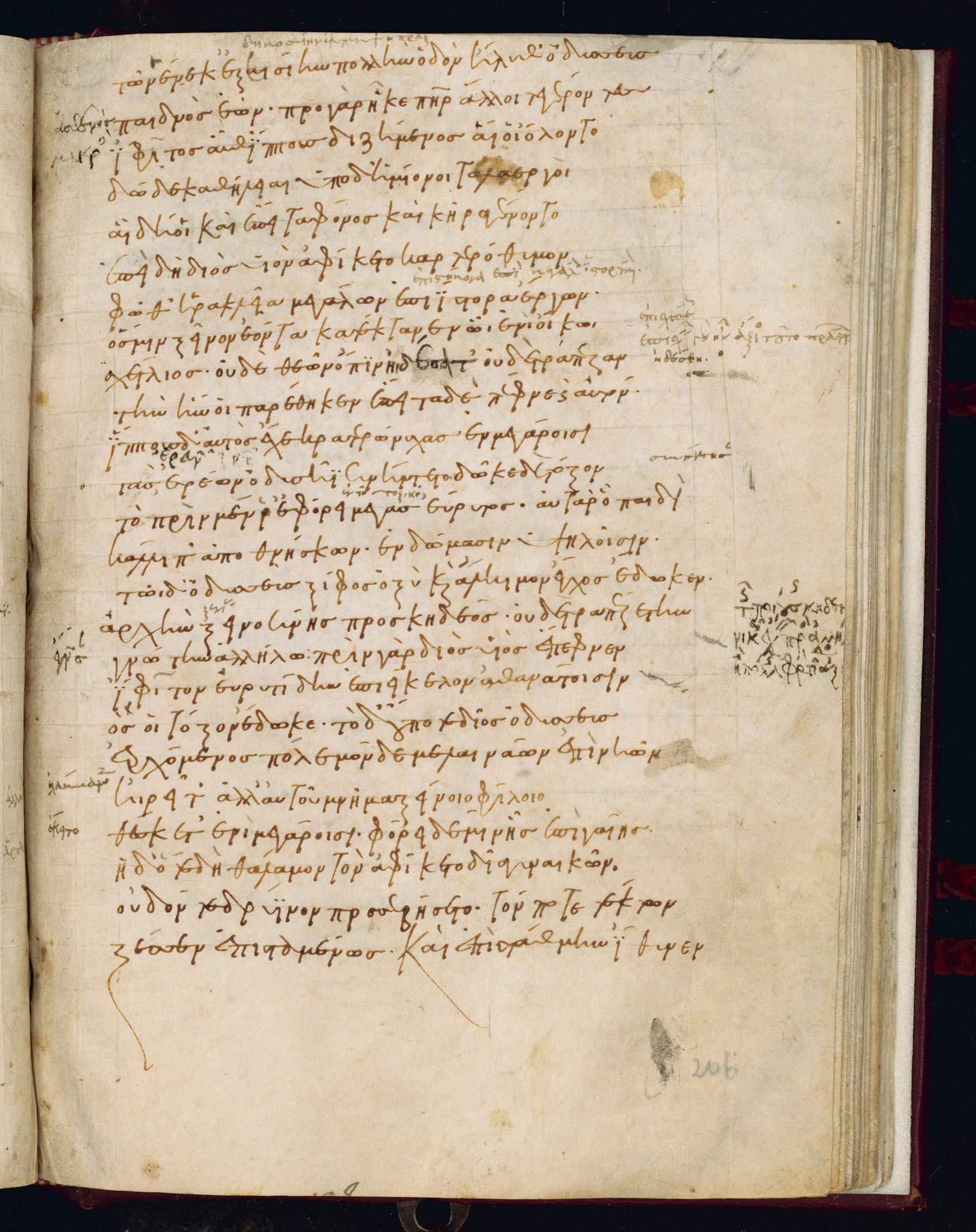
Laur. Plut. 32.24, fol. 206r: Odyssey 21.20-44, begins ‹τῶν ἕνεκʼ ἐξεσίην πολλὴν›, ends ‹καὶ ἐπὶ στάθμην ἴθυνεν,›. Checked on the image: first and last lines read and matched to the Greek. Fol. 205v ends with 21.19. Fol. 206v begins with 21.45. English blocks here: 20-24, 25-29, 30-34, 35-39, 40-41, 42-44.
20τῶν ἕνεκʼ ἐξεσίην πολλὴν ὁδὸν ἦλθεν Ὀδυσσεὺς
21παιδνὸς ἐών· πρὸ γὰρ ἧκε πατὴρ ἄλλοι τε γέροντες.
22Ἴφιτος αὖθʼ ἵππους διζήμενος, αἵ οἱ ὄλοντο
23δώδεκα θήλειαι, ὑπὸ δʼ ἡμίονοι ταλαεργοί·
24αἳ δή οἱ καὶ ἔπειτα φόνος καὶ μοῖρα γένοντο,
25ἐπεὶ δὴ Διὸς υἱὸν ἀφίκετο καρτερόθυμον,
26φῶθʼ Ἡρακλῆα, μεγάλων ἐπιίστορα ἔργων,
27ὅς μιν ξεῖνον ἐόντα κατέκτανεν ᾧ ἐνὶ οἴκῳ,
28σχέτλιος, οὐδὲ θεῶν ὄπιν ᾐδέσατʼ οὐδὲ τράπεζαν,
29τὴν ἥν οἱ παρέθηκεν· ἔπειτα δὲ πέφνε καὶ αὐτόν,
30ἵππους δʼ αὐτὸς ἔχε κρατερώνυχας ἐν μεγάροισι.
31τὰς ἐρέων Ὀδυσῆϊ συνήντετο, δῶκε δὲ τόξον,
32τὸ πρὶν μέν ῥʼ ἐφόρει μέγας Εὔρυτος, αὐτὰρ ὁ παιδὶ
33κάλλιπʼ ἀποθνῄσκων ἐν δώμασιν ὑψηλοῖσι.
34τῷ δʼ Ὀδυσεὺς ξίφος ὀξὺ καὶ ἄλκιμον ἔγχος ἔδωκεν,
35ἀρχὴν ξεινοσύνης προσκηδέος· οὐδὲ τραπέζῃ
36γνώτην ἀλλήλων· πρὶν γὰρ Διὸς υἱὸς ἔπεφνεν
37Ἴφιτον Εὐρυτίδην, ἐπιείκελον ἀθανάτοισιν,
38ὅς οἱ τόξον ἔδωκε. τὸ δʼ οὔ ποτε δῖος Ὀδυσσεὺς
39ἐρχόμενος πόλεμόνδε μελαινάων ἐπὶ νηῶν
40ᾑρεῖτʼ, ἀλλʼ αὐτοῦ μνῆμα ξείνοιο φίλοιο
41κέσκετʼ ἐνὶ μεγάροισι, φόρει δέ μιν ἧς ἐπὶ γαίης.
42ἡ δʼ ὅτε δὴ θάλαμον τὸν ἀφίκετο δῖα γυναικῶν
43οὐδόν τε δρύϊνον προσεβήσετο, τόν ποτε τέκτων
44ξέσσεν ἐπισταμένως καὶ ἐπὶ στάθμην ἴθυνεν,
20It was on an embassy in quest of these that Odysseus had come a far journey, while he was but a youth; for his father and the other elders had sent him forth. And Iphitus, on his part, had come in search of twelve brood mares, which he had lost, with sturdy mules at the teat; but to him thereafter did they bring death and doom, 25when he came to the stout-hearted son of Zeus, the man Heracles, who well knew deeds of daring; for Heracles slew him, his guest though he was, in his own house, ruthlessly, and had regard neither for the wrath of the gods nor for the table which he had set before him, but slew the man thereafter, 30and himself kept the stout-hoofed mares in his halls. It was while asking for these that Iphitus met Odysseus, and gave him the bow, which of old great Eurytus had been wont to bear, and had left at his death to his son in his lofty house. And to Iphitus Odysseus gave a sharp sword and a mighty spear, 35as the beginning of loving friendship; yet they never knew one another at the table, for ere that might be the son of Zeus had slain Iphitus, son of Eurytus, a man like unto the immortals, who gave Odysseus the bow. This bow goodly Odysseus, when going forth to war, would never 40take with him on the black ships, but it lay in his halls at home as a memorial of a dear friend, and he carried it in his own land. 42Now when the fair lady had come to the store-room, and had stepped upon the threshold of oak, which of old the carpenter had skilfully planed and made straight to the line—
Where on the image
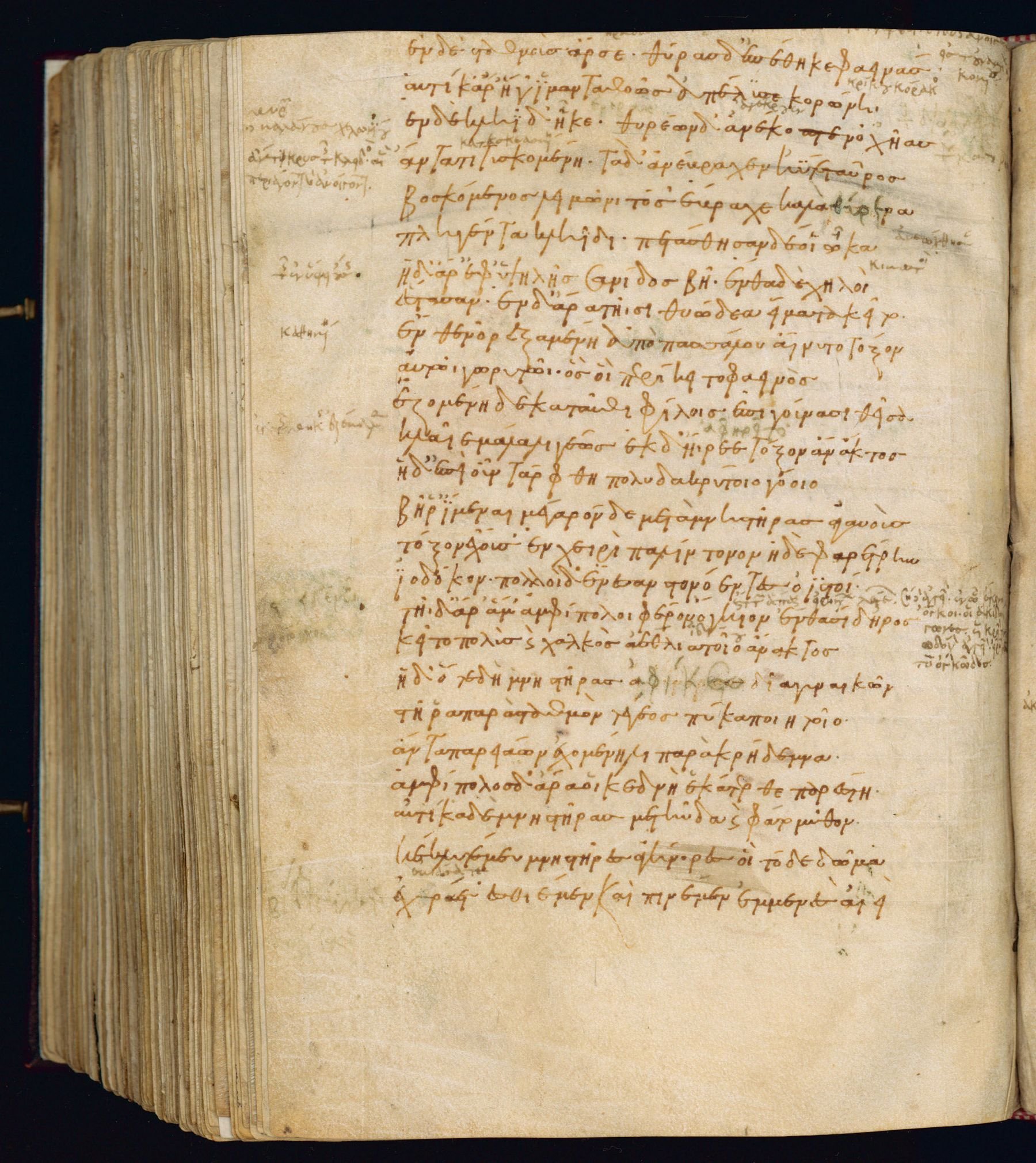
Laur. Plut. 32.24, fol. 206v: Odyssey 21.45-69, begins ‹ἐν δὲ σταθμοὺς ἄρσε,›, ends ‹καὶ πινέμεν ἐμμενὲς αἰεὶ›. Checked on the image: first and last lines read and matched to the Greek. Fol. 206r ends with 21.44. Fol. 207r begins with 21.70. English blocks here: 45-49, 50-54, 55-59, 60-64, 65-69.
45ἐν δὲ σταθμοὺς ἄρσε, θύρας δʼ ἐπέθηκε φαεινάς,
46αὐτίκʼ ἄρʼ ἥ γʼ ἱμάντα θοῶς ἀπέλυσε κορώνης,
47ἐν δὲ κληῗδʼ ἧκε, θυρέων δʼ ἀνέκοπτεν ὀχῆας
48ἄντα τιτυσκομένη· τὰ δʼ ἀνέβραχεν ἠΰτε ταῦρος
49βοσκόμενος λειμῶνι· τόσʼ ἔβραχε καλὰ θύρετρα
50πληγέντα κληΐδι, πετάσθησαν δέ οἱ ὦκα.
51ἡ δʼ ἄρʼ ἐφʼ ὑψηλῆς σανίδος βῆ· ἔνθα δὲ χηλοὶ
52ἕστασαν, ἐν δʼ ἄρα τῇσι θυώδεα εἵματʼ ἔκειτο.
53ἔνθεν ὀρεξαμένη ἀπὸ πασσάλου αἴνυτο τόξον
54αὐτῷ γωρυτῷ, ὅς οἱ περίκειτο φαεινός.
55ἑζομένη δὲ κατʼ αὖθι, φίλοις ἐπὶ γούνασι θεῖσα,
56κλαῖε μάλα λιγέως, ἐκ δʼ ᾕρεε τόξον ἄνακτος.
57ἡ δʼ ἐπεὶ οὖν τάρφθη πολυδακρύτοιο γόοιο,
58βῆ ῥʼ ἴμεναι μέγαρόνδε μετὰ μνηστῆρας ἀγαυοὺς
59τόξον ἔχουσʼ ἐν χειρὶ παλίντονον ἠδὲ φαρέτρην
60ἰοδόκον· πολλοὶ δʼ ἔνεσαν στονόεντες ὀϊστοί.
61τῇ δʼ ἄρʼ ἅμʼ ἀμφίπολοι φέρον ὄγκιον, ἔνθα σίδηρος
62κεῖτο πολὺς καὶ χαλκός, ἀέθλια τοῖο ἄνακτος.
63ἡ δʼ ὅτε δὴ μνηστῆρας ἀφίκετο δῖα γυναικῶν,
64στῆ ῥα παρὰ σταθμὸν τέγεος πύκα ποιητοῖο,
65ἄντα παρειάων σχομένη λιπαρὰ κρήδεμνα.
66ἀμφίπολος δʼ ἄρα οἱ κεδνὴ ἑκάτερθε παρέστη.
67αὐτίκα δὲ μνηστῆρσι μετηύδα καὶ φάτο μῦθον·
68κέκλυτέ μευ, μνηστῆρες ἀγήνορες, οἳ τόδε δῶμα
69ἐχράετʼ ἐσθιέμεν καὶ πινέμεν ἐμμενὲς αἰεὶ
45thereon had he also fitted door-posts, and set on them bright doors—straightway she quickly loosed the thong from the handle and thrust in the key, and with sure aim shot back the bolts. And as a bull bellows 50when grazing in a meadow, even so bellowed the fair doors, smitten by the key; and quickly they flew open before her. Then she stepped upon the high floor, where the chests stood in which fragrant raiment was stored, and stretched out her hand from thence and took from its peg the bow together with the bright case which surrounded it. 55And there she sat down and laid the case upon her knees and wept aloud, and took out the bow of her lord. But when she had had her fill of tearful wailing, she went her way to the hall, to the company of the lordly wooers, bearing in her hands the back-bent bow and the quiver 60that held the arrows, and many arrows were in it, fraught with groanings. And by her side her maidens bore a chest, wherein lay abundance of iron and bronze, the battle-gear of her lord. Now when the fair lady reached the wooers, she stood by the door-post of the well-built hall, 65holding before her face her shining veil; and a faithful handmaid stood on either side of her. Then straightway she spoke among the wooers, and said: “Hear me, ye proud wooers, who have beset this house to eat and drink ever without end,
Where on the image
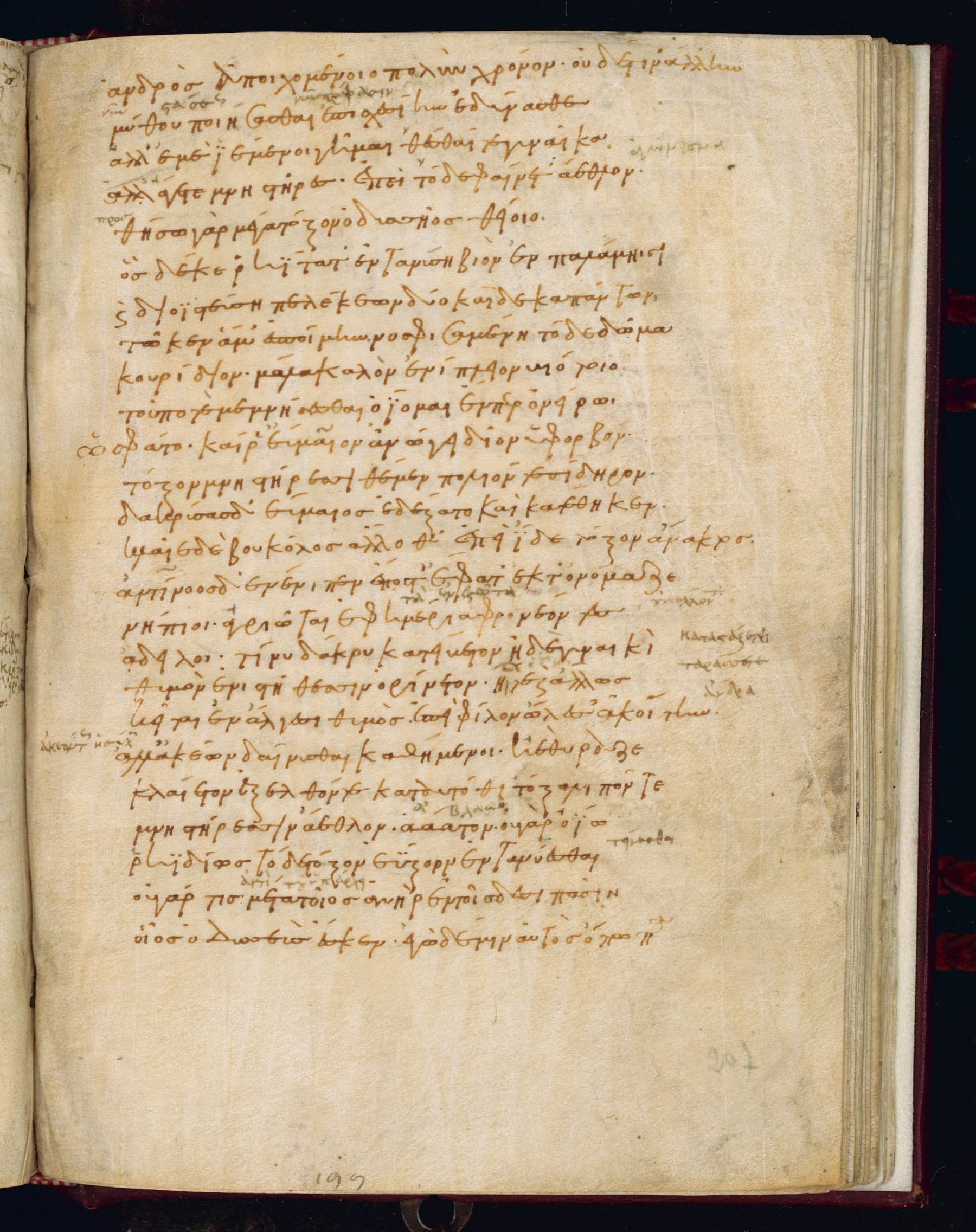
Laur. Plut. 32.24, fol. 207r: Odyssey 21.70-94, begins ‹ἀνδρὸς ἀποιχομένοιο πολὺν χρόνον·›, ends ‹δέ μιν αὐτὸς ὄπωπα,›. Checked on the image: first and last lines read and matched to the Greek. Fol. 206v ends with 21.69. Fol. 207v begins with 21.95. English blocks here: 70-74, 75-79, 80-84, 85-89, 90-94.
70ἀνδρὸς ἀποιχομένοιο πολὺν χρόνον· οὐδέ τινʼ ἄλλην
71μύθου ποιήσασθαι ἐπισχεσίην ἐδύνασθε,
72ἀλλʼ ἐμὲ ἱέμενοι γῆμαι θέσθαι τε γυναῖκα.
73ἀλλʼ ἄγετε, μνηστῆρες, ἐπεὶ τόδε φαίνετʼ ἄεθλον.
74θήσω γὰρ μέγα τόξον Ὀδυσσῆος θείοιο·
75ὃς δέ κε ῥηΐτατʼ ἐντανύσῃ βιὸν ἐν παλάμῃσι
76καὶ διοϊστεύσῃ πελέκεων δυοκαίδεκα πάντων,
77τῷ κεν ἅμʼ ἑσποίμην, νοσφισσαμένη τόδε δῶμα
78κουρίδιον, μάλα καλόν, ἐνίπλειον βιότοιο,
79τοῦ ποτὲ μεμνήσεσθαι ὀΐομαι ἔν περ ὀνείρῳ.
80ὣς φάτο, καί ῥʼ Εὔμαιον ἀνώγει, δῖον ὑφορβόν,
81τόξον μνηστήρεσσι θέμεν πολιόν τε σίδηρον.
82δακρύσας δʼ Εὔμαιος ἐδέξατο καὶ κατέθηκε·
83κλαῖε δὲ βουκόλος ἄλλοθʼ, ἐπεὶ ἴδε τόξον ἄνακτος.
84Ἀντίνοος δʼ ἐνένιπεν ἔπος τʼ ἔφατʼ ἔκ τʼ ὀνόμαζε·
85νήπιοι ἀγροιῶται, ἐφημέρια φρονέοντες,
86ἆ δειλώ, τί νυ δάκρυ κατείβετον ἠδὲ γυναικὶ
87θυμὸν ἐνὶ στήθεσσιν ὀρίνετον; ᾗ τε καὶ ἄλλως
88κεῖται ἐν ἄλγεσι θυμός, ἐπεὶ φίλον ὤλεσʼ ἀκοίτην.
89ἀλλʼ ἀκέων δαίνυσθε καθήμενοι, ἠὲ θύραζε
90κλαίετον ἐξελθόντε, κατʼ αὐτόθι τόξα λιπόντε,
91μνηστήρεσσιν ἄεθλον ἀάατον· οὐ γὰρ ὀΐω
92ῥηϊδίως τόδε τόξον ἐΰξοον ἐντανύεσθαι.
93οὐ γάρ τις μέτα τοῖος ἀνὴρ ἐν τοίσδεσι πᾶσιν
94οἷος Ὀδυσσεὺς ἔσκεν· ἐγὼ δέ μιν αὐτὸς ὄπωπα,
70since its master has long been gone, nor could you find any other plea to urge, save only as desiring to wed me and take me to wife. Nay, come now, ye wooers, since this is shewn to be your prize. I will set before you the great bow of divine Odysseus, 75and whosoever shall most easily string the bow in his hands and shoot an arrow through all twelve axes, with him will I go, and forsake this house of my wedded life, a house most fair and filled with livelihood, which, methinks I shall ever remember even in my dreams.” 80So she spoke, and bade Eumaeus, the goodly swineherd, set for the wooers the bow and the grey iron. And, bursting into tears, Eumaeus took them and laid them down, and in another place the neatherd wept, when he saw the bow of his lord. Then Antinous rebuked them, and spoke, and addressed them: 85“Foolish boors, who mind only the things of the day! Wretched pair, why now do you shed tears, and trouble the soul in the breast of the lady, whose heart even as it is lies low in pain, seeing that she has lost her dear husband? Nay, sit and feast in silence, 90or else go forth and weep, and leave the bow here behind as a decisive contest for the wooers; for not easily, methinks, is this polished bow to be strung. For there is no man among all these here such as Odysseus was, and I myself saw him.
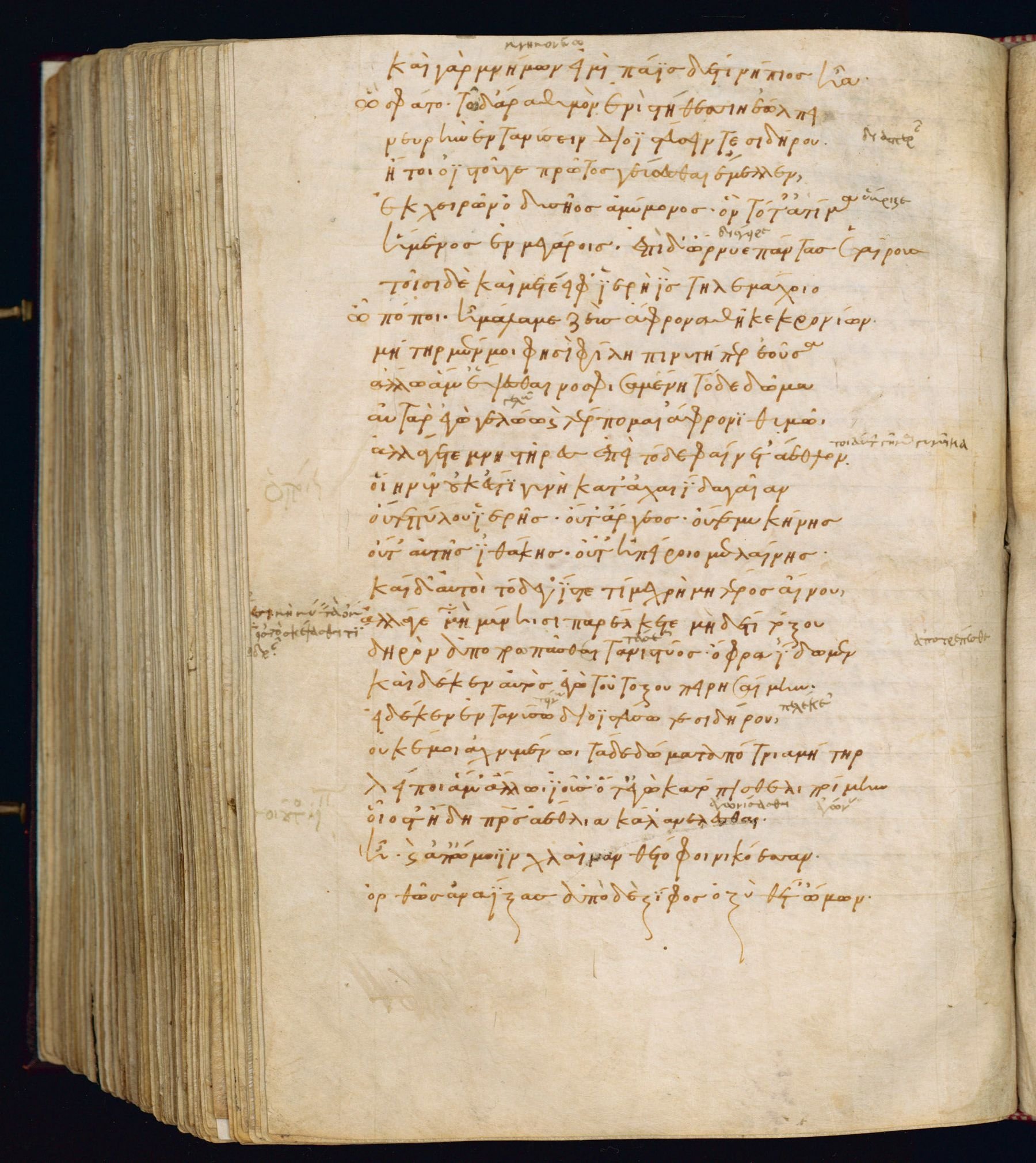
Where on the image
Laur. Plut. 32.24, fol. 207v: Odyssey 21.95-119, begins ‹καὶ γὰρ μνήμων εἰμί,›, ends ‹ξίφος ὀξὺ θέτʼ ὤμων.›. Checked on the image: first and last lines read and matched to the Greek. Fol. 207r ends with 21.94. Fol. 208r begins with 21.120. English blocks here: 95-99, 100-104, 105-109, 110-114, 115-117, 118-119.
95καὶ γὰρ μνήμων εἰμί, πάϊς δʼ ἔτι νήπιος ἦα.
96ὣς φάτο, τῷ δʼ ἄρα θυμὸς ἐνὶ στήθεσσιν ἐώλπει
97νευρὴν ἐντανύσειν διοϊστεύσειν τε σιδήρου.
98ἦ τοι ὀϊστοῦ γε πρῶτος γεύσεσθαι ἔμελλεν
99ἐκ χειρῶν Ὀδυσῆος ἀμύμονος, ὃν τότʼ ἀτίμα
100ἥμενος ἐν μεγάροις, ἐπὶ δʼ ὤρνυε πάντας ἑταίρους.
101τοῖσι δὲ καὶ μετέειφʼ ἱερὴ ἲς Τηλεμάχοιο·
102ὢ πόποι, ἦ μάλα με Ζεὺς ἄφρονα θῆκε Κρονίων·
103μήτηρ μέν μοί φησι φίλη, πινυτή περ ἐοῦσα,
104ἄλλῳ ἅμʼ ἕψεσθαι νοσφισσαμένη τόδε δῶμα·
105αὐτὰρ ἐγὼ γελόω καὶ τέρπομαι ἄφρονι θυμῷ.
106ἀλλʼ ἄγετε, μνηστῆρες, ἐπεὶ τόδε φαίνετʼ ἄεθλον,
107οἵη νῦν οὐκ ἔστι γυνὴ κατʼ Ἀχαιΐδα γαῖαν,
108οὔτε Πύλου ἱερῆς οὔτʼ Ἄργεος οὔτε Μυκήνης·
109οὔτʼ αὐτῆς Ἰθάκης οὔτʼ ἠπείροιο μελαίνης·
110καὶ δʼ αὐτοὶ τόδε γʼ ἴστε· τί με χρὴ μητέρος αἴνου;
111ἀλλʼ ἄγε μὴ μύνῃσι παρέλκετε μηδʼ ἔτι τόξου
112δηρὸν ἀποτρωπᾶσθε τανυστύος, ὄφρα ἴδωμεν.
113καὶ δέ κεν αὐτὸς ἐγὼ τοῦ τόξου πειρησαίμην·
114εἰ δέ κεν ἐντανύσω διοϊστεύσω τε σιδήρου,
115οὔ κέ μοι ἀχνυμένῳ τάδε δώματα πότνια μήτηρ
116λείποι ἅμʼ ἄλλῳ ἰοῦσʼ, ὅτʼ ἐγὼ κατόπισθε λιποίμην
117οἷός τʼ ἤδη πατρὸς ἀέθλια κάλʼ ἀνελέσθαι.
118ἦ καὶ ἀπʼ ὤμοιϊν χλαῖναν θέτο φοινικόεσσαν
119ὀρθὸς ἀναΐξας, ἀπὸ δὲ ξίφος ὀξὺ θέτʼ ὤμων.
95For I remember him, though I was still but a child.” So he spoke, but the heart in his breast hoped that he would string the bow and shoot an arrow through the iron. Yet verily he was to be the first to taste of an arrow from the hands of noble Odysseus, whom then he, 100as he sat in the halls, was dishonoring, and urging on all his comrades. Then among them spoke the strong and mighty Telemachus: “Lo now, of a truth Zeus, son of Cronos, has made me witless. My dear mother, for all that she is wise, declares that she will follow another lord, forsaking this house; 105yet I laugh, and am glad with a witless mind. Come then, ye wooers, since this is shewn to be your prize, a lady, the like of whom is not now in the Achaean land, neither in sacred Pylos, nor in Argos, nor in Mycene, nor yet in Ithaca itself, nor in the dark mainland. 110Nay, but of yourselves you know this—what need have I to praise my mother? Come then, put not the matter aside with excuses, nor any more turn away too long from the drawing of the bow, that we may see the issue. Yea, and I would myself make trial of yon bow. If I shall string it and shoot an arrow through the iron, 115it will not vex me that my honored mother should leave this house and go along with another, seeing that I should be left here able now to wield the goodly battle-gear of my father.” 118With this he flung the scarlet cloak from off his back, and sprang up erect; and he laid his sharp sword from off his shoulders.
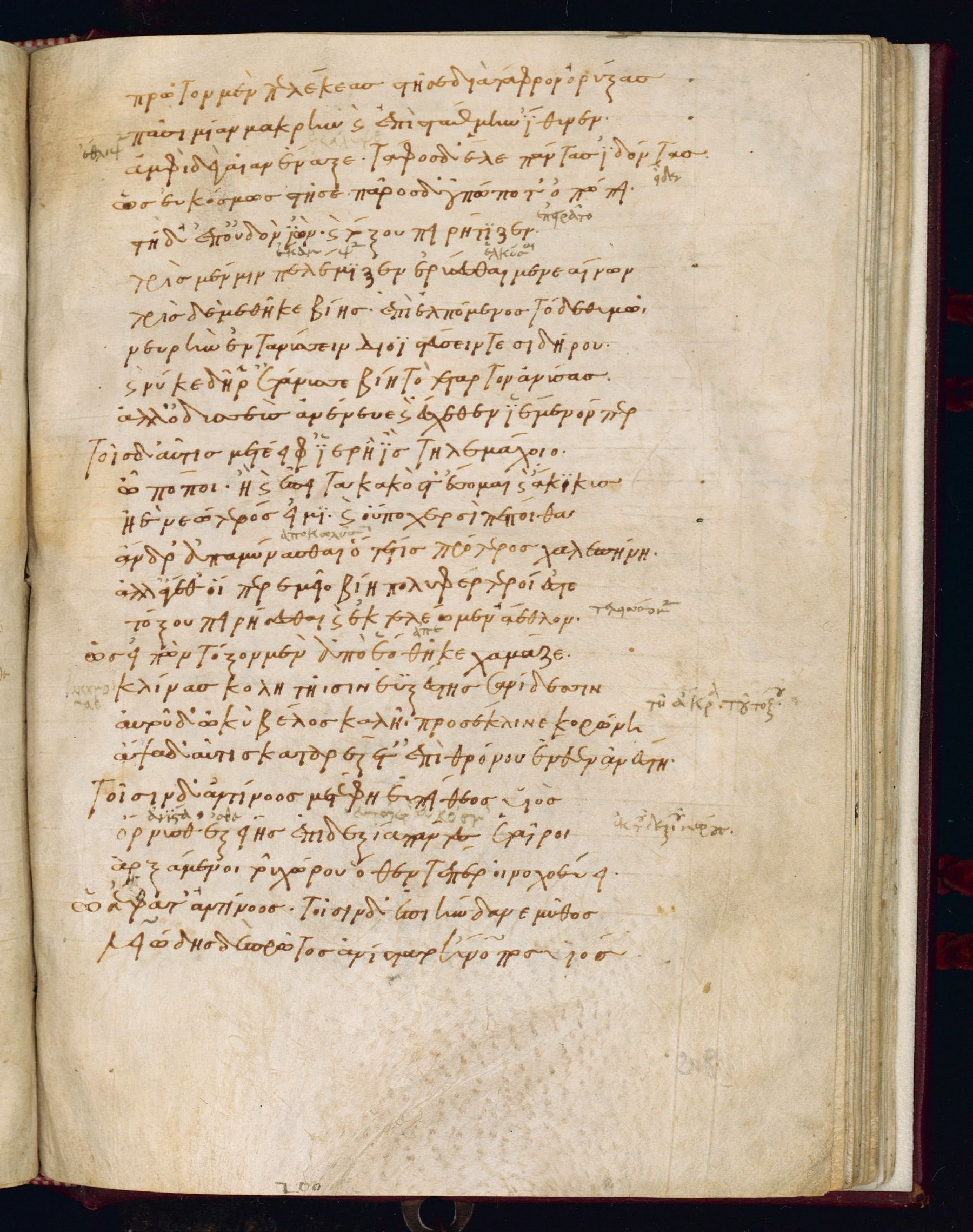
Where on the image
Laur. Plut. 32.24, fol. 208r: Odyssey 21.120-144, begins ‹πρῶτον μὲν πελέκεας στῆσεν,›, ends ‹πρῶτος ἀνίστατο, Οἴνοπος υἱός,›. Checked on the image: first and last lines read and matched to the Greek. Fol. 207v ends with 21.119. Fol. 208v begins with 21.145. English blocks here: 120-124, 125-129, 130-134, 135-139, 140-144.
120πρῶτον μὲν πελέκεας στῆσεν, διὰ τάφρον ὀρύξας
121πᾶσι μίαν μακρήν, καὶ ἐπὶ στάθμην ἴθυνεν,
122ἀμφὶ δὲ γαῖαν ἔναξε· τάφος δʼ ἕλε πάντας ἰδόντας,
123ὡς εὐκόσμως στῆσε· πάρος δʼ οὐ πώ ποτʼ ὀπώπει.
124στῆ δʼ ἄρʼ ἐπʼ οὐδὸν ἰὼν καὶ τόξου πειρήτιζε.
125τρὶς μέν μιν πελέμιξεν ἐρύσσεσθαι μενεαίνων,
126τρὶς δὲ μεθῆκε βίης, ἐπιελπόμενος τό γε θυμῷ,
127νευρὴν ἐντανύειν διοϊστεύσειν τε σιδήρου.
128καί νύ κε δή ῥʼ ἐτάνυσσε βίῃ τὸ τέταρτον ἀνέλκων,
129ἀλλʼ Ὀδυσεὺς ἀνένευε καὶ ἔσχεθεν ἱέμενόν περ.
130τοῖς δʼ αὖτις μετέειφʼ ἱερὴ ἲς Τηλεμάχοιο·
131ὢ πόποι, ἦ καὶ ἔπειτα κακός τʼ ἔσομαι καὶ ἄκικυς,
132ἠὲ νεώτερός εἰμι καὶ οὔ πω χερσὶ πέποιθα
133ἄνδρʼ ἀπαμύνασθαι, ὅτε τις πρότερος χαλεπήνῃ.
134ἀλλʼ ἄγεθʼ, οἵ περ ἐμεῖο βίῃ προφερέστεροί ἐστε,
135τόξου πειρήσασθε, καὶ ἐκτελέωμεν ἄεθλον.
136ὣς εἰπὼν τόξον μὲν ἀπὸ ἕο θῆκε χαμᾶζε,
137κλίνας κολλητῇσιν ἐϋξέστῃς σανίδεσσιν,
138αὐτοῦ δʼ ὠκὺ βέλος καλῇ προσέκλινε κορώνῃ,
139ἂψ δʼ αὖτις κατʼ ἄρʼ ἕζετʼ ἐπὶ θρόνου ἔνθεν ἀνέστη.
140τοῖσιν δʼ Ἀντίνοος μετέφη, Εὐπείθεος υἱός·
141ὄρνυσθʼ ἑξείης ἐπιδέξια πάντες ἑταῖροι,
142ἀρξάμενοι τοῦ χώρου ὅθεν τέ περ οἰνοχοεύει.
143ὣς ἔφατʼ Ἀντίνοος, τοῖσιν δʼ ἐπιήνδανε μῦθος.
144Λειώδης δὲ πρῶτος ἀνίστατο, Οἴνοπος υἱός,
120First then he set up the axes, when he had dug a trench, one long trench for all, and made it straight to the line, and about them he stamped in the earth. And amazement seized all who saw him, that he set them out so orderly, though before he had never seen them. Then he went and stood upon the threshold, and began to try the bow. 125Thrice he made it quiver in his eagerness to draw it, and thrice he relaxed his effort, though in his heart he hoped to string the bow and shoot an arrow through the iron. And now at the last he would haply have strung it in his might, as for the fourth time he sought to draw up the string, but Odysseus nodded in dissent, and checked him in his eagerness. 130Then the strong and mighty Telemachus spoke among them again: “Out on it, even in days to come shall I be a coward and a weakling, or else I am too young, and have not yet trust in my might to defend me against a man, when one waxes wroth without a cause. But, come now, you that are mightier than I, 135make trial of the bow, and let us end the contest.” So saying, he set the bow from him on the ground, leaning it against the jointed, polished door, and hard by he leaned the swift arrow against the fair bow-tip, and then sat down again on the seat from which he had risen. 140Then Antinous, son of Eupeithes, spoke among them: “Rise up in order, all you of our company, from left to right, beginning from the place where the cupbearer pours the wine.” So spoke Antinous, and his word was pleasing to them. Then first arose Leiodes, son of Oenops,
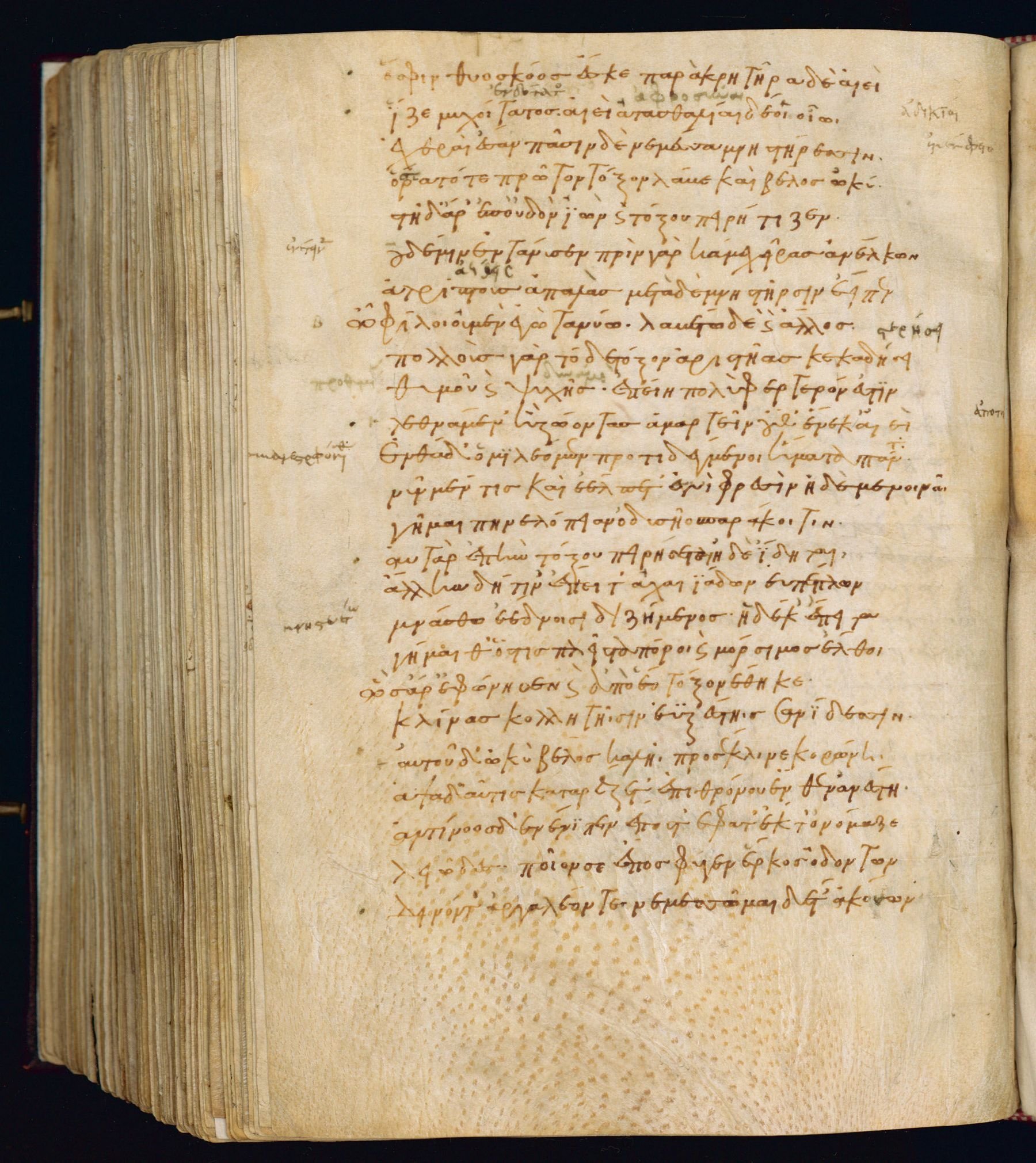
Where on the image
Laur. Plut. 32.24, fol. 208v: Odyssey 21.145-169, begins ‹ὅ σφι θυοσκόος ἔσκε,›, ends ‹—νεμεσσῶμαι δέ τʼ ἀκούων—›. Checked on the image: first and last lines read and matched to the Greek. Fol. 208r ends with 21.144. Fol. 209r begins with 21.170. English blocks here: 145-149, 150-154, 155-159, 160-162, 163-164, 165-169.
145ὅ σφι θυοσκόος ἔσκε, παρὰ κρητῆρα δὲ καλὸν
146ἷζε μυχοίτατος αἰέν· ἀτασθαλίαι δέ οἱ οἴῳ
147ἐχθραὶ ἔσαν, πᾶσιν δὲ νεμέσσα μνηστήρεσσιν·
148ὅς ῥα τότε πρῶτος τόξον λάβε καὶ βέλος ὠκύ.
149στῆ δʼ ἄρʼ ἐπʼ οὐδὸν ἰὼν καὶ τόξου πειρήτιζεν,
150οὐδέ μιν ἐντάνυσε· πρὶν γὰρ κάμε χεῖρας ἀνέλκων
151ἀτρίπτους ἁπαλάς· μετὰ δὲ μνηστῆρσιν ἔειπεν·
152ὦ φίλοι, οὐ μὲν ἐγὼ τανύω, λαβέτω δὲ καὶ ἄλλος.
153πολλοὺς γὰρ τόδε τόξον ἀριστῆας κεκαδήσει
154θυμοῦ καὶ ψυχῆς, ἐπεὶ ἦ πολὺ φέρτερόν ἐστι
155τεθνάμεν ἢ ζώοντας ἁμαρτεῖν, οὗθʼ ἕνεκʼ αἰεὶ
156ἐνθάδʼ ὁμιλέομεν, ποτιδέγμενοι ἤματα πάντα.
157νῦν μέν τις καὶ ἔλπετʼ ἐνὶ φρεσὶν ἠδὲ μενοινᾷ
158γῆμαι Πηνελόπειαν, Ὀδυσσῆος παράκοιτιν.
159αὐτὰρ ἐπὴν τόξου πειρήσεται ἠδὲ ἴδηται,
160ἄλλην δή τινʼ ἔπειτα Ἀχαιϊάδων εὐπέπλων
161μνάσθω ἐέδνοισιν διζήμενος· ἡ δέ κʼ ἔπειτα
162γήμαιθʼ ὅς κε πλεῖστα πόροι καὶ μόρσιμος ἔλθοι.
163ὣς ἄρʼ ἐφώνησεν καὶ ἀπὸ ἕο τόξον ἔθηκε,
164κλίνας κολλητῇσιν ἐϋξέστῃς σανίδεσσιν,
165αὐτοῦ δʼ ὠκὺ βέλος καλῇ προσέκλινε κορώνῃ,
166ἂψ δʼ αὖτις κατʼ ἄρ ἕζετʼ ἐπὶ θρόνου ἔνθεν ἀνέστη.
167Ἀντίνοος δʼ ἐνένιπεν ἔπος τʼ ἔφατʼ ἔκ τʼ ὀνόμαζε·
168Λειῶδες, ποῖόν σε ἔπος φύγεν ἕρκος ὀδόντων,
169δεινόν τʼ ἀργαλέον τε, —νεμεσσῶμαι δέ τʼ ἀκούων—
145who was their soothsayer, and ever sat by the fair mixing-bowl in the innermost part of the hall; deeds of wanton folly were hateful to him alone, and he was full of indignation at all the wooers. He it was who now first took the bow and swift arrow, and he went and stood upon the threshold, and began to try the bow; 150but he could not string it. Ere that might be his hands grew weary, as he sought to draw up the string, his unworn delicate hands; and he spoke among the wooers: “Friends, it is not I that shall string it; let another take it. For many princes shall this bow rob of spirit and of life, since verily it is better far 155to die than to live on and fail of that for the sake of which we ever gather here, waiting expectantly day after day. Now many a man even hopes in his heart and desires to wed Penelope, the wife of Odysseus; but when he shall have made trial of the bow, and seen the outcome, thereafter let him woo 160some other of the fair-robed Achaean women with his gifts, and seek to win her; then should Penelope wed him who offers most, and who comes as her fated lord.” 163So he spoke, and set the bow from him, leaning it against the jointed, polished door, 165and hard by he leaned the swift arrow against the fair bow-tip, and then sat down on the seat from which he had risen. But Antinous rebuked him, and spoke, and addressed him: “Leiodes, what a word has escaped the barrier of thy teeth, a dread word and grievous! I am angered to hear it,
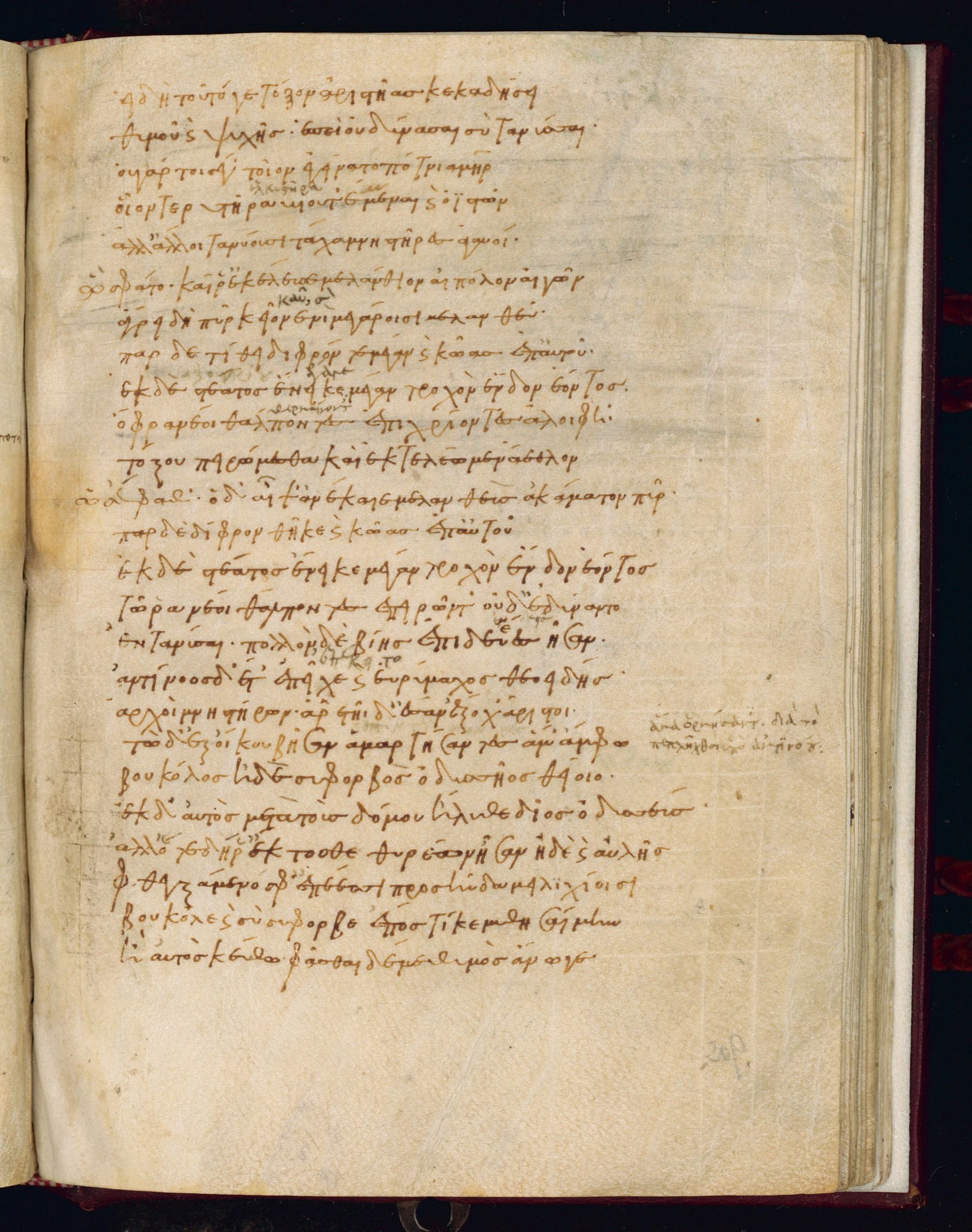
Where on the image
Laur. Plut. 32.24, fol. 209r: Odyssey 21.170-194, begins ‹εἰ δὴ τοῦτό γε›, ends ‹δέ με θυμὸς ἀνώγει.›. Checked on the image: first and last lines read and matched to the Greek. Fol. 208v ends with 21.169. Fol. 209v begins with 21.195. English blocks here: 170-174, 175-179, 180-184, 185-189, 190-194.
170εἰ δὴ τοῦτό γε τόξον ἀριστῆας κεκαδήσει
171θυμοῦ καὶ ψυχῆς, ἐπεὶ οὐ δύνασαι σὺ τανύσσαι.
172οὐ γάρ τοί σέ γε τοῖον ἐγείνατο πότνια μήτηρ
173οἷόν τε ῥυτῆρα βιοῦ τʼ ἔμεναι καὶ ὀϊστῶν·
174ἀλλʼ ἄλλοι τανύουσι τάχα μνηστῆρες ἀγαυοί.
175ὣς φάτο, καί ῥʼ ἐκέλευσε Μελάνθιον, αἰπόλον αἰγῶν·
176ἄγρει δή, πῦρ κῆον ἐνὶ μεγάροισι, Μελανθεῦ,
177πὰρ δὲ τίθει δίφρον τε μέγαν καὶ κῶας ἐπʼ αὐτοῦ,
178ἐκ δὲ στέατος ἔνεικε μέγαν τροχὸν ἔνδον ἐόντος,
179ὄφρα νέοι θάλποντες, ἐπιχρίοντες ἀλοιφῇ,
180τόξου πειρώμεσθα καὶ ἐκτελέωμεν ἄεθλον.
181ὣς φάθʼ, ὁ δʼ αἶψʼ ἀνέκαιε Μελάνθιος ἀκάματον πῦρ,
182πὰρ δὲ φέρων δίφρον θῆκεν καὶ κῶας ἐπʼ αὐτοῦ,
183ἐκ δὲ στέατος ἔνεικε μέγαν τροχὸν ἔνδον ἐόντος·
184τῷ ῥα νέοι θάλποντες ἐπειρῶντʼ· οὐδʼ ἐδύναντο
185ἐντανύσαι, πολλὸν δὲ βίης ἐπιδευέες ἦσαν.
186Ἀντίνοος δʼ ἔτʼ ἐπεῖχε καὶ Εὐρύμαχος θεοειδής,
187ἀρχοὶ μνηστήρων· ἀρετῇ δʼ ἔσαν ἔξοχʼ ἄριστοι.
188τὼ δʼ ἐξ οἴκου βῆσαν ὁμαρτήσαντες ἅμʼ ἄμφω
189βουκόλος ἠδὲ συφορβὸς Ὀδυσσῆος θείοιο·
190ἐκ δʼ αὐτὸς μετὰ τοὺς δόμου ἤλυθε δῖος Ὀδυσσεύς.
191ἀλλʼ ὅτε δή ῥʼ ἐκτὸς θυρέων ἔσαν ἠδὲ καὶ αὐλῆς,
192φθεγξάμενός σφε ἔπεσσι προσηύδα μειλιχίοισι·
193βουκόλε καὶ σύ, συφορβέ, ἔπος τί κε μυθησαίμην,
194ἦ αὐτὸς κεύθω; φάσθαι δέ με θυμὸς ἀνώγει.
170if forsooth this bow is to rob princes of spirit and of life, because thou art not able to string it. For, I tell thee, thy honored mother did not bear thee of such strength as to draw a bow and shoot arrows; but others of the lordly wooers will soon string it.” 175So he spoke, and called to Melanthius, the goatherd: “Come now, light a fire in the hall, Melanthius; and set by it a great seat with a fleece upon it, and bring forth a great cake of the fat that is within, that we youths may warm the bow, and anoint it with fat, 180and so make trial of it, and end the contest.” So he spoke, and Melanthius straightway rekindled the unwearied fire, and brought and placed by it a great seat with a fleece upon it, and he brought forth a great cake of the fat that was within. Therewith the youths warmed the bow, and made trial of it, but they could not 185string it, for they were far lacking in strength. Now Antinous was still persisting and godlike Eurymachus, leaders of the wooers, who were far the best in valiance; but those other two had gone forth both together from the hall, the neatherd and the swineherd of divine Odysseus; 190and after them Odysseus himself went forth from the house. But when they were now outside the gates and the court, he spoke and addressed them with gentle words: “Neatherd, and thou too swineherd, shall I tell you something or keep it to myself? Nay, my spirit bids me tell it.
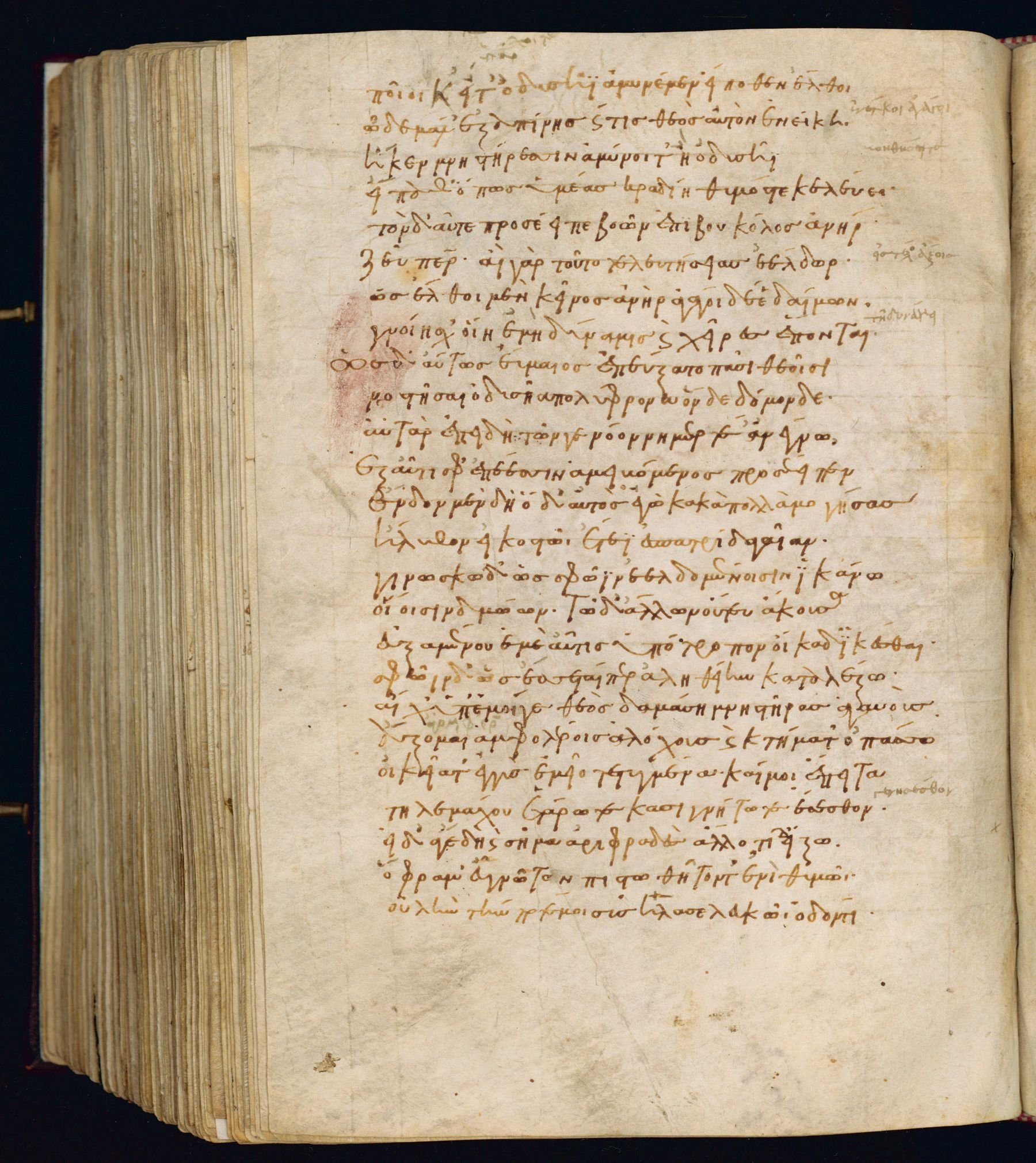
Where on the image
Laur. Plut. 32.24, fol. 209v: Odyssey 21.195-219, begins ‹ποῖοί κʼ εἶτʼ Ὀδυσῆϊ›, ends ‹σῦς ἤλασε λευκῷ ὀδόντι›. Checked on the image: first and last lines read and matched to the Greek. Fol. 209r ends with 21.194. Fol. 210r begins with 21.220. English blocks here: 195-199, 200-204, 205-209, 210-214, 215-219.
195ποῖοί κʼ εἶτʼ Ὀδυσῆϊ ἀμυνέμεν, εἴ ποθεν ἔλθοι
196ὧδε μάλʼ ἐξαπίνης καί τις θεὸς αὐτὸν ἐνείκαι;
197ἤ κε μνηστήρεσσιν ἀμύνοιτʼ ἦ Ὀδυσῆϊ;
198εἴπαθʼ ὅπως ὑμέας κραδίη θυμός τε κελεύει.
199τὸν δʼ αὖτε προσέειπε βοῶν ἐπιβουκόλος ἀνήρ·
200Ζεῦ πάτερ, αἲ γὰρ τοῦτο τελευτήσειας ἐέλδωρ,
201ὡς ἔλθοι μὲν κεῖνος ἀνήρ, ἀγάγοι δέ ἑ δαίμων·
202γνοίης χʼ οἵη ἐμὴ δύναμις καὶ χεῖρες ἕπονται.
203ὣς δʼ αὔτως Εὔμαιος ἐπεύχετο πᾶσι θεοῖσι
204νοστῆσαι Ὀδυσῆα πολύφρονα ὅνδε δόμονδε.
205αὐτὰρ ἐπεὶ δὴ τῶν γε νόον νημερτέʼ ἀνέγνω,
206ἐξαῦτίς σφε ἔπεσσιν ἀμειβόμενος προσέειπεν·
207ἔνδον μὲν δὴ ὅδʼ αὐτὸς ἐγώ, κακὰ πολλὰ μογήσας
208ἤλυθον εἰκοστῷ ἔτεϊ ἐς πατρίδα γαῖαν.
209γιγνώσκω δʼ ὡς σφῶϊν ἐελδομένοισιν ἱκάνω
210οἴοισι δμώων· τῶν δʼ ἄλλων οὔ τευ ἄκουσα
211εὐξαμένου ἐμὲ αὖτις ὑπότροπον οἴκαδʼ ἱκέσθαι.
212σφῶϊν δʼ, ὡς ἔσεταί περ, ἀληθείην καταλέξω.
213εἴ χʼ ὑπʼ ἐμοί γε θεὸς δαμάσῃ μνηστῆρας ἀγαυούς,
214ἄξομαι ἀμφοτέροις ἀλόχους καὶ κτήματʼ ὀπάσσω
215οἰκία τʼ ἐγγὺς ἐμεῖο τετυγμένα· καί μοι ἔπειτα
216Τηλεμάχου ἑτάρω τε κασιγνήτω τε ἔσεσθον.
217εἰ δʼ ἄγε δή, καὶ σῆμα ἀριφραδὲς ἄλλο τι δείξω,
218ὄφρα μʼ ἐῢ γνῶτον πιστωθῆτόν τʼ ἐνὶ θυμῷ,
219οὐλήν, τήν ποτέ με σῦς ἤλασε λευκῷ ὀδόντι
195What manner of men would you be to defend Odysseus, if he should come from somewhere thus suddenly, and some god should bring him? Would you bear aid to the wooers or to Odysseus? Speak out as your heart and spirit bid you.” Then the herdsmen of the cattle answered him: 200“Father Zeus, oh that thou wouldest fulfil this wish! Grant that that man may come back, and that some god may guide him. Then shouldest thou know what manner of might is mine, and how my hands obey.” And even in like manner did Eumaeus pray to all the gods that wise Odysseus; might come back to his own home. 205But when he knew with certainty the mind of these, he made answer, and spoke to them again, saying: “At home now in truth am I here before you, my very self. After many grievous toils I am come in the twentieth year to my native land. And I know that by you two 210alone of all my thralls is my coming desired, but of the rest have I heard not one praying that I might come back again to my home. But to you two will I tell the truth, even as it shall be. If a god shall subdue the lordly wooers unto me, I will bring you each a wife, and will give you possessions 215and a house built near my own, and thereafter you two shall be in my eyes friends and brothers of Telemachus. Nay, come, more than this, I will shew you also a manifest sign, that you may know me well and be assured in heart, even the scar of the wound which long ago a boar dealt me with his white tusk,
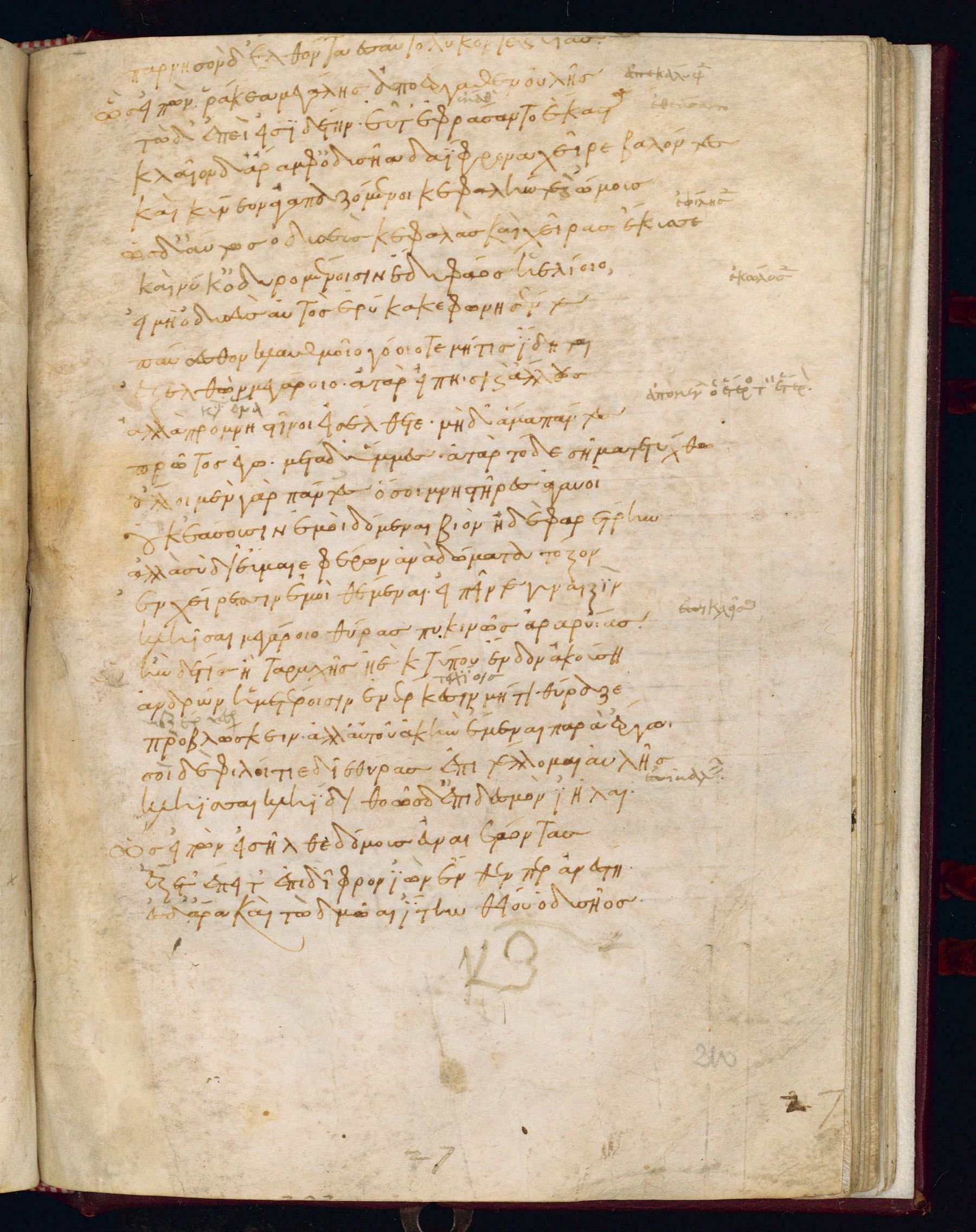
Where on the image
Laur. Plut. 32.24, fol. 210r: Odyssey 21.220-244, begins ‹Παρνησόνδʼ ἐλθόντα σὺν υἱάσιν›, ends ‹δμῶε ἴτην θείου Ὀδυσῆος.›. Checked on the image: first and last lines read and matched to the Greek. Fol. 209v ends with 21.219. Fol. 210v begins with 21.245. English blocks here: 220-224, 225-229, 230-234, 235-239, 240-244.
220Παρνησόνδʼ ἐλθόντα σὺν υἱάσιν Αὐτολύκοιο.
221ὣς εἰπὼν ῥάκεα μεγάλης ἀποέργαθεν οὐλῆς.
222τὼ δʼ ἐπεὶ εἰσιδέτην εὖ τʼ ἐφράσσαντο ἕκαστα,
223κλαῖον ἄρʼ ἀμφʼ Ὀδυσῆϊ δαΐφρονι χεῖρε βαλόντε,
224καὶ κύνεον ἀγαπαζόμενοι κεφαλήν τε καὶ ὤμους
225ὣς δʼ αὔτως Ὀδυσεὺς κεφαλὰς καὶ χεῖρας ἔκυσσε.
226καί νύ κʼ ὀδυρομένοισιν ἔδυ φάος ἠελίοιο,
227εἰ μὴ Ὀδυσσεὺς αὐτὸς ἐρύκακε φώνησέν τε·
228παύεσθον κλαυθμοῖο γόοιό τε, μή τις ἴδηται
229ἐξελθὼν μεγάροιο, ἀτὰρ εἴπῃσι καὶ εἴσω.
230ἀλλὰ προμνηστῖνοι ἐσέλθετε, μηδʼ ἅμα πάντες,
231πρῶτος ἐγώ, μετὰ δʼ ὔμμες· ἀτὰρ τόδε σῆμα τετύχθω·
232ἄλλοι μὲν γὰρ πάντες, ὅσοι μνηστῆρες ἀγαυοί,
233οὐκ ἐάσουσιν ἐμοὶ δόμεναι βιὸν ἠδὲ φαρέτρην·
234ἀλλὰ σύ, δῖʼ Εὔμαιε, φέρων ἀνὰ δώματα τόξον
235ἐν χείρεσσιν ἐμοὶ θέμεναι, εἰπεῖν τε γυναιξὶ
236κληῗσαι μεγάροιο θύρας πυκινῶς ἀραρυίας,
237ἢν δέ τις ἢ στοναχῆς ἠὲ κτύπου ἔνδον ἀκούσῃ
238ἀνδρῶν ἡμετέροισιν ἐν ἕρκεσι, μή τι θύραζε
239προβλώσκειν, ἀλλʼ αὐτοῦ ἀκὴν ἔμεναι παρὰ ἔργῳ.
240σοὶ δέ, Φιλοίτιε δῖε, θύρας ἐπιτέλλομαι αὐλῆς
241κληῗσαι κληῗδι, θοῶς δʼ ἐπὶ δεσμὸν ἰῆλαι.
242ὣς εἰπὼν εἰσῆλθε δόμους εὖ ναιετάοντας·
243ἕζετʼ ἔπειτʼ ἐπὶ δίφρον ἰών, ἔνθεν περ ἀνέστη·
244ἐς δʼ ἄρα καὶ τὼ δμῶε ἴτην θείου Ὀδυσῆος.
220when I went to Parnassus with the sons of Autolycus.” So saying, he drew aside the rags from the great scar. And when the two had seen it, and had marked each thing well, they flung their arms about wise Odysseus, and wept; and they kissed his head and shoulders in loving welcome. 225And even in like manner Odysseus kissed their heads and hands. And now the light of the sun would have gone down upon their weeping, had not Odysseus himself checked them, and said: “Cease now from weeping and wailing, lest some one come forth from the hall and see us, and make it known within as well. 230But go within one after another, not all together, I first and you thereafter, and let this be made a sign. All the rest, as many as are lordly wooers, will not suffer the bow and the quiver to be given to me; but do thou, goodly Eumaeus, as thou bearest the bow through the halls, 235place it in my hands, and bid the women bar the close-fitting doors of their hall. And if any one of them hears groanings or the din of men within our walls, let them not rush out, but remain where they are in silence at their work. 240But to thee, goodly Philoetius, do I give charge to fasten with a bar the gate of the court, and swiftly to cast a cord upon it.” So saying, he entered the stately house, and went and sat down on the seat from which he had risen. And the two slaves of divine Odysseus went in as well.
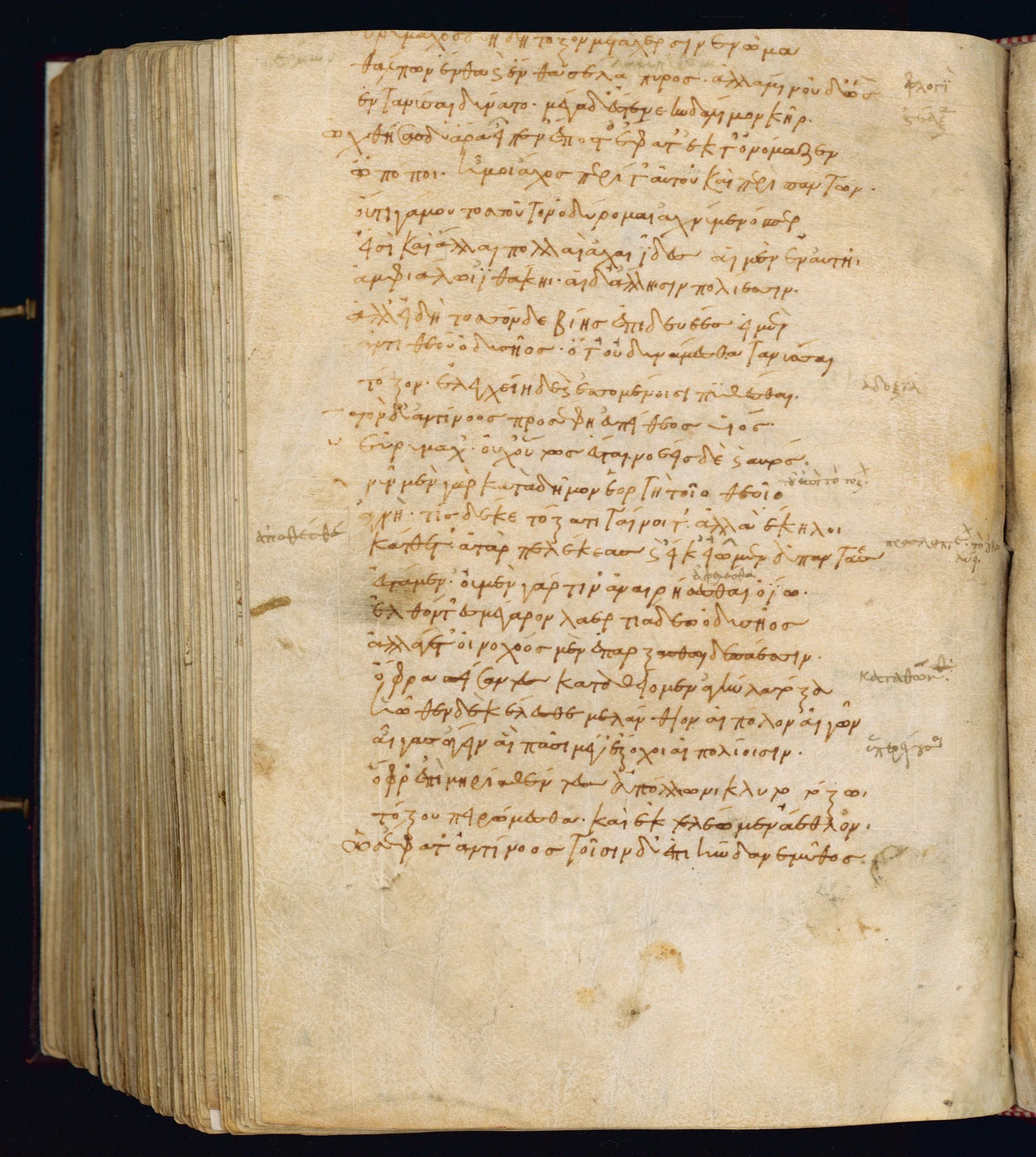
Where on the image
Laur. Plut. 32.24, fol. 210v: Odyssey 21.245-269, begins ‹Εὐρύμαχος δʼ ἤδη τόξον›, ends ‹τοῖσιν δʼ ἐπιήνδανε μῦθος.›. Checked on the image: first and last lines read and matched to the Greek. Fol. 210r ends with 21.244. Fol. 211r begins with 21.270. English blocks here: 245-249, 250-254, 255-255, 256-259, 260-264, 265-269.
245Εὐρύμαχος δʼ ἤδη τόξον μετὰ χερσὶν ἐνώμα,
246θάλπων ἔνθα καὶ ἔνθα σέλᾳ πυρός· ἀλλά μιν οὐδʼ ὣς
247ἐντανύσαι δύνατο, μέγα δʼ ἔστενε κυδάλιμον κῆρ·
248ὀχθήσας δʼ ἄρα εἶπεν ἔπος τʼ ἔφατʼ ἔκ τʼ ὀνόμαζεν·
249ὢ πόποι, ἦ μοι ἄχος περί τʼ αὐτοῦ καὶ περὶ πάντων·
250οὔ τι γάμου τοσσοῦτον ὀδύρομαι, ἀχνύμενός περ·
251εἰσὶ καὶ ἄλλαι πολλαὶ Ἀχαιΐδες, αἱ μὲν ἐν αὐτῇ
252ἀμφιάλῳ Ἰθάκῃ, αἱ δʼ ἄλλῃσιν πολίεσσιν·
253ἀλλʼ εἰ δὴ τοσσόνδε βίης ἐπιδευέες εἰμὲν
254ἀντιθέου Ὀδυσῆος, ὅ τʼ οὐ δυνάμεσθα τανύσσαι
255τόξον· ἐλεγχείη δὲ καὶ ἐσσομένοισι πυθέσθαι.
256τὸν δʼ αὖτʼ Ἀντίνοος προσέφη, Εὐπείθεος υἱός·
257Εὐρύμαχʼ, οὐχ οὕτως ἔσται· νοέεις δὲ καὶ αὐτός.
258νῦν μὲν γὰρ κατὰ δῆμον ἑορτὴ τοῖο θεοῖο
259ἁγνή· τίς δέ κε τόξα τιταίνοιτʼ; ἀλλὰ ἕκηλοι
260κάτθετʼ· ἀτὰρ πελέκεάς γε καὶ εἴ κʼ εἰῶμεν ἅπαντας
261ἑστάμεν· οὐ μὲν γάρ τινʼ ἀναιρήσεσθαι ὀΐω,
262ἐλθόντʼ ἐς μέγαρον Λαερτιάδεω Ὀδυσῆος.
263ἀλλʼ ἄγετʼ, οἰνοχόος μὲν ἐπαρξάσθω δεπάεσσιν,
264ὄφρα σπείσαντες καταθείομεν ἀγκύλα τόξα·
265ἠῶθεν δὲ κέλεσθε Μελάνθιον, αἰπόλον αἰγῶν,
266αἶγας ἄγειν, αἳ πᾶσι μέγʼ ἔξοχοι αἰπολίοισιν,
267ὄφρʼ ἐπὶ μηρία θέντες Ἀπόλλωνι κλυτοτόξῳ
268τόξου πειρώμεσθα καὶ ἐκτελέωμεν ἄεθλον.
269ὣς ἔφατʼ Ἀντίνοος, τοῖσιν δʼ ἐπιήνδανε μῦθος.
245Eurymachus was now handling the bow, warming it on this side and on that in the light of the fire; but not even so was he able to string it; and in his noble heart he groaned, and with a burst of anger he spoke and addressed them: “Out on it! Verily I am grieved for myself and for you all. 250It is in no wise for the marriage that I mourn so greatly, grieved though I am; for there are many other Achaean women, some in sea-girt Ithaca itself, and some in other cities; but I mourn if in truth we fall so far short of godlike Odysseus in might, seeing that we cannot string 255his bow. This is a reproach for men that are yet to be to hear of.” 256Then Antinous, son of Eupeithes, answered him: “Eurymachus, this shall not be so, and thou of thyself too knowest it. For to-day throughout the land is the feast of the god—a holy feast. Who then would bend a bow? Nay, quietly 260set it by; and as for the axes—what if we should let them all stand as they are? No man, methinks, will come to the hall of Odysseus, son of Laertes, and carry them off. Nay, come, let the bearer pour drops for libation into the cups, that we may pour libations, and lay aside the curved bow. 265And in the morning bid Melanthius, the goatherd, to bring she-goats, far the best in all the herds, that we may lay thigh-pieces on the altar of Apollo, the famed archer; and so make trial of the bow, and end the contest.” So spoke Antinous, and his word was pleasing to them.
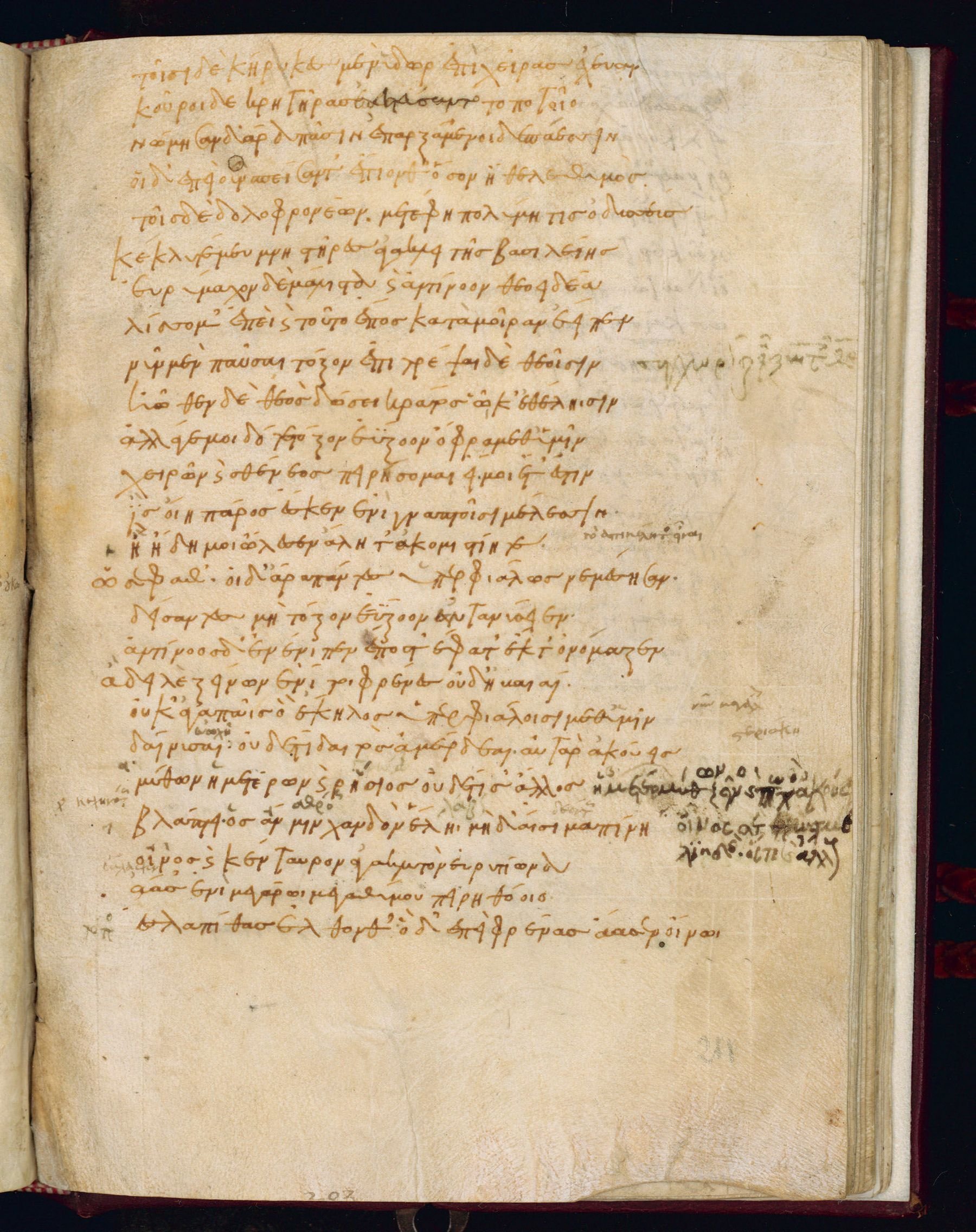
Where on the image
Laur. Plut. 32.24, fol. 211r: Odyssey 21.270-297, begins ‹τοῖσι δὲ κήρυκες μὲν›, ends ‹ἐπεὶ φρένας ἄασεν οἴνῳ,›. Checked on the image: first and last lines read and matched to the Greek. Fol. 210v ends with 21.269. Fol. 211v begins with 21.298. 21.276 (ὄφρʼ εἴπω τά με θυμὸς ...) is not on the page: the scribe passes from 21.275 to 21.277. 21.292 is written after 21.291 at the end of the same line, and 21.293 is in the right margin beside 21.294 (25 lines). English blocks here: 270-274, 275-279, 280-284, 285-289, 290-294, 295-299.
270τοῖσι δὲ κήρυκες μὲν ὕδωρ ἐπὶ χεῖρας ἔχευαν,
271κοῦροι δὲ κρητῆρας ἐπεστέψαντο ποτοῖο,
272νώμησαν δʼ ἄρα πᾶσιν ἐπαρξάμενοι δεπάεσσιν.
273οἱ δʼ ἐπεὶ οὖν σπεῖσάν τʼ ἔπιόν θʼ ὅσον ἤθελε θυμός,
274τοῖς δὲ δολοφρονέων μετέφη πολύμητις Ὀδυσσεύς·
275κέκλυτέ μευ, μνηστῆρες ἀγακλειτῆς βασιλείης·
276ὄφρʼ εἴπω τά με θυμὸς ἐνὶ στήθεσσι κελεύει·
277Εὐρύμαχον δὲ μάλιστα καὶ Ἀντίνοον θεοειδέα
278λίσσομʼ, ἐπεὶ καὶ τοῦτο ἔπος κατὰ μοῖραν ἔειπε,
279νῦν μὲν παῦσαι τόξον, ἐπιτρέψαι δὲ θεοῖσιν·
280ἠῶθεν δὲ θεὸς δώσει κράτος ᾧ κʼ ἐθέλῃσιν.
281ἀλλʼ ἄγʼ ἐμοὶ δότε τόξον ἐΰξοον, ὄφρα μεθʼ ὑμῖν
282χειρῶν καὶ σθένεος πειρήσομαι, ἤ μοι ἔτʼ ἐστὶν
283ἴς, οἵη πάρος ἔσκεν ἐνὶ γναμπτοῖσι μέλεσσιν,
284ἦ ἤδη μοι ὄλεσσεν ἄλη τʼ ἀκομιστίη τε.
285ὣς ἔφαθʼ, οἱ δʼ ἄρα πάντες ὑπερφιάλως νεμέσησαν,
286δείσαντες μὴ τόξον ἐΰξοον ἐντανύσειεν.
287Ἀντίνοος δʼ ἐνένιπεν ἔπος τʼ ἔφατʼ ἔκ τʼ ὀνόμαζεν·
288ἆ δειλὲ ξείνων, ἔνι τοι φρένες οὐδʼ ἠβαιαί·
289οὐκ ἀγαπᾷς ὃ ἕκηλος ὑπερφιάλοισι μεθʼ ἡμῖν
290δαίνυσαι, οὐδέ τι δαιτὸς ἀμέρδεαι, αὐτὰρ ἀκούεις
291μύθων ἡμετέρων καὶ ῥήσιος; οὐδέ τις ἄλλος
292ἡμετέρων μύθων ξεῖνος καὶ πτωχὸς ἀκούει.
293οἶνός σε τρώει μελιηδής, ὅς τε καὶ ἄλλους
294βλάπτει, ὃς ἄν μιν χανδὸν ἕλῃ μηδʼ αἴσιμα πίνῃ.
295οἶνος καὶ Κένταυρον, ἀγακλυτὸν Εὐρυτίωνα,
296ἄασʼ ἐνὶ μεγάρῳ μεγαθύμου Πειριθόοιο,
297ἐς Λαπίθας ἐλθόνθʼ· ὁ δʼ ἐπεὶ φρένας ἄασεν οἴνῳ,
270Then the heralds poured water over their hands, and youths filled the bowls brim full of drink, and served out to all, pouring first drops for libation into the cups. But when they had poured libations, and had drunk to their heart's content, then with crafty mind Odysseus of many wiles spoke among them: 275“Hear me, wooers of the glorious queen, that I may say what the heart in my breast bids me. To Eurymachus most of all do I make my prayer, and to godlike Antinous, since this word also of his was spoken aright, namely that for the present you cease to try the bow, and leave the issue with the gods; 280and in the morning the god will give the victory to whomsoever he will. But come, give me the polished bow, that in your midst I may prove my hands and strength, whether I have yet might such as was of old in my supple limbs, or whether by now my wanderings and lack of food have destroyed it.” 285So he spoke, and they all waxed exceeding wroth, fearing lest he might string the polished bow. And Antinous rebuked him, and spoke and addressed him: “Ah, wretched stranger, thou hast no wit, no, not a trace. Art thou not content 290that thou feastest undisturbed in our proud company, and lackest naught of the banquet, but hearest our words and our speech, while no other that is a stranger and beggar hears our words? It is wine that wounds thee, honey-sweet wine, which works harm to others too, if one takes it in great gulps, and drinks beyond measure. 295It was wine that made foolish even the centaur, glorious Eurytion, in the hall of greathearted Peirithous, when he went to the Lapithae: and when his heart had been made foolish with wine, in his madness he wrought evil in the house of Peirithous. Then grief seized the heroes,
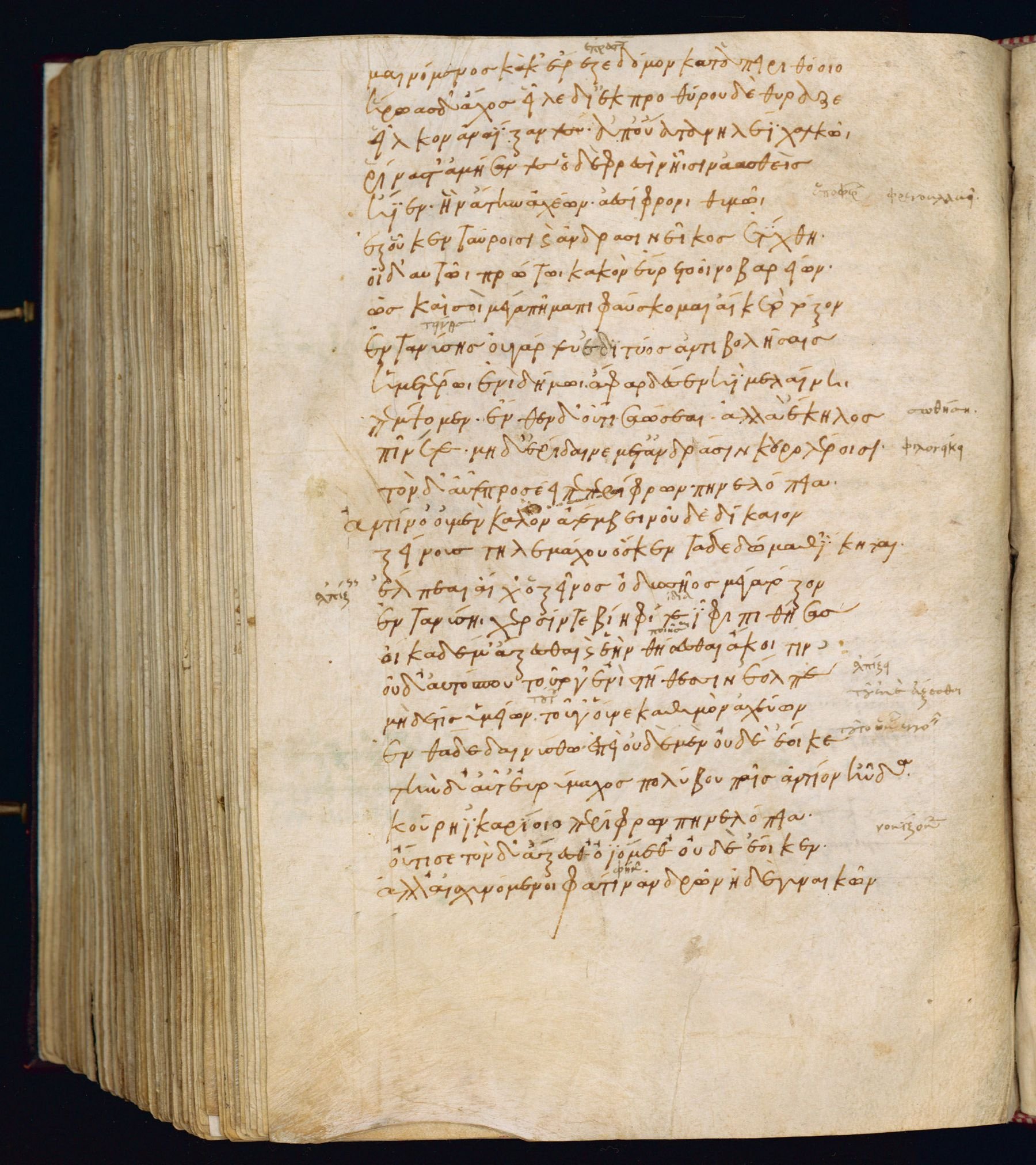
Where on the image
Laur. Plut. 32.24, fol. 211v: Odyssey 21.298-323, begins ‹μαινόμενος κάκʼ ἔρεξε δόμον›, ends ‹φάτιν ἀνδρῶν ἠδὲ γυναικῶν,›. Checked on the image: first and last lines read and matched to the Greek. Fol. 211r ends with 21.297. Fol. 212r begins with 21.324. 21.308 (εἰς Ἔχετον βασιλῆα ...) is not on the page: the scribe passes from 21.307 to 21.309 (25 lines). English blocks here: 300-304, 305-309, 310-310, 311-314, 315-319, 320-324.
298μαινόμενος κάκʼ ἔρεξε δόμον κάτα Πειριθόοιο·
299ἥρωας δʼ ἄχος εἷλε, διὲκ προθύρου δὲ θύραζε
300ἕλκον ἀναΐξαντες, ἀπʼ οὔατα νηλέϊ χαλκῷ
301ῥῖνάς τʼ ἀμήσαντες· ὁ δὲ φρεσὶν ᾗσιν ἀασθεὶς
302ἤϊεν ἣν ἄτην ὀχέων ἀεσίφρονι θυμῷ.
303ἐξ οὗ Κενταύροισι καὶ ἀνδράσι νεῖκος ἐτύχθη,
304οἷ δʼ αὐτῷ πρώτῳ κακὸν εὕρετο οἰνοβαρείων.
305ὣς καὶ σοὶ μέγα πῆμα πιφαύσκομαι, αἴ κε τὸ τόξον
306ἐντανύσῃς· οὐ γάρ τευ ἐπητύος ἀντιβολήσεις
307ἡμετέρῳ ἐνὶ δήμῳ, ἄφαρ δέ σε νηῒ μελαίνῃ
308εἰς Ἔχετον βασιλῆα, βροτῶν δηλήμονα πάντων,
309πέμψομεν· ἔνθεν δʼ οὔ τι σαώσεαι· ἀλλὰ ἕκηλος
310πῖνέ τε, μηδʼ ἐρίδαινε μετʼ ἀνδράσι κουροτέροισιν.
311τὸν δʼ αὖτε προσέειπε περίφρων Πηνελόπεια·
312Ἀντίνοʼ, οὐ μὲν καλὸν ἀτέμβειν οὐδὲ δίκαιον
313ξείνους Τηλεμάχου, ὅς κεν τάδε δώμαθʼ ἵκηται·
314ἔλπεαι, αἴ χʼ ὁ ξεῖνος Ὀδυσσῆος μέγα τόξον
315ἐντανύσῃ χερσίν τε βίηφί τε ἧφι πιθήσας,
316οἴκαδέ μʼ ἄξεσθαι καὶ ἑὴν θήσεσθαι ἄκοιτιν;
317οὐδʼ αὐτός που τοῦτό γʼ ἐνὶ στήθεσσιν ἔολπε·
318μηδέ τις ὑμείων τοῦ γʼ εἵνεκα θυμὸν ἀχεύων
319ἐνθάδε δαινύσθω, ἐπεὶ οὐδὲ μὲν οὐδὲ ἔοικεν.
320τὴν δʼ αὖτʼ Εὐρύμαχος, Πολύβου πάϊς, ἀντίον ηὔδα·
321κούρη Ἰκαρίοιο, περίφρον Πηνελόπεια,
322οὔ τί σε τόνδʼ ἄξεσθαι ὀϊόμεθʼ· οὐδὲ ἔοικεν·
323ἀλλʼ αἰσχυνόμενοι φάτιν ἀνδρῶν ἠδὲ γυναικῶν,
300and they leapt up and dragged him forth through the gateway, when they had shorn off his ears and his nostrils with the pitiless bronze, and he, made foolish in heart, went his way, bearing with him the curse of his sin in the folly of his heart. From hence the feud arose between the centaurs and mankind; but it was for himself first that he found evil, being heavy with wine. 305Even so do I declare great harm for thee, if thou shalt string the bow, for thou shalt meet with no kindness at the hands of anyone in our land, but we will send thee straightway in a black ship to king Echetus, the maimer of all men, from whose hands thou shalt in no wise escape alive. Nay, then, be still, 310and drink thy wine, and do not strive with men younger than thou.” 311Then wise Penelope answered him: “Antinous, it is not well nor just to rob of their due the guests of Telemachus, whosoever he be that comes to this house. Dost thou think that, if yon stranger 315strings the great bow of Odysseus, trusting in his strength and his might, he will lead me to his home, and make me his wife? Nay, he himself, I ween, has not this hope in his breast; so let no one of you on this account sit at meat here in sorrow of heart; nay, that were indeed unseemly.” 320Then Eurymachus, son of Polybus, answered her: “Daughter of Icarius, wise Penelope, it is not that we think the man will lead thee to his home—that were indeed unseemly—but that we dread the talk of men and women, lest hereafter some base fellow among the Achaeans should say:
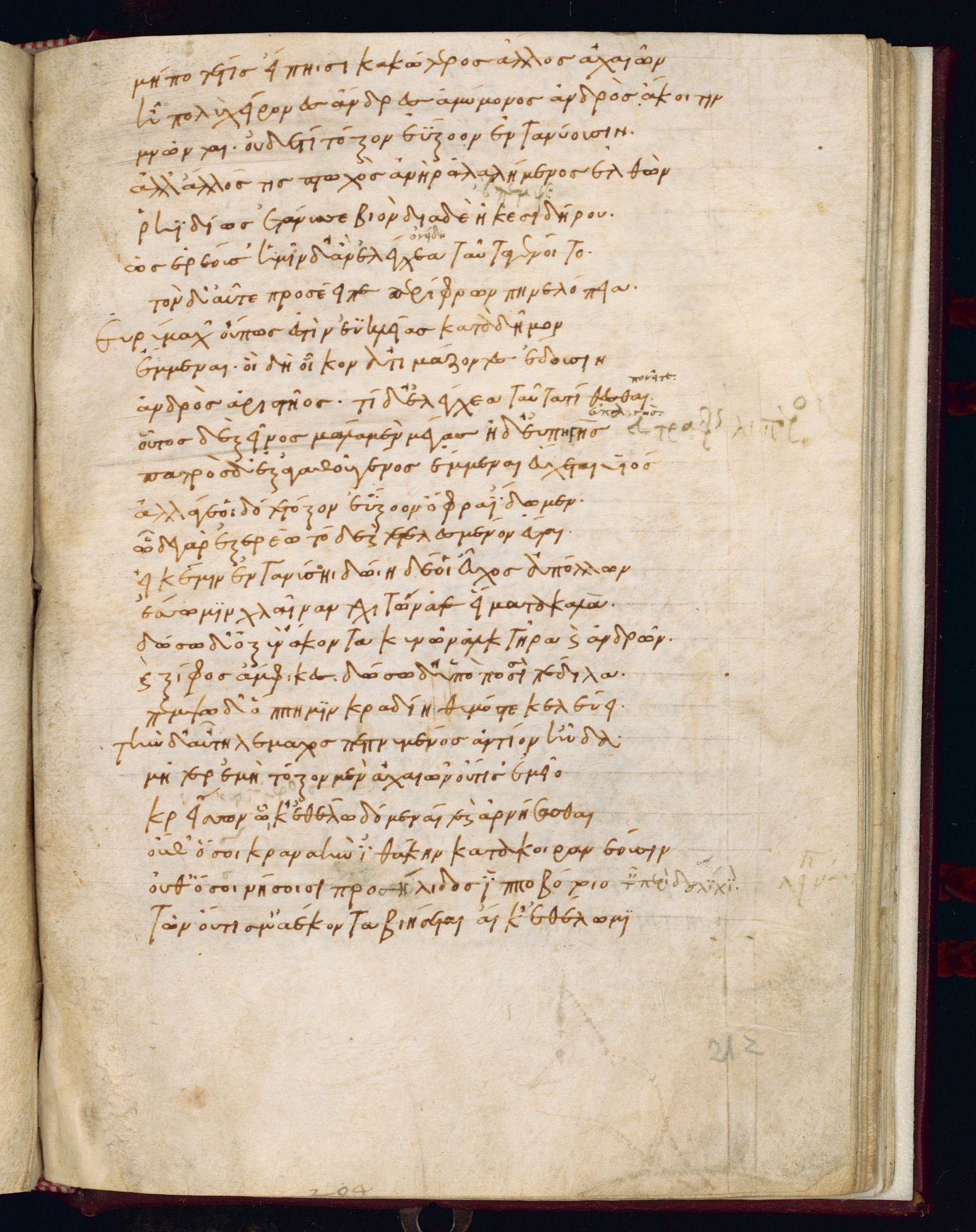
Where on the image
Laur. Plut. 32.24, fol. 212r: Odyssey 21.324-348, begins ‹μή ποτέ τις εἴπῃσι›, ends ‹βιήσεται, αἴ κʼ ἐθέλωμι›. Checked on the image: first and last lines read and matched to the Greek. Fol. 211v ends with 21.323. Fol. 212v begins with 21.349. English blocks here: 325-329, 330-334, 335-339, 340-344, 345-349.
324μή ποτέ τις εἴπῃσι κακώτερος ἄλλος Ἀχαιῶν
325ἦ πολὺ χείρονες ἄνδρες ἀμύμονος ἀνδρὸς ἄκοιτιν
326μνῶνται, οὐδέ τι τόξον ἐΰξοον ἐντανύουσιν·
327ἀλλʼ ἄλλος τις πτωχὸς ἀνὴρ ἀλαλήμενος ἐλθὼν
328ῥηϊδίως ἐτάνυσσε βιόν, διὰ δʼ ἧκε σιδήρου.
329ὣς ἐρέουσʼ, ἡμῖν δʼ ἂν ἐλέγχεα ταῦτα γένοιτο.
330τὸν δʼ αὖτε προσέειπε περίφρων Πηνελόπεια·
331Εὐρύμαχʼ, οὔ πως ἔστιν ἐϋκλεῖας κατὰ δῆμον
332ἔμμεναι οἳ δὴ οἶκον ἀτιμάζοντες ἔδουσιν
333ἀνδρὸς ἀριστῆος· τί δʼ ἐλέγχεα ταῦτα τίθεσθε;
334οὗτος δὲ ξεῖνος μάλα μὲν μέγας ἠδʼ εὐπηγής,
335πατρὸς δʼ ἐξ ἀγαθοῦ γένος εὔχεται ἔμμεναι υἱός.
336ἀλλʼ ἄγε οἱ δότε τόξον ἐΰξοον, ὄφρα ἴδωμεν.
337ὧδε γὰρ ἐξερέω, τὸ δὲ καὶ τετελεσμένον ἔσται·
338εἴ κέ μιν ἐντανύσῃ, δώῃ δέ οἱ εὖχος Ἀπόλλων,
339ἕσσω μιν χλαῖνάν τε χιτῶνά τε, εἵματα καλά,
340δώσω δʼ ὀξὺν ἄκοντα, κυνῶν ἀλκτῆρα καὶ ἀνδρῶν,
341καὶ ξίφος ἄμφηκες· δώσω δʼ ὑπὸ ποσσὶ πέδιλα,
342πέμψω δʼ ὅππη μιν κραδίη θυμός τε κελεύει.
343τὴν δʼ αὖ Τηλέμαχος πεπνυμένος ἀντίον ηὔδα·
344μῆτερ ἐμή, τόξον μὲν Ἀχαιῶν οὔ τις ἐμεῖο
345κρείσσων, ᾧ κʼ ἐθέλω, δόμεναί τε καὶ ἀρνήσασθαι,
346οὔθʼ ὅσσοι κραναὴν Ἰθάκην κάτα κοιρανέουσιν,
347οὔθʼ ὅσσοι νήσοισι πρὸς Ἤλιδος ἱπποβότοιο·
348τῶν οὔ τίς μʼ ἀέκοντα βιήσεται, αἴ κʼ ἐθέλωμι
325‘Truly men weaker far are wooing the wife of a noble man, and cannot string his polished bow. But another, a beggar, that came on his wanderings, easily strung the bow, and shot through the iron.’ Thus will men speak, but to us this would become a reproach.” 330Then wise Penelope answered him again: “Eurymachus, in no wise can there be good report in the land for men who dishonor and consume the house of a prince. Why then do you make this matter a reproach? This stranger is right tall and well-built, 335and declares himself to be born the son of a good father. Nay, come, give him the polished bow and let us see. For thus will I speak out to thee, and this word shall verily be brought to pass; if he shall string the bow, and Apollo grant him glory, I will clothe him with a cloak and tunic, fair raiment, 340and will give him a sharp javelin to ward off dogs and men, and a two-edged sword; and I will give him sandals to bind beneath his feet, and will send him whithersoever his heart and spirit bid him go.” Then wise Telemachus answered her: “My mother, as for the bow, no man of the Achaeans 345has a better right than I to give or to deny it to whomsoever I will—no, not all those who lord it in rocky Ithaca, or in the islands towards horse-pasturing Elis. No man among these shall thwart me against my will, even though I should wish to give this bow outright to the stranger to bear away with him.
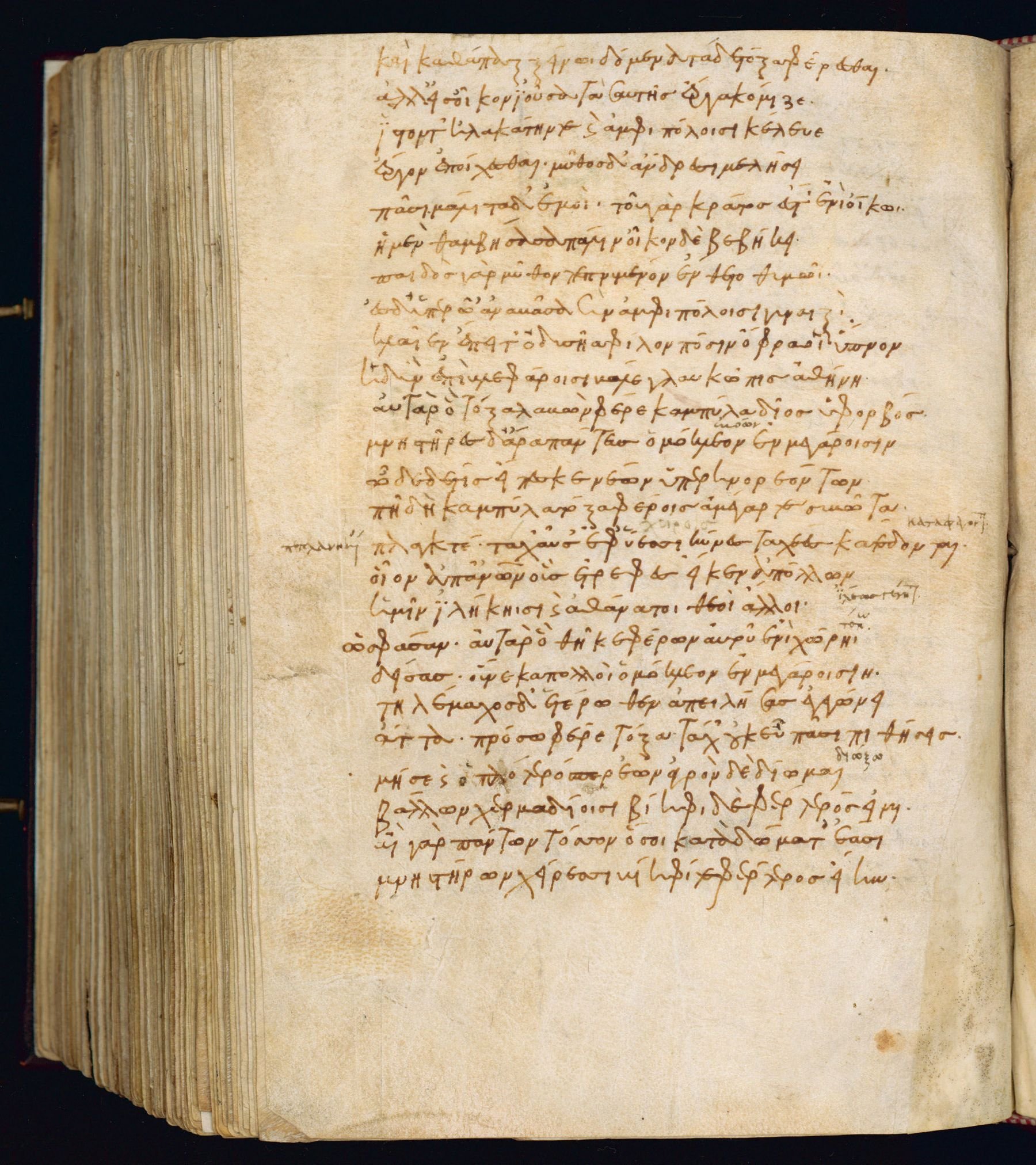
Where on the image
Laur. Plut. 32.24, fol. 212v: Odyssey 21.349-373, begins ‹καὶ καθάπαξ ξείνῳ δόμεναι›, ends ‹βίηφί τε φέρτερος εἴην·›. Checked on the image: first and last lines read and matched to the Greek. Fol. 212r ends with 21.348. Fol. 213r begins with 21.374. English blocks here: 350-353, 354-354, 355-359, 360-364, 365-369, 370-374.
349καὶ καθάπαξ ξείνῳ δόμεναι τάδε τόξα φέρεσθαι.
350ἀλλʼ εἰς οἶκον ἰοῦσα τὰ σʼ αὐτῆς ἔργα κόμιζε,
351ἱστόν τʼ ἠλακάτην τε, καὶ ἀμφιπόλοισι κέλευε
352ἔργον ἐποίχεσθαι· τόξον δʼ ἄνδρεσσι μελήσει
353πᾶσι, μάλιστα δʼ ἐμοί· τοῦ γὰρ κράτος ἔστʼ ἐνὶ οἴκῳ.
354ἡ μὲν θαμβήσασα πάλιν οἶκόνδε βεβήκει·
355παιδὸς γὰρ μῦθον πεπνυμένον ἔνθετο θυμῷ.
356ἐς δʼ ὑπερῷʼ ἀναβᾶσα σὺν ἀμφιπόλοισι γυναιξὶ
357κλαῖεν ἔπειτʼ Ὀδυσῆα, φίλον πόσιν, ὄφρα οἱ ὕπνον
358ἡδὺν ἐπὶ βλεφάροισι βάλε γλαυκῶπις Ἀθήνη.
359αὐτὰρ ὁ τόξα λαβὼν φέρε καμπύλα δῖος ὑφορβός·
360μνηστῆρες δʼ ἄρα πάντες ὁμόκλεον ἐν μεγάροισιν·
361ὧδε δέ τις εἴπεσκε νέων ὑπερηνορεόντων·
362πῆ δὴ καμπύλα τόξα φέρεις, ἀμέγαρτε συβῶτα,
363πλαγκτέ; τάχʼ αὖ σʼ ἐφʼ ὕεσσι κύνες ταχέες κατέδονται
364οἶον ἀπʼ ἀνθρώπων, οὓς ἔτρεφες, εἴ κεν Ἀπόλλων
365ἡμῖν ἱλήκῃσι καὶ ἀθάνατοι θεοὶ ἄλλοι.
366ὣς φάσαν, αὐτὰρ, ὁ θῆκε φέρων αὐτῇ ἐνὶ χώρῃ,
367δείσας, οὕνεκα πολλοὶ ὁμόκλεον ἐν μεγάροισιν.
368Τηλέμαχος δʼ ἑτέρωθεν ἀπειλήσας ἐγεγώνει·
369ἄττα, πρόσω φέρε τόξα· τάχʼ οὐκ εὖ πᾶσι πιθήσεις
370μή σε καὶ ὁπλότερός περ ἐὼν ἀγρόνδε δίωμαι,
371βάλλων χερμαδίοισι· βίηφι δὲ φέρτερός εἰμι.
372αἲ γὰρ πάντων τόσσον, ὅσοι κατὰ δώματʼ ἔασι,
373μνηστήρων χερσίν τε βίηφί τε φέρτερος εἴην·
350But do thou go thy chamber, and busy thyself with thine own tasks, the loom and the distaff, and bid thy handmaids ply their tasks. The bow shall be for men, for all, but most of all for me; since mine is the authority in the house.” 354She then, seized with wonder, went back to her chamber, 355for she laid to heart the wise saying of her son. Up to her upper chamber she went with her handmaids, and then bewailed Odysseus, her dear husband, until flashing-eyed Athena cast sweet sleep upon her eyelids. Now the goodly swineherd had taken the curved bow and was bearing it, 360but the wooers all cried out in the halls. And thus would one of the proud youths speak: “Whither, pray, art thou bearing the curved bow, miserable swineherd, thou man distraught? Soon by thy swine, alone and apart from men, shall the swift hounds devour thee—hounds thyself didst rear—if but Apollo 365be gracious to us, and the other immortal gods.” So they spoke, and he set down the bow, as he bore it, in that very place, seized with fear because many men were crying out aloud in the halls. But Telemachus on the other side called out threateningly: “Father, bear the bow onward—soon shalt thou rue giving heed to all— 370lest, younger though I am, I drive thee to the field, and pelt thee with stones; for in strength I am the better. I would that I were even so much better in strength and might than all the wooers that are in the house; then would I soon send many a one
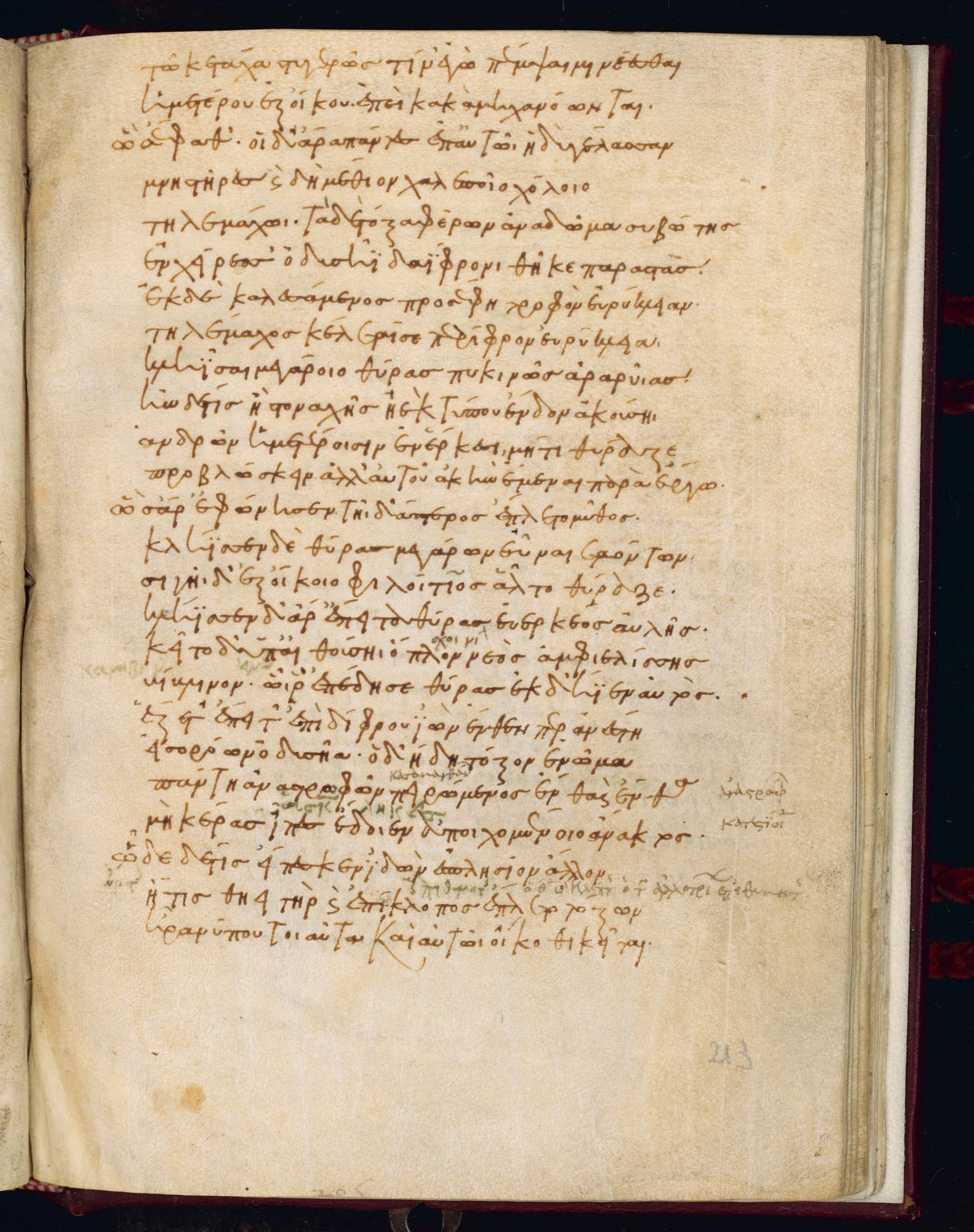
Where on the image
Laur. Plut. 32.24, fol. 213r: Odyssey 21.374-398, begins ‹τῷ κε τάχα στυγερῶς›, ends ‹καὶ αὐτῷ οἴκοθι κεῖται›. Checked on the image: first and last lines read and matched to the Greek. Fol. 212v ends with 21.373. Fol. 213v begins with 21.399. English blocks here: 375-379, 380-384, 385-389, 390-394, 395-399.
374τῷ κε τάχα στυγερῶς τινʼ ἐγὼ πέμψαιμι νέεσθαι
375ἡμετέρου ἐξ οἴκου, ἐπεὶ κακὰ μηχανόωνται.
376ὣς ἔφαθʼ, οἱ δʼ ἄρα πάντες ἐπʼ αὐτῷ ἡδὺ γέλασσαν
377μνηστῆρες, καὶ δὴ μέθιεν χαλεποῖο χόλοιο
378Τηλεμάχῳ· τὰ δὲ τόξα φέρων ἀνὰ δῶμα συβώτης
379ἐν χείρεσσʼ Ὀδυσῆϊ δαΐφρονι θῆκε παραστάς.
380ἐκ δὲ καλεσσάμενος προσέφη τροφὸν Εὐρύκλειαν·
381Τηλέμαχος κέλεταί σε, περίφρων Εὐρύκλεια,
382κληῗσαι μεγάροιο θύρας πυκινῶς ἀραρυίας.
383ἢν δέ τις ἢ στοναχῆς ἠὲ κτύπου ἔνδον ἀκούσῃ
384ἀνδρῶν ἡμετέροισιν ἐν ἕρκεσι, μή τι θύραζε
385προβλώσκειν, ἀλλʼ αὐτοῦ ἀκὴν ἔμεναι παρὰ ἔργῳ.
386ὣς ἄρʼ ἐφώνησεν, τῇ δʼ ἄπτερος ἔπλετο μῦθος,
387κλήϊσεν δὲ θύρας μεγάρων εὖ ναιεταόντων.
388σιγῇ δʼ ἐξ οἴκοιο Φιλοίτιος ἆλτο θύραζε,
389κλήϊσεν δʼ ἄρʼ ἔπειτα θύρας εὐερκέος αὐλῆς.
390κεῖτο δʼ ὑπʼ αἰθούσῃ ὅπλον νεὸς ἀμφιελίσσης
391βύβλινον, ᾧ ῥʼ ἐπέδησε θύρας, ἐς δʼ ἤϊεν αὐτός·
392ἕζετʼ ἔπειτʼ ἐπὶ δίφρον ἰών, ἔνθεν περ ἀνέστη,
393εἰσορόων Ὀδυσῆα. ὁ δʼ ἤδη τόξον ἐνώμα
394πάντη ἀναστρωφῶν, πειρώμενος ἔνθα καὶ ἔνθα,
395μὴ κέρα ἶπες ἔδοιεν ἀποιχομένοιο ἄνακτος.
396ὧδε τις εἴπεσκεν ἰδὼν ἐς πλησίον ἄλλον·
397ἦ τις θηητὴρ καὶ ἐπίκλοπος ἔπλετο τόξων·
398ἤ ῥά νύ που τοιαῦτα καὶ αὐτῷ οἴκοθι κεῖται
375forth from our house to go his way in evil case; for they devise wickedness.” So he spoke, but all the wooers laughed merrily at him, and relaxed the bitterness of their anger against Telemachus. Howbeit the swineherd bore the bow through the hall, and came up to wise Odysseus, and put it in his hands. 380Then he called forth the nurse Eurycleia, and said to her: “Telemachus bids thee, wise Eurycleia, to bar the close-fitting doors of the hall, and if any of the women hear within groanings or the din of men within our walls, let them not 385rush out, but remain where they are in silence at their work.” So he spoke, but her word remained unwinged; and she barred the doors of the stately halls. But in silence Philoetius hastened forth from the house, and barred the gates of the well-fenced court. 390Now there lay beneath the portico the cable of a curved ship, made of byblus plant, wherewith he made fast the gates, and then himself went within. Thereafter he came and sat down on the seat from which he had risen, and gazed upon Odysseus; now he was already handling the bow, turning it round and round, and trying it this way and that, 395lest worms might have eaten the horns, while its lord was afar. And thus would one speak with a glance at his neighbor: “Verily he has a shrewd eye, and is a cunning knave with a bow. It may be haply that he has himself such bows stored away at home, or else he is minded to make one, that he thus
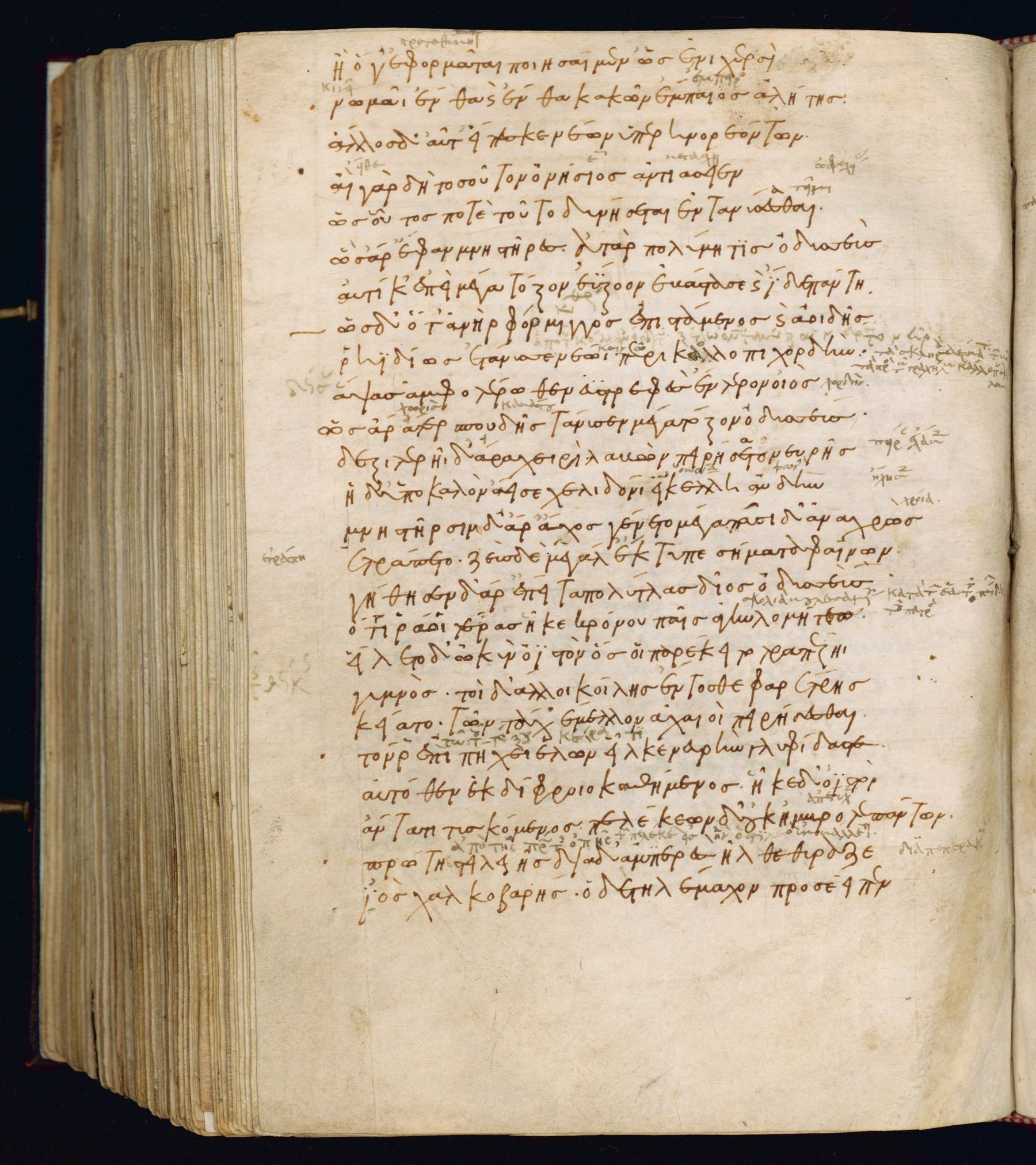
Where on the image
Laur. Plut. 32.24, fol. 213v: Odyssey 21.399-423, begins ‹ἢ ὅ γʼ ἐφορμᾶται›, ends ‹ὁ δὲ Τηλέμαχον προσέειπε·›. Checked on the image: first and last lines read and matched to the Greek. Fol. 213r ends with 21.398. Fol. 214r begins with 21.424. English here: 21.400-423. At the break between fol. 213v (Greek to 21.423) and fol. 214r (Greek from 21.424) the English is cut where Odysseus' speech begins (“Telemachus, the stranger ...), the same line as the Greek. At the page's other break the English follows Murray's five-line marks (a block that crosses the break goes with the page holding its middle line).
399ἢ ὅ γʼ ἐφορμᾶται ποιησέμεν, ὡς ἐνὶ χερσὶ
400νωμᾷ ἔνθα καὶ ἔνθα κακῶν ἔμπαιος ἀλήτης.
401ἄλλος δʼ αὖ εἴπεσκε νέων ὑπερηνορεόντων·
402αἲ γὰρ δὴ τοσσοῦτον ὀνήσιος ἀντιάσειεν
403ὡς οὗτός ποτε τοῦτο δυνήσεται ἐντανύσασθαι.
404ὣς ἄρʼ ἔφαν μνηστῆρες· ἀτὰρ πολύμητις Ὀδυσσεύς,
405αὐτίκʼ ἐπεὶ μέγα τόξον ἐβάστασε καὶ ἴδε πάντη,
406ὡς ὅτʼ ἀνὴρ φόρμιγγος ἐπιστάμενος καὶ ἀοιδῆς
407ῥηϊδίως ἐτάνυσσε νέῳ περὶ κόλλοπι χορδήν,
408ἅψας ἀμφοτέρωθεν ἐϋστρεφὲς ἔντερον οἰός,
409ὣς ἄρʼ ἄτερ σπουδῆς τάνυσεν μέγα τόξον Ὀδυσσεύς.
410δεξιτερῇ ἄρα χειρὶ λαβὼν πειρήσατο νευρῆς·
411ἡ δʼ ὑπὸ καλὸν ἄεισε, χελιδόνι εἰκέλη αὐδήν.
412μνηστῆρσιν δʼ ἄρʼ ἄχος γένετο μέγα, πᾶσι δʼ ἄρα χρὼς
413ἐτράπετο· Ζεὺς δὲ μεγάλʼ ἔκτυπε σήματα φαίνων·
414γήθησέν τʼ ἄρʼ ἔπειτα πολύτλας δῖος Ὀδυσσεύς.
415ὅττι ῥά οἱ τέρας ἧκε Κρόνου πάϊς ἀγκυλομήτεω·
416εἵλετο δʼ ὠκὺν ὀϊστόν, ὅ οἱ παρέκειτο τραπέζῃ
417γυμνός· τοὶ δʼ ἄλλοι κοίλης ἔντοσθε φαρέτρης
418κείατο, τῶν τάχʼ ἔμελλον Ἀχαιοὶ πειρήσεσθαι.
419τόν ῥʼ ἐπὶ πήχει ἑλὼν ἕλκεν νευρὴν γλυφίδας τε,
420αὐτόθεν ἐκ δίφροιο καθήμενος, ἧκε δʼ ὀϊστὸν
421ἄντα τιτυσκόμενος, πελέκεων δʼ οὐκ ἤμβροτε πάντων
422πρώτης στειλειῆς, διὰ δʼ ἀμπερὲς ἦλθε θύραζε
423ἰὸς χαλκοβαρής· ὁ δὲ Τηλέμαχον προσέειπε·
400turns it this way and that in his hands, the rascally vagabond.” 401And again another of the proud youths would say: “Would that the fellow might find profit in just such measure as he shall prove able ever to string this bow.” So spoke the wooers, but Odysseus of many wiles, 405as soon as he had lifted the great bow and scanned it on every side—even as when a man well-skilled in the lyre and in song easily stretches the string about a new peg, making fast at either end the twisted sheep-gut—so without effort did Odysseus string the great bow. 410And he held it in his right hand, and tried the string, which sang sweetly beneath his touch, like to a swallow in tone. But upon the wooers came great grief, and the faces of them changed color, and Zeus thundered loud, shewing forth his signs. Then glad at heart was the much-enduring, goodly Odysseus 415that the son of crooked-counselling Cronos sent him an omen, and he took up a swift arrow, which lay by him on the table, bare, but the others were stored within the hollow quiver, even those of which the Achaeans were soon to taste. This he took, and laid upon the bridge of the bow, and drew the bow-string and the notched arrow 420even from the chair where he sat, and let fly the shaft with sure aim, and did not miss the end of the handle of one of the axes, but clean through and out at the end passed the arrow weighted with bronze. But he spoke to Telemachus, saying:
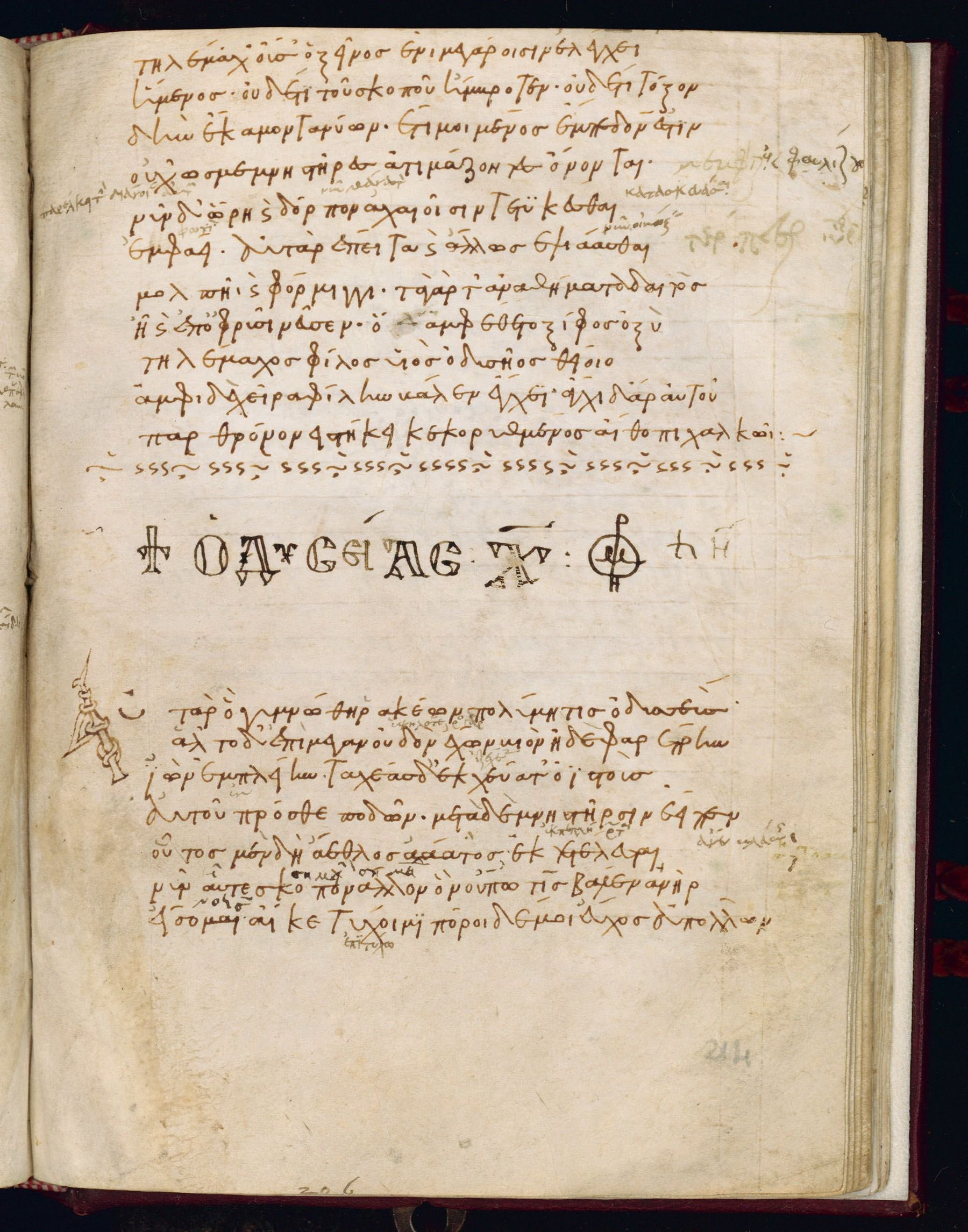
Where on the image
Laur. Plut. 32.24, fol. 214r: Odyssey 21.424-434, begins ‹Τηλέμαχʼ, οὔ σʼ ὁ›, ends ‹ἑστήκει κεκορυθμένος αἴθοπι χαλκῷ.›. Checked on the image: first and last lines read and matched to the Greek. Fol. 213v ends with 21.423. The page holds 21.424-434, 22.1-7. Book 21 ends with 21.434, followed by a line of ornament; the heading ὀδυσσείας χ in decorated capitals follows, and book 22 begins with an enlarged initial. English here: 21.424-434. At the break between fol. 213v (Greek to 21.423) and fol. 214r (Greek from 21.424) the English is cut where Odysseus' speech begins (“Telemachus, the stranger ...), the same line as the Greek. At the page's other break the English follows Murray's five-line marks (a block that crosses the break goes with the page holding its middle line).
424Τηλέμαχʼ, οὔ σʼ ὁ ξεῖνος ἐνὶ μεγάροισιν ἐλέγχει
425ἥμενος, οὐδέ τι τοῦ σκοποῦ ἤμβροτον οὐδέ τι τόξον
426δὴν ἔκαμον τανύων· ἔτι μοι μένος ἔμπεδόν ἐστιν,
427οὐχ ὥς με μνηστῆρες ἀτιμάζοντες ὄνονται.
428νῦν δʼ ὥρη καὶ δόρπον Ἀχαιοῖσιν τετυκέσθαι
429ἐν φάει, αὐτὰρ ἔπειτα καὶ ἄλλως ἑψιάασθαι
430μολπῇ καὶ φόρμιγγι· τὰ γάρ τʼ ἀναθήματα δαιτός.
431ἦ καὶ ἐπʼ ὀφρύσι νεῦσεν· ὁ δʼ ἀμφέθετο ξίφος ὀξὺ
432Τηλέμαχος, φίλος υἱὸς Ὀδυσσῆος θείοιο,
433ἀμφὶ δὲ χεῖρα φίλην βάλεν ἔγχεϊ, ἄγχι δʼ ἄρʼ αὐτοῦ
434πὰρ θρόνον ἑστήκει κεκορυθμένος αἴθοπι χαλκῷ.
424“Telemachus, the stranger 425that sits in thy halls brings no shame upon thee, nor in any wise did I miss the mark, or labour long in stringing the bow; still is my strength unbroken—not as the wooers scornfully taunt me. But now it is time that supper too be made ready for the Achaeans, while yet there is light, and thereafter must yet other sport be made 430with song and with the lyre; for these things are the accompaniments of a feast.” He spoke, and made a sign with his brows, and Telemachus, the dear son of divine Odysseus, girt about him his sharp sword, and took his spear in his grasp, and stood by the chair at his father's side, armed with gleaming bronze.
Notes
- Greek: A. T. Murray, Homer: The Odyssey (Loeb Classical Library, 1919), via Perseus.
- English: A. T. Murray's translation in the same edition; his footnotes are omitted.
Cite
Sources
- Source: Laur. Plut. 32.24 (BML Teca Digitale IIIF) + Murray Greek (Loeb 1919, Perseus) + Murray English (Loeb 1919, Perseus) (holding institution)
- Critical edition: Murray, Loeb 1919, via Perseus
← previous · → next · v cycle view · l back to library