Homer, Odyssey, Book 20: Portents for the suitors
Introduction
The Odyssey, composed around 700 BCE and attributed to Homer, tells of Odysseus' ten-year journey home from Troy and his return to Ithaca. Book 20 (394 lines): Portents for the suitors.
The page photographs are from Florence, Biblioteca Medicea Laurenziana, Plut. 32.24 (parchment, 10th century, 234 folios; the oldest manuscript of the Odyssey with published images), in the Biblioteca Medicea Laurenziana's Teca Digitale. This book is on fol. 197v-205r; each section below is one page, with its first and last line as read on the photograph. Many pages carry interlinear glosses and a few marginal notes in later hands.
The Greek is A. T. Murray's Loeb text (1919) via Perseus, not a transcription of this manuscript, whose wording differs in places. The English is Murray's prose translation (1919), divided every five lines; at a page break a five-line block goes with the page holding most of it, except at the page breaks where a section's note says the English is cut at the end of Murray's sentence. Each section's note gives its English line range.
Where the scribe left out a line, wrote one in the margin, changed the order or added a line not in Murray's text, the section's note on the photograph says so; the Greek and English shown are Murray's full text for the page's range.
How was this verified? (Provenance)
Where on the image
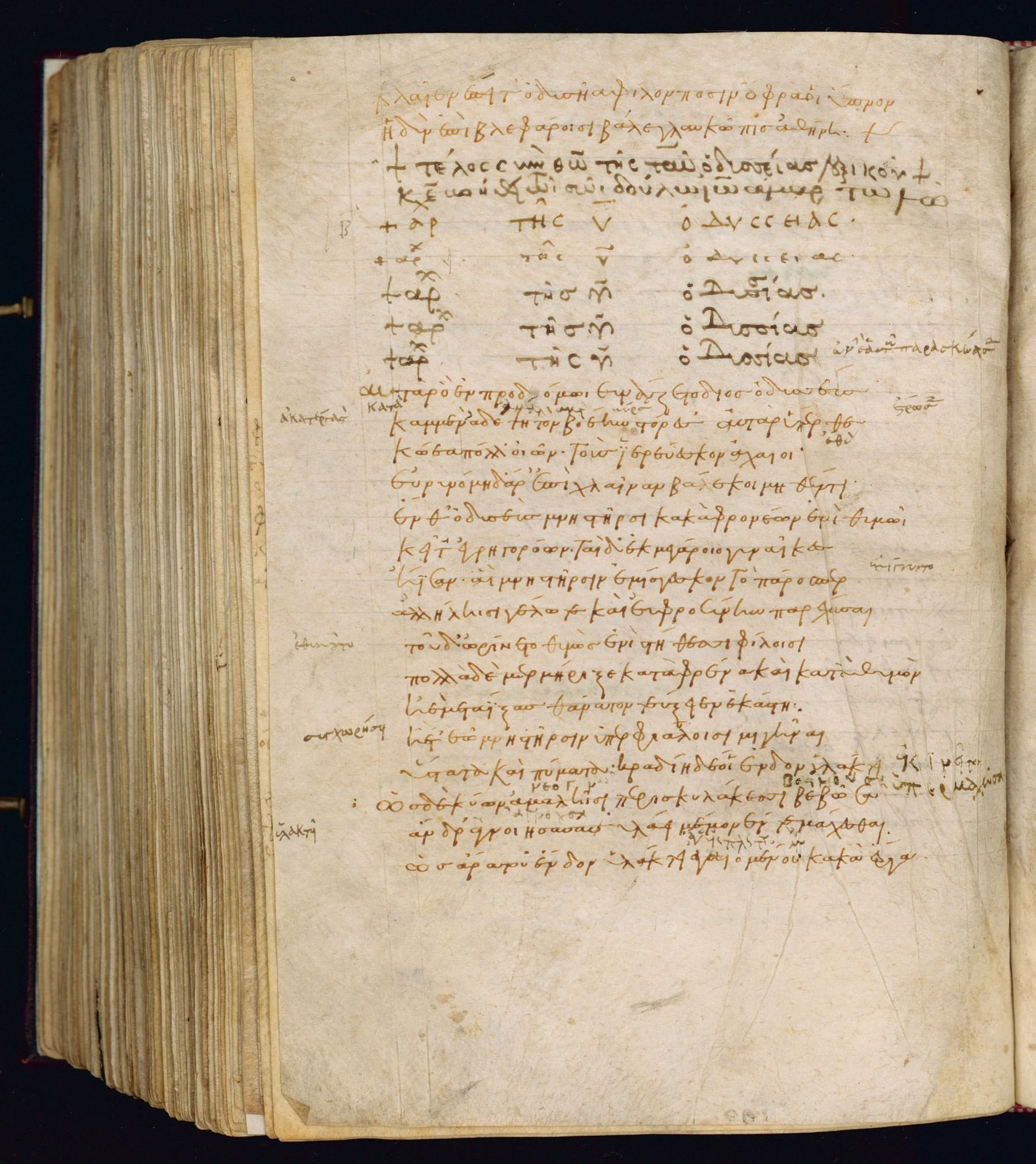
Laur. Plut. 32.24, fol. 197v: Odyssey 20.1-16, begins ‹αὐτὰρ ὁ ἐν προδόμῳ›, ends ‹ὑλάκτει ἀγαιομένου κακὰ ἔργα·›. Checked on the image: first and last lines read and matched to the Greek. Fol. 198r begins with 20.17. The page holds 19.603-604, 20.1-16. Book 19 ends with 19.604; a subscription (τέλος σὺν θεῷ τῆς ... ὀδυσσείας) and a second line in the same style follow, then five short lines in a later hand repeating the heading for book 20 (ἀρχὴ τῆς υ ὀδυσσείας). Book 20 begins after them. English blocks here: 1-4, 5-9, 10-14.
1αὐτὰρ ὁ ἐν προδόμῳ εὐνάζετο δῖος Ὀδυσσεύς·
2κὰμ μὲν ἀδέψητον βοέην στόρεσʼ, αὐτὰρ ὕπερθε
3κώεα πόλλʼ ὀΐων, τοὺς ἱρεύεσκον Ἀχαιοί·
4Εὐρυνόμη δʼ ἄρʼ ἐπὶ χλαῖναν βάλε κοιμηθέντι.
5ἔνθʼ Ὀδυσεὺς μνηστῆρσι κακὰ φρονέων ἐνὶ θυμῷ
6κεῖτʼ ἐγρηγορόων· ταὶ δʼ ἐκ μεγάροιο γυναῖκες
7ἤϊσαν, αἳ μνηστῆρσιν ἐμισγέσκοντο πάρος περ,
8ἀλλήλῃσι γέλω τε καὶ εὐφροσύνην παρέχουσαι.
9τοῦ δʼ ὠρίνετο θυμὸς ἐνὶ στήθεσσι φίλοισι·
10πολλὰ δὲ μερμήριζε κατὰ φρένα καὶ κατὰ θυμόν,
11ἠὲ μεταΐξας θάνατον τεύξειεν ἑκάστῃ,
12ἦ ἔτʼ ἐῷ μνηστῆρσιν ὑπερφιάλοισι μιγῆναι
13ὕστατα καὶ πύματα, κραδίη δέ οἱ ἔνδον ὑλάκτει.
14ὡς δὲ κύων ἀμαλῇσι περὶ σκυλάκεσσι βεβῶσα
15ἄνδρʼ ἀγνοιήσασʼ ὑλάει μέμονέν τε μάχεσθαι,
16ὥς ῥα τοῦ ἔνδον ὑλάκτει ἀγαιομένου κακὰ ἔργα·
1But the goodly Odysseus lay down to sleep in the fore-hall of the house. On the ground he spread an undressed ox-hide and above it many fleeces of sheep, which the Achaeans were wont to slay, and Eurynome threw over him a cloak, when he had laid him down. 5There Odysseus, pondering in his heart evil for the wooers, lay sleepless. And the women came forth from the hall, those that had before been wont to lie with the wooers, making laughter and merriment among themselves. But the heart was stirred in his breast, 10and much he debated in mind and heart, whether he should rush after them and deal death to each, or suffer them to lie with the insolent wooers for the last and latest time; and his heart growled within him. And as a bitch stands over her tender whelps
Where on the image
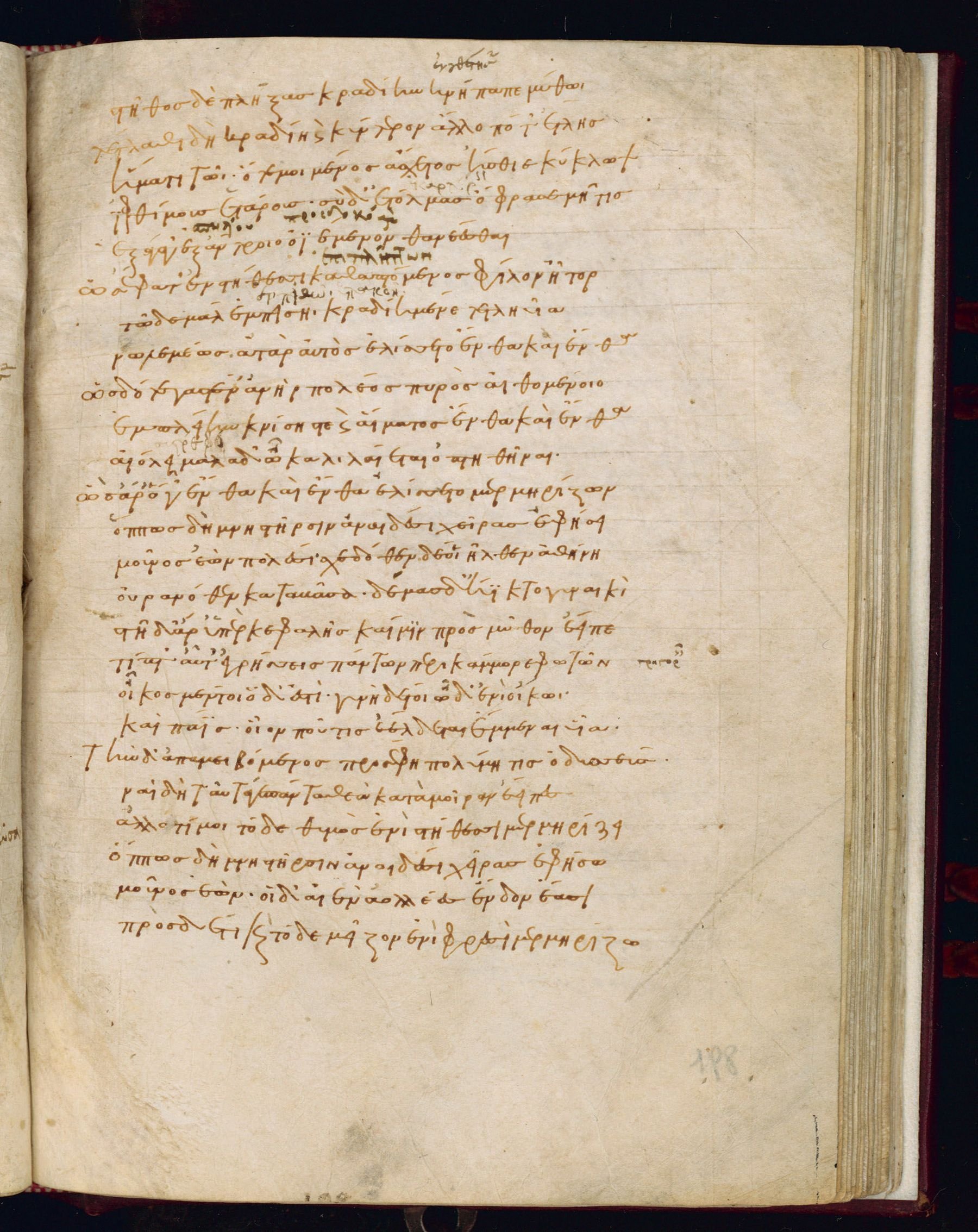
Laur. Plut. 32.24, fol. 198r: Odyssey 20.17-41, begins ‹στῆθος δὲ πλήξας κραδίην›, ends ‹μεῖζον ἐνὶ φρεσὶ μερμηρίζω·›. Checked on the image: first and last lines read and matched to the Greek. Fol. 197v ends with 20.16. Fol. 198v begins with 20.42. English blocks here: 15-19, 20-24, 25-29, 30-34, 35-39, 40-43.
17στῆθος δὲ πλήξας κραδίην ἠνίπαπε μύθῳ·
18τέτλαθι δή, κραδίη· καὶ κύντερον ἄλλο ποτʼ ἔτλης.
19ἤματι τῷ ὅτε μοι μένος ἄσχετος ἤσθιε Κύκλωψ
20ἰφθίμους ἑτάρους· σὺ δʼ ἐτόλμας, ὄφρα σε μῆτις
21ἐξάγαγʼ ἐξ ἄντροιο ὀϊόμενον θανέεσθαι.
22ὣς ἔφατʼ, ἐν στήθεσσι καθαπτόμενος φίλον ἦτορ·
23τῷ δὲ μάλʼ ἐν πείσῃ κραδίη μένε τετληυῖα
24νωλεμέως· ἀτὰρ αὐτὸς ἑλίσσετο ἔνθα καὶ ἔνθα.
25ὡς δʼ ὅτε γαστέρʼ ἀνὴρ πολέος πυρὸς αἰθομένοιο,
26ἐμπλείην κνίσης τε καὶ αἵματος, ἔνθα καὶ ἔνθα
27αἰόλλῃ, μάλα δʼ ὦκα λιλαίεται ὀπτηθῆναι,
28ὣς ἄρʼ ὅ γʼ ἔνθα καὶ ἔνθα ἑλίσσετο, μερμηρίζων
29ὅππως δὴ μνηστῆρσιν ἀναιδέσι χεῖρας ἐφήσει
30μοῦνος ἐὼν πολέσι. σχεδόθεν δέ οἱ ἦλθεν Ἀθήνη
31οὐρανόθεν καταβᾶσα· δέμας δʼ ἤϊκτο γυναικί·
32στῆ δʼ ἄρʼ ὑπὲρ κεφαλῆς καί μιν πρὸς μῦθον ἔειπε·
33τίπτʼ αὖτʼ ἐγρήσσεις, πάντων περὶ κάμμορε φωτῶν;
34οἶκος μέν τοι ὅδʼ ἐστί, γυνὴ δέ τοι ἥδʼ ἐνὶ οἴκῳ
35καὶ, πάϊς, οἷόν πού τις ἐέλδεται ἔμμεναι υἷα.
36τὴν δʼ ἀπαμειβόμενος προσέφη πολύμητις Ὀδυσσεύς·
37ναὶ δὴ ταῦτά γε πάντα, θεά, κατὰ μοῖραν ἔειπες·
38ἀλλά τί μοι τόδε θυμὸς ἐνὶ φρεσὶ μερμηρίζει,
39ὅππως δὴ μνηστῆρσιν ἀναιδέσι χεῖρας ἐφήσω,
40μοῦνος ἐών· οἱ δʼ αἰὲν ἀολλέες ἔνδον ἔασι.
41πρὸς δʼ ἔτι καὶ τόδε μεῖζον ἐνὶ φρεσὶ μερμηρίζω·
15growling, when she sees a man she does not know, and is eager to fight, so his heart growled within him in his wrath at their evil deeds; but he smote his breast, and rebuked his heart, saying: “Endure, my heart; a worse thing even than this didst thou once endure on that day when the Cyclops, unrestrained in daring, devoured my 20mighty comrades; but thou didst endure until craft got thee forth from the cave where thou thoughtest to die.” So he spoke, chiding the heart in his breast, and his heart remained bound within him to endure steadfastly; but he himself lay tossing this way and that. 25And as when a man before a great blazing fire turns swiftly this way and that a paunch full of fat and blood, and is very eager to have it roasted quickly, so Odysseus tossed from side to side, pondering how he might put forth his hands upon the shameless wooers, 30one man as he was against so many. Then Athena came down from heaven and drew near to him in the likeness of a woman, and she stood above his head, and spoke to him, and said: “Why now again art thou wakeful, ill-fated above all men? Lo, this is thy house, and here within is thy wife 35and thy child, such a man, methinks, as anyone might pray to have for his son.” And Odysseus of many wiles answered her, and said: “Yea, goddess, all this hast thou spoken aright. But the heart in my breast is pondering somewhat upon this, how I may put forth my hands upon the shameless wooers, 40all alone as I am, while they remain always in a body in the house. And furthermore this other and harder thing I ponder in my mind: even if I were to slay them by the will of Zeus and of thyself, where then should I find escape from bane? Of this I bid thee take thought.”
Where on the image
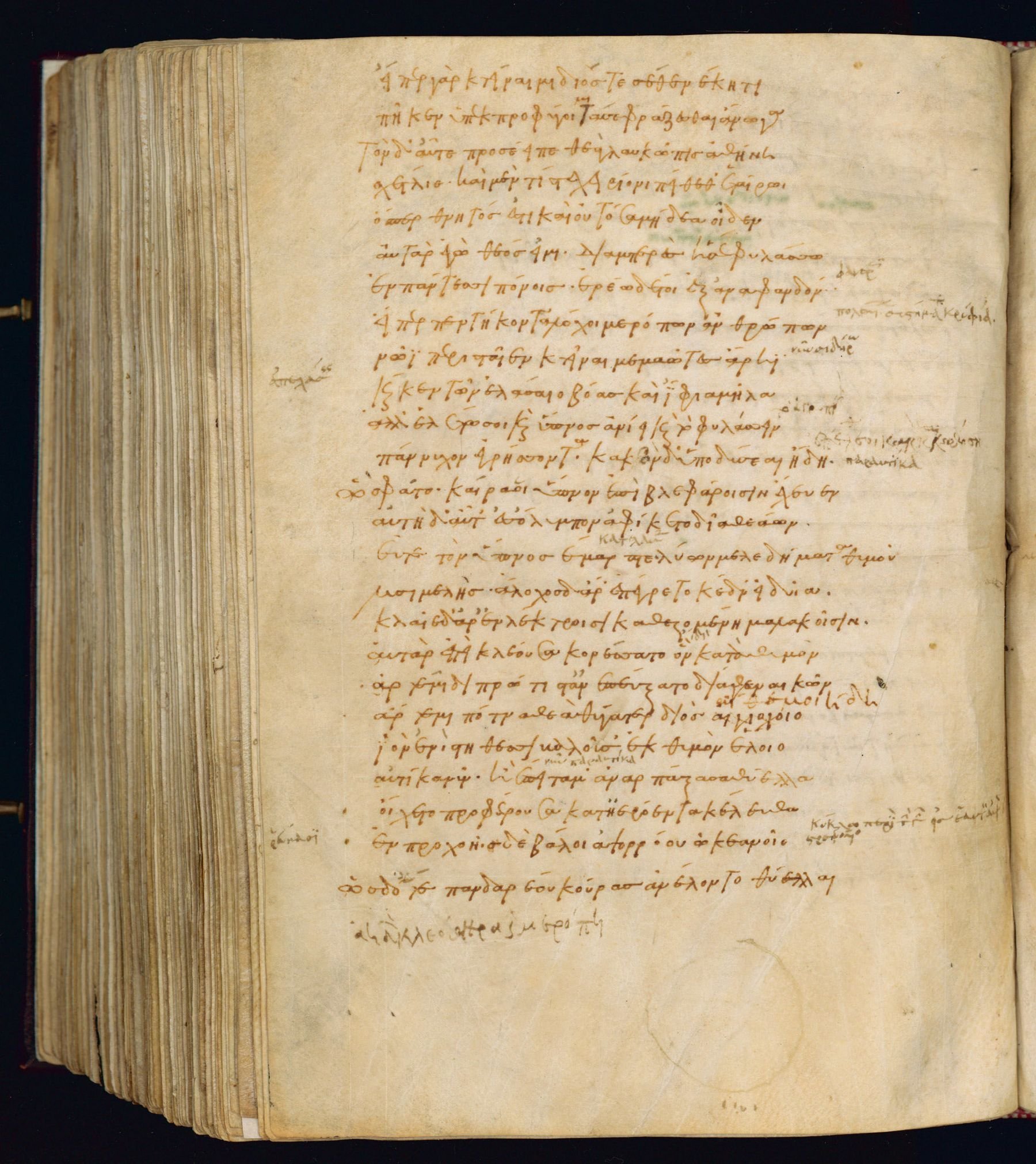
Laur. Plut. 32.24, fol. 198v: Odyssey 20.42-66, begins ‹εἴ περ γὰρ κτείναιμι›, ends ‹Πανδαρέου κούρας ἀνέλοντο θύελλαι·›. Checked on the image: first and last lines read and matched to the Greek. Fol. 198r ends with 20.41. Fol. 199r begins with 20.67. English blocks here: 44-44, 45-49, 50-54, 55-59, 60-64.
42εἴ περ γὰρ κτείναιμι Διός τε σέθεν τε ἕκητι,
43πῆ κεν ὑπεκπροφύγοιμι; τά σε φράζεσθαι ἄνωγα.
44τὸν δʼ αὖτε προσέειπε θεὰ γλαυκῶπις Ἀθήνη·
45σχέτλιε, καὶ μέν τίς τε χερείονι πείθεθʼ ἑταίρῳ,
46ὅς περ θνητός τʼ ἐστὶ καὶ οὐ τόσα μήδεα οἶδεν·
47αὐτὰρ ἐγὼ θεός εἰμι, διαμπερὲς ἥ σε φυλάσσω
48ἐν πάντεσσι πόνοις. ἐρέω δέ τοι ἐξαναφανδόν·
49εἴ περ πεντήκοντα λόχοι μερόπων ἀνθρώπων
50νῶϊ περισταῖεν, κτεῖναι μεμαῶτες Ἄρηϊ,
51καί κεν τῶν ἐλάσαιο βόας καὶ ἴφια μῆλα.
52ἀλλʼ ἑλέτω σε καὶ ὕπνος· ἀνίη καὶ τὸ φυλάσσειν
53πάννυχον ἐγρήσσοντα, κακῶν δʼ ὑποδύσεαι ἤδη.
54ὣς φάτο, καί ῥά οἱ ὕπνον ἐπὶ βλεφάροισιν ἔχευεν,
55αὐτὴ δʼ ἂψ ἐς Ὄλυμπον ἀφίκετο δῖα θεάων.
56εὖτε τὸν ὕπνος ἔμαρπτε, λύων μελεδήματα θυμοῦ,
57λυσιμελής, ἄλοχος δʼ ἄρʼ ἐπέγρετο κεδνὰ ἰδυῖα·
58κλαῖε δʼ ἄρʼ ἐν λέκτροισι καθεζομένη μαλακοῖσιν.
59αὐτὰρ ἐπεὶ κλαίουσα κορέσσατο ὃν κατὰ θυμόν,
60Ἀρτέμιδι πρώτιστον ἐπεύξατο δῖα γυναικῶν·
61Ἄρτεμι, πότνα θεά, θύγατερ Διός, αἴθε μοι ἤδη
62ἰὸν ἐνὶ στήθεσσι βαλοῦσʼ ἐκ θυμὸν ἕλοιο
63αὐτίκα νῦν, ἢ ἔπειτα μʼ ἀναρπάξασα θύελλα
64οἴχοιτο προφέρουσα κατʼ ἠερόεντα κέλευθα,
65ἐν προχοῇς δὲ βάλοι ἀψορρόου Ὠκεανοῖο.
66ὡς δʼ ὅτε Πανδαρέου κούρας ἀνέλοντο θύελλαι·
44Then the goddess, flashing-eyed Athena, answered him: 45“Obstinate one, many a man puts his trust even in a weaker friend than I am, one that is mortal, and knows not such wisdom as mine; but I am a god, that guard thee to the end in all thy toils. And I will tell thee openly; if fifty troops of mortal men 50should stand about us, eager to slay us in battle, even their cattle and goodly sheep shouldest thou drive off. Nay, let sleep now come over thee. There is weariness also in keeping wakeful watch the whole night through; and even now shalt thou come forth from out thy perils.” So she spoke, and shed sleep upon his eyelids, 55but herself, the fair goddess, went back to Olympus. Now while sleep seized him, loosening the cares of his heart, sleep that loosens the limbs of men, his true-hearted wife awoke, and wept, as she sat upon her soft bed. But when her heart had had its fill of weeping, 60to Artemis first of all the fair lady made her prayer: “Artemis, mighty goddess, daughter of Zeus, would that now thou wouldest fix thy arrow in my breast and take away my life even in this hour; or that a storm-wind might catch me up and bear me hence over the murky ways,
Where on the image
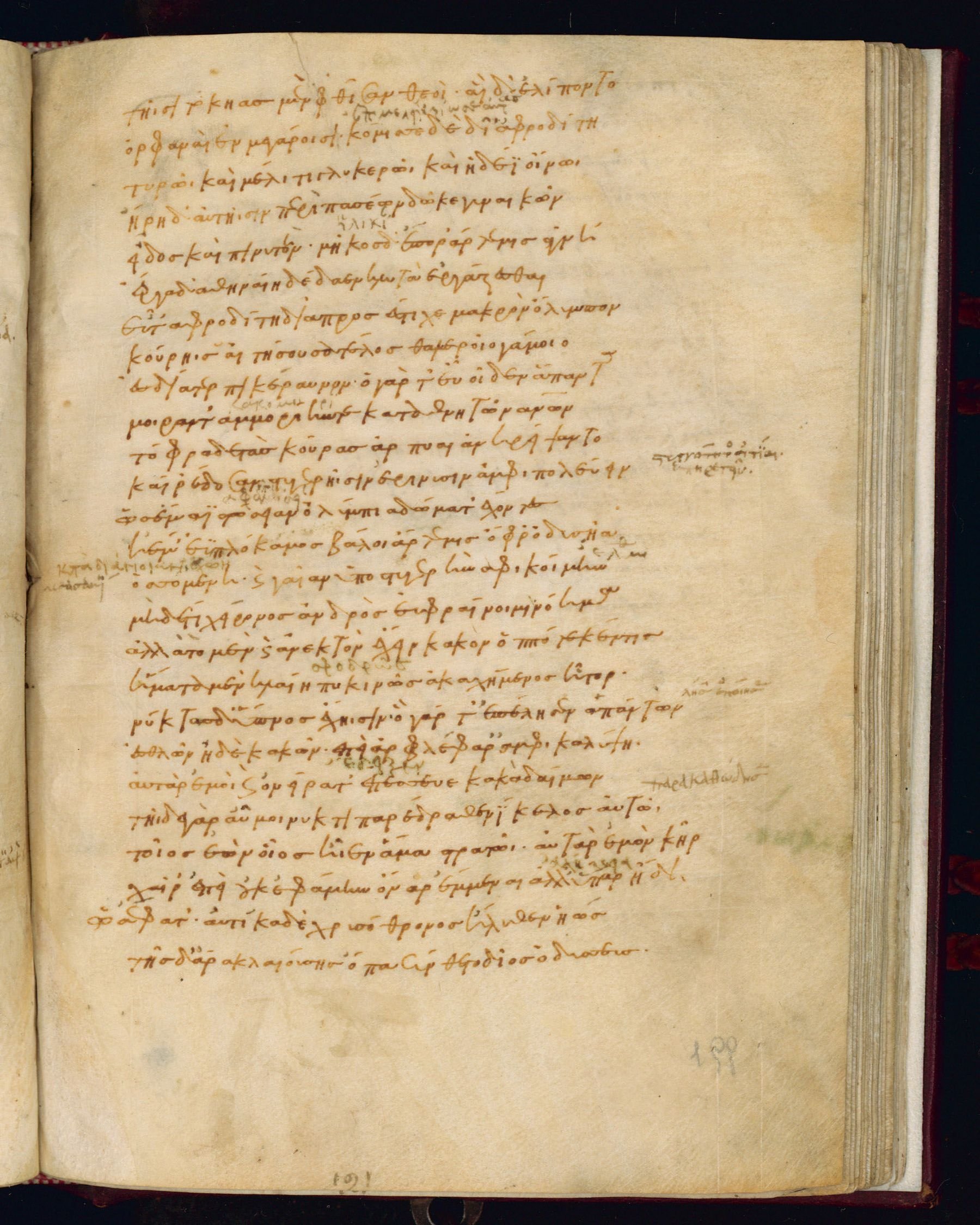
Laur. Plut. 32.24, fol. 199r: Odyssey 20.67-92, begins ‹τῇσι τοκῆας μὲν φθῖσαν›, ends ‹ὄπα σύνθετο δῖος Ὀδυσσεύς·›. Checked on the image: first and last lines read and matched to the Greek. Fol. 198v ends with 20.66. Fol. 199v begins with 20.93. English blocks here: 65-69, 70-74, 75-79, 80-84, 85-89, 90-90, 91-94.
67τῇσι τοκῆας μὲν φθῖσαν θεοί, αἱ δʼ ἐλίποντο
68ὀρφαναὶ ἐν μεγάροισι, κόμισσε δὲ δῖʼ Ἀφροδίτη
69τυρῷ καὶ μέλιτι γλυκερῷ καὶ ἡδέϊ οἴνῳ·
70Ἥρη δʼ αὐτῇσιν περὶ πασέων δῶκε γυναικῶν
71εἶδος καὶ πινυτήν, μῆκος δʼ ἔπορʼ Ἄρτεμις ἁγνή,
72ἔργα δʼ Ἀθηναίη δέδαε κλυτὰ ἐργάζεσθαι.
73εὖτʼ Ἀφροδίτη δῖα προσέστιχε μακρὸν Ὄλυμπον,
74κούρῃς αἰτήσουσα τέλος θαλεροῖο γάμοιο—
75ἐς Δία τερπικέραυνον, ὁ γάρ τʼ εὖ οἶδεν ἅπαντα,
76μοῖράν τʼ ἀμμορίην τε καταθνητῶν ἀνθρώπων—
77τόφρα δὲ τὰς κούρας ἅρπυιαι ἀνηρείψαντο
78καί ῥʼ ἔδοσαν στυγερῇσιν ἐρινύσιν ἀμφιπολεύειν·
79ὣς ἔμʼ ἀϊστώσειαν Ὀλύμπια δώματʼ ἔχοντες,
80ἠέ μʼ ἐϋπλόκαμος βάλοι Ἄρτεμις, ὄφρʼ Ὀδυσῆα
81ὀσσομένη καὶ γαῖαν ὕπο στυγερὴν ἀφικοίμην,
82μηδέ τι χείρονος ἀνδρὸς ἐϋφραίνοιμι νόημα.
83ἀλλὰ τὸ μὲν καὶ ἀνεκτὸν ἔχει κακόν, ὁππότε κέν τις
84ἤματα μὲν κλαίῃ, πυκινῶς ἀκαχήμενος ἦτορ,
85νύκτας δʼ ὕπνος ἔχῃσιν—ὁ γάρ τʼ ἐπέλησεν ἁπάντων,
86ἐσθλῶν ἠδὲ κακῶν, ἐπεὶ ἄρ βλέφαρʼ ἀμφικαλύψῃ—
87αὐτὰρ ἐμοὶ καὶ ὀνείρατʼ ἐπέσσευεν κακὰ δαίμων.
88τῇδε γὰρ αὖ μοι νυκτὶ παρέδραθεν εἴκελος αὐτῷ,
89τοῖος ἐὼν οἷος ᾖεν ἅμα στρατῷ· αὐτὰρ ἐμὸν κῆρ
90χαῖρʼ, ἐπεὶ οὐκ ἐφάμην ὄναρ ἔμμεναι, ἀλλʼ ὕπαρ ἤδη.
91ὣς ἔφατʼ, αὐτίκα δὲ χρυσόθρονος ἤλυθεν Ἠώς.
92τῆς δʼ ἄρα κλαιούσης ὄπα σύνθετο δῖος Ὀδυσσεύς·
65and cast me forth at the mouth of backward-flowing Oceanus, even as on a time storm-winds bore away the daughters of Pandareus. Their parents the gods had slain, and they were left orphans in the halls, and fair Aphrodite tended them with cheese, and sweet honey, and pleasant wine, 70and Here gave them beauty and wisdom above all women, and chaste Artemis gave them stature, and Athena taught them skill in famous handiwork. But while beautiful Aphrodite was going to high Olympus to ask for the maidens the accomplishment of gladsome marriage— 75going to Zeus who hurls the thunderbolt, for well he knows all things, both the happiness and the haplessness of mortal men—meanwhile the spirits of the storm snatched away the maidens and gave them to the hateful Erinyes to deal with. Would that even so those who have dwellings on Olympus would blot me from sight, 80or that fair-tressed Artemis would smite me, so that with Odysseus before my mind I might even pass beneath the hateful earth, and never gladden in any wise the heart of a baser man. Yet when a man weeps by day with a heart sore distressed, 85but at night sleep holds him, this brings with it an evil that may well be borne—for sleep makes one forget all things, the good and the evil, when once it envelops the eyelids—but upon me a god sends evil dreams as well. For this night again there lay by my side one like him, even such as he was when he went forth with the host, and my heart 90was glad, for I deemed it was no dream, but the truth at last.” 91So she spoke, and straightway came golden-throned Dawn. But as she wept goodly Odysseus heard her voice, and thereupon he mused, and it seemed to his heart that she knew him and was standing by his head.
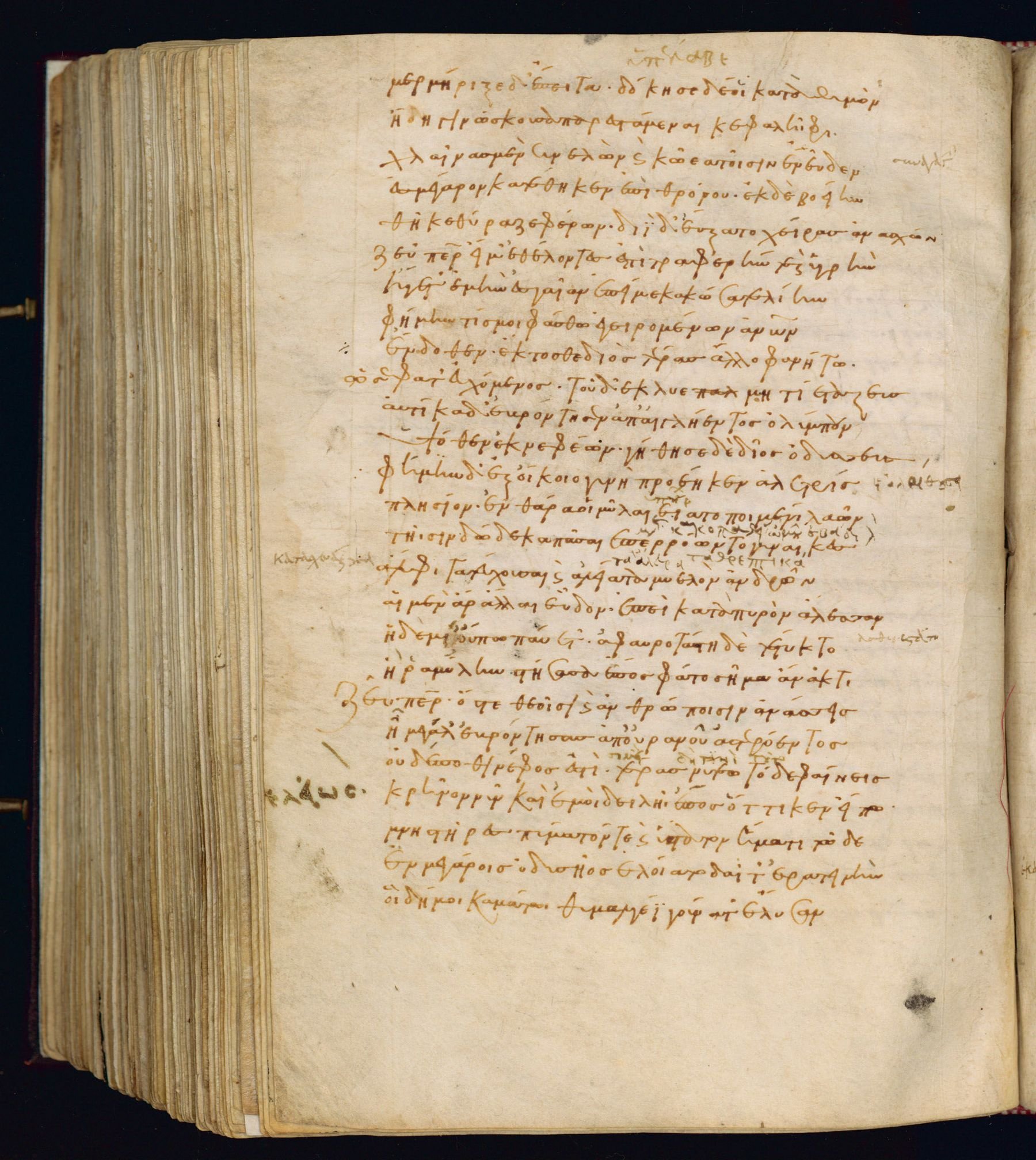
Where on the image
Laur. Plut. 32.24, fol. 199v: Odyssey 20.93-118, begins ‹μερμήριζε δʼ ἔπειτα, δόκησε›, ends ‹καμάτῳ θυμαλγέι· γούνατʼ ἔλυσαν›. Checked on the image: first and last lines read and matched to the Greek. Fol. 199r ends with 20.92. Fol. 200r begins with 20.119. English blocks here: 95-99, 100-104, 105-109, 110-114, 115-119.
93μερμήριζε δʼ ἔπειτα, δόκησε δέ οἱ κατὰ θυμὸν
94ἤδη γιγνώσκουσα παρεστάμεναι κεφαλῆφι.
95χλαῖναν μὲν συνελὼν καὶ κώεα, τοῖσιν ἐνεῦδεν,
96ἐς μέγαρον κατέθηκεν ἐπὶ θρόνου, ἐκ δὲ βοείην
97θῆκε θύραζε φέρων, Διὶ δʼ εὔξατο χεῖρας ἀνασχών·
98Ζεῦ πάτερ, εἴ μʼ ἐθέλοντες ἐπὶ τραφερήν τε καὶ ὑγρὴν
99ἤγετʼ ἐμὴν ἐς γαῖαν, ἐπεί μʼ ἐκακώσατε λίην,
100φήμην τίς μοι φάσθω ἐγειρομένων ἀνθρώπων
101ἔνδοθεν, ἔκτοσθεν δὲ Διὸς τέρας ἄλλο φανήτω.
102ὣς ἔφατʼ εὐχόμενος· τοῦ δʼ ἔκλυε μητίετα Ζεύς,
103αὐτίκα δʼ ἐβρόντησεν ἀπʼ αἰγλήεντος Ὀλύμπου,
104ὑψόθεν ἐκ νεφέων· γήθησε δὲ δῖος Ὀδυσσεύς.
105φήμην δʼ ἐξ οἴκοιο γυνὴ προέηκεν ἀλετρὶς
106πλησίον, ἔνθʼ ἄρα οἱ μύλαι ἥατο ποιμένι λαῶν,
107τῇσιν δώδεκα πᾶσαι ἐπερρώοντο γυναῖκες
108ἄλφιτα τεύχουσαι καὶ ἀλείατα, μυελὸν ἀνδρῶν.
109αἱ μὲν ἄρʼ ἄλλαι εὗδον, ἐπεὶ κατὰ πυρὸν ἄλεσσαν,
110ἡ δὲ μίʼ οὔπω παύετʼ, ἀφαυροτάτη δʼ ἐτέτυκτο·
111ἥ ῥα μύλην στήσασα ἔπος φάτο, σῆμα ἄνακτι·
112Ζεῦ πάτερ, ὅς τε θεοῖσι καὶ ἀνθρώποισιν ἀνάσσεις,
113ἦ μεγάλʼ ἐβρόντησας ἀπʼ οὐρανοῦ ἀστερόεντος,
114οὐδέ ποθι νέφος ἐστί· τέρας νύ τεῳ τόδε φαίνεις.
115κρῆνον νῦν καὶ ἐμοὶ δειλῇ ἔπος, ὅττι κεν εἴπω·
116μνηστῆρες πύματόν τε καὶ ὕστατον ἤματι τῷδε
117ἐν μεγάροις Ὀδυσῆος ἑλοίατο δαῖτʼ ἐρατεινήν,
118οἳ δή μοι καμάτῳ θυμαλγέι· γούνατʼ ἔλυσαν
95Then he gathered up the cloak and the fleeces on which he was lying and laid them on a chair in the hall, and carried the ox-hide out of doors and set it down; and he lifted up his hands and prayed to Zeus: “Father Zeus, if of your good will ye gods have brought me over land and sea to my own country, when ye had afflicted me sore, 100let some one of those who are awaking utter a word of omen for me within, and without let a sign from Zeus be shown besides.” So he spoke in prayer, and Zeus the counsellor heard him. Straightway he thundered from gleaming Olympus, from on high from out the clouds; and goodly Odysseus was glad. 105And a woman, grinding at the mill, uttered a word of omen from within the house hard by, where the mills of the shepherd of the people were set. At these mills twelve women in all were wont to ply their tasks, making meal of barley and of wheat, the marrow of men. Now the others were sleeping, for they had ground their wheat, 110but she alone had not yet ceased, for she was the weakest of all. She now stopped her mill and spoke a word, a sign for her master: “Father Zeus, who art lord over gods and men, verily loud hast thou thundered from the starry sky, yet nowhere is there any cloud: surely this is a sign that thou art showing to some man. 115Fulfil now even for wretched me the word that I shall speak. May the wooers this day for the last and latest time hold their glad feast in the halls of Odysseus. They that have loosened my limbs with bitter labour, as I made them barley meal, may they now sup their last.”
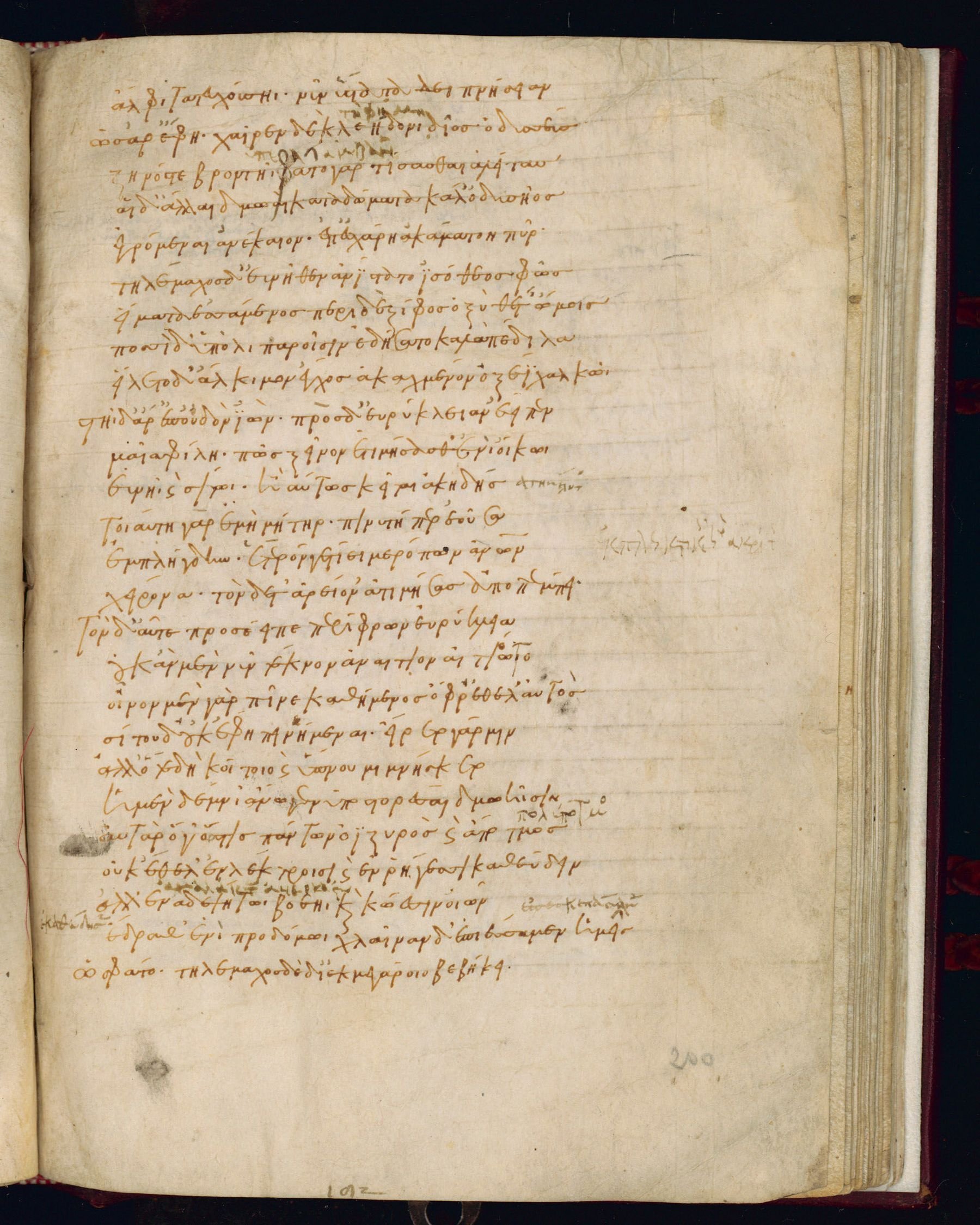
Where on the image
Laur. Plut. 32.24, fol. 200r: Odyssey 20.119-144, begins ‹ἄλφιτα τευχούσῃ· νῦν ὕστατα›, ends ‹δὲ διὲκ μεγάροιο βεβήκει›. Checked on the image: first and last lines read and matched to the Greek. Fol. 199v ends with 20.118. Fol. 200v begins with 20.145. English blocks here: 120-124, 125-129, 130-132, 133-134, 135-139, 140-144.
119ἄλφιτα τευχούσῃ· νῦν ὕστατα δειπνήσειαν.
120ὣς ἄρʼ ἔφη, χαῖρεν δὲ κλεηδόνι δῖος Ὀδυσσεὺς
121Ζηνός τε βροντῇ· φάτο γὰρ τίσασθαι ἀλείτας.
122αἱ δʼ ἄλλαι δμῳαὶ κατὰ δώματα κάλʼ Ὀδυσῆος
123ἀγρόμεναι ἀνέκαιον ἐπʼ ἐσχάρῃ ἀκάματον πῦρ.
124Τηλέμαχος δʼ εὐνῆθεν ἀνίστατο, ἰσόθεος φώς,
125εἵματα ἑσσάμενος· περὶ δὲ ξίφος ὀξὺ θέτʼ ὤμῳ·
126ποσσὶ δʼ ὑπὸ λιπαροῖσιν ἐδήσατο καλὰ πέδιλα,
127εἵλετο δʼ ἄλκιμον ἔγχος, ἀκαχμένον ὀξέι· χαλκῷ·
128στῆ δʼ ἄρʼ ἐπʼ οὐδὸν ἰών, πρὸς δʼ Εὐρύκλειαν ἔειπε·
129μαῖα φίλη, τὸν ξεῖνον ἐτιμήσασθʼ ἐνὶ οἴκῳ
130εὐνῇ καὶ σίτῳ, ἦ αὔτως κεῖται ἀκηδής;
131τοιαύτη γὰρ ἐμὴ μήτηρ, πινυτή περ ἐοῦσα·
132ἐμπλήγδην ἕτερόν γε τίει μερόπων ἀνθρώπων
133χείρονα, τὸν δέ τʼ ἀρείονʼ ἀτιμήσασʼ ἀποπέμπει.
134τὸν δʼ αὖτε προσέειπε περίφρων Εὐρύκλεια·
135οὐκ ἄν μιν νῦν, τέκνον, ἀναίτιον αἰτιόῳο.
136οἶνον μὲν γὰρ πῖνε καθήμενος, ὄφρʼ ἔθελʼ αὐτός,
137σίτου δʼ οὐκέτʼ ἔφη πεινήμεναι· εἴρετο γάρ μιν.
138ἀλλʼ ὅτε δὴ κοίτοιο καὶ ὕπνου μιμνήσκοιτο,
139ἡ μὲν δέμνιʼ ἄνωγεν ὑποστορέσαι δμῳῇσιν,
140αὐτὰρ ὅ γʼ, ὥς τις πάμπαν ὀϊζυρὸς καὶ ἄποτμος,
141οὐκ ἔθελʼ ἐν λέκτροισι καὶ ἐν ῥήγεσσι καθεύδειν,
142ἀλλʼ ἐν ἀδεψήτῳ βοέῃ καὶ κώεσιν οἰῶν
143ἔδραθʼ ἐνὶ προδόμῳ· χλαῖναν δʼ ἐπιέσσαμεν ἡμεῖς.
144ὣς φάτο, Τηλέμαχος δὲ διὲκ μεγάροιο βεβήκει
120So she spoke, and goodly Odysseus was glad at the word of omen and at the thunder of Zeus, for he thought he had gotten vengeance on the guilty. Now the other maidens in the fair palace of Odysseus had gathered together and were kindling on the hearth unwearied fire, and Telemachus rose from his bed, a godlike man, 125and put on his clothing. He slung his sharp sword about his shoulder, and beneath his shining feet he bound his fair sandals; and he took his mighty spear, tipped with sharp bronze, and went and stood upon the threshold, and spoke to Eurycleia: “Dear nurse, have ye honored the stranger in our house 130with bed and food, or does he lie all uncared for? For such is my mother's way, wise though she is: in wondrous fashion she honours one of mortal men, though he be the worse, while the better she sends unhonored away.” 133Then wise Eurycleia answered him: 135“In this matter, child, thou shouldest not blame her, who is without blame. He sat here and drank wine as long as he would, but for food he said he had no more hunger, for she asked him. But when he bethought him of rest and sleep, she bade the maidens strew his bed. 140But he, as one wholly wretched and hapless, would not sleep on a bed and under blankets, but on an undressed ox-hide and fleeces of sheep he slept in the fore-hall, and we flung over him a cloak.” So she spoke, and Telemachus went forth through the hall
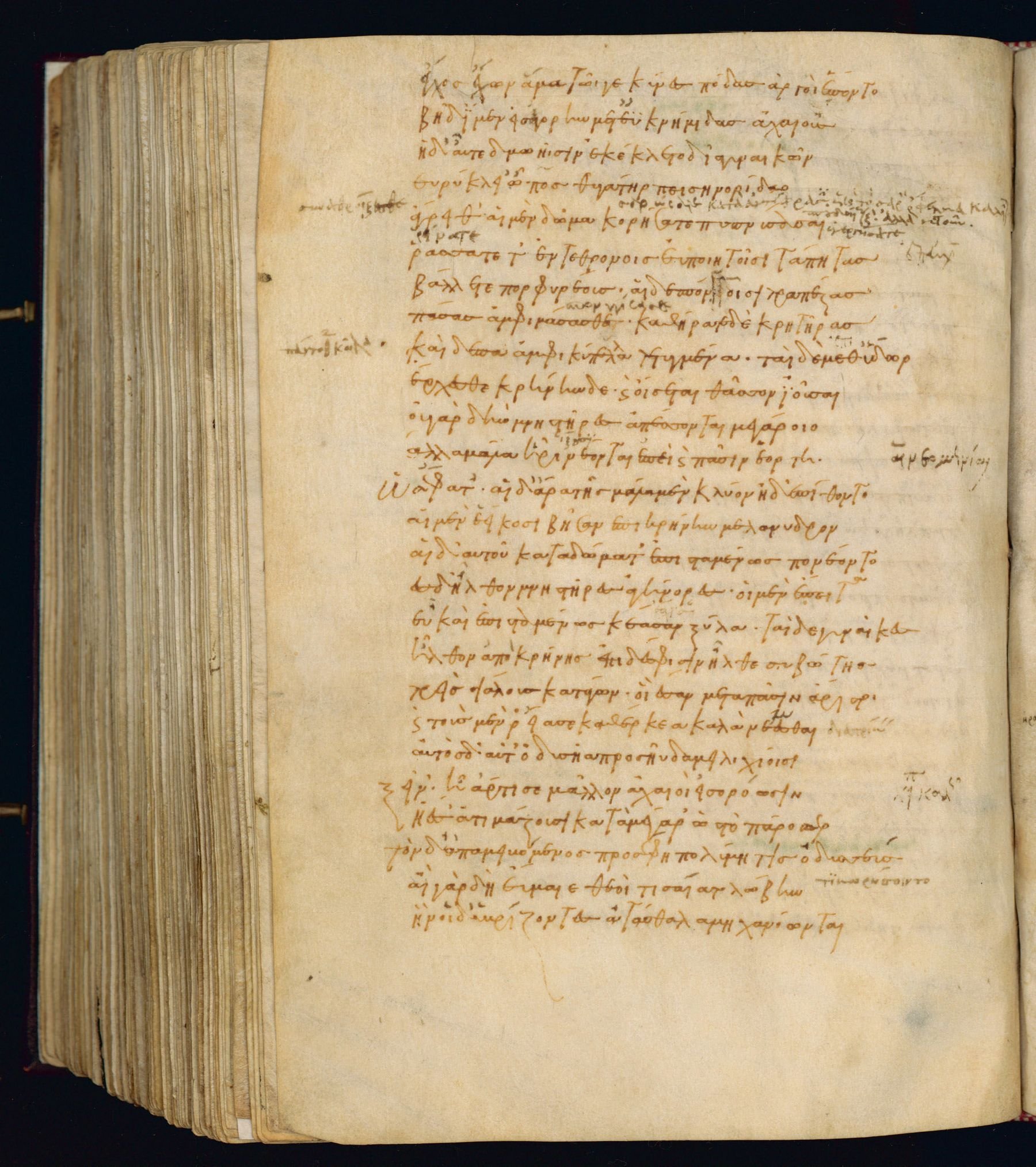
Where on the image
Laur. Plut. 32.24, fol. 200v: Odyssey 20.145-170, begins ‹ἔγχος ἔχων, ἅμα τῷ›, ends ‹οἵδʼ ὑβρίζοντες ἀτάσθαλα μηχανόωνται›. Checked on the image: first and last lines read and matched to the Greek. Fol. 200r ends with 20.144. Fol. 201r begins with 20.171. English blocks here: 145-149, 150-154, 155-159, 160-164, 165-169.
145ἔγχος ἔχων, ἅμα τῷ γε δύω κύνες ἀργοὶ ἕποντο.
146βῆ δʼ ἴμεν εἰς ἀγορὴν μετʼ ἐϋκνήμιδας Ἀχαιούς.
147ἡ δʼ αὖτε δμῳῇσιν ἐκέκλετο δῖα γυναικῶν,
148Εὐρύκλειʼ, Ὦπος θυγάτηρ Πεισηνορίδαο·
149ἀγρεῖθʼ, αἱ μὲν δῶμα κορήσατε ποιπνύσασαι,
150ῥάσσατέ τʼ, ἔν τε θρόνοις εὐποιήτοισι τάπητας
151βάλλετε πορφυρέους· αἱ δὲ σπόγγοισι τραπέζας
152πάσας ἀμφιμάσασθε, καθήρατε δὲ κρητῆρας
153καὶ δέπα ἀμφικύπελλα τετυγμένα· ταὶ δὲ μεθʼ ὕδωρ
154ἔρχεσθε κρήνηνδε, καὶ οἴσετε θᾶσσον ἰοῦσαι.
155οὐ γὰρ δὴν μνηστῆρες ἀπέσσονται μεγάροιο,
156ἀλλὰ μάλʼ ἦρι νέονται, ἐπεὶ καὶ πᾶσιν ἑορτή.
157ὣς ἔφαθʼ, αἱ δʼ ἄρα τῆς μάλα μὲν κλύον ἠδʼ ἐπίθοντο.
158αἱ μὲν ἐείκοσι βῆσαν ἐπὶ κρήνην μελάνυδρον,
159αἱ δʼ αὐτοῦ κατὰ δώματʼ ἐπισταμένως πονέοντο.
160ἐς δʼ ἦλθον δρηστῆρες Ἀχαιῶν. οἱ μὲν ἔπειτα
161εὖ καὶ ἐπισταμένως κέασαν ξύλα, ταὶ δὲ γυναῖκες
162ἦλθον ἀπὸ κρήνης· ἐπὶ δέ σφισιν ἦλθε συβώτης
163τρεῖς σιάλους κατάγων, οἳ ἔσαν μετὰ πᾶσιν ἄριστοι.
164καὶ τοὺς μέν ῥʼ εἴασε καθʼ ἕρκεα καλὰ νέμεσθαι,
165αὐτὸς δʼ αὖτʼ Ὀδυσῆα προσηύδα μειλιχίοισι·
166ξεῖνʼ, ἦ ἄρ τί σε μᾶλλον Ἀχαιοὶ εἰσορόωσιν,
167ἦέ σʼ ἀτιμάζουσι κατὰ μέγαρʼ, ὡς τὸ πάρος περ;
168τὸν δʼ ἀπαμειβόμενος προσέφη πολυμήτις Ὀδυσσεύς·
169αἲ γὰρ δή, Εὔμαιε, θεοὶ τισαίατο λώβην,
170ἣν οἵδʼ ὑβρίζοντες ἀτάσθαλα μηχανόωνται
145with his spear in his hand, and with him went two swift hounds. And he went his way to the place of assembly to join the company of the well-greaved Achaeans, but Eurycleia, the goodly lady, daughter of Ops, son of Peisenor, called to her maidens, saying: “Come, let some of you busily sweep the hall 150and sprinkle it, and throw on the shapely chairs coverlets of purple, and let others wipe all the tables with sponges and cleanse the mixing-bowls and the well-wrought double cups, and others still go to the spring for water and bring it quickly here. 155For the wooers will not long be absent from the hall, but will return right early; for it is a feast-day for all men.” So she spoke, and they readily hearkened and obeyed. Twenty of them went to the spring of dark water, and the others busied themselves there in the house in skilful fashion. 160Then in came the serving-men of the Acheans, who thereafter split logs of wood well and skilfully; and the women came back from the spring. After them came the swineherd, driving three boars which were the best in all his herd. These he let be to feed in the fair courts, 165but himself spoke to Odysseus with gentle words: “Stranger, do the Achaeans look on thee with any more regard, or do they dishonor thee in the halls as before?” Then Odysseus of many wiles answered him, and said: “Ah, Eumaeus, I would that the gods might take vengeance on the outrage
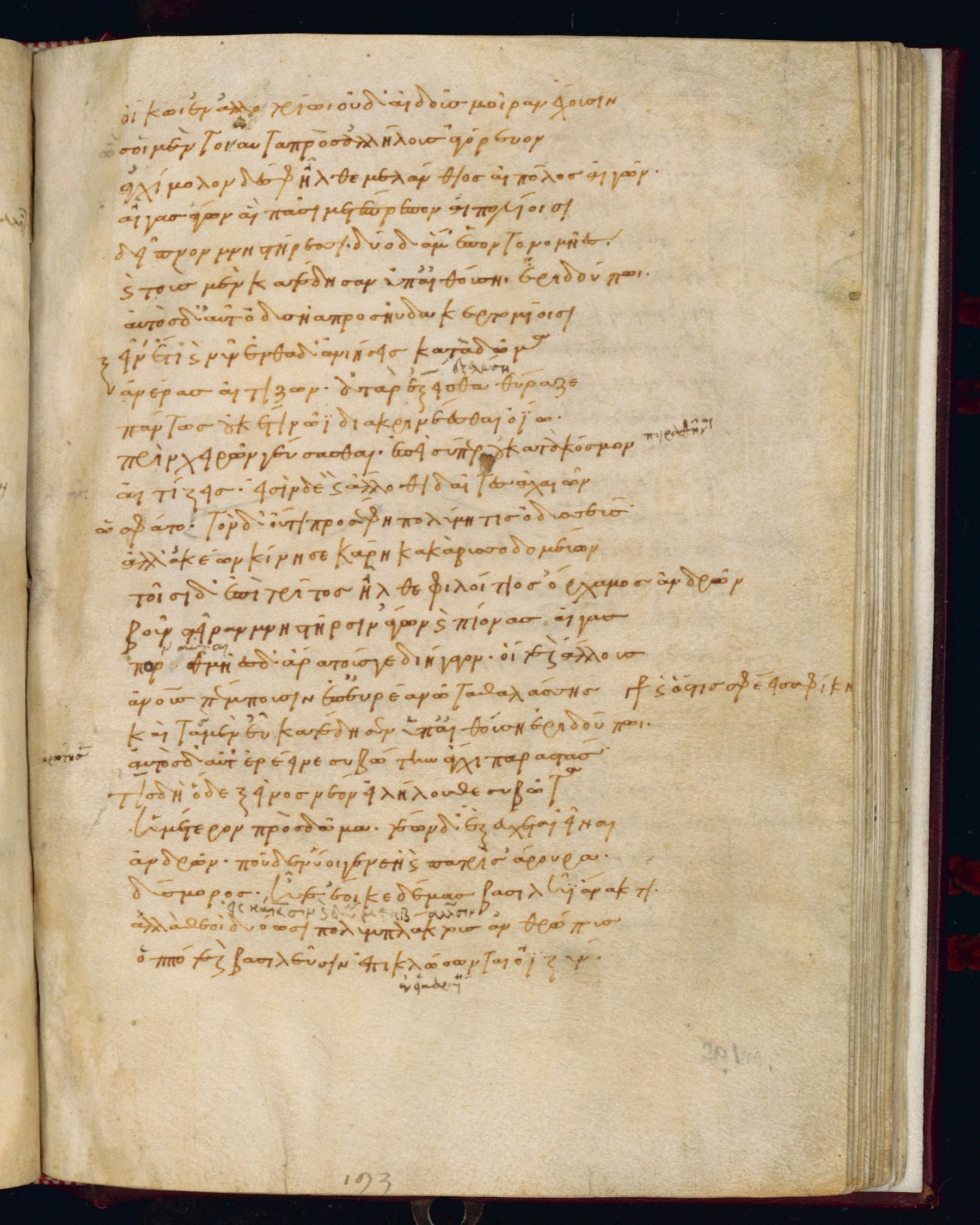
Where on the image
Laur. Plut. 32.24, fol. 201r: Odyssey 20.171-196, begins ‹οἴκῳ ἐν ἀλλοτρίῳ, οὐδʼ›, ends ‹καὶ βασιλεῦσιν ἐπικλώσωνται ὀϊζύν.›. Checked on the image: first and last lines read and matched to the Greek. Fol. 200v ends with 20.170. Fol. 201v begins with 20.197. English blocks here: 170-174, 175-179, 180-182, 183-184, 185-189, 190-194.
171οἴκῳ ἐν ἀλλοτρίῳ, οὐδʼ αἰδοῦς μοῖραν ἔχουσιν.
172ὣς οἱ μὲν τοιαῦτα πρὸς ἀλλήλους ἀγόρευον,
173ἀγχίμολον δέ σφʼ ἦλθε Μελάνθιος, αἰπόλος αἰγῶν.
174αἶγας ἄγων αἳ πᾶσι μετέπρεπον αἰπολίοισι,
175δεῖπνον μνηστήρεσσι. δύω δʼ ἅμʼ ἕποντο νομῆες.
176καὶ τὰς μὲν κατέδησεν ὑπʼ αἰθούσῃ ἐριδούπῳ,
177αὐτὸς δʼ αὖτʼ Ὀδυσῆα προσηύδα κερτομίοισι·
178ξεῖνʼ, ἔτι καὶ νῦν ἐνθάδʼ ἀνιήσεις κατὰ δῶμα
179ἀνέρας αἰτίζων, ἀτὰρ οὐκ ἔξεισθα θύραζε;
180πάντως οὐκέτι νῶϊ διακρινέεσθαι ὀΐω
181πρὶν χειρῶν γεύσασθαι, ἐπεὶ σύ περ οὐ κατὰ κόσμον
182αἰτίζεις· εἰσὶν δὲ καὶ ἄλλαι δαῖτες Ἀχαιῶν.
183ὣς φάτο, τὸν δʼ οὔ τι προσέφη πολύμητις Ὀδυσσεύς,
184ἀλλʼ ἀκέων κίνησε κάρη, κακὰ βυσσοδομεύων.
185τοῖσι δʼ ἐπὶ τρίτος ἦλθε Φιλοίτιος, ὄρχαμος ἀνδρῶν,
186βοῦν στεῖραν μνηστῆρσιν ἄγων καὶ πίονας αἶγας.
187πορθμῆες δʼ ἄρα τούς γε διήγαγον, οἵ τε καὶ ἄλλους
188ἀνθρώπους πέμπουσιν, ὅτις σφέας εἰσαφίκηται.
189καὶ τὰ μὲν εὖ κατέδησεν ὑπʼ αἰθούσῃ ἐριδούπῳ,
190αὐτὸς δʼ αὖτʼ ἐρέεινε συβώτην ἄγχι παραστάς·
191τίς δὴ ὅδε ξεῖνος νέον εἰλήλουθε, συβῶτα,
192ἡμέτερον πρὸς δῶμα; τέων δʼ ἐξ εὔχεται εἶναι
193ἀνδρῶν; ποῦ δέ νύ οἱ γενεὴ καὶ πατρὶς ἄρουρα;
194δύσμορος, ἦ τε ἔοικε δέμας βασιλῆϊ ἄνακτι·
195ἀλλὰ θεοὶ δυόωσι πολυπλάγκτους ἀνθρώπους,
196ὁππότε καὶ βασιλεῦσιν ἐπικλώσωνται ὀϊζύν.
170wherewith these men in wantonness devise wicked folly in another's house, and have no place for shame.” Thus they spoke to one another. And near to them came Melanthius the goatherd, leading she-goats that were the best in all the herds, 175to make a feast for the wooers, and two herdsmen followed with him. The goats he tethered beneath the echoing portico, and himself spoke to Odysseus with taunting words: “Stranger, wilt thou even now still be a plague to us here in the hall, asking alms of men, and wilt thou not begone? 180'Tis plain, methinks, that we two shall not part company till we taste one another's fists, for thy begging is in no wise decent. Also it is not here alone that there are feasts of the Achaeans.” 183So he spoke, but Odysseus of many wiles made no answer, but he shook his head in silence, pondering evil in the deep of his heart. 185Besides these a third man came, Philoetius, a leader of men, driving for the wooers a barren heifer and fat she-goats. These had been brought over from the mainland by ferrymen, who send other men, too, on their way, whosoever comes to them. The beasts he tethered carefully beneath the echoing portico, 190but himself came close to the swineherd and questioned him, saying: “Who is this stranger, swineherd, who has newly come to our house? From what men does he declare himself to be sprung? Where are his kinsmen and his native fields? Hapless man! Yet truly in form he is like a royal prince;
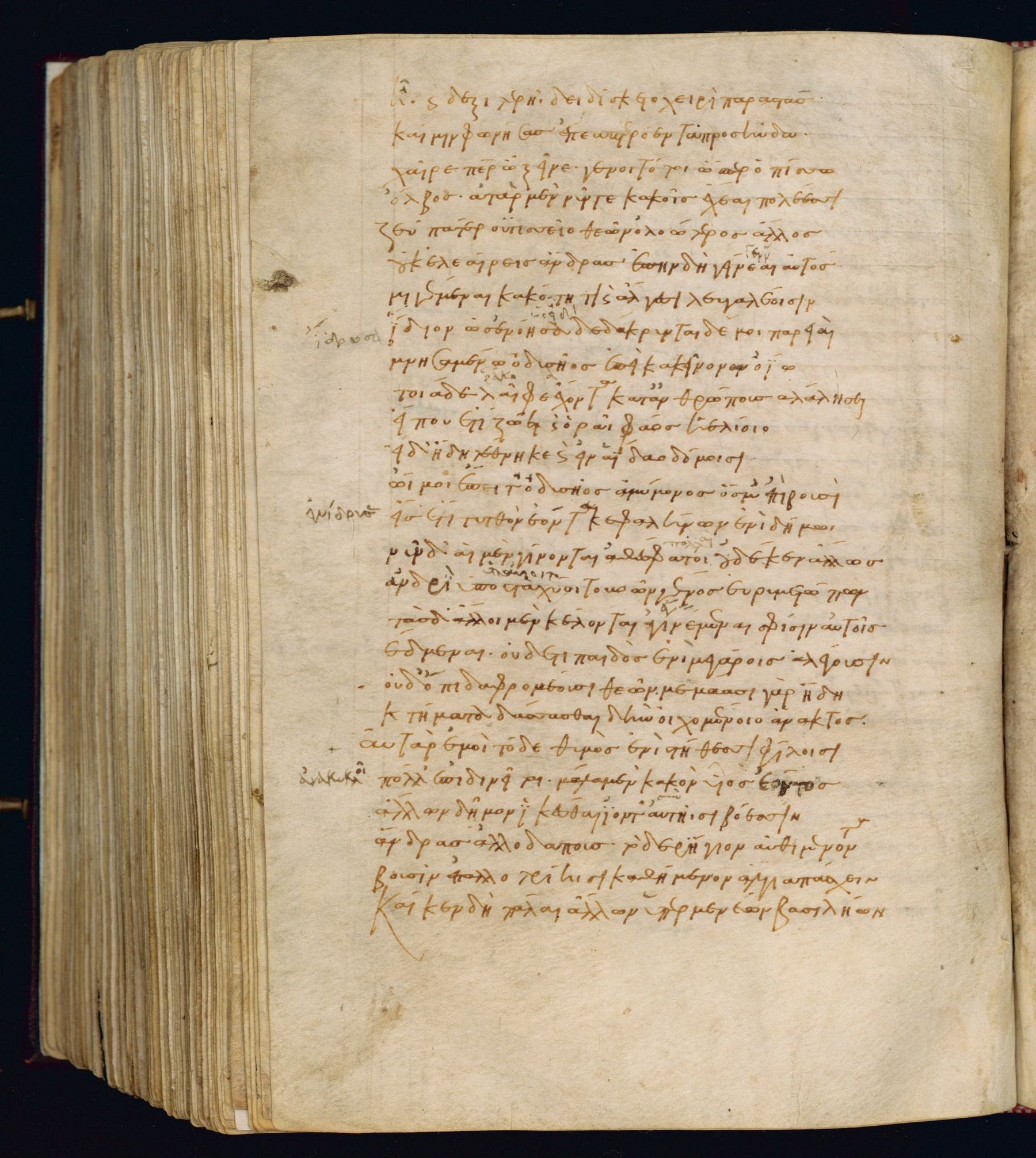
Where on the image
Laur. Plut. 32.24, fol. 201v: Odyssey 20.197-222, begins ‹ἦ καὶ δεξιτερῇ δειδίσκετο›, ends ‹πάλαι ἄλλον ὑπερμενέων βασιλήων›. Checked on the image: first and last lines read and matched to the Greek. Fol. 201r ends with 20.196. Fol. 202r begins with 20.223. English blocks here: 195-199, 200-204, 205-209, 210-214, 215-219, 220-224.
197ἦ καὶ δεξιτερῇ δειδίσκετο χειρὶ παραστάς,
198καί μιν φωνήσας ἔπεα πτερόεντα προσηύδα·
199χαῖρε, πάτερ ὦ ξεῖνε· γένοιτό τοι ἔς περ ὀπίσσω
200ὄλβος· ἀτὰρ μὲν νῦν γε κακοῖς ἔχεαι πολέεσσι.
201Ζεῦ πάτερ, οὔ τις σεῖο θεῶν ὀλοώτερος ἄλλος·
202οὐκ ἐλεαίρεις ἄνδρας, ἐπὴν δὴ γείνεαι αὐτός,
203μισγέμεναι κακότητι καὶ ἄλγεσι λευγαλέοισιν.
204ἴδιον, ὡς ἐνόησα, δεδάκρυνται δέ μοι ὄσσε
205μνησαμένῳ Ὀδυσῆος, ἐπεὶ καὶ κεῖνον ὀΐω
206τοιάδε λαίφεʼ ἔχοντα κατʼ ἀνθρώπους ἀλάλησθαι,
207εἴ που ἔτι ζώει καὶ ὁρᾷ φάος ἠελίοιο.
208εἰ δʼ ἤδη τέθνηκε καὶ εἰν Ἀΐδαο δόμοισιν,
209ὤ μοι ἔπειτʼ Ὀδυσῆος ἀμύμονος, ὅς μʼ ἐπὶ βουσὶν
210εἷσʼ ἔτι τυτθὸν ἐόντα Κεφαλλήνων ἐνὶ δήμῳ.
211νῦν δʼ αἱ μὲν γίγνονται ἀθέσφατοι, οὐδέ κεν ἄλλως
212ἀνδρί γʼ ὑποσταχύοιτο βοῶν γένος εὐρυμετώπων·
213τὰς δʼ ἄλλοι με κέλονται ἀγινέμεναί σφισιν αὐτοῖς
214ἔδμεναι· οὐδέ τι παιδὸς ἐνὶ μεγάροις ἀλέγουσιν,
215οὐδʼ ὄπιδα τρομέουσι θεῶν· μεμάασι γὰρ ἤδη
216κτήματα δάσσασθαι δὴν οἰχομένοιο ἄνακτος.
217αὐτὰρ ἐμοὶ τόδε θυμὸς ἐνὶ στήθεσσι φίλοισι
218πόλλʼ ἐπιδινεῖται· μάλα μὲν κακὸν υἷος ἐόντος
219ἄλλων δῆμον ἱκέσθαι ἰόντʼ αὐτῇσι βόεσσιν,
220ἄνδρας ἐς ἀλλοδαπούς· τὸ δὲ ῥίγιον, αὖθι μένοντα
221βουσὶν ἐπʼ ἀλλοτρίῃσι καθήμενον ἄλγεα πάσχειν.
222καί κεν δὴ πάλαι ἄλλον ὑπερμενέων βασιλήων
195howbeit the gods bring to misery far-wandering men, whenever they spin for them the threads of trouble, even though they be kings.” Therewith he drew near to Odysseus, and stretching forth his right hand in greeting, spoke and addressed him with winged words: “Hail, Sir stranger; 200may happy fortune be thine in time to come, though now thou art the thrall of many sorrows! Father Zeus, no other god is more baneful than thou; thou hast no pity on men when thou hast thyself given them birth, but bringest them into misery and wretched pains. The sweat broke out on me when I marked the man, and my eyes are full of tears 205as I think of Odysseus; for he, too, I ween, is clothed in such rags and is a wanderer among men, if indeed he still lives and beholds the light of the sun. But if he is already dead and in the house of Hades, then woe is me for blameless Odysseus, who 210set me over his cattle, when I was yet a boy, in the land of the Cephallenians And now these wax past counting; in no other wise could the breed of broad-browed cattle yield better increase for a mortal man. But strangers bid me drive these now for themselves to eat, and they care nothing for the son in the house, 215nor do they tremble at the wrath of the gods, for they are eager now to divide among themselves the possessions of our lord that has long been gone. Now, as for myself, the heart in my breast keeps revolving this matter: a very evil thing it is, while the son lives, to depart along with my cattle and go to a land of strangers, 220even to an alien folk; but this is worse still, to remain here and suffer woes in charge of cattle that are given over to others. Aye, verily, long ago would I have fled and come to some other of the proud kings, for now things are no more to be borne; but still I think of that hapless one, if perchance he might come back I know not whence,
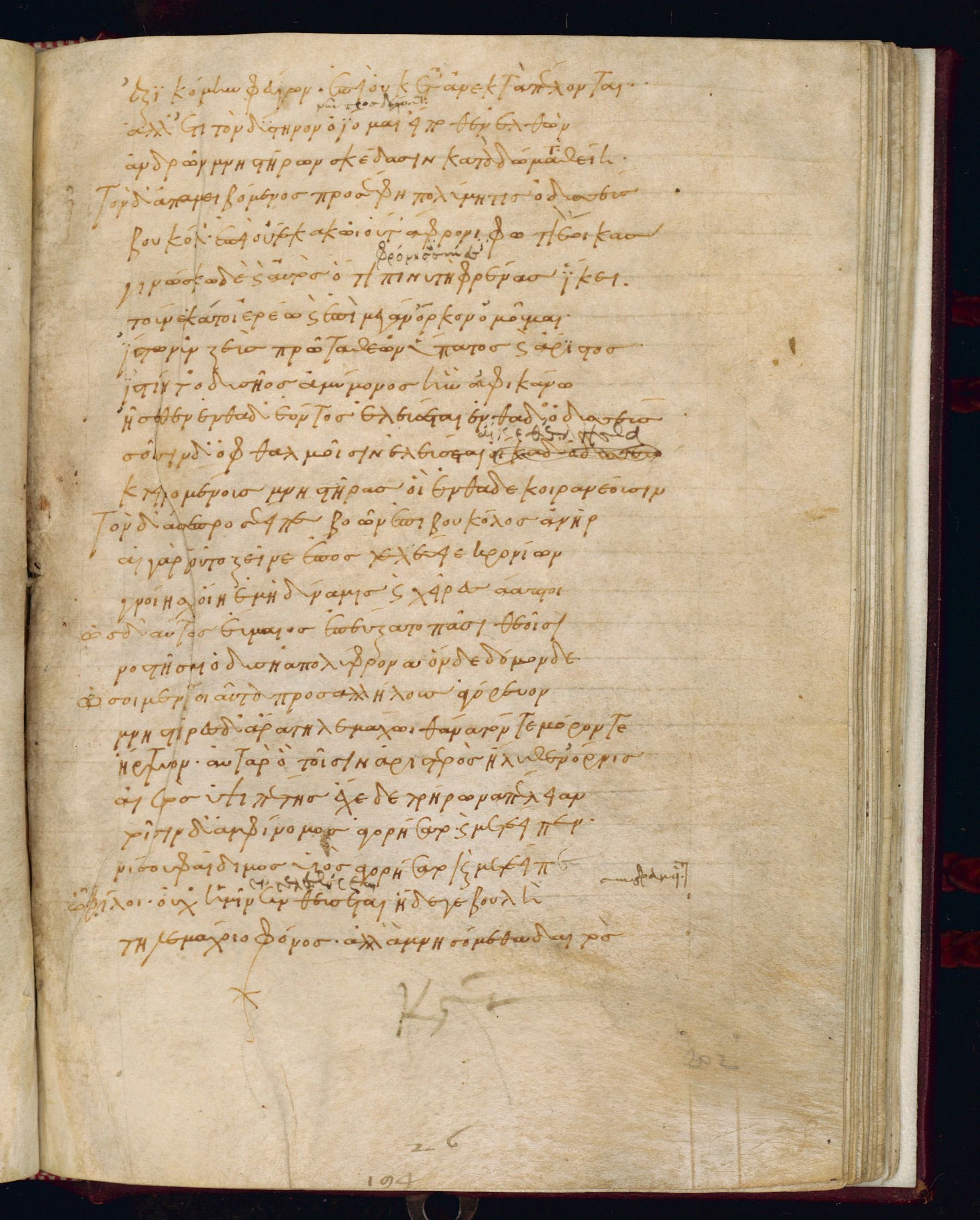
Where on the image
Laur. Plut. 32.24, fol. 202r: Odyssey 20.223-246, begins ‹ἐξικόμην φεύγων, ἐπεὶ οὐκέτʼ›, ends ‹φόνος· ἀλλὰ μνησώμεθα δαιτός.›. Checked on the image: first and last lines read and matched to the Greek. Fol. 201v ends with 20.222. Fol. 202v begins with 20.247. After 20.244 the page has a line not in Murray's text: Νίσου φαίδιμος υἱὸς ἀγορήσατο καὶ μετέειπε (25 lines for 24 edition verses). English blocks here: 225-225, 226-229, 230-234, 235-239, 240-244.
223ἐξικόμην φεύγων, ἐπεὶ οὐκέτʼ ἀνεκτὰ πέλονται·
224ἀλλʼ ἔτι τὸν δύστηνον ὀΐομαι, εἴ ποθεν ἐλθὼν
225ἀνδρῶν μνηστήρων σκέδασιν κατὰ δώματα θείῃ.
226τὸν δʼ ἀπαμειβόμενος προσέφη πολύμητις Ὀδυσσεύς·
227βουκόλʼ, ἐπεὶ οὔτε κακῷ οὔτʼ ἄφρονι φωτὶ ἔοικας,
228γιγνώσκω δὲ καὶ αὐτὸς ὅ τοι πινυτὴ φρένας ἵκει,
229τοὔνεκά τοι ἐρέω καὶ ἐπὶ μέγαν ὅρκον ὀμοῦμαι·
230ἴστω νῦν Ζεὺς πρῶτα θεῶν ξενίη τε τράπεζα
231ἱστίη τʼ Ὀδυσῆος ἀμύμονος, ἣν ἀφικάνω,
232ἦ σέθεν ἐνθάδʼ ἐόντος ἐλεύσεται οἴκαδʼ Ὀδυσσεύς·
233σοῖσιν δʼ ὀφθαλμοῖσιν ἐπόψεαι, αἴ κʼ ἐθέλῃσθα,
234κτεινομένους μνηστῆρας, οἳ ἐνθάδε κοιρανέουσιν.
235τὸν δʼ αὖτε προσέειπε βοῶν ἐπιβουκόλος ἀνήρ·
236αἲ γὰρ τοῦτο, ξεῖνε, ἔπος τελέσειε Κρονίων·
237γνοίης χʼ οἵη ἐμὴ δύναμις καὶ χεῖρες ἕπονται.
238ὣς δʼ αὔτως Εὔμαιος ἐπεύξατο πᾶσι θεοῖσι
239νοστῆσαι Ὀδυσῆα πολύφρονα ὅνδε δόμονδε.
240ὣς οἱ μὲν τοιαῦτα πρὸς ἀλλήλους ἀγόρευον,
241μνηστῆρες δʼ ἄρα Τηλεμάχῳ θάνατόν τε μόρον τε
242ἤρτυον· αὐτὰρ ὁ τοῖσιν ἀριστερὸς ἤλυθεν ὄρνις,
243αἰετὸς ὑψιπέτης, ἔχε δὲ τρήρωνα πέλειαν.
244τοῖσιν δʼ Ἀμφίνομος ἀγορήσατο καὶ μετέειπεν·
245ὦ φίλοι, οὐχ ἡμῖν συνθεύσεται ἥδε γε βουλή,
246Τηλεμάχοιο φόνος· ἀλλὰ μνησώμεθα δαιτός.
225and make a scattering of the wooers in his house.” 226Then Odysseus of many wiles answered him, and said: “Neatherd, since thou seemest to be neither an evil man nor a witless, and I see for myself that thou hast gotten an understanding heart, therefore will I speak out and swear a great oath to confirm my words. 230Now be my witness Zeus above all gods, and this hospitable board, and the hearth of noble Odysseus to which I am come, that verily while thou art here Odysseus shall come home, and thou shalt see with thine eyes, if thou wilt, the slaying of the wooers, who lord it here.” 235Then the herdsman of the cattle answered him: “Ah, stranger, I would that the son of Cronos might fulfil this word of thine! Then shouldest thou know what manner of might is mine, and how my hands obey.” And even in like manner did Eumaeus pray to all the gods that wise Odysseus might come back to his own home. 240Thus they spoke to one another, but the wooers meanwhile were plotting death and fate for Telemachus; howbeit there came to them a bird on their left, an eagle of lofty flight, clutching a timid dove. Then Amphinomus spoke in their assembly, and said:
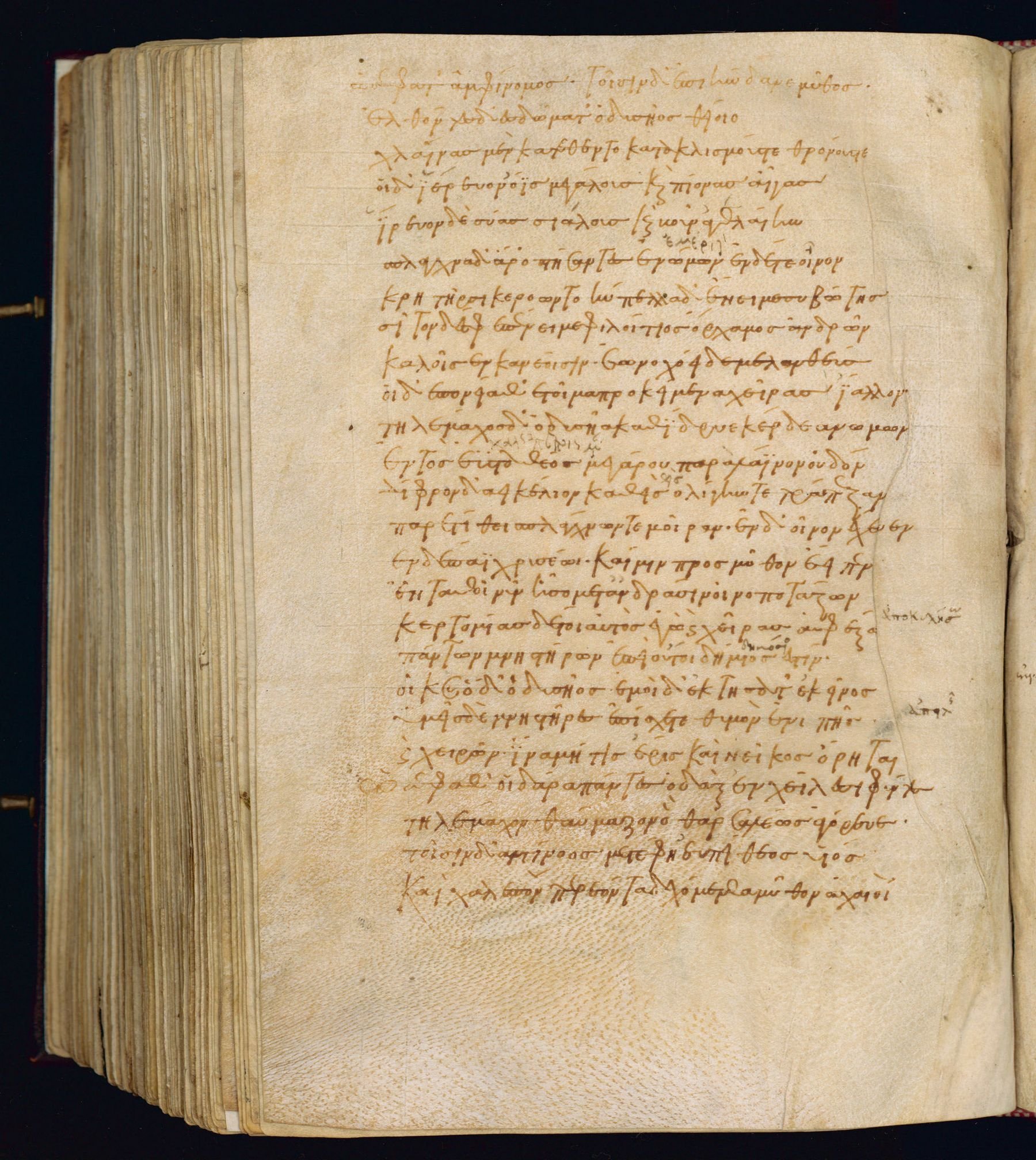
Where on the image
Laur. Plut. 32.24, fol. 202v: Odyssey 20.247-271, begins ‹ὣς ἔφατʼ Ἀμφίνομος, τοῖσιν›, ends ‹ἐόντα δεχώμεθα μῦθον, Ἀχαιοί,›. Checked on the image: first and last lines read and matched to the Greek. Fol. 202r ends with 20.246. Fol. 203r begins with 20.272. English blocks here: 245-249, 250-254, 255-259, 260-264, 265-267, 268-269.
247ὣς ἔφατʼ Ἀμφίνομος, τοῖσιν δʼ ἐπιήνδανε μῦθος.
248ἐλθόντες δʼ ἐς δώματʼ Ὀδυσσῆος θείοιο
249χλαίνας μὲν κατέθεντο κατὰ κλισμούς τε θρόνους τε,
250οἱ δʼ ἱέρευον ὄϊς μεγάλους καὶ πίονας αἶγας,
251ἵρευον δὲ σύας σιάλους καὶ βοῦν ἀγελαίην·
252σπλάγχνα δʼ ἄρʼ ὀπτήσαντες ἐνώμων, ἐν δέ τε οἶνον
253κρητῆρσιν κερόωντο· κύπελλα δὲ νεῖμε συβώτης.
254σῖτον δέ σφʼ ἐπένειμε Φιλοίτιος, ὄρχαμος ἀνδρῶν,
255καλοῖς ἐν κανέοισιν, ἐῳνοχόει δὲ Μελανθεύς.
256οἱ δʼ ἐπʼ ὀνείαθʼ ἑτοῖμα προκείμενα χεῖρας ἴαλλον.
257Τηλέμαχος δʼ Ὀδυσῆα καθίδρυε, κέρδεα νωμῶν,
258ἐντὸς ἐϋσταθέος μεγάρου, παρὰ λάϊνον οὐδόν,
259δίφρον ἀεικέλιον καταθεὶς ὀλίγην τε τράπεζαν·
260πὰρ δʼ ἐτίθει σπλάγχνων μοίρας, ἐν δʼ οἶνον ἔχευεν
261ἐν δέπαϊ χρυσέῳ, καί μιν πρὸς μῦθον ἔειπεν·
262ἐνταυθοῖ νῦν ἧσο μετʼ ἀνδράσιν οἰνοποτάζων·
263κερτομίας δέ τοι αὐτὸς ἐγὼ καὶ χεῖρας ἀφέξω
264πάντων μνηστήρων, ἐπεὶ οὔ τοι δήμιός ἐστιν
265οἶκος ὅδʼ, ἀλλʼ Ὀδυσῆος, ἐμοὶ δʼ ἐκτήσατο κεῖνος.
266ὑμεῖς δέ, μνηστῆρες, ἐπίσχετε θυμὸν ἐνιπῆς
267καὶ χειρῶν, ἵνα μή τις ἔρις καὶ νεῖκος ὄρηται.
268ὣς ἔφαθʼ, οἱ δʼ ἄρα πάντες ὀδὰξ ἐν χείλεσι φύντες
269Τηλέμαχον θαύμαζον, ὃ θαρσαλέως ἀγόρευε.
270τοῖσιν δʼ Ἀντίνοος μετέφη, Εὐπείθεος υἱός·
271καὶ χαλεπόν περ ἐόντα δεχώμεθα μῦθον, Ἀχαιοί,
245“Friends, this plan of ours will not run to our liking, even the slaying of Telemachus; nay, let us bethink us of the feast.” So spoke Amphinomus, and his word was pleasing to them. Then, going into the house of godlike Odysseus, they laid their cloaks on the chairs and high seats, 250and men fell to slaying great sheep and fat goats, aye, and fatted swine, and the heifer of the herd. Then they roasted the entrails and served them out, and mixed wine in the bowls, and the swineherd handed out the cups. And Philoetius, a leader of men, handed them bread 255in a beautiful basket, and Melanthius poured them wine. So they put forth their hands to the good cheer lying ready before them. But Telemachus, with crafty thought, made Odysseus sit within the well-built hall by the threshold of stone, and placed for him a mean stool and a little table. 260Beside him he set portions of the entrails and poured wine in a cup of gold, and said to him: “Sit down here among the lords and drink thy wine, and the revilings and blows of all the wooers will I myself ward from thee; for this is no public 265resort, but the house of Odysseus, and it was for me that he won it. And for your part, ye wooers, refrain your minds from rebukes and blows, that no strife or quarrel may arise.” 268So he spoke, and they all bit their lips and marvelled at Telemachus for that he spoke boldly;
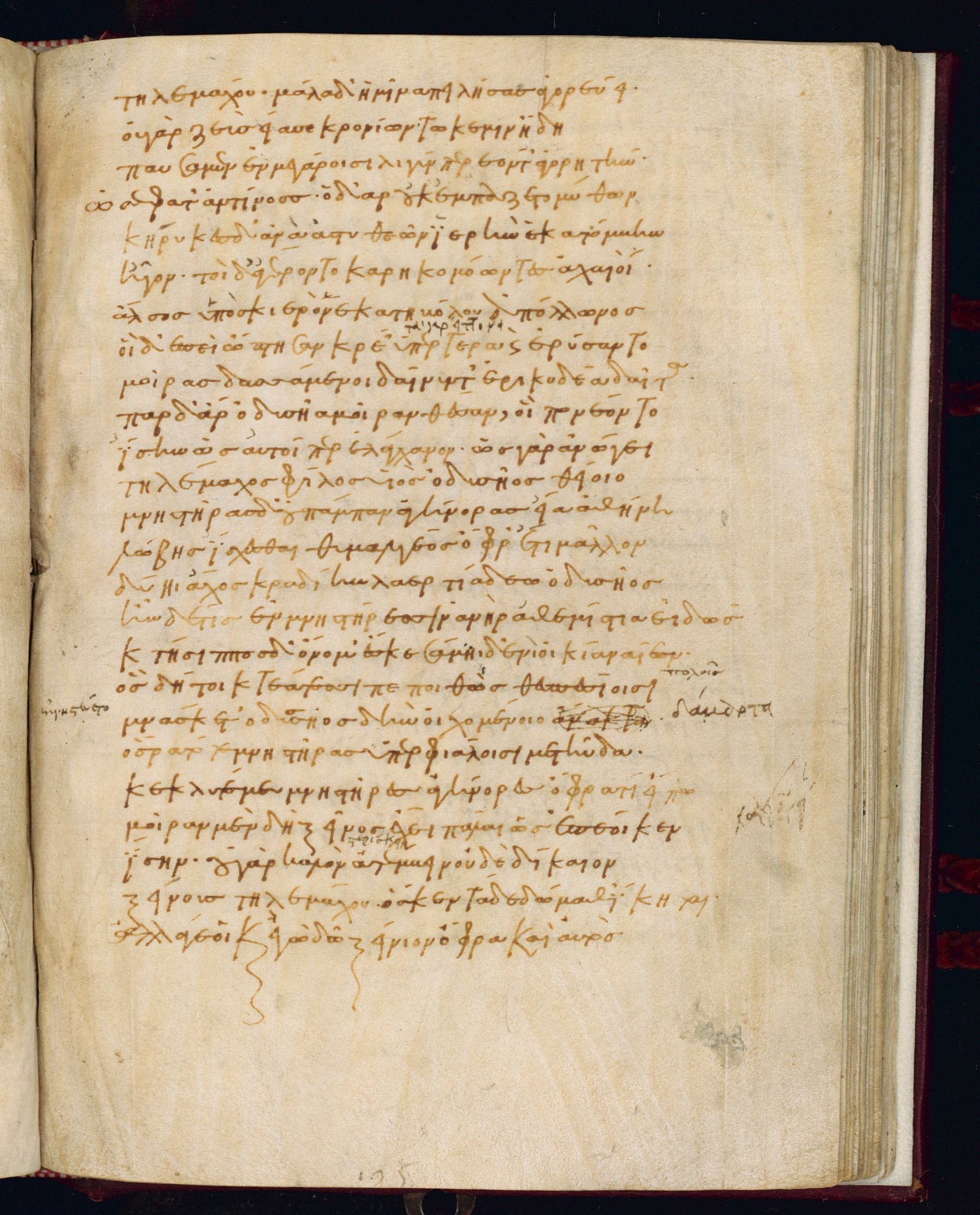
Where on the image
Laur. Plut. 32.24, fol. 203r: Odyssey 20.272-296, begins ‹Τηλεμάχου· μάλα δʼ ἧμιν›, ends ‹ξείνιον, ὄφρα καὶ αὐτὸς›. Checked on the image: first and last lines read and matched to the Greek. Fol. 202v ends with 20.271. Fol. 203v begins with 20.297. English blocks here: 270-274, 275-279, 280-284, 285-289, 290-294, 295-298.
272Τηλεμάχου· μάλα δʼ ἧμιν ἀπειλήσας ἀγορεύει.
273οὐ γὰρ Ζεὺς εἴασε Κρονίων· τῷ κέ μιν ἤδη
274παύσαμεν ἐν μεγάροισι, λιγύν περ ἐόντʼ ἀγορητήν.
275ὣς ἔφατʼ Ἀντίνοος· ὁ δʼ ἄρʼ οὐκ ἐμπάζετο μύθων.
276κήρυκες δʼ ἀνὰ ἄστυ θεῶν ἱερὴν ἑκατόμβην
277ἦγον· τοὶ δʼ ἀγέροντο κάρη κομόωντες Ἀχαιοὶ
278ἄλσος ὕπο σκιερὸν ἑκατηβόλου Ἀπόλλωνος.
279οἱ δʼ ἐπεὶ ὤπτησαν κρέʼ ὑπέρτερα καὶ ἐρύσαντο,
280μοίρας δασσάμενοι δαίνυντʼ ἐρικυδέα δαῖτα·
281πὰρ δʼ ἄρʼ Ὀδυσσῆϊ μοῖραν θέσαν οἳ πονέοντο
282ἴσην, ὡς αὐτοί περ ἐλάγχανον· ὣς γὰρ ἀνώγει
283Τηλέμαχος, φίλος υἱὸς Ὀδυσσῆος θείοιο.
284μνηστῆρας δʼ οὐ πάμπαν ἀγήνορας εἴα Ἀθήνη
285λώβης ἴσχεσθαι θυμαλγέος, ὄφρʼ ἔτι μᾶλλον
286δύη ἄχος κραδίην Λαερτιάδην Ὀδυσῆα.
287ἦν δέ τις ἐν μνηστῆρσιν ἀνὴρ ἀθεμίστια εἰδώς,
288Κτήσιππος δʼ ὄνομʼ ἔσκε, Σάμῃ δʼ ἐνὶ οἰκία ναῖεν·
289ὃς δή τοι κτεάτεσσι πεποιθὼς θεσπεσίοισι
290μνάσκετʼ Ὀδυσσῆος δὴν οἰχομένοιο δάμαρτα.
291ὅς ῥα τότε μνηστῆρσιν ὑπερφιάλοισι μετηύδα·
292κέκλυτέ μευ, μνηστῆρες ἀγήνορες, ὄφρα τι εἴπω·
293μοῖραν μὲν δὴ ξεῖνος ἔχει πάλαι, ὡς ἐπέοικεν,
294ἴσην· οὐ γὰρ καλὸν ἀτέμβειν οὐδὲ δίκαιον
295ξείνους Τηλεμάχου, ὅς κεν τάδε δώμαθʼ ἵκηται.
296ἀλλʼ ἄγε οἱ καὶ ἐγὼ δῶ ξείνιον, ὄφρα καὶ αὐτὸς
270and Antinous, son of Eupeithes, spoke among them, saying: “Hard though it be, Achaeans, let us accept the word of Telemachus, though boldly he threatens us in his speech. For Zeus, son of Cronos, did not suffer it, else would we ere now have silenced him in the halls, clear-voiced talker though he is.” 275So spoke Antinous, but Telemachus paid no heed to his words. Meanwhile the heralds were leading through the city the holy hecatomb of the gods, and the long-haired Achaeans gathered together beneath a shady grove of Apollo, the archer-god. But when they had roasted the outer flesh and drawn it off the spits, 280they divided the portions and feasted a glorious feast. And by Odysseus those who served set a portion equal to that which they received themselves, for so Telemachus commanded, the dear son of divine Odysseus. But the proud wooers Athena 285would in no wise suffer to abstain from bitter outrage, that pain might sink yet deeper into the heart of Odysseus, son of Laertes. There was among the wooers a man with his heart set on lawlessness—Ctesippus was his name, and in Same was his dwelling—who, trusting forsooth in his boundless wealth, 290wooed the wife of Odysseus, that had long been gone. He it was who now spoke among the haughty wooers: “Hear me, ye proud wooers, that I may say somewhat. A portion has the stranger long had, an equal portion, as is meet; for it is not well nor just to rob of their due 295the guests of Telemachus, whosoever he be that comes to this house. Nay, come, I too will give him a stranger's-gift, that he in turn may give a present either to the bath-woman or to some other of the slaves who are in the house of godlike Odysseus.”
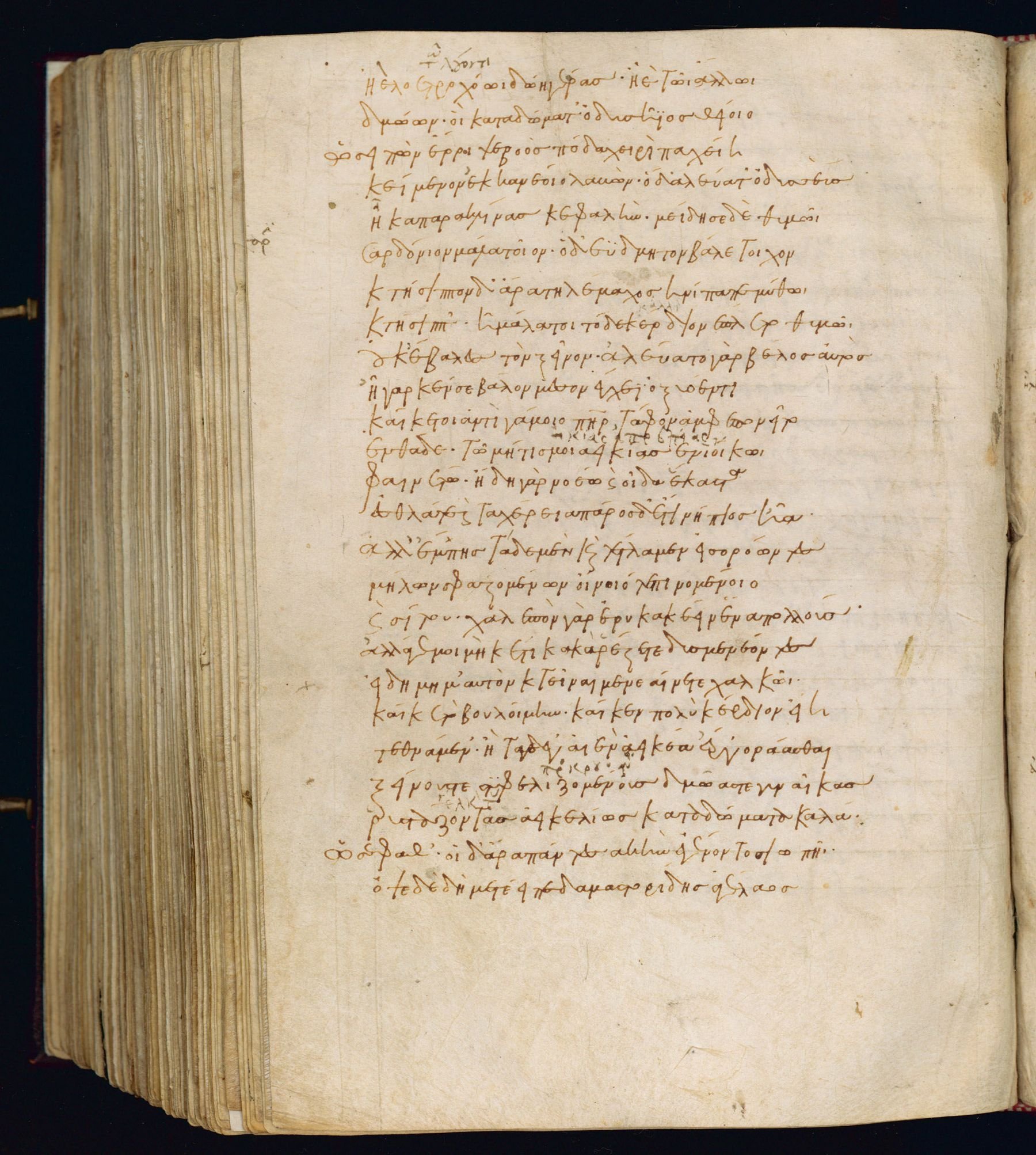
Where on the image
Laur. Plut. 32.24, fol. 203v: Odyssey 20.297-321, begins ‹ἠὲ λοετροχόῳ δώῃ γέρας›, ends ‹δὴ μετέειπε Δαμαστορίδης Ἀγέλαος·›. Checked on the image: first and last lines read and matched to the Greek. Fol. 203r ends with 20.296. Fol. 204r begins with 20.322. English blocks here: 299-299, 300-304, 305-309, 310-314, 315-319.
297ἠὲ λοετροχόῳ δώῃ γέρας ἠέ τῳ ἄλλῳ
298δμώων, οἳ κατὰ δώματʼ Ὀδυσσῆος θείοιο.
299ὣς εἰπὼν ἔρριψε βοὸς πόδα χειρὶ παχείῃ.
300κείμενον ἐκ κανέοιο λαβών· ὁ δʼ ἀλεύατʼ Ὀδυσσεὺς
301ἦκα παρακλίνας κεφαλήν, μείδησε δὲ θυμῷ
302σαρδάνιον μάλα τοῖον· ὁ δʼ εὔδμητον βάλε τοῖχον.
303Κτήσιππον δʼ ἄρα Τηλέμαχος ἠνίπαπε μύθῳ·
304Κτήσιππʼ, ἦ μάλα τοι τόδε κέρδιον ἔπλετο θυμῷ·
305οὐκ ἔβαλες τὸν ξεῖνον· ἀλεύατο γὰρ βέλος αὐτός.
306ἦ γάρ κέν σε μέσον βάλον ἔγχεϊ ὀξυόεντι,
307καί κέ τοι ἀντὶ γάμοιο πατὴρ τάφον ἀμφεπονεῖτο
308ἐνθάδε. τῷ μή τίς μοι ἀεικείας ἐνὶ οἴκῳ
309φαινέτω· ἤδη γὰρ νοέω καὶ οἶδα ἕκαστα,
310ἐσθλά τε καὶ τὰ χέρηα· πάρος δʼ ἔτι νήπιος ἦα.
311ἀλλʼ ἔμπης τάδε μὲν καὶ τέτλαμεν εἰσορόωντες,
312μήλων σφαζομένων οἴνοιό τε πινομένοιο
313καὶ σίτου· χαλεπὸν γὰρ ἐρυκακέειν ἕνα πολλούς.
314ἀλλʼ ἄγε μηκέτι μοι κακὰ ῥέζετε δυσμενέοντες·
315εἰ δʼ ἤδη μʼ αὐτὸν κτεῖναι μενεαίνετε χαλκῷ,
316καί κε τὸ βουλοίμην, καί κεν πολὺ κέρδιον εἴη
317τεθνάμεν ἢ τάδε γʼ αἰὲν ἀεικέα ἔργʼ ὁράασθαι,
318ξείνους τε στυφελιζομένους δμῳάς τε γυναῖκας
319ῥυστάζοντας ἀεικελίως κατὰ δώματα καλά.
320ὣς ἔφαθʼ, οἱ δʼ ἄρα πάντες ἀκὴν ἐγένοντο σιωπῇ·
321ὀψὲ δὲ δὴ μετέειπε Δαμαστορίδης Ἀγέλαος·
299So saying, he hurled with strong hand the hoof of an ox, 300taking it up from the basket where it lay. But Odysseus avoided it with a quick turn of his head, and in his heart he smiled a right grim and bitter smile; and the ox's hoof struck the well-built wall. Then Telemachus rebuked Ctesippus, and said: “Ctesippus, verily this thing fell out more to thy soul's profit. 305Thou didst not smite the stranger, for he himself avoided thy missile, else surely would I have struck thee through the middle with my sharp spear, and instead of a wedding feast thy father would have been busied with a funeral feast in this land. Wherefore let no man, I warn you, make a show of forwardness in my house; for now I mark and understand all things, 310the good and the evil, whereas heretofore I was but a child. But none the less we still endure to see these deeds, while sheep are slaughtered, and wine drunk, and bread consumed, for hard it is for one man to restrain many. Yet come, no longer work me harm of your evil wills. 315But if you are minded even now to slay me myself with the sword, even that would I choose, and it would be better far to die than continually to behold these shameful deeds, strangers mishandled and men dragging the handmaidens in shameful fashion through the fair hall.”
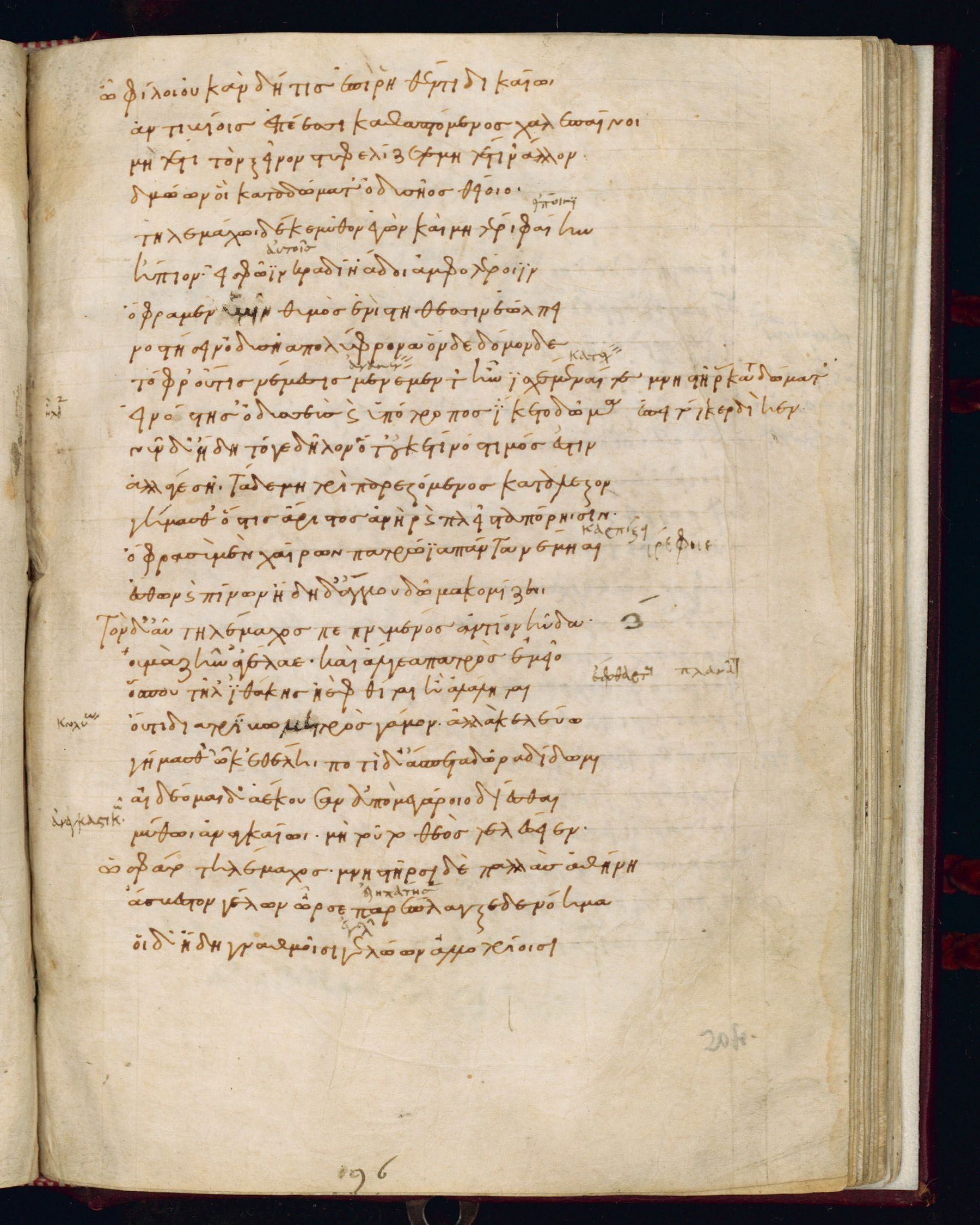
Where on the image
Laur. Plut. 32.24, fol. 204r: Odyssey 20.322-347, begins ‹ὦ φίλοι, οὐκ ἂν›, ends ‹ἤδη γναθμοῖσι γελοίων ἀλλοτρίοισιν,›. Checked on the image: first and last lines read and matched to the Greek. Fol. 203v ends with 20.321. Fol. 204v begins with 20.348. 20.330 and the beginning of 20.331 are written as one long line; the end of 20.331 (ἐπεὶ τόδε κέρδιον ἦεν) is added at the end of the next line, after 20.332 (25 lines). English blocks here: 320-324, 325-329, 330-334, 335-339, 340-344, 345-349.
322ὦ φίλοι, οὐκ ἂν δή τις ἐπὶ ῥηθέντι δικαίῳ
323ἀντιβίοις ἐπέεσσι καθαπτόμενος χαλεπαίνοι·
324μήτε τι τὸν ξεῖνον στυφελίζετε μήτε τινʼ ἄλλον
325δμώων, οἳ κατὰ δώματʼ Ὀδυσσῆος θείοιο.
326Τηλεμάχῳ δέ κε μῦθον ἐγὼ καὶ μητέρι φαίην
327ἤπιον, εἴ σφωϊν κραδίῃ ἅδοι ἀμφοτέροιϊν.
328ὄφρα μὲν ὑμῖν θυμὸς ἐνὶ στήθεσσιν ἐώλπει
329νοστήσειν Ὀδυσῆα πολύφρονα ὅνδε δόμονδε,
330τόφρʼ οὔ τις νέμεσις μενέμεν τʼ ἦν ἰσχέμεναί τε
331μνηστῆρας κατὰ δώματʼ, ἐπεὶ τόδε κέρδιον ἦεν,
332εἰ νόστησʼ Ὀδυσεὺς καὶ ὑπότροπος ἵκετο δῶμα·
333νῦν δʼ ἤδη τόδε δῆλον, ὅ τʼ οὐκέτι νόστιμός ἐστιν.
334ἀλλʼ ἄγε, σῇ τάδε μητρὶ παρεζόμενος κατάλεξον,
335γήμασθʼ ὅς τις ἄριστος ἀνὴρ καὶ πλεῖστα πόρῃσιν,
336ὄφρα σὺ μὲν χαίρων πατρώϊα πάντα νέμηαι,
337ἔσθων καὶ πίνων, ἡ δʼ ἄλλου δῶμα κομίζῃ.
338τὸν δʼ αὖ Τηλέμαχος πεπνυμένος ἀντίον ηὔδα·
339οὐ μὰ Ζῆνʼ, Ἀγέλαε, καὶ ἄλγεα πατρὸς ἐμοῖο,
340ὅς που τῆλʼ Ἰθάκης ἢ ἔφθιται ἢ ἀλάληται,
341οὔ τι διατρίβω μητρὸς γάμον, ἀλλὰ κελεύω
342γήμασθʼ ᾧ κʼ ἐθέλῃ, ποτὶ δʼ ἄσπετα δῶρα δίδωμι.
343αἰδέομαι δʼ ἀέκουσαν ἀπὸ μεγάροιο δίεσθαι
344μύθῳ ἀναγκαίῳ· μὴ τοῦτο θεὸς τελέσειεν.
345ὣς φάτο Τηλέμαχος· μνηστῆρσι δὲ Παλλὰς Ἀθήνη
346ἄσβεστον γέλω ὦρσε, παρέπλαγξεν δὲ νόημα.
347οἱ δʼ ἤδη γναθμοῖσι γελοίων ἀλλοτρίοισιν,
320So he spoke, and they were all hushed in silence, but at last there spoke among them Agelaus, son of Damastor: “Friends, no man in answer to what has been fairly spoken would wax wroth and make reply with wrangling words. Abuse not any more the stranger nor any 325of the slaves that are in the house of divine Odysseus. But to Telemachus and his mother I would speak a gentle word, if perchance it may find favour in the minds of both. So long as the hearts in your breasts had hope that wise Odysseus would return to his own house, 330so long there was no ground for blame that you waited, and restrained the wooers in your halls; for this was the better course, had Odysseus returned and come back to his house. But now this is plain, that he will return no more. Nay then, come, sit by thy mother and tell her this, 335namely that she must wed him whosoever is the best man, and who offers the most gifts; to the end that thou mayest enjoy in peace all the heritage of thy fathers, eating and drinking, and that she may keep the house of another.” Then wise Telemachus answered him: “Nay, by Zeus, Agelaus, and by the woes of my father, 340who somewhere far from Ithaca has perished or is wandering, in no wise do I delay my mother's marriage, but I bid her wed what man she will, and I offer besides gifts past counting. But I am ashamed to drive her forth from the hall against her will by a word of compulsion. May God never bring such a thing to pass.” 345So spoke Telemachus, but among the wooers Pallas Athena roused unquenchable laughter, and turned their wits awry. And now they laughed with alien lips, and all bedabbled with blood was the flesh they ate, and their eyes were filled with tears and their spirits set on wailing.
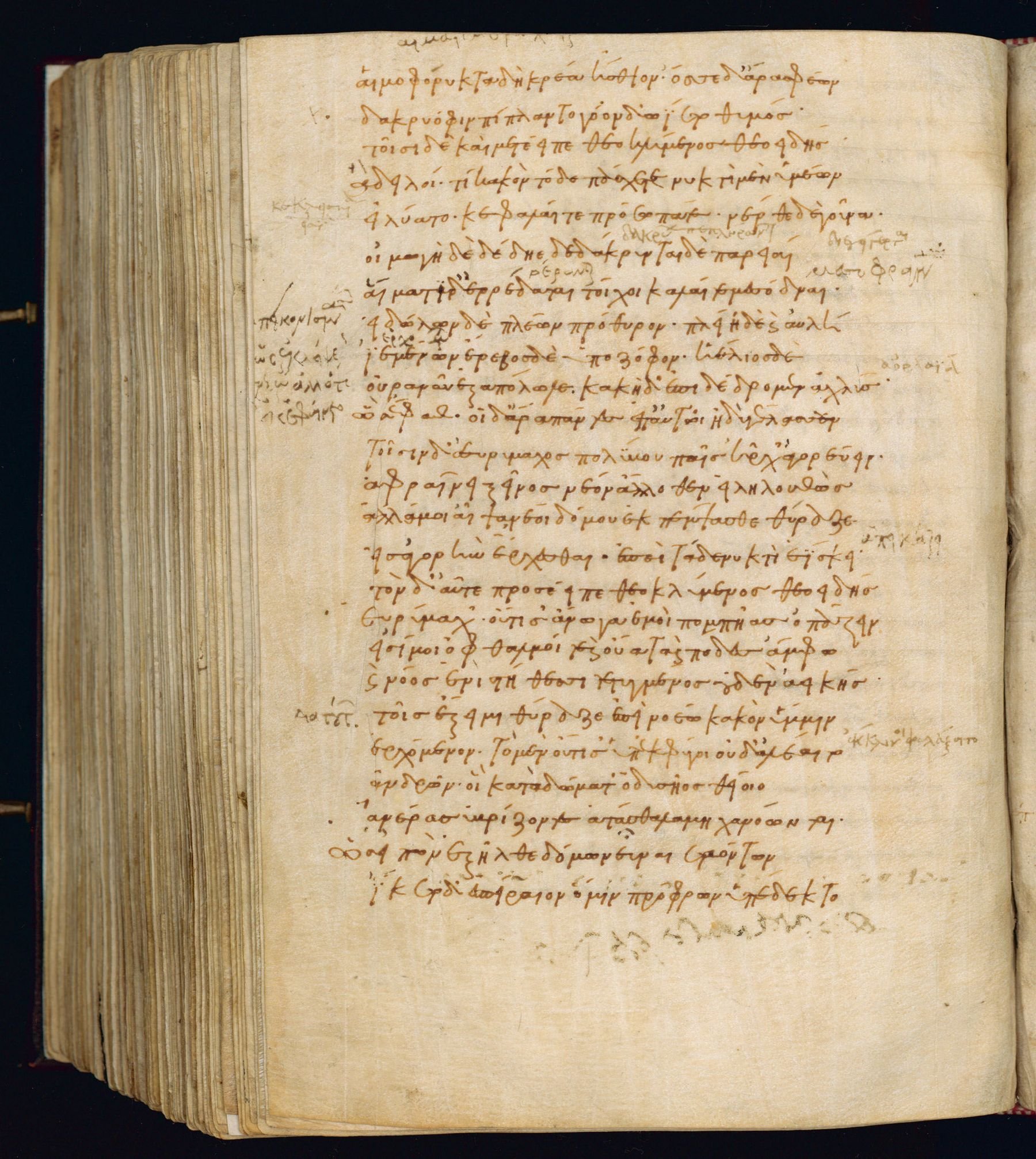
Where on the image
Laur. Plut. 32.24, fol. 204v: Odyssey 20.348-372, begins ‹αἱμοφόρυκτα δὲ δὴ κρέα›, ends ‹ὅ μιν πρόφρων ὑπέδεκτο.›. Checked on the image: first and last lines read and matched to the Greek. Fol. 204r ends with 20.347. Fol. 205r begins with 20.373. English blocks here: 350-354, 355-359, 360-364, 365-369, 370-374.
348αἱμοφόρυκτα δὲ δὴ κρέα ἤσθιον· ὄσσε δʼ ἄρα σφέων
349δακρυόφιν πίμπλαντο, γόον δʼ ὠΐετο θυμός.
350τοῖσι δὲ καὶ μετέειπε Θεοκλύμενος θεοειδής·
351ἆ δειλοί, τί κακὸν τόδε πάσχετε; νυκτὶ μὲν ὑμέων
352εἰλύαται κεφαλαί τε πρόσωπά τε νέρθε τε γοῦνα.
353οἰμωγὴ δὲ δέδηε, δεδάκρυνται δὲ παρειαί,
354αἵματι δʼ ἐρράδαται τοῖχοι καλαί τε μεσόδμαι·
355εἰδώλων δὲ πλέον πρόθυρον, πλείη δὲ καὶ αὐλή,
356ἱεμένων Ἔρεβόσδε ὑπὸ ζόφον· ἠέλιος δὲ
357οὐρανοῦ ἐξαπόλωλε, κακὴ δʼ ἐπιδέδρομεν ἀχλύς.
358ὣς ἔφαθʼ, οἱ δʼ ἄρα πάντες ἐπʼ αὐτῷ ἡδὺ γέλασσαν.
359τοῖσιν δʼ Εὐρύμαχος, Πολύβου πάϊς, ἦρχʼ ἀγορεύειν·
360ἀφραίνει ξεῖνος νέον ἄλλοθεν εἰληλουθώς.
361ἀλλά μιν αἶψα, νέοι, δόμου ἐκπέμψασθε θύραζε
362εἰς ἀγορὴν ἔρχεσθαι, ἐπεὶ τάδε νυκτὶ ἐΐσκει.
363τὸν δʼ αὖτε προσέειπε Θεοκλύμενος θεοειδής·
364Εὐρύμαχʼ, οὔ τί σʼ ἄνωγα ἐμοὶ πομπῆας ὀπάζειν·
365εἰσί μοι ὀφθαλμοί τε καὶ οὔατα καὶ πόδες ἄμφω
366καὶ νόος ἐν στήθεσσι τετυγμένος οὐδὲν ἀεικής.
367τοῖς ἔξειμι θύραζε, ἐπεὶ νοέω κακὸν ὔμμιν
368ἐρχόμενον, τό κεν οὔ τις ὑπεκφύγοι οὐδʼ ἀλέαιτο
369μνηστήρων, οἳ δῶμα κάτʼ ἀντιθέου Ὀδυσῆος
370ἀνέρας ὑβρίζοντες ἀτάσθαλα μηχανάασθε.
371ὣς εἰπὼν ἐξῆλθε δόμων εὖ ναιεταόντων,
372ἵκετο δʼ ἐς Πείραιον, ὅ μιν πρόφρων ὑπέδεκτο.
350Then among them spoke godlike Theoclymenus: “Ah, wretched men, what evil is this that you suffer? Shrouded in night are your heads and your faces and your knees beneath you; kindled is the sound of wailing, bathed in tears are your cheeks, and sprinkled with blood are the walls and the fair rafters. 355And full of ghosts is the porch and full the court, of ghosts that hasten down to Erebus beneath the darkness, and the sun has perished out of heaven and an evil mist hovers over all.” So he spoke, but they all laughed merrily at him. And among them Eurymachus, son of Polybus, was the first to speak: 360“Mad is the stranger that has newly come from abroad. Quick, ye youths, convey him forth out of doors to go his way to the place of assembly, since here he finds it like night.” Then godlike Theoclymenus answered him: “Eurymachus, in no wise do I bid thee give me guides for my way. 365I have eyes and ears and my two feet, and a mind in my breast that is in no wise meanly fashioned. With these will I go forth out of doors, for I mark evil coming upon you which not one of the wooers may escape or avoid, of all you who in the house of godlike Odysseus 370insult men and devise wicked folly.” So saying, he went forth from the stately halls and came to Piraeus, who received him with a ready heart. But all the wooers, looking at one another, sought to provoke Telemachus by laughing at his guests.
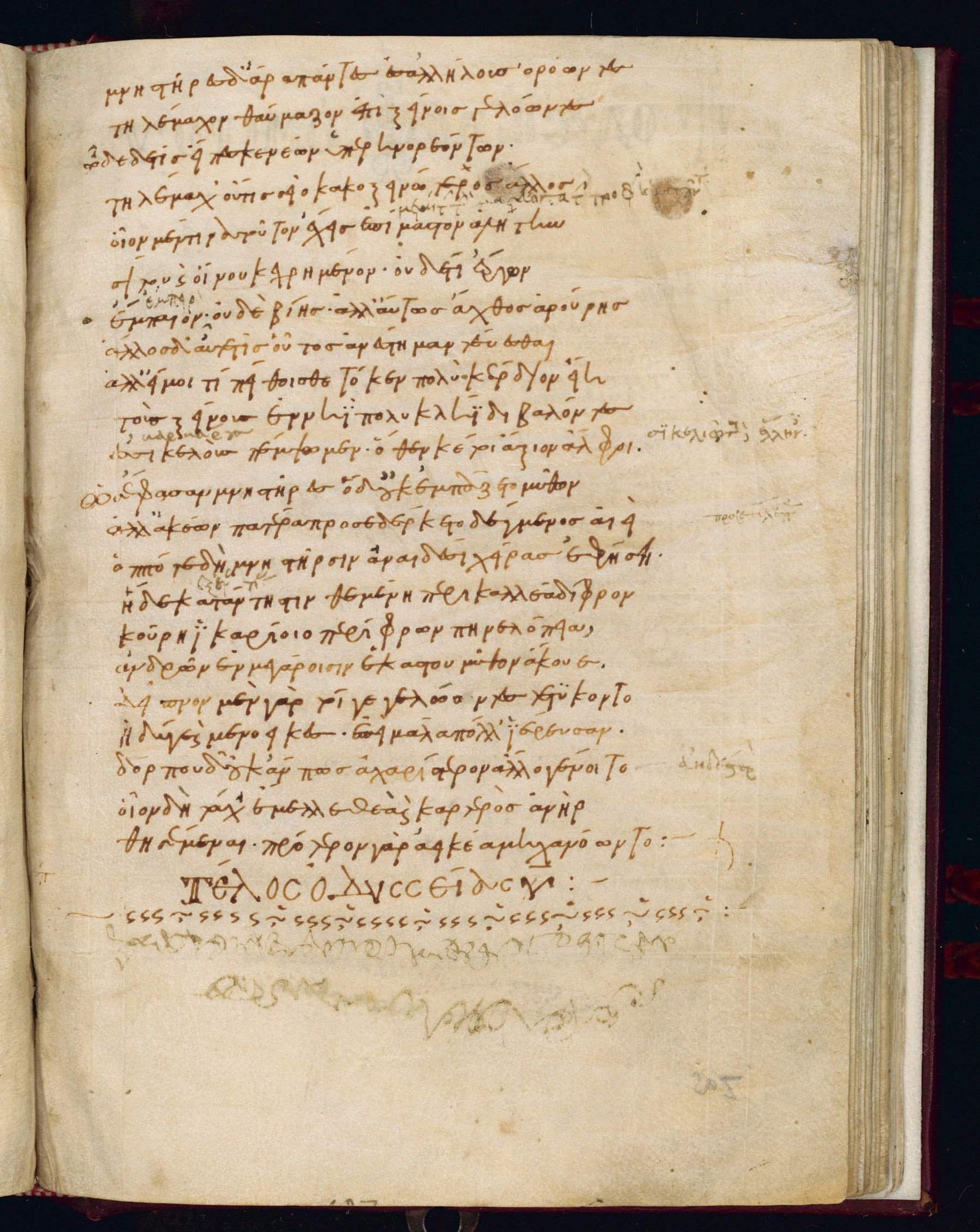
Where on the image
Laur. Plut. 32.24, fol. 205r: Odyssey 20.373-394, begins ‹μνηστῆρες δʼ ἄρα πάντες›, ends ‹πρότεροι γὰρ ἀεικέα μηχανόωντο.›. Checked on the image: first and last lines read and matched to the Greek. Fol. 204v ends with 20.372. Book 20 ends with 20.394, followed by the subscription τέλος ὀδυσσείας υ in capitals and a line of ornament; the rest of the page is blank apart from faint offset. Book 21 begins on fol. 205v. English blocks here: 375-379, 380-384, 385-389, 390-394.
373μνηστῆρες δʼ ἄρα πάντες ἐς ἀλλήλους ὁρόωντες
374Τηλέμαχον ἐρέθιζον, ἐπὶ ξείνοις γελόωντες·
375ὧδε δέ τις εἴπεσκε νέων ὑπερηνορεόντων·
376Τηλέμαχʼ, οὔ τις σεῖο κακοξεινώτερος ἄλλος·
377οἷον μέν τινα τοῦτον ἔχεις ἐπίμαστον ἀλήτην,
378σίτου καὶ οἴνου κεχρημένον, οὐδέ τι ἔργων
379ἔμπαιον οὐδὲ βίης, ἀλλʼ αὔτως ἄχθος ἀρούρης.
380ἄλλος δʼ αὖτέ τις οὗτος ἀνέστη μαντεύεσθαι.
381ἀλλʼ εἴ μοί τι πίθοιο, τό κεν πολὺ κέρδιον εἴη·
382τοὺς ξείνους ἐν νηῒ πολυκληῗδι βαλόντες
383ἐς Σικελοὺς πέμψωμεν, ὅθεν κέ τοι ἄξιον ἄλφοι.
384ὣς ἔφασαν μνηστῆρες· ὁ δʼ οὐκ ἐμπάζετο μύθων,
385ἀλλʼ ἀκέων πατέρα προσεδέρκετο, δέγμενος αἰεί,
386ὁππότε δὴ μνηστῆρσιν ἀναιδέσι χεῖρας ἐφήσει.
387ἡ δὲ κατʼ ἄντηστιν θεμένη περικαλλέα δίφρον
388κούρη Ἰκαρίοιο, περίφρων Πηνελόπεια,
389ἀνδρῶν ἐν μεγάροισιν ἑκάστου μῦθον ἄκουεν.
390δεῖπνον μὲν γάρ τοί γε γελοίωντες τετύκοντο
391ἡδὺ τε καὶ μενοεικές, ἐπεὶ μάλα πόλλʼ ἱέρευσαν·
392δόρπου δʼ οὐκ ἄν πως ἀχαρίστερον ἄλλο γένοιτο,
393οἷον δὴ τάχʼ ἔμελλε θεὰ καὶ καρτερὸς ἀνὴρ
394θησέμεναι· πρότεροι γὰρ ἀεικέα μηχανόωντο.
375And thus would one of the proud youths speak: “Telemachus, no man is more unlucky in his guests than thou, seeing that thou keepest such a filthy vagabond as this man here, always wanting bread and wine, and skilled neither in the works of peace nor those of war, but a mere burden of the earth. 380And this other fellow again stood up to prophesy. Nay, if thou wouldst hearken to me it would be better far: let us fling these strangers on board a benched ship, and send them to the Sicilians, whence they would bring thee in a fitting price.” So spake the wooers, but he paid no heed to their words. 385Nay, in silence he watched his father, ever waiting until he should put forth his hands upon the shameless wooers. But the daughter of Icarius, wise Penelope, had set her beautiful chair over against them, and heard the words of each man in the hall. 390For they had made ready their meal in the midst of their laughing, a sweet meal, and one to satisfy the heart, for they had slain many beasts. But never could meal have been more graceless than a supper such as a goddess and a mighty man were soon to set before them. For unprovoked they were contriving deeds of shame.
Notes
- Greek: A. T. Murray, Homer: The Odyssey (Loeb Classical Library, 1919), via Perseus.
- English: A. T. Murray's translation in the same edition; his footnotes are omitted.
Cite
Sources
- Source: Laur. Plut. 32.24 (BML Teca Digitale IIIF) + Murray Greek (Loeb 1919, Perseus) + Murray English (Loeb 1919, Perseus) (holding institution)
- Critical edition: Murray, Loeb 1919, via Perseus
← previous · → next · v cycle view · l back to library