Homer, Odyssey, Book 24, lines 104-548: Laertes and the peace (second manuscript)
Introduction
The Odyssey, composed around 700 BCE and attributed to Homer, tells of Odysseus' ten-year journey home from Troy and his return to Ithaca. Book 24 (548 lines): the spirits of the suitors go down to Hades, where Amphimedon tells Agamemnon how they died; Odysseus finds his father Laertes in his orchard and makes himself known; the suitors' kin take up arms, and Athena stops the fighting and makes peace.
The 10th-century manuscript used for the rest of this collection, Laur. Plut. 32.24, breaks off at 24.103. This entry gives lines 104-548 from a second manuscript in the same library: Florence, Biblioteca Medicea Laurenziana, Plut. 32.4 (parchment, 15th century, 476 folios; Iliad, Odyssey, Batrachomyomachia and Homeric Hymns), a fine Florentine copy of the 15th century written in one column of 36 lines. The Odyssey ends on fol. 445v. Each section below is one page, with its first and last line as read on the photograph; the first section begins at 24.104, the 20th line of fol. 439v.
The Greek is A. T. Murray's Loeb text (1919) via Perseus, not a transcription of this manuscript. The English is Murray's prose translation (1919), cut at the end of the sentence, or the start of the speech, nearest each page break; each section's note gives its exact English line range. 24.533 is not written in this manuscript (see the note on fol. 445v).
How was this verified? (Provenance)
Where on the image
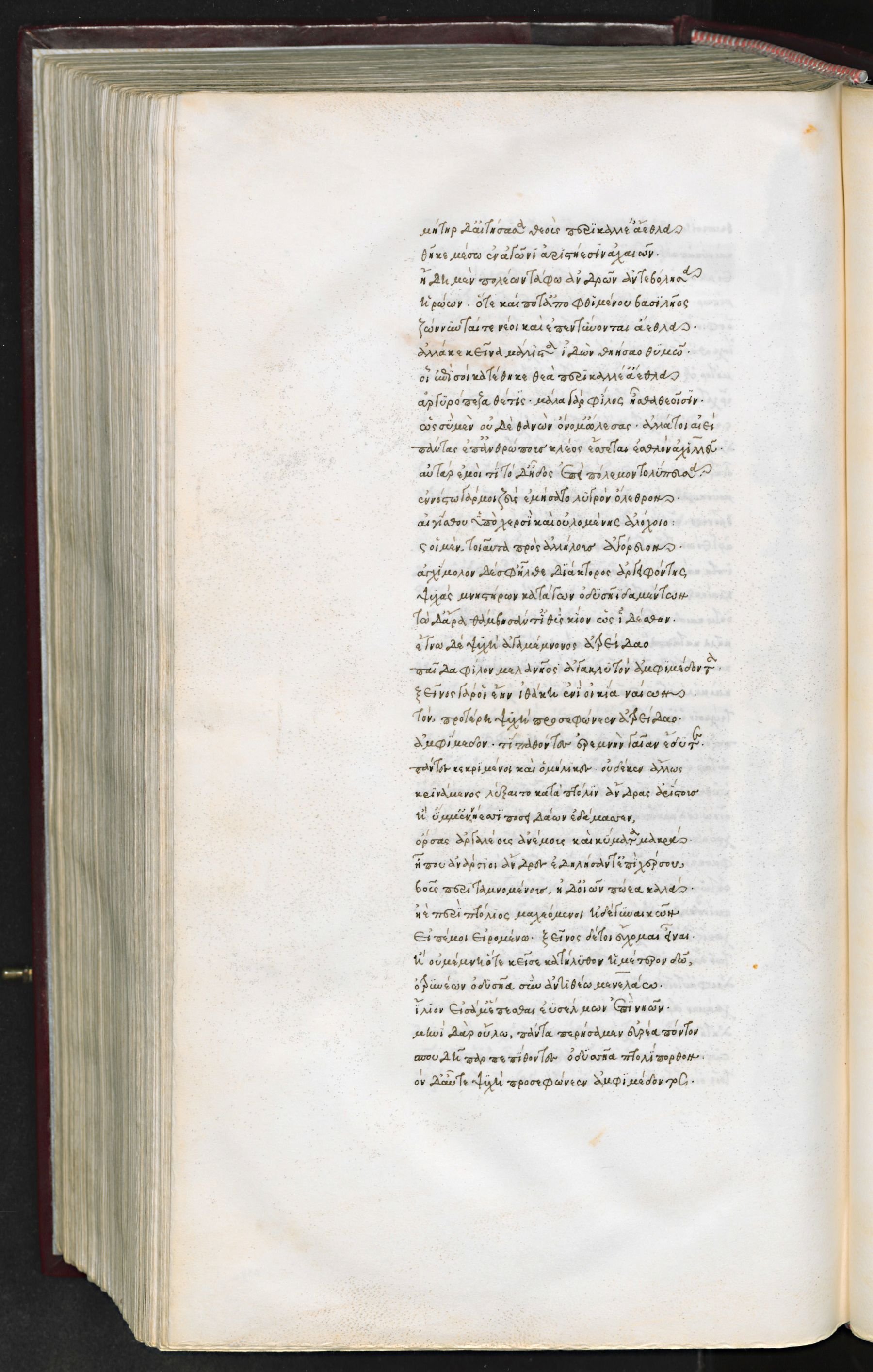
Laur. Plut. 32.4, fol. 439v: Odyssey 24.104-120, begins ‹ξεῖνος γάρ οἱ ἔην ἰθάκῃ ἔνι οἰκία ναίων›, ends ‹τὸν δ' αὖτε ψυχὴ προσεφώνεεν ἀμφιμέδοντος›. Checked on the image: first and last lines read and matched to the Greek, and the 36 lines of the page counted. Fol. 440r begins with 24.121. The page has 36 lines, 24.85-120: it begins ‹μήτηρ δ' αἰτήσασα θεοὺς περικαλλέ' ἄεθλα› (24.85); 24.104 is its 20th line. Lines 24.85-103 are given in the preceding entry from Laur. Plut. 32.24 and are not repeated here. English here: 24.102-120; the English begins with Murray's sentence for 24.102-104 (And the spirit of Agamemnon ... dwelling in Ithaca.), whose last line, 24.104, is the first line given here; 24.102-103 are also rendered in the preceding entry.
104ξεῖνος γάρ οἱ ἔην Ἰθάκῃ ἔνι οἰκία ναίων.
105τὸν προτέρη ψυχὴ προσεφώνεεν Ἀτρεΐδαο·
106Ἀμφίμεδον, τί παθόντες ἐρεμνὴν γαῖαν ἔδυτε
107πάντες κεκριμένοι καὶ ὁμήλικες; οὐδέ κεν ἄλλως
108κρινάμενος λέξαιτο κατὰ πτόλιν ἄνδρας ἀρίστους.
109ἦ ὔμμʼ ἐν νήεσσι Ποσειδάων ἐδάμασσεν,
110ὄρσας ἀργαλέους ἀνέμους καὶ κύματα μακρά;
111ἦ που ἀνάρσιοι ἄνδρες ἐδηλήσαντʼ ἐπὶ χέρσου
112βοῦς περιταμνομένους ἠδʼ οἰῶν πώεα καλά,
113ἠὲ περὶ πτόλιος μαχεούμενοι ἠδὲ γυναικῶν;
114εἰπέ μοι εἰρομένῳ· ξεῖνος δέ τοι εὔχομαι εἶναι.
115ἦ οὐ μέμνῃ ὅτε κεῖσε κατήλυθον ὑμέτερον δῶ,
116ὀτρυνέων Ὀδυσῆα σὺν ἀντιθέῳ Μενελάῳ
117Ἴλιον εἰς ἅμʼ ἕπεσθαι ἐϋσσέλμων ἐπὶ νηῶν;
118μηνὶ δʼ ἄρʼ οὔλῳ πάντα περήσαμεν εὐρέα πόντον,
119σπουδῇ παρπεπιθόντες Ὀδυσσῆα πτολίπορθον.
120τὸν δʼ αὖτε ψυχὴ προσεφώνεεν Ἀμφιμέδοντος·
102And the spirit of Agamemnon, son of Atreus, recognized the dear son of Melaneus, glorious Amphimedon, who had been his host, dwelling in Ithaca. 105Then the spirit of the son of Atreus spoke first to him and said “Amphimedon, what has befallen you that ye have come down beneath the dark earth, all of you picked men and of like age? One would make no other choice, were one to pick the best men in a city. Did Poseidon smite you on board your ships, 110when he had roused cruel winds and long waves? Or did foemen work you harm on the land, while you were cutting off their cattle and fair flocks of sheep, or while they fought in defence of their city and their women? Tell me what I ask; for I declare that I am a friend of thy house. 115Dost thou not remember when I came thither to your house with godlike Menelaus to urge Odysseus to go with us to Ilios on the benched ships? A full month it took us to cross all the wide sea, for hardly could we win to our will Odysseus, the sacker of cities.” 120Then the spirit of Amphimedon answered him, and said:
Where on the image
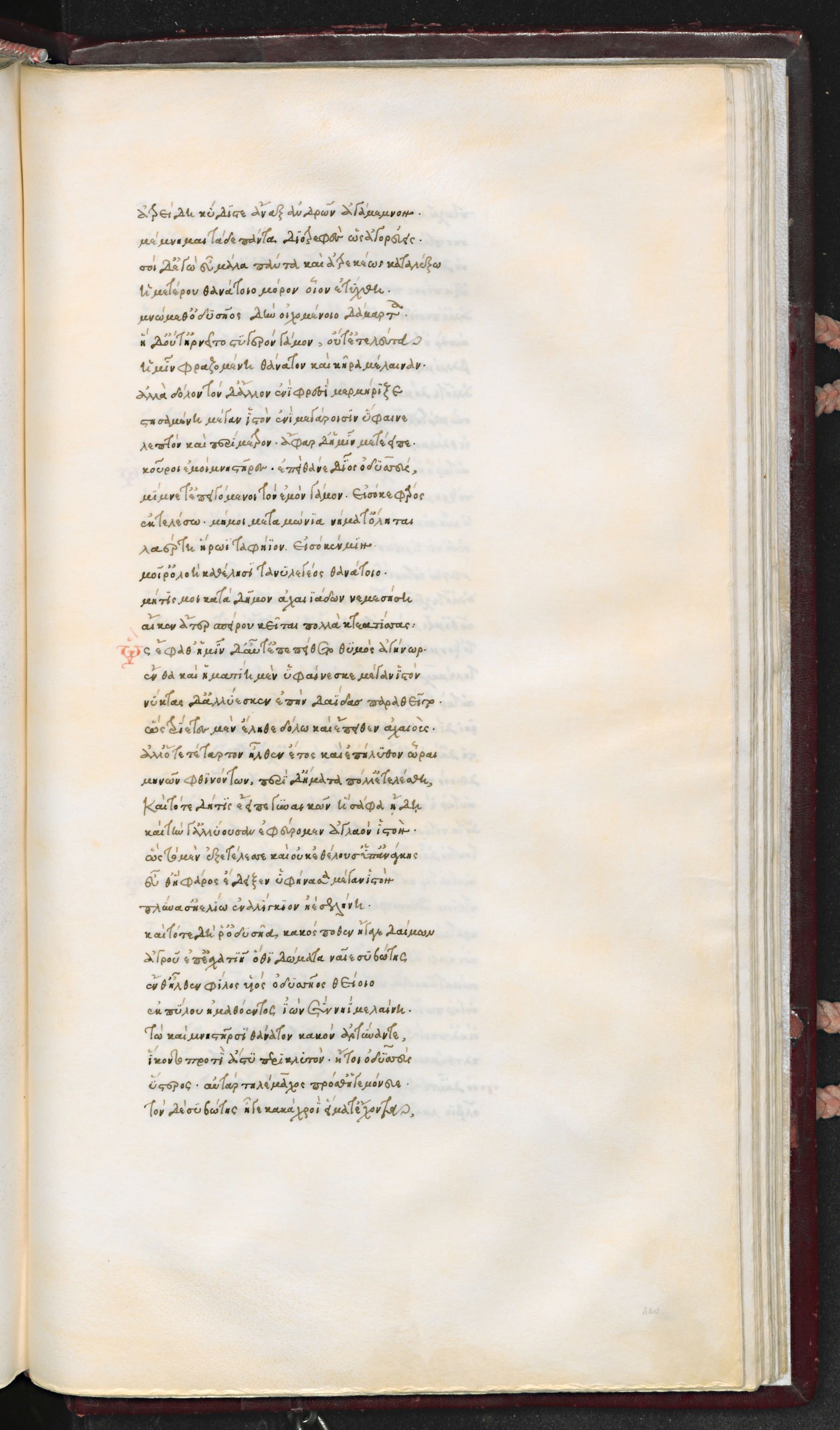
Laur. Plut. 32.4, fol. 440r: Odyssey 24.121-156, begins ‹ἀτρεΐδη κύδιστε ἄναξ ἀνδρῶν ἀγάμεμνον›, ends ‹τὸν δὲ συβώτης ἦγε κακὰ χροῒ εἵματ' ἔχοντα›. Checked on the image: first and last lines read and matched to the Greek, and the 36 lines of the page counted. Fol. 439v ends with 24.120. Fol. 440v begins with 24.157. English here: 24.121-155; cut where Amphimedon's speech begins (24.121), the same line as the Greek.
121Ἀτρεΐδη κύδιστε, ἄναξ ἀνδρῶν Ἀγάμεμνον,
122μέμνημαι τάδε πάντα, διοτρεφές, ὡς ἀγορεύεις·
123σοὶ δʼ ἐγὼ εὖ μάλα πάντα καὶ ἀτρεκέως καταλέξω,
124ἡμετέρου θανάτοιο κακὸν τέλος, οἷον ἐτύχθη.
125μνώμεθʼ Ὀδυσσῆος δὴν οἰχομένοιο δάμαρτα·
126ἡ δʼ οὔτʼ ἠρνεῖτο στυγερὸν γάμον οὔτʼ ἐτελεύτα,
127ἡμῖν φραζομένη θάνατον καὶ κῆρα μέλαιναν,
128ἀλλὰ δόλον τόνδʼ ἄλλον ἐνὶ φρεσὶ μερμήριξε·
129στησαμένη μέγαν ἱστὸν ἐνὶ μεγάροισιν ὕφαινε,
130λεπτὸν καὶ περίμετρον· ἄφαρ δʼ ἡμῖν μετέειπε·
131κοῦροι ἐμοὶ μνηστῆρες, ἐπεὶ θάνε δῖος Ὀδυσσεύς,
132μίμνετʼ ἐπειγόμενοι τὸν ἐμὸν γάμον, εἰς ὅ κε φᾶρος
133ἐκτελέσω, μή μοι μεταμώνια νήματʼ ὄληται,
134Λαέρτῃ ἥρωϊ ταφήϊον, εἰς ὅτε κέν μιν
135μοῖρʼ ὀλοὴ καθέλῃσι τανηλεγέος θανάτοιο,
136μή τίς μοι κατὰ δῆμον Ἀχαιϊάδων νεμεσήσῃ,
137αἴ κεν ἄτερ σπείρου κεῖται πολλὰ κτεατίσσας.
138ὣς ἔφαθʼ, ἡμῖν δʼ αὖτʼ ἐπεπείθετο θυμὸς ἀγήνωρ.
139ἔνθα καὶ ἠματίη μὲν ὑφαίνεσκεν μέγαν ἱστόν,
140νύκτας δʼ ἀλλύεσκεν, ἐπεὶ δαΐδας παραθεῖτο.
141ὣς τρίετες μὲν ἔληθε δόλῳ καὶ ἔπειθεν Ἀχαιούς·
142ἀλλʼ ὅτε τέτρατον ἦλθεν ἔτος καὶ ἐπήλυθον ὧραι,
143μηνῶν φθινόντων, περὶ δʼ ἤματα πόλλʼ ἐτελέσθη,
144καὶ τότε δή τις ἔειπε γυναικῶν, ἣ σάφα ᾔδη,
145καὶ τήν γʼ ἀλλύουσαν ἐφεύρομεν ἀγλαὸν ἱστόν.
146ὣς τὸ μὲν ἐξετέλεσσε καὶ οὐκ ἐθέλουσʼ, ὑπʼ ἀνάγκης.
147εὖθʼ ἡ φᾶρος ἔδειξεν, ὑφήνασα μέγαν ἱστόν,
148πλύνασʼ, ἠελίῳ ἐναλίγκιον ἠὲ σελήνῃ,
149καὶ τότε δή ῥʼ Ὀδυσῆα κακός ποθεν ἤγαγε δαίμων
150ἀγροῦ ἐπʼ ἐσχατιήν, ὅθι δώματα ναῖε συβώτης.
151ἔνθʼ ἦλθεν φίλος υἱὸς Ὀδυσσῆος θείοιο,
152ἐκ Πύλου ἠμαθόεντος ἰὼν σὺν νηῒ μελαίνῃ·
153τὼ δὲ μνηστῆρσιν θάνατον κακὸν ἀρτύναντε
154ἵκοντο προτὶ ἄστυ περικλυτόν, ἦ τοι Ὀδυσσεὺς
155ὕστερος, αὐτὰρ Τηλέμαχος πρόσθʼ ἡγεμόνευε.
156τὸν δὲ συβώτης ἦγε κακὰ χροῒ εἵματʼ ἔχοντα,
121“Most glorious son of Atreus, king of men, Agamemnon, I remember all these things, O thou fostered of Zeus, even as thou dost tell them; and on my part I will frankly tell thee all the truth, how for us an evil end of death was wrought. 125We wooed the wife of Odysseus, that had long been gone, and she neither refused the hateful marriage, nor would she ever make an end, devising for us death and black fate. Nay, she contrived in her heart this guileful thing also: she set up in her halls a great web, and fell to weaving— 130fine of thread was the web and very wide; and straightway she spoke among us: “‘Young men, my wooers, since goodly Odysseus is dead, be patient, though eager for my marriage, until I finish this robe—I would not that my spinning should come to naught—a shroud for the lord Laertes against the time when 135the fell fate of grievous death shall strike him down; lest any of the Achaean women in the land should be wroth at me, if he were to lie without a shroud, who had won great possessions.’ 138“So she spoke, and our proud hearts consented. Then day by day she would weave at the great web, 140but by night would unravel it, when she had let place torches by her. Thus for three years she by her craft kept the Achaeans from knowing, and beguiled them; but when the fourth year came, as the seasons rolled on, as the months waned and many days were brought in their course, even then one of her women who knew all, told us, 145and we caught her unravelling the splendid web. So she finished it against her will perforce. “Now when she had shewn us the robe, after weaving the great web and washing it, and it shone like the sun or the moon, then it was that some cruel god brought Odysseus from somewhere 150to the border of the land, where the swineherd dwelt. Thither too came the dear son of divine Odysseus on his return from sandy Pylos in his black ship, and these two, when they had planned an evil death for the wooers, came to the famous city, Odysseus verily 155later, but Telemachus led the way before him.
Where on the image
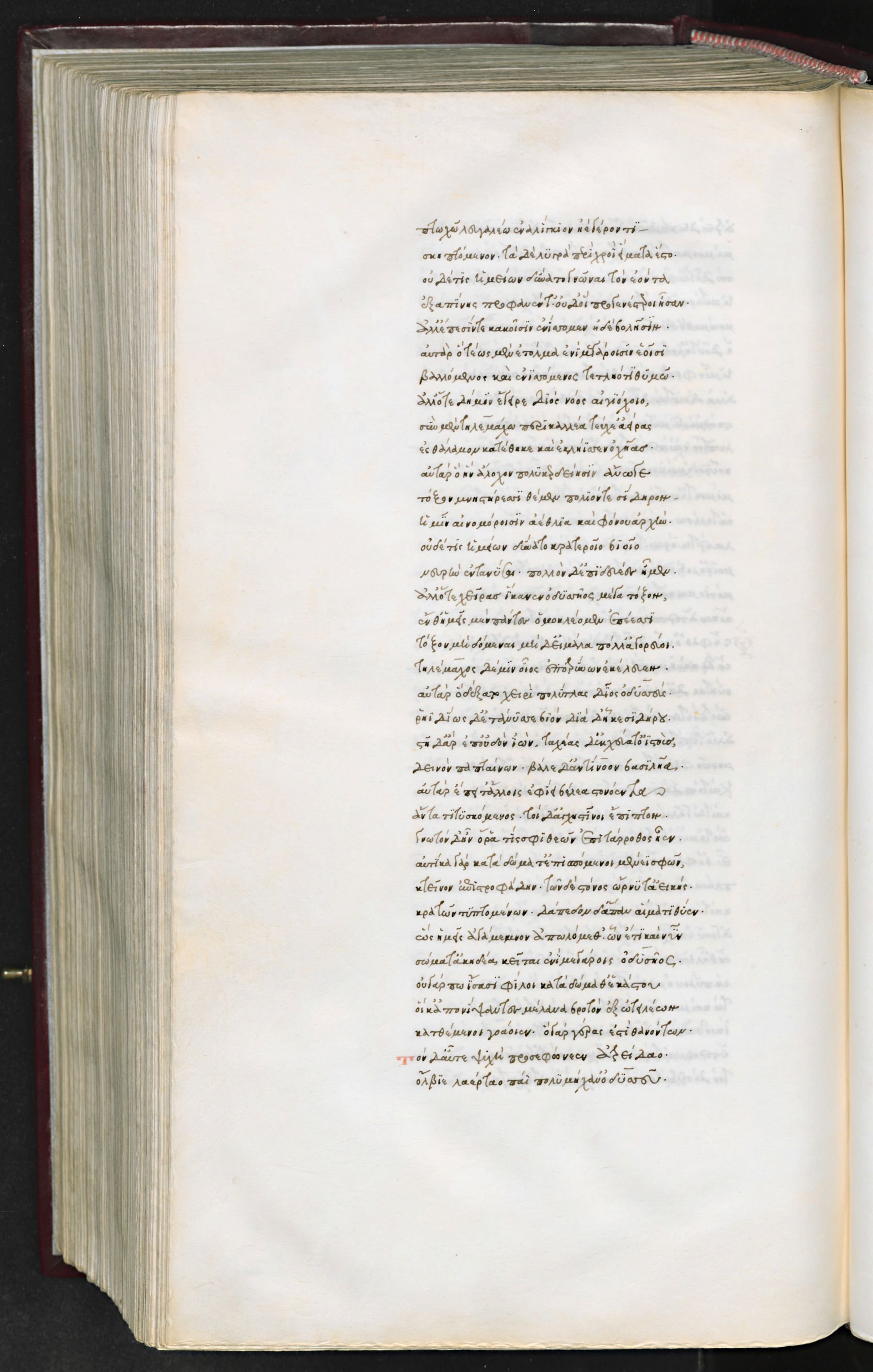
Laur. Plut. 32.4, fol. 440v: Odyssey 24.157-192, begins ‹πτωχῷ λευγαλέῳ ἐναλίγκιον ἠδὲ γέροντι›, ends ‹ὄλβιε λαέρταο παῖ πολυμήχαν' ὀδυσσεῦ›. Checked on the image: first and last lines read and matched to the Greek, and the 36 lines of the page counted. Fol. 440r ends with 24.156. Fol. 441r begins with 24.193. English here: 24.156-191; Murray's sentence for 24.156-158 (Now the swineherd brought his master ... about his body;) begins one line before the page break and is given with this page.
157πτωχῷ λευγαλέῳ ἐναλίγκιον ἠδὲ γέροντι
158σκηπτόμενον· τὰ δὲ λυγρὰ περὶ χροῒ εἵματα ἕστο·
159οὐδέ τις ἡμείων δύνατο γνῶναι τὸν ἐόντα
160ἐξαπίνης προφανέντʼ, οὐδʼ οἳ προγενέστεροι ἦσαν,
161ἀλλʼ ἔπεσίν τε κακοῖσιν ἐνίσσομεν ἠδὲ βολῇσιν.
162αὐτὰρ ὁ τῆος ἐτόλμα ἐνὶ μεγάροισιν ἑοῖσι
163βαλλόμενος καὶ ἐνισσόμενος τετληότι θυμῷ·
164ἀλλʼ ὅτε δή μιν ἔγειρε Διὸς νοός αἰγιόχοιο,
165σὺν μὲν Τηλεμάχῳ περικαλλέα τεύχεʼ ἀείρας
166ἐς θάλαμον κατέθηκε καὶ ἐκλήϊσεν ὀχῆας,
167αὐτὰρ ὁ ἣν ἄλοχον πολυκερδείῃσιν ἄνωγε
168τόξον μνηστήρεσσι θέμεν πολιόν τε σίδηρον,
169ἡμῖν αἰνομόροισιν ἀέθλια καὶ φόνου ἀρχήν.
170οὐδέ τις ἡμείων δύνατο κρατεροῖο βιοῖο
171νευρὴν ἐντανύσαι, πολλὸν δʼ ἐπιδευέες ἦμεν.
172ἀλλʼ ὅτε χεῖρας ἵκανεν Ὀδυσσῆος μέγα τόξον,
173ἔνθʼ ἡμεῖς μὲν πάντες ὁμοκλέομεν ἐπέεσσι
174τόξον μὴ δόμεναι, μηδʼ εἰ μάλα πολλʼ ἀγορεύοι·
175Τηλέμαχος δέ μιν οἶος ἐποτρύνων ἐκέλευσεν.
176αὐτὰρ ὁ δέξατο χειρὶ πολύτλας δῖος Ὀδυσσεύς,
177ῥηϊδίως δʼ ἐτάνυσσε βιόν, διὰ δʼ ἧκε σιδήρου,
178στῆ δʼ ἄρʼ ἐπʼ οὐδὸν ἰών, ταχέας δʼ ἐκχεύατʼ ὀϊστοὺς
179δεινὸν παπταίνων, βάλε δʼ Ἀντίνοον βασιλῆα.
180αὐτὰρ ἔπειτʼ ἄλλοις ἐφίει βέλεα στονόεντα,
181ἄντα τιτυσκόμενος· τοὶ δʼ ἀγχιστῖνοι ἔπιπτον.
182γνωτὸν δʼ ἦν ὅ ῥά τίς σφι θεῶν ἐπιτάρροθος ἦεν·
183αὐτίκα γὰρ κατὰ δώματʼ ἐπισπόμενοι μένεϊ σφῷ
184κτεῖνον ἐπιστροφάδην, τῶν δὲ στόνος ὤρνυτʼ ἀεικὴς
185κράτων τυπτομένων, δάπεδον δʼ ἅπαν αἵματι θῦεν.
186ὣς ἡμεῖς, Ἀγάμεμνον, ἀπωλόμεθʼ, ὧν ἔτι καὶ νῦν
187σώματʼ ἀκηδέα κεῖται ἐνὶ μεγάροις Ὀδυσῆος·
188οὐ γάρ πω ἴσασι φίλοι κατὰ δώμαθʼ ἑκάστου,
189οἵ κʼ ἀπονίψαντες μέλανα βρότον ἐξ ὠτειλέων
190κατθέμενοι γοάοιεν· ὃ γὰρ γέρας ἐστὶ θανόντων.
191τὸν δʼ αὖτε ψυχὴ προσεφώνεεν Ἀτρεΐδαο·
192ὄλβιε Λαέρταο πάϊ, πολυμήχανʼ Ὀδυσσεῦ,
156Now the swineherd brought his master, clad in mean raiment, in the likeness of a woeful and aged beggar, leaning on a staff, and miserable was the raiment that he wore about his body; and not one of us could know that it was he, 160when he appeared so suddenly, no, not even those that were older men, but we assailed him with evil words and with missiles. Howbeit he with steadfast heart endured for a time to be pelted and taunted in his own halls; but when at last the will of Zeus, who bears the aegis, roused him, 165with the help of Telemachus he took all the beautiful arms and laid them away in the store-room and made fast the bolts. Then in his great cunning he bade his wife set before the wooers his bow and the grey iron to be a contest for us ill-fated men and the beginning of death. 170And no man of us was able to stretch the string of the mighty bow; nay, we fell far short of that strength. But when the great bow came to the hands of Odysseus, then we all cried out aloud not to give him the bow, how much soever he might speak; 175but Telemachus alone urged him on, and bade him take it. Then he took the bow in his hand, the much-enduring, goodly Odysseus, and with ease did he string it and send an arrow through the iron. Then he went and stood on the threshold, and poured out the swift arrows, glaring about him terribly, and smote king Antinous. 180And thereafter upon the others he with sure aim let fly his shafts, fraught with groanings, and the men fell thick and fast. Then was it known that some god was their helper; for straightway rushing on through the halls in their fury they slew men left and right, and therefrom rose hideous groaning, 185as heads were smitten, and all the floor swam with blood. Thus we perished, Agamemnon, and even now our bodies still lie uncared-for in the halls of Odysseus; for our friends in each man's home know naught as yet—our friends who might wash the black blood from our wounds 190and lay our bodies out with wailing; for that is the due of the dead.” 191Then the spirit of the son of Atreus answered him:
Where on the image
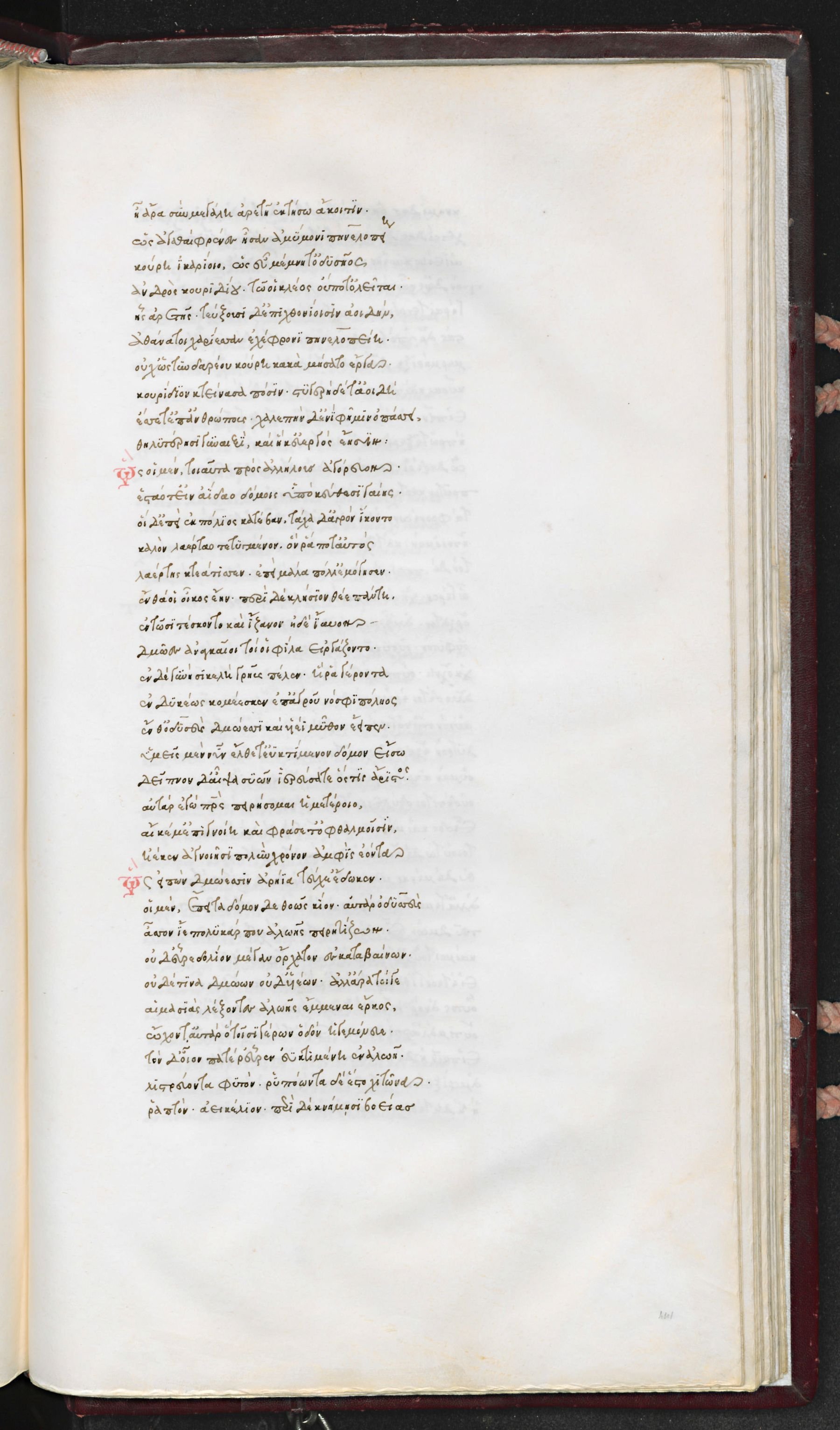
Laur. Plut. 32.4, fol. 441r: Odyssey 24.193-228, begins ‹ἦ ἄρα σὺν μεγάλῃ ἀρετῇ ἐκτήσω ἄκοιτιν›, ends ‹ῥαπτὸν ἀεικέλιον· περὶ δὲ κνήμῃσι βοείας›. Checked on the image: first and last lines read and matched to the Greek, and the 36 lines of the page counted. Fol. 440v ends with 24.192. Fol. 441v begins with 24.229. English here: 24.192-231; Agamemnon's speech begins in 24.192, the last line of the page before; it is given whole with this page.
193ἦ ἄρα σὺν μεγάλῃ ἀρετῇ ἐκτήσω ἄκοιτιν.
194ὡς ἀγαθαὶ φρένες ἦσαν ἀμύμονι Πηνελοπείῃ,
195κούρῃ Ἰκαρίου· ὡς εὖ μέμνητʼ Ὀδυσῆος,
196ἀνδρὸς κουριδίου· τῷ οἱ κλέος οὔ ποτʼ ὀλεῖται
197ἧς ἀρετῆς, τεύξουσι δʼ ἐπιχθονίοισιν ἀοιδὴν
198ἀθάνατοι χαρίεσσαν ἐχέφρονι Πηνελοπείῃ,
199οὐχ ὡς Τυνδαρέου κούρη κακὰ μήσατο ἔργα,
200κουρίδιον κτείνασα πόσιν, στυγερὴ δέ τʼ ἀοιδὴ
201ἔσσετʼ ἐπʼ ἀνθρώπους, χαλεπὴν δέ τε φῆμιν ὀπάσσει
202θηλυτέρῃσι γυναιξί, καὶ ἥ κʼ εὐεργὸς ἔῃσιν.
203ὣς οἱ μὲν τοιαῦτα πρὸς ἀλλήλους ἀγόρευον,
204ἑσταότʼ εἰν Ἀΐδαο δόμοις, ὑπὸ κεύθεσι γαίης·
205οἱ δʼ ἐπεὶ ἐκ πόλιος κατέβαν, τάχα δʼ ἀγρὸν ἵκοντο
206καλὸν Λαέρταο τετυγμένον, ὅν ῥά ποτʼ αὐτὸς
207Λαέρτης κτεάτισσεν, ἐπεὶ μάλα πόλλʼ ἐμόγησεν.
208ἔνθα οἱ οἶκος ἔην, περὶ δὲ κλίσιον θέε πάντη,
209ἐν τῷ σιτέσκοντο καὶ ἵζανον ἠδὲ ἴαυον
210δμῶες ἀναγκαῖοι, τοί οἱ φίλα ἐργάζοντο.
211ἐν δὲ γυνὴ Σικελὴ γρηῢς πέλεν, ἥ ῥα γέροντα
212ἐνδυκέως κομέεσκεν ἐπʼ ἀγροῦ, νόσφι πόληος.
213ἔνθʼ Ὀδυσεὺς δμώεσσι καὶ υἱέϊ μῦθον ἔειπεν·
214ὑμεῖς μὲν νῦν ἔλθετʼ ἐϋκτίμενον δόμον εἴσω,
215δεῖπνον δʼ αἶψα συῶν ἱερεύσατε ὅς τις ἄριστος·
216αὐτὰρ ἐγὼ πατρὸς πειρήσομαι ἡμετέροιο,
217αἴ κέ μʼ ἐπιγνώῃ καὶ φράσσεται ὀφθαλμοῖσιν,
218ἦέ κεν ἀγνοιῇσι, πολὺν χρόνον ἀμφὶς ἐόντα.
219ὣς εἰπὼν δμώεσσιν ἀρήϊα τεύχεʼ ἔδωκεν.
220οἱ μὲν ἔπειτα δόμονδε θοῶς κίον, αὐτὰρ Ὀδυσσεὺς
221ἆσσον ἴεν πολυκάρπου ἀλωῆς πειρητίζων.
222οὐδʼ εὗρεν Δολίον, μέγαν ὄρχατον ἐσκαταβαίνων,
223οὐδέ τινα δμώων οὐδʼ υἱῶν· ἀλλʼ ἄρα τοί γε
224αἱμασιὰς λέξοντες ἀλωῆς ἔμμεναι ἕρκος
225ᾤχοντʼ, αὐτὰρ ὁ τοῖσι γέρων ὁδὸν ἡγεμόνευε.
226τὸν δʼ οἶον πατέρʼ εὗρεν ἐϋκτιμένῃ ἐν ἀλωῇ,
227λιστρεύοντα φυτόν· ῥυπόωντα δὲ ἕστο χιτῶνα
228ῥαπτὸν ἀεικέλιον, περὶ δὲ κνήμῃσι βοείας
192“Happy son of Laertes, Odysseus of many devices, of a truth full of all excellence was the wife thou didst win, so good of understanding was peerless Penelope, 195daughter of Icarius, in that she was loyally mindful of Odysseus, her wedded husband. Therefore the fame of her virtue shall never perish, but the immortals shall make among men on earth a pleasant song in honor of constant Penelope. Not on this wise did the daughter of Tyndareus devise evil deeds 200and slay her wedded husband, and hateful shall the song regarding her be among men, and evil repute doth she bring upon all womankind, even upon her that doeth uprightly.” Thus the two spoke to one another, as they stood in the house of Hades beneath the depths of the earth. 205But Odysseus and his men, when they had gone down from the city, quickly came to the fair and well-ordered farm of Laertes, which he had won for himself in days past, and much had he toiled for it. There was his house, and all about it ran the sheds in which ate, and sat, and slept 210the servants that were bondsmen, that did his pleasure; but within it was an old Sicilian woman, who tended the old man with kindly care there at the farm, far from the city. Then Odysseus spoke to the servants and to his son, saying: “Do you now go within the well-built house, 215and straightway slay for dinner the best of the swine; but I will make trial of my father, and see whether he will recognize me and know me by sight, or whether he will fail to know me, since I have been gone so long a time.” So saying, he gave to the slaves his battle-gear. 220They thereafter went quickly to the house; but Odysseus drew near to the fruitful vineyard in his quest. Now he did not find Dolius as he went down into the great orchard, nor any of his slaves or of his sons, but as it chanced 225they had gone to gather stones for the vineyard wall, and the old man was their leader. But he found his father alone in the well-ordered vineyard, digging about a plant; and he was clothed in a foul tunic, patched and wretched, and about his shins he had bound stitched greaves of ox-hide to guard against scratches, 230and he wore gloves upon his hands because of the thorns, and on his head a goatskin cap; and he nursed his sorrow.
Where on the image
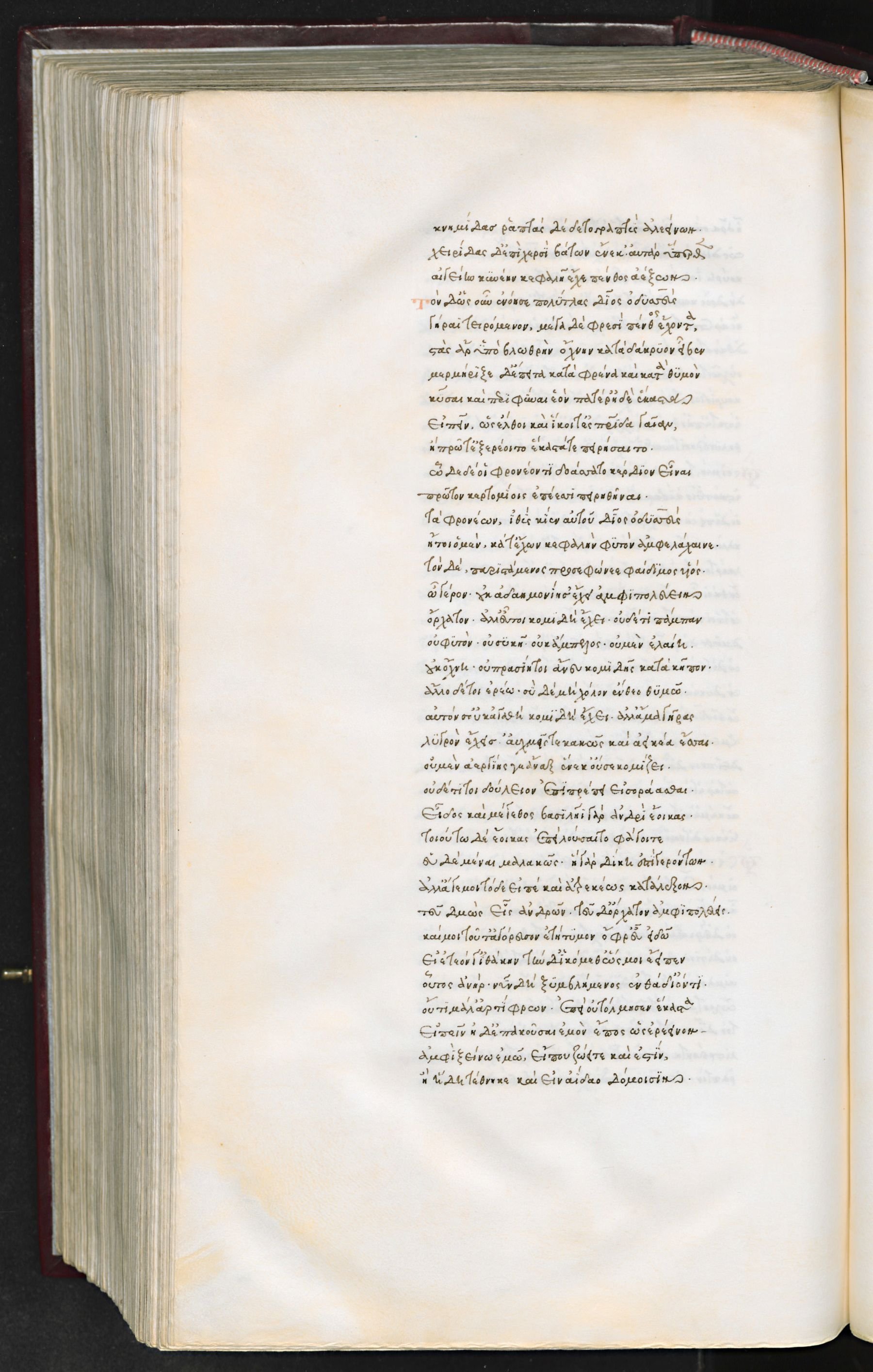
Laur. Plut. 32.4, fol. 441v: Odyssey 24.229-264, begins ‹κνημῖδας ῥαπτὰς δέδετο γραπτῦς ἀλεείνων›, ends ‹ἦ ἤδη τέθνηκε καὶ εἰν ἀΐδαο δόμοισιν›. Checked on the image: first and last lines read and matched to the Greek, and the 36 lines of the page counted. Fol. 441r ends with 24.228. Fol. 442r begins with 24.265. English here: 24.232-264; Murray's sentence for 24.226-231 (But he found his father ... nursed his sorrow.) runs three lines on each side of the page break and is given whole with the page before; the English here begins with 24.232.
229κνημῖδας ῥαπτὰς δέδετο, γραπτῦς ἀλεείνων,
230χειρῖδάς τʼ ἐπὶ χερσὶ βάτων ἕνεκʼ· αὐτὰρ ὕπερθεν
231αἰγείην κυνέην κεφαλῇ ἔχε, πένθος ἀέξων.
232τὸν δʼ ὡς οὖν ἐνόησε πολύτλας δῖος Ὀδυσσεὺς
233γήραϊ τειρόμενον, μέγα δὲ φρεσὶ πένθος ἔχοντα,
234στὰς ἄρʼ ὑπὸ βλωθρὴν ὄγχνην κατὰ δάκρυον εἶβε.
235μερμήριξε δʼ ἔπειτα κατὰ φρένα καὶ κατὰ θυμὸν
236κύσσαι καὶ περιφῦναι ἑὸν πατέρʼ, ἠδὲ ἕκαστα
237εἰπεῖν, ὡς ἔλθοι καὶ ἵκοιτʼ ἐς πατρίδα γαῖαν,
238ἦ πρῶτʼ ἐξερέοιτο ἕκαστά τε πειρήσαιτο.
239ὧδε δέ οἱ φρονέοντι δοάσσατο κέρδιον εἶναι,
240πρῶτον κερτομίοις ἐπέεσσιν πειρηθῆναι.
241τὰ φρονέων ἰθὺς κίεν αὐτοῦ δῖος Ὀδυσσεύς.
242ἦ τοι ὁ μὲν κατέχων κεφαλὴν φυτὸν ἀμφελάχαινε·
243τὸν δὲ παριστάμενος προσεφώνεε φαίδιμος υἱός·
244ὦ γέρον, οὐκ ἀδαημονίη σʼ ἔχει ἀμφιπολεύειν
245ὄρχατον, ἀλλʼ εὖ τοι κομιδὴ ἔχει, οὐδέ τι πάμπαν,
246οὐ φυτόν, οὐ συκέη, οὐκ ἄμπελος, οὐ μὲν ἐλαίη,
247οὐκ ὄγχνη, οὐ πρασιή τοι ἄνευ κομιδῆς κατὰ κῆπον.
248ἄλλο δέ τοι ἐρέω, σὺ δὲ μὴ χόλον ἔνθεο θυμῷ
249αὐτόν σʼ οὐκ ἀγαθὴ κομιδὴ ἔχει, ἀλλʼ ἅμα γῆρας
250λυγρὸν ἔχεις αὐχμεῖς τε κακῶς καὶ ἀεικέα ἕσσαι.
251οὐ μὲν ἀεργίης γε ἄναξ ἕνεκʼ οὔ σε κομίζει,
252οὐδέ τί τοι δούλειον ἐπιπρέπει εἰσοράασθαι
253εἶδος καὶ μέγεθος· βασιλῆϊ γὰρ ἀνδρὶ ἔοικας.
254τοιούτῳ δὲ ἔοικας, ἐπεὶ λούσαιτο φάγοι τε,
255εὑδέμεναι μαλακῶς· ἡ γὰρ δίκη ἐστὶ γερόντων.
256ἀλλʼ ἄγε μοι τόδε εἰπὲ καὶ ἀτρεκέως κατάλεξον,
257τεῦ δμὼς εἶς ἀνδρῶν; τεῦ δʼ ὄρχατον ἀμφιπολεύεις;
258καὶ μοι τοῦτʼ ἀγόρευσον ἐτήτυμον, ὄφρʼ ἐῢ εἰδῶ,
259εἰ ἐτεόν γʼ Ἰθάκην τήνδʼ ἱκόμεθʼ, ὥς μοι ἔειπεν
260οὗτος ἀνὴρ νῦν δὴ ξυμβλήμενος ἐνθάδʼ ἰόντι,
261οὔ τι μάλʼ ἀρτίφρων, ἐπεὶ οὐ τόλμησεν ἕκαστα
262εἰπεῖν ἠδʼ ἐπακοῦσαι ἐμὸν ἔπος, ὡς ἐρέεινον
263ἀμφὶ ξείνῳ ἐμῷ, ἤ που ζώει τε καὶ ἔστιν
264ἦ ἤδη τέθνηκε καὶ εἰν Ἀΐδαο δόμοισιν.
232Now when the much-enduring, goodly Odysseus saw him, worn with old age and laden with great grief at heart, he stood still beneath a tall pear tree, and shed tears. 235Then he debated in mind and heart whether to kiss and embrace his father, and tell him all, how he had returned and come to his native land, or whether he should first question him, and prove him in each thing. And, as he pondered, this seemed to him the better course, 240to prove him first with mocking words. So with this in mind the goodly Odysseus went straight toward him. He verily was holding his head down, digging about a plant, and his glorious son came up to him, and addressed him, saying: “Old man, no lack of skill hast thou to tend 245a garden; nay, thy care is good, and there is naught whatsoever, either plant or fig tree, or vine, nay, or olive, or pear, or garden-plot in all the field that lacks care. But another thing will I tell thee, and do thou not lay up wrath thereat in thy heart: thou thyself enjoyest no good care, but 250thou bearest woeful old age, and therewith art foul and unkempt, and clad in mean raiment. Surely it is not because of sloth on thy part that thy master cares not for thee, nor dost thou seem in any wise like a slave to look upon either in form or in stature; for thou art like a king, even like one who, when he has bathed and eaten, 255should sleep soft; for this is the way of old men. But come, tell me this, and declare it truly. Whose slave art thou, and whose orchard dost thou tend? And tell me this also truly, that I may know full well, whether this is indeed Ithaca, to which we are now come, as 260a man yonder told me, who met me but now on my way hither. In no wise over sound of wit was he, for he deigned not to tell me of each thing, nor to listen to my word, when I questioned him about a friend of mine, whether haply he still lives, or is now dead and in the house of Hades.
Where on the image
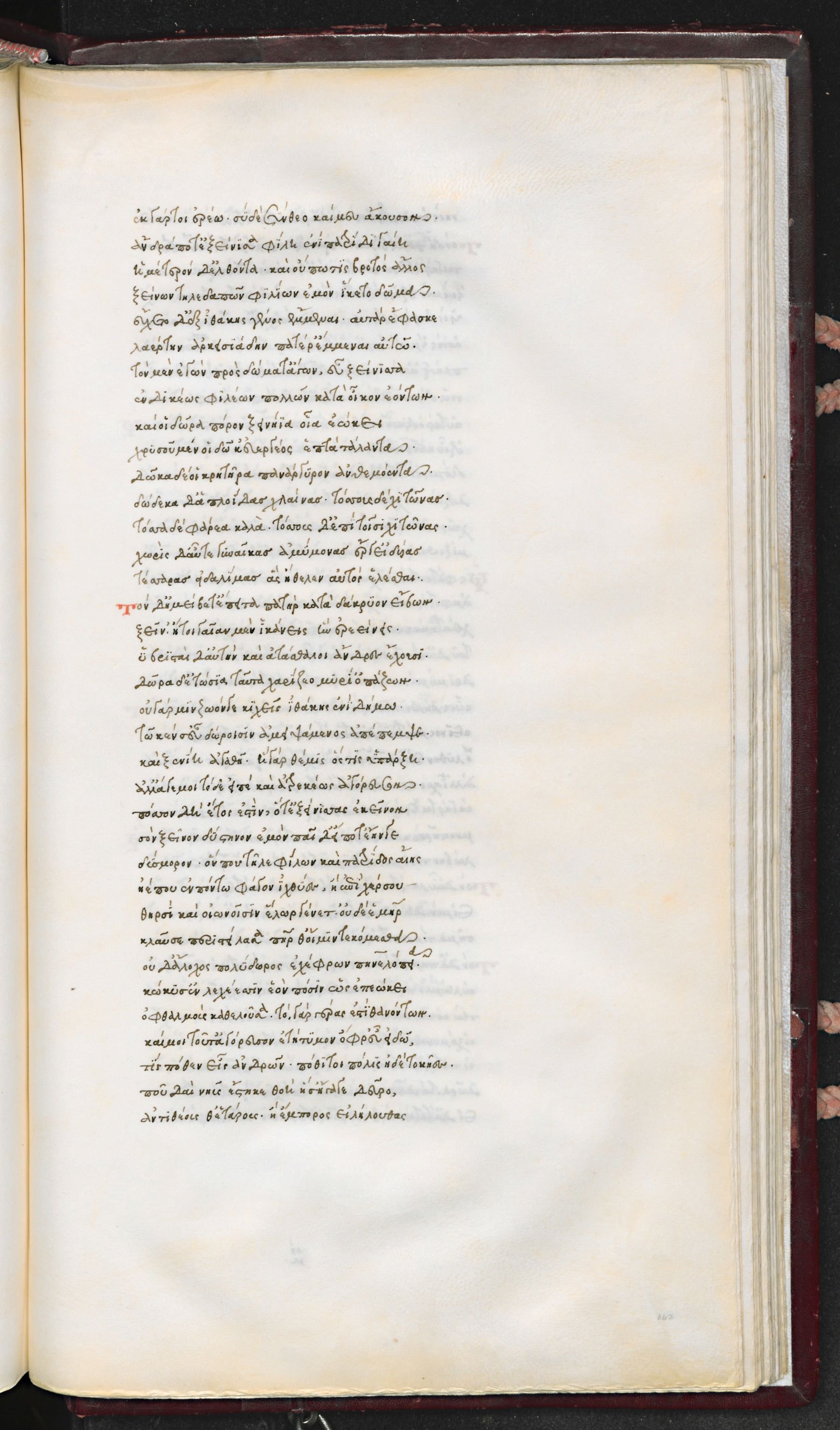
Laur. Plut. 32.4, fol. 442r: Odyssey 24.265-300, begins ‹ἐκ γάρ τοι ἐρέω· σὺ δὲ σύνθεο καί μευ ἄκουσον›, ends ‹ἀντιθέους θ' ἑτάρους· ἦ ἔμπορος εἰλήλουθας›. Checked on the image: first and last lines read and matched to the Greek, and the 36 lines of the page counted. Fol. 441v ends with 24.264. Fol. 442v begins with 24.301. English here: 24.265-300 (to the middle of the line); cut at the sentence that begins with 24.265, the same line as the Greek.
265ἐκ γάρ τοι ἐρέω, σὺ δὲ σύνθεο καί μευ ἄκουσον·
266ἄνδρα ποτʼ ἐξείνισσα φίλῃ ἐνὶ πατρίδι γαίῃ
267ἡμέτερόνδʼ ἐλθόντα, καὶ οὔ πω τις βροτὸς ἄλλος
268ξείνων τηλεδαπῶν φιλίων ἐμὸν ἵκετο δῶμα·
269εὔχετο δʼ ἐξ Ἰθάκης γένος ἔμμεναι, αὐτὰρ ἔφασκε
270Λαέρτην Ἀρκεισιάδην πατέρʼ ἔμμεναι αὐτῷ.
271τὸν μὲν ἐγὼ πρὸς δώματʼ ἄγων ἐῢ ἐξείνισσα,
272ἐνδυκέως φιλέων, πολλῶν κατὰ οἶκον ἐόντων,
273καί οἱ δῶρα πόρον ξεινήϊα, οἷα ἐῴκει.
274χρυσοῦ μέν οἱ δῶκʼ εὐεργέος ἑπτὰ τάλαντα,
275δῶκα δέ οἱ κρητῆρα πανάργυρον ἀνθεμόεντα,
276δώδεκα δʼ ἁπλοΐδας χλαίνας, τόσσους δὲ τάπητας,
277τόσσα δὲ φάρεα καλά, τόσους δʼ ἐπὶ τοῖσι χιτῶνας,
278χωρὶς δʼ αὖτε γυναῖκας, ἀμύμονα ἔργα ἰδυίας,
279τέσσαρας εἰδαλίμας, ἃς ἤθελεν αὐτὸς ἑλέσθαι.
280τὸν δʼ ἠμείβετʼ ἔπειτα πατὴρ κατὰ δάκρυον εἴβων·
281ξεῖνʼ, ἦ τοι μὲν γαῖαν ἱκάνεις, ἣν ἐρεείνεις,
282ὑβρισταὶ δʼ αὐτὴν καὶ ἀτάσθαλοι ἄνδρες ἔχουσιν·
283δῶρα δʼ ἐτώσια ταῦτα χαρίζεο, μυρίʼ ὀπάζων·
284εἰ γάρ μιν ζωόν γʼ ἐκίχεις Ἰθάκης ἐνὶ δήμῳ,
285τῷ κέν σʼ εὖ δώροισιν ἀμειψάμενος ἀπέπεμψε
286καὶ ξενίῃ ἀγαθῇ ἡ γὰρ θέμις, ὅς τις ὑπάρξῃ.
287ἀλλʼ ἄγε μοι τόδε εἰπὲ καὶ ἀτρεκέως κατάλεξον,
288πόστον δὴ ἔτος ἐστίν, ὅτε ξείνισσας ἐκεῖνον
289σὸν ξεῖνον δύστηνον, ἐμὸν παῖδʼ, εἴ ποτʼ ἔην γε,
290δύσμορον; ὅν που τῆλε φίλων καὶ πατρίδος αἴης
291ἠέ που ἐν πόντῳ φάγον ἰχθύες, ἢ ἐπὶ χέρσου
292θηρσὶ καὶ οἰωνοῖσιν ἕλωρ γένετʼ· οὐδέ ἑ μήτηρ
293κλαῦσε περιστείλασα πατήρ θʼ, οἵ μιν τεκόμεσθα·
294οὐδʼ ἄλοχος πολύδωρος, ἐχέφρων Πηνελόπεια,
295κώκυσʼ ἐν λεχέεσσιν ἑὸν πόσιν, ὡς ἐπεῴκει,
296ὀφθαλμοὺς καθελοῦσα· τὸ γὰρ γέρας ἐστὶ θανόντων.
297καί μοι τοῦτʼ ἀγόρευσον ἐτήτυμον, ὄφρʼ ἐῢ εἰδῶ·
298τίς πόθεν εἶς ἀνδρῶν; πόθι τοι πόλις ἠδὲ τοκῆες;
299ποῦ δὲ νηῦς ἕστηκε θοή, ἥ σʼ ἤγαγε δεῦρο
300ἀντιθέους θʼ ἑτάρους; ἦ ἔμπορος εἰλήλουθας
265For I will tell thee, and do thou give heed and hearken. I once entertained in my dear native land a man that came to our house, and never did any man beside of strangers that dwell afar come to my house a more welcome guest. He declared that by lineage he came from Ithaca, and said 270that his own father was Laertes, son of Arceisius. So I took him to the house and gave him entertainment with kindly welcome of the rich store that was within, and I gave him gifts of friendship, such as are meet. Of well-wrought gold 275I gave him seven talents, and a mixing-bowl all of silver, embossed with flowers, and twelve cloaks of single fold, and as many coverlets, and as many fair mantles, and as many tunics besides, and furthermore women, skilled in goodly handiwork, four comely women, whom he himself was minded to choose.” 280Then his father answered him, weeping: “Stranger, verily thou art come to the country of which thou dost ask, but wanton and reckless men now possess it. And all in vain didst thou bestow those gifts, the countless gifts thou gavest. For if thou hadst found him yet alive in the land of Ithaca, 285then would he have sent thee on thy way with ample requital of gifts and good entertainment; for that is the due of him who begins the kindness But come, tell me this, and declare it truly. How many years have passed since thou didst entertain that guest, that hapless guest, my son—as sure as ever such a man there was— 290my ill-starred son, whom far from his friends and his native land haply the fishes have devoured in the deep, or on the shore he has become the spoil of beasts and birds? Nor did his mother deck him for burial and weep over him, nor his father, we who gave him birth, no, nor did his wife, wooed with many gifts, constant Penelope, 295bewail her own husband upon the bier, as was meet, when she had closed his eyes in death; though that is the due of the dead. And tell me this also truly, that I may know full well. Who art thou among men, and from whence? Where is thy city, and where thy parents? Where is the swift ship moored that brought thee hither 300with thy godlike comrades?
Where on the image
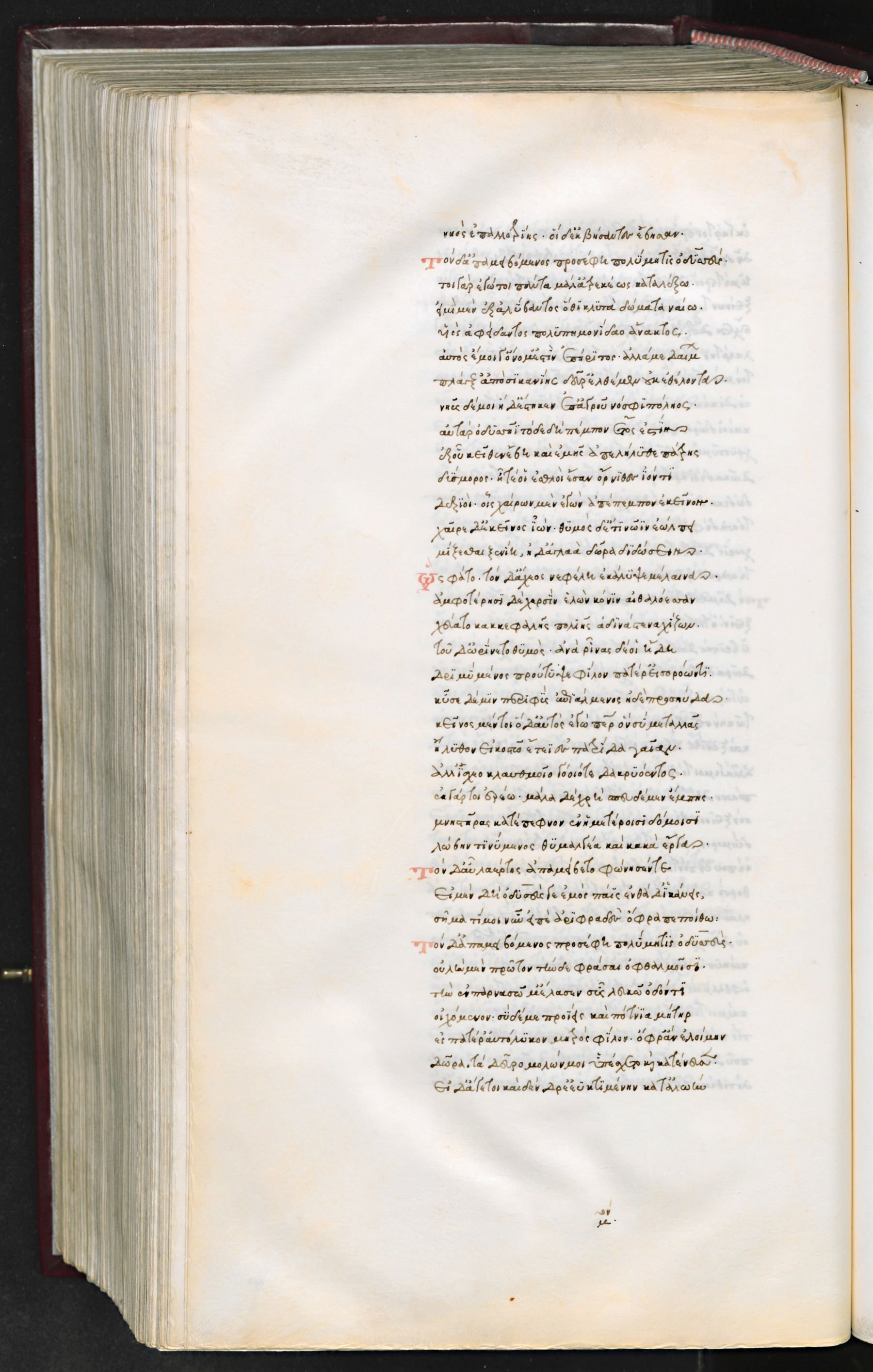
Laur. Plut. 32.4, fol. 442v: Odyssey 24.301-336, begins ‹νηὸς ἐπ' ἀλλοτρίης· οἱ δ' ἐκβήσαντες ἔβησαν›, ends ‹εἰ δ' ἄγε τοι καὶ δένδρε' ἐϋκτιμένην κατ' ἀλωὴν›. Checked on the image: first and last lines read and matched to the Greek, and the 36 lines of the page counted. Fol. 442r ends with 24.300. Fol. 443r begins with 24.337. English here: 24.300-335; Laertes' question in 24.300-301 (Or didst thou come as a passenger ... set thee on shore?) begins in the middle of 24.300, the last line of the page before, and is given with this page; the first half of 24.300 (with thy godlike comrades?) ends the English of the page before.
301νηὸς ἐπʼ ἀλλοτρίης, οἱ δʼ ἐκβήσαντες ἔβησαν;
302τὸν δʼ ἀπαμειβόμενος προσέφη πολύμητις Ὀδυσσεύς·
303τοιγὰρ ἐγώ τοι πάντα μάλʼ ἀτρεκέως καταλέξω.
304εἰμὶ μὲν ἐξ Ἀλύβαντος, ὅθι κλυτὰ δώματα ναίω,
305υἱὸς Ἀφείδαντος Πολυπημονίδαο ἄνακτος·
306αὐτὰρ ἐμοί γʼ ὄνομʼ ἐστὶν Ἐπήριτος· ἀλλά με δαίμων
307πλάγξʼ ἀπὸ Σικανίης δεῦρʼ ἐλθέμεν οὐκ ἐθέλοντα·
308νηῦς δέ μοι ἥδʼ ἕστηκεν ἐπʼ ἀγροῦ νόσφι πόληος.
309αὐτὰρ Ὀδυσσῆϊ τόδε δὴ πέμπτον ἔτος ἐστίν,
310ἐξ οὗ κεῖθεν ἔβη καὶ ἐμῆς ἀπελήλυθε πάτρης,
311δύσμορος· ἦ τέ οἱ ἐσθλοὶ ἔσαν ὄρνιθες ἰόντι,
312δεξιοί, οἷς χαίρων μὲν ἐγὼν ἀπέπεμπον ἐκεῖνον,
313χαῖρε δὲ κεῖνος ἰών· θυμὸς δʼ ἔτι νῶϊν ἐώλπει
314μίξεσθαι ξενίῃ ἠδʼ ἀγλαὰ δῶρα διδώσειν.
315ὣς φάτο, τὸν δʼ ἄχεος νεφέλη ἐκάλυψε μέλαινα·
316ἀμφοτέρῃσι δὲ χερσὶν ἑλὼν κόνιν αἰθαλόεσσαν
317χεύατο κὰκ κεφαλῆς πολιῆς, ἁδινὰ στεναχίζων.
318τοῦ δʼ ὠρίνετο θυμός, ἀνὰ ῥῖνας δέ οἱ ἤδη
319δριμὺ μένος προὔτυψε φίλον πατέρʼ εἰσορόωντι.
320κύσσε δέ μιν περιφὺς ἐπιάλμενος, ἠδὲ προσηύδα·
321κεῖνος μέν τοι ὅδʼ αὐτὸς ἐγώ, πάτερ, ὃν σὺ μεταλλᾷς,
322ἤλυθον εἰκοστῷ ἔτεϊ ἐς πατρίδα γαῖαν.
323ἀλλʼ ἴσχεο κλαυθμοῖο γόοιό τε δακρυόεντος.
324ἐκ γάρ τοι ἐρέω· μάλα δὲ χρὴ σπευδέμεν ἔμπης·
325μνηστῆρας κατέπεφνον ἐν ἡμετέροισι δόμοισι,
326λώβην τινύμενος θυμαλγέα καὶ κακὰ ἔργα.
327τὸν δʼ αὖ Λαέρτης ἀπαμείβετο φώνησέν τε·
328εἰ μὲν δὴ Ὀδυσεύς γε ἐμὸς πάϊς ἐνθάδʼ ἱκάνεις,
329σῆμά τί μοι νῦν εἰπὲ ἀριφραδές, ὄφρα πεποίθω.
330τὸν δʼ ἀπαμειβόμενος προσέφη πολύμητις Ὀδυσσεύς·
331οὐλὴν μὲν πρῶτον τήνδε φράσαι ὀφθαλμοῖσι,
332τὴν ἐν Παρνησῷ μʼ ἔλασεν σῦς λευκῷ ὀδόντι
333οἰχόμενον· σὺ δέ με προΐεις καὶ πότνια μήτηρ
334ἐς πατέρʼ Αὐτόλυκον μητρὸς φίλον, ὄφρʼ ἂν ἑλοίμην
335δῶρα, τὰ δεῦρο μολών μοι ὑπέσχετο καὶ κατένευσεν.
336εἰ δʼ ἄγε τοι καὶ δένδρεʼ ἐϋκτιμένην κατʼ ἀλωὴν
300Or didst thou come as a passenger on another's ship, and did they depart when they had set thee on shore?” Then Odysseus of many wiles answered him, and said: “Then verily will I frankly tell thee all. I come from Alybas, where I have a glorious house, 305and I am the son of Apheidas, son of lord Polypemon, and my own name is Eperitus. But a god drove me wandering from Sicania to come hither against my will and my ship lies yonder off the tilled land away from the city. But as for Odysseus, it is now the fifth year 310since he went thence, and departed from my country. Hapless man! Yet he had birds of good omen, when he set out, birds upon the right. So I was glad of them, as I sent him on his way, and he went gladly forth, and our hearts hoped that we should yet meet as host and guest and give one another glorious gifts.” 315So he spoke, and a dark cloud of grief enwrapped Laertes, and with both his hands he took the dark dust and strewed it over his grey head with ceaseless groaning. Then the heart of Odysseus was stirred, and up through his nostrils shot a keen pang, as he beheld his dear father. 320And he sprang toward him, and clasped him in his arms, and kissed him, saying: “Lo, father, I here before thee, my very self, am that man of whom thou dost ask; I am come in the twentieth year to my native land. But cease from grief and tearful lamenting, for I will tell thee all, though great is the need of haste. 325The wooers have I slain in our halls, and have taken vengeance on their grievous insolence and their evil deeds.” 327Then Laertes answered him again, and said: “If it is indeed as Odysseus, my son, that thou art come hither, tell me now some clear sign, that I maybe sure.” 330And Odysseus of many wiles answered him and said: “This scar first do thou mark with thine eyes, the scar of the wound which a boar dealt me with his white tusk on Parnassus, when I had gone thither. It was thou that didst send me forth, thou and my honored mother, to Autolycus, my mother's father, that I might get 335the gifts which, when he came hither, he promised and agreed to give me.
Where on the image
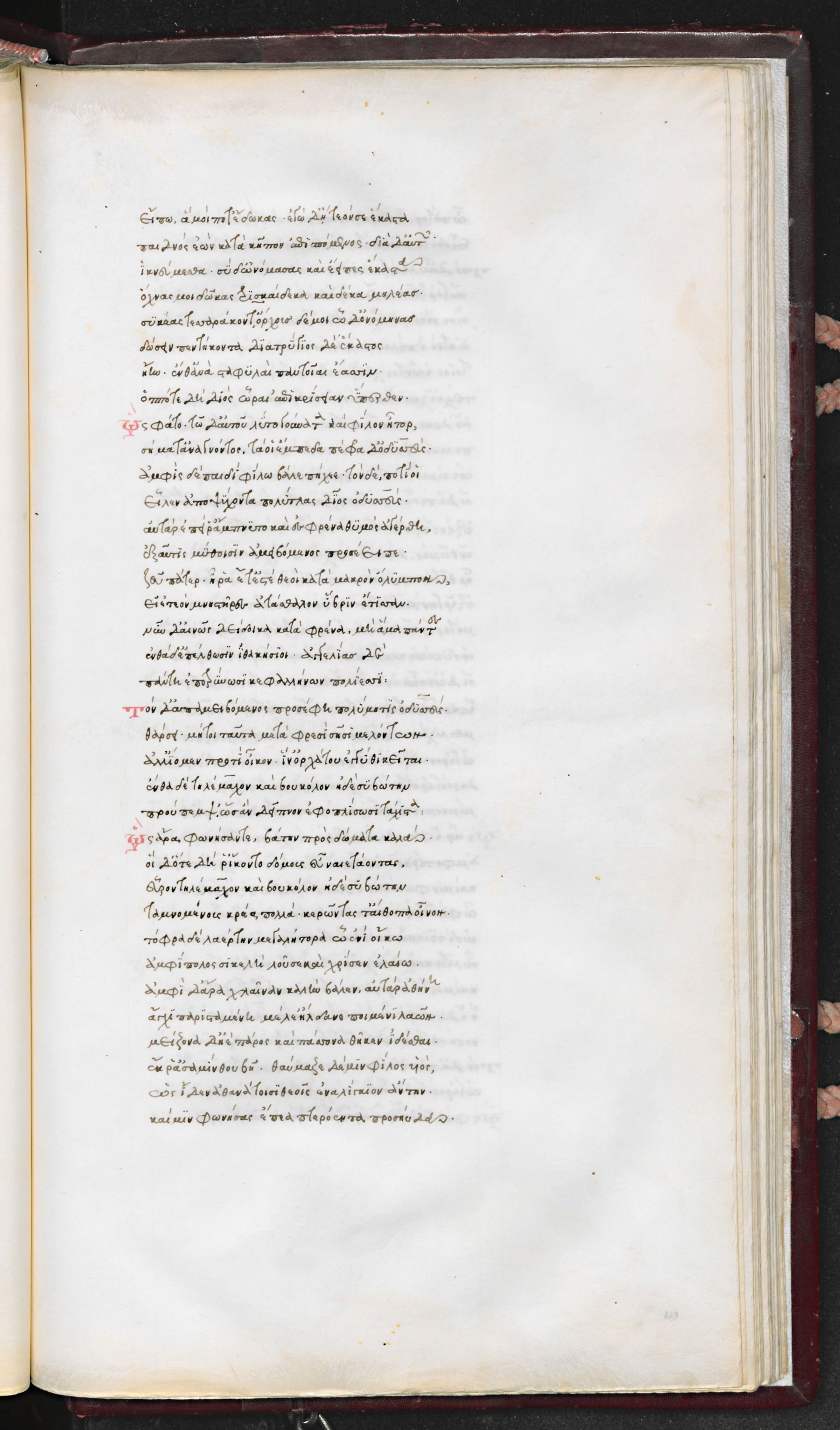
Laur. Plut. 32.4, fol. 443r: Odyssey 24.337-372, begins ‹εἴπω ἅ μοί ποτ' ἔδωκας· ἐγὼ δ' ᾔτεόν σε ἕκαστα›, ends ‹καί μιν φωνήσας ἔπεα πτερόεντα προσηύδα›. Checked on the image: first and last lines read and matched to the Greek, and the 36 lines of the page counted. Fol. 442v ends with 24.336. Fol. 443v begins with 24.373. English here: 24.336-372; Murray's sentence for 24.336-338 (And come, I will tell thee also the trees ... this and that.) begins one line before the page break and is given with this page.
337εἴπω, ἅ μοί ποτʼ ἔδωκας, ἐγὼ δʼ ᾔτεόν σε ἕκαστα
338παιδνὸς ἐών, κατὰ κῆπον ἐπισπόμενος· διὰ δʼ αὐτῶν
339ἱκνεύμεσθα, σὺ δʼ ὠνόμασας καὶ ἔειπες ἕκαστα.
340ὄγχνας μοι δῶκας τρισκαίδεκα καὶ δέκα μηλέας,
341συκέας τεσσαράκοντʼ· ὄρχους δέ μοι ὧδʼ ὀνόμηνας
342δώσειν πεντήκοντα, διατρύγιος δὲ ἕκαστος
343ἤην· ἔνθα δʼ ἀνὰ σταφυλαὶ παντοῖαι ἔασιν—
344ὁππότε δὴ Διὸς ὧραι ἐπιβρίσειαν ὕπερθεν.
345ὣς φάτο, τοῦ δʼ αὐτοῦ λύτο γούνατα καὶ φίλον ἦτορ,
346σήματʼ ἀναγνόντος τά οἱ ἔμπεδα πέφραδʼ Ὀδυσσεύς.
347ἀμφὶ δὲ παιδὶ φίλῳ βάλε πήχεε· τὸν δὲ ποτὶ οἷ
348εἷλεν ἀποψύχοντα πολύτλας δῖος Ὀδυσσεύς.
349αὐτὰρ ἐπεί ῥʼ ἄμπνυτο καὶ ἐς φρένα θυμὸς ἀγέρθη,
350ἐξαῦτις μύθοισιν ἀμειβόμενος προσέειπε·
351Ζεῦ πάτερ, ἦ ῥα ἔτʼ ἔστε θεοὶ κατὰ μακρὸν Ὄλυμπον,
352εἰ ἐτεὸν μνηστῆρες ἀτάσθαλον ὕβριν ἔτισαν.
353νῦν δʼ αἰνῶς δείδοικα κατὰ φρένα μὴ τάχα πάντες
354ἐνθάδʼ ἐπέλθωσιν Ἰθακήσιοι, ἀγγελίας δὲ
355πάντη ἐποτρύνωσι Κεφαλλήνων πολίεσσι.
356τὸν δʼ ἀπαμειβόμενος προσέφη πολύμητις Ὀδυσσεύς·
357θάρσει, μή τοι ταῦτα μετὰ φρεσὶ σῇσι μελόντων.
358ἀλλʼ ἴομεν προτὶ οἶκον, ὃς ὀρχάτου ἐγγύθι κεῖται·
359ἔνθα δὲ Τηλέμαχον καὶ βουκόλον ἠδὲ συβώτην
360προὔπεμψʼ, ὡς ἂν δεῖπνον ἐφοπλίσσωσι τάχιστα.
361ὣς ἄρα φωνήσαντε βάτην πρὸς δώματα καλά.
362οἱ δʼ ὅτε δή ῥʼ ἵκοντο δόμους εὖ ναιετάοντας,
363εὗρον Τηλέμαχον καὶ βουκόλον ἠδὲ συβώτην
364ταμνομένους κρέα πολλὰ κερῶντάς τʼ αἴθοπα οἶνον.
365τόφρα δὲ Λαέρτην μεγαλήτορα ᾧ ἐνὶ οἴκῳ
366ἀμφίπολος Σικελὴ λοῦσεν καὶ χρῖσεν ἐλαίῳ,
367ἀμφὶ δʼ ἄρα χλαῖναν καλὴν βάλεν· αὐτὰρ Ἀθήνη
368ἄγχι παρισταμένη μέλεʼ ἤλδανε ποιμένι λαῶν,
369μείζονα δʼ ἠὲ πάρος καὶ πάσσονα θῆκεν ἰδέσθαι.
370ἐκ δʼ ἀσαμίνθου βῆ· θαύμαζε δέ μιν φίλος υἱός,
371ὡς ἴδεν ἀθανάτοισι θεοῖς ἐναλίγκιον ἄντην·
372καί μιν φωνήσας ἔπεα πτερόεντα προσηύδα·
336And come, I will tell thee also the trees in the well-ordered garden which once thou gavest me, and I, who was but a child, was following thee through the garden, and asking thee for this and that. It was through these very trees that we passed, and thou didst name them, and tell me of each one. 340Pear-trees thirteen thou gavest me, and ten apple-trees, and forty fig-trees. And rows of vines too didst thou promise to give me, even as I say, fifty of them, which ripened severally at different times—and upon them are clusters of all sorts—whensoever the seasons of Zeus weighed them down from above.” 345So he spoke, and his father's knees were loosened where he stood, and his heart melted, as he knew the sure tokens which Odysseus told him. About his dear son he flung both his arms, and the much-enduring, goodly Odysseus caught him unto him fainting. But when he revived, and his spirit returned again into his breast, 350once more he made answer, and spoke, saying: “Father Zeus, verily ye gods yet hold sway on high Olympus, if indeed the wooers have paid the price of their wanton insolence. But now I have wondrous dread at heart, lest straightway all the men of Ithaca come hither against us, and 355send messengers everywhere to the cities of the Cephallenians.” Then Odysseus of many wiles answered him, and said: “Be of good cheer, and let not these things distress thy heart. But let us go to the house, which lies near the orchard, for thither 360I sent forward Telemachus and the neatherd and the swineherd, that with all speed they might prepare our meal.” So spoke the two, and went their way to the goodly house. And when they had come to the stately house, they found Telemachus, and the neatherd, and the swineherd carving flesh in abundance, and mixing the flaming wine. 365Meanwhile the Sicilian handmaid bathed great-hearted Laertes in his house, and anointed him with oil, and about him cast a fair cloak. But Athena drew near, and made greater the limbs of the shepherd of the people, and made him taller than before and mightier to behold. 370Then he came forth from the bath, and his dear son marvelled at him, seeing him in presence like unto the immortal gods. And he spoke, and addressed him with winged words:
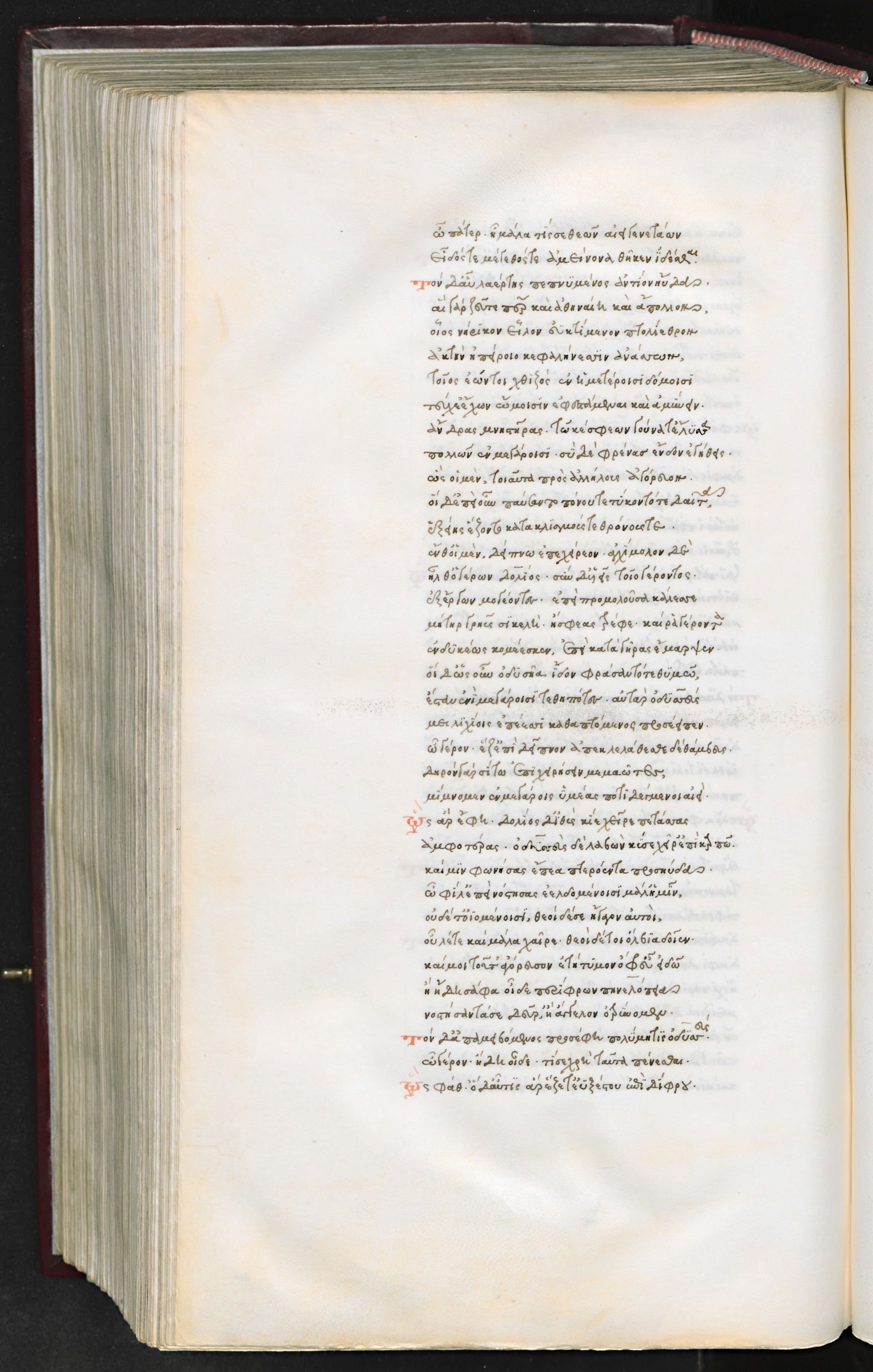
Where on the image
Laur. Plut. 32.4, fol. 443v: Odyssey 24.373-408, begins ‹ὦ πάτερ ἦ μάλα τίς σε θεῶν αἰειγενετάων›, ends ‹ὣς φάθ' ὁ δ' αὖτις ἄρ' ἕζετ' ἐϋξέστου ἐπὶ δίφρου›. Checked on the image: first and last lines read and matched to the Greek, and the 36 lines of the page counted. Fol. 443r ends with 24.372. Fol. 444r begins with 24.409. English here: 24.373-408; cut where Odysseus' speech begins (24.373), the same line as the Greek.
373ὦ πάτερ, ἦ μάλα τίς σε θεῶν αἰειγενετάων
374εἶδός τε μέγεθός τε ἀμείνονα θῆκεν ἰδέσθαι.
375τὸν δʼ αὖ Λαέρτης πεπνυμένος ἀντίον ηὔδα·
376αἲ γάρ, Ζεῦ τε πάτερ καὶ Ἀθηναίη καὶ Ἄπολλον,
377οἷος Νήρικον εἷλον, ἐϋκτίμενον πτολίεθρον,
378ἀκτὴν ἠπείροιο, Κεφαλλήνεσσιν ἀνάσσων,
379τοῖος ἐών τοι χθιζὸς ἐν ἡμετέροισι δόμοισιν,
380τεύχεʼ ἔχων ὤμοισιν, ἐφεστάμεναι καὶ ἀμύνειν
381ἄνδρας μνηστῆρας· τῷ κε σφέων γούνατʼ ἔλυσα
382πολλῶν ἐν μεγάροισι, σὺ δὲ φρένας ἔνδον ἐγήθεις.
383ὣς οἱ μὲν τοιαῦτα πρὸς ἀλλήλους ἀγόρευον.
384οἱ δʼ ἐπεὶ οὖν παύσαντο πόνου τετύκοντό τε δαῖτα,
385ἑξείης ἕζοντο κατὰ κλισμούς τε θρόνους τε·
386ἔνθʼ οἱ μὲν δείπνῳ ἐπεχείρεον, ἀγχίμολον δὲ
387ἦλθʼ ὁ γέρων Δολίος, σὺν δʼ υἱεῖς τοῖο γέροντος,
388ἐξ ἔργων μογέοντες, ἐπεὶ προμολοῦσα κάλεσσεν
389μήτηρ γρηῦς Σικελή, ἥ σφεας τρέφε καί ῥα γέροντα
390ἐνδυκέως κομέεσκεν, ἐπεὶ κατὰ γῆρας ἔμαρψεν.
391οἱ δʼ ὡς οὖν Ὀδυσῆα ἴδον φράσσαντό τε θυμῷ,
392ἔσταν ἐνὶ μεγάροισι τεθηπότες· αὐτὰρ Ὀδυσσεὺς
393μειλιχίοις ἐπέεσσι καθαπτόμενος προσέειπεν·
394ὦ γέρον, ἵζʼ ἐπὶ δεῖπνον, ἀπεκλελάθεσθε δὲ θάμβευς·
395δηρὸν γὰρ σίτῳ ἐπιχειρήσειν μεμαῶτες
396μίμνομεν ἐν μεγάροις, ὑμέας ποτιδέγμενοι αἰεί.
397ὣς ἄρ ἔφη, Δολίος δʼ ἰθὺς κίε χεῖρε πετάσσας
398ἀμφοτέρας, Ὀδυσεῦς δὲ λαβὼν κύσε χεῖρʼ ἐπὶ καρπῷ,
399καί μιν φωνήσας ἔπεα πτερόεντα προσηύδα·
400ὦ φίλʼ, ἐπεὶ νόστησας ἐελδομένοισι μάλʼ ἡμῖν
401οὐδʼ ἔτʼ ὀϊομένοισι, θεοὶ δέ σʼ ἀνήγαγον αὐτοί,
402οὖλέ τε καὶ μάλα χαῖρε, θεοὶ δέ τοι ὄλβια δοῖεν.
403καί μοι τοῦτʼ ἀγόρευσον ἐτήτυμον, ὄφρʼ ἐῢ εἰδῶ,
404ἢ ἤδη σάφα οἶδε περίφρων Πηνελόπεια
405νοστήσαντά σε δεῦρʼ, ἦ ἄγγελον ὀτρύνωμεν.
406τὸν δʼ ἀπαμειβόμενος προσέφη πολύμητις Ὀδυσσεύς
407ὦ γέρον, ἤδη οἶδε· τί σε χρὴ ταῦτα πένεσθαι;
408ὣς φάθʼ, ὁ δʼ αὖτις ἄρʼ ἕζετʼ ἐϋξέστου ἐπὶ δίφρου.
373“Father, surely some one of the gods that are forever has made thee goodlier to behold in comeliness and in stature.” 375Then wise Laertes answered him: “I would, O father Zeus, and Athena, and Apollo, that in such strength as when I took Nericus, the well built citadel on the shore of the mainland, when I was lord of the Cephallenians, even in such strength I had stood by thy side yesterday in our house 380with my armour about my shoulders, and had beaten back the wooers. So should I have loosened the knees of many of them in the halls, and thy heart would have been made glad within thee.” So they spoke to one another. But when the others had ceased from their labour, and had made ready the meal, 385they sat down in order on the chairs and high seats. Then they were about to set hands to their food, when the old man Dolius drew near, and with him the old man's sons, wearied from their work in the fields, for their mother, the old Sicilian woman, had gone forth and called them, she who 390saw to their food, and tended the old man with kindly care, now that old age had laid hold of him. And they, when they saw Odysseus, and marked him in their minds, stood in the halls lost in wonder. But Odysseus addressed them with gentle words, and said: “Old man, sit down to dinner, and do ye wholly forget your wonder, 395for long have we waited in the halls, though eager to set hands to the food, ever expecting your coming.” So he spoke, and Dolius ran straight toward him with both hands outstretched, and he clasped the hand of Odysseus and kissed it on the wrist, and spoke, and addressed him with winged words: 400“Dear master, since thou hast come back to us, who sorely longed for thee, but had no more thought to see thee, and the gods themselves have brought thee—hail to thee, and all welcome, and may the gods grant thee happiness. And tell me this also truly, that I may know full well. Does wise Penelope yet know surely 405that thou hast come back hither, or shall we send her a messenger?” Then Odysseus of many wiles answered him, and said: “Old man, she knows already; why shouldst thou be busied with this?” So he spoke, and the other sat down again on the polished chair.
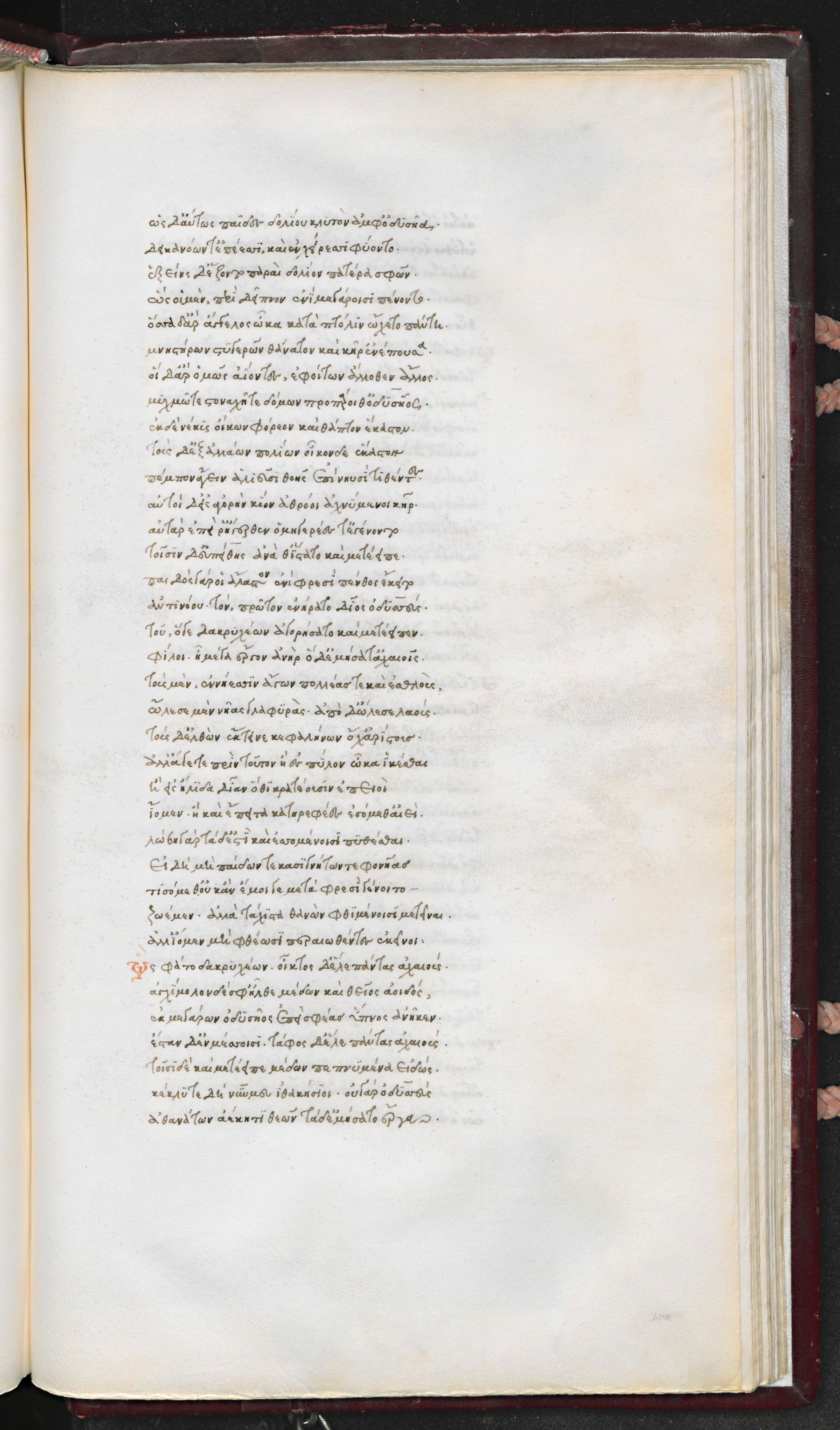
Where on the image
Laur. Plut. 32.4, fol. 444r: Odyssey 24.409-444, begins ‹ὣς δ' αὔτως παῖδες δολίου κλυτὸν ἀμφ' ὀδυσῆα›, ends ‹ἀθανάτων ἀέκητι θεῶν τάδ' ἐμήσατο ἔργα›. Checked on the image: first and last lines read and matched to the Greek, and the 36 lines of the page counted. Fol. 443v ends with 24.408. Fol. 444v begins with 24.445. English here: 24.409-444; cut at the sentence that begins with 24.409, the same line as the Greek.
409ὣς δʼ αὔτως παῖδες Δολίου κλυτὸν ἀμφʼ Ὀδυσῆα
410δεικανόωντʼ ἐπέεσσι καὶ ἐν χείρεσσι φύοντο,
411ἑξείης δʼ ἕζοντο παραὶ Δολίον, πατέρα σφόν.
412ὣς οἱ μὲν περὶ δεῖπνον ἐνὶ μεγάροισι πένοντο·
413Ὄσσα δʼ ἄρʼ ἄγγελος ὦκα κατὰ πτόλιν ᾤχετο πάντη,
414μνηστήρων στυγερὸν θάνατον καὶ κῆρʼ ἐνέπουσα.
415οἱ δʼ ἄρʼ ὁμῶς ἀΐοντες ἐφοίτων ἄλλοθεν ἄλλος
416μυχμῷ τε στοναχῇ τε δόμων προπάροιθʼ Ὀδυσῆος,
417ἐκ δὲ νέκυς οἴκων φόρεον καὶ θάπτον ἕκαστοι,
418τοὺς δʼ ἐξ ἀλλάων πολίων οἶκόνδε ἕκαστον
419πέμπον ἄγειν ἁλιεῦσι θοῇς ἐπὶ νηυσὶ τιθέντες·
420αὐτοὶ δʼ εἰς ἀγορὴν κίον ἀθρόοι, ἀχνύμενοι κῆρ.
421αὐτὰρ ἐπεί ῥʼ ἤγερθεν ὁμηγερέες τʼ ἐγένοντο,
422τοῖσιν δʼ Εὐπείθης ἀνά θʼ ἵστατο καὶ μετέειπε·
423παιδὸς γάρ οἱ ἄλαστον ἐνὶ φρεσὶ πένθος ἔκειτο,
424Ἀντινόου, τὸν πρῶτον ἐνήρατο δῖος Ὀδυσσεύς·
425τοῦ ὅ γε δάκρυ χέων ἀγορήσατο καὶ μετέειπεν·
426ὦ φίλοι, ἦ μέγα ἔργον ἀνὴρ ὅδʼ ἐμήσατʼ Ἀχαιούς·
427τοὺς μὲν σὺν νήεσσιν ἄγων πολέας τε καὶ ἐσθλοὺς
428ὤλεσε μὲν νῆας γλαφυράς, ἀπὸ δʼ ὤλεσε λαούς·
429τοὺς δʼ ἐλθὼν ἔκτεινε Κεφαλλήνων ὄχʼ ἀρίστους,
430ἀλλʼ ἄγετε, πρὶν τοῦτον ἢ ἐς Πύλον ὦκα ἱκέσθαι
431ἢ καὶ ἐς Ἤλιδα δῖαν, ὅθι κρατέουσιν Ἐπειοί,
432ἴομεν· ἦ καὶ ἔπειτα κατηφέες ἐσσόμεθʼ αἰεί·
433λώβη γὰρ τάδε γʼ ἐστὶ καὶ ἐσσομένοισι πυθέσθαι,
434εἰ δὴ μὴ παίδων τε κασιγνήτων τε φονῆας
435τισόμεθʼ. οὐκ ἂν ἐμοί γε μετὰ φρεσὶν ἡδὺ γένοιτο
436ζωέμεν, ἀλλὰ τάχιστα θανὼν φθιμένοισι μετείην.
437ἀλλʼ ἴομεν, μὴ φθέωσι περαιωθέντες ἐκεῖνοι.
438ὣς φάτο δάκρυ χέων, οἶκτος δʼ ἕλε πάντας Ἀχαιούς.
439ἀγχίμολον δέ σφʼ ἦλθε Μέδων καὶ θεῖος ἀοιδὸς
440ἐκ μεγάρων Ὀδυσῆος, ἐπεί σφεας ὕπνος ἀνῆκεν,
441ἔσταν δʼ ἐν μέσσοισι· τάφος δʼ ἕλεν ἄνδρα ἕκαστον.
442τοῖσι δὲ καὶ μετέειπε Μέδων πεπνυμένα εἰδώς·
443κέκλυτε δὴ νῦν μευ, Ἰθακήσιοι· οὐ γὰρ Ὀδυσσεὺς
444ἀθανάτων ἀέκητι θεῶν τάδʼ ἐμήσατο ἔργα·
409And even in like manner the sons of Dolius gathered around glorious Odysseus 410and greeted him in speech, and clasped his hands. Then they sat down in order beside Dolius, their father. 412So they were busied with their meal in the halls; but meanwhile Rumor, the messenger, went swiftly throughout all the city, telling of the terrible death and fate of the wooers. 415And the people heard it all at once, and gathered from every side with moanings and wailings before the palace of Odysseus. Forth from the halls they brought each his dead, and buried them; and those from other cities they sent each to his own home, placing them on swift ships for seamen to bear them, 420but they themselves went together to the place of assembly, sad at heart. Now when they were assembled and met together Eupeithes arose and spoke among them, for comfortless grief for his son lay heavy on his heart, even for Antinous, the first man whom goodly Odysseus had slain. 425Weeping for him he addressed their assembly and said: “Friends, a monstrous deed has this man of a truth devised against the Achaeans. Some he led forth in his ships, many men and goodly, and he has lost his hollow ships and utterly lost his men; and others again has he slain on his return, and these by far the best of the Cephallenians. 430Nay then, come, before the fellow goes swiftly to Pylos or to goodly Elis, where the Epeans hold sway, let us go forth; verily even in days to come shall we be disgraced forever. For a shame is this even for men that are yet to be to hear of, if we shall not 435take vengeance on the slayers of our sons and our brothers. To me surely life would then no more be sweet; rather would I die at once and be among the dead. Nay, let us forth, lest they be too quick for us, and cross over the sea.” So he spoke, weeping, and pity laid hold of all the Achaeans. Then near them came Medon and the divine minstrel 440from the halls of Odysseus, for sleep had released them; and they took their stand in the midst, and wonder seized every man. Then Medon, wise of heart, spoke among them: “Hearken now to me, men of Ithaca, for verily not without the will of the immortal gods has Odysseus devised these deeds.
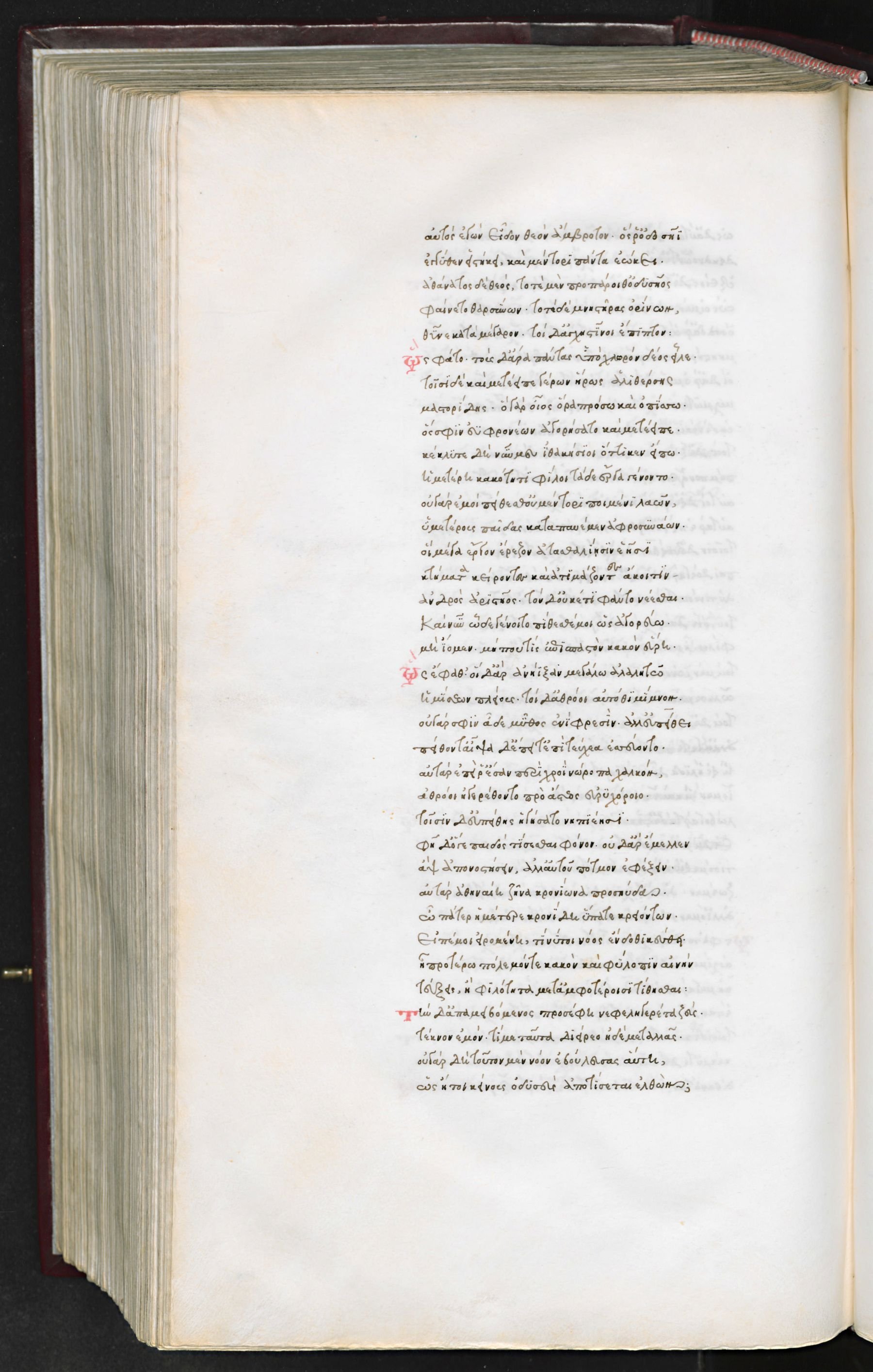
Where on the image
Laur. Plut. 32.4, fol. 444v: Odyssey 24.445-480, begins ‹αὐτὸς ἐγὼν εἶδον θεὸν ἄμβροτον ὅς ῥ' ὀδυσῆϊ›, ends ‹ὡς ἦ τοι κείνους ὀδυσεὺς ἀποτίσεται ἐλθών;›. Checked on the image: first and last lines read and matched to the Greek, and the 36 lines of the page counted. Fol. 444r ends with 24.444. Fol. 445r begins with 24.481. English here: 24.445-480; cut at the sentence that begins with 24.445, the same line as the Greek.
445αὐτὸς ἐγὼν εἶδον θεὸν ἄμβροτον, ὅς ῥʼ Ὀδυσῆϊ
446ἐγγύθεν ἑστήκει καὶ Μέντορι πάντα ἐῴκει.
447ἀθάνατος δὲ θεὸς τοτὲ μὲν προπάροιθʼ Ὀδυσῆος
448φαίνετο θαρσύνων, τοτὲ δὲ μνηστῆρας ὀρίνων
449θῦνε κατὰ μέγαρον· τοὶ δʼ ἀγχιστῖνοι ἔπιπτον.
450ὣς φάτο, τοὺς δʼ ἄρα πάντας ὑπὸ χλωρὸν δέος ᾕρει.
451τοῖσι δὲ καὶ μετέειπε γέρων ἥρως Ἁλιθέρσης
452Μαστορίδης· ὁ γὰρ οἶος ὅρα πρόσσω καὶ ὀπίσσω·
453ὅ σφιν ἐϋφρονέων ἀγορήσατο καὶ μετέειπε·
454κέκλυτε δὴ νῦν μευ, Ἰθακήσιοι, ὅττι κεν εἴπω·
455ὑμετέρῃ κακότητι, φίλοι, τάδε ἔργα γένοντο·
456οὐ γὰρ ἐμοὶ πείθεσθʼ, οὐ Μέντορι ποιμένι λαῶν,
457ὑμετέρους παῖδας καταπαυέμεν ἀφροσυνάων,
458οἳ μέγα ἔργον ἔρεξαν ἀτασθαλίῃσι κακῇσι,
459κτήματα κείροντες καὶ ἀτιμάζοντες ἄκοιτιν
460ἀνδρὸς ἀριστῆος· τὸν δʼ οὐκέτι φάντο νέεσθαι.
461καὶ νῦν ὧδε γένοιτο. πίθεσθέ μοι ὡς ἀγορεύω·
462μὴ ἴομεν, μή πού τις ἐπίσπαστον κακὸν εὕρῃ.
463ὣς ἔφαθʼ, οἱ δʼ ἄρʼ ἀνήϊξαν μεγάλῳ ἀλαλητῷ
464ἡμίσεων πλείους· τοὶ δʼ ἀθρόοι αὐτόθι μίμνον·
465οὐ γάρ σφιν ἅδε μῦθος ἐνὶ φρεσίν, ἀλλʼ Εὐπείθει
466πείθοντʼ· αἶψα δʼ ἔπειτʼ ἐπὶ τεύχεα ἐσσεύοντο.
467αὐτὰρ ἐπεί ῥʼ ἕσσαντο περὶ χροῒ νώροπα χαλκόν,
468ἀθρόοι ἠγερέθοντο πρὸ ἄστεος εὐρυχόροιο.
469τοῖσιν δʼ Εὐπείθης ἡγήσατο νηπιέῃσι·
470φῆ δʼ ὅ γε τίσεσθαι παιδὸς φόνον, οὐδʼ ἄρʼ ἔμελλεν
471ἂψ ἀπονοστήσειν, ἀλλʼ αὐτοῦ πότμον ἐφέψειν.
472αὐτὰρ Ἀθηναίη Ζῆνα Κρονίωνα προσηύδα·
473ὦ πάτερ ἡμέτερε, Κρονίδη, ὕπατε κρειόντων,
474εἰπέ μοι εἰρομένῃ, τί νύ τοι νόος ἔνδοθι κεύθει;
475ἢ προτέρω πόλεμόν τε κακὸν καὶ φύλοπιν αἰνὴν
476τεύξεις, ἦ φιλότητα μετʼ ἀμφοτέροισι τίθησθα;
477τὴν δʼ ἀπαμειβόμενος προσέφη νεφεληγερέτα Ζεύς·
478τέκνον ἐμόν, τί με ταῦτα διείρεαι ἠδὲ μεταλλᾷς;
479οὐ γὰρ δὴ τοῦτον μὲν ἐβούλευσας νόον αὐτή,
480ὡς ἦ τοι κείνους Ὀδυσεὺς ἀποτίσεται ἐλθών;
445Nay, I myself saw an immortal god, who stood close beside Odysseus, and seemed in all things like unto Mentor. Yet as an immortal god now in front of Odysseus would he appear, heartening him, and now again would rage through the hall, scaring the wooers; and they fell thick and fast.” 450So he spoke, and thereat pale fear seized them all. Then among them spoke the old lord Halitherses, son of Mastor, for he alone saw before and after: he with good intent addressed their assembly, and said: “Hearken now to me, men of Ithaca, to the word that I shall say. 455Through your own cowardice, friends, have these deeds been brought to pass, for you would not obey me, nor Mentor, shepherd of the people, to make your sons cease from their folly. They wrought a monstrous deed in their blind and wanton wickedness, wasting the wealth and dishonoring the wife 460of a prince, who, they said, would never more return. Now then be it thus; and do you hearken to me, as I bid. Let us not go forth, lest haply many a one shall find a bane which he has brought upon himself.” So he spoke, but they sprang up with loud cries, more than half of them, but the rest remained together in their seats; 465for his speech was not to their mind, but they hearkened to Eupeithes, and quickly thereafter they rushed for their arms. Then when they had clothed their bodies in gleaming bronze, they gathered together in front of the spacious city. And Eupeithes led them in his folly, 470for he thought to avenge the slaying of his son; yet he was himself never more to come back, but was there to meet his doom. But Athena spoke to Zeus, son of Cronos, saying: “Father of us all, thou son of Cronos, high above all lords, tell to me that ask thee what purpose thy mind now hides within thee. 475Wilt thou yet further bring to pass evil war and the dread din of battle, or wilt thou establish friendship betwixt the twain?” Then Zeus, the cloud-gatherer, answered her, and said: “My child, why dost thou ask and question me of this? Didst thou not thyself devise this plan, 480that verily Odysseus should take vengeance on these men at his coming?
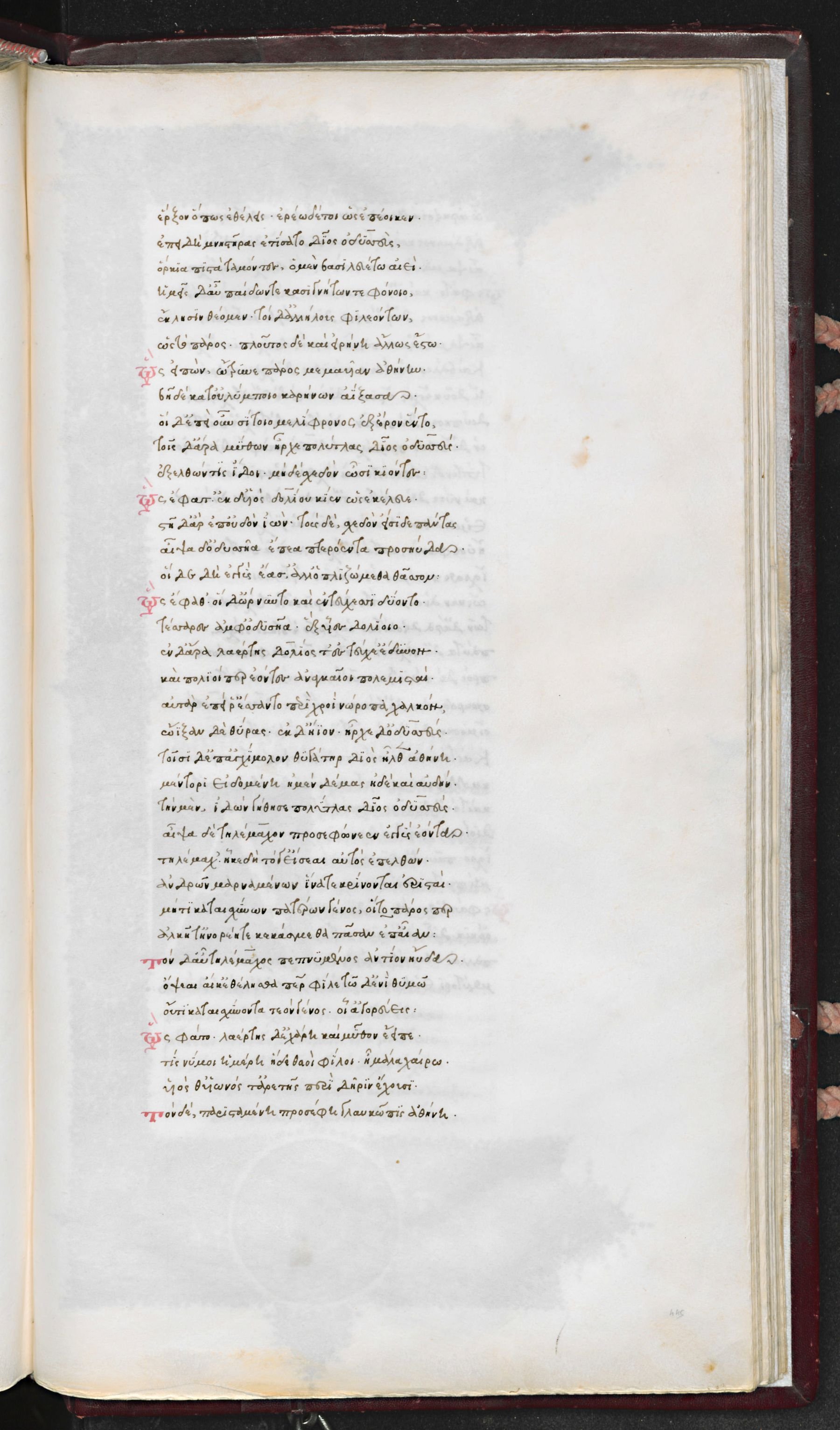
Where on the image
Laur. Plut. 32.4, fol. 445r: Odyssey 24.481-516, begins ‹ἔρξον ὅπως ἐθέλεις· ἐρέω δέ τοι ὡς ἐπέοικεν›, ends ‹τὸν δὲ παρισταμένη προσέφη γλαυκῶπις ἀθήνη›. Checked on the image: first and last lines read and matched to the Greek, and the 36 lines of the page counted. Fol. 444v ends with 24.480. Fol. 445v begins with 24.517. English here: 24.481-516; cut at the sentence that begins with 24.481, the same line as the Greek.
481ἔρξον ὅπως ἐθέλεις· ἐρέω τέ τοι ὡς ἐπέοικεν.
482ἐπεὶ δὴ μνηστῆρας ἐτίσατο δῖος Ὀδυσσεύς,
483ὅρκια πιστὰ ταμόντες ὁ μὲν βασιλευέτω αἰεί,
484ἡμεῖς δʼ αὖ παίδων τε κασιγνήτων τε φόνοιο
485ἔκλησιν θέωμεν· τοὶ δʼ ἀλλήλους φιλεόντων
486ὡς τὸ πάρος, πλοῦτος δὲ καὶ εἰρήνη ἅλις ἔστω.
487ὣς εἰπὼν ὤτρυνε πάρος μεμαυῖαν Ἀθήνην,
488βῆ δὲ κατʼ Οὐλύμποιο καρήνων ἀΐξασα.
489οἱ δʼ ἐπεὶ οὖν σίτοιο μελίφρονος ἐξ ἔρον ἕντο,
490τοῖς δʼ ἄρα μύθων ἦρχε πολύτλας δῖος Ὀδυσσεύς·
491ἐξελθών τις ἴδοι μὴ δὴ σχεδὸν ὦσι κιόντες.
492ὣς ἔφατʼ· ἐκ δʼ υἱὸς Δολίου κίεν, ὡς ἐκέλευεν·
493στῆ δʼ ἄρʼ ἐπʼ οὐδὸν ἰών, τοὺς δὲ σχεδὸν εἴσιδε πάντας·
494αἶψα δʼ Ὀδυσσῆα ἔπεα πτερόεντα προσηύδα·
495οἵδε δὴ ἐγγὺς ἔασʼ· ἀλλʼ ὁπλιζώμεθα θᾶσσον.
496ὣς ἔφαθʼ, οἱ δʼ ὤρνυντο καὶ ἐν τεύχεσσι δύοντο,
497τέσσαρες ἀμφʼ Ὀδυσῆʼ, ἓξ δʼ υἱεῖς οἱ Δολίοιο·
498ἐν δʼ ἄρα Λαέρτης Δολίος τʼ ἐς τεύχεʼ ἔδυνον,
499καὶ πολιοί περ ἐόντες, ἀναγκαῖοι πολεμισταί.
500αὐτὰρ ἐπεί ῥʼ ἕσσαντο περὶ χροῒ νώροπα χαλκόν,
501ὤϊξάν ῥα θύρας, ἐκ δʼ ἤϊον, ἦρχε δʼ Ὀδυσσεύς.
502τοῖσι δʼ ἐπʼ ἀγχίμολον θυγάτηρ Διὸς ἦλθεν Ἀθήνη
503Μέντορι εἰδομένη ἠμὲν δέμας ἠδὲ καὶ αὐδήν.
504τὴν μὲν ἰδὼν γήθησε πολύτλας δῖος Ὀδυσσεύς·
505αἶψα δὲ Τηλέμαχον προσεφώνεεν ὃν φίλον υἱόν·
506Τηλέμαχʼ, ἤδη μὲν τόδε γʼ εἴσεαι αὐτὸς ἐπελθών,
507ἀνδρῶν μαρναμένων ἵνα τε κρίνονται ἄριστοι,
508μή τι καταισχύνειν πατέρων γένος, οἳ τὸ πάρος περ
509ἀλκῇ τʼ ἠνορέῃ τε κεκάσμεθα πᾶσαν ἐπʼ αἶαν.
510τὸν δʼ αὖ Τηλέμαχος πεπνυμένος ἀντίον ηὔδα·
511ὄψεαι, αἴ κʼ ἐθέλῃσθα, πάτερ φίλε, τῷδʼ ἐπὶ θυμῷ
512οὔ τι καταισχύνοντα τεὸν γένος, ὡς ἀγορεύεις.
513ὣς φάτο, Λαέρτης δʼ ἐχάρη καὶ μῦθον ἔειπε·
514τίς νύ μοι ἡμέρη ἥδε, θεοὶ φίλοι; ἦ μάλα χαίρω·
515υἱός θʼ υἱωνός τʼ ἀρετῆς πέρι δῆριν ἔχουσιν.
516τὸν δὲ παρισταμένη προσέφη γλαυκῶπις Ἀθήνη·
481Do as thou wilt, but I will tell thee what is fitting. Now that goodly Odysseus has taken vengeance on the wooers, let them swear a solemn oath, and let him be king all his days, and let us on our part 485bring about a forgetting of the slaying of their sons and brothers; and let them love one another as before, and let wealth and peace abound.” So saying, he roused Athena, who was already eager, and she went darting down from the heights of Olympus. But when they had put from them the desire of honey-hearted food, 490the much-enduring, goodly Odysseus was the first to speak among his company, saying: “Let one go forth and see whether they be not now drawing near.” So he spoke, and a son of Dolius went forth, as he bade; he went and stood upon the threshold, and saw them all close at hand, and straightway he spoke to Odysseus winged words: 495“Here they are close at hand. Quick, let us arm.” 496So he spoke, and they rose up and arrayed themselves in armour: Odysseus and his men were four, and six the sons of Dolius, and among them Laertes and Dolius donned their armour, grey-headed though they were, warriors perforce. 500But when they had clothed their bodies in gleaming bronze, they opened the doors and went forth, and Odysseus led them. Then Athena, daughter of Zeus, drew near them in the likeness of Mentor both in form and in voice, and the much-enduring, goodly Odysseus was glad at sight of her, 505and straightway spoke to Telemachus, his dear son: “Telemachus, now shalt thou learn this—having thyself come to the place of battle, where the best warriors are put to the trial—to bring no disgrace upon the house of thy fathers, for we have ever excelled in strength and in valor over all the earth.” 510And wise Telemachus answered him: “Thou shalt see me, if thou wilt, dear father, in my present temper, bringing no disgrace upon thy house, even as thou sayest.” So said he, and Laertes was glad, and spoke, saying: “What a day is this for me, kind gods! 515Verily right glad am I: my son and my son's son are vying with one another in valor.” Then flashing-eyed Athena came near him and said:
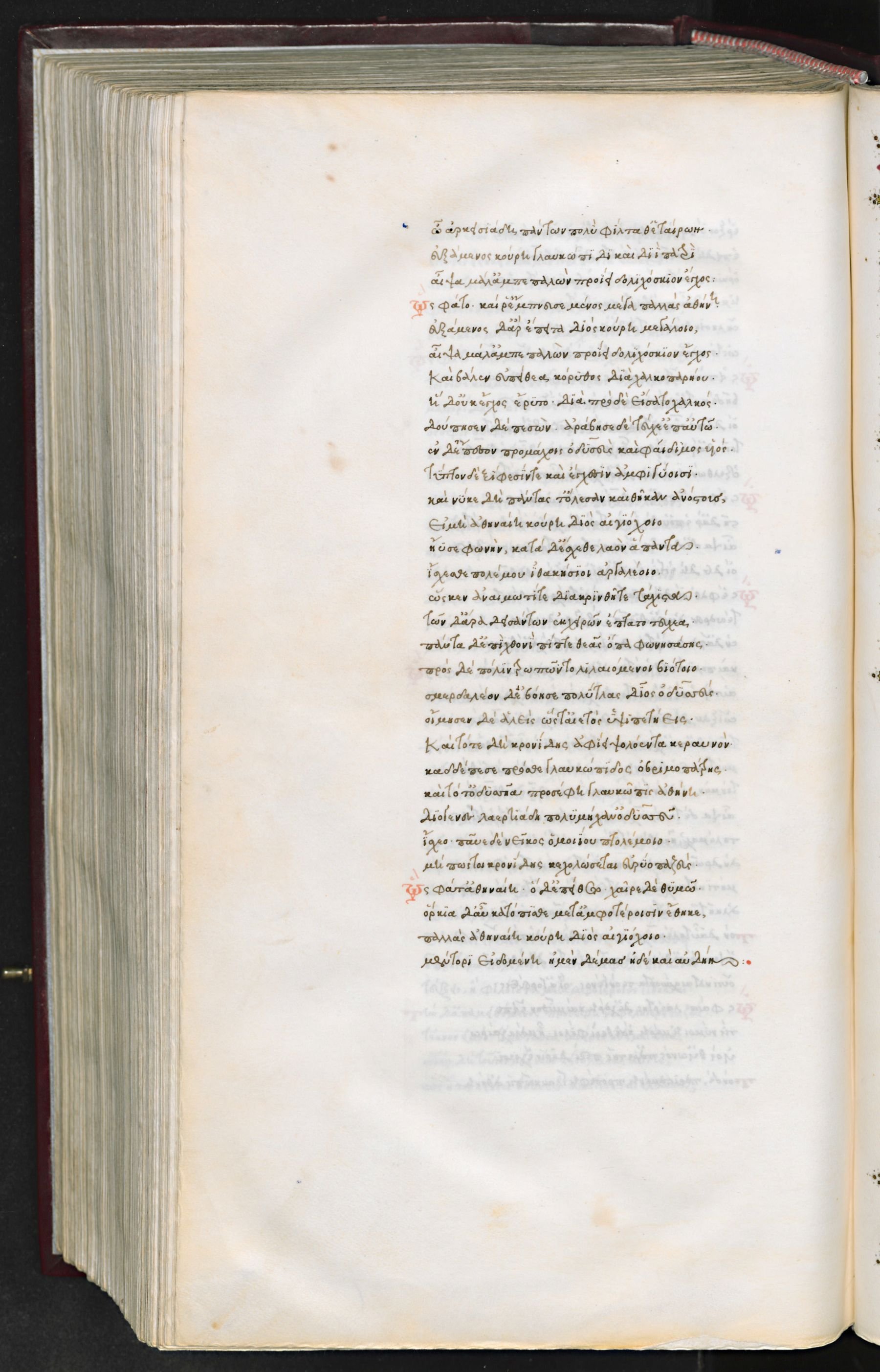
Where on the image
Laur. Plut. 32.4, fol. 445v: Odyssey 24.517-548, begins ‹ὦ ἀρκεισιάδη πάντων πολὺ φίλταθ' ἑταίρων›, ends ‹μέντορι εἰδομένη ἠμὲν δέμας ἠδὲ καὶ αὐδήν›. Checked on the image: first and last lines read and matched to the Greek, and the 31 lines of the page counted. Fol. 445r ends with 24.516. The Odyssey ends here, 31 lines down the page, with a red sign after the last word; 24.533 (ὣς φάτ' Ἀθηναίη, τοὺς δὲ χλωρὸν δέος εἷλεν) is not on the page: ‹ὥς κεν ἀναιμωτί γε διακρινθῆτε τάχιστα› (24.532) is followed directly by ‹τῶν δ' ἄρα δεισάντων ἐκ χειρῶν ἔπτατο τεύχεα› (24.534). It stays in the Greek and English shown, which are Murray's full text. Fol. 446r begins the next work under an illuminated border. English here: 24.517-548; cut where Athena's speech begins (24.517), the same line as the Greek.
517ὦ Ἀρκεισιάδη, πάντων πολὺ φίλταθʼ ἑταίρων,
518εὐξάμενος κούρῃ γλαυκώπιδι καὶ Διὶ πατρί,
519αἶψα μαλʼ ἀμπεπαλὼν προΐει δολιχόσκιον ἔγχος.
520ὣς φάτο, καί ῥʼ ἔμπνευσε μένος μέγα Παλλὰς Ἀθήνη
521εὐξάμενος δʼ ἄρʼ ἔπειτα Διὸς κούρῃ μεγάλοιο,
522αἶψα μάλʼ ἀμπεπαλὼν προΐει δολιχόσκιον ἔγχος,
523καὶ βάλεν Εὐπείθεα κόρυθος διὰ χαλκοπαρῄου.
524ἡ δʼ οὐκ ἔγχος ἔρυτο, διαπρὸ δὲ εἴσατο χαλκός,
525δούπησεν δὲ πεσών, ἀράβησε δὲ τεύχεʼ ἐπʼ αὐτῷ.
526ἐν δʼ ἔπεσον προμάχοις Ὀδυσεὺς καὶ φαίδιμος υἱός,
527τύπτον δὲ ξίφεσίν τε καὶ ἔγχεσιν ἀμφιγύοισι.
528καί νύ κε δὴ πάντας ὄλεσαν καὶ ἔθηκαν ἀνόστους,
529εἰ μὴ Ἀθηναίη, κούρη Διὸς αἰγιόχοιο,
530ἤϋσεν φωνῇ, κατὰ δʼ ἔσχεθε λαὸν ἅπαντα.
531ἴσχεσθε πτολέμου, Ἰθακήσιοι, ἀργαλέοιο,
532ὥς κεν ἀναιμωτί γε διακρινθῆτε τάχιστα.
533ὣς φάτʼ Ἀθηναίη, τοὺς δὲ χλωρὸν δέος εἷλεν·
534τῶν δʼ ἄρα δεισάντων ἐκ χειρῶν ἔπτατο τεύχεα,
535πάντα δʼ ἐπὶ χθονὶ πῖπτε, θεᾶς ὄπα φωνησάσης·
536πρὸς δὲ πόλιν τρωπῶντο λιλαιόμενοι βιότοιο.
537σμερδαλέον δʼ ἐβόησε πολύτλας δῖος Ὀδυσσεύς,
538οἴμησεν δὲ ἀλεὶς ὥς τʼ αἰετὸς ὑψιπετήεις.
539καὶ τότε δὴ Κρονίδης ἀφίει ψολόεντα κεραυνόν,
540κὰδ δʼ ἔπεσε πρόσθε γλαυκώπιδος ὀβριμοπάτρης.
541δὴ τότʼ Ὀδυσσῆα προσέφη γλαυκῶπις Ἀθήνη·
542διογενὲς Λαερτιάδη, πολυμήχανʼ Ὀδυσσεῦ,
543ἴσχεο, παῦε δὲ νεῖκος ὁμοιΐου πολέμοιο,
544μή πως τοι Κρονίδης κεχολώσεται εὐρύοπα Ζεύς.
545ὣς φάτʼ Ἀθηναίη, ὁ δʼ ἐπείθετο, χαῖρε δὲ θυμῷ.
546ὅρκια δʼ αὖ κατόπισθε μετʼ ἀμφοτέροισιν ἔθηκεν
547Παλλὰς Ἀθηναίη, κούρη Διὸς αἰγιόχοιο,
548Μέντορι εἰδομένη ἠμὲν δέμας ἠδὲ καὶ αὐδήν.
517“Son of Arceisius, far the dearest of all my friends, make a prayer to the flashing-eyed maiden and to father Zeus, and then straightway raise aloft thy long spear, and hurl it.” 520So spoke Pallas Athena, and breathed into him great might. Then he prayed to the daughter of great Zeus, and straightway raised aloft his long spear, and hurled it, and smote Eupeithes through the helmet with cheek-piece of bronze. This stayed not the spear, but the bronze passed through, 525and he fell with a thud, and his armour clanged about him. Then on the foremost fighters fell Odysseus and his glorious son, and thrust at them with swords and double-pointed spears. And now would they have slain them all, and cut them off from returning, had not Athena, daughter of Zeus, who bears the aegis, 530shouted aloud, and checked all the host, saying: “Refrain, men of Ithaca, from grievous war, that with all speed you may part, and that without bloodshed.” So spoke Athena, and pale fear seized them. Then in their terror the arms flew from their hands 535and fell one and all to the ground, as the goddess uttered her voice, and they turned toward the city, eager to save their lives. Terribly then shouted the much-enduring, goodly Odysseus, and gathering himself together he swooped upon them like an eagle of lofty flight, and at that moment the son of Cronos cast a flaming thunderbolt, 540and down it fell before the flashing-eyed daughter of the mighty sire. Then flashing-eyed Athena spoke to Odysseus saying: “Son of Laertes, sprung from Zeus, Odysseus of many devices, stay thy hand, and make the strife of equal war to cease, lest haply the son of Cronos be wroth with thee, even Zeus, whose voice is borne afar.” 545So spoke Athena, and he obeyed, and was glad at heart. Then for all time to come a solemn covenant betwixt the twain was made by Pallas Athena, daughter of Zeus, who bears the aegis, in the likeness of Mentor both in form and in voice.
Notes
- Greek: A. T. Murray, Homer: The Odyssey (Loeb Classical Library, 1919), via Perseus.
- English: A. T. Murray's translation in the same edition; his footnotes are omitted.
Cite
Sources
- Source: Laur. Plut. 32.4 (BML Teca Digitale IIIF) + Murray Greek (Loeb 1919, Perseus) + Murray English (Loeb 1919, Perseus) (holding institution)
- Critical edition: Murray, Loeb 1919, via Perseus
← previous · → next · v cycle view · l back to library