Homer, Odyssey, Book 3: Telemachus at Pylos
Introduction
The Odyssey, composed around 700 BCE and attributed to Homer, tells of Odysseus' ten-year journey home from Troy and his return to Ithaca. Book 3 (497 lines): Telemachus at Pylos.
The page photographs are from Florence, Biblioteca Medicea Laurenziana, Plut. 32.24 (parchment, 10th century, 234 folios; the oldest manuscript of the Odyssey with published images), in the Biblioteca Medicea Laurenziana's Teca Digitale. This book is on fol. 19r-29r; each section below is one page, with its first and last line as read on the photograph. Many pages carry interlinear glosses and a few marginal notes in later hands.
The Greek is A. T. Murray's Loeb text (1919) via Perseus, not a transcription of this manuscript, whose wording differs in places. The English is Murray's prose translation (1919), divided every five lines; at a page break a five-line block goes with the page holding most of it, except at the page breaks where a section's note says the English is cut at the end of Murray's sentence. Each section's note gives its English line range.
Where the scribe left out a line, wrote one in the margin, changed the order or added a line not in Murray's text, the section's note on the photograph says so; the Greek and English shown are Murray's full text for the page's range.
How was this verified? (Provenance)
Where on the image
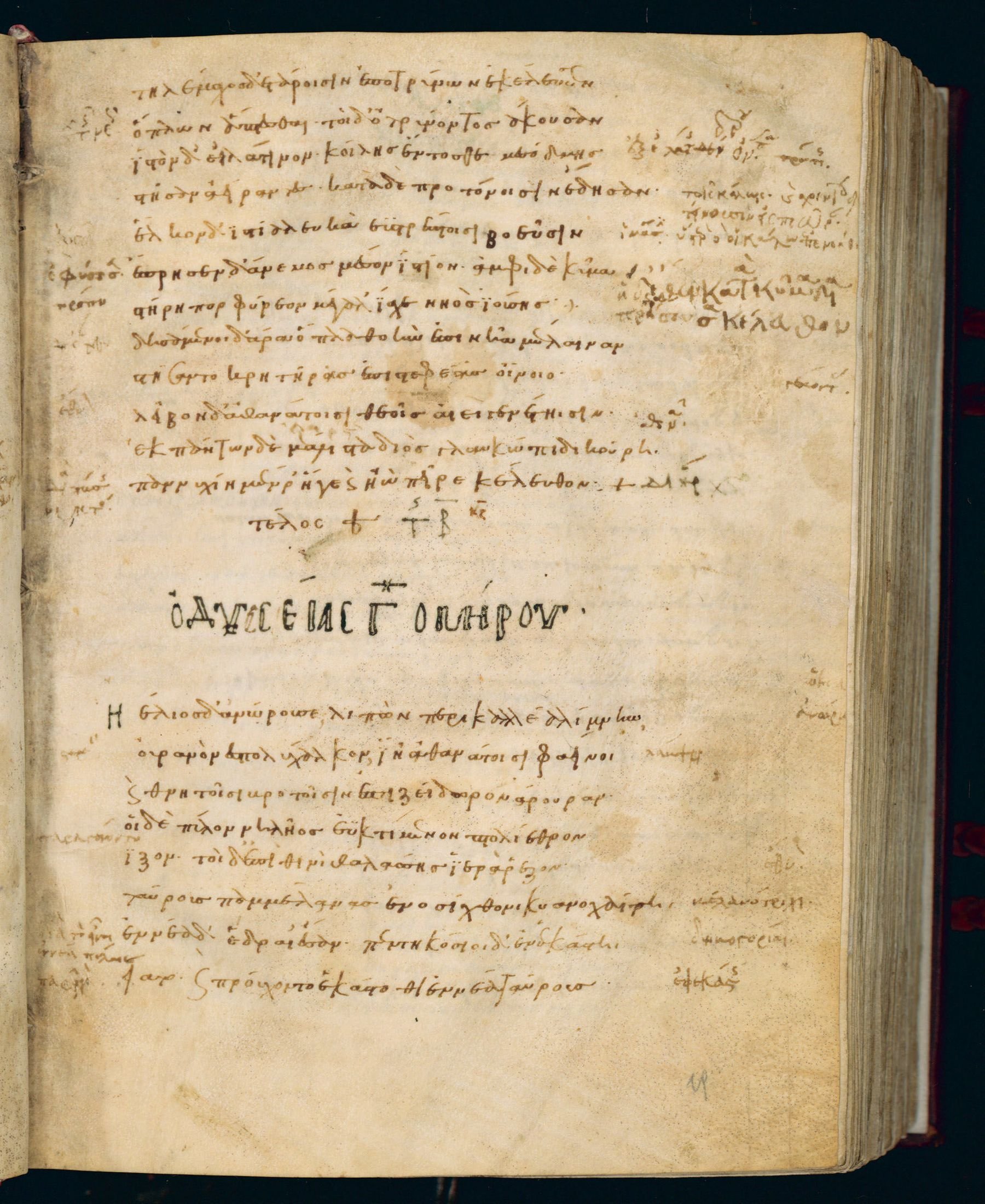
Laur. Plut. 32.24, fol. 19r: Odyssey 3.1-8, begins ‹Ἠέλιος δʼ ἀνόρουσε, λιπὼν›, ends ‹προύχοντο ἑκάστοθι ἐννέα ταύρους.›. Checked on the image: first and last lines read and matched to the Greek. Fol. 19v begins with 3.9. The page holds 2.422-434, 3.1-8. Book 2 ends with line 434 and the subscription τέλος τῆς β; a heading ὀδυσσείας γ ὁμήρου in capitals follows and book 3 begins with a large initial. English here: 3.1-8. At the break between fol. 19r (Greek to 3.8) and fol. 19v (Greek from 3.9) the English is cut where Murray's sentence for 3.9 begins (Now when they had tasted ...), so both pages' English ends and begins with the same line as the Greek. At the page's other break the English follows Murray's five-line marks (a block that crosses the break goes with the page holding its middle line).
1Ἠέλιος δʼ ἀνόρουσε, λιπὼν περικαλλέα λίμνην,
2οὐρανὸν ἐς πολύχαλκον, ἵνʼ ἀθανάτοισι φαείνοι
3καὶ θνητοῖσι βροτοῖσιν ἐπὶ ζείδωρον ἄρουραν·
4οἱ δὲ Πύλον, Νηλῆος ἐυκτίμενον πτολίεθρον,
5ἷξον· τοὶ δʼ ἐπὶ θινὶ θαλάσσης ἱερὰ ῥέζον,
6ταύρους παμμέλανας, ἐνοσίχθονι κυανοχαίτῃ.
7ἐννέα δʼ ἕδραι ἔσαν, πεντακόσιοι δʼ ἐν ἑκάστῃ
8ἥατο καὶ προύχοντο ἑκάστοθι ἐννέα ταύρους.
1And now the sun, leaving the beauteous mere, sprang up into the brazen heaven to give light to the immortals and to mortal men on the earth, the giver of grain; and they came to Pylos, the well-built citadel of Neleus. 5Here the townsfolk on the shore of the sea were offering sacrifice of black bulls to the dark-haired Earth-shaker. Nine companies there were, and five hundred men sat in each, and in each they held nine bulls ready for sacrifice.
Where on the image
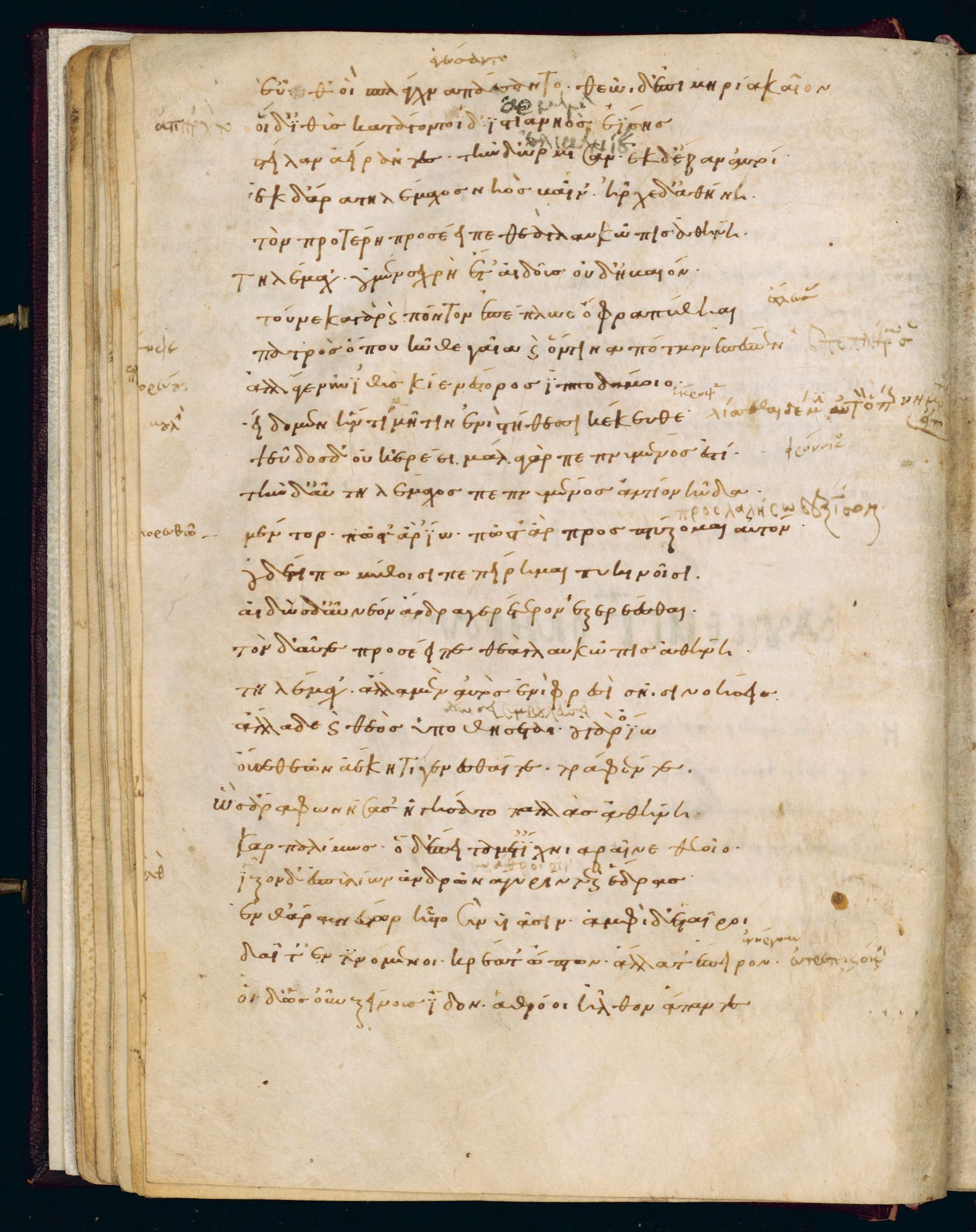
Laur. Plut. 32.24, fol. 19v: Odyssey 3.9-34, begins ‹εὖθʼ οἱ σπλάγχνα πάσαντο,›, ends ‹ἴδον, ἁθρόοι ἦλθον ἅπαντες,›. Checked on the image: first and last lines read and matched to the Greek. Fol. 19r ends with 3.8. Fol. 20r begins with 3.35. 3.19 is not in the text column; it is written in the right margin beside 3.18 (the page has 25 lines in the column). English here: 3.9-34. At the break between fol. 19r (Greek to 3.8) and fol. 19v (Greek from 3.9) the English is cut where Murray's sentence for 3.9 begins (Now when they had tasted ...), so both pages' English ends and begins with the same line as the Greek. At the page's other break the English follows Murray's five-line marks (a block that crosses the break goes with the page holding its middle line).
9εὖθʼ οἱ σπλάγχνα πάσαντο, θεῷ δʼ ἐπὶ μηρίʼ ἔκαιον,
10οἱ δʼ ἰθὺς κατάγοντο ἰδʼ ἱστία νηὸς ἐίσης
11στεῖλαν ἀείραντες, τὴν δʼ ὥρμισαν, ἐκ δʼ ἔβαν αὐτοί·
12ἐκ δʼ ἄρα Τηλέμαχος νηὸς βαῖνʼ, ἦρχε δʼ Ἀθήνη.
13τὸν προτέρη προσέειπε θεά, γλαυκῶπις Ἀθήνη·
14Τηλέμαχʼ, οὐ μέν σε χρὴ ἔτʼ αἰδοῦς, οὐδʼ ἠβαιόν·
15τοὔνεκα γὰρ καὶ πόντον ἐπέπλως, ὄφρα πύθηαι
16πατρός, ὅπου κύθε γαῖα καὶ ὅν τινα πότμον ἐπέσπεν.
17ἀλλʼ ἄγε νῦν ἰθὺς κίε Νέστορος ἱπποδάμοιο·
18εἴδομεν ἥν τινα μῆτιν ἐνὶ στήθεσσι κέκευθε.
19λίσσεσθαι δέ μιν αὐτός, ὅπως νημερτέα εἴπῃ·
20ψεῦδος δʼ οὐκ ἐρέει· μάλα γὰρ πεπνυμένος ἐστί.
21τὴν δʼ αὖ Τηλέμαχος πεπνυμένος ἀντίον ηὔδα·
22Μέντορ, πῶς τʼ ἄρʼ ἴω; πῶς τʼ ἂρ προσπτύξομαι αὐτόν;
23οὐδέ τί πω μύθοισι πεπείρημαι πυκινοῖσιν·
24αἰδὼς δʼ αὖ νέον ἄνδρα γεραίτερον ἐξερέεσθαι.
25τὸν δʼ αὖτε προσέειπε θεά, γλαυκῶπις Ἀθήνη·
26Τηλέμαχʼ, ἄλλα μὲν αὐτὸς ἐνὶ φρεσὶ σῇσι νοήσεις,
27ἄλλα δὲ καὶ δαίμων ὑποθήσεται· οὐ γὰρ ὀίω
28οὔ σε θεῶν ἀέκητι γενέσθαι τε τραφέμεν τε.
29ὣς ἄρα φωνήσασʼ ἡγήσατο Παλλὰς Ἀθήνη
30καρπαλίμως· ὁ δʼ ἔπειτα μετʼ ἴχνια βαῖνε θεοῖο.
31ἷξον δʼ ἐς Πυλίων ἀνδρῶν ἄγυρίν τε καὶ ἕδρας,
32ἔνθʼ ἄρα Νέστωρ ἧστο σὺν υἱάσιν, ἀμφὶ δʼ ἑταῖροι
33δαῖτʼ ἐντυνόμενοι κρέα τʼ ὤπτων ἄλλα τʼ ἔπειρον.
34οἱ δʼ ὡς οὖν ξείνους ἴδον, ἁθρόοι ἦλθον ἅπαντες,
9Now when they had tasted the inner parts and were burning the thigh-pieces to the god, 10the others put straight in to the shore, and hauled up and furled the sail of the shapely ship, and moored her, and themselves stepped forth. Forth too from the ship stepped Telemachus, and Athena led the way. And the goddess, flashing-eyed Athena, spake first to him, and said: “Telemachus, no longer hast thou need to feel shame, no, not a whit. 15For to this end hast thou sailed over the sea, that thou mightest seek tidings of thy father,—where the earth covered him, and what fate he met. But come now, go straightway to Nestor, tamer of horses; let us learn what counsel he keepeth hid in his breast. And do thou beseech him thyself that he may tell thee the very truth. 20A lie will he not utter, for he is wise indeed.” Then wise Telemachus answered her: “Mentor, how shall I go, and how shall I greet him? I am as yet all unversed in subtle speech, and moreover a young man has shame to question an elder.” 25Then the goddess, flashing-eyed Athena, answered him: “Telemachus, somewhat thou wilt of thyself devise in thy breast, and somewhat heaven too will prompt thee. For, methinks, not without the favour of the gods hast thou been born and reared.” So spake Pallas Athena, and led the way 30quickly; but he followed in the footsteps of the goddess; and they came to the gathering and the companies of the men of Pylos. There Nestor sat with his sons, and round about his people, making ready the feast, were roasting some of the meat and putting other pieces on spits. But when they saw the strangers they all came thronging about them,
Where on the image
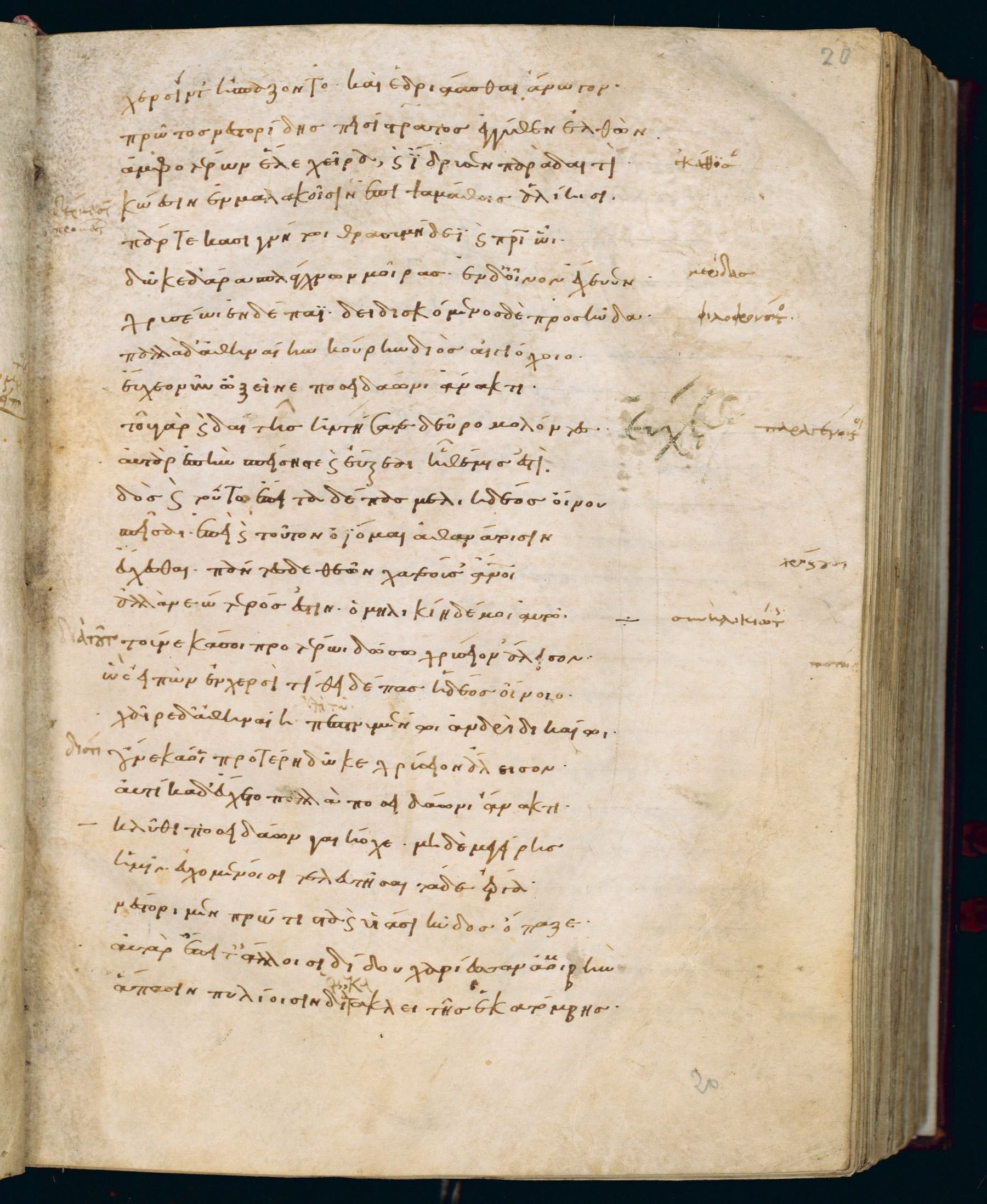
Laur. Plut. 32.24, fol. 20r: Odyssey 3.35-59, begins ‹χερσίν τʼ ἠσπάζοντο καὶ›, ends ‹σύμπασιν Πυλίοισιν ἀγακλειτῆς ἑκατόμβης.›. Checked on the image: first and last lines read and matched to the Greek. Fol. 19v ends with 3.34. Fol. 20v begins with 3.60. English blocks here: 35-39, 40-44, 45-49, 50-50, 51-54, 55-59.
35χερσίν τʼ ἠσπάζοντο καὶ ἑδριάασθαι ἄνωγον.
36πρῶτος Νεστορίδης Πεισίστρατος ἐγγύθεν ἐλθὼν
37ἀμφοτέρων ἕλε χεῖρα καὶ ἵδρυσεν παρὰ δαιτὶ
38κώεσιν ἐν μαλακοῖσιν ἐπὶ ψαμάθοις ἁλίῃσιν
39πάρ τε κασιγνήτῳ Θρασυμήδεϊ καὶ πατέρι ᾧ·
40δῶκε δʼ ἄρα σπλάγχνων μοίρας, ἐν δʼ οἶνον ἔχευεν
41χρυσείῳ δέπαϊ· δειδισκόμενος δὲ προσηύδα
42Παλλάδʼ Ἀθηναίην κούρην Διὸς αἰγιόχοιο·
43εὔχεο νῦν, ὦ ξεῖνε, Ποσειδάωνι ἄνακτι·
44τοῦ γὰρ καὶ δαίτης ἠντήσατε δεῦρο μολόντες.
45αὐτὰρ ἐπὴν σπείσῃς τε καὶ εὔξεαι, ἣ θέμις ἐστί,
46δὸς καὶ τούτῳ ἔπειτα δέπας μελιηδέος οἴνου
47σπεῖσαι, ἐπεὶ καὶ τοῦτον ὀίομαι ἀθανάτοισιν
48εὔχεσθαι· πάντες δὲ θεῶν χατέουσʼ ἄνθρωποι.
49ἀλλὰ νεώτερός ἐστιν, ὁμηλικίη δʼ ἐμοὶ αὐτῷ·
50τοὔνεκα σοὶ προτέρῳ δώσω χρύσειον ἄλεισον.
51ὣς εἰπὼν ἐν χειρὶ τίθει δέπας ἡδέος οἴνου·
52χαῖρε δʼ Ἀθηναίη πεπνυμένῳ ἀνδρὶ δικαίῳ,
53οὕνεκα οἷ προτέρῃ δῶκε χρύσειον ἄλεισον·
54αὐτίκα δʼ εὔχετο πολλὰ Ποσειδάωνι ἄνακτι·
55κλῦθι, Ποσείδαον γαιήοχε, μηδὲ μεγήρῃς
56ἡμῖν εὐχομένοισι τελευτῆσαι τάδε ἔργα.
57Νέστορι μὲν πρώτιστα καὶ υἱάσι κῦδος ὄπαζε,
58αὐτὰρ ἔπειτʼ ἄλλοισι δίδου χαρίεσσαν ἀμοιβὴν
59σύμπασιν Πυλίοισιν ἀγακλειτῆς ἑκατόμβης.
35and clasped their hands in welcome, and bade them sit down. First Nestor's son Peisistratus came near and took both by the hand, and made them to sit down at the feast on soft fleeces upon the sand of the sea, beside his brother Thrasymedes and his father. 40Thereupon he gave them portions of the inner meat and poured wine in a golden cup, and, pledging her, he spoke to Pallas Athena, daughter of Zeus who bears the aegis: “Pray now, stranger, to the lord Poseidon, for his is the feast whereon you have chanced in coming hither. 45And when thou hast poured libations and hast prayed, as is fitting, then give thy friend also the cup of honey-sweet wine that he may pour, since he too, I ween, prays to the immortals; for all men have need of the gods. Howbeit he is the younger, of like age with myself, 50wherefore to thee first will I give the golden cup.” 51So he spake, and placed in her hand the cup of sweet wine. But Pallas Athena rejoiced at the man's wisdom and judgment, in that to her first he gave the golden cup; and straightway she prayed earnestly to the lord Poseidon: 55“Hear me, Poseidon, thou Earth-enfolder, and grudge not in answer to our prayer to bring these deeds to fulfillment. To Nestor, first of all, and to his sons vouchsafe renown, and then do thou grant to the rest gracious requital for this glorious hecatomb, even to all the men of Pylos;
Where on the image
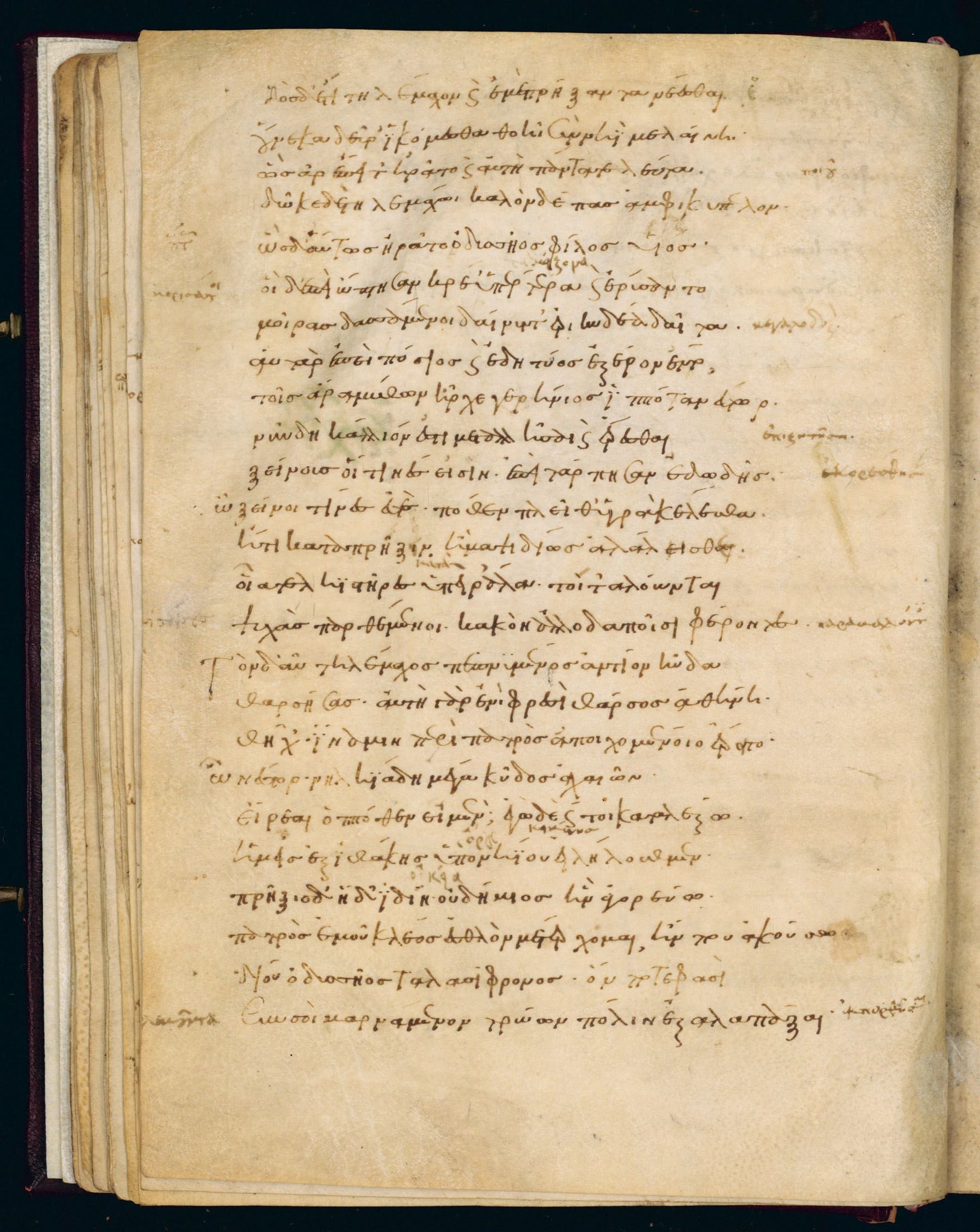
Laur. Plut. 32.24, fol. 20v: Odyssey 3.60-85, begins ‹δὸς δʼ ἔτι Τηλέμαχον›, ends ‹μαρνάμενον Τρώων πόλιν ἐξαλαπάξαι.›. Checked on the image: first and last lines read and matched to the Greek. Fol. 20r ends with 3.59. Fol. 21r begins with 3.86. 3.78 (ἠδʼ ἵνα μιν κλέος ἐσθλὸν ...) is not on the page: the scribe passes from 3.77 to 3.79 (25 lines). English blocks here: 60-64, 65-69, 70-74, 75-79, 80-84.
60δὸς δʼ ἔτι Τηλέμαχον καὶ ἐμὲ πρήξαντα νέεσθαι,
61οὕνεκα δεῦρʼ ἱκόμεσθα θοῇ σὺν νηὶ μελαίνῃ.
62ὣς ἄρʼ ἔπειτʼ ἠρᾶτο καὶ αὐτὴ πάντα τελεύτα.
63δῶκε δὲ Τηλεμάχῳ καλὸν δέπας ἀμφικύπελλον·
64ὣς δʼ αὔτως ἠρᾶτο Ὀδυσσῆος φίλος υἱός.
65οἱ δʼ ἐπεὶ ὤπτησαν κρέʼ ὑπέρτερα καὶ ἐρύσαντο,
66μοίρας δασσάμενοι δαίνυντʼ ἐρικυδέα δαῖτα.
67αὐτὰρ ἐπεὶ πόσιος καὶ ἐδητύος ἐξ ἔρον ἕντο,
68τοῖς ἄρα μύθων ἦρχε Γερήνιος ἱππότα Νέστωρ·
69νῦν δὴ κάλλιόν ἐστι μεταλλῆσαι καὶ ἐρέσθαι
70ξείνους, οἵ τινές εἰσιν, ἐπεὶ τάρπησαν ἐδωδῆς.
71ὦ ξεῖνοι, τίνες ἐστέ; πόθεν πλεῖθʼ ὑγρὰ κέλευθα;
72ἤ τι κατὰ πρῆξιν ἦ μαψιδίως ἀλάλησθε
73οἷά τε ληιστῆρες ὑπεὶρ ἅλα, τοί τʼ ἀλόωνται
74ψυχὰς παρθέμενοι κακὸν ἀλλοδαποῖσι φέροντες;
75τὸν δʼ αὖ Τηλέμαχος πεπνυμένος ἀντίον ηὔδα
76θαρσήσας· αὐτὴ γὰρ ἐνὶ φρεσὶ θάρσος Ἀθήνη
77θῆχʼ, ἵνα μιν περὶ πατρὸς ἀποιχομένοιο ἔροιτο
78ἠδʼ ἵνα μιν κλέος ἐσθλὸν ἐν ἀνθρώποισιν ἔχῃσιν·
79ὦ Νέστορ Νηληϊάδη, μέγα κῦδος Ἀχαιῶν,
80εἴρεαι ὁππόθεν εἰμέν· ἐγὼ δέ κέ τοι καταλέξω.
81ἡμεῖς ἐξ Ἰθάκης ὑπονηίου εἰλήλουθμεν·
82πρῆξις δʼ ἥδʼ ἰδίη, οὐ δήμιος, ἣν ἀγορεύω.
83πατρὸς ἐμοῦ κλέος εὐρὺ μετέρχομαι, ἤν που ἀκούσω,
84δίου Ὀδυσσῆος ταλασίφρονος, ὅν ποτέ φασι
85σὺν σοὶ μαρνάμενον Τρώων πόλιν ἐξαλαπάξαι.
60and grant furthermore that Telemachus and I may return when we have accomplished all that for which we came hither with our swift black ship.” Thus she prayed, and was herself fulfilling all. Then she gave Telemachus the fair two-handled cup, and in like manner the dear son of Odysseus prayed. 65Then when they had roasted the outer flesh and drawn it off the spits, they divided the portions and feasted a glorious feast. But when they had put from them the desire of food and drink, the horseman, Nestor of Gerenia, spoke first among them: “Now verily is it seemlier to ask and enquire 70of the strangers who they are, since now they have had their joy of food. Strangers, who are ye? Whence do ye sail over the watery ways? Is it on some business, or do ye wander at random over the sea, even as pirates, who wander hazarding their lives and bringing evil to men of other lands?” 75Then wise Telemachus took courage, and made answer, for Athena herself put courage in his heart, that he might ask about his father that was gone, and that good report might be his among men: “Nestor, son of Neleus, great glory of the Achaeans, 80thou askest whence we are, and I will surely tell thee. We have come from Ithaca that is below Neion; but this business whereof I speak is mine own, and concerns not the people. I come after the wide-spread rumor of my father, if haply I may hear of it, even of goodly Odysseus of the steadfast heart, who once, men say,
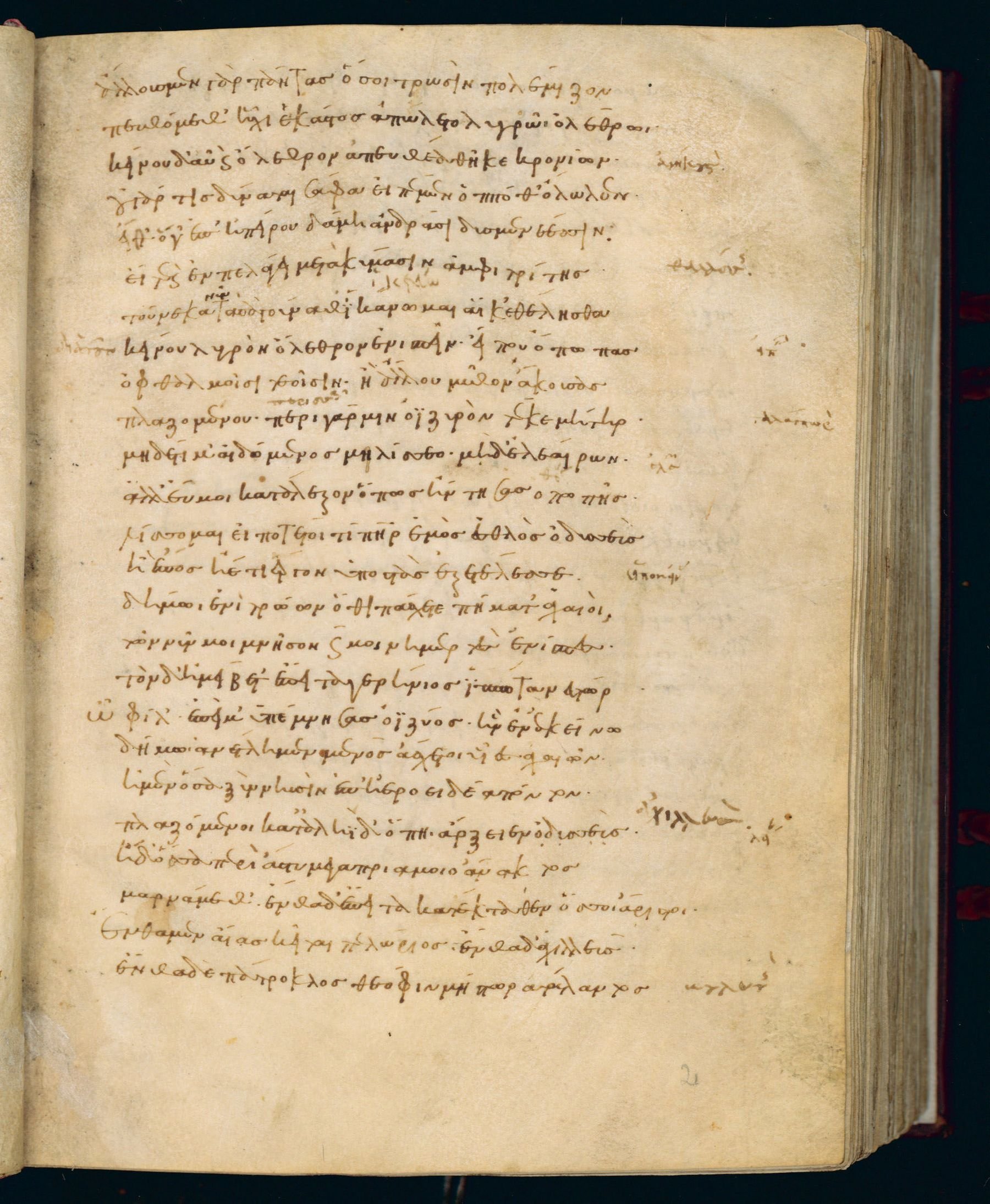
Where on the image
Laur. Plut. 32.24, fol. 21r: Odyssey 3.86-110, begins ‹ἄλλους μὲν γὰρ πάντας,›, ends ‹Πάτροκλος, θεόφιν μήστωρ ἀτάλαντος,›. Checked on the image: first and last lines read and matched to the Greek. Fol. 20v ends with 3.85. Fol. 21v begins with 3.111. English blocks here: 85-89, 90-94, 95-99, 100-101, 102-104, 105-109.
86ἄλλους μὲν γὰρ πάντας, ὅσοι Τρωσὶν πολέμιζον,
87πευθόμεθʼ, ἧχι ἕκαστος ἀπώλετο λυγρῷ ὀλέθρῳ,
88κείνου δʼ αὖ καὶ ὄλεθρον ἀπευθέα θῆκε Κρονίων.
89οὐ γάρ τις δύναται σάφα εἰπέμεν ὁππόθʼ ὄλωλεν,
90εἴθʼ ὅ γʼ ἐπʼ ἠπείρου δάμη ἀνδράσι δυσμενέεσσιν,
91εἴτε καὶ ἐν πελάγει μετὰ κύμασιν Ἀμφιτρίτης.
92τοὔνεκα νῦν τὰ σὰ γούναθʼ ἱκάνομαι, αἴ κʼ ἐθέλῃσθα
93κείνου λυγρὸν ὄλεθρον ἐνισπεῖν, εἴ που ὄπωπας
94ὀφθαλμοῖσι τεοῖσιν ἢ ἄλλου μῦθον ἄκουσας
95πλαζομένου· πέρι γάρ μιν ὀιζυρὸν τέκε μήτηρ.
96μηδέ τί μʼ αἰδόμενος μειλίσσεο μηδʼ ἐλεαίρων,
97ἀλλʼ εὖ μοι κατάλεξον ὅπως ἤντησας ὀπωπῆς.
98λίσσομαι, εἴ ποτέ τοί τι πατὴρ ἐμός, ἐσθλὸς Ὀδυσσεύς,
99ἢ ἔπος ἠέ τι ἔργον ὑποστὰς ἐξετέλεσσε
100δήμῳ ἔνι Τρώων, ὅθι πάσχετε πήματʼ Ἀχαιοί,
101τῶν νῦν μοι μνῆσαι, καί μοι νημερτὲς ἐνίσπες.
102τὸν δʼ ἠμείβετʼ ἔπειτα Γερήνιος ἱππότα Νέστωρ·
103ὦ φίλʼ, ἐπεί μʼ ἔμνησας ὀιζύος, ἣν ἐν ἐκείνῳ
104δήμῳ ἀνέτλημεν μένος ἄσχετοι υἷες Ἀχαιῶν,
105ἠμὲν ὅσα ξὺν νηυσὶν ἐπʼ ἠεροειδέα πόντον
106πλαζόμενοι κατὰ ληίδʼ, ὅπῃ ἄρξειεν Ἀχιλλεύς,
107ἠδʼ ὅσα καὶ περὶ ἄστυ μέγα Πριάμοιο ἄνακτος
108μαρνάμεθʼ· ἔνθα δʼ ἔπειτα κατέκταθεν ὅσσοι ἄριστοι.
109ἔνθα μὲν Αἴας κεῖται ἀρήιος, ἔνθα δʼ Ἀχιλλεύς,
110ἔνθα δὲ Πάτροκλος, θεόφιν μήστωρ ἀτάλαντος,
85fought by thy side and sacked the city of the Trojans. For of all men else, as many as warred with the Trojans, we learn where each man died a woeful death, but of him the son of Cronos has made even the death to be past learning; for no man can tell surely where he hath died,— 90whether he was overcome by foes on the mainland, or on the deep among the waves of Amphitrite. Therefore am I now come to thy knees, if perchance thou wilt be willing to tell me of his woeful death, whether thou sawest it haply with thine own eyes, or didst hear from some other the story 95of his wanderings; for beyond all men did his mother bear him to sorrow. And do thou nowise out of ruth or pity for me speak soothing words, but tell me truly how thou didst come to behold him. I beseech thee, if ever my father, noble Odysseus, promised aught to thee of word or deed and fulfilled it 100in the land of the Trojans, where you Achaeans suffered woes, be mindful of it now, I pray thee, and tell me the very truth.” 102Then the horseman, Nestor of Gerenia, answered him: “My friend, since thou hast recalled to my mind the sorrow which we endured in that land, we sons of the Achaeans, unrestrained in daring,— 105all that we endured on shipboard, as we roamed after booty over the misty deep whithersoever Achilles led; and all our fightings around the great city of king Priam;—lo, there all our best were slain. There lies warlike Aias, there Achilles,
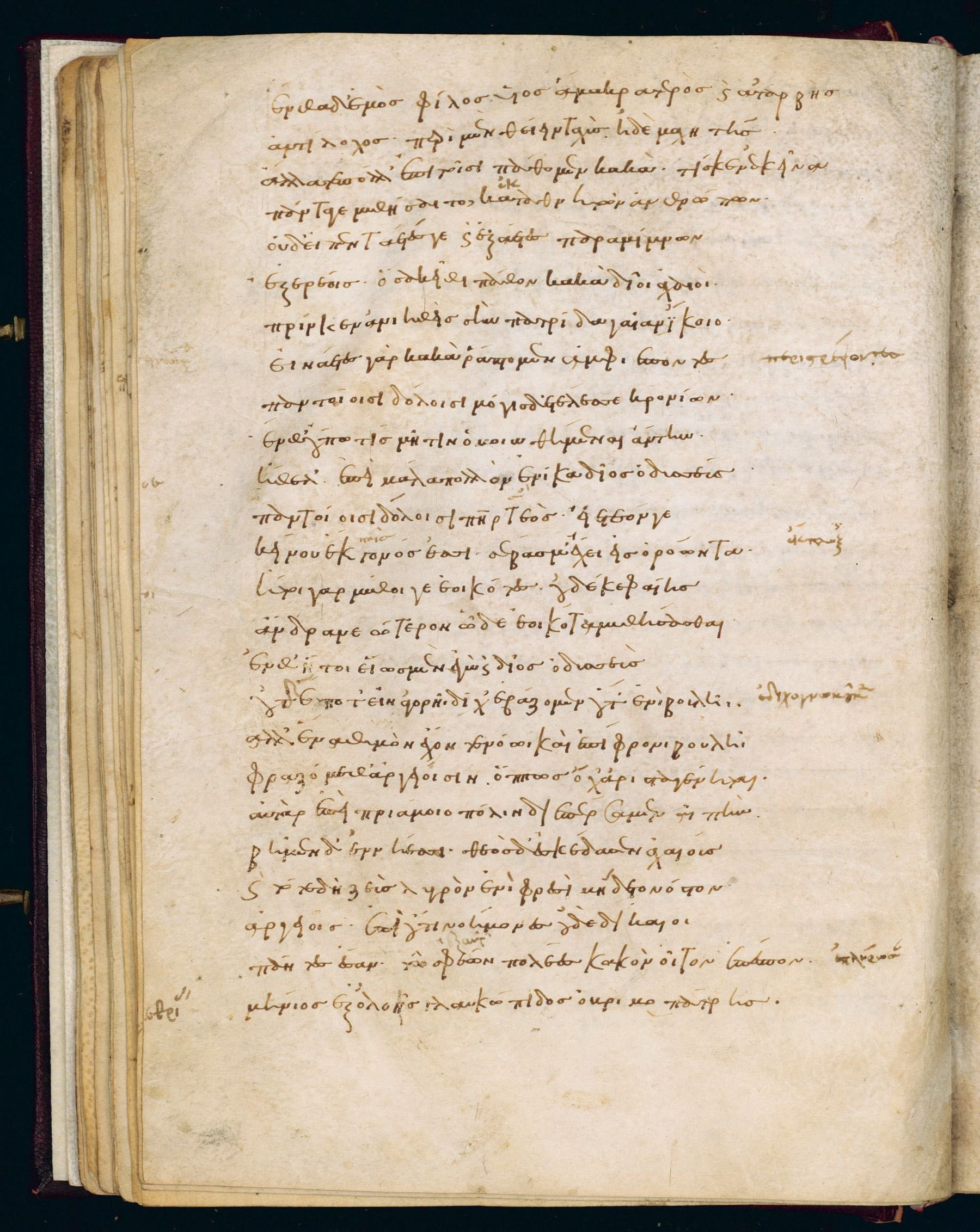
Where on the image
Laur. Plut. 32.24, fol. 21v: Odyssey 3.111-135, begins ‹ἔνθα δʼ ἐμὸς φίλος›, ends ‹ἐξ ὀλοῆς γλαυκώπιδος ὀβριμοπάτρης.›. Checked on the image: first and last lines read and matched to the Greek. Fol. 21r ends with 3.110. Fol. 22r begins with 3.136. English blocks here: 110-114, 115-119, 120-124, 125-129, 130-134.
111ἔνθα δʼ ἐμὸς φίλος υἱός, ἅμα κρατερὸς καὶ ἀμύμων,
112Ἀντίλοχος, πέρι μὲν θείειν ταχὺς ἠδὲ μαχητής·
113ἄλλα τε πόλλʼ ἐπὶ τοῖς πάθομεν κακά· τίς κεν ἐκεῖνα
114πάντα γε μυθήσαιτο καταθνητῶν ἀνθρώπων;
115οὐδʼ εἰ πεντάετές γε καὶ ἑξάετες παραμίμνων
116ἐξερέοις ὅσα κεῖθι πάθον κακὰ δῖοι Ἀχαιοί·
117πρίν κεν ἀνιηθεὶς σὴν πατρίδα γαῖαν ἵκοιο.
118εἰνάετες γάρ σφιν κακὰ ῥάπτομεν ἀμφιέποντες
119παντοίοισι δόλοισι, μόγις δʼ ἐτέλεσσε Κρονίων.
120ἔνθʼ οὔ τίς ποτε μῆτιν ὁμοιωθήμεναι ἄντην
121ἤθελʼ, ἐπεὶ μάλα πολλὸν ἐνίκα δῖος Ὀδυσσεὺς
122παντοίοισι δόλοισι, πατὴρ τεός, εἰ ἐτεόν γε
123κείνου ἔκγονός ἐσσι· σέβας μʼ ἔχει εἰσορόωντα.
124ἦ τοι γὰρ μῦθοί γε ἐοικότες, οὐδέ κε φαίης
125ἄνδρα νεώτερον ὧδε ἐοικότα μυθήσασθαι.
126ἔνθʼ ἦ τοι ἧος μὲν ἐγὼ καὶ δῖος Ὀδυσσεὺς
127οὔτε ποτʼ εἰν ἀγορῇ δίχʼ ἐβάζομεν οὔτʼ ἐνὶ βουλῇ,
128ἀλλʼ ἕνα θυμὸν ἔχοντε νόῳ καὶ ἐπίφρονι βουλῇ
129φραζόμεθʼ Ἀργείοισιν ὅπως ὄχʼ ἄριστα γένοιτο.
130αὐτὰρ ἐπεὶ Πριάμοιο πόλιν διεπέρσαμεν αἰπήν,
131βῆμεν δʼ ἐν νήεσσι, θεὸς δʼ ἐκέδασσεν Ἀχαιούς,
132καὶ τότε δὴ Ζεὺς λυγρὸν ἐνὶ φρεσὶ μήδετο νόστον
133Ἀργείοις, ἐπεὶ οὔ τι νοήμονες οὐδὲ δίκαιοι
134πάντες ἔσαν· τῶ σφεων πολέες κακὸν οἶτον ἐπέσπον
135μήνιος ἐξ ὀλοῆς γλαυκώπιδος ὀβριμοπάτρης.
110there Patroclus, the peer of the gods in counsel; and there my own dear son, strong alike and peerless, Antilochus, pre-eminent in speed of foot and as a warrior. Aye, and many other ills we suffered besides these; who of mortal men could tell them all? 115Nay, if for five years' space or six years' space thou wert to abide here, and ask of all the woes which the goodly Achaeans endured there, thou wouldest grow weary ere the end and get thee back to thy native land. For nine years' space were we busied plotting their ruin with all manner of wiles; and hardly did the son of Cronos bring it to pass. 120There no man ventured to vie with him in counsel, since goodly Odysseus far excelled in all manner of wiles,—thy father, if indeed thou art his son. Amazement holds me as I look on thee, for verily thy speech is like his; nor would one think 125that a younger man would speak so like him. Now all the time that we were there goodly Odysseus and I never spoke at variance either in the assembly or in the council, but being of one mind advised the Argives with wisdom and shrewd counsel how all might be for the best. 130But when we had sacked the lofty city of Priam, and had gone away in our ships, and a god had scattered the Achaeans, then, even then, Zeus planned in his heart a woeful return for the Argives, for in no wise prudent or just were all. Wherefore many of them met an evil fate
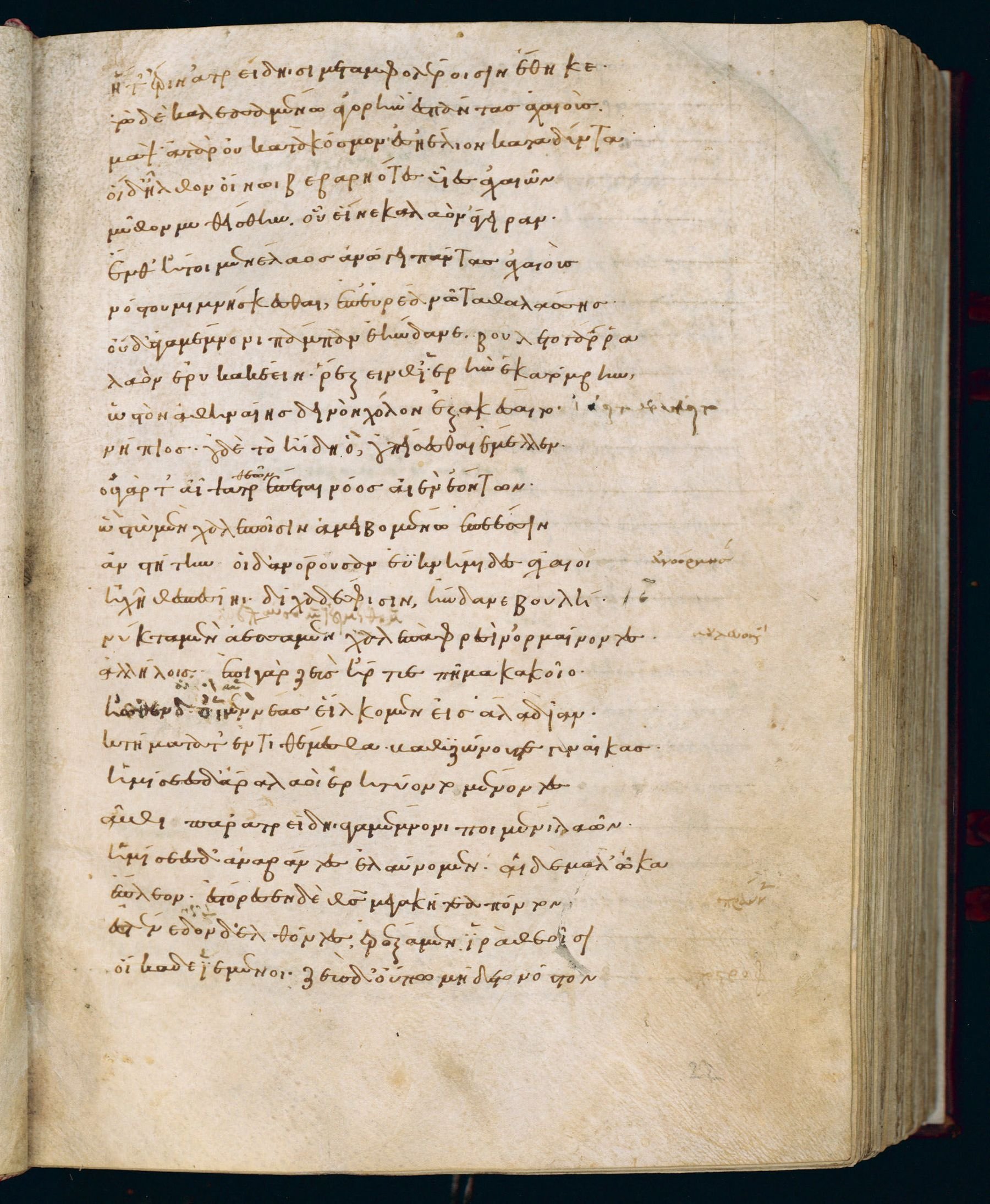
Where on the image
Laur. Plut. 32.24, fol. 22r: Odyssey 3.136-160, begins ‹ἥ τʼ ἔριν Ἀτρεΐδῃσι›, ends ‹οὔ πω μήδετο νόστον,›. Checked on the image: first and last lines read and matched to the Greek. Fol. 21v ends with 3.135. Fol. 22v begins with 3.161. English blocks here: 135-139, 140-140, 141-144, 145-149, 150-154, 155-159.
136ἥ τʼ ἔριν Ἀτρεΐδῃσι μετʼ ἀμφοτέροισιν ἔθηκε.
137τὼ δὲ καλεσσαμένω ἀγορὴν ἐς πάντας Ἀχαιούς,
138μάψ, ἀτὰρ οὐ κατὰ κόσμον, ἐς ἠέλιον καταδύντα,
139οἱ δʼ ἦλθον οἴνῳ βεβαρηότες υἷες Ἀχαιῶν,
140μῦθον μυθείσθην, τοῦ εἵνεκα λαὸν ἄγειραν.
141ἔνθʼ ἦ τοι Μενέλαος ἀνώγει πάντας Ἀχαιοὺς
142νόστου μιμνήσκεσθαι ἐπʼ εὐρέα νῶτα θαλάσσης,
143οὐδʼ Ἀγαμέμνονι πάμπαν ἑήνδανε· βούλετο γάρ ῥα
144λαὸν ἐρυκακέειν ῥέξαι θʼ ἱερὰς ἑκατόμβας,
145ὡς τὸν Ἀθηναίης δεινὸν χόλον ἐξακέσαιτο,
146νήπιος, οὐδὲ τὸ ᾔδη, ὃ οὐ πείσεσθαι ἔμελλεν·
147οὐ γάρ τʼ αἶψα θεῶν τρέπεται νόος αἰὲν ἐόντων.
148ὣς τὼ μὲν χαλεποῖσιν ἀμειβομένω ἐπέεσσιν
149ἕστασαν· οἱ δʼ ἀνόρουσαν ἐυκνήμιδες Ἀχαιοὶ
150ἠχῇ θεσπεσίῃ, δίχα δέ σφισιν ἥνδανε βουλή.
151νύκτα μὲν ἀέσαμεν χαλεπὰ φρεσὶν ὁρμαίνοντες
152ἀλλήλοις· ἐπὶ γὰρ Ζεὺς ἤρτυε πῆμα κακοῖο·
153ἠῶθεν δʼ οἱ μὲν νέας ἕλκομεν εἰς ἅλα δῖαν
154κτήματά τʼ ἐντιθέμεσθα βαθυζώνους τε γυναῖκας.
155ἡμίσεες δʼ ἄρα λαοὶ ἐρητύοντο μένοντες
156αὖθι παρʼ Ἀτρεΐδῃ Ἀγαμέμνονι, ποιμένι λαῶν·
157ἡμίσεες δʼ ἀναβάντες ἐλαύνομεν· αἱ δὲ μάλʼ ὦκα
158ἔπλεον, ἐστόρεσεν δὲ θεὸς μεγακήτεα πόντον.
159ἐς Τένεδον δʼ ἐλθόντες ἐρέξαμεν ἱρὰ θεοῖσιν,
160οἴκαδε ἱέμενοι· Ζεὺς δʼ οὔ πω μήδετο νόστον,
135through the fell wrath of the flashing-eyed goddess, the daughter of the mighty sire, for she caused strife between the two sons of Atreus. Now these two called to an assembly all the Achaeans, recklessly and in no due order, at set of sun—and they came heavy with wine, the sons of the Achaeans,— 140and they spoke their word, and told wherefore they had gathered the host together. 141Then in truth Menelaus bade all the Achaeans think of their return over the broad back of the sea, but in no wise did he please Agamemnon, for he was fain to hold back the host and to offer holy hecatombs, 145that he might appease the dread wrath of Athena,—fool! nor knew he this, that with her was to be no hearkening; for the mind of the gods that are forever is not quickly turned. So these two stood bandying harsh words; but the well-greaved Achaeans sprang up 150with a wondrous din, and two-fold plans found favour with them. That night we rested, each side pondering hard thoughts against the other, for Zeus was bringing upon us an evil doom, but in the morning some of us launched our ships upon the bright sea, and put on board our goods and the low-girdled women. 155Half, indeed, of the host held back and remained there with Agamemnon, son of Atreus, shepherd of the host, but half of us embarked and rowed away; and swiftly the ships sailed, for a god made smooth the cavernous sea. But when we came to Tenedos, we offered sacrifice to the gods,
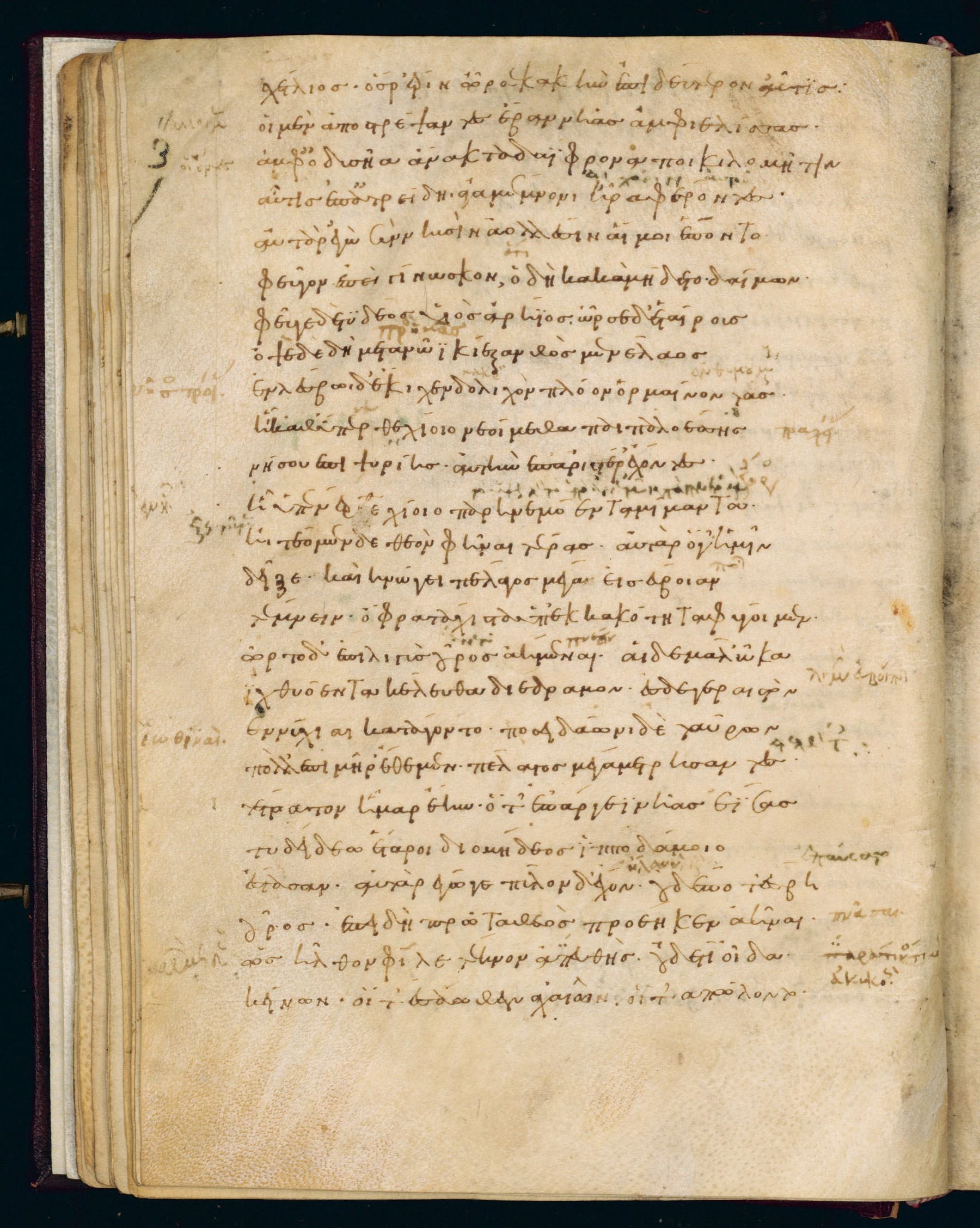
Where on the image
Laur. Plut. 32.24, fol. 22v: Odyssey 3.161-185, begins ‹σχέτλιος, ὅς ῥʼ ἔριν›, ends ‹Ἀχαιῶν οἵ τʼ ἀπόλοντο.›. Checked on the image: first and last lines read and matched to the Greek. Fol. 22r ends with 3.160. Fol. 23r begins with 3.186. English blocks here: 160-164, 165-169, 170-174, 175-179, 180-183, 184-184.
161σχέτλιος, ὅς ῥʼ ἔριν ὦρσε κακὴν ἔπι δεύτερον αὖτις.
162οἱ μὲν ἀποστρέψαντες ἔβαν νέας ἀμφιελίσσας
163ἀμφʼ Ὀδυσῆα ἄνακτα δαΐφρονα, ποικιλομήτην,
164αὖτις ἐπʼ Ἀτρεΐδῃ Ἀγαμέμνονι ἦρα φέροντες·
165αὐτὰρ ἐγὼ σὺν νηυσὶν ἀολλέσιν, αἵ μοι ἕποντο,
166φεῦγον, ἐπεὶ γίγνωσκον, ὃ δὴ κακὰ μήδετο δαίμων.
167φεῦγε δὲ Τυδέος υἱὸς ἀρήιος, ὦρσε δʼ ἑταίρους.
168ὀψὲ δὲ δὴ μετὰ νῶι κίε ξανθὸς Μενέλαος,
169ἐν Λέσβῳ δʼ ἔκιχεν δολιχὸν πλόον ὁρμαίνοντας,
170ἢ καθύπερθε Χίοιο νεοίμεθα παιπαλοέσσης,
171νήσου ἔπι Ψυρίης, αὐτὴν ἐπʼ ἀριστέρʼ ἔχοντες,
172ἦ ὑπένερθε Χίοιο, παρʼ ἠνεμόεντα Μίμαντα.
173ᾐτέομεν δὲ θεὸν φῆναι τέρας· αὐτὰρ ὅ γʼ ἡμῖν
174δεῖξε, καὶ ἠνώγει πέλαγος μέσον εἰς Ἐύβοιαν
175τέμνειν, ὄφρα τάχιστα ὑπὲκ κακότητα φύγοιμεν.
176ὦρτο δʼ ἐπὶ λιγὺς οὖρος ἀήμεναι· αἱ δὲ μάλʼ ὦκα
177ἰχθυόεντα κέλευθα διέδραμον, ἐς δὲ Γεραιστὸν
178ἐννύχιαι κατάγοντο· Ποσειδάωνι δὲ ταύρων
179πόλλʼ ἐπὶ μῆρʼ ἔθεμεν, πέλαγος μέγα μετρήσαντες.
180τέτρατον ἦμαρ ἔην, ὅτʼ ἐν Ἄργεϊ νῆας ἐίσας
181Τυδεΐδεω ἕταροι Διομήδεος ἱπποδάμοιο
182ἵστασαν· αὐτὰρ ἐγώ γε Πύλονδʼ ἔχον, οὐδέ ποτʼ ἔσβη
183οὖρος, ἐπεὶ δὴ πρῶτα θεὸς προέηκεν ἀῆναι.
184ὣς ἦλθον, φίλε τέκνον, ἀπευθής, οὐδέ τι οἶδα
185κείνων, οἵ τʼ ἐσάωθεν Ἀχαιῶν οἵ τʼ ἀπόλοντο.
160being eager to reach our homes, howbeit Zeus did not yet purpose our return, stubborn god, who roused evil strife again a second time. Then some turned back their curved ships and departed, even the lord Odysseus, the wise and crafty-minded, with his company, once more showing favour to Agamemnon, son of Atreus; 165but I with the full company of ships that followed me fled on, for I knew that the god was devising evil. And the warlike son of Tydeus fled and urged on his men; and late upon our track came fair-haired Menelaus, and overtook us in Lesbos, as we were debating the long voyage, 170whether we should sail to sea-ward of rugged Chios, toward the isle Psyria, keeping Chios itself on our left, or to land-ward of Chios past windy Mimas. So we asked the god to shew us a sign, and he shewed it us, and bade us cleave through the midst of the sea to Euboea, 175that we might the soonest escape from misery. And a shrill wind sprang up to blow, and the ships ran swiftly over the teeming ways, and at night put in to Geraestus. There on the altar of Poseidon we laid many thighs of bulls, thankful to have traversed the great sea. 180It was the fourth day when in Argos the company of Diomedes, son of Tydeus, tamer of horses, stayed their shapely ships; but I held on toward Pylos, and the wind was not once quenched from the time when the god first sent it forth to blow. 184“Thus I came, dear child, without tidings, nor know I aught
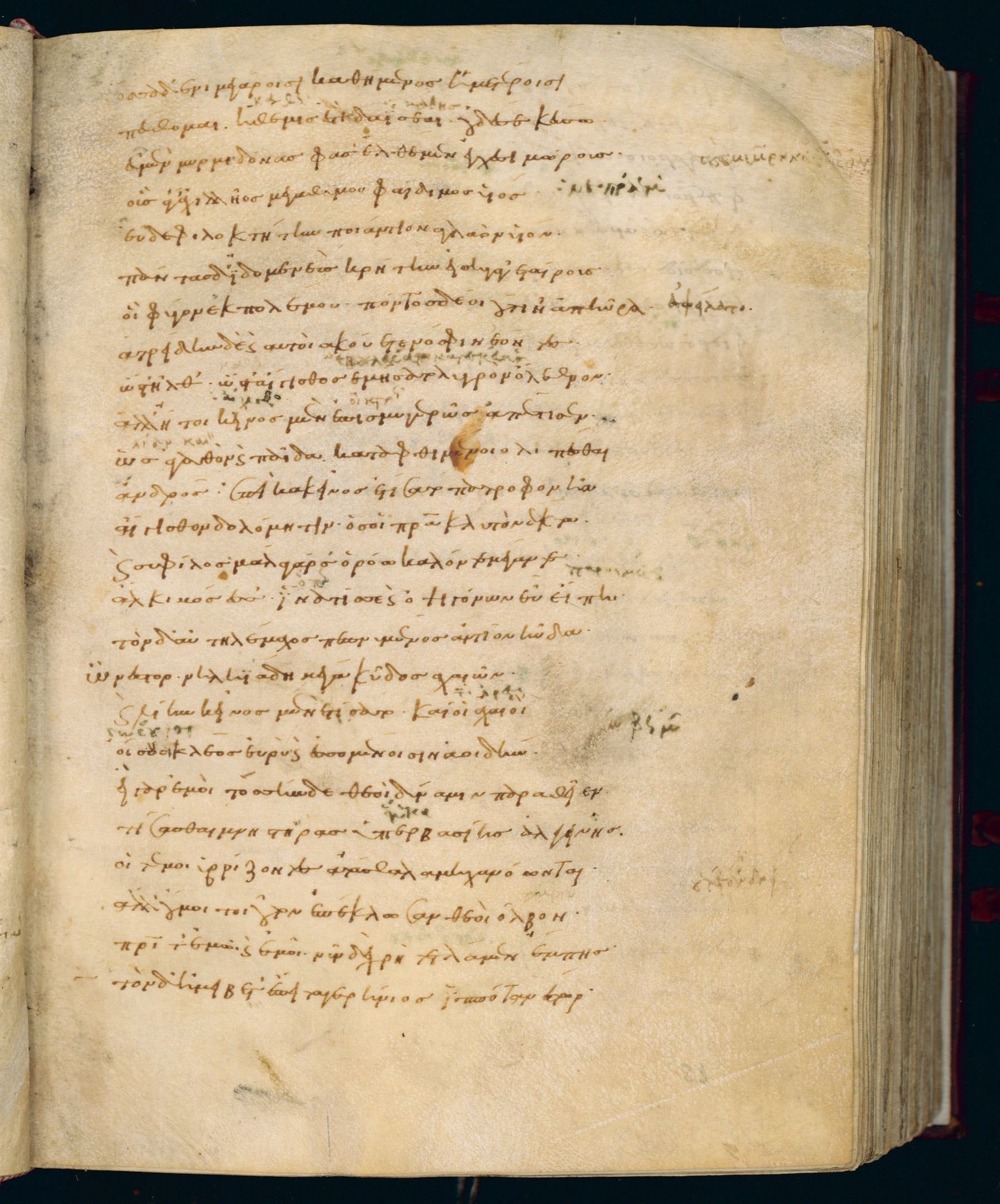
Where on the image
Laur. Plut. 32.24, fol. 23r: Odyssey 3.186-210, begins ‹ὅσσα δʼ ἐνὶ μεγάροισι›, ends ‹ἔπειτα Γερήνιος ἱππότα Νέστωρ·›. Checked on the image: first and last lines read and matched to the Greek. Fol. 22v ends with 3.185. Fol. 23v begins with 3.211. English blocks here: 185-189, 190-194, 195-199, 200-204, 205-209.
186ὅσσα δʼ ἐνὶ μεγάροισι καθήμενος ἡμετέροισι
187πεύθομαι, ἣ θέμις ἐστί, δαήσεαι, οὐδέ σε κεύσω.
188εὖ μὲν Μυρμιδόνας φάσʼ ἐλθέμεν ἐγχεσιμώρους,
189οὓς ἄγʼ Ἀχιλλῆος μεγαθύμου φαίδιμος υἱός,
190εὖ δὲ Φιλοκτήτην, Ποιάντιον ἀγλαὸν υἱόν.
191πάντας δʼ Ἰδομενεὺς Κρήτην εἰσήγαγʼ ἑταίρους,
192οἳ φύγον ἐκ πολέμου, πόντος δέ οἱ οὔ τινʼ ἀπηύρα.
193Ἀτρεΐδην δὲ καὶ αὐτοὶ ἀκούετε, νόσφιν ἐόντες,
194ὥς τʼ ἦλθʼ, ὥς τʼ Αἴγισθος ἐμήσατο λυγρὸν ὄλεθρον.
195ἀλλʼ ἦ τοι κεῖνος μὲν ἐπισμυγερῶς ἀπέτισεν·
196ὡς ἀγαθὸν καὶ παῖδα καταφθιμένοιο λιπέσθαι
197ἀνδρός, ἐπεὶ καὶ κεῖνος ἐτίσατο πατροφονῆα,
198Αἴγισθον δολόμητιν, ὅ οἱ πατέρα κλυτὸν ἔκτα.
199καὶ σὺ φίλος, μάλα γάρ σʼ ὁρόω καλόν τε μέγαν τε,
200ἄλκιμος ἔσσʼ, ἵνα τίς σε καὶ ὀψιγόνων ἐὺ εἴπῃ.
201τὸν δʼ αὖ Τηλέμαχος πεπνυμένος ἀντίον ηὔδα·
202ὦ Νέστορ Νηληϊάδη, μέγα κῦδος Ἀχαιῶν,
203καὶ λίην κεῖνος μὲν ἐτίσατο, καί οἱ Ἀχαιοὶ
204οἴσουσι κλέος εὐρὺ καὶ ἐσσομένοισι πυθέσθαι·
205αἲ γὰρ ἐμοὶ τοσσήνδε θεοὶ δύναμιν περιθεῖεν,
206τίσασθαι μνηστῆρας ὑπερβασίης ἀλεγεινῆς,
207οἵ τέ μοι ὑβρίζοντες ἀτάσθαλα μηχανόωνται.
208ἀλλʼ οὔ μοι τοιοῦτον ἐπέκλωσαν θεοὶ ὄλβον,
209πατρί τʼ ἐμῷ καὶ ἐμοί· νῦν δὲ χρὴ τετλάμεν ἔμπης.
210τὸν δʼ ἠμείβετʼ ἔπειτα Γερήνιος ἱππότα Νέστωρ·
185of those others, who of the Achaeans were saved, and who were lost. But what tidings I have heard as I abide in our halls thou shalt hear, as is right, nor will I hide it from thee. Safely, they say, came the Myrmidons that rage with the spear, whom the famous son of great-hearted Achilles led; 190and safely Philoctetes, the glorious son of Poias. All his company, too, did Idomeneus bring to Crete, all who escaped the war, and the sea robbed him of none. But of the son of Atreus you have yourselves heard, far off though you are, how he came, and how Aegisthus devised for him a woeful doom. 195Yet verily he paid the reckoning therefor in terrible wise, so good a thing is it that a son be left behind a man at his death, since that son took vengeance on his father's slayer, the guileful Aegisthus, for that he slew his glorious father. Thou, too, friend, for I see thou art a comely man and tall, 200be thou valiant, that many an one among men yet to be born may praise thee.” Then wise Telemachus answered him: “Nestor, son of Neleus, great glory of the Achaeans, yea verily that son took vengeance, and the Achaeans shall spread his fame abroad, that men who are yet to be may hear thereof. 205O that the gods would clothe me with such strength, that I might take vengeance on the wooers for their grievous sin, who in wantonness devise mischief against me. But lo, the gods have spun for me no such happiness, for me or for my father; and now I must in any case endure.”
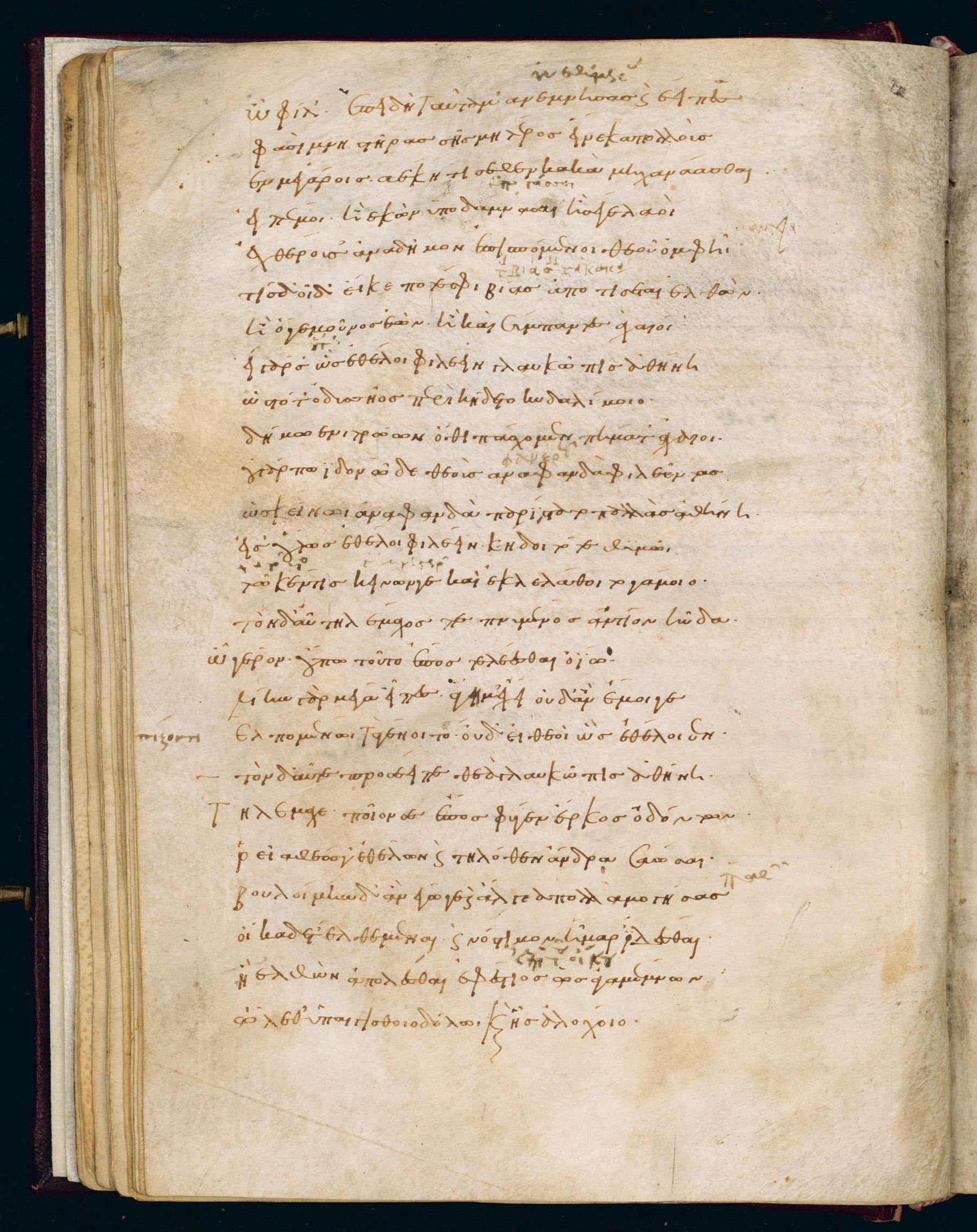
Where on the image
Laur. Plut. 32.24, fol. 23v: Odyssey 3.211-235, begins ‹ὦ φίλʼ, ἐπεὶ δὴ›, ends ‹δόλῳ καὶ ἧς ἀλόχοιο.›. Checked on the image: first and last lines read and matched to the Greek. Fol. 23r ends with 3.210. Fol. 24r begins with 3.236. English blocks here: 210-214, 215-219, 220-224, 225-228, 229-229, 230-234.
211ὦ φίλʼ, ἐπεὶ δὴ ταῦτά μʼ ἀνέμνησας καὶ ἔειπες,
212φασὶ μνηστῆρας σῆς μητέρος εἵνεκα πολλοὺς
213ἐν μεγάροις ἀέκητι σέθεν κακὰ μηχανάασθαι·
214εἰπέ μοι, ἠὲ ἑκὼν ὑποδάμνασαι, ἦ σέ γε λαοὶ
215ἐχθαίρουσʼ ἀνὰ δῆμον, ἐπισπόμενοι θεοῦ ὀμφῇ.
216τίς δʼ οἶδʼ εἴ κέ ποτέ σφι βίας ἀποτίσεται ἐλθών,
217ἢ ὅ γε μοῦνος ἐὼν ἢ καὶ σύμπαντες Ἀχαιοί;
218εἰ γάρ σʼ ὣς ἐθέλοι φιλέειν γλαυκῶπις Ἀθήνη,
219ὡς τότʼ Ὀδυσσῆος περικήδετο κυδαλίμοιο
220δήμῳ ἔνι Τρώων, ὅθι πάσχομεν ἄλγεʼ Ἀχαιοί—
221οὐ γάρ πω ἴδον ὧδε θεοὺς ἀναφανδὰ φιλεῦντας,
222ὡς κείνῳ ἀναφανδὰ παρίστατο Παλλὰς Ἀθήνη—
223εἴ σʼ οὕτως ἐθέλοι φιλέειν κήδοιτό τε θυμῷ,
224τῶ κέν τις κείνων γε καὶ ἐκλελάθοιτο γάμοιο.
225τὸν δʼ αὖ Τηλέμαχος πεπνυμένος ἀντίον ηὔδα·
226ὦ γέρον, οὔ πω τοῦτο ἔπος τελέεσθαι ὀίω·
227λίην γὰρ μέγα εἶπες· ἄγη μʼ ἔχει. οὐκ ἂν ἐμοί γε
228ἐλπομένῳ τὰ γένοιτʼ, οὐδʼ εἰ θεοὶ ὣς ἐθέλοιεν.
229τὸν δʼ αὖτε προσέειπε θεά, γλαυκῶπις Ἀθήνη·
230Τηλέμαχε, ποῖόν σε ἔπος φύγεν ἕρκος ὀδόντων.
231ῥεῖα θεός γʼ ἐθέλων καὶ τηλόθεν ἄνδρα σαώσαι.
232βουλοίμην δʼ ἂν ἐγώ γε καὶ ἄλγεα πολλὰ μογήσας
233οἴκαδέ τʼ ἐλθέμεναι καὶ νόστιμον ἦμαρ ἰδέσθαι,
234ἢ ἐλθὼν ἀπολέσθαι ἐφέστιος, ὡς Ἀγαμέμνων
235ὤλεθʼ ὑπʼ Αἰγίσθοιο δόλῳ καὶ ἧς ἀλόχοιο.
210Then the horseman, Nestor of Gerenia, answered him: “Friend, since thou calledst this to my mind and didst speak of it, they say that many wooers for the hand of thy mother devise evils in thy halls in thy despite. Tell me, art thou willingly thus oppressed, or do the people 215throughout the land hate thee, following the voice of a god? Who knows but Odysseus may some day come and take vengeance on them for their violent deeds,—he alone, it may be, or even all the host of the Achaeans? Ah, would that flashing-eyed Athena might choose to love thee even as then she cared exceedingly for glorious Odysseus 220in the land of the Trojans, where we Achaeans suffered woes. For never yet have I seen the gods so manifestly shewing love, as Pallas Athena did to him, standing manifest by his side. If she would be pleased to love thee in such wise and would care for thee at heart, then would many a one of them utterly forget marriage.” 225Then wise Telemachus answered him: “Old man, in no wise do I deem that this word will be brought to pass. Too great is what thou sayest; amazement holds me. No hope have I that this will come to pass, no, not though the gods should so will it.” 229Then the goddess, flashing-eyed Athena, spoke to him, and said: 230“Telemachus, what a word has escaped the barrier of thy teeth! Easily might a god who willed it bring a man safe home, even from afar. But for myself, I had rather endure many grievous toils ere I reached home and saw the day of my returning, than after my return be slain at my hearth, as Agamemnon
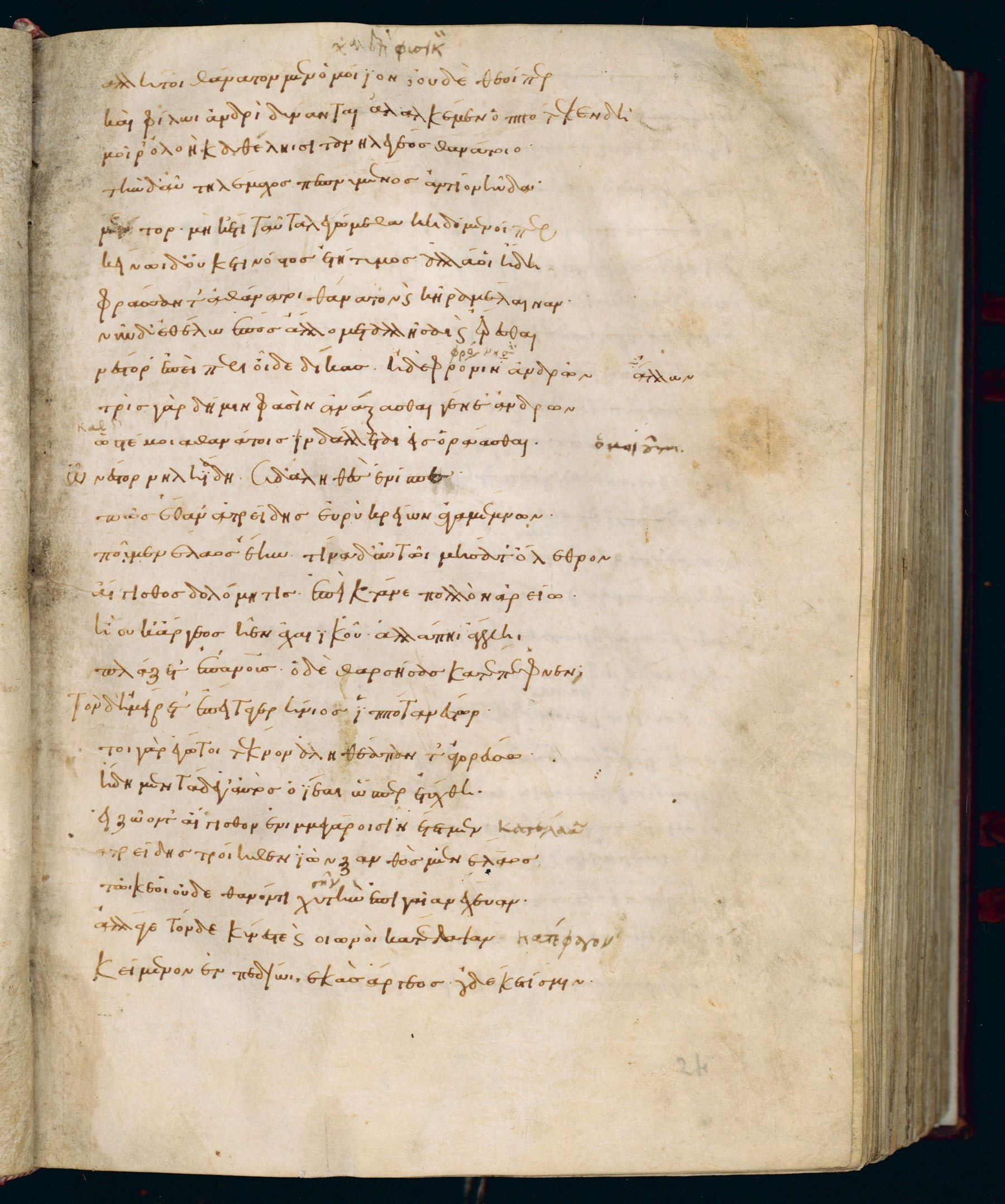
Where on the image
Laur. Plut. 32.24, fol. 24r: Odyssey 3.236-260, begins ‹ἀλλʼ ἦ τοι θάνατον›, ends ‹οὐδέ κέ τίς μιν›. Checked on the image: first and last lines read and matched to the Greek. Fol. 23v ends with 3.235. Fol. 24v begins with 3.261. English blocks here: 235-239, 240-244, 245-249, 250-254, 255-259.
236ἀλλʼ ἦ τοι θάνατον μὲν ὁμοίιον οὐδὲ θεοί περ
237καὶ φίλῳ ἀνδρὶ δύνανται ἀλαλκέμεν, ὁππότε κεν δὴ
238μοῖρʼ ὀλοὴ καθέλῃσι τανηλεγέος θανάτοιο.
239τὴν δʼ αὖ Τηλέμαχος πεπνυμένος ἀντίον ηὔδα·
240Μέντορ, μηκέτι ταῦτα λεγώμεθα κηδόμενοί περ·
241κείνῳ δʼ οὐκέτι νόστος ἐτήτυμος, ἀλλά οἱ ἤδη
242φράσσαντʼ ἀθάνατοι θάνατον καὶ κῆρα μέλαιναν.
243νῦν δʼ ἐθέλω ἔπος ἄλλο μεταλλῆσαι καὶ ἐρέσθαι
244Νέστορʼ, ἐπεὶ περὶ οἶδε δίκας ἠδὲ φρόνιν ἄλλων·
245τρὶς γὰρ δή μίν φασιν ἀνάξασθαι γένεʼ ἀνδρῶν·
246ὥς τέ μοι ἀθάνατος ἰνδάλλεται εἰσοράασθαι.
247ὦ Νέστορ Νηληϊάδη, σὺ δʼ ἀληθὲς ἐνίσπες·
248πῶς ἔθανʼ Ἀτρεΐδης εὐρὺ κρείων Ἀγαμέμνων;
249ποῦ Μενέλαος ἔην; τίνα δʼ αὐτῷ μήσατʼ ὄλεθρον
250Αἴγισθος δολόμητις, ἐπεὶ κτάνε πολλὸν ἀρείω;
251ἦ οὐκ Ἄργεος ἦεν Ἀχαιικοῦ, ἀλλά πῃ ἄλλῃ
252πλάζετʼ ἐπʼ ἀνθρώπους, ὁ δὲ θαρσήσας κατέπεφνε;
253τὸν δʼ ἠμείβετʼ ἔπειτα Γερήνιος ἱππότα Νέστωρ·
254τοιγὰρ ἐγώ τοι, τέκνον, ἀληθέα πάντʼ ἀγορεύσω.
255ἦ τοι μὲν τάδε καὐτὸς ὀίεαι, ὥς κεν ἐτύχθη,
256εἰ ζωόν γʼ Αἴγισθον ἐνὶ μεγάροισιν ἔτετμεν
257Ἀτρεΐδης Τροίηθεν ἰών, ξανθὸς Μενέλαος·
258τῶ κέ οἱ οὐδὲ θανόντι χυτὴν ἐπὶ γαῖαν ἔχευαν,
259ἀλλʼ ἄρα τόν γε κύνες τε καὶ οἰωνοὶ κατέδαψαν
260κείμενον ἐν πεδίῳ ἑκὰς ἄστεος, οὐδέ κέ τίς μιν
235was slain by the guile of Aegisthus and of his own wife. But of a truth death that is common to all the gods themselves cannot ward from a man they love, when the fell fate of grievous death shall strike him down.” Then wise Telemachus answered her: 240“Mentor, no longer let us tell of these things despite our grief. For him no return can ever more be brought to pass; nay, ere this the immortals have devised for him death and black fate. But now I would make enquiry and ask Nestor regarding another matter, since beyond all others he knows judgments and wisdom; 245for thrice, men say, has he been king for a generation of men, and like unto an immortal he seems to me to look upon. Nestor, son of Neleus, do thou tell me truly: how was the son of Atreus, wide-ruling Agamemnon, slain? Where was Menelaus? What death did 250guileful Aegisthus plan for the king, since he slew a man mightier far than himself? Was Menelaus not in Achaean Argos, but wandering elsewhere among men, so that Aegisthus took heart and did the murderous deed?” Then the horseman, Nestor of Gerenia, answered him: “Then verily, my child, will I tell thee all the truth. 255Lo, of thine own self thou dost guess how this matter would have fallen out, if the son of Atreus, fair-haired Menelaus, on his return from Troy had found Aegisthus in his halls alive. Then for him not even in death would they have piled the up-piled earth, but the dogs and birds would have torn him
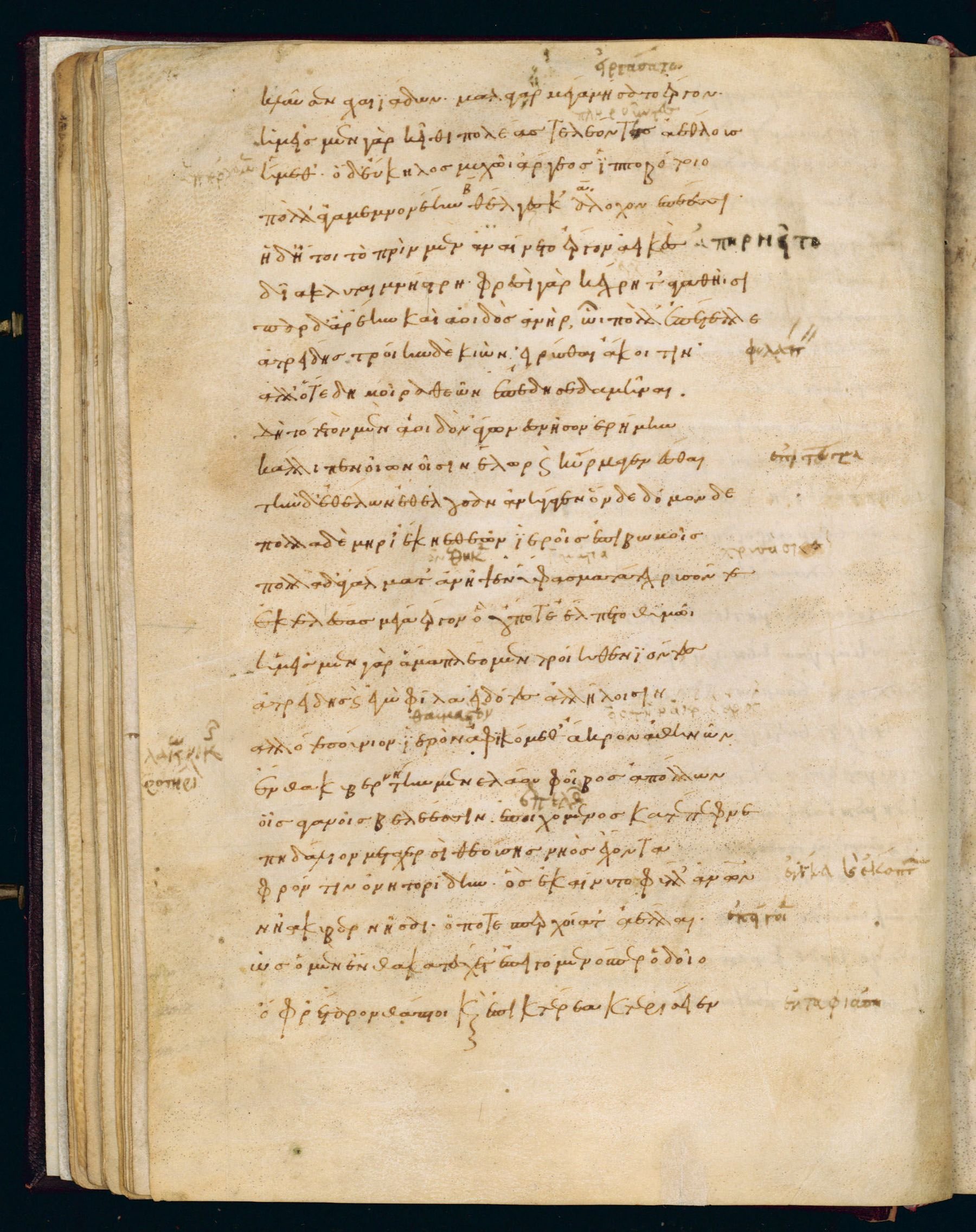
Where on the image
Laur. Plut. 32.24, fol. 24v: Odyssey 3.261-285, begins ‹κλαῦσεν Ἀχαιιάδων· μάλα γὰρ›, ends ‹καὶ ἐπὶ κτέρεα κτερίσειεν.›. Checked on the image: first and last lines read and matched to the Greek. Fol. 24r ends with 3.260. Fol. 25r begins with 3.286. English blocks here: 260-264, 265-269, 270-274, 275-275, 276-279, 280-284.
261κλαῦσεν Ἀχαιιάδων· μάλα γὰρ μέγα μήσατο ἔργον.
262ἡμεῖς μὲν γὰρ κεῖθι πολέας τελέοντες ἀέθλους
263ἥμεθʼ· ὁ δʼ εὔκηλος μυχῷ Ἄργεος ἱπποβότοιο
264πόλλʼ Ἀγαμεμνονέην ἄλοχον θέλγεσκʼ ἐπέεσσιν.
265ἡ δʼ ἦ τοι τὸ πρὶν μὲν ἀναίνετο ἔργον ἀεικὲς
266δῖα Κλυταιμνήστρη· φρεσὶ γὰρ κέχρητʼ ἀγαθῇσι·
267πὰρ δʼ ἄρʼ ἔην καὶ ἀοιδὸς ἀνήρ, ᾧ πόλλʼ ἐπέτελλεν
268Ἀτρεΐδης Τροίηνδε κιὼν εἴρυσθαι ἄκοιτιν.
269ἀλλʼ ὅτε δή μιν μοῖρα θεῶν ἐπέδησε δαμῆναι,
270δὴ τότε τὸν μὲν ἀοιδὸν ἄγων ἐς νῆσον ἐρήμην
271κάλλιπεν οἰωνοῖσιν ἕλωρ καὶ κύρμα γενέσθαι,
272τὴν δʼ ἐθέλων ἐθέλουσαν ἀνήγαγεν ὅνδε δόμονδε.
273πολλὰ δὲ μηρίʼ ἔκηε θεῶν ἱεροῖς ἐπὶ βωμοῖς,
274πολλὰ δʼ ἀγάλματʼ ἀνῆψεν, ὑφάσματά τε χρυσόν τε,
275ἐκτελέσας μέγα ἔργον, ὃ οὔ ποτε ἔλπετο θυμῷ.
276ἡμεῖς μὲν γὰρ ἅμα πλέομεν Τροίηθεν ἰόντες,
277Ἀτρεΐδης καὶ ἐγώ, φίλα εἰδότες ἀλλήλοισιν·
278ἀλλʼ ὅτε Σούνιον ἱρὸν ἀφικόμεθʼ, ἄκρον Ἀθηνέων,
279ἔνθα κυβερνήτην Μενελάου Φοῖβος Ἀπόλλων
280οἷς ἀγανοῖς βελέεσσιν ἐποιχόμενος κατέπεφνε,
281πηδάλιον μετὰ χερσὶ θεούσης νηὸς ἔχοντα,
282Φρόντιν Ὀνητορίδην, ὃς ἐκαίνυτο φῦλʼ ἀνθρώπων
283νῆα κυβερνῆσαι, ὁπότε σπέρχοιεν ἄελλαι.
284ὣς ὁ μὲν ἔνθα κατέσχετʼ, ἐπειγόμενός περ ὁδοῖο,
285ὄφρʼ ἕταρον θάπτοι καὶ ἐπὶ κτέρεα κτερίσειεν.
260as he lay on the plain far from the city, nor would any of the Achaean women have bewailed him; for monstrous was the deed he devised. We on our part abode there in Troy fulfilling our many toils; but he, at ease in a nook of horse-pasturing Argos, ever sought to beguile with words the wife of Agamemnon. 265Now at the first she put from her the unseemly deed, the beautiful Clytemnestra, for she had an understanding heart; and with her was furthermore a minstrel whom the son of Atreus straitly charged, when he set forth for the land of Troy, to guard his wife. But when at length the doom of the gods bound her that she should be overcome, 270then verily Aegisthus took the minstrel to a desert isle and left him to be the prey and spoil of birds; and her, willing as he was willing, he led to his own house. And many thigh-pieces he burned upon the holy altars of the gods, and many offerings he hung up, woven stuffs and gold, 275since he had accomplished a mighty deed beyond all his heart had hoped. 276“Now we were sailing together on our way from Troy, the son of Atreus and I, in all friendship; but when we came to holy Sunium, the cape of Athens, there Phoebus Apollo 280assailed with his gentle shafts and slew the helmsman of Menelaus, as he held in his hands the steering-oar of the speeding ship, even Phrontis, son of Onetor, who excelled the tribes of men in piloting a ship when the storm winds blow strong. So Menelaus tarried there, though eager for his journey,
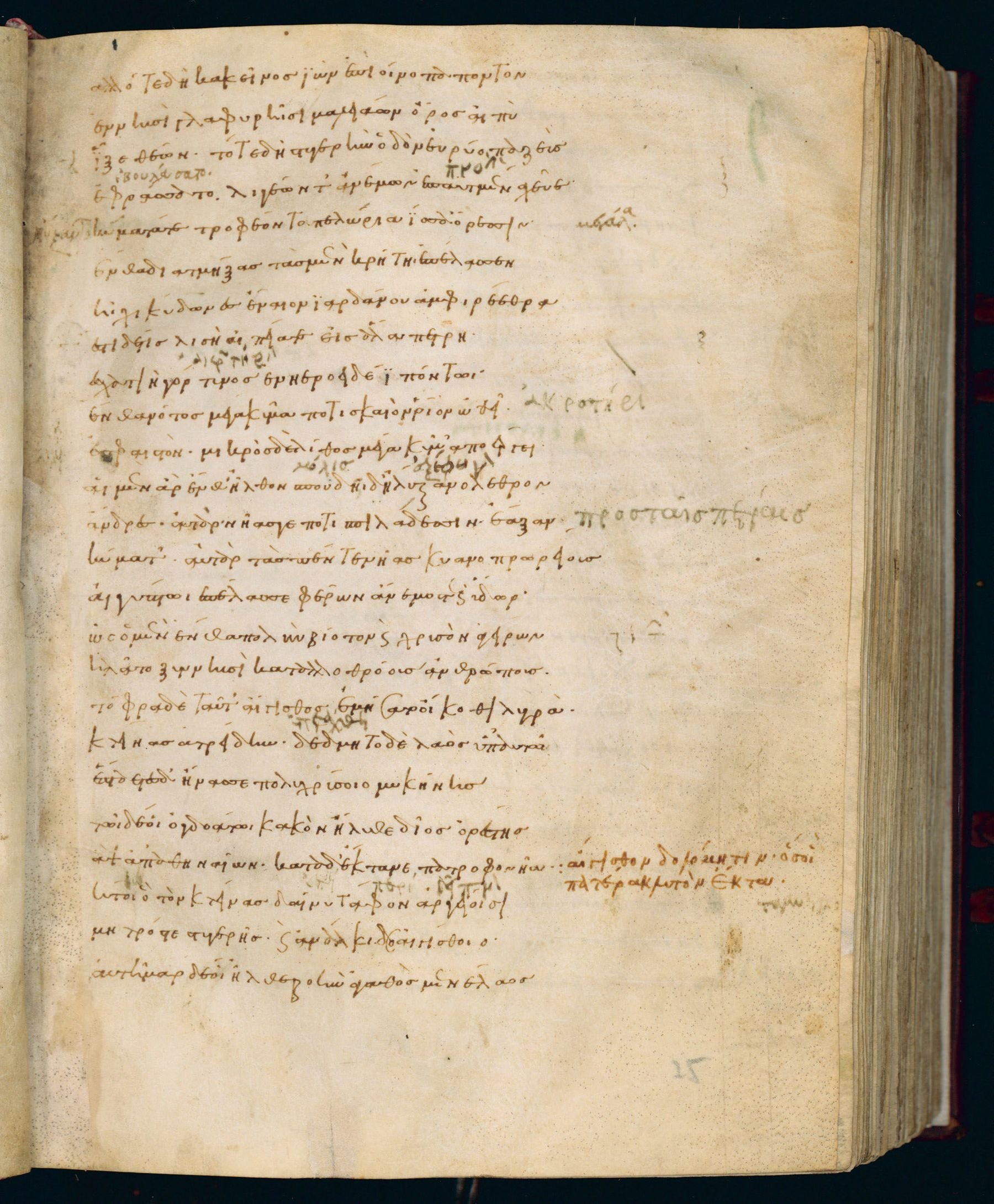
Where on the image
Laur. Plut. 32.24, fol. 25r: Odyssey 3.286-311, begins ‹ἀλλʼ ὅτε δὴ καὶ›, ends ‹ἦλθε βοὴν ἀγαθὸς Μενέλαος›. Checked on the image: first and last lines read and matched to the Greek. Fol. 24v ends with 3.285. Fol. 25v begins with 3.312. 3.308 is not in the text column; it is written in the right margin beside 3.307. The page has 3.304 before 3.305 (Murray prints 305 before 304). English blocks here: 285-289, 290-294, 295-299, 300-304, 305-309.
286ἀλλʼ ὅτε δὴ καὶ κεῖνος ἰὼν ἐπὶ οἴνοπα πόντον
287ἐν νηυσὶ γλαφυρῇσι Μαλειάων ὄρος αἰπὺ
288ἷξε θέων, τότε δὴ στυγερὴν ὁδὸν εὐρύοπα Ζεὺς
289ἐφράσατο, λιγέων δʼ ἀνέμων ἐπʼ ἀυτμένα χεῦε,
290κύματά τε τροφέοντο πελώρια, ἶσα ὄρεσσιν.
291ἔνθα διατμήξας τὰς μὲν Κρήτῃ ἐπέλασσεν,
292ἧχι Κύδωνες ἔναιον Ἰαρδάνου ἀμφὶ ῥέεθρα.
293ἔστι δέ τις λισσὴ αἰπεῖά τε εἰς ἅλα πέτρη
294ἐσχατιῇ Γόρτυνος ἐν ἠεροειδέι πόντῳ·
295ἔνθα Νότος μέγα κῦμα ποτὶ σκαιὸν ῥίον ὠθεῖ,
296ἐς Φαιστόν, μικρὸς δὲ λίθος μέγα κῦμʼ ἀποέργει.
297αἱ μὲν ἄρʼ ἔνθʼ ἦλθον, σπουδῇ δʼ ἤλυξαν ὄλεθρον
298ἄνδρες, ἀτὰρ νῆάς γε ποτὶ σπιλάδεσσιν ἔαξαν
299κύματʼ· ἀτὰρ τὰς πέντε νέας κυανοπρῳρείους
300Αἰγύπτῳ ἐπέλασσε φέρων ἄνεμός τε καὶ ὕδωρ.
301ὣς ὁ μὲν ἔνθα πολὺν βίοτον καὶ χρυσὸν ἀγείρων
302ἠλᾶτο ξὺν νηυσὶ κατʼ ἀλλοθρόους ἀνθρώπους·
303τόφρα δὲ ταῦτʼ Αἴγισθος ἐμήσατο οἴκοθι λυγρά.
304κτείνας Ἀτρεΐδην, δέδμητο δὲ λαὸς ὑπʼ αὐτῷ.
305ἑπτάετες δʼ ἤνασσε πολυχρύσοιο Μυκήνης,
306τῷ δέ οἱ ὀγδοάτῳ κακὸν ἤλυθε δῖος Ὀρέστης
307ἂψ ἀπʼ Ἀθηνάων, κατὰ δʼ ἔκτανε πατροφονῆα,
308Αἴγισθον δολόμητιν, ὅ οἱ πατέρα κλυτὸν ἔκτα.
309ἦ τοι ὁ τὸν κτείνας δαίνυ τάφον Ἀργείοισιν
310μητρός τε στυγερῆς καὶ ἀνάλκιδος Αἰγίσθοιο·
311αὐτῆμαρ δέ οἱ ἦλθε βοὴν ἀγαθὸς Μενέλαος
285that he might bury his comrade and over him pay funeral rites. But when he in his turn, as he passed over the wine-dark sea in the hollow ships, reached in swift course the steep height of Malea, then verily Zeus, whose voice is borne afar, planned for him a hateful path and poured upon him the blasts of shrill winds, 290and the waves were swollen to huge size, like unto mountains. Then, parting his ships in twain, he brought some to Crete, where the Cydonians dwelt about the streams of Iardanus. Now there is a smooth cliff, sheer towards the sea, on the border of Gortyn in the misty deep, 295where the Southwest Wind drives the great wave against the headland on the left toward Phaestus, and a little rock holds back a great wave. Thither came some of his ships, and the men with much ado escaped destruction, howbeit the ships the waves dashed to pieces against the reef. But the five other dark-prowed ships 300the wind, as it bore them, and the wave brought to Egypt. So he was wandering there with his ships among men of strange speech, gathering much livelihood and gold; but meanwhile Aegisthus devised this woeful work at home. 305Seven years he reigned over Mycenae, rich in gold, after slaying the son of Atreus, and the people were subdued under him; but in the eighth came as his bane the goodly Orestes back from Athens, and slew his father's murderer,
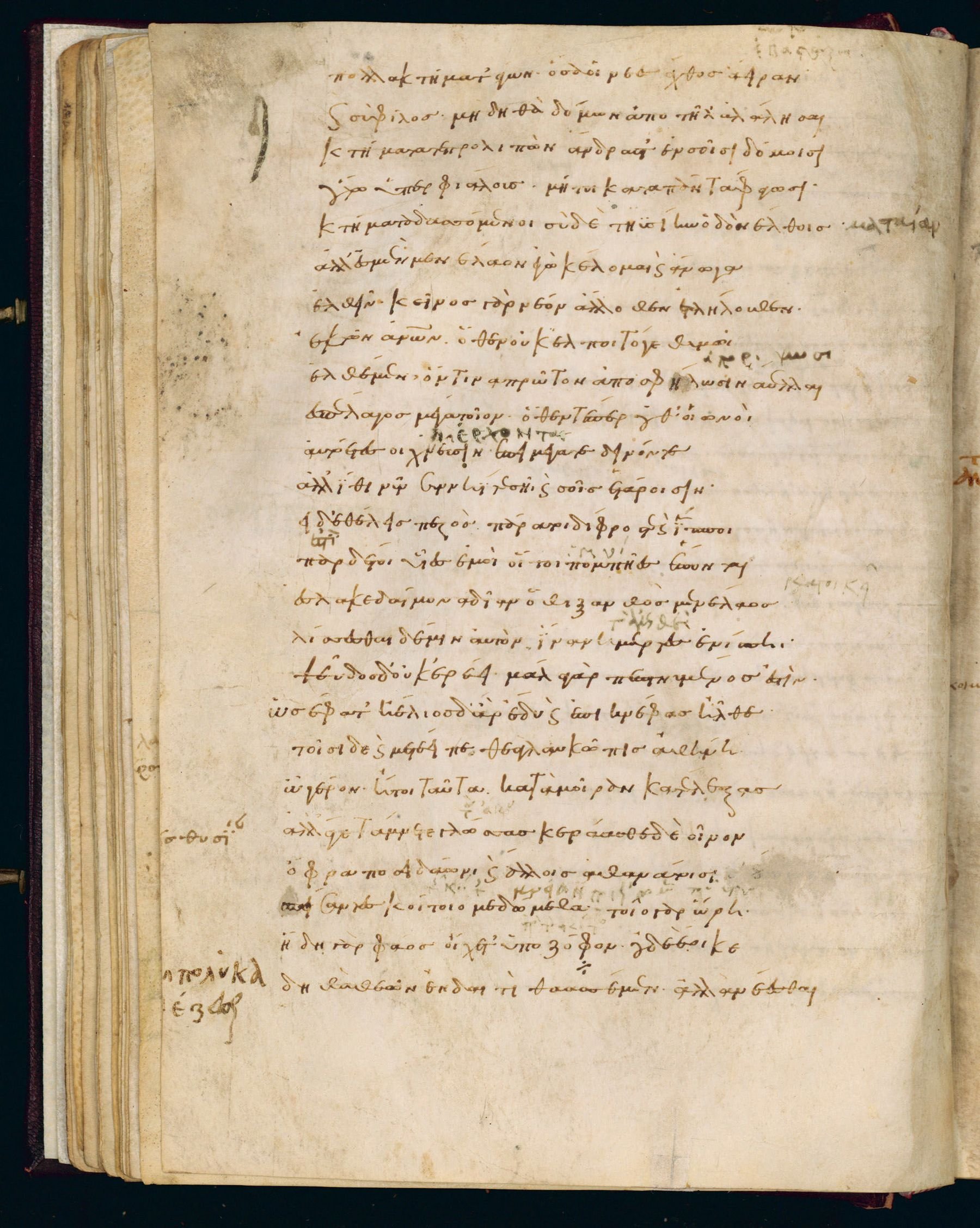
Where on the image
Laur. Plut. 32.24, fol. 25v: Odyssey 3.312-336, begins ‹πολλὰ κτήματʼ ἄγων, ὅσα›, ends ‹δαιτὶ θαασσέμεν, ἀλλὰ νέεσθαι.›. Checked on the image: first and last lines read and matched to the Greek. Fol. 25r ends with 3.311. Fol. 26r begins with 3.337. English blocks here: 310-314, 315-319, 320-324, 325-328, 329-329, 330-334.
312πολλὰ κτήματʼ ἄγων, ὅσα οἱ νέες ἄχθος ἄειραν.
313καὶ σύ, φίλος, μὴ δηθὰ δόμων ἄπο τῆλʼ ἀλάλησο,
314κτήματά τε προλιπὼν ἄνδρας τʼ ἐν σοῖσι δόμοισιν
315οὕτω ὑπερφιάλους, μή τοι κατὰ πάντα φάγωσιν
316κτήματα δασσάμενοι, σὺ δὲ τηϋσίην ὁδὸν ἔλθῃς.
317ἀλλʼ ἐς μὲν Μενέλαον ἐγὼ κέλομαι καὶ ἄνωγα
318ἐλθεῖν· κεῖνος γὰρ νέον ἄλλοθεν εἰλήλουθεν,
319ἐκ τῶν ἀνθρώπων, ὅθεν οὐκ ἔλποιτό γε θυμῷ
320ἐλθέμεν, ὅν τινα πρῶτον ἀποσφήλωσιν ἄελλαι
321ἐς πέλαγος μέγα τοῖον, ὅθεν τέ περ οὐδʼ οἰωνοὶ
322αὐτόετες οἰχνεῦσιν, ἐπεὶ μέγα τε δεινόν τε.
323ἀλλʼ ἴθι νῦν σὺν νηί τε σῇ καὶ σοῖς ἑτάροισιν·
324εἰ δʼ ἐθέλεις πεζός, πάρα τοι δίφρος τε καὶ ἵπποι,
325πὰρ δέ τοι υἷες ἐμοί, οἵ τοι πομπῆες ἔσονται
326ἐς Λακεδαίμονα δῖαν, ὅθι ξανθὸς Μενέλαος.
327λίσσεσθαι δέ μιν αὐτός, ἵνα νημερτὲς ἐνίσπῃ·
328ψεῦδος δʼ οὐκ ἐρέει· μάλα γὰρ πεπνυμένος ἐστίν.
329ὣς ἔφατʼ, ἠέλιος δʼ ἄρʼ ἔδυ καὶ ἐπὶ κνέφας ἦλθε.
330τοῖσι δὲ καὶ μετέειπε θεά, γλαυκῶπις Ἀθήνη·
331ὦ γέρον, ἦ τοι ταῦτα κατὰ μοῖραν κατέλεξας·
332ἀλλʼ ἄγε τάμνετε μὲν γλώσσας, κεράασθε δὲ οἶνον,
333ὄφρα Ποσειδάωνι καὶ ἄλλοις ἀθανάτοισιν
334σπείσαντες κοίτοιο μεδώμεθα· τοῖο γὰρ ὥρη.
335ἤδη γὰρ φάος οἴχεθʼ ὑπὸ ζόφον, οὐδὲ ἔοικεν·
336δηθὰ θεῶν ἐν δαιτὶ θαασσέμεν, ἀλλὰ νέεσθαι.
310the guileful Aegisthus, for that he had slain his glorious father. Now when he had slain him, he made a funeral feast for the Argives over his hateful mother and the craven Aegisthus; and on the self-same day there came to him Menelaus, good at the war-cry, bringing much treasure, even all the burden that his ships could bear. “So do not thou, my friend, wander long far from home, leaving thy wealth behind thee and men in thy house 315so insolent, lest they divide and devour all thy wealth, and thou shalt have gone on a fruitless journey. But to Menelaus I bid and command thee to go, for he has but lately come from a strange land, from a folk whence no one would hope in his heart 320to return, whom the storms had once driven astray into a sea so great, whence the very birds do not fare in the space of a year, so great is it and terrible. But now go thy way with thy ship and thy comrades, or, if thou wilt go by land, here are chariot and horses at hand for thee, 325and here at thy service are my sons, who will be thy guides to goodly Lacedaemon, where lives fair-haired Menelaus. And do thou beseech him thyself that he may tell thee the very truth. A lie will be not utter, for he is wise indeed.” 329So he spoke, and the sun set, and darkness came on. 330Then among them spoke the goddess, flashing-eyed Athena: “Old man, of a truth thou hast told this tale aright. But come, cut out the tongues of the victims and mix the wine, that when we have poured libations to Poseidon and the other immortals, we may bethink us of sleep; for it is the time thereto.
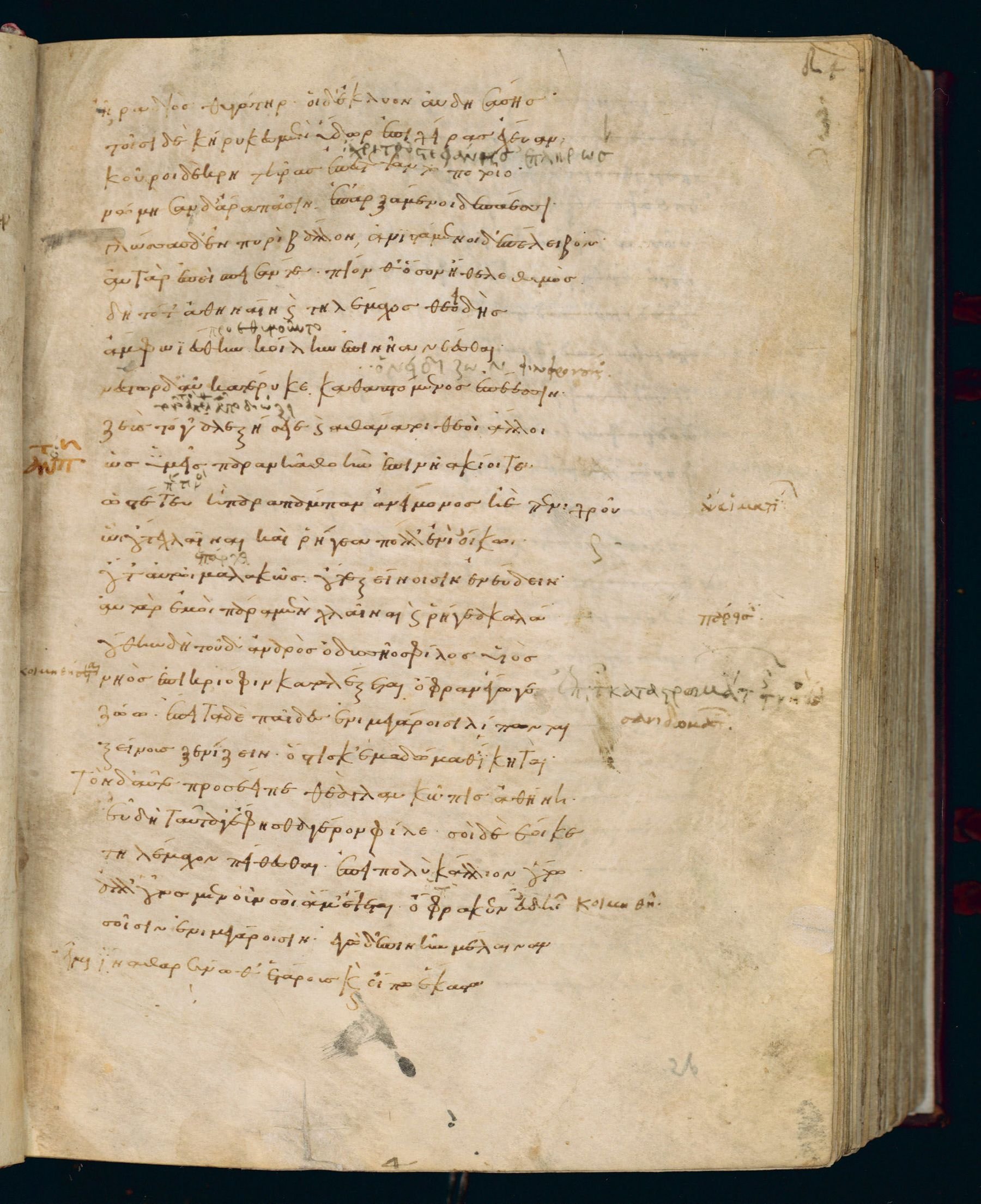
Where on the image
Laur. Plut. 32.24, fol. 26r: Odyssey 3.337-361, begins ‹ἦ ῥα Διὸς θυγάτηρ,›, ends ‹ἑτάρους εἴπω τε ἕκαστα.›. Checked on the image: first and last lines read and matched to the Greek. Fol. 25v ends with 3.336. Fol. 26v begins with 3.362. English blocks here: 335-339, 340-344, 345-349, 350-354, 355-359.
337ἦ ῥα Διὸς θυγάτηρ, οἱ δʼ ἔκλυον αὐδησάσης.
338τοῖσι δὲ κήρυκες μὲν ὕδωρ ἐπὶ χεῖρας ἔχευαν,
339κοῦροι δὲ κρητῆρας ἐπεστέψαντο ποτοῖο,
340νώμησαν δʼ ἄρα πᾶσιν ἐπαρξάμενοι δεπάεσσι·
341γλώσσας δʼ ἐν πυρὶ βάλλον, ἀνιστάμενοι δʼ ἐπέλειβον.
342αὐτὰρ ἐπεὶ σπεῖσάν τʼ ἔπιον θʼ, ὅσον ἤθελε θυμός,
343δὴ τότʼ Ἀθηναίη καὶ Τηλέμαχος θεοειδὴς
344ἄμφω ἱέσθην κοίλην ἐπὶ νῆα νέεσθαι.
345Νέστωρ δʼ αὖ κατέρυκε καθαπτόμενος ἐπέεσσιν·
346Ζεὺς τό γʼ ἀλεξήσειε καὶ ἀθάνατοι θεοὶ ἄλλοι,
347ὡς ὑμεῖς παρʼ ἐμεῖο θοὴν ἐπὶ νῆα κίοιτε
348ὥς τέ τευ ἦ παρὰ πάμπαν ἀνείμονος ἠδὲ πενιχροῦ,
349ᾧ οὔ τι χλαῖναι καὶ ῥήγεα πόλλʼ ἐνὶ οἴκῳ,
350οὔτʼ αὐτῷ μαλακῶς οὔτε ξείνοισιν ἐνεύδειν.
351αὐτὰρ ἐμοὶ πάρα μὲν χλαῖναι καὶ ῥήγεα καλά.
352οὔ θην δὴ τοῦδʼ ἀνδρὸς Ὀδυσσῆος φίλος υἱὸς
353νηὸς ἐπʼ ἰκριόφιν καταλέξεται, ὄφρʼ ἂν ἐγώ γε
354ζώω, ἔπειτα δὲ παῖδες ἐνὶ μεγάροισι λίπωνται,
355ξείνους ξεινίζειν, ὅς τίς κʼ ἐμὰ δώμαθʼ ἵκηται.
356τὸν δʼ αὖτε προσέειπε θεά, γλαυκῶπις Ἀθήνη·
357εὖ δὴ ταῦτά γʼ ἔφησθα, γέρον φίλε· σοὶ δὲ ἔοικεν
358Τηλέμαχον πείθεσθαι, ἐπεὶ πολὺ κάλλιον οὕτως.
359ἀλλʼ οὗτος μὲν νῦν σοὶ ἅμʼ ἕψεται, ὄφρα κεν εὕδῃ
360σοῖσιν ἐνὶ μεγάροισιν· ἐγὼ δʼ ἐπὶ νῆα μέλαιναν
361εἶμʼ, ἵνα θαρσύνω θʼ ἑτάρους εἴπω τε ἕκαστα.
335Even now has the light gone down beneath the darkness, and it is not fitting to sit long at the feast of the gods, but to go our way.” So spoke the daughter of Zeus, and they hearkenened to her voice. Heralds poured water over their hands, and youths filled the bowls brim full of drink, 340and served out to all, pouring first drops for libation into the cups. Then they cast the tongues upon the fire, and, rising up, poured libations upon them. But when they had poured libations and had drunk to their heart's content, then verily Athena and godlike Telemachus were both fain to return to the hollow ship; 345but Nestor on his part sought to stay them, and he spoke to them, saying: “This may Zeus forbid, and the other immortal gods, that ye should go from my house to your swift ship as from one utterly without raiment and poor, who has not cloaks and blankets in plenty in his house, 350whereon both he and his guests may sleep softly. Nay, in my house there are cloaks and fair blankets. Never surely shall the dear son of this man Odysseus lie down upon the deck of a ship, while I yet live and children after me are left in my halls 355to entertain strangers, even whosoever shall come to my house.” Then the goddess, flashing-eyed Athena, answered him: “Well indeed hast thou spoken in this, old friend, and it were fitting for Telemachus to hearken to thee, since it is far better thus. But while he shall now follow with thee, that he may sleep
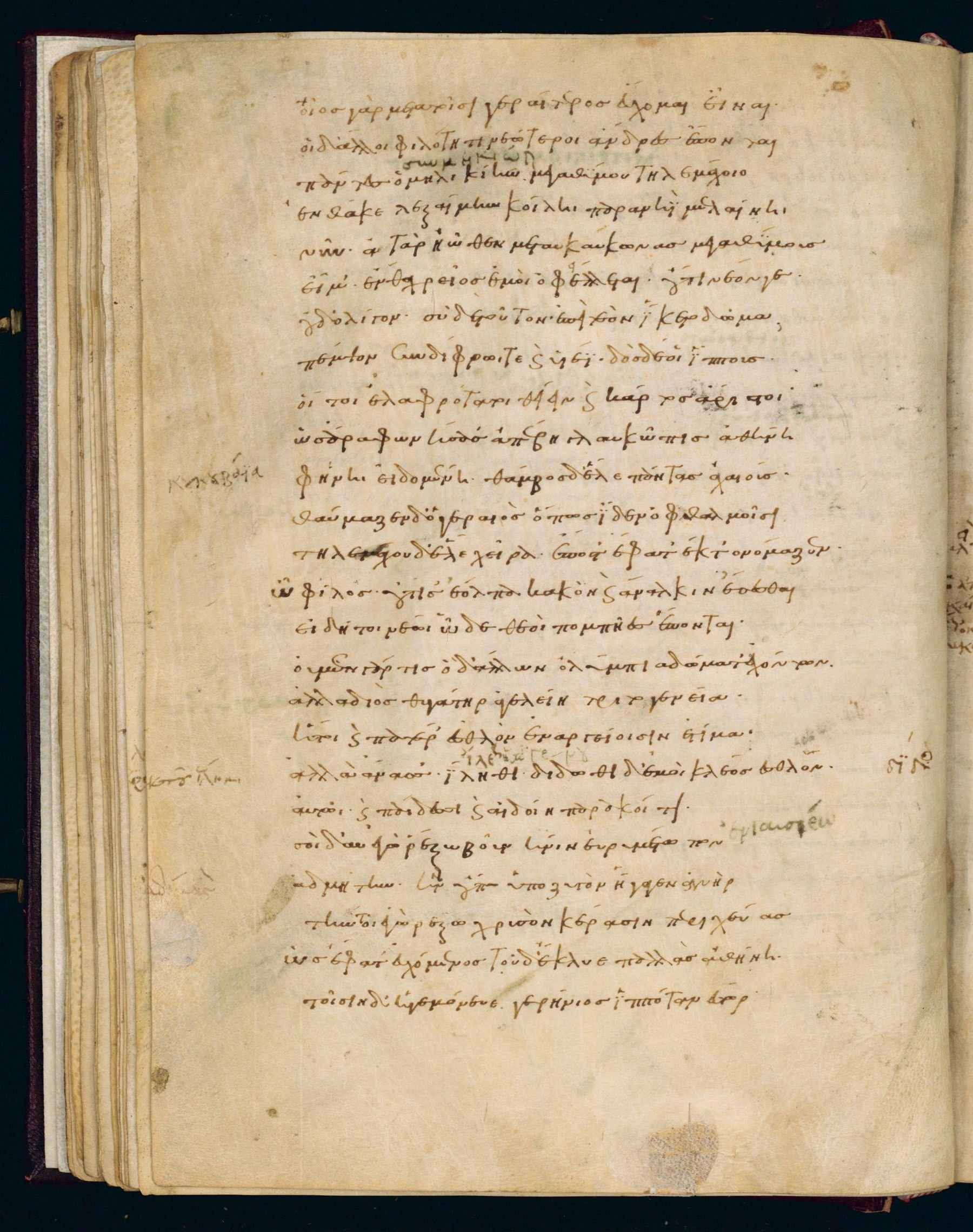
Where on the image
Laur. Plut. 32.24, fol. 26v: Odyssey 3.362-386, begins ‹οἶος γὰρ μετὰ τοῖσι›, ends ‹ἡγεμόνευε Γερήνιος ἱππότα Νέστωρ,›. Checked on the image: first and last lines read and matched to the Greek. Fol. 26r ends with 3.361. Fol. 27r begins with 3.387. English blocks here: 360-364, 365-369, 370-370, 371-374, 375-379, 380-384.
362οἶος γὰρ μετὰ τοῖσι γεραίτερος εὔχομαι εἶναι·
363οἱ δʼ ἄλλοι φιλότητι νεώτεροι ἄνδρες ἕπονται,
364πάντες ὁμηλικίη μεγαθύμου Τηλεμάχοιο.
365ἔνθα κε λεξαίμην κοίλῃ παρὰ νηὶ μελαίνῃ
366νῦν· ἀτὰρ ἠῶθεν μετὰ Καύκωνας μεγαθύμους
367εἶμʼ ἔνθα χρεῖός μοι ὀφέλλεται, οὔ τι νέον γε
368οὐδʼ ὀλίγον. σὺ δὲ τοῦτον, ἐπεὶ τεὸν ἵκετο δῶμα,
369πέμψον σὺν δίφρῳ τε καὶ υἱέι· δὸς δέ οἱ ἵππους,
370οἵ τοι ἐλαφρότατοι θείειν καὶ κάρτος ἄριστοι.
371ὣς ἄρα φωνήσασʼ ἀπέβη γλαυκῶπις Ἀθήνη
372φήνῃ εἰδομένη· θάμβος δʼ ἕλε πάντας ἰδόντας.
373θαύμαζεν δʼ ὁ γεραιός, ὅπως ἴδεν ὀφθαλμοῖσι·
374Τηλεμάχου δʼ ἕλε χεῖρα, ἔπος τʼ ἔφατʼ ἔκ τʼ ὀνόμαζεν·
375ὦ φίλος, οὔ σε ἔολπα κακὸν καὶ ἄναλκιν ἔσεσθαι,
376εἰ δή τοι νέῳ ὧδε θεοὶ πομπῆες ἕπονται.
377οὐ μὲν γάρ τις ὅδʼ ἄλλος Ὀλύμπια δώματʼ ἐχόντων,
378ἀλλὰ Διὸς θυγάτηρ, κυδίστη Τριτογένεια,
379ἥ τοι καὶ πατέρʼ ἐσθλὸν ἐν Ἀργείοισιν ἐτίμα.
380ἀλλὰ ἄνασσʼ ἵληθι, δίδωθι δέ μοι κλέος ἐσθλόν,
381αὐτῷ καὶ παίδεσσι καὶ αἰδοίῃ παρακοίτι·
382σοὶ δʼ αὖ ἐγὼ ῥέξω βοῦν ἦνιν εὐρυμέτωπον
383ἀδμήτην, ἣν οὔ πω ὑπὸ ζυγὸν ἤγαγεν ἀνήρ·
384τήν τοι ἐγὼ ῥέξω χρυσὸν κέρασιν περιχεύας.
385ὣς ἔφατʼ εὐχόμενος, τοῦ δʼ ἔκλυε Παλλὰς Ἀθήνη.
386τοῖσιν δʼ ἡγεμόνευε Γερήνιος ἱππότα Νέστωρ,
360in thy halls, I for my part will go to the black ship, that I may hearten my comrades and tell them all. For alone among them I declare that I am an older man; the others are younger who follow in friendship, all of them of like age with great-hearted Telemachus. 365There will I lay me down by the hollow black ship this night, but in the morning I will go to the great-hearted Cauconians, where a debt is owing to me, in no wise new or small. But do thou send this man on his way with a chariot and with thy son, since he has come to thy house, and give him horses, 370the fleetest thou host in running and the best in strength.” 371So spoke the goddess, flashing-eyed Athena, and she departed in the likeness of a sea-eagle; and amazement fell upon all at the sight, and the old man marvelled, when his eyes beheld it. And he grasped the hand of Telemachus, and spoke, and addressed him: 375“Friend, in no wise do I think that thou wilt prove a base man or a craven, if verily when thou art so young the gods follow thee to be thy guides. For truly this is none other of those that have their dwellings on Olympus but the daughter of Zeus, Tritogeneia, the maid most glorious, she that honored also thy noble father among the Argives. 380Nay, O Queen, be gracious, and grant to me fair renown, to me and to my sons and to my revered wife; and to thee in return will I sacrifice a sleek heifer, broad of brow, unbroken, which no man hath yet led beneath the yoke. Her will I sacrifice, and I will overlay her horns with gold.”
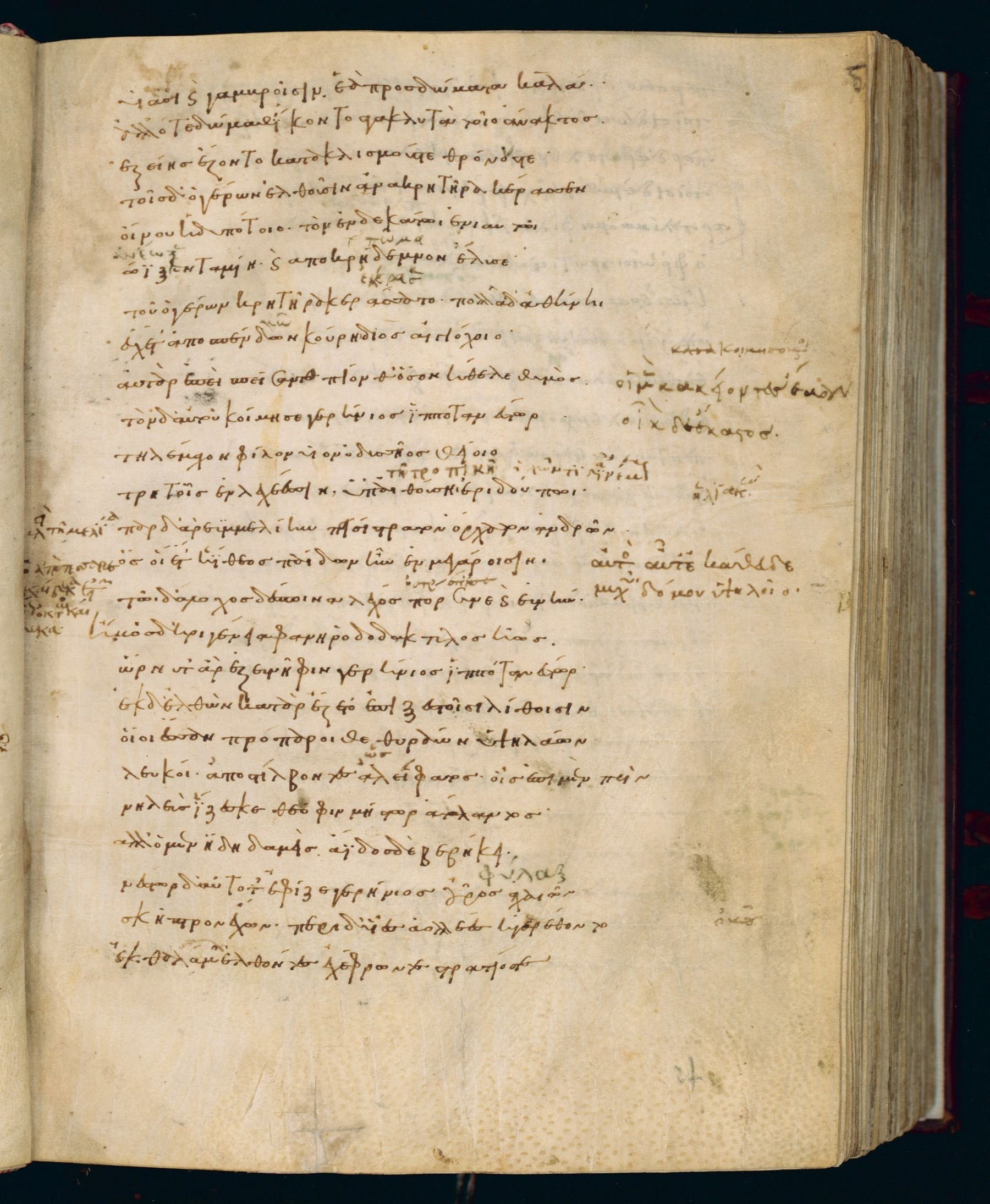
Where on the image
Laur. Plut. 32.24, fol. 27r: Odyssey 3.387-413, begins ‹υἱάσι καὶ γαμβροῖσιν, ἑὰ›, ends ‹Ἐχέφρων τε Στρατίος τε›. Checked on the image: first and last lines read and matched to the Greek. Fol. 26v ends with 3.386. Fol. 27v begins with 3.414. 3.396 and 3.402 are not in the text column; each is written in the right margin, beside 3.395 and 3.401 (the column has 25 lines). English blocks here: 385-389, 390-394, 395-399, 400-403, 404-404, 405-409, 410-414.
387υἱάσι καὶ γαμβροῖσιν, ἑὰ πρὸς δώματα καλά.
388ἀλλʼ ὅτε δώμαθʼ ἵκοντο ἀγακλυτὰ τοῖο ἄνακτος,
389ἑξείης ἕζοντο κατὰ κλισμούς τε θρόνους τε·
390τοῖς δʼ ὁ γέρων ἐλθοῦσιν ἀνὰ κρητῆρα κέρασσεν
391οἴνου ἡδυπότοιο, τὸν ἑνδεκάτῳ ἐνιαυτῷ
392ὤιξεν ταμίη καὶ ἀπὸ κρήδεμνον ἔλυσε·
393τοῦ ὁ γέρων κρητῆρα κεράσσατο, πολλὰ δʼ Ἀθήνῃ
394εὔχετʼ ἀποσπένδων, κούρῃ Διὸς αἰγιόχοιο.
395αὐτὰρ ἐπεὶ σπεῖσάν τʼ ἔπιον θʼ, ὅσον ἤθελε θυμός,
396οἱ μὲν κακκείοντες ἔβαν οἶκόνδε ἕκαστος,
397τὸν δʼ αὐτοῦ κοίμησε Γερήνιος ἱππότα Νέστωρ,
398Τηλέμαχον, φίλον υἱὸν Ὀδυσσῆος θείοιο,
399τρητοῖς ἐν λεχέεσσιν ὑπʼ αἰθούσῃ ἐριδούπῳ,
400πὰρʼ δʼ ἄρʼ ἐυμμελίην Πεισίστρατον, ὄρχαμον ἀνδρῶν,
401ὅς οἱ ἔτʼ ἠίθεος παίδων ἦν ἐν μεγάροισιν·
402αὐτὸς δʼ αὖτε καθεῦδε μυχῷ δόμου ὑψηλοῖο,
403τῷ δʼ ἄλοχος δέσποινα λέχος πόρσυνε καὶ εὐνήν.
404ἦμος δʼ ἠριγένεια φάνη ῥοδοδάκτυλος Ἠώς,
405ὤρνυτʼ ἄρʼ ἐξ εὐνῆφι Γερήνιος ἱππότα Νέστωρ,
406ἐκ δʼ ἐλθὼν κατʼ ἄρʼ ἕζετʼ ἐπὶ ξεστοῖσι λίθοισιν,
407οἵ οἱ ἔσαν προπάροιθε θυράων ὑψηλάων,
408λευκοί, ἀποστίλβοντες ἀλείφατος· οἷς ἔπι μὲν πρὶν
409Νηλεὺς ἵζεσκεν, θεόφιν μήστωρ ἀτάλαντος·
410ἀλλʼ ὁ μὲν ἤδη κηρὶ δαμεὶς Ἄϊδόσδε βεβήκει,
411Νέστωρ αὖ τότʼ ἐφῖζε Γερήνιος, οὖρος Ἀχαιῶν,
412σκῆπτρον ἔχων. περὶ δʼ υἷες ἀολλέες ἠγερέθοντο
413ἐκ θαλάμων ἐλθόντες, Ἐχέφρων τε Στρατίος τε
385So he spoke in prayer, and Pallas Athena heard him. Then the horseman, Nestor of Gerenia, led them, his sons and the husbands of his daughters, to his beautiful palace. And when they reached the glorious palace of the king, they sat down in rows on the chairs and high seats; 390and on their coming the old man mixed for them a bowl of sweet wine, which now in the eleventh year the housewife opened, when she had loosed the string that held the lid. Thereof the old man bade mix a bowl, and earnestly he prayed, as he poured libations, to Athena, the daughter of Zeus who bears the aegis. 395But when they had poured libations, and had drunk to their heart's content, they went, each to his home, to take their rest. But the horseman, Nestor of Gerenia, bade Telemachus, the dear son of divine Odysseus, to sleep there on a corded bedstead under the echoing portico, 400and by him Peisistratus, of the good ashen spear, a leader of men, who among his sons was still unwed in the palace. But he himself slept in the inmost chamber of the lofty house, and beside him lay the lady his wife, who had strewn the couch. 404Soon as early Dawn appeared, the rosy-fingered, 405up from his bed rose the horseman, Nestor of Gerenia, and went forth and sat down on the polished stones which were before his lofty doors, white and glistening as with oil. On these of old was wont to sit Neleus, the peer of the gods in counsel; 410but he ere this had been stricken by fate and had gone to the house of Hades, and now there sat upon them in his turn Nestor of Gerenia, the warder of the Achaeans, holding a sceptre in his hands. About him his sons gathered in a throng as they came forth from their chambers, Echephron and Stratius and Perseus and Aretus and godlike Thrasymedes;
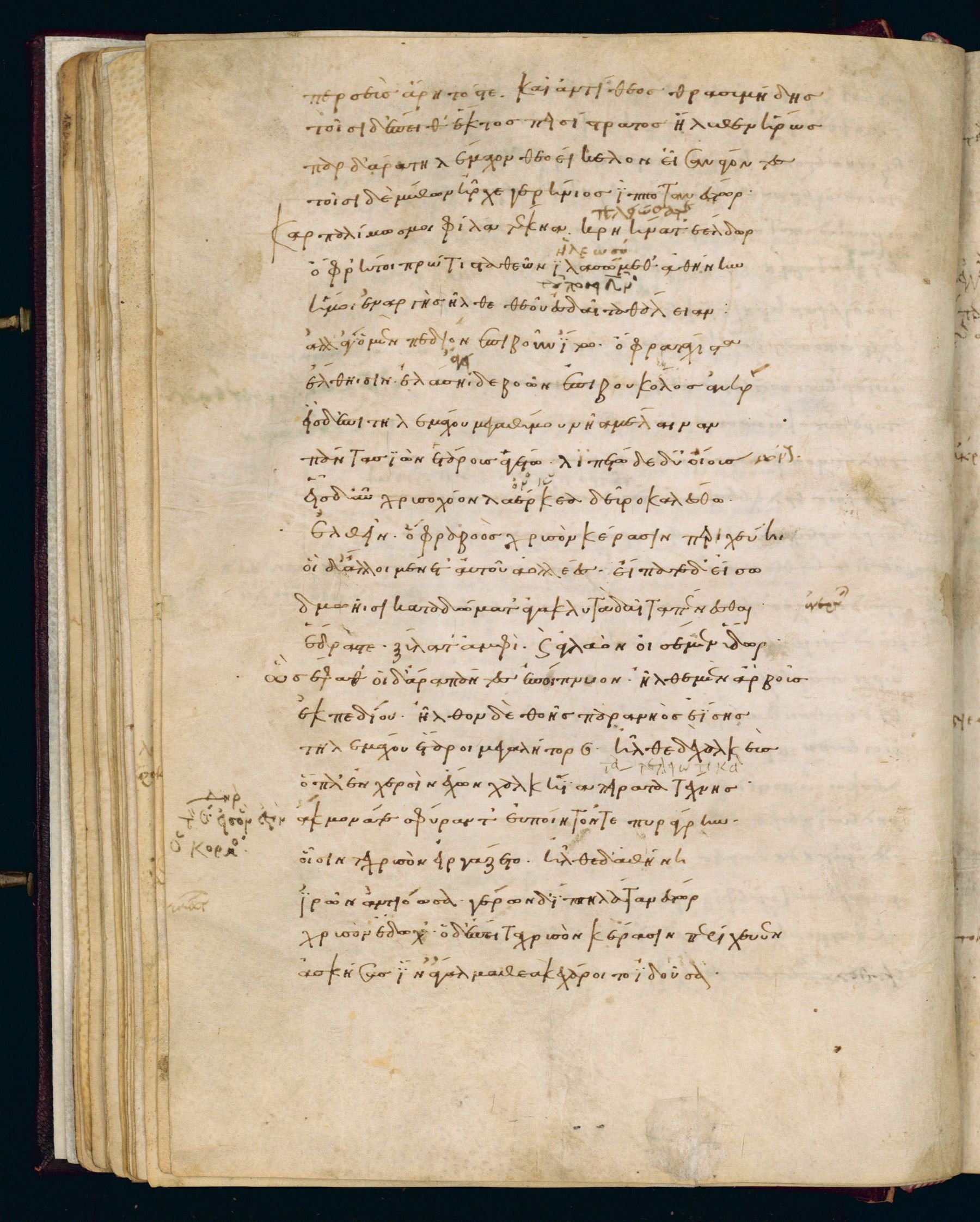
Where on the image
Laur. Plut. 32.24, fol. 27v: Odyssey 3.414-438, begins ‹Περσεύς τʼ Ἄρητός τε›, ends ‹ἄγαλμα θεὰ κεχάροιτο ἰδοῦσα.›. Checked on the image: first and last lines read and matched to the Greek. Fol. 27r ends with 3.413. Fol. 28r begins with 3.439. English blocks here: 415-419, 420-424, 425-429, 430-434, 435-439.
414Περσεύς τʼ Ἄρητός τε καὶ ἀντίθεος Θρασυμήδης.
415τοῖσι δʼ ἔπειθʼ ἕκτος Πεισίστρατος ἤλυθεν ἥρως,
416πὰρ δʼ ἄρα Τηλέμαχον θεοείκελον εἷσαν ἄγοντες.
417τοῖσι δὲ μύθων ἦρχε Γερήνιος ἱππότα Νέστωρ·
418καρπαλίμως μοι, τέκνα φίλα, κρηήνατʼ ἐέλδωρ,
419ὄφρʼ ἦ τοι πρώτιστα θεῶν ἱλάσσομʼ Ἀθήνην,
420ἥ μοι ἐναργὴς ἦλθε θεοῦ ἐς δαῖτα θάλειαν.
421ἀλλʼ ἄγʼ ὁ μὲν πεδίονδʼ ἐπὶ βοῦν, ἴτω, ὄφρα τάχιστα
422ἔλθῃσιν, ἐλάσῃ δὲ βοῶν ἐπιβουκόλος ἀνήρ·
423εἷς δʼ ἐπὶ Τηλεμάχου μεγαθύμου νῆα μέλαιναν
424πάντας ἰὼν ἑτάρους ἀγέτω, λιπέτω δὲ δύʼ οἴους·
425εἷς δʼ αὖ χρυσοχόον Λαέρκεα δεῦρο κελέσθω
426ἐλθεῖν, ὄφρα βοὸς χρυσὸν κέρασιν περιχεύῃ.
427οἱ δʼ ἄλλοι μένετʼ αὐτοῦ ἀολλέες, εἴπατε δʼ εἴσω
428δμῳῇσιν κατὰ δώματʼ ἀγακλυτὰ δαῖτα πένεσθαι,
429ἕδρας τε ξύλα τʼ ἀμφὶ καὶ ἀγλαὸν οἰσέμεν ὕδωρ.
430ὣς ἔφαθʼ, οἱ δʼ ἄρα πάντες ἐποίπνυον. ἦλθε μὲν ἂρ βοῦς
431ἐκ πεδίου, ἦλθον δὲ θοῆς παρὰ νηὸς ἐίσης
432Τηλεμάχου ἕταροι μεγαλήτορος, ἦλθε δὲ χαλκεὺς
433ὅπλʼ ἐν χερσὶν ἔχων χαλκήια, πείρατα τέχνης,
434ἄκμονά τε σφῦράν τʼ ἐυποίητόν τε πυράγρην,
435οἷσίν τε χρυσὸν εἰργάζετο· ἦλθε δʼ Ἀθήνη
436ἱρῶν ἀντιόωσα. γέρων δʼ ἱππηλάτα Νέστωρ
437χρυσὸν ἔδωχʼ· ὁ δʼ ἔπειτα βοὸς κέρασιν περίχευεν
438ἀσκήσας, ἵνʼ ἄγαλμα θεὰ κεχάροιτο ἰδοῦσα.
415and to these thereafter came as the sixth the lord Peisistratus. And they led godlike Telemachus and made him sit beside them; and the horseman, Nestor of Gerenia, was first to speak among them: “Quickly, my dear children, fulfil my desire, that first of all the gods I may propitiate Athena, 420who came to me in manifest presence to the rich feast of the god. Come now, let one go to the plain for a heifer, that she may come speedily, and that the neatherd may drive her; and let one go to the black ship of great-hearted Telemachus and bring all his comrades, and let him leave two men only; 425and let one again bid the goldsmith Laerces come hither, that he may overlay the heifer's horns with gold. And do ye others abide here together; and bid the handmaids within to make ready a feast throughout our glorious halls, to fetch seats, and logs to set on either side of the altar, and to bring clear water.” 430So he spoke, and they all set busily to work. The heifer came from the plain and from the swift, shapely ship came the comrades of great-hearted Telemachus; the smith came, bearing in his hands his tools of bronze, the implements of his craft, anvil and hammer and well-made tongs, 435wherewith he wrought the gold; and Athena came to accept the sacrifice. Then the old man, Nestor, the driver of chariots, gave gold, and the smith prepared it, and overlaid therewith the horns of the heifer, that the goddess might rejoice when she beheld the offering. And Stratius and goodly Echephron led the heifer by the horns,
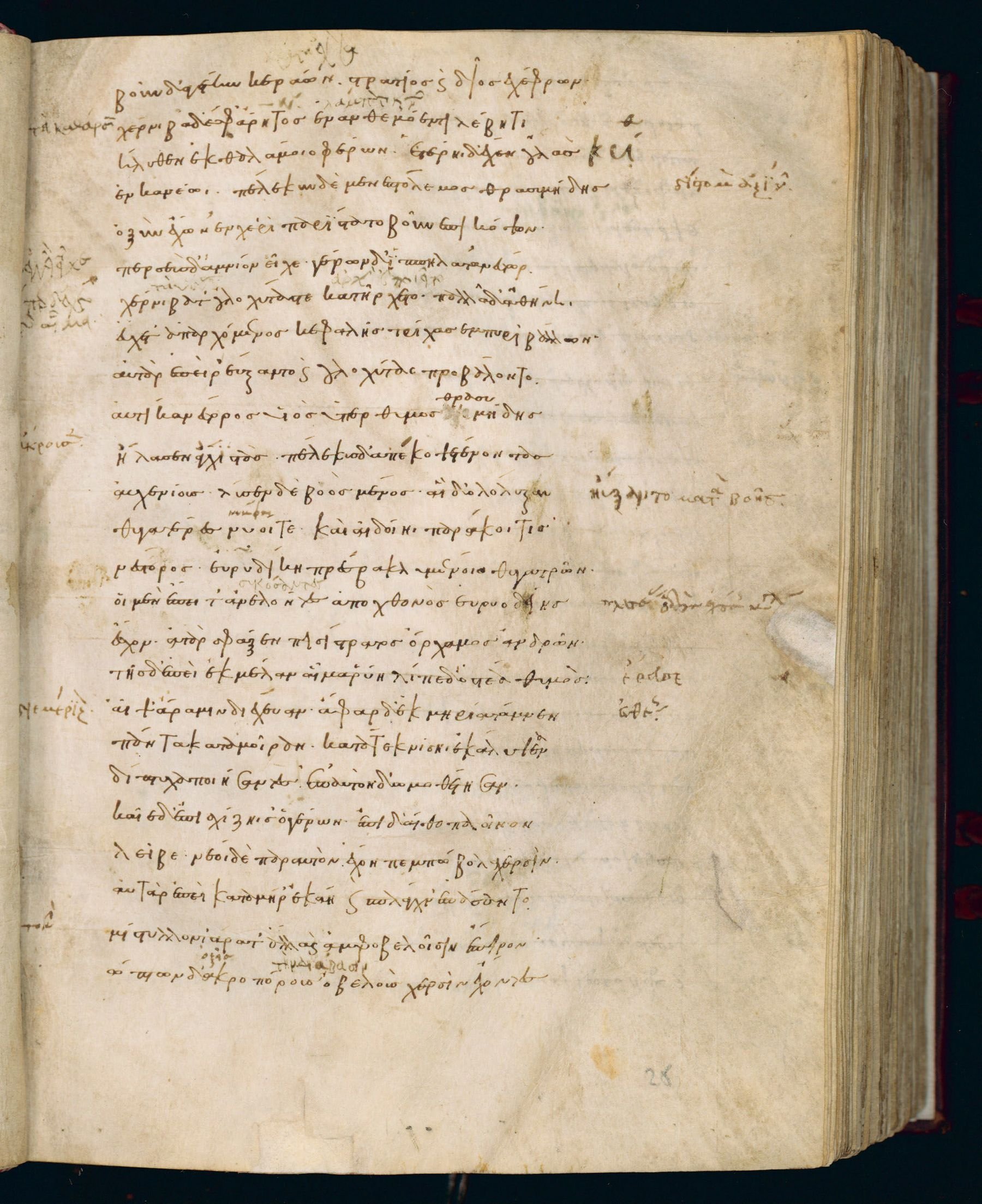
Where on the image
Laur. Plut. 32.24, fol. 28r: Odyssey 3.439-463, begins ‹βοῦν δʼ ἀγέτην κεράων›, ends ‹ὀβελοὺς ἐν χερσὶν ἔχοντες.›. Checked on the image: first and last lines read and matched to the Greek. Fol. 27v ends with 3.438. Fol. 28v begins with 3.464. English blocks here: 440-444, 445-446, 447-449, 450-454, 455-459, 460-464.
439βοῦν δʼ ἀγέτην κεράων Στρατίος καὶ δῖος Ἐχέφρων.
440χέρνιβα δέ σφʼ Ἄρητος ἐν ἀνθεμόεντι λέβητι
441ἤλυθεν ἐκ θαλάμοιο φέρων, ἑτέρῃ δʼ ἔχεν οὐλὰς
442ἐν κανέῳ πέλεκυν δὲ μενεπτόλεμος Θρασυμήδης
443ὀξὺν ἔχων ἐν χειρὶ παρίστατο βοῦν ἐπικόψων.
444Περσεὺς δʼ ἀμνίον εἶχε· γέρων δʼ ἱππηλάτα Νέστωρ
445χέρνιβά τʼ οὐλοχύτας τε κατήρχετο, πολλὰ δʼ Ἀθήνῃ
446εὔχετʼ ἀπαρχόμενος, κεφαλῆς τρίχας ἐν πυρὶ βάλλων.
447αὐτὰρ ἐπεί ῥʼ εὔξαντο καὶ οὐλοχύτας προβάλοντο,
448αὐτίκα Νέστορος υἱὸς ὑπέρθυμος Θρασυμήδης
449ἤλασεν ἄγχι στάς· πέλεκυς δʼ ἀπέκοψε τένοντας
450αὐχενίους, λῦσεν δὲ βοὸς μένος. αἱ δʼ ὀλόλυξαν
451θυγατέρες τε νυοί τε καὶ αἰδοίη παράκοιτις
452Νέστορος, Εὐρυδίκη, πρέσβα Κλυμένοιο θυγατρῶν.
453οἱ μὲν ἔπειτʼ ἀνελόντες ἀπὸ χθονὸς εὐρυοδείης
454ἔσχον· ἀτὰρ σφάξεν Πεισίστρατος, ὄρχαμος ἀνδρῶν.
455τῆς δʼ ἐπεὶ ἐκ μέλαν αἷμα ῥύη, λίπε δʼ ὀστέα θυμός,
456αἶψʼ ἄρα μιν διέχευαν, ἄφαρ δʼ ἐκ μηρία τάμνον
457πάντα κατὰ μοῖραν, κατά τε κνίσῃ ἐκάλυψαν
458δίπτυχα ποιήσαντες, ἐπʼ αὐτῶν δʼ ὠμοθέτησαν.
459καῖε δʼ ἐπὶ σχίζῃς ὁ γέρων, ἐπὶ δʼ αἴθοπα οἶνον
460λεῖβε· νέοι δὲ παρʼ αὐτὸν ἔχον πεμπώβολα χερσίν.
461αὐτὰρ ἐπεὶ κατὰ μῆρʼ ἐκάη καὶ σπλάγχνα πάσαντο,
462μίστυλλόν τʼ ἄρα τἆλλα καὶ ἀμφʼ ὀβελοῖσιν ἔπειραν,
463ὤπτων δʼ ἀκροπόρους ὀβελοὺς ἐν χερσὶν ἔχοντες.
440and Aretus came from the chamber, bringing them water for the hands in a basin embossed with flowers, and in the other hand he held barley grains in a basket; and Thrasymedes, steadfast in fight, stood by, holding in his hands a sharp axe, to fell the heifer; and Perseus held the bowl for the blood. Then the old man, Nestor, driver of chariots, 445began the opening rite of hand-washing and sprinkling with barley grains, and earnestly he prayed to Athena, cutting off as first offering the hair from the head, and casting it into the fire. 447Now when they had prayed, and had strewn the barley grains, straightway the son of Nestor, Thrasymedes, high of heart, came near and dealt the blow; and the axe cut through the sinews 450of the neck, and loosened the strength of the heifer. Then the women raised the sacred cry, the daughters and the sons' wives and the revered wife of Nestor, Eurydice, the eldest of the daughters of Clymenus, and the men raised the heifer's head from the broad-wayed earth and held it, and Peisistratus, leader of men, cut the throat. 455And when the black blood had flowed from her and the life had left the bones, at once they cut up the body and straightway cut out the thigh-pieces all in due order, and covered them with a double layer of fat, and laid raw flesh upon them. Then the old man burned them on billets of wood, and poured over them sparkling wine, 460and beside him the young men held in their hands the five-pronged forks. But when the thigh-pieces were wholly burned, and they had tasted the inner parts, they cut up the rest and spitted and roasted it, holding the pointed spits in their hands. Meanwhile the fair Polycaste,
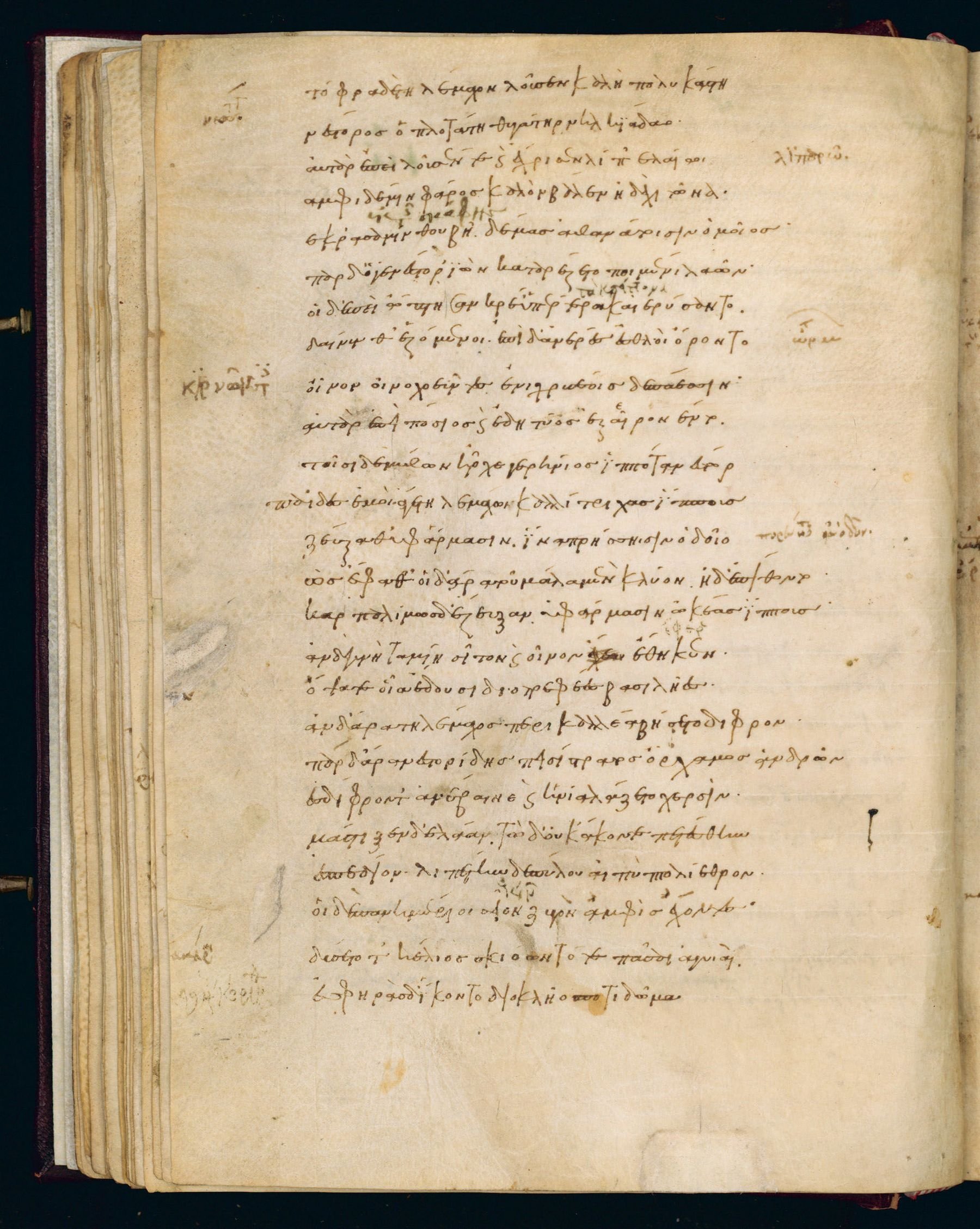
Where on the image
Laur. Plut. 32.24, fol. 28v: Odyssey 3.464-488, begins ‹τόφρα δὲ Τηλέμαχον λοῦσεν›, ends ‹ἵκοντο Διοκλῆος ποτὶ δῶμα,›. Checked on the image: first and last lines read and matched to the Greek. Fol. 28r ends with 3.463. Fol. 29r begins with 3.489. English blocks here: 465-469, 470-474, 475-479, 480-484, 485-489.
464τόφρα δὲ Τηλέμαχον λοῦσεν καλὴ Πολυκάστη,
465Νέστορος ὁπλοτάτη θυγάτηρ Νηληϊάδαο.
466αὐτὰρ ἐπεὶ λοῦσέν τε καὶ ἔχρισεν λίπʼ ἐλαίῳ,
467ἀμφὶ δέ μιν φᾶρος καλὸν βάλεν ἠδὲ χιτῶνα,
468ἔκ ῥʼ ἀσαμίνθου βῆ δέμας ἀθανάτοισιν ὁμοῖος·
469πὰρ δʼ ὅ γε Νέστορʼ ἰὼν κατʼ ἄρʼ ἕζετο, ποιμένα λαῶν.
470οἱ δʼ ἐπεὶ ὤπτησαν κρέʼ ὑπέρτερα καὶ ἐρύσαντο,
471δαίνυνθʼ ἑζόμενοι· ἐπὶ δʼ ἀνέρες ἐσθλοὶ ὄροντο
472οἶνον οἰνοχοεῦντες ἐνὶ χρυσέοις δεπάεσσιν.
473αὐτὰρ ἐπεὶ πόσιος καὶ ἐδητύος ἐξ ἔρον ἕντο,
474τοῖσι δὲ μύθων ἦρχε Γερήνιος ἱππότα Νέστωρ·
475παῖδες ἐμοί, ἄγε Τηλεμάχῳ καλλίτριχας ἵππους
476ζεύξαθʼ ὑφʼ ἅρματʼ ἄγοντες, ἵνα πρήσσῃσιν ὁδοῖο.
477ὣς ἔφαθʼ, οἱ δʼ ἄρα τοῦ μάλα μὲν κλύον ἠδʼ ἐπίθοντο,
478καρπαλίμως δʼ ἔζευξαν ὑφʼ ἅρμασιν ὠκέας ἵππους.
479ἐν δὲ γυνὴ ταμίη σῖτον καὶ οἶνον ἔθηκεν
480ὄψα τε, οἷα ἔδουσι διοτρεφέες βασιλῆες.
481ἂν δʼ ἄρα Τηλέμαχος περικαλλέα βήσετο δίφρον·
482πὰρ δʼ ἄρα Νεστορίδης Πεισίστρατος, ὄρχαμος ἀνδρῶν,
483ἐς δίφρον τʼ ἀνέβαινε καὶ ἡνία λάζετο χερσί,
484μάστιξεν δʼ ἐλάαν, τὼ δʼ οὐκ ἀέκοντε πετέσθην
485ἐς πεδίον, λιπέτην δὲ Πύλου αἰπὺ πτολίεθρον.
486οἱ δὲ πανημέριοι σεῖον ζυγὸν ἀμφὶς ἔχοντες.
487δύσετό τʼ ἠέλιος σκιόωντό τε πᾶσαι ἀγυιαί,
488ἐς Φηρὰς δʼ ἵκοντο Διοκλῆος ποτὶ δῶμα,
465the youngest daughter of Nestor, son of Neleus, bathed Telemachus. And when she had bathed him and anointed him richly with oil, and had cast about him a fair cloak and a tunic, forth from the bath he came in form like unto the immortals; and he went and sat down by Nestor, the shepherd of the people. 470Now when they had roasted the outer flesh and had drawn it off the spits, they sat down and feasted, and worthy men waited on them, pouring wine into golden cups. But when they had put from them the desire of food and drink, the horseman, Nestor of Gerenia, was first to speak, saying: 475“My sons, up, yoke for Telemachus horses with beautiful mane beneath the car, that he may get forward on his journey.” So he spoke, and they readily hearkened and obeyed; and quickly they yoked beneath the car the swift horses. And the housewife placed in the car bread and wine 480and dainties, such as kings, fostered of Zeus, are wont to eat. Then Telemachus mounted the beautiful car, and Peisistratus, son of Nestor, a leader of men, mounted beside him, and took the reins in his hands. He touched the horses with the whip to start them, and nothing loath the pair sped on 485to the plain, and left the steep citadel of Pylos. So all day long they shook the yoke which they bore about their necks. Now the sun set and all the ways grew dark. And they came to Pherae, to the house of Diocles, son of Ortilochus, whom Alpheus begot.
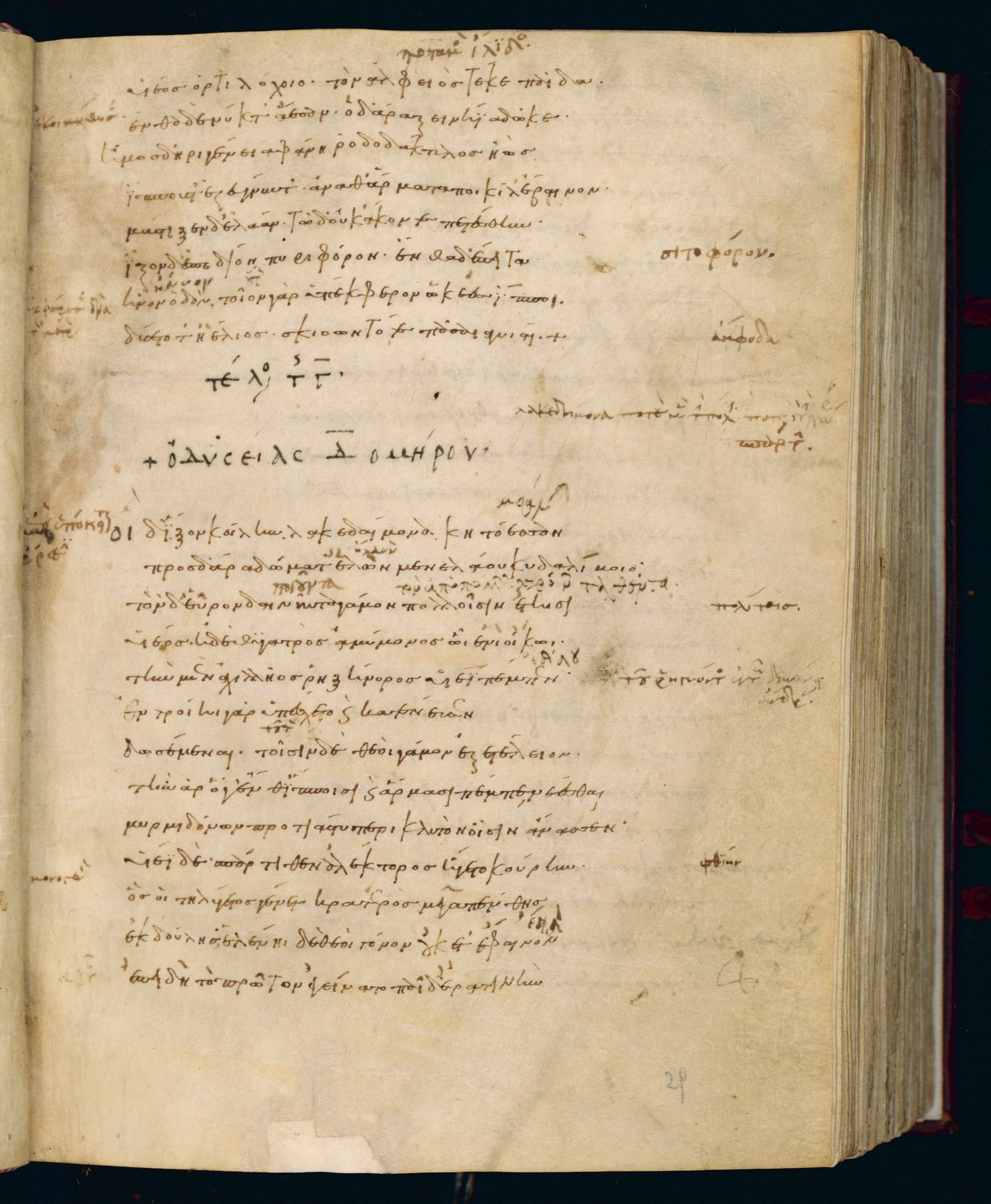
Where on the image
Laur. Plut. 32.24, fol. 29r: Odyssey 3.489-497, begins ‹υἱέος Ὀρτιλόχοιο, τὸν Ἀλφειὸς›, ends ‹σκιόωντό τε πᾶσαι ἀγυιαί.›. Checked on the image: first and last lines read and matched to the Greek. Fol. 28v ends with 3.488. The page holds 3.489-497, 4.1-13. Book 3 ends with 3.497, followed by the subscription τέλος τοῦ γ; a heading + ὀδυσσείας δ ὁμήρου follows and book 4 begins with an enlarged initial. 3.493 (ἐκ δʼ ἔλασαν προθύροιο ...) is not on the page: the scribe passes from 3.492 to 3.494. English blocks here: 490-494, 495-497.
489υἱέος Ὀρτιλόχοιο, τὸν Ἀλφειὸς τέκε παῖδα.
490ἔνθα δὲ νύκτʼ ἄεσαν, ὁ δὲ τοῖς πὰρ ξείνια θῆκεν.
491ἦμος δʼ ἠριγένεια φάνη ῥοδοδάκτυλος Ἠώς,
492ἵππους τε ζεύγνυντʼ ἀνά θʼ ἅρματα ποικίλʼ ἔβαινον·
493ἐκ δʼ ἔλασαν προθύροιο καὶ αἰθούσης ἐριδούπου·
494μάστιξεν δʼ ἐλάαν, τὼ δʼ οὐκ ἀέκοντε πετέσθην.
495ἷξον δʼ ἐς πεδίον πυρηφόρον, ἔνθα δʼ ἔπειτα
496ἦνον ὁδόν· τοῖον γὰρ ὑπέκφερον ὠκέες ἵπποι.
497δύσετό τʼ ἠέλιος σκιόωντό τε πᾶσαι ἀγυιαί.
490There they spent the night, and before them he set the entertainment due to strangers. So soon as early Dawn appeared, the rosy-fingered, they yoked the horses and mounted the inlaid car, and drove forth from the gateway and the echoing portico. Then Peisistratus touched the horses with the whip to start them, and nothing loath the pair sped onward. 495So they came to the wheat-bearing plain, and thereafter pressed on toward their journey's end, so well did their swift horses bear them on. And the sun set and all the ways grew dark.
Notes
- Greek: A. T. Murray, Homer: The Odyssey (Loeb Classical Library, 1919), via Perseus.
- English: A. T. Murray's translation in the same edition; his footnotes are omitted.
Cite
Sources
- Source: Laur. Plut. 32.24 (BML Teca Digitale IIIF) + Murray Greek (Loeb 1919, Perseus) + Murray English (Loeb 1919, Perseus) (holding institution)
- Critical edition: Murray, Loeb 1919, via Perseus
← previous · → next · v cycle view · l back to library