Homer, Odyssey, Book 4: Telemachus at Sparta
Introduction
The Odyssey, composed around 700 BCE and attributed to Homer, tells of Odysseus' ten-year journey home from Troy and his return to Ithaca. Book 4 (847 lines): Telemachus at Sparta.
The page photographs are from Florence, Biblioteca Medicea Laurenziana, Plut. 32.24 (parchment, 10th century, 234 folios; the oldest manuscript of the Odyssey with published images), in the Biblioteca Medicea Laurenziana's Teca Digitale. This book is on fol. 29r-45v; each section below is one page, with its first and last line as read on the photograph. Many pages carry interlinear glosses and a few marginal notes in later hands.
The Greek is A. T. Murray's Loeb text (1919) via Perseus, not a transcription of this manuscript, whose wording differs in places. The English is Murray's prose translation (1919), divided every five lines; at a page break a five-line block goes with the page holding most of it, except at the page breaks where a section's note says the English is cut at the end of Murray's sentence. Each section's note gives its English line range.
Where the scribe left out a line, wrote one in the margin, changed the order or added a line not in Murray's text, the section's note on the photograph says so; the Greek and English shown are Murray's full text for the page's range.
How was this verified? (Provenance)
Where on the image
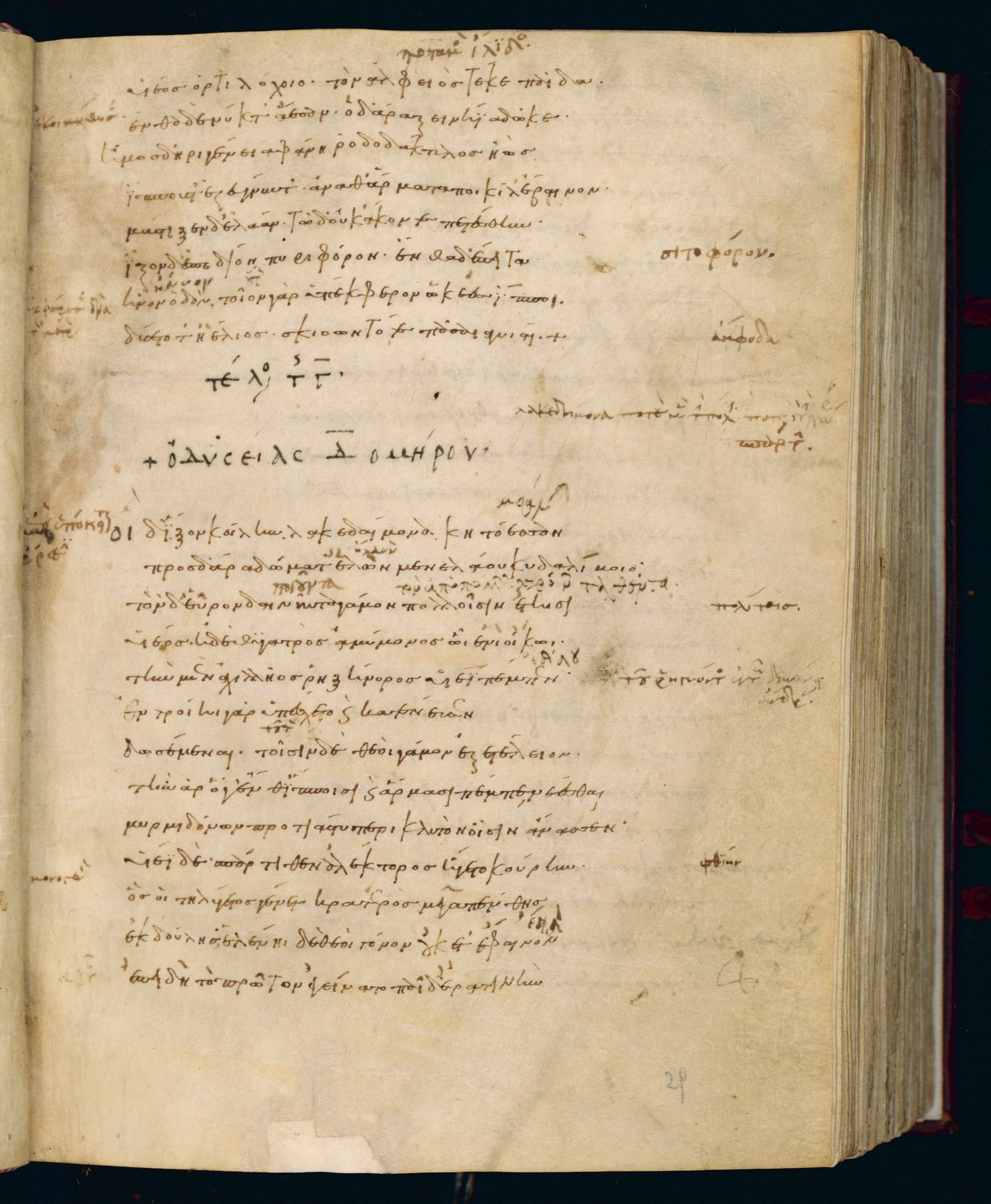
Laur. Plut. 32.24, fol. 29r: Odyssey 4.1-13, begins ‹οἱ δʼ ἷξον κοίλην›, ends ‹πρῶτον ἐγείνατο παῖδʼ ἐρατεινήν,›. Checked on the image: first and last lines read and matched to the Greek. Fol. 29v begins with 4.14. The page holds 3.489-497, 4.1-13. Book 3 ends with 3.497, followed by the subscription τέλος τοῦ γ; a heading + ὀδυσσείας δ ὁμήρου follows and book 4 begins with an enlarged initial. 3.493 (ἐκ δʼ ἔλασαν προθύροιο ...) is not on the page: the scribe passes from 3.492 to 3.494. English blocks here: 1-4, 5-9, 10-14.
1οἱ δʼ ἷξον κοίλην Λακεδαίμονα κητώεσσαν,
2πρὸς δʼ ἄρα δώματʼ ἔλων Μενελάου κυδαλίμοιο.
3τὸν δʼ εὗρον δαινύντα γάμον πολλοῖσιν ἔτῃσιν
4υἱέος ἠδὲ θυγατρὸς ἀμύμονος ᾧ ἐνὶ οἴκῳ.
5τὴν μὲν Ἀχιλλῆος ῥηξήνορος υἱέι πέμπεν·
6ἐν Τροίῃ γὰρ πρῶτον ὑπέσχετο καὶ κατένευσε
7δωσέμεναι, τοῖσιν δὲ θεοὶ γάμον ἐξετέλειον.
8τὴν ἄρʼ ὅ γʼ ἔνθʼ ἵπποισι καὶ ἅρμασι πέμπε νέεσθαι
9Μυρμιδόνων προτὶ ἄστυ περικλυτόν, οἷσιν ἄνασσεν.
10υἱέι δὲ Σπάρτηθεν Ἀλέκτορος ἤγετο κούρην,
11ὅς οἱ τηλύγετος γένετο κρατερὸς Μεγαπένθης
12ἐκ δούλης· Ἑλένῃ δὲ θεοὶ γόνον οὐκέτʼ ἔφαινον,
13ἐπεὶ δὴ τὸ πρῶτον ἐγείνατο παῖδʼ ἐρατεινήν,
1And they came to the hollow land of Lacedaemon with its many ravines, and drove to the palace of glorious Menelaus. Him they found giving a marriage feast to his many kinsfolk for his noble son and daughter within his house. 5His daughter he was sending to the son of Achilles, breaker of the ranks of men, for in the land of Troy he first had promised and pledged that he would give her, and now the gods were bringing their marriage to pass. Her then he was sending forth with horses and chariots to go her way to the glorious city of the Myrmidons, over whom her lord was king; 10but for his son he was bringing to his home from Sparta the daughter of Alector, even for the stalwart Megapenthes, who was his son well-beloved, born of a slave woman; for to Helen the gods vouchsafed issue no more after that she had at the first borne her lovely child, Hermione, who had the beauty of golden Aphrodite.
Where on the image
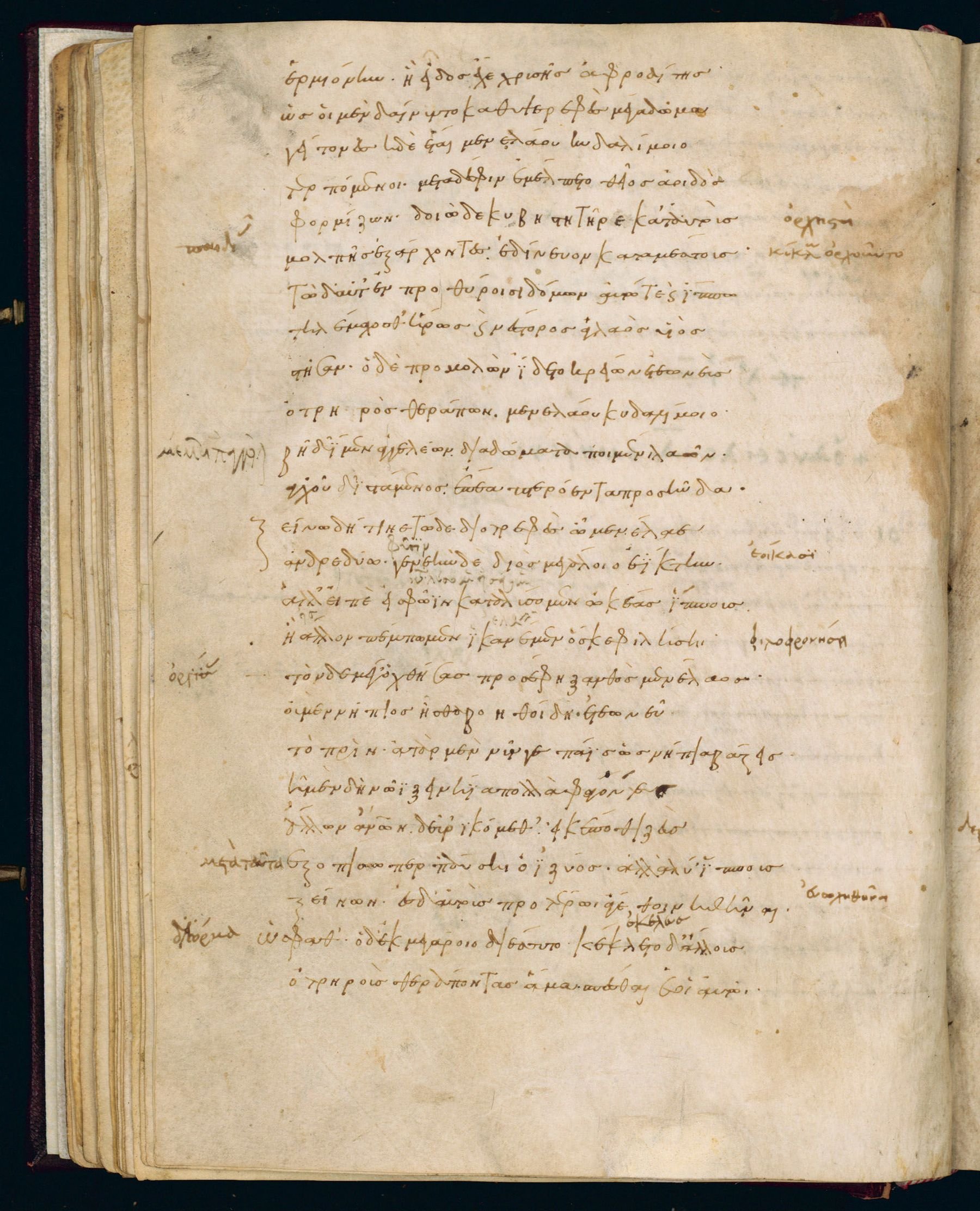
Laur. Plut. 32.24, fol. 29v: Odyssey 4.14-38, begins ‹Ἑρμιόνην, ἣ εἶδος ἔχε›, ends ‹ἅμα σπέσθαι ἑοῖ αὐτῷ.›. Checked on the image: first and last lines read and matched to the Greek. Fol. 29r ends with 4.13. Fol. 30r begins with 4.39. English blocks here: 15-19, 20-24, 25-29, 30-34, 35-39.
14Ἑρμιόνην, ἣ εἶδος ἔχε χρυσέης Ἀφροδίτης.
15ὣς οἱ μὲν δαίνυντο καθʼ ὑψερεφὲς μέγα δῶμα
16γείτονες ἠδὲ ἔται Μενελάου κυδαλίμοιο,
17τερπόμενοι· μετὰ δέ σφιν ἐμέλπετο θεῖος ἀοιδὸς
18φορμίζων, δοιὼ δὲ κυβιστητῆρε κατʼ αὐτούς,
19μολπῆς ἐξάρχοντος, ἐδίνευον κατὰ μέσσους.
20τὼ δʼ αὖτʼ ἐν προθύροισι δόμων αὐτώ τε καὶ ἵππω,
21Τηλέμαχός θʼ ἥρως καὶ Νέστορος ἀγλαὸς υἱός,
22στῆσαν· ὁ δὲ προμολὼν ἴδετο κρείων Ἐτεωνεύς,
23ὀτρηρὸς θεράπων Μενελάου κυδαλίμοιο,
24βῆ δʼ ἴμεν ἀγγελέων διὰ δώματα ποιμένι λαῶν,
25ἀγχοῦ δʼ ἱστάμενος ἔπεα πτερόεντα προσηύδα·
26ξείνω δή τινε τώδε, διοτρεφὲς ὦ Μενέλαε,
27ἄνδρε δύω, γενεῇ δὲ Διὸς μεγάλοιο ἔικτον.
28ἀλλʼ εἴπʼ, ἤ σφωιν καταλύσομεν ὠκέας ἵππους,
29ἦ ἄλλον πέμπωμεν ἱκανέμεν, ὅς κε φιλήσῃ.
30τὸν δὲ μέγʼ ὀχθήσας προσέφη ξανθὸς Μενέλαος·
31οὐ μὲν νήπιος ἦσθα, Βοηθοΐδη Ἐτεωνεῦ,
32τὸ πρίν· ἀτὰρ μὲν νῦν γε πάϊς ὣς νήπια βάζεις.
33ἦ μὲν δὴ νῶι ξεινήια πολλὰ φαγόντε
34ἄλλων ἀνθρώπων δεῦρʼ ἱκόμεθʼ, αἴ κέ ποθι Ζεὺς
35ἐξοπίσω περ παύσῃ ὀιζύος. ἀλλὰ λύʼ ἵππους
36ξείνων, ἐς δʼ αὐτοὺς προτέρω ἄγε θοινηθῆναι.
37ὣς φάθʼ, ὁ δὲ μεγάροιο διέσσυτο, κέκλετο δʼ ἄλλους
38ὀτρηροὺς θεράποντας ἅμα σπέσθαι ἑοῖ αὐτῷ.
15So they were feasting in the great high-roofed hall, the neighbors and kinsfolk of glorious Menelaus, and making merry; and among them a divine minstrel was singing to the lyre, and two tumblers whirled up and down through the midst of them, as he began his song. 20Then the two, the prince Telemachus and the glorious son of Nestor, halted at the gateway of the palace, they and their two horses. And the lord Eteoneus came forth and saw them, the busy squire of glorious Menelaus; and he went through the hall to bear the tidings to the shepherd of the people. 25So he came near and spoke to him winged words: “Here are two strangers, Menelaus, fostered of Zeus, two men that are like the seed of great Zeus. But tell me, shall we unyoke for them their swift horses, or send them on their way to some other host, who will give them entertainment?” 30Then, stirred to sore displeasure, fair-haired Menelaus spoke to him: “Aforetime thou was not wont to be a fool, Eteoneus, son of Boethous, but now like a child thou talkest folly. Surely we two ate full often hospitable cheer of other men, ere we came hither in the hope that Zeus 35would hereafter grant us respite from sorrow. Nay, unyoke the strangers' horses, and lead the men forward into the house, that they may feast.” So he spoke, and the other hastened through the hall, and called to the other busy squires to follow along with him. They loosed the sweating horses from beneath the yoke
Where on the image
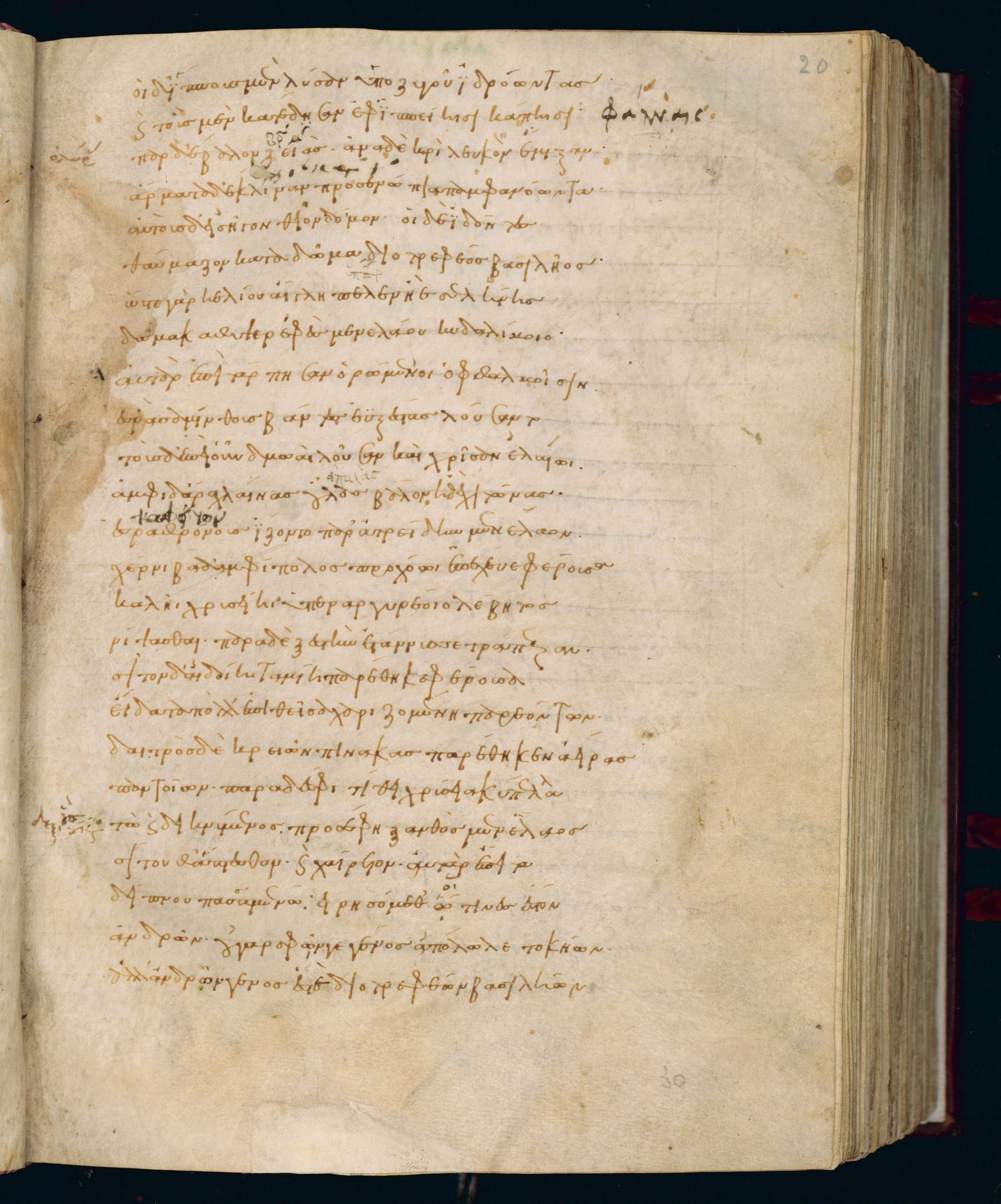
Laur. Plut. 32.24, fol. 30r: Odyssey 4.39-63, begins ‹οἱ δʼ ἵππους μὲν›, ends ‹γένος ἐστὲ διοτρεφέων βασιλήων›. Checked on the image: first and last lines read and matched to the Greek. Fol. 29v ends with 4.38. Fol. 30v begins with 4.64. English blocks here: 40-44, 45-48, 49-49, 50-54, 55-59, 60-64.
39οἱ δʼ ἵππους μὲν λῦσαν ὑπὸ ζυγοῦ ἱδρώοντας,
40καὶ τοὺς μὲν κατέδησαν ἐφʼ ἱππείῃσι κάπῃσι,
41πὰρ δʼ ἔβαλον ζειάς, ἀνὰ δὲ κρῖ λευκὸν ἔμιξαν,
42ἅρματα δʼ ἔκλιναν πρὸς ἐνώπια παμφανόωντα,
43αὐτοὺς δʼ εἰσῆγον θεῖον δόμον. οἱ δὲ ἰδόντες
44θαύμαζον κατὰ δῶμα διοτρεφέος βασιλῆος·
45ὥς τε γὰρ ἠελίου αἴγλη πέλεν ἠὲ σελήνης
46δῶμα καθʼ ὑψερεφὲς Μενελάου κυδαλίμοιο.
47αὐτὰρ ἐπεὶ τάρπησαν ὁρώμενοι ὀφθαλμοῖσιν,
48ἔς ῥʼ ἀσαμίνθους βάντες ἐυξέστας λούσαντο.
49τοὺς δʼ ἐπεὶ οὖν δμῳαὶ λοῦσαν καὶ χρῖσαν ἐλαίῳ,
50ἀμφὶ δʼ ἄρα χλαίνας οὔλας βάλον ἠδὲ χιτῶνας,
51ἔς ῥα θρόνους ἕζοντο παρʼ Ἀτρεΐδην Μενέλαον.
52χέρνιβα δʼ ἀμφίπολος προχόῳ ἐπέχευε φέρουσα
53καλῇ χρυσείῃ ὑπὲρ ἀργυρέοιο λέβητος,
54νίψασθαι· παρὰ δὲ ξεστὴν ἐτάνυσσε τράπεζαν.
55σῖτον δʼ αἰδοίη ταμίη παρέθηκε φέρουσα,
56εἴδατα πόλλʼ ἐπιθεῖσα, χαριζομένη παρεόντων.
57δαιτρὸς δὲ κρειῶν πίνακας παρέθηκεν ἀείρας
58παντοίων, παρὰ δέ σφι τίθει χρύσεια κύπελλα.
59τὼ καὶ δεικνύμενος προσέφη ξανθὸς Μενέλαος·
60σίτου θʼ ἅπτεσθον καὶ χαίρετον. αὐτὰρ ἔπειτα
61δείπνου πασσαμένω εἰρησόμεθʼ, οἵ τινές ἐστον
62ἀνδρῶν· οὐ γὰρ σφῷν γε γένος ἀπόλωλε τοκήων,
63ἀλλʼ ἀνδρῶν γένος ἐστὲ διοτρεφέων βασιλήων
40and tied them at the stalls of the horses, and flung before them spelt, and mixed therewith white barley. Then they tilted the chariot against the bright entrance walls, and led the men into the divine palace. But at the sight they marvelled as they passed through the palace of the king, fostered of Zeus; 45for there was a gleam as of sun or moon over the high-roofed house of glorious Menelaus. But when they had satisfied their eyes with gazing they went into the polished baths and bathed. 49And when the maids had bathed them and anointed them with oil, 50and had cast about them fleecy cloaks and tunics, they sat down on chairs beside Menelaus, son of Atreus. Then a handmaid brought water for the hands in a fair pitcher of gold, and poured it over a silver basin for them to wash, and beside them drew up a polished table. 55And the grave housewife brought and set before them bread, and therewith dainties in abundance, giving freely of her store. And a carver lifted up and placed before them platters of all manner of meats, and set by them golden goblets. Then fair-haired Menelaus greeted the two and said: 60“Take of the food, and be glad, and then when you have supped, we will ask you who among men you are; for in you two the breed of your sires is not lost, but ye are of the breed of men that are sceptred kings, fostered of Zeus; for base churls could not beget such sons as you.”
Where on the image
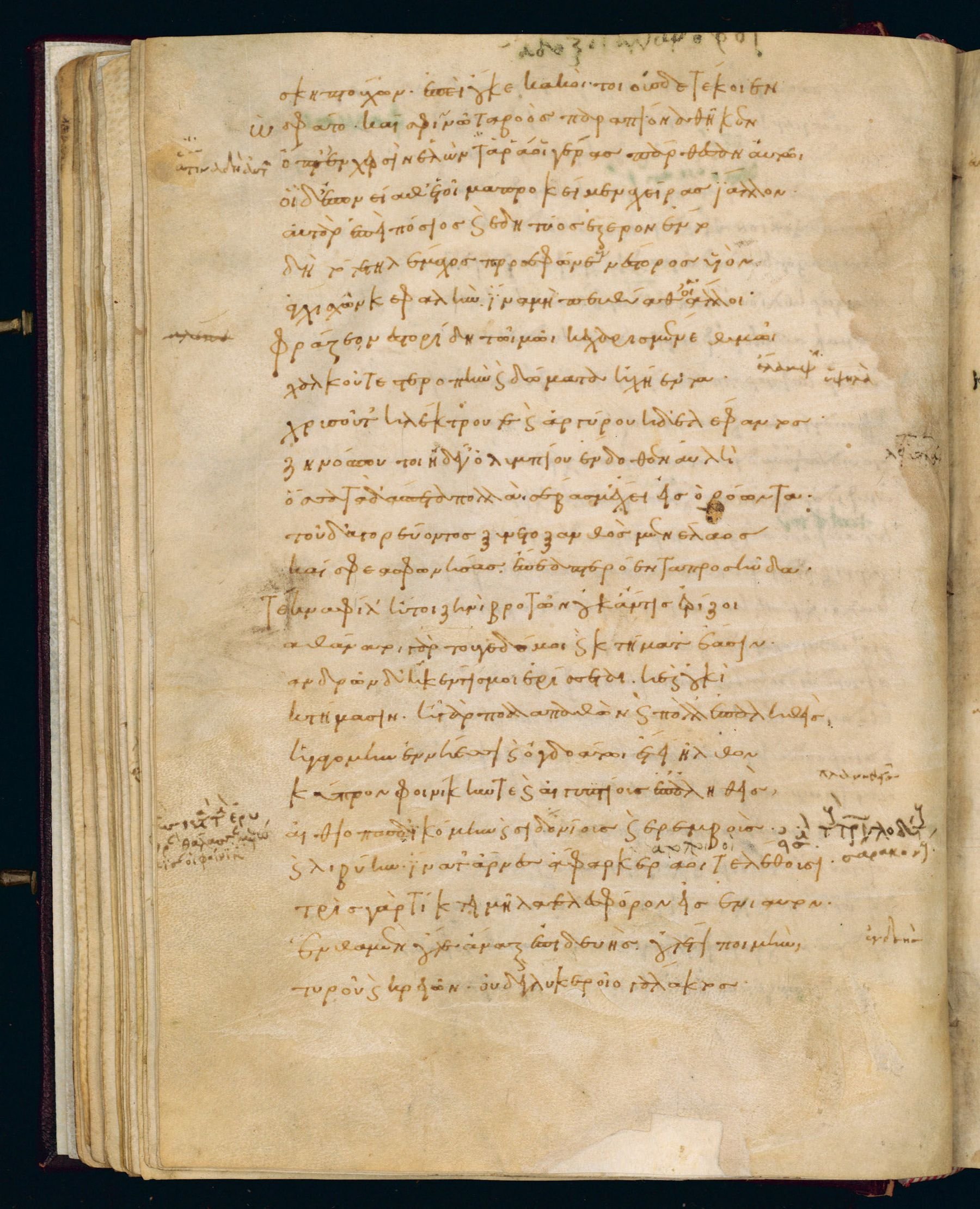
Laur. Plut. 32.24, fol. 30v: Odyssey 4.64-88, begins ‹σκηπτούχων, ἐπεὶ οὔ κε›, ends ‹κρειῶν οὐδὲ γλυκεροῖο γάλακτος,›. Checked on the image: first and last lines read and matched to the Greek. Fol. 30r ends with 4.63. Fol. 31r begins with 4.89. English blocks here: 65-69, 70-74, 75-79, 80-84, 85-89.
64σκηπτούχων, ἐπεὶ οὔ κε κακοὶ τοιούσδε τέκοιεν.
65ὣς φάτο, καί σφιν νῶτα βοὸς παρὰ πίονα θῆκεν
66ὄπτʼ ἐν χερσὶν ἑλών, τά ῥά οἱ γέρα πάρθεσαν αὐτῷ.
67οἱ δʼ ἐπʼ ὀνείαθʼ ἑτοῖμα προκείμενα χεῖρας ἴαλλον.
68αὐτὰρ ἐπεὶ πόσιος καὶ ἐδητύος ἐξ ἔρον ἕντο,
69δὴ τότε Τηλέμαχος προσεφώνεε Νέστορος υἱόν,
70ἄγχι σχὼν κεφαλήν, ἵνα μὴ πευθοίαθʼ οἱ ἄλλοι·
71φράζεο, Νεστορίδη, τῷ ἐμῷ κεχαρισμένε θυμῷ,
72χαλκοῦ τε στεροπὴν κὰδ δώματα ἠχήεντα
73χρυσοῦ τʼ ἠλέκτρου τε καὶ ἀργύρου ἠδʼ ἐλέφαντος.
74Ζηνός που τοιήδε γʼ Ὀλυμπίου ἔνδοθεν αὐλή,
75ὅσσα τάδʼ ἄσπετα πολλά· σέβας μʼ ἔχει εἰσορόωντα.
76τοῦ δʼ ἀγορεύοντος ξύνετο ξανθὸς Μενέλαος,
77καί σφεας φωνήσας ἔπεα πτερόεντα προσηύδα·
78τέκνα φίλʼ, ἦ τοι Ζηνὶ βροτῶν οὐκ ἄν τις ἐρίζοι·
79ἀθάνατοι γὰρ τοῦ γε δόμοι καὶ κτήματʼ ἔασιν·
80ἀνδρῶν δʼ ἤ κέν τίς μοι ἐρίσσεται, ἠὲ καὶ οὐκί,
81κτήμασιν. ἦ γὰρ πολλὰ παθὼν καὶ πόλλʼ ἐπαληθεὶς
82ἠγαγόμην ἐν νηυσὶ καὶ ὀγδοάτῳ ἔτει ἦλθον,
83Κύπρον Φοινίκην τε καὶ Αἰγυπτίους ἐπαληθείς,
84Αἰθίοπάς θʼ ἱκόμην καὶ Σιδονίους καὶ Ἐρεμβοὺς
85καὶ Λιβύην, ἵνα τʼ ἄρνες ἄφαρ κεραοὶ τελέθουσι.
86τρὶς γὰρ τίκτει μῆλα τελεσφόρον εἰς ἐνιαυτόν.
87ἔνθα μὲν οὔτε ἄναξ ἐπιδευὴς οὔτε τι ποιμὴν
88τυροῦ καὶ κρειῶν οὐδὲ γλυκεροῖο γάλακτος,
65So saying he took in his hands roast meat and set it before them, even the fat ox-chine which they had set before himself as a mess of honor. So they put forth their hands to the good cheer lying ready before them. But when they had put from them the desire of food and drink, lo, then Telemachus spoke to the son of Nestor, 70holding his head close to him, that the others might not hear: “Son of Nestor, dear to this heart of mine, mark the flashing of bronze throughout the echoing halls, and the flashing of gold, of electrum, of silver, and of ivory. Of such sort, methinks, is the court of Olympian Zeus within, 75such untold wealth is here; amazement holds me as I look.” Now as he spoke fair-haired Menelaus heard him, and he spoke and addressed them with winged words: “Dear children, with Zeus verily no mortal man could vie, for everlasting are his halls and his possessions; 80but of men another might vie with me in wealth or haply might not. For of a truth after many woes and wide wanderings I brought my wealth home in my ships and came in the eighth year. Over Cyprus and Phoenicia I wandered, and Egypt, and I came to the Ethiopians and the Sidonians and the Erembi, 85and to Libya, where the lambs are horned from their birth. For there the ewes bear their young thrice within the full course of the year; there neither master nor shepherd has any lack of cheese or of meat or of sweet milk, but the flocks ever yield milk to the milking the year through.
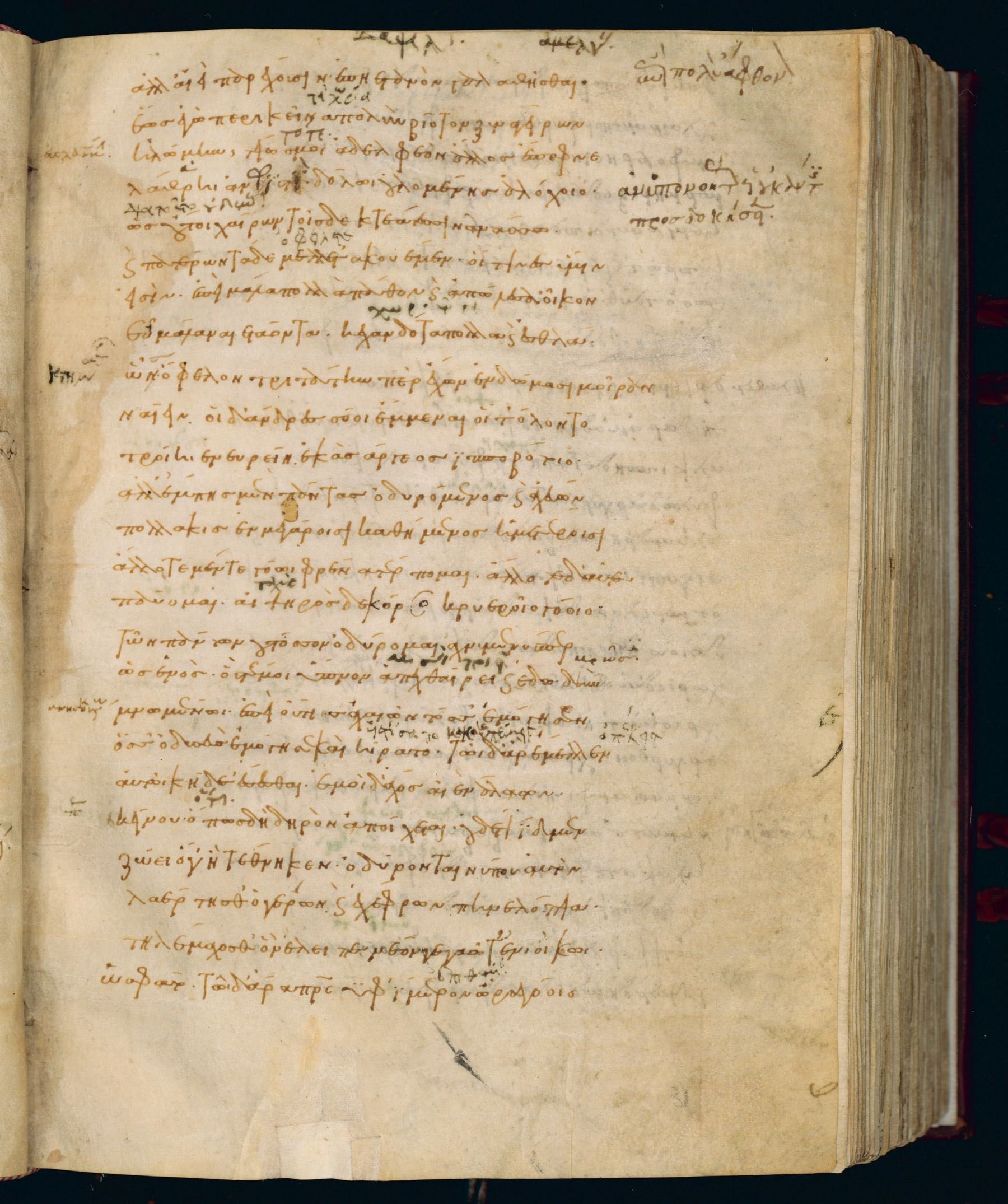
Where on the image
Laur. Plut. 32.24, fol. 31r: Odyssey 4.89-113, begins ‹ἀλλʼ αἰεὶ παρέχουσιν ἐπηετανὸν›, ends ‹ὑφʼ ἵμερον ὦρσε γόοιο.›. Checked on the image: first and last lines read and matched to the Greek. Fol. 30v ends with 4.88. Fol. 31v begins with 4.114. English blocks here: 90-94, 95-99, 100-104, 105-109, 110-114.
89ἀλλʼ αἰεὶ παρέχουσιν ἐπηετανὸν γάλα θῆσθαι.
90ἧος ἐγὼ περὶ κεῖνα πολὺν βίοτον συναγείρων
91ἠλώμην, τῆός μοι ἀδελφεὸν ἄλλος ἔπεφνεν
92λάθρῃ, ἀνωιστί, δόλῳ οὐλομένης ἀλόχοιο·
93ὣς οὔ τοι χαίρων τοῖσδε κτεάτεσσιν ἀνάσσω.
94καὶ πατέρων τάδε μέλλετʼ ἀκουέμεν, οἵ τινες ὑμῖν
95εἰσίν, ἐπεὶ μάλα πολλὰ πάθον, καὶ ἀπώλεσα οἶκον
96εὖ μάλα ναιετάοντα, κεχανδότα πολλὰ καὶ ἐσθλά.
97ὧν ὄφελον τριτάτην περ ἔχων ἐν δώμασι μοῖραν
98ναίειν, οἱ δʼ ἄνδρες σόοι ἔμμεναι, οἳ τότʼ ὄλοντο
99Τροίῃ ἐν εὐρείῃ ἑκὰς Ἄργεος ἱπποβότοιο.
100ἀλλʼ ἔμπης πάντας μὲν ὀδυρόμενος καὶ ἀχεύων
101πολλάκις ἐν μεγάροισι καθήμενος ἡμετέροισιν
102ἄλλοτε μέν τε γόῳ φρένα τέρπομαι, ἄλλοτε δʼ αὖτε
103παύομαι· αἰψηρὸς δὲ κόρος κρυεροῖο γόοιο.
104τῶν πάντων οὐ τόσσον ὀδύρομαι, ἀχνύμενός περ,
105ὡς ἑνός, ὅς τέ μοι ὕπνον ἀπεχθαίρει καὶ ἐδωδὴν
106μνωομένῳ, ἐπεὶ οὔ τις Ἀχαιῶν τόσσʼ ἐμόγησεν,
107ὅσσʼ Ὀδυσεὺς ἐμόγησε καὶ ἤρατο. τῷ δʼ ἄρʼ ἔμελλεν
108αὐτῷ κήδεʼ ἔσεσθαι, ἐμοὶ δʼ ἄχος αἰὲν ἄλαστον
109κείνου, ὅπως δὴ δηρὸν ἀποίχεται, οὐδέ τι ἴδμεν,
110ζώει ὅ γʼ ἦ τέθνηκεν. ὀδύρονταί νύ που αὐτὸν
111Λαέρτης θʼ ὁ γέρων καὶ ἐχέφρων Πηνελόπεια
112Τηλέμαχός θʼ, ὃν ἔλειπε νέον γεγαῶτʼ ἐνὶ οἴκῳ.
113ὣς φάτο, τῷ δʼ ἄρα πατρὸς ὑφʼ ἵμερον ὦρσε γόοιο.
90While I wandered in those lands gathering much livelihood, meanwhile another slew my brother by stealth and at unawares, by the guile of his accursed wife. Thus, thou mayest see, I have no joy in being lord of this wealth; and you may well have heard of this from your fathers, whosoever they 95may be, for full much did I suffer, and let fall into ruin a stately house and one stored with much goodly treasure. Would that I dwelt in my halls with but a third part of this wealth, and that those men were safe who then perished in the broad land of Troy far from horse-pasturing Argos. 100And yet, though I often sit in my halls weeping and sorrowing for them all—one moment indeed I ease my heart with weeping, and then again I cease, for men soon have surfeit of chill lament—yet for them all I mourn not so much, despite my grief, 105as for one only, who makes me to loathe both sleep and food, when I think of him; for no one of the Achaeans toiled so much as Odysseus toiled and endured. But to himself, as it seems, his portion was to be but woe, and for me there is sorrow never to be forgotten for him, in that he is gone so long, nor do we know aught 110whether he be alive or dead. Mourned is he, I ween, by the old man Laertes, and by constant Penelope, and by Telemachus, whom he left a new-born child in his house.” So he spoke, and in Telemachus he roused the desire to weep for his father. Tears from his eyelids he let fall upon the ground, when he heard his father's name,
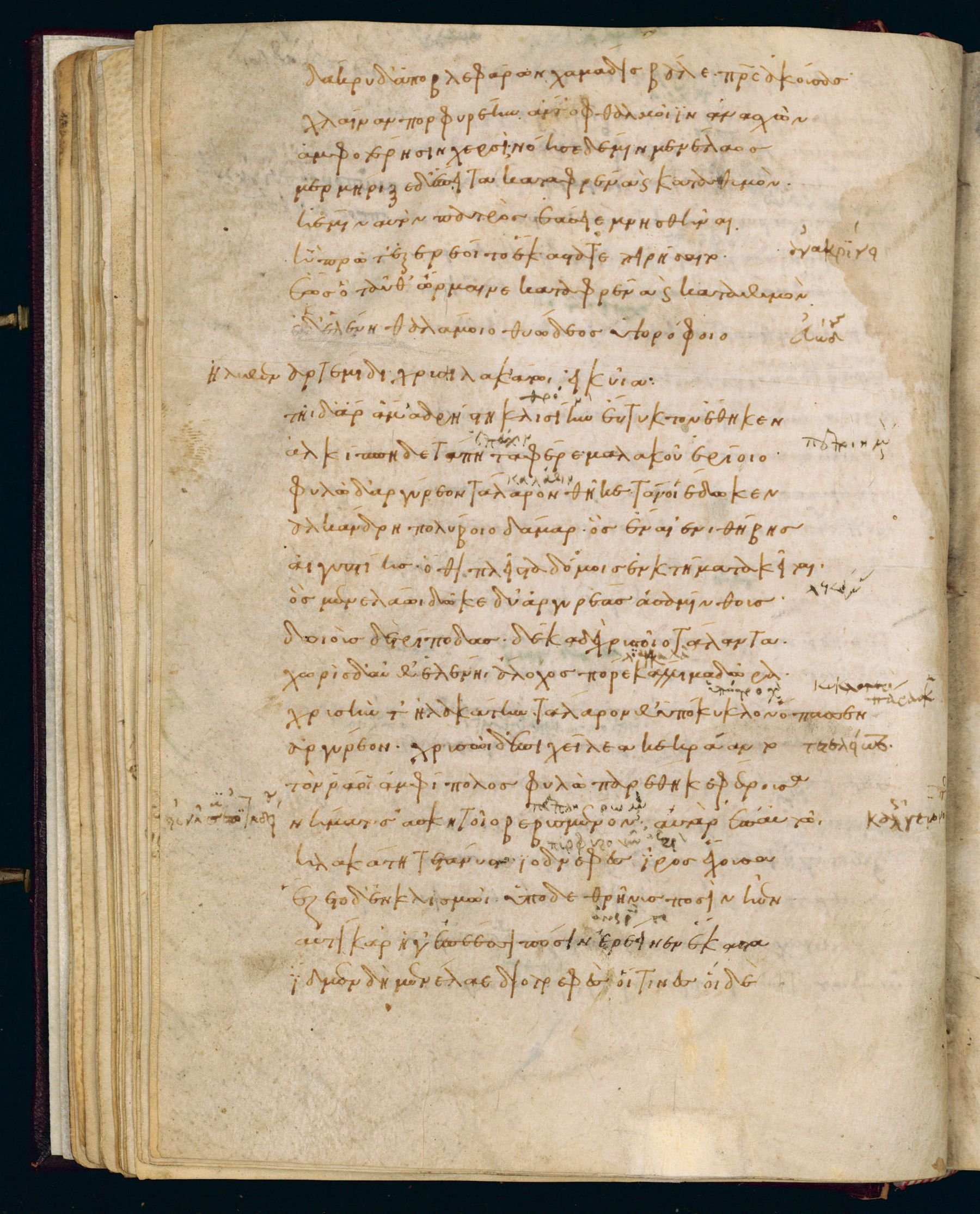
Where on the image
Laur. Plut. 32.24, fol. 31v: Odyssey 4.114-138, begins ‹δάκρυ δʼ ἀπὸ βλεφάρων›, ends ‹διοτρεφές, οἵ τινες οἵδε›. Checked on the image: first and last lines read and matched to the Greek. Fol. 31r ends with 4.113. Fol. 32r begins with 4.139. English blocks here: 115-119, 120-124, 125-129, 130-134, 135-139.
114δάκρυ δʼ ἀπὸ βλεφάρων χαμάδις βάλε πατρὸς ἀκούσας,
115χλαῖναν πορφυρέην ἄντʼ ὀφθαλμοῖιν ἀνασχὼν
116ἀμφοτέρῃσιν χερσί. νόησε δέ μιν Μενέλαος,
117μερμήριξε δʼ ἔπειτα κατὰ φρένα καὶ κατὰ θυμόν,
118ἠέ μιν αὐτὸν πατρὸς ἐάσειε μνησθῆναι
119ἦ πρῶτʼ ἐξερέοιτο ἕκαστά τε πειρήσαιτο.
120ἧος ὁ ταῦθʼ ὥρμαινε κατὰ φρένα καὶ κατὰ θυμόν,
121ἐκ δʼ Ἑλένη θαλάμοιο θυώδεος ὑψορόφοιο
122ἤλυθεν Ἀρτέμιδι χρυσηλακάτῳ ἐικυῖα.
123τῇ δʼ ἄρʼ ἅμʼ Ἀδρήστη κλισίην εὔτυκτον ἔθηκεν,
124Ἀλκίππη δὲ τάπητα φέρεν μαλακοῦ ἐρίοιο,
125Φυλὼ δʼ ἀργύρεον τάλαρον φέρε, τόν οἱ ἔθηκεν
126Ἀλκάνδρη, Πολύβοιο δάμαρ, ὃς ἔναιʼ ἐνὶ Θήβῃς
127Αἰγυπτίῃς, ὅθι πλεῖστα δόμοις ἐν κτήματα κεῖται·
128ὃς Μενελάῳ δῶκε δύʼ ἀργυρέας ἀσαμίνθους,
129δοιοὺς δὲ τρίποδας, δέκα δὲ χρυσοῖο τάλαντα.
130χωρὶς δʼ αὖθʼ Ἑλένῃ ἄλοχος πόρε κάλλιμα δῶρα·
131χρυσέην τʼ ἠλακάτην τάλαρόν θʼ ὑπόκυκλον ὄπασσεν
132ἀργύρεον, χρυσῷ δʼ ἐπὶ χείλεα κεκράαντο.
133τόν ῥά οἱ ἀμφίπολος Φυλὼ παρέθηκε φέρουσα
134νήματος ἀσκητοῖο βεβυσμένον· αὐτὰρ ἐπʼ αὐτῷ
135ἠλακάτη τετάνυστο ἰοδνεφὲς εἶρος ἔχουσα.
136ἕζετο δʼ ἐν κλισμῷ, ὑπὸ δὲ θρῆνυς ποσὶν ἦεν.
137αὐτίκα δʼ ἥ γʼ ἐπέεσσι πόσιν ἐρέεινεν ἕκαστα·
138ἴδμεν δή, Μενέλαε διοτρεφές, οἵ τινες οἵδε
115and with both hands held up his purple cloak before his eyes. And Menelaus noted him, and debated in mind and heart whether he should leave him to speak of his father himself, or whether he should first question him and prove him in each thing. 120While he pondered thus in mind and heart, forth then from her fragrant high-roofed chamber came Helen, like Artemis of the golden arrows; and with her came Adraste, and placed for her a chair, beautifully wrought, and Alcippe brought a rug of soft wool 125and Phylo a silver basket, which Alcandre had given her, the wife of Polybus, who dwelt in Thebes of Egypt, where greatest store of wealth is laid up in men's houses. He gave to Menelaus two silver baths and two tripods and ten talents of gold. 130And besides these, his wife gave to Helen also beautiful gifts,—a golden distaff and a basket with wheels beneath did she give, a basket of silver, and with gold were the rims thereof gilded. This then the handmaid, Phylo, brought and placed beside her, filled with finely-spun yarn, and across it 135was laid the distaff laden with violet-dark wool. So Helen sat down upon the chair, and below was a footstool for the feet; and at once she questioned her husband on each matter, and said: “Do we know, Menelaus, fostered of Zeus, who these men declare themselves to be who have come to our house?
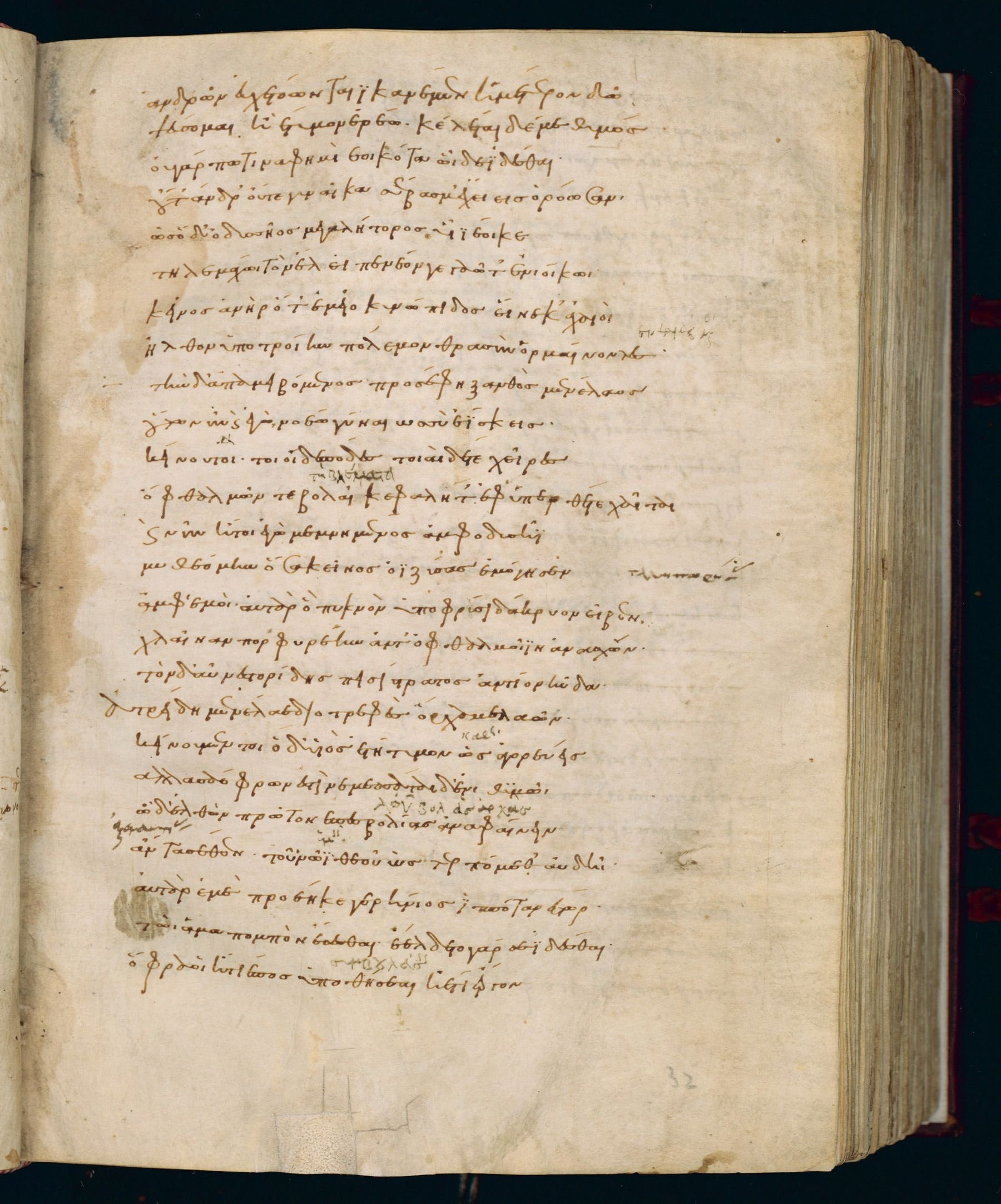
Where on the image
Laur. Plut. 32.24, fol. 32r: Odyssey 4.139-163, begins ‹ἀνδρῶν εὐχετόωνται ἱκανέμεν ἡμέτερον›, ends ‹ὑποθήσεαι ἠέ τι ἔργον.›. Checked on the image: first and last lines read and matched to the Greek. Fol. 31v ends with 4.138. Fol. 32v begins with 4.164. English blocks here: 140-146, 147-149, 150-154, 155-159, 160-164.
139ἀνδρῶν εὐχετόωνται ἱκανέμεν ἡμέτερον δῶ;
140ψεύσομαι ἦ ἔτυμον ἐρέω; κέλεται δέ με θυμός.
141οὐ γάρ πώ τινά φημι ἐοικότα ὧδε ἰδέσθαι
142οὔτʼ ἄνδρʼ οὔτε γυναῖκα, σέβας μʼ ἔχει εἰσορόωσαν,
143ὡς ὅδʼ Ὀδυσσῆος μεγαλήτορος υἷι ἔοικε,
144Τηλεμάχῳ, τὸν ἔλειπε νέον γεγαῶτʼ ἐνὶ οἴκῳ
145κεῖνος ἀνήρ, ὅτʼ ἐμεῖο κυνώπιδος εἵνεκʼ Ἀχαιοὶ
146ἤλθεθʼ ὑπὸ Τροίην πόλεμον θρασὺν ὁρμαίνοντες.
147τὴν δʼ ἀπαμειβόμενος προσέφη ξανθὸς Μενέλαος·
148οὕτω νῦν καὶ ἐγὼ νοέω, γύναι, ὡς σὺ ἐίσκεις·
149κείνου γὰρ τοιοίδε πόδες τοιαίδε τε χεῖρες
150ὀφθαλμῶν τε βολαὶ κεφαλή τʼ ἐφύπερθέ τε χαῖται.
151καὶ νῦν ἦ τοι ἐγὼ μεμνημένος ἀμφʼ Ὀδυσῆι
152μυθεόμην, ὅσα κεῖνος ὀιζύσας ἐμόγησεν
153ἀμφʼ ἐμοί, αὐτὰρ ὁ πικρὸν ὑπʼ ὀφρύσι δάκρυον εἶβε,
154χλαῖναν πορφυρέην ἄντʼ ὀφθαλμοῖιν ἀνασχών.
155τὸν δʼ αὖ Νεστορίδης Πεισίστρατος ἀντίον ηὔδα·
156Ἀτρεΐδη Μενέλαε διοτρεφές, ὄρχαμε λαῶν,
157κείνου μέν τοι ὅδʼ υἱὸς ἐτήτυμον, ὡς ἀγορεύεις·
158ἀλλὰ σαόφρων ἐστί, νεμεσσᾶται δʼ ἐνὶ θυμῷ
159ὧδʼ ἐλθὼν τὸ πρῶτον ἐπεσβολίας ἀναφαίνειν
160ἄντα σέθεν, τοῦ νῶι θεοῦ ὣς τερπόμεθʼ αὐδῇ.
161αὐτὰρ ἐμὲ προέηκε Γερήνιος ἱππότα Νέστωρ
162τῷ ἅμα πομπὸν ἕπεσθαι· ἐέλδετο γάρ σε ἰδέσθαι,
163ὄφρα οἱ ἤ τι ἔπος ὑποθήσεαι ἠέ τι ἔργον.
140Shall I disguise my thought, or speak the truth? Nay, my heart bids me speak. For never yet, I declare, saw I one so like another, whether man or woman—amazement holds me, as I look—as this man is like the son of great-hearted Odysseus, even Telemachus, whom that warrior left a new-born child in his house, when for the sake of shameless me ye Achaeans came up under the walls of Troy, pondering in your hearts fierce war.” 147Then fair-haired Menelaus answered her: “Even so do I myself now note it, wife, as thou markest the likeness. Such were his feet, such his hands, 150and the glances of his eyes, and his head and hair above. And verily but now, as I made mention of Odysseus and was telling of all the woe and toil he endured for my sake, this youth let fall a bitter tear from beneath his brows, holding up his purple cloak before his eyes.” 155Then Peisistratus, son of Nestor, answered him:“Menelaus, son of Atreus, fostered of Zeus, leader of hosts, his son indeed this youth is, as thou sayest. But he is of prudent mind and feels shame at heart thus on his first coming to make a show of forward words 160in the presence of thee, in whose voice we both take delight as in a god's. But the horseman, Nestor of Gerenia, sent me forth to go with him as his guide, for he was eager to see thee, that thou mightest put in his heart some word or some deed. For many sorrows has a son
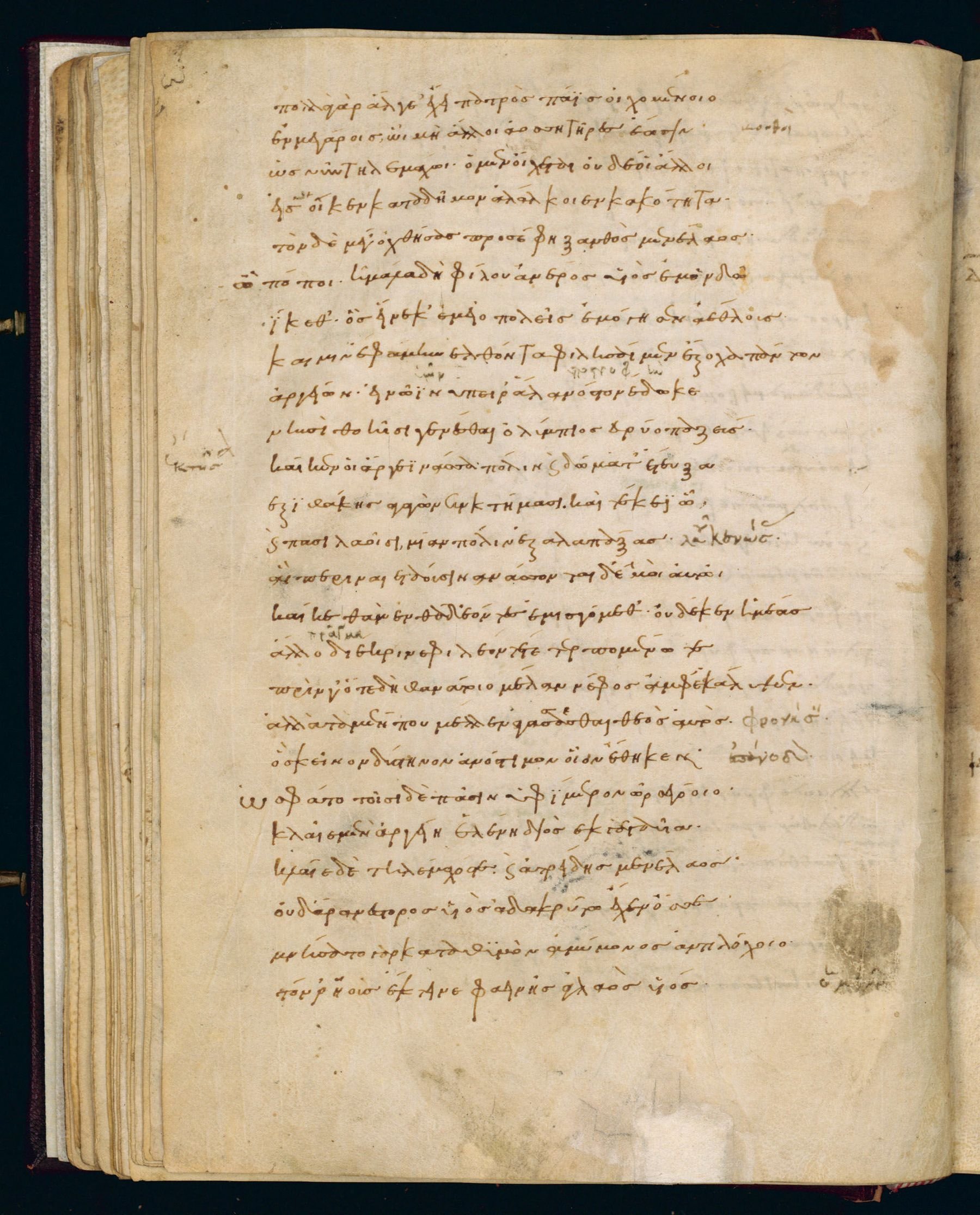
Where on the image
Laur. Plut. 32.24, fol. 32v: Odyssey 4.164-188, begins ‹πολλὰ γὰρ ἄλγεʼ ἔχει›, ends ‹ἔκτεινε φαεινῆς ἀγλαὸς υἱός·›. Checked on the image: first and last lines read and matched to the Greek. Fol. 32r ends with 4.163. Fol. 33r begins with 4.189. English blocks here: 165-169, 170-174, 175-179, 180-182, 183-184, 185-189.
164πολλὰ γὰρ ἄλγεʼ ἔχει πατρὸς πάϊς οἰχομένοιο
165ἐν μεγάροις, ᾧ μὴ ἄλλοι ἀοσσητῆρες ἔωσιν,
166ὡς νῦν Τηλεμάχῳ ὁ μὲν οἴχεται, οὐδέ οἱ ἄλλοι
167εἴσʼ οἵ κεν κατὰ δῆμον ἀλάλκοιεν κακότητα.
168τὸν δʼ ἀπαμειβόμενος προσέφη ξανθὸς Μενέλαος·
169ὢ πόποι, ἦ μάλα δὴ φίλου ἀνέρος υἱὸς ἐμὸν δῶ
170ἵκεθʼ, ὃς εἵνεκʼ ἐμεῖο πολέας ἐμόγησεν ἀέθλους·
171καί μιν ἔφην ἐλθόντα φιλησέμεν ἔξοχον ἄλλων
172Ἀργείων, εἰ νῶιν ὑπεὶρ ἅλα νόστον ἔδωκε
173νηυσὶ θοῇσι γενέσθαι Ὀλύμπιος εὐρύοπα Ζεύς.
174καί κέ οἱ Ἄργεϊ νάσσα πόλιν καὶ δώματʼ ἔτευξα,
175ἐξ Ἰθάκης ἀγαγὼν σὺν κτήμασι καὶ τέκεϊ ᾧ
176καὶ πᾶσιν λαοῖσι, μίαν πόλιν ἐξαλαπάξας,
177αἳ περιναιετάουσιν, ἀνάσσονται δʼ ἐμοὶ αὐτῷ.
178καί κε θάμʼ ἐνθάδʼ ἐόντες ἐμισγόμεθʼ· οὐδέ κεν ἡμέας
179ἄλλο διέκρινεν φιλέοντέ τε τερπομένω τε,
180πρίν γʼ ὅτε δὴ θανάτοιο μέλαν νέφος ἀμφεκάλυψεν.
181ἀλλὰ τὰ μέν που μέλλεν ἀγάσσεσθαι θεὸς αὐτός,
182ὃς κεῖνον δύστηνον ἀνόστιμον οἶον ἔθηκεν.
183ὣς φάτο, τοῖσι δὲ πᾶσιν ὑφʼ ἵμερον ὦρσε γόοιο.
184κλαῖε μὲν Ἀργείη Ἑλένη, Διὸς ἐκγεγαυῖα,
185κλαῖε δὲ Τηλέμαχός τε καὶ Ἀτρεΐδης Μενέλαος,
186οὐδʼ ἄρα Νέστορος υἱὸς ἀδακρύτω ἔχεν ὄσσε·
187μνήσατο γὰρ κατὰ θυμὸν ἀμύμονος Ἀντιλόχοιο,
188τόν ῥʼ Ἠοῦς ἔκτεινε φαεινῆς ἀγλαὸς υἱός·
165in his halls when his father is gone, when there are none other to be his helpers, even as it is now with Telemachus; his father is gone, and there are no others among the people who might ward off ruin.” Then fair-haired Menelaus answered him and said: “Lo now, verily is there come to my house the son of a man well-beloved, 170who for my sake endured many toils. And I thought that if he came back I should give him welcome beyond all the other Argives, if Olympian Zeus, whose voice is borne afar, had granted to us two a return in our swift ships over the sea. And in Argos I would have given him a city to dwell in, and would have built him a house, 175when I had brought him from Ithaca with his goods and his son and all his people, driving out the dwellers of some one city among those that lie round about and obey me myself as their lord. Then, living here, should we ofttimes have met together, nor would aught have parted us, loving and joying in one another, 180until the black cloud of death enfolded us. Howbeit of this, methinks, the god himself must have been jealous, who to that hapless man alone vouchsafed no return.” 183So he spoke, and in them all aroused the desire of lament. Argive Helen wept, the daughter of Zeus, 185Telemachus wept, and Menelaus, son of Atreus, nor could the son of Nestor keep his eyes tearless. For he thought in his heart of peerless Antilochus, whom the glorious son of the bright Dawn had slain. Thinking of him, he spoke winged words:
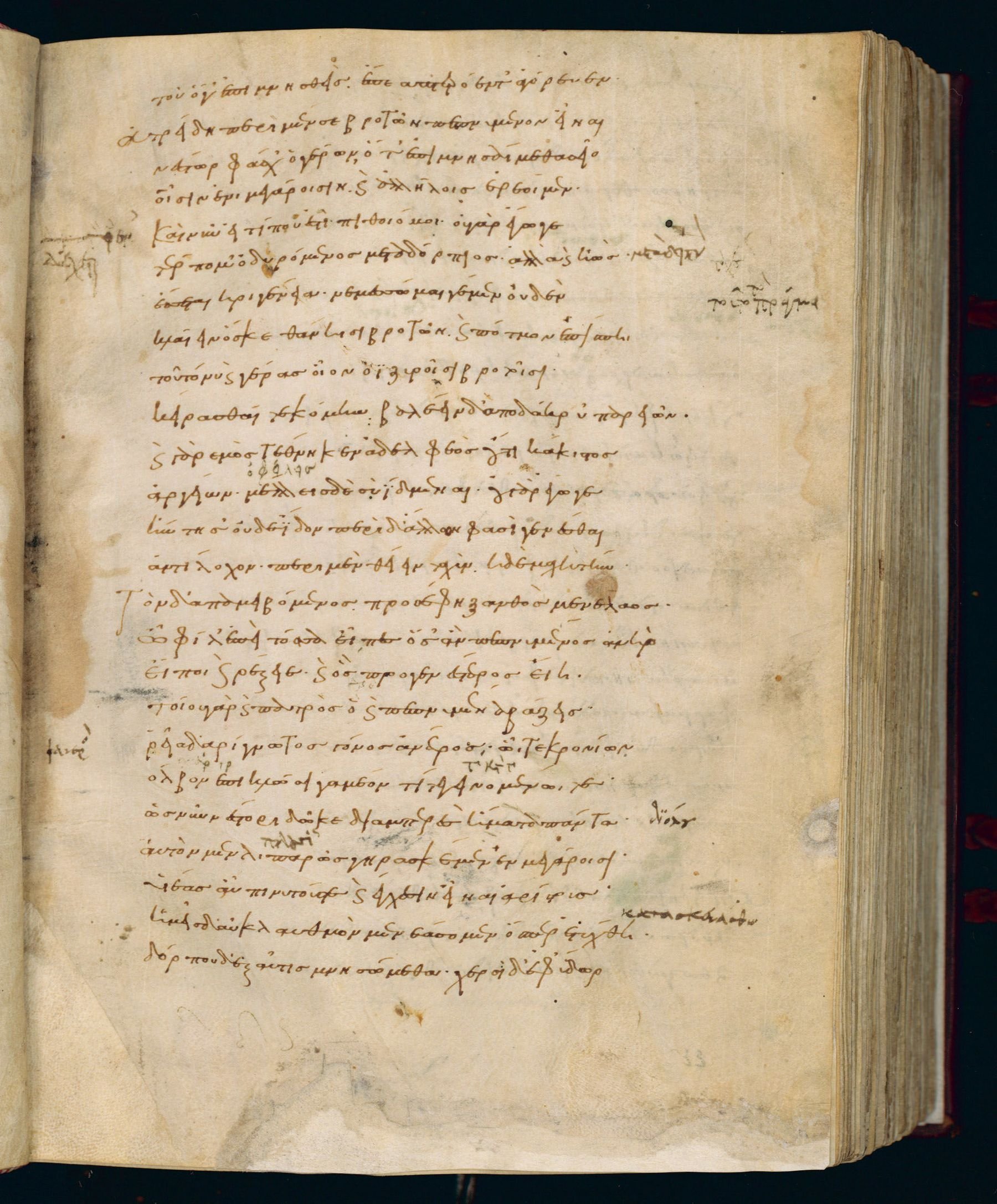
Where on the image
Laur. Plut. 32.24, fol. 33r: Odyssey 4.189-213, begins ‹τοῦ ὅ γʼ ἐπιμνησθεὶς›, ends ‹χερσὶ δʼ ἐφʼ ὕδωρ›. Checked on the image: first and last lines read and matched to the Greek. Fol. 32v ends with 4.188. Fol. 33v begins with 4.214. English blocks here: 190-194, 195-199, 200-204, 205-209, 210-214.
189τοῦ ὅ γʼ ἐπιμνησθεὶς ἔπεα πτερόεντʼ ἀγόρευεν·
190Ἀτρεΐδη, περὶ μέν σε βροτῶν πεπνυμένον εἶναι
191Νέστωρ φάσχʼ ὁ γέρων, ὅτʼ ἐπιμνησαίμεθα σεῖο
192οἷσιν ἐνὶ μεγάροισι, καὶ ἀλλήλους ἐρέοιμεν.
193καὶ νῦν, εἴ τί που ἔστι, πίθοιό μοι· οὐ γὰρ ἐγώ γε
194τέρπομʼ ὀδυρόμενος μεταδόρπιος, ἀλλὰ καὶ ἠὼς
195ἔσσεται ἠριγένεια· νεμεσσῶμαί γε μὲν οὐδὲν
196κλαίειν ὅς κε θάνῃσι βροτῶν καὶ πότμον ἐπίσπῃ.
197τοῦτό νυ καὶ γέρας οἶον ὀιζυροῖσι βροτοῖσιν,
198κείρασθαί τε κόμην βαλέειν τʼ ἀπὸ δάκρυ παρειῶν.
199καὶ γὰρ ἐμὸς τέθνηκεν ἀδελφεός, οὔ τι κάκιστος
200Ἀργείων· μέλλεις δὲ σὺ ἴδμεναι· οὐ γὰρ ἐγώ γε
201ἤντησʼ οὐδὲ ἴδον· περὶ δʼ ἄλλων φασὶ γενέσθαι
202Ἀντίλοχον, πέρι μὲν θείειν ταχὺν ἠδὲ μαχητήν.
203τὸν δʼ ἀπαμειβόμενος προσέφη ξανθὸς Μενέλαος·
204ὦ φίλʼ, ἐπεὶ τόσα εἶπες, ὅσʼ ἂν πεπνυμένος ἀνὴρ
205εἴποι καὶ ῥέξειε, καὶ ὃς προγενέστερος εἴη·
206τοίου γὰρ καὶ πατρός, ὃ καὶ πεπνυμένα βάζεις,
207ῥεῖα δʼ ἀρίγνωτος γόνος ἀνέρος ᾧ τε Κρονίων
208ὄλβον ἐπικλώσῃ γαμέοντί τε γεινομένῳ τε,
209ὡς νῦν Νέστορι δῶκε διαμπερὲς ἤματα πάντα
210αὐτὸν μὲν λιπαρῶς γηρασκέμεν ἐν μεγάροισιν,
211υἱέας αὖ πινυτούς τε καὶ ἔγχεσιν εἶναι ἀρίστους.
212ἡμεῖς δὲ κλαυθμὸν μὲν ἐάσομεν, ὃς πρὶν ἐτύχθη,
213δόρπου δʼ ἐξαῦτις μνησώμεθα, χερσὶ δʼ ἐφʼ ὕδωρ
190“Son of Atreus, old Nestor used ever to say that thou wast wise above all men, whenever we made mention of thee in his halls and questioned one another. And now, if it may in any wise be, hearken to me, for I take no joy in weeping at supper time,—and moreover 195early dawn will soon be here. I count it indeed no blame to weep for any mortal who has died and met his fate. Yea, this is the only due we pay to miserable mortals, to cut the hair and let a tear fall from the cheeks. For a brother of mine, too, is dead, nowise the meanest 200of the Argives, and thou mayest well have known him. As for me, I never met him nor saw him; but men say that Antilochus was above all others pre-eminent in speed of foot and as a warrior.” Then fair-haired Menelaus answered him and said: “My friend, truly thou hast said all that a wise man 205might say or do, even one that was older than thou; for from such a father art thou sprung, wherefore thou dost even speak wisely. Easily known is the seed of that man for whom the son of Cronos spins the thread of good fortune at marriage and at birth, even as now he has granted to Nestor throughout all his days continually that 210he should himself reach a sleek old age in his halls, and that his sons in their turn should be wise and most valiant with the spear. But we will cease the weeping which but now was made, and let us once more think of our supper, and let them pour water over our hands. Tales there will be in the morning also
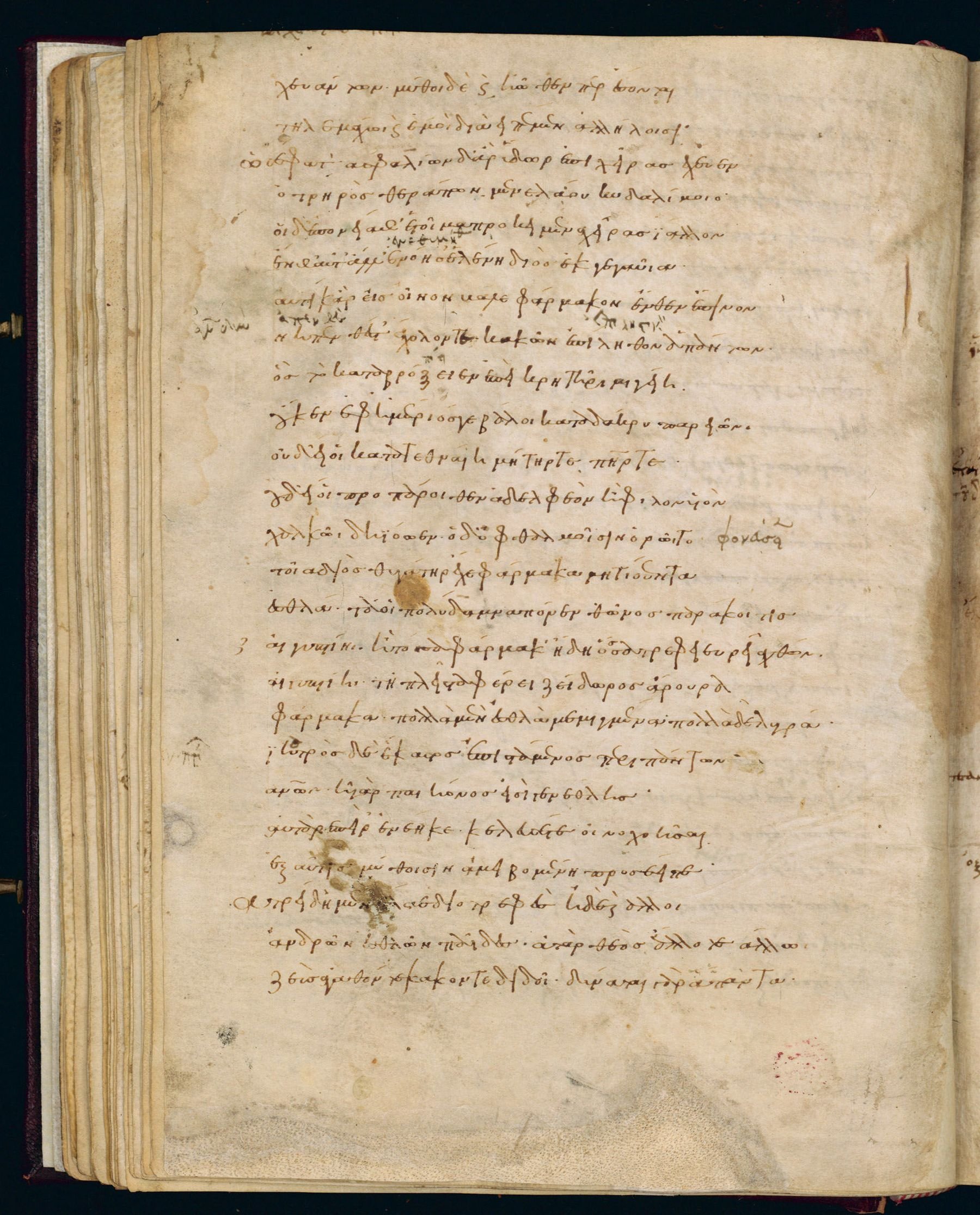
Where on the image
Laur. Plut. 32.24, fol. 33v: Odyssey 4.214-237, begins ‹χευάντων. μῦθοι δὲ καὶ›, ends ‹διδοῖ· δύναται γὰρ ἅπαντα·›. Checked on the image: first and last lines read and matched to the Greek. Fol. 33r ends with 4.213. Fol. 34r begins with 4.238. The page has one verse not in Murray's text, between 4.228 and 4.229: it begins Αἰγυπτίη and ends εὐρεῖα χθών (25 lines for 24 edition verses). English blocks here: 215-218, 219-219, 220-224, 225-229, 230-234, 235-239.
214χευάντων. μῦθοι δὲ καὶ ἠῶθέν περ ἔσονται
215Τηλεμάχῳ καὶ ἐμοὶ διαειπέμεν ἀλλήλοισιν.
216ὣς ἔφατʼ, Ἀσφαλίων δʼ ἄρʼ ὕδωρ ἐπὶ χεῖρας ἔχευεν,
217ὀτρηρὸς θεράπων Μενελάου κυδαλίμοιο.
218οἱ δʼ ἐπʼ ὀνείαθʼ ἑτοῖμα προκείμενα χεῖρας ἴαλλον.
219ἔνθʼ αὖτʼ ἄλλʼ ἐνόησʼ Ἑλένη Διὸς ἐκγεγαυῖα·
220αὐτίκʼ ἄρʼ εἰς οἶνον βάλε φάρμακον, ἔνθεν ἔπινον,
221νηπενθές τʼ ἄχολόν τε, κακῶν ἐπίληθον ἁπάντων.
222ὃς τὸ καταβρόξειεν, ἐπὴν κρητῆρι μιγείη,
223οὔ κεν ἐφημέριός γε βάλοι κατὰ δάκρυ παρειῶν,
224οὐδʼ εἴ οἱ κατατεθναίη μήτηρ τε πατήρ τε,
225οὐδʼ εἴ οἱ προπάροιθεν ἀδελφεὸν ἢ φίλον υἱὸν
226χαλκῷ δηιόῳεν, ὁ δʼ ὀφθαλμοῖσιν ὁρῷτο.
227τοῖα Διὸς θυγάτηρ ἔχε φάρμακα μητιόεντα,
228ἐσθλά, τά οἱ Πολύδαμνα πόρεν, Θῶνος παράκοιτις
229Αἰγυπτίη, τῇ πλεῖστα φέρει ζείδωρος ἄρουρα
230φάρμακα, πολλὰ μὲν ἐσθλὰ μεμιγμένα πολλὰ δὲ λυγρά·
231ἰητρὸς δὲ ἕκαστος ἐπιστάμενος περὶ πάντων
232ἀνθρώπων· ἦ γὰρ Παιήονός εἰσι γενέθλης.
233αὐτὰρ ἐπεί ῥʼ ἐνέηκε κέλευσέ τε οἰνοχοῆσαι,
234ἐξαῦτις μύθοισιν ἀμειβομένη προσέειπεν·
235Ἀτρεΐδη Μενέλαε διοτρεφὲς ἠδὲ καὶ οἵδε
236ἀνδρῶν ἐσθλῶν παῖδες· ἀτὰρ θεὸς ἄλλοτε ἄλλῳ
237Ζεὺς ἀγαθόν τε κακόν τε διδοῖ· δύναται γὰρ ἅπαντα·
215for Telemachus and me to tell to one another to the full.” So he spoke, and Asphalion poured water over their hands, the busy squire of glorious Menelaus. And they put forth their hands to the good cheer lying ready before them. 219Then Helen, daughter of Zeus, took other counsel. 220Straightway she cast into the wine of which they were drinking a drug to quiet all pain and strife, and bring forgetfulness of every ill. Whoso should drink this down, when it is mingled in the bowl, would not in the course of that day let a tear fall down over his cheeks, 225no, not though his mother and father should lie there dead, or though before his face men should slay with the sword his brother or dear son, and his own eyes beheld it. Such cunning drugs had the daughter of Zeus, drugs of healing, which Polydamna, the wife of Thon, had given her, a woman of Egypt, for there the earth, the giver of grain, bears greatest store 230of drugs, many that are healing when mixed, and many that are baneful; there every man is a physician, wise above human kind; for they are of the race of Paeeon. Now when she had cast in the drug, and had bidden pour forth the wine, again she made answer, and said: 235“Menelaus, son of Atreus, fostered of Zeus, and ye that are here, sons of noble men—though now to one and now to another Zeus gives good and ill, for he can do all things,—now verily sit ye in the halls and feast, and take ye joy in telling tales, for I will tell what fitteth the time.
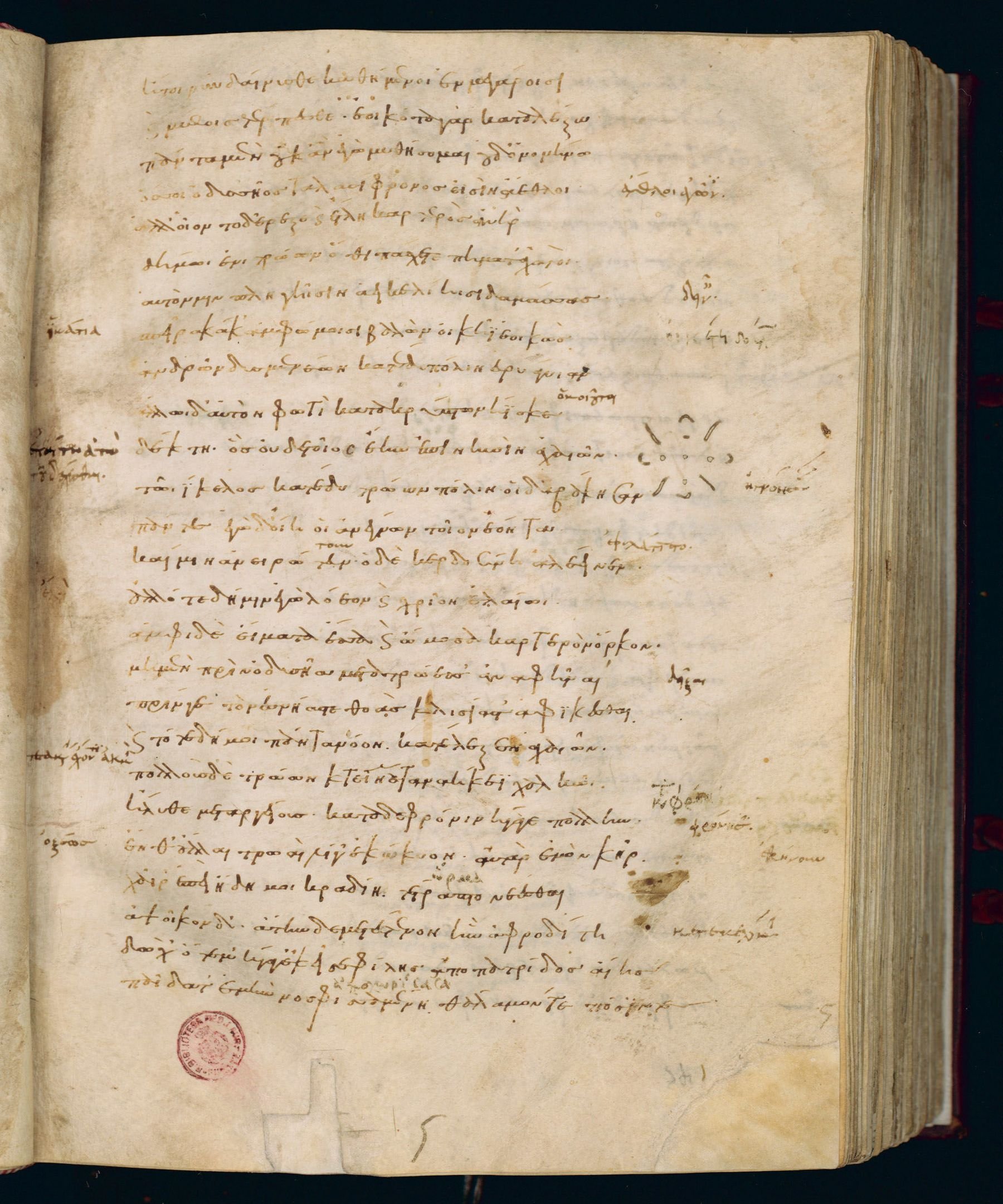
Where on the image
Laur. Plut. 32.24, fol. 34r: Odyssey 4.238-263, begins ‹ἦ τοι νῦν δαίνυσθε›, ends ‹θάλαμόν τε πόσιν τε›. Checked on the image: first and last lines read and matched to the Greek. Fol. 33v ends with 4.237. Fol. 34v begins with 4.264. English blocks here: 240-244, 245-249, 250-254, 255-259, 260-264.
238ἦ τοι νῦν δαίνυσθε καθήμενοι ἐν μεγάροισι
239καὶ μύθοις τέρπεσθε· ἐοικότα γὰρ καταλέξω.
240πάντα μὲν οὐκ ἂν ἐγὼ μυθήσομαι οὐδʼ ὀνομήνω,
241ὅσσοι Ὀδυσσῆος ταλασίφρονός εἰσιν ἄεθλοι·
242ἀλλʼ οἷον τόδʼ ἔρεξε καὶ ἔτλη καρτερὸς ἀνὴρ
243δήμῳ ἔνι Τρώων, ὅθι πάσχετε πήματʼ Ἀχαιοί.
244αὐτόν μιν πληγῇσιν ἀεικελίῃσι δαμάσσας,
245σπεῖρα κάκʼ ἀμφʼ ὤμοισι βαλών, οἰκῆι ἐοικώς,
246ἀνδρῶν δυσμενέων κατέδυ πόλιν εὐρυάγυιαν·
247ἄλλῳ δʼ αὐτὸν φωτὶ κατακρύπτων ἤισκε,
248δέκτῃ, ὃς οὐδὲν τοῖος ἔην ἐπὶ νηυσὶν Ἀχαιῶν.
249τῷ ἴκελος κατέδυ Τρώων πόλιν, οἱ δʼ ἀβάκησαν
250πάντες· ἐγὼ δέ μιν οἴη ἀνέγνων τοῖον ἐόντα,
251καί μιν ἀνηρώτων· ὁ δὲ κερδοσύνῃ ἀλέεινεν.
252ἀλλʼ ὅτε δή μιν ἐγὼ λόεον καὶ χρῖον ἐλαίῳ,
253ἀμφὶ δὲ εἵματα ἕσσα καὶ ὤμοσα καρτερὸν ὅρκον
254μὴ μὲν πρὶν Ὀδυσῆα μετὰ Τρώεσσʼ ἀναφῆναι,
255πρίν γε τὸν ἐς νῆάς τε θοὰς κλισίας τʼ ἀφικέσθαι,
256καὶ τότε δή μοι πάντα νόον κατέλεξεν Ἀχαιῶν.
257πολλοὺς δὲ Τρώων κτείνας ταναήκεϊ χαλκῷ
258ἦλθε μετʼ Ἀργείους, κατὰ δὲ φρόνιν ἤγαγε πολλήν.
259ἔνθʼ ἄλλαι Τρῳαὶ λίγʼ ἐκώκυον· αὐτὰρ ἐμὸν κῆρ
260χαῖρʼ, ἐπεὶ ἤδη μοι κραδίη τέτραπτο νέεσθαι
261ἂψ οἶκόνδʼ, ἄτην δὲ μετέστενον, ἣν Ἀφροδίτη
262δῶχʼ, ὅτε μʼ ἤγαγε κεῖσε φίλης ἀπὸ πατρίδος αἴης,
263παῖδά τʼ ἐμὴν νοσφισσαμένην θάλαμόν τε πόσιν τε
240All things I cannot tell or recount, even all the labours of Odysseus of the steadfast heart; but what a thing was this which that mighty man wrought and endured in the land of the Trojans, where you Achaens suffered woes! Marring his own body with cruel blows, 245and flinging a wretched garment about his shoulders, in the fashion of a slave he entered the broad-wayed city of the foe, and he hid himself under the likeness of another, a beggar, he who was in no wise such an one at the ships of the Achaeans. In this likeness he entered the city of the Trojans, and all of them were but as babes. 250I alone recognized him in this disguise, and questioned him, but he in his cunning sought to avoid me. Howbeit when I was bathing him and anointing him with oil, and had put on him raiment, and sworn a mighty oath not to make him known among the Trojans as Odysseus 255before that he reached the swift ships and the huts, then at length he told me all the purpose of the Achaeans. And when he had slain many of the Trojans with the long sword, he returned to the company of the Argives and brought back plentiful tidings. Then the other Trojan women wailed aloud, but my soul 260was glad, for already my heart was turned to go back to my home, and I groaned for the blindness that Aphrodite gave me, when she led me thither from my dear native land, forsaking my child and my bridal chamber, and my husband, a man who lacked nothing, whether in wisdom or in comeliness.”
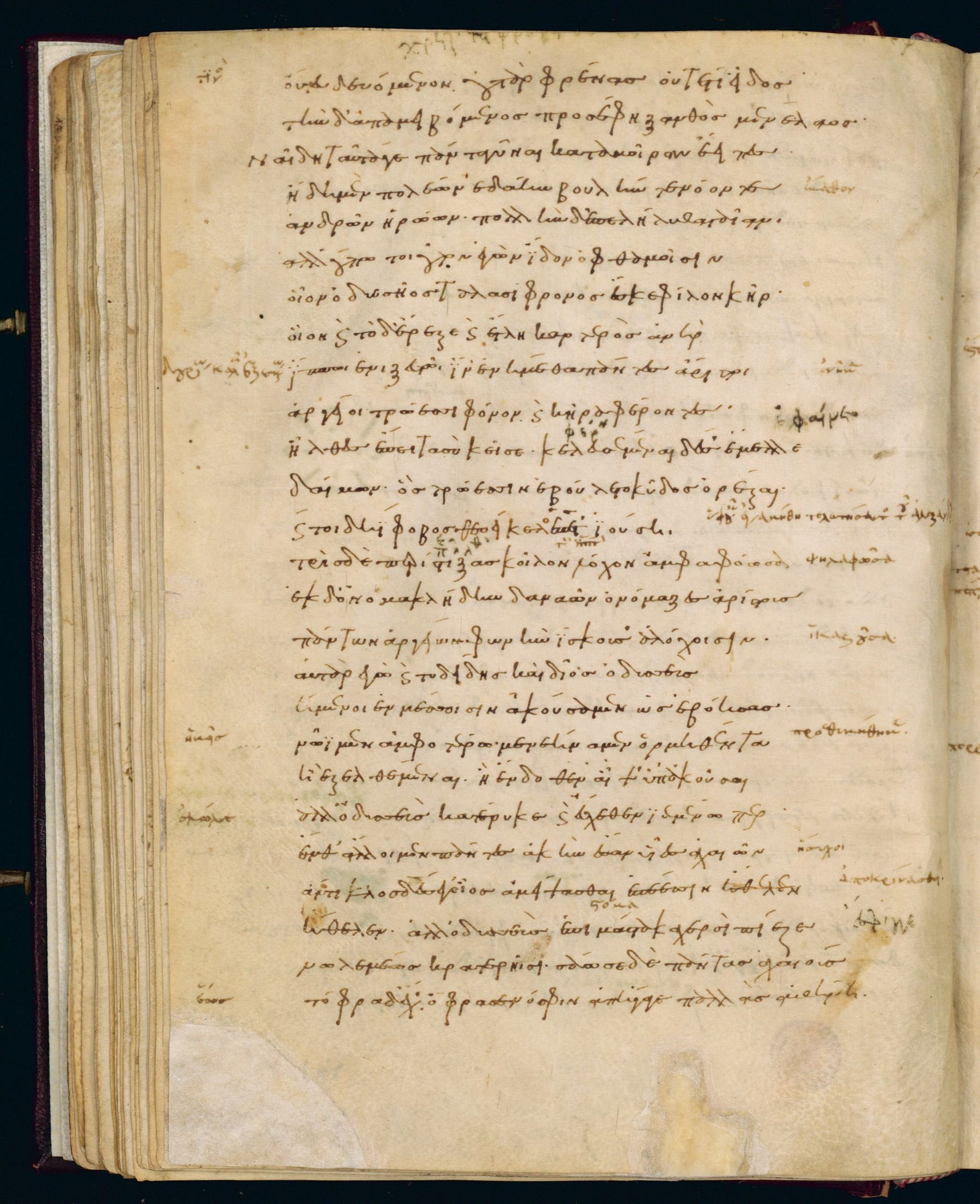
Where on the image
Laur. Plut. 32.24, fol. 34v: Odyssey 4.264-289, begins ‹οὔ τευ δευόμενον, οὔτʼ›, ends ‹νόσφιν ἀπήγαγε Παλλὰς Ἀθήνη.›. Checked on the image: first and last lines read and matched to the Greek. Fol. 34r ends with 4.263. Fol. 35r begins with 4.290. English blocks here: 265-269, 270-274, 275-279, 280-284, 285-289.
264οὔ τευ δευόμενον, οὔτʼ ἂρ φρένας οὔτε τι εἶδος.
265τὴν δʼ ἀπαμειβόμενος προσέφη ξανθὸς Μενέλαος·
266ναὶ δὴ ταῦτά γε πάντα, γύναι, κατὰ μοῖραν ἔειπες.
267ἤδη μὲν πολέων ἐδάην βουλήν τε νόον τε
268ἀνδρῶν ἡρώων, πολλὴν δʼ ἐπελήλυθα γαῖαν·
269ἀλλʼ οὔ πω τοιοῦτον ἐγὼν ἴδον ὀφθαλμοῖσιν,
270οἷον Ὀδυσσῆος ταλασίφρονος ἔσκε φίλον κῆρ.
271οἷον καὶ τόδʼ ἔρεξε καὶ ἔτλη καρτερὸς ἀνὴρ
272ἵππῳ ἔνι ξεστῷ, ἵνʼ ἐνήμεθα πάντες ἄριστοι
273Ἀργείων Τρώεσσι φόνον καὶ κῆρα φέροντες.
274ἦλθες ἔπειτα σὺ κεῖσε· κελευσέμεναι δέ σʼ ἔμελλε
275δαίμων, ὃς Τρώεσσιν ἐβούλετο κῦδος ὀρέξαι·
276καί τοι Δηΐφοβος θεοείκελος ἕσπετʼ ἰούσῃ.
277τρὶς δὲ περίστειξας κοῖλον λόχον ἀμφαφόωσα,
278ἐκ δʼ ὀνομακλήδην Δαναῶν ὀνόμαζες ἀρίστους,
279πάντων Ἀργείων φωνὴν ἴσκουσʼ ἀλόχοισιν.
280αὐτὰρ ἐγὼ καὶ Τυδεΐδης καὶ δῖος Ὀδυσσεὺς
281ἥμενοι ἐν μέσσοισιν ἀκούσαμεν ὡς ἐβόησας.
282νῶι μὲν ἀμφοτέρω μενεήναμεν ὁρμηθέντε
283ἢ ἐξελθέμεναι, ἢ ἔνδοθεν αἶψʼ ὑπακοῦσαι·
284ἀλλʼ Ὀδυσεὺς κατέρυκε καὶ ἔσχεθεν ἱεμένω περ.
285ἔνθʼ ἄλλοι μὲν πάντες ἀκὴν ἔσαν υἷες Ἀχαιῶν,
286Ἄντικλος δὲ σέ γʼ οἶος ἀμείψασθαι ἐπέεσσιν
287ἤθελεν. ἀλλʼ Ὀδυσεὺς ἐπὶ μάστακα χερσὶ πίεζεν
288νωλεμέως κρατερῇσι, σάωσε δὲ πάντας Ἀχαιούς·
289τόφρα δʼ ἔχʼ, ὄφρα σε νόσφιν ἀπήγαγε Παλλὰς Ἀθήνη.
265Then fair-haired Menelaus answered her and said:“Aye verily, all this, wife, hast thou spoken aright. Ere now have I come to know the counsel and the mind of many warriors, and have travelled over the wide earth, but never yet have mine eyes beheld such an one 270as was Odysseus of the steadfast heart. What a thing was this, too, which that mighty man wrought and endured in the carven horse, wherein all we chiefs of the Argives were sitting, bearing to the Trojans death and fate! Then thou camest thither, and it must be that thou wast bidden 275by some god, who wished to grant glory to the Trojans, and godlike Deiphobus followed thee on thy way. Thrice didst thou go about the hollow ambush, trying it with thy touch, and thou didst name aloud the chieftains of the Danaans by their names, likening thy voice to the voices of the wives of all the Argives. 280Now I and the son of Tydeus and goodly Odysseus sat there in the midst and heard how thou didst call, and we two were eager to rise up and come forth, or else to answer straightway from within, but Odysseus held us back and stayed us, despite our eagerness. 285Then all the other sons of the Achaeans held their peace, but Anticlus alone was fain to speak and answer thee; but Odysseus firmly closed his mouth with strong hands, and saved all the Achaeans, and held him thus until Pallas Athena led thee away.”
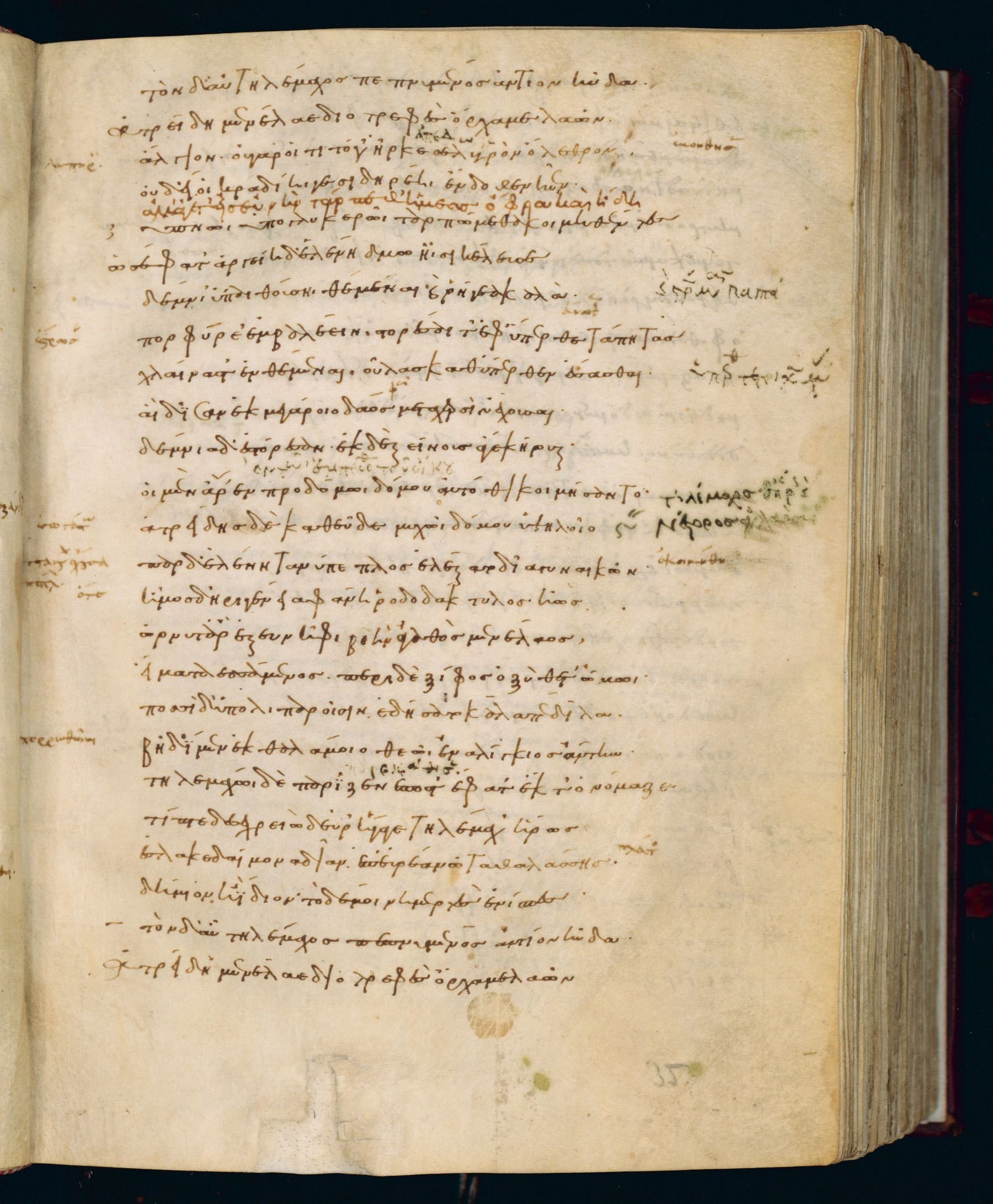
Where on the image
Laur. Plut. 32.24, fol. 35r: Odyssey 4.290-316, begins ‹τὸν δʼ αὖ Τηλέμαχος›, ends ‹Μενέλαε διοτρεφές, ὄρχαμε λαῶν,›. Checked on the image: first and last lines read and matched to the Greek. Fol. 34v ends with 4.289. Fol. 35v begins with 4.317. 4.294 is written in smaller letters squeezed between 4.293 and 4.295, and 4.303 is written in the right margin beside 4.302 (the column has 25 lines). English blocks here: 290-294, 295-299, 300-304, 305-309, 310-314.
290τὸν δʼ αὖ Τηλέμαχος πεπνυμένος ἀντίον ηὔδα·
291Ἀτρεΐδη Μενέλαε διοτρεφές, ὄρχαμε λαῶν,
292ἄλγιον· οὐ γάρ οἵ τι τάδʼ ἤρκεσε λυγρὸν ὄλεθρον,
293οὐδʼ εἴ οἱ κραδίη γε σιδηρέη ἔνδοθεν ἦεν.
294ἀλλʼ ἄγετʼ εἰς εὐνὴν τράπεθʼ ἡμέας, ὄφρα καὶ ἤδη
295ὕπνῳ ὕπο γλυκερῷ ταρπώμεθα κοιμηθέντες.
296ὣς ἔφατʼ, Ἀργείη δʼ Ἑλένη δμῳῇσι κέλευσεν
297δέμνιʼ ὑπʼ αἰθούσῃ θέμεναι καὶ ῥήγεα καλὰ
298πορφύρεʼ ἐμβαλέειν στορέσαι τʼ ἐφύπερθε τάπητας,
299χλαίνας τʼ ἐνθέμεναι οὔλας καθύπερθεν ἕσασθαι.
300αἱ δʼ ἴσαν ἐκ μεγάροιο δάος μετὰ χερσὶν ἔχουσαι,
301δέμνια δὲ στόρεσαν· ἐκ δὲ ξείνους ἄγε κῆρυξ.
302οἱ μὲν ἄρʼ ἐν προδόμῳ δόμου αὐτόθι κοιμήσαντο,
303Τηλέμαχός θʼ ἥρως καὶ Νέστορος ἀγλαὸς υἱός·
304Ἀτρεΐδης δὲ καθεῦδε μυχῷ δόμου ὑψηλοῖο,
305πὰρ δʼ Ἑλένη τανύπεπλος ἐλέξατο, δῖα γυναικῶν.
306ἦμος δʼ ἠριγένεια φάνη ῥοδοδάκτυλος Ἠώς,
307ὤρνυτʼ ἄρʼ ἐξ εὐνῆφι βοὴν ἀγαθὸς Μενέλαος
308εἵματα ἑσσάμενος, περὶ δὲ ξίφος ὀξὺ θέτʼ ὤμῳ,
309ποσσὶ δʼ ὑπὸ λιπαροῖσιν ἐδήσατο καλὰ πέδιλα,
310βῆ δʼ ἴμεν ἐκ θαλάμοιο θεῷ ἐναλίγκιος ἄντην,
311Τηλεμάχῳ δὲ παρῖζεν, ἔπος τʼ ἔφατʼ ἔκ τʼ ὀνόμαζεν·
312τίπτε δέ σε χρειὼ δεῦρʼ ἤγαγε, Τηλέμαχʼ ἥρως,
313ἐς Λακεδαίμονα δῖαν, ἐπʼ εὐρέα νῶτα θαλάσσης;
314δήμιον ἦ ἴδιον; τόδε μοι νημερτὲς ἐνίσπες.
315τὸν δʼ αὖ Τηλέμαχος πεπνυμένος ἀντίον ηὔδα·
316Ἀτρεΐδη Μενέλαε διοτρεφές, ὄρχαμε λαῶν,
290Then wise Telemachus answered him: “Menelaus, son of Atreus, fostered of Zeus, leader of hosts, all the more grievous is it; for in no wise did this ward off from him woeful destruction, nay, not though the heart within him had been of iron. But come, send us to bed, that lulled now 295by sweet sleep we may rest and take our joy.” Thus he spoke, and Argive Helen bade her handmaids place bedsteads beneath the portico, and to lay on them fair purple blankets, and to spread there over coverlets, and on these to put fleecy cloaks for clothing. 300But the maids went forth from the hall with torches in their hands and strewed the couch, and a herald led forth the guests. So they slept there in the fore-hall of the palace, the prince Telemachus and the glorious son of Nestor; but the son of Atreus slept in the inmost chamber of the lofty house, 305and beside him lay long-robed Helen, peerless among women. So soon as early Dawn appeared, the rosy-fingered, up from his bed arose Menelaus, good at the war-cry, and put on his clothing. About his shoulders he slung his sharp sword, and beneath his shining feet bound his fair sandals, 310and went forth from his chamber like unto a god to look upon. Then he sat down beside Telemachus, and spoke, and addressed him: “What need has brought thee hither, prince Telemachus, to goodly Lacedaemon over the broad back of the sea? Is it a public matter, or thine own? Tell me the truth of this.”
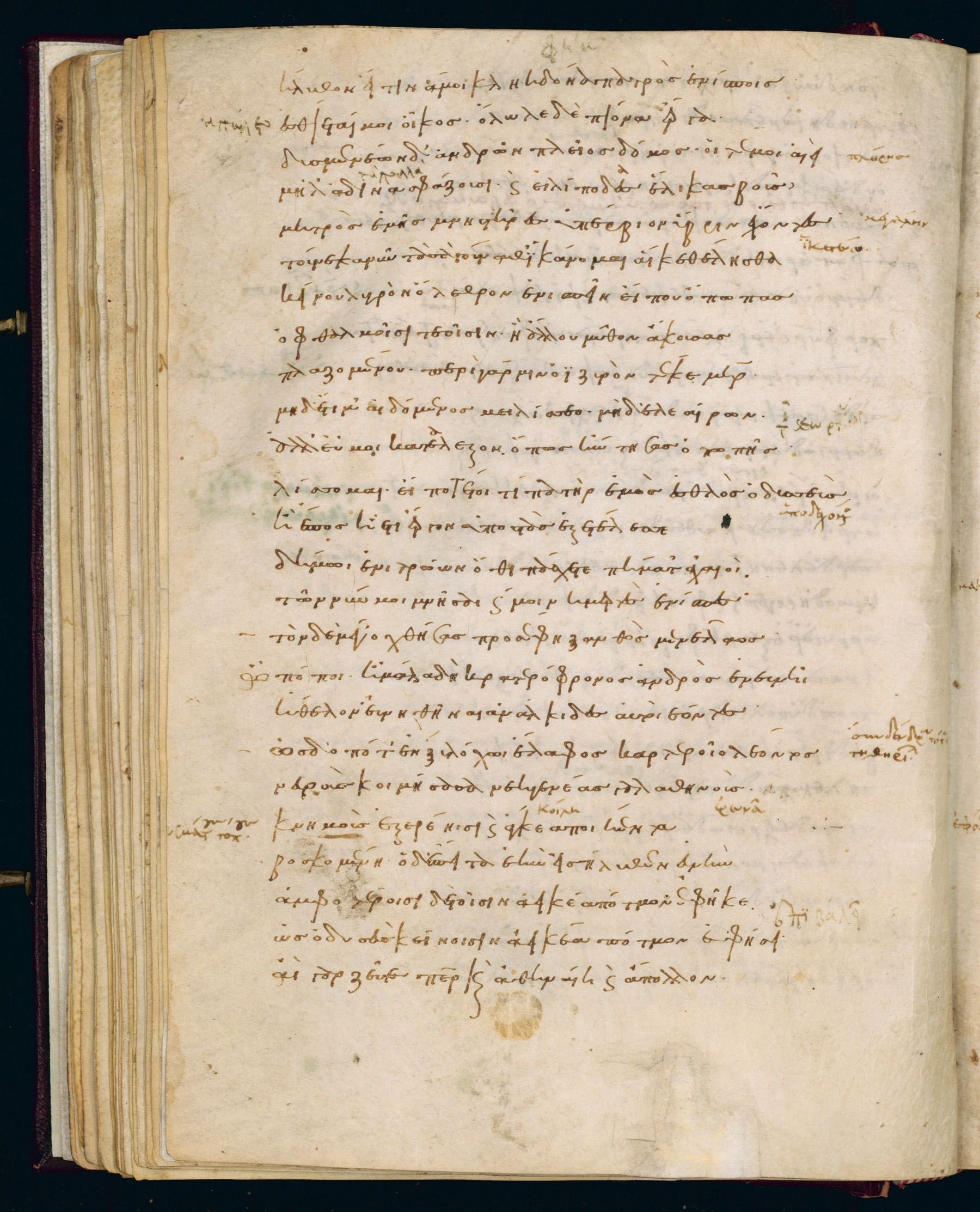
Where on the image
Laur. Plut. 32.24, fol. 35v: Odyssey 4.317-341, begins ‹ἤλυθον, εἴ τινά μοι›, ends ‹καὶ Ἀθηναίη καὶ Ἄπολλον,›. Checked on the image: first and last lines read and matched to the Greek. Fol. 35r ends with 4.316. Fol. 36r begins with 4.342. English blocks here: 315-319, 320-324, 325-329, 330-334, 335-339.
317ἤλυθον, εἴ τινά μοι κληηδόνα πατρὸς ἐνίσποις.
318ἐσθίεταί μοι οἶκος, ὄλωλε δὲ πίονα ἔργα,
319δυσμενέων δʼ ἀνδρῶν πλεῖος δόμος, οἵ τέ μοι αἰεὶ
320μῆλʼ ἁδινὰ σφάζουσι καὶ εἰλίποδας ἕλικας βοῦς,
321μητρὸς ἐμῆς μνηστῆρες ὑπέρβιον ὕβριν ἔχοντες.
322τοὔνεκα νῦν τὰ σὰ γούναθʼ ἱκάνομαι, αἴ κʼ ἐθέλῃσθα
323κείνου λυγρὸν ὄλεθρον ἐνισπεῖν, εἴ που ὄπωπας
324ὀφθαλμοῖσι τεοῖσιν ἢ ἄλλου μῦθον ἄκουσας
325πλαζομένου· περὶ γάρ μιν ὀιζυρὸν τέκε μήτηρ.
326μηδέ τί μʼ αἰδόμενος μειλίσσεο μηδʼ ἐλεαίρων,
327ἀλλʼ εὖ μοι κατάλεξον ὅπως ἤντησας ὀπωπῆς.
328λίσσομαι, εἴ ποτέ τοί τι πατὴρ ἐμός, ἐσθλὸς Ὀδυσσεὺς
329ἢ ἔπος ἠέ τι ἔργον ὑποστὰς ἐξετέλεσσε
330δήμῳ ἔνι Τρώων, ὅθι πάσχετε πήματʼ Ἀχαιοί,
331τῶν νῦν μοι μνῆσαι, καί μοι νημερτὲς ἐνίσπες.
332τὸν δὲ μέγʼ ὀχθήσας προσέφη ξανθὸς Μενέλαος·
333ὢ πόποι, ἦ μάλα δὴ κρατερόφρονος ἀνδρὸς ἐν εὐνῇ
334ἤθελον εὐνηθῆναι ἀνάλκιδες αὐτοὶ ἐόντες.
335ὡς δʼ ὁπότʼ ἐν ξυλόχῳ ἔλαφος κρατεροῖο λέοντος
336νεβροὺς κοιμήσασα νεηγενέας γαλαθηνοὺς
337κνημοὺς ἐξερέῃσι καὶ ἄγκεα ποιήεντα
338βοσκομένη, ὁ δʼ ἔπειτα ἑὴν εἰσήλυθεν εὐνήν,
339ἀμφοτέροισι δὲ τοῖσιν ἀεικέα πότμον ἐφῆκεν,
340ὣς Ὀδυσεὺς κείνοισιν ἀεικέα πότμον ἐφήσει.
341αἲ γάρ, Ζεῦ τε πάτερ καὶ Ἀθηναίη καὶ Ἄπολλον,
315Then wise Telemachus answered him: “Menelaus, son of Atreus, fostered of Zeus, leader of hosts, I came if haply thou mightest tell me some tidings of my father. My home is being devoured and my rich lands are ruined; with men that are foes my house is filled, who are ever 320slaying my thronging sheep and my sleek kine of shambling gait, even the wooers of my mother, overweening in their insolence. Therefore am I now come to thy knees, if perchance thou wilt be willing to tell me of his woeful death, whether thou sawest it haply with thine own eyes, or didst hear from some other the story 325of his wanderings; for beyond all men did his mother bear him to sorrow. And do thou no wise out of ruth or pity for me speak soothing words, but tell me truly how thou didst come to behold him. I beseech thee, if ever my father, noble Odysseus, promised aught to thee of word or deed and fulfilled it 330in the land of the Trojans, where you Achaeans suffered woes, be mindful of it now, I pray thee, and tell me the truth.” Then, stirred to sore displeasure, fair-haired Menelaus spoke to him: “Out upon them, for verily in the bed of a man of valiant heart were they fain to lie, who are themselves cravens. 335Even as when in the thicket-lair of a mighty lion a hind has laid to sleep her new-born suckling fawns, and roams over the mountain slopes and grassy vales seeking pasture, and then the lion comes to his lair and upon the two lets loose a cruel doom,
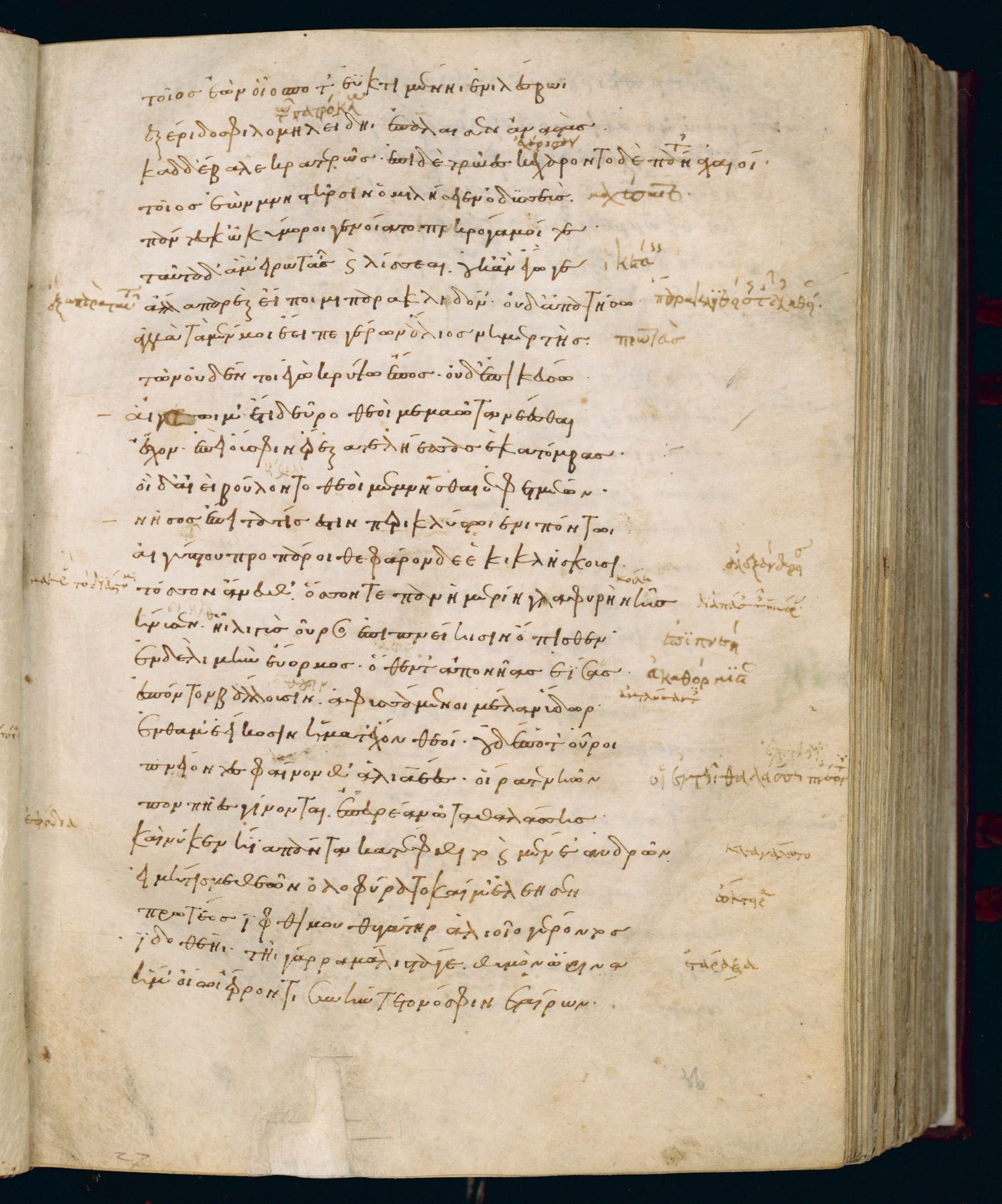
Where on the image
Laur. Plut. 32.24, fol. 36r: Odyssey 4.342-367, begins ‹τοῖος ἐών, οἷός ποτʼ›, ends ‹ἔρροντι συνήντετο νόσφιν ἑταίρων·›. Checked on the image: first and last lines read and matched to the Greek. Fol. 35v ends with 4.341. Fol. 36v begins with 4.368. English blocks here: 340-344, 345-349, 350-350, 351-354, 355-359, 360-364, 365-369.
342τοῖος ἐών, οἷός ποτʼ ἐυκτιμένῃ ἐνὶ Λέσβῳ
343ἐξ ἔριδος Φιλομηλεΐδῃ ἐπάλαισεν ἀναστάς,
344κὰδ δʼ ἔβαλε κρατερῶς, κεχάροντο δὲ πάντες Ἀχαιοί,
345τοῖος ἐὼν μνηστῆρσιν ὁμιλήσειεν Ὀδυσσεύς·
346πάντες κʼ ὠκύμοροί τε γενοίατο πικρόγαμοί τε.
347ταῦτα δʼ ἅ μʼ εἰρωτᾷς καὶ λίσσεαι, οὐκ ἂν ἐγώ γε
348ἄλλα παρὲξ εἴποιμι παρακλιδόν, οὐδʼ ἀπατήσω,
349ἀλλὰ τὰ μέν μοι ἔειπε γέρων ἅλιος νημερτής,
350τῶν οὐδέν τοι ἐγὼ κρύψω ἔπος οὐδʼ ἐπικεύσω.
351Αἰγύπτῳ μʼ ἔτι δεῦρο θεοὶ μεμαῶτα νέεσθαι
352ἔσχον, ἐπεὶ οὔ σφιν ἔρεξα τεληέσσας ἑκατόμβας.
353οἱ δʼ αἰεὶ βούλοντο θεοὶ μεμνῆσθαι ἐφετμέων.
354νῆσος ἔπειτά τις ἔστι πολυκλύστῳ ἐνὶ πόντῳ
355Αἰγύπτου προπάροιθε, Φάρον δέ ἑ κικλήσκουσι,
356τόσσον ἄνευθʼ ὅσσον τε πανημερίη γλαφυρὴ νηῦς
357ἤνυσεν, ᾗ λιγὺς οὖρος ἐπιπνείῃσιν ὄπισθεν·
358ἐν δὲ λιμὴν ἐύορμος, ὅθεν τʼ ἀπὸ νῆας ἐίσας
359ἐς πόντον βάλλουσιν, ἀφυσσάμενοι μέλαν ὕδωρ.
360ἔνθα μʼ ἐείκοσιν ἤματʼ ἔχον θεοί, οὐδέ ποτʼ οὖροι
361πνείοντες φαίνονθʼ ἁλιαέες, οἵ ῥά τε νηῶν
362πομπῆες γίγνονται ἐπʼ εὐρέα νῶτα θαλάσσης.
363καί νύ κεν ἤια πάντα κατέφθιτο καὶ μένεʼ ἀνδρῶν,
364εἰ μή τίς με θεῶν ὀλοφύρατο καί μʼ ἐσάωσε,
365Πρωτέος ἰφθίμου θυγάτηρ ἁλίοιο γέροντος,
366Εἰδοθέη· τῇ γάρ ῥα μάλιστά γε θυμὸν ὄρινα.
367ἥ μʼ οἴῳ ἔρροντι συνήντετο νόσφιν ἑταίρων·
340so will Odysseus let loose a cruel doom upon these men. I would, O father Zeus and Athena and Apollo, that in such strength as when once in fair-stablished Lesbos he rose up and wrestled a match with Philomeleides and threw him mightily, and all the Achaeans rejoiced, 345even in such strength Odysseus might come among the wooers; then should they all find swift destruction and bitterness in their wooing. But in this matter of which thou dost ask and beseech me, verily I will not swerve aside to speak of other things, nor will I deceive thee; but of all that the unerring old man of the sea told me 350not one thing will I hide from thee or conceal. 351“In Egypt, eager though I was to journey hither, the gods still held me back, because I offered not to them hecatombs that bring fulfillment, and the gods ever wished that men should be mindful of their commands. Now there is an island in the surging sea 355in front of Egypt, and men call it Pharos, distant as far as a hollow ship runs in a whole day when the shrill wind blows fair behind her. Therein is a harbor with good anchorage, whence men launch the shapely ships into the sea, when they have drawn supplies of black water. 360There for twenty days the gods kept me, nor ever did the winds that blow over the deep spring up, which speed men's ships over the broad back of the sea. And now would all my stores have been spent and the strength of my men, had not one of the gods taken pity on me and saved me, even Eidothea, 365daughter of mighty Proteus, the old man of the sea; for her heart above all others had I moved. She met me as I wandered alone apart from my comrades, who were ever roaming about the island, fishing with bent hooks, for hunger pinched their bellies;
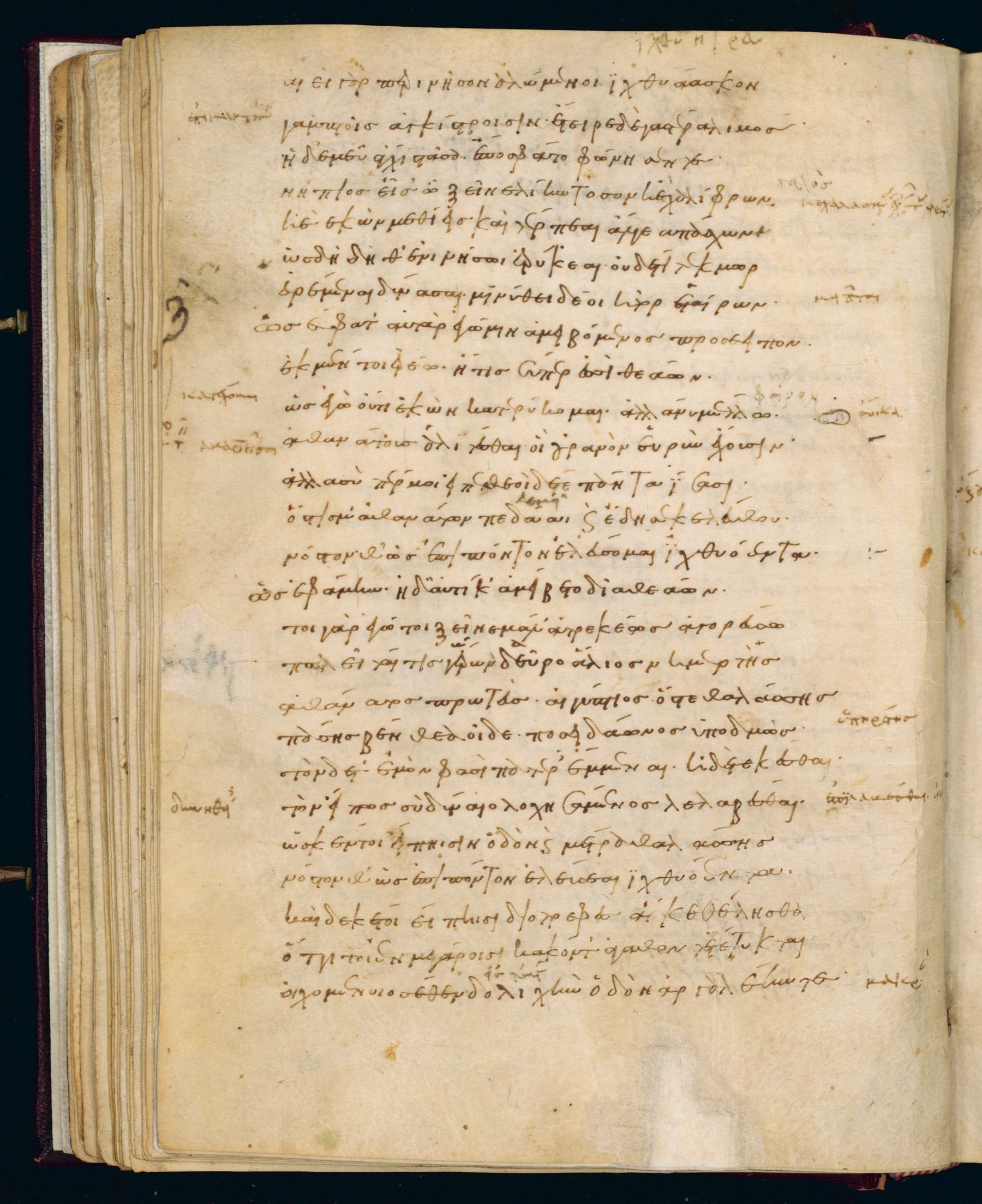
Where on the image
Laur. Plut. 32.24, fol. 36v: Odyssey 4.368-393, begins ‹αἰεὶ γὰρ περὶ νῆσον›, ends ‹δολιχὴν ὁδὸν ἀργαλέην τε.›. Checked on the image: first and last lines read and matched to the Greek. Fol. 36r ends with 4.367. Fol. 37r begins with 4.394. English blocks here: 370-374, 375-379, 380-384, 385-389, 390-394.
368αἰεὶ γὰρ περὶ νῆσον ἀλώμενοι ἰχθυάασκον
369γναμπτοῖς ἀγκίστροισιν, ἔτειρε δὲ γαστέρα λιμός.
370ἡ δέ μευ ἄγχι στᾶσα ἔπος φάτο φώνησέν τε·
371νήπιός εἰς, ὦ ξεῖνε, λίην τόσον ἠδὲ χαλίφρων,
372ἦε ἑκὼν μεθίεις καὶ τέρπεαι ἄλγεα πάσχων;
373ὡς δὴ δήθʼ ἐνὶ νήσῳ ἐρύκεαι, οὐδέ τι τέκμωρ
374εὑρέμεναι δύνασαι, μινύθει δέ τοι ἦτορ ἑταίρων.
375ὣς ἔφατʼ, αὐτὰρ ἐγώ μιν ἀμειβόμενος προσέειπον·
376ἐκ μέν τοι ἐρέω, ἥ τις σύ πέρ ἐσσι θεάων,
377ὡς ἐγὼ οὔ τι ἑκὼν κατερύκομαι, ἀλλά νυ μέλλω
378ἀθανάτους ἀλιτέσθαι, οἳ οὐρανὸν εὐρὺν ἔχουσιν.
379ἀλλὰ σύ πέρ μοι εἰπέ, θεοὶ δέ τε πάντα ἴσασιν,
380ὅς τίς μʼ ἀθανάτων πεδάᾳ καὶ ἔδησε κελεύθου,
381νόστον θʼ, ὡς ἐπὶ πόντον ἐλεύσομαι ἰχθυόεντα.
382ὣς ἐφάμην, ἡ δʼ αὐτίκʼ ἀμείβετο δῖα θεάων·
383τοιγὰρ ἐγώ τοι, ξεῖνε, μάλʼ ἀτρεκέως ἀγορεύσω.
384πωλεῖταί τις δεῦρο γέρων ἅλιος νημερτὴς
385ἀθάνατος Πρωτεὺς Αἰγύπτιος, ὅς τε θαλάσσης
386πάσης βένθεα οἶδε, Ποσειδάωνος ὑποδμώς·
387τὸν δέ τʼ ἐμόν φασιν πατέρʼ ἔμμεναι ἠδὲ τεκέσθαι.
388τόν γʼ εἴ πως σὺ δύναιο λοχησάμενος λελαβέσθαι,
389ὅς κέν τοι εἴπῃσιν ὁδὸν καὶ μέτρα κελεύθου
390νόστον θʼ, ὡς ἐπὶ πόντον ἐλεύσεαι ἰχθυόεντα.
391καὶ δέ κέ τοι εἴπῃσι, διοτρεφές, αἴ κʼ ἐθέλῃσθα,
392ὅττι τοι ἐν μεγάροισι κακόν τʼ ἀγαθόν τε τέτυκται
393οἰχομένοιο σέθεν δολιχὴν ὁδὸν ἀργαλέην τε.
370and she came close to me, and spoke, and said: “‘Art thou so very foolish, stranger, and slack of wit, or art thou of thine own will remiss, and hast pleasure in suffering woes? So long art thou pent in the isle and canst find no sign of deliverance and the heart of thy comrades grows faint.’ 375“So she spoke, and I made answer and said: ‘I will speak out and tell thee, whosoever among goddesses thou art, that in no wise am I pent here of mine own will, but it must be that I have sinned against the immortals, who hold broad heaven. But do thou tell me—for the gods know all things— 380who of the immortals fetters me here, and has hindered me from my path, and tell me of my return, how I may go over the teeming deep.’ “So I spoke, and the beautiful goddess straightway made answer: ‘Then verily, stranger, will I frankly tell thee all. There is wont to come hither the unerring old man of the sea, 385immortal Proteus of Egypt, who knows the depths of every sea, and is the servant of Poseidon. He, they say, is my father that begat me. If thou couldst in any wise lie in wait and catch him, he will tell thee thy way and the measure of thy path, 390and of thy return, how thou mayest go over the teeming deep. Aye, and he will tell thee, thou fostered of Zeus, if so thou wilt, what evil and what good has been wrought in thy halls, while thou hast been gone on thy long and grievous way.’ “So she spoke, and I made answer and said:
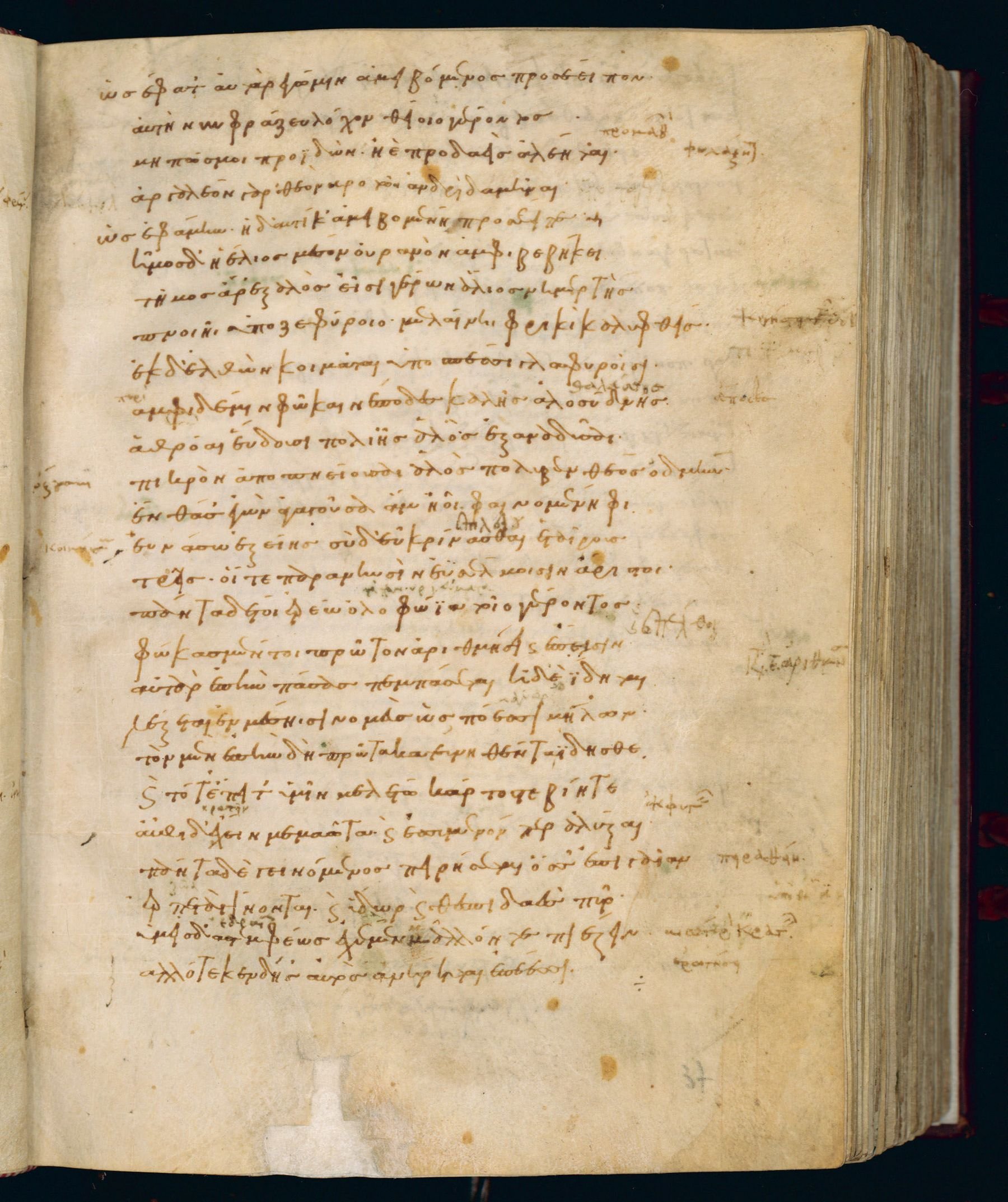
Where on the image
Laur. Plut. 32.24, fol. 37r: Odyssey 4.394-420, begins ‹ὣς ἔφατʼ, αὐτὰρ ἐγώ›, ends ‹σʼ αὐτὸς ἀνείρηται ἐπέεσσι,›. Checked on the image: first and last lines read and matched to the Greek. Fol. 36v ends with 4.393. Fol. 37v begins with 4.421. 4.399 (τοιγὰρ ἐγώ τοι, ξεῖνε ...) is not on the page: the scribe passes from 4.398 to 4.400 (26 lines). English blocks here: 395-397, 398-399, 400-404, 405-409, 410-414, 415-419.
394ὣς ἔφατʼ, αὐτὰρ ἐγώ μιν ἀμειβόμενος προσέειπον·
395αὐτὴ νῦν φράζευ σὺ λόχον θείοιο γέροντος,
396μή πώς με προϊδὼν ἠὲ προδαεὶς ἀλέηται·
397ἀργαλέος γάρ τʼ ἐστὶ θεὸς βροτῷ ἀνδρὶ δαμῆναι.
398ὣς ἐφάμην, ἡ δʼ αὐτίκʼ ἀμείβετο δῖα θεάων·
399τοιγὰρ ἐγώ τοι, ξεῖνε, μάλʼ ἀτρεκέως ἀγορεύσω.
400ἦμος δʼ ἠέλιος μέσον οὐρανὸν ἀμφιβεβήκῃ,
401τῆμος ἄρʼ ἐξ ἁλὸς εἶσι γέρων ἅλιος νημερτὴς
402πνοιῇ ὕπο Ζεφύροιο μελαίνῃ φρικὶ καλυφθείς,
403ἐκ δʼ ἐλθὼν κοιμᾶται ὑπὸ σπέσσι γλαφυροῖσιν·
404ἀμφὶ δέ μιν φῶκαι νέποδες καλῆς ἁλοσύδνης
405ἁθρόαι εὕδουσιν, πολιῆς ἁλὸς ἐξαναδῦσαι,
406πικρὸν ἀποπνείουσαι ἁλὸς πολυβενθέος ὀδμήν.
407ἔνθα σʼ ἐγὼν ἀγαγοῦσα ἅμʼ ἠοῖ φαινομένηφιν
408εὐνάσω ἑξείης· σὺ δʼ ἐὺ κρίνασθαι ἑταίρους
409τρεῖς, οἵ τοι παρὰ νηυσὶν ἐυσσέλμοισιν ἄριστοι.
410πάντα δέ τοι ἐρέω ὀλοφώια τοῖο γέροντος.
411φώκας μέν τοι πρῶτον ἀριθμήσει καὶ ἔπεισιν·
412αὐτὰρ ἐπὴν πάσας πεμπάσσεται ἠδὲ ἴδηται,
413λέξεται ἐν μέσσῃσι νομεὺς ὣς πώεσι μήλων.
414τὸν μὲν ἐπὴν δὴ πρῶτα κατευνηθέντα ἴδησθε,
415καὶ τότʼ ἔπειθʼ ὑμῖν μελέτω κάρτος τε βίη τε,
416αὖθι δʼ ἔχειν μεμαῶτα καὶ ἐσσύμενόν περ ἀλύξαι.
417πάντα δὲ γιγνόμενος πειρήσεται, ὅσσʼ ἐπὶ γαῖαν
418ἑρπετὰ γίγνονται, καὶ ὕδωρ καὶ θεσπιδαὲς πῦρ·
419ὑμεῖς δʼ ἀστεμφέως ἐχέμεν μᾶλλόν τε πιέζειν.
420ἀλλʼ ὅτε κεν δή σʼ αὐτὸς ἀνείρηται ἐπέεσσι,
395‘Do thou thyself now devise a means of lying in wait for the divine old man, lest haply he see me beforehand and being ware of my purpose avoid me. For hard is a god for a mortal man to master.’ 398“So I spoke, and the beautiful goddess straightway made answer: ‘Then verily, stranger, will I frankly tell thee all. 400When the sun hath reached mid-heaven, the unerring old man of the sea is wont to come forth from the brine at the breath of the West Wind, hidden by the dark ripple. And when he is come forth, he lies down to sleep in the hollow caves; and around him the seals, the brood of the fair daughter of the sea, 405sleep in a herd, coming forth from the gray water, and bitter is the smell they breathe of the depths of the sea. Thither will I lead thee at break of day and lay you all in a row; for do thou choose carefully three of thy companions, who are the best thou hast in thy well-benched ships. 410And I will tell thee all the wizard wiles of that old man. First he will count the seals, and go over them; but when he has told them all off by fives, and beheld them, he will lay himself down in their midst, as a shepherd among his flocks of sheep. Now so soon as you see him laid to rest, 415thereafter let your hearts be filled with strength and courage, and do you hold him there despite his striving and struggling to escape. For try he will, and will assume all manner of shapes of all things that move upon the earth, and of water, and of wondrous blazing fire. Yet do ye hold him unflinchingly and grip him yet the more.
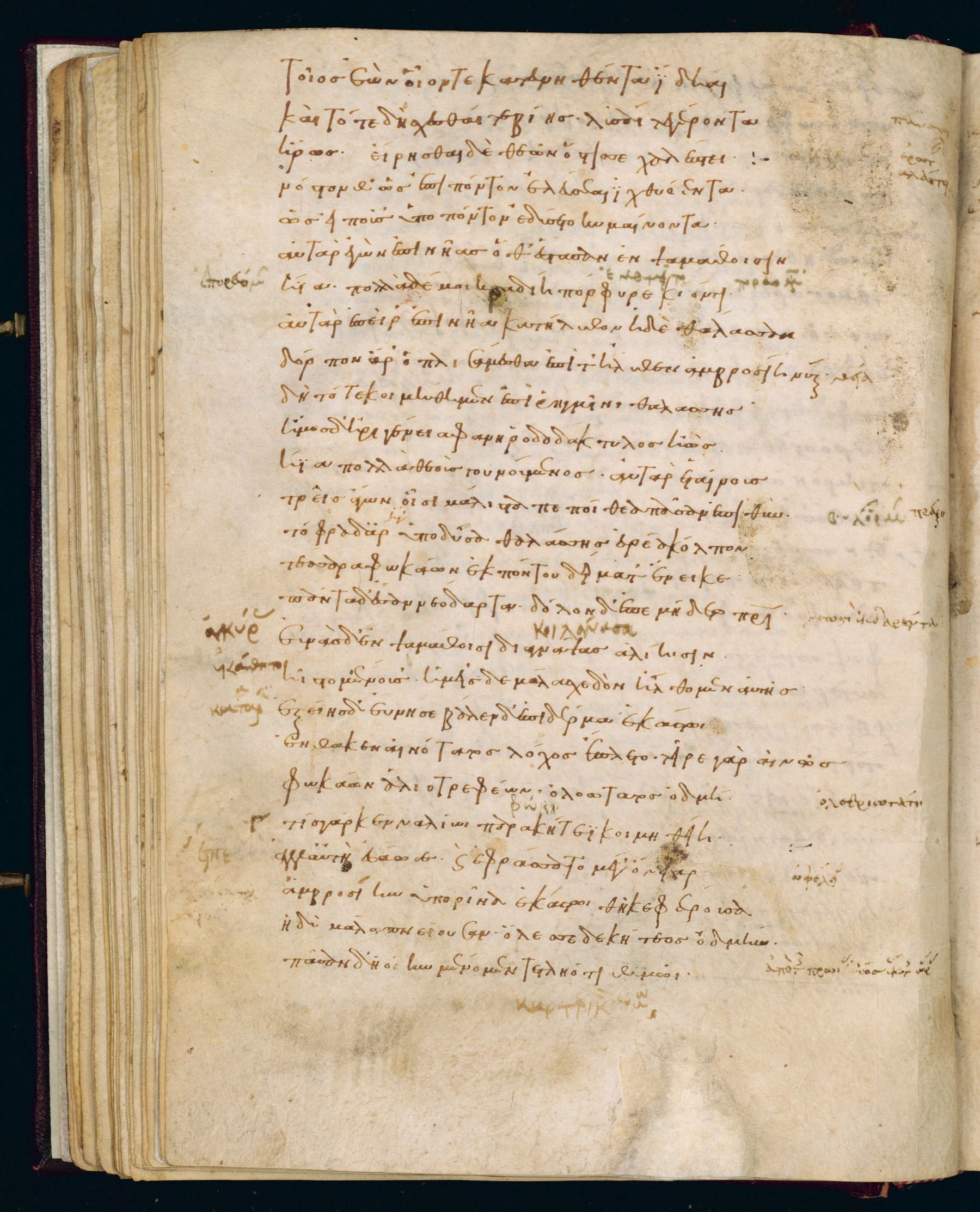
Where on the image
Laur. Plut. 32.24, fol. 37v: Odyssey 4.421-447, begins ‹τοῖος ἐὼν οἷόν κε›, ends ‹ἠοίην μένομεν τετληότι θυμῷ·›. Checked on the image: first and last lines read and matched to the Greek. Fol. 37r ends with 4.420. Fol. 38r begins with 4.448. 4.432 (καὶ τότε δὴ παρὰ θῖνα θαλάσσης εὐρυπόροιο) is not on the page: the scribe passes from 4.431 to 4.433 (26 lines). English blocks here: 420-424, 425-429, 430-434, 435-439, 440-444, 445-449.
421τοῖος ἐὼν οἷόν κε κατευνηθέντα ἴδησθε,
422καὶ τότε δὴ σχέσθαι τε βίης λῦσαί τε γέροντα,
423ἥρως, εἴρεσθαι δέ, θεῶν ὅς τίς σε χαλέπτει,
424νόστον θʼ, ὡς ἐπὶ πόντον ἐλεύσεαι ἰχθυόεντα.
425ὣς εἰποῦσʼ ὑπὸ πόντον ἐδύσετο κυμαίνοντα.
426αὐτὰρ ἐγὼν ἐπὶ νῆας, ὅθʼ ἕστασαν ἐν ψαμάθοισιν,
427ἤια· πολλὰ δέ μοι κραδίη πόρφυρε κιόντι.
428αὐτὰρ ἐπεί ῥʼ ἐπὶ νῆα κατήλυθον ἠδὲ θάλασσαν,
429δόρπον θʼ ὁπλισάμεσθʼ, ἐπί τʼ ἤλυθεν ἀμβροσίη νύξ·
430δὴ τότε κοιμήθημεν ἐπὶ ῥηγμῖνι θαλάσσης.
431ἦμος δʼ ἠριγένεια φάνη ῥοδοδάκτυλος Ἠώς,
432καὶ τότε δὴ παρὰ θῖνα θαλάσσης εὐρυπόροιο
433ἤια πολλὰ θεοὺς γουνούμενος· αὐτὰρ ἑταίρους
434τρεῖς ἄγον, οἷσι μάλιστα πεποίθεα πᾶσαν ἐπʼ ἰθύν.
435τόφρα δʼ ἄρʼ ἥ γʼ ὑποδῦσα θαλάσσης εὐρέα κόλπον
436τέσσαρα φωκάων ἐκ πόντου δέρματʼ ἔνεικε·
437πάντα δʼ ἔσαν νεόδαρτα· δόλον δʼ ἐπεμήδετο πατρί.
438εὐνὰς δʼ ἐν ψαμάθοισι διαγλάψασʼ ἁλίῃσιν
439ἧστο μένουσʼ· ἡμεῖς δὲ μάλα σχεδὸν ἤλθομεν αὐτῆς·
440ἑξείης δʼ εὔνησε, βάλεν δʼ ἐπὶ δέρμα ἑκάστῳ.
441ἔνθα κεν αἰνότατος λόχος ἔπλετο· τεῖρε γὰρ αἰνῶς
442φωκάων ἁλιοτρεφέων ὀλοώτατος ὀδμή·
443τίς γάρ κʼ εἰναλίῳ παρὰ κήτεϊ κοιμηθείη;
444ἀλλʼ αὐτὴ ἐσάωσε καὶ ἐφράσατο μέγʼ ὄνειαρ·
445ἀμβροσίην ὑπὸ ῥῖνα ἑκάστῳ θῆκε φέρουσα
446ἡδὺ μάλα πνείουσαν, ὄλεσσε δὲ κήτεος ὀδμήν.
447πᾶσαν δʼ ἠοίην μένομεν τετληότι θυμῷ·
420But when at length of his own will he speaks and questions thee in that shape in which you saw him laid to rest, then, hero, stay thy might, and set the old man free, and ask him who of the gods is wroth with thee, and of thy return, how thou mayest go over the teeming deep.’ 425“So saying she plunged beneath the surging sea, but I went to my ships, where they stood on the sand, and many things did my heart darkly ponder as I went. But when I had come down to the ship and to the sea, and we had made ready our supper, and immortal night had come on, 430then we lay down to rest on the shore of the sea. And as soon as early Dawn appeared, the rosy-fingered, I went along the shore of the broad-wayed sea, praying earnestly to the gods; and I took with me three of my comrades, in whom I trusted most for every adventure. 435“She meanwhile had plunged beneath the broad bosom of the sea, and had brought forth from the deep the skins of four seals, and all were newly flayed; and she devised a plot against her father. She had scooped out lairs in the sand of the sea, and sat waiting; and we came very near to her, 440and she made us to lie down in a row, and cast a skin over each. Then would our ambush have proved most terrible, for terribly did the deadly stench of the brine-bred seals distress us—who would lay him down by a beast of the sea?—but she of herself delivered us, and devised a great boon; 445she brought and placed ambrosia of a very sweet fragrance beneath each man's nose, and destroyed the stench of the beast. So all the morning we waited with steadfast heart, and the seals came forth from the sea in throngs. These then laid them down in rows along the shore of the sea,
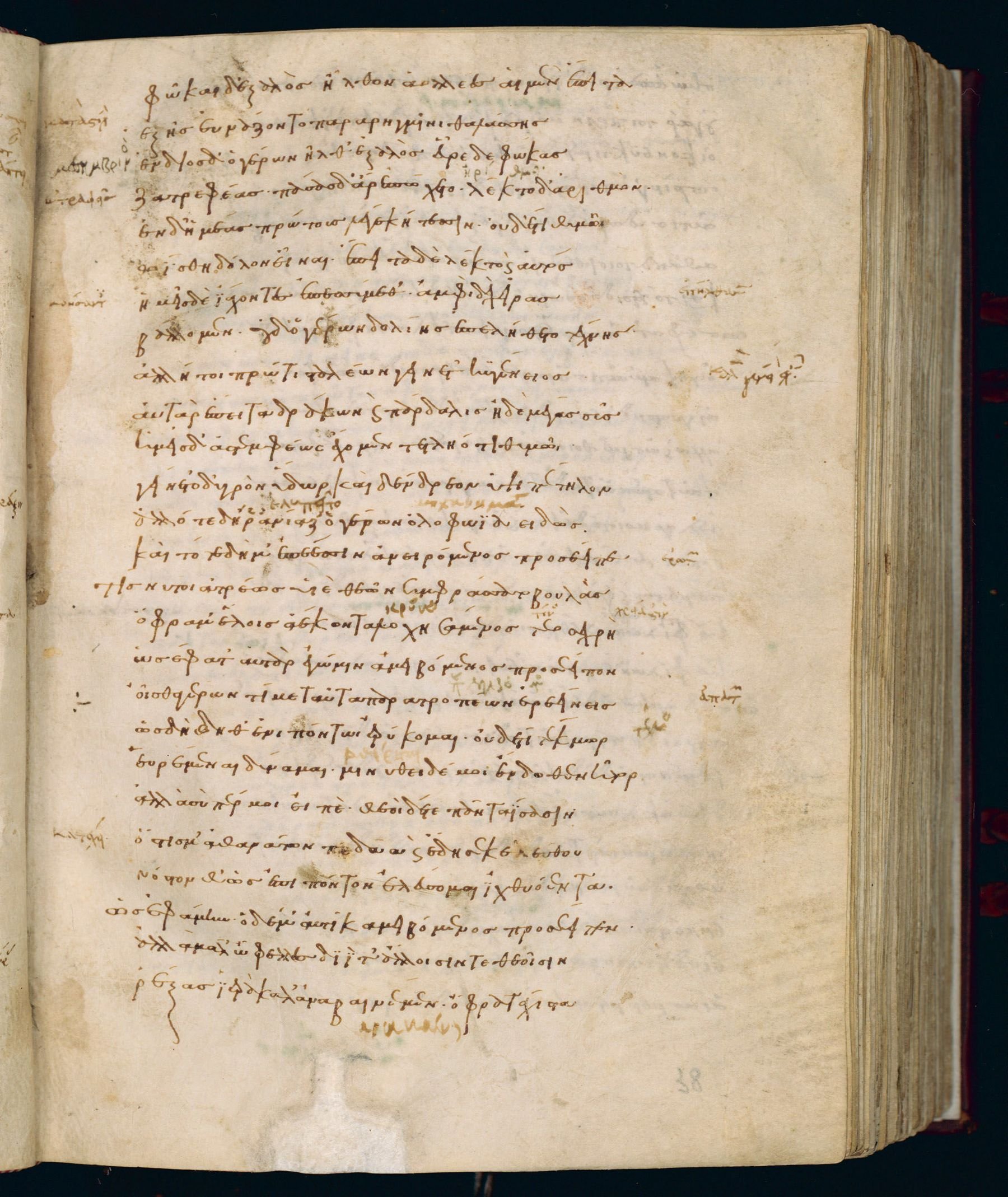
Where on the image
Laur. Plut. 32.24, fol. 38r: Odyssey 4.448-473, begins ‹φῶκαι δʼ ἐξ ἁλὸς›, ends ‹κάλʼ ἀναβαινέμεν, ὄφρα τάχιστα›. Checked on the image: first and last lines read and matched to the Greek. Fol. 37v ends with 4.447. Fol. 38v begins with 4.474. English blocks here: 450-454, 455-459, 460-464, 465-469, 470-474.
448φῶκαι δʼ ἐξ ἁλὸς ἦλθον ἀολλέες. αἱ μὲν ἔπειτα
449ἑξῆς εὐνάζοντο παρὰ ῥηγμῖνι θαλάσσης·
450ἔνδιος δʼ ὁ γέρων ἦλθʼ ἐξ ἁλός, εὗρε δὲ φώκας
451ζατρεφέας, πάσας δʼ ἄρʼ ἐπῴχετο, λέκτο δʼ ἀριθμόν·
452ἐν δʼ ἡμέας πρώτους λέγε κήτεσιν, οὐδέ τι θυμῷ
453ὠΐσθη δόλον εἶναι· ἔπειτα δὲ λέκτο καὶ αὐτός.
454ἡμεῖς δὲ ἰάχοντες ἐπεσσύμεθʼ, ἀμφὶ δὲ χεῖρας
455βάλλομεν· οὐδʼ ὁ γέρων δολίης ἐπελήθετο τέχνης,
456ἀλλʼ ἦ τοι πρώτιστα λέων γένετʼ ἠυγένειος,
457αὐτὰρ ἔπειτα δράκων καὶ πάρδαλις ἠδὲ μέγας σῦς·
458γίγνετο δʼ ὑγρὸν ὕδωρ καὶ δένδρεον ὑψιπέτηλον·
459ἡμεῖς δʼ ἀστεμφέως ἔχομεν τετληότι θυμῷ.
460ἀλλʼ ὅτε δή ῥʼ ἀνίαζʼ ὁ γέρων ὀλοφώια εἰδώς,
461καὶ τότε δή μʼ ἐπέεσσιν ἀνειρόμενος προσέειπε·
462τίς νύ τοι, Ἀτρέος υἱέ, θεῶν συμφράσσατο βουλάς,
463ὄφρα μʼ ἕλοις ἀέκοντα λοχησάμενος; τέο σε χρή;
464ὣς ἔφατʼ, αὐτὰρ ἐγώ μιν ἀμειβόμενος προσέειπον·
465οἶσθα, γέρον, τί με ταῦτα παρατροπέων ἐρεείνεις;
466ὡς δὴ δήθʼ ἐνὶ νήσῳ ἐρύκομαι, οὐδέ τι τέκμωρ
467εὑρέμεναι δύναμαι, μινύθει δέ μοι ἔνδοθεν ἦτορ.
468ἀλλὰ σύ πέρ μοι εἰπέ, θεοὶ δέ τε πάντα ἴσασιν,
469ὅς τίς μʼ ἀθανάτων πεδάᾳ καὶ ἔδησε κελεύθου,
470νόστον θʼ, ὡς ἐπὶ πόντον ἐλεύσομαι ἰχθυόεντα.
471ὣς ἐφάμην, ὁ δέ μʼ αὐτίκʼ ἀμειβόμενος προσέειπεν·
472ἀλλὰ μάλʼ ὤφελλες Διί τʼ ἄλλοισίν τε θεοῖσι
473ῥέξας ἱερὰ κάλʼ ἀναβαινέμεν, ὄφρα τάχιστα
450and at noon the old man came forth from the sea and found the fatted seals; and he went over all, and counted their number. Among the creatures he counted us first, nor did his heart guess that there was guile; and then he too laid him down. Thereat we rushed upon him with a shout, and 455threw our arms about him, nor did that old man forget his crafty wiles. Nay, at the first he turned into a bearded lion, and then into a serpent, and a leopard, and a huge boar; then he turned into flowing water, and into a tree, high and leafy; but we held on unflinchingly with steadfast heart. 460But when at last that old man, skilled in wizard arts, grew weary, then he questioned me, and spoke, and said: “‘Who of the gods, son of Atreus, took counsel with thee that thou mightest lie in wait for me, and take me against my will? Of what hast thou need?’ “So he spoke, and I made answer, and said: 465‘Thou knowest, old man—why dost thou seek to put me off with this question?—how long a time I am pent in this isle, and can find no sign of deliverance, and my heart grows faint within me. But do thou tell me—for the gods know all things—who of the immortals fetters me here, and has hindered me from my path, and tell me 470of my return, how I may go over the teeming deep.’ “So I spoke, and he straightway made answer, and said: ‘Nay, surely thou oughtest to have made fair offerings to Zeus and the other gods before embarking, that with greatest speed thou mightest have come to thy country, sailing over the wine-dark sea.
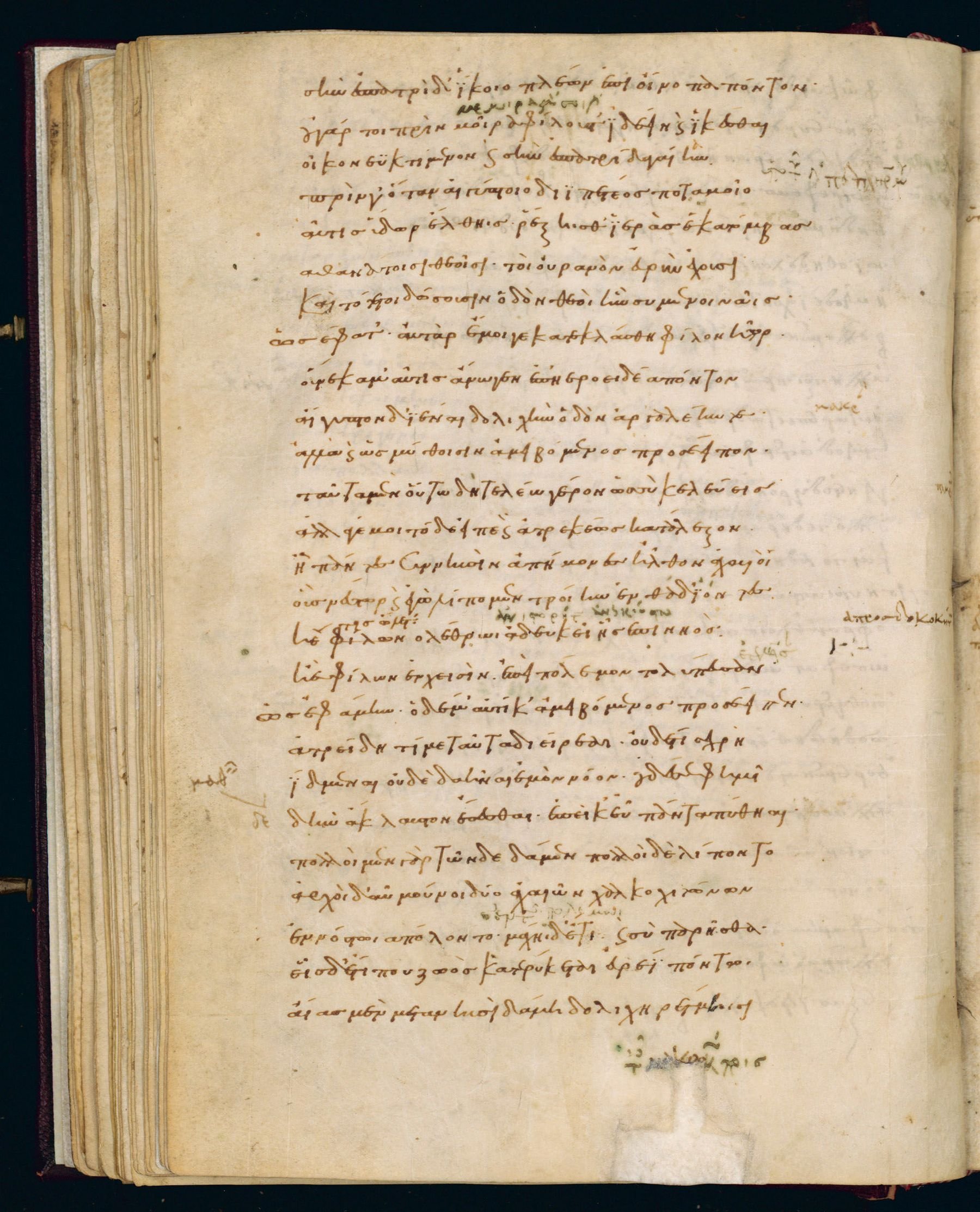
Where on the image
Laur. Plut. 32.24, fol. 38v: Odyssey 4.474-499, begins ‹σὴν ἐς πατρίδʼ ἵκοιο›, ends ‹μετὰ νηυσὶ δάμη δολιχηρέτμοισι.›. Checked on the image: first and last lines read and matched to the Greek. Fol. 38r ends with 4.473. Fol. 39r begins with 4.500. English blocks here: 475-479, 480-480, 481-484, 485-489, 490-494, 495-499.
474σὴν ἐς πατρίδʼ ἵκοιο πλέων ἐπὶ οἴνοπα πόντον.
475οὐ γάρ τοι πρὶν μοῖρα φίλους τʼ ἰδέειν καὶ ἱκέσθαι
476οἶκον ἐυκτίμενον καὶ σὴν ἐς πατρίδα γαῖαν,
477πρίν γʼ ὅτʼ ἂν Αἰγύπτοιο, διιπετέος ποταμοῖο,
478αὖτις ὕδωρ ἔλθῃς ῥέξῃς θʼ ἱερὰς ἑκατόμβας
479ἀθανάτοισι θεοῖσι, τοὶ οὐρανὸν εὐρὺν ἔχουσι·
480καὶ τότε τοι δώσουσιν ὁδὸν θεοί, ἣν σὺ μενοινᾷς.
481ὣς ἔφατʼ, αὐτὰρ ἐμοί γε κατεκλάσθη φίλον ἦτορ,
482οὕνεκά μʼ αὖτις ἄνωγεν ἐπʼ ἠεροειδέα πόντον
483Αἴγυπτόνδʼ ἰέναι, δολιχὴν ὁδὸν ἀργαλέην τε.
484ἀλλὰ καὶ ὣς μύθοισιν ἀμειβόμενος προσέειπον·
485ταῦτα μὲν οὕτω δὴ τελέω, γέρον, ὡς σὺ κελεύεις.
486ἀλλʼ ἄγε μοι τόδε εἰπὲ καὶ ἀτρεκέως κατάλεξον,
487ἢ πάντες σὺν νηυσὶν ἀπήμονες ἦλθον Ἀχαιοί,
488οὓς Νέστωρ καὶ ἐγὼ λίπομεν Τροίηθεν ἰόντες,
489ἦέ τις ὤλετʼ ὀλέθρῳ ἀδευκέι ἧς ἐπὶ νηὸς
490ἠὲ φίλων ἐν χερσίν, ἐπεὶ πόλεμον τολύπευσεν.
491ὣς ἐφάμην, ὁ δέ μʼ αὐτίκʼ ἀμειβόμενος προσέειπεν·
492Ἀτρεΐδη, τί με ταῦτα διείρεαι; οὐδέ τί σε χρὴ
493ἴδμεναι, οὐδὲ δαῆναι ἐμὸν νόον· οὐδέ σέ φημι
494δὴν ἄκλαυτον ἔσεσθαι, ἐπὴν ἐὺ πάντα πύθηαι.
495πολλοὶ μὲν γὰρ τῶν γε δάμεν, πολλοὶ δὲ λίποντο·
496ἀρχοὶ δʼ αὖ δύο μοῦνοι Ἀχαιῶν χαλκοχιτώνων
497ἐν νόστῳ ἀπόλοντο· μάχῃ δέ τε καὶ σὺ παρῆσθα.
498εἷς δʼ ἔτι που ζωὸς κατερύκεται εὐρέι πόντῳ.
499Αἴας μὲν μετὰ νηυσὶ δάμη δολιχηρέτμοισι.
475For it is not thy fate to see thy friends, and reach thy well-built house and thy native land, before that thou hast once more gone to the waters of Aegyptus, the heaven-fed river, and hast offered holy hecatombs to the immortal gods who hold broad heaven. 480Then at length shall the gods grant thee the journey thou desirest.’ 481“So he spoke, and my spirit was broken within me, for that he bade me go again over the misty deep to Aegyptus, a long and weary way. Yet even so I made answer, and said: 485“‘All this will I perform, old man, even as thou dost bid. But come now, tell me this, and declare it truly. Did all the Achaeans return unscathed in their ships, all those whom Nestor and I left, as we set out from Troy? Or did any perish by a cruel death on board his ship, 490or in the arms of his friends, when he had wound up the skein of war?’ “So I spoke, and he straightway made answer, and said: ‘Son of Atreus, why dost thou question me of this? In no wise does it behove thee to know, or to learn my mind; nor, methinks, wilt thou long be free from tears, when thou hast heard all aright. 495For many of them were slain, and many were left; but two chieftains alone of the brazen-coated Achaeans perished on their homeward way ( as for the fighting, thou thyself wast there), and one, I ween, still lives, and is held back on the broad deep. “‘Aias truly was lost amid his long-oared ships.
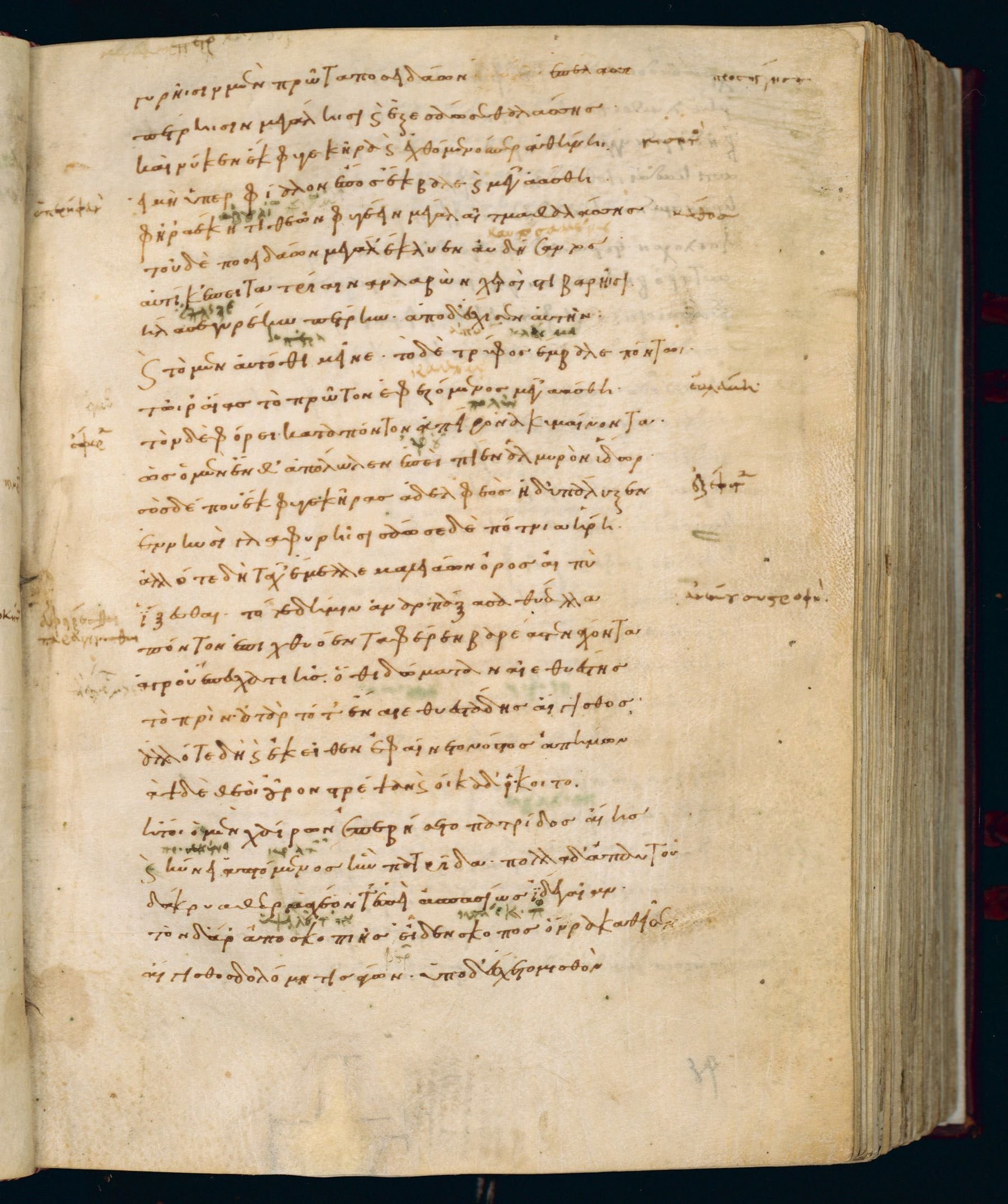
Where on the image
Laur. Plut. 32.24, fol. 39r: Odyssey 4.500-525, begins ‹Γυρῇσίν μιν πρῶτα Ποσειδάων›, ends ‹ὑπὸ δʼ ἔσχετο μισθὸν›. Checked on the image: first and last lines read and matched to the Greek. Fol. 38v ends with 4.499. Fol. 39v begins with 4.526. English blocks here: 500-504, 505-509, 510-511, 512-514, 515-519, 520-524.
500Γυρῇσίν μιν πρῶτα Ποσειδάων ἐπέλασσεν
501πέτρῃσιν μεγάλῃσι καὶ ἐξεσάωσε θαλάσσης·
502καί νύ κεν ἔκφυγε κῆρα καὶ ἐχθόμενός περ Ἀθήνῃ,
503εἰ μὴ ὑπερφίαλον ἔπος ἔκβαλε καὶ μέγʼ ἀάσθη·
504φῆ ῥʼ ἀέκητι θεῶν φυγέειν μέγα λαῖτμα θαλάσσης.
505τοῦ δὲ Ποσειδάων μεγάλʼ ἔκλυεν αὐδήσαντος·
506αὐτίκʼ ἔπειτα τρίαιναν ἑλὼν χερσὶ στιβαρῇσιν
507ἤλασε Γυραίην πέτρην, ἀπὸ δʼ ἔσχισεν αὐτήν·
508καὶ τὸ μὲν αὐτόθι μεῖνε, τὸ δὲ τρύφος ἔμπεσε πόντῳ,
509τῷ ῥʼ Αἴας τὸ πρῶτον ἐφεζόμενος μέγʼ ἀάσθη·
510τὸν δʼ ἐφόρει κατὰ πόντον ἀπείρονα κυμαίνοντα.
511ὣς ὁ μὲν ἔνθʼ ἀπόλωλεν, ἐπεὶ πίεν ἁλμυρὸν ὕδωρ.
512σὸς δέ που ἔκφυγε κῆρας ἀδελφεὸς ἠδʼ ὑπάλυξεν
513ἐν νηυσὶ γλαφυρῇσι· σάωσε δὲ πότνια Ἥρη.
514ἀλλʼ ὅτε δὴ τάχʼ ἔμελλε Μαλειάων ὄρος αἰπὺ
515ἵξεσθαι, τότε δή μιν ἀναρπάξασα θύελλα
516πόντον ἐπʼ ἰχθυόεντα φέρεν βαρέα στενάχοντα,
517ἀγροῦ ἐπʼ ἐσχατιήν, ὅθι δώματα ναῖε Θυέστης
518τὸ πρίν, ἀτὰρ τότʼ ἔναιε Θυεστιάδης Αἴγισθος.
519ἀλλʼ ὅτε δὴ καὶ κεῖθεν ἐφαίνετο νόστος ἀπήμων,
520ἂψ δὲ θεοὶ οὖρον στρέψαν, καὶ οἴκαδʼ ἵκοντο,
521ἦ τοι ὁ μὲν χαίρων ἐπεβήσετο πατρίδος αἴης
522καὶ κύνει ἁπτόμενος ἣν πατρίδα· πολλὰ δʼ ἀπʼ αὐτοῦ
523δάκρυα θερμὰ χέοντʼ, ἐπεὶ ἀσπασίως ἴδε γαῖαν.
524τὸν δʼ ἄρʼ ἀπὸ σκοπιῆς εἶδε σκοπός, ὅν ῥα καθεῖσεν
525Αἴγισθος δολόμητις ἄγων, ὑπὸ δʼ ἔσχετο μισθὸν
500Upon the great rocks of Gyrae Poseidon at first drove him, but saved him from the sea; and he would have escaped his doom, hated of Athena though he was, had he not uttered a boastful word in great blindness of heart. He declared that it was in spite of the gods that he had escaped the great gulf of the sea; 505and Poseidon heard his boastful speech, and straightway took his trident in his mighty hands, and smote the rock of Gyrae and clove it in sunder. And one part abode in its place, but the sundered part fell into the sea, even that on which Aias sat at the first when his heart was greatly blinded, 510and it bore him down into the boundless surging deep. So there he perished, when he had drunk the salt water. 512“‘But thy brother escaped, indeed, the fates and shunned them with his hollow ships, for queenly Hera saved him. But when he was now about 515to reach the steep height of Malea, then the storm-wind caught him up and bore him over the teeming deep, groaning heavily, to the border of the land, where aforetime Thyestes dwelt, but where now dwelt Thyestes' son Aegisthus. But when from hence too a safe return was shewed him, 520and the gods changed the course of the wind that it blew fair, and they reached home, then verily with rejoicing did Agamemnon set foot on his native land, and he clasped his land and kissed it, and many were the hot tears that streamed from his eyes, for welcome to him was the sight of his land. Now from his place of watch a watchman saw him, whom
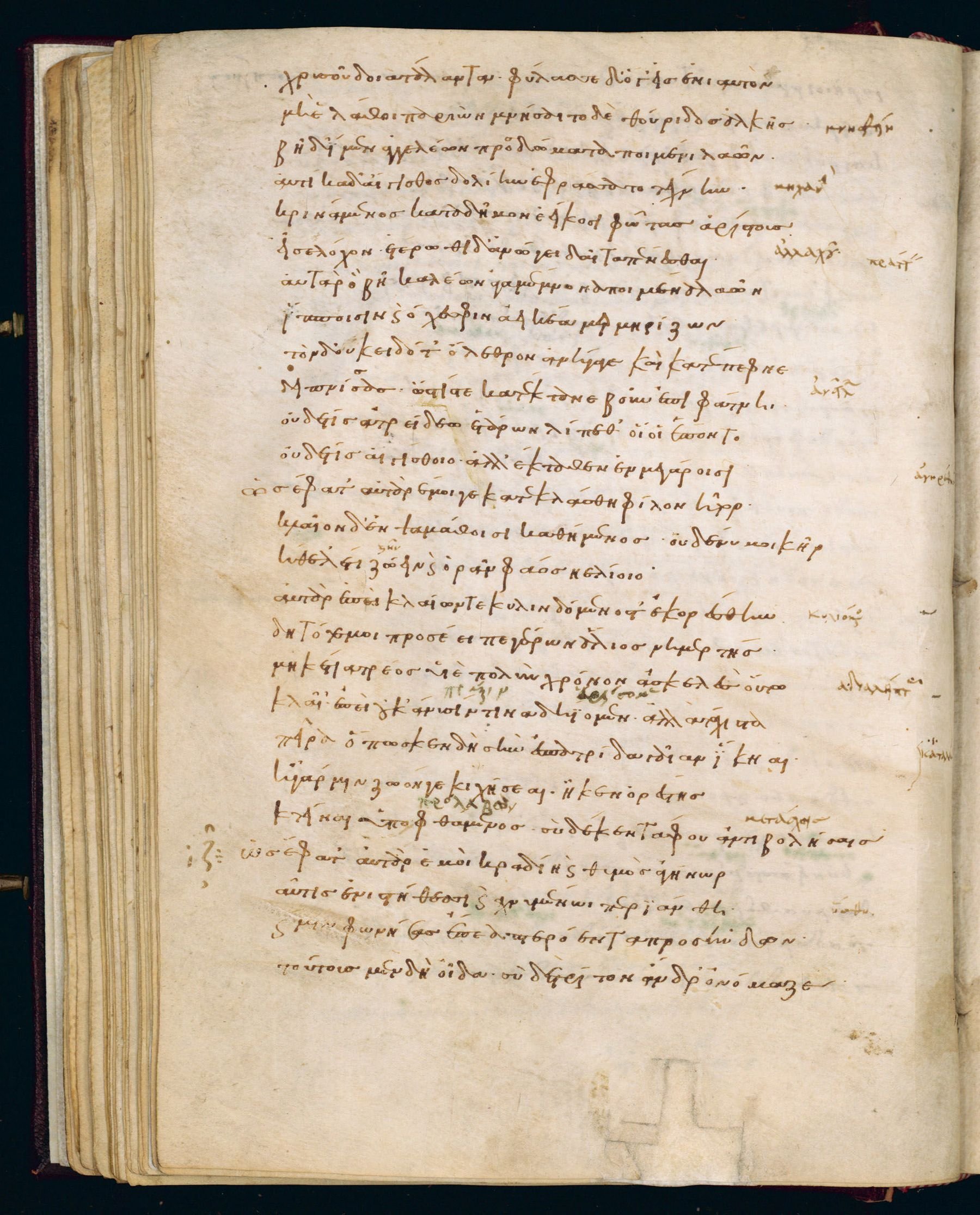
Where on the image
Laur. Plut. 32.24, fol. 39v: Odyssey 4.526-551, begins ‹χρυσοῦ δοιὰ τάλαντα· φύλασσε›, ends ‹δὲ τρίτον ἄνδρʼ ὀνόμαζε,›. Checked on the image: first and last lines read and matched to the Greek. Fol. 39r ends with 4.525. Fol. 40r begins with 4.552. English blocks here: 525-529, 530-534, 535-539, 540-544, 545-549, 550-553.
526χρυσοῦ δοιὰ τάλαντα· φύλασσε δʼ ὅ γʼ εἰς ἐνιαυτόν,
527μή ἑ λάθοι παριών, μνήσαιτο δὲ θούριδος ἀλκῆς.
528βῆ δʼ ἴμεν ἀγγελέων πρὸς δώματα ποιμένι λαῶν.
529αὐτίκα δʼ Αἴγισθος δολίην ἐφράσσατο τέχνην·
530κρινάμενος κατὰ δῆμον ἐείκοσι φῶτας ἀρίστους
531εἷσε λόχον, ἑτέρωθι δʼ ἀνώγει δαῖτα πένεσθαι.
532αὐτὰρ ὁ βῆ καλέων Ἀγαμέμνονα, ποιμένα λαῶν
533ἵπποισιν καὶ ὄχεσφιν, ἀεικέα μερμηρίζων.
534τὸν δʼ οὐκ εἰδότʼ ὄλεθρον ἀνήγαγε καὶ κατέπεφνεν
535δειπνίσσας, ὥς τίς τε κατέκτανε βοῦν ἐπὶ φάτνῃ.
536οὐδέ τις Ἀτρεΐδεω ἑτάρων λίπεθʼ οἵ οἱ ἕποντο,
537οὐδέ τις Αἰγίσθου, ἀλλʼ ἔκταθεν ἐν μεγάροισιν.
538ὣς ἔφατʼ, αὐτὰρ ἐμοί γε κατεκλάσθη φίλον ἦτορ,
539κλαῖον δʼ ἐν ψαμάθοισι καθήμενος, οὐδέ νύ μοι κῆρ
540ἤθελʼ ἔτι ζώειν καὶ ὁρᾶν φάος ἠελίοιο.
541αὐτὰρ ἐπεὶ κλαίων τε κυλινδόμενός τε κορέσθην,
542δὴ τότε με προσέειπε γέρων ἅλιος νημερτής·
543μηκέτι, Ἀτρέος υἱέ, πολὺν χρόνον ἀσκελὲς οὕτω
544κλαῖʼ, ἐπεὶ οὐκ ἄνυσίν τινα δήομεν· ἀλλὰ τάχιστα
545πείρα ὅπως κεν δὴ σὴν πατρίδα γαῖαν ἵκηαι.
546ἢ γάρ μιν ζωόν γε κιχήσεαι, ἤ κεν Ὀρέστης
547κτεῖνεν ὑποφθάμενος, σὺ δέ κεν τάφου ἀντιβολήσαις.
548ὣς ἔφατʼ, αὐτὰρ ἐμοὶ κραδίη καὶ θυμὸς ἀγήνωρ
549αὖτις ἐνὶ στήθεσσι καὶ ἀχνυμένῳ περ ἰάνθη,
550καί μιν φωνήσας ἔπεα πτερόεντα προσηύδων·
551τούτους μὲν δὴ οἶδα· σὺ δὲ τρίτον ἄνδρʼ ὀνόμαζε,
525guileful Aegisthus took and set there, promising him as a reward two talents of gold; and he had been keeping guard for a year, lest Agamemnon should pass by him unseen, and be mindful of his furious might. So he went to the palace to bear the tidings to the shepherd of the people, and Aegisthus straightway planned a treacherous device. 530He chose out twenty men, the best in the land, and set them to lie in wait, but on the further side of the hall he bade prepare a feast. Then he went with chariot and horses to summon Agamemnon, shepherd of the people, his mind pondering a dastardly deed. So he brought him up all unaware of his doom, 535and when he had feasted him he slew him, as one slays an ox at the stall. And not one of the comrades of the son of Atreus was left, of all that followed him, nor one of the men of Aegisthus, but they were all slain in the halls.’ “So he spoke, and my spirit was broken within me, and I wept, as I sat on the sands, nor had my heart 540any longer desire to live and to behold the light of the sun. But when I had had my fill of weeping and writhing, then the unerring old man of the sea said to me: “‘No more, son of Atreus, do thou weep long time thus without ceasing, for in it we shall find no help. Nay, rather, with all the speed thou canst, 545strive that thou mayest come to thy native land, for either thou wilt find Aegisthus alive, or haply Orestes may have forestalled thee and slain him, and thou mayest chance upon his funeral feast.’ “So he spoke, and my heart and spirit were again warmed with comfort in my breast despite my grief, 550and I spoke, and addressed him with winged words: “‘Of these men now I know, but do thou name the third, who he is that still lives, and is held back upon the broad sea, or is haply dead. Fain would I hear, despite my grief.’
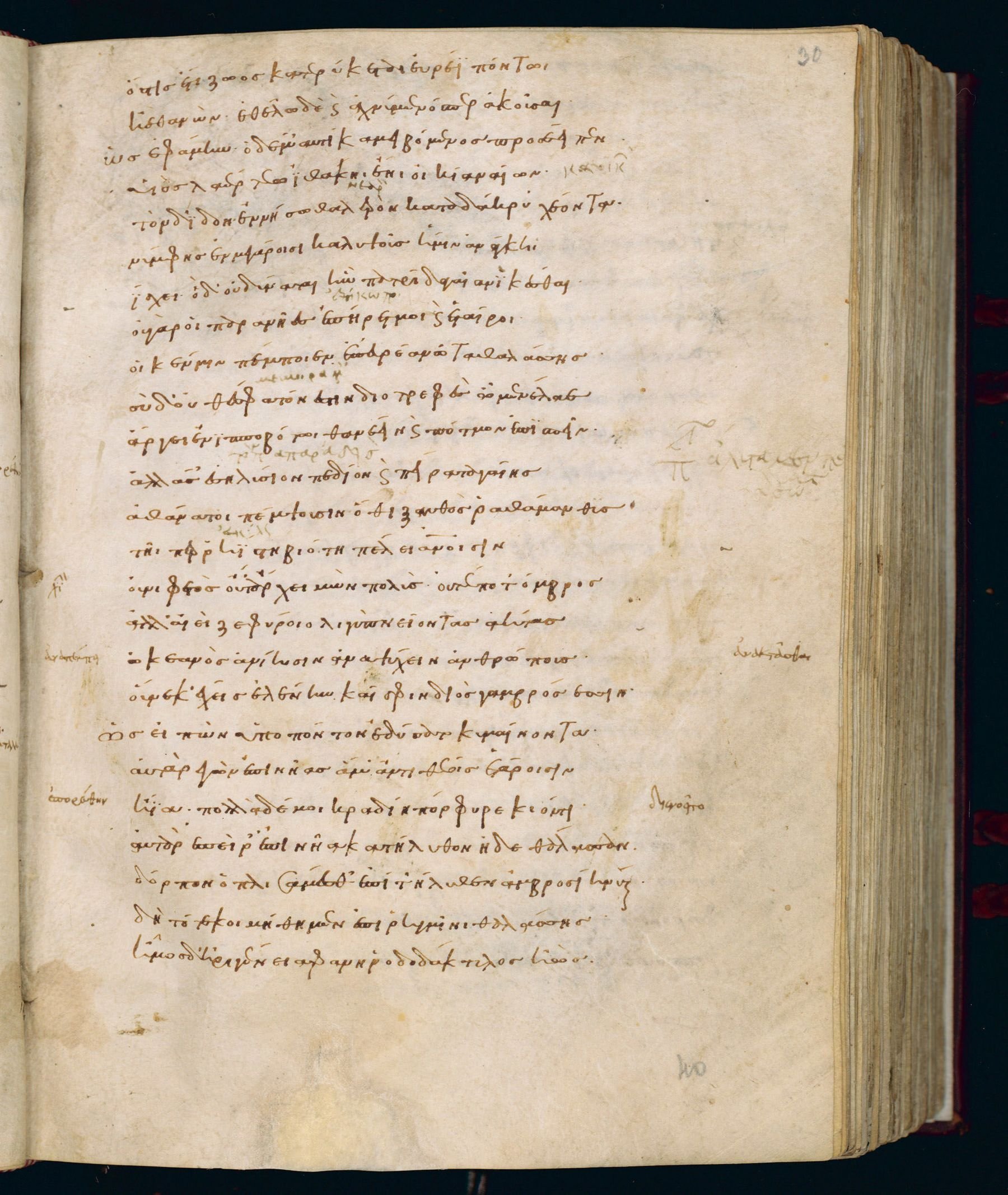
Where on the image
Laur. Plut. 32.24, fol. 40r: Odyssey 4.552-576, begins ‹ὅς τις ἔτι ζωὸς›, ends ‹ἠριγένεια φάνη ῥοδοδάκτυλος Ἠώς,›. Checked on the image: first and last lines read and matched to the Greek. Fol. 39v ends with 4.551. Fol. 40v begins with 4.577. English blocks here: 554-554, 555-559, 560-564, 565-569, 570-574.
552ὅς τις ἔτι ζωὸς κατερύκεται εὐρέι πόντῳ
553ἠὲ θανών· ἐθέλω δὲ καὶ ἀχνύμενός περ ἀκοῦσαι.
554ὣς ἐφάμην, ὁ δέ μʼ αὐτίκʼ ἀμειβόμενος προσέειπεν·
555υἱὸς Λαέρτεω, Ἰθάκῃ ἔνι οἰκία ναίων·
556τὸν δʼ ἴδον ἐν νήσῳ θαλερὸν κατὰ δάκρυ χέοντα,
557νύμφης ἐν μεγάροισι Καλυψοῦς, ἥ μιν ἀνάγκῃ
558ἴσχει· ὁ δʼ οὐ δύναται ἣν πατρίδα γαῖαν ἱκέσθαι·
559οὐ γάρ οἱ πάρα νῆες ἐπήρετμοι καὶ ἑταῖροι,
560οἵ κέν μιν πέμποιεν ἐπʼ εὐρέα νῶτα θαλάσσης.
561σοὶ δʼ οὐ θέσφατόν ἐστι, διοτρεφὲς ὦ Μενέλαε,
562Ἄργει ἐν ἱπποβότῳ θανέειν καὶ πότμον ἐπισπεῖν,
563ἀλλά σʼ ἐς Ἠλύσιον πεδίον καὶ πείρατα γαίης
564ἀθάνατοι πέμψουσιν, ὅθι ξανθὸς Ῥαδάμανθυς,
565τῇ περ ῥηίστη βιοτὴ πέλει ἀνθρώποισιν·
566οὐ νιφετός, οὔτʼ ἂρ χειμὼν πολὺς οὔτε ποτʼ ὄμβρος,
567ἀλλʼ αἰεὶ Ζεφύροιο λιγὺ πνείοντος ἀήτας
568Ὠκεανὸς ἀνίησιν ἀναψύχειν ἀνθρώπους·
569οὕνεκʼ ἔχεις Ἑλένην καί σφιν γαμβρὸς Διός ἐσσι.
570ὣς εἰπὼν ὑπὸ πόντον ἐδύσετο κυμαίνοντα.
571αὐτὰρ ἐγὼν ἐπὶ νῆας ἅμʼ ἀντιθέοις ἑτάροισιν
572ἤια, πολλὰ δέ μοι κραδίη πόρφυρε κιόντι.
573αὐτὰρ ἐπεί ῥʼ ἐπὶ νῆα κατήλθομεν ἠδὲ θάλασσαν,
574δόρπον θʼ ὁπλισάμεσθʼ, ἐπί τʼ ἤλυθεν ἀμβροσίη νύξ,
575δὴ τότε κοιμήθημεν ἐπὶ ῥηγμῖνι θαλάσσης.
576ἦμος δʼ ἠριγένεια φάνη ῥοδοδάκτυλος Ἠώς,
554“So I spoke, and he straightway made answer, and said: 555‘It is the son of Laertes, whose home is in Ithaca. Him I saw in an island, shedding big tears, in the halls of the nymph Calypso, who keeps him there perforce, and he cannot come to his native land, for he has at hand no ships with oars and no comrades 560to send him on his way over the broad back of the sea. But for thyself, Menelaus, fostered of Zeus, it is not ordained that thou shouldst die and meet thy fate in horse-pasturing Argos, but to the Elysian plain and the bounds of the earth will the immortals convey thee, where dwells fair-haired Rhadamanthus, 565and where life is easiest for men. No snow is there, nor heavy storm, nor ever rain, but ever does Ocean send up blasts of the shrill-blowing West Wind that they may give cooling to men; for thou hast Helen to wife, and art in their eyes the husband of the daughter of Zeus.’ 570“So saying he plunged beneath the surging sea, but I went to my ships with my god like comrades, and many things did my heart darkly ponder as I went. But when I had come down to the ship and to the sea, and we had made ready our supper, and immortal night had come on,
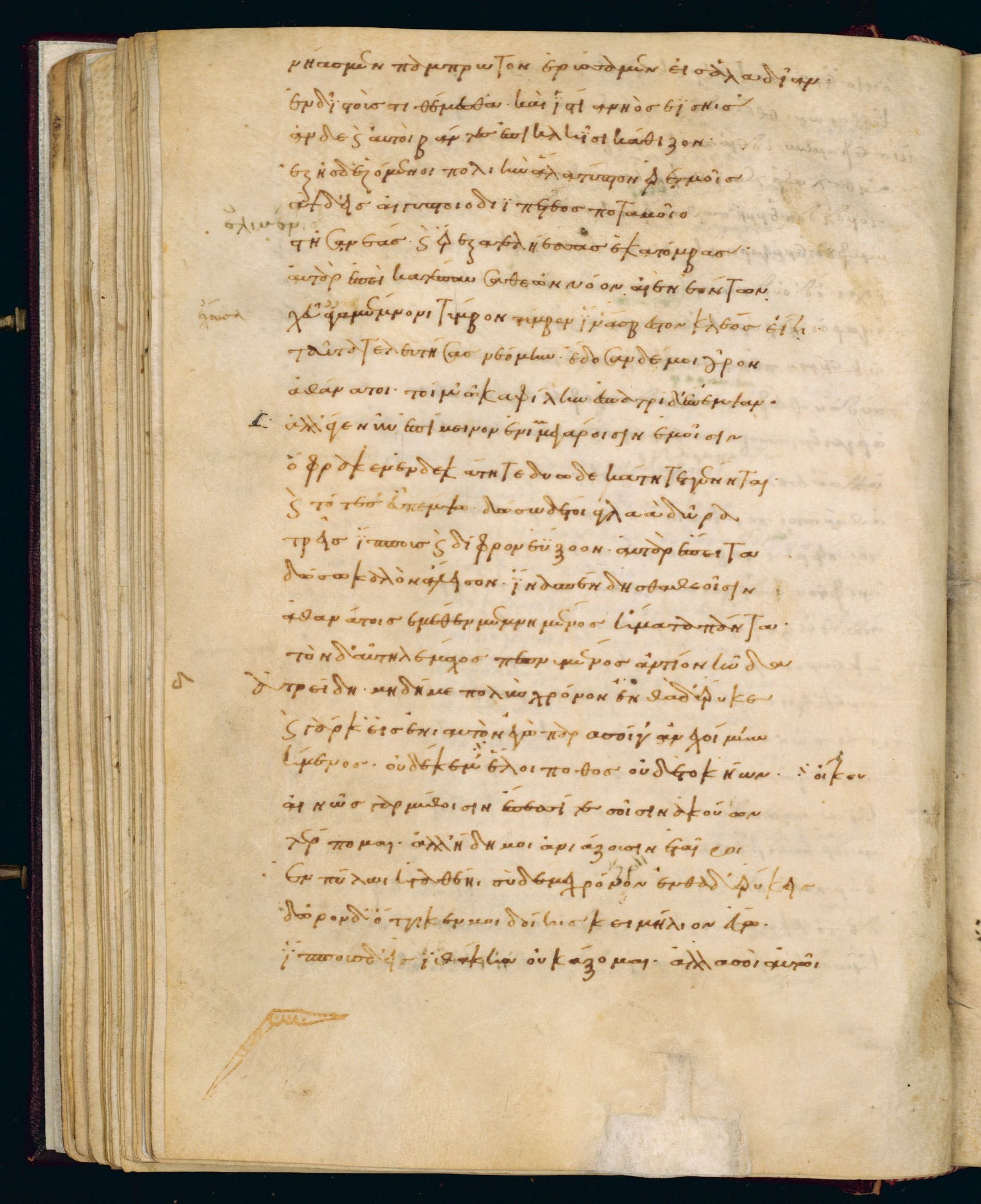
Where on the image
Laur. Plut. 32.24, fol. 40v: Odyssey 4.577-601, begins ‹νῆας μὲν πάμπρωτον ἐρύσσαμεν›, ends ‹ἄξομαι, ἀλλὰ σοὶ αὐτῷ›. Checked on the image: first and last lines read and matched to the Greek. Fol. 40r ends with 4.576. Fol. 41r begins with 4.602. English blocks here: 575-579, 580-584, 585-589, 590-592, 593-594, 595-599.
577νῆας μὲν πάμπρωτον ἐρύσσαμεν εἰς ἅλα δῖαν,
578ἐν δʼ ἱστοὺς τιθέμεσθα καὶ ἱστία νηυσὶν ἐίσῃς,
579ἂν δὲ καὶ αὐτοὶ βάντες ἐπὶ κληῖσι καθῖζον·
580ἑξῆς δʼ ἑζόμενοι πολιὴν ἅλα τύπτον ἐρετμοῖς.
581ἂψ δʼ εἰς Αἰγύπτοιο διιπετέος ποταμοῖο
582στῆσα νέας, καὶ ἔρεξα τεληέσσας ἑκατόμβας.
583αὐτὰρ ἐπεὶ κατέπαυσα θεῶν χόλον αἰὲν ἐόντων,
584χεῦʼ Ἀγαμέμνονι τύμβον, ἵνʼ ἄσβεστον κλέος εἴη.
585ταῦτα τελευτήσας νεόμην, ἔδοσαν δέ μοι οὖρον
586ἀθάνατοι, τοί μʼ ὦκα φίλην ἐς πατρίδʼ ἔπεμψαν.
587ἀλλʼ ἄγε νῦν ἐπίμεινον ἐνὶ μεγάροισιν ἐμοῖσιν,
588ὄφρα κεν ἑνδεκάτη τε δυωδεκάτη τε γένηται·
589καὶ τότε σʼ εὖ πέμψω, δώσω δέ τοι ἀγλαὰ δῶρα,
590τρεῖς ἵππους καὶ δίφρον ἐύξοον· αὐτὰρ ἔπειτα
591δώσω καλὸν ἄλεισον, ἵνα σπένδῃσθα θεοῖσιν
592ἀθανάτοις ἐμέθεν μεμνημένος ἤματα πάντα.
593τὸν δʼ αὖ Τηλέμαχος πεπνυμένος ἀντίον ηὔδα·
594Ἀτρεΐδη, μὴ δή με πολὺν χρόνον ἐνθάδʼ ἔρυκε.
595καὶ γάρ κʼ εἰς ἐνιαυτὸν ἐγὼ παρὰ σοί γʼ ἀνεχοίμην
596ἥμενος, οὐδέ κέ μʼ οἴκου ἕλοι πόθος οὐδὲ τοκήων·
597αἰνῶς γὰρ μύθοισιν ἔπεσσί τε σοῖσιν ἀκούων
598τέρπομαι. ἀλλʼ ἤδη μοι ἀνιάζουσιν ἑταῖροι
599ἐν Πύλῳ ἠγαθέῃ· σὺ δέ με χρόνον ἐνθάδʼ ἐρύκεις.
600δῶρον δʼ ὅττι κέ μοι δοίης, κειμήλιον ἔστω·
601ἵππους δʼ εἰς Ἰθάκην οὐκ ἄξομαι, ἀλλὰ σοὶ αὐτῷ
575then we lay down to rest on the shore of the sea. And as soon as early Dawn appeared, the rosy-fingered, our ships first of all we drew down to the bright sea, and set the masts and the sails in the shapely ships, and the men, too, went on board and sat down upon the benches, 580and sitting well in order smote the grey sea with their oars. So back again to the waters of Aegyptus, the heaven-fed river, I sailed, and there moored my ships and offered hecatombs that bring fulfillment. But when I had stayed the wrath of the gods that are forever, I heaped up a mound to Agamemnon, that his fame might be unquenchable. 585Then, when I had made an end of this, I set out for home, and the immortals gave me a fair wind, and brought me swiftly to my dear native land. But come now, tarry in my halls until the eleventh or the twelfth day be come. Then will I send thee forth with honor and give thee splendid gifts, 590three horses and a well-polished car; and besides I will give thee a beautiful cup, that thou mayest pour libations to the immortal gods, and remember me all thy days.” 593Then wise Telemachus answered him: “Son of Atreus, keep me no long time here, 595for verily for a year would I be content to sit in thy house, nor would desire for home or parents come upon me; for wondrous is the pleasure I take in listening to thy tales and thy speech. But even now my comrades are chafing in sacred Pylos, and thou art keeping me long time here.
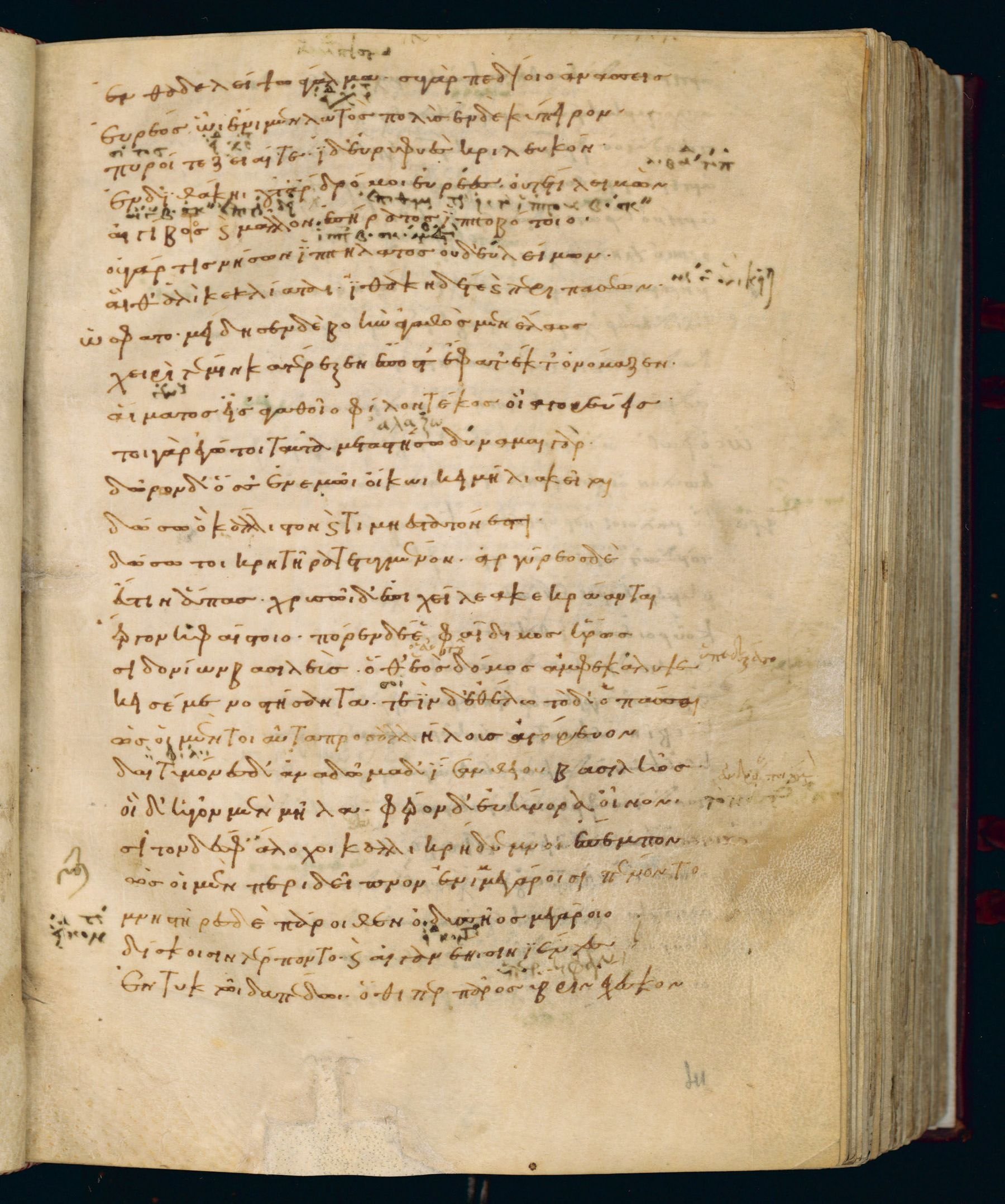
Where on the image
Laur. Plut. 32.24, fol. 41r: Odyssey 4.602-627, begins ‹ἐνθάδε λείψω ἄγαλμα· σὺ›, ends ‹περ πάρος, ὕβριν ἔχοντες.›. Checked on the image: first and last lines read and matched to the Greek. Fol. 40v ends with 4.601. Fol. 41v begins with 4.628. English blocks here: 600-604, 605-609, 610-614, 615-619, 620-624, 625-629.
602ἐνθάδε λείψω ἄγαλμα· σὺ γὰρ πεδίοιο ἀνάσσεις
603εὐρέος, ᾧ ἔνι μὲν λωτὸς πολύς, ἐν δὲ κύπειρον
604πυροί τε ζειαί τε ἰδʼ εὐρυφυὲς κρῖ λευκόν.
605ἐν δʼ Ἰθάκῃ οὔτʼ ἂρ δρόμοι εὐρέες οὔτε τι λειμών·
606αἰγίβοτος, καὶ μᾶλλον ἐπήρατος ἱπποβότοιο.
607οὐ γάρ τις νήσων ἱππήλατος οὐδʼ ἐυλείμων,
608αἵ θʼ ἁλὶ κεκλίαται· Ἰθάκη δέ τε καὶ περὶ πασέων.
609ὣς φάτο, μείδησεν δὲ βοὴν ἀγαθὸς Μενέλαος,
610χειρί τέ μιν κατέρεξεν ἔπος τʼ ἔφατʼ ἔκ τʼ ὀνόμαζεν·
611αἵματός εἰς ἀγαθοῖο, φίλον τέκος, οἷʼ ἀγορεύεις·
612τοιγὰρ ἐγώ τοι ταῦτα μεταστήσω· δύναμαι γάρ.
613δώρων δʼ ὅσσʼ ἐν ἐμῷ οἴκῳ κειμήλια κεῖται,
614δώσω ὃ κάλλιστον καὶ τιμηέστατόν ἐστιν·
615δώσω τοι κρητῆρα τετυγμένον· ἀργύρεος δὲ
616ἔστιν ἅπας, χρυσῷ δʼ ἐπὶ χείλεα κεκράανται,
617ἔργον δʼ Ἡφαίστοιο. πόρεν δέ ἑ Φαίδιμος ἥρως,
618Σιδονίων βασιλεύς, ὅθʼ ἑὸς δόμος ἀμφεκάλυψε
619κεῖσέ με νοστήσαντα· τεῒν δʼ ἐθέλω τόδʼ ὀπάσσαι.
620ὣς οἱ μὲν τοιαῦτα πρὸς ἀλλήλους ἀγόρευον,
621δαιτυμόνες δʼ ἐς δώματʼ ἴσαν θείου βασιλῆος.
622οἱ δʼ ἦγον μὲν μῆλα, φέρον δʼ ἐυήνορα οἶνον·
623σῖτον δέ σφʼ ἄλοχοι καλλικρήδεμνοι ἔπεμπον.
624ὣς οἱ μὲν περὶ δεῖπνον ἐνὶ μεγάροισι πένοντο.
625μνηστῆρες δὲ πάροιθεν Ὀδυσσῆος μεγάροιο
626δίσκοισιν τέρποντο καὶ αἰγανέῃσιν ἱέντες
627ἐν τυκτῷ δαπέδῳ, ὅθι περ πάρος, ὕβριν ἔχοντες.
600And whatsoever gift thou wouldest give me, let it be some treasure; but horses will I not take to Ithaca, but will leave them here for thyself to delight in, for thou art lord of a wide plain, wherein is lotus in abundance, and galingale and wheat and spelt, and broad-eared white barley. 605But in Ithaca there are no widespread courses nor aught of meadow-land. It is a pasture-land of goats and pleasanter than one that pastures horses. For not one of the islands that lean upon the sea is fit for driving horses, or rich in meadows, and Ithaca least of all.” So he spoke, and Menelaus, good at the war-cry, smiled, 610and stroked him with his hand, and spoke, and addressed him: “Thou art of noble blood, dear child, that thou speakest thus. Therefore will I change these gifts, for well I may. Of all the gifts that lie stored as treasures in my house, I will give thee that one which is fairest and costliest. 615I will give thee a well-wrought mixing bowl. All of silver it is, and with gold are the rims thereof gilded, the work of Hephaestus; and the warrior Phaedimus, king of the Sidonians, gave it me, when his house sheltered me as I came thither, and now I am minded to give it to thee.” 620Thus they spoke to one another, and meanwhile the banqueters came to the palace of the divine king. They drove up sheep, and brought strengthening wine, and their wives with beautiful veils sent them bread. Thus they were busied about the feast in the halls. 625But the wooers in front of the palace of Odysseus were making merry, throwing the discus and the javelin in a levelled place, as their wont was, in insolence of heart; and Antinous and godlike Eurymachus were sitting there, the leaders of the wooers, who in valiance were far the best of all.
Where on the image
Laur. Plut. 32.24, fol. 41v: Odyssey 4.628-653, begins ‹Ἀντίνοος δὲ καθῆστο καὶ›, ends ‹ἀρχὸν ἐγὼ βαίνοντʼ ἐνόησα›. Checked on the image: first and last lines read and matched to the Greek. Fol. 41r ends with 4.627. Fol. 42r begins with 4.654. English blocks here: 630-634, 635-639, 640-644, 645-649, 650-654.
628Ἀντίνοος δὲ καθῆστο καὶ Εὐρύμαχος θεοειδής,
629ἀρχοὶ μνηστήρων, ἀρετῇ δʼ ἔσαν ἔξοχʼ ἄριστοι.
630τοῖς δʼ υἱὸς Φρονίοιο Νοήμων ἐγγύθεν ἐλθὼν
631Ἀντίνοον μύθοισιν ἀνειρόμενος προσέειπεν·
632Ἀντίνοʼ, ἦ ῥά τι ἴδμεν ἐνὶ φρεσίν, ἦε καὶ οὐκί,
633ὁππότε Τηλέμαχος νεῖτʼ ἐκ Πύλου ἠμαθόεντος;
634νῆά μοι οἴχετʼ ἄγων· ἐμὲ δὲ χρεὼ γίγνεται αὐτῆς
635Ἤλιδʼ ἐς εὐρύχορον διαβήμεναι, ἔνθα μοι ἵπποι
636δώδεκα θήλειαι, ὑπὸ δʼ ἡμίονοι ταλαεργοὶ
637ἀδμῆτες· τῶν κέν τινʼ ἐλασσάμενος δαμασαίμην.
638ὣς ἔφαθʼ, οἱ δʼ ἀνὰ θυμὸν ἐθάμβεον· οὐ γὰρ ἔφαντο
639ἐς Πύλον οἴχεσθαι Νηλήιον, ἀλλά που αὐτοῦ
640ἀγρῶν ἢ μήλοισι παρέμμεναι ἠὲ συβώτῃ.
641τὸν δʼ αὖτʼ Ἀντίνοος προσέφη Ἐυπείθεος υἱός·
642νημερτές μοι ἔνισπε, πότʼ ᾤχετο καὶ τίνες αὐτῷ
643κοῦροι ἕποντʼ; Ἰθάκης ἐξαίρετοι, ἦ ἑοὶ αὐτοῦ
644θῆτές τε δμῶές τε; δύναιτό κε καὶ τὸ τελέσσαι.
645καί μοι τοῦτʼ ἀγόρευσον ἐτήτυμον, ὄφρʼ ἐὺ εἰδῶ,
646ἤ σε βίῃ ἀέκοντος ἀπηύρα νῆα μέλαιναν,
647ἦε ἑκών οἱ δῶκας, ἐπεὶ προσπτύξατο μύθῳ.
648τὸν δʼ υἱὸς Φρονίοιο Νοήμων ἀντίον ηὔδα·
649αὐτὸς ἑκών οἱ δῶκα· τί κεν ῥέξειε καὶ ἄλλος,
650ὁππότʼ ἀνὴρ τοιοῦτος ἔχων μελεδήματα θυμῷ
651αἰτίζῃ; χαλεπόν κεν ἀνήνασθαι δόσιν εἴη.
652κοῦροι δʼ, οἳ κατὰ δῆμον ἀριστεύουσι μεθʼ ἡμέας,
653οἵ οἱ ἕποντʼ· ἐν δʼ ἀρχὸν ἐγὼ βαίνοντʼ ἐνόησα
630To them Noemon, son of Phronius, drew near, and he questioned Antinous, and spoke, and said: “Antinous, know we at all in our hearts, or know we not, when Telemachus will return from sandy Pylos? He is gone, taking a ship of mine, and I have need of her 635to cross over to spacious Elis, where I have twelve brood mares, and at the teat sturdy mules as yet unbroken. Of these I would fain drive one off and break him in.” So he spoke, and they marvelled at heart, for they did not deem that Telemachus had gone to Neleian Pylos, but that he was somewhere there 640on his lands, among the flocks or with the swineherd. Then Antinous, son of Eupeithes, spoke to him, saying: “Tell me the truth; when did he go, and what youths went with him? Were they chosen youths of Ithaca, or hirelings and slaves of his own? Able would he be to accomplish even that. 645And tell me this truly, that I may know full well. Was it perforce and against thy will that he took from thee the black ship? or didst thou give it him freely of thine own will, because he besought thee?” Then Noemon, son of Phronius, answered him:“I myself freely gave it him. What else could any man do, 650when a man like him, his heart laden with care, makes entreaty? Hard it were to deny the gift. The youths that are the noblest in the land after ourselves, even these have gone with him; and among them I noted one going on board as their leader, Mentor, or a god, who was in all things like unto Mentor.
Where on the image
Laur. Plut. 32.24, fol. 42r: Odyssey 4.654-678, begins ‹Μέντορα, ἠὲ θεόν, τῷ›, ends ‹δʼ ἔνδοθι μῆτιν ὕφαινον.›. Checked on the image: first and last lines read and matched to the Greek. Fol. 41v ends with 4.653. Fol. 42v begins with 4.679. English blocks here: 655-659, 660-664, 665-669, 670-674, 675-679.
654Μέντορα, ἠὲ θεόν, τῷ δʼ αὐτῷ πάντα ἐῴκει.
655ἀλλὰ τὸ θαυμάζω· ἴδον ἐνθάδε Μέντορα δῖον
656χθιζὸν ὑπηοῖον, τότε δʼ ἔμβη νηὶ Πύλονδε.
657ὣς ἄρα φωνήσας ἀπέβη πρὸς δώματα πατρός,
658τοῖσιν δʼ ἀμφοτέροισιν ἀγάσσατο θυμὸς ἀγήνωρ.
659μνηστῆρας δʼ ἄμυδις κάθισαν καὶ παῦσαν ἀέθλων.
660τοῖσιν δʼ Ἀντίνοος μετέφη Εὐπείθεος υἱός,
661ἀχνύμενος· μένεος δὲ μέγα φρένες ἀμφιμέλαιναι
662πίμπλαντʼ, ὄσσε δέ οἱ πυρὶ λαμπετόωντι ἐίκτην·
663ὢ πόποι, ἦ μέγα ἔργον ὑπερφιάλως ἐτελέσθη
664Τηλεμάχῳ ὁδὸς ἥδε· φάμεν δέ οἱ οὐ τελέεσθαι.
665ἐκ τοσσῶνδʼ ἀέκητι νέος πάϊς οἴχεται αὔτως
666νῆα ἐρυσσάμενος, κρίνας τʼ ἀνὰ δῆμον ἀρίστους.
667ἄρξει καὶ προτέρω κακὸν ἔμμεναι· ἀλλά οἱ αὐτῷ
668Ζεὺς ὀλέσειε βίην, πρὶν ἥβης μέτρον ἱκέσθαι.
669ἀλλʼ ἄγε μοι δότε νῆα θοὴν καὶ εἴκοσʼ ἑταίρους,
670ὄφρα μιν αὐτὸν ἰόντα λοχήσομαι ἠδὲ φυλάξω
671ἐν πορθμῷ Ἰθάκης τε Σάμοιό τε παιπαλοέσσης,
672ὡς ἂν ἐπισμυγερῶς ναυτίλλεται εἵνεκα πατρός.
673ὣς ἔφαθʼ, οἱ δʼ ἄρα πάντες ἐπῄνεον ἠδʼ ἐκέλευον.
674αὐτίκʼ ἔπειτʼ ἀνστάντες ἔβαν δόμον εἰς Ὀδυσῆος.
675οὐδʼ ἄρα Πηνελόπεια πολὺν χρόνον ἦεν ἄπυστος
676μύθων, οὓς μνηστῆρες ἐνὶ φρεσὶ βυσσοδόμευον·
677κῆρυξ γάρ οἱ ἔειπε Μέδων, ὃς ἐπεύθετο βουλὰς
678αὐλῆς ἐκτὸς ἐών· οἱ δʼ ἔνδοθι μῆτιν ὕφαινον.
655But at this I marvel. I saw goodly Mentor here yesterday at early dawn; but at that time he embarked for Pylos.” So saying he departed to his father's house, but of those two the proud hearts were angered. The wooers they straightway made to sit down and cease from their games; 660and among them spoke Antinous, son of Eupeithes, in displeasure; and with rage was his black heart wholly filled, and his eyes were like blazing fire. “Out upon him, verily a proud deed has been insolently brought to pass by Telemachus, even this journey, and we deemed that he would never see it accomplished. 665Forth in despite of all of us here the lad is gone without more ado, launching a ship, and choosing the best men in the land. He will begin by and by to be our bane; but to his own undoing may Zeus destroy his might before ever he reaches the measure of manhood. But come, give me a swift ship and twenty men, 670that I may watch in ambush for him as he passes in the strait between Ithaca and rugged Samos. Thus shall his voyaging in search of his father come to a sorry end.” So he spoke, and they all praised his words, and bade him act. And straightway they rose up and went to the house of Odysseus. 675Now Penelope was no long time without knowledge of the plans which the wooers were plotting in the deep of their hearts; for the herald Medon told her, who heard their counsel as he stood without the court and they within were weaving their plot. So he went through the hall to bear the tidings to Penelope;
Where on the image
Laur. Plut. 32.24, fol. 42v: Odyssey 4.679-703, begins ‹βῆ δʼ ἴμεν ἀγγελέων›, ends ‹γούνατα καὶ φίλον ἦτορ,›. Checked on the image: first and last lines read and matched to the Greek. Fol. 42r ends with 4.678. Fol. 43r begins with 4.704. English blocks here: 680-684, 685-689, 690-694, 695-699, 700-704.
679βῆ δʼ ἴμεν ἀγγελέων διὰ δώματα Πηνελοπείῃ·
680τὸν δὲ κατʼ οὐδοῦ βάντα προσηύδα Πηνελόπεια·
681κῆρυξ, τίπτε δέ σε πρόεσαν μνηστῆρες ἀγαυοί;
682ἦ εἰπέμεναι δμῳῇσιν Ὀδυσσῆος θείοιο
683ἔργων παύσασθαι, σφίσι δʼ αὐτοῖς δαῖτα πένεσθαι;
684μὴ μνηστεύσαντες μηδʼ ἄλλοθʼ ὁμιλήσαντες
685ὕστατα καὶ πύματα νῦν ἐνθάδε δειπνήσειαν·
686οἳ θάμʼ ἀγειρόμενοι βίοτον κατακείρετε πολλόν,
687κτῆσιν Τηλεμάχοιο δαΐφρονος· οὐδέ τι πατρῶν
688ὑμετέρων τὸ πρόσθεν ἀκούετε, παῖδες ἐόντες,
689οἷος Ὀδυσσεὺς ἔσκε μεθʼ ὑμετέροισι τοκεῦσιν,
690οὔτε τινὰ ῥέξας ἐξαίσιον οὔτε τι εἰπὼν
691ἐν δήμῳ, ἥ τʼ ἐστὶ δίκη θείων βασιλήων·
692ἄλλον κʼ ἐχθαίρῃσι βροτῶν, ἄλλον κε φιλοίη.
693κεῖνος δʼ οὔ ποτε πάμπαν ἀτάσθαλον ἄνδρα ἐώργει.
694ἀλλʼ ὁ μὲν ὑμέτερος θυμὸς καὶ ἀεικέα ἔργα
695φαίνεται, οὐδέ τίς ἐστι χάρις μετόπισθʼ ἐυεργέων.
696τὴν δʼ αὖτε προσέειπε Μέδων πεπνυμένα εἰδώς·
697αἲ γὰρ δή, βασίλεια, τόδε πλεῖστον κακὸν εἴη.
698ἀλλὰ πολὺ μεῖζόν τε καὶ ἀργαλεώτερον ἄλλο
699μνηστῆρες φράζονται, ὃ μὴ τελέσειε Κρονίων·
700Τηλέμαχον μεμάασι κατακτάμεν ὀξέι χαλκῷ
701οἴκαδε νισόμενον· ὁ δʼ ἔβη μετὰ πατρὸς ἀκουὴν
702ἐς Πύλον ἠγαθέην ἠδʼ ἐς Λακεδαίμονα δῖαν.
703ὣς φάτο, τῆς δʼ αὐτοῦ λύτο γούνατα καὶ φίλον ἦτορ,
680and as he stepped across the threshold Penelope spoke to him and said: “Herald, why have the lordly wooers sent thee forth? Was it to tell the handmaids of divine Odysseus to cease from their tasks, and make ready a feast for them? Never wooing any more, nor consorting together elsewhere, 685may they now feast here their latest and their last—even ye who are ever thronging here and wasting much livelihood, the wealth of wise Telemachus. Surely ye hearkened not at all in olden days, when ye were children, when your fathers told what manner of man Odysseus was among them that begat you, 690in that he wrought no wrong in deed or word to any man in the land, as the wont is of divine kings—one man they hate and another they love. Yet he never wrought iniquity at all to any man. But your mind and your unseemly deeds 695are plain to see, nor is there in after days any gratitude for good deeds done.” Then Medon, wise of heart, answered her: “I would, O queen, that this were the greatest evil. But another greater far and more grievous are the wooers planning, which I pray that the son of Cronos may never bring to pass. 700They are minded to slay Telemachus with the sharp sword on his homeward way; for he went in quest of tidings of his father to sacred Pylos and to goodly Lacedaemon.” So he spoke, and her knees were loosened where she sat, and her heart melted. Long time she was speechless, and both her eyes
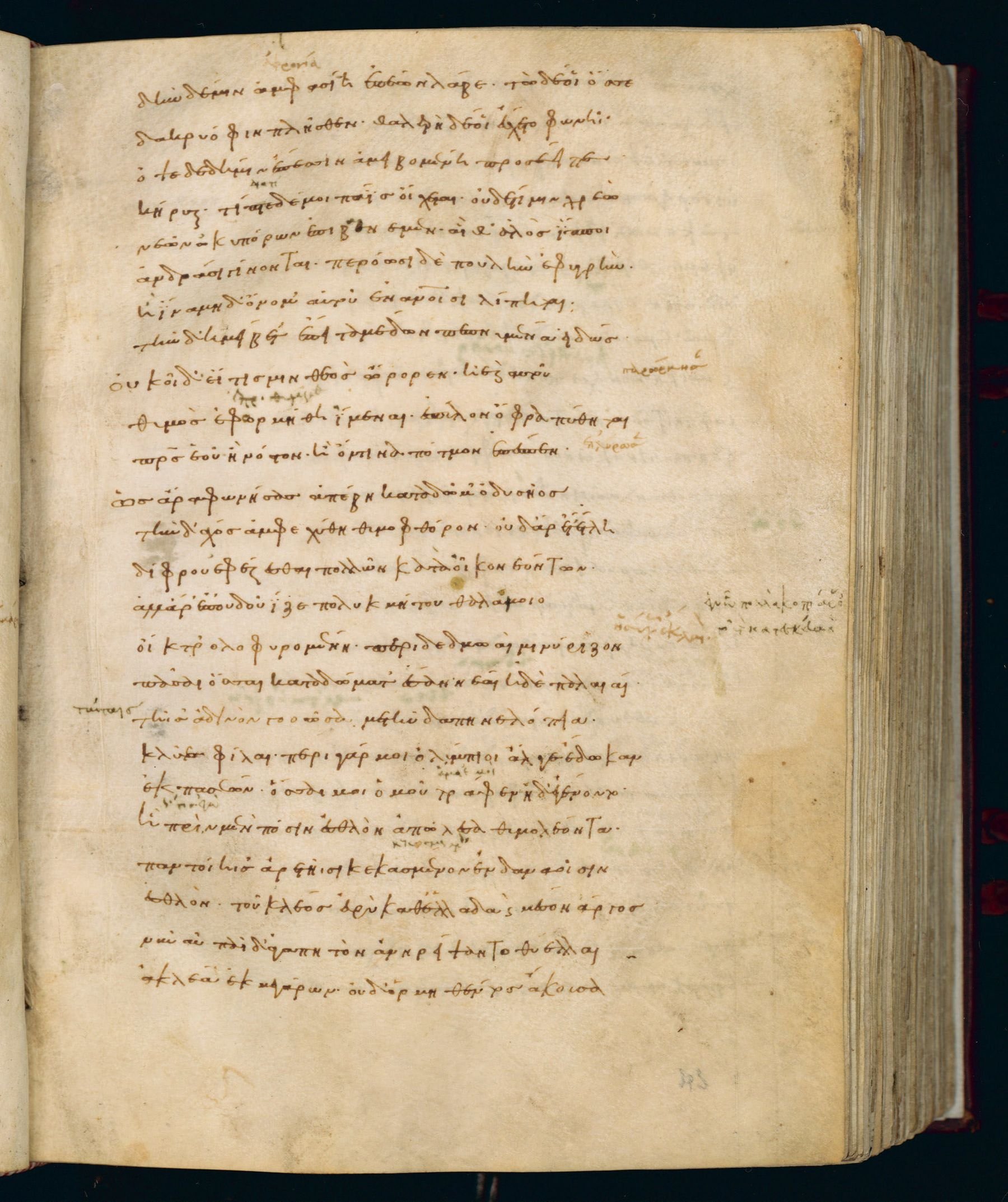
Where on the image
Laur. Plut. 32.24, fol. 43r: Odyssey 4.704-728, begins ‹δὴν δέ μιν ἀμφασίη›, ends ‹μεγάρων, οὐδʼ ὁρμηθέντος ἄκουσα.›. Checked on the image: first and last lines read and matched to the Greek. Fol. 42v ends with 4.703. Fol. 43v begins with 4.729. English blocks here: 705-709, 710-714, 715-719, 720-724, 725-729.
704δὴν δέ μιν ἀμφασίη ἐπέων λάβε· τὼ δέ οἱ ὄσσε
705δακρυόφι πλῆσθεν, θαλερὴ δέ οἱ ἔσχετο φωνή.
706ὀψὲ δὲ δή μιν ἔπεσσιν ἀμειβομένη προσέειπε·
707κῆρυξ, τίπτε δέ μοι πάϊς οἴχεται; οὐδέ τί μιν χρεὼ
708νηῶν ὠκυπόρων ἐπιβαινέμεν, αἵ θʼ ἁλὸς ἵπποι
709ἀνδράσι γίγνονται, περόωσι δὲ πουλὺν ἐφʼ ὑγρήν.
710ἦ ἵνα μηδʼ ὄνομʼ αὐτοῦ ἐν ἀνθρώποισι λίπηται;
711τὴν δʼ ἠμείβετʼ ἔπειτα Μέδων πεπνυμένα εἰδώς·
712οὐκ οἶδʼ ἤ τίς μιν θεὸς ὤρορεν, ἦε καὶ αὐτοῦ
713θυμὸς ἐφωρμήθη ἴμεν ἐς Πύλον, ὄφρα πύθηται
714πατρὸς ἑοῦ ἢ νόστον ἢ ὅν τινα πότμον ἐπέσπεν.
715ὣς ἄρα φωνήσας ἀπέβη κατὰ δῶμʼ Ὀδυσῆος.
716τὴν δʼ ἄχος ἀμφεχύθη θυμοφθόρον, οὐδʼ ἄρʼ ἔτʼ ἔτλη
717δίφρῳ ἐφέζεσθαι πολλῶν κατὰ οἶκον ἐόντων,
718ἀλλʼ ἄρʼ ἐπʼ οὐδοῦ ἷζε πολυκμήτου θαλάμοιο
719οἴκτρʼ ὀλοφυρομένη· περὶ δὲ δμῳαὶ μινύριζον
720πᾶσαι, ὅσαι κατὰ δώματʼ ἔσαν νέαι ἠδὲ παλαιαί.
721τῇς δʼ ἁδινὸν γοόωσα μετηύδα Πηνελόπεια·
722κλῦτε, φίλαι· πέρι γάρ μοι Ὀλύμπιος ἄλγεʼ ἔδωκεν
723ἐκ πασέων, ὅσσαι μοι ὁμοῦ τράφεν ἠδʼ ἐγένοντο·
724ἣ πρὶν μὲν πόσιν ἐσθλὸν ἀπώλεσα θυμολέοντα,
725παντοίῃς ἀρετῇσι κεκασμένον ἐν Δαναοῖσιν,
726ἐσθλόν, τοῦ κλέος εὐρὺ καθʼ Ἑλλάδα καὶ μέσον Ἄργος.
727νῦν αὖ παῖδʼ ἀγαπητὸν ἀνηρείψαντο θύελλαι
728ἀκλέα ἐκ μεγάρων, οὐδʼ ὁρμηθέντος ἄκουσα.
705were filled with tears, and the flow of her voice was checked. But at last she made answer, and said to him: “Herald, why is my son gone? He had no need to go on board swift-faring ships, which serve men as horses of the deep, and cross over the wide waters of the sea. 710Was it that not even his name should be left among men?” Then Medon, wise of heart, answered her: “I know not whether some god impelled him, or whether his own heart was moved to go to Pylos, that he might learn either of his father's return or what fate he had met.” 715So he spoke, and departed through the house of Odysseus, and on her fell a cloud of soul-consuming grief, and she had no more the heart to sit upon one of the many seats that were in the room, but down upon the threshold of her fair-wrought chamber she sank, moaning piteously, and round about her wailed her handmaids, 720even all that were in the house, both young and old. Among these with sobs of lamentation spoke Penelope: “Hear me, my friends, for to me the Olympian has given sorrow above all the women who were bred and born with me. For long since I lost my noble husband of the lion heart, 725pre-eminent in all manner of worth among the Danaans, my noble husband, whose fame is wide through Hellas and mid-Argos. And now again my well-loved son have the storm-winds swept away from our halls without tidings, nor did I hear of his setting forth. Cruel, that ye are! Not even you took thought, any one of you,
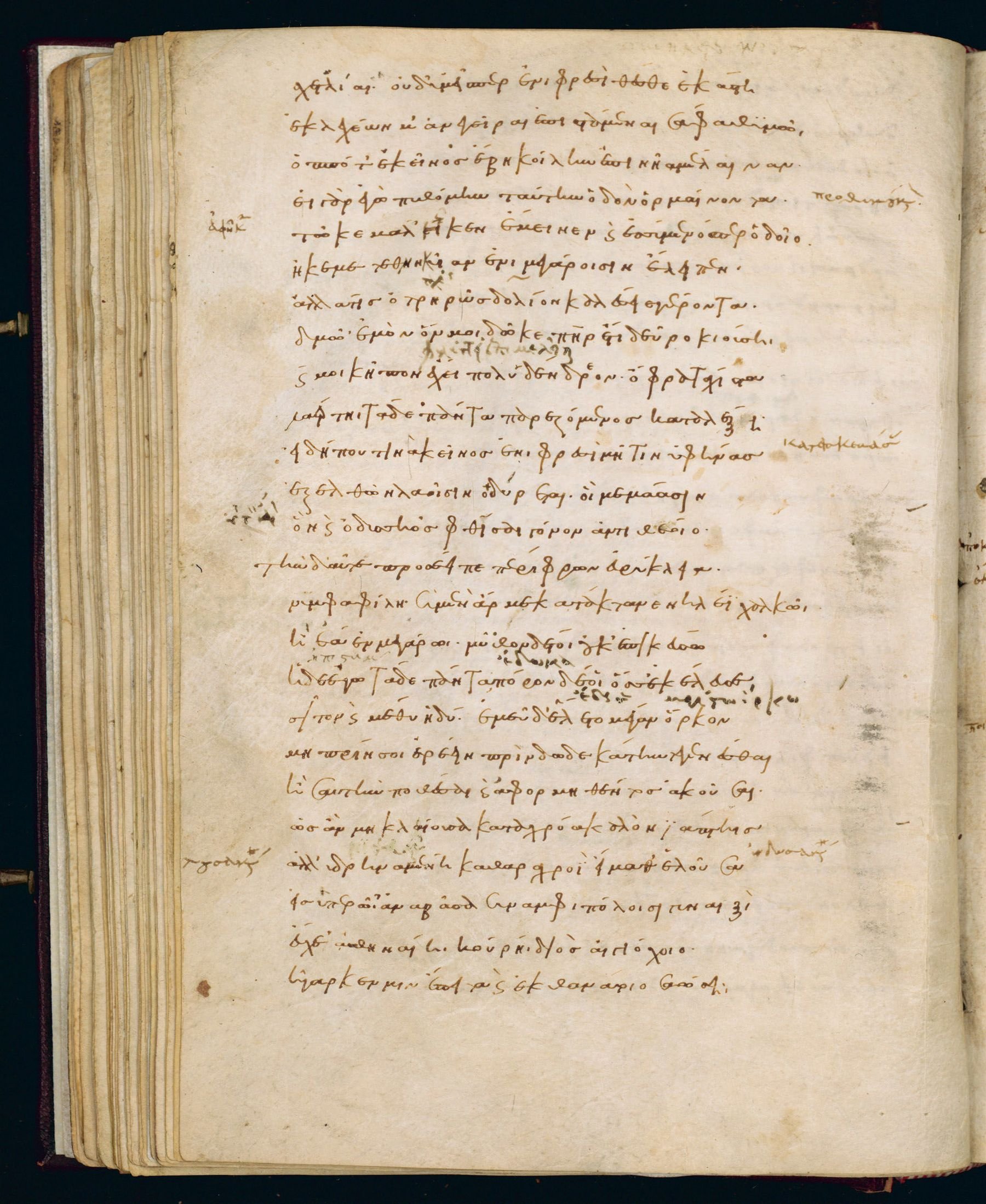
Where on the image
Laur. Plut. 32.24, fol. 43v: Odyssey 4.729-753, begins ‹σχέτλιαι, οὐδʼ ὑμεῖς περ›, ends ‹καὶ ἐκ θανάτοιο σαώσαι.›. Checked on the image: first and last lines read and matched to the Greek. Fol. 43r ends with 4.728. Fol. 44r begins with 4.754. English blocks here: 730-734, 735-739, 740-744, 745-749, 750-754.
729σχέτλιαι, οὐδʼ ὑμεῖς περ ἐνὶ φρεσὶ θέσθε ἑκάστη
730ἐκ λεχέων μʼ ἀνεγεῖραι, ἐπιστάμεναι σάφα θυμῷ,
731ὁππότʼ ἐκεῖνος ἔβη κοίλην ἐπὶ νῆα μέλαιναν.
732εἰ γὰρ ἐγὼ πυθόμην ταύτην ὁδὸν ὁρμαίνοντα,
733τῷ κε μάλʼ ἤ κεν ἔμεινε καὶ ἐσσύμενός περ ὁδοῖο,
734ἤ κέ με τεθνηκυῖαν ἐνὶ μεγάροισιν ἔλειπεν.
735ἀλλά τις ὀτρηρῶς Δολίον καλέσειε γέροντα,
736δμῶʼ ἐμόν, ὅν μοι δῶκε πατὴρ ἔτι δεῦρο κιούσῃ,
737καί μοι κῆπον ἔχει πολυδένδρεον, ὄφρα τάχιστα
738Λαέρτῃ τάδε πάντα παρεζόμενος καταλέξῃ,
739εἰ δή πού τινα κεῖνος ἐνὶ φρεσὶ μῆτιν ὑφήνας
740ἐξελθὼν λαοῖσιν ὀδύρεται, οἳ μεμάασιν
741ὃν καὶ Ὀδυσσῆος φθῖσαι γόνον ἀντιθέοιο.
742τὴν δʼ αὖτε προσέειπε φίλη τροφὸς Εὐρύκλεια·
743νύμφα φίλη, σὺ μὲν ἄρ με κατάκτανε νηλέι χαλκῷ
744ἢ ἔα ἐν μεγάρῳ· μῦθον δέ τοι οὐκ ἐπικεύσω.
745ᾔδεʼ ἐγὼ τάδε πάντα, πόρον δέ οἱ ὅσσʼ ἐκέλευε,
746σῖτον καὶ μέθυ ἡδύ· ἐμεῦ δʼ ἕλετο μέγαν ὅρκον
747μὴ πρὶν σοὶ ἐρέειν, πρὶν δωδεκάτην γε γενέσθαι
748ἢ σʼ αὐτὴν ποθέσαι καὶ ἀφορμηθέντος ἀκοῦσαι,
749ὡς ἂν μὴ κλαίουσα κατὰ χρόα καλὸν ἰάπτῃς.
750ἀλλʼ ὑδρηναμένη, καθαρὰ χροῒ εἵμαθʼ ἑλοῦσα,
751εἰς ὑπερῷʼ ἀναβᾶσα σὺν ἀμφιπόλοισι γυναιξὶν
752εὔχεʼ Ἀθηναίῃ κούρῃ Διὸς αἰγιόχοιο·
753ἡ γάρ κέν μιν ἔπειτα καὶ ἐκ θανάτοιο σαώσαι.
730to rouse me from my couch, though in your hearts ye knew full well when he went on board the hollow black ship. For had I learned that he was pondering this journey, he should verily have stayed here, how eager soever to be gone, or he should have left me dead in the halls. 735But now let one hasten to call hither the aged Dolius, my servant, whom my father gave me or ever I came hither, and who keeps my garden of many trees, that he may straightway go and sit by Laertes, and tell him of all these things. So haply may Laertes weave some plan in his heart, 740and go forth and with weeping make his plea to the people, who are minded to destroy his race and that of godlike Odysseus.” Then the good nurse Eurycleia answered her:“Dear lady, thou mayest verily slay me with the pitiless sword or let me abide in the house, yet will I not hide my word from thee. 745I knew all this, and gave him whatever he bade me, bread and sweet wine. But he took from me a mighty oath not to tell thee until at least the twelfth day should come, or thou shouldst thyself miss him and hear that he was gone, that thou mightest not mar thy fair flesh with weeping. 750But now bathe thyself, and take clean raiment for thy body, and then go up to thy upper chamber with thy handmaids and pray to Athena, the daughter of Zeus who bears the aegis; for she may then save him even from death. And trouble not a troubled old man; for
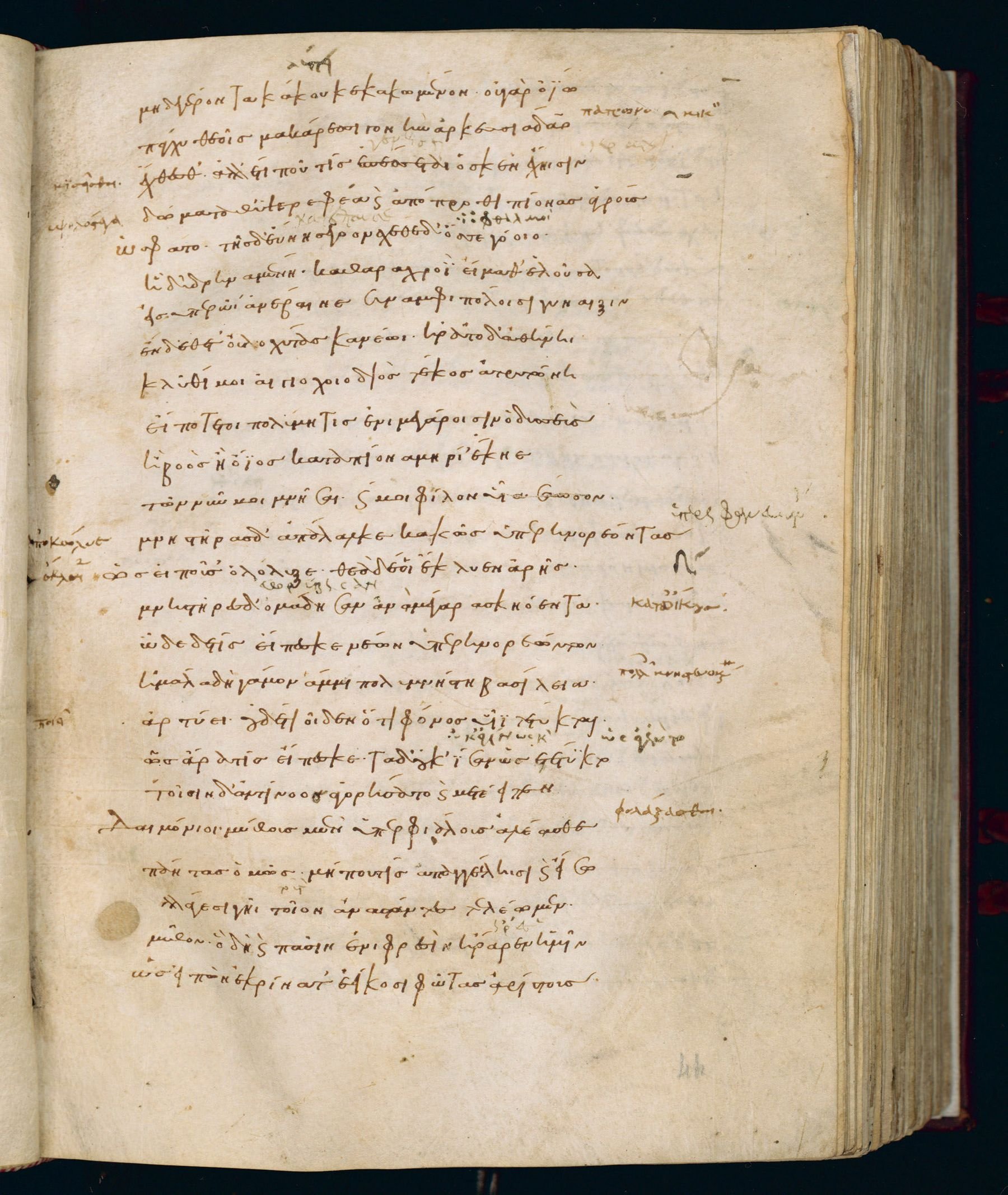
Where on the image
Laur. Plut. 32.24, fol. 44r: Odyssey 4.754-778, begins ‹μηδὲ γέροντα κάκου κεκακωμένον·›, ends ‹ἐκρίνατʼ ἐείκοσι φῶτας ἀρίστους,›. Checked on the image: first and last lines read and matched to the Greek. Fol. 43v ends with 4.753. Fol. 44v begins with 4.779. English blocks here: 755-757, 758-759, 760-764, 765-769, 770-774, 775-779.
754μηδὲ γέροντα κάκου κεκακωμένον· οὐ γὰρ ὀίω
755πάγχυ θεοῖς μακάρεσσι γονὴν Ἀρκεισιάδαο
756ἔχθεσθʼ, ἀλλʼ ἔτι πού τις ἐπέσσεται ὅς κεν ἔχῃσι
757δώματά θʼ ὑψερεφέα καὶ ἀπόπροθι πίονας ἀγρούς.
758ὣς φάτο, τῆς δʼ εὔνησε γόον, σχέθε δʼ ὄσσε γόοιο.
759ἡ δʼ ὑδρηναμένη, καθαρὰ χροῒ εἵμαθʼ ἑλοῦσα
760εἰς ὑπερῷʼ ἀνέβαινε σὺν ἀμφιπόλοισι γυναιξίν,
761ἐν δʼ ἔθετʼ οὐλοχύτας κανέῳ, ἠρᾶτο δʼ Ἀθήνῃ·
762κλῦθί μευ, αἰγιόχοιο Διὸς τέκος, Ἀτρυτώνη,
763εἴ ποτέ τοι πολύμητις ἐνὶ μεγάροισιν Ὀδυσσεὺς
764ἢ βοὸς ἢ ὄϊος κατὰ πίονα μηρίʼ ἔκηε,
765τῶν νῦν μοι μνῆσαι, καί μοι φίλον υἷα σάωσον,
766μνηστῆρας δʼ ἀπάλαλκε κακῶς ὑπερηνορέοντας.
767ὣς εἰποῦσʼ ὀλόλυξε, θεὰ δέ οἱ ἔκλυεν ἀρῆς.
768μνηστῆρες δʼ ὁμάδησαν ἀνὰ μέγαρα σκιόεντα·
769ὧδε δέ τις εἴπεσκε νέων ὑπερηνορεόντων·
770ἦ μάλα δὴ γάμον ἄμμι πολυμνήστη βασίλεια
771ἀρτύει, οὐδέ τι οἶδεν ὅ οἱ φόνος υἷι τέτυκται.
772ὣς ἄρα τις εἴπεσκε, τὰ δʼ οὐκ ἴσαν ὡς ἐτέτυκτο.
773τοῖσιν δʼ Ἀντίνοος ἀγορήσατο καὶ μετέειπε·
774δαιμόνιοι, μύθους μὲν ὑπερφιάλους ἀλέασθε
775πάντας ὁμῶς, μή πού τις ἀπαγγείλῃσι καὶ εἴσω.
776ἀλλʼ ἄγε σιγῇ τοῖον ἀναστάντες τελέωμεν
777μῦθον, ὃ δὴ καὶ πᾶσιν ἐνὶ φρεσὶν ἤραρεν ἡμῖν.
778ὣς εἰπὼν ἐκρίνατʼ ἐείκοσι φῶτας ἀρίστους,
755the race of the son of Arceisius is not, methinks, utterly hated by the blessed gods, but there shall still be one, I ween, to hold the high-roofed halls and the rich fields far away.” 758So she spoke, and lulled Penelope's laments, and made her eyes to cease from weeping. She then bathed, and took clean raiment for her body, 760and went up to her upper chamber with her handmaids, and placing barley grains in a basket prayed to Athena: “Hear me, child of Zeus who bears the aegis, unwearied one. If ever Odysseus, of many wiles, burnt to thee in his halls fat thigh-pieces of heifer or ewe, 765remember these things now, I pray thee, and save my dear son, and ward off from him the wooers in their evil insolence.” So saying she raised the sacred cry, and the goddess heard her prayer. But the wooers broke into uproar throughout the shadowy halls, and thus would one of the proud youths speak: 770“Aye, verily the queen, wooed of many, is preparing our marriage, nor does she know at all that death has been made ready for her son.” So would one of them speak; but they knew not how these things were to be. And Antinous addressed their company, and said: “Good sirs, shun haughty speech 775of every kind alike, lest someone report your speech even within the house. Nay come, in silence thus let us arise and put into effect our plan which pleased us one and all at heart.” So he spoke, and chose twenty men that were best, and they went their way to the swift ship and the shore of the sea.
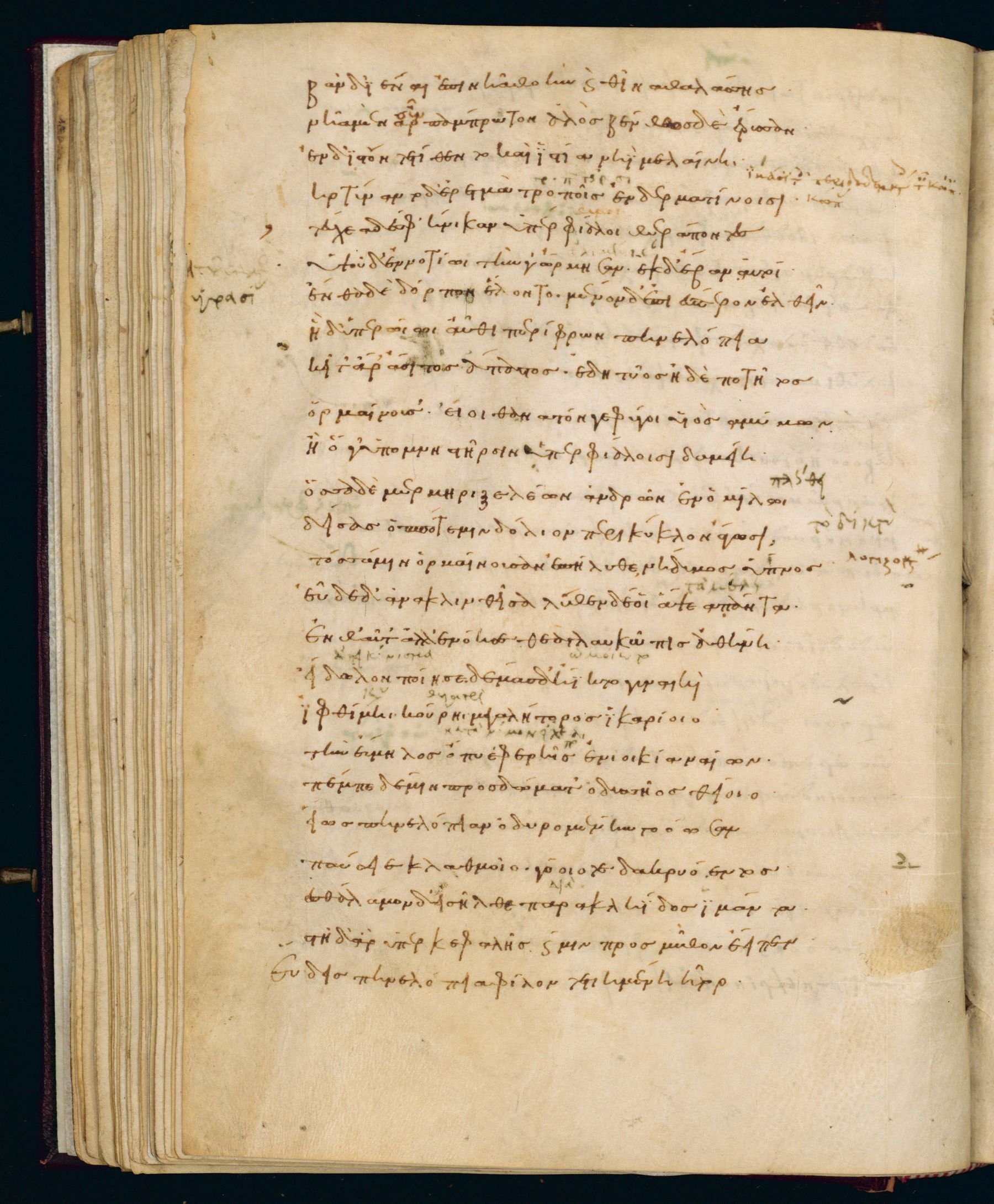
Where on the image
Laur. Plut. 32.24, fol. 44v: Odyssey 4.779-804, begins ‹βὰν δʼ ἰέναι ἐπὶ›, ends ‹Πηνελόπεια, φίλον τετιημένη ἦτορ;›. Checked on the image: first and last lines read and matched to the Greek. Fol. 44r ends with 4.778. Fol. 45r begins with 4.805. 4.783 is not in the text column; it is written in the right margin beside 4.782 (the column has 25 lines). English blocks here: 780-784, 785-789, 790-794, 795-799, 800-804.
779βὰν δʼ ἰέναι ἐπὶ νῆα θοὴν καὶ θῖνα θαλάσσης.
780νῆα μὲν οὖν πάμπρωτον ἁλὸς βένθοσδε ἔρυσσαν,
781ἐν δʼ ἱστόν τʼ ἐτίθεντο καὶ ἱστία νηὶ μελαίνῃ,
782ἠρτύναντο δʼ ἐρετμὰ τροποῖς ἐν δερματίνοισιν,
783πάντα κατὰ μοῖραν, ἀνά θʼ ἱστία λευκὰ πέτασσαν·
784τεύχεα δέ σφʼ ἤνεικαν ὑπέρθυμοι θεράποντες.
785ὑψοῦ δʼ ἐν νοτίῳ τήν γʼ ὥρμισαν, ἐκ δʼ ἔβαν αὐτοί·
786ἔνθα δὲ δόρπον ἕλοντο, μένον δʼ ἐπὶ ἕσπερον ἐλθεῖν.
787ἡ δʼ ὑπερωίῳ αὖθι περίφρων Πηνελόπεια
788κεῖτʼ ἄρʼ ἄσιτος, ἄπαστος ἐδητύος ἠδὲ ποτῆτος,
789ὁρμαίνουσʼ ἤ οἱ θάνατον φύγοι υἱὸς ἀμύμων,
790ἦ ὅ γʼ ὑπὸ μνηστῆρσιν ὑπερφιάλοισι δαμείη.
791ὅσσα δὲ μερμήριξε λέων ἀνδρῶν ἐν ὁμίλῳ
792δείσας, ὁππότε μιν δόλιον περὶ κύκλον ἄγωσι,
793τόσσα μιν ὁρμαίνουσαν ἐπήλυθε νήδυμος ὕπνος·
794εὗδε δʼ ἀνακλινθεῖσα, λύθεν δέ οἱ ἅψεα πάντα.
795ἔνθʼ αὖτʼ ἄλλʼ ἐνόησε θεά, γλαυκῶπις Ἀθήνη·
796εἴδωλον ποίησε, δέμας δʼ ἤικτο γυναικί,
797Ἰφθίμῃ, κούρῃ μεγαλήτορος Ἰκαρίοιο,
798τὴν Εὔμηλος ὄπυιε Φερῇς ἔνι οἰκία ναίων.
799πέμπε δέ μιν πρὸς δώματʼ Ὀδυσσῆος θείοιο,
800ἧος Πηνελόπειαν ὀδυρομένην γοόωσαν
801παύσειε κλαυθμοῖο γόοιό τε δακρυόεντος.
802ἐς θάλαμον δʼ εἰσῆλθε παρὰ κληῖδος ἱμάντα,
803στῆ δʼ ἄρʼ ὑπὲρ κεφαλῆς, καί μιν πρὸς μῦθον ἔειπεν·
804εὕδεις, Πηνελόπεια, φίλον τετιημένη ἦτορ;
780The ship first of all they drew down to the deep water, and set the mast and sail in the black ship, and fitted the oars in the leathern thole-straps, all in due order, and spread the white sail. And proud squires brought them their weapons. 785Well out in the roadstead they moored the ship, and themselves disembarked. There then they took supper, and waited till evening should come. But she, the wise Penelope, lay there in her upper chamber, touching no food, tasting neither meat nor drink, pondering whether her peerless son would escape death, 790or be slain by the insolent wooers. And even as a lion is seized with fear and broods amid a throng of men, when they draw their crafty ring about him, so was she pondering when sweet sleep came upon her. And she sank back and slept, and all her joints relaxed. 795Then the goddess, flashing-eyed Athena, took other counsel. She made a phantom, and likened it in form to a woman, Iphthime, daughter of great-hearted Icarius, whom Eumelus wedded, whose home was in Pherae. And she sent it to the house of divine Odysseus, 800to Penelope in the midst of her wailing and lamenting, to bid her cease from weeping and tearful lamentation. So into the chamber it passed by the thong of the bolt, and stood above her head, and spoke to her, and said: “Sleepest thou, Penelope, thy heart sore stricken?
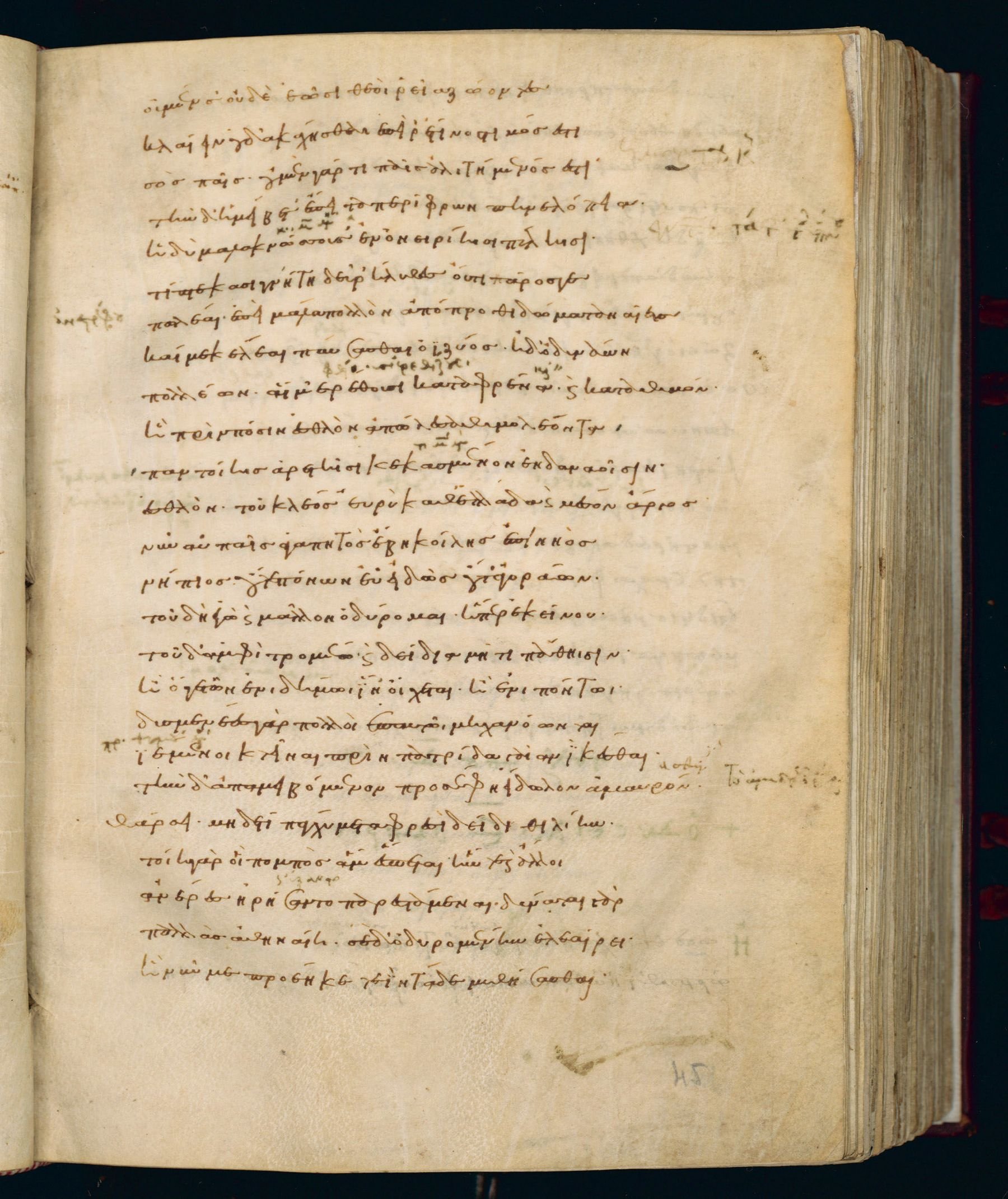
Where on the image
Laur. Plut. 32.24, fol. 45r: Odyssey 4.805-829, begins ‹οὐ μέν σʼ οὐδὲ›, ends ‹προέηκε τεῒν τάδε μυθήσασθαι.›. Checked on the image: first and last lines read and matched to the Greek. Fol. 44v ends with 4.804. Fol. 45v begins with 4.830. English blocks here: 805-809, 810-814, 815-819, 820-824, 825-829.
805οὐ μέν σʼ οὐδὲ ἐῶσι θεοὶ ῥεῖα ζώοντες
806κλαίειν οὐδʼ ἀκάχησθαι, ἐπεί ῥʼ ἔτι νόστιμός ἐστι
807σὸς παῖς· οὐ μὲν γάρ τι θεοῖς ἀλιτήμενός ἐστι.
808τὴν δʼ ἠμείβετʼ ἔπειτα περίφρων Πηνελόπεια,
809ἡδὺ μάλα κνώσσουσʼ ἐν ὀνειρείῃσι πύλῃσιν·
810τίπτε, κασιγνήτη, δεῦρʼ ἤλυθες; οὔ τι πάρος γε
811πωλέʼ, ἐπεὶ μάλα πολλὸν ἀπόπροθι δώματα ναίεις·
812καί με κέλεαι παύσασθαι ὀιζύος ἠδʼ ὀδυνάων
813πολλέων, αἵ μʼ ἐρέθουσι κατὰ φρένα καὶ κατὰ θυμόν,
814ἣ πρὶν μὲν πόσιν ἐσθλὸν ἀπώλεσα θυμολέοντα,
815παντοίῃς ἀρετῇσι κεκασμένον ἐν Δαναοῖσιν,
816ἐσθλόν, τοῦ κλέος εὐρὺ καθʼ Ἑλλάδα καὶ μέσον Ἄργος·
817νῦν αὖ παῖς ἀγαπητὸς ἔβη κοίλης ἐπὶ νηός,
818νήπιος, οὔτε πόνων ἐὺ εἰδὼς οὔτʼ ἀγοράων.
819τοῦ δὴ ἐγὼ καὶ μᾶλλον ὀδύρομαι ἤ περ ἐκείνου·
820τοῦ δʼ ἀμφιτρομέω καὶ δείδια, μή τι πάθῃσιν,
821ἢ ὅ γε τῶν ἐνὶ δήμῳ, ἵνʼ οἴχεται, ἢ ἐνὶ πόντῳ·
822δυσμενέες γὰρ πολλοὶ ἐπʼ αὐτῷ μηχανόωνται,
823ἱέμενοι κτεῖναι πρὶν πατρίδα γαῖαν ἱκέσθαι.
824τὴν δʼ ἀπαμειβόμενον προσέφη εἴδωλον ἀμαυρόν·
825θάρσει, μηδέ τι πάγχυ μετὰ φρεσὶ δείδιθι λίην·
826τοίη γάρ οἱ πομπὸς ἅμʼ ἔρχεται, ἥν τε καὶ ἄλλοι
827ἀνέρες ἠρήσαντο παρεστάμεναι, δύναται γάρ,
828Παλλὰς Ἀθηναίη· σὲ δʼ ὀδυρομένην ἐλεαίρει·
829ἣ νῦν με προέηκε τεῒν τάδε μυθήσασθαι.
805Nay, the gods that live at ease suffer thee not to weep or be distressed, seeing that thy son is yet to return; for in no wise is he a sinner in the eyes of the gods.” Then wise Penelope answered her, as she slumbered very sweetly at the gates of dreams: 810“Why, sister, art thou come hither? Thou hast not heretofore been wont to come, for thou dwellest in a home far away. And thou biddest me cease from my grief and the many pains that distress me in mind and heart. Long since I lost my noble husband of the lion heart, 815pre-eminent in all manner of worth among the Danaans, my noble husband whose fame is wide in Hellas and mid-Argos. And now again my well-loved son is gone forth in a hollow ship, a mere child, knowing naught of toils and the gatherings of men. For him I sorrow even more than for that other, 820and tremble for him, and fear lest aught befall him, whether it be in the land of the men to whom he is gone, or on the sea. For many foes are plotting against him, eager to slay him before he comes back to his native land.” Then the dim phantom answered her, and said: 825“Take heart, and be not in thy mind too sore afraid; since such a guide goes with him as men have full often besought to stand by their side, for she has power,—even Pallas Athena. And she pities thee in thy sorrow, for she it is that has sent me forth to tell thee this.”
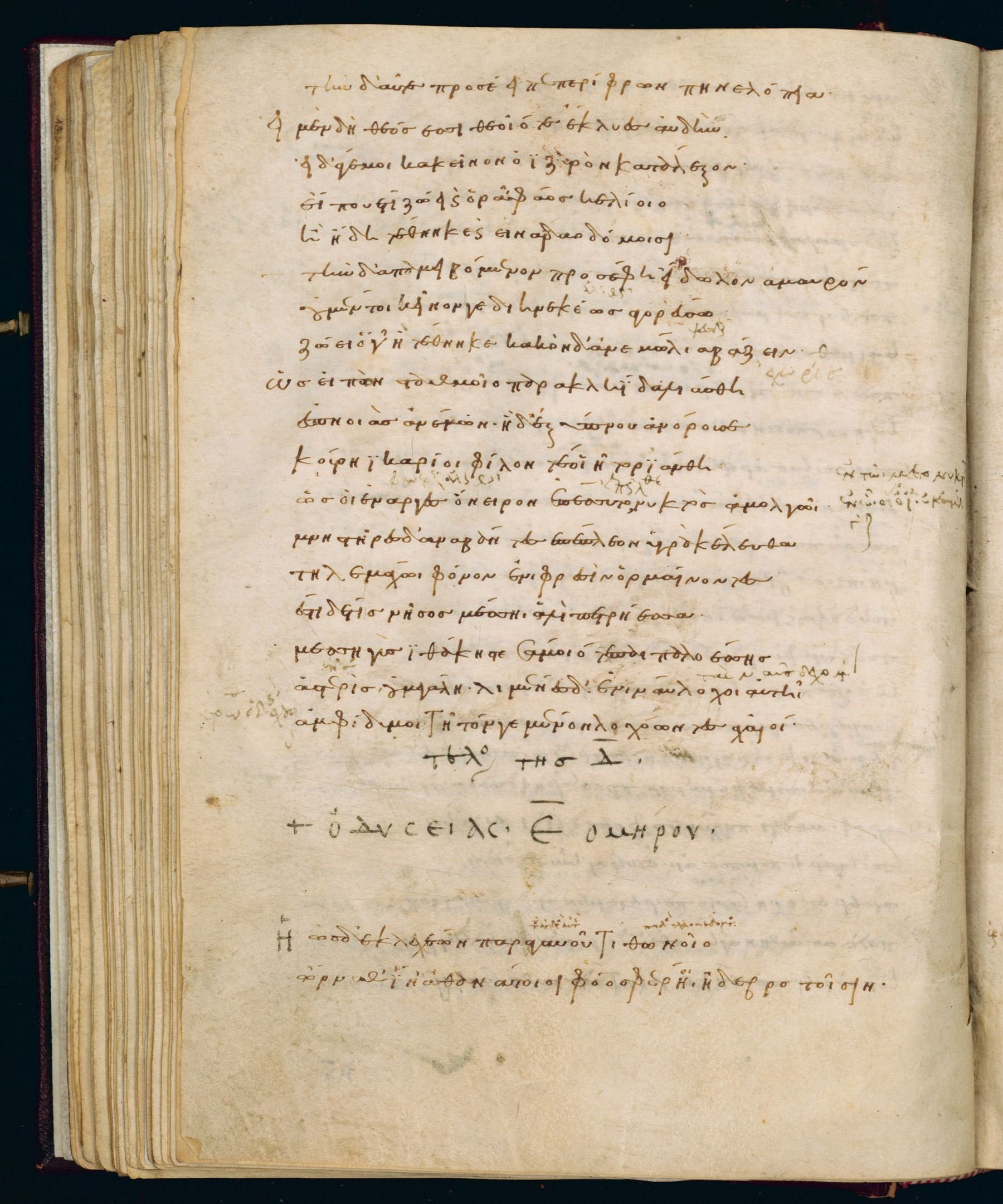
Where on the image
Laur. Plut. 32.24, fol. 45v: Odyssey 4.830-847, begins ‹τὴν δʼ αὖτε προσέειπε›, ends ‹γε μένον λοχόωντες Ἀχαιοί.›. Checked on the image: first and last lines read and matched to the Greek. Fol. 45r ends with 4.829. The page holds 4.830-847, 5.1-2. Book 4 ends with 4.847, followed by the subscription τέλος τῆς δ; a heading + ὀδυσσείας ε ὁμήρου follows after a space and book 5 begins with an enlarged initial Η. English blocks here: 830-834, 835-839, 840-844, 845-847.
830τὴν δʼ αὖτε προσέειπε περίφρων Πηνελόπεια·
831εἰ μὲν δὴ θεός ἐσσι θεοῖό τε ἔκλυες αὐδῆς,
832εἰ δʼ ἄγε μοι καὶ κεῖνον ὀιζυρὸν κατάλεξον,
833ἤ που ἔτι ζώει καὶ ὁρᾷ φάος ἠελίοιο,
834ἦ ἤδη τέθνηκε καὶ εἰν Ἀίδαο δόμοισι.
835τὴν δʼ ἀπαμειβόμενον προσέφη εἴδωλον ἀμαυρόν·
836οὐ μέν τοι κεῖνόν γε διηνεκέως ἀγορεύσω,
837ζώει ὅ γʼ ἦ τέθνηκε· κακὸν δʼ ἀνεμώλια βάζειν.
838ὣς εἰπὸν σταθμοῖο παρὰ κληῖδα λιάσθη
839ἐς πνοιὰς ἀνέμων. ἡ δʼ ἐξ ὕπνου ἀνόρουσε
840κούρη Ἰκαρίοιο· φίλον δέ οἱ ἦτορ ἰάνθη,
841ὥς οἱ ἐναργὲς ὄνειρον ἐπέσσυτο νυκτὸς ἀμολγῷ.
842μνηστῆρες δʼ ἀναβάντες ἐπέπλεον ὑγρὰ κέλευθα
843Τηλεμάχῳ φόνον αἰπὺν ἐνὶ φρεσὶν ὁρμαίνοντες.
844ἔστι δέ τις νῆσος μέσσῃ ἁλὶ πετρήεσσα,
845μεσσηγὺς Ἰθάκης τε Σάμοιό τε παιπαλοέσσης,
846Ἀστερίς, οὐ μεγάλη· λιμένες δʼ ἔνι ναύλοχοι αὐτῇ
847ἀμφίδυμοι· τῇ τόν γε μένον λοχόωντες Ἀχαιοί.
830Then again wise Penelope answered her: “If thou art indeed a god, and hast listened to the voice of a god, come, tell me, I pray thee, also of that hapless one, whether he still lives and beholds the light of the sun, or whether he is already dead and in the house of Hades.” 835And the dim phantom answered her, and said:“Nay, of him I may not speak at length, whether he be alive or dead; it is an ill thing to speak words vain as wind.” So saying the phantom glided away by the bolt of the door into the breath of the winds. And 840the daughter of Icarius started up from sleep, and her heart was warmed with comfort, that so clear a vision had sped to her in the darkness of night. But the wooers embarked, and sailed over the watery ways, pondering in their hearts utter murder for Telemachus. There is a rocky isle in the midst of the sea, 845midway between Ithaca and rugged Samos, Asteris, of no great size, but therein is a harbor where ships may lie, with an entrance on either side. There it was that the Achaeans tarried, lying in wait for Telemachus.
Notes
- Greek: A. T. Murray, Homer: The Odyssey (Loeb Classical Library, 1919), via Perseus.
- English: A. T. Murray's translation in the same edition; his footnotes are omitted.
Cite
Sources
- Source: Laur. Plut. 32.24 (BML Teca Digitale IIIF) + Murray Greek (Loeb 1919, Perseus) + Murray English (Loeb 1919, Perseus) (holding institution)
- Critical edition: Murray, Loeb 1919, via Perseus
← previous · → next · v cycle view · l back to library