Homer, Odyssey, Book 8: The games of the Phaeacians
Introduction
The Odyssey, composed around 700 BCE and attributed to Homer, tells of Odysseus' ten-year journey home from Troy and his return to Ithaca. Book 8 (586 lines): The games of the Phaeacians.
The page photographs are from Florence, Biblioteca Medicea Laurenziana, Plut. 32.24 (parchment, 10th century, 234 folios; the oldest manuscript of the Odyssey with published images), in the Biblioteca Medicea Laurenziana's Teca Digitale. This book is on fol. 69v-81r; each section below is one page, with its first and last line as read on the photograph. Many pages carry interlinear glosses and a few marginal notes in later hands.
The Greek is A. T. Murray's Loeb text (1919) via Perseus, not a transcription of this manuscript, whose wording differs in places. The English is Murray's prose translation (1919), divided every five lines; at a page break a five-line block goes with the page holding most of it, except at the page breaks where a section's note says the English is cut at the end of Murray's sentence. Each section's note gives its English line range.
Where the scribe left out a line, wrote one in the margin, changed the order or added a line not in Murray's text, the section's note on the photograph says so; the Greek and English shown are Murray's full text for the page's range.
How was this verified? (Provenance)
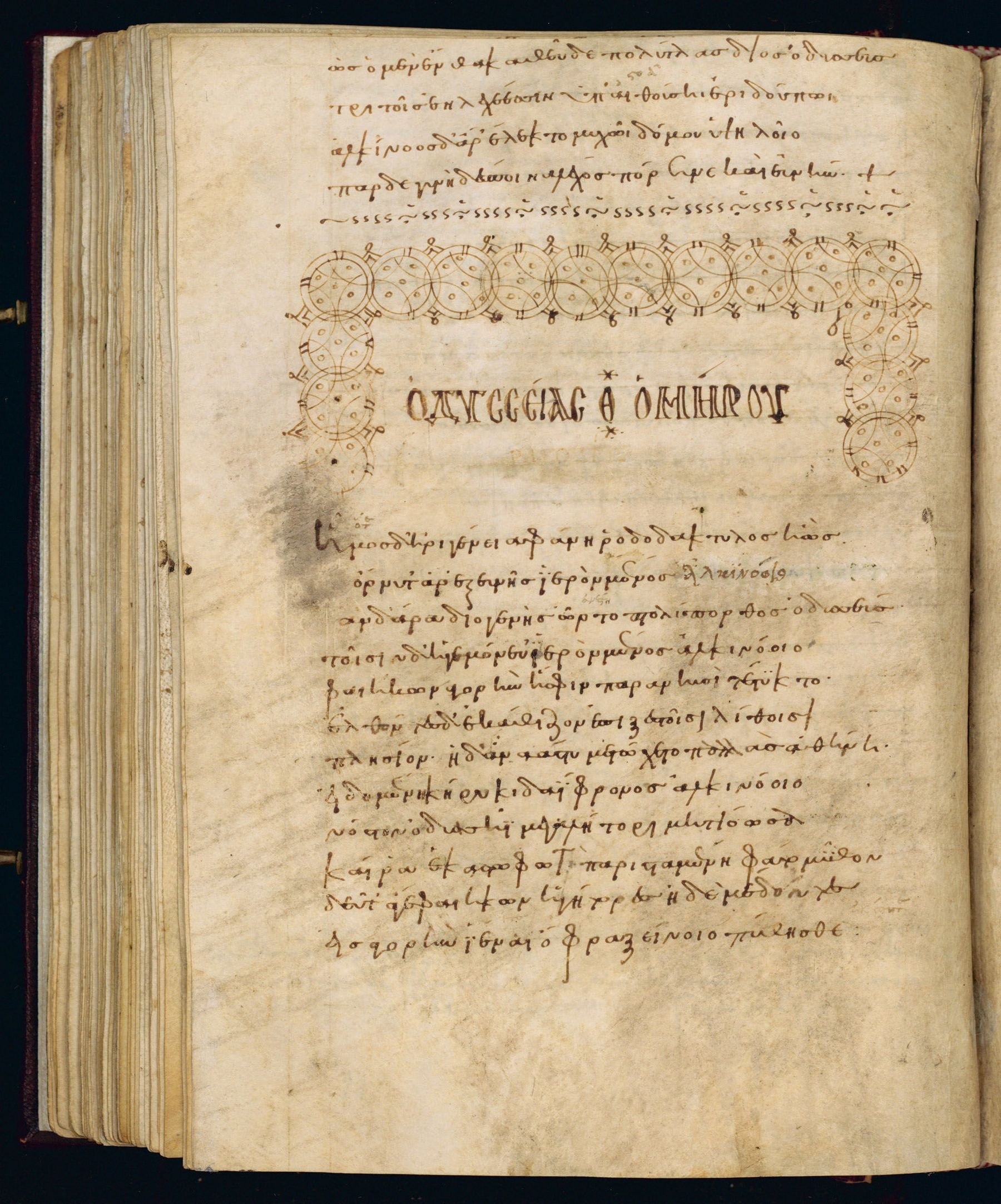
Where on the image
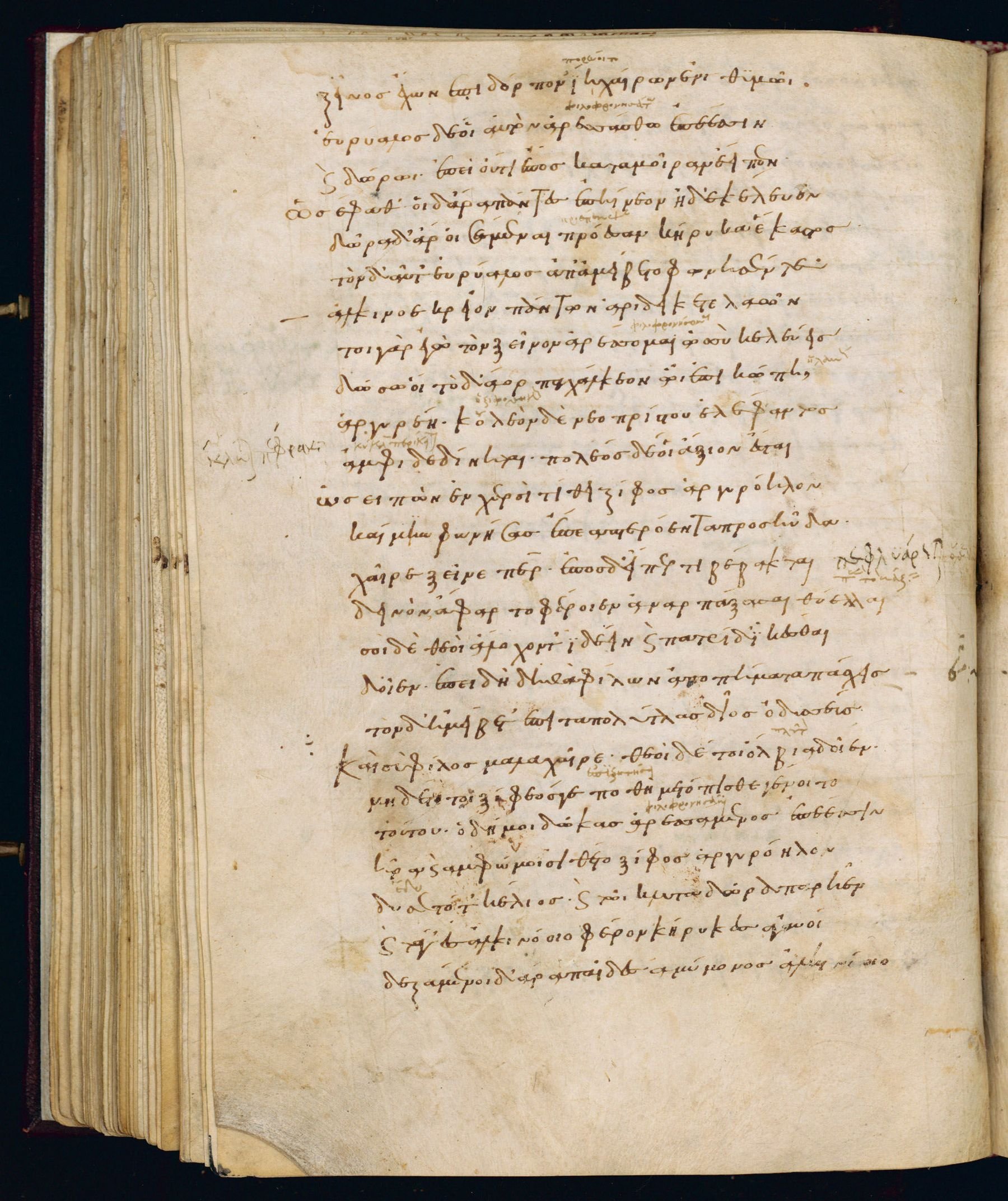
Laur. Plut. 32.24, fol. 69v: Odyssey 8.1-12, begins ‹ἦμος δʼ ἠριγένεια φάνη›, ends ‹ἰέναι, ὄφρα ξείνοιο πύθησθε,›. Checked on the image: first and last lines read and matched to the Greek. Fol. 70r begins with 8.13. The page holds 7.344-347, 8.1-12. Book 7 ends with 7.347, followed by a line of ornament; book 8 begins under a decorated headpiece with the title ὀδυσσείας θ ὁμήρου in capitals, and 8.1 has an enlarged initial. English blocks here: 1-4, 5-9, 10-14.
1ἦμος δʼ ἠριγένεια φάνη ῥοδοδάκτυλος Ἠώς,
2ὤρνυτʼ ἄρʼ ἐξ εὐνῆς ἱερὸν μένος Ἀλκινόοιο,
3ἂν δʼ ἄρα διογενὴς ὦρτο πτολίπορθος Ὀδυσσεύς.
4τοῖσιν δʼ ἡγεμόνευʼ ἱερὸν μένος Ἀλκινόοιο
5Φαιήκων ἀγορήνδʼ, ἥ σφιν παρὰ νηυσὶ τέτυκτο.
6ἐλθόντες δὲ καθῖζον ἐπὶ ξεστοῖσι λίθοισι
7πλησίον. ἡ δʼ ἀνὰ ἄστυ μετῴχετο Παλλὰς Ἀθήνη
8εἰδομένη κήρυκι δαΐφρονος Ἀλκινόοιο,
9νόστον Ὀδυσσῆι μεγαλήτορι μητιόωσα,
10καί ῥα ἑκάστῳ φωτὶ παρισταμένη φάτο μῦθον·
11δεῦτʼ ἄγε, Φαιήκων ἡγήτορες ἠδὲ μέδοντες,
12εἰς ἀγορὴν ἰέναι, ὄφρα ξείνοιο πύθησθε,
1As soon as early Dawn appeared, the rosy-fingered, the strong and mighty Alcinous rose from his couch, and up rose also Zeus-born Odysseus, the sacker of cities. And the strong and mighty Alcinous led the way 5to the place of assembly of the Phaeacians, which was builded for them hard by their ships. Thither they came and sat down on the polished stones close by one another; and Pallas Athena went throughout the city, in the likeness of the herald of wise Alcinous, devising a return for great-hearted Odysseus. 10To each man's side she came, and spoke and said: “Hither now, leaders and counsellors of the Phaeacians, come to the place of assembly, that you may learn of the stranger who has newly come to the palace of wise Alcinous after his wanderings over the sea, and in form is like unto the immortals.”
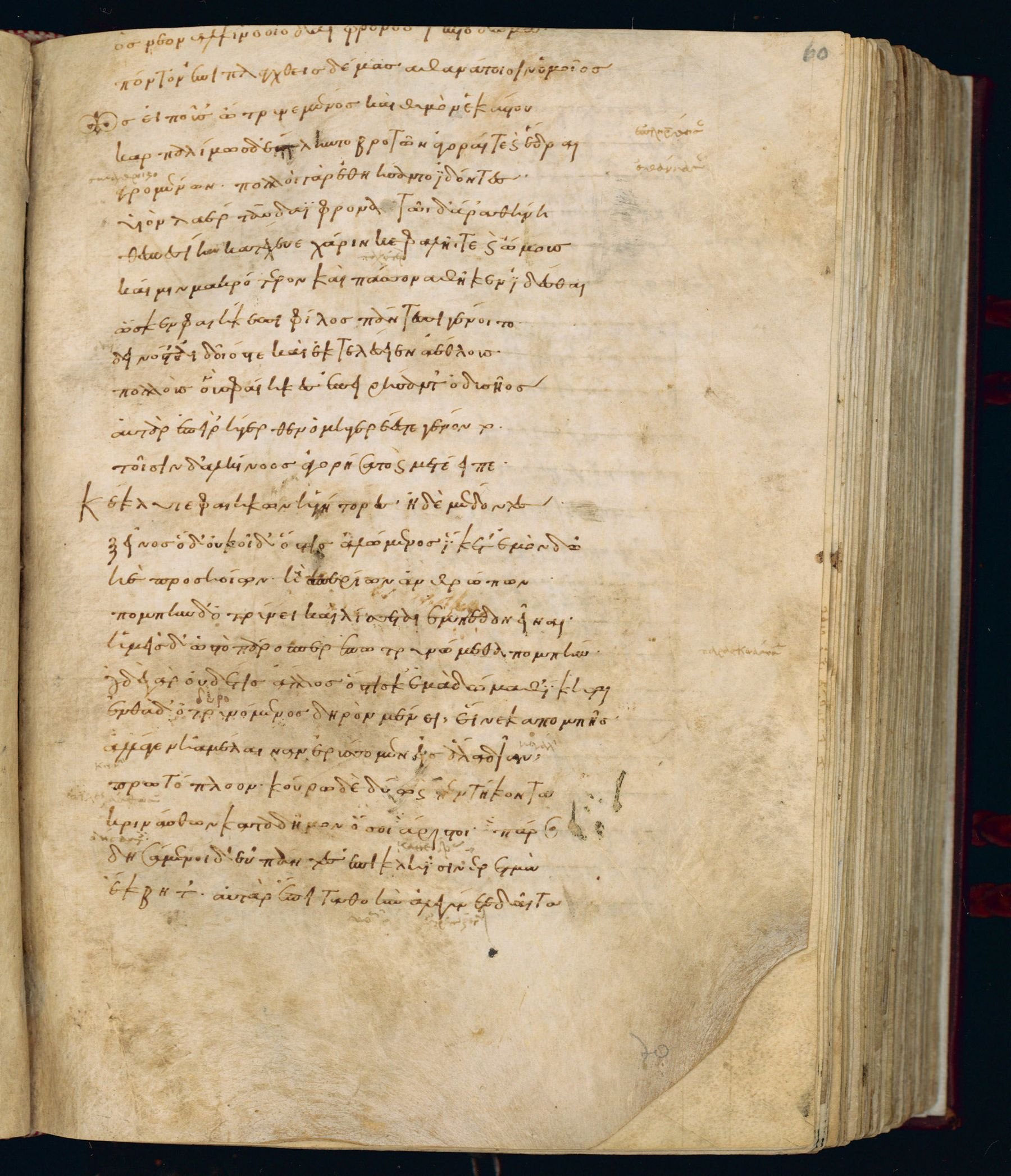
Where on the image
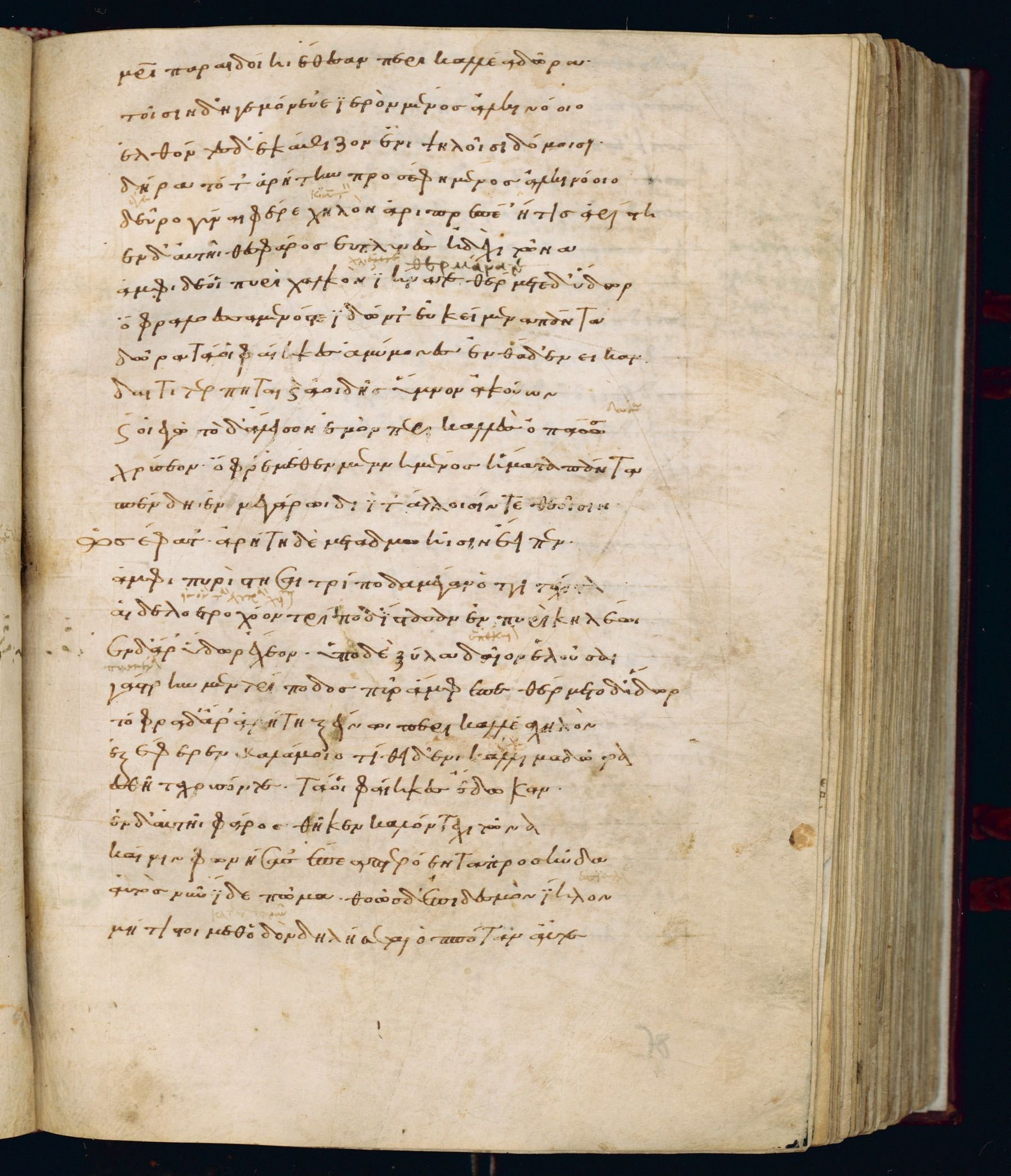
Laur. Plut. 32.24, fol. 70r: Odyssey 8.13-38, begins ‹ὃς νέον Ἀλκινόοιο δαΐφρονος›, ends ‹ἔπειτα θοὴν ἀλεγύνετε δαῖτα›. Checked on the image: first and last lines read and matched to the Greek. Fol. 69v ends with 8.12. Fol. 70v begins with 8.39. The top edge is curled in the photograph, so the first line (8.13) is only partly visible. 8.27 (ὄφρʼ εἴπω τά με θυμὸς ...) is not on the page: the scribe passes from 8.26 to 8.28 (25 lines). English blocks here: 15-19, 20-24, 25-29, 30-34, 35-39.
13ὃς νέον Ἀλκινόοιο δαΐφρονος ἵκετο δῶμα
14πόντον ἐπιπλαγχθείς, δέμας ἀθανάτοισιν ὁμοῖος.
15ὣς εἰποῦσʼ ὤτρυνε μένος καὶ θυμὸν ἑκάστου.
16καρπαλίμως δʼ ἔμπληντο βροτῶν ἀγοραί τε καὶ ἕδραι
17ἀγρομένων· πολλοὶ δʼ ἄρʼ ἐθηήσαντο ἰδόντες
18υἱὸν Λαέρταο δαΐφρονα· τῷ δʼ ἄρʼ Ἀθήνη
19θεσπεσίην κατέχευε χάριν κεφαλῇ τε καὶ ὤμοις
20καί μιν μακρότερον καὶ πάσσονα θῆκεν ἰδέσθαι,
21ὥς κεν Φαιήκεσσι φίλος πάντεσσι γένοιτο
22δεινός τʼ αἰδοῖός τε καὶ ἐκτελέσειεν ἀέθλους
23πολλούς, τοὺς Φαίηκες ἐπειρήσαντʼ Ὀδυσῆος.
24αὐτὰρ ἐπεί ῥʼ ἤγερθεν ὁμηγερέες τʼ ἐγένοντο,
25τοῖσιν δʼ Ἀλκίνοος ἀγορήσατο καὶ μετέειπε·
26κέκλυτε, Φαιήκων ἡγήτορες ἠδὲ μέδοντες,
27ὄφρʼ εἴπω τά με θυμὸς ἐνὶ στήθεσσι κελεύει.
28ξεῖνος ὅδʼ, οὐκ οἶδʼ ὅς τις, ἀλώμενος ἵκετʼ ἐμὸν δῶ,
29ἠὲ πρὸς ἠοίων ἦ ἑσπερίων ἀνθρώπων·
30πομπὴν δʼ ὀτρύνει, καὶ λίσσεται ἔμπεδον εἶναι.
31ἡμεῖς δʼ, ὡς τὸ πάρος περ, ἐποτρυνώμεθα πομπήν.
32οὐδὲ γὰρ οὐδέ τις ἄλλος, ὅτις κʼ ἐμὰ δώμαθʼ ἵκηται,
33ἐνθάδʼ ὀδυρόμενος δηρὸν μένει εἵνεκα πομπῆς.
34ἀλλʼ ἄγε νῆα μέλαιναν ἐρύσσομεν εἰς ἅλα δῖαν
35πρωτόπλοον, κούρω δὲ δύω καὶ πεντήκοντα
36κρινάσθων κατὰ δῆμον, ὅσοι πάρος εἰσὶν ἄριστοι.
37δησάμενοι δʼ ἐὺ πάντες ἐπὶ κληῖσιν ἐρετμὰ
38ἔκβητʼ· αὐτὰρ ἔπειτα θοὴν ἀλεγύνετε δαῖτα
15So saying she roused the spirit and heart of each man, and speedily the place of assembly and the seats were filled with men that gathered. And many marvelled at the sight of the wise son of Laertes, for wondrous was the grace that Athena shed upon his head and shoulders; 20and she made him taller and sturdier to behold, that he might be welcomed by all the Phaeacians, and win awe and reverence, and might accomplish the many feats wherein the Phaeacians made trial of Odysseus. Now when they were assembled and met together, 25Alcinous addressed their assembly and spoke among them: “Hearken to me, leaders and counsellors of the Phaeacians, that I may speak what the heart in my breast bids me. This stranger—I know not who he is—has come to my house in his wanderings, whether from men of the east or of the west. 30He urges that he be sent on his way, and prays for assurance, and let us on our part, as of old we were wont, speed on his sending; for verily no man soever who comes to my house, abides here long in sorrow for lack of sending. Nay come, let us draw a black ship down to the bright sea 35for her first voyage, and let men choose two and fifty youths from out the people, even those that have heretofore been the best. And when you have all duly lashed the oars to the thole-pins, go ashore, and then go your way to my house, and prepare a feast with speed; and I will provide bountifully for all.
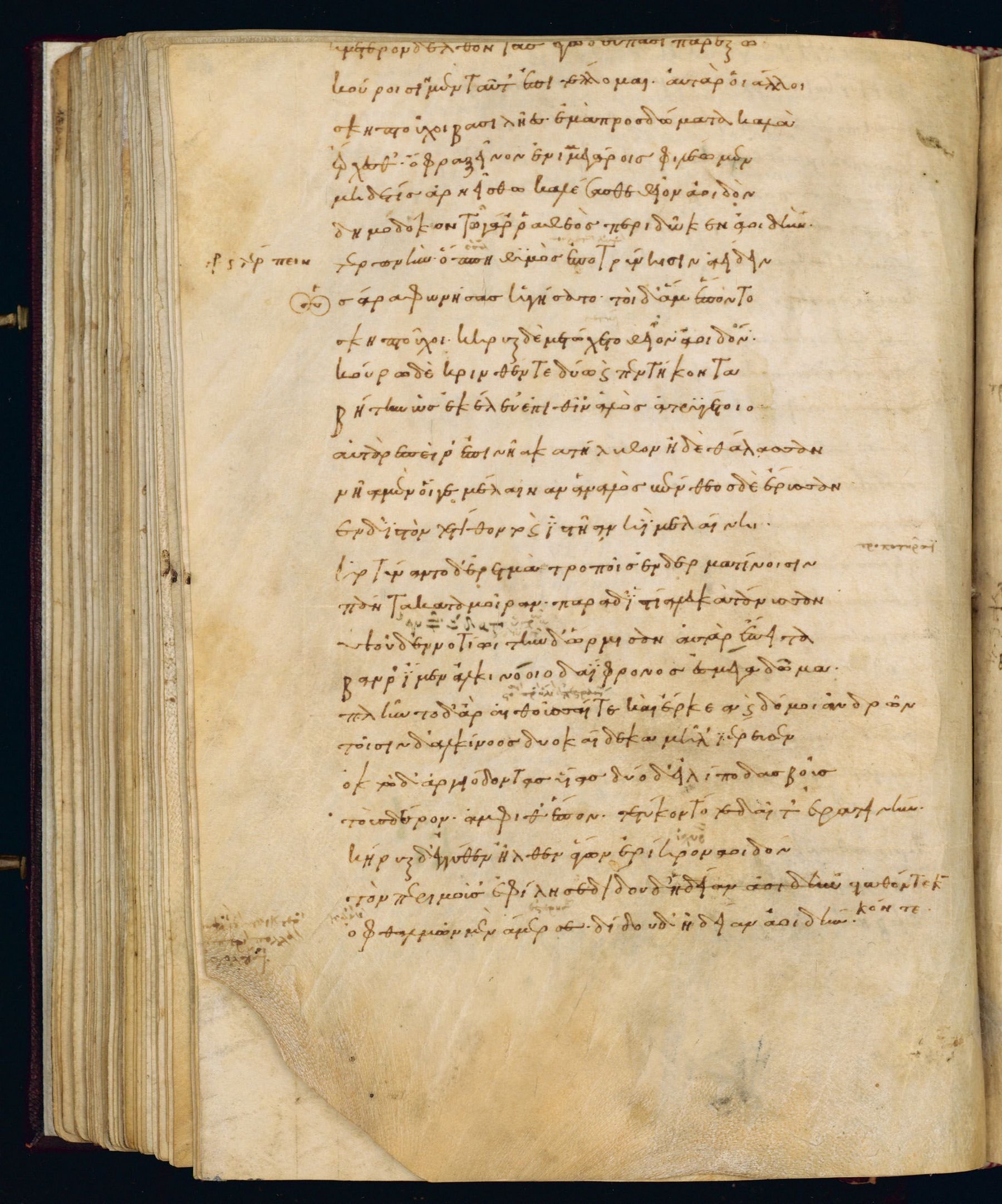
Where on the image
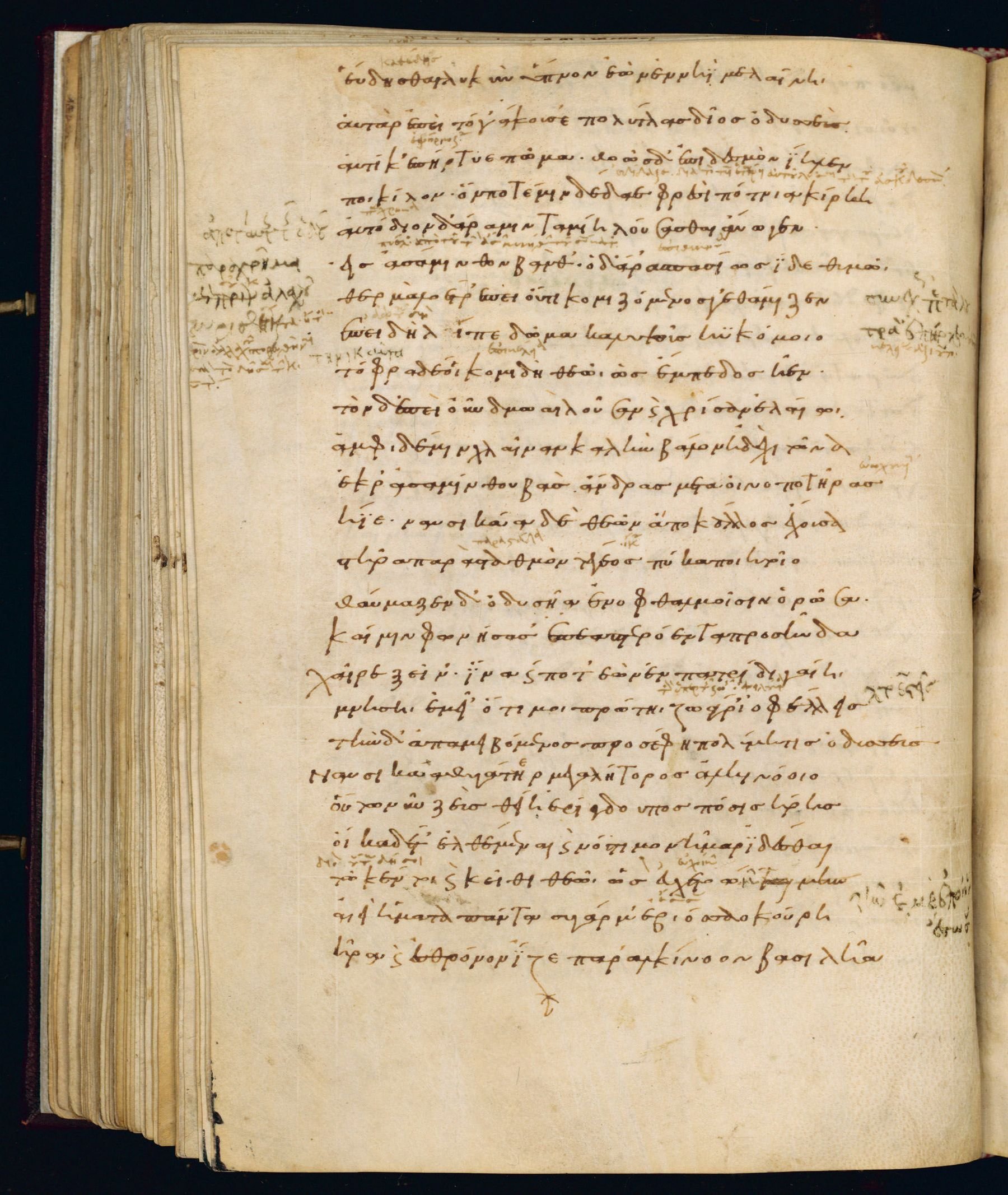
Laur. Plut. 32.24, fol. 70v: Odyssey 8.39-64, begins ‹ἡμέτερόνδʼ ἐλθόντες· ἐγὼ δʼ›, ends ‹δίδου δʼ ἡδεῖαν ἀοιδήν.›. Checked on the image: first and last lines read and matched to the Greek. Fol. 70r ends with 8.38. Fol. 71r begins with 8.65. 8.58 (ἀγρομένων· πολλοὶ δʼ ἄρʼ ἔσαν ...) is not on the page: the scribe passes from 8.57 to 8.59 (25 lines). English blocks here: 40-44, 45-45, 46-49, 50-54, 55-59, 60-64.
39ἡμέτερόνδʼ ἐλθόντες· ἐγὼ δʼ ἐὺ πᾶσι παρέξω.
40κούροισιν μὲν ταῦτʼ ἐπιτέλλομαι· αὐτὰρ οἱ ἄλλοι
41σκηπτοῦχοι βασιλῆες ἐμὰ πρὸς δώματα καλὰ
42ἔρχεσθʼ, ὄφρα ξεῖνον ἐνὶ μεγάροισι φιλέωμεν,
43μηδέ τις ἀρνείσθω. καλέσασθε δὲ θεῖον ἀοιδὸν
44Δημόδοκον· τῷ γάρ ῥα θεὸς πέρι δῶκεν ἀοιδὴν
45τέρπειν, ὅππῃ θυμὸς ἐποτρύνῃσιν ἀείδειν.
46ὣς ἄρα φωνήσας ἡγήσατο, τοὶ δʼ ἅμʼ ἕποντο
47σκηπτοῦχοι· κῆρυξ δὲ μετῴχετο θεῖον ἀοιδόν.
48κούρω δὲ κρινθέντε δύω καὶ πεντήκοντα
49βήτην, ὡς ἐκέλευσʼ, ἐπὶ θῖνʼ ἁλὸς ἀτρυγέτοιο.
50αὐτὰρ ἐπεί ῥʼ ἐπὶ νῆα κατήλυθον ἠδὲ θάλασσαν,
51νῆα μὲν οἵ γε μέλαιναν ἁλὸς βένθοσδε ἔρυσσαν,
52ἐν δʼ ἱστόν τʼ ἐτίθεντο καὶ ἱστία νηὶ μελαίνῃ,
53ἠρτύναντο δʼ ἐρετμὰ τροποῖς ἐν δερματίνοισι,
54πάντα κατὰ μοῖραν, ἀνά θʼ ἱστία λευκὰ πέτασσαν.
55ὑψοῦ δʼ ἐν νοτίῳ τήν γʼ ὥρμισαν· αὐτὰρ ἔπειτα
56βάν ῥʼ ἴμεν Ἀλκινόοιο δαΐφρονος ἐς μέγα δῶμα.
57πλῆντο δʼ ἄρʼ αἴθουσαί τε καὶ ἕρκεα καὶ δόμοι ἀνδρῶν
58ἀγρομένων· πολλοὶ δʼ ἄρʼ ἔσαν, νέοι ἠδὲ παλαιοί.
59τοῖσιν δʼ Ἀλκίνοος δυοκαίδεκα μῆλʼ ἱέρευσεν,
60ὀκτὼ δʼ ἀργιόδοντας ὕας, δύο δʼ εἰλίποδας βοῦς·
61τοὺς δέρον ἀμφί θʼ ἕπον, τετύκοντό τε δαῖτʼ ἐρατεινήν.
62κῆρυξ δʼ ἐγγύθεν ἦλθεν ἄγων ἐρίηρον ἀοιδόν,
63τὸν πέρι μοῦσʼ ἐφίλησε, δίδου δʼ ἀγαθόν τε κακόν τε·
64ὀφθαλμῶν μὲν ἄμερσε, δίδου δʼ ἡδεῖαν ἀοιδήν.
40To the youths this is my command, but do you others, the sceptred kings, come to my fair palace, that we may entertain yon stranger in the halls; and let no man say me nay. And summon hither the divine minstrel, Demodocus; for to him above all others has the god granted skill in song, 45to give delight in whatever way his spirit prompts him to sing.” 46So saying, he led the way, and the sceptred kings followed him, while a herald went for the divine minstrel. And chosen youths, two and fifty, went, as he bade, to the shore of the unresting sea. 50And when they had come down to the ship and to the sea, they drew the black ship down to the deep water, and placed the mast and sail in the black ship, and fitted the oars in the leathern thole-straps, all in due order, and spread the white sail. 55Well out in the roadstead they moored the ship, and then went their way to the great palace of the wise Alcinous. Filled were the porticoes and courts and rooms with the men that gathered, for many there were, both young and old. For them Alcinous slaughtered twelve sheep, 60and eight white-tusked boars, and two oxen of shambling gait. These they flayed and dressed, and made ready a goodly feast. Then the herald drew near, leading the good minstrel, whom the Muse loved above all other men, and gave him both good and evil; of his sight she deprived him, but gave him the gift of sweet song.
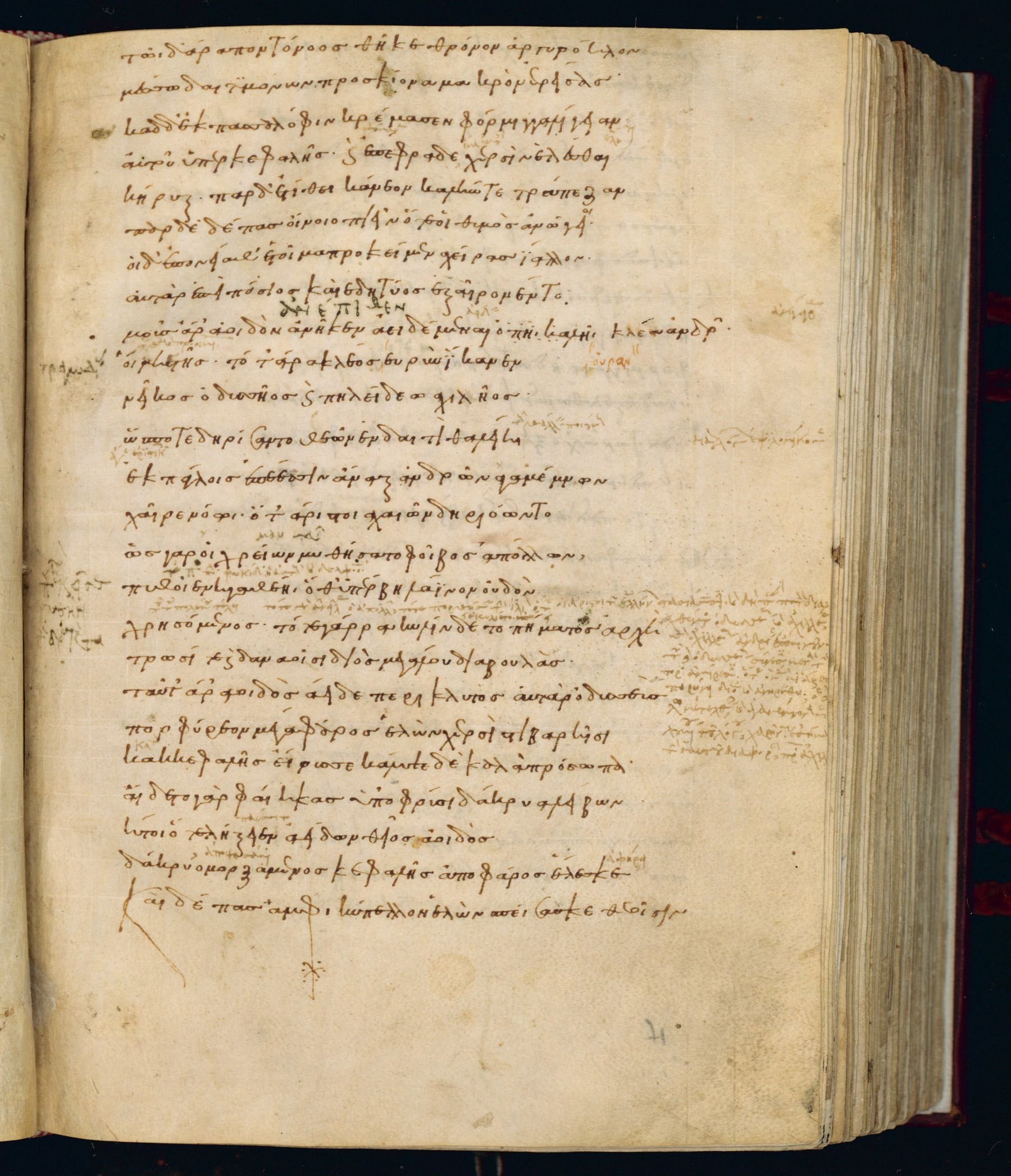
Where on the image
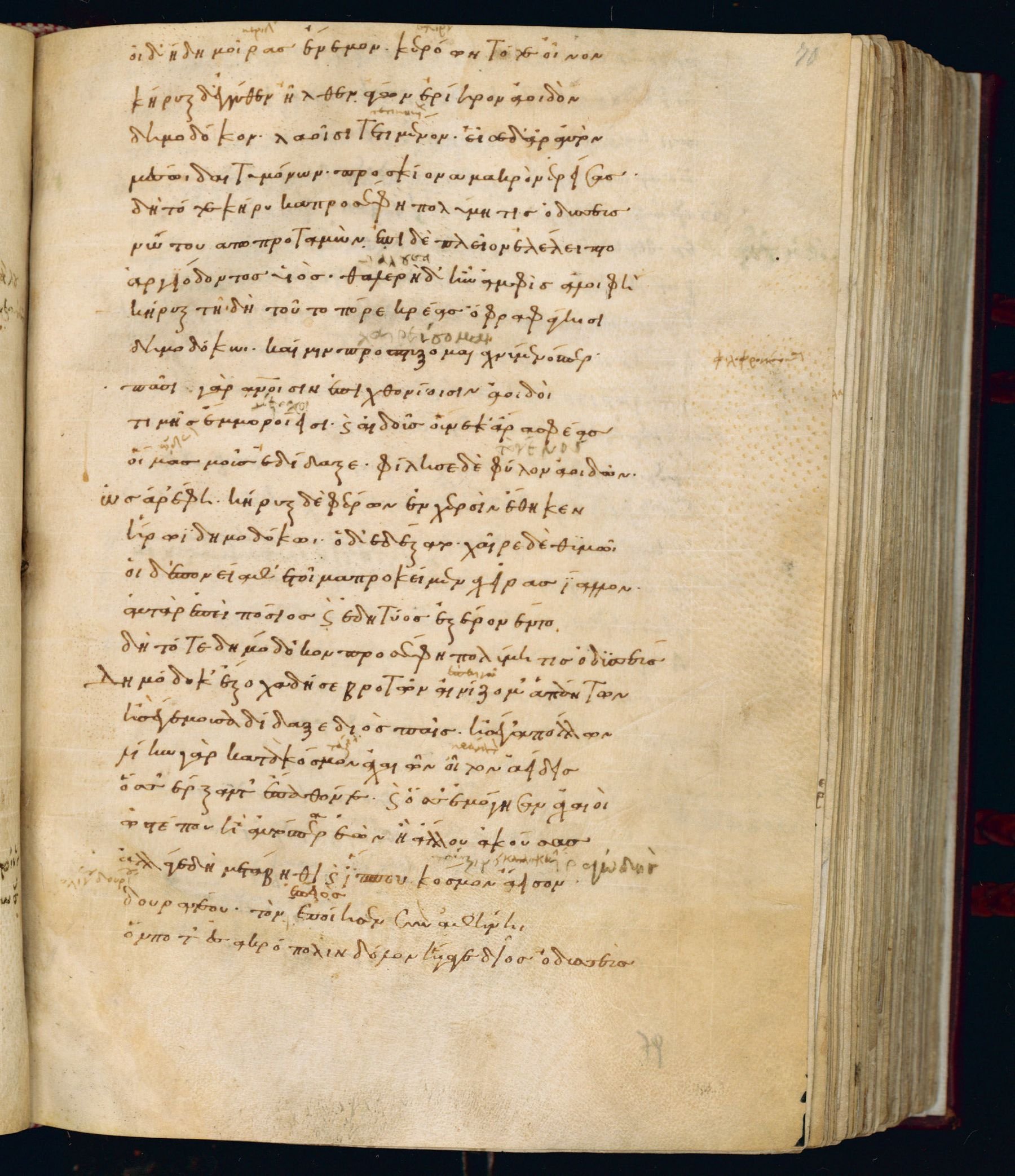
Laur. Plut. 32.24, fol. 71r: Odyssey 8.65-89, begins ‹τῷ δʼ ἄρα Ποντόνοος›, ends ‹ἀμφικύπελλον ἑλὼν σπείσασκε θεοῖσιν·›. Checked on the image: first and last lines read and matched to the Greek. Fol. 70v ends with 8.64. Fol. 71v begins with 8.90. English blocks here: 65-69, 70-74, 75-79, 80-82, 83-84, 85-89.
65τῷ δʼ ἄρα Ποντόνοος θῆκε θρόνον ἀργυρόηλον
66μέσσῳ δαιτυμόνων, πρὸς κίονα μακρὸν ἐρείσας·
67κὰδ δʼ ἐκ πασσαλόφι κρέμασεν φόρμιγγα λίγειαν
68αὐτοῦ ὑπὲρ κεφαλῆς καὶ ἐπέφραδε χερσὶν ἑλέσθαι
69κῆρυξ· πὰρ δʼ ἐτίθει κάνεον καλήν τε τράπεζαν,
70πὰρ δὲ δέπας οἴνοιο, πιεῖν ὅτε θυμὸς ἀνώγοι.
71οἱ δʼ ἐπʼ ὀνείαθʼ ἑτοῖμα προκείμενα χεῖρας ἴαλλον.
72αὐτὰρ ἐπεὶ πόσιος καὶ ἐδητύος ἐξ ἔρον ἕντο,
73μοῦσʼ ἄρʼ ἀοιδὸν ἀνῆκεν ἀειδέμεναι κλέα ἀνδρῶν,
74οἴμης τῆς τότʼ ἄρα κλέος οὐρανὸν εὐρὺν ἵκανε,
75νεῖκος Ὀδυσσῆος καὶ Πηλεΐδεω Ἀχιλῆος,
76ὥς ποτε δηρίσαντο θεῶν ἐν δαιτὶ θαλείῃ
77ἐκπάγλοις ἐπέεσσιν, ἄναξ δʼ ἀνδρῶν Ἀγαμέμνων
78χαῖρε νόῳ, ὅ τʼ ἄριστοι Ἀχαιῶν δηριόωντο.
79ὣς γάρ οἱ χρείων μυθήσατο Φοῖβος Ἀπόλλων
80Πυθοῖ ἐν ἠγαθέῃ, ὅθʼ ὑπέρβη λάινον οὐδὸν
81χρησόμενος· τότε γάρ ῥα κυλίνδετο πήματος ἀρχὴ
82Τρωσί τε καὶ Δαναοῖσι Διὸς μεγάλου διὰ βουλάς.
83ταῦτʼ ἄρʼ ἀοιδὸς ἄειδε περικλυτός· αὐτὰρ Ὀδυσσεὺς
84πορφύρεον μέγα φᾶρος ἑλὼν χερσὶ στιβαρῇσι
85κὰκ κεφαλῆς εἴρυσσε, κάλυψε δὲ καλὰ πρόσωπα·
86αἴδετο γὰρ Φαίηκας ὑπʼ ὀφρύσι δάκρυα λείβων.
87ἦ τοι ὅτε λήξειεν ἀείδων θεῖος ἀοιδός,
88δάκρυ ὀμορξάμενος κεφαλῆς ἄπο φᾶρος ἕλεσκε
89καὶ δέπας ἀμφικύπελλον ἑλὼν σπείσασκε θεοῖσιν·
65For him Pontonous, the herald, set a silver-studded chair in the midst of the banqueters, leaning it against a tall pillar, and he hung the clear-toned lyre from a peg close above his head, and showed him how to reach it with his hands. And beside him he placed a basket and a beautiful table, 70and a cup of wine, to drink when his heart should bid him. So they put forth their hands to the good cheer lying ready before them. But when they had put from them the desire of food and drink, the Muse moved the minstrel to sing of the glorious deeds of warriors, from that lay the fame whereof had then reached broad heaven, 75even the quarrel of Odysseus and Achilles, son of Peleus, how once they strove with furious words at a rich feast of the gods, and Agamemnon, king of men, was glad at heart that the best of the Achaeans were quarrelling; for thus Phoebus Apollo, in giving his response, had told him that it should be, 80in sacred Pytho, when he passed over the threshold of stone to enquire of the oracle. For then the beginning of woe was rolling upon Trojans and Danaans through the will of great Zeus. 83This song the famous minstrel sang; but Odysseus grasped his great purple cloak with his stout hands, 85and drew it down over his head, and hid his comely face; for he had shame of the Phaeacians as he let fall tears from beneath his eyebrows. Yea, and as often as the divine minstrel ceased his singing, Odysseus would wipe away his tears and draw the cloak from off his head, and taking the two-handled cup would pour libations to the gods.
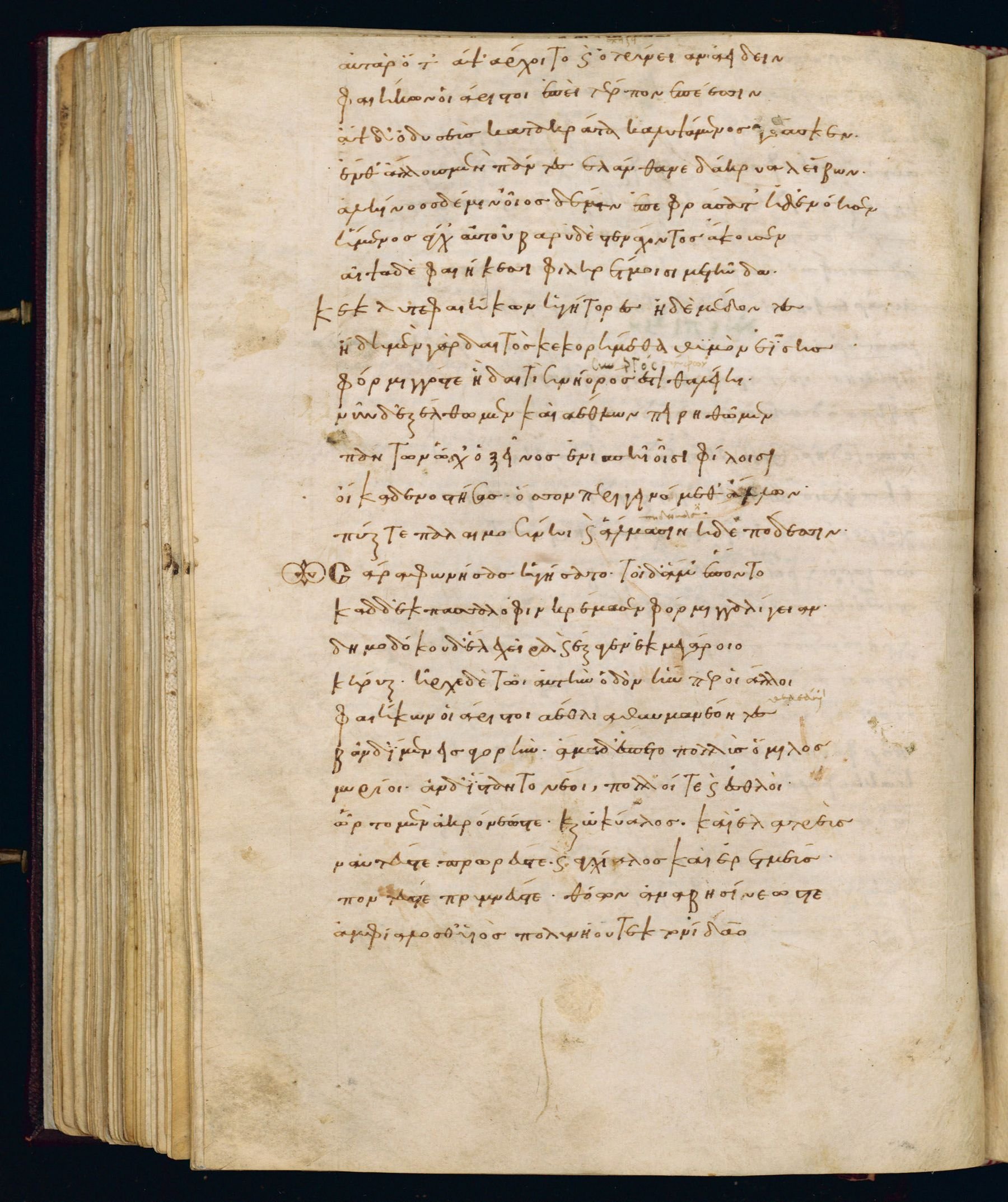
Where on the image
Laur. Plut. 32.24, fol. 71v: Odyssey 8.90-114, begins ‹αὐτὰρ ὅτʼ ἂψ ἄρχοιτο›, ends ‹θʼ, υἱὸς Πολυνήου Τεκτονίδαο·›. Checked on the image: first and last lines read and matched to the Greek. Fol. 71r ends with 8.89. Fol. 72r begins with 8.115. English blocks here: 90-94, 95-99, 100-104, 105-109, 110-114.
90αὐτὰρ ὅτʼ ἂψ ἄρχοιτο καὶ ὀτρύνειαν ἀείδειν
91Φαιήκων οἱ ἄριστοι, ἐπεὶ τέρποντʼ ἐπέεσσιν,
92ἂψ Ὀδυσεὺς κατὰ κρᾶτα καλυψάμενος γοάασκεν.
93ἔνθʼ ἄλλους μὲν πάντας ἐλάνθανε δάκρυα λείβων,
94Ἀλκίνοος δέ μιν οἶος ἐπεφράσατʼ ἠδʼ ἐνόησεν
95ἥμενος ἄγχʼ αὐτοῦ, βαρὺ δὲ στενάχοντος ἄκουσεν.
96αἶψα δὲ Φαιήκεσσι φιληρέτμοισι μετηύδα·
97κέκλυτε, Φαιήκων ἡγήτορες ἠδὲ μέδοντες.
98ἤδη μὲν δαιτὸς κεκορήμεθα θυμὸν ἐίσης
99φόρμιγγός θʼ, ἣ δαιτὶ συνήορός ἐστι θαλείῃ·
100νῦν δʼ ἐξέλθωμεν καὶ ἀέθλων πειρηθῶμεν
101πάντων, ὥς χʼ ὁ ξεῖνος ἐνίσπῃ οἷσι φίλοισιν
102οἴκαδε νοστήσας, ὅσσον περιγιγνόμεθʼ ἄλλων
103πύξ τε παλαιμοσύνῃ τε καὶ ἅλμασιν ἠδὲ πόδεσσιν.
104ὣς ἄρα φωνήσας ἡγήσατο, τοὶ δʼ ἅμʼ ἕποντο.
105κὰδ δʼ ἐκ πασσαλόφι κρέμασεν φόρμιγγα λίγειαν,
106Δημοδόκου δʼ ἕλε χεῖρα καὶ ἔξαγεν ἐκ μεγάροιο
107κῆρυξ· ἦρχε δὲ τῷ αὐτὴν ὁδὸν ἥν περ οἱ ἄλλοι
108Φαιήκων οἱ ἄριστοι, ἀέθλια θαυμανέοντες.
109βὰν δʼ ἴμεν εἰς ἀγορήν, ἅμα δʼ ἕσπετο πουλὺς ὅμιλος,
110μυρίοι· ἂν δʼ ἵσταντο νέοι πολλοί τε καὶ ἐσθλοί.
111ὦρτο μὲν Ἀκρόνεώς τε καὶ Ὠκύαλος καὶ Ἐλατρεύς,
112Ναυτεύς τε Πρυμνεύς τε καὶ Ἀγχίαλος καὶ Ἐρετμεύς,
113Ποντεύς τε Πρωρεύς τε, Θόων Ἀναβησίνεώς τε
114Ἀμφίαλός θʼ, υἱὸς Πολυνήου Τεκτονίδαο·
90But as often as he began again, and the nobles of the Phaeacians bade him sing, because they took pleasure in his lay, Odysseus would again cover his head and moan. Now from all the rest he concealed the tears that he shed, but Alcinous alone marked him and took heed, 95for he sat by him, and heard him groaning heavily. And straightway he spoke among the Phaeacians, lovers of the oar: “Hear me, ye leaders and counsellors of the Phaeacians, already have we satisfied our hearts with the equal banquet and with the lyre, which is the companion of the rich feast. 100But now let us go forth, and make trial of all manner of games, that yon stranger may tell his friends, when he returns home, how far we excel other men in boxing and wrestling and leaping and in speed of foot.” So saying, he led the way, and they followed him. 105From the peg the herald hung the clear-toned lyre, and took Demodocus by the hand, and led him forth from the hall, guiding him by the self-same road by which the others, the nobles of the Phaeacians, had gone to gaze upon the games. They went their way to the place of assembly, and with them went a great throng, 110past counting; and up rose many noble youths. There rose Acroneus, and Ocyalus, and Elatreus, and Nauteus, and Prymneus, and Anchialus, and Eretmeus, and Ponteus, and Proreus, Thoon and Anabesineus,
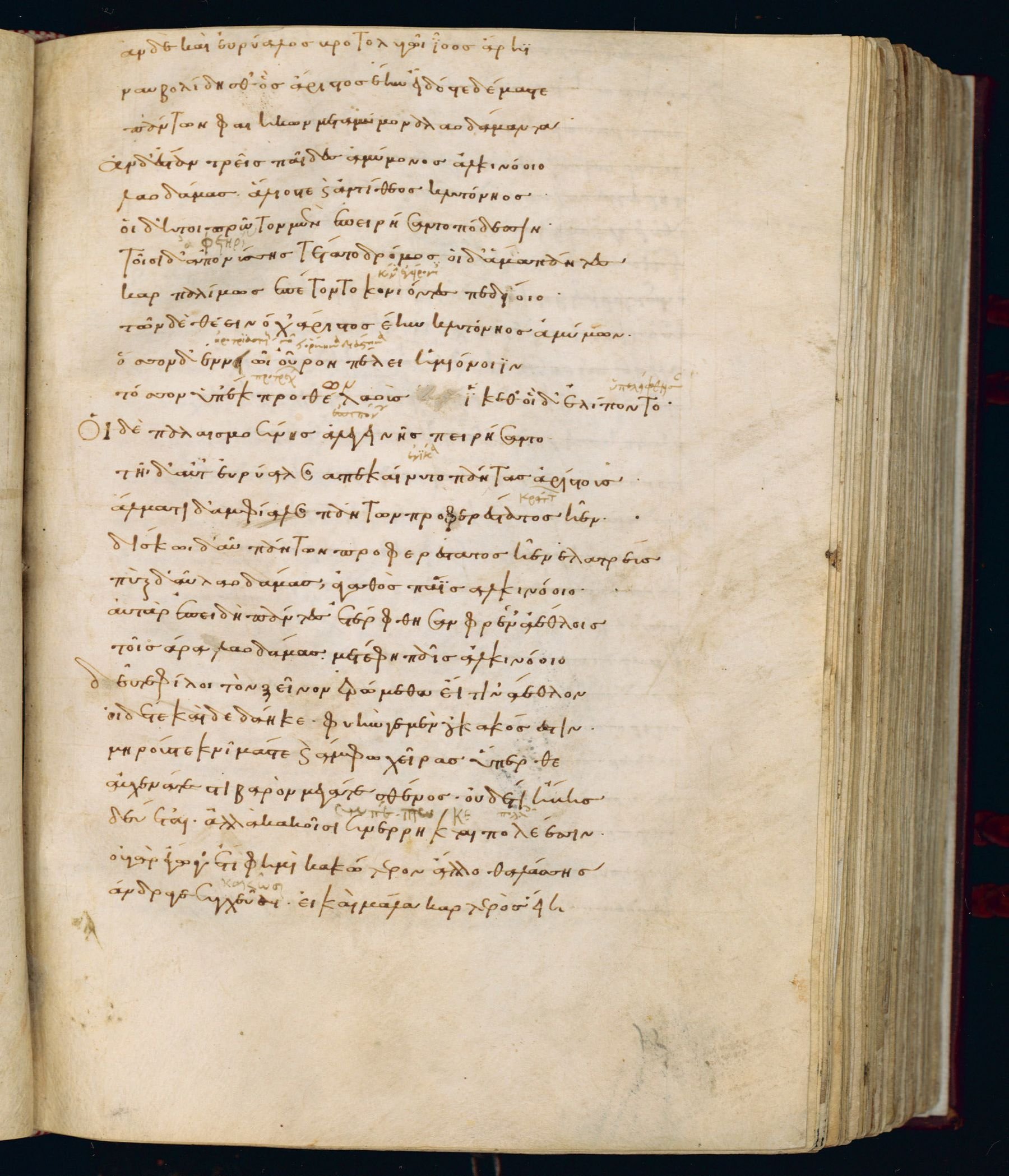
Where on the image
Laur. Plut. 32.24, fol. 72r: Odyssey 8.115-139, begins ‹ἂν δὲ καὶ Εὐρύαλος,›, ends ‹καὶ μάλα καρτερὸς εἴη.›. Checked on the image: first and last lines read and matched to the Greek. Fol. 71v ends with 8.114. Fol. 72v begins with 8.140. English blocks here: 115-119, 120-120, 121-124, 125-129, 130-134, 135-139.
115ἂν δὲ καὶ Εὐρύαλος, βροτολοιγῷ ἶσος Ἄρηϊ,
116Ναυβολίδης, ὃς ἄριστος ἔην εἶδός τε δέμας τε
117πάντων Φαιήκων μετʼ ἀμύμονα Λαοδάμαντα.
118ἂν δʼ ἔσταν τρεῖς παῖδες ἀμύμονος Ἀλκινόοιο,
119Λαοδάμας θʼ Ἅλιός τε καὶ ἀντίθεος Κλυτόνηος.
120οἱ δʼ ἦ τοι πρῶτον μὲν ἐπειρήσαντο πόδεσσι.
121τοῖσι δʼ ἀπὸ νύσσης τέτατο δρόμος· οἱ δʼ ἅμα πάντες
122καρπαλίμως ἐπέτοντο κονίοντες πεδίοιο·
123τῶν δὲ θέειν ὄχʼ ἄριστος ἔην Κλυτόνηος ἀμύμων·
124ὅσσον τʼ ἐν νειῷ οὖρον πέλει ἡμιόνοιιν,
125τόσσον ὑπεκπροθέων λαοὺς ἵκεθʼ, οἱ δʼ ἐλίποντο.
126οἱ δὲ παλαιμοσύνης ἀλεγεινῆς πειρήσαντο·
127τῇ δʼ αὖτʼ Εὐρύαλος ἀπεκαίνυτο πάντας ἀρίστους.
128ἅλματι δʼ Ἀμφίαλος πάντων προφερέστατος ἦεν·
129δίσκῳ δʼ αὖ πάντων πολὺ φέρτατος ἦεν Ἐλατρεύς,
130πὺξ δʼ αὖ Λαοδάμας, ἀγαθὸς πάϊς Ἀλκινόοιο.
131αὐτὰρ ἐπεὶ δὴ πάντες ἐτέρφθησαν φρένʼ ἀέθλοις,
132τοῖς ἄρα Λαοδάμας μετέφη πάϊς Ἀλκινόοιο·
133δεῦτε, φίλοι, τὸν ξεῖνον ἐρώμεθα εἴ τινʼ ἄεθλον
134οἶδέ τε καὶ δεδάηκε. φυήν γε μὲν οὐ κακός ἐστι,
135μηρούς τε κνήμας τε καὶ ἄμφω χεῖρας ὕπερθεν
136αὐχένα τε στιβαρὸν μέγα τε σθένος· οὐδέ τι ἥβης
137δεύεται, ἀλλὰ κακοῖσι συνέρρηκται πολέεσσιν·
138οὐ γὰρ ἐγώ γέ τί φημι κακώτερον ἄλλο θαλάσσης
139ἄνδρα γε συγχεῦαι, εἰ καὶ μάλα καρτερὸς εἴη.
115and Amphialus, son of Polyneus, son of Tecton; and up rose also Euryalus, the peer of man-destroying Ares, the son of Naubolus, who in comeliness and form was the best of all the Phaeacians after peerless Laodamas; and up rose the three sons of noble Alcinous, Laodamas, and Halius, and godlike Clytoneus. 120These then first made trial in the foot-race. 121A course was marked out for them from the turning point, and they all sped swiftly, raising the dust of the plain; but among them noble Clytoneus was far the best at running, and by as far as is the range of a team of mules in fallow land, 125by so far he shot to the front and reached the host, and the others were left behind. Then they made trial of toilsome wrestling, and here in turn Euryalus excelled all the princes. And in leaping Amphialus was best of all, and with the discus again far the best of all was Elatreus, 130and in boxing Laodamas, the good son of Alcinous. But when the hearts of all had taken pleasure in the contests, Laodamas, the son of Alcinous, spoke among them: “Come, friends, let us ask yon stranger whether he knows and has learned any contests. In build, surely, he is no mean man, 135in thighs and calves, and in his two arms above, his stout neck, and his great might. In no wise does he lack aught of the strength of youth, but he has been broken by many troubles. For to my mind there is naught worse than the sea to confound a man, be he never so strong.”
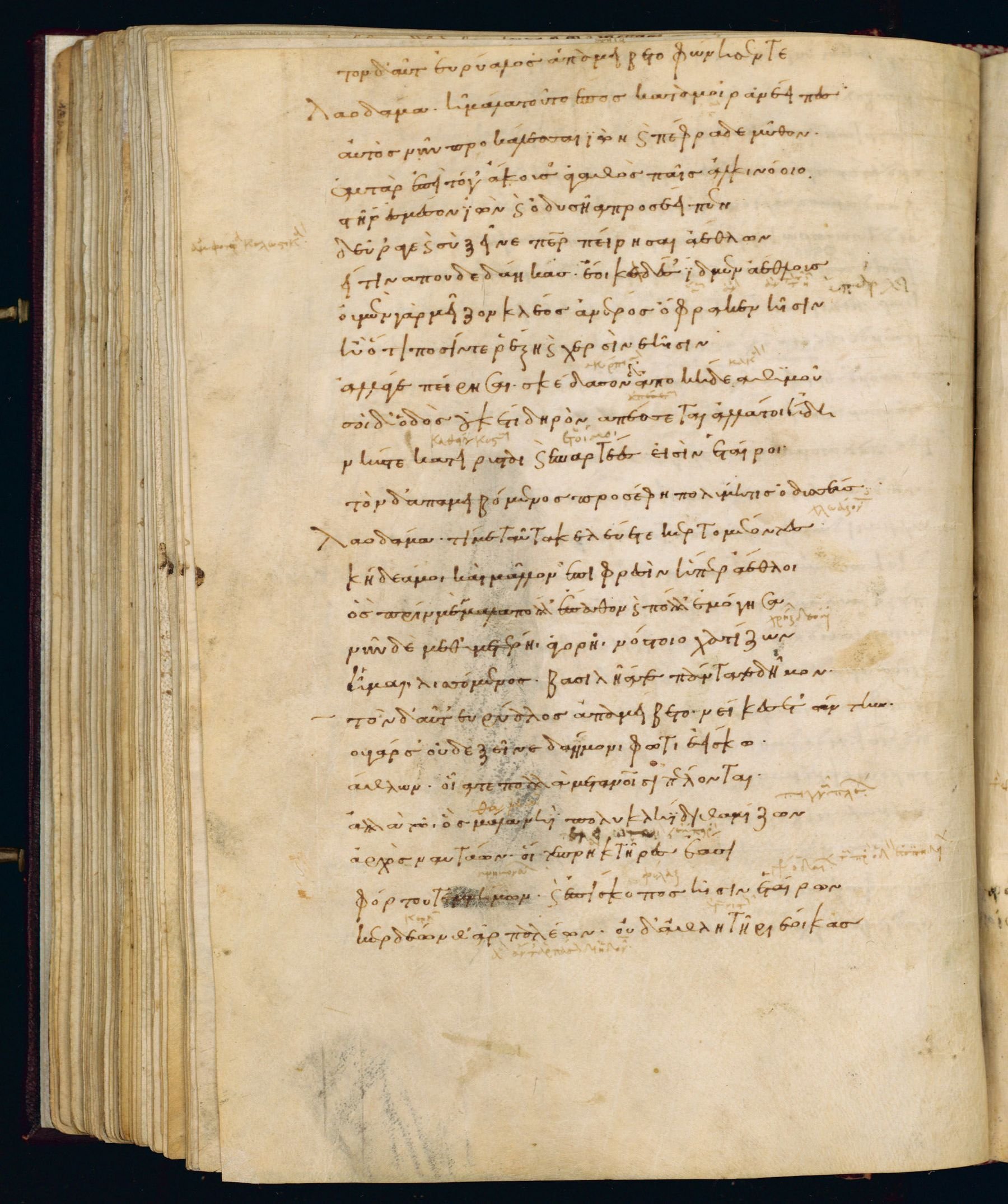
Where on the image
Laur. Plut. 32.24, fol. 72v: Odyssey 8.140-164, begins ‹τὸν δʼ αὖτʼ Εὐρύαλος›, ends ‹ἁρπαλέων· οὐδʼ ἀθλητῆρι ἔοικας.›. Checked on the image: first and last lines read and matched to the Greek. Fol. 72r ends with 8.139. Fol. 73r begins with 8.165. English blocks here: 140-144, 145-149, 150-154, 155-159, 160-164.
140τὸν δʼ αὖτʼ Εὐρύαλος ἀπαμείβετο φώνησέν τε·
141Λαοδάμα, μάλα τοῦτο ἔπος κατὰ μοῖραν ἔειπες.
142αὐτὸς νῦν προκάλεσσαι ἰὼν καὶ πέφραδε μῦθον.
143αὐτὰρ ἐπεὶ τό γʼ ἄκουσʼ ἀγαθὸς πάϊς Ἀλκινόοιο,
144στῆ ῥʼ ἐς μέσσον ἰὼν καὶ Ὀδυσσῆα προσέειπε·
145δεῦρʼ ἄγε καὶ σύ, ξεῖνε πάτερ, πείρησαι ἀέθλων,
146εἴ τινά που δεδάηκας· ἔοικε δέ σʼ ἴδμεν ἀέθλους·
147οὐ μὲν γὰρ μεῖζον κλέος ἀνέρος ὄφρα κʼ ἔῃσιν,
148ἤ ὅ τι ποσσίν τε ῥέξῃ καὶ χερσὶν ἑῇσιν.
149ἀλλʼ ἄγε πείρησαι, σκέδασον δʼ ἀπὸ κήδεα θυμοῦ.
150σοὶ δʼ ὁδὸς οὐκέτι δηρὸν ἀπέσσεται, ἀλλά τοι ἤδη
151νηῦς τε κατείρυσται καὶ ἐπαρτέες εἰσὶν ἑταῖροι.
152τὸν δʼ ἀπαμειβόμενος προσέφη πολύμητις Ὀδυσσεύς·
153Λαοδάμα, τί με ταῦτα κελεύετε κερτομέοντες;
154κήδεά μοι καὶ μᾶλλον ἐνὶ φρεσὶν ἤ περ ἄεθλοι,
155ὃς πρὶν μὲν μάλα πολλὰ πάθον καὶ πολλὰ μόγησα,
156νῦν δὲ μεθʼ ὑμετέρῃ ἀγορῇ νόστοιο χατίζων
157ἧμαι, λισσόμενος βασιλῆά τε πάντα τε δῆμον.
158τὸν δʼ αὖτʼ Εὐρύαλος ἀπαμείβετο νείκεσέ τʼ ἄντην·
159οὐ γάρ σʼ οὐδέ, ξεῖνε, δαήμονι φωτὶ ἐίσκω
160ἄθλων, οἷά τε πολλὰ μετʼ ἀνθρώποισι πέλονται,
161ἀλλὰ τῷ, ὅς θʼ ἅμα νηὶ πολυκλήιδι θαμίζων,
162ἀρχὸς ναυτάων οἵ τε πρηκτῆρες ἔασιν,
163φόρτου τε μνήμων καὶ ἐπίσκοπος ᾖσιν ὁδαίων
164κερδέων θʼ ἁρπαλέων· οὐδʼ ἀθλητῆρι ἔοικας.
140And Euryalus in turn answered him, and said:“Laodamas, this word of thine is right fitly spoken. Go now thyself and challenge him, and make known thy word.” Now when the good son of Alcinous heard this he came and took his stand in the midst and spoke to Odysseus: 145“Come, Sir stranger, do thou, too, make trial of the contests, if thou knowest any; and it must be that thou knowest contests, for there is no greater glory for a man so long as he lives than that which he achieves by his own hands and his feet. Nay, come, make trial, and cast away care from thy heart. 150Thy journey shall no more be long delayed, nay, even now thy ship is launched and the crew is ready.” Then Odysseus of many wiles answered him, and said: “Laodamas, why do ye mock me with this challenge? Sorrow is in my mind far more than contests, 155seeing that in time past I have suffered much and toiled much, and now I sit in the midst of your assembly, longing for my return home, and making my prayer to the king and to all the people.” Then again Euryalus made answer and taunted him to his face: “Nay verily, stranger, for I do not liken thee to a man that is skilled 160in contests, such as abound among men, but to one who, faring to and fro with his benched ship, is a captain of sailors who are merchantmen, one who is mindful of his freight, and has charge of a home-borne cargo, and the gains of his greed. Thou dost not look like an athlete.”
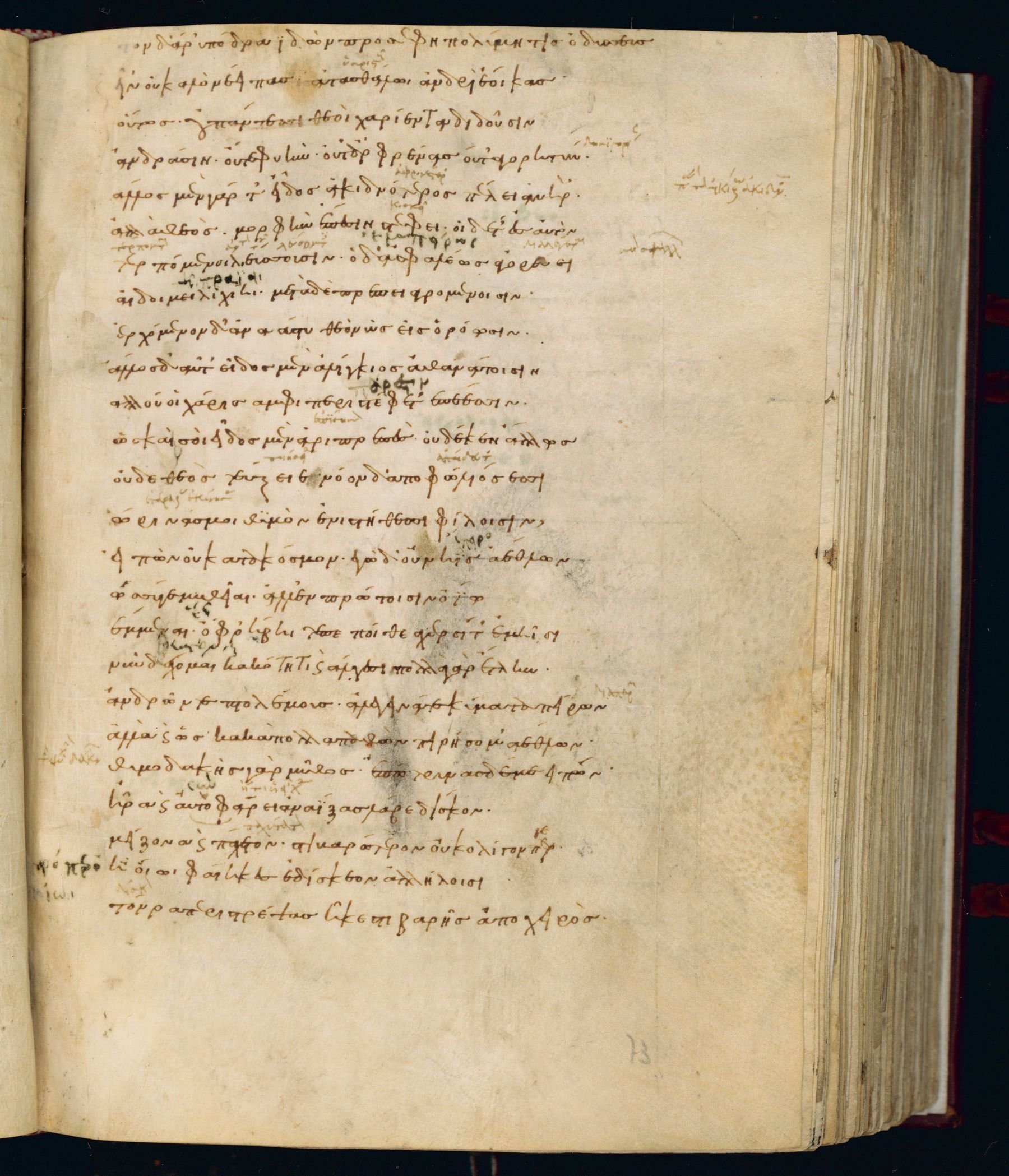
Where on the image
Laur. Plut. 32.24, fol. 73r: Odyssey 8.165-189, begins ‹τὸν δʼ ἄρʼ ὑπόδρα›, ends ‹ἧκε στιβαρῆς ἀπὸ χειρός,›. Checked on the image: first and last lines read and matched to the Greek. Fol. 72v ends with 8.164. Fol. 73v begins with 8.190. English blocks here: 165-169, 170-174, 175-179, 180-184, 185-189.
165τὸν δʼ ἄρʼ ὑπόδρα ἰδὼν προσέφη πολύμητις Ὀδυσσεύς·
166ξεῖνʼ, οὐ καλὸν ἔειπες· ἀτασθάλῳ ἀνδρὶ ἔοικας.
167οὕτως οὐ πάντεσσι θεοὶ χαρίεντα διδοῦσιν
168ἀνδράσιν, οὔτε φυὴν οὔτʼ ἂρ φρένας οὔτʼ ἀγορητύν.
169ἄλλος μὲν γάρ τʼ εἶδος ἀκιδνότερος πέλει ἀνήρ,
170ἀλλὰ θεὸς μορφὴν ἔπεσι στέφει, οἱ δέ τʼ ἐς αὐτὸν
171τερπόμενοι λεύσσουσιν· ὁ δʼ ἀσφαλέως ἀγορεύει
172αἰδοῖ μειλιχίῃ, μετὰ δὲ πρέπει ἀγρομένοισιν,
173ἐρχόμενον δʼ ἀνὰ ἄστυ θεὸν ὣς εἰσορόωσιν.
174ἄλλος δʼ αὖ εἶδος μὲν ἀλίγκιος ἀθανάτοισιν,
175ἀλλʼ οὔ οἱ χάρις ἀμφιπεριστέφεται ἐπέεσσιν,
176ὡς καὶ σοὶ εἶδος μὲν ἀριπρεπές, οὐδέ κεν ἄλλως
177οὐδὲ θεὸς τεύξειε, νόον δʼ ἀποφώλιός ἐσσι.
178ὤρινάς μοι θυμὸν ἐνὶ στήθεσσι φίλοισιν
179εἰπὼν οὐ κατὰ κόσμον. ἐγὼ δʼ οὐ νῆις ἀέθλων,
180ὡς σύ γε μυθεῖαι, ἀλλʼ ἐν πρώτοισιν ὀίω
181ἔμμεναι, ὄφρʼ ἥβῃ τε πεποίθεα χερσί τʼ ἐμῇσι.
182νῦν δʼ ἔχομαι κακότητι καὶ ἄλγεσι· πολλὰ γὰρ ἔτλην
183ἀνδρῶν τε πτολέμους ἀλεγεινά τε κύματα πείρων.
184ἀλλὰ καὶ ὥς, κακὰ πολλὰ παθών, πειρήσομʼ ἀέθλων·
185θυμοδακὴς γὰρ μῦθος, ἐπώτρυνας δέ με εἰπών.
186ἦ ῥα καὶ αὐτῷ φάρει ἀναΐξας λάβε δίσκον
187μείζονα καὶ πάχετον, στιβαρώτερον οὐκ ὀλίγον περ
188ἢ οἵῳ Φαίηκες ἐδίσκεον ἀλλήλοισι.
189τόν ῥα περιστρέψας ἧκε στιβαρῆς ἀπὸ χειρός,
165Then with an angry glance from beneath his brows Odysseus of many wiles answered him: “Stranger, thou hast not spoken well; thou art as one blind with folly. So true is it that the gods do not give gracious gifts to all alike, not form nor mind nor eloquence. For one man is inferior in comeliness, 170but the god sets a crown of beauty upon his words, and men look upon him with delight, and he speaks on unfalteringly with sweet modesty, and is conspicuous among the gathered people, and as he goes through the city men gaze upon him as upon a god. Another again is in comeliness like the immortals, 175but no crown of grace is set about his words. So, in thy case, thy comeliness is preeminent, nor could a god himself mend it, but in mind thou art stunted. Thou hast stirred the spirit in my breast by speaking thus unmannerly. I am not unskilled in sports 180as thou pratest, nay, methinks I was among the first so long as I trusted in my youth and in my hands. But now I am bound by suffering and pains; for much have I endured in passing through wars of men and the grievous waves. But even so, though I have suffered much, I will make trial of the contests, 185for thy word has stung me to the heart, and thou hast provoked me with thy speech.” He spoke, and, leaping up with his cloak about him as it was, seized a discus larger than the rest and thick, no little heavier than those with which the Phaeacians were wont to contend one with another. This with a whirl he sent from his stout hand,
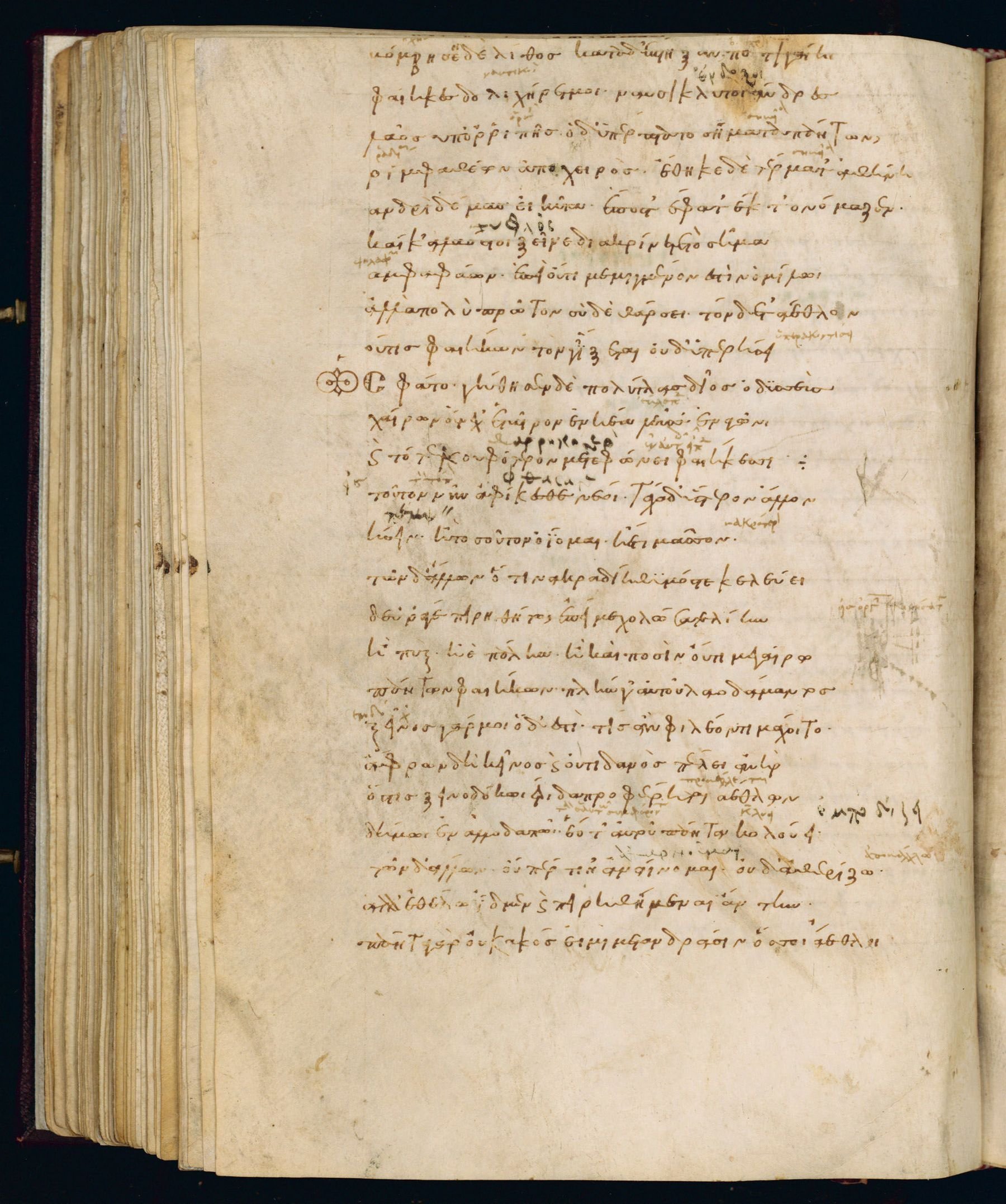
Where on the image
Laur. Plut. 32.24, fol. 73v: Odyssey 8.190-214, begins ‹βόμβησεν δὲ λίθος· κατὰ›, ends ‹μετʼ ἀνδράσιν ὅσσοι ἄεθλοι·›. Checked on the image: first and last lines read and matched to the Greek. Fol. 73r ends with 8.189. Fol. 74r begins with 8.215. English blocks here: 190-194, 195-198, 199-199, 200-204, 205-209, 210-214.
190βόμβησεν δὲ λίθος· κατὰ δʼ ἔπτηξαν ποτὶ γαίῃ
191Φαίηκες δολιχήρετμοι, ναυσίκλυτοι ἄνδρες,
192λᾶος ὑπὸ ῥιπῆς· ὁ δʼ ὑπέρπτατο σήματα πάντων
193ῥίμφα θέων ἀπὸ χειρός. ἔθηκε δὲ τέρματʼ Ἀθήνη
194ἀνδρὶ δέμας ἐικυῖα, ἔπος τʼ ἔφατʼ ἔκ τʼ ὀνόμαζεν·
195καί κʼ ἀλαός τοι, ξεῖνε, διακρίνειε τὸ σῆμα
196ἀμφαφόων, ἐπεὶ οὔ τι μεμιγμένον ἐστὶν ὁμίλῳ,
197ἀλλὰ πολὺ πρῶτον. σὺ δὲ θάρσει τόνδε γʼ ἄεθλον·
198οὔ τις Φαιήκων τόδε γʼ ἵξεται, οὐδʼ ὑπερήσει.
199ὣς φάτο, γήθησεν δὲ πολύτλας δῖος Ὀδυσσεύς,
200χαίρων, οὕνεχʼ ἑταῖρον ἐνηέα λεῦσσʼ ἐν ἀγῶνι.
201καὶ τότε κουφότερον μετεφώνεε Φαιήκεσσιν·
202τοῦτον νῦν ἀφίκεσθε, νέοι. τάχα δʼ ὕστερον ἄλλον
203ἥσειν ἢ τοσσοῦτον ὀίομαι ἢ ἔτι μᾶσσον.
204τῶν δʼ ἄλλων ὅτινα κραδίη θυμός τε κελεύει,
205δεῦρʼ ἄγε πειρηθήτω, ἐπεί μʼ ἐχολώσατε λίην,
206ἢ πὺξ ἠὲ πάλῃ ἢ καὶ ποσίν, οὔ τι μεγαίρω,
207πάντων Φαιήκων, πλήν γʼ αὐτοῦ Λαοδάμαντος.
208ξεῖνος γάρ μοι ὅδʼ ἐστί· τίς ἂν φιλέοντι μάχοιτο;
209ἄφρων δὴ κεῖνός γε καὶ οὐτιδανὸς πέλει ἀνήρ,
210ὅς τις ξεινοδόκῳ ἔριδα προφέρηται ἀέθλων
211δήμῳ ἐν ἀλλοδαπῷ· ἕο δʼ αὐτοῦ πάντα κολούει.
212τῶν δʼ ἄλλων οὔ πέρ τινʼ ἀναίνομαι οὐδʼ ἀθερίζω,
213ἀλλʼ ἐθέλω ἴδμεν καὶ πειρηθήμεναι ἄντην.
214πάντα γὰρ οὐ κακός εἰμι, μετʼ ἀνδράσιν ὅσσοι ἄεθλοι·
190and the stone hummed as it flew; and down they crouched to the earth, the Phaeacians of the long oars, men famed for their ships, beneath the rush of the stone. Past the marks of all it flew, speeding lightly from his hand, and Athena, in the likeness of a man, set the mark, and she spoke and addressed him: 195“Even a blind man, stranger, could distinguish this mark, groping for it with his hands, for it is in nowise confused with the throng of the others, but is far the first. Be thou of good cheer for this bout at least: no one of the Phaeacians will reach this, or cast beyond it.” 199So she spoke, and the much-enduring goodly Odysseus was glad, 200rejoicing that he saw a true friend in the lists. Then with a lighter heart he spoke among the Phaeacians: “Reach this now, young men; and presently, methinks, I will send another after it, as far or even further. Of the rest, if any man's heart and spirit bid him, 205let him come hither and make trial—for ye have greatly angered me—be it in boxing or in wrestling, aye, or in running, I care not; let any one come of all the Phaeacians, save Laodamas alone. For he is my host, and who would quarrel with one that entertains him? Foolish is that man and worthless, 210who challenges to a contest the host who receives him in a strange land; he does but mar his own fortunes. But of all the rest I refuse none, and make light of none, but am fain to know them, and make trial of them man to man. For in all things I am no weakling, even in all the contests that are practised among men.
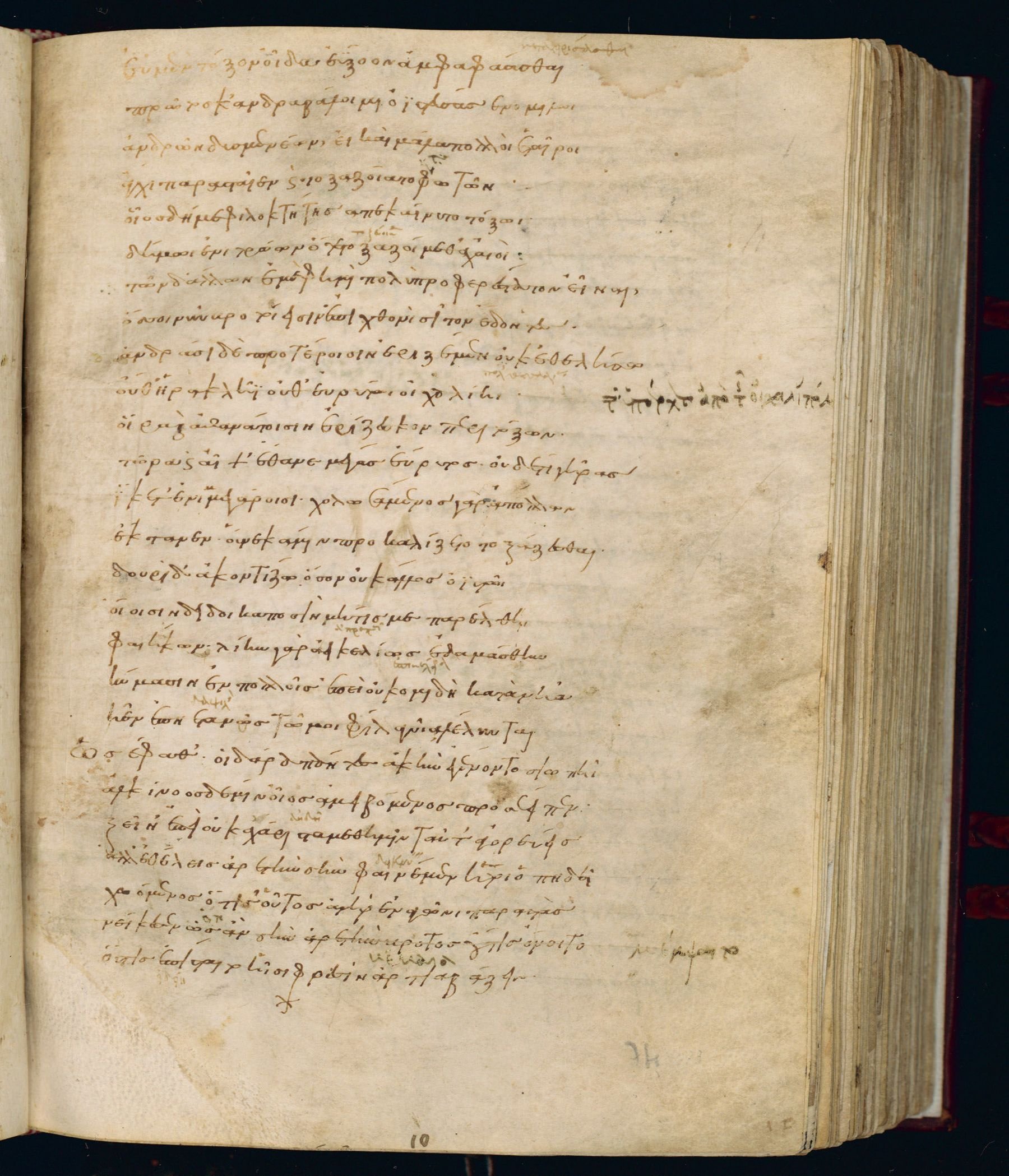
Where on the image
Laur. Plut. 32.24, fol. 74r: Odyssey 8.215-240, begins ‹εὖ μὲν τόξον οἶδα›, ends ‹ᾗσι φρεσὶν ἄρτια βάζειν·›. Checked on the image: first and last lines read and matched to the Greek. Fol. 73v ends with 8.214. Fol. 74v begins with 8.241. English blocks here: 215-219, 220-224, 225-229, 230-234, 235-239.
215εὖ μὲν τόξον οἶδα ἐύξοον ἀμφαφάασθαι·
216πρῶτός κʼ ἄνδρα βάλοιμι ὀιστεύσας ἐν ὁμίλῳ
217ἀνδρῶν δυσμενέων, εἰ καὶ μάλα πολλοὶ ἑταῖροι
218ἄγχι παρασταῖεν καὶ τοξαζοίατο φωτῶν.
219οἶος δή με Φιλοκτήτης ἀπεκαίνυτο τόξῳ
220δήμῳ ἔνι Τρώων, ὅτε τοξαζοίμεθʼ Ἀχαιοί.
221τῶν δʼ ἄλλων ἐμέ φημι πολὺ προφερέστερον εἶναι,
222ὅσσοι νῦν βροτοί εἰσιν ἐπὶ χθονὶ σῖτον ἔδοντες.
223ἀνδράσι δὲ προτέροισιν ἐριζέμεν οὐκ ἐθελήσω,
224οὔθʼ Ἡρακλῆι οὔτʼ Εὐρύτῳ Οἰχαλιῆι,
225οἵ ῥα καὶ ἀθανάτοισιν ἐρίζεσκον περὶ τόξων.
226τῷ ῥα καὶ αἶψʼ ἔθανεν μέγας Εὔρυτος, οὐδʼ ἐπὶ γῆρας
227ἵκετʼ ἐνὶ μεγάροισι· χολωσάμενος γὰρ Ἀπόλλων
228ἔκτανεν, οὕνεκά μιν προκαλίζετο τοξάζεσθαι.
229δουρὶ δʼ ἀκοντίζω ὅσον οὐκ ἄλλος τις ὀιστῷ.
230οἴοισιν δείδοικα ποσὶν μή τίς με παρέλθῃ
231Φαιήκων· λίην γὰρ ἀεικελίως ἐδαμάσθην
232κύμασιν ἐν πολλοῖς, ἐπεὶ οὐ κομιδὴ κατὰ νῆα
233ἦεν ἐπηετανός· τῷ μοι φίλα γυῖα λέλυνται.
234ὣς ἔφαθʼ, οἱ δʼ ἄρα πάντες ἀκὴν ἐγένοντο σιωπῇ.
235Ἀλκίνοος δέ μιν οἶος ἀμειβόμενος προσέειπεν·
236ξεῖνʼ, ἐπεὶ οὐκ ἀχάριστα μεθʼ ἡμῖν ταῦτʼ ἀγορεύεις,
237ἀλλʼ ἐθέλεις ἀρετὴν σὴν φαινέμεν, ἥ τοι ὀπηδεῖ,
238χωόμενος ὅτι σʼ οὗτος ἀνὴρ ἐν ἀγῶνι παραστὰς
239νείκεσεν, ὡς ἂν σὴν ἀρετὴν βροτὸς οὔ τις ὄνοιτο,
240ὅς τις ἐπίσταιτο ᾗσι φρεσὶν ἄρτια βάζειν·
215Well do I know how to handle the polished bow, and ever would I be the first to shoot and smite my man in the throng of the foe, even though many comrades stood by me and were shooting at the men. Only Philoctetes excelled me with the bow 220in the land of the Trojans, when we Achaeans shot. But of all others I declare that I am best by far, of all mortals that are now upon the earth and eat bread. Yet with men of former days I will not seek to vie, with Heracles or with Eurytus of Oechalia, 225who strove even with the immortals in archery. Wherefore great Eurytus died soon, nor did old age come upon him in his halls, for Apollo waxed wroth and slew him, because he had challenged him to a contest with the bow. And with the spear I throw farther than any other man can shoot with an arrow. 230In the foot race alone I fear that someone of the Phaeacians may out strip me, for cruelly have I been broken amid the many waves, since there was in my ship no lasting store of provisions; therefore my limbs are loosened.” So he spoke and they were all hushed in silence; 235but Alcinous alone answered him and said: “Stranger, since not ungraciously dost thou speak thus in our midst, but art minded to shew forth the prowess which waits upon thee, in anger that yonder man came up to thee in the lists and taunted thee in a way in which no mortal would make light of thy prowess,
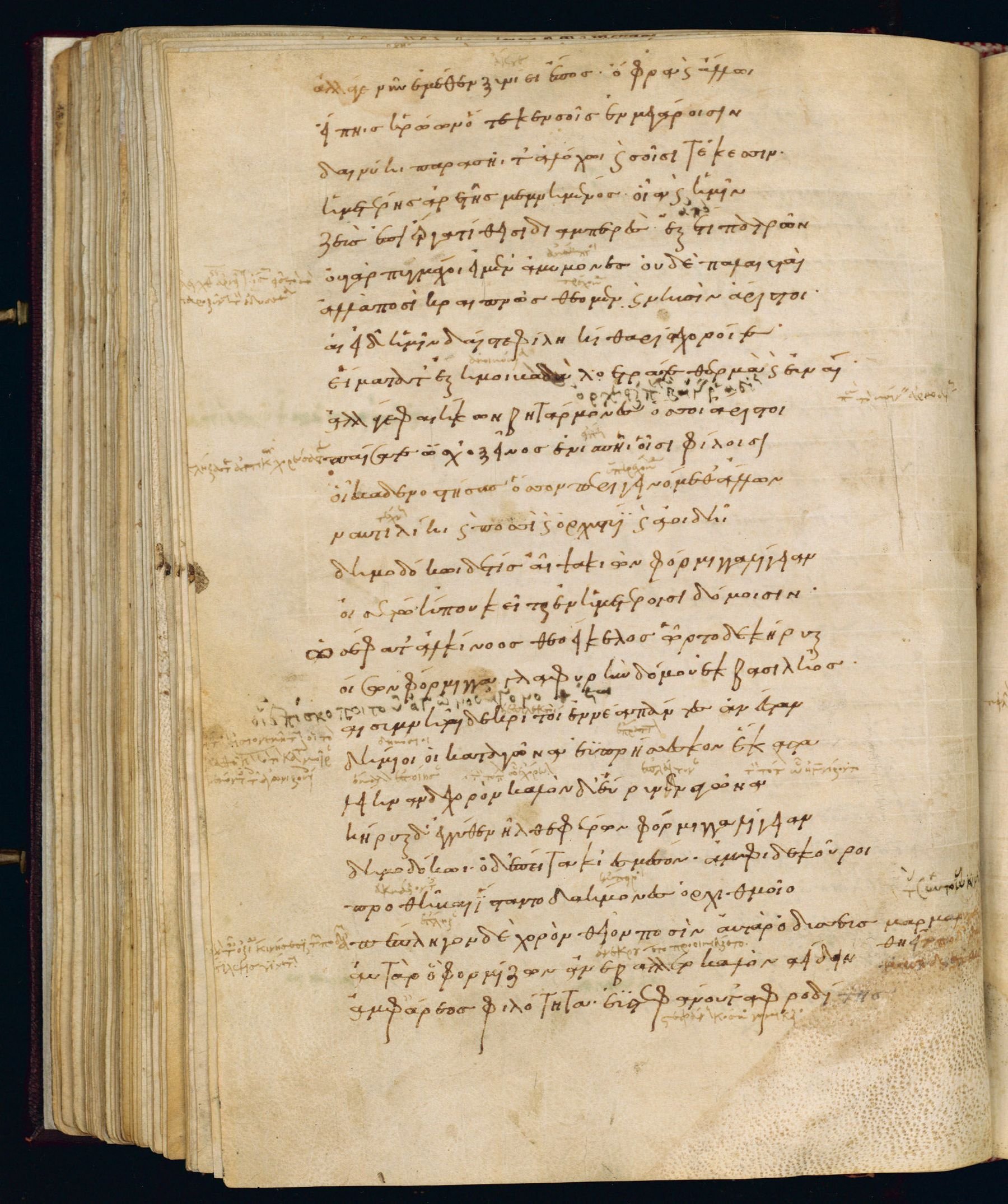
Where on the image
Laur. Plut. 32.24, fol. 74v: Odyssey 8.241-267, begins ‹ἀλλʼ ἄγε νῦν ἐμέθεν›, ends ‹φιλότητος εὐστεφάνου τʼ Ἀφροδίτης,›. Checked on the image: first and last lines read and matched to the Greek. Fol. 74r ends with 8.240. Fol. 75r begins with 8.268. 8.265 is not in the text column; it is written in the right margin beside 8.264 (the column has 26 lines). English blocks here: 240-244, 245-249, 250-254, 255-259, 260-264, 265-269.
241ἀλλʼ ἄγε νῦν ἐμέθεν ξυνίει ἔπος, ὄφρα καὶ ἄλλῳ
242εἴπῃς ἡρώων, ὅτε κεν σοῖς ἐν μεγάροισι
243δαινύῃ παρὰ σῇ τʼ ἀλόχῳ καὶ σοῖσι τέκεσσιν,
244ἡμετέρης ἀρετῆς μεμνημένος, οἷα καὶ ἡμῖν
245Ζεὺς ἐπὶ ἔργα τίθησι διαμπερὲς ἐξ ἔτι πατρῶν.
246οὐ γὰρ πυγμάχοι εἰμὲν ἀμύμονες οὐδὲ παλαισταί,
247ἀλλὰ ποσὶ κραιπνῶς θέομεν καὶ νηυσὶν ἄριστοι,
248αἰεὶ δʼ ἡμῖν δαίς τε φίλη κίθαρίς τε χοροί τε
249εἵματά τʼ ἐξημοιβὰ λοετρά τε θερμὰ καὶ εὐναί.
250ἀλλʼ ἄγε, Φαιήκων βητάρμονες ὅσσοι ἄριστοι,
251παίσατε, ὥς χʼ ὁ ξεῖνος ἐνίσπῃ οἷσι φίλοισιν
252οἴκαδε νοστήσας, ὅσσον περιγιγνόμεθʼ ἄλλων
253ναυτιλίῃ καὶ ποσσὶ καὶ ὀρχηστυῖ καὶ ἀοιδῇ.
254Δημοδόκῳ δέ τις αἶψα κιὼν φόρμιγγα λίγειαν
255οἰσέτω, ἥ που κεῖται ἐν ἡμετέροισι δόμοισιν.
256ὣς ἔφατʼ Ἀλκίνοος θεοείκελος, ὦρτο δὲ κῆρυξ
257οἴσων φόρμιγγα γλαφυρὴν δόμου ἐκ βασιλῆος.
258αἰσυμνῆται δὲ κριτοὶ ἐννέα πάντες ἀνέσταν
259δήμιοι, οἳ κατʼ ἀγῶνας ἐὺ πρήσσεσκον ἕκαστα,
260λείηναν δὲ χορόν, καλὸν δʼ εὔρυναν ἀγῶνα.
261κῆρυξ δʼ ἐγγύθεν ἦλθε φέρων φόρμιγγα λίγειαν
262Δημοδόκῳ· ὁ δʼ ἔπειτα κίʼ ἐς μέσον· ἀμφὶ δὲ κοῦροι
263πρωθῆβαι ἵσταντο, δαήμονες ὀρχηθμοῖο,
264πέπληγον δὲ χορὸν θεῖον ποσίν. αὐτὰρ Ὀδυσσεὺς
265μαρμαρυγὰς θηεῖτο ποδῶν, θαύμαζε δὲ θυμῷ.
266αὐτὰρ ὁ φορμίζων ἀνεβάλλετο καλὸν ἀείδειν
267ἀμφʼ Ἄρεος φιλότητος εὐστεφάνου τʼ Ἀφροδίτης,
240who knew in his heart how to speak fitly; come, now, hearken to my words, that thou mayest tell to another hero, when in thy halls thou art feasting with thy wife and children, and rememberest our skill, what feats 245Zeus has vouchsafed to us from our fathers' days even until now. For we are not faultless boxers or wrestlers, but in the foot race we run swiftly, and we are the best seamen; and ever to us is the banquet dear, and the lyre, and the dance, and changes of raiment, and warm baths, and the couch. 250But come now, all ye that are the best dancers of the Phaeacians, make sport, that the stranger may tell his friends on reaching home how far we surpass others in seamanship and in fleetness of foot, and in the dance and in song. And let one go straightway 255and fetch for Demodocus the clear-toned lyre which lies somewhere in our halls.” So spoke Alcinous the godlike, and the herald rose to fetch the hollow lyre from the palace of the king. Then stood up masters of the lists, nine in all, men chosen from out the people, who in their gatherings were wont to order all things aright. 260They levelled a place for the dance, and marked out a fair wide ring, and the herald came near, bearing the clear-toned lyre for Demodocus. He then moved into the midst, and around him stood boys in the first bloom of youth, well skilled in the dance, and they smote the goodly dancing floor with their feet. And Odysseus 265gazed at the twinklings of their feet and marvelled in spirit. But the minstrel struck the chords in prelude to his sweet lay and sang of the love of Ares and Aphrodite of the fair crown, how first they lay together in the house of Hephaestus secretly; and Ares gave her many gifts, and shamed the bed
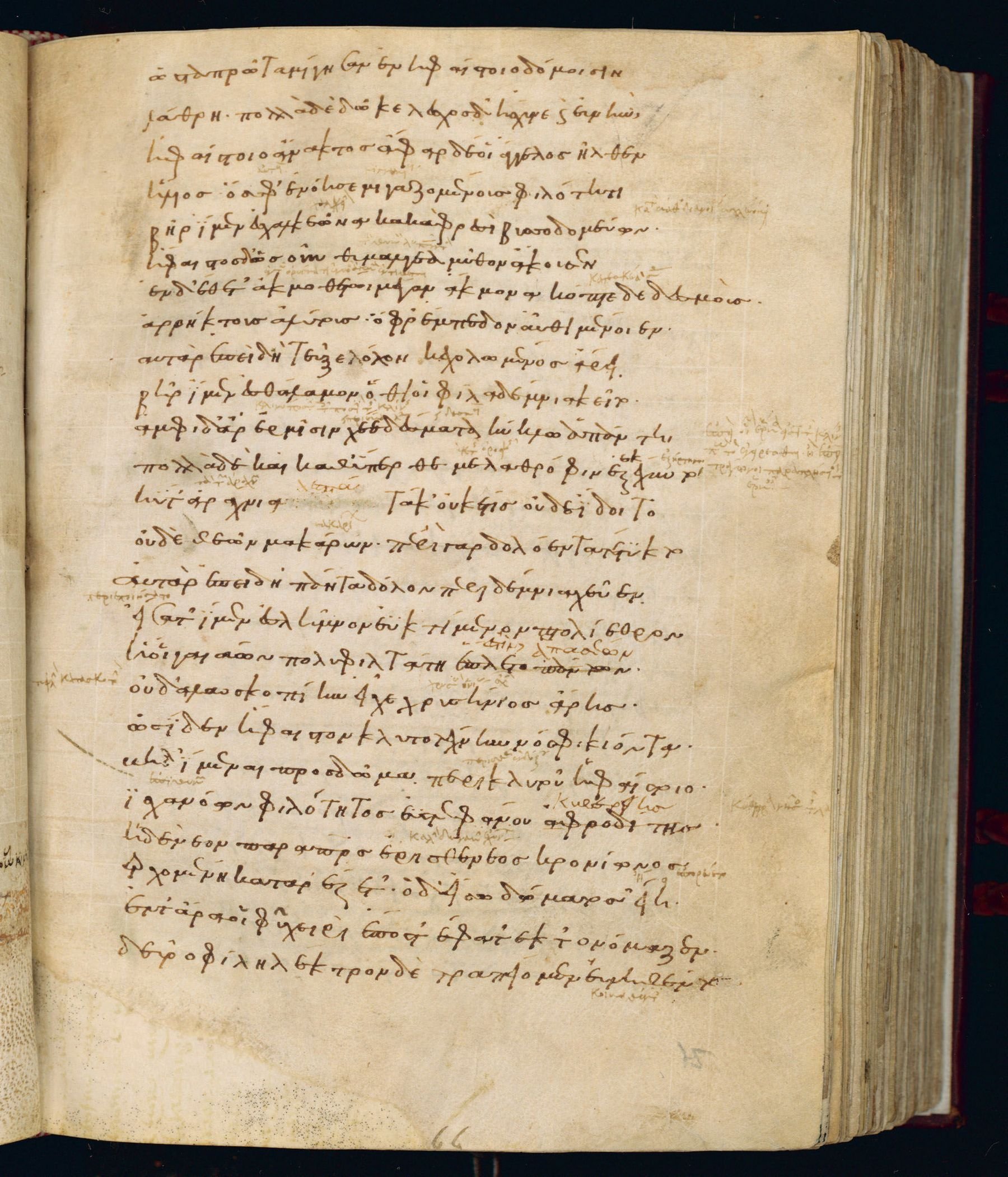
Where on the image
Laur. Plut. 32.24, fol. 75r: Odyssey 8.268-292, begins ‹ὡς τὰ πρῶτα μίγησαν›, ends ‹φίλη, λέκτρονδε τραπείομεν εὐνηθέντες·›. Checked on the image: first and last lines read and matched to the Greek. Fol. 74v ends with 8.267. Fol. 75v begins with 8.293. English blocks here: 270-274, 275-279, 280-284, 285-289, 290-294.
268ὡς τὰ πρῶτα μίγησαν ἐν Ἡφαίστοιο δόμοισι
269λάθρῃ, πολλὰ δʼ ἔδωκε, λέχος δʼ ᾔσχυνε καὶ εὐνὴν
270Ἡφαίστοιο ἄνακτος. ἄφαρ δέ οἱ ἄγγελος ἦλθεν
271Ἥλιος, ὅ σφʼ ἐνόησε μιγαζομένους φιλότητι.
272Ἥφαιστος δʼ ὡς οὖν θυμαλγέα μῦθον ἄκουσε,
273βῆ ῥʼ ἴμεν ἐς χαλκεῶνα κακὰ φρεσὶ βυσσοδομεύων,
274ἐν δʼ ἔθετʼ ἀκμοθέτῳ μέγαν ἄκμονα, κόπτε δὲ δεσμοὺς
275ἀρρήκτους ἀλύτους, ὄφρʼ ἔμπεδον αὖθι μένοιεν.
276αὐτὰρ ἐπεὶ δὴ τεῦξε δόλον κεχολωμένος Ἄρει,
277βῆ ῥʼ ἴμεν ἐς θάλαμον, ὅθι οἱ φίλα δέμνιʼ ἔκειτο,
278ἀμφὶ δʼ ἄρʼ ἑρμῖσιν χέε δέσματα κύκλῳ ἁπάντῃ·
279πολλὰ δὲ καὶ καθύπερθε μελαθρόφιν ἐξεκέχυντο,
280ἠύτʼ ἀράχνια λεπτά, τά γʼ οὔ κέ τις οὐδὲ ἴδοιτο,
281οὐδὲ θεῶν μακάρων· πέρι γὰρ δολόεντα τέτυκτο.
282αὐτὰρ ἐπεὶ δὴ πάντα δόλον περὶ δέμνια χεῦεν,
283εἴσατʼ ἴμεν ἐς Λῆμνον, ἐυκτίμενον πτολίεθρον,
284ἥ οἱ γαιάων πολὺ φιλτάτη ἐστὶν ἁπασέων.
285οὐδʼ ἀλαοσκοπιὴν εἶχε χρυσήνιος Ἄρης,
286ὡς ἴδεν Ἥφαιστον κλυτοτέχνην νόσφι κιόντα·
287βῆ δʼ ἰέναι πρὸς δῶμα περικλυτοῦ Ἡφαίστοιο
288ἰσχανόων φιλότητος ἐυστεφάνου Κυθερείης.
289ἡ δὲ νέον παρὰ πατρὸς ἐρισθενέος Κρονίωνος
290ἐρχομένη κατʼ ἄρʼ ἕζεθʼ· ὁ δʼ εἴσω δώματος ᾔει,
291ἔν τʼ ἄρα οἱ φῦ χειρί, ἔπος τʼ ἔφατʼ ἔκ τʼ ὀνόμαζε·
292δεῦρο, φίλη, λέκτρονδε τραπείομεν εὐνηθέντες·
270of the lord Hephaestus. But straightway one came to him with tidings, even Helius, who had marked them as they lay together in love. And when Hephaestus heard the grievous tale, he went his way to his smithy, pondering evil in the deep of his heart, and set on the anvil block the great anvil and forged bonds 275which might not be broken or loosed, that the lovers might bide fast where they were. But when he had fashioned the snare in his wrath against Ares, he went to his chamber where lay his bed, and everywhere round about the bed-posts he spread the bonds, and many too were hung from above, from the roof-beams, 280fine as spiders' webs, so that no one even of the blessed gods could see them, so exceeding craftily were they fashioned. But when he had spread all his snare about the couch, he made as though he would go to Lemnos, that well-built citadel, which is in his eyes far the dearest of all lands. 285And no blind watch did Ares of the golden rein keep, when he saw Hephaestus, famed for his handicraft, departing, but he went his way to the house of famous Hephaestus, eager for the love of Cytherea of the fair crown. Now she had but newly come from the presence of her father, the mighty son of Cronos, 290and had sat her down. And Ares came into the house and clasped her hand and spoke and addressed her: “Come, love, let us to bed and take our joy, couched together. For Hephaestus is no longer here in the land, but has now gone, I ween, to Lemnos, to visit the Sintians of savage speech.”
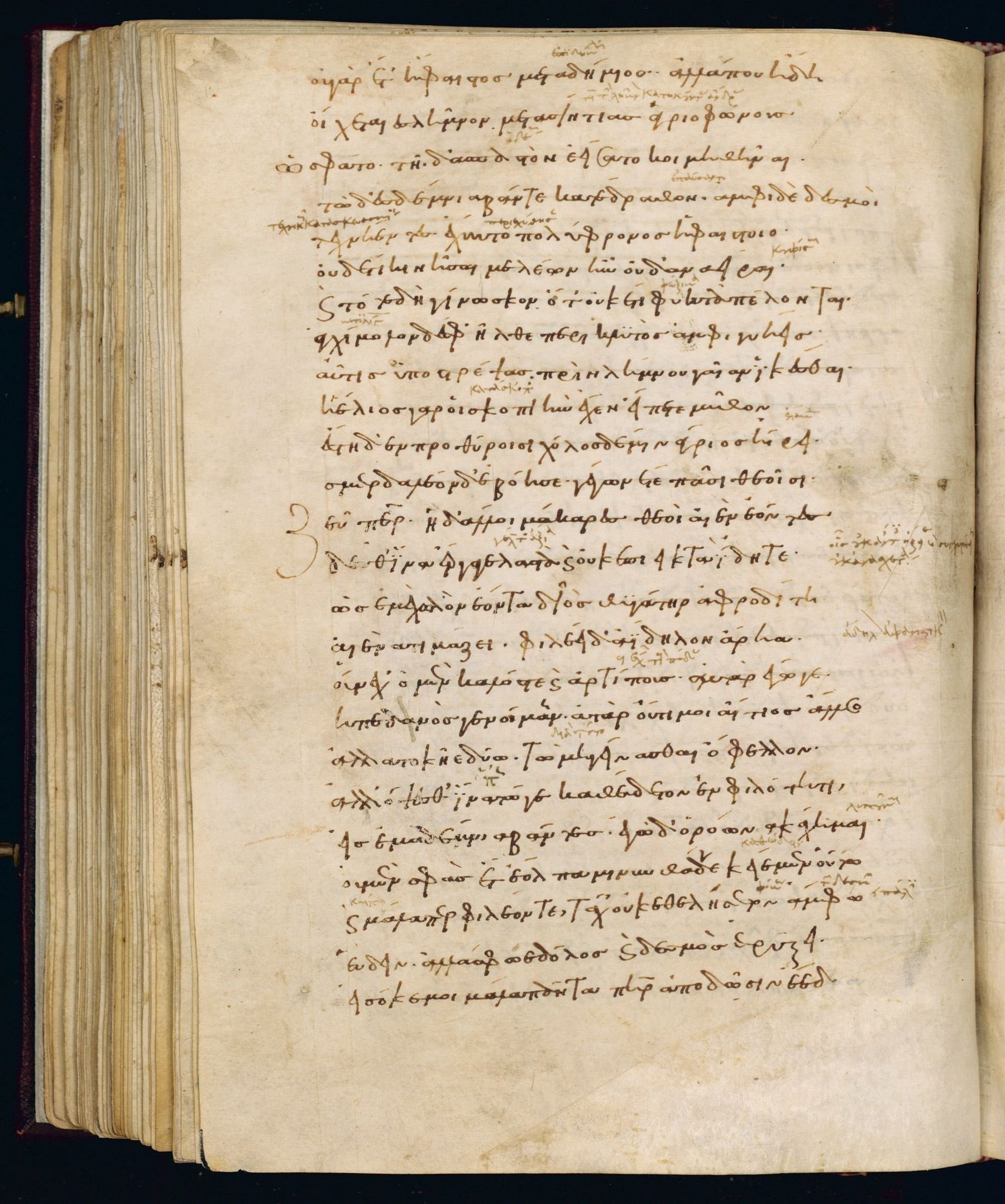
Where on the image
Laur. Plut. 32.24, fol. 75v: Odyssey 8.293-318, begins ‹οὐ γὰρ ἔθʼ Ἥφαιστος›, ends ‹πάντα πατὴρ ἀποδῷσιν ἔεδνα,›. Checked on the image: first and last lines read and matched to the Greek. Fol. 75r ends with 8.292. Fol. 76r begins with 8.319. 8.303 (βῆ δʼ ἴμεναι πρὸς δῶμα ...) is not on the page: the scribe passes from 8.302 to 8.304 (25 lines). English blocks here: 295-299, 300-304, 305-309, 310-314, 315-319.
293οὐ γὰρ ἔθʼ Ἥφαιστος μεταδήμιος, ἀλλά που ἤδη
294οἴχεται ἐς Λῆμνον μετὰ Σίντιας ἀγριοφώνους.
295ὣς φάτο, τῇ δʼ ἀσπαστὸν ἐείσατο κοιμηθῆναι.
296τὼ δʼ ἐς δέμνια βάντε κατέδραθον· ἀμφὶ δὲ δεσμοὶ
297τεχνήεντες ἔχυντο πολύφρονος Ἡφαίστοιο,
298οὐδέ τι κινῆσαι μελέων ἦν οὐδʼ ἀναεῖραι.
299καὶ τότε δὴ γίγνωσκον, ὅ τʼ οὐκέτι φυκτὰ πέλοντο.
300ἀγχίμολον δέ σφʼ ἦλθε περικλυτὸς ἀμφιγυήεις,
301αὖτις ὑποστρέψας πρὶν Λήμνου γαῖαν ἱκέσθαι·
302Ἠέλιος γάρ οἱ σκοπιὴν ἔχεν εἶπέ τε μῦθον.
303βῆ δʼ ἴμεναι πρὸς δῶμα φίλον τετιημένος ἦτορ·
304ἔστη δʼ ἐν προθύροισι, χόλος δέ μιν ἄγριος ᾕρει·
305σμερδαλέον δʼ ἐβόησε, γέγωνέ τε πᾶσι θεοῖσιν·
306Ζεῦ πάτερ ἠδʼ ἄλλοι μάκαρες θεοὶ αἰὲν ἐόντες,
307δεῦθʼ, ἵνα ἔργα γελαστὰ καὶ οὐκ ἐπιεικτὰ ἴδησθε,
308ὡς ἐμὲ χωλὸν ἐόντα Διὸς θυγάτηρ Ἀφροδίτη
309αἰὲν ἀτιμάζει, φιλέει δʼ ἀίδηλον Ἄρηα,
310οὕνεχʼ ὁ μὲν καλός τε καὶ ἀρτίπος, αὐτὰρ ἐγώ γε
311ἠπεδανὸς γενόμην. ἀτὰρ οὔ τί μοι αἴτιος ἄλλος,
312ἀλλὰ τοκῆε δύω, τὼ μὴ γείνασθαι ὄφελλον.
313ἀλλʼ ὄψεσθʼ, ἵνα τώ γε καθεύδετον ἐν φιλότητι
314εἰς ἐμὰ δέμνια βάντες, ἐγὼ δʼ ὁρόων ἀκάχημαι.
315οὐ μέν σφεας ἔτʼ ἔολπα μίνυνθά γε κειέμεν οὕτως
316καὶ μάλα περ φιλέοντε· τάχʼ οὐκ ἐθελήσετον ἄμφω
317εὕδειν· ἀλλά σφωε δόλος καὶ δεσμὸς ἐρύξει,
318εἰς ὅ κέ μοι μάλα πάντα πατὴρ ἀποδῷσιν ἔεδνα,
295So he spoke, and a welcome thing it seemed to her to lie with him. So they two went to the couch, and lay them down to sleep, and about them clung the cunning bonds of the wise Hephaestus, nor could they in any wise stir their limbs or raise them up. Then at length they learned that there was no more escaping. 300And near to them came the famous god of the two strong arms, having turned back before he reached the land of Lemnos; for Helius had kept watch for him and had brought him word. So he went to his house with a heavy heart, and stood at the gateway, and fierce anger seized him. 305And terribly he cried out and called to all the gods: “Father Zeus, and ye other blessed gods that are forever, come hither that ye may see a laughable matter and a monstrous, even how Aphrodite, daughter of Zeus, scorns me for that I am lame and loves destructive Ares 310because he is comely and strong of limb, whereas I was born misshapen. Yet for this is none other to blame but my two parents—would they had never begotten me! But ye shall see where these two have gone up into my bed and sleep together in love; and I am troubled at the sight. 315Yet, methinks, they will not wish to lie longer thus, no, not for a moment, how loving soever they are. Soon shall both lose their desire to sleep; but the snare and the bonds shall hold them until her father pays back to me all the gifts of wooing that I gave him for the sake of his shameless girl;
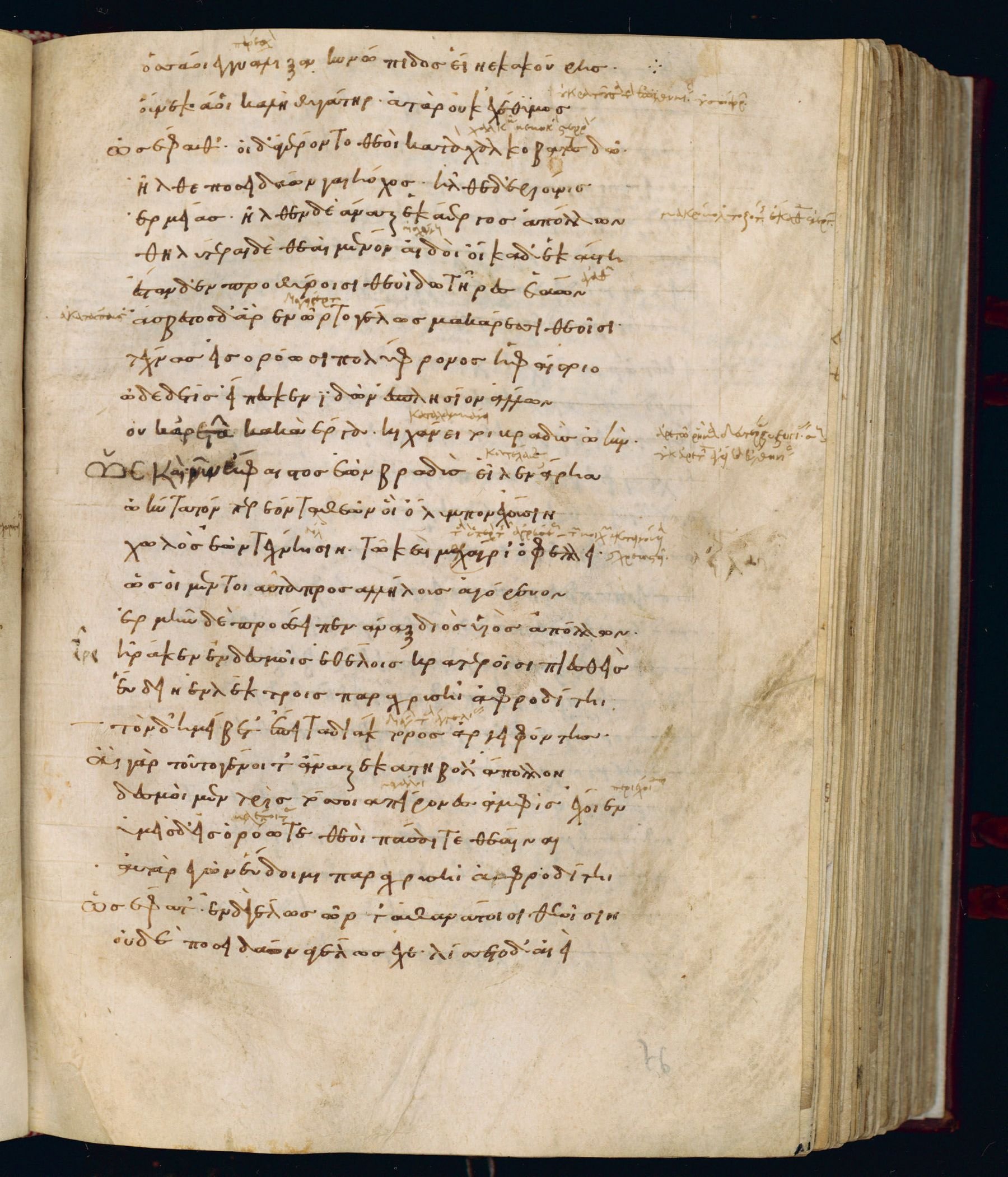
Where on the image
Laur. Plut. 32.24, fol. 76r: Odyssey 8.319-344, begins ‹ὅσσα οἱ ἐγγυάλιξα κυνώπιδος›, ends ‹ἔχε, λίσσετο δʼ αἰεὶ›. Checked on the image: first and last lines read and matched to the Greek. Fol. 75v ends with 8.318. Fol. 76v begins with 8.345. 8.335 (Ἑρμεία, Διὸς υἱέ ...) is not on the page: the scribe passes from 8.334 to 8.336 (25 lines). English blocks here: 320-324, 325-329, 330-334, 335-339, 340-342, 343-344.
319ὅσσα οἱ ἐγγυάλιξα κυνώπιδος εἵνεκα κούρης,
320οὕνεκά οἱ καλὴ θυγάτηρ, ἀτὰρ οὐκ ἐχέθυμος.
321ὣς ἔφαθʼ, οἱ δʼ ἀγέροντο θεοὶ ποτὶ χαλκοβατὲς δῶ·
322ἦλθε Ποσειδάων γαιήοχος, ἦλθʼ ἐριούνης
323Ἑρμείας, ἦλθεν δὲ ἄναξ ἑκάεργος Ἀπόλλων.
324θηλύτεραι δὲ θεαὶ μένον αἰδοῖ οἴκοι ἑκάστη.
325ἔσταν δʼ ἐν προθύροισι θεοί, δωτῆρες ἑάων·
326ἄσβεστος δʼ ἄρʼ ἐνῶρτο γέλως μακάρεσσι θεοῖσι
327τέχνας εἰσορόωσι πολύφρονος Ἡφαίστοιο.
328ὧδε δέ τις εἴπεσκεν ἰδὼν ἐς πλησίον ἄλλον·
329οὐκ ἀρετᾷ κακὰ ἔργα· κιχάνει τοι βραδὺς ὠκύν,
330ὡς καὶ νῦν Ἥφαιστος ἐὼν βραδὺς εἷλεν Ἄρηα
331ὠκύτατόν περ ἐόντα θεῶν οἳ Ὄλυμπον ἔχουσιν,
332χωλὸς ἐὼν τέχνῃσι· τὸ καὶ μοιχάγριʼ ὀφέλλει.
333ὣς οἱ μὲν τοιαῦτα πρὸς ἀλλήλους ἀγόρευον·
334Ἑρμῆν δὲ προσέειπεν ἄναξ Διὸς υἱὸς Ἀπόλλων·
335Ἑρμεία, Διὸς υἱέ, διάκτορε, δῶτορ ἑάων,
336ἦ ῥά κεν ἐν δεσμοῖς ἐθέλοις κρατεροῖσι πιεσθεὶς
337εὕδειν ἐν λέκτροισι παρὰ χρυσέῃ Ἀφροδίτῃ;
338τὸν δʼ ἠμείβετʼ ἔπειτα διάκτορος ἀργεϊφόντης·
339αἲ γὰρ τοῦτο γένοιτο, ἄναξ ἑκατηβόλʼ Ἄπολλον·
340δεσμοὶ μὲν τρὶς τόσσοι ἀπείρονες ἀμφὶς ἔχοιεν,
341ὑμεῖς δʼ εἰσορόῳτε θεοὶ πᾶσαί τε θέαιναι,
342αὐτὰρ ἐγὼν εὕδοιμι παρὰ χρυσέῃ Ἀφροδίτῃ.
343ὣς ἔφατʼ, ἐν δὲ γέλως ὦρτʼ ἀθανάτοισι θεοῖσιν.
344οὐδὲ Ποσειδάωνα γέλως ἔχε, λίσσετο δʼ αἰεὶ
320for his daughter is fair but bridles not her passion.” So he spoke and the gods gathered to the house of the brazen floor. Poseidon came, the earth-enfolder, and the helper Hermes came, and the lord Apollo, the archer god. Now the goddesses abode for shame each in her own house, 325but the gods, the givers of good things, stood in the gateway; and unquenchable laughter arose among the blessed gods as they saw the craft of wise Hephaestus. And thus would one speak, with a glance at his neighbor: “Ill deeds thrive not. The slow catches the swift; 330even as now Hephaestus, slow though he is, has out-stripped Ares for all that he is the swiftest of the gods who hold Olympus. Lame though he is, he has caught him by craft, wherefore Ares owes the fine of the adulterer.” Thus they spoke to one another. But to Hermes the lord Apollo, son of Zeus, said: 335“Hermes, son of Zeus, messenger, giver of good things, wouldst thou in sooth be willing, even though ensnared with strong bonds, to lie on a couch by the side of golden Aphrodite?” Then the messenger, Argeiphontes, answered him:“Would that this might befall, lord Apollo, thou archer god— 340that thrice as many bonds inextricable might clasp me about and ye gods, aye, and all the goddesses too might be looking on, but that I might sleep by the side of golden Aphrodite.” 343So he spoke and laughter arose among the immortal gods. Yet Poseidon laughed not, but ever besought
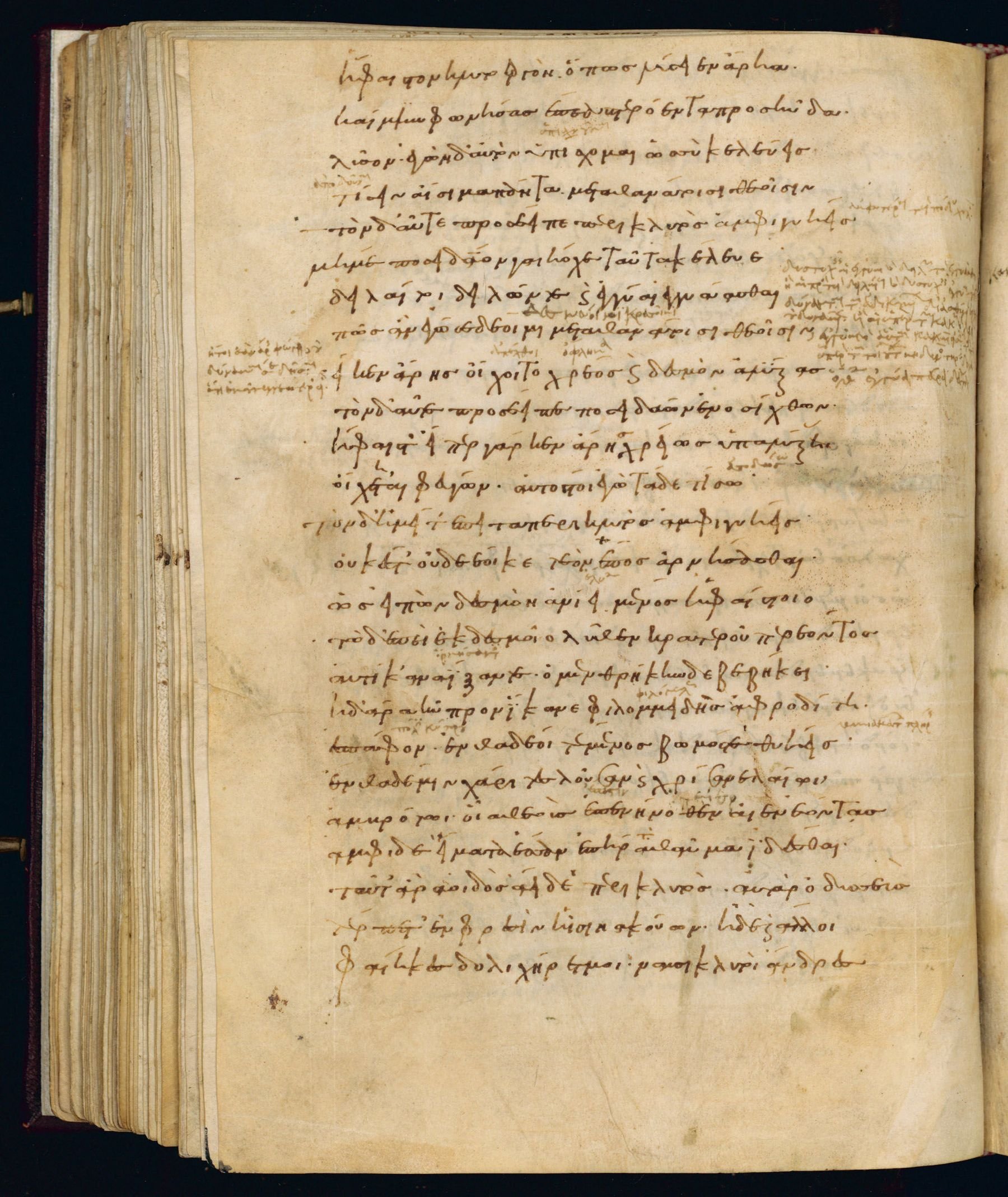
Where on the image
Laur. Plut. 32.24, fol. 76v: Odyssey 8.345-369, begins ‹Ἥφαιστον κλυτοεργὸν ὅπως λύσειεν›, ends ‹Φαίηκες δολιχήρετμοι, ναυσίκλυτοι ἄνδρες.›. Checked on the image: first and last lines read and matched to the Greek. Fol. 76r ends with 8.344. Fol. 77r begins with 8.370. English blocks here: 345-349, 350-354, 355-359, 360-364, 365-369.
345Ἥφαιστον κλυτοεργὸν ὅπως λύσειεν Ἄρηα.
346καί μιν φωνήσας ἔπεα πτερόεντα προσηύδα·
347λῦσον· ἐγὼ δέ τοι αὐτὸν ὑπίσχομαι, ὡς σὺ κελεύεις,
348τίσειν αἴσιμα πάντα μετʼ ἀθανάτοισι θεοῖσιν.
349τὸν δʼ αὖτε προσέειπε περικλυτὸς ἀμφιγυήεις·
350μή με, Ποσείδαον γαιήοχε, ταῦτα κέλευε·
351δειλαί τοι δειλῶν γε καὶ ἐγγύαι ἐγγυάασθαι.
352πῶς ἂν ἐγώ σε δέοιμι μετʼ ἀθανάτοισι θεοῖσιν,
353εἴ κεν Ἄρης οἴχοιτο χρέος καὶ δεσμὸν ἀλύξας;
354τὸν δʼ αὖτε προσέειπε Ποσειδάων ἐνοσίχθων·
355Ἥφαιστʼ, εἴ περ γάρ κεν Ἄρης χρεῖος ὑπαλύξας
356οἴχηται φεύγων, αὐτός τοι ἐγὼ τάδε τίσω.
357τὸν δʼ ἠμείβετʼ ἔπειτα περικλυτὸς ἀμφιγυήεις·
358οὐκ ἔστʼ οὐδὲ ἔοικε τεὸν ἔπος ἀρνήσασθαι.
359ὣς εἰπὼν δεσμὸν ἀνίει μένος Ἡφαίστοιο.
360τὼ δʼ ἐπεὶ ἐκ δεσμοῖο λύθεν, κρατεροῦ περ ἐόντος,
361αὐτίκʼ ἀναΐξαντε ὁ μὲν Θρῄκηνδε βεβήκει,
362ἡ δʼ ἄρα Κύπρον ἵκανε φιλομμειδὴς Ἀφροδίτη,
363ἐς Πάφον· ἔνθα δέ οἱ τέμενος βωμός τε θυήεις.
364ἔνθα δέ μιν Χάριτες λοῦσαν καὶ χρῖσαν ἐλαίῳ
365ἀμβρότῳ, οἷα θεοὺς ἐπενήνοθεν αἰὲν ἐόντας,
366ἀμφὶ δὲ εἵματα ἕσσαν ἐπήρατα, θαῦμα ἰδέσθαι.
367ταῦτʼ ἄρʼ ἀοιδὸς ἄειδε περικλυτός· αὐτὰρ Ὀδυσσεὺς
368τέρπετʼ ἐνὶ φρεσὶν ᾗσιν ἀκούων ἠδὲ καὶ ἄλλοι
369Φαίηκες δολιχήρετμοι, ναυσίκλυτοι ἄνδρες.
345Hephaestus, the famous craftsman, to set Ares free; and he spoke, and addressed him with winged words: “Loose him, and I promise, as thou biddest me, that he shall himself pay thee all that is right in the presence of the immortal gods.” Then the famous god of the two strong arms answered him: 350“Ask not this of me, Poseidon, thou earth-enfolder. A sorry thing to be sure of is the surety for a sorry knave. How could I put thee in bonds among the immortal gods, if Ares should avoid both the debt and the bonds and depart?” Then again Poseidon, the earth-shaker, answered him: 355“Hephaestus, even if Ares shall avoid the debt and flee away, I will myself pay thee this.” Then the famous god of the two strong arms answered him: “It may not be that I should say thee nay, nor were it seemly.” So saying the mighty Hephaestus loosed the bonds 360and the two, when they were freed from that bond so strong, sprang up straightway. And Ares departed to Thrace, but she, the laughter-loving Aphrodite, went to Cyprus, to Paphos, where is her demesne and fragrant altar. There the Graces bathed her and anointed her with 365immortal oil, such as gleams upon the gods that are forever. And they clothed her in lovely raiment, a wonder to behold. This song the famous minstrel sang; and Odysseus was glad at heart as he listened, and so too were the Phaeacians of the long oars, men famed for their ships.
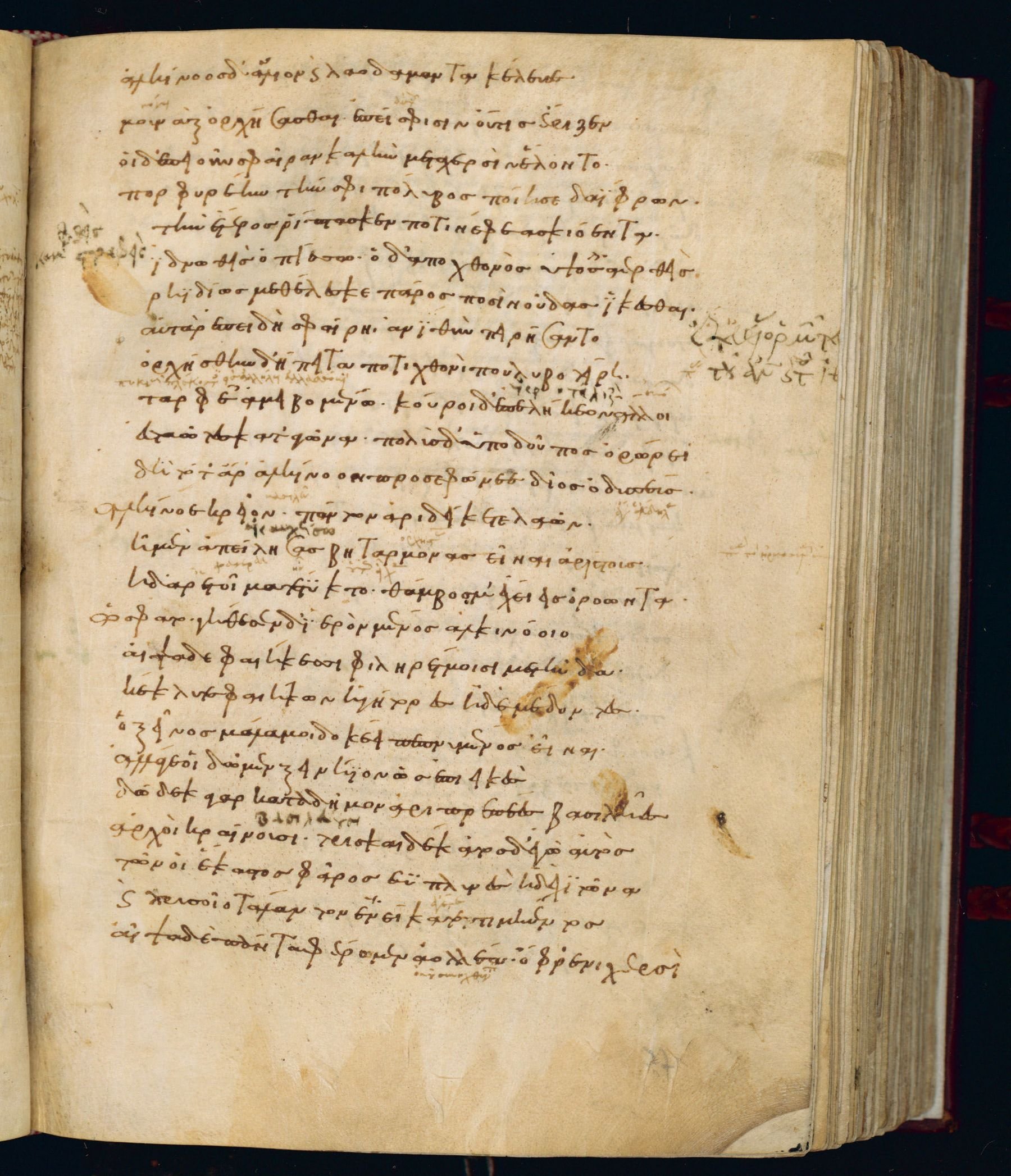
Where on the image
Laur. Plut. 32.24, fol. 77r: Odyssey 8.370-394, begins ‹Ἀλκίνοος δʼ Ἅλιον καὶ›, ends ‹ἀολλέα, ὄφρʼ ἐνὶ χερσὶν›. Checked on the image: first and last lines read and matched to the Greek. Fol. 76v ends with 8.369. Fol. 77v begins with 8.395. English blocks here: 370-374, 375-379, 380-384, 385-389, 390-394.
370Ἀλκίνοος δʼ Ἅλιον καὶ Λαοδάμαντα κέλευσεν
371μουνὰξ ὀρχήσασθαι, ἐπεί σφισιν οὔ τις ἔριζεν.
372οἱ δʼ ἐπεὶ οὖν σφαῖραν καλὴν μετὰ χερσὶν ἕλοντο,
373πορφυρέην, τήν σφιν Πόλυβος ποίησε δαΐφρων,
374τὴν ἕτερος ῥίπτασκε ποτὶ νέφεα σκιόεντα
375ἰδνωθεὶς ὀπίσω, ὁ δʼ ἀπὸ χθονὸς ὑψόσʼ ἀερθεὶς
376ῥηιδίως μεθέλεσκε, πάρος ποσὶν οὖδας ἱκέσθαι.
377αὐτὰρ ἐπεὶ δὴ σφαίρῃ ἀνʼ ἰθὺν πειρήσαντο,
378ὠρχείσθην δὴ ἔπειτα ποτὶ χθονὶ πουλυβοτείρῃ
379ταρφέʼ ἀμειβομένω· κοῦροι δʼ ἐπελήκεον ἄλλοι
380ἑστεῶτες κατʼ ἀγῶνα, πολὺς δʼ ὑπὸ κόμπος ὀρώρει.
381δὴ τότʼ ἄρʼ Ἀλκίνοον προσεφώνεε δῖος Ὀδυσσεύς·
382Ἀλκίνοε κρεῖον, πάντων ἀριδείκετε λαῶν,
383ἠμὲν ἀπείλησας βητάρμονας εἶναι ἀρίστους,
384ἠδʼ ἄρʼ ἑτοῖμα τέτυκτο· σέβας μʼ ἔχει εἰσορόωντα.
385ὣς φάτο, γήθησεν δʼ ἱερὸν μένος Ἀλκινόοιο,
386αἶψα δὲ Φαιήκεσσι φιληρέτμοισι μετηύδα·
387κέκλυτε, Φαιήκων ἡγήτορες ἠδὲ μέδοντες.
388ὁ ξεῖνος μάλα μοι δοκέει πεπνυμένος εἶναι.
389ἀλλʼ ἄγε οἱ δῶμεν ξεινήιον, ὡς ἐπιεικές.
390δώδεκα γὰρ κατὰ δῆμον ἀριπρεπέες βασιλῆες
391ἀρχοὶ κραίνουσι, τρισκαιδέκατος δʼ ἐγὼ αὐτός·
392τῶν οἱ ἕκαστος φᾶρος ἐυπλυνὲς ἠδὲ χιτῶνα
393καὶ χρυσοῖο τάλαντον ἐνείκατε τιμήεντος.
394αἶψα δὲ πάντα φέρωμεν ἀολλέα, ὄφρʼ ἐνὶ χερσὶν
370Then Alcinous bade Halius and Laodamas dance alone, for no one could vie with them. And when they had taken in their hands the beautiful ball of purple, which wise Polybus had made for them, the one 375would lean backward and toss it toward the shadowy clouds, and the other would leap up from the earth and skilfully catch it before his feet touched the ground again. But when they had tried their skill in throwing the ball straight up, the two fell to dancing on the bounteous earth, ever tossing the ball to and fro, and the other youths 380stood in the lists and beat time, and thereat a great din arose. Then to Alcinous spoke goodly Odysseus: “Lord Alcinous, renowned above all men, thou didst boast that thy dancers were the best, and lo, thy words are made good; amazement holds me as I look on them.” 385So he spoke, and the strong and mighty Alcinous was glad; and straightway he spoke among the Phaeacians, lovers of the oar: “Hear me, leaders and counsellors of the Phaeacians. This stranger verily seems to me a man of understanding. Come then, let us give him a gift of friendship, as is fitting; 390for twelve glorious kings bear sway in our land as rulers, and I myself am the thirteenth. Now do you, each of the twelve, bring a newly washed cloak and tunic, and a talent of precious gold, and let us straightway bring all together,
Where on the image
Laur. Plut. 32.24, fol. 77v: Odyssey 8.395-419, begins ‹ξεῖνος ἔχων ἐπὶ δόρπον›, ends ‹ἄρα παῖδες ἀμύμονος Ἀλκινόοιο›. Checked on the image: first and last lines read and matched to the Greek. Fol. 77r ends with 8.394. Fol. 78r begins with 8.420. English blocks here: 395-399, 400-404, 405-409, 410-414, 415-419.
395ξεῖνος ἔχων ἐπὶ δόρπον ἴῃ χαίρων ἐνὶ θυμῷ.
396Εὐρύαλος δέ ἑ αὐτὸν ἀρεσσάσθω ἐπέεσσι
397καὶ δώρῳ, ἐπεὶ οὔ τι ἔπος κατὰ μοῖραν ἔειπεν.
398ὣς ἔφαθʼ, οἱ δʼ ἄρα πάντες ἐπῄνεον ἠδʼ ἐκέλευον,
399δῶρα δʼ ἄρʼ οἰσέμεναι πρόεσαν κήρυκα ἕκαστος.
400τὸν δʼ αὖτʼ Εὐρύαλος ἀπαμείβετο φώνησέν τε·
401Ἀλκίνοε κρεῖον, πάντων ἀριδείκετε λαῶν,
402τοιγὰρ ἐγὼ τὸν ξεῖνον ἀρέσσομαι, ὡς σὺ κελεύεις.
403δώσω οἱ τόδʼ ἄορ παγχάλκεον, ᾧ ἔπι κώπη
404ἀργυρέη, κολεὸν δὲ νεοπρίστου ἐλέφαντος
405ἀμφιδεδίνηται· πολέος δέ οἱ ἄξιον ἔσται.
406ὣς εἰπὼν ἐν χερσὶ τίθει ξίφος ἀργυρόηλον
407καί μιν φωνήσας ἔπεα πτερόεντα προσηύδα·
408χαῖρε, πάτερ ὦ ξεῖνε· ἔπος δʼ εἴ πέρ τι βέβακται
409δεινόν, ἄφαρ τὸ φέροιεν ἀναρπάξασαι ἄελλαι.
410σοὶ δὲ θεοὶ ἄλοχόν τʼ ἰδέειν καὶ πατρίδʼ ἱκέσθαι
411δοῖεν, ἐπεὶ δὴ δηθὰ φίλων ἄπο πήματα πάσχεις.
412τὸν δʼ ἀπαμειβόμενος προσέφη πολύμητις Ὀδυσσεύς·
413καὶ σὺ φίλος μάλα χαῖρε, θεοὶ δέ τοι ὄλβια δοῖεν.
414μηδέ τι τοι ξίφεός γε ποθὴ μετόπισθε γένοιτο
415τούτου, ὃ δή μοι δῶκας ἀρεσσάμενος ἐπέεσσιν.
416ἦ ῥα καὶ ἀμφʼ ὤμοισι θέτο ξίφος ἀργυρόηλον.
417δύσετό τʼ ἠέλιος, καὶ τῷ κλυτὰ δῶρα παρῆεν.
418καὶ τά γʼ ἐς Ἀλκινόοιο φέρον κήρυκες ἀγαυοί·
419δεξάμενοι δʼ ἄρα παῖδες ἀμύμονος Ἀλκινόοιο
395that the stranger with our gifts in his hands may go to his supper glad at heart. And let Euryalus make amends to the stranger himself with words and with a gift, for the word that he spoke was in no wise seemly.” So he spoke, and they all praised his words and bade that so it should be, and sent forth every man a herald to fetch the gifts. 400And Euryalus in turn made answer, and said: “Lord Alcinous, renowned above all men, I will indeed make amends to the stranger, as thou biddest me. I will give him this sword, all of bronze, whereon is a hilt of silver, and a scabbard of new-sawn ivory 405is wrought about it; and it shall be to him a thing of great worth.” So saying, he put into his hands the silver-studded sword, and spoke, and addressed him with winged words: “Hail, Sir stranger; but if any word has been spoken that was harsh, may the storm-winds straightway snatch it and bear it away. 410And for thyself, may the gods grant thee to see thy wife, and to come to thy native land, for long time hast thou been suffering woes far from thy friends.” And Odysseus of many wiles answered him: “All hail to thee, too, friend; and may the gods grant thee happiness, and mayest thou never hereafter miss 415this sword which thou hast given me, making amends with gentle speech.” He spoke, and about his shoulders hung the silver-studded sword. And the sun set, and the glorious gifts were brought him. These the lordly heralds bore to the palace of Alcinous, and the sons of peerless Alcinous
Where on the image
Laur. Plut. 32.24, fol. 78r: Odyssey 8.420-444, begins ‹μητρὶ παρʼ αἰδοίῃ ἔθεσαν›, ends ‹δηλήσεται, ὁππότʼ ἂν αὖτε›. Checked on the image: first and last lines read and matched to the Greek. Fol. 77v ends with 8.419. Fol. 78v begins with 8.445. English blocks here: 420-424, 425-429, 430-432, 433-434, 435-439, 440-444.
420μητρὶ παρʼ αἰδοίῃ ἔθεσαν περικαλλέα δῶρα.
421τοῖσιν δʼ ἡγεμόνευʼ ἱερὸν μένος Ἀλκινόοιο,
422ἐλθόντες δὲ καθῖζον ἐν ὑψηλοῖσι θρόνοισι.
423δή ῥα τότʼ Ἀρήτην προσέφη μένος Ἀλκινόοιο·
424δεῦρο, γύναι, φέρε χηλὸν ἀριπρεπέʼ, ἥ τις ἀρίστη·
425ἐν δʼ αὐτὴ θὲς φᾶρος ἐυπλυνὲς ἠδὲ χιτῶνα.
426ἀμφὶ δέ οἱ πυρὶ χαλκὸν ἰήνατε, θέρμετε δʼ ὕδωρ,
427ὄφρα λοεσσάμενός τε ἰδών τʼ ἐὺ κείμενα πάντα
428δῶρα, τά οἱ Φαίηκες ἀμύμονες ἐνθάδʼ ἔνεικαν,
429δαιτί τε τέρπηται καὶ ἀοιδῆς ὕμνον ἀκούων.
430καί οἱ ἐγὼ τόδʼ ἄλεισον ἐμὸν περικαλλὲς ὀπάσσω,
431χρύσεον, ὄφρʼ ἐμέθεν μεμνημένος ἤματα πάντα
432σπένδῃ ἐνὶ μεγάρῳ Διί τʼ ἄλλοισίν τε θεοῖσιν.
433ὣς ἔφατʼ, Ἀρήτη δὲ μετὰ δμῳῇσιν ἔειπεν
434ἀμφὶ πυρὶ στῆσαι τρίποδα μέγαν ὅττι τάχιστα.
435αἱ δὲ λοετροχόον τρίποδʼ ἵστασαν ἐν πυρὶ κηλέῳ,
436ἔν δʼ ἄρʼ ὕδωρ ἔχεαν, ὑπὸ δὲ ξύλα δαῖον ἑλοῦσαι.
437γάστρην μὲν τρίποδος πῦρ ἄμφεπε, θέρμετο δʼ ὕδωρ·
438τόφρα δʼ ἄρʼ Ἀρήτη ξείνῳ περικαλλέα χηλὸν
439ἐξέφερεν θαλάμοιο, τίθει δʼ ἐνὶ κάλλιμα δῶρα,
440ἐσθῆτα χρυσόν τε, τά οἱ Φαίηκες ἔδωκαν·
441ἐν δʼ αὐτὴ φᾶρος θῆκεν καλόν τε χιτῶνα,
442καί μιν φωνήσασʼ ἔπεα πτερόεντα προσηύδα·
443αὐτὸς νῦν ἴδε πῶμα, θοῶς δʼ ἐπὶ δεσμὸν ἴηλον,
444μή τίς τοι καθʼ ὁδὸν δηλήσεται, ὁππότʼ ἂν αὖτε
420took the beautiful gifts and set them before their honored mother. And the strong and mighty Alcinous led the way, and they came in and sat down on the high seats. Then to Arete spoke the mighty Alcinous: “Bring hither, wife, a goodly chest, the best thou hast, 425and thyself place in it a newly-washed cloak and tunic; and do ye heat for the stranger a cauldron on the fire, and warm water, that when he has bathed and has seen well bestowed all the gifts which the noble Phaeacians have brought hither, he may take pleasure in the feast, and in hearing the strains of the song. 430And I will give him this beautiful cup of mine, wrought of gold, that he may remember me all his days as he pours libations in his halls to Zeus and to the other gods.” 433So he spoke, and Arete bade her handmaids to set a great cauldron on the fire with all speed. 435And they set on the blazing fire the cauldron for filling the bath, and poured in water, and took billets of wood and kindled them beneath it. Then the fire played about the belly of the cauldron, and the water grew warm; but meanwhile Arete brought forth for the stranger a beautiful chest from the treasure chamber, and placed in it the goodly gifts, 440the raiment and the gold, which the Phaeacians gave. And therein she herself placed a cloak and a fair tunic; and she spoke and addressed Odysseus with winged words: “Look now thyself to the lid, and quickly cast a cord upon it, lest some one despoil thee of thy goods on the way, when later on
Where on the image
Laur. Plut. 32.24, fol. 78v: Odyssey 8.445-469, begins ‹εὕδῃσθα γλυκὺν ὕπνον ἰὼν›, ends ‹ἷζε παρʼ Ἀλκίνοον βασιλῆα·›. Checked on the image: first and last lines read and matched to the Greek. Fol. 78r ends with 8.444. Fol. 79r begins with 8.470. English blocks here: 445-449, 450-454, 455-459, 460-464, 465-468, 469-469.
445εὕδῃσθα γλυκὺν ὕπνον ἰὼν ἐν νηὶ μελαίνῃ.
446αὐτὰρ ἐπεὶ τό γʼ ἄκουσε πολύτλας δῖος Ὀδυσσεύς,
447αὐτίκʼ ἐπήρτυε πῶμα, θοῶς δʼ ἐπὶ δεσμὸν ἴηλεν
448ποικίλον, ὅν ποτέ μιν δέδαε φρεσὶ πότνια Κίρκη·
449αὐτόδιον δʼ ἄρα μιν ταμίη λούσασθαι ἀνώγει
450ἔς ῥʼ ἀσάμινθον βάνθʼ· ὁ δʼ ἄρ ἀσπασίως ἴδε θυμῷ
451θερμὰ λοέτρʼ, ἐπεὶ οὔ τι κομιζόμενός γε θάμιζεν,
452ἐπεὶ δὴ λίπε δῶμα Καλυψοῦς ἠυκόμοιο.
453τόφρα δέ οἱ κομιδή γε θεῷ ὣς ἔμπεδος ἦεν.
454τὸν δʼ ἐπεὶ οὖν δμῳαὶ λοῦσαν καὶ χρῖσαν ἐλαίῳ,
455ἀμφὶ δέ μιν χλαῖναν καλὴν βάλον ἠδὲ χιτῶνα,
456ἔκ ῥʼ ἀσαμίνθου βὰς ἄνδρας μέτα οἰνοποτῆρας
457ἤιε· Ναυσικάα δὲ θεῶν ἄπο κάλλος ἔχουσα
458στῆ ῥα παρὰ σταθμὸν τέγεος πύκα ποιητοῖο,
459θαύμαζεν δʼ Ὀδυσῆα ἐν ὀφθαλμοῖσιν ὁρῶσα,
460καί μιν φωνήσασʼ ἔπεα πτερόεντα προσηύδα·
461χαῖρε, ξεῖνʼ, ἵνα καί ποτʼ ἐὼν ἐν πατρίδι γαίῃ
462μνήσῃ ἐμεῦ, ὅτι μοι πρώτῃ ζωάγριʼ ὀφέλλεις.
463τὴν δʼ ἀπαμειβόμενος προσέφη πολύμητις Ὀδυσσεύς.
464Ναυσικάα θύγατερ μεγαλήτορος Ἀλκινόοιο,
465οὕτω νῦν Ζεὺς θείη, ἐρίγδουπος πόσις Ἥρης,
466οἴκαδέ τʼ ἐλθέμεναι καὶ νόστιμον ἦμαρ ἰδέσθαι·
467τῷ κέν τοι καὶ κεῖθι θεῷ ὣς εὐχετοῴμην
468αἰεὶ ἤματα πάντα· σὺ γάρ μʼ ἐβιώσαο, κούρη.
469ἦ ῥα καὶ ἐς θρόνον ἷζε παρʼ Ἀλκίνοον βασιλῆα·
445thou art lying in sweet sleep, as thou farest in the black ship.” Now when the much-enduring goodly Odysseus heard these words, he straightway fitted on the lid, and quickly cast a cord upon it—a cunning knot, which queenly Circe once had taught him. Then forthwith the housewife bade him 450go to the bath and bathe; and his heart was glad when he saw the warm bath, for he had not been wont to have such tendance from the time that he left the house of faired-haired Calypso, but until then he had tendance continually as a god. Now when the handmaids had bathed him and anointed him with oil, 455and had cast about him a fair cloak and a tunic, he came forth from the bath, and went to join the men at their wine. And Nausicaa, gifted with beauty by the gods, stood by the door-post of the well-built hall, and she marvelled at Odysseus, as her eyes beheld him, 460and she spoke, and addressed him with winged words: “Farewell, stranger, and hereafter even in thy own native land mayest thou remember me, for to me first thou owest the price of thy life.” Then Odysseus of many wiles answered her:“Nausicaa, daughter of great-hearted Alcinous, 465so may Zeus grant, the loud-thundering lord of Here, that I may reach my home and see the day of my returning. Then will I even there pray to thee as to a god all my days, for thou, maiden, hast given me life.” 469He spoke, and sat down on a chair beside king Alcinous.
Where on the image
Laur. Plut. 32.24, fol. 79r: Odyssey 8.470-494, begins ‹οἱ δʼ ἤδη μοίρας›, ends ‹δόλον ἤγαγε δῖος Ὀδυσσεὺς›. Checked on the image: first and last lines read and matched to the Greek. Fol. 78v ends with 8.469. Fol. 79v begins with 8.495. English blocks here: 470-474, 475-479, 480-484, 485-489, 490-494.
470οἱ δʼ ἤδη μοίρας τʼ ἔνεμον κερόωντό τε οἶνον.
471κῆρυξ δʼ ἐγγύθεν ἦλθεν ἄγων ἐρίηρον ἀοιδόν,
472Δημόδοκον λαοῖσι τετιμένον· εἷσε δʼ ἄρʼ αὐτὸν
473μέσσῳ δαιτυμόνων, πρὸς κίονα μακρὸν ἐρείσας.
474δὴ τότε κήρυκα προσέφη πολύμητις Ὀδυσσεύς,
475νώτου ἀποπροταμών, ἐπὶ δὲ πλεῖον ἐλέλειπτο,
476ἀργιόδοντος ὑός, θαλερὴ δʼ ἦν ἀμφὶς ἀλοιφή·
477κῆρυξ, τῆ δή, τοῦτο πόρε κρέας, ὄφρα φάγῃσιν,
478Δημοδόκῳ· καί μιν προσπτύξομαι ἀχνύμενός περ·
479πᾶσι γὰρ ἀνθρώποισιν ἐπιχθονίοισιν ἀοιδοὶ
480τιμῆς ἔμμοροί εἰσι καὶ αἰδοῦς, οὕνεκʼ ἄρα σφέας
481οἴμας μοῦσʼ ἐδίδαξε, φίλησε δὲ φῦλον ἀοιδῶν.
482ὣς ἄρʼ ἔφη, κῆρυξ δὲ φέρων ἐν χερσὶν ἔθηκεν
483ἥρῳ Δημοδόκῳ· ὁ δʼ ἐδέξατο, χαῖρε δὲ θυμῷ.
484οἱ δʼ ἐπʼ ὀνείαθʼ ἑτοῖμα προκείμενα χεῖρας ἴαλλον.
485αὐτὰρ ἐπεὶ πόσιος καὶ ἐδητύος ἐξ ἔρον ἕντο,
486δὴ τότε Δημόδοκον προσέφη πολύμητις Ὀδυσσεύς·
487Δημόδοκʼ, ἔξοχα δή σε βροτῶν αἰνίζομʼ ἁπάντων.
488ἢ σέ γε μοῦσʼ ἐδίδαξε, Διὸς πάϊς, ἢ σέ γʼ Ἀπόλλων·
489λίην γὰρ κατὰ κόσμον Ἀχαιῶν οἶτον ἀείδεις,
490ὅσσʼ ἔρξαν τʼ ἔπαθόν τε καὶ ὅσσʼ ἐμόγησαν Ἀχαιοί,
491ὥς τέ που ἢ αὐτὸς παρεὼν ἢ ἄλλου ἀκούσας.
492ἀλλʼ ἄγε δὴ μετάβηθι καὶ ἵππου κόσμον ἄεισον
493δουρατέου, τὸν Ἐπειὸς ἐποίησεν σὺν Ἀθήνῃ,
494ὅν ποτʼ ἐς ἀκρόπολιν δόλον ἤγαγε δῖος Ὀδυσσεὺς
470And now they were serving out portions and mixing the wine. Then the herald came near, leading the good minstrel, Demodocus, held in honor by the people, and seated him in the midst of the banqueters, leaning his chair against a high pillar. Then to the herald said Odysseus of many wiles, 475cutting off a portion of the chine of a white-tusked boar, whereof yet more was left, and there was rich fat on either side: “Herald, take and give this portion to Demodocus, that he may eat, and I will greet him, despite my grief. For among all men that are upon the earth minstrels 480win honor and reverence, for that the Muse has taught them the paths of song, and loves the tribe of minstrels.” So he spoke, and the herald bore the portion and placed it in the hands of the lord Demodocus, and he took it and was glad at heart. So they put forth their hands to the good cheer lying ready before them. 485But when they had put from them the desire of food and drink, then to Demodocus said Odysseus of many wiles: “Demodocus, verily above all mortal men do I praise thee, whether it was the Muse, the daughter of Zeus, that taught thee, or Apollo; for well and truly dost thou sing of the fate of the Achaeans, 490all that they wrought and suffered, and all the toils they endured, as though haply thou hadst thyself been present, or hadst heard the tale from another. But come now, change thy theme, and sing of the building of the horse of wood, which Epeius made with Athena's help, the horse which once Odysseus led up into the citadel as a thing of guile,
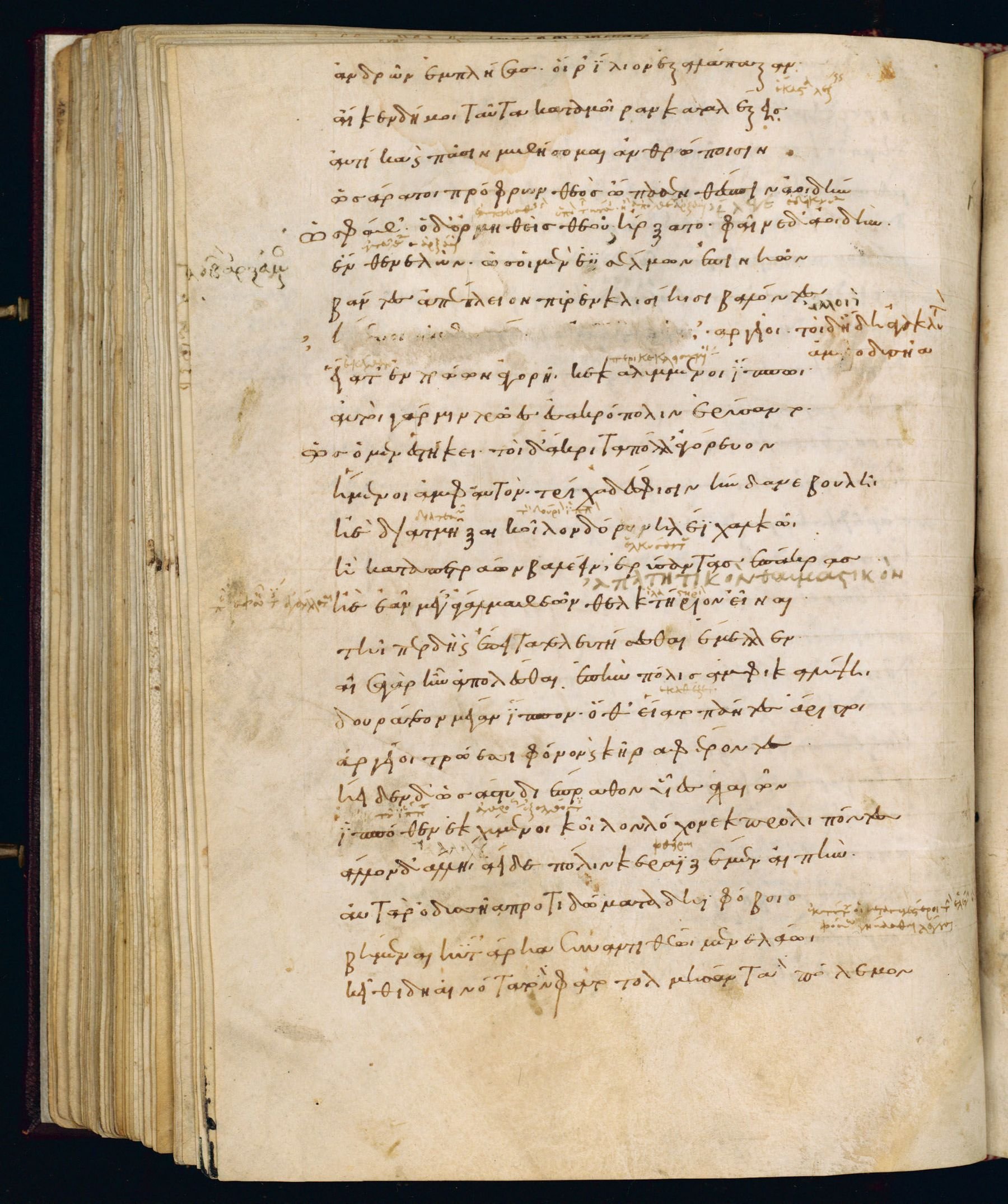
Where on the image
Laur. Plut. 32.24, fol. 79v: Odyssey 8.495-519, begins ‹ἀνδρῶν ἐμπλήσας οἵ ῥʼ›, ends ‹αἰνότατον πόλεμον φάτο τολμήσαντα›. Checked on the image: first and last lines read and matched to the Greek. Fol. 79r ends with 8.494. Fol. 80r begins with 8.520. 8.502 is faint, partly rubbed away, between 8.501 and 8.503. English blocks here: 495-499, 500-504, 505-509, 510-514, 515-519.
495ἀνδρῶν ἐμπλήσας οἵ ῥʼ Ἴλιον ἐξαλάπαξαν.
496αἴ κεν δή μοι ταῦτα κατὰ μοῖραν καταλέξῃς,
497αὐτίκʼ ἐγὼ πᾶσιν μυθήσομαι ἀνθρώποισιν,
498ὡς ἄρα τοι πρόφρων θεὸς ὤπασε θέσπιν ἀοιδήν.
499ὣς φάθʼ, ὁ δʼ ὁρμηθεὶς θεοῦ ἤρχετο, φαῖνε δʼ ἀοιδήν,
500ἔνθεν ἑλὼν ὡς οἱ μὲν ἐυσσέλμων ἐπὶ νηῶν
501βάντες ἀπέπλειον, πῦρ ἐν κλισίῃσι βαλόντες,
502Ἀργεῖοι, τοὶ δʼ ἤδη ἀγακλυτὸν ἀμφʼ Ὀδυσῆα
503ἥατʼ ἐνὶ Τρώων ἀγορῇ κεκαλυμμένοι ἵππῳ·
504αὐτοὶ γάρ μιν Τρῶες ἐς ἀκρόπολιν ἐρύσαντο.
505ὣς ὁ μὲν ἑστήκει, τοὶ δʼ ἄκριτα πόλλʼ ἀγόρευον
506ἥμενοι ἀμφʼ αὐτόν· τρίχα δέ σφισιν ἥνδανε βουλή,
507ἠὲ διαπλῆξαι κοῖλον δόρυ νηλέι χαλκῷ,
508ἢ κατὰ πετράων βαλέειν ἐρύσαντας ἐπʼ ἄκρης,
509ἢ ἐάαν μέγʼ ἄγαλμα θεῶν θελκτήριον εἶναι,
510τῇ περ δὴ καὶ ἔπειτα τελευτήσεσθαι ἔμελλεν·
511αἶσα γὰρ ἦν ἀπολέσθαι, ἐπὴν πόλις ἀμφικαλύψῃ
512δουράτεον μέγαν ἵππον, ὅθʼ ἥατο πάντες ἄριστοι
513Ἀργείων Τρώεσσι φόνον καὶ κῆρα φέροντες.
514ἤειδεν δʼ ὡς ἄστυ διέπραθον υἷες Ἀχαιῶν
515ἱππόθεν ἐκχύμενοι, κοῖλον λόχον ἐκπρολιπόντες.
516ἄλλον δʼ ἄλλῃ ἄειδε πόλιν κεραϊζέμεν αἰπήν,
517αὐτὰρ Ὀδυσσῆα προτὶ δώματα Δηιφόβοιο
518βήμεναι, ἠύτʼ Ἄρηα σὺν ἀντιθέῳ Μενελάῳ.
519κεῖθι δὴ αἰνότατον πόλεμον φάτο τολμήσαντα
495when he had filled it with the men who sacked Ilios. If thou dost indeed tell me this tale aright, I will declare to all mankind that the god has of a ready heart granted thee the gift of divine song.” So he spoke, and the minstrel, moved by the god, began, and let his song be heard, 500taking up the tale where the Argives had embarked on their benched ships and were sailing away, after casting fire on their huts, while those others led by glorious Odysseus were now sitting in the place of assembly of the Trojans, hidden in the horse; for the Trojans had themselves dragged it to the citadel. 505So there it stood, while the people talked long as they sat about it, and could form no resolve. Nay, in three ways did counsel find favour in their minds: either to cleave the hollow timber with the pitiless bronze, or to drag it to the height and cast it down the rocks, or to let it stand as a great offering to propitiate the gods, 510even as in the end it was to be brought to pass; for it was their fate to perish when their city should enclose the great horse of wood, wherein were sitting all the best of the Argives, bearing to the Trojans death and fate. And he sang how the sons of the Achaeans 515poured forth from the horse and, leaving their hollow ambush, sacked the city. Of the others he sang how in divers ways they wasted the lofty city, but of Odysseus, how he went like Ares to the house of Deiphobus together with godlike Menelaus. There it was, he said, that Odysseus braved the most terrible fight
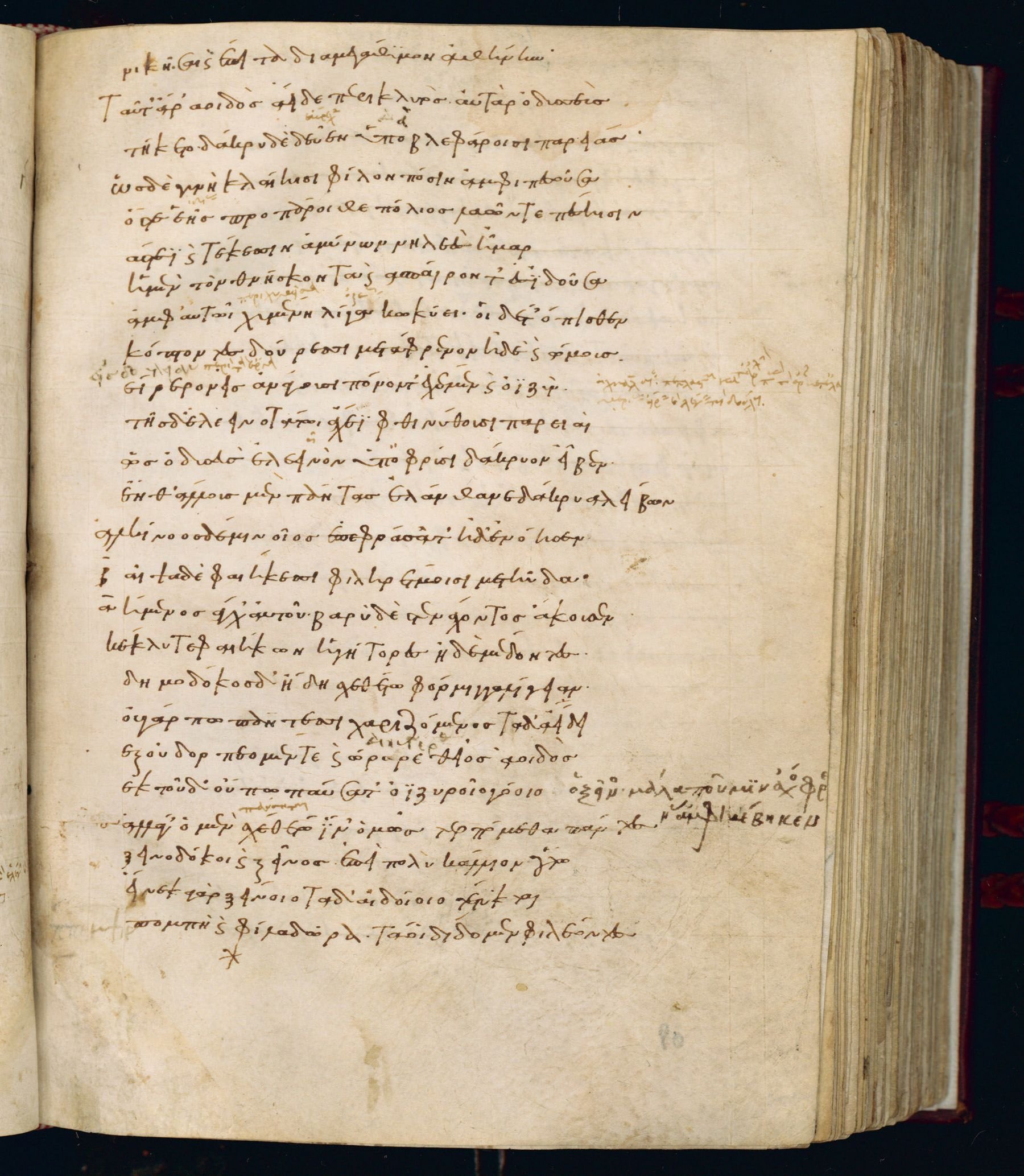
Where on the image
Laur. Plut. 32.24, fol. 80r: Odyssey 8.520-545, begins ‹νικῆσαι καὶ ἔπειτα διὰ›, ends ‹τά οἱ δίδομεν φιλέοντες.›. Checked on the image: first and last lines read and matched to the Greek. Fol. 79v ends with 8.519. Fol. 80v begins with 8.546. 8.534 and 8.535 are written in the order 535, 534, with the letters β and α in the left margin to restore the order. 8.541 is written after 8.540 at the end of the same line, running into the right margin (25 lines). English blocks here: 520-520, 521-524, 525-529, 530-534, 535-539, 540-544.
520νικῆσαι καὶ ἔπειτα διὰ μεγάθυμον Ἀθήνην.
521ταῦτʼ ἄρʼ ἀοιδὸς ἄειδε περικλυτός· αὐτὰρ Ὀδυσσεὺς
522τήκετο, δάκρυ δʼ ἔδευεν ὑπὸ βλεφάροισι παρειάς.
523ὡς δὲ γυνὴ κλαίῃσι φίλον πόσιν ἀμφιπεσοῦσα,
524ὅς τε ἑῆς πρόσθεν πόλιος λαῶν τε πέσῃσιν,
525ἄστεϊ καὶ τεκέεσσιν ἀμύνων νηλεὲς ἦμαρ·
526ἡ μὲν τὸν θνήσκοντα καὶ ἀσπαίροντα ἰδοῦσα
527ἀμφʼ αὐτῷ χυμένη λίγα κωκύει· οἱ δέ τʼ ὄπισθε
528κόπτοντες δούρεσσι μετάφρενον ἠδὲ καὶ ὤμους
529εἴρερον εἰσανάγουσι, πόνον τʼ ἐχέμεν καὶ ὀιζύν·
530τῆς δʼ ἐλεεινοτάτῳ ἄχεϊ φθινύθουσι παρειαί·
531ὣς Ὀδυσεὺς ἐλεεινὸν ὑπʼ ὀφρύσι δάκρυον εἶβεν.
532ἔνθʼ ἄλλους μὲν πάντας ἐλάνθανε δάκρυα λείβων,
533Ἀλκίνοος δέ μιν οἶος ἐπεφράσατʼ ἠδʼ ἐνόησεν,
534ἥμενος ἄγχʼ αὐτοῦ, βαρὺ δὲ στενάχοντος ἄκουσεν.
535αἶψα δὲ Φαιήκεσσι φιληρέτμοισι μετηύδα·
536κέκλυτε, Φαιήκων ἡγήτορες ἠδὲ μέδοντες,
537Δημόδοκος δʼ ἤδη σχεθέτω φόρμιγγα λίγειαν·
538οὐ γάρ πως πάντεσσι χαριζόμενος τάδʼ ἀείδει.
539ἐξ οὗ δορπέομέν τε καὶ ὤρορε θεῖος ἀοιδός,
540ἐκ τοῦ δʼ οὔ πω παύσατʼ ὀιζυροῖο γόοιο
541ὁ ξεῖνος· μάλα πού μιν ἄχος φρένας ἀμφιβέβηκεν.
542ἀλλʼ ἄγʼ ὁ μὲν σχεθέτω, ἵνʼ ὁμῶς τερπώμεθα πάντες,
543ξεινοδόκοι καὶ ξεῖνος, ἐπεὶ πολὺ κάλλιον οὕτως·
544εἵνεκα γὰρ ξείνοιο τάδʼ αἰδοίοιο τέτυκται,
545πομπὴ καὶ φίλα δῶρα, τά οἱ δίδομεν φιλέοντες.
520and in the end conquered by the aid of great-hearted Athena. 521This song the famous minstrel sang. But the heart of Odysseus was melted and tears wet his cheeks beneath his eyelids. And as a woman wails and flings herself about her dear husband, who has fallen in front of his city and his people, 525seeking toward off from his city and his children the pitiless day; and as she beholds him dying and gasping for breath, she clings to him and shrieks aloud, while the foe behind her smite her back and shoulders with their spears, and lead her away to captivity to bear toil and woe, 530while with most pitiful grief her cheeks are wasted: even so did Odysseus let fall pitiful tears from beneath his brows. Now from all the rest he concealed the tears that he shed, but Alcinous alone marked him and took heed, 535for he sat by him and heard him groaning heavily. And straightway he spoke among the Phaeacians, lovers of the oar: “Hear me, leaders and counsellors of the Phaeacians, and let Demodocus now check his clear-toned lyre, for in no wise to all alike does he give pleasure with this song. Ever since we began to sup and the divine minstrel was moved to sing, 540from that time yon stranger has never ceased from sorrowful lamentation; surely, methinks, grief has encompassed his heart. Nay, let the minstrel cease, that we may all make merry, hosts and guest alike, since it is better thus. Lo, for the sake of the honored stranger all these things have been made ready,
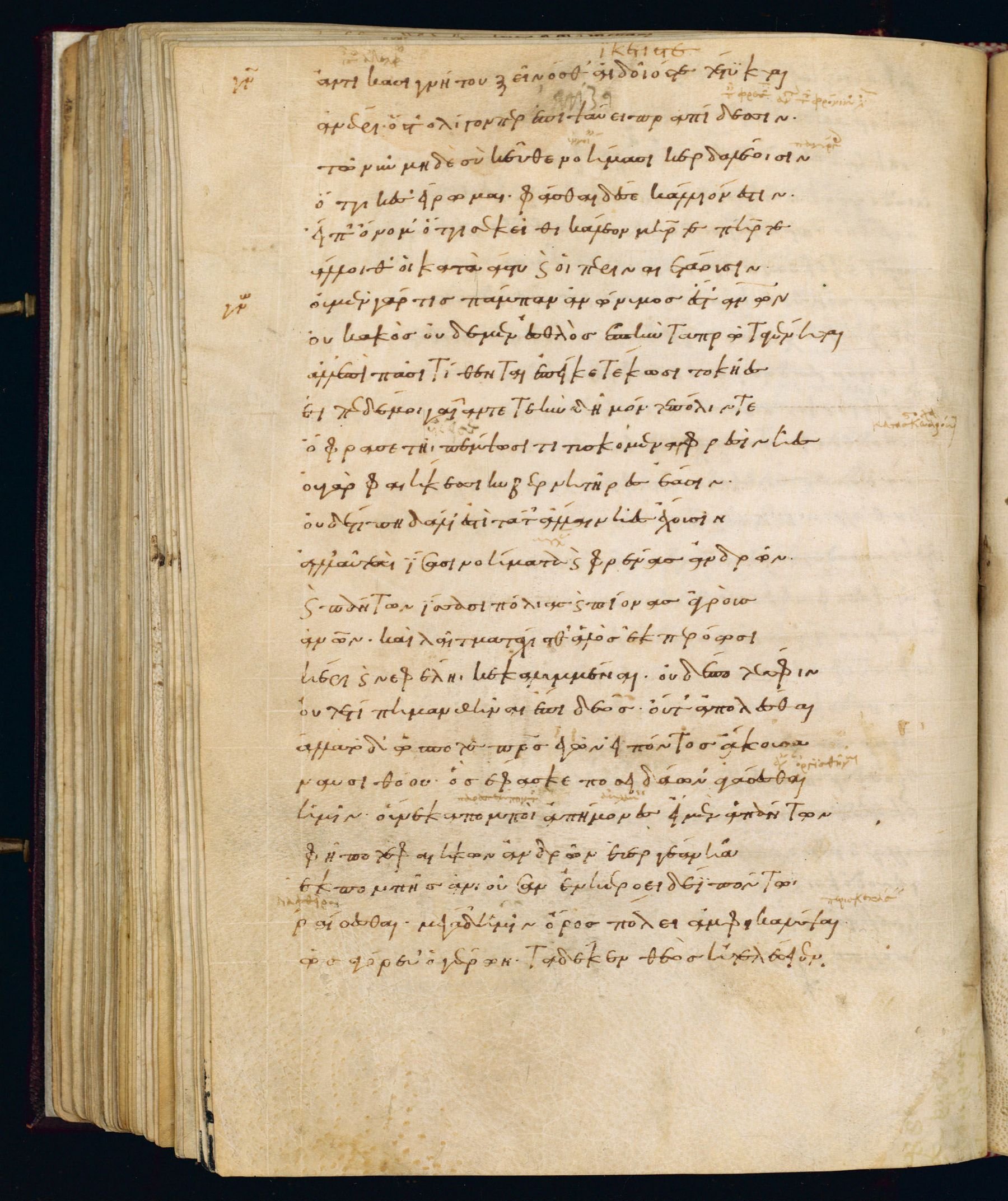
Where on the image
Laur. Plut. 32.24, fol. 80v: Odyssey 8.546-570, begins ‹ἀντὶ κασιγνήτου ξεῖνός θʼ›, ends ‹κεν θεὸς ἢ τελέσειεν›. Checked on the image: first and last lines read and matched to the Greek. Fol. 80r ends with 8.545. Fol. 81r begins with 8.571. English blocks here: 545-549, 550-554, 555-559, 560-564, 565-569.
546ἀντὶ κασιγνήτου ξεῖνός θʼ ἱκέτης τε τέτυκται
547ἀνέρι, ὅς τʼ ὀλίγον περ ἐπιψαύῃ πραπίδεσσι.
548τῷ νῦν μηδὲ σὺ κεῦθε νοήμασι κερδαλέοισιν
549ὅττι κέ σʼ εἴρωμαι· φάσθαι δέ σε κάλλιόν ἐστιν.
550εἴπʼ ὄνομʼ ὅττι σε κεῖθι κάλεον μήτηρ τε πατήρ τε
551ἄλλοι θʼ οἳ κατὰ ἄστυ καὶ οἳ περιναιετάουσιν.
552οὐ μὲν γάρ τις πάμπαν ἀνώνυμός ἐστʼ ἀνθρώπων,
553οὐ κακὸς οὐδὲ μὲν ἐσθλός, ἐπὴν τὰ πρῶτα γένηται,
554ἀλλʼ ἐπὶ πᾶσι τίθενται, ἐπεί κε τέκωσι, τοκῆες.
555εἰπὲ δέ μοι γαῖάν τε· τεὴν δῆμόν τε πόλιν τε,
556ὄφρα σε τῇ πέμπωσι τιτυσκόμεναι φρεσὶ νῆες·
557οὐ γὰρ Φαιήκεσσι κυβερνητῆρες ἔασιν,
558οὐδέ τι πηδάλιʼ ἔστι, τά τʼ ἄλλαι νῆες ἔχουσιν·
559ἀλλʼ αὐταὶ ἴσασι νοήματα καὶ φρένας ἀνδρῶν,
560καὶ πάντων ἴσασι πόλιας καὶ πίονας ἀγροὺς
561ἀνθρώπων, καὶ λαῖτμα τάχισθʼ ἁλὸς ἐκπερόωσιν
562ἠέρι καὶ νεφέλῃ κεκαλυμμέναι· οὐδέ ποτέ σφιν
563οὔτε τι πημανθῆναι ἔπι δέος οὔτʼ ἀπολέσθαι.
564ἀλλὰ τόδʼ ὥς ποτε πατρὸς ἐγὼν εἰπόντος ἄκουσα
565Ναυσιθόου, ὃς ἔφασκε Ποσειδάωνʼ ἀγάσασθαι
566ἡμῖν, οὕνεκα πομποὶ ἀπήμονές εἰμεν ἁπάντων.
567φῆ ποτὲ Φαιήκων ἀνδρῶν ἐυεργέα νῆα
568ἐκ πομπῆς ἀνιοῦσαν ἐν ἠεροειδέι πόντῳ
569ῥαισέμεναι, μέγα δʼ ἧμιν ὄρος πόλει ἀμφικαλύψειν.
570ὣς ἀγόρευʼ ὁ γέρων· τὰ δέ κεν θεὸς ἢ τελέσειεν
545his sending and the gifts of friendship which we give him of our love. Dear as a brother is the stranger and the suppliant to a man whose wits have never so short a range. Therefore do not thou longer hide with crafty thought whatever I shall ask thee;to speak out plainly is the better course. 550Tell me the name by which they were wont to call thee in thy home, even thy mother and thy father and other folk besides, thy townsmen and the dwellers round about. For there is no one of all mankind who is nameless, be he base man or noble, when once he has been born, but parents bestow names on all when they give them birth. 555And tell me thy country, thy people, and thy city, that our ships may convey thee thither, discerning the course by their wits. For the Phaeacians have no pilots, nor steering-oars such as other ships have, but their ships of themselves understand the thoughts and minds of men, 560and they know the cities and rich fields of all peoples, and most swiftly do they cross over the gulf of the sea, hidden in mist and cloud, nor ever have they fear of harm or ruin. Yet this story I once heard thus told by my father 565Nausithous, who was wont to say that Poseidon was wroth with us because we give safe convoy to all men. He said that someday, as a well-built ship of the Phaeacians was returning from a convoy over the misty deep, Poseidon would smite her and would fling a great mountain about our city.
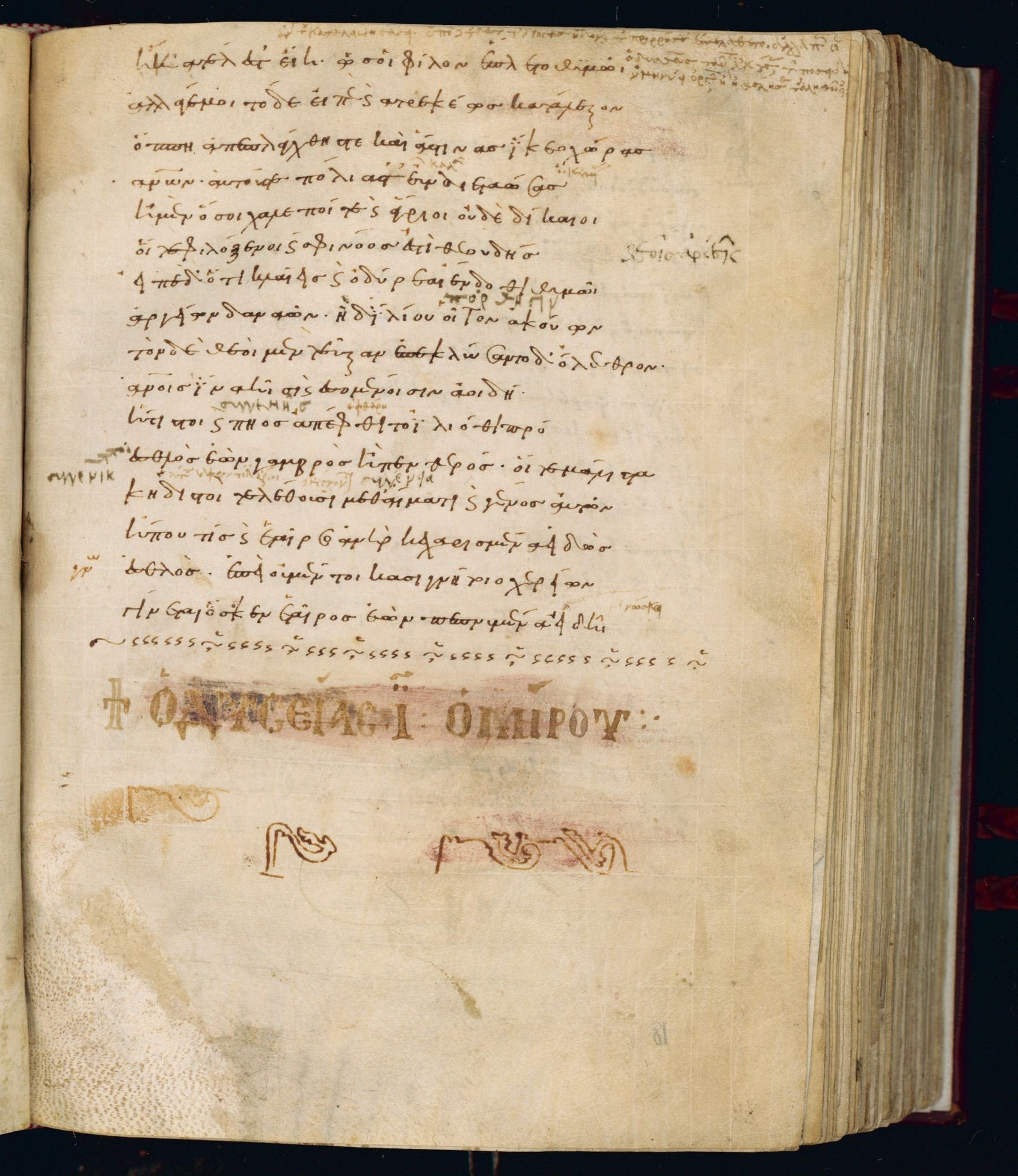
Where on the image
Laur. Plut. 32.24, fol. 81r: Odyssey 8.571-586, begins ‹ἤ κʼ ἀτέλεστʼ εἴη,›, ends ‹ἑταῖρος ἐὼν πεπνυμένα εἰδῇ.›. Checked on the image: first and last lines read and matched to the Greek. Fol. 80v ends with 8.570. Book 8 ends with 8.586, followed by a line of ornament and the heading + ὀδυσσείας ι ὁμήρου in red capitals (smudged); the rest of the page is blank apart from pen flourishes. Book 9 begins on fol. 81v. English blocks here: 570-574, 575-579, 580-584, 585-586.
571ἤ κʼ ἀτέλεστʼ εἴη, ὥς οἱ φίλον ἔπλετο θυμῷ·
572ἀλλʼ ἄγε μοι τόδε εἰπὲ καὶ ἀτρεκέως κατάλεξον,
573ὅππῃ ἀπεπλάγχθης τε καὶ ἅς τινας ἵκεο χώρας
574ἀνθρώπων, αὐτούς τε πόλιάς τʼ ἐὺ ναιετοώσας,
575ἠμὲν ὅσοι χαλεποί τε καὶ ἄγριοι οὐδὲ δίκαιοι,
576οἵ τε φιλόξεινοι, καί σφιν νόος ἐστὶ θεουδής.
577εἰπὲ δʼ ὅ τι κλαίεις καὶ ὀδύρεαι ἔνδοθι θυμῷ
578Ἀργείων Δαναῶν ἠδʼ Ἰλίου οἶτον ἀκούων.
579τὸν δὲ θεοὶ μὲν τεῦξαν, ἐπεκλώσαντο δʼ ὄλεθρον
580ἀνθρώποις, ἵνα ᾖσι καὶ ἐσσομένοισιν ἀοιδή.
581ἦ τίς τοι καὶ πηὸς ἀπέφθιτο Ἰλιόθι πρὸ
582ἐσθλὸς ἐών, γαμβρὸς ἢ πενθερός, οἵ τε μάλιστα
583κήδιστοι τελέθουσι μεθʼ αἷμά τε καὶ γένος αὐτῶν;
584ἦ τίς που καὶ ἑταῖρος ἀνὴρ κεχαρισμένα εἰδώς,
585ἐσθλός; ἐπεὶ οὐ μέν τι κασιγνήτοιο χερείων
586γίγνεται, ὅς κεν ἑταῖρος ἐὼν πεπνυμένα εἰδῇ.
570So that old man spoke, and these things the god will haply bring to pass, or will leave unfulfilled, as may be his good pleasure. But come, now, tell me this and declare it truly: whither thou hast wandered and to what countries of men thou hast come; tell me of the people and of their well-built cities, 575both of those who are cruel and wild and unjust, and of those who love strangers and fear the gods in their thoughts. And tell me why thou dost weep and wail in spirit as thou hearest the doom of the Argive Danaans and of Ilios. This the gods wrought, and spun the skein of ruin 580for men, that there might be a song for those yet to be born. Did some kinsman of thine fall before Ilios, some good, true man, thy daughter's husband or thy wife's father, such as are nearest to one after one's own kin and blood? Or was it haply some comrade dear to thy heart, 585some good, true man? For no whit worse than a brother is a comrade who has an understanding heart.”
Notes
- Greek: A. T. Murray, Homer: The Odyssey (Loeb Classical Library, 1919), via Perseus.
- English: A. T. Murray's translation in the same edition; his footnotes are omitted.
Cite
Sources
- Source: Laur. Plut. 32.24 (BML Teca Digitale IIIF) + Murray Greek (Loeb 1919, Perseus) + Murray English (Loeb 1919, Perseus) (holding institution)
- Critical edition: Murray, Loeb 1919, via Perseus
← previous · → next · v cycle view · l back to library