Homer, Odyssey, Book 7: The palace of Alcinous
Introduction
The Odyssey, composed around 700 BCE and attributed to Homer, tells of Odysseus' ten-year journey home from Troy and his return to Ithaca. Book 7 (347 lines): The palace of Alcinous.
The page photographs are from Florence, Biblioteca Medicea Laurenziana, Plut. 32.24 (parchment, 10th century, 234 folios; the oldest manuscript of the Odyssey with published images), in the Biblioteca Medicea Laurenziana's Teca Digitale. This book is on fol. 62v-69v; each section below is one page, with its first and last line as read on the photograph. Many pages carry interlinear glosses and a few marginal notes in later hands.
The Greek is A. T. Murray's Loeb text (1919) via Perseus, not a transcription of this manuscript, whose wording differs in places. The English is Murray's prose translation (1919), divided every five lines; at a page break a five-line block goes with the page holding most of it, except at the page breaks where a section's note says the English is cut at the end of Murray's sentence. Each section's note gives its English line range.
Where the scribe left out a line, wrote one in the margin, changed the order or added a line not in Murray's text, the section's note on the photograph says so; the Greek and English shown are Murray's full text for the page's range.
How was this verified? (Provenance)
Where on the image
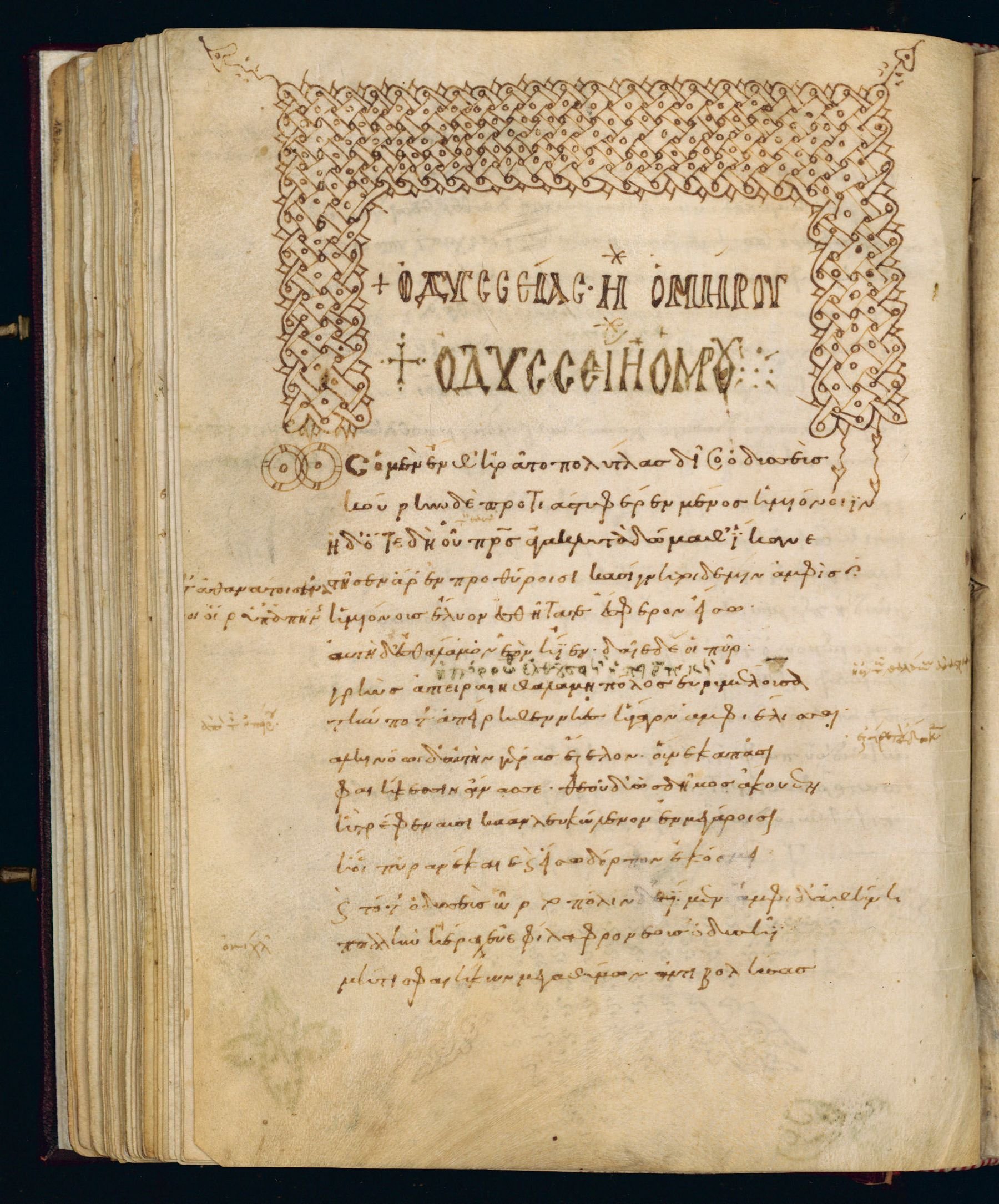
Laur. Plut. 32.24, fol. 62v: Odyssey 7.1-16, begins ‹ὧς ὁ μὲν ἔνθʼ›, ends ‹τις Φαιήκων μεγαθύμων ἀντιβολήσας›. Checked on the image: first and last lines read and matched to the Greek. Fol. 63r begins with 7.17. Book 7 begins under an interlace headpiece framing the titles + ὀδυσσείας η ὁμήρου and + ὀδυσσεία ὁμήρου in capitals; 7.1 has an enlarged initial. 7.4-6 are written in two lines that run out into the left margin (15 lines for 16 verses). English blocks here: 1-4, 5-9, 10-14.
1ὧς ὁ μὲν ἔνθʼ ἠρᾶτο πολύτλας δῖος Ὀδυσσεύς,
2κούρην δὲ προτὶ ἄστυ φέρεν μένος ἡμιόνοιιν.
3ἡ δʼ ὅτε δὴ οὗ πατρὸς ἀγακλυτὰ δώμαθʼ ἵκανε,
4στῆσεν ἄρʼ ἐν προθύροισι, κασίγνητοι δέ μιν ἀμφὶς
5ἵσταντʼ ἀθανάτοις ἐναλίγκιοι, οἵ ῥʼ ὑπʼ ἀπήνης
6ἡμιόνους ἔλυον ἐσθῆτά τε ἔσφερον εἴσω.
7αὐτὴ δʼ ἐς θάλαμον ἑὸν ἤιε· δαῖε δέ οἱ πῦρ
8γρῆυς Ἀπειραίη, θαλαμηπόλος Εὐρυμέδουσα,
9τήν ποτʼ Ἀπείρηθεν νέες ἤγαγον ἀμφιέλισσαι·
10Ἀλκινόῳ δʼ αὐτὴν γέρας ἔξελον, οὕνεκα πᾶσιν
11Φαιήκεσσιν ἄνασσε, θεοῦ δʼ ὣς δῆμος ἄκουεν·
12ἣ τρέφε Ναυσικάαν λευκώλενον ἐν μεγάροισιν.
13ἥ οἱ πῦρ ἀνέκαιε καὶ εἴσω δόρπον ἐκόσμει.
14καὶ τότʼ Ὀδυσσεὺς ὦρτο πόλινδʼ ἴμεν· ἀμφὶ δʼ Ἀθήνη
15πολλὴν ἠέρα χεῦε φίλα φρονέουσʼ Ὀδυσῆι,
16μή τις Φαιήκων μεγαθύμων ἀντιβολήσας
1So he prayed there, the much-enduring goodly Odysseus, while the two strong mules bore the maiden to the city. But when she had come to the glorious palace of her father, she halted the mules at the outer gate, and her brothers 5thronged about her, men like the immortals, and loosed the mules from the wagon, and bore the raiment within; and she herself went to her chamber. There a fire was kindled for her by her waiting-woman, Eurymedusa, an aged dame from Apeire. Long ago the curved ships had brought her from Apeire, 10and men had chosen her from the spoil as a gift of honor for Alcinous, for that he was king over all the Phaeacians, and the people hearkened to him as to a god. She it was who had reared the white-armed Nausicaa in the palace, and she it was who kindled the fire for her, and made ready her supper in the chamber. Then Odysseus roused himself to go to the city, and Athena,
Where on the image
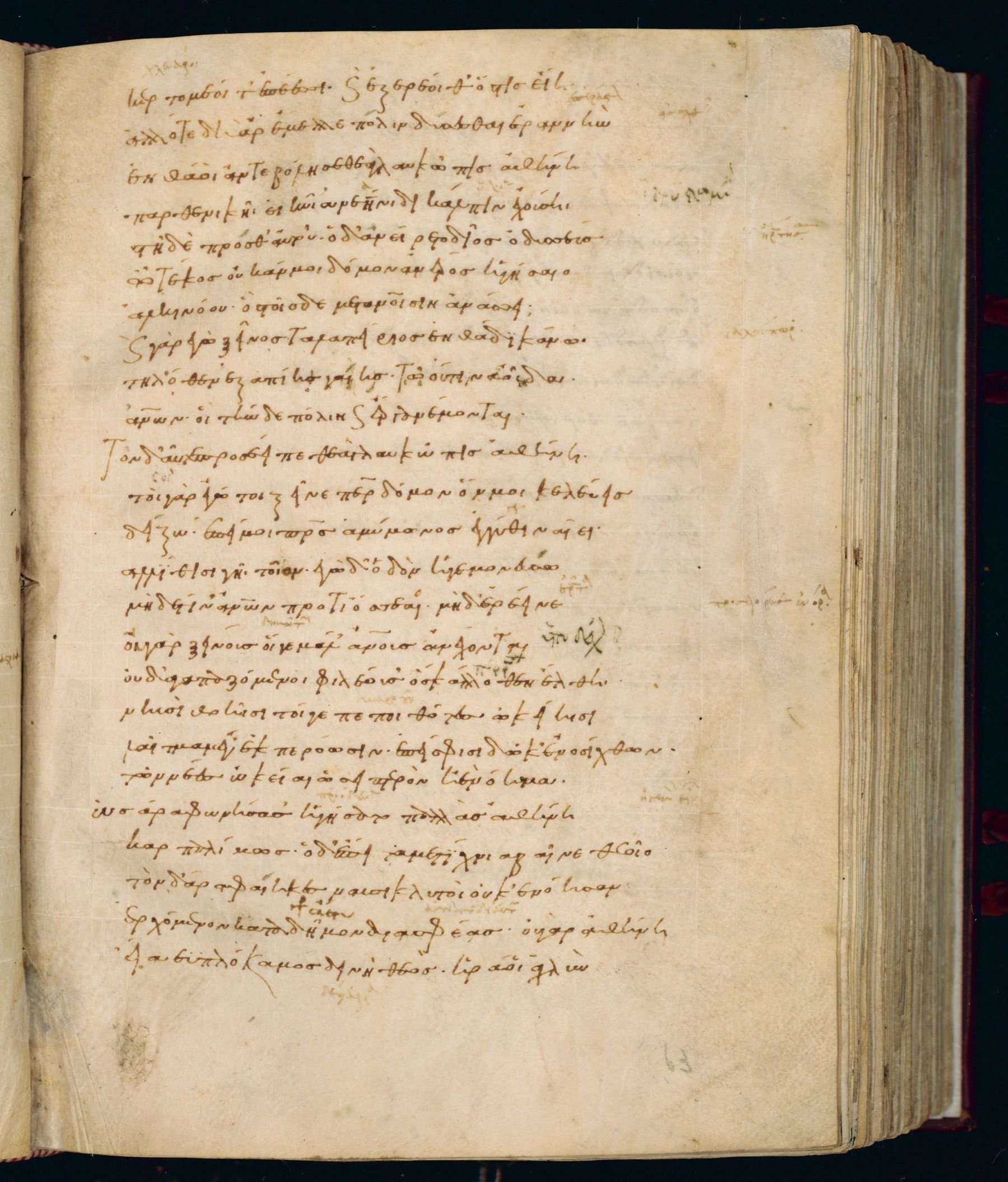
Laur. Plut. 32.24, fol. 63r: Odyssey 7.17-41, begins ‹κερτομέοι τʼ ἐπέεσσι καὶ›, ends ‹ἥ ῥά οἱ ἀχλὺν›. Checked on the image: first and last lines read and matched to the Greek. Fol. 62v ends with 7.16. Fol. 63v begins with 7.42. English blocks here: 15-19, 20-24, 25-29, 30-34, 35-36, 37-39.
17κερτομέοι τʼ ἐπέεσσι καὶ ἐξερέοιθʼ ὅτις εἴη.
18ἀλλʼ ὅτε δὴ ἄρʼ ἔμελλε πόλιν δύσεσθαι ἐραννήν,
19ἔνθα οἱ ἀντεβόλησε θεά, γλαυκῶπις Ἀθήνη,
20παρθενικῇ ἐικυῖα νεήνιδι, κάλπιν ἐχούσῃ.
21στῆ δὲ πρόσθʼ αὐτοῦ, ὁ δʼ ἀνείρετο δῖος Ὀδυσσεύς·
22ὦ τέκος, οὐκ ἄν μοι δόμον ἀνέρος ἡγήσαιο
23Ἀλκινόου, ὃς τοῖσδε μετʼ ἀνθρώποισι ἀνάσσει;
24καὶ γὰρ ἐγὼ ξεῖνος ταλαπείριος ἐνθάδʼ ἱκάνω
25τηλόθεν ἐξ ἀπίης γαίης· τῷ οὔ τινα οἶδα
26ἀνθρώπων, οἳ τήνδε πόλιν καὶ γαῖαν ἔχουσιν.
27τὸν δʼ αὖτε προσέειπε θεά, γλαυκῶπις Ἀθήνη·
28τοιγὰρ ἐγώ τοι, ξεῖνε πάτερ, δόμον, ὅν με κελεύεις,
29δείξω, ἐπεί μοι πατρὸς ἀμύμονος ἐγγύθι ναίει.
30ἀλλʼ ἴθι σιγῇ τοῖον, ἐγὼ δʼ ὁδὸν ἡγεμονεύσω,
31μηδέ τινʼ ἀνθρώπων προτιόσσεο μηδʼ ἐρέεινε.
32οὐ γὰρ ξείνους οἵδε μάλʼ ἀνθρώπους ἀνέχονται,
33οὐδʼ ἀγαπαζόμενοι φιλέουσʼ ὅς κʼ ἄλλοθεν ἔλθῃ.
34νηυσὶ θοῇσιν τοί γε πεποιθότες ὠκείῃσι
35λαῖτμα μέγʼ ἐκπερόωσιν, ἐπεί σφισι δῶκʼ ἐνοσίχθων·
36τῶν νέες ὠκεῖαι ὡς εἰ πτερὸν ἠὲ νόημα.
37ὣς ἄρα φωνήσασʼ ἡγήσατο Παλλὰς Ἀθήνη
38καρπαλίμως· ὁ δʼ ἔπειτα μετʼ ἴχνια βαῖνε θεοῖο.
39τὸν δʼ ἄρα Φαίηκες ναυσικλυτοὶ οὐκ ἐνόησαν
40ἐρχόμενον κατὰ ἄστυ διὰ σφέας· οὐ γὰρ Ἀθήνη
41εἴα ἐυπλόκαμος, δεινὴ θεός, ἥ ῥά οἱ ἀχλὺν
15with kindly purpose, cast about him a thick mist, that no one of the great-hearted Phaeacians, meeting him, should speak mockingly to him, and ask him who he was. But when he was about to enter the lovely city, then the goddess, flashing-eyed Athena, met him 20in the guise of a young maiden carrying a pitcher, and she stood before him; and goodly Odysseus questioned her, saying: “My child, couldst thou not guide me to the house of him they call Alcinous, who is lord among the people here? For I am come hither a stranger sore-tried 25from afar, from a distant country; wherefore I know no one of the people who possess this city and land.” Then the goddess, flashing-eyed Athena, answered him: “Then verily, Sir stranger, I will shew thee the palace as thou dost bid me, for it lies hard by the house of my own noble father. 30Only go thou quietly, and I will lead the way. But turn not thine eyes upon any man nor question any, for the men here endure not stranger-folk, nor do they give kindly welcome to him who comes from another land. They, indeed, trusting in the speed of their swift ships, 35cross over the great gulf of the sea, for this the Earth-shaker has granted them; and their ships are swift as a bird on the wing or as a thought.” 37So speaking, Pallas Athena led the way quickly, and he followed in the footsteps of the goddess.
Where on the image
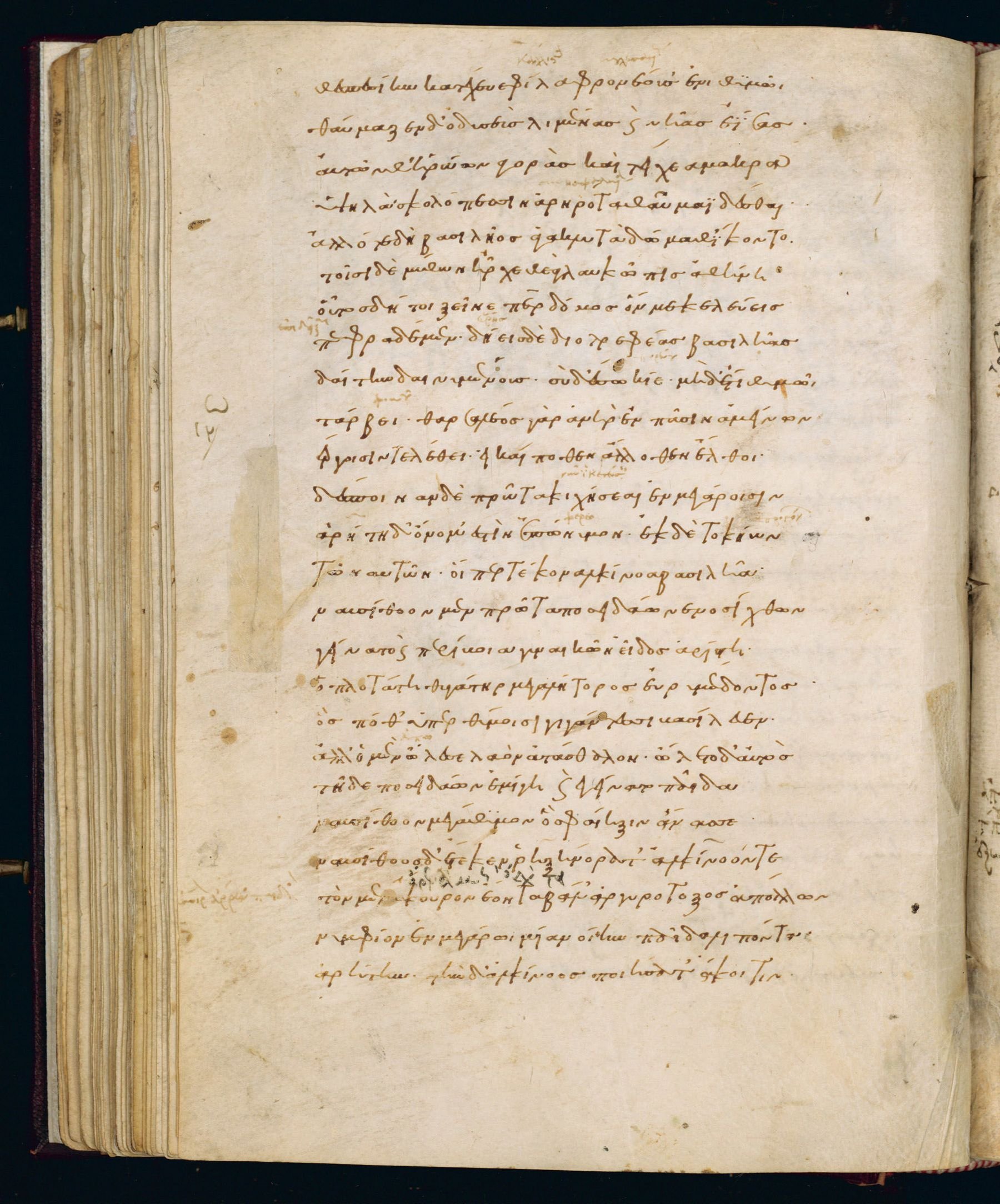
Laur. Plut. 32.24, fol. 63v: Odyssey 7.42-66, begins ‹θεσπεσίην κατέχευε φίλα φρονέουσʼ›, ends ‹δʼ Ἀλκίνοος ποιήσατʼ ἄκοιτιν,›. Checked on the image: first and last lines read and matched to the Greek. Fol. 63r ends with 7.41. Fol. 64r begins with 7.67. English blocks here: 40-44, 45-49, 50-54, 55-59, 60-64.
42θεσπεσίην κατέχευε φίλα φρονέουσʼ ἐνὶ θυμῷ.
43θαύμαζεν δʼ Ὀδυσεὺς λιμένας καὶ νῆας ἐίσας
44αὐτῶν θʼ ἡρώων ἀγορὰς καὶ τείχεα μακρὰ
45ὑψηλά, σκολόπεσσιν ἀρηρότα, θαῦμα ἰδέσθαι.
46ἀλλʼ ὅτε δὴ βασιλῆος ἀγακλυτὰ δώμαθʼ ἵκοντο,
47τοῖσι δὲ μύθων ἦρχε θεά, γλαυκῶπις Ἀθήνη·
48οὗτος δή τοι, ξεῖνε πάτερ, δόμος, ὅν με κελεύεις
49πεφραδέμεν· δήεις δὲ διοτρεφέας βασιλῆας
50δαίτην δαινυμένους· σὺ δʼ ἔσω κίε, μηδέ τι θυμῷ
51τάρβει· θαρσαλέος γὰρ ἀνὴρ ἐν πᾶσιν ἀμείνων
52ἔργοισιν τελέθει, εἰ καί ποθεν ἄλλοθεν ἔλθοι.
53δέσποιναν μὲν πρῶτα κιχήσεαι ἐν μεγάροισιν·
54Ἀρήτη δʼ ὄνομʼ ἐστὶν ἐπώνυμον, ἐκ δὲ τοκήων
55τῶν αὐτῶν οἵ περ τέκον Ἀλκίνοον βασιλῆα.
56Ναυσίθοον μὲν πρῶτα Ποσειδάων ἐνοσίχθων
57γείνατο καὶ Περίβοια, γυναικῶν εἶδος ἀρίστη,
58ὁπλοτάτη θυγάτηρ μεγαλήτορος Εὐρυμέδοντος,
59ὅς ποθʼ ὑπερθύμοισι Γιγάντεσσιν βασίλευεν.
60ἀλλʼ ὁ μὲν ὤλεσε λαὸν ἀτάσθαλον, ὤλετο δʼ αὐτός·
61τῇ δὲ Ποσειδάων ἐμίγη καὶ ἐγείνατο παῖδα
62Ναυσίθοον μεγάθυμον, ὃς ἐν Φαίηξιν ἄνασσε·
63Ναυσίθοος δʼ ἔτεκεν Ῥηξήνορά τʼ Ἀλκίνοόν τε.
64τὸν μὲν ἄκουρον ἐόντα βάλʼ ἀργυρότοξος Ἀπόλλων
65νυμφίον ἐν μεγάρῳ, μίαν οἴην παῖδα λιπόντα
66Ἀρήτην· τὴν δʼ Ἀλκίνοος ποιήσατʼ ἄκοιτιν,
40And as he went through the city in the midst of them, the Phaeacians, famed for their ships, took no heed of him, for fair-tressed Athena, the dread goddess, would not suffer it, but shed about him a wondrous mist, for her heart was kind toward him. And Odysseus marvelled at the harbors and the stately ships, at the meeting-places where the heroes themselves gathered, and the walls, long and 45high and crowned with palisades, a wonder to behold. But when they had come to the glorious palace of the king, the goddess, flashing-eyed Athena, was the first to speak, saying: “Here, Sir stranger, is the house which thou didst bid me shew to thee, and thou wilt find the kings, fostered of Zeus, 50feasting at the banquet. Go thou within, and let thy heart fear nothing; for a bold man is better in all things, though he be a stranger from another land. The queen shalt thou approach first in the palace; Arete is the name by which she is called, 55and she is sprung from the same line as is the king Alcinous. Nausithous at the first was born from the earth-shaker Poseidon and Periboea, the comeliest of women, youngest daughter of great-hearted Eurymedon, who once was king over the insolent Giants. 60But he brought destruction on his froward people, and was himself destroyed. But with Periboea lay Poseidon and begat a son, great-hearted Nausithous, who ruled over the Phaeacians; and Nausithous begat Rhexenor and Alcinous. Rhexenor, when as yet he had no son, Apollo of the silver bow smote
Where on the image
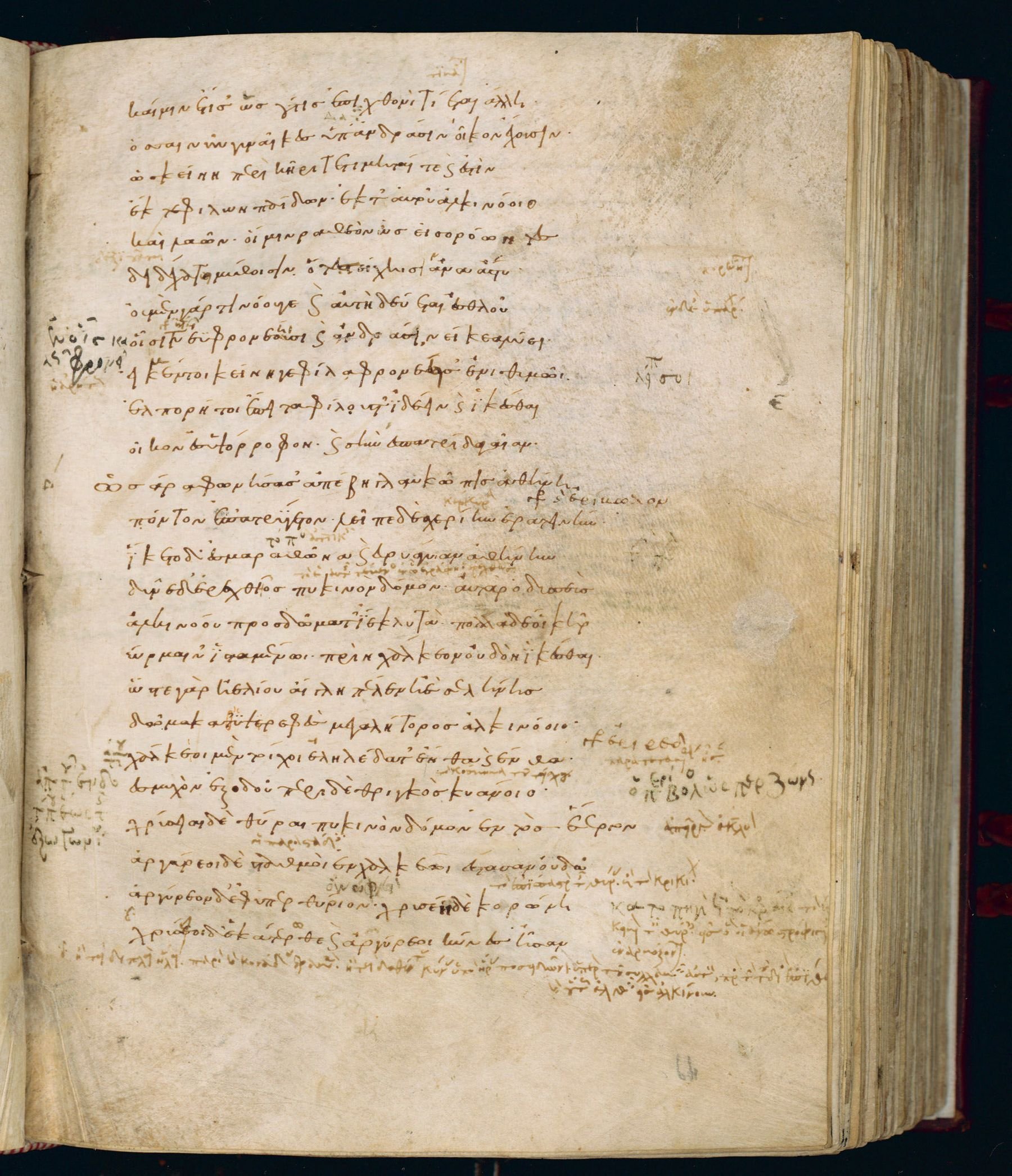
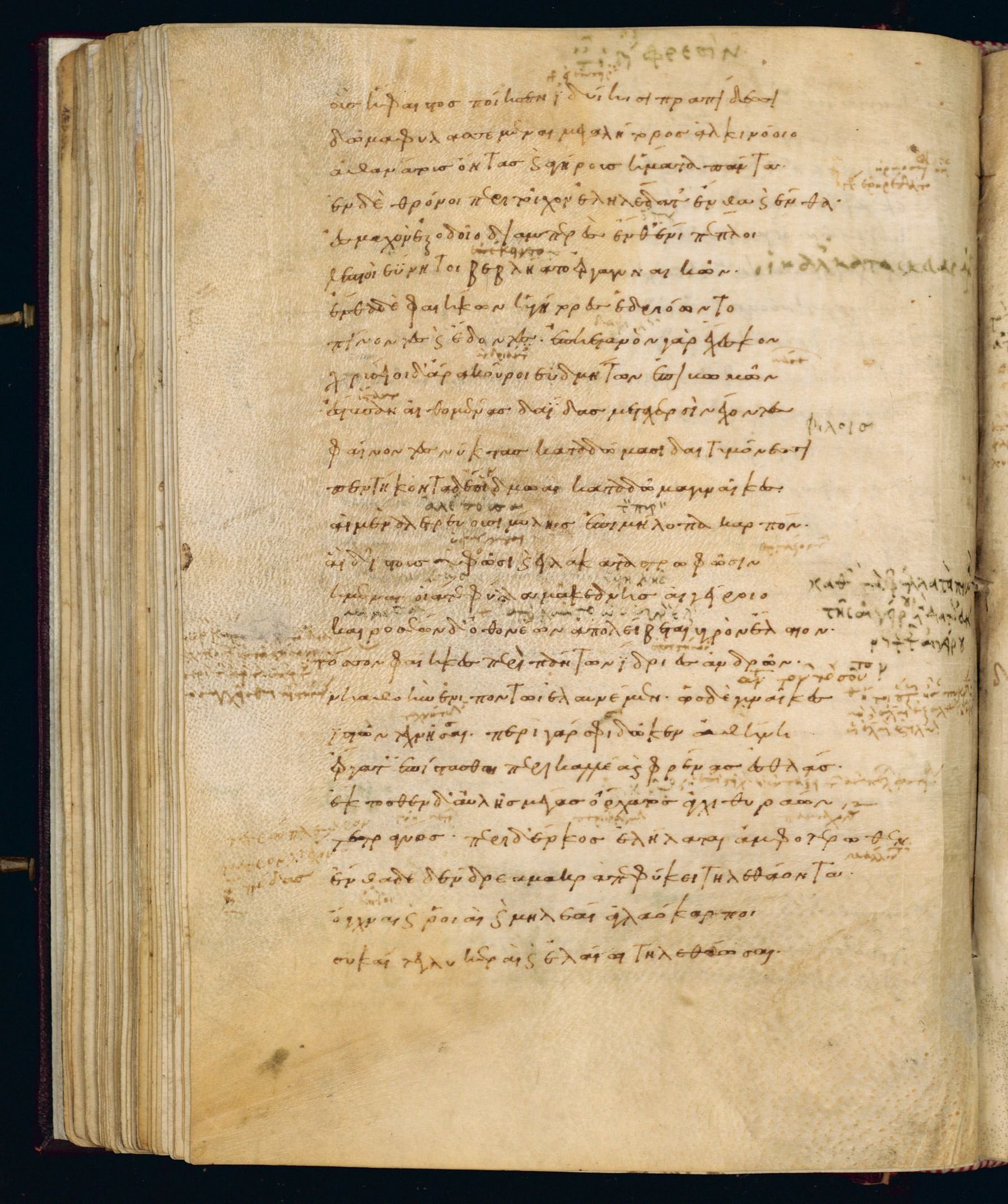
Laur. Plut. 32.24, fol. 64r: Odyssey 7.67-91, begins ‹καί μιν ἔτισʼ, ὡς›, ends ‹καὶ ἀργύρεοι κύνες ἦσαν,›. Checked on the image: first and last lines read and matched to the Greek. Fol. 63v ends with 7.66. Fol. 64v begins with 7.92. Below the last verse there is a marginal scholium in small script. English blocks here: 65-69, 70-74, 75-76, 77-79, 80-84, 85-89.
67καί μιν ἔτισʼ, ὡς οὔ τις ἐπὶ χθονὶ τίεται ἄλλη,
68ὅσσαι νῦν γε γυναῖκες ὑπʼ ἀνδράσιν οἶκον ἔχουσιν.
69ὣς κείνη περὶ κῆρι τετίμηταί τε καὶ ἔστιν
70ἔκ τε φίλων παίδων ἔκ τʼ αὐτοῦ Ἀλκινόοιο
71καὶ λαῶν, οἵ μίν ῥα θεὸν ὣς εἰσορόωντες
72δειδέχαται μύθοισιν, ὅτε στείχῃσʼ ἀνὰ ἄστυ.
73οὐ μὲν γάρ τι νόου γε καὶ αὐτὴ δεύεται ἐσθλοῦ·
74ᾗσι τʼ ἐὺ φρονέῃσι καὶ ἀνδράσι νείκεα λύει.
75εἴ κέν τοι κείνη γε φίλα φρονέῃσʼ ἐνὶ θυμῷ,
76ἐλπωρή τοι ἔπειτα φίλους τʼ ἰδέειν καὶ ἱκέσθαι
77οἶκον ἐς ὑψόροφον καὶ σὴν ἐς πατρίδα γαῖαν.
78ὣς ἄρα φωνήσασʼ ἀπέβη γλαυκῶπις Ἀθήνη
79πόντον ἐπʼ ἀτρύγετον, λίπε δὲ Σχερίην ἐρατεινήν,
80ἵκετο δʼ ἐς Μαραθῶνα καὶ εὐρυάγυιαν Ἀθήνην,
81δῦνε δʼ Ἐρεχθῆος πυκινὸν δόμον. αὐτὰρ Ὀδυσσεὺς
82Ἀλκινόου πρὸς δώματʼ ἴε κλυτά· πολλὰ δέ οἱ κῆρ
83ὥρμαινʼ ἱσταμένῳ, πρὶν χάλκεον οὐδὸν ἱκέσθαι.
84ὥς τε γὰρ ἠελίου αἴγλη πέλεν ἠὲ σελήνης
85δῶμα καθʼ ὑψερεφὲς μεγαλήτορος Ἀλκινόοιο.
86χάλκεοι μὲν γὰρ τοῖχοι ἐληλέδατʼ ἔνθα καὶ ἔνθα,
87ἐς μυχὸν ἐξ οὐδοῦ, περὶ δὲ θριγκὸς κυάνοιο·
88χρύσειαι δὲ θύραι πυκινὸν δόμον ἐντὸς ἔεργον·
89σταθμοὶ δʼ ἀργύρεοι ἐν χαλκέῳ ἕστασαν οὐδῷ,
90ἀργύρεον δʼ ἐφʼ ὑπερθύριον, χρυσέη δὲ κορώνη.
91χρύσειοι δʼ ἑκάτερθε καὶ ἀργύρεοι κύνες ἦσαν,
65in his hall, a bridegroom though he was, and he left only one daughter, Arete. Her Alcinous made his wife, and honored her as no other woman on earth is honored, of all those who in these days direct their households in subjection to their husbands; so heartily is she honored, 70and has ever been, by her children and by Alcinous himself and by the people, who look upon her as upon a goddess, and greet her as she goes through the city. For she of herself is no wise lacking in good understanding, and for the women to whom she has good will she makes an end of strife even among their husbands. 75If in her sight thou dost win favour, then there is hope that thou wilt see thy friends, and return to thy high-roofed house and unto thy native land.” 77So saying, flashing-eyed Athena departed over the unresting sea, and left lovely Scheria. 80She came to Marathon and broad-wayed Athens, and entered the well-built house of Erectheus; but Odysseus went to the glorious palace of Alcinous. There he stood, and his heart pondered much before he reached the threshold of bronze; for there was a gleam as of sun or moon 85over the high-roofed house of great-hearted Alcinous. Of bronze were the walls that stretched this way and that from the threshold to the innermost chamber, and around was a cornice of cyanus. Golden were the doors that shut in the well-built house, and doorposts of silver were set in a threshold of bronze.
Where on the image
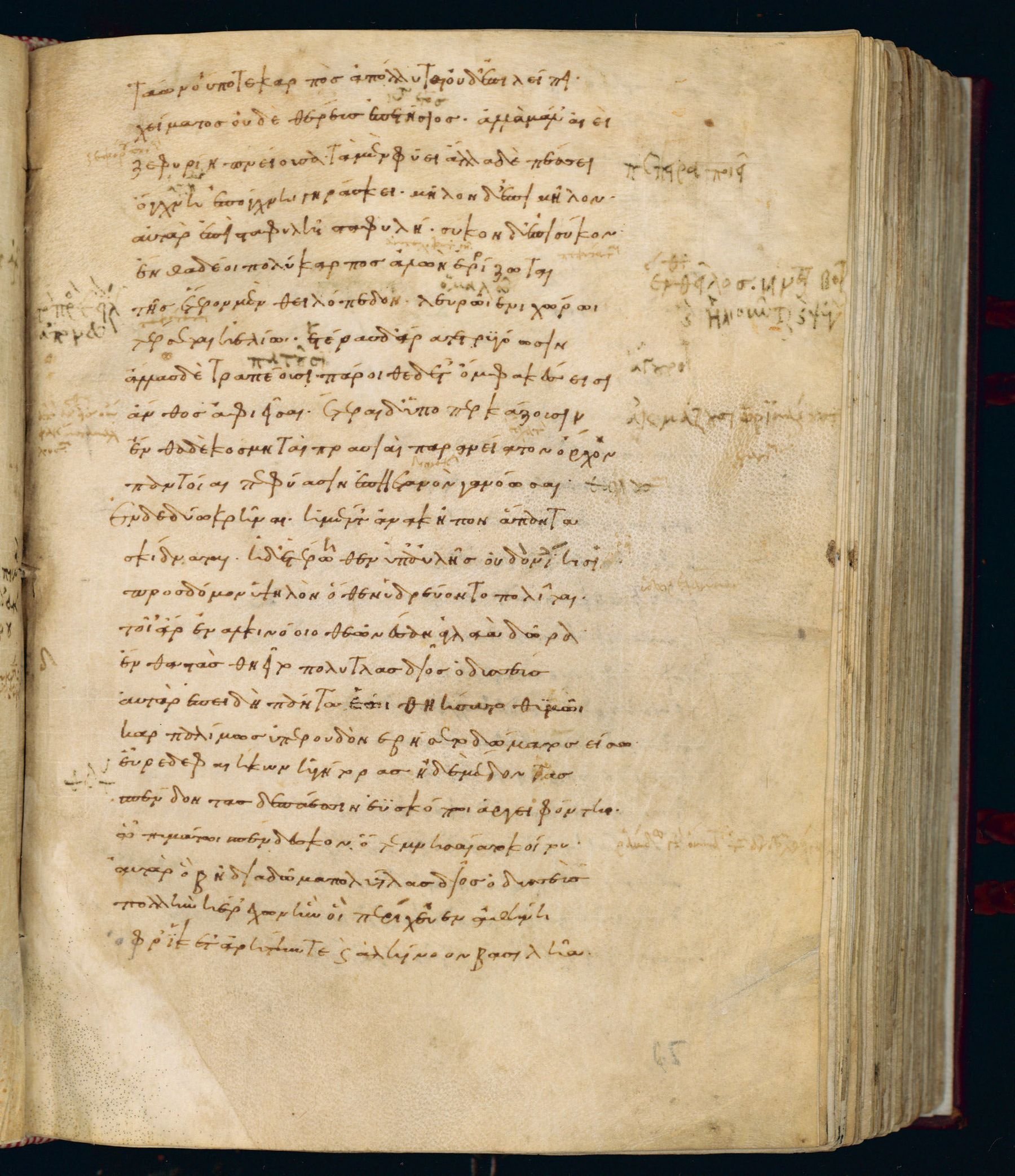
Laur. Plut. 32.24, fol. 64v: Odyssey 7.92-116, begins ‹οὓς Ἥφαιστος ἔτευξεν ἰδυίῃσι›, ends ‹γλυκεραὶ καὶ ἐλαῖαι τηλεθόωσαι.›. Checked on the image: first and last lines read and matched to the Greek. Fol. 64r ends with 7.91. Fol. 65r begins with 7.117. English blocks here: 90-94, 95-99, 100-104, 105-106, 107-109, 110-114.
92οὓς Ἥφαιστος ἔτευξεν ἰδυίῃσι πραπίδεσσι
93δῶμα φυλασσέμεναι μεγαλήτορος Ἀλκινόοιο,
94ἀθανάτους ὄντας καὶ ἀγήρως ἤματα πάντα.
95ἐν δὲ θρόνοι περὶ τοῖχον ἐρηρέδατʼ ἔνθα καὶ ἔνθα,
96ἐς μυχὸν ἐξ οὐδοῖο διαμπερές, ἔνθʼ ἐνὶ πέπλοι
97λεπτοὶ ἐύννητοι βεβλήατο, ἔργα γυναικῶν.
98ἔνθα δὲ Φαιήκων ἡγήτορες ἑδριόωντο
99πίνοντες καὶ ἔδοντες· ἐπηετανὸν γὰρ ἔχεσκον.
100χρύσειοι δʼ ἄρα κοῦροι ἐυδμήτων ἐπὶ βωμῶν
101ἕστασαν αἰθομένας δαΐδας μετὰ χερσὶν ἔχοντες,
102φαίνοντες νύκτας κατὰ δώματα δαιτυμόνεσσι.
103πεντήκοντα δέ οἱ δμωαὶ κατὰ δῶμα γυναῖκες
104αἱ μὲν ἀλετρεύουσι μύλῃς ἔπι μήλοπα καρπόν,
105αἱ δʼ ἱστοὺς ὑφόωσι καὶ ἠλάκατα στρωφῶσιν
106ἥμεναι, οἷά τε φύλλα μακεδνῆς αἰγείροιο·
107καιρουσσέων δʼ ὀθονέων ἀπολείβεται ὑγρὸν ἔλαιον.
108ὅσσον Φαίηκες περὶ πάντων ἴδριες ἀνδρῶν
109νῆα θοὴν ἐνὶ πόντῳ ἐλαυνέμεν, ὣς δὲ γυναῖκες
110ἱστῶν τεχνῆσσαι· πέρι γάρ σφισι δῶκεν Ἀθήνη
111ἔργα τʼ ἐπίστασθαι περικαλλέα καὶ φρένας ἐσθλάς.
112ἔκτοσθεν δʼ αὐλῆς μέγας ὄρχατος ἄγχι θυράων
113τετράγυος· περὶ δʼ ἕρκος ἐλήλαται ἀμφοτέρωθεν.
114ἔνθα δὲ δένδρεα μακρὰ πεφύκασι τηλεθόωντα,
115ὄγχναι καὶ ῥοιαὶ καὶ μηλέαι ἀγλαόκαρποι
116συκέαι τε γλυκεραὶ καὶ ἐλαῖαι τηλεθόωσαι.
90Of silver was the lintel above, and of gold the handle. On either side of the door there stood gold and silver dogs, which Hephaestus had fashioned with cunning skill to guard the palace of great-hearted Alcinous; immortal were they and ageless all their days. 95Within, seats were fixed along the wall on either hand, from the threshold to the innermost chamber, and on them were thrown robes of soft fabric, cunningly woven, the handiwork of women. On these the leaders of the Phaeacians were wont to sit drinking and eating, for they had unfailing store. 100And golden youths stood on well-built pedestals, holding lighted torches in their hands to give light by night to the banqueters in the hall. And fifty slave-women he had in the house, of whom some grind the yellow grain on the millstone, 105and others weave webs, or, as they sit, twirl the yarn, like unto the leaves of a tall poplar tree; and from the closely-woven linen the soft olive oil drips down. 107For as the Phaeacian men are skilled above all others in speeding a swift ship upon the sea, so are the women 110cunning workers at the loom, for Athena has given to them above all others skill in fair handiwork, and an understanding heart. But without the courtyard, hard by the door, is a great orchard of four acres, and a hedge runs about it on either side. Therein grow trees, tall and luxuriant,
Where on the image
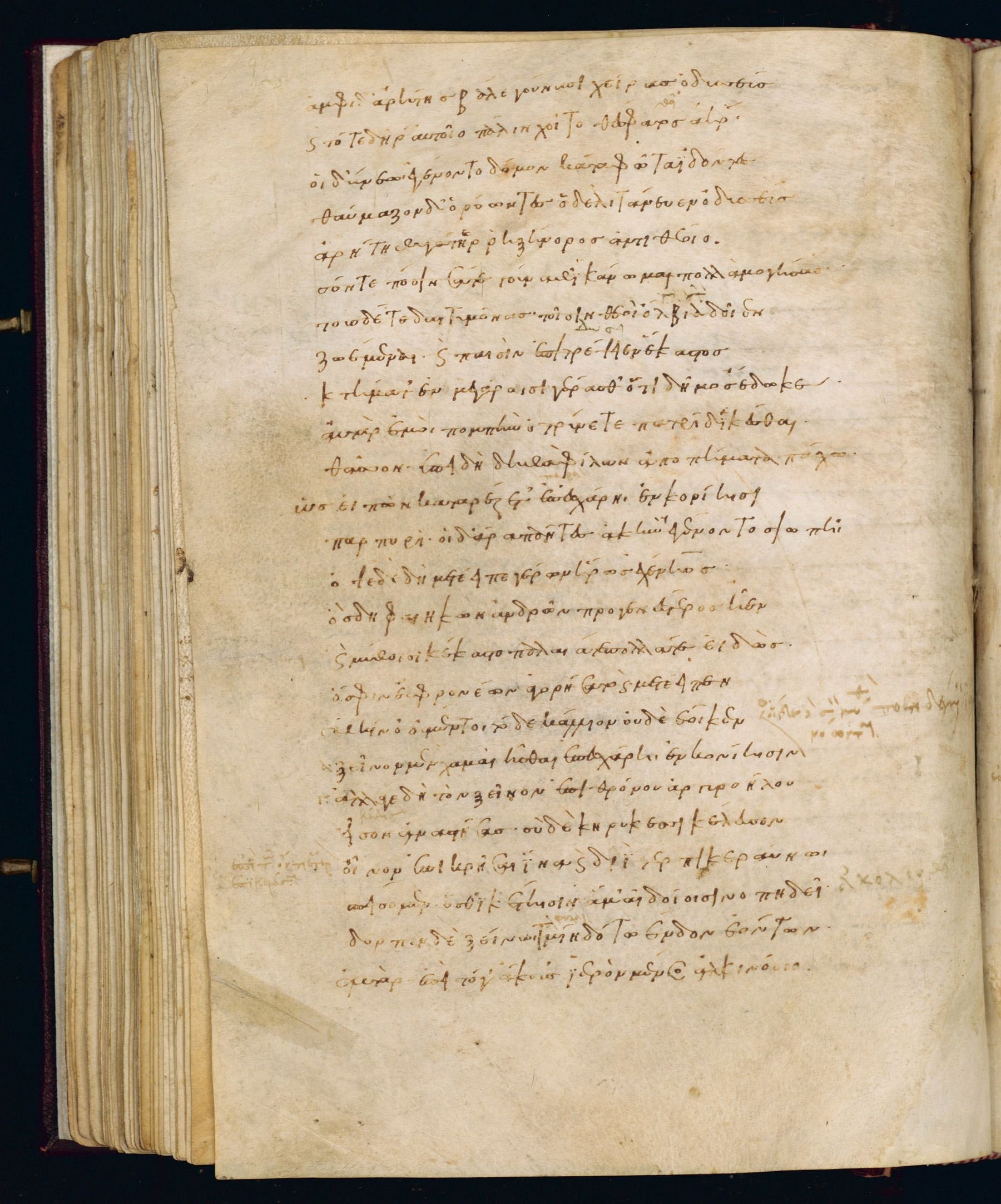
Laur. Plut. 32.24, fol. 65r: Odyssey 7.117-141, begins ‹τάων οὔ ποτε καρπὸς›, ends ‹τε καὶ Ἀλκίνοον βασιλῆα.›. Checked on the image: first and last lines read and matched to the Greek. Fol. 64v ends with 7.116. Fol. 65v begins with 7.142. English blocks here: 115-119, 120-124, 125-129, 130-134, 135-139.
117τάων οὔ ποτε καρπὸς ἀπόλλυται οὐδʼ ἀπολείπει
118χείματος οὐδὲ θέρευς, ἐπετήσιος· ἀλλὰ μάλʼ αἰεὶ
119Ζεφυρίη πνείουσα τὰ μὲν φύει, ἄλλα δὲ πέσσει.
120ὄγχνη ἐπʼ ὄγχνῃ γηράσκει, μῆλον δʼ ἐπὶ μήλῳ,
121αὐτὰρ ἐπὶ σταφυλῇ σταφυλή, σῦκον δʼ ἐπὶ σύκῳ.
122ἔνθα δέ οἱ πολύκαρπος ἀλωὴ ἐρρίζωται,
123τῆς ἕτερον μὲν θειλόπεδον λευρῷ ἐνὶ χώρῳ
124τέρσεται ἠελίῳ, ἑτέρας δʼ ἄρα τε τρυγόωσιν,
125ἄλλας δὲ τραπέουσι· πάροιθε δέ τʼ ὄμφακές εἰσιν
126ἄνθος ἀφιεῖσαι, ἕτεραι δʼ ὑποπερκάζουσιν.
127ἔνθα δὲ κοσμηταὶ πρασιαὶ παρὰ νείατον ὄρχον
128παντοῖαι πεφύασιν, ἐπηετανὸν γανόωσαι·
129ἐν δὲ δύω κρῆναι ἡ μέν τʼ ἀνὰ κῆπον ἅπαντα
130σκίδναται, ἡ δʼ ἑτέρωθεν ὑπʼ αὐλῆς οὐδὸν ἵησι
131πρὸς δόμον ὑψηλόν, ὅθεν ὑδρεύοντο πολῖται.
132τοῖʼ ἄρʼ ἐν Ἀλκινόοιο θεῶν ἔσαν ἀγλαὰ δῶρα.
133ἔνθα στὰς θηεῖτο πολύτλας δῖος Ὀδυσσεύς.
134αὐτὰρ ἐπεὶ δὴ πάντα ἑῷ θηήσατο θυμῷ,
135καρπαλίμως ὑπὲρ οὐδὸν ἐβήσετο δώματος εἴσω.
136εὗρε δὲ Φαιήκων ἡγήτορας ἠδὲ μέδοντας
137σπένδοντας δεπάεσσιν ἐυσκόπῳ ἀργεϊφόντῃ,
138ᾧ πυμάτῳ σπένδεσκον, ὅτε μνησαίατο κοίτου.
139αὐτὰρ ὁ βῆ διὰ δῶμα πολύτλας δῖος Ὀδυσσεὺς
140πολλὴν ἠέρʼ ἔχων, ἥν οἱ περίχευεν Ἀθήνη,
141ὄφρʼ ἵκετʼ Ἀρήτην τε καὶ Ἀλκίνοον βασιλῆα.
115pears and pomegranates and apple-trees with their bright fruit, and sweet figs, and luxuriant olives. Of these the fruit perishes not nor fails in winter or in summer, but lasts throughout the year; and ever does the west wind, as it blows, quicken to life some fruits, and ripen others; 120pear upon pear waxes ripe, apple upon apple, cluster upon cluster, and fig upon fig. There, too, is his fruitful vineyard planted, one part of which, a warm spot on level ground, is being dried in the sun, while other grapes men are gathering, 125and others, too, they are treading; but in front are unripe grapes that are shedding the blossom, and others that are turning purple. There again, by the last row of the vines, grow trim garden beds of every sort, blooming the year through, and therein are two springs, one of which sends its water throughout all the garden, 130while the other, over against it, flows beneath the threshold of the court toward the high house; from this the townsfolk drew their water. Such were the glorious gifts of the gods in the palace of Alcinous. There the much-enduring goodly Odysseus stood and gazed. But when he had marvelled in his heart at all things, 135he passed quickly over the threshold into the house. There he found the leaders and counsellors of the Phaeacians pouring libations from their cups to the keen-sighted Argeiphontes, to whom they were wont to pour the wine last of all, when they were minded to go to their rest. But the much-enduring goodly Odysseus went through the hall,
Where on the image
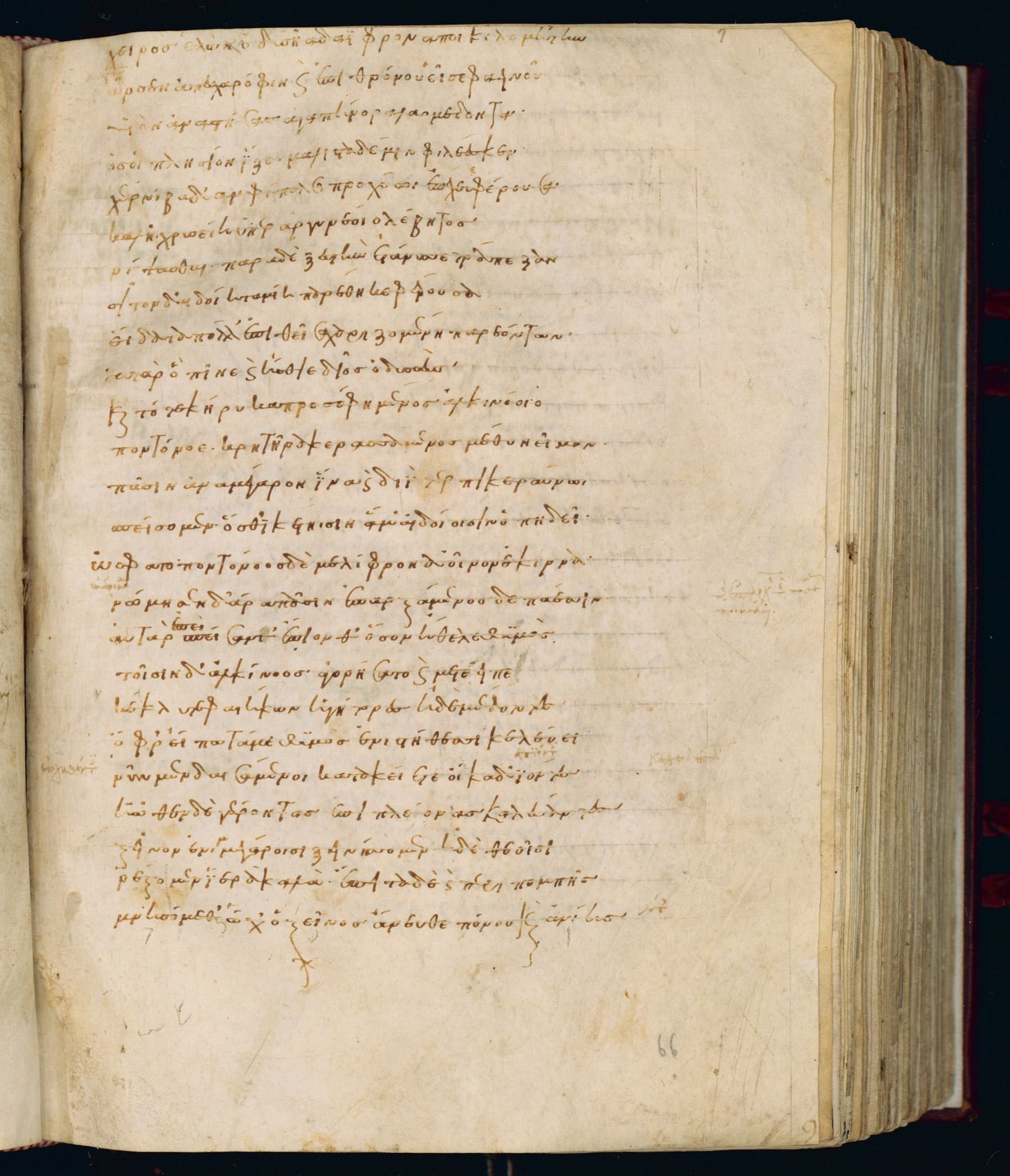
Laur. Plut. 32.24, fol. 65v: Odyssey 7.142-167, begins ‹ἀμφὶ δʼ ἄρʼ Ἀρήτης›, ends ‹ἄκουσʼ ἱερὸν μένος Ἀλκινόοιο,›. Checked on the image: first and last lines read and matched to the Greek. Fol. 65r ends with 7.141. Fol. 66r begins with 7.168. 7.161 is not in the text column (the scribe passes from 7.160 to 7.162); a faded marginal addition beside 7.159 seems to contain it (25 lines in the column). English blocks here: 140-144, 145-149, 150-151, 152-154, 155-159, 160-164, 165-169.
142ἀμφὶ δʼ ἄρʼ Ἀρήτης βάλε γούνασι χεῖρας Ὀδυσσεύς,
143καὶ τότε δή ῥʼ αὐτοῖο πάλιν χύτο θέσφατος ἀήρ.
144οἱ δʼ ἄνεῳ ἐγένοντο, δόμον κάτα φῶτα ἰδόντες·
145θαύμαζον δʼ ὁρόωντες. ὁ δὲ λιτάνευεν Ὀδυσσεύς·
146Ἀρήτη, θύγατερ Ῥηξήνορος ἀντιθέοιο,
147σόν τε πόσιν σά τε γούναθʼ ἱκάνω πολλὰ μογήσας
148τούσδε τε δαιτυμόνας· τοῖσιν θεοὶ ὄλβια δοῖεν
149ζωέμεναι, καὶ παισὶν ἐπιτρέψειεν ἕκαστος
150κτήματʼ ἐνὶ μεγάροισι γέρας θʼ ὅ τι δῆμος ἔδωκεν·
151αὐτὰρ ἐμοὶ πομπὴν ὀτρύνετε πατρίδʼ ἱκέσθαι
152θᾶσσον, ἐπεὶ δὴ δηθὰ φίλων ἄπο πήματα πάσχω.
153ὣς εἰπὼν κατʼ ἄρʼ ἕζετʼ ἐπʼ ἐσχάρῃ ἐν κονίῃσιν
154πὰρ πυρί· οἱ δʼ ἄρα πάντες ἀκὴν ἐγένοντο σιωπῇ.
155ὀψὲ δὲ δὴ μετέειπε γέρων ἥρως Ἐχένηος,
156ὃς δὴ Φαιήκων ἀνδρῶν προγενέστερος ἦεν
157καὶ μύθοισι κέκαστο, παλαιά τε πολλά τε εἰδώς·
158ὅ σφιν ἐὺ φρονέων ἀγορήσατο καὶ μετέειπεν·
159Ἀλκίνοʼ, οὐ μέν τοι τόδε κάλλιον, οὐδὲ ἔοικε,
160ξεῖνον μὲν χαμαὶ ἧσθαι ἐπʼ ἐσχάρῃ ἐν κονίῃσιν,
161οἵδε δὲ σὸν μῦθον ποτιδέγμενοι ἰσχανόωνται.
162ἄλλʼ ἄγε δὴ ξεῖνον μὲν ἐπὶ θρόνου ἀργυροήλου
163εἷσον ἀναστήσας, σὺ δὲ κηρύκεσσι κέλευσον
164οἶνον ἐπικρῆσαι, ἵνα καὶ Διὶ τερπικεραύνῳ
165σπείσομεν, ὅς θʼ ἱκέτῃσιν ἅμʼ αἰδοίοισιν ὀπηδεῖ·
166δόρπον δὲ ξείνῳ ταμίη δότω ἔνδον ἐόντων.
167αὐτὰρ ἐπεὶ τό γʼ ἄκουσʼ ἱερὸν μένος Ἀλκινόοιο,
140wrapped in the thick mist which Athena had shed about him, till he came to Arete and to Alcinous the king. About the knees of Arete Odysseus cast his hands, and straightway the wondrous mist melted from him, and a hush fell upon all that were in the room at sight of the man, 145and they marvelled as they looked upon him. But Odysseus made his prayer: “Arete, daughter of godlike Rhexenor, to thy husband and to thy knees am I come after many toils,—aye and to these banqueters, to whom may the gods grant happiness in life, and may each of them hand down to his children 150the wealth in his halls, and the dues of honor which the people have given him. But for me do ye speed my sending, that I may come to my native land, and that quickly; for long time have I been suffering woes far from my friends.” 152So saying he sat down on the hearth in the ashes by the fire, and they were all hushed in silence. 155But at length there spoke among them the old lord Echeneus, who was an elder among the Phaeacians, well skilled in speech, and understanding all the wisdom of old. He with good intent addressed the assembly, and said: “Alcinous, lo, this is not the better way, nor is it seemly, 160that a stranger should sit upon the ground on the hearth in the ashes; but these others hold back waiting for thy word. Come, make the stranger to arise, and set him upon a silver-studded chair, and bid the heralds mix wine, 165that we may pour libations also to Zeus, who hurls the thunderbolt; for he ever attends upon reverend suppliants. And let the housewife give supper to the stranger of the store that is in the house.” When the strong and mighty Alcinous heard this, he took by the hand Odysseus, the wise and crafty-minded, and raised him from the hearth, and set him upon a bright chair
Where on the image
Laur. Plut. 32.24, fol. 66r: Odyssey 7.168-192, begins ‹χειρὸς ἑλὼν Ὀδυσῆα δαΐφρονα›, ends ‹ἄνευθε πόνου καὶ ἀνίης›. Checked on the image: first and last lines read and matched to the Greek. Fol. 65v ends with 7.167. Fol. 66v begins with 7.193. English blocks here: 170-174, 175-179, 180-184, 185-189, 190-194.
168χειρὸς ἑλὼν Ὀδυσῆα δαΐφρονα ποικιλομήτην
169ὦρσεν ἀπʼ ἐσχαρόφιν καὶ ἐπὶ θρόνου εἷσε φαεινοῦ,
170υἱὸν ἀναστήσας ἀγαπήνορα Λαοδάμαντα,
171ὅς οἱ πλησίον ἷζε, μάλιστα δέ μιν φιλέεσκεν.
172χέρνιβα δʼ ἀμφίπολος προχόῳ ἐπέχευε φέρουσα
173καλῇ χρυσείῃ ὑπὲρ ἀργυρέοιο λέβητος,
174νίψασθαι· παρὰ δὲ ξεστὴν ἐτάνυσσε τράπεζαν.
175σῖτον δʼ αἰδοίη ταμίη παρέθηκε φέρουσα,
176εἴδατα πόλλʼ ἐπιθεῖσα, χαριζομένη παρεόντων.
177αὐτὰρ ὁ πῖνε καὶ ἦσθε πολύτλας δῖος Ὀδυσσεύς.
178καὶ τότε κήρυκα προσέφη μένος Ἀλκινόοιο·
179Ποντόνοε, κρητῆρα κερασσάμενος μέθυ νεῖμον
180πᾶσιν ἀνὰ μέγαρον, ἵνα καὶ Διὶ τερπικεραύνῳ
181σπείσομεν, ὅς θʼ ἱκέτῃσιν ἅμʼ αἰδοίοισιν ὀπηδεῖ.
182ὣς φάτο, Ποντόνοος δὲ μελίφρονα οἶνον ἐκίρνα,
183νώμησεν δʼ ἄρα πᾶσιν ἐπαρξάμενος δεπάεσσιν.
184αὐτὰρ ἐπεὶ σπεῖσάν τʼ ἔπιόν θʼ, ὅσον ἤθελε θυμός,
185τοῖσιν δʼ Ἀλκίνοος ἀγορήσατο καὶ μετέειπε·
186κέκλυτε, Φαιήκων ἡγήτορες ἠδὲ μέδοντες
187ὄφρʼ εἴπω τά με θυμὸς ἐνὶ στήθεσσι κελεύει.
188νῦν μὲν δαισάμενοι κατακείετε οἴκαδʼ ἰόντες·
189ἠῶθεν δὲ γέροντας ἐπὶ πλέονας καλέσαντες
190ξεῖνον ἐνὶ μεγάροις ξεινίσσομεν ἠδὲ θεοῖσιν
191ῥέξομεν ἱερὰ καλά, ἔπειτα δὲ καὶ περὶ πομπῆς
192μνησόμεθʼ, ὥς χʼ ὁ ξεῖνος ἄνευθε πόνου καὶ ἀνίης
170from which he bade his son, the kindly Laodamas, to rise; for he sat next to him, and was his best beloved. Then a handmaid brought water for the hands in a fair pitcher of gold, and poured it over a silver basin, for him to wash, and beside him drew up a polished table. 175And the grave housewife brought and set before him bread, and therewith dainties in abundance, giving freely of her store. So the much-enduring goodly Odysseus drank and ate; and then the mighty Alcinous spoke to the herald, and said: “Pontonous, mix the bowl, and serve wine 180to all in the hall, that we may pour libations also to Zeus, who hurls the thunderbolt; for he ever attends upon reverend suppliants.” He spoke, and Pontonous mixed the honey-hearted wine, and served out to all, pouring first drops for libation into the cups. But when they had poured libations, and had drunk to their heart's content, 185Alcinous addressed the assembly, and spoke among them: “Hearken to me, leaders and counsellors of the Phaeacians, that I may say what the heart in my breast bids me. Now that ye have finished your feast, go each of you to his house to rest. But in the morning we will call more of the elders together, 190and will entertain the stranger in our halls and offer goodly victims to the gods. After that we will take thought also of his sending, that without toil or pain yon stranger may under our sending, come to his native land speedily and with rejoicing, though he come from never so far.
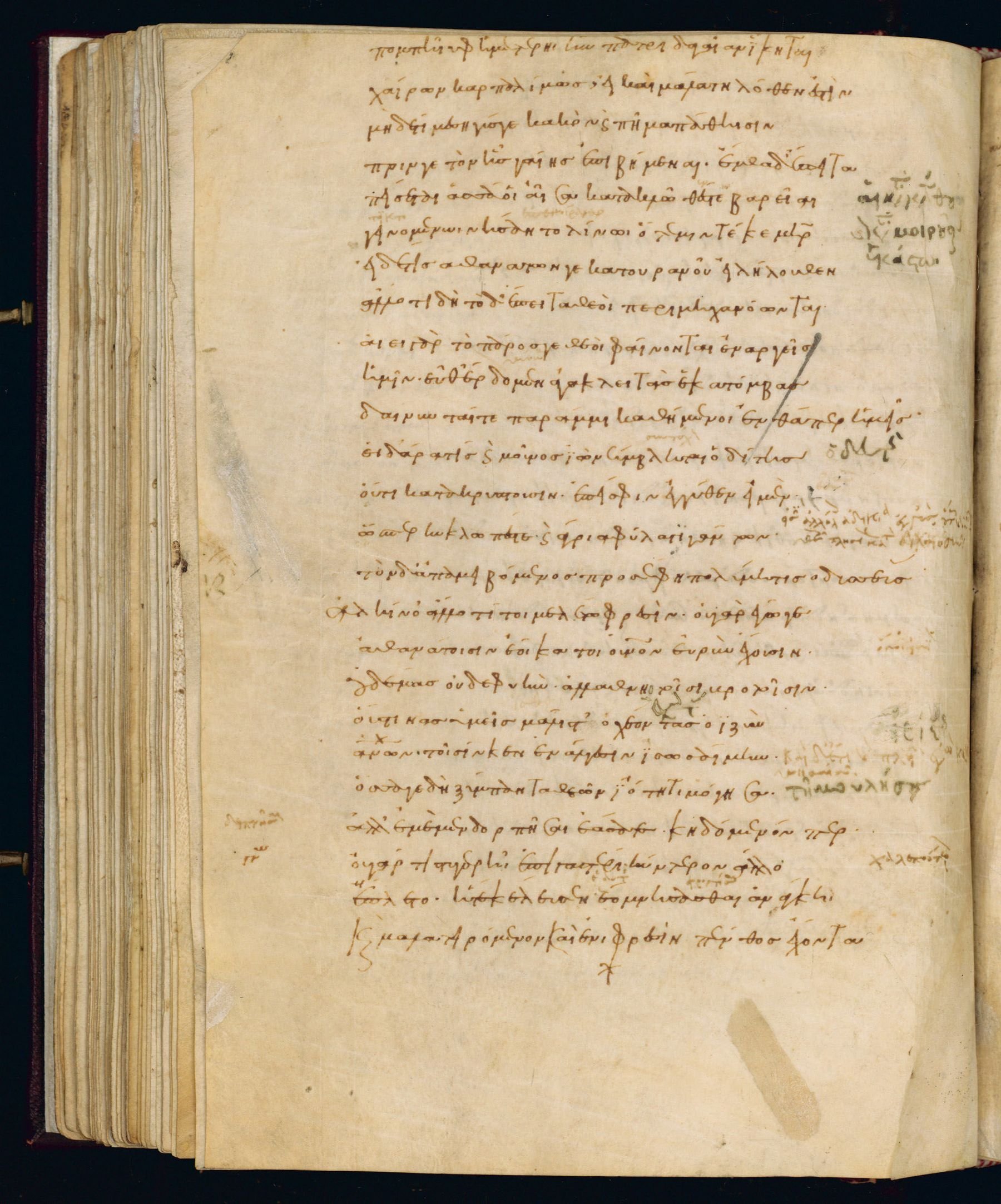
Where on the image
Laur. Plut. 32.24, fol. 66v: Odyssey 7.193-218, begins ‹πομπῇ ὑφʼ ἡμετέρῃ ἣν›, ends ‹ἐνὶ φρεσὶ πένθος ἔχοντα,›. Checked on the image: first and last lines read and matched to the Greek. Fol. 66r ends with 7.192. Fol. 67r begins with 7.219. 7.213 is not in the text column (the scribe passes from 7.212 to 7.214); a faded marginal addition beside 7.212 seems to begin καὶ δʼ ἔτι (25 lines in the column). English blocks here: 195-197, 198-199, 200-204, 205-209, 210-214, 215-219.
193πομπῇ ὑφʼ ἡμετέρῃ ἣν πατρίδα γαῖαν ἵκηται
194χαίρων καρπαλίμως, εἰ καὶ μάλα τηλόθεν ἐστί,
195μηδέ τι μεσσηγύς γε κακὸν καὶ πῆμα πάθῃσι,
196πρίν γε τὸν ἧς γαίης ἐπιβήμεναι· ἔνθα δʼ ἔπειτα
197πείσεται, ἅσσα οἱ αἶσα κατὰ κλῶθές τε βαρεῖαι
198γιγνομένῳ νήσαντο λίνῳ, ὅτε μιν τέκε μήτηρ.
199εἰ δέ τις ἀθανάτων γε κατʼ οὐρανοῦ εἰλήλουθεν,
200ἄλλο τι δὴ τόδʼ ἔπειτα θεοὶ περιμηχανόωνται.
201αἰεὶ γὰρ τὸ πάρος γε θεοὶ φαίνονται ἐναργεῖς
202ἡμῖν, εὖτʼ ἔρδωμεν ἀγακλειτὰς ἑκατόμβας,
203δαίνυνταί τε παρʼ ἄμμι καθήμενοι ἔνθα περ ἡμεῖς.
204εἰ δʼ ἄρα τις καὶ μοῦνος ἰὼν ξύμβληται ὁδίτης,
205οὔ τι κατακρύπτουσιν, ἐπεί σφισιν ἐγγύθεν εἰμέν,
206ὥς περ Κύκλωπές τε καὶ ἄγρια φῦλα Γιγάντων.
207τὸν δʼ ἀπαμειβόμενος προσέφη πολύμητις Ὀδυσσεύς·
208Ἀλκίνοʼ, ἄλλο τί τοι μελέτω φρεσίν· οὐ γὰρ ἐγώ γε
209ἀθανάτοισιν ἔοικα, τοὶ οὐρανὸν εὐρὺν ἔχουσιν,
210οὐ δέμας οὐδὲ φυήν, ἀλλὰ θνητοῖσι βροτοῖσιν.
211οὕς τινας ὑμεῖς ἴστε μάλιστʼ ὀχέοντας ὀιζὺν
212ἀνθρώπων, τοῖσίν κεν ἐν ἄλγεσιν ἰσωσαίμην.
213καὶ δʼ ἔτι κεν καὶ μᾶλλον ἐγὼ κακὰ μυθησαίμην,
214ὅσσα γε δὴ ξύμπαντα θεῶν ἰότητι μόγησα.
215ἀλλʼ ἐμὲ μὲν δορπῆσαι ἐάσατε κηδόμενόν περ·
216οὐ γάρ τι στυγερῇ ἐπὶ γαστέρι κύντερον ἄλλο
217ἔπλετο, ἥ τʼ ἐκέλευσεν ἕο μνήσασθαι ἀνάγκῃ
218καὶ μάλα τειρόμενον καὶ ἐνὶ φρεσὶ πένθος ἔχοντα,
195Nor shall he meanwhile suffer any evil or harm, until he sets foot upon his own land; but thereafter he shall suffer whatever Fate and the dread Spinners spun with their thread for him at his birth, when his mother bore him. 198But if he is one of the immortals come down from heaven, 200then is this some new thing which the gods are planning; for ever heretofore have they been wont to appear to us in manifest form, when we sacrifice to them glorious hecatombs, and they feast among us, sitting even where we sit. Aye, and if one of us as a lone wayfarer meets them, 205they use no concealment, for we are of near kin to them, as are the Cyclopes and the wild tribes of the Giants.” Then Odysseus of many wiles answered him, and said: “Alcinous, far from thee be that thought; for I am not like the immortals, who hold broad heaven, 210either in stature or in form, but like mortal men. Whomsoever ye know among men who bear greatest burden of woe, to them might I liken myself in my sorrows. Yea, and I could tell a yet longer tale of all the evils which I have endured by the will of the gods. 215But as for me, suffer me now to eat, despite my grief; for there is nothing more shameless than a hateful belly, which bids a man perforce take thought thereof, be he never so sore distressed and laden with grief at heart, even as I, too, am laden with grief at heart, yet ever does my belly
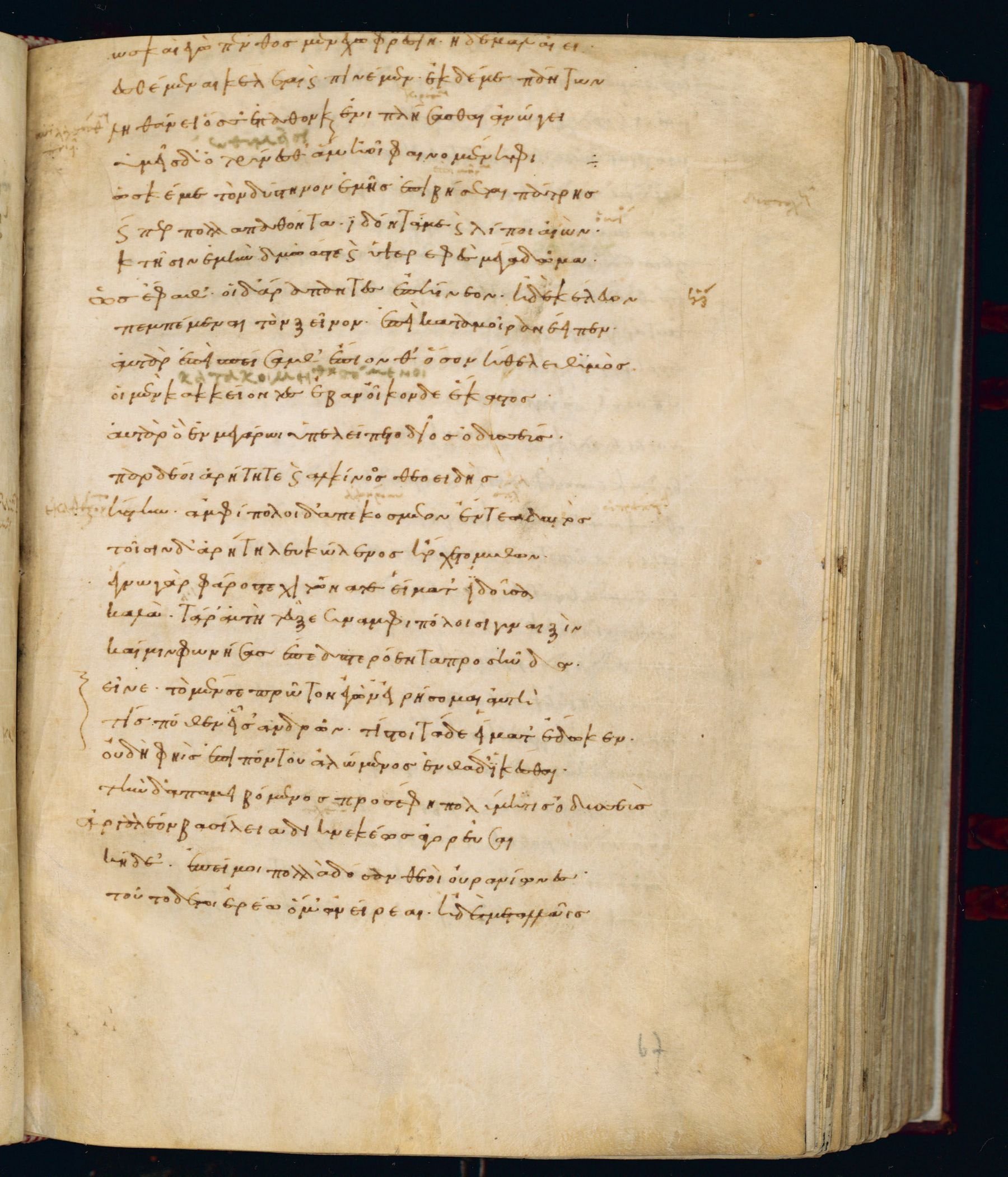
Where on the image
Laur. Plut. 32.24, fol. 67r: Odyssey 7.219-243, begins ‹ὡς καὶ ἐγὼ πένθος›, ends ‹μʼ ἀνείρεαι ἠδὲ μεταλλᾷς.›. Checked on the image: first and last lines read and matched to the Greek. Fol. 66v ends with 7.218. Fol. 67v begins with 7.244. English blocks here: 220-224, 225-229, 230-234, 235-239, 240-244.
219ὡς καὶ ἐγὼ πένθος μὲν ἔχω φρεσίν, ἡ δὲ μάλʼ αἰεὶ
220ἐσθέμεναι κέλεται καὶ πινέμεν, ἐκ δέ με πάντων
221ληθάνει ὅσσʼ ἔπαθον, καὶ ἐνιπλησθῆναι ἀνώγει.
222ὑμεῖς δʼ ὀτρύνεσθαι ἅμʼ ἠοῖ φαινομένηφιν,
223ὥς κʼ ἐμὲ τὸν δύστηνον ἐμῆς ἐπιβήσετε πάτρης
224καί περ πολλὰ παθόντα· ἰδόντα με καὶ λίποι αἰὼν
225κτῆσιν ἐμήν, δμῶάς τε καὶ ὑψερεφὲς μέγα δῶμα.
226ὣς ἔφαθʼ, οἱ δʼ ἄρα πάντες ἐπῄνεον ἠδʼ ἐκέλευον
227πεμπέμεναι τὸν ξεῖνον, ἐπεὶ κατὰ μοῖραν ἔειπεν.
228αὐτὰρ ἐπεὶ σπεῖσάν τʼ ἔπιον θʼ ὅσον ἤθελε θυμός,
229οἱ μὲν κακκείοντες ἔβαν οἶκόνδε ἕκαστος,
230αὐτὰρ ὁ ἐν μεγάρῳ ὑπελείπετο δῖος Ὀδυσσεύς,
231πὰρ δέ οἱ Ἀρήτη τε καὶ Ἀλκίνοος θεοειδὴς
232ἥσθην· ἀμφίπολοι δʼ ἀπεκόσμεον ἔντεα δαιτός.
233τοῖσιν δʼ Ἀρήτη λευκώλενος ἤρχετο μύθων·
234ἔγνω γὰρ φᾶρός τε χιτῶνά τε εἵματʼ ἰδοῦσα
235καλά, τά ῥʼ αὐτὴ τεῦξε σὺν ἀμφιπόλοισι γυναιξί·
236καί μιν φωνήσασʼ ἔπεα πτερόεντα προσηύδα·
237ξεῖνε, τὸ μέν σε πρῶτον ἐγὼν εἰρήσομαι αὐτή·
238τίς πόθεν εἰς ἀνδρῶν; τίς τοι τάδε εἵματʼ ἔδωκεν;
239οὐ δὴ φῆς ἐπὶ πόντον ἀλώμενος ἐνθάδʼ ἱκέσθαι;
240τὴν δʼ ἀπαμειβόμενος προσέφη πολύμητις Ὀδυσσεύς·
241ἀργαλέον, βασίλεια, διηνεκέως ἀγορεῦσαι
242κήδεʼ, ἐπεί μοι πολλὰ δόσαν θεοὶ Οὐρανίωνες·
243τοῦτο δέ τοι ἐρέω ὅ μʼ ἀνείρεαι ἠδὲ μεταλλᾷς.
220bid me eat and drink, and makes me forget all that I have suffered, and commands me to eat my fill. But do ye make haste at break of day, that ye may set me, hapless one, on the soil of my native land, even after my many woes. Yea, let life leave me, when I have seen once more 225my possessions, my slaves, and my great high-roofed house.” So he spoke, and they all praised his words, and bade send the stranger on his way, since he had spoken fittingly. Then when they had poured libations, and had drunk to their heart's content, they went each man to his home, to take their rest, 230and goodly Odysseus was left behind in the hall, and beside him sat Arete and godlike Alcinous; and the handmaids cleared away the dishes of the feast. Then white-armed Arete was the first to speak; for, as she saw it, she knew his 235fair raiment, the mantle and tunic, which she herself had wrought with her handmaids. And she spoke, and addressed him with winged words: “Stranger, this question will I myself ask thee first. Who art thou among men, and from whence? Who gave thee this raiment? Didst thou not say that thou camest hither wandering over the sea?” 240Then Odysseus of many wiles answered her, and said: “Hard were it, O queen, to tell to the end the tale of my woes, since full many have the heavenly gods given me. But this will I tell thee, of which thou dost ask and enquire. There is an isle, Ogygia, which lies far off in the sea.
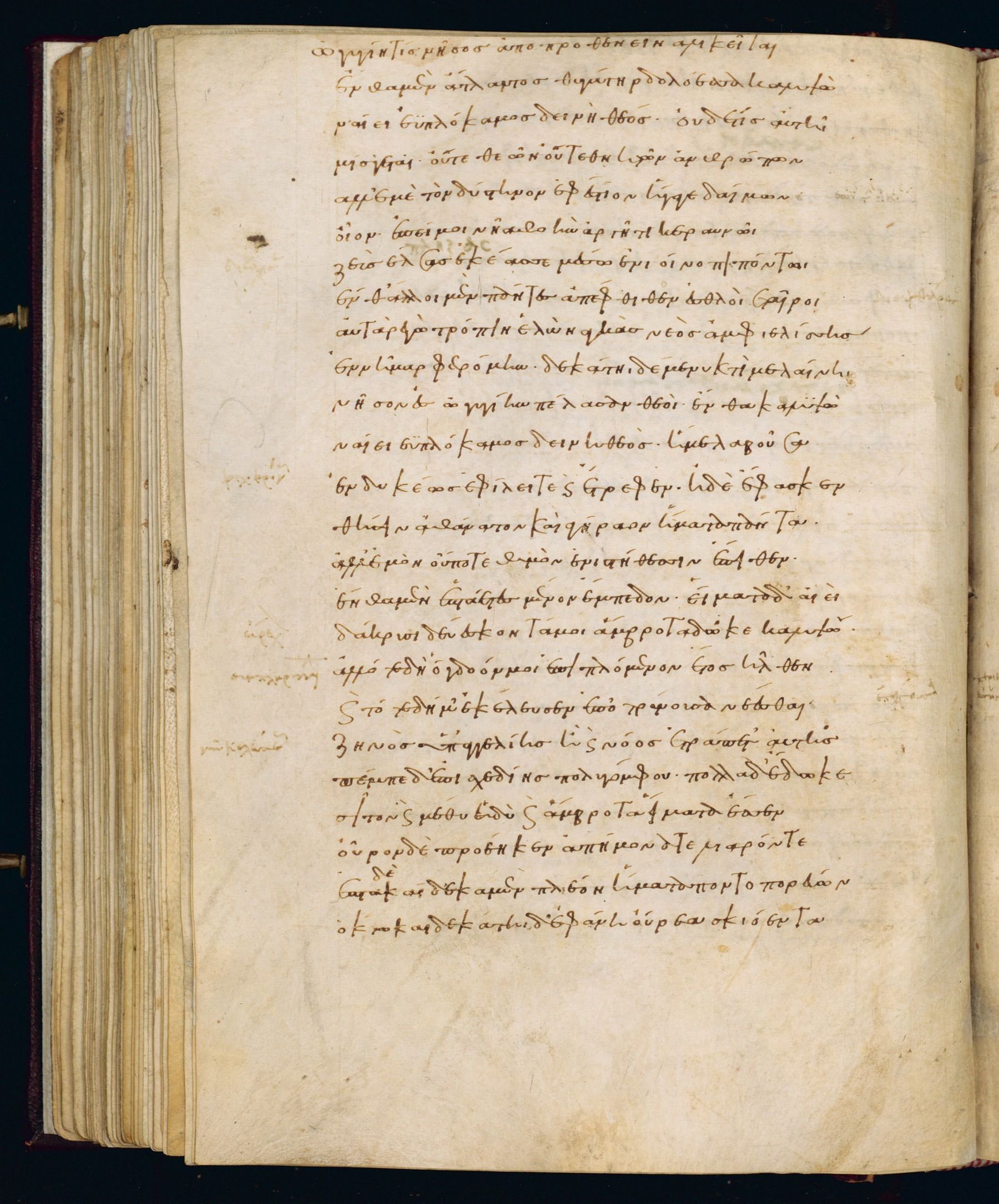
Where on the image
Laur. Plut. 32.24, fol. 67v: Odyssey 7.244-268, begins ‹Ὠγυγίη τις νῆσος ἀπόπροθεν›, ends ‹δʼ ἐφάνη ὄρεα σκιόεντα›. Checked on the image: first and last lines read and matched to the Greek. Fol. 67r ends with 7.243. Fol. 68r begins with 7.269. English blocks here: 245-249, 250-254, 255-259, 260-264, 265-269.
244Ὠγυγίη τις νῆσος ἀπόπροθεν εἰν ἁλὶ κεῖται·
245ἔνθα μὲν Ἄτλαντος θυγάτηρ, δολόεσσα Καλυψὼ
246ναίει ἐυπλόκαμος, δεινὴ θεός· οὐδέ τις αὐτῇ
247μίσγεται οὔτε θεῶν οὔτε θνητῶν ἀνθρώπων.
248ἀλλʼ ἐμὲ τὸν δύστηνον ἐφέστιον ἤγαγε δαίμων
249οἶον, ἐπεί μοι νῆα θοὴν ἀργῆτι κεραυνῷ
250Ζεὺς ἔλσας ἐκέασσε μέσῳ ἐνὶ οἴνοπι πόντῳ.
251ἔνθʼ ἄλλοι μὲν πάντες ἀπέφθιθεν ἐσθλοὶ ἑταῖροι,
252αὐτὰρ ἐγὼ τρόπιν ἀγκὰς ἑλὼν νεὸς ἀμφιελίσσης
253ἐννῆμαρ φερόμην· δεκάτῃ δέ με νυκτὶ μελαίνῃ
254νῆσον ἐς Ὠγυγίην πέλασαν θεοί, ἔνθα Καλυψὼ
255ναίει ἐυπλόκαμος, δεινὴ θεός, ἥ με λαβοῦσα
256ἐνδυκέως ἐφίλει τε καὶ ἔτρεφεν ἠδὲ ἔφασκε
257θήσειν ἀθάνατον καὶ ἀγήραον ἤματα πάντα·
258ἀλλʼ ἐμὸν οὔ ποτε θυμὸν ἐνὶ στήθεσσιν ἔπειθεν.
259ἔνθα μὲν ἑπτάετες μένον ἔμπεδον, εἵματα δʼ αἰεὶ
260δάκρυσι δεύεσκον, τά μοι ἄμβροτα δῶκε Καλυψώ·
261ἀλλʼ ὅτε δὴ ὀγδόατόν μοι ἐπιπλόμενον ἔτος ἦλθεν,
262καὶ τότε δή μʼ ἐκέλευσεν ἐποτρύνουσα νέεσθαι
263Ζηνὸς ὑπʼ ἀγγελίης, ἢ καὶ νόος ἐτράπετʼ αὐτῆς.
264πέμπε δʼ ἐπὶ σχεδίης πολυδέσμου, πολλὰ δʼ ἔδωκε,
265σῖτον καὶ μέθυ ἡδύ, καὶ ἄμβροτα εἵματα ἕσσεν,
266οὖρον δὲ προέηκεν ἀπήμονά τε λιαρόν τε.
267ἑπτὰ δὲ καὶ δέκα μὲν πλέον ἤματα ποντοπορεύων,
268ὀκτωκαιδεκάτῃ δʼ ἐφάνη ὄρεα σκιόεντα
245Therein dwells the fair-tressed daughter of Atlas, guileful Calypso, a dread goddess, and with her no one either of gods or mortals hath aught to do; but me in my wretchedness did fate bring to her hearth alone, for Zeus had smitten my swift ship with his bright thunderbolt, 250and had shattered it in the midst of the wine-dark sea. There all the rest of my trusty comrades perished, but I clasped in my arms the keel of my curved ship and was borne drifting for nine days, and on the tenth black night the gods brought me to the isle, Ogygia, where 255the fair-tressed Calypso dwells, a dread goddess. She took me to her home with kindly welcome, and gave me food, and said that she would make me immortal and ageless all my days; but she could never persuade the heart in my breast. There for seven years' space I remained continually, and ever 260with my tears would I wet the immortal raiment which Calypso gave me. But when the eight year came in circling course, then she roused me and bade me go, either because of some message from Zeus, or because her own mind was turned. And she sent me on my way on a raft, stoutly bound, and gave me abundant store 265of bread and sweet wine, and clad me in immortal raiment, and sent forth a gentle wind and warm. So for seventeen days I sailed over the sea, and on the eighteenth appeared the shadowy mountains of your land; and my heart was glad,
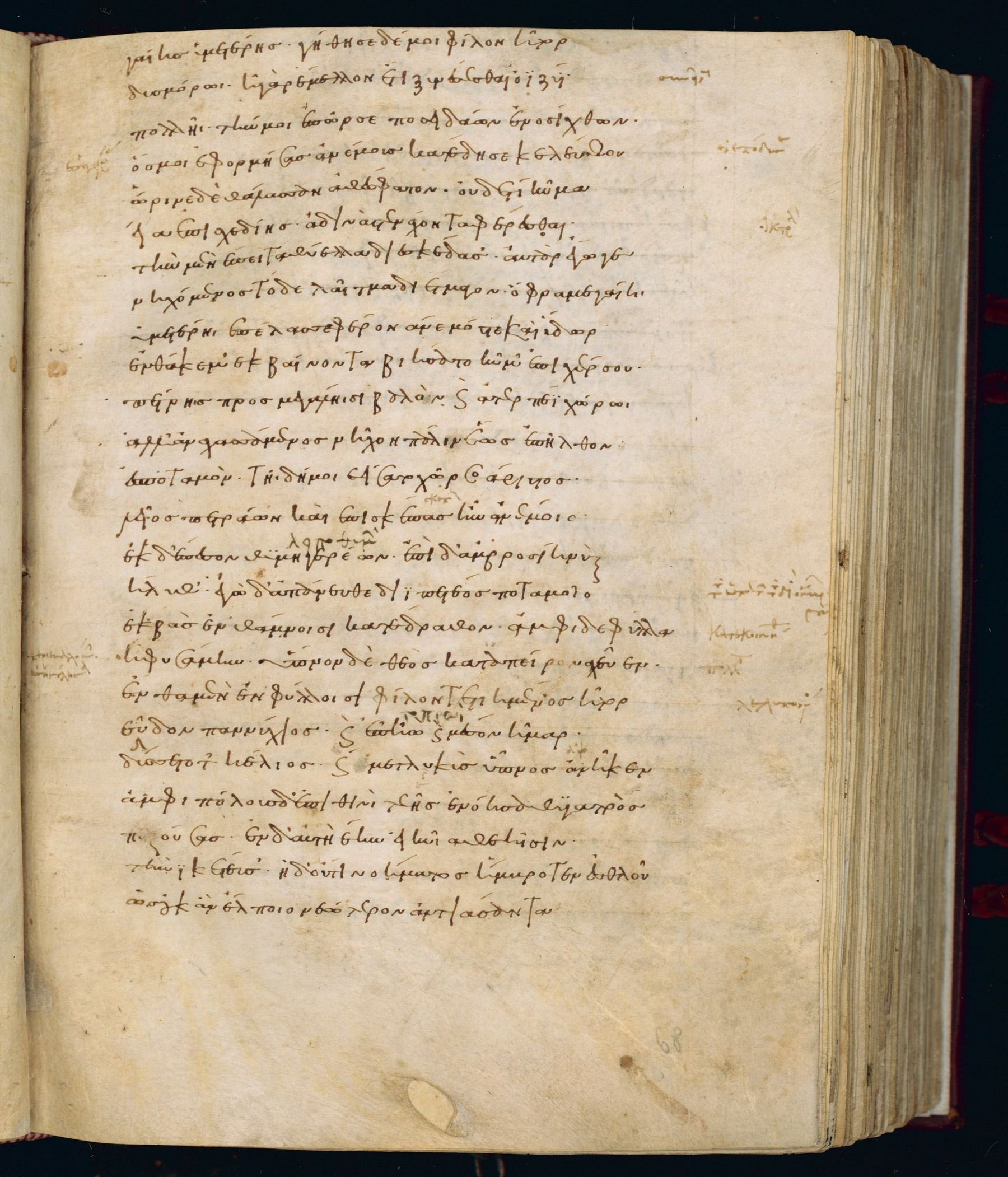
Where on the image
Laur. Plut. 32.24, fol. 68r: Odyssey 7.269-293, begins ‹γαίης ὑμετέρης, γήθησε δέ›, ends ‹ἂν ἔλποιο νεώτερον ἀντιάσαντα›. Checked on the image: first and last lines read and matched to the Greek. Fol. 67v ends with 7.268. Fol. 68v begins with 7.294. English blocks here: 270-274, 275-279, 280-284, 285-286, 287-289, 290-294.
269γαίης ὑμετέρης, γήθησε δέ μοι φίλον ἦτορ
270δυσμόρῳ· ἦ γὰρ ἔμελλον ἔτι ξυνέσεσθαι ὀιζυῖ
271πολλῇ, τήν μοι ἐπῶρσε Ποσειδάων ἐνοσίχθων,
272ὅς μοι ἐφορμήσας ἀνέμους κατέδησε κέλευθον,
273ὤρινεν δὲ θάλασσαν ἀθέσφατον, οὐδέ τι κῦμα
274εἴα ἐπὶ σχεδίης ἁδινὰ στενάχοντα φέρεσθαι.
275τὴν μὲν ἔπειτα θύελλα διεσκέδασʼ· αὐτὰρ ἐγώ γε
276νηχόμενος τόδε λαῖτμα διέτμαγον, ὄφρα με γαίῃ
277ὑμετέρῃ ἐπέλασσε φέρων ἄνεμός τε καὶ ὕδωρ.
278ἔνθα κέ μʼ ἐκβαίνοντα βιήσατο κῦμʼ ἐπὶ χέρσου,
279πέτρῃς πρὸς μεγάλῃσι βαλὸν καὶ ἀτερπέι χώρῳ·
280ἀλλʼ ἀναχασσάμενος νῆχον πάλιν, ἧος ἐπῆλθον
281ἐς ποταμόν, τῇ δή μοι ἐείσατο χῶρος ἄριστος,
282λεῖος πετράων, καὶ ἐπὶ σκέπας ἦν ἀνέμοιο.
283ἐκ δʼ ἔπεσον θυμηγερέων, ἐπὶ δʼ ἀμβροσίη νὺξ
284ἤλυθʼ. ἐγὼ δʼ ἀπάνευθε διιπετέος ποταμοῖο
285ἐκβὰς ἐν θάμνοισι κατέδραθον, ἀμφὶ δὲ φύλλα
286ἠφυσάμην· ὕπνον δὲ θεὸς κατʼ ἀπείρονα χεῦεν.
287ἔνθα μὲν ἐν φύλλοισι φίλον τετιημένος ἦτορ
288εὗδον παννύχιος καὶ ἐπʼ ἠῶ καὶ μέσον ἦμαρ.
289δείλετό τʼ ἠέλιος καί με γλυκὺς ὕπνος ἀνῆκεν.
290ἀμφιπόλους δʼ ἐπὶ θινὶ τεῆς ἐνόησα θυγατρὸς
291παιζούσας, ἐν δʼ αὐτὴ ἔην ἐικυῖα θεῇσι·
292τὴν ἱκέτευσʼ· ἡ δʼ οὔ τι νοήματος ἤμβροτεν ἐσθλοῦ,
293ὡς οὐκ ἂν ἔλποιο νεώτερον ἀντιάσαντα
270ill-starred that I was; for verily I was yet to have fellowship with great woe, which Poseidon, the earth-shaker, sent upon me. For he stirred up the winds against me and stayed my course, and wondrously roused the sea, nor would the wave suffer me to be borne upon my raft, as I groaned ceaselessly. 275My raft indeed the storm shattered, but by swimming I clove my way through yon gulf of the sea, until the wind and the waves, as they bore me, brought me to your shores. There, had I sought to land, the waves would have hurled me upon the shore, and dashed me against the great crags and a cheerless place, 280but I gave way, and swam back until I came to a river, where seemed to me the best place, since it was smooth of rocks, and besides there was shelter from the wind. Forth then I staggered, and sank down, gasping for breath, and immortal night came on. Then I went forth from the heaven-fed river, 285and lay down to sleep in the bushes, gathering leaves about me; and a god shed over me infinite sleep. 287So there among the leaves I slept, my heart sore stricken, the whole night through, until the morning and until midday; and the sun turned to his setting ere sweet sleep released me. 290Then I saw the handmaids of thy daughter on the shore at play, and amid them was she, fair as the goddesses. To her I made my prayer; and she in no wise failed in good understanding, to do as thou wouldst not deem that one of younger years would do on meeting thee; for younger folk are ever thoughtless.
Where on the image
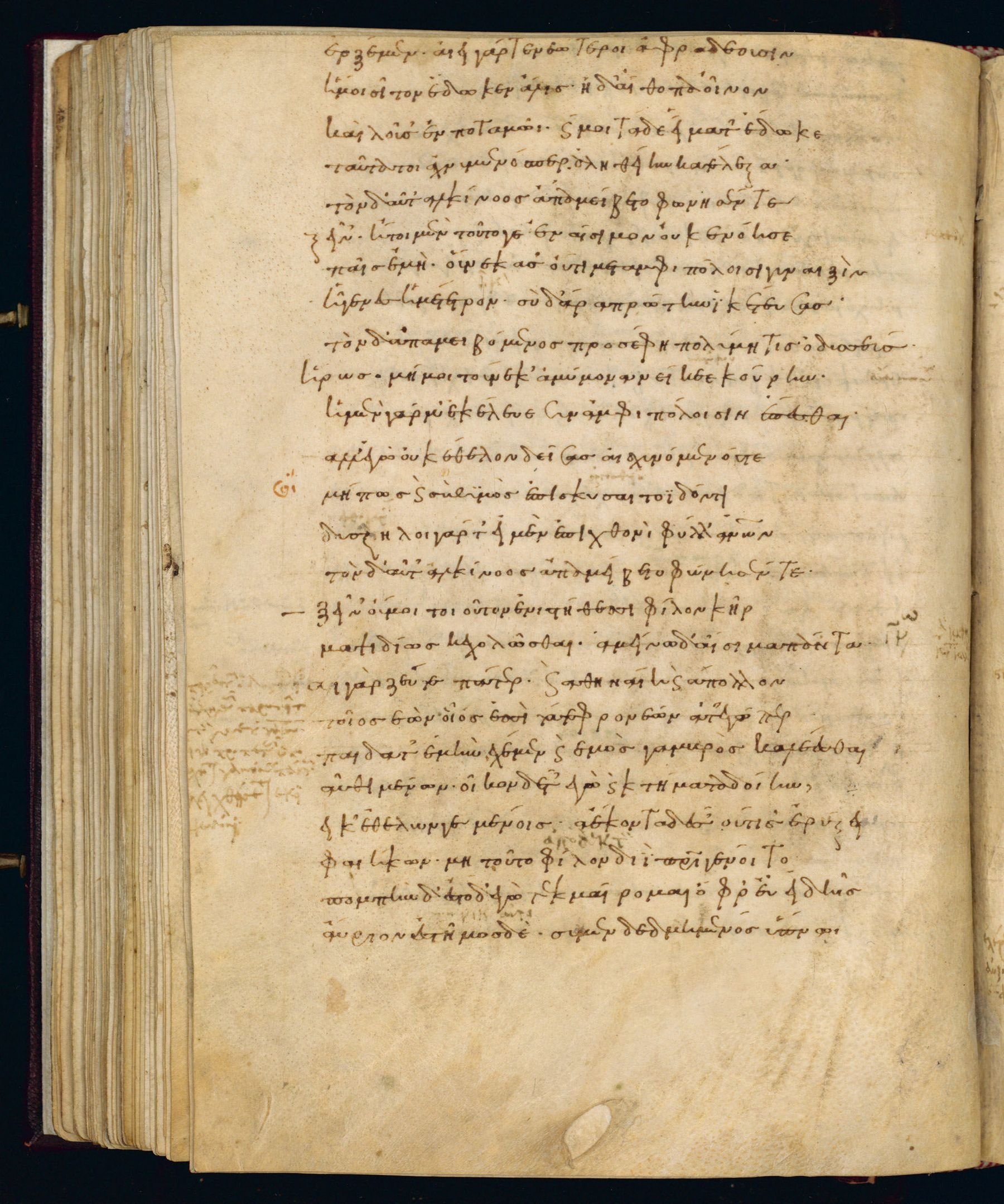
Laur. Plut. 32.24, fol. 68v: Odyssey 7.294-318, begins ‹ἐρξέμεν· αἰεὶ γάρ τε›, ends ‹σὺ μὲν δεδμημένος ὕπνῳ›. Checked on the image: first and last lines read and matched to the Greek. Fol. 68r ends with 7.293. Fol. 69r begins with 7.319. English blocks here: 295-299, 300-304, 305-309, 310-314, 315-316, 317-319.
294ἐρξέμεν· αἰεὶ γάρ τε νεώτεροι ἀφραδέουσιν.
295ἥ μοι σῖτον ἔδωκεν ἅλις ἠδʼ αἴθοπα οἶνον
296καὶ λοῦσʼ ἐν ποταμῷ καί μοι τάδε εἵματʼ ἔδωκε.
297ταῦτά τοι ἀχνύμενός περ ἀληθείην κατέλεξα.
298τὸν δʼ αὖτʼ Ἀλκίνοος ἀπαμείβετο φώνησέν τε·
299ξεῖνʼ, ἦ τοι μὲν τοῦτό γʼ ἐναίσιμον οὐκ ἐνόησε
300παῖς ἐμή, οὕνεκά σʼ οὔ τι μετʼ ἀμφιπόλοισι γυναιξὶν
301ἦγεν ἐς ἡμέτερον, σὺ δʼ ἄρα πρώτην ἱκέτευσας.
302τὸν δʼ ἀπαμειβόμενος προσέφη πολύμητις Ὀδυσσεύς·
303ἥρως, μή τοι τοὔνεκʼ ἀμύμονα νείκεε κούρην·
304ἡ μὲν γάρ μʼ ἐκέλευε σὺν ἀμφιπόλοισιν ἕπεσθαι,
305ἀλλʼ ἐγὼ οὐκ ἔθελον δείσας αἰσχυνόμενός τε,
306μή πως καὶ σοὶ θυμὸς ἐπισκύσσαιτο ἰδόντι·
307δύσζηλοι γάρ τʼ εἰμὲν ἐπὶ χθονὶ φῦλʼ ἀνθρώπων.
308τὸν δʼ αὖτʼ Ἀλκίνοος ἀπαμείβετο φώνησέν τε·
309ξεῖνʼ, οὔ μοι τοιοῦτον ἐνὶ στήθεσσι φίλον κῆρ
310μαψιδίως κεχολῶσθαι· ἀμείνω δʼ αἴσιμα πάντα.
311αἲ γάρ, Ζεῦ τε πάτερ καὶ Ἀθηναίη καὶ Ἄπολλον,
312τοῖος ἐὼν οἷός ἐσσι, τά τε φρονέων ἅ τʼ ἐγώ περ,
313παῖδά τʼ ἐμὴν ἐχέμεν καὶ ἐμὸς γαμβρὸς καλέεσθαι
314αὖθι μένων· οἶκον δέ κʼ ἐγὼ καὶ κτήματα δοίην,
315εἴ κʼ ἐθέλων γε μένοις· ἀέκοντα δέ σʼ οὔ τις ἐρύξει
316Φαιήκων· μὴ τοῦτο φίλον Διὶ πατρὶ γένοιτο.
317πομπὴν δʼ ἐς τόδʼ ἐγὼ τεκμαίρομαι, ὄφρʼ ἐὺ εἰδῇς,
318αὔριον ἔς· τῆμος δὲ σὺ μὲν δεδμημένος ὕπνῳ
295She gave bread in plenty and sparkling wine, and bathed me in the river, and gave me this raiment. In this, for all my sorrows, have I told thee the truth.” Then in turn Alcinous answered him, and said:“Stranger, verily my daughter was not minded aright in this, 300that she did not bring thee to our house with her maidens. Yet it was to her first that thou didst make thy prayer.” Then Odysseus of many wiles answered him, and said: “Prince, rebuke not for this, I pray thee, thy blameless daughter. She did indeed bid me follow with her maidens, 305but I would not for fear and shame, lest haply thy heart should darken with wrath as thou sawest it; for we are quick to anger, we tribes of men upon the earth.” And again Alcinous answered him, and said:“Stranger, not such is the heart in my breast, 310to be filled with wrath without a cause. Better is due measure in all things. I would, O father Zeus, and Athena and Apollo, that thou, so goodly a man, and like-minded with me, wouldst have my daughter to wife, and be called my son, and abide here; a house and possessions would I give thee, 315if thou shouldst choose to remain, but against thy will shall no one of the Phaeacians keep thee; let not that be the will of father Zeus. 317But as for thy sending, that thou mayest know it surely, I appoint a time thereto, even the morrow. Then shalt thou lie down, overcome by sleep, and they shall row thee over the calm sea until thou comest
Where on the image
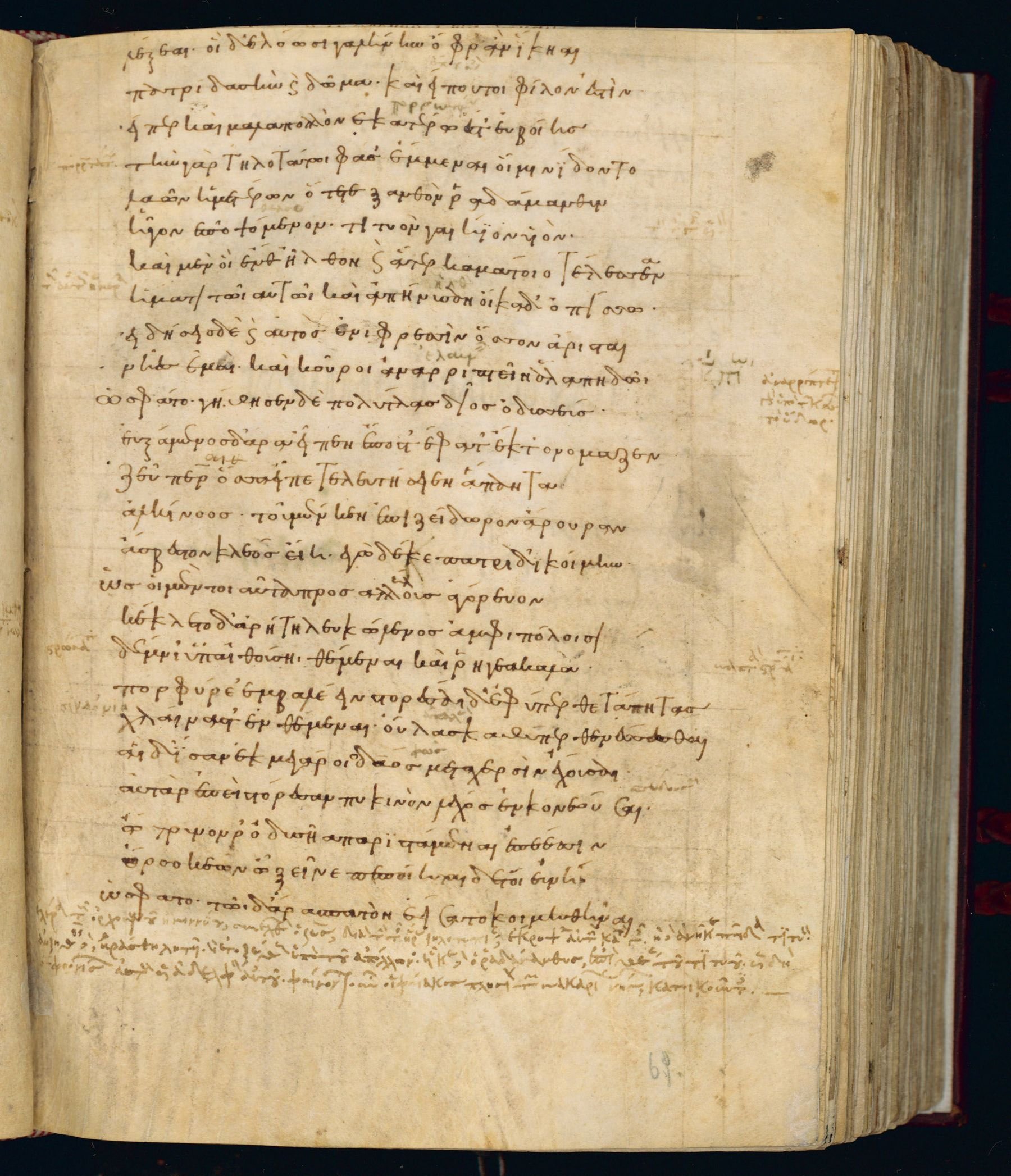
Laur. Plut. 32.24, fol. 69r: Odyssey 7.319-343, begins ‹λέξεαι, οἱ δʼ ἐλόωσι›, ends ‹δʼ ἀσπαστὸν ἐείσατο κοιμηθῆναι.›. Checked on the image: first and last lines read and matched to the Greek. Fol. 68v ends with 7.318. Fol. 69v begins with 7.344. Below the last verse there is a marginal scholium in small script. English blocks here: 320-324, 325-329, 330-334, 335-339, 340-344.
319λέξεαι, οἱ δʼ ἐλόωσι γαλήνην, ὄφρʼ ἂν ἵκηαι
320πατρίδα σὴν καὶ δῶμα, καὶ εἴ πού τοι φίλον ἐστίν,
321εἴ περ καὶ μάλα πολλὸν ἑκαστέρω ἔστʼ Εὐβοίης,
322τήν περ τηλοτάτω φάσʼ ἔμμεναι, οἵ μιν ἴδοντο
323λαῶν ἡμετέρων, ὅτε τε ξανθὸν Ῥαδάμανθυν
324ἦγον ἐποψόμενον Τιτυὸν Γαιήιον υἱόν.
325καὶ μὲν οἱ ἔνθʼ ἦλθον καὶ ἄτερ καμάτοιο τέλεσσαν
326ἤματι τῷ αὐτῷ καὶ ἀπήνυσαν οἴκαδʼ ὀπίσσω.
327εἰδήσεις δὲ καὶ αὐτὸς ἐνὶ φρεσὶν ὅσσον ἄρισται
328νῆες ἐμαὶ καὶ κοῦροι ἀναρρίπτειν ἅλα πηδῷ.
329ὣς φάτο, γήθησεν δὲ πολύτλας δῖος Ὀδυσσεύς,
330εὐχόμενος δʼ ἄρα εἶπεν, ἔπος τʼ ἔφατʼ ἔκ τʼ ὀνόμαζεν·
331Ζεῦ πάτερ, αἴθʼ ὅσα εἶπε τελευτήσειεν ἅπαντα
332Ἀλκίνοος· τοῦ μέν κεν ἐπὶ ζείδωρον ἄρουραν
333ἄσβεστον κλέος εἴη, ἐγὼ δέ κε πατρίδʼ ἱκοίμην.
334ὣς οἱ μὲν τοιαῦτα πρὸς ἀλλήλους ἀγόρευον·
335κέκλετο δʼ Ἀρήτη λευκώλενος ἀμφιπόλοισιν
336δέμνιʼ ὑπʼ αἰθούσῃ θέμεναι καὶ ῥήγεα καλὰ
337πορφύρεʼ ἐμβαλέειν, στορέσαι τʼ ἐφύπερθε τάπητας
338χλαίνας τʼ ἐνθέμεναι οὔλας καθύπερθεν ἕσασθαι.
339αἱ δʼ ἴσαν ἐκ μεγάροιο δάος μετὰ χερσὶν ἔχουσαι·
340αὐτὰρ ἐπεὶ στόρεσαν πυκινὸν λέχος ἐγκονέουσαι,
341ὤτρυνον δʼ Ὀδυσῆα παριστάμεναι ἐπέεσσιν·
342ὄρσο κέων, ὦ ξεῖνε· πεποίηται δέ τοι εὐνή.
343ὣς φάν, τῷ δʼ ἀσπαστὸν ἐείσατο κοιμηθῆναι.
320to thy country and thy house, or to whatsoever place thou wilt, aye though it be even far beyond Euboea, which those of our people who saw it, when they carried fair-haired Rhadamanthus to visit Tityus, the son of Gaea, say is the furthest of lands. 325Thither they went, and without toil accomplished their journey, and on the selfsame day came back home. So shalt thou, too, know for thyself how far my ships are the best, and my youths at tossing the brine with the oar-blade.” So said he, and the much-enduring goodly Odysseus was glad; 330and he spoke in prayer, and said: “Father Zeus, grant that Alcinous may bring to pass all that he has said. So shall his fame be unquenchable over the earth, the giver of grain, and I shall reach my native land.” Thus they spoke to one another, 335and white-armed Arete bade her maidens place a bedstead under cover of the portico, and to lay on it fair blankets of purple, and to spread there over coverlets, and on these to put fleecy cloaks for clothing. So they went forth from the hall with torches in their hands. 340But when they had busily spread the stout-built bedstead, they came to Odysseus, and called to him, and said: “Rouse thee now, stranger, to go to thy rest; thy bed is made.” Thus they spoke, and welcome did it seem to him to lay him down to sleep. So there he slept, the much-enduring goodly Odysseus,
Where on the image
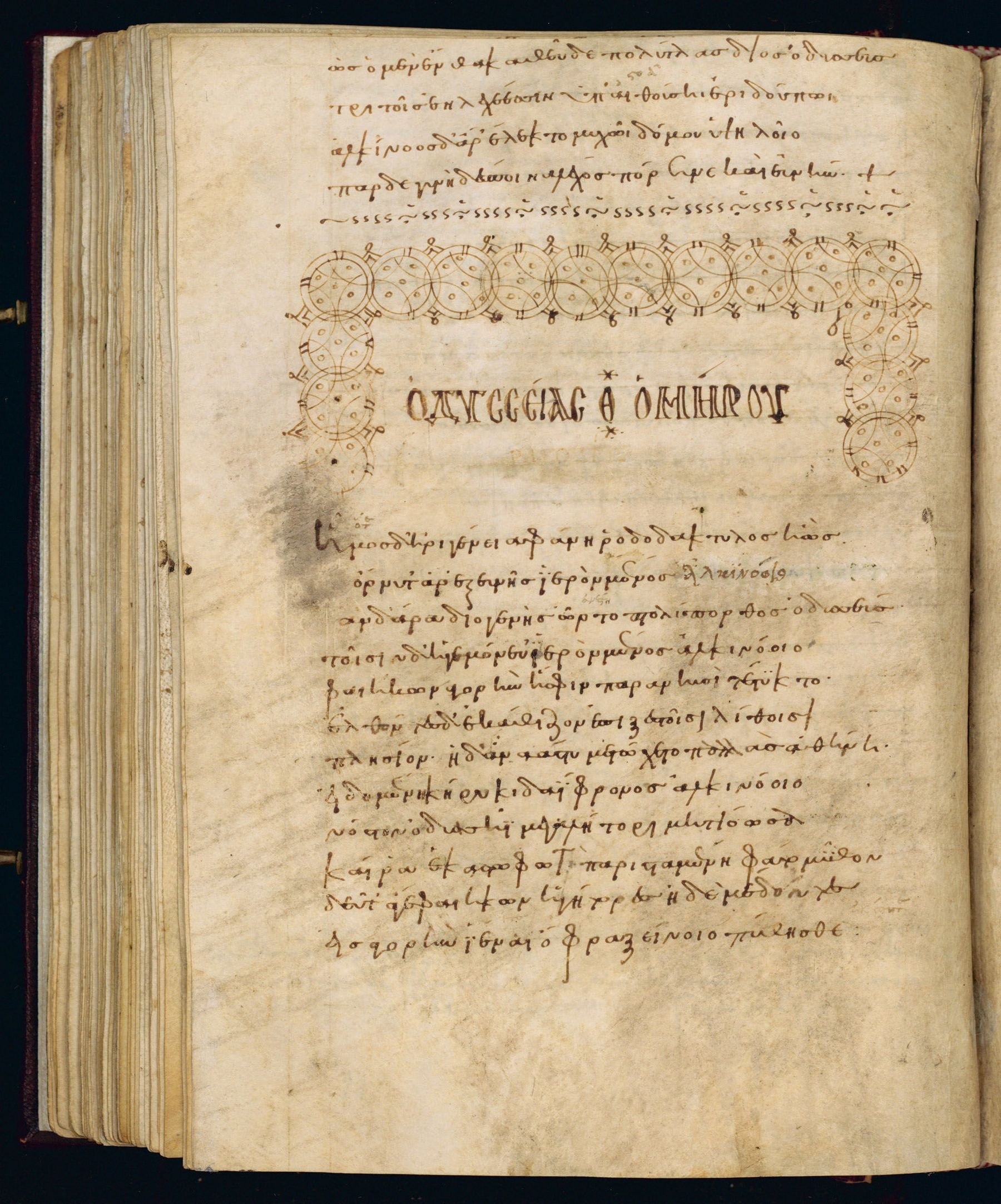
Laur. Plut. 32.24, fol. 69v: Odyssey 7.344-347, begins ‹ὣς ὁ μὲν ἔνθα›, ends ‹λέχος πόρσυνε καὶ εὐνήν.›. Checked on the image: first and last lines read and matched to the Greek. Fol. 69r ends with 7.343. The page holds 7.344-347, 8.1-12. Book 7 ends with 7.347, followed by a line of ornament; book 8 begins under a decorated headpiece with the title ὀδυσσείας θ ὁμήρου in capitals, and 8.1 has an enlarged initial. English blocks here: 345-347.
344ὣς ὁ μὲν ἔνθα καθεῦδε πολύτλας δῖος Ὀδυσσεὺς
345τρητοῖς ἐν λεχέεσσιν ὑπʼ αἰθούσῃ ἐριδούπῳ·
346Ἀλκίνοος δʼ ἄρα λέκτο μυχῷ δόμου ὑψηλοῖο,
347πὰρ δὲ γυνὴ δέσποινα λέχος πόρσυνε καὶ εὐνήν.
345on the corded bedstead under the echoing portico. But Alcinous lay down in the inmost chamber of the lofty house, and beside him lay the lady his wife, who had strewn the couch.
Notes
- Greek: A. T. Murray, Homer: The Odyssey (Loeb Classical Library, 1919), via Perseus.
- English: A. T. Murray's translation in the same edition; his footnotes are omitted.
Cite
Sources
- Source: Laur. Plut. 32.24 (BML Teca Digitale IIIF) + Murray Greek (Loeb 1919, Perseus) + Murray English (Loeb 1919, Perseus) (holding institution)
- Critical edition: Murray, Loeb 1919, via Perseus
← previous · → next · v cycle view · l back to library