P52 (John Rylands fragment): John 18:31-33, 37-38
Introduction
P52 is a fragment of a papyrus leaf, 8.9 by 6.0 cm, from a codex of the Gospel of John. Bernard Grenfell bought it in Egypt in 1920 for the John Rylands Library, Manchester, and Colin H. Roberts identified it in 1935. It is usually dated to the 2nd century (the library's catalogue gives mid to late 2nd century; NTVMR gives 125-175), which makes it the oldest known manuscript of any part of the New Testament. Its provenance is Upper Egypt, possibly Oxyrhynchus.
One side (the recto, with the papyrus fibres running across) carries parts of John 18:31-33, where Jesus is brought before Pilate; the other side (the verso) carries parts of 18:37-38, Pilate's question "What is truth?". Seven lines survive on each side out of about eighteen. Because text runs on from one side to the other, the leaf was part of a book (a codex), not a roll.
Each section below shows one side of the fragment. The Greek is the diplomatic transcription made by the Institute for New Testament Textual Research (INTF, Muenster) for its New Testament Virtual Manuscript Room. Only a few letters of each line are preserved; the transcribers' restorations of the lost letters are in square brackets.
How was this verified? (Provenance)
Where on the image
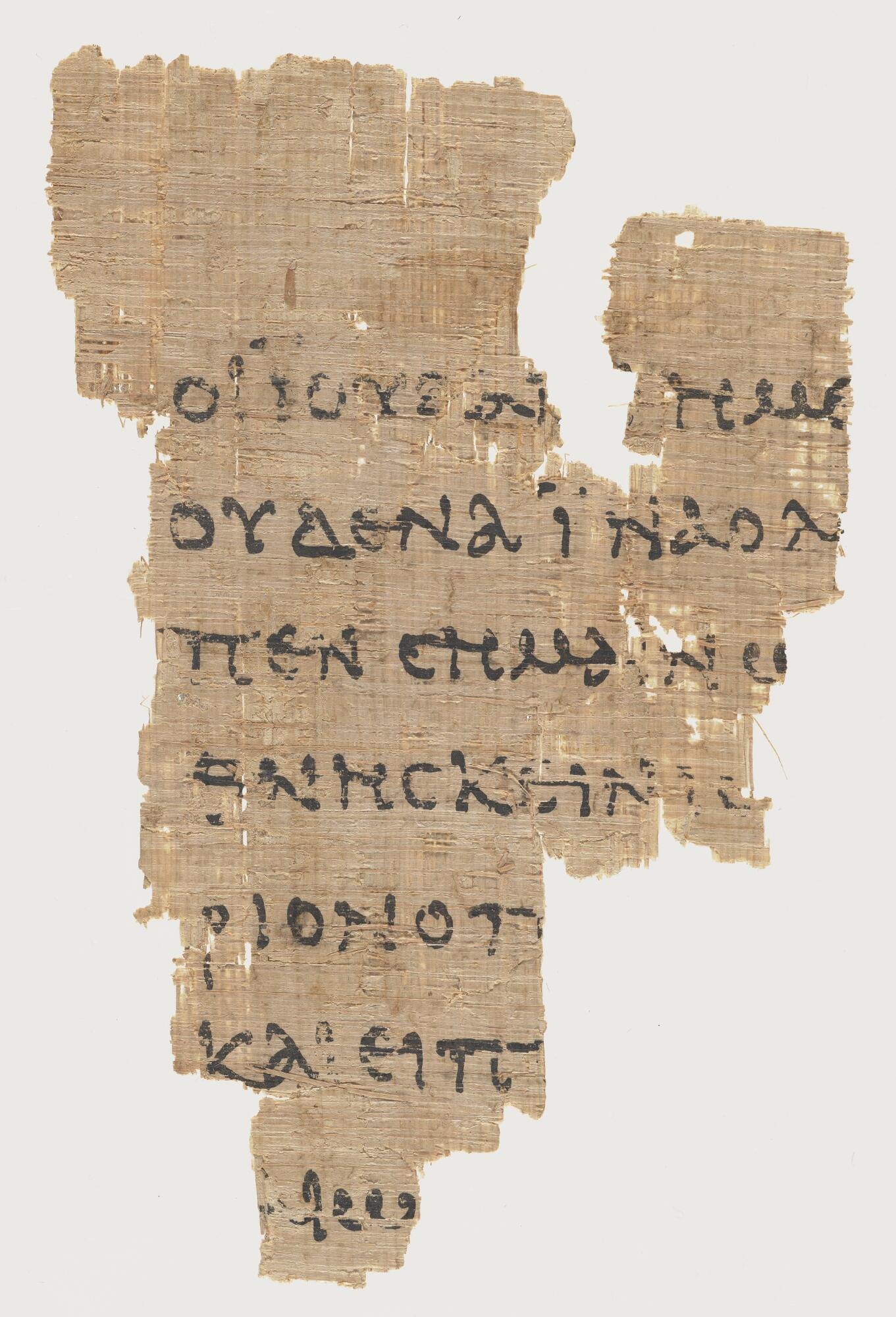
Manchester Digital Collections, Greek P 457, image 1 (recto), cropped to the fragment. NTVMR page 10 (folio 001r) indexes this side as John 18:31-33. Checked on the image: 7 lines, fibres running across (the recto). Line 1 οι ιουδαι at the left and ημ on the detached piece at the right (John 18:31); line 2 ουδενα ινα ο λ; line 3 πεν σημαιν; line 4 θνησκειν ι; line 5 ριον ο π; line 6 και ειπ; line 7 (bottom) αιω, from ιουδαιων at the end of 18:33. Almost all of each line is lost: the letters outside square brackets are the ones on the fragment, and the bracketed text and the English cover the complete verses.
18:31 οι ιουδαι[ο]ι̣ ημε̣[ιν ουκ εξεστιν αποκτειναι]
ουδενα 32 ινα ο λ[ογος του ιησου πληρωθη ον ει]
πεν σημαινω̣[ν ποιω θανατω ημελλεν απο]
θνησκειν 33 ισ̣[ηλθεν ουν παλιν εις το πραιτω]
ριον ο π̣[ιλατος και εφωνησεν τον ιησουν]
και ειπ[εν αυτω συ ει ο βασιλευς των ιου]
[δ]α̣ιω[ν]
18:31Then said Pilate unto them, Take ye him, and judge him according to your law. The Jews therefore said unto him, It is not lawful for us to put any man to death: 32That the saying of Jesus might be fulfilled, which he spake, signifying what death he should die. 33Then Pilate entered into the judgment hall again, and called Jesus, and said unto him, Art thou the King of the Jews?
Where on the image
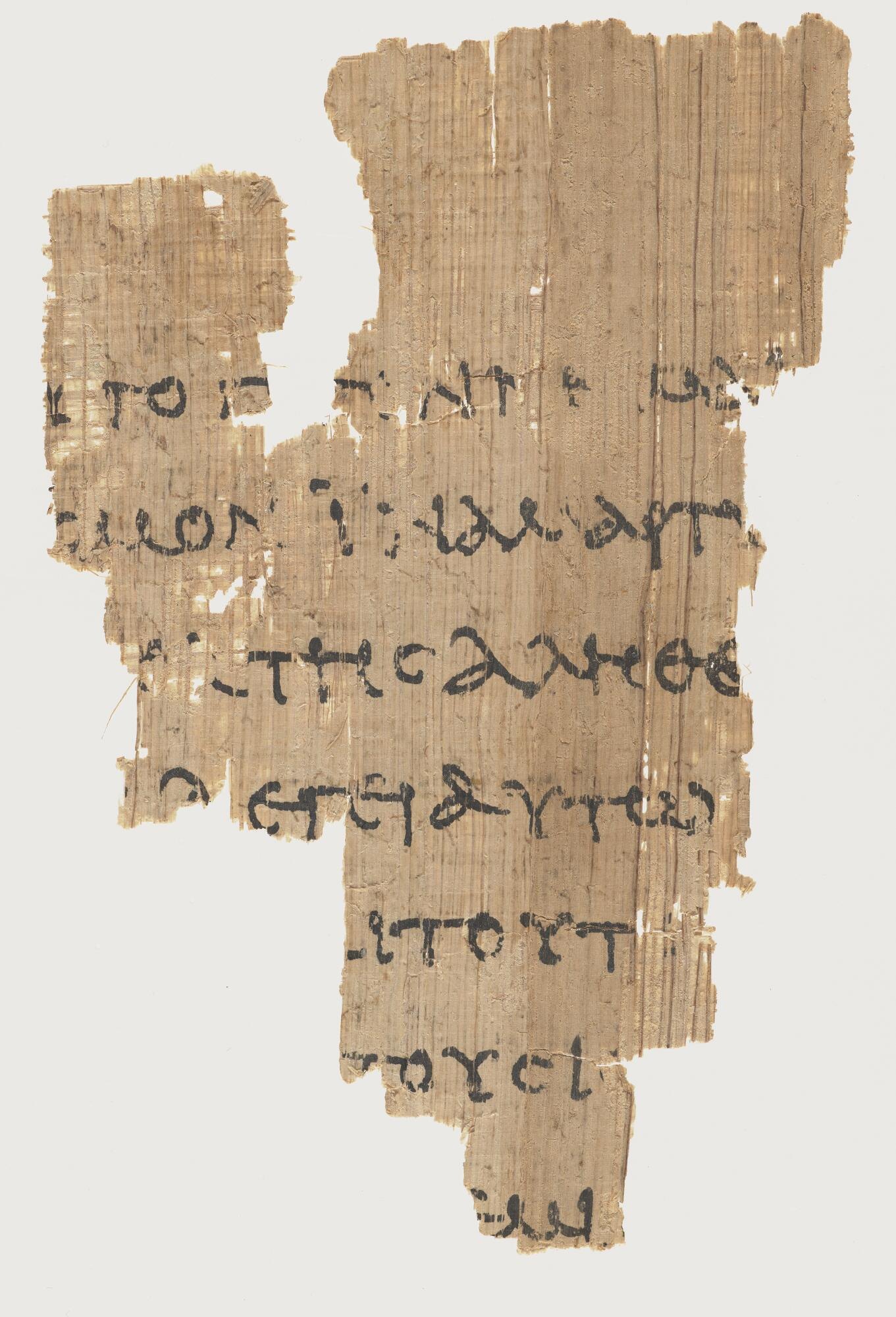
Manchester Digital Collections, Greek P 457, image 2 (verso), cropped to the fragment. NTVMR page 20 (folio 001v) indexes this side as John 18:37-38. Checked on the image: 7 lines, fibres running down (the verso). Line 1 υτο γ at the left and μαι at the right (εις τουτο γεγεννημαι, John 18:37); line 2 σμον ινα μαρτυ; line 3 εκ της αληθε; line 4 λεγει αυτω (18:38); line 5 ι τουτο; line 6 τους ι; line 7 (bottom) εμι, from ουδεμιαν. Almost all of each line is lost: the letters outside square brackets are the ones on the fragment, and the bracketed text and the English cover the complete verses.
18:37 [βασιλευς ειμι εγω εις το]υ̣το γ[ε]γ̣ε̣νν̣η̣μαι̣
[και εληλυθα εις τον κο]σμον ινα μαρτυ̣
[ρησω τη αληθεια πας ο ων] ε̣κ̣ της αληθε[ι]
[ας ακουει μου της φωνης] 38 λεγει αυτω
[ο πιλατος τι εστιν αληθεια κ]α̣ι τουτο̣
[ειπων παλιν εξηλθεν προς] τ̣ους ιο̣[υ]
[δαιους και λεγει αυτοις εγω ουδ]εμι[αν]
18:37Pilate therefore said unto him, Art thou a king then? Jesus answered, Thou sayest that I am a king. To this end was I born, and for this cause came I into the world, that I should bear witness unto the truth. Every one that is of the truth heareth my voice. 38Pilate saith unto him, What is truth? And when he had said this, he went out again unto the Jews, and saith unto them, I find in him no fault at all.
Notes
- Greek: the NTVMR diplomatic transcription, line by line as on the papyrus. Square brackets enclose letters that are lost or illegible and were supplied by the transcribers; a dot under a letter marks it as uncertain; [...] marks a gap. Nomina sacra and numerals keep the scribe's overline. Spelling is the scribe's (no accents or breathings). Words broken at a line end stay broken as on the papyrus. Corrections are not shown: the text is the first hand.
- English: the King James Version (1611), whole verses, for every verse that has text on the page. A verse that begins on one page and ends on the next is given in full on both. The KJV translates a later form of the Greek text, so its wording does not always match the papyrus; material differences (such as verses the papyrus does not have) are noted in the section.
- Restorations: the length of the lost parts of the lines fits the standard text of John 18:31-33 and 37-38. Scholars have debated whether the repeated words εις τουτο in 18:37 fit the line length; the restoration shown is the NTVMR transcribers'.
Cite
Sources
- Source: John Rylands Library, Manchester, Greek P 457 (P52): photographs from Manchester Digital Collections; Greek from the INTF NTVMR transcription; English from the King James Version (holding institution)
- Critical edition: INTF NTVMR diplomatic transcription (CC BY 4.0)
← previous · → next · v cycle view · l back to library