The Instruction for Kagemni (Papyrus Prisse, pages 1-2)
Introduction
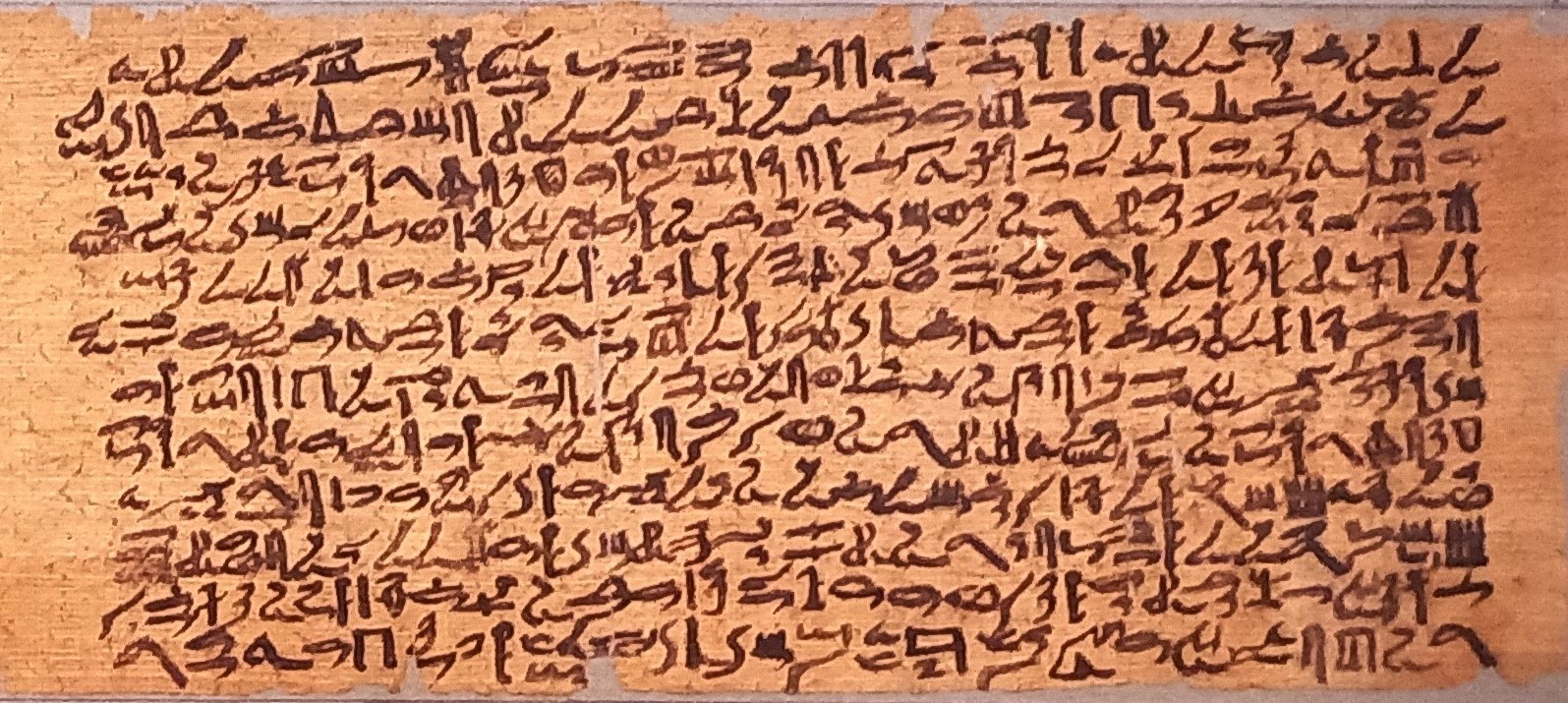
The Papyrus Prisse, bought at Thebes in 1843 by Emile Prisse d'Avennes and now in the Bibliotheque nationale de France (Egyptien 183-194), is one of the oldest surviving literary papyri. It was written in the 12th Dynasty, around 1850 BCE, in a large hieratic book hand. The roll begins with the end of a wisdom text addressed to Kagemni; the beginning of that text is lost.
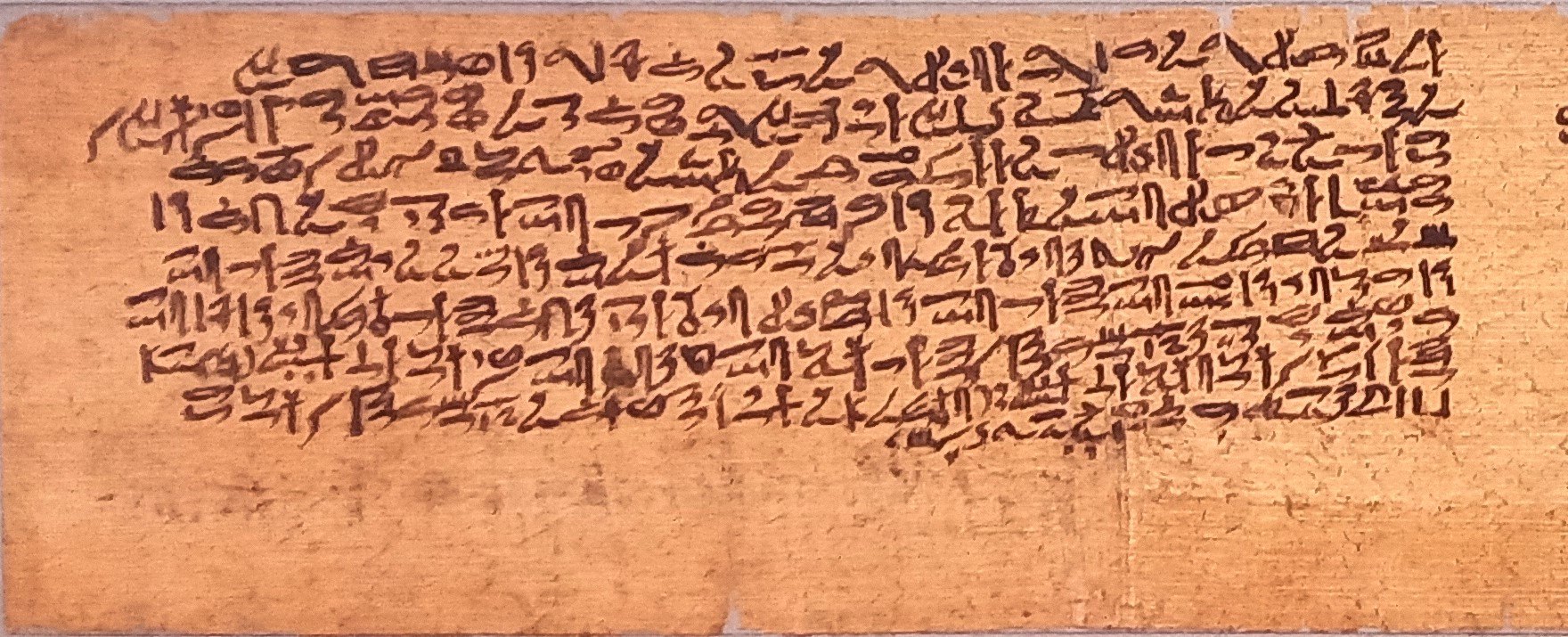
The instruction is set in the Old Kingdom: a vizier gives rules of modest conduct (silence, restraint at table, no boasting) to his children, who read them aloud; then King Huni dies, Sneferu becomes king, and Kagemni is made vizier. The two columns of Kagemni (12 and 9 lines) are on frame Egyptien 183; the papyrus then has a stretch of erased writing (frames 184-185) before the Instruction of Ptahhotep begins.
Each section below gives the Thesaurus Linguae Aegyptiae transliteration with the papyrus page and line numbers (1,1 to 2,9), the English of Battiscombe Gunn (1906), and the photograph of the column that carries it. Signs supplied by the editor are in angle brackets, superfluous signs in braces, damaged signs in half brackets, and the lost end of the colophon is shown as [...].
How was this verified? (Provenance)
Where on the image
Prisse 1,1-1,3 (TLA page,line numbers): TLA sentences 1-7 of this text, on page 1. Page 1 is Egyptien 183 (Commons photograph Papyrus_Prisse_183.jpg), right-hand column of frame 183; checked on the image: 12 lines (BnF: 'deux colonnes de texte, 12 et 9 lignes'; TLA 1,1-1,12), no rubrics.
1,1wḏꜣ snḏ,w ḥzi̯ mt〈j〉 wn ẖn n gr,w 1,2wsḫ s,t n.t hru̯ m mdwi̯.w spd ds.w.pl 1,3r thi̯-mtn nn ḥn n js ḥr zp =f
The cautious man flourisheth, the exact one is praised; the innermost chamber openeth unto the man of silence. Wide is the seat of the man gentle of speech; but knives are prepared against one that forceth a path, that he advance not, save in due season.
Where on the image
Prisse 1,3-1,7 (TLA page,line numbers): TLA sentences 8-18 of this text, on page 1. Page 1 is Egyptien 183 (Commons photograph Papyrus_Prisse_183.jpg), right-hand column of frame 183; checked on the image: 12 lines (BnF: 'deux colonnes de texte, 12 et 9 lignes'; TLA 1,1-1,12), no rubrics.
1,3jr ḥmsi̯ =k ḥnꜥ ꜥšꜣ,t 1,4msdi̯ tʾ mrr =k ꜣ,t pw kt.t dꜣjr-jb ḫw pw ꜣfꜥ 1,5jw ḏbꜥ =t〈w〉 jm jw jkn n mw ꜥḫm =f jb,t jw mḥ,{t}〈w〉 rʾ m šw,w 1,6smn =f jb jw nfr,t jdn bw-nfr jw nh〈j〉 n ktt jdn wr ẖz 1,7pw ḥnti̯ n ẖ,t =f swꜣ tr smḫ.n =f wstn ẖ,t m pr =sn
If thou sit with a company of people, desire not the bread that thou likest: short is the time of restraining the heart, and gluttony is an abomination; therein is the quality of a beast. A cup of water quencheth the thirst, and a mouthful of melon supporteth the heart. A good thing standeth for goodness, but some small thing standeth for plenty. A base man is he that is governed by his belly; he departeth only when he is no longer able to fill full his belly in men's houses.
Where on the image
Prisse 1,7-1,10 (TLA page,line numbers): TLA sentences 19-25 of this text, on page 1. Page 1 is Egyptien 183 (Commons photograph Papyrus_Prisse_183.jpg), right-hand column of frame 183; checked on the image: 12 lines (BnF: 'deux colonnes de texte, 12 et 9 lignes'; TLA 1,1-1,12), no rubrics.
1,7jr 1,8ḥmsi̯ =k ḥnꜥ ꜣfꜥ wnm =k ꜣḫf =f swꜣ jr zw{r}j =k ḥnꜥ 1,9tḫ,w šzp =k jw jb =f ḥtp.w m ꜣt.w r jwf r-gs skn 1,10šzp ḏi̯ =f n =k m wjn st kꜣ szf.t pw
If thou sit with a glutton, eat with him, then depart (?).
If thou drink with a drunkard, accept [drink], and his heart shall be satisfied.
Refuse not meat when with a greedy man. Take that which he giveth thee; set it not on one side, thinking that it will be a courteous thing.
Where on the image
Prisse 1,10-2,1 (TLA page,line numbers): TLA sentences 26-31 of this text, on pages 1 and 2. Page 1 is Egyptien 183 (Commons photograph Papyrus_Prisse_183.jpg), right-hand column of frame 183; checked on the image: 12 lines (BnF: 'deux colonnes de texte, 12 et 9 lignes'; TLA 1,1-1,12), no rubrics. Page 2 is Egyptien 183 (Commons photograph Papyrus_Prisse_183.jpg), left-hand column of frame 183; checked on the image: 9 lines (TLA 2,1-2,9), the rest of the frame blank.
1,10jr šw.w m srḫ n tʾ 1,11n sḫm.n md,t nb.t jm =f ḫ{r}〈t〉r n ḥr r dfꜣ jb j{m}ꜣm n =f 1,12kꜣhs r mw,t =f mr =f pw bw-nb jmi̯ pri̯ rn =k 2,1jw gr =k m rʾ =k njs.t〈w〉 =k
If a man be lacking in good fellowship, no speech hath any influence over him. He is sour of face toward the glad-hearted that are kindly to him; he is a grief unto his mother and his friends; and all men [cry], 'Let thy name be known; thou art silent in thy mouth when thou art addressed!'
Where on the image
Prisse 2,1-2,2 (TLA page,line numbers): TLA sentences 32-34 of this text, on page 2. Page 2 is Egyptien 183 (Commons photograph Papyrus_Prisse_183.jpg), left-hand column of frame 183; checked on the image: 9 lines (TLA 2,1-2,9), the rest of the frame blank.
2,1m ꜥꜣi̯ jb =k ḥr ḫpš 2,2m-ḥr〈,j〉-jb ḏꜣm =k zꜣw jtn =k n rḫ.n =tw ḫpr.t jrr.t nṯr ḫft ḫsf =f
Be not haughty because of thy might in the midst of thy young soldiers. Beware of making strife, for one knoweth not the things that the God will do when He punisheth.
Where on the image
Prisse 2,3-2,9 (TLA page,line numbers): TLA sentences 35-45 of this text, on page 2. Page 2 is Egyptien 183 (Commons photograph Papyrus_Prisse_183.jpg), left-hand column of frame 183; checked on the image: 9 lines (TLA 2,1-2,9), the rest of the frame blank.
2,3rḏi̯.jn ṯꜣ,t〈j〉 njs.t〈w〉 nꜣy =f n ẖrd.w.pl m-ḫt ꜥrq =f sḫr 2,4r〈m〉ṯ bj〈ꜣ〉,t =sn m jyi̯.t ḥr =f ḏr.n ḏd.n =f n =sn jr n,t.t nb.t m zẖꜣw ḥr 2,5pꜣ šfd,w sḏm st mj ḏd =j st m zni̯ ḥꜣw-ḥr šꜣꜣ.t wn.jn =sn 2,6ḥr rḏi̯.t st ḥr ẖ,t.pl =sn wn.jn =sn ḥr šdi̯.t st mj n,t.t m zẖꜣw wn.jn nfr st ḥr jb =sn 2,7r ḫ,t nb.t n,t{j}〈.t〉 m tꜣ pn r-ḏr =f wn.jn ꜥḥꜥ =sn ḥmsi̯ =sn ḫft ꜥḥꜥ.n ḥm n nsw,t-bj,tj Ḥwnj 2,8mnj.n =f ꜥḥꜥ.n sꜥḥꜥ ḥm n nsw,t-bj,tj Snfr,w m nsw,t mnḫ m tꜣ pn r-ḏr =f ꜥḥꜥ.n rḏi̯ 2,9Kꜣ=〈j〉-gmi̯.n=j r 〈j〉m〈,j〉-rʾ-nʾ,t ṯꜣ,t〈j〉
The Vizier caused his sons and daughters to be summoned, when he had finished the rules of the conduct of men. And they marvelled when they came to him. Then he said unto them, 'Hearken unto everything that is in writing in this book, even as I have said it in adding unto profitable sayings.' And they cast themselves on their bellies, and they read it, even as it was in writing. And it was better in their opinion than any thing in this land unto its limits.
Now they were living when His Majesty, the King of Upper and Lower Egypt, HEUNI, departed, and His Majesty, the King of Upper and Lower Egypt, SENFÔRU, was enthroned as a gracious king over the whole of this land.
Then was Ke'gemni made Governor of his City and Vizier.
Where on the image
Prisse 2,9 (TLA page,line numbers): TLA sentence 46 of this text, on page 2. Page 2 is Egyptien 183 (Commons photograph Papyrus_Prisse_183.jpg), left-hand column of frame 183; checked on the image: 9 lines (TLA 2,1-2,9), the rest of the frame blank.
2,9jwi̯ =f pw […] […] […]
IT IS FINISHED.
Notes
- Gunn's footnote markers and page numbers have been removed; his own square brackets and question marks are kept.
- Gunn numbers the precepts 1-5; the closing narrative and the colophon are given here as sections 6 and 'colophon'.
- The TLA has no hieroglyphic encoding for this text, so only the transliteration is shown.
Cite
Sources
- Source: Papyrus Prisse, BnF Egyptien 183 (photographs by Zunkir, Wikimedia Commons, CC BY-SA 4.0) + TLA transliteration (ed. P. Dils, CC BY-SA 4.0) + English of Battiscombe Gunn (1906, public domain) (holding institution)
- Critical edition: Thesaurus Linguae Aegyptiae, ed. Peter Dils (2018 data, AED-TEI)
← previous · → next · v cycle view · l back to library