Philo of Alexandria, On the Confusion of Tongues 146-147: the Logos, God's firstborn and image
Introduction
On the Confusion of Tongues is one of Philo's allegorical commentaries on Genesis; it treats the tower of Babel (Genesis 11:1-9). Commenting on the brothers' words 'We are all sons of one man' (Genesis 42:11), Philo says that those who know the one God are rightly called sons of God (145). The two sections shown here add that one who is not yet worthy of that name should labour to be adorned 'according to his first-born word, the eldest of his angels, as the great archangel of many names' (Yonge's translation, where 'word' renders Logos): he is called the Beginning (Yonge: 'the authority'), the Name of God, the Word, the Man after God's image, and he who sees, Israel. If we are not yet fit to be called sons of God, we may be children of his invisible image, the Logos, 'for the image of God is his most ancient word' (146-147).
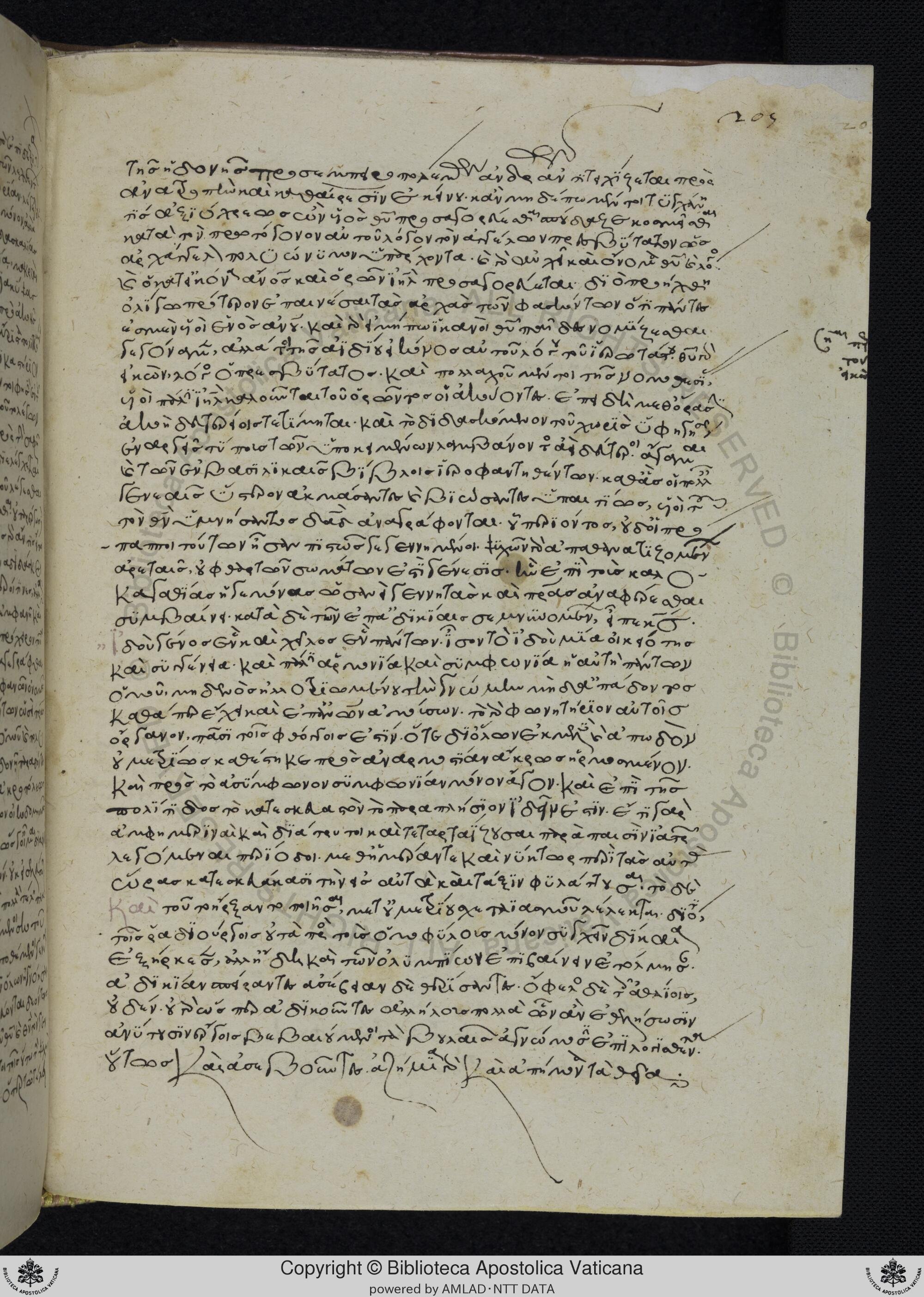
The page shown is fol. 205r of Vatican City, Biblioteca Apostolica Vaticana, Pal. gr. 248 (14th-15th century), where this treatise occupies fols. 196v-208 in a hand different from that of On the Creation. Both sections stand on lines 2-10 of the page. The Greek is Wendland's critical text (1897); the English is C. D. Yonge's translation (1854).
How was this verified? (Provenance)
Where on the image
On Pal. gr. 248 fol. 205r. Pal. gr. 248 fol. 205r (a different hand from On the Creation). Line 1 ends section 145 ('τῆς ἡδονῆς πρὸς ἐμπειροπολέμων ἀνδρῶν ἀντιτειχίζεται πρὸς'); section 146 begins on line 2 with 'κἂν μηδέπω μέντοι τυγχάνῃ τις ἀξιόχρεως' and runs to 'Ἰσραὴλ προσαγορεύεται' on line 6; section 147 runs from 'διὸ προήχθην' on line 6 to 'θεοῦ γὰρ εἰκὼν λόγος ὁ πρεσβύτατος' on line 10, followed by 'καὶ πολλαχοῦ μέντοι τῆς νομοθεσίας' (section 148). Viewer: https://digi.vatlib.it/view/MSS_Pal.gr.248/0415 Checked on the images. The Greek shown is the critical edition, not a transcription of this manuscript.
κἂν μηδέπω μέντοι τυγχάνῃ τις ἀξιόχρεως ὢν υἱὸς θεοῦ προσαγορεύεσθαι, σπουδαζέτω κοσμεῖσθαι κατὰ τὸν πρωτόγονον αὐτοῦ λόγον, τὸν ἀγγέλων πρεσβύτατον, ὡς ἂν ἀρχάγγελον, πολυώνυμον ὑπάρχοντα· καὶ γὰρ ἀρχὴ καὶ ὄνομα θεοῦ καὶ λόγος καὶ ὁ κατ’ εἰκόνα ἄνθρωπος καὶ ὁ ὁρῶν, Ἰσραήλ, προσαγορεύεται.
And even if there be not as yet any one who is worthy to be called a son of God, nevertheless let him labour earnestly to be adorned according to his first-born word, the eldest of his angels, as the great archangel of many names; for he is called, the authority, and the name of God, and the Word, and man according to God’s image, and he who sees Israel.
Where on the image
On Pal. gr. 248 fol. 205r. Pal. gr. 248 fol. 205r (a different hand from On the Creation). Line 1 ends section 145 ('τῆς ἡδονῆς πρὸς ἐμπειροπολέμων ἀνδρῶν ἀντιτειχίζεται πρὸς'); section 146 begins on line 2 with 'κἂν μηδέπω μέντοι τυγχάνῃ τις ἀξιόχρεως' and runs to 'Ἰσραὴλ προσαγορεύεται' on line 6; section 147 runs from 'διὸ προήχθην' on line 6 to 'θεοῦ γὰρ εἰκὼν λόγος ὁ πρεσβύτατος' on line 10, followed by 'καὶ πολλαχοῦ μέντοι τῆς νομοθεσίας' (section 148). Viewer: https://digi.vatlib.it/view/MSS_Pal.gr.248/0415 Checked on the images. The Greek shown is the critical edition, not a transcription of this manuscript.
διὸ προήχθην ὀλίγῳ πρότερον ἐπαινέσαι τὰς ἀρετὰς τῶν φασκόντων ὅτι „πάντες ἐσμὲν υἱοὶ ἑνὸς ἀνθρώπου“ (Gen. 42, 11)· καὶ γὰρ εἰ μήπω ἱκανοὶ θεοῦ παῖδες νομίζεσθαι γεγόναμεν, ἀλλά τοι τῆς ἀειδοῦς εἰκόνος αὐτοῦ, λόγου τοῦ ἱερωτάτου· θεοῦ γὰρ εἰκὼν λόγος ὁ πρεσβύτατος.
For which reason I was induced a little while ago to praise the principles of those who said, "We are all one man’s sons." For even if we are not yet suitable to be called the sons of God, still we may deserve to be called the children of his eternal image, of his most sacred word; for the image of God is his most ancient word.
Notes
- Greek: Paul Wendland, Philonis Alexandrini opera quae supersunt II (Berlin: Reimer, 1897), pp. 229-267, digital text First1KGreek tlg0018.tlg013.1st1K-grc1. Square brackets mark words the editor deletes, angle brackets words he adds. Apparatus notes are not shown.
- English: C. D. Yonge, The Works of Philo Judaeus, vol. 2 (London: H. G. Bohn, 1854), 'A Treatise on the Confusion of Languages'. Yonge translated from Mangey's edition of 1742, so his wording follows a slightly different Greek text; his section breaks follow the Scholer edition and a clause can fall on the neighbouring side of a break.
Cite
Sources
- Source: Vatican City, Biblioteca Apostolica Vaticana, Pal. gr. 248 fol. 205r (Biblioteca Apostolica Vaticana, DigiVatLib (IIIF)) + Cohn-Wendland Greek (First1KGreek) + C. D. Yonge English (1854, First1KGreek) (holding institution)
- Critical edition: Cohn-Wendland, Philonis Alexandrini opera (1896-1898), via First1KGreek
← previous · → next · v cycle view · l back to library