Philo of Alexandria, Who is the Heir of Divine Things 205-206: the Logos stands between Creator and creation
Introduction
Who is the Heir of Divine Things comments on Genesis 15, God's covenant with Abraham, and especially on the animals Abraham divided in two (Genesis 15:10). Philo reads the dividing as the work of the divine Logos, which cuts all things into their opposites. In the two sections shown, the Father who begot all things has given the archangel and eldest Logos a special gift: to stand on the border and separate the creature from the Creator. The same Logos pleads for mortal man before the immortal and carries the ruler's message to the subject, and says with Moses, 'And I stood in the midst, between the Lord and you' (Deuteronomy 5:5): in Yonge's words, 'neither being uncreate as God, nor yet created as you, but being in the midst between these two extremities, like a hostage, as it were, to both parties'.
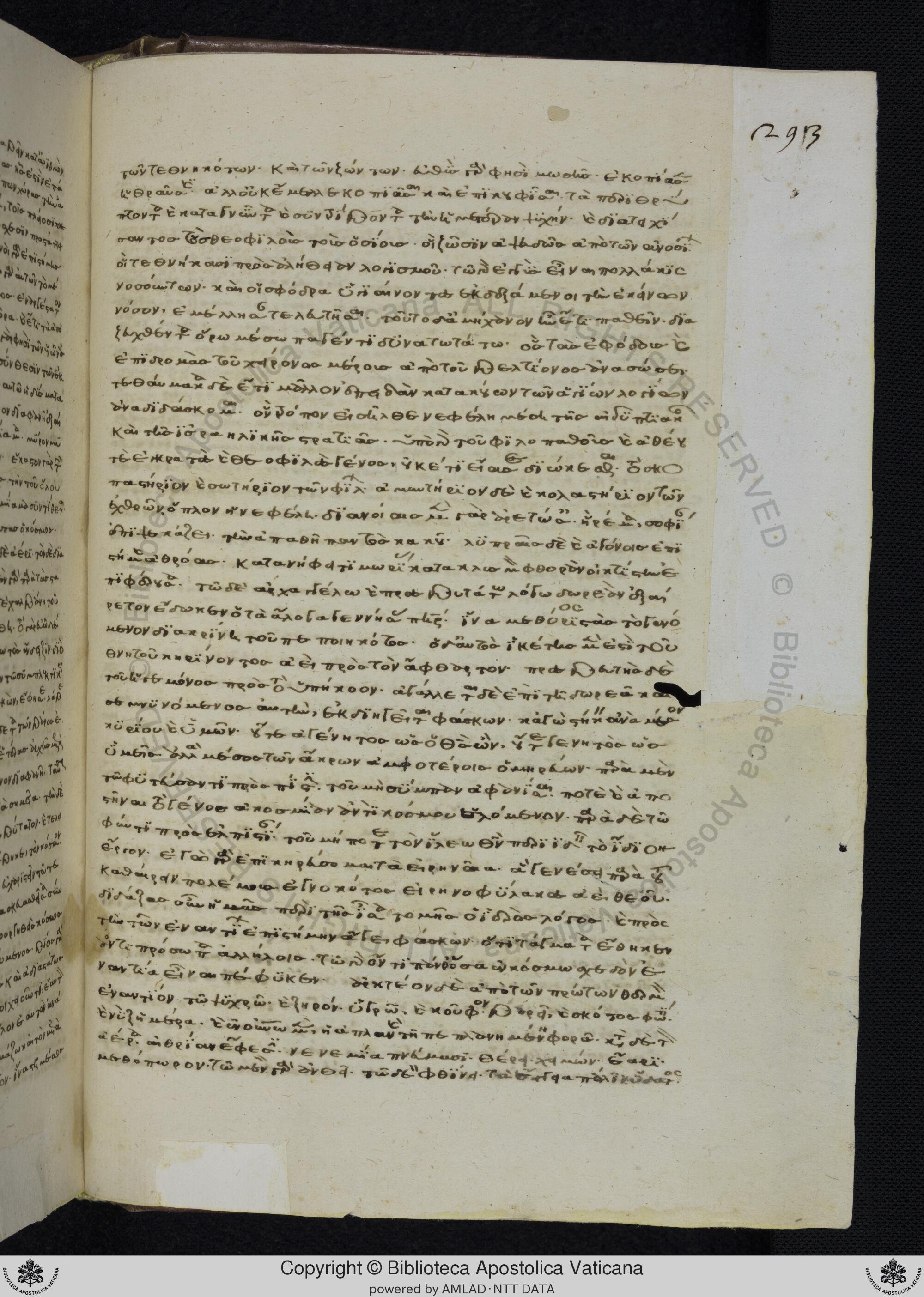
The page shown is fol. 293r of Vatican City, Biblioteca Apostolica Vaticana, Pal. gr. 248 (14th-15th century), where this treatise occupies fols. 280v-300v in a third, more upright hand. Both sections stand in the lower middle of the page. The Greek is Wendland's critical text (1898); the English is C. D. Yonge's translation (1854).
How was this verified? (Provenance)
Where on the image
On Pal. gr. 248 fol. 293r. Pal. gr. 248 fol. 293r. The page runs from 'τῶν τεθνηκότων καὶ τῶν ζώντων· εὐθὺς γάρ φησι Μωυσῆς' (section 201) to 'μετόπωρον· τῷ μὲν γὰρ ἀνθεῖ, τῷ δὲ φθίνει τὰ ἔγγεια· πάλιν ὕδατος' (section 208). Section 205 begins on line 18 with 'τῷ δὲ ἀρχαγγέλῳ καὶ πρεσβυτάτῳ λόγῳ', after '... φθορὰν οἰκτίστην ἐπιφέρουσα' (end of 204); section 206 begins 'ἀγάλλεται δὲ ἐπὶ τῇ δωρεᾷ' in the middle of line 22 and ends with '... εἰρηνοφύλακος ἀεὶ θεοῦ', after which 'διδάξας οὖν ἡμᾶς περὶ τῆς εἰς ἴσα τομῆς' (section 207) begins a new line. Viewer: https://digi.vatlib.it/view/MSS_Pal.gr.248/0591 Checked on the images. The Greek shown is the critical edition, not a transcription of this manuscript.
τῷ δὲ ἀρχαγγέλῳ καὶ πρεσβυτάτῳ λόγῳ δωρεὰν ἔδωκεν ἐξαίρετον ὁ τὰ ὅλα γεννήσας πατήρ, ἵνα μεθόριος στὰς τὸ γενόμενον διακρίνῃ τοῦ πεποιηκότος. ὁ δ’ αὐτὸς ἱκέτης μέν ἐστι τοῦ θνητοῦ κηραίνοντος αἰεὶ πρὸς τὸ ἄφθαρτον, πρεσβευτὴς δὲ τοῦ ἡγεμόνος πρὸς τὸ ὑπήκοον.
And the Father who created the universe has given to his archangelic and most ancient Word a pre-eminent gift, to stand on the confines of both, and separated that which had been created from the Creator. And this same Word is continually a suppliant to the immortal God on behalf of the mortal race, which is exposed to affliction and misery; and is also the ambassador, sent by the Ruler of all, to the subject race.
Where on the image
On Pal. gr. 248 fol. 293r. Pal. gr. 248 fol. 293r. The page runs from 'τῶν τεθνηκότων καὶ τῶν ζώντων· εὐθὺς γάρ φησι Μωυσῆς' (section 201) to 'μετόπωρον· τῷ μὲν γὰρ ἀνθεῖ, τῷ δὲ φθίνει τὰ ἔγγεια· πάλιν ὕδατος' (section 208). Section 205 begins on line 18 with 'τῷ δὲ ἀρχαγγέλῳ καὶ πρεσβυτάτῳ λόγῳ', after '... φθορὰν οἰκτίστην ἐπιφέρουσα' (end of 204); section 206 begins 'ἀγάλλεται δὲ ἐπὶ τῇ δωρεᾷ' in the middle of line 22 and ends with '... εἰρηνοφύλακος ἀεὶ θεοῦ', after which 'διδάξας οὖν ἡμᾶς περὶ τῆς εἰς ἴσα τομῆς' (section 207) begins a new line. Viewer: https://digi.vatlib.it/view/MSS_Pal.gr.248/0591 Checked on the images. The Greek shown is the critical edition, not a transcription of this manuscript.
ἀγάλλεται δὲ ἐπὶ τῇ δωρεᾷ καὶ σεμνυνόμενος αὐτὴν ἐκδιηγεῖται φάσκων· „κἀγὼ εἱστήκειν ἀνὰ μέσον κυρίου καὶ ὑμῶν“ (Deut. 5, 5), οὔτε ἀγένητος ὡς ὁ θεὸς ὢν οὔτε γενητὸς ὡς ὑμεῖς, ἀλλὰ μέσος τῶν ἄκρων, ἀμφοτέροις ὁμηρεύων, παρὰ μὲν τῷ φυτεύσαντι πρὸς πίστιν τοῦ μὴ σύμπαν ἀφηνιάσαι ποτὲ καὶ ἀποστῆναι τὸ γεγονὸς ἀκοσμίαν ἀντὶ κόσμου ἑλόμενον, παρὰ δὲ τῷ φύντι πρὸς εὐελπιστίαν τοῦ μήποτε τὸν ἵλεω θεὸν περιιδεῖν τὸ ἴδιον ἔργον. ἐγὼ γὰρ ἐπικηρυκεύομαι τὰ εἰρηναῖα γενέσει παρὰ τοῦ καθαιρεῖν πολέμους ἐγνωκότος εἰρηνοφύλακος αἰεὶ θεοῦ.
And the Word rejoices in the gift, and, exulting in it, announces it and boasts of it, saying, "And I stood in the midst, between the Lord and you;" neither being uncreate as God, nor yet created as you, but being in the midst between these two extremities, like a hostage, as it were, to both parties: a hostage to the Creator, as a pledge and security that the whole race would never fly off and revolt entirely, choosing disorder rather than order; and to the creature, to lead it to entertain a confident hope that the merciful God would not overlook his own work. For I will proclaim peaceful intelligence to the creation from him who has determined to destroy wars, namely God, who is ever the guardian of peace.
Notes
- Greek: Paul Wendland, Philonis Alexandrini opera quae supersunt III (Berlin: Reimer, 1898), pp. 1-71, digital text First1KGreek tlg0018.tlg015.1st1K-grc1. Square brackets mark words the editor deletes, angle brackets words he adds. Apparatus notes are not shown.
- English: C. D. Yonge, The Works of Philo Judaeus, vol. 2 (London: H. G. Bohn, 1854), 'Who is the Heir of Divine Things'. Yonge translated from Mangey's edition of 1742, so his wording follows a slightly different Greek text; his section breaks follow the Scholer edition and a clause can fall on the neighbouring side of a break.
Cite
Sources
- Source: Vatican City, Biblioteca Apostolica Vaticana, Pal. gr. 248 fol. 293r (Biblioteca Apostolica Vaticana, DigiVatLib (IIIF)) + Cohn-Wendland Greek (First1KGreek) + C. D. Yonge English (1854, First1KGreek) (holding institution)
- Critical edition: Cohn-Wendland, Philonis Alexandrini opera (1896-1898), via First1KGreek
← previous · → next · v cycle view · l back to library