Plato, Laws 4.715e-716d: god is the measure of all things
Introduction
In book 4 of the Laws, Plato's last work, the Athenian Stranger imagines the first settlers of a new city and composes the address they should hear. It opens with 'the ancient saying' that god holds the beginning, the end and the middle of all things, and that Justice follows him to punish those who fall away from the divine law. Then comes the reply to Protagoras' 'man is the measure of all things': 'In our eyes God will be the measure of all things in the highest degree'. Whoever would be dear to such a being must, as far as he can, become like him: the temperate man is dear to god because he is like him.
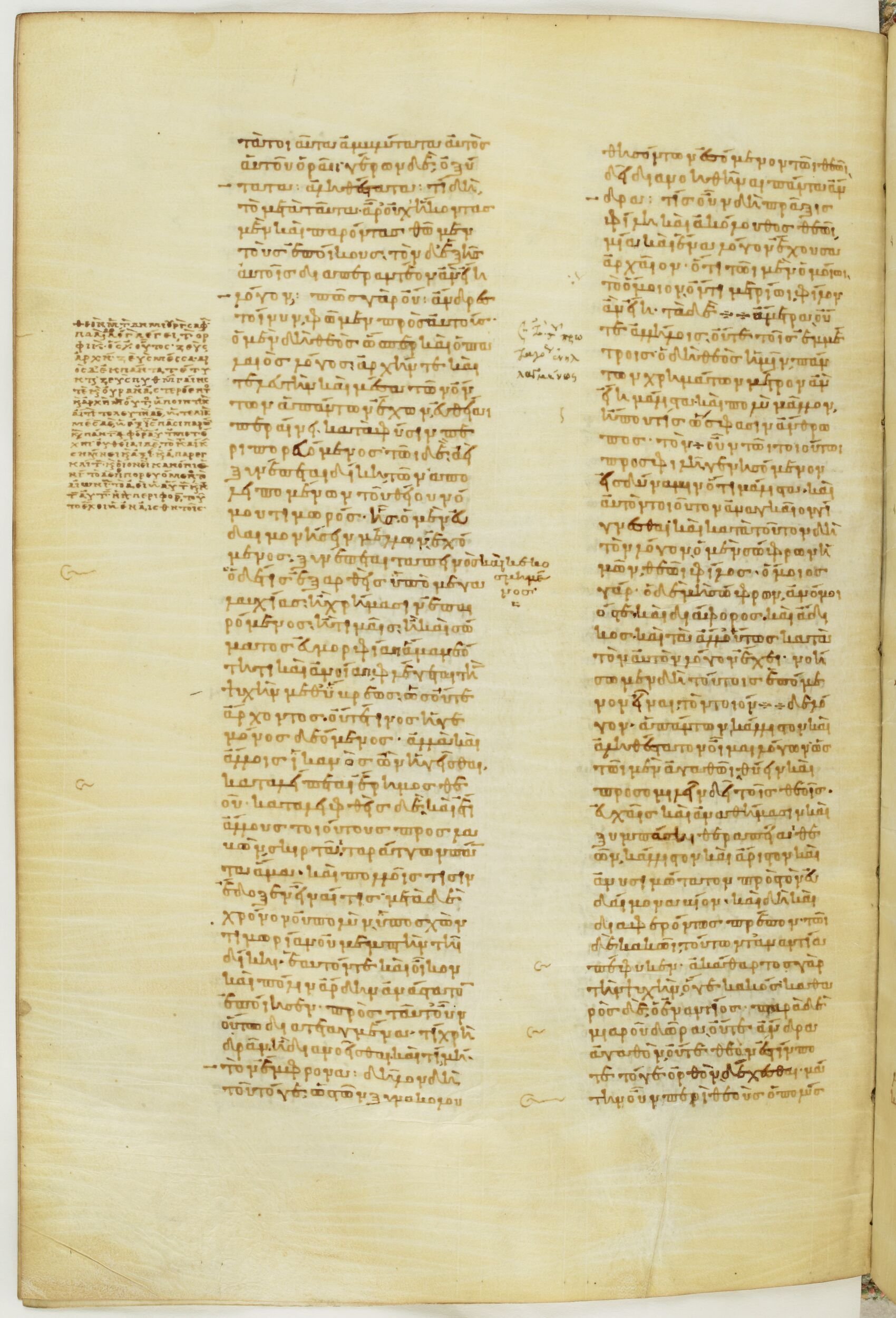
The page shown is from Paris, Bibliotheque nationale de France, grec 1807 (siglum A), copied in the second half of the 9th century, the oldest manuscript of the Laws. The whole passage stands on one page, fol. 189v, written in two columns of 44 lines: it begins on line 2 of the first column and ends in the second column, which closes with the opening words of 717a. The Greek is Burnet's critical text; the manuscript spells some words differently (for example xynepetai for synepetai).
How was this verified? (Provenance)
Where on the image
On Paris gr. 1807 fol. 189v. Paris gr. 1807 fol. 189v, two columns of 44 lines. Column 1, line 1 'τὰ τοιαῦτα ἀμβλύτατα αὐτὸς' ends 715d; 715e begins on line 2 'αὑτοῦ ὁρᾷ, γέρων δὲ ὀξύ(τατα)'; 'ὁ μὲν δὴ θεός, ὥσπερ καὶ ὁ παλαιὸς λόγος' is on lines 10-11 and 716a 'μέσα τῶν ὄντων ἁπάντων' on lines 12-13; column 1 ends with 'τοῦτό γε· ὡς τῶν ξυνακολου(θησόντων)' (716b). Column 2 begins 'θησόντων ἐσόμενον τῷ θεῷ', has 716c 'τίς οὖν δὴ πρᾶξις φίλη' on line 3, and ends 'μάτην οὖν περὶ θεοὺς ὁ πολὺς' (717a). Viewer: https://gallica.bnf.fr/ark:/12148/btv1b8419248n/f388.item Checked on the images. The Greek shown is Burnet's critical text; the copyist's wording differs from it in small details.
αὐτὸς αὑτοῦ ὁρᾷ, γέρων δὲ ὀξύτατα. ΚΛ. ἀληθέστατα. ΑΘ. τί δὴ τὸ μετὰ ταῦτα; ἆρʼ οὐχ ἥκοντας μὲν καὶ παρόντας θῶμεν τοὺς ἐποίκους, τὸν δʼ ἑξῆς αὐτοῖς διαπεραντέον ἂν εἴη λόγον; ΚΛ. πῶς γὰρ οὔ; ΑΘ. ἄνδρες τοίνυν φῶμεν πρὸς αὐτούς, ὁ μὲν δὴ θεός, ὥσπερ καὶ ὁ παλαιὸς λόγος, ἀρχήν τε καὶ τελευτὴν καὶ
when he is young, but at its keenest when he is old. Clin. Very true. Ath. What, then, is to be our next step? May we not assume that our immigrants have arrived and are in the country, and should we not proceed with our address to them? Clin. Of course. Ath. Let us, then, speak to them thus:— O men, that God who, as old tradition tells, holdeth the beginning, the end, and the center of all things that exist,
Where on the image
On Paris gr. 1807 fol. 189v. Paris gr. 1807 fol. 189v, two columns of 44 lines. Column 1, line 1 'τὰ τοιαῦτα ἀμβλύτατα αὐτὸς' ends 715d; 715e begins on line 2 'αὑτοῦ ὁρᾷ, γέρων δὲ ὀξύ(τατα)'; 'ὁ μὲν δὴ θεός, ὥσπερ καὶ ὁ παλαιὸς λόγος' is on lines 10-11 and 716a 'μέσα τῶν ὄντων ἁπάντων' on lines 12-13; column 1 ends with 'τοῦτό γε· ὡς τῶν ξυνακολου(θησόντων)' (716b). Column 2 begins 'θησόντων ἐσόμενον τῷ θεῷ', has 716c 'τίς οὖν δὴ πρᾶξις φίλη' on line 3, and ends 'μάτην οὖν περὶ θεοὺς ὁ πολὺς' (717a). Viewer: https://gallica.bnf.fr/ark:/12148/btv1b8419248n/f388.item Checked on the images. The Greek shown is Burnet's critical text; the copyist's wording differs from it in small details.
μέσα τῶν ὄντων ἁπάντων ἔχων, εὐθείᾳ περαίνει κατὰ φύσιν περιπορευόμενος· τῷ δὲ ἀεὶ συνέπεται δίκη τῶν ἀπολειπομένων τοῦ θείου νόμου τιμωρός, ἧς ὁ μὲν εὐδαιμονήσειν μέλλων ἐχόμενος συνέπεται ταπεινὸς καὶ κεκοσμημένος, ὁ δέ τις ἐξαρθεὶς ὑπὸ μεγαλαυχίας, ἢ χρήμασιν ἐπαιρόμενος ἢ τιμαῖς, ἢ καὶ σώματος εὐμορφίᾳ ἅμα νεότητι καὶ ἀνοίᾳ φλέγεται τὴν ψυχὴν μεθʼ ὕβρεως, ὡς οὔτε ἄρχοντος οὔτε τινὸς ἡγεμόνος δεόμενος, ἀλλὰ καὶ ἄλλοις ἱκανὸς ὢν ἡγεῖσθαι,
completeth his circuit by nature’s ordinance in straight, unswerving course. With him followeth Justice, as avenger of them that fall short of the divine law; and she, again, is followed by every man who would fain be happy, cleaving to her with lowly and orderly behavior; but whoso is uplifted by vainglory, or prideth himself on his riches or his honors or his comeliness of body, and through this pride joined to youth and folly, is inflamed in soul with insolence, dreaming that he has no need of ruler or guide, but rather is competent himself to guide others,—
Where on the image
On Paris gr. 1807 fol. 189v. Paris gr. 1807 fol. 189v, two columns of 44 lines. Column 1, line 1 'τὰ τοιαῦτα ἀμβλύτατα αὐτὸς' ends 715d; 715e begins on line 2 'αὑτοῦ ὁρᾷ, γέρων δὲ ὀξύ(τατα)'; 'ὁ μὲν δὴ θεός, ὥσπερ καὶ ὁ παλαιὸς λόγος' is on lines 10-11 and 716a 'μέσα τῶν ὄντων ἁπάντων' on lines 12-13; column 1 ends with 'τοῦτό γε· ὡς τῶν ξυνακολου(θησόντων)' (716b). Column 2 begins 'θησόντων ἐσόμενον τῷ θεῷ', has 716c 'τίς οὖν δὴ πρᾶξις φίλη' on line 3, and ends 'μάτην οὖν περὶ θεοὺς ὁ πολὺς' (717a). Viewer: https://gallica.bnf.fr/ark:/12148/btv1b8419248n/f388.item Checked on the images. The Greek shown is Burnet's critical text; the copyist's wording differs from it in small details.
καταλείπεται ἔρημος θεοῦ, καταλειφθεὶς δὲ καὶ ἔτι ἄλλους τοιούτους προσλαβὼν σκιρτᾷ ταράττων πάντα ἅμα, καὶ πολλοῖς τισιν ἔδοξεν εἶναί τις, μετὰ δὲ χρόνον οὐ πολὺν ὑποσχὼν τιμωρίαν οὐ μεμπτὴν τῇ δίκῃ ἑαυτόν τε καὶ οἶκον καὶ πόλιν ἄρδην ἀνάστατον ἐποίησεν. πρὸς ταῦτʼ οὖν οὕτω διατεταγμένα τί χρὴ δρᾶν ἢ διανοεῖσθαι καὶ τί μὴ τὸν ἔμφρονα; ΚΛ. δῆλον δὴ τοῦτό γε· ὡς τῶν συνακολουθησόντων ἐσόμενον τῷ θεῷ δεῖ διανοηθῆναι πάντα ἄνδρα.
such an one is abandoned and left behind by the God, and when left behind he taketh to him others of like nature, and by his mad prancings throweth all into confusion: to many, indeed, he seemeth to be some great one, but after no long time he payeth the penalty, not unmerited, to Justice, when he bringeth to total ruin himself, his house, and his country. Looking at these things, thus ordained, what ought the prudent man to do, or to devise, or to refrain from doing? Clin. The answer is plain: Every man ought so to devise as to be of the number of those who follow in the steps of the God.
Where on the image
On Paris gr. 1807 fol. 189v. Paris gr. 1807 fol. 189v, two columns of 44 lines. Column 1, line 1 'τὰ τοιαῦτα ἀμβλύτατα αὐτὸς' ends 715d; 715e begins on line 2 'αὑτοῦ ὁρᾷ, γέρων δὲ ὀξύ(τατα)'; 'ὁ μὲν δὴ θεός, ὥσπερ καὶ ὁ παλαιὸς λόγος' is on lines 10-11 and 716a 'μέσα τῶν ὄντων ἁπάντων' on lines 12-13; column 1 ends with 'τοῦτό γε· ὡς τῶν ξυνακολου(θησόντων)' (716b). Column 2 begins 'θησόντων ἐσόμενον τῷ θεῷ', has 716c 'τίς οὖν δὴ πρᾶξις φίλη' on line 3, and ends 'μάτην οὖν περὶ θεοὺς ὁ πολὺς' (717a). Viewer: https://gallica.bnf.fr/ark:/12148/btv1b8419248n/f388.item Checked on the images. The Greek shown is Burnet's critical text; the copyist's wording differs from it in small details.
ΑΘ. τίς οὖν δὴ πρᾶξις φίλη καὶ ἀκόλουθος θεῷ; μία, καὶ ἕνα λόγον ἔχουσα ἀρχαῖον, ὅτι τῷ μὲν ὁμοίῳ τὸ ὅμοιον ὄντι μετρίῳ φίλον ἂν εἴη, τὰ δʼ ἄμετρα οὔτε ἀλλήλοις οὔτε τοῖς ἐμμέτροις. ὁ δὴ θεὸς ἡμῖν πάντων χρημάτων μέτρον ἂν εἴη μάλιστα, καὶ πολὺ μᾶλλον ἤ πού τις, ὥς φασιν, ἄνθρωπος· τὸν οὖν τῷ τοιούτῳ προσφιλῆ γενησόμενον, εἰς δύναμιν ὅτι μάλιστα καὶ αὐτὸν τοιοῦτον ἀναγκαῖον γίγνεσθαι,
Ath. What conduct, then, is dear to God and in his steps? One kind of conduct, expressed in one ancient phrase, namely, that like is dear to like when it is moderate, whereas immoderate things are dear neither to one another nor to things moderate. In our eyes God will be the measure of all things in the highest degree—a degree much higher than is any man they talk of. He, then, that is to become dear to such an one must needs become, so far as he possibly can, of a like character; and, according to the present argument, he amongst us that is temperate is dear to God,
Where on the image
On Paris gr. 1807 fol. 189v. Paris gr. 1807 fol. 189v, two columns of 44 lines. Column 1, line 1 'τὰ τοιαῦτα ἀμβλύτατα αὐτὸς' ends 715d; 715e begins on line 2 'αὑτοῦ ὁρᾷ, γέρων δὲ ὀξύ(τατα)'; 'ὁ μὲν δὴ θεός, ὥσπερ καὶ ὁ παλαιὸς λόγος' is on lines 10-11 and 716a 'μέσα τῶν ὄντων ἁπάντων' on lines 12-13; column 1 ends with 'τοῦτό γε· ὡς τῶν ξυνακολου(θησόντων)' (716b). Column 2 begins 'θησόντων ἐσόμενον τῷ θεῷ', has 716c 'τίς οὖν δὴ πρᾶξις φίλη' on line 3, and ends 'μάτην οὖν περὶ θεοὺς ὁ πολὺς' (717a). Viewer: https://gallica.bnf.fr/ark:/12148/btv1b8419248n/f388.item Checked on the images. The Greek shown is Burnet's critical text; the copyist's wording differs from it in small details.
καὶ κατὰ τοῦτον δὴ τὸν λόγον ὁ μὲν σώφρων ἡμῶν θεῷ φίλος, ὅμοιος γάρ, ὁ δὲ μὴ σώφρων ἀνόμοιός τε καὶ διάφορος καὶ <ὁ> ἄδικος, καὶ τὰ ἄλλʼ οὕτως κατὰ τὸν αὐτὸν λόγον ἔχει. νοήσωμεν δὴ τούτοις ἑπόμενον εἶναι τὸν τοιόνδε λόγον, ἁπάντων κάλλιστον καὶ ἀληθέστατον οἶμαι λόγων, ὡς τῷ μὲν ἀγαθῷ θύειν καὶ προσομιλεῖν ἀεὶ τοῖς θεοῖς εὐχαῖς καὶ ἀναθήμασιν καὶ συμπάσῃ θεραπείᾳ θεῶν κάλλιστον καὶ ἄριστον καὶ ἀνυσιμώτατον πρὸς τὸν εὐδαίμονα
since he is like him, while he that is not temperate is unlike and at enmity,—as is also he who is unjust, and so likewise with the rest, by parity of reasoning. On this there follows, let us observe, this further rule,—and of all rules it is the noblest and truest,—that to engage in sacrifice and communion with the gods continually, by prayers and offerings and devotions of every kind, is a thing most noble and good and helpful towards the happy life, and superlatively fitting also, for the good man;
Notes
- Greek: John Burnet, Platonis Opera (Oxford Classical Texts, 1900-1907), Perseus digital text. Square brackets mark words Burnet deletes.
- English: R. G. Bury, Plato X-XI: Laws (Loeb Classical Library, Harvard University Press / Heinemann, 1926), Perseus tlg0059.tlg034.perseus-eng2. The English section breaks follow the translator's own Stephanus markers, so a few words may fall on the neighbouring side of a break compared with the Greek.
Cite
Sources
- Source: Paris, Bibliotheque nationale de France, grec 1807 fol. 189v (Bibliotheque nationale de France, Gallica (IIIF)) + Burnet Greek (Perseus) + R. G. Bury (1926) English (Perseus) (holding institution)
- Critical edition: Burnet, Platonis Opera (1900-1907), via Perseus
← previous · → next · v cycle view · l back to library