Plato, Theaetetus 172c-177c: the philosopher and the flight to become like god
Introduction
In the middle of the Theaetetus, while examining Protagoras' claim that man is the measure of all things, Socrates breaks off to compare two kinds of people: the man trained in the law courts, quick and servile, and the philosopher, who does not know the way to the market place but whose mind ranges over the earth and the heavens. The digression ends with the sentence that later Platonists, Philo and the Greek Church Fathers took as a definition of the human goal: "we ought to try to escape from earth to the dwelling of the gods as quickly as we can; and to escape is to become like God, so far as this is possible" (phyge de homoiosis theoi kata to dynaton, 176a-b). Becoming like god is defined as becoming just and holy with wisdom.
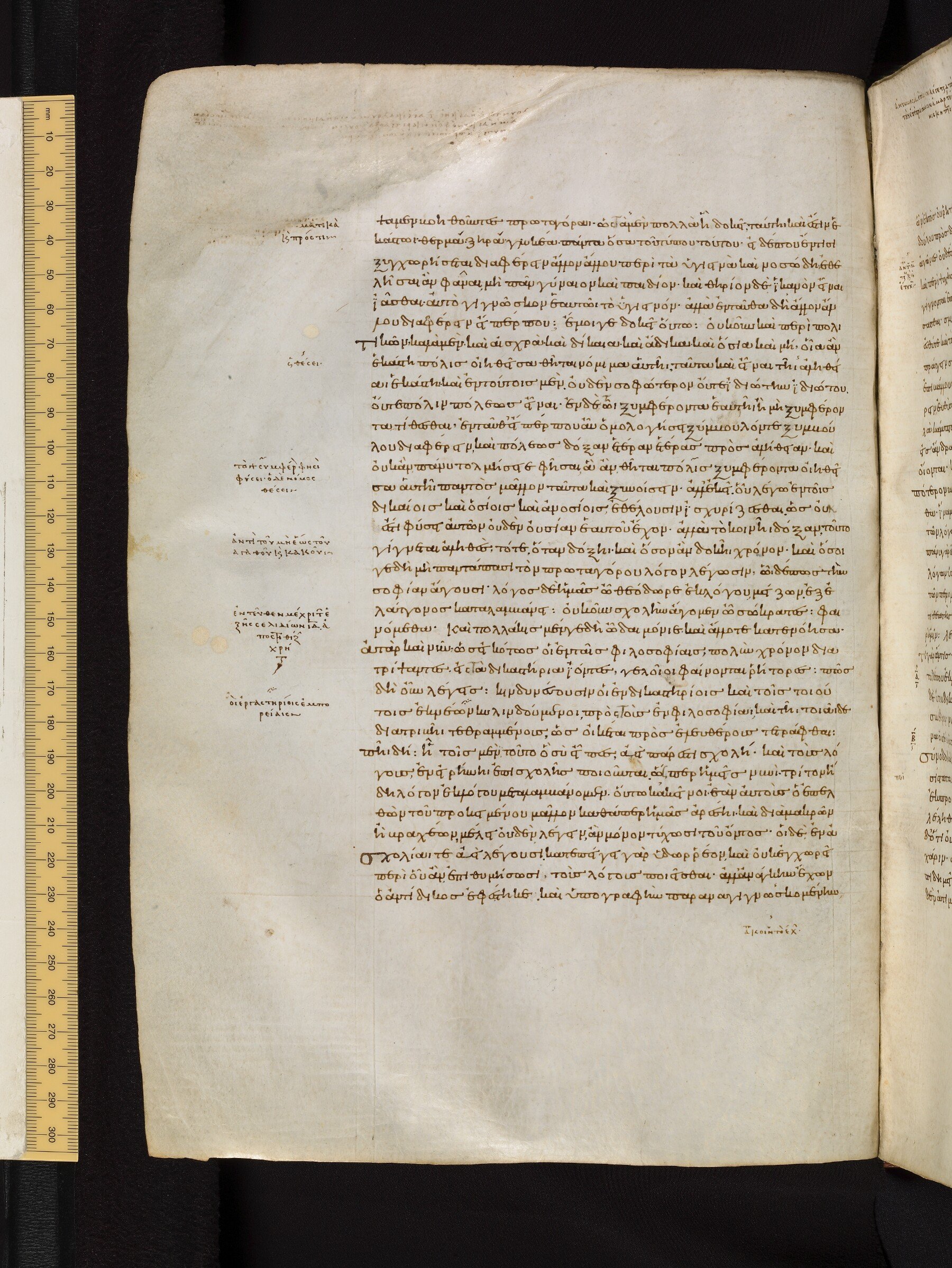
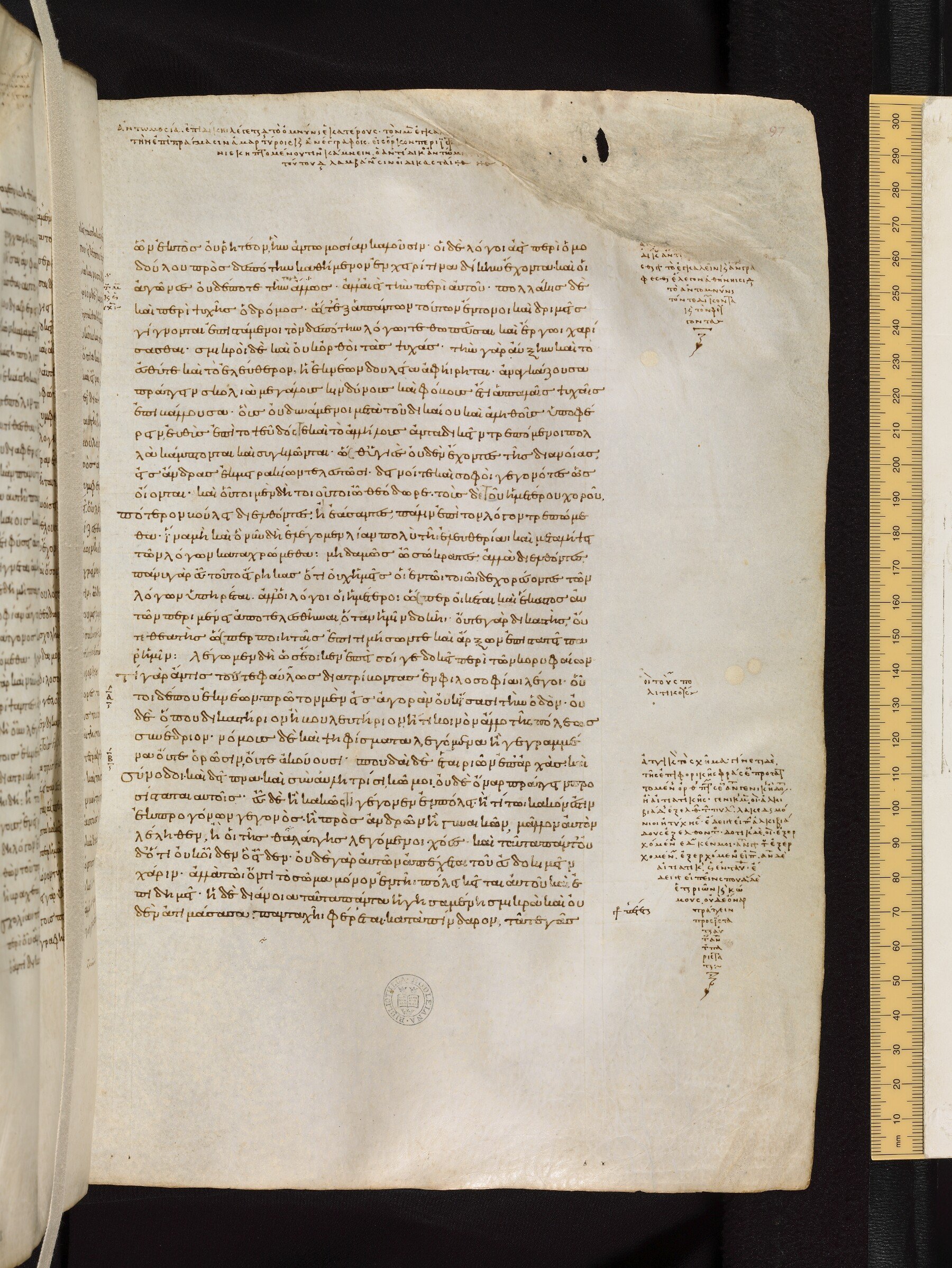
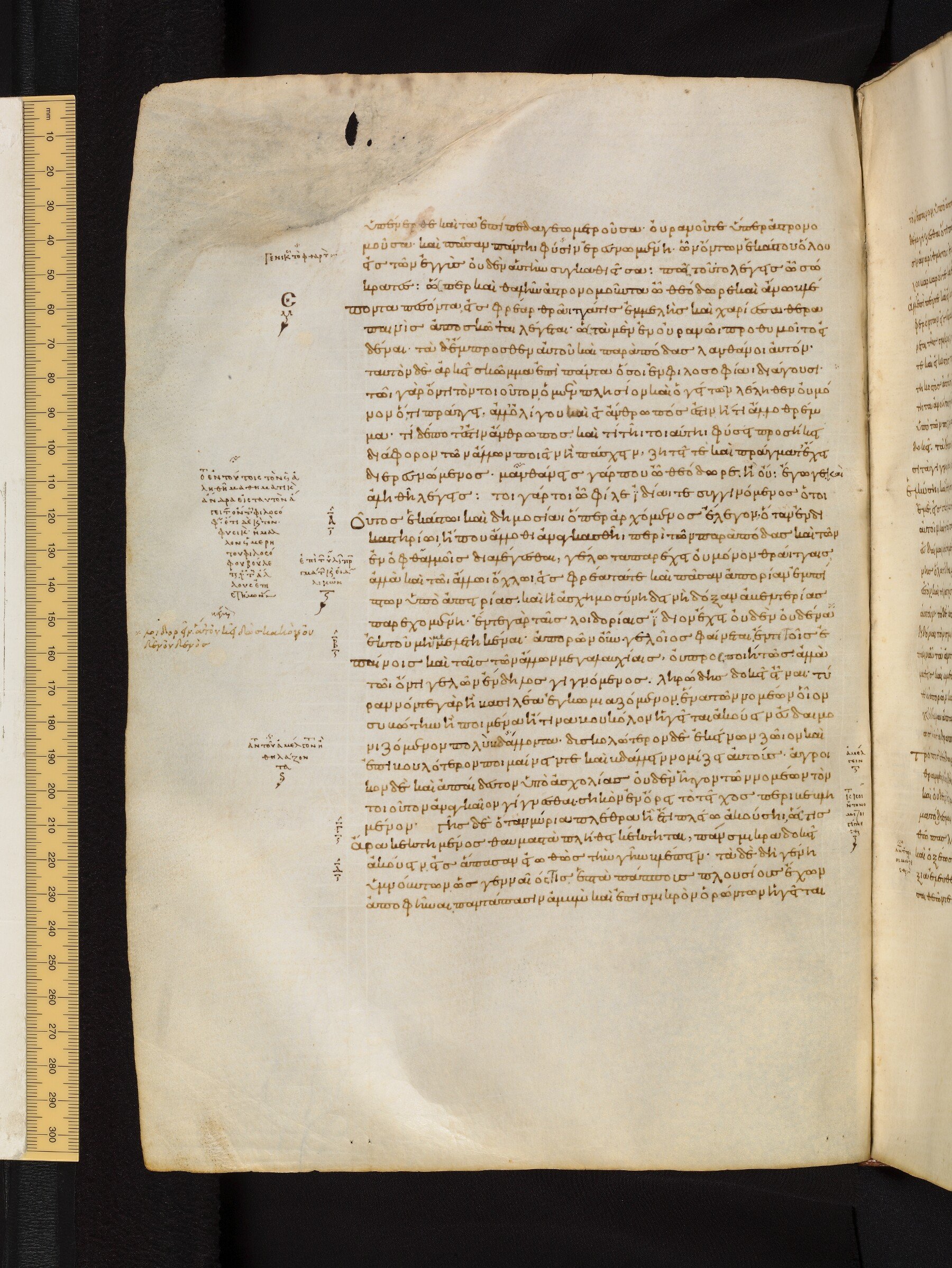
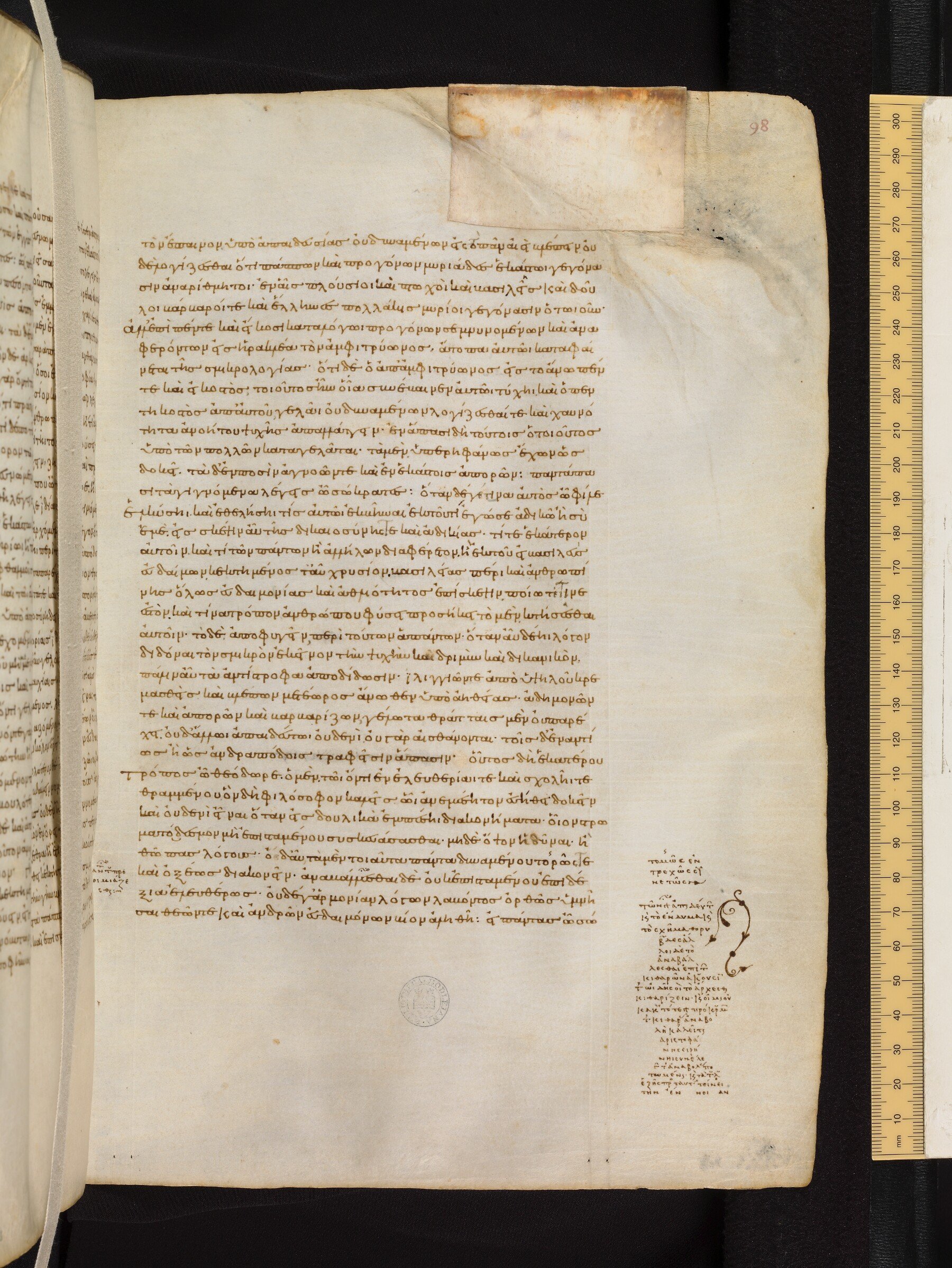
The pages shown are from the Clarke Plato (Oxford, Bodleian Library, MS. E. D. Clarke 39), copied in Constantinople in 895 for Arethas of Patrae. It is the oldest surviving manuscript of this dialogue, cited by editors as B. The passage runs from fol. 96v line 20 to fol. 99r, six pages of 34 lines. Each section below is one Stephanus subsection; the page or pages listed for it were identified by reading the first and last lines of each page on the image. The Greek shown is Burnet's critical text, so the copyist's spelling and some words differ from it in places (for example, at 173e the manuscript has pheretai where Burnet prints petetai, and at 176a it has the word alethe that Burnet brackets).
How was this verified? (Provenance)
Where on the image
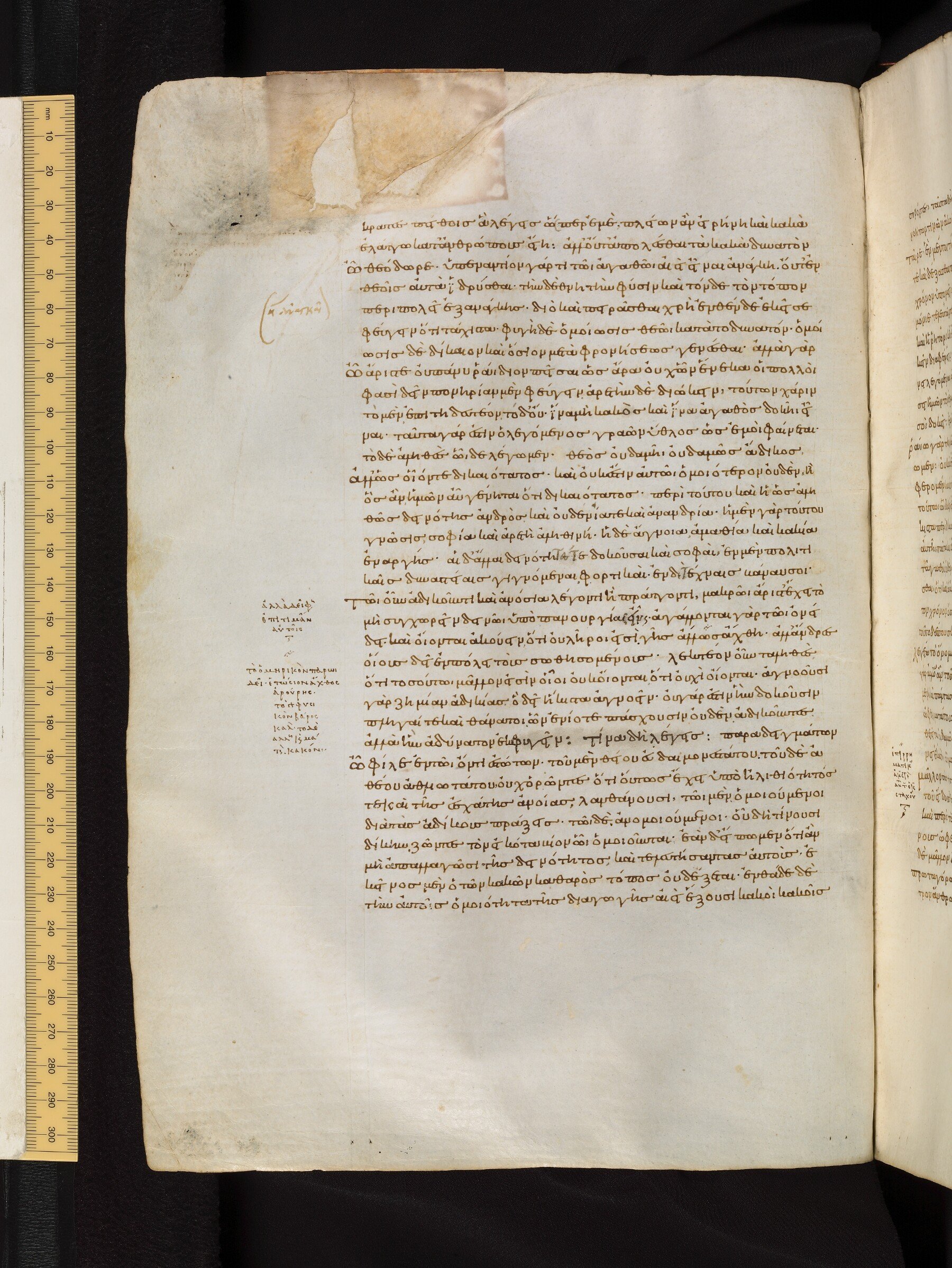
On Clarke 39 fol. 96v. Clarke 39 fol. 96v runs from 'βοηθοῦντες Πρωταγόρᾳ, ὡς τὰ μὲν πολλὰ ᾗ δοκεῖ ταύτῃ καὶ ἔστιν' on its first line (171e) to 'ὁ ἀντίδικος ἐφέστηκεν καὶ ὑπογραφὴν παραναγιγνωσκομένην' on its last line (172e). 172c begins on line 20 ('λάττονος καταλαμβάνει· οὐκοῦν σχολὴν ἄγομεν, ὦ Σώκρατες'); 172d begins at the end of line 25 ('τοιᾷδε', with 'διατριβῇ τεθραμμένους' on line 26). Viewer: https://digital.bodleian.ox.ac.uk/objects/f57d074b-cff1-4172-8236-797c7b8f0403/surfaces/60b6ad78-fd77-4176-962e-030552998a63/ Checked on the images. The Greek shown is Burnet's critical text; the copyist's wording differs from it in small details.
καταλαμβάνει. ΘΕΟ. οὐκοῦν σχολὴν ἄγομεν, ὦ Σώκρατες; ΣΩ. φαινόμεθα. καὶ πολλάκις μέν γε δή, ὦ δαιμόνιε, καὶ ἄλλοτε κατενόησα, ἀτὰρ καὶ νῦν, ὡς εἰκότως οἱ ἐν ταῖς φιλοσοφίαις πολὺν χρόνον διατρίψαντες εἰς τὰ δικαστήρια ἰόντες γελοῖοι φαίνονται ῥήτορες. ΘΕΟ. πῶς δὴ οὖν λέγεις; ΣΩ. κινδυνεύουσιν οἱ ἐν δικαστηρίοις καὶ τοῖς τοιούτοις ἐκ νέων κυλινδούμενοι πρὸς τοὺς ἐν φιλοσοφίᾳ καὶ τῇ
a greater one after a lesser, is overtaking us. THEO. Well, Socrates, we have plenty of leisure, have we not? SOC. Apparently we have. And that makes me think, my friend, as I have often done before, how natural it is that those who have spent a long time in the study of philosophy appear ridiculous when they enter the courts of law as speakers. THEO. What do you mean? SOC. Those who have knocked about in courts and the like from their youth up seem to me, when compared with those who have been brought up in philosophy
Where on the image
On Clarke 39 fol. 96v. Clarke 39 fol. 96v runs from 'βοηθοῦντες Πρωταγόρᾳ, ὡς τὰ μὲν πολλὰ ᾗ δοκεῖ ταύτῃ καὶ ἔστιν' on its first line (171e) to 'ὁ ἀντίδικος ἐφέστηκεν καὶ ὑπογραφὴν παραναγιγνωσκομένην' on its last line (172e). 172c begins on line 20 ('λάττονος καταλαμβάνει· οὐκοῦν σχολὴν ἄγομεν, ὦ Σώκρατες'); 172d begins at the end of line 25 ('τοιᾷδε', with 'διατριβῇ τεθραμμένους' on line 26). Viewer: https://digital.bodleian.ox.ac.uk/objects/f57d074b-cff1-4172-8236-797c7b8f0403/surfaces/60b6ad78-fd77-4176-962e-030552998a63/ Checked on the images. The Greek shown is Burnet's critical text; the copyist's wording differs from it in small details.
τοιᾷδε διατριβῇ τεθραμμένους ὡς οἰκέται πρὸς ἐλευθέρους τεθράφθαι. ΘΕΟ. πῇ δή; ΣΩ. ἧι τοῖς μὲν τοῦτο ὃ σὺ εἶπες ἀεὶ πάρεστι, σχολή, καὶ τοὺς λόγους ἐν εἰρήνῃ ἐπὶ σχολῆς ποιοῦνται· ὥσπερ ἡμεῖς νυνὶ τρίτον ἤδη λόγον ἐκ λόγου μεταλαμβάνομεν, οὕτω κἀκεῖνοι, ἐὰν αὐτοὺς ὁ ἐπελθὼν τοῦ προκειμένου μᾶλλον καθάπερ ἡμᾶς ἀρέσῃ· καὶ διὰ μακρῶν ἢ βραχέων μέλει οὐδὲν λέγειν, ἂν μόνον τύχωσι τοῦ ὄντος· οἱ δὲ ἐν ἀσχολίᾳ
and similar pursuits, to be as slaves in breeding compared with freemen. THEO. In what way is this the case? SOC. In this way: the latter always have that which you just spoke of, leisure, and they talk at their leisure in peace; just as we are now taking up argument after argument, already beginning a third, so can they, if as in our case, the new one pleases them better than that in which they are engaged; and they do not care at all whether their talk is long or short, if only they attain the truth. But the men of the other sort are always in a hurry—for the water flowing through the water-clock urges them on—
Where on the image
Starts on fol. 96v and continues on fol. 97r (page break inside this subsection). Clarke 39 fol. 96v runs from 'βοηθοῦντες Πρωταγόρᾳ, ὡς τὰ μὲν πολλὰ ᾗ δοκεῖ ταύτῃ καὶ ἔστιν' on its first line (171e) to 'ὁ ἀντίδικος ἐφέστηκεν καὶ ὑπογραφὴν παραναγιγνωσκομένην' on its last line (172e). 172c begins on line 20 ('λάττονος καταλαμβάνει· οὐκοῦν σχολὴν ἄγομεν, ὦ Σώκρατες'); 172d begins at the end of line 25 ('τοιᾷδε', with 'διατριβῇ τεθραμμένους' on line 26). Viewer: https://digital.bodleian.ox.ac.uk/objects/f57d074b-cff1-4172-8236-797c7b8f0403/surfaces/60b6ad78-fd77-4176-962e-030552998a63/ Clarke 39 fol. 97r runs from 'ὧν ἐκτὸς οὐ ῥητέον, ἣν ἀντωμοσίαν καλοῦσιν· οἱ δὲ λόγοι ἀεὶ περὶ ὁμοδούλου' on its first line (172e) to 'ἀτιμάσασα πανταχῇ φέρεται κατὰ Πίνδαρον, τά τε γᾶς' on its last line (173e). At 173e the manuscript reads φέρεται (Burnet πέτεται). Viewer: https://digital.bodleian.ox.ac.uk/objects/f57d074b-cff1-4172-8236-797c7b8f0403/surfaces/0eb896d5-d79f-4331-ac8e-ff80da301177/ Checked on the images. The Greek shown is Burnet's critical text; the copyist's wording differs from it in small details.
τε ἀεὶ λέγουσι—κατεπείγει γὰρ ὕδωρ ῥέον—καὶ οὐκ ἐγχωρεῖ περὶ οὗ ἂν ἐπιθυμήσωσι τοὺς λόγους ποιεῖσθαι, ἀλλʼ ἀνάγκην ἔχων ὁ ἀντίδικος ἐφέστηκεν καὶ ὑπογραφὴν παραναγιγνωσκομένην ὧν ἐκτὸς οὐ ῥητέον [ἣν ἀντωμοσίαν καλοῦσιν]· οἱ δὲ λόγοι ἀεὶ περὶ ὁμοδούλου πρὸς δεσπότην καθήμενον, ἐν χειρί τινα δίκην ἔχοντα, καὶ οἱ ἀγῶνες οὐδέποτε τὴν ἄλλως ἀλλʼ ἀεὶ τὴν περὶ αὐτοῦ, πολλάκις δὲ καὶ περὶ ψυχῆς
and the other party in the suit does not permit them to talk about anything they please, but stands over them exercising the law’s compulsion by reading the brief, from which no deviation is allowed (this is called the affidavit); and their discourse is always about a fellow slave and is addressed to a master who sits there holding some case or other in his hands; and the contests never run an indefinite course, but are always directed to the point at issue, and often the race is for the defendant’s life.
Where on the image
On Clarke 39 fol. 97r. Clarke 39 fol. 97r runs from 'ὧν ἐκτὸς οὐ ῥητέον, ἣν ἀντωμοσίαν καλοῦσιν· οἱ δὲ λόγοι ἀεὶ περὶ ὁμοδούλου' on its first line (172e) to 'ἀτιμάσασα πανταχῇ φέρεται κατὰ Πίνδαρον, τά τε γᾶς' on its last line (173e). At 173e the manuscript reads φέρεται (Burnet πέτεται). Viewer: https://digital.bodleian.ox.ac.uk/objects/f57d074b-cff1-4172-8236-797c7b8f0403/surfaces/0eb896d5-d79f-4331-ac8e-ff80da301177/ Checked on the images. The Greek shown is Burnet's critical text; the copyist's wording differs from it in small details.
ὁ δρόμος· ὥστʼ ἐξ ἁπάντων τούτων ἔντονοι καὶ δριμεῖς γίγνονται, ἐπιστάμενοι τὸν δεσπότην λόγῳ τε θωπεῦσαι καὶ ἔργῳ ὑπελθεῖν, σμικροὶ δὲ καὶ οὐκ ὀρθοὶ τὰς ψυχάς. τὴν γὰρ αὔξην καὶ τὸ εὐθύ τε καὶ τὸ ἐλευθέριον ἡ ἐκ νέων δουλεία ἀφῄρηται, ἀναγκάζουσα πράττειν σκολιά, μεγάλους κινδύνους καὶ φόβους ἔτι ἁπαλαῖς ψυχαῖς ἐπιβάλλουσα, οὓς οὐ δυνάμενοι μετὰ τοῦ δικαίου καὶ ἀληθοῦς ὑποφέρειν, εὐθὺς ἐπὶ τὸ ψεῦδός τε καὶ τὸ ἀλλήλους ἀνταδικεῖν τρεπόμενοι
As a result of all this, the speakers become tense and shrewd; they know how to wheedle their master with words and gain his favor by acts; but in their souls they become small and warped. For they have been deprived of growth and straightforwardness and independence by the slavery they have endured from their youth up, for this forces them to do crooked acts by putting a great burden of fears and dangers upon their souls while these are still tender; and since they cannot bear this burden with uprightness and truth, they turn forthwith to deceit and to requiting wrong with wrong, so that they become greatly bent and stunted.
Where on the image
On Clarke 39 fol. 97r. Clarke 39 fol. 97r runs from 'ὧν ἐκτὸς οὐ ῥητέον, ἣν ἀντωμοσίαν καλοῦσιν· οἱ δὲ λόγοι ἀεὶ περὶ ὁμοδούλου' on its first line (172e) to 'ἀτιμάσασα πανταχῇ φέρεται κατὰ Πίνδαρον, τά τε γᾶς' on its last line (173e). At 173e the manuscript reads φέρεται (Burnet πέτεται). Viewer: https://digital.bodleian.ox.ac.uk/objects/f57d074b-cff1-4172-8236-797c7b8f0403/surfaces/0eb896d5-d79f-4331-ac8e-ff80da301177/ Checked on the images. The Greek shown is Burnet's critical text; the copyist's wording differs from it in small details.
πολλὰ κάμπτονται καὶ συγκλῶνται, ὥσθʼ ὑγιὲς οὐδὲν ἔχοντες τῆς διανοίας εἰς ἄνδρας ἐκ μειρακίων τελευτῶσι, δεινοί τε καὶ σοφοὶ γεγονότες, ὡς οἴονται. καὶ οὗτοι μὲν δὴ τοιοῦτοι, ὦ Θεόδωρε· τοὺς δὲ τοῦ ἡμετέρου χοροῦ πότερον βούλει διελθόντες ἢ ἐάσαντες πάλιν ἐπὶ τὸν λόγον τρεπώμεθα, ἵνα μὴ καί, ὃ νυνδὴ ἐλέγομεν, λίαν πολὺ τῇ ἐλευθερίᾳ καὶ μεταλήψει τῶν λόγων καταχρώμεθα; ΘΕΟ. μηδαμῶς, ὦ Σώκρατες, ἀλλὰ διελθόντες. πάνυ
Consequently they pass from youth to manhood with no soundness of mind in them, but they think they have become clever and wise. So much for them, Theodorus. Shall we describe those who belong to our band, or shall we let that go and return to the argument, in order to avoid abuse of that freedom and variety of discourse, of which we were speaking just now? THEO. By all means, Socrates, describe them;
Where on the image
On Clarke 39 fol. 97r. Clarke 39 fol. 97r runs from 'ὧν ἐκτὸς οὐ ῥητέον, ἣν ἀντωμοσίαν καλοῦσιν· οἱ δὲ λόγοι ἀεὶ περὶ ὁμοδούλου' on its first line (172e) to 'ἀτιμάσασα πανταχῇ φέρεται κατὰ Πίνδαρον, τά τε γᾶς' on its last line (173e). At 173e the manuscript reads φέρεται (Burnet πέτεται). Viewer: https://digital.bodleian.ox.ac.uk/objects/f57d074b-cff1-4172-8236-797c7b8f0403/surfaces/0eb896d5-d79f-4331-ac8e-ff80da301177/ Checked on the images. The Greek shown is Burnet's critical text; the copyist's wording differs from it in small details.
γὰρ εὖ τοῦτο εἴρηκας, ὅτι οὐχ ἡμεῖς οἱ ἐν τῷ τοιῷδε χορεύοντες τῶν λόγων ὑπηρέται, ἀλλʼ οἱ λόγοι ἡμέτεροι ὥσπερ οἰκέται, καὶ ἕκαστος αὐτῶν περιμένει ἀποτελεσθῆναι ὅταν ἡμῖν δοκῇ· οὔτε γὰρ δικαστὴς οὔτε θεατὴς ὥσπερ ποιηταῖς ἐπιτιμήσων τε καὶ ἄρξων ἐπιστατεῖ παρʼ ἡμῖν. ΣΩ. λέγωμεν δή, ὡς ἔοικεν, ἐπεὶ σοί γε δοκεῖ, περὶ τῶν κορυφαίων· τί γὰρ ἄν τις τούς γε φαύλως διατρίβοντας ἐν φιλοσοφίᾳ λέγοι; οὗτοι δέ που ἐκ νέων πρῶτον μὲν εἰς
for I like your saying that we who belong to this band are not the servants of our arguments, but the arguments are, as it were, our servants, and each of them must await our pleasure to be finished; for we have neither judge, nor, as the poets have, any spectator set over us to censure and rule us. SOC. Very well, that is quite appropriate, since it is your wish; and let us speak of the leaders; for why should anyone talk about the inferior philosophers? The leaders, in the first place, from their youth up, remain ignorant of the way to the agora,
Where on the image
On Clarke 39 fol. 97r. Clarke 39 fol. 97r runs from 'ὧν ἐκτὸς οὐ ῥητέον, ἣν ἀντωμοσίαν καλοῦσιν· οἱ δὲ λόγοι ἀεὶ περὶ ὁμοδούλου' on its first line (172e) to 'ἀτιμάσασα πανταχῇ φέρεται κατὰ Πίνδαρον, τά τε γᾶς' on its last line (173e). At 173e the manuscript reads φέρεται (Burnet πέτεται). Viewer: https://digital.bodleian.ox.ac.uk/objects/f57d074b-cff1-4172-8236-797c7b8f0403/surfaces/0eb896d5-d79f-4331-ac8e-ff80da301177/ Checked on the images. The Greek shown is Burnet's critical text; the copyist's wording differs from it in small details.
ἀγορὰν οὐκ ἴσασι τὴν ὁδόν, οὐδὲ ὅπου δικαστήριον ἢ βουλευτήριον ἤ τι κοινὸν ἄλλο τῆς πόλεως συνέδριον· νόμους δὲ καὶ ψηφίσματα λεγόμενα ἢ γεγραμμένα οὔτε ὁρῶσιν οὔτε ἀκούουσι· σπουδαὶ δὲ ἑταιριῶν ἐπʼ ἀρχὰς καὶ σύνοδοι καὶ δεῖπνα καὶ σὺν αὐλητρίσι κῶμοι, οὐδὲ ὄναρ πράττειν προσίσταται αὐτοῖς. εὖ δὲ ἢ κακῶς τις γέγονεν ἐν πόλει, ἤ τί τῳ κακόν ἐστιν ἐκ προγόνων γεγονὸς ἢ πρὸς ἀνδρῶν ἢ γυναικῶν, μᾶλλον αὐτὸν λέληθεν ἢ οἱ τῆς θαλάττης λεγόμενοι
do not even know where the court-room is, or the senate-house, or any other public place of assembly; as for laws and decrees, they neither hear the debates upon them nor see them when they are published; and the strivings of political clubs after public offices, and meetings, and banquets, and revellings with chorus girls—it never occurs to them even in their dreams to indulge in such things. And whether anyone in the city is of high or low birth, or what evil has been inherited by anyone from his ancestors, male or female, are matters to which they pay no more attention than to the number of pints in the sea, as the saying is.
Where on the image
Starts on fol. 97r and continues on fol. 97v (page break inside this subsection). Clarke 39 fol. 97r runs from 'ὧν ἐκτὸς οὐ ῥητέον, ἣν ἀντωμοσίαν καλοῦσιν· οἱ δὲ λόγοι ἀεὶ περὶ ὁμοδούλου' on its first line (172e) to 'ἀτιμάσασα πανταχῇ φέρεται κατὰ Πίνδαρον, τά τε γᾶς' on its last line (173e). At 173e the manuscript reads φέρεται (Burnet πέτεται). Viewer: https://digital.bodleian.ox.ac.uk/objects/f57d074b-cff1-4172-8236-797c7b8f0403/surfaces/0eb896d5-d79f-4331-ac8e-ff80da301177/ Clarke 39 fol. 97v runs from 'ὑπένερθε καὶ τὰ ἐπίπεδα γεωμετροῦσα, οὐρανοῦ τε ὕπερ ἀστρονομοῦσα' on its first line (173e) to 'ἀποφῆναι, παντάπασιν ἀμβλὺ καὶ ἐπὶ σμικρὸν ὁρώντων ἡγεῖται' on its last line (174e). Viewer: https://digital.bodleian.ox.ac.uk/objects/f57d074b-cff1-4172-8236-797c7b8f0403/surfaces/403a61ee-a345-435f-af8c-097ba2195c92/ Checked on the images. The Greek shown is Burnet's critical text; the copyist's wording differs from it in small details.
χόες. καὶ ταῦτα πάντʼ οὐδʼ ὅτι οὐκ οἶδεν, οἶδεν· οὐδὲ γὰρ αὐτῶν ἀπέχεται τοῦ εὐδοκιμεῖν χάριν, ἀλλὰ τῷ ὄντι τὸ σῶμα μόνον ἐν τῇ πόλει κεῖται αὐτοῦ καὶ ἐπιδημεῖ, ἡ δὲ διάνοια, ταῦτα πάντα ἡγησαμένη σμικρὰ καὶ οὐδέν, ἀτιμάσασα πανταχῇ πέτεται κατὰ Πίνδαρον τᾶς τε γᾶς ὑπένερθε καὶ τὰ ἐπίπεδα γεωμετροῦσα, οὐρανοῦ θʼ ὕπερ ἀστρονομοῦσα,
And all these things the philosopher does not even know that he does not know; for he does not keep aloof from them for the sake of gaining reputation, but really it is only his body that has its place and home in the city; his mind, considering all these things petty and of no account, disdains them and is borne in all directions, as Pindar says, both below the earth, and measuring the surface of the earth, and above the sky, studying the stars, and investigating the universal nature
Where on the image
On Clarke 39 fol. 97v. Clarke 39 fol. 97v runs from 'ὑπένερθε καὶ τὰ ἐπίπεδα γεωμετροῦσα, οὐρανοῦ τε ὕπερ ἀστρονομοῦσα' on its first line (173e) to 'ἀποφῆναι, παντάπασιν ἀμβλὺ καὶ ἐπὶ σμικρὸν ὁρώντων ἡγεῖται' on its last line (174e). Viewer: https://digital.bodleian.ox.ac.uk/objects/f57d074b-cff1-4172-8236-797c7b8f0403/surfaces/403a61ee-a345-435f-af8c-097ba2195c92/ Checked on the images. The Greek shown is Burnet's critical text; the copyist's wording differs from it in small details.
καὶ πᾶσαν πάντῃ φύσιν ἐρευνωμένη τῶν ὄντων ἑκάστου ὅλου, εἰς τῶν ἐγγὺς οὐδὲν αὑτὴν συγκαθιεῖσα. ΘΕΟ. πῶς τοῦτο λέγεις, ὦ Σώκρατες; ΣΩ. ὥσπερ καὶ Θαλῆν ἀστρονομοῦντα, ὦ Θεόδωρε, καὶ ἄνω βλέποντα, πεσόντα εἰς φρέαρ, Θρᾷττά τις ἐμμελὴς καὶ χαρίεσσα θεραπαινὶς ἀποσκῶψαι λέγεται ὡς τὰ μὲν ἐν οὐρανῷ προθυμοῖτο εἰδέναι, τὰ δʼ ἔμπροσθεν αὐτοῦ καὶ παρὰ πόδας λανθάνοι αὐτόν. ταὐτὸν δὲ ἀρκεῖ σκῶμμα ἐπὶ πάντας
of every thing that is, each in its entirety, never lowering itself to anything close at hand. THEO. What do you mean by this, Socrates? SOC. Why, take the case of Thales, Theodorus. While he was studying the stars and looking upwards, he fell into a pit, and a neat, witty Thracian servant girl jeered at him, they say, because he was so eager to know the things in the sky that he could not see what was there before him at his very feet. The same jest applies to all who pass their lives in philosophy.
Where on the image
On Clarke 39 fol. 97v. Clarke 39 fol. 97v runs from 'ὑπένερθε καὶ τὰ ἐπίπεδα γεωμετροῦσα, οὐρανοῦ τε ὕπερ ἀστρονομοῦσα' on its first line (173e) to 'ἀποφῆναι, παντάπασιν ἀμβλὺ καὶ ἐπὶ σμικρὸν ὁρώντων ἡγεῖται' on its last line (174e). Viewer: https://digital.bodleian.ox.ac.uk/objects/f57d074b-cff1-4172-8236-797c7b8f0403/surfaces/403a61ee-a345-435f-af8c-097ba2195c92/ Checked on the images. The Greek shown is Burnet's critical text; the copyist's wording differs from it in small details.
ὅσοι ἐν φιλοσοφίᾳ διάγουσι. τῷ γὰρ ὄντι τὸν τοιοῦτον ὁ μὲν πλησίον καὶ ὁ γείτων λέληθεν, οὐ μόνον ὅτι πράττει, ἀλλʼ ὀλίγου καὶ εἰ ἄνθρωπός ἐστιν ἤ τι ἄλλο θρέμμα· τί δέ ποτʼ ἐστὶν ἄνθρωπος καὶ τί τῇ τοιαύτῃ φύσει προσήκει διάφορον τῶν ἄλλων ποιεῖν ἢ πάσχειν, ζητεῖ τε καὶ πράγματʼ ἔχει διερευνώμενος. μανθάνεις γάρ που, ὦ Θεόδωρε· ἢ οὔ; ΘΕΟ. ἔγωγε· καὶ ἀληθῆ λέγεις. ΣΩ. τοιγάρτοι, ὦ φίλε, ἰδίᾳ τε συγγιγνόμενος ὁ τοιοῦτος
For really such a man pays no attention to his next door neighbor; he is not only ignorant of what he is doing, but he hardly knows whether he is a human being or some other kind of a creature; but what a human being is and what is proper for such a nature to do or bear different from any other, this he inquires and exerts himself to find out. Do you understand, Theodorus, or not? THEO. Yes, I do; you are right. SOC. Hence it is, my friend, such a man, both in private, when he meets with individuals, and in public, as I said in the beginning,
Where on the image
On Clarke 39 fol. 97v. Clarke 39 fol. 97v runs from 'ὑπένερθε καὶ τὰ ἐπίπεδα γεωμετροῦσα, οὐρανοῦ τε ὕπερ ἀστρονομοῦσα' on its first line (173e) to 'ἀποφῆναι, παντάπασιν ἀμβλὺ καὶ ἐπὶ σμικρὸν ὁρώντων ἡγεῖται' on its last line (174e). Viewer: https://digital.bodleian.ox.ac.uk/objects/f57d074b-cff1-4172-8236-797c7b8f0403/surfaces/403a61ee-a345-435f-af8c-097ba2195c92/ Checked on the images. The Greek shown is Burnet's critical text; the copyist's wording differs from it in small details.
ἑκάστῳ καὶ δημοσίᾳ, ὅπερ ἀρχόμενος ἔλεγον, ὅταν ἐν δικαστηρίῳ ἤ που ἄλλοθι ἀναγκασθῇ περὶ τῶν παρὰ πόδας καὶ τῶν ἐν ὀφθαλμοῖς διαλέγεσθαι, γέλωτα παρέχει οὐ μόνον Θρᾴτταις ἀλλὰ καὶ τῷ ἄλλῳ ὄχλῳ, εἰς φρέατά τε καὶ πᾶσαν ἀπορίαν ἐμπίπτων ὑπὸ ἀπειρίας, καὶ ἡ ἀσχημοσύνη δεινή, δόξαν ἀβελτερίας παρεχομένη· ἔν τε γὰρ ταῖς λοιδορίαις ἴδιον ἔχει οὐδὲν οὐδένα λοιδορεῖν, ἅτʼ οὐκ εἰδὼς κακὸν οὐδὲν οὐδενὸς ἐκ τοῦ μὴ μεμελετηκέναι· ἀπορῶν
when he is obliged to speak in court or elsewhere about the things at his feet and before his eyes, is a laughing-stock not only to Thracian girls but to the multitude in general, for he falls into pits and all sorts of perplexities through inexperience, and his awkwardness is terrible, making him seem a fool; for when it comes to abusing people he has no personal abuse to offer against anyone, because he knows no evil of any man, never having cared for such things; so his perplexity makes him appear ridiculous; and as to laudatory speeches
Where on the image
On Clarke 39 fol. 97v. Clarke 39 fol. 97v runs from 'ὑπένερθε καὶ τὰ ἐπίπεδα γεωμετροῦσα, οὐρανοῦ τε ὕπερ ἀστρονομοῦσα' on its first line (173e) to 'ἀποφῆναι, παντάπασιν ἀμβλὺ καὶ ἐπὶ σμικρὸν ὁρώντων ἡγεῖται' on its last line (174e). Viewer: https://digital.bodleian.ox.ac.uk/objects/f57d074b-cff1-4172-8236-797c7b8f0403/surfaces/403a61ee-a345-435f-af8c-097ba2195c92/ Checked on the images. The Greek shown is Burnet's critical text; the copyist's wording differs from it in small details.
οὖν γελοῖος φαίνεται. ἔν τε τοῖς ἐπαίνοις καὶ ταῖς τῶν ἄλλων μεγαλαυχίαις οὐ προσποιήτως ἀλλὰ τῷ ὄντι γελῶν ἔνδηλος γιγνόμενος ληρώδης δοκεῖ εἶναι. τύραννόν τε γὰρ ἢ βασιλέα ἐγκωμιαζόμενον, ἕνα τῶν νομέων, οἷον συβώτην ἢ ποιμένα ἤ τινα βουκόλον, ἡγεῖται ἀκούειν εὐδαιμονιζόμενον πολὺ βδάλλοντα· δυσκολώτερον δὲ ἐκείνων ζῷον καὶ ἐπιβουλότερον ποιμαίνειν τε καὶ βδάλλειν νομίζει αὐτούς, ἄγροικον δὲ καὶ ἀπαίδευτον ὑπὸ ἀσχολίας οὐδὲν ἧττον τῶν
and the boastings of others, it becomes manifest that he is laughing at them—not pretending to laugh, but really laughing—and so he is thought to be a fool. When he hears a panegyric of a despot or a king he fancies he is listening to the praises of some herdsman—a swineherd, a shepherd, or a neatherd, for instance—who gets much milk from his beasts; but he thinks that the ruler tends and milks a more perverse and treacherous creature than the herdsmen, and that he must grow coarse and uncivilized,
Where on the image
Starts on fol. 97v and continues on fol. 98r (page break inside this subsection). Clarke 39 fol. 97v runs from 'ὑπένερθε καὶ τὰ ἐπίπεδα γεωμετροῦσα, οὐρανοῦ τε ὕπερ ἀστρονομοῦσα' on its first line (173e) to 'ἀποφῆναι, παντάπασιν ἀμβλὺ καὶ ἐπὶ σμικρὸν ὁρώντων ἡγεῖται' on its last line (174e). Viewer: https://digital.bodleian.ox.ac.uk/objects/f57d074b-cff1-4172-8236-797c7b8f0403/surfaces/403a61ee-a345-435f-af8c-097ba2195c92/ Clarke 39 fol. 98r runs from 'τὸν ἔπαινον, ὑπὸ ἀπαιδευσίας οὐ δυναμένων εἰς τὸ πᾶν ἀεὶ βλέπειν' on its first line (174e) to 'θεῶν τε καὶ ἀνδρῶν εὐδαιμόνων βίον ἀληθῆ. εἰ πάντας, ὦ Σώ(κρατες)' on its last line (176a). Viewer: https://digital.bodleian.ox.ac.uk/objects/f57d074b-cff1-4172-8236-797c7b8f0403/surfaces/a53f5e14-9db7-47dd-8fad-79b6eca89f26/ Checked on the images. The Greek shown is Burnet's critical text; the copyist's wording differs from it in small details.
νομέων τὸν τοιοῦτον ἀναγκαῖον γίγνεσθαι, σηκὸν ἐν ὄρει τὸ τεῖχος περιβεβλημένον. γῆς δὲ ὅταν μυρία πλέθρα ἢ ἔτι πλείω ἀκούσῃ ὥς τις ἄρα κεκτημένος θαυμαστὰ πλήθει κέκτηται, πάνσμικρα δοκεῖ ἀκούειν εἰς ἅπασαν εἰωθὼς τὴν γῆν βλέπειν. τὰ δὲ δὴ γένη ὑμνούντων, ὡς γενναῖός τις ἑπτὰ πάππους πλουσίους ἔχων ἀποφῆναι, παντάπασιν ἀμβλὺ καὶ ἐπὶ σμικρὸν ὁρώντων ἡγεῖται τὸν ἔπαινον, ὑπὸ
no less than they, for he has no leisure and lives surrounded by a wall, as the herdsmen live in their mountain pens. And when he hears that someone is amazingly rich, because he owns ten thousand acres of land or more, to him, accustomed as he is to think of the whole earth, this seems very little. And when people sing the praises of lineage and say someone is of noble birth, because he can show seven wealthy ancestors, he thinks that such praises betray an altogether dull and narrow vision on the part of those who utter them;
Where on the image
On Clarke 39 fol. 98r. Clarke 39 fol. 98r runs from 'τὸν ἔπαινον, ὑπὸ ἀπαιδευσίας οὐ δυναμένων εἰς τὸ πᾶν ἀεὶ βλέπειν' on its first line (174e) to 'θεῶν τε καὶ ἀνδρῶν εὐδαιμόνων βίον ἀληθῆ. εἰ πάντας, ὦ Σώ(κρατες)' on its last line (176a). Viewer: https://digital.bodleian.ox.ac.uk/objects/f57d074b-cff1-4172-8236-797c7b8f0403/surfaces/a53f5e14-9db7-47dd-8fad-79b6eca89f26/ Checked on the images. The Greek shown is Burnet's critical text; the copyist's wording differs from it in small details.
ἀπαιδευσίας οὐ δυναμένων εἰς τὸ πᾶν ἀεὶ βλέπειν οὐδὲ λογίζεσθαι ὅτι πάππων καὶ προγόνων μυριάδες ἑκάστῳ γεγόνασιν ἀναρίθμητοι, ἐν αἷς πλούσιοι καὶ πτωχοὶ καὶ βασιλῆς καὶ δοῦλοι βάρβαροί τε καὶ Ἕλληνες πολλάκις μυρίοι γεγόνασιν ὁτῳοῦν· ἀλλʼ ἐπὶ πέντε καὶ εἴκοσι καταλόγῳ προγόνων σεμνυνομένων καὶ ἀναφερόντων εἰς Ἡρακλέα τὸν Ἀμφιτρύωνος ἄτοπα αὐτῷ καταφαίνεται τῆς σμικρολογίας, ὅτι
because of lack of education they cannot keep their eyes fixed upon the whole and are unable to calculate that every man has had countless thousands of ancestors and progenitors, among whom have been in any instance rich and poor, kings and slaves, barbarians and Greeks. And when people pride themselves on a list of twenty-five ancestors and trace their pedigree back to Heracles, the son of Amphitryon, the pettiness of their ideas seems absurd to him; he laughs at them because they cannot free their silly minds of vanity by calculating that
Where on the image
On Clarke 39 fol. 98r. Clarke 39 fol. 98r runs from 'τὸν ἔπαινον, ὑπὸ ἀπαιδευσίας οὐ δυναμένων εἰς τὸ πᾶν ἀεὶ βλέπειν' on its first line (174e) to 'θεῶν τε καὶ ἀνδρῶν εὐδαιμόνων βίον ἀληθῆ. εἰ πάντας, ὦ Σώ(κρατες)' on its last line (176a). Viewer: https://digital.bodleian.ox.ac.uk/objects/f57d074b-cff1-4172-8236-797c7b8f0403/surfaces/a53f5e14-9db7-47dd-8fad-79b6eca89f26/ Checked on the images. The Greek shown is Burnet's critical text; the copyist's wording differs from it in small details.
δὲ ὁ ἀπʼ Ἀμφιτρύωνος εἰς τὸ ἄνω πεντεκαιεικοστὸς τοιοῦτος ἦν οἵα συνέβαινεν αὐτῷ τύχη, καὶ ὁ πεντηκοστὸς ἀπʼ αὐτοῦ, γελᾷ οὐ δυναμένων λογίζεσθαί τε καὶ χαυνότητα ἀνοήτου ψυχῆς ἀπαλλάττειν. ἐν ἅπασι δὴ τούτοις ὁ τοιοῦτος ὑπὸ τῶν πολλῶν καταγελᾶται, τὰ μὲν ὑπερηφάνως ἔχων, ὡς δοκεῖ, τὰ δʼ ἐν ποσὶν ἀγνοῶν τε καὶ ἐν ἑκάστοις ἀπορῶν. ΘΕΟ. παντάπασι τὰ γιγνόμενα λέγεις, ὦ Σώκρατες. ΣΩ. ὅταν δέ γέ τινα αὐτός, ὦ φίλε, ἑλκύσῃ ἄνω, καὶ
Amphitryon’s twenty-fifth ancestor was such as fortune happened to make him, and the fiftieth for that matter. In all these cases the philosopher is derided by the common herd, partly because he seems to be contemptuous, partly because he is ignorant of common things and is always in perplexity. THEO. That all happens just as you say, Socrates. SOC. But when, my friend,
Where on the image
On Clarke 39 fol. 98r. Clarke 39 fol. 98r runs from 'τὸν ἔπαινον, ὑπὸ ἀπαιδευσίας οὐ δυναμένων εἰς τὸ πᾶν ἀεὶ βλέπειν' on its first line (174e) to 'θεῶν τε καὶ ἀνδρῶν εὐδαιμόνων βίον ἀληθῆ. εἰ πάντας, ὦ Σώ(κρατες)' on its last line (176a). Viewer: https://digital.bodleian.ox.ac.uk/objects/f57d074b-cff1-4172-8236-797c7b8f0403/surfaces/a53f5e14-9db7-47dd-8fad-79b6eca89f26/ Checked on the images. The Greek shown is Burnet's critical text; the copyist's wording differs from it in small details.
ἐθελήσῃ τις αὐτῷ ἐκβῆναι ἐκ τοῦ τί ἐγὼ σὲ ἀδικῶ ἢ σὺ ἐμέ; εἰς σκέψιν αὐτῆς δικαιοσύνης τε καὶ ἀδικίας, τί τε ἑκάτερον αὐτοῖν καὶ τί τῶν πάντων ἢ ἀλλήλων διαφέρετον, ἢ ἐκ τοῦ εἰ βασιλεὺς εὐδαίμων, κεκτημένος τʼ αὖ χρυσίον, βασιλείας πέρι καὶ ἀνθρωπίνης ὅλως εὐδαιμονίας καὶ ἀθλιότητος ἐπὶ σκέψιν, ποίω τέ τινε ἐστὸν καὶ τίνα τρόπον ἀνθρώπου φύσει προσήκει τὸ μὲν κτήσασθαι αὐτοῖν, τὸ δὲ ἀποφυγεῖν—περὶ τούτων ἁπάντων ὅταν αὖ δέῃ λόγον
he draws a man upwards and the other is willing to rise with him above the level of What wrong have I done you or you me? to the investigation of abstract right and wrong, to inquire what each of them is and wherein they differ from each other and from all other things, or above the level of Is a king happy? or, on the other hand, Has he great wealth? to the investigation of royalty and of human happiness and wretchedness in general, to see what the nature of each is and in what way man is naturally fitted to gain the one and escape the other—
Where on the image
On Clarke 39 fol. 98r. Clarke 39 fol. 98r runs from 'τὸν ἔπαινον, ὑπὸ ἀπαιδευσίας οὐ δυναμένων εἰς τὸ πᾶν ἀεὶ βλέπειν' on its first line (174e) to 'θεῶν τε καὶ ἀνδρῶν εὐδαιμόνων βίον ἀληθῆ. εἰ πάντας, ὦ Σώ(κρατες)' on its last line (176a). Viewer: https://digital.bodleian.ox.ac.uk/objects/f57d074b-cff1-4172-8236-797c7b8f0403/surfaces/a53f5e14-9db7-47dd-8fad-79b6eca89f26/ Checked on the images. The Greek shown is Burnet's critical text; the copyist's wording differs from it in small details.
διδόναι τὸν σμικρὸν ἐκεῖνον τὴν ψυχὴν καὶ δριμὺν καὶ δικανικόν, πάλιν αὖ τὰ ἀντίστροφα ἀποδίδωσιν· εἰλιγγιῶν τε ἀπὸ ὑψηλοῦ κρεμασθεὶς καὶ βλέπων μετέωρος ἄνωθεν ὑπὸ ἀηθείας ἀδημονῶν τε καὶ ἀπορῶν καὶ βατταρίζων γέλωτα Θρᾴτταις μὲν οὐ παρέχει οὐδʼ ἄλλῳ ἀπαιδεύτῳ οὐδενί, οὐ γὰρ αἰσθάνονται, τοῖς δʼ ἐναντίως ἢ ὡς ἀνδραπόδοις τραφεῖσι πᾶσιν. οὗτος δὴ ἑκατέρου τρόπος, ὦ Θεόδωρε, ὁ
when that man of small and sharp and pettifogging mind is compelled in his turn to give an account of all these things, then the tables are turned; dizzied by the new experience of hanging at such a height, he gazes downward from the air in dismay and perplexity; he stammers and becomes ridiculous, not in the eyes of Thracian girls or other uneducated persons, for they have no perception of it, but in those of all men who have been brought up as free men, not as slaves. Such is the character of each of the two classes, Theodorus, of the man who has truly been brought up in freedom
Where on the image
On Clarke 39 fol. 98r. Clarke 39 fol. 98r runs from 'τὸν ἔπαινον, ὑπὸ ἀπαιδευσίας οὐ δυναμένων εἰς τὸ πᾶν ἀεὶ βλέπειν' on its first line (174e) to 'θεῶν τε καὶ ἀνδρῶν εὐδαιμόνων βίον ἀληθῆ. εἰ πάντας, ὦ Σώ(κρατες)' on its last line (176a). Viewer: https://digital.bodleian.ox.ac.uk/objects/f57d074b-cff1-4172-8236-797c7b8f0403/surfaces/a53f5e14-9db7-47dd-8fad-79b6eca89f26/ Checked on the images. The Greek shown is Burnet's critical text; the copyist's wording differs from it in small details.
μὲν τῷ ὄντι ἐν ἐλευθερίᾳ τε καὶ σχολῇ τεθραμμένου, ὃν δὴ φιλόσοφον καλεῖς, ᾧ ἀνεμέσητον εὐήθει δοκεῖν καὶ οὐδενὶ εἶναι ὅταν εἰς δουλικὰ ἐμπέσῃ διακονήματα, οἷον στρωματόδεσμον μὴ ἐπισταμένου συσκευάσασθαι μηδὲ ὄψον ἡδῦναι ἢ θῶπας λόγους· ὁ δʼ αὖ τὰ μὲν τοιαῦτα πάντα δυναμένου τορῶς τε καὶ ὀξέως διακονεῖν, ἀναβάλλεσθαι δὲ οὐκ ἐπισταμένου ἐπιδέξια ἐλευθερίως οὐδέ γʼ ἁρμονίαν λόγων
and leisure, whom you call a philosopher—who may without censure appear foolish and good for nothing when he is involved in menial services, if, for instance, he does not know how to pack up his bedding, much less to put the proper sweetening into a sauce or a fawning speech—and of the other, who can perform all such services smartly and quickly, but does not know how to wear his cloak as a freeman should, properly draped, still less to acquire the true harmony of speech
Where on the image
Starts on fol. 98r and continues on fol. 98v (page break inside this subsection). Clarke 39 fol. 98r runs from 'τὸν ἔπαινον, ὑπὸ ἀπαιδευσίας οὐ δυναμένων εἰς τὸ πᾶν ἀεὶ βλέπειν' on its first line (174e) to 'θεῶν τε καὶ ἀνδρῶν εὐδαιμόνων βίον ἀληθῆ. εἰ πάντας, ὦ Σώ(κρατες)' on its last line (176a). Viewer: https://digital.bodleian.ox.ac.uk/objects/f57d074b-cff1-4172-8236-797c7b8f0403/surfaces/a53f5e14-9db7-47dd-8fad-79b6eca89f26/ Clarke 39 fol. 98v runs from '(Σώ)κρατες, πείθοις ἃ λέγεις ὥσπερ ἐμέ, πλείων ἂν εἰρήνη καὶ κακὰ' on its first line (176a) to 'τὴν αὑτοῖς ὁμοιότητα τῆς διαγωγῆς ἀεὶ ἕξουσι, κακοὶ κακοῖς' on its last line (177a). 176a-b ('ἐνθένδε ἐκεῖσε φεύγειν ὅτι τάχιστα· φυγὴ δὲ ὁμοίωσις θεῷ κατὰ τὸ δυνατόν') is in the upper part of this page. Viewer: https://digital.bodleian.ox.ac.uk/objects/f57d074b-cff1-4172-8236-797c7b8f0403/surfaces/6761e642-e355-42ee-913a-90cbcf958679/ Checked on the images. The Greek shown is Burnet's critical text; the copyist's wording differs from it in small details.
λαβόντος ὀρθῶς ὑμνῆσαι θεῶν τε καὶ ἀνδρῶν εὐδαιμόνων βίον [ἀληθῆ]. ΘΕΟ. εἰ πάντας, ὦ Σώκρατες, πείθοις ἃ λέγεις ὥσπερ ἐμέ, πλείων ἂν εἰρήνη καὶ κακὰ ἐλάττω κατʼ ἀνθρώπους εἴη. ΣΩ. ἀλλʼ οὔτʼ ἀπολέσθαι τὰ κακὰ δυνατόν, ὦ Θεόδωρε— ὑπεναντίον γάρ τι τῷ ἀγαθῷ ἀεὶ εἶναι ἀνάγκη—οὔτʼ ἐν θεοῖς αὐτὰ ἱδρῦσθαι, τὴν δὲ θνητὴν φύσιν καὶ τόνδε τὸν τόπον περιπολεῖ ἐξ ἀνάγκης. διὸ καὶ πειρᾶσθαι χρὴ ἐνθένδε
and hymn aright the praises of the true life of gods and blessed men. THEO. If, Socrates, you could persuade all men of the truth of what you say as you do me, there would be more peace and fewer evils among mankind. SOC. But it is impossible that evils should be done away with, Theodorus, for there must always be something opposed to the good; and they cannot have their place among the gods, but must inevitably hover about mortal nature and this earth. Therefore we ought to try to escape from earth to the dwelling of the gods as quickly as we can;
Where on the image
On Clarke 39 fol. 98v. Clarke 39 fol. 98v runs from '(Σώ)κρατες, πείθοις ἃ λέγεις ὥσπερ ἐμέ, πλείων ἂν εἰρήνη καὶ κακὰ' on its first line (176a) to 'τὴν αὑτοῖς ὁμοιότητα τῆς διαγωγῆς ἀεὶ ἕξουσι, κακοὶ κακοῖς' on its last line (177a). 176a-b ('ἐνθένδε ἐκεῖσε φεύγειν ὅτι τάχιστα· φυγὴ δὲ ὁμοίωσις θεῷ κατὰ τὸ δυνατόν') is in the upper part of this page. Viewer: https://digital.bodleian.ox.ac.uk/objects/f57d074b-cff1-4172-8236-797c7b8f0403/surfaces/6761e642-e355-42ee-913a-90cbcf958679/ Checked on the images. The Greek shown is Burnet's critical text; the copyist's wording differs from it in small details.
ἐκεῖσε φεύγειν ὅτι τάχιστα. φυγὴ δὲ ὁμοίωσις θεῷ κατὰ τὸ δυνατόν· ὁμοίωσις δὲ δίκαιον καὶ ὅσιον μετὰ φρονήσεως γενέσθαι. ἀλλὰ γάρ, ὦ ἄριστε, οὐ πάνυ τι ῥᾴδιον πεῖσαι ὡς ἄρα οὐχ ὧν ἕνεκα οἱ πολλοί φασι δεῖν πονηρίαν μὲν φεύγειν, ἀρετὴν δὲ διώκειν, τούτων χάριν τὸ μὲν ἐπιτηδευτέον, τὸ δʼ οὔ, ἵνα δὴ μὴ κακὸς καὶ ἵνα ἀγαθὸς δοκῇ εἶναι· ταῦτα μὲν γάρ ἐστιν ὁ λεγόμενος γραῶν ὕθλος, ὡς ἐμοὶ φαίνεται· τὸ δὲ ἀληθὲς ὧδε λέγωμεν. θεὸς οὐδαμῇ
and to escape is to become like God, so far as this is possible; and to become like God is to become righteous and holy and wise. But, indeed, my good friend, it is not at all easy to persuade people that the reason generally advanced for the pursuit of virtue and the avoidance of vice—namely, in order that a man may not seem bad and may seem good—is not the reason why the one should be practiced and the other not; that, I think, is merely old wives’ chatter, as the saying is.
Where on the image
On Clarke 39 fol. 98v. Clarke 39 fol. 98v runs from '(Σώ)κρατες, πείθοις ἃ λέγεις ὥσπερ ἐμέ, πλείων ἂν εἰρήνη καὶ κακὰ' on its first line (176a) to 'τὴν αὑτοῖς ὁμοιότητα τῆς διαγωγῆς ἀεὶ ἕξουσι, κακοὶ κακοῖς' on its last line (177a). 176a-b ('ἐνθένδε ἐκεῖσε φεύγειν ὅτι τάχιστα· φυγὴ δὲ ὁμοίωσις θεῷ κατὰ τὸ δυνατόν') is in the upper part of this page. Viewer: https://digital.bodleian.ox.ac.uk/objects/f57d074b-cff1-4172-8236-797c7b8f0403/surfaces/6761e642-e355-42ee-913a-90cbcf958679/ Checked on the images. The Greek shown is Burnet's critical text; the copyist's wording differs from it in small details.
οὐδαμῶς ἄδικος, ἀλλʼ ὡς οἷόν τε δικαιότατος, καὶ οὐκ ἔστιν αὐτῷ ὁμοιότερον οὐδὲν ἢ ὃς ἂν ἡμῶν αὖ γένηται ὅτι δικαιότατος. περὶ τοῦτο καὶ ἡ ὡς ἀληθῶς δεινότης ἀνδρὸς καὶ οὐδενία τε καὶ ἀνανδρία. ἡ μὲν γὰρ τούτου γνῶσις σοφία καὶ ἀρετὴ ἀληθινή, ἡ δὲ ἄγνοια ἀμαθία καὶ κακία ἐναργής· αἱ δʼ ἄλλαι δεινότητές τε δοκοῦσαι καὶ σοφίαι ἐν μὲν πολιτικαῖς δυναστείαις γιγνόμεναι φορτικαί, ἐν δὲ τέχναις
Let us give the true reason. God is in no wise and in no manner unrighteous, but utterly and perfectly righteous, and there is nothing so like him as that one of us who in turn becomes most nearly perfect in righteousness. It is herein that the true cleverness of a man is found and also his worthlessness and cowardice; for the knowledge of this is wisdom or true virtue, and ignorance of it is folly or manifest wickedness; and all the other kinds of seeming cleverness and wisdom are paltry when they appear in public affairs and vulgar in the arts. Therefore by far the best thing for the unrighteous man
Where on the image
On Clarke 39 fol. 98v. Clarke 39 fol. 98v runs from '(Σώ)κρατες, πείθοις ἃ λέγεις ὥσπερ ἐμέ, πλείων ἂν εἰρήνη καὶ κακὰ' on its first line (176a) to 'τὴν αὑτοῖς ὁμοιότητα τῆς διαγωγῆς ἀεὶ ἕξουσι, κακοὶ κακοῖς' on its last line (177a). 176a-b ('ἐνθένδε ἐκεῖσε φεύγειν ὅτι τάχιστα· φυγὴ δὲ ὁμοίωσις θεῷ κατὰ τὸ δυνατόν') is in the upper part of this page. Viewer: https://digital.bodleian.ox.ac.uk/objects/f57d074b-cff1-4172-8236-797c7b8f0403/surfaces/6761e642-e355-42ee-913a-90cbcf958679/ Checked on the images. The Greek shown is Burnet's critical text; the copyist's wording differs from it in small details.
βάναυσοι. τῷ οὖν ἀδικοῦντι καὶ ἀνόσια λέγοντι ἢ πράττοντι μακρῷ ἄριστʼ ἔχει τὸ μὴ συγχωρεῖν δεινῷ ὑπὸ πανουργίας εἶναι· ἀγάλλονται γὰρ τῷ ὀνείδει καὶ οἴονται ἀκούειν ὅτι οὐ λῆροί εἰσι, γῆς ἄλλως ἄχθη, ἀλλʼ ἄνδρες οἵους δεῖ ἐν πόλει τοὺς σωθησομένους. λεκτέον οὖν τἀληθές, ὅτι τοσούτῳ μᾶλλόν εἰσιν οἷοι οὐκ οἴονται, ὅτι οὐχὶ οἴονται· ἀγνοοῦσι γὰρ ζημίαν ἀδικίας, ὃ δεῖ ἥκιστα ἀγνοεῖν. οὐ γάρ ἐστιν ἣν δοκοῦσιν, πληγαί τε καὶ θάνατοι, ὧν ἐνίοτε πάσχουσιν
and the man whose words or deeds are impious is not to grant that he is clever through knavery; for such men glory in that reproach, and think it means that they are not triflers, useless burdens upon the earth, but such as men should be who are to live safely in a state. So we must tell them the truth—that just because they do not think they are such as they are, they are so all the more truly; for they do not know the penalty of unrighteousness, which is the thing they most ought to know. For it is not what they think it is—scourgings and death, which they sometimes escape entirely when they have done wrong—but a penalty which it is impossible
Where on the image
On Clarke 39 fol. 98v. Clarke 39 fol. 98v runs from '(Σώ)κρατες, πείθοις ἃ λέγεις ὥσπερ ἐμέ, πλείων ἂν εἰρήνη καὶ κακὰ' on its first line (176a) to 'τὴν αὑτοῖς ὁμοιότητα τῆς διαγωγῆς ἀεὶ ἕξουσι, κακοὶ κακοῖς' on its last line (177a). 176a-b ('ἐνθένδε ἐκεῖσε φεύγειν ὅτι τάχιστα· φυγὴ δὲ ὁμοίωσις θεῷ κατὰ τὸ δυνατόν') is in the upper part of this page. Viewer: https://digital.bodleian.ox.ac.uk/objects/f57d074b-cff1-4172-8236-797c7b8f0403/surfaces/6761e642-e355-42ee-913a-90cbcf958679/ Checked on the images. The Greek shown is Burnet's critical text; the copyist's wording differs from it in small details.
οὐδὲν ἀδικοῦντες, ἀλλὰ ἣν ἀδύνατον ἐκφυγεῖν. ΘΕΟ. τίνα δὴ λέγεις; ΣΩ. παραδειγμάτων, ὦ φίλε, ἐν τῷ ὄντι ἑστώτων, τοῦ μὲν θείου εὐδαιμονεστάτου, τοῦ δὲ ἀθέου ἀθλιωτάτου, οὐχ ὁρῶντες ὅτι οὕτως ἔχει, ὑπὸ ἠλιθιότητός τε καὶ τῆς ἐσχάτης
to escape. THEO. What penalty do you mean? SOC. Two patterns, my friend, are set up in the world, the divine, which is most blessed, and the godless, which is most wretched. But these men do not see that this is the case, and their silliness and extreme foolishness blind them to the fact that
Where on the image
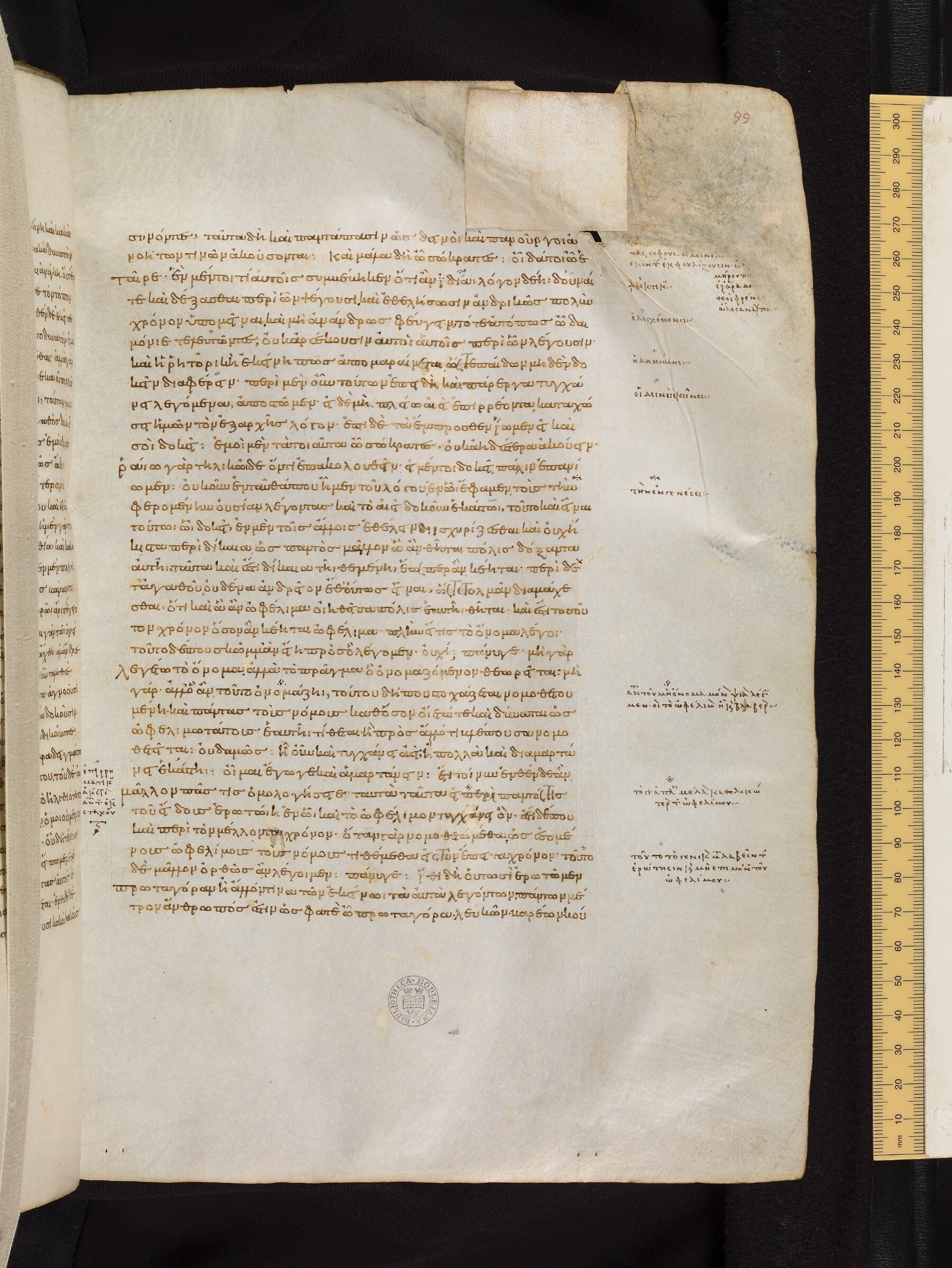
Starts on fol. 98v and continues on fol. 99r (page break inside this subsection). Clarke 39 fol. 98v runs from '(Σώ)κρατες, πείθοις ἃ λέγεις ὥσπερ ἐμέ, πλείων ἂν εἰρήνη καὶ κακὰ' on its first line (176a) to 'τὴν αὑτοῖς ὁμοιότητα τῆς διαγωγῆς ἀεὶ ἕξουσι, κακοὶ κακοῖς' on its last line (177a). 176a-b ('ἐνθένδε ἐκεῖσε φεύγειν ὅτι τάχιστα· φυγὴ δὲ ὁμοίωσις θεῷ κατὰ τὸ δυνατόν') is in the upper part of this page. Viewer: https://digital.bodleian.ox.ac.uk/objects/f57d074b-cff1-4172-8236-797c7b8f0403/surfaces/6761e642-e355-42ee-913a-90cbcf958679/ Clarke 39 fol. 99r runs from 'συνόντες, ταῦτα δὴ καὶ παντάπασιν ὡς δεινοὶ καὶ πανοῦργοι' on its first line (177a) to 'ὡς φατέ, ὦ Πρωταγόρα, λευκῶν, βαρέων, κού(φων)' on its last line (178b). 177b begins on line 2 ('οἶδά τοι, ὦ ἑταῖρε'); 177c has 'ἐπὶ δὲ τὰ ἔμπροσθεν ἴωμεν' on line 10 and 'οὐκοῦν ἐνταῦθά που ἦμεν τοῦ λόγου' on line 13. Viewer: https://digital.bodleian.ox.ac.uk/objects/f57d074b-cff1-4172-8236-797c7b8f0403/surfaces/08a559ac-d493-4431-ab1b-cede81f9516a/ Checked on the images. The Greek shown is Burnet's critical text; the copyist's wording differs from it in small details.
ἀνοίας λανθάνουσι τῷ μὲν ὁμοιούμενοι διὰ τὰς ἀδίκους πράξεις, τῷ δὲ ἀνομοιούμενοι. οὗ δὴ τίνουσι δίκην ζῶντες τὸν εἰκότα βίον ᾧ ὁμοιοῦνται· ἐὰν δʼ εἴπωμεν ὅτι, ἂν μὴ ἀπαλλαγῶσι τῆς δεινότητος, καὶ τελευτήσαντας αὐτοὺς ἐκεῖνος μὲν ὁ τῶν κακῶν καθαρὸς τόπος οὐ δέξεται, ἐνθάδε δὲ τὴν αὑτοῖς ὁμοιότητα τῆς διαγωγῆς ἀεὶ ἕξουσι, κακοὶ κακοῖς συνόντες, ταῦτα δὴ καὶ παντάπασιν ὡς δεινοὶ καὶ πανοῦργοι ἀνοήτων τινῶν ἀκούσονται. ΘΕΟ. καὶ μάλα δή, ὦ Σώκρατες.
through their unrighteous acts they are made like the one and unlike the other. They therefore pay the penalty for this by living a life that conforms to the pattern they resemble; and if we tell them that, unless they depart from their cleverness, the blessed place that is pure of all things evil will not receive them after death, and here on earth they will always live the life like themselves—evil men associating with evil—when they hear this, they will be so confident in their unscrupulous cleverness that they will think our words the talk of fools. THEO. Very true, Socrates.
Where on the image
On Clarke 39 fol. 99r. Clarke 39 fol. 99r runs from 'συνόντες, ταῦτα δὴ καὶ παντάπασιν ὡς δεινοὶ καὶ πανοῦργοι' on its first line (177a) to 'ὡς φατέ, ὦ Πρωταγόρα, λευκῶν, βαρέων, κού(φων)' on its last line (178b). 177b begins on line 2 ('οἶδά τοι, ὦ ἑταῖρε'); 177c has 'ἐπὶ δὲ τὰ ἔμπροσθεν ἴωμεν' on line 10 and 'οὐκοῦν ἐνταῦθά που ἦμεν τοῦ λόγου' on line 13. Viewer: https://digital.bodleian.ox.ac.uk/objects/f57d074b-cff1-4172-8236-797c7b8f0403/surfaces/08a559ac-d493-4431-ab1b-cede81f9516a/ Checked on the images. The Greek shown is Burnet's critical text; the copyist's wording differs from it in small details.
ΣΩ. οἶδά τοι, ὦ ἑταῖρε. ἓν μέντοι τι αὐτοῖς συμβέβηκεν· ὅταν ἰδίᾳ λόγον δέῃ δοῦναί τε καὶ δέξασθαι περὶ ὧν ψέγουσι, καὶ ἐθελήσωσιν ἀνδρικῶς πολὺν χρόνον ὑπομεῖναι καὶ μὴ ἀνάνδρως φυγεῖν, τότε ἀτόπως, ὦ δαιμόνιε, τελευτῶντες οὐκ ἀρέσκουσιν αὐτοὶ αὑτοῖς περὶ ὧν λέγουσι, καὶ ἡ ῥητορικὴ ἐκείνη πως ἀπομαραίνεται, ὥστε παίδων μηδὲν δοκεῖν διαφέρειν. περὶ μὲν οὖν τούτων, ἐπειδὴ καὶ πάρεργα τυγχάνει λεγόμενα, ἀποστῶμεν—εἰ δὲ μή, πλείω
SOC. Yes, my friend, I know. However, there is one thing that has happened to them: whenever they have to carry on a personal argument about the doctrines to which they object, if they are willing to stand their ground for a while like men and do not run away like cowards, then, my friend, they at last become strangely dissatisfied with themselves and their arguments; their brilliant rhetoric withers away, so that they seem no better than children. But this is a digression. Let us turn away from these matters—if we do not,
Where on the image
On Clarke 39 fol. 99r. Clarke 39 fol. 99r runs from 'συνόντες, ταῦτα δὴ καὶ παντάπασιν ὡς δεινοὶ καὶ πανοῦργοι' on its first line (177a) to 'ὡς φατέ, ὦ Πρωταγόρα, λευκῶν, βαρέων, κού(φων)' on its last line (178b). 177b begins on line 2 ('οἶδά τοι, ὦ ἑταῖρε'); 177c has 'ἐπὶ δὲ τὰ ἔμπροσθεν ἴωμεν' on line 10 and 'οὐκοῦν ἐνταῦθά που ἦμεν τοῦ λόγου' on line 13. Viewer: https://digital.bodleian.ox.ac.uk/objects/f57d074b-cff1-4172-8236-797c7b8f0403/surfaces/08a559ac-d493-4431-ab1b-cede81f9516a/ Checked on the images. The Greek shown is Burnet's critical text; the copyist's wording differs from it in small details.
ἀεὶ ἐπιρρέοντα καταχώσει ἡμῶν τὸν ἐξ ἀρχῆς λόγον—ἐπὶ δὲ τὰ ἔμπροσθεν ἴωμεν, εἰ καὶ σοὶ δοκεῖ. ΘΕΟ. ἐμοὶ μὲν τὰ τοιαῦτα, ὦ Σώκρατες, οὐκ ἀηδέστερα ἀκούειν· ῥᾴω γὰρ τηλικῷδε ὄντι ἐπακολουθεῖν. εἰ μέντοι δοκεῖ, πάλιν ἐπανίωμεν. ΣΩ. οὐκοῦν ἐνταῦθά που ἦμεν τοῦ λόγου, ἐν ᾧ ἔφαμεν τοὺς τὴν φερομένην οὐσίαν λέγοντας, καὶ τὸ ἀεὶ δοκοῦν ἑκάστῳ τοῦτο καὶ εἶναι τούτῳ ᾧ δοκεῖ, ἐν μὲν τοῖς ἄλλοις ἐθέλειν διισχυρίζεσθαι καὶ οὐχ ἥκιστα περὶ τὰ δίκαια, ὡς
they will come on like an ever-rising flood and bury in silt our original argument—and let us, if you please, proceed. THEO. To me, Socrates, such digressions are quite as agreeable as the argument; for they are easier for a man of my age to follow. However, if you prefer, let us return to our argument. SOC. Very well. We were at about the point in our argument where we said that those who declare that only motion is reality, and that whatever seems to each man really is to him to whom it seems, are willing to maintain their position in regard to other matters
Notes
- Greek: John Burnet, Platonis Opera (Oxford Classical Texts, 1900-1907), Perseus digital text. Square brackets mark words Burnet deletes.
- English: Harold North Fowler, Plato VII: Theaetetus, Sophist (Loeb Classical Library, Harvard University Press / Heinemann, 1921), Perseus tlg0059.tlg006.perseus-eng2. The English section breaks follow the translator's own Stephanus markers, so a few words may fall on the neighbouring side of a break compared with the Greek.
Cite
Sources
- Source: Oxford, Bodleian Library, MS. E. D. Clarke 39 fol. 96v-99r (Bodleian Libraries, University of Oxford, Digital Bodleian (IIIF)) + Burnet Greek (Perseus) + H. N. Fowler (1921) English (Perseus) (holding institution)
- Critical edition: Burnet, Platonis Opera (1900-1907), via Perseus
← previous · → next · v cycle view · l back to library