Plato, Symposium 201d-212c: Diotima on love and the ascent to beauty itself
Introduction
At the banquet held by the poet Agathon each guest gives a speech in praise of Love (Eros). Socrates does not give his own: he repeats what he says he learned from Diotima, a wise woman of Mantinea. Love, she taught, is not a god but a great spirit (daimon) that carries messages between gods and men; it is the desire to possess the good for ever, and so it is also a desire for immortality, which mortals reach by begetting, in body or in soul. The speech ends with the 'ladder' of love: from one beautiful body to all bodies, to souls, practices, laws and sciences, until the lover sees beauty itself, pure and unmixed; such a man, Diotima says, 'is destined to win the friendship of Heaven; he, above all men, is immortal' (212a).
The pages shown are from the Clarke Plato (Oxford, Bodleian Library, MS. E. D. Clarke 39), copied in Constantinople in 895, the oldest manuscript of the Symposium (siglum B). The passage runs over eleven pages, fol. 213r to fol. 218r, each of 34 lines. Each section below is one Stephanus subsection, linked to the page or pages that carry its words; the pages were identified by reading the first and last lines of each page on the image. The Greek is Burnet's critical text, not a transcription of the manuscript.
How was this verified? (Provenance)
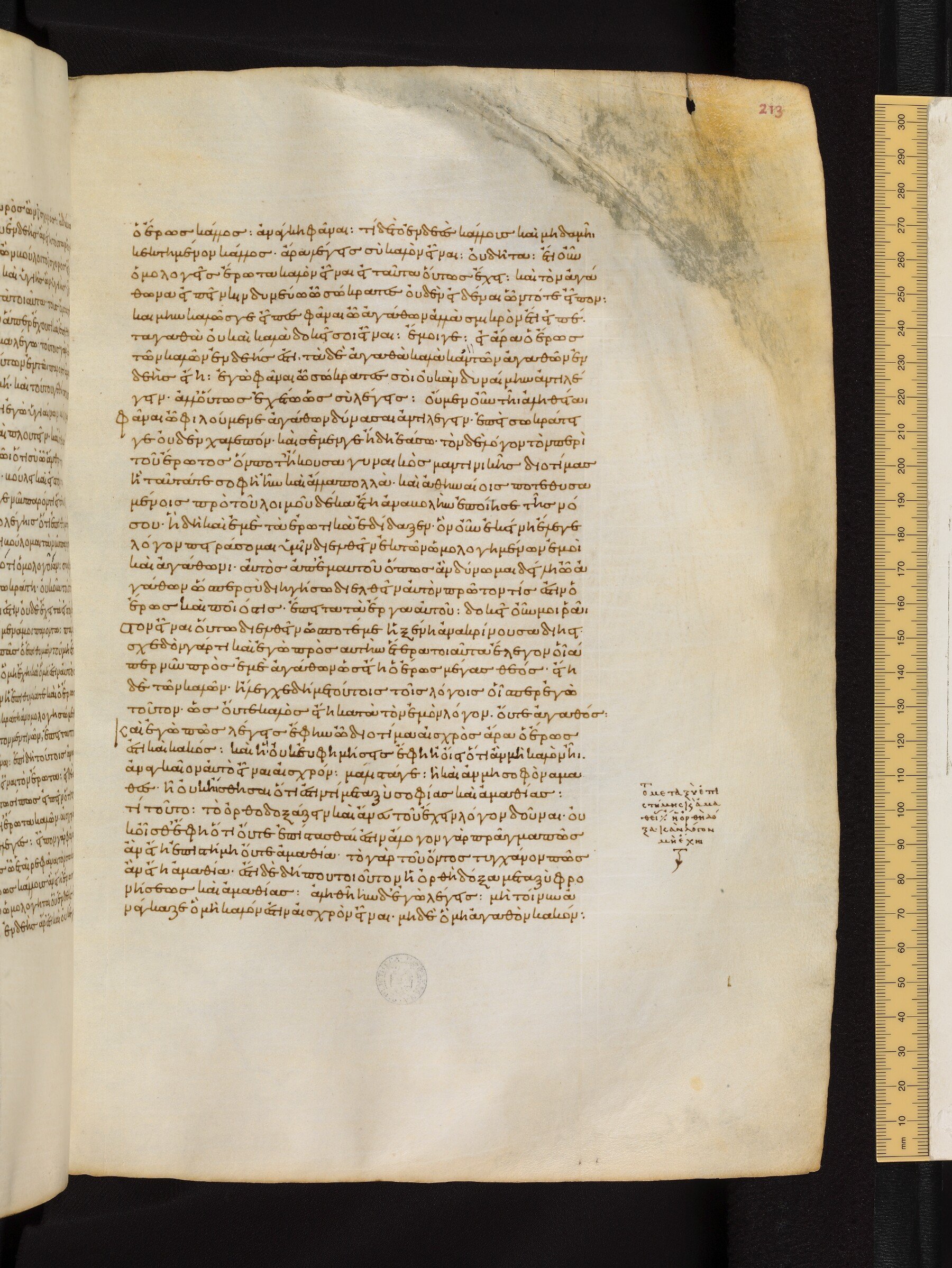
Where on the image
On Clarke 39 fol. 213r. Clarke 39 fol. 213r runs from 'ὁ Ἔρως κάλλος. ἀνάγκη, φάναι. τί δέ; τὸ ἐνδεὲς κάλλους καὶ μηδαμῇ' on its first line (201b) to 'μὴ τοίνυν ἀνάγκαζε ὃ μὴ καλόν ἐστιν αἰσχρὸν εἶναι, μηδὲ ὃ μὴ ἀγαθὸν κακόν' on its last line (202b). Viewer: https://digital.bodleian.ox.ac.uk/objects/f57d074b-cff1-4172-8236-797c7b8f0403/surfaces/e2a037e9-77e5-441a-8b28-7522e8ff5b18/ Checked on the images. The Greek shown is Burnet's critical text; the copyist's wording differs from it in small details.
καὶ σὲ μέν γε ἤδη ἐάσω· τὸν δὲ λόγον τὸν περὶ τοῦ Ἔρωτος, ὅν ποτʼ ἤκουσα γυναικὸς Μαντινικῆς Διοτίμας, ἣ ταῦτά τε σοφὴ ἦν καὶ ἄλλα πολλά—καὶ Ἀθηναίοις ποτὲ θυσαμένοις πρὸ τοῦ λοιμοῦ δέκα ἔτη ἀναβολὴν ἐποίησε τῆς νόσου, ἣ δὴ καὶ ἐμὲ τὰ ἐρωτικὰ ἐδίδαξεν—ὃν οὖν ἐκείνη ἔλεγε λόγον, πειράσομαι ὑμῖν διελθεῖν ἐκ τῶν ὡμολογημένων ἐμοὶ καὶ Ἀγάθωνι, αὐτὸς ἐπʼ ἐμαυτοῦ, ὅπως ἂν δύνωμαι. δεῖ δή, ὦ Ἀγάθων, ὥσπερ σὺ διηγήσω, διελθεῖν
whom you cannot contradict: Socrates you easily may. And now I shall let you alone, and proceed with the discourse upon Love which I heard one day from a Mantinean woman named Diotima: in this subject she was skilled, and in many others too; for once, by bidding the Athenians offer sacrifices ten years before the plague, she procured them so much delay in the advent of the sickness. Well, I also had my lesson from her in love-matters; so now I will try and follow up the points on which Agathon and I have just agreed by narrating to you all on my own account, as well as I am able, the speech she delivered to me. So first, Agathon, I must unfold,
Where on the image
On Clarke 39 fol. 213r. Clarke 39 fol. 213r runs from 'ὁ Ἔρως κάλλος. ἀνάγκη, φάναι. τί δέ; τὸ ἐνδεὲς κάλλους καὶ μηδαμῇ' on its first line (201b) to 'μὴ τοίνυν ἀνάγκαζε ὃ μὴ καλόν ἐστιν αἰσχρὸν εἶναι, μηδὲ ὃ μὴ ἀγαθὸν κακόν' on its last line (202b). Viewer: https://digital.bodleian.ox.ac.uk/objects/f57d074b-cff1-4172-8236-797c7b8f0403/surfaces/e2a037e9-77e5-441a-8b28-7522e8ff5b18/ Checked on the images. The Greek shown is Burnet's critical text; the copyist's wording differs from it in small details.
αὐτὸν πρῶτον, τίς ἐστιν ὁ Ἔρως καὶ ποῖός τις, ἔπειτα τὰ ἔργα αὐτοῦ. δοκεῖ οὖν μοι ῥᾷστον εἶναι οὕτω διελθεῖν, ὥς ποτέ με ἡ ξένη ἀνακρίνουσα διῄει. σχεδὸν γάρ τι καὶ ἐγὼ πρὸς αὐτὴν ἕτερα τοιαῦτα ἔλεγον οἷάπερ νῦν πρὸς ἐμὲ Ἀγάθων, ὡς εἴη ὁ Ἔρως μέγας θεός, εἴη δὲ τῶν καλῶν· ἤλεγχε δή με τούτοις τοῖς λόγοις οἷσπερ ἐγὼ τοῦτον, ὡς οὔτε καλὸς εἴη κατὰ τὸν ἐμὸν λόγον οὔτε ἀγαθός. καὶ ἐγώ, πῶς λέγεις, ἔφην, ὦ Διοτίμα; αἰσχρὸς ἄρα ὁ Ἔρως ἐστὶ καὶ κακός; καὶ ἥ, οὐκ εὐφημήσεις; ἔφη· ἢ οἴει, ὅτι ἂν μὴ καλὸν ᾖ, ἀναγκαῖον αὐτὸ εἶναι αἰσχρόν;
in your manner of exposition, who and what sort of being is Love, and then I shall tell of his works. The readiest way, I think, will be to give my description that form of question and answer which the stranger woman used for hers that day. For I spoke to her in much the same terms as Agathon addressed just now to me, saying Love was a great god, and was of beautiful things; and she refuted me with the very arguments I have brought against our young friend, showing that by my account that god was neither beautiful nor good. How do you mean, Diotima? said I; is Love then ugly and bad? Peace, for shame! she replied: or do you imagine that whatever is not beautiful must needs be ugly?
Where on the image
On Clarke 39 fol. 213r. Clarke 39 fol. 213r runs from 'ὁ Ἔρως κάλλος. ἀνάγκη, φάναι. τί δέ; τὸ ἐνδεὲς κάλλους καὶ μηδαμῇ' on its first line (201b) to 'μὴ τοίνυν ἀνάγκαζε ὃ μὴ καλόν ἐστιν αἰσχρὸν εἶναι, μηδὲ ὃ μὴ ἀγαθὸν κακόν' on its last line (202b). Viewer: https://digital.bodleian.ox.ac.uk/objects/f57d074b-cff1-4172-8236-797c7b8f0403/surfaces/e2a037e9-77e5-441a-8b28-7522e8ff5b18/ Checked on the images. The Greek shown is Burnet's critical text; the copyist's wording differs from it in small details.
μάλιστά γε. ἦ καὶ ἂν μὴ σοφόν, ἀμαθές; ἢ οὐκ ᾔσθησαι ὅτι ἔστιν τι μεταξὺ σοφίας καὶ ἀμαθίας; τί τοῦτο; τὸ ὀρθὰ δοξάζειν καὶ ἄνευ τοῦ ἔχειν λόγον δοῦναι οὐκ οἶσθʼ, ἔφη, ὅτι οὔτε ἐπίστασθαί ἐστιν—ἄλογον γὰρ πρᾶγμα πῶς ἂν εἴη ἐπιστήμη; —οὔτε ἀμαθία—τὸ γὰρ τοῦ ὄντος τυγχάνον πῶς ἂν εἴη ἀμαθία; —ἔστι δὲ δήπου τοιοῦτον ἡ ὀρθὴ δόξα, μεταξὺ φρονήσεως καὶ ἀμαθίας. ἀληθῆ, ἦν δʼ ἐγώ, λέγεις.
To be sure I do. And what is not skilled, ignorant? Have you not observed that there is something halfway between skill and ignorance? What is that? You know, of course, that to have correct opinion, if you can give no reason for it, is neither full knowledge—how can an unreasoned thing be knowledge?—nor yet ignorance; for what hits on the truth cannot be ignorance. So correct opinion, I take it, is just in that position, between understanding and ignorance. Quite true, I said.
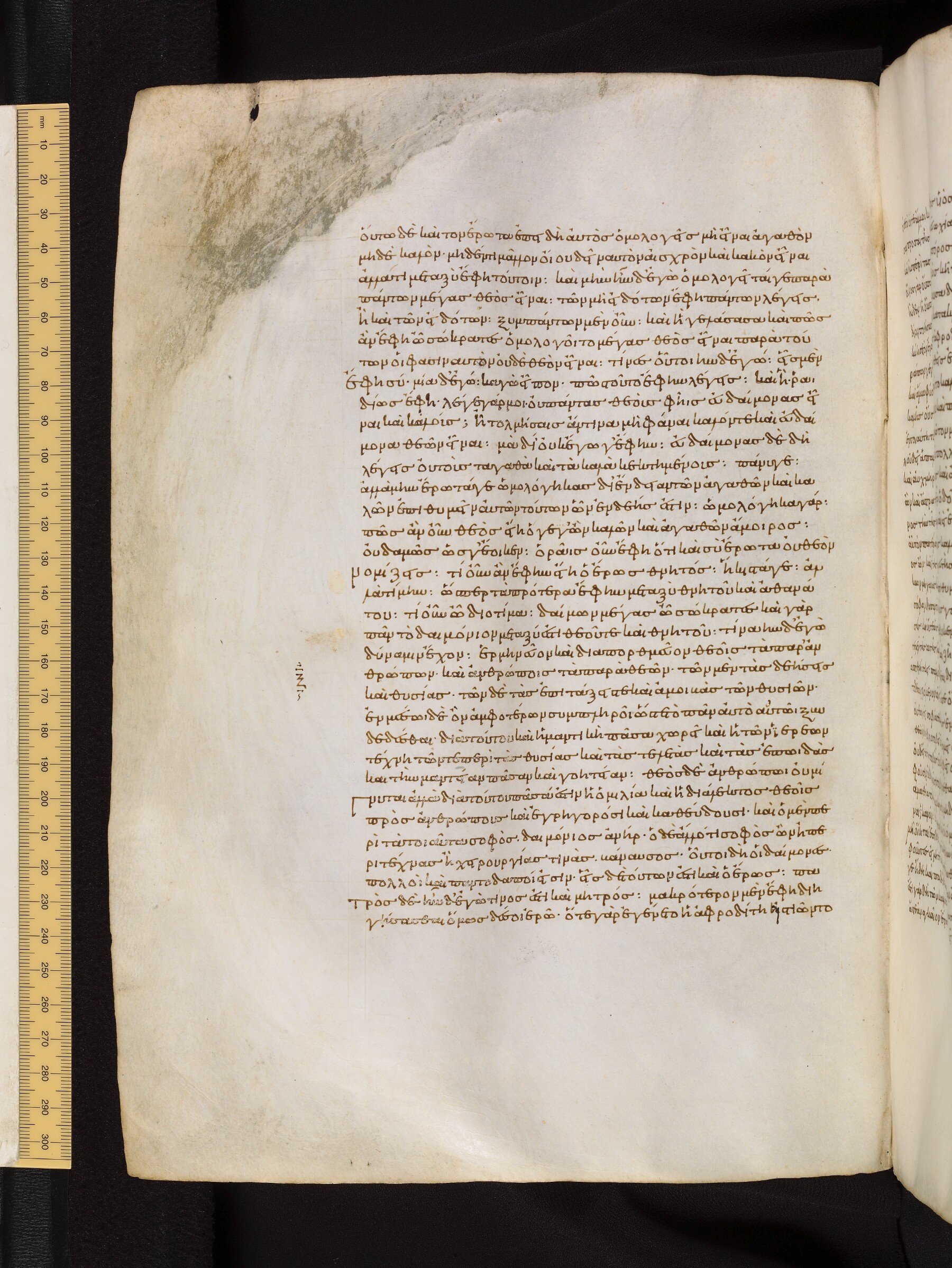
Where on the image
Starts on fol. 213r and continues on fol. 213v (page break inside this subsection). Clarke 39 fol. 213r runs from 'ὁ Ἔρως κάλλος. ἀνάγκη, φάναι. τί δέ; τὸ ἐνδεὲς κάλλους καὶ μηδαμῇ' on its first line (201b) to 'μὴ τοίνυν ἀνάγκαζε ὃ μὴ καλόν ἐστιν αἰσχρὸν εἶναι, μηδὲ ὃ μὴ ἀγαθὸν κακόν' on its last line (202b). Viewer: https://digital.bodleian.ox.ac.uk/objects/f57d074b-cff1-4172-8236-797c7b8f0403/surfaces/e2a037e9-77e5-441a-8b28-7522e8ff5b18/ Clarke 39 fol. 213v runs from 'οὕτω δὲ καὶ τὸν Ἔρωτα, ἐπειδὴ αὐτὸς ὁμολογεῖς μὴ εἶναι ἀγαθὸν' on its first line (202b) to 'ὅτε γὰρ ἐγένετο ἡ Ἀφροδίτη, ἡστιῶντο' on its last line (203b). Viewer: https://digital.bodleian.ox.ac.uk/objects/f57d074b-cff1-4172-8236-797c7b8f0403/surfaces/d73794f2-db8f-419f-a450-8b8066fb30f3/ Checked on the images. The Greek shown is Burnet's critical text; the copyist's wording differs from it in small details.
μὴ τοίνυν ἀνάγκαζε ὃ μὴ καλόν ἐστιν αἰσχρὸν εἶναι, μηδὲ ὃ μὴ ἀγαθόν, κακόν. οὕτω δὲ καὶ τὸν ἔρωτα ἐπειδὴ αὐτὸς ὁμολογεῖς μὴ εἶναι ἀγαθὸν μηδὲ καλόν, μηδέν τι μᾶλλον οἴου δεῖν αὐτὸν αἰσχρὸν καὶ κακὸν εἶναι, ἀλλά τι μεταξύ, ἔφη, τούτοιν. καὶ μήν, ἦν δʼ ἐγώ, ὁμολογεῖταί γε παρὰ πάντων μέγας θεὸς εἶναι. τῶν μὴ εἰδότων, ἔφη, πάντων λέγεις, ἢ καὶ τῶν εἰδότων; συμπάντων μὲν οὖν. καὶ ἣ γελάσασα καὶ πῶς ἄν, ἔφη, ὦ Σώκρατες,
Then do not compel what is not beautiful to be ugly, she said, or what is not good to be bad. Likewise of Love, when you find yourself admitting that he is not good nor beautiful, do not therefore suppose he must be ugly and bad, but something betwixt the two. And what of the notion, I asked, to which every one agrees, that he is a great god? Every one? People who do not know, she rejoined, or those who know also? I mean everybody in the world.
Where on the image
On Clarke 39 fol. 213v. Clarke 39 fol. 213v runs from 'οὕτω δὲ καὶ τὸν Ἔρωτα, ἐπειδὴ αὐτὸς ὁμολογεῖς μὴ εἶναι ἀγαθὸν' on its first line (202b) to 'ὅτε γὰρ ἐγένετο ἡ Ἀφροδίτη, ἡστιῶντο' on its last line (203b). Viewer: https://digital.bodleian.ox.ac.uk/objects/f57d074b-cff1-4172-8236-797c7b8f0403/surfaces/d73794f2-db8f-419f-a450-8b8066fb30f3/ Checked on the images. The Greek shown is Burnet's critical text; the copyist's wording differs from it in small details.
ὁμολογοῖτο μέγας θεὸς εἶναι παρὰ τούτων, οἵ φασιν αὐτὸν οὐδὲ θεὸν εἶναι; τίνες οὗτοι; ἦν δʼ ἐγώ. εἷς μέν, ἔφη, σύ, μία δʼ ἐγώ. κἀγὼ εἶπον, πῶς τοῦτο, ἔφην, λέγεις; καὶ ἥ, ῥᾳδίως, ἔφη. λέγε γάρ μοι, οὐ πάντας θεοὺς φῂς εὐδαίμονας εἶναι καὶ καλούς; ἢ τολμήσαις ἄν τινα μὴ φάναι καλόν τε καὶ εὐδαίμονα θεῶν εἶναι; μὰ Δίʼ οὐκ ἔγωγʼ, ἔφην. εὐδαίμονας δὲ δὴ λέγεις οὐ τοὺς τἀγαθὰ καὶ τὰ καλὰ κεκτημένους; πάνυ γε.
At this she laughed and said, But how, Socrates, can those agree that he is a great god who say he is no god at all? What persons are they? I asked. You are one, she replied, and I am another. How do you make that out? I said. Easily, said she; tell me, do you not say that all gods are happy and beautiful? Or will you dare to deny that any god is beautiful and happy? Bless me! I exclaimed, not I. And do you not call those happy who possess good and beautiful things?
Where on the image
On Clarke 39 fol. 213v. Clarke 39 fol. 213v runs from 'οὕτω δὲ καὶ τὸν Ἔρωτα, ἐπειδὴ αὐτὸς ὁμολογεῖς μὴ εἶναι ἀγαθὸν' on its first line (202b) to 'ὅτε γὰρ ἐγένετο ἡ Ἀφροδίτη, ἡστιῶντο' on its last line (203b). Viewer: https://digital.bodleian.ox.ac.uk/objects/f57d074b-cff1-4172-8236-797c7b8f0403/surfaces/d73794f2-db8f-419f-a450-8b8066fb30f3/ Checked on the images. The Greek shown is Burnet's critical text; the copyist's wording differs from it in small details.
ἀλλὰ μὴν Ἔρωτά γε ὡμολόγηκας διʼ ἔνδειαν τῶν ἀγαθῶν καὶ καλῶν ἐπιθυμεῖν αὐτῶν τούτων ὧν ἐνδεής ἐστιν. ὡμολόγηκα γάρ. πῶς ἂν οὖν θεὸς εἴη ὅ γε τῶν καλῶν καὶ ἀγαθῶν ἄμοιρος; οὐδαμῶς, ὥς γʼ ἔοικεν. ὁρᾷς οὖν, ἔφη, ὅτι καὶ σὺ ἔρωτα οὐ θεὸν νομίζεις; τί οὖν ἄν, ἔφην, εἴη ὁ Ἔρως; θνητός; ἥκιστά γε. ἀλλὰ τί μήν; ὥσπερ τὰ πρότερα, ἔφη, μεταξὺ θνητοῦ καὶ ἀθανάτου. τί οὖν, ὦ Διοτίμα; δαίμων μέγας, ὦ Σώκρατες· καὶ γὰρ πᾶν τὸ δαιμόνιον
Certainly I do. But you have admitted that Love, from lack of good and beautiful things, desires these very things that he lacks. Yes, I have. How then can he be a god, if he is devoid of things beautiful and good? By no means, it appears. So you see, she said, you are a person who does not consider Love to be a god. What then, I asked, can Love be? A mortal? Anything but that.
Where on the image
On Clarke 39 fol. 213v. Clarke 39 fol. 213v runs from 'οὕτω δὲ καὶ τὸν Ἔρωτα, ἐπειδὴ αὐτὸς ὁμολογεῖς μὴ εἶναι ἀγαθὸν' on its first line (202b) to 'ὅτε γὰρ ἐγένετο ἡ Ἀφροδίτη, ἡστιῶντο' on its last line (203b). Viewer: https://digital.bodleian.ox.ac.uk/objects/f57d074b-cff1-4172-8236-797c7b8f0403/surfaces/d73794f2-db8f-419f-a450-8b8066fb30f3/ Checked on the images. The Greek shown is Burnet's critical text; the copyist's wording differs from it in small details.
μεταξύ ἐστι θεοῦ τε καὶ θνητοῦ. τίνα, ἦν δʼ ἐγώ, δύναμιν ἔχον; ἑρμηνεῦον καὶ διαπορθμεῦον θεοῖς τὰ παρʼ ἀνθρώπων καὶ ἀνθρώποις τὰ παρὰ θεῶν, τῶν μὲν τὰς δεήσεις καὶ θυσίας, τῶν δὲ τὰς ἐπιτάξεις τε καὶ ἀμοιβὰς τῶν θυσιῶν, ἐν μέσῳ δὲ ὂν ἀμφοτέρων συμπληροῖ, ὥστε τὸ πᾶν αὐτὸ αὑτῷ συνδεδέσθαι. διὰ τούτου καὶ ἡ μαντικὴ πᾶσα χωρεῖ καὶ ἡ τῶν ἱερέων τέχνη τῶν τε περὶ τὰς θυσίας καὶ τελετὰς
Well what? As I previously suggested, between a mortal and an immortal. And what is that, Diotima? A great spirit, Socrates: for the whole of the spiritual is between divine and mortal. Possessing what power? I asked. Interpreting and transporting human things to the gods and divine things to men; entreaties and sacrifices from below, and ordinances and requitals from above: being midway between, it makes each to supplement the other, so that the whole is combined in one. Through it are conveyed all divination and priestcraft concerning sacrifice and ritual
Where on the image
On Clarke 39 fol. 213v. Clarke 39 fol. 213v runs from 'οὕτω δὲ καὶ τὸν Ἔρωτα, ἐπειδὴ αὐτὸς ὁμολογεῖς μὴ εἶναι ἀγαθὸν' on its first line (202b) to 'ὅτε γὰρ ἐγένετο ἡ Ἀφροδίτη, ἡστιῶντο' on its last line (203b). Viewer: https://digital.bodleian.ox.ac.uk/objects/f57d074b-cff1-4172-8236-797c7b8f0403/surfaces/d73794f2-db8f-419f-a450-8b8066fb30f3/ Checked on the images. The Greek shown is Burnet's critical text; the copyist's wording differs from it in small details.
καὶ τὰς ἐπῳδὰς καὶ τὴν μαντείαν πᾶσαν καὶ γοητείαν. θεὸς δὲ ἀνθρώπῳ οὐ μείγνυται, ἀλλὰ διὰ τούτου πᾶσά ἐστιν ἡ ὁμιλία καὶ ἡ διάλεκτος θεοῖς πρὸς ἀνθρώπους, καὶ ἐγρηγορόσι καὶ καθεύδουσι· καὶ ὁ μὲν περὶ τὰ τοιαῦτα σοφὸς δαιμόνιος ἀνήρ, ὁ δὲ ἄλλο τι σοφὸς ὢν ἢ περὶ τέχνας ἢ χειρουργίας τινὰς βάναυσος. οὗτοι δὴ οἱ δαίμονες πολλοὶ καὶ παντοδαποί εἰσιν, εἷς δὲ τούτων ἐστὶ καὶ ὁ Ἔρως. πατρὸς δέ, ἦν δʼ ἐγώ, τίνος ἐστὶ καὶ μητρός;
and incantations, and all soothsaying and sorcery. God with man does not mingle: but the spiritual is the means of all society and converse of men with gods and of gods with men, whether waking or asleep. Whosoever has skill in these affairs is a spiritual man to have it in other matters, as in common arts and crafts, is for the mechanical. Many and multifarious are these spirits, and one of them is Love. From what father and mother sprung? I asked.
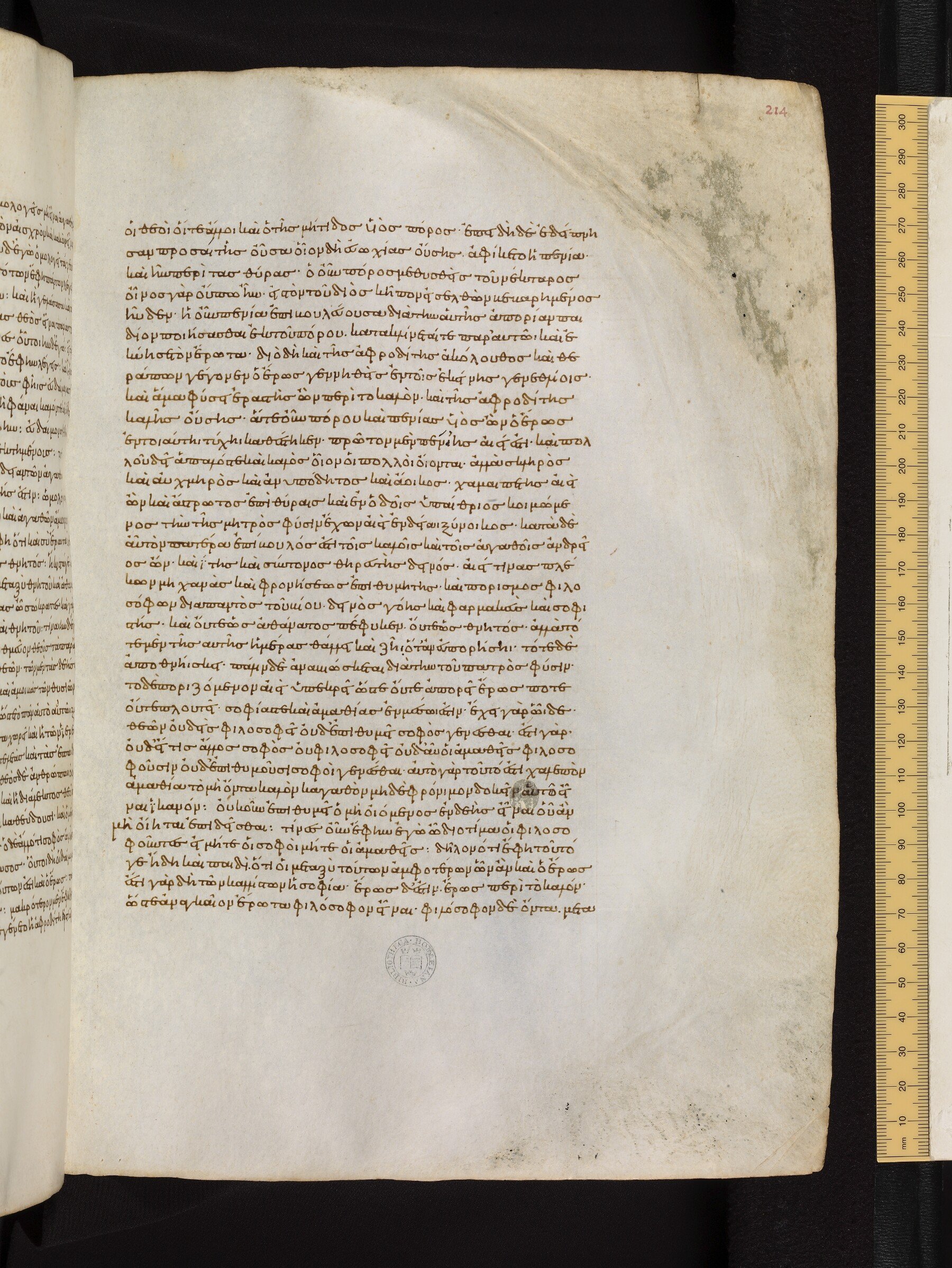
Where on the image
Starts on fol. 213v and continues on fol. 214r (page break inside this subsection). Clarke 39 fol. 213v runs from 'οὕτω δὲ καὶ τὸν Ἔρωτα, ἐπειδὴ αὐτὸς ὁμολογεῖς μὴ εἶναι ἀγαθὸν' on its first line (202b) to 'ὅτε γὰρ ἐγένετο ἡ Ἀφροδίτη, ἡστιῶντο' on its last line (203b). Viewer: https://digital.bodleian.ox.ac.uk/objects/f57d074b-cff1-4172-8236-797c7b8f0403/surfaces/d73794f2-db8f-419f-a450-8b8066fb30f3/ Clarke 39 fol. 214r runs from 'οἱ θεοὶ οἵ τε ἄλλοι καὶ ὁ τῆς Μήτιδος ὑὸς Πόρος' on its first line (203b) to 'ὥστε ἀναγκαῖον Ἔρωτα φιλόσοφον εἶναι, φιλόσοφον δὲ ὄντα μετα(ξὺ)' on its last line (204b). Viewer: https://digital.bodleian.ox.ac.uk/objects/f57d074b-cff1-4172-8236-797c7b8f0403/surfaces/01f48b78-e730-4890-b8ba-19c3f47ca156/ Checked on the images. The Greek shown is Burnet's critical text; the copyist's wording differs from it in small details.
μακρότερον μέν, ἔφη, διηγήσασθαι· ὅμως δέ σοι ἐρῶ. ὅτε γὰρ ἐγένετο ἡ Ἀφροδίτη, ἡστιῶντο οἱ θεοὶ οἵ τε ἄλλοι καὶ ὁ τῆς Μήτιδος ὑὸς Πόρος. ἐπειδὴ δὲ ἐδείπνησαν, προσαιτήσουσα οἷον δὴ εὐωχίας οὔσης ἀφίκετο ἡ Πενία, καὶ ἦν περὶ τὰς θύρας. ὁ οὖν Πόρος μεθυσθεὶς τοῦ νέκταρος— οἶνος γὰρ οὔπω ἦν—εἰς τὸν τοῦ Διὸς κῆπον εἰσελθὼν βεβαρημένος ηὗδεν. ἡ οὖν Πενία ἐπιβουλεύουσα διὰ τὴν αὑτῆς ἀπορίαν παιδίον ποιήσασθαι ἐκ τοῦ Πόρου, κατακλίνεταί
That is rather a long story, she replied; but still, I will tell it you. When Aphrodite was born, the gods made a great feast, and among the company was Resource the son of Cunning. And when they had banqueted there came Poverty abegging, as well she might in an hour of good cheer, and hung about the door. Now Resource, grown tipsy with nectar—for wine as yet there was none—went into the garden of Zeus, and there, overcome with heaviness, slept. Then Poverty, being of herself so resourceless, devised the scheme of having a child by Resource,
Where on the image
On Clarke 39 fol. 214r. Clarke 39 fol. 214r runs from 'οἱ θεοὶ οἵ τε ἄλλοι καὶ ὁ τῆς Μήτιδος ὑὸς Πόρος' on its first line (203b) to 'ὥστε ἀναγκαῖον Ἔρωτα φιλόσοφον εἶναι, φιλόσοφον δὲ ὄντα μετα(ξὺ)' on its last line (204b). Viewer: https://digital.bodleian.ox.ac.uk/objects/f57d074b-cff1-4172-8236-797c7b8f0403/surfaces/01f48b78-e730-4890-b8ba-19c3f47ca156/ Checked on the images. The Greek shown is Burnet's critical text; the copyist's wording differs from it in small details.
τε παρʼ αὐτῷ καὶ ἐκύησε τὸν ἔρωτα. διὸ δὴ καὶ τῆς Ἀφροδίτης ἀκόλουθος καὶ θεράπων γέγονεν ὁ Ἔρως, γεννηθεὶς ἐν τοῖς ἐκείνης γενεθλίοις, καὶ ἅμα φύσει ἐραστὴς ὢν περὶ τὸ καλὸν καὶ τῆς Ἀφροδίτης καλῆς οὔσης. ἅτε οὖν Πόρου καὶ Πενίας ὑὸς ὢν ὁ Ἔρως ἐν τοιαύτῃ τύχῃ καθέστηκεν. πρῶτον μὲν πένης ἀεί ἐστι, καὶ πολλοῦ δεῖ ἁπαλός τε καὶ καλός, οἷον οἱ πολλοὶ οἴονται, ἀλλὰ σκληρὸς
and lying down by his side she conceived Love. Hence it is that Love from the beginning has been attendant and minister to Aphrodite, since he was begotten on the day of her birth, and is, moreover, by nature a lover bent on beauty since Aphrodite is beautiful. Now, as the son of Resource and Poverty, Love is in a peculiar case. First, he is ever poor, and far from tender or beautiful as most suppose him:
Where on the image
On Clarke 39 fol. 214r. Clarke 39 fol. 214r runs from 'οἱ θεοὶ οἵ τε ἄλλοι καὶ ὁ τῆς Μήτιδος ὑὸς Πόρος' on its first line (203b) to 'ὥστε ἀναγκαῖον Ἔρωτα φιλόσοφον εἶναι, φιλόσοφον δὲ ὄντα μετα(ξὺ)' on its last line (204b). Viewer: https://digital.bodleian.ox.ac.uk/objects/f57d074b-cff1-4172-8236-797c7b8f0403/surfaces/01f48b78-e730-4890-b8ba-19c3f47ca156/ Checked on the images. The Greek shown is Burnet's critical text; the copyist's wording differs from it in small details.
καὶ αὐχμηρὸς καὶ ἀνυπόδητος καὶ ἄοικος, χαμαιπετὴς ἀεὶ ὢν καὶ ἄστρωτος, ἐπὶ θύραις καὶ ἐν ὁδοῖς ὑπαίθριος κοιμώμενος, τὴν τῆς μητρὸς φύσιν ἔχων, ἀεὶ ἐνδείᾳ σύνοικος. κατὰ δὲ αὖ τὸν πατέρα ἐπίβουλός ἐστι τοῖς καλοῖς καὶ τοῖς ἀγαθοῖς, ἀνδρεῖος ὢν καὶ ἴτης καὶ σύντονος, θηρευτὴς δεινός, ἀεί τινας πλέκων μηχανάς, καὶ φρονήσεως ἐπιθυμητὴς καὶ πόριμος, φιλοσοφῶν διὰ παντὸς τοῦ βίου, δεινὸς γόης καὶ φαρμακεὺς καὶ σοφιστής· καὶ οὔτε ὡς
rather is he hard and parched, shoeless and homeless; on the bare ground always he lies with no bedding, and takes his rest on doorsteps and waysides in the open air; true to his mother’s nature, he ever dwells with want. But he takes after his father in scheming for all that is beautiful and good; for he is brave, strenuous and high-strung, a famous hunter, always weaving some stratagem; desirous and competent of wisdom, throughout life ensuing the truth; a master of jugglery, witchcraft,
Where on the image
On Clarke 39 fol. 214r. Clarke 39 fol. 214r runs from 'οἱ θεοὶ οἵ τε ἄλλοι καὶ ὁ τῆς Μήτιδος ὑὸς Πόρος' on its first line (203b) to 'ὥστε ἀναγκαῖον Ἔρωτα φιλόσοφον εἶναι, φιλόσοφον δὲ ὄντα μετα(ξὺ)' on its last line (204b). Viewer: https://digital.bodleian.ox.ac.uk/objects/f57d074b-cff1-4172-8236-797c7b8f0403/surfaces/01f48b78-e730-4890-b8ba-19c3f47ca156/ Checked on the images. The Greek shown is Burnet's critical text; the copyist's wording differs from it in small details.
ἀθάνατος πέφυκεν οὔτε ὡς θνητός, ἀλλὰ τοτὲ μὲν τῆς αὐτῆς ἡμέρας θάλλει τε καὶ ζῇ, ὅταν εὐπορήσῃ, τοτὲ δὲ ἀποθνῄσκει, πάλιν δὲ ἀναβιώσκεται διὰ τὴν τοῦ πατρὸς φύσιν, τὸ δὲ ποριζόμενον ἀεὶ ὑπεκρεῖ, ὥστε οὔτε ἀπορεῖ Ἔρως ποτὲ οὔτε πλουτεῖ, σοφίας τε αὖ καὶ ἀμαθίας ἐν μέσῳ ἐστίν.
>and artful speech. By birth neither immortal nor mortal, in the selfsame day he is flourishing and alive at the hour when he is abounding in resource; at another he is dying, and then reviving again by force of his father’s nature: yet the resources that he gets will ever be ebbing away; so that Love is at no time either resourceless or wealthy, and furthermore, he stands midway betwixt wisdom and ignorance. The position is this: no gods ensue wisdom or desire to be made wise;
Where on the image
On Clarke 39 fol. 214r. Clarke 39 fol. 214r runs from 'οἱ θεοὶ οἵ τε ἄλλοι καὶ ὁ τῆς Μήτιδος ὑὸς Πόρος' on its first line (203b) to 'ὥστε ἀναγκαῖον Ἔρωτα φιλόσοφον εἶναι, φιλόσοφον δὲ ὄντα μετα(ξὺ)' on its last line (204b). Viewer: https://digital.bodleian.ox.ac.uk/objects/f57d074b-cff1-4172-8236-797c7b8f0403/surfaces/01f48b78-e730-4890-b8ba-19c3f47ca156/ Checked on the images. The Greek shown is Burnet's critical text; the copyist's wording differs from it in small details.
ἔχει γὰρ ὧδε. θεῶν οὐδεὶς φιλοσοφεῖ οὐδʼ ἐπιθυμεῖ σοφὸς γενέσθαι—ἔστι γάρ—οὐδʼ εἴ τις ἄλλος σοφός, οὐ φιλοσοφεῖ. οὐδʼ αὖ οἱ ἀμαθεῖς φιλοσοφοῦσιν οὐδʼ ἐπιθυμοῦσι σοφοὶ γενέσθαι· αὐτὸ γὰρ τοῦτό ἐστι χαλεπὸν ἀμαθία, τὸ μὴ ὄντα καλὸν κἀγαθὸν μηδὲ φρόνιμον δοκεῖν αὑτῷ εἶναι ἱκανόν. οὔκουν ἐπιθυμεῖ ὁ μὴ οἰόμενος ἐνδεὴς εἶναι οὗ ἂν μὴ οἴηται ἐπιδεῖσθαι. τίνες οὖν, ἔφην ἐγώ, ὦ Διοτίμα, οἱ φιλοσοφοῦντες, εἰ μήτε οἱ σοφοὶ μήτε οἱ ἀμαθεῖς;
such they are already; nor does anyone else that is wise ensue it. Neither do the ignorant ensue wisdom, nor desire to be made wise: in this very point is ignorance distressing, when a person who is not comely or worthy or intelligent is satisfied with himself. The man who does not feel himself defective has no desire for that whereof he feels no defect. Who then, Diotima, I asked, are the followers of wisdom, if they are neither the wise nor the ignorant?
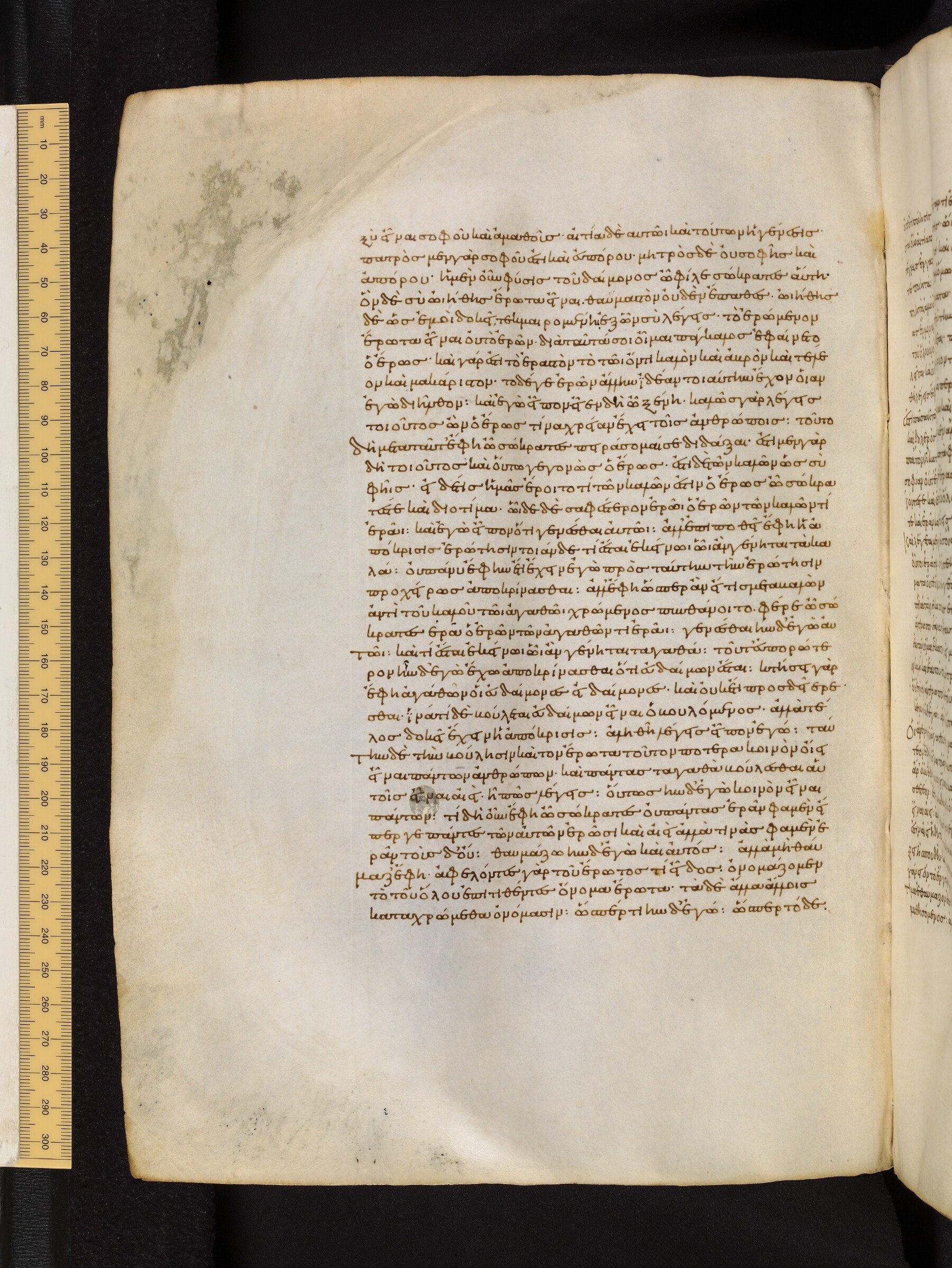
Where on the image
Starts on fol. 214r and continues on fol. 214v (page break inside this subsection). Clarke 39 fol. 214r runs from 'οἱ θεοὶ οἵ τε ἄλλοι καὶ ὁ τῆς Μήτιδος ὑὸς Πόρος' on its first line (203b) to 'ὥστε ἀναγκαῖον Ἔρωτα φιλόσοφον εἶναι, φιλόσοφον δὲ ὄντα μετα(ξὺ)' on its last line (204b). Viewer: https://digital.bodleian.ox.ac.uk/objects/f57d074b-cff1-4172-8236-797c7b8f0403/surfaces/01f48b78-e730-4890-b8ba-19c3f47ca156/ Clarke 39 fol. 214v runs from '(μεταξὺ) εἶναι σοφοῦ καὶ ἀμαθοῦς. αἰτία δὲ αὐτῷ καὶ τούτων ἡ γένεσις' on its first line (204b) to 'ὥσπερ τί; ἦν δʼ ἐγώ. ὥσπερ τόδε' on its last line (205b). Viewer: https://digital.bodleian.ox.ac.uk/objects/f57d074b-cff1-4172-8236-797c7b8f0403/surfaces/3de7c403-9a25-4627-8170-d0baf3df42ff/ Checked on the images. The Greek shown is Burnet's critical text; the copyist's wording differs from it in small details.
δῆλον δή, ἔφη, τοῦτό γε ἤδη καὶ παιδί, ὅτι οἱ μεταξὺ τούτων ἀμφοτέρων, ὧν ἂν εἴη καὶ ὁ Ἔρως. ἔστιν γὰρ δὴ τῶν καλλίστων ἡ σοφία, Ἔρως δʼ ἐστὶν ἔρως περὶ τὸ καλόν, ὥστε ἀναγκαῖον ἔρωτα φιλόσοφον εἶναι, φιλόσοφον δὲ ὄντα μεταξὺ εἶναι σοφοῦ καὶ ἀμαθοῦς. αἰτία δὲ αὐτῷ καὶ τούτων ἡ γένεσις· πατρὸς μὲν γὰρ σοφοῦ ἐστι καὶ εὐπόρου, μητρὸς δὲ οὐ σοφῆς καὶ ἀπόρου. ἡ μὲν οὖν φύσις τοῦ δαίμονος, ὦ φίλε Σώκρατες, αὕτη· ὃν δὲ σὺ ᾠήθης ἔρωτα
Why, a child could tell by this time, she answered, that they are the intermediate sort, and amongst these also is Love. For wisdom has to do with the fairest things, and Love is a love directed to what is fair; so that Love must needs be a friend of wisdom, and, as such, must be between wise and ignorant. This again is a result for which he has to thank his origin: for while he comes of a wise and resourceful father, his mother is unwise and resourceless. Such, my good Socrates, is the nature of this spirit. That you should have formed your other notion of Love
Where on the image
On Clarke 39 fol. 214v. Clarke 39 fol. 214v runs from '(μεταξὺ) εἶναι σοφοῦ καὶ ἀμαθοῦς. αἰτία δὲ αὐτῷ καὶ τούτων ἡ γένεσις' on its first line (204b) to 'ὥσπερ τί; ἦν δʼ ἐγώ. ὥσπερ τόδε' on its last line (205b). Viewer: https://digital.bodleian.ox.ac.uk/objects/f57d074b-cff1-4172-8236-797c7b8f0403/surfaces/3de7c403-9a25-4627-8170-d0baf3df42ff/ Checked on the images. The Greek shown is Burnet's critical text; the copyist's wording differs from it in small details.
εἶναι, θαυμαστὸν οὐδὲν ἔπαθες. ᾠήθης δέ, ὡς ἐμοὶ δοκεῖ τεκμαιρομένῃ ἐξ ὧν σὺ λέγεις, τὸ ἐρώμενον ἔρωτα εἶναι, οὐ τὸ ἐρῶν· διὰ ταῦτά σοι οἶμαι πάγκαλος ἐφαίνετο ὁ Ἔρως. καὶ γὰρ ἔστι τὸ ἐραστὸν τὸ τῷ ὄντι καλὸν καὶ ἁβρὸν καὶ τέλεον καὶ μακαριστόν· τὸ δέ γε ἐρῶν ἄλλην ἰδέαν τοιαύτην ἔχον, οἵαν ἐγὼ διῆλθον. καὶ ἐγὼ εἶπον, εἶεν δή, ὦ ξένη, καλῶς γὰρ λέγεις· τοιοῦτος ὢν ὁ Ἔρως τίνα χρείαν ἔχει τοῖς ἀνθρώποις;
is no surprising accident. You supposed, if I am to take your own words as evidence, that the beloved and not the lover was Love. This led you, I fancy, to hold that Love is all-beautiful. The lovable, indeed, is the truly beautiful, tender, perfect, and heaven-blest; but the lover is of a different type, in accordance with the account I have given. Upon this I observed: Very well then, madam, you are right; but if Love is such as you describe him, of what use is he to mankind?
Where on the image
On Clarke 39 fol. 214v. Clarke 39 fol. 214v runs from '(μεταξὺ) εἶναι σοφοῦ καὶ ἀμαθοῦς. αἰτία δὲ αὐτῷ καὶ τούτων ἡ γένεσις' on its first line (204b) to 'ὥσπερ τί; ἦν δʼ ἐγώ. ὥσπερ τόδε' on its last line (205b). Viewer: https://digital.bodleian.ox.ac.uk/objects/f57d074b-cff1-4172-8236-797c7b8f0403/surfaces/3de7c403-9a25-4627-8170-d0baf3df42ff/ Checked on the images. The Greek shown is Burnet's critical text; the copyist's wording differs from it in small details.
τοῦτο δὴ μετὰ ταῦτʼ, ἔφη, ὦ Σώκρατες, πειράσομαί σε διδάξαι. ἔστι μὲν γὰρ δὴ τοιοῦτος καὶ οὕτω γεγονὼς ὁ Ἔρως, ἔστι δὲ τῶν καλῶν, ὡς σὺ φῄς. εἰ δέ τις ἡμᾶς ἔροιτο· τί τῶν καλῶν ἐστιν ὁ Ἔρως, ὦ Σώκρατές τε καὶ Διοτίμα; ὧδε δὲ σαφέστερον· ἐρᾷ ὁ ἐρῶν τῶν καλῶν· τί ἐρᾷ; καὶ ἐγὼ εἶπον ὅτι γενέσθαι αὑτῷ. ἀλλʼ ἔτι ποθεῖ, ἔφη, ἡ ἀπόκρισις ἐρώτησιν τοιάνδε· τί ἔσται ἐκείνῳ ᾧ ἂν γένηται τὰ καλά; οὐ πάνυ ἔφην ἔτι ἔχειν ἐγὼ πρὸς ταύτην τὴν ἐρώτησιν προχείρως ἀποκρίνασθαι.
That is the next question, Socrates, she replied, on which I will try to enlighten you. While Love is of such nature and origin as I have related, he is also set on beautiful things, as you say. Now, suppose some one were to ask us: In what respect is he Love of beautiful things, Socrates and Diotima? But let me put the question more clearly thus: What is the love of the lover of beautiful things? That they may be his, I replied. But your answer craves a further query, she said, such as this: What will he have who gets beautiful things? This question I declared I was quite unable now to answer offhand.
Where on the image
On Clarke 39 fol. 214v. Clarke 39 fol. 214v runs from '(μεταξὺ) εἶναι σοφοῦ καὶ ἀμαθοῦς. αἰτία δὲ αὐτῷ καὶ τούτων ἡ γένεσις' on its first line (204b) to 'ὥσπερ τί; ἦν δʼ ἐγώ. ὥσπερ τόδε' on its last line (205b). Viewer: https://digital.bodleian.ox.ac.uk/objects/f57d074b-cff1-4172-8236-797c7b8f0403/surfaces/3de7c403-9a25-4627-8170-d0baf3df42ff/ Checked on the images. The Greek shown is Burnet's critical text; the copyist's wording differs from it in small details.
ἀλλʼ, ἔφη, ὥσπερ ἂν εἴ τις μεταβαλὼν ἀντὶ τοῦ καλοῦ τῷ ἀγαθῷ χρώμενος πυνθάνοιτο· φέρε, ὦ Σώκρατες, ἐρᾷ ὁ ἐρῶν τῶν ἀγαθῶν· τί ἐρᾷ; γενέσθαι, ἦν δʼ ἐγώ, αὑτῷ. καὶ τί ἔσται ἐκείνῳ ᾧ ἂν γένηται τἀγαθά; τοῦτʼ εὐπορώτερον, ἦν δʼ ἐγώ, ἔχω ἀποκρίνασθαι, ὅτι εὐδαίμων ἔσται.
Well, she proceeded, imagine that the object is changed, and the inquiry is made about the good instead of the beautiful. Come, Socrates (I shall say), what is the love of the lover of good things? That they may be his, I replied. And what will he have who gets good things? I can make more shift to answer this, I said; he will be happy.
Where on the image
On Clarke 39 fol. 214v. Clarke 39 fol. 214v runs from '(μεταξὺ) εἶναι σοφοῦ καὶ ἀμαθοῦς. αἰτία δὲ αὐτῷ καὶ τούτων ἡ γένεσις' on its first line (204b) to 'ὥσπερ τί; ἦν δʼ ἐγώ. ὥσπερ τόδε' on its last line (205b). Viewer: https://digital.bodleian.ox.ac.uk/objects/f57d074b-cff1-4172-8236-797c7b8f0403/surfaces/3de7c403-9a25-4627-8170-d0baf3df42ff/ Checked on the images. The Greek shown is Burnet's critical text; the copyist's wording differs from it in small details.
κτήσει γάρ, ἔφη, ἀγαθῶν οἱ εὐδαίμονες εὐδαίμονες, καὶ οὐκέτι προσδεῖ ἐρέσθαι ἵνα τί δὲ βούλεται εὐδαίμων εἶναι ὁ βουλόμενος; ἀλλὰ τέλος δοκεῖ ἔχειν ἡ ἀπόκρισις. ἀληθῆ λέγεις, εἶπον ἐγώ. ταύτην δὴ τὴν βούλησιν καὶ τὸν ἔρωτα τοῦτον πότερα κοινὸν οἴει εἶναι πάντων ἀνθρώπων, καὶ πάντας τἀγαθὰ βούλεσθαι αὑτοῖς εἶναι ἀεί, ἢ πῶς λέγεις; οὕτως, ἦν δʼ ἐγώ· κοινὸν εἶναι πάντων. τί δὴ οὖν, ἔφη, ὦ Σώκρατες, οὐ πάντας ἐρᾶν φαμεν,
Yes, she said, the happy are happy by acquisition of good things, and we have no more need to ask for what end a man wishes to be happy, when such is his wish: the answer seems to be ultimate. Quite true, I said. Now do you suppose this wish or this love to be common to all mankind, and that every one always wishes to have good things? Or what do you say? Even so, I said; it is common to all.
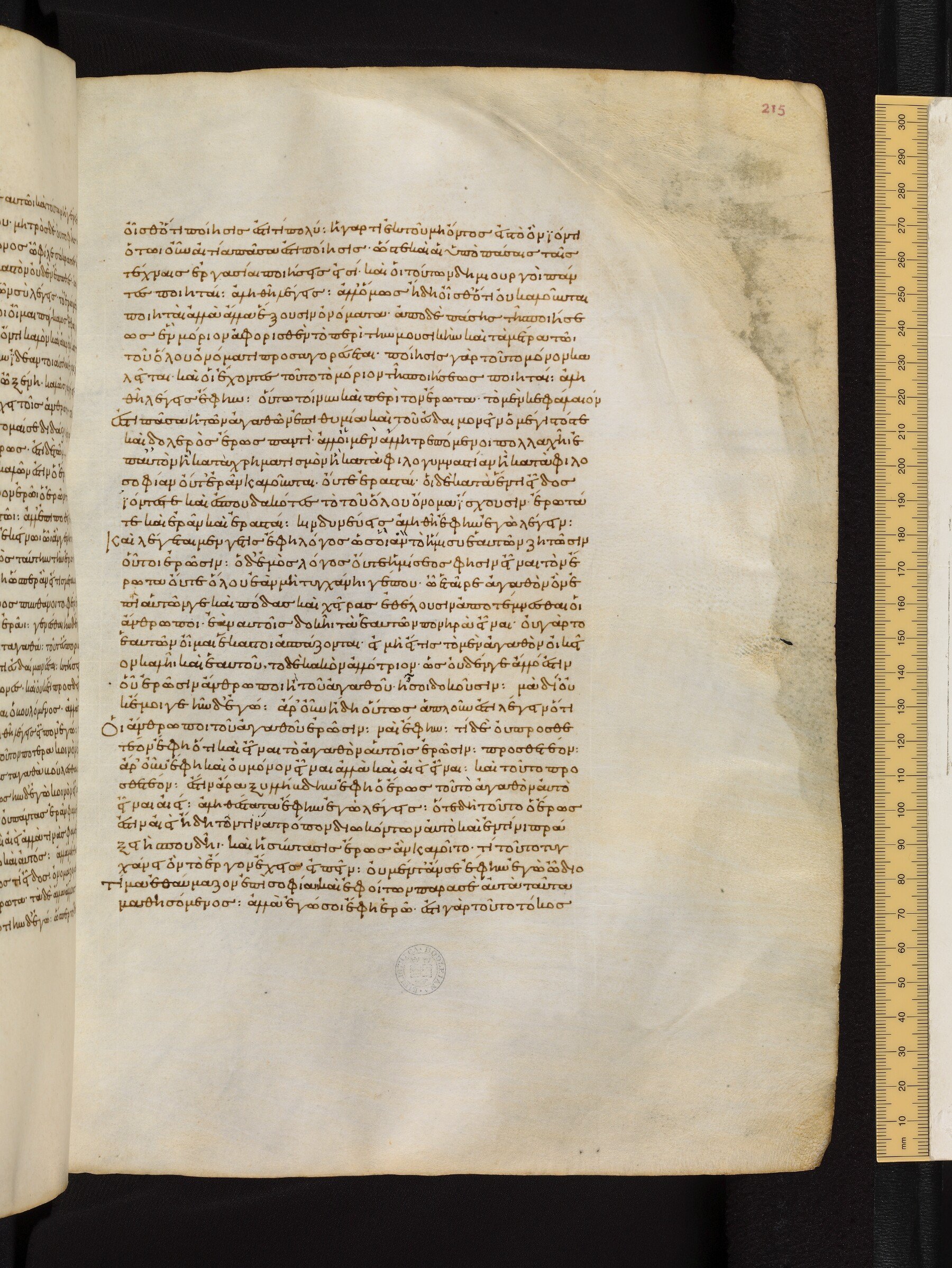
Where on the image
Starts on fol. 214v and continues on fol. 215r (page break inside this subsection). Clarke 39 fol. 214v runs from '(μεταξὺ) εἶναι σοφοῦ καὶ ἀμαθοῦς. αἰτία δὲ αὐτῷ καὶ τούτων ἡ γένεσις' on its first line (204b) to 'ὥσπερ τί; ἦν δʼ ἐγώ. ὥσπερ τόδε' on its last line (205b). Viewer: https://digital.bodleian.ox.ac.uk/objects/f57d074b-cff1-4172-8236-797c7b8f0403/surfaces/3de7c403-9a25-4627-8170-d0baf3df42ff/ Clarke 39 fol. 215r runs from 'οἶσθʼ ὅτι ποίησίς ἐστί τι πολύ' on its first line (205b) to 'ἀλλʼ ἐγώ σοι, ἔφη, ἐρῶ. ἔστι γὰρ τοῦτο τόκος' on its last line (206b). Viewer: https://digital.bodleian.ox.ac.uk/objects/f57d074b-cff1-4172-8236-797c7b8f0403/surfaces/f2f23953-ed07-4da9-a9f0-dfe6ec90fe17/ Checked on the images. The Greek shown is Burnet's critical text; the copyist's wording differs from it in small details.
εἴπερ γε πάντες τῶν αὐτῶν ἐρῶσι καὶ ἀεί, ἀλλά τινάς φαμεν ἐρᾶν, τοὺς δʼ οὔ; θαυμάζω, ἦν δʼ ἐγώ, καὶ αὐτός. ἀλλὰ μὴ θαύμαζʼ, ἔφη· ἀφελόντες γὰρ ἄρα τοῦ ἔρωτός τι εἶδος ὀνομάζομεν, τὸ τοῦ ὅλου ἐπιτιθέντες ὄνομα, ἔρωτα, τὰ δὲ ἄλλα ἄλλοις καταχρώμεθα ὀνόμασιν. ὥσπερ τί; ἦν δʼ ἐγώ. ὥσπερ τόδε. οἶσθʼ ὅτι ποίησίς ἐστί τι πολύ· ἡ γάρ τοι ἐκ τοῦ μὴ ὄντος εἰς τὸ ὂν ἰόντι ὁτῳοῦν αἰτία πᾶσά ἐστι
Well then, Socrates, she said, we do not mean that all men love, when we say that all men love the same things always; we mean that some people love and others do not? I am wondering myself, I replied. But you should not wonder, she said; for we have singled out a certain form of love, and applying thereto the name of the whole, we call it love; and there are other names that we commonly abuse. As, for example—? I asked. Take the following: you know that poetry is more than a single thing. For of anything whatever that passes from not being into being the whole cause
Where on the image
On Clarke 39 fol. 215r. Clarke 39 fol. 215r runs from 'οἶσθʼ ὅτι ποίησίς ἐστί τι πολύ' on its first line (205b) to 'ἀλλʼ ἐγώ σοι, ἔφη, ἐρῶ. ἔστι γὰρ τοῦτο τόκος' on its last line (206b). Viewer: https://digital.bodleian.ox.ac.uk/objects/f57d074b-cff1-4172-8236-797c7b8f0403/surfaces/f2f23953-ed07-4da9-a9f0-dfe6ec90fe17/ Checked on the images. The Greek shown is Burnet's critical text; the copyist's wording differs from it in small details.
ποίησις, ὥστε καὶ αἱ ὑπὸ πάσαις ταῖς τέχναις ἐργασίαι ποιήσεις εἰσὶ καὶ οἱ τούτων δημιουργοὶ πάντες ποιηταί. ἀληθῆ λέγεις. ἀλλʼ ὅμως, ἦ δʼ ἥ, οἶσθʼ ὅτι οὐ καλοῦνται ποιηταὶ ἀλλὰ ἄλλα ἔχουσιν ὀνόματα, ἀπὸ δὲ πάσης τῆς ποιήσεως ἓν μόριον ἀφορισθὲν τὸ περὶ τὴν μουσικὴν καὶ τὰ μέτρα τῷ τοῦ ὅλου ὀνόματι προσαγορεύεται. ποίησις γὰρ τοῦτο μόνον καλεῖται, καὶ οἱ ἔχοντες τοῦτο τὸ μόριον τῆς ποιήσεως ποιηταί. ἀληθῆ λέγεις, ἔφην.
is composing or poetry; so that the productions of all arts are kinds of poetry, and their craftsmen are all poets. That is true. But still, as you are aware, said she, they are not called poets: they have other names, while a single section disparted from the whole of poetry—merely the business of music and meters—is entitled with the name of the whole. This and no more is called poetry; those only who possess this branch of the art are poets. Quite true, I said. Well, it is just the same with love. Generically, indeed,
Where on the image
On Clarke 39 fol. 215r. Clarke 39 fol. 215r runs from 'οἶσθʼ ὅτι ποίησίς ἐστί τι πολύ' on its first line (205b) to 'ἀλλʼ ἐγώ σοι, ἔφη, ἐρῶ. ἔστι γὰρ τοῦτο τόκος' on its last line (206b). Viewer: https://digital.bodleian.ox.ac.uk/objects/f57d074b-cff1-4172-8236-797c7b8f0403/surfaces/f2f23953-ed07-4da9-a9f0-dfe6ec90fe17/ Checked on the images. The Greek shown is Burnet's critical text; the copyist's wording differs from it in small details.
οὕτω τοίνυν καὶ περὶ τὸν ἔρωτα. τὸ μὲν κεφάλαιόν ἐστι πᾶσα ἡ τῶν ἀγαθῶν ἐπιθυμία καὶ τοῦ εὐδαιμονεῖν ὁ μέγιστός τε καὶ δολερὸς ἔρως παντί· ἀλλʼ οἱ μὲν ἄλλῃ τρεπόμενοι πολλαχῇ ἐπʼ αὐτόν, ἢ κατὰ χρηματισμὸν ἢ κατὰ φιλογυμναστίαν ἢ κατὰ φιλοσοφίαν, οὔτε ἐρᾶν καλοῦνται οὔτε ἐρασταί, οἱ δὲ κατὰ ἕν τι εἶδος ἰόντες τε καὶ ἐσπουδακότες τὸ τοῦ ὅλου ὄνομα ἴσχουσιν, ἔρωτά τε καὶ ἐρᾶν καὶ ἐρασταί. κινδυνεύεις ἀληθῆ, ἔφην ἐγώ, λέγειν. καὶ λέγεται μέν γέ τις, ἔφη, λόγος, ὡς οἳ ἂν τὸ ἥμισυ
it is all that desire of good things and of being happy —Love most mighty and all-beguiling. Yet, whereas those who resort to him in various other ways—in money-making, an inclination to sports, or philosophy—are not described either as loving or as lovers, all those who pursue him seriously in one of his several forms obtain, as loving and as lovers, the name of the whole. I fancy you are right, I said.
Where on the image
On Clarke 39 fol. 215r. Clarke 39 fol. 215r runs from 'οἶσθʼ ὅτι ποίησίς ἐστί τι πολύ' on its first line (205b) to 'ἀλλʼ ἐγώ σοι, ἔφη, ἐρῶ. ἔστι γὰρ τοῦτο τόκος' on its last line (206b). Viewer: https://digital.bodleian.ox.ac.uk/objects/f57d074b-cff1-4172-8236-797c7b8f0403/surfaces/f2f23953-ed07-4da9-a9f0-dfe6ec90fe17/ Checked on the images. The Greek shown is Burnet's critical text; the copyist's wording differs from it in small details.
ἑαυτῶν ζητῶσιν, οὗτοι ἐρῶσιν· ὁ δʼ ἐμὸς λόγος οὔτε ἡμίσεός φησιν εἶναι τὸν ἔρωτα οὔτε ὅλου, ἐὰν μὴ τυγχάνῃ γέ που, ὦ ἑταῖρε, ἀγαθὸν ὄν, ἐπεὶ αὑτῶν γε καὶ πόδας καὶ χεῖρας ἐθέλουσιν ἀποτέμνεσθαι οἱ ἄνθρωποι, ἐὰν αὐτοῖς δοκῇ τὰ ἑαυτῶν πονηρὰ εἶναι. οὐ γὰρ τὸ ἑαυτῶν οἶμαι ἕκαστοι ἀσπάζονται, εἰ μὴ εἴ τις τὸ μὲν ἀγαθὸν οἰκεῖον καλεῖ καὶ ἑαυτοῦ, τὸ δὲ κακὸν ἀλλότριον· ὡς οὐδέν γε ἄλλο ἐστὶν οὗ
> And certainly there runs a story, she continued, that all who go seeking their other half are in love; though by my account love is neither for half nor for whole, unless, of course, my dear sir, this happens to be something good. For men are prepared to have their own feet and hands cut off if they feel these belongings to be harmful. The fact is, I suppose, that each person does not cherish his belongings except where a man calls the good his own property and the bad another’s;
Where on the image
On Clarke 39 fol. 215r. Clarke 39 fol. 215r runs from 'οἶσθʼ ὅτι ποίησίς ἐστί τι πολύ' on its first line (205b) to 'ἀλλʼ ἐγώ σοι, ἔφη, ἐρῶ. ἔστι γὰρ τοῦτο τόκος' on its last line (206b). Viewer: https://digital.bodleian.ox.ac.uk/objects/f57d074b-cff1-4172-8236-797c7b8f0403/surfaces/f2f23953-ed07-4da9-a9f0-dfe6ec90fe17/ Checked on the images. The Greek shown is Burnet's critical text; the copyist's wording differs from it in small details.
ἐρῶσιν ἅνθρωποι ἢ τοῦ ἀγαθοῦ. ἢ σοὶ δοκοῦσιν; μὰ Δίʼ οὐκ ἔμοιγε, ἦν δʼ ἐγώ. ἆρʼ οὖν, ἦ δʼ ἥ, οὕτως ἁπλοῦν ἐστι λέγειν ὅτι οἱ ἄνθρωποι τἀγαθοῦ ἐρῶσιν; ναί, ἔφην. τί δέ; οὐ προσθετέον, ἔφη, ὅτι καὶ εἶναι τὸ ἀγαθὸν αὑτοῖς ἐρῶσιν; προσθετέον. ἆρʼ οὖν, ἔφη, καὶ οὐ μόνον εἶναι, ἀλλὰ καὶ ἀεὶ εἶναι; καὶ τοῦτο προσθετέον. ἔστιν ἄρα συλλήβδην, ἔφη, ὁ ἔρως τοῦ τὸ ἀγαθὸν αὑτῷ εἶναι ἀεί. ἀληθέστατα, ἔφην ἐγώ, λέγεις.
since what men love is simply and solely the good. Or is your view otherwise? Faith, no, I said. Then we may state unreservedly that men love the good? Yes, I said. Well now, must we not extend it to this, that they love the good to be theirs? We must. And do they love it to be not merely theirs but theirs always? Include that also. Briefly then, said she, love loves the good to be one’s own for ever. That is the very truth, I said.
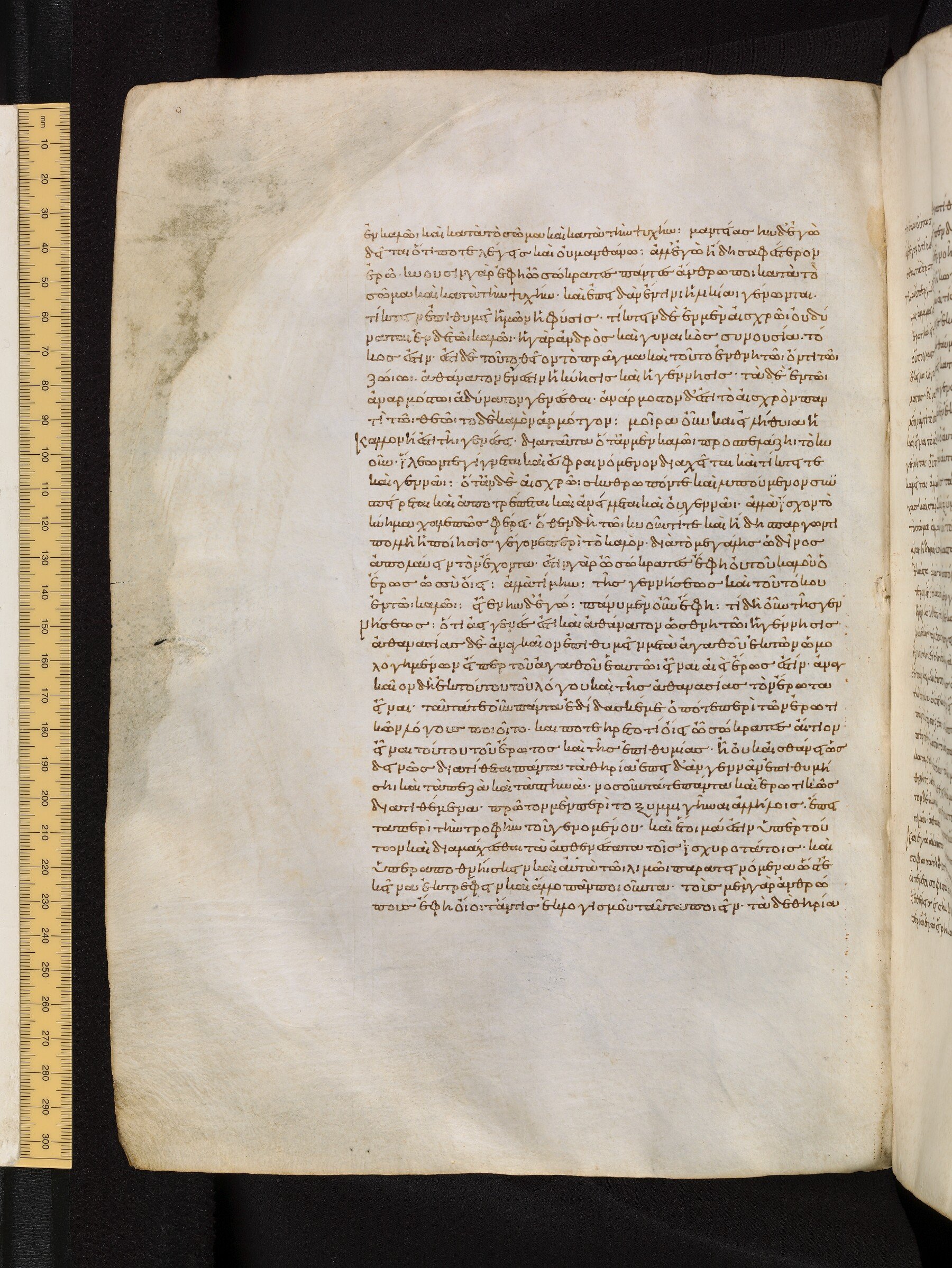
Where on the image
Starts on fol. 215r and continues on fol. 215v (page break inside this subsection). Clarke 39 fol. 215r runs from 'οἶσθʼ ὅτι ποίησίς ἐστί τι πολύ' on its first line (205b) to 'ἀλλʼ ἐγώ σοι, ἔφη, ἐρῶ. ἔστι γὰρ τοῦτο τόκος' on its last line (206b). Viewer: https://digital.bodleian.ox.ac.uk/objects/f57d074b-cff1-4172-8236-797c7b8f0403/surfaces/f2f23953-ed07-4da9-a9f0-dfe6ec90fe17/ Clarke 39 fol. 215v runs from 'ἐν καλῷ καὶ κατὰ τὸ σῶμα καὶ κατὰ τὴν ψυχήν. μαντείας, ἦν δʼ ἐγώ' on its first line (206b) to 'οἴοιτʼ ἄν τις ἐκ λογισμοῦ ταῦτα ποιεῖν· τὰ δὲ θηρία' on its last line (207b). Viewer: https://digital.bodleian.ox.ac.uk/objects/f57d074b-cff1-4172-8236-797c7b8f0403/surfaces/b457a253-56a2-4f0b-bfa0-8b44c419ecb3/ Checked on the images. The Greek shown is Burnet's critical text; the copyist's wording differs from it in small details.
ὅτε δὴ τοῦτο ὁ ἔρως ἐστὶν ἀεί, ἦ δʼ ἥ, τῶν τίνα τρόπον διωκόντων αὐτὸ καὶ ἐν τίνι πράξει ἡ σπουδὴ καὶ ἡ σύντασις ἔρως ἂν καλοῖτο; τί τοῦτο τυγχάνει ὂν τὸ ἔργον; ἔχεις εἰπεῖν; οὐ μεντἂν σέ, ἔφην ἐγώ, ὦ Διοτίμα, ἐθαύμαζον ἐπὶ σοφίᾳ καὶ ἐφοίτων παρὰ σὲ αὐτὰ ταῦτα μαθησόμενος. ἀλλὰ ἐγώ σοι, ἔφη, ἐρῶ. ἔστι γὰρ τοῦτο τόκος ἐν καλῷ καὶ κατὰ τὸ σῶμα καὶ κατὰ τὴν ψυχήν. μαντείας, ἦν δʼ ἐγώ, δεῖται ὅτι ποτε λέγεις, καὶ οὐ μανθάνω.
Now if love is always for this, she proceeded, what is the method of those who pursue it, and what is the behavior whose eagerness and straining are to be termed love? What actually is this effort? Can you tell me? Ah, Diotima, I said; in that case I should hardly be admiring you and your wisdom, and sitting at your feet to be enlightened on just these questions. Well, I will tell you, said she; it is begetting on a beautiful thing by means of both the body and the soul. It wants some divination to make out what you mean, I said; I do not understand.
Where on the image
On Clarke 39 fol. 215v. Clarke 39 fol. 215v runs from 'ἐν καλῷ καὶ κατὰ τὸ σῶμα καὶ κατὰ τὴν ψυχήν. μαντείας, ἦν δʼ ἐγώ' on its first line (206b) to 'οἴοιτʼ ἄν τις ἐκ λογισμοῦ ταῦτα ποιεῖν· τὰ δὲ θηρία' on its last line (207b). Viewer: https://digital.bodleian.ox.ac.uk/objects/f57d074b-cff1-4172-8236-797c7b8f0403/surfaces/b457a253-56a2-4f0b-bfa0-8b44c419ecb3/ Checked on the images. The Greek shown is Burnet's critical text; the copyist's wording differs from it in small details.
ἀλλʼ ἐγώ, ἦ δʼ ἥ, σαφέστερον ἐρῶ. κυοῦσιν γάρ, ἔφη, ὦ Σώκρατες, πάντες ἄνθρωποι καὶ κατὰ τὸ σῶμα καὶ κατὰ τὴν ψυχήν, καὶ ἐπειδὰν ἔν τινι ἡλικίᾳ γένωνται, τίκτειν ἐπιθυμεῖ ἡμῶν ἡ φύσις. τίκτειν δὲ ἐν μὲν αἰσχρῷ οὐ δύναται, ἐν δὲ τῷ καλῷ. ἡ γὰρ ἀνδρὸς καὶ γυναικὸς συνουσία τόκος ἐστίν. ἔστι δὲ τοῦτο θεῖον τὸ πρᾶγμα, καὶ τοῦτο ἐν θνητῷ ὄντι τῷ ζῴῳ ἀθάνατον ἔνεστιν, ἡ κύησις καὶ ἡ γέννησις. τὰ δὲ ἐν τῷ ἀναρμόστῳ ἀδύνατον γενέσθαι.
Let me put it more clearly, she said. All men are pregnant, Socrates, both in body and in soul: on reaching a certain age our nature yearns to beget. This it cannot do upon an ugly person, but only on the beautiful: the conjunction of man and woman is a begetting for both. It is a divine affair, this engendering and bringing to birth, an immortal element in the creature that is mortal; and it cannot occur in the discordant.
Where on the image
On Clarke 39 fol. 215v. Clarke 39 fol. 215v runs from 'ἐν καλῷ καὶ κατὰ τὸ σῶμα καὶ κατὰ τὴν ψυχήν. μαντείας, ἦν δʼ ἐγώ' on its first line (206b) to 'οἴοιτʼ ἄν τις ἐκ λογισμοῦ ταῦτα ποιεῖν· τὰ δὲ θηρία' on its last line (207b). Viewer: https://digital.bodleian.ox.ac.uk/objects/f57d074b-cff1-4172-8236-797c7b8f0403/surfaces/b457a253-56a2-4f0b-bfa0-8b44c419ecb3/ Checked on the images. The Greek shown is Burnet's critical text; the copyist's wording differs from it in small details.
ἀνάρμοστον δʼ ἐστὶ τὸ αἰσχρὸν παντὶ τῷ θείῳ, τὸ δὲ καλὸν ἁρμόττον. Μοῖρα οὖν καὶ Εἰλείθυια ἡ Καλλονή ἐστι τῇ γενέσει. διὰ ταῦτα ὅταν μὲν καλῷ προσπελάζῃ τὸ κυοῦν, ἵλεών τε γίγνεται καὶ εὐφραινόμενον διαχεῖται καὶ τίκτει τε καὶ γεννᾷ· ὅταν δὲ αἰσχρῷ, σκυθρωπόν τε καὶ λυπούμενον συσπειρᾶται καὶ ἀποτρέπεται καὶ ἀνείλλεται καὶ οὐ γεννᾷ, ἀλλὰ ἴσχον τὸ κύημα χαλεπῶς φέρει. ὅθεν δὴ τῷ κυοῦντί τε καὶ ἤδη σπαργῶντι πολλὴ ἡ πτοίησις γέγονε
The ugly is discordant with whatever is divine, whereas the beautiful is accordant. Thus Beauty presides over birth as Fate and Lady of Travail; and hence it is that when the pregnant approaches the beautiful it becomes not only gracious but so exhilarate, that it flows over with begetting and bringing forth; though when it meets the ugly it coils itself close in a sullen dismay: rebuffed and repressed, it brings not forth, but goes in labor with the burden of its young. Therefore when a person is big and teeming-ripe
Where on the image
On Clarke 39 fol. 215v. Clarke 39 fol. 215v runs from 'ἐν καλῷ καὶ κατὰ τὸ σῶμα καὶ κατὰ τὴν ψυχήν. μαντείας, ἦν δʼ ἐγώ' on its first line (206b) to 'οἴοιτʼ ἄν τις ἐκ λογισμοῦ ταῦτα ποιεῖν· τὰ δὲ θηρία' on its last line (207b). Viewer: https://digital.bodleian.ox.ac.uk/objects/f57d074b-cff1-4172-8236-797c7b8f0403/surfaces/b457a253-56a2-4f0b-bfa0-8b44c419ecb3/ Checked on the images. The Greek shown is Burnet's critical text; the copyist's wording differs from it in small details.
περὶ τὸ καλὸν διὰ τὸ μεγάλης ὠδῖνος ἀπολύειν τὸν ἔχοντα. ἔστιν γάρ, ὦ Σώκρατες, ἔφη, οὐ τοῦ καλοῦ ὁ ἔρως, ὡς σὺ οἴει. ἀλλὰ τί μήν; τῆς γεννήσεως καὶ τοῦ τόκου ἐν τῷ καλῷ. εἶεν, ἦν δʼ ἐγώ. πάνυ μὲν οὖν, ἔφη. τί δὴ οὖν τῆς γεννήσεως; ὅτι ἀειγενές ἐστι καὶ ἀθάνατον ὡς θνητῷ ἡ γέννησις. ἀθανασίας
he feels himself in a sore flutter for the beautiful, because its possessor can relieve him of his heavy pangs. For you are wrong, Socrates, in supposing that love is of the beautiful. What then is it? It is of engendering and begetting upon the beautiful. Be it so, I said. To be sure it is, she went on; and how of engendering? Because this is something ever-existent and immortal in our mortal life.
Where on the image
On Clarke 39 fol. 215v. Clarke 39 fol. 215v runs from 'ἐν καλῷ καὶ κατὰ τὸ σῶμα καὶ κατὰ τὴν ψυχήν. μαντείας, ἦν δʼ ἐγώ' on its first line (206b) to 'οἴοιτʼ ἄν τις ἐκ λογισμοῦ ταῦτα ποιεῖν· τὰ δὲ θηρία' on its last line (207b). Viewer: https://digital.bodleian.ox.ac.uk/objects/f57d074b-cff1-4172-8236-797c7b8f0403/surfaces/b457a253-56a2-4f0b-bfa0-8b44c419ecb3/ Checked on the images. The Greek shown is Burnet's critical text; the copyist's wording differs from it in small details.
δὲ ἀναγκαῖον ἐπιθυμεῖν μετὰ ἀγαθοῦ ἐκ τῶν ὡμολογημένων, εἴπερ τοῦ ἀγαθοῦ ἑαυτῷ εἶναι ἀεὶ ἔρως ἐστίν. ἀναγκαῖον δὴ ἐκ τούτου τοῦ λόγου καὶ τῆς ἀθανασίας τὸν ἔρωτα εἶναι. ταῦτά τε οὖν πάντα ἐδίδασκέ με, ὁπότε περὶ τῶν ἐρωτικῶν λόγους ποιοῖτο, καί ποτε ἤρετο τί οἴει, ὦ Σώκρατες, αἴτιον εἶναι τούτου τοῦ ἔρωτος καὶ τῆς ἐπιθυμίας; ἢ οὐκ αἰσθάνῃ ὡς δεινῶς διατίθεται πάντα τὰ θηρία ἐπειδὰν γεννᾶν ἐπιθυμήσῃ, καὶ τὰ πεζὰ καὶ τὰ πτηνά, νοσοῦντά τε
From what has been admitted, we needs must yearn for immortality no less than for good, since love loves good to be one’s own for ever. And hence it necessarily follows that love is of immortality. All this instruction did I get from her at various times when she discoursed of love-matters; and one time she asked me, What do you suppose, Socrates, to be the cause of this love and desire? For you must have observed the strange state into which all the animals are thrown, whether going on earth or winging the air, when they desire to beget: they are all sick
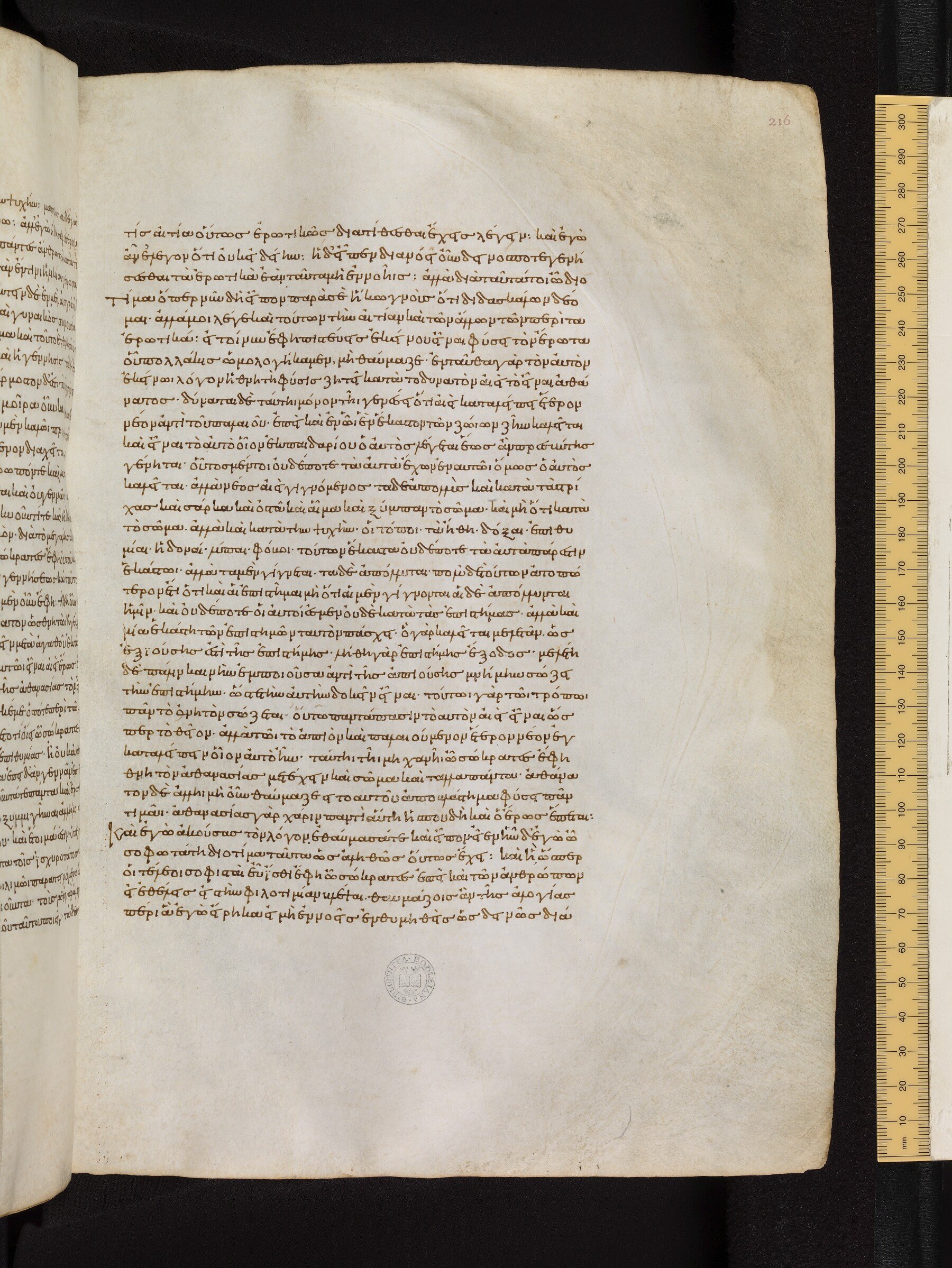
Where on the image
Starts on fol. 215v and continues on fol. 216r (page break inside this subsection). Clarke 39 fol. 215v runs from 'ἐν καλῷ καὶ κατὰ τὸ σῶμα καὶ κατὰ τὴν ψυχήν. μαντείας, ἦν δʼ ἐγώ' on its first line (206b) to 'οἴοιτʼ ἄν τις ἐκ λογισμοῦ ταῦτα ποιεῖν· τὰ δὲ θηρία' on its last line (207b). Viewer: https://digital.bodleian.ox.ac.uk/objects/f57d074b-cff1-4172-8236-797c7b8f0403/surfaces/b457a253-56a2-4f0b-bfa0-8b44c419ecb3/ Clarke 39 fol. 216r runs from 'τίς αἰτία οὕτως ἐρωτικῶς διατίθεσθαι' on its first line (207b) to 'εἰ μὴ ἐννοεῖς ἐνθυμηθεὶς ὡς δεινῶς διά(κεινται)' on its last line (208c). Viewer: https://digital.bodleian.ox.ac.uk/objects/f57d074b-cff1-4172-8236-797c7b8f0403/surfaces/85e9ae32-9532-4881-b183-86807ab9e9c0/ Checked on the images. The Greek shown is Burnet's critical text; the copyist's wording differs from it in small details.
πάντα καὶ ἐρωτικῶς διατιθέμενα, πρῶτον μὲν περὶ τὸ συμμιγῆναι ἀλλήλοις, ἔπειτα περὶ τὴν τροφὴν τοῦ γενομένου, καὶ ἕτοιμά ἐστιν ὑπὲρ τούτων καὶ διαμάχεσθαι τὰ ἀσθενέστατα τοῖς ἰσχυροτάτοις καὶ ὑπεραποθνῄσκειν, καὶ αὐτὰ τῷ λιμῷ παρατεινόμενα ὥστʼ ἐκεῖνα ἐκτρέφειν, καὶ ἄλλο πᾶν ποιοῦντα. τοὺς μὲν γὰρ ἀνθρώπους, ἔφη, οἴοιτʼ ἄν τις ἐκ λογισμοῦ ταῦτα ποιεῖν· τὰ δὲ θηρία τίς αἰτία οὕτως ἐρωτικῶς
and amorously disposed, first to have union one with another, and next to find food for the new-born; in whose behalf they are ready to fight hard battles, even the weakest against the strongest, and to sacrifice their lives; to be racked with starvation themselves if they can but nurture their young, and be put to any sort of shift. As for men, said she, one might suppose they do these things on the promptings of reason; but what is the cause
Where on the image
On Clarke 39 fol. 216r. Clarke 39 fol. 216r runs from 'τίς αἰτία οὕτως ἐρωτικῶς διατίθεσθαι' on its first line (207b) to 'εἰ μὴ ἐννοεῖς ἐνθυμηθεὶς ὡς δεινῶς διά(κεινται)' on its last line (208c). Viewer: https://digital.bodleian.ox.ac.uk/objects/f57d074b-cff1-4172-8236-797c7b8f0403/surfaces/85e9ae32-9532-4881-b183-86807ab9e9c0/ Checked on the images. The Greek shown is Burnet's critical text; the copyist's wording differs from it in small details.
διατίθεσθαι; ἔχεις λέγειν; καὶ ἐγὼ αὖ ἔλεγον ὅτι οὐκ εἰδείην· ἣ δʼ εἶπεν, Διανοῇ οὖν δεινός ποτε γενήσεσθαι τὰ ἐρωτικά, ἐὰν ταῦτα μὴ ἐννοῇς; ἀλλὰ διὰ ταῦτά τοι, ὦ Διοτίμα, ὅπερ νυνδὴ εἶπον, παρὰ σὲ ἥκω, γνοὺς ὅτι διδασκάλων δέομαι. ἀλλά μοι λέγε καὶ τούτων τὴν αἰτίαν καὶ τῶν ἄλλων τῶν περὶ τὰ ἐρωτικά. εἰ τοίνυν, ἔφη, πιστεύεις ἐκείνου εἶναι φύσει τὸν ἔρωτα, οὗ πολλάκις ὡμολογήκαμεν, μὴ θαύμαζε. ἐνταῦθα γὰρ
of this amorous condition in the animals? Can you tell me? Once more I replied that I did not know; so she proceeded: How do you design ever to become a master of love-matters, if you can form no notion of this? Why, it is just for this, I tell you, Diotima—as I stated a moment ago—that I have come to see you, because I noted my need of an instructor. Come, tell me the cause of these effects as well as of the others that have relation to love. Well then, she said, if you believe that love is by nature bent on what we have repeatedly admitted, you may cease to wonder. For here, too, on the same principle as before,
Where on the image
On Clarke 39 fol. 216r. Clarke 39 fol. 216r runs from 'τίς αἰτία οὕτως ἐρωτικῶς διατίθεσθαι' on its first line (207b) to 'εἰ μὴ ἐννοεῖς ἐνθυμηθεὶς ὡς δεινῶς διά(κεινται)' on its last line (208c). Viewer: https://digital.bodleian.ox.ac.uk/objects/f57d074b-cff1-4172-8236-797c7b8f0403/surfaces/85e9ae32-9532-4881-b183-86807ab9e9c0/ Checked on the images. The Greek shown is Burnet's critical text; the copyist's wording differs from it in small details.
τὸν αὐτὸν ἐκείνῳ λόγον ἡ θνητὴ φύσις ζητεῖ κατὰ τὸ δυνατὸν ἀεί τε εἶναι καὶ ἀθάνατος. δύναται δὲ ταύτῃ μόνον, τῇ γενέσει, ὅτι ἀεὶ καταλείπει ἕτερον νέον ἀντὶ τοῦ παλαιοῦ, ἐπεὶ καὶ ἐν ᾧ ἓν ἕκαστον τῶν ζῴων ζῆν καλεῖται καὶ εἶναι τὸ αὐτό—οἷον ἐκ παιδαρίου ὁ αὐτὸς λέγεται ἕως ἂν πρεσβύτης γένηται· οὗτος μέντοι οὐδέποτε τὰ αὐτὰ ἔχων ἐν αὑτῷ ὅμως ὁ αὐτὸς καλεῖται, ἀλλὰ νέος ἀεὶ γιγνόμενος, τὰ δὲ ἀπολλύς, καὶ κατὰ τὰς τρίχας καὶ σάρκα καὶ ὀστᾶ καὶ
the mortal nature ever seeks, as best it can, to be immortal. In one way only can it succeed, and that is by generation; since so it can always leave behind it a new creature in place of the old. It is only for a while that each live thing can be described as alive and the same, as a man is said to be the same person from childhood until he is advanced in years: yet though he is called the same he does not at any time possess the same properties; he is continually becoming a new person, and there are things also which he loses,
Where on the image
On Clarke 39 fol. 216r. Clarke 39 fol. 216r runs from 'τίς αἰτία οὕτως ἐρωτικῶς διατίθεσθαι' on its first line (207b) to 'εἰ μὴ ἐννοεῖς ἐνθυμηθεὶς ὡς δεινῶς διά(κεινται)' on its last line (208c). Viewer: https://digital.bodleian.ox.ac.uk/objects/f57d074b-cff1-4172-8236-797c7b8f0403/surfaces/85e9ae32-9532-4881-b183-86807ab9e9c0/ Checked on the images. The Greek shown is Burnet's critical text; the copyist's wording differs from it in small details.
αἷμα καὶ σύμπαν τὸ σῶμα. καὶ μὴ ὅτι κατὰ τὸ σῶμα, ἀλλὰ καὶ κατὰ τὴν ψυχὴν οἱ τρόποι, τὰ ἤθη, δόξαι, ἐπιθυμίαι, ἡδοναί, λῦπαι, φόβοι, τούτων ἕκαστα οὐδέποτε τὰ αὐτὰ πάρεστιν ἑκάστῳ, ἀλλὰ τὰ μὲν γίγνεται, τὰ δὲ ἀπόλλυται. πολὺ δὲ τούτων ἀτοπώτερον ἔτι, ὅτι καὶ αἱ ἐπιστῆμαι
as appears by his hair, his flesh, his bones, and his blood and body altogether. And observe that not only in his body but in his soul besides we find none of his manners or habits, his opinions, desires, pleasures, pains or fears, ever abiding the same in his particular self; some things grow in him, while others perish. And here is a yet stranger fact:
Where on the image
On Clarke 39 fol. 216r. Clarke 39 fol. 216r runs from 'τίς αἰτία οὕτως ἐρωτικῶς διατίθεσθαι' on its first line (207b) to 'εἰ μὴ ἐννοεῖς ἐνθυμηθεὶς ὡς δεινῶς διά(κεινται)' on its last line (208c). Viewer: https://digital.bodleian.ox.ac.uk/objects/f57d074b-cff1-4172-8236-797c7b8f0403/surfaces/85e9ae32-9532-4881-b183-86807ab9e9c0/ Checked on the images. The Greek shown is Burnet's critical text; the copyist's wording differs from it in small details.
μὴ ὅτι αἱ μὲν γίγνονται, αἱ δὲ ἀπόλλυνται ἡμῖν, καὶ οὐδέποτε οἱ αὐτοί ἐσμεν οὐδὲ κατὰ τὰς ἐπιστήμας, ἀλλὰ καὶ μία ἑκάστη τῶν ἐπιστημῶν ταὐτὸν πάσχει. ὃ γὰρ καλεῖται μελετᾶν, ὡς ἐξιούσης ἐστὶ τῆς ἐπιστήμης· λήθη γὰρ ἐπιστήμης ἔξοδος, μελέτη δὲ πάλιν καινὴν ἐμποιοῦσα ἀντὶ τῆς ἀπιούσης μνήμην σῴζει τὴν ἐπιστήμην, ὥστε τὴν αὐτὴν δοκεῖν εἶναι. τούτῳ γὰρ τῷ τρόπῳ πᾶν τὸ θνητὸν σῴζεται, οὐ τῷ παντάπασιν τὸ αὐτὸ ἀεὶ εἶναι ὥσπερ τὸ
with regard to the possessions of knowledge, not merely do some of them grow and others perish in us, so that neither in what we know are we ever the same persons; but a like fate attends each single sort of knowledge. What we call conning implies that our knowledge is departing; since forgetfulness is an egress of knowledge, while conning substitutes a fresh one in place of that which departs, and so preserves our knowledge enough to make it seem the same. Every mortal thing is preserved in this way; not by keeping it exactly the same for ever,
Where on the image
On Clarke 39 fol. 216r. Clarke 39 fol. 216r runs from 'τίς αἰτία οὕτως ἐρωτικῶς διατίθεσθαι' on its first line (207b) to 'εἰ μὴ ἐννοεῖς ἐνθυμηθεὶς ὡς δεινῶς διά(κεινται)' on its last line (208c). Viewer: https://digital.bodleian.ox.ac.uk/objects/f57d074b-cff1-4172-8236-797c7b8f0403/surfaces/85e9ae32-9532-4881-b183-86807ab9e9c0/ Checked on the images. The Greek shown is Burnet's critical text; the copyist's wording differs from it in small details.
θεῖον, ἀλλὰ τῷ τὸ ἀπιὸν καὶ παλαιούμενον ἕτερον νέον ἐγκαταλείπειν οἷον αὐτὸ ἦν. ταύτῃ τῇ μηχανῇ, ὦ Σώκρατες, ἔφη, θνητὸν ἀθανασίας μετέχει, καὶ σῶμα καὶ τἆλλα πάντα· ἀθάνατον δὲ ἄλλῃ. μὴ οὖν θαύμαζε εἰ τὸ αὑτοῦ ἀποβλάστημα φύσει πᾶν τιμᾷ· ἀθανασίας γὰρ χάριν παντὶ αὕτη ἡ σπουδὴ καὶ ὁ ἔρως ἕπεται. καὶ ἐγὼ ἀκούσας τὸν λόγον ἐθαύμασά τε καὶ εἶπον εἶεν, ἦν δʼ ἐγώ, ὦ σοφωτάτη Διοτίμα, ταῦτα ὡς ἀληθῶς οὕτως ἔχει;
like the divine, but by replacing what goes off or is antiquated with something fresh, in the semblance of the original. Through this device, Socrates, a mortal thing partakes of immortality, both in its body and in all other respects; by no other means can it be done. So do not wonder if everything naturally values its own offshoot; since all are beset by this eagerness and this love with a view to immortality. On hearing this argument I wondered, and said:
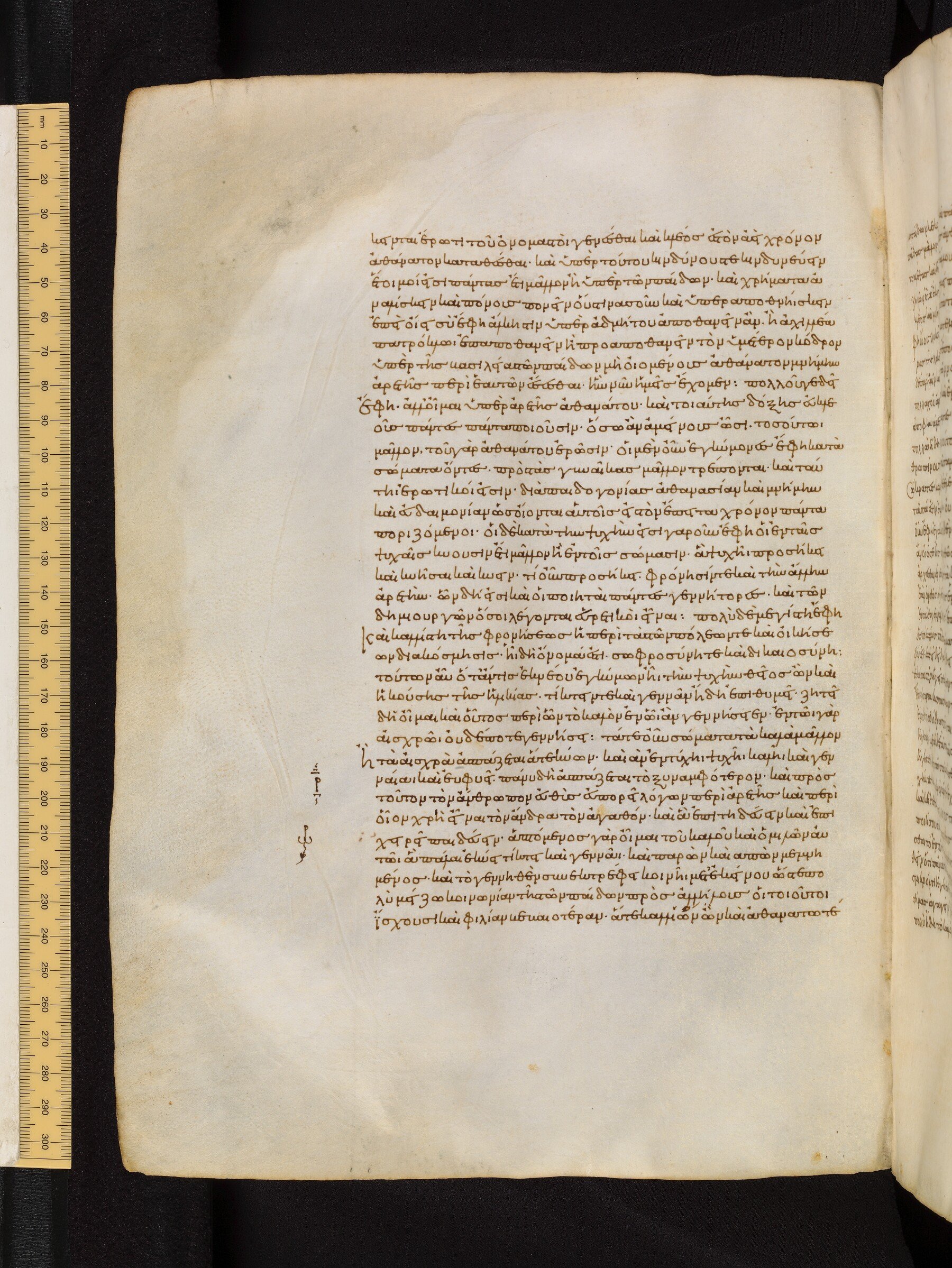
Where on the image
Starts on fol. 216r and continues on fol. 216v (page break inside this subsection). Clarke 39 fol. 216r runs from 'τίς αἰτία οὕτως ἐρωτικῶς διατίθεσθαι' on its first line (207b) to 'εἰ μὴ ἐννοεῖς ἐνθυμηθεὶς ὡς δεινῶς διά(κεινται)' on its last line (208c). Viewer: https://digital.bodleian.ox.ac.uk/objects/f57d074b-cff1-4172-8236-797c7b8f0403/surfaces/85e9ae32-9532-4881-b183-86807ab9e9c0/ Clarke 39 fol. 216v runs from '(διά)κεινται ἔρωτι τοῦ ὀνομαστοὶ γενέσθαι καὶ κλέος ἐς τὸν ἀεὶ χρόνον' on its first line (208c) to 'ἴσχουσι καὶ φιλίαν βεβαιοτέραν, ἅτε καλλιόνων καὶ ἀθανατωτέ(ρων)' on its last line (209c). Viewer: https://digital.bodleian.ox.ac.uk/objects/f57d074b-cff1-4172-8236-797c7b8f0403/surfaces/106774a8-31fc-4c6e-9c45-d8d8956762e6/ Checked on the images. The Greek shown is Burnet's critical text; the copyist's wording differs from it in small details.
καὶ ἥ, ὥσπερ οἱ τέλεοι σοφισταί, εὖ ἴσθι, ἔφη, ὦ Σώκρατες· ἐπεί γε καὶ τῶν ἀνθρώπων εἰ ἐθέλεις εἰς τὴν φιλοτιμίαν βλέψαι, θαυμάζοις ἂν τῆς ἀλογίας περὶ ἃ ἐγὼ εἴρηκα εἰ μὴ ἐννοεῖς, ἐνθυμηθεὶς ὡς δεινῶς διάκεινται ἔρωτι τοῦ ὀνομαστοὶ γενέσθαι καὶ κλέος ἐς τὸν ἀεὶ χρόνον ἀθάνατον καταθέσθαι, καὶ ὑπὲρ τούτου κινδύνους τε κινδυνεύειν ἕτοιμοί εἰσι πάντας ἔτι μᾶλλον ἢ ὑπὲρ τῶν
Really, can this in truth be so, most wise Diotima? Whereat she, like the professors in their glory: Be certain of it, Socrates; only glance at the ambition of the men around you, and you will have to wonder at the unreasonableness of what I have told you, unless you are careful to consider how singularly they are affected with the love of winning a name, and laying up fame immortal for all time to come. For this, even more than for their children, they are ready to run all risks,
Where on the image
On Clarke 39 fol. 216v. Clarke 39 fol. 216v runs from '(διά)κεινται ἔρωτι τοῦ ὀνομαστοὶ γενέσθαι καὶ κλέος ἐς τὸν ἀεὶ χρόνον' on its first line (208c) to 'ἴσχουσι καὶ φιλίαν βεβαιοτέραν, ἅτε καλλιόνων καὶ ἀθανατωτέ(ρων)' on its last line (209c). Viewer: https://digital.bodleian.ox.ac.uk/objects/f57d074b-cff1-4172-8236-797c7b8f0403/surfaces/106774a8-31fc-4c6e-9c45-d8d8956762e6/ Checked on the images. The Greek shown is Burnet's critical text; the copyist's wording differs from it in small details.
παίδων, καὶ χρήματα ἀναλίσκειν καὶ πόνους πονεῖν οὑστινασοῦν καὶ ὑπεραποθνῄσκειν. ἐπεὶ οἴει σύ, ἔφη, Ἄλκηστιν ὑπὲρ Ἀδμήτου ἀποθανεῖν ἄν, ἢ Ἀχιλλέα Πατρόκλῳ ἐπαποθανεῖν, ἢ προαποθανεῖν τὸν ὑμέτερον Κόδρον ὑπὲρ τῆς βασιλείας τῶν παίδων, μὴ οἰομένους ἀθάνατον μνήμην ἀρετῆς πέρι ἑαυτῶν ἔσεσθαι, ἣν νῦν ἡμεῖς ἔχομεν; πολλοῦ γε δεῖ, ἔφη, ἀλλʼ οἶμαι ὑπὲρ ἀρετῆς ἀθανάτου καὶ τοιαύτης δόξης εὐκλεοῦς πάντες πάντα ποιοῦσιν, ὅσῳ ἂν ἀμείνους
to expend money, perform any kind of task, and sacrifice their lives. Do you suppose, she asked, that Alcestis would have died for Admetus, or Achilles have sought death on the corpse of Patroclus, or your own Codrus have welcomed it to save the children of his queen, if they had not expected to win a deathless memory for valor, which now we keep? Of course not. I hold it is for immortal distinction and
Where on the image
On Clarke 39 fol. 216v. Clarke 39 fol. 216v runs from '(διά)κεινται ἔρωτι τοῦ ὀνομαστοὶ γενέσθαι καὶ κλέος ἐς τὸν ἀεὶ χρόνον' on its first line (208c) to 'ἴσχουσι καὶ φιλίαν βεβαιοτέραν, ἅτε καλλιόνων καὶ ἀθανατωτέ(ρων)' on its last line (209c). Viewer: https://digital.bodleian.ox.ac.uk/objects/f57d074b-cff1-4172-8236-797c7b8f0403/surfaces/106774a8-31fc-4c6e-9c45-d8d8956762e6/ Checked on the images. The Greek shown is Burnet's critical text; the copyist's wording differs from it in small details.
ὦσι, τοσούτῳ μᾶλλον· τοῦ γὰρ ἀθανάτου ἐρῶσιν. οἱ μὲν οὖν ἐγκύμονες, ἔφη, κατὰ τὰ σώματα ὄντες πρὸς τὰς γυναῖκας μᾶλλον τρέπονται καὶ ταύτῃ ἐρωτικοί εἰσιν, διὰ παιδογονίας ἀθανασίαν καὶ μνήμην καὶ εὐδαιμονίαν, ὡς οἴονται, αὑτοῖς εἰς τὸν ἔπειτα χρόνον πάντα ποριζόμενοι· οἱ δὲ κατὰ τὴν
for such illustrious renown as this that they all do all they can, and so much the more in proportion to their excellence. They are in love with what is immortal. Now those who are teeming in body betake them rather to women, and are amorous on this wise: by getting children they acquire an immortality, a memorial, and a state of bliss, which in their imagining they for all succeeding time procure.
Where on the image
On Clarke 39 fol. 216v. Clarke 39 fol. 216v runs from '(διά)κεινται ἔρωτι τοῦ ὀνομαστοὶ γενέσθαι καὶ κλέος ἐς τὸν ἀεὶ χρόνον' on its first line (208c) to 'ἴσχουσι καὶ φιλίαν βεβαιοτέραν, ἅτε καλλιόνων καὶ ἀθανατωτέ(ρων)' on its last line (209c). Viewer: https://digital.bodleian.ox.ac.uk/objects/f57d074b-cff1-4172-8236-797c7b8f0403/surfaces/106774a8-31fc-4c6e-9c45-d8d8956762e6/ Checked on the images. The Greek shown is Burnet's critical text; the copyist's wording differs from it in small details.
ψυχήν—εἰσὶ γὰρ οὖν, ἔφη, οἳ ἐν ταῖς ψυχαῖς κυοῦσιν ἔτι μᾶλλον ἢ ἐν τοῖς σώμασιν, ἃ ψυχῇ προσήκει καὶ κυῆσαι καὶ τεκεῖν· τί οὖν προσήκει; φρόνησίν τε καὶ τὴν ἄλλην ἀρετήν—ὧν δή εἰσι καὶ οἱ ποιηταὶ πάντες γεννήτορες καὶ τῶν δημιουργῶν ὅσοι λέγονται εὑρετικοὶ εἶναι· πολὺ δὲ μεγίστη, ἔφη, καὶ καλλίστη τῆς φρονήσεως ἡ περὶ τὰ τῶν πόλεών τε καὶ οἰκήσεων διακόσμησις, ᾗ δὴ ὄνομά ἐστι σωφροσύνη τε καὶ δικαιοσύνη—τούτων δʼ αὖ ὅταν τις ἐκ
But pregnancy of soul—for there are persons, she declared, who in their souls still more than in their bodies conceive those things which are proper for soul to conceive and bring forth; and what are those things? Prudence, and virtue in general; and of these the begetters are all the poets and those craftsmen who are styled inventors. Now by far the highest and fairest part of prudence is that which concerns the regulation of cities and habitations; it is called sobriety
Where on the image
On Clarke 39 fol. 216v. Clarke 39 fol. 216v runs from '(διά)κεινται ἔρωτι τοῦ ὀνομαστοὶ γενέσθαι καὶ κλέος ἐς τὸν ἀεὶ χρόνον' on its first line (208c) to 'ἴσχουσι καὶ φιλίαν βεβαιοτέραν, ἅτε καλλιόνων καὶ ἀθανατωτέ(ρων)' on its last line (209c). Viewer: https://digital.bodleian.ox.ac.uk/objects/f57d074b-cff1-4172-8236-797c7b8f0403/surfaces/106774a8-31fc-4c6e-9c45-d8d8956762e6/ Checked on the images. The Greek shown is Burnet's critical text; the copyist's wording differs from it in small details.
νέου ἐγκύμων ᾖ τὴν ψυχήν, ᾔθεος ὢν καὶ ἡκούσης τῆς ἡλικίας, τίκτειν τε καὶ γεννᾶν ἤδη ἐπιθυμῇ, ζητεῖ δὴ οἶμαι καὶ οὗτος περιιὼν τὸ καλὸν ἐν ᾧ ἂν γεννήσειεν· ἐν τῷ γὰρ αἰσχρῷ οὐδέποτε γεννήσει. τά τε οὖν σώματα τὰ καλὰ μᾶλλον ἢ τὰ αἰσχρὰ ἀσπάζεται ἅτε κυῶν, καὶ ἂν ἐντύχῃ ψυχῇ καλῇ καὶ γενναίᾳ καὶ εὐφυεῖ, πάνυ δὴ ἀσπάζεται τὸ συναμφότερον, καὶ πρὸς τοῦτον τὸν ἄνθρωπον εὐθὺς εὐπορεῖ λόγων περὶ ἀρετῆς καὶ περὶ οἷον χρὴ εἶναι
and justice. So when a man’s soul is so far divine that it is made pregnant with these from his youth, and on attaining manhood immediately desires to bring forth and beget, he too, I imagine, goes about seeking the beautiful object whereon he may do his begetting, since he will never beget upon the ugly. Hence it is the beautiful rather than the ugly bodies that he welcomes in his pregnancy, and if he chances also on a soul that is fair and noble and well-endowed, he gladly cherishes the two combined in one; and straightway in addressing such a person he is resourceful in discoursing of virtue and of what should be
Where on the image
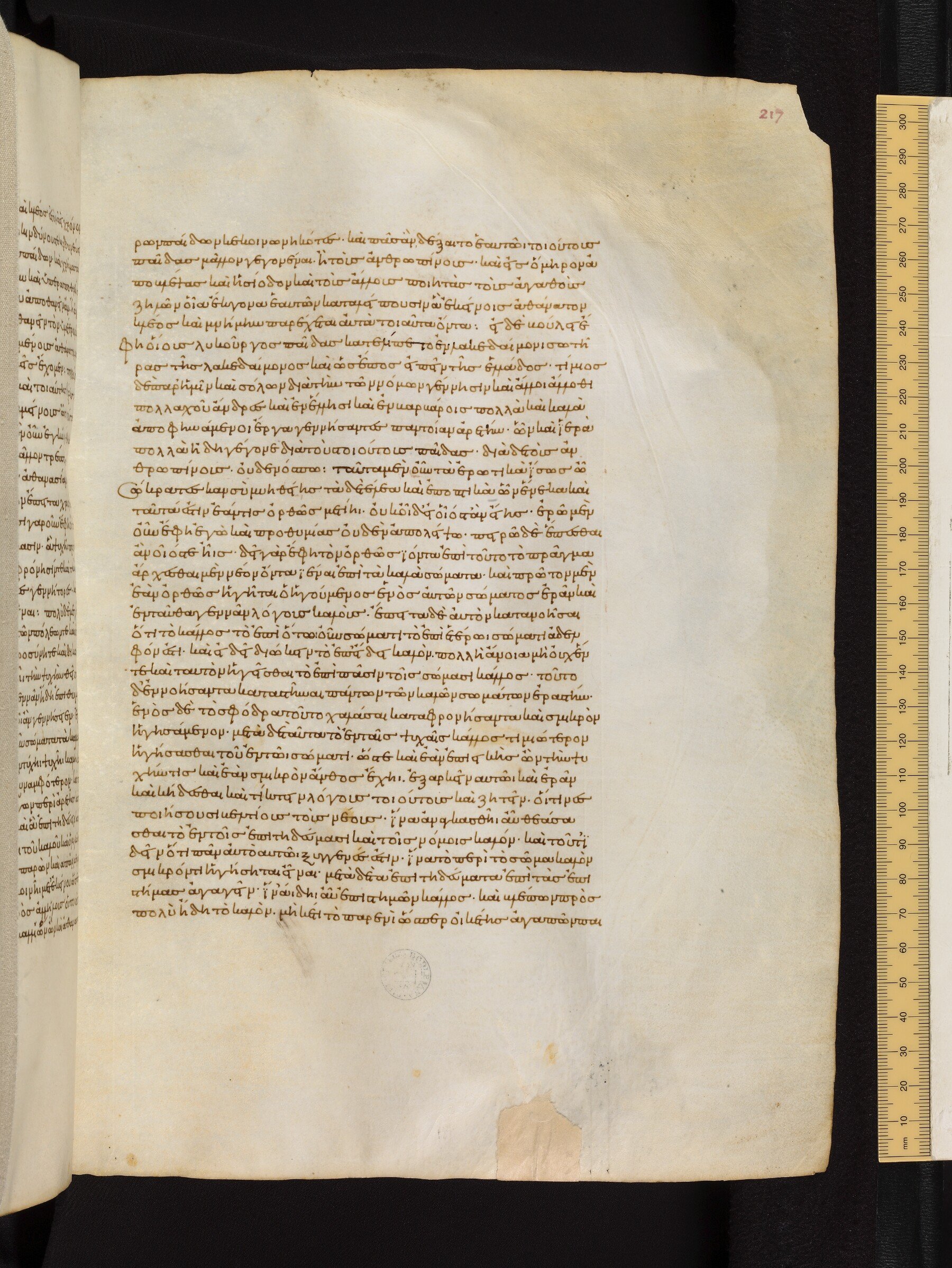
Starts on fol. 216v and continues on fol. 217r (page break inside this subsection). Clarke 39 fol. 216v runs from '(διά)κεινται ἔρωτι τοῦ ὀνομαστοὶ γενέσθαι καὶ κλέος ἐς τὸν ἀεὶ χρόνον' on its first line (208c) to 'ἴσχουσι καὶ φιλίαν βεβαιοτέραν, ἅτε καλλιόνων καὶ ἀθανατωτέ(ρων)' on its last line (209c). Viewer: https://digital.bodleian.ox.ac.uk/objects/f57d074b-cff1-4172-8236-797c7b8f0403/surfaces/106774a8-31fc-4c6e-9c45-d8d8956762e6/ Clarke 39 fol. 217r runs from '(ἀθανατωτέ)ρων παίδων κεκοινωνηκότες' on its first line (209c) to 'πολὺ ἤδη τὸ καλόν, μηκέτι τὸ παρʼ ἑνί, ὥσπερ οἰκέτης, ἀγαπῶν παι(δαρίου)' on its last line (210d). Viewer: https://digital.bodleian.ox.ac.uk/objects/f57d074b-cff1-4172-8236-797c7b8f0403/surfaces/27027f1a-0aa5-4ef7-9184-e6d9670a3133/ Checked on the images. The Greek shown is Burnet's critical text; the copyist's wording differs from it in small details.
τὸν ἄνδρα τὸν ἀγαθὸν καὶ ἃ ἐπιτηδεύειν, καὶ ἐπιχειρεῖ παιδεύειν. ἁπτόμενος γὰρ οἶμαι τοῦ καλοῦ καὶ ὁμιλῶν αὐτῷ, ἃ πάλαι ἐκύει τίκτει καὶ γεννᾷ, καὶ παρὼν καὶ ἀπὼν μεμνημένος, καὶ τὸ γεννηθὲν συνεκτρέφει κοινῇ μετʼ ἐκείνου, ὥστε πολὺ μείζω κοινωνίαν τῆς τῶν παίδων πρὸς ἀλλήλους οἱ τοιοῦτοι ἴσχουσι καὶ φιλίαν βεβαιοτέραν, ἅτε καλλιόνων καὶ ἀθανατωτέρων παίδων κεκοινωνηκότες. καὶ πᾶς ἂν δέξαιτο ἑαυτῷ τοιούτους παῖδας μᾶλλον γεγονέναι ἢ τοὺς
the good man’s character and what his pursuits; and so he takes in hand the other’s education. For I hold that by contact with the fair one and by consorting with him he bears and brings forth his long-felt conception, because in presence or absence he remembers his fair. Equally too with him he shares the nurturing of what is begotten, so that men in this condition enjoy a far fuller community with each other than that which comes with children, and a far surer friendship, since the children of their union are fairer and more deathless. Every one would choose to have got children such as these rather than the human sort—
Where on the image
On Clarke 39 fol. 217r. Clarke 39 fol. 217r runs from '(ἀθανατωτέ)ρων παίδων κεκοινωνηκότες' on its first line (209c) to 'πολὺ ἤδη τὸ καλόν, μηκέτι τὸ παρʼ ἑνί, ὥσπερ οἰκέτης, ἀγαπῶν παι(δαρίου)' on its last line (210d). Viewer: https://digital.bodleian.ox.ac.uk/objects/f57d074b-cff1-4172-8236-797c7b8f0403/surfaces/27027f1a-0aa5-4ef7-9184-e6d9670a3133/ Checked on the images. The Greek shown is Burnet's critical text; the copyist's wording differs from it in small details.
ἀνθρωπίνους, καὶ εἰς Ὅμηρον ἀποβλέψας καὶ Ἡσίοδον καὶ τοὺς ἄλλους ποιητὰς τοὺς ἀγαθοὺς ζηλῶν, οἷα ἔκγονα ἑαυτῶν καταλείπουσιν, ἃ ἐκείνοις ἀθάνατον κλέος καὶ μνήμην παρέχεται αὐτὰ τοιαῦτα ὄντα· εἰ δὲ βούλει, ἔφη, οἵους Λυκοῦργος παῖδας κατελίπετο ἐν Λακεδαίμονι σωτῆρας τῆς Λακεδαίμονος καὶ ὡς ἔπος εἰπεῖν τῆς Ἑλλάδος. τίμιος δὲ παρʼ ὑμῖν καὶ Σόλων διὰ τὴν τῶν νόμων γέννησιν, καὶ ἄλλοι
merely from turning a glance upon Homer and Hesiod and all the other good poets, and envying the fine offspring they leave behind to procure them a glory immortally renewed in the memory of men. Or only look, she said, at the fine children whom Lycurgus left behind him in Lacedaemon to deliver his country and—I may almost say—the whole of Greece; while Solon is highly esteemed among you for begetting his laws; and so are
Where on the image
On Clarke 39 fol. 217r. Clarke 39 fol. 217r runs from '(ἀθανατωτέ)ρων παίδων κεκοινωνηκότες' on its first line (209c) to 'πολὺ ἤδη τὸ καλόν, μηκέτι τὸ παρʼ ἑνί, ὥσπερ οἰκέτης, ἀγαπῶν παι(δαρίου)' on its last line (210d). Viewer: https://digital.bodleian.ox.ac.uk/objects/f57d074b-cff1-4172-8236-797c7b8f0403/surfaces/27027f1a-0aa5-4ef7-9184-e6d9670a3133/ Checked on the images. The Greek shown is Burnet's critical text; the copyist's wording differs from it in small details.
ἄλλοθι πολλαχοῦ ἄνδρες, καὶ ἐν Ἕλλησι καὶ ἐν βαρβάροις, πολλὰ καὶ καλὰ ἀποφηνάμενοι ἔργα, γεννήσαντες παντοίαν ἀρετήν· ὧν καὶ ἱερὰ πολλὰ ἤδη γέγονε διὰ τοὺς τοιούτους παῖδας, διὰ δὲ τοὺς ἀνθρωπίνους οὐδενός πω. ταῦτα μὲν οὖν τὰ ἐρωτικὰ ἴσως, ὦ Σώκρατες, κἂν σὺ
diverse men in diverse other regions, whether among the Greeks or among foreign peoples, for the number of goodly deeds shown forth in them, the manifold virtues they begot. In their name has many a shrine been reared because of their fine children; whereas for the human sort never any man obtained this honor. Into these love-matters even you, Socrates, might haply be initiated;
Where on the image
On Clarke 39 fol. 217r. Clarke 39 fol. 217r runs from '(ἀθανατωτέ)ρων παίδων κεκοινωνηκότες' on its first line (209c) to 'πολὺ ἤδη τὸ καλόν, μηκέτι τὸ παρʼ ἑνί, ὥσπερ οἰκέτης, ἀγαπῶν παι(δαρίου)' on its last line (210d). Viewer: https://digital.bodleian.ox.ac.uk/objects/f57d074b-cff1-4172-8236-797c7b8f0403/surfaces/27027f1a-0aa5-4ef7-9184-e6d9670a3133/ Checked on the images. The Greek shown is Burnet's critical text; the copyist's wording differs from it in small details.
μυηθείης· τὰ δὲ τέλεα καὶ ἐποπτικά, ὧν ἕνεκα καὶ ταῦτα ἔστιν, ἐάν τις ὀρθῶς μετίῃ, οὐκ οἶδʼ εἰ οἷός τʼ ἂν εἴης. ἐρῶ μὲν οὖν, ἔφη, ἐγὼ καὶ προθυμίας οὐδὲν ἀπολείψω· πειρῶ δὲ ἕπεσθαι, ἂν οἷός τε ᾖς. δεῖ γάρ, ἔφη, τὸν ὀρθῶς ἰόντα ἐπὶ τοῦτο τὸ πρᾶγμα ἄρχεσθαι μὲν νέον ὄντα ἰέναι ἐπὶ τὰ καλὰ σώματα, καὶ πρῶτον μέν, ἐὰν ὀρθῶς ἡγῆται ὁ ἡγούμενος, ἑνὸς αὐτὸν σώματος ἐρᾶν καὶ ἐνταῦθα γεννᾶν λόγους καλούς, ἔπειτα δὲ αὐτὸν κατανοῆσαι ὅτι τὸ κάλλος
but I doubt if you could approach the rites and revelations to which these, for the properly instructed, are merely the avenue. However I will speak of them, she said, and will not stint my best endeavors; only you on your part must try your best to follow. He who would proceed rightly in this business must not merely begin from his youth to encounter beautiful bodies. In the first place, indeed, if his conductor guides him aright, he must be in love with one particular body, and engender beautiful converse therein;
Where on the image
On Clarke 39 fol. 217r. Clarke 39 fol. 217r runs from '(ἀθανατωτέ)ρων παίδων κεκοινωνηκότες' on its first line (209c) to 'πολὺ ἤδη τὸ καλόν, μηκέτι τὸ παρʼ ἑνί, ὥσπερ οἰκέτης, ἀγαπῶν παι(δαρίου)' on its last line (210d). Viewer: https://digital.bodleian.ox.ac.uk/objects/f57d074b-cff1-4172-8236-797c7b8f0403/surfaces/27027f1a-0aa5-4ef7-9184-e6d9670a3133/ Checked on the images. The Greek shown is Burnet's critical text; the copyist's wording differs from it in small details.
τὸ ἐπὶ ὁτῳοῦν σώματι τῷ ἐπὶ ἑτέρῳ σώματι ἀδελφόν ἐστι, καὶ εἰ δεῖ διώκειν τὸ ἐπʼ εἴδει καλόν, πολλὴ ἄνοια μὴ οὐχ ἕν τε καὶ ταὐτὸν ἡγεῖσθαι τὸ ἐπὶ πᾶσιν τοῖς σώμασι κάλλος· τοῦτο δʼ ἐννοήσαντα καταστῆναι πάντων τῶν καλῶν σωμάτων ἐραστήν, ἑνὸς δὲ τὸ σφόδρα τοῦτο χαλάσαι καταφρονήσαντα καὶ σμικρὸν ἡγησάμενον· μετὰ δὲ ταῦτα τὸ ἐν ταῖς ψυχαῖς κάλλος τιμιώτερον ἡγήσασθαι τοῦ ἐν τῷ σώματι, ὥστε καὶ ἐὰν ἐπιεικὴς ὢν τὴν ψυχήν τις κἂν σμικρὸν ἄνθος
but next he must remark how the beauty attached to this or that body is cognate to that which is attached to any other, and that if he means to ensue beauty in form, it is gross folly not to regard as one and the same the beauty belonging to all; and so, having grasped this truth, he must make himself a lover of all beautiful bodies, and slacken the stress of his feeling for one by contemning it and counting it a trifle. But his next advance will be to set a higher value on the beauty of souls than on that of the body, so that however little the grace that may bloom in any likely soul
Where on the image
On Clarke 39 fol. 217r. Clarke 39 fol. 217r runs from '(ἀθανατωτέ)ρων παίδων κεκοινωνηκότες' on its first line (209c) to 'πολὺ ἤδη τὸ καλόν, μηκέτι τὸ παρʼ ἑνί, ὥσπερ οἰκέτης, ἀγαπῶν παι(δαρίου)' on its last line (210d). Viewer: https://digital.bodleian.ox.ac.uk/objects/f57d074b-cff1-4172-8236-797c7b8f0403/surfaces/27027f1a-0aa5-4ef7-9184-e6d9670a3133/ Checked on the images. The Greek shown is Burnet's critical text; the copyist's wording differs from it in small details.
ἔχῃ, ἐξαρκεῖν αὐτῷ καὶ ἐρᾶν καὶ κήδεσθαι καὶ τίκτειν λόγους τοιούτους καὶ ζητεῖν, οἵτινες ποιήσουσι βελτίους τοὺς νέους, ἵνα ἀναγκασθῇ αὖ θεάσασθαι τὸ ἐν τοῖς ἐπιτηδεύμασι καὶ τοῖς νόμοις καλὸν καὶ τοῦτʼ ἰδεῖν ὅτι πᾶν αὐτὸ αὑτῷ συγγενές ἐστιν, ἵνα τὸ περὶ τὸ σῶμα καλὸν σμικρόν τι ἡγήσηται εἶναι· μετὰ δὲ τὰ ἐπιτηδεύματα ἐπὶ τὰς ἐπιστήμας ἀγαγεῖν, ἵνα ἴδῃ αὖ ἐπιστημῶν κάλλος, καὶ βλέπων πρὸς
it shall suffice him for loving and caring, and for bringing forth and soliciting such converse as will tend to the betterment of the young; and that finally he may be constrained to contemplate the beautiful as appearing in our observances and our laws, and to behold it all bound together in kinship and so estimate the body’s beauty as a slight affair. From observances he should be led on to the branches of knowledge, that there also he may behold a province of beauty, and by looking thus on beauty in the mass may escape from the mean, meticulous slavery of a single instance, where he must center all his care,
Where on the image
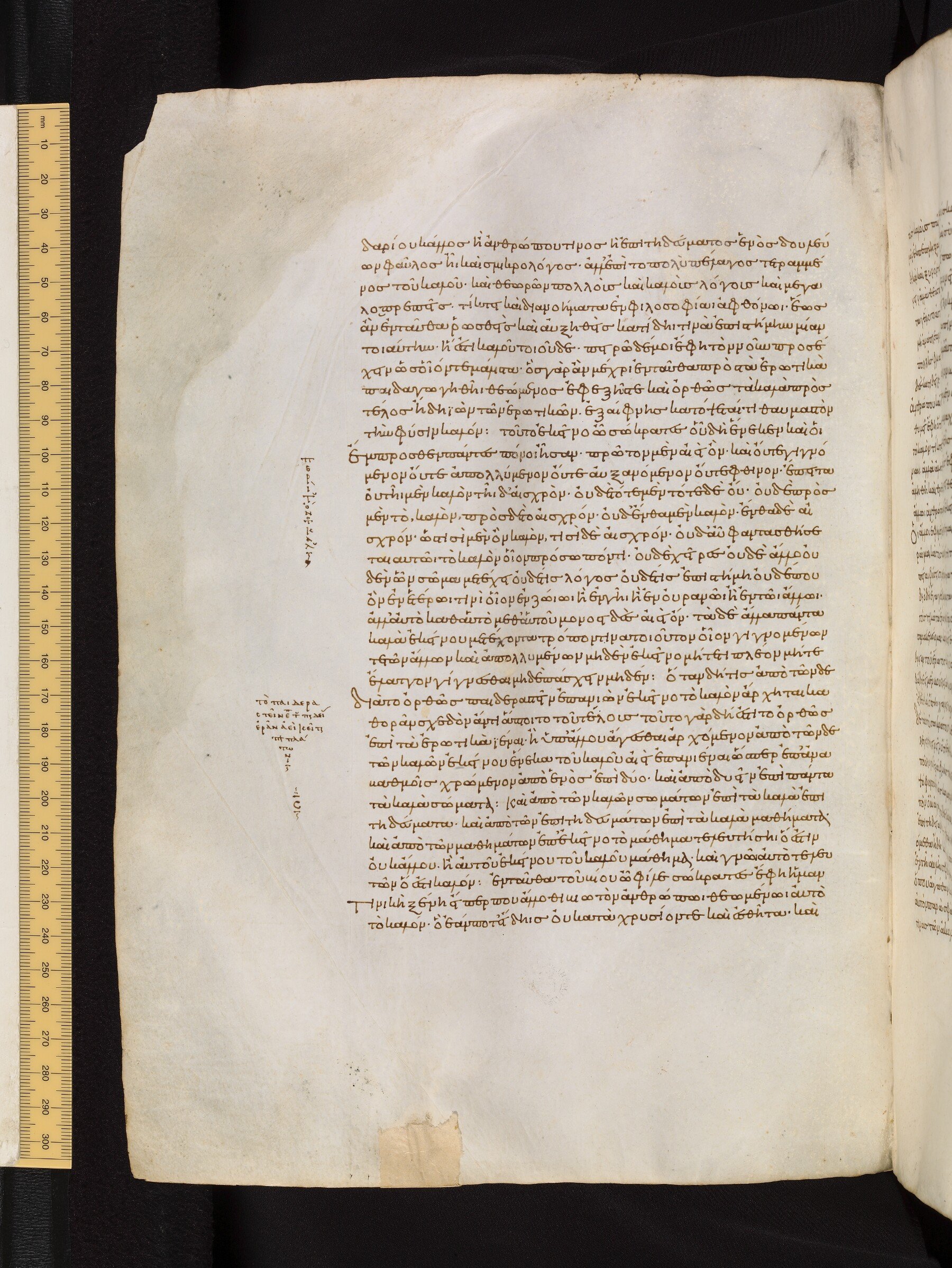
Starts on fol. 217r and continues on fol. 217v (page break inside this subsection). Clarke 39 fol. 217r runs from '(ἀθανατωτέ)ρων παίδων κεκοινωνηκότες' on its first line (209c) to 'πολὺ ἤδη τὸ καλόν, μηκέτι τὸ παρʼ ἑνί, ὥσπερ οἰκέτης, ἀγαπῶν παι(δαρίου)' on its last line (210d). Viewer: https://digital.bodleian.ox.ac.uk/objects/f57d074b-cff1-4172-8236-797c7b8f0403/surfaces/27027f1a-0aa5-4ef7-9184-e6d9670a3133/ Clarke 39 fol. 217v runs from '(παι)δαρίου κάλλος ἢ ἀνθρώπου τινὸς ἢ ἐπιτηδεύματος ἑνός' on its first line (210d) to 'ὃ ἐάν ποτε ἴδῃς, οὐ κατὰ χρυσίον τε καὶ ἐσθῆτα καὶ' on its last line (211d). Viewer: https://digital.bodleian.ox.ac.uk/objects/f57d074b-cff1-4172-8236-797c7b8f0403/surfaces/732fece8-ffee-47ab-8fb2-6d8092a155d0/ Checked on the images. The Greek shown is Burnet's critical text; the copyist's wording differs from it in small details.
πολὺ ἤδη τὸ καλὸν μηκέτι τὸ παρʼ ἑνί, ὥσπερ οἰκέτης, ἀγαπῶν παιδαρίου κάλλος ἢ ἀνθρώπου τινὸς ἢ ἐπιτηδεύματος ἑνός, δουλεύων φαῦλος ᾖ καὶ σμικρολόγος, ἀλλʼ ἐπὶ τὸ πολὺ πέλαγος τετραμμένος τοῦ καλοῦ καὶ θεωρῶν πολλοὺς καὶ καλοὺς λόγους καὶ μεγαλοπρεπεῖς τίκτῃ καὶ διανοήματα ἐν φιλοσοφίᾳ ἀφθόνῳ, ἕως ἂν ἐνταῦθα ῥωσθεὶς καὶ αὐξηθεὶς κατίδῃ τινὰ ἐπιστήμην μίαν τοιαύτην, ἥ ἐστι καλοῦ
like a lackey, upon the beauty of a particular child or man or single observance; and turning rather towards the main ocean of the beautiful may by contemplation of this bring forth in all their splendor many fair fruits of discourse and meditation in a plenteous crop of philosophy; until with the strength and increase there acquired he descries a certain single knowledge connected with a beauty which has yet to be told. And here, I pray you,
Where on the image
On Clarke 39 fol. 217v. Clarke 39 fol. 217v runs from '(παι)δαρίου κάλλος ἢ ἀνθρώπου τινὸς ἢ ἐπιτηδεύματος ἑνός' on its first line (210d) to 'ὃ ἐάν ποτε ἴδῃς, οὐ κατὰ χρυσίον τε καὶ ἐσθῆτα καὶ' on its last line (211d). Viewer: https://digital.bodleian.ox.ac.uk/objects/f57d074b-cff1-4172-8236-797c7b8f0403/surfaces/732fece8-ffee-47ab-8fb2-6d8092a155d0/ Checked on the images. The Greek shown is Burnet's critical text; the copyist's wording differs from it in small details.
τοιοῦδε. πειρῶ δέ μοι, ἔφη, τὸν νοῦν προσέχειν ὡς οἷόν τε μάλιστα. ὃς γὰρ ἂν μέχρι ἐνταῦθα πρὸς τὰ ἐρωτικὰ παιδαγωγηθῇ, θεώμενος ἐφεξῆς τε καὶ ὀρθῶς τὰ καλά, πρὸς τέλος ἤδη ἰὼν τῶν ἐρωτικῶν ἐξαίφνης κατόψεταί τι θαυμαστὸν τὴν φύσιν καλόν, τοῦτο ἐκεῖνο, ὦ Σώκρατες, οὗ δὴ ἕνεκεν καὶ οἱ ἔμπροσθεν πάντες πόνοι ἦσαν, πρῶτον μὲν
said she, give me the very best of your attention. When a man has been thus far tutored in the lore of love, passing from view to view of beautiful things, in the right and regular ascent, suddenly he will have revealed to him, as he draws to the close of his dealings in love, a wondrous vision, beautiful in its nature; and this, Socrates, is the final object of all those previous toils. First of all, it is ever-existent
Where on the image
On Clarke 39 fol. 217v. Clarke 39 fol. 217v runs from '(παι)δαρίου κάλλος ἢ ἀνθρώπου τινὸς ἢ ἐπιτηδεύματος ἑνός' on its first line (210d) to 'ὃ ἐάν ποτε ἴδῃς, οὐ κατὰ χρυσίον τε καὶ ἐσθῆτα καὶ' on its last line (211d). Viewer: https://digital.bodleian.ox.ac.uk/objects/f57d074b-cff1-4172-8236-797c7b8f0403/surfaces/732fece8-ffee-47ab-8fb2-6d8092a155d0/ Checked on the images. The Greek shown is Burnet's critical text; the copyist's wording differs from it in small details.
ἀεὶ ὂν καὶ οὔτε γιγνόμενον οὔτε ἀπολλύμενον, οὔτε αὐξανόμενον οὔτε φθίνον, ἔπειτα οὐ τῇ μὲν καλόν, τῇ δʼ αἰσχρόν, οὐδὲ τοτὲ μέν, τοτὲ δὲ οὔ, οὐδὲ πρὸς μὲν τὸ καλόν, πρὸς δὲ τὸ αἰσχρόν, οὐδʼ ἔνθα μὲν καλόν, ἔνθα δὲ αἰσχρόν, ὡς τισὶ μὲν ὂν καλόν, τισὶ δὲ αἰσχρόν· οὐδʼ αὖ φαντασθήσεται αὐτῷ τὸ καλὸν οἷον πρόσωπόν τι οὐδὲ χεῖρες οὐδὲ ἄλλο οὐδὲν ὧν σῶμα μετέχει, οὐδέ τις λόγος οὐδέ τις ἐπιστήμη, οὐδέ που ὂν ἐν ἑτέρῳ τινι, οἷον ἐν ζῴῳ ἢ ἐν γῇ ἢ ἐν οὐρανῷ
and neither comes to be nor perishes, neither waxes nor wanes; next, it is not beautiful in part and in part ugly, nor is it such at such a time and other at another, nor in one respect beautiful and in another ugly, nor so affected by position as to seem beautiful to some and ugly to others. Nor again will our initiate find the beautiful presented to him in the guise of a face or of hands or any other portion of the body, nor as a particular description or piece of knowledge, nor as existing somewhere in another substance, such as an animal or
Where on the image
On Clarke 39 fol. 217v. Clarke 39 fol. 217v runs from '(παι)δαρίου κάλλος ἢ ἀνθρώπου τινὸς ἢ ἐπιτηδεύματος ἑνός' on its first line (210d) to 'ὃ ἐάν ποτε ἴδῃς, οὐ κατὰ χρυσίον τε καὶ ἐσθῆτα καὶ' on its last line (211d). Viewer: https://digital.bodleian.ox.ac.uk/objects/f57d074b-cff1-4172-8236-797c7b8f0403/surfaces/732fece8-ffee-47ab-8fb2-6d8092a155d0/ Checked on the images. The Greek shown is Burnet's critical text; the copyist's wording differs from it in small details.
ἢ ἔν τῳ ἄλλῳ, ἀλλʼ αὐτὸ καθʼ αὑτὸ μεθʼ αὑτοῦ μονοειδὲς ἀεὶ ὄν, τὰ δὲ ἄλλα πάντα καλὰ ἐκείνου μετέχοντα τρόπον τινὰ τοιοῦτον, οἷον γιγνομένων τε τῶν ἄλλων καὶ ἀπολλυμένων μηδὲν ἐκεῖνο μήτε τι πλέον μήτε ἔλαττον γίγνεσθαι μηδὲ πάσχειν μηδέν. ὅταν δή τις ἀπὸ τῶνδε διὰ τὸ ὀρθῶς παιδεραστεῖν ἐπανιὼν ἐκεῖνο τὸ καλὸν ἄρχηται καθορᾶν, σχεδὸν ἄν τι ἅπτοιτο τοῦ τέλους. τοῦτο γὰρ δή ἐστι τὸ ὀρθῶς ἐπὶ
the earth or sky or any other thing; but existing ever in singularity of form independent by itself, while all the multitude of beautiful things partake of it in such wise that, though all of them are coming to be and perishing, it grows neither greater nor less, and is affected by nothing. So when a man by the right method of boy-loving ascends from these particulars and begins to descry that beauty, he is almost able to lay hold of the final secret. Such is the right approach
Where on the image
On Clarke 39 fol. 217v. Clarke 39 fol. 217v runs from '(παι)δαρίου κάλλος ἢ ἀνθρώπου τινὸς ἢ ἐπιτηδεύματος ἑνός' on its first line (210d) to 'ὃ ἐάν ποτε ἴδῃς, οὐ κατὰ χρυσίον τε καὶ ἐσθῆτα καὶ' on its last line (211d). Viewer: https://digital.bodleian.ox.ac.uk/objects/f57d074b-cff1-4172-8236-797c7b8f0403/surfaces/732fece8-ffee-47ab-8fb2-6d8092a155d0/ Checked on the images. The Greek shown is Burnet's critical text; the copyist's wording differs from it in small details.
τὰ ἐρωτικὰ ἰέναι ἢ ὑπʼ ἄλλου ἄγεσθαι, ἀρχόμενον ἀπὸ τῶνδε τῶν καλῶν ἐκείνου ἕνεκα τοῦ καλοῦ ἀεὶ ἐπανιέναι, ὥσπερ ἐπαναβασμοῖς χρώμενον, ἀπὸ ἑνὸς ἐπὶ δύο καὶ ἀπὸ δυοῖν ἐπὶ πάντα τὰ καλὰ σώματα, καὶ ἀπὸ τῶν καλῶν σωμάτων ἐπὶ τὰ καλὰ ἐπιτηδεύματα, καὶ ἀπὸ τῶν ἐπιτηδευμάτων ἐπὶ τὰ καλὰ μαθήματα, καὶ ἀπὸ τῶν μαθημάτων ἐπʼ ἐκεῖνο τὸ μάθημα τελευτῆσαι, ὅ ἐστιν οὐκ ἄλλου ἢ αὐτοῦ ἐκείνου τοῦ καλοῦ μάθημα, καὶ γνῷ αὐτὸ τελευτῶν ὃ ἔστι
or induction to love-matters. Beginning from obvious beauties he must for the sake of that highest beauty be ever climbing aloft, as on the rungs of a ladder, from one to two, and from two to all beautiful bodies; from personal beauty he proceeds to beautiful observances, from observance to beautiful learning, and from learning at last to that particular study which is concerned with the beautiful itself and that alone; so that in the end he comes to know
Where on the image
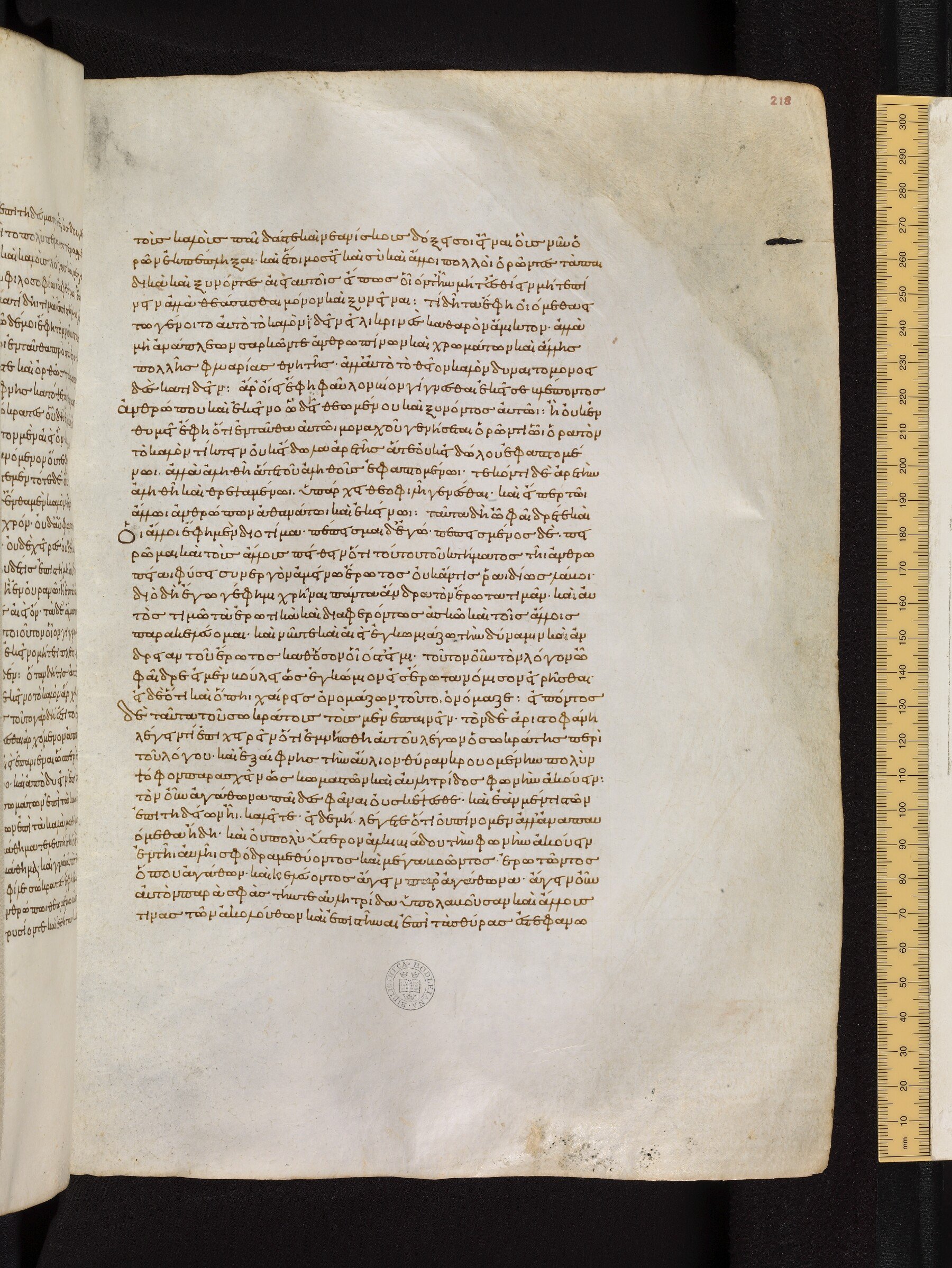
Starts on fol. 217v and continues on fol. 218r (page break inside this subsection). Clarke 39 fol. 217v runs from '(παι)δαρίου κάλλος ἢ ἀνθρώπου τινὸς ἢ ἐπιτηδεύματος ἑνός' on its first line (210d) to 'ὃ ἐάν ποτε ἴδῃς, οὐ κατὰ χρυσίον τε καὶ ἐσθῆτα καὶ' on its last line (211d). Viewer: https://digital.bodleian.ox.ac.uk/objects/f57d074b-cff1-4172-8236-797c7b8f0403/surfaces/732fece8-ffee-47ab-8fb2-6d8092a155d0/ Clarke 39 fol. 218r runs from 'τοὺς καλοὺς παῖδάς τε καὶ νεανίσκους δόξει σοι εἶναι' on its first line (211d) to 'τινὰς τῶν ἀκολούθων καὶ ἐπιστῆναι ἐπὶ τὰς θύρας' on its last line (212d). Viewer: https://digital.bodleian.ox.ac.uk/objects/f57d074b-cff1-4172-8236-797c7b8f0403/surfaces/dc908e6a-3f6a-4a6b-8b37-79f87a7df21b/ Checked on the images. The Greek shown is Burnet's critical text; the copyist's wording differs from it in small details.
καλόν. ἐνταῦθα τοῦ βίου, ὦ φίλε Σώκρατες, ἔφη ἡ Μαντινικὴ ξένη, εἴπερ που ἄλλοθι, βιωτὸν ἀνθρώπῳ, θεωμένῳ αὐτὸ τὸ καλόν. ὃ ἐάν ποτε ἴδῃς, οὐ κατὰ χρυσίον τε καὶ ἐσθῆτα καὶ τοὺς καλοὺς παῖδάς τε καὶ νεανίσκους δόξει σοι εἶναι, οὓς νῦν ὁρῶν ἐκπέπληξαι καὶ ἕτοιμος εἶ καὶ σὺ καὶ ἄλλοι πολλοί, ὁρῶντες τὰ παιδικὰ καὶ συνόντες ἀεὶ αὐτοῖς, εἴ πως οἷόν τʼ ἦν, μήτʼ ἐσθίειν μήτε πίνειν, ἀλλὰ θεᾶσθαι μόνον καὶ συνεῖναι. τί δῆτα, ἔφη, οἰόμεθα, εἴ τῳ γένοιτο
the very essence of beauty. In that state of life above all others, my dear Socrates, said the Mantinean woman, a man finds it truly worth while to live, as he contemplates essential beauty. This, when once beheld, will outshine your gold and your vesture, your beautiful boys and striplings, whose aspect now so astounds you and makes you and many another, at the sight and constant society of your darlings, ready to do without either food or drink if that were any way possible, and only gaze upon them and have their company.
Where on the image
On Clarke 39 fol. 218r. Clarke 39 fol. 218r runs from 'τοὺς καλοὺς παῖδάς τε καὶ νεανίσκους δόξει σοι εἶναι' on its first line (211d) to 'τινὰς τῶν ἀκολούθων καὶ ἐπιστῆναι ἐπὶ τὰς θύρας' on its last line (212d). Viewer: https://digital.bodleian.ox.ac.uk/objects/f57d074b-cff1-4172-8236-797c7b8f0403/surfaces/dc908e6a-3f6a-4a6b-8b37-79f87a7df21b/ Checked on the images. The Greek shown is Burnet's critical text; the copyist's wording differs from it in small details.
αὐτὸ τὸ καλὸν ἰδεῖν εἰλικρινές, καθαρόν, ἄμεικτον, ἀλλὰ μὴ ἀνάπλεων σαρκῶν τε ἀνθρωπίνων καὶ χρωμάτων καὶ ἄλλης πολλῆς φλυαρίας θνητῆς, ἀλλʼ αὐτὸ τὸ θεῖον καλὸν δύναιτο μονοειδὲς κατιδεῖν; ἆρʼ οἴει, ἔφη, φαῦλον βίον
But tell me, what would happen if one of you had the fortune to look upon essential beauty entire, pure and unalloyed; not infected with the flesh and color of humanity, and ever so much more of mortal trash? What if he could behold the divine beauty itself, in its unique form?
Where on the image
On Clarke 39 fol. 218r. Clarke 39 fol. 218r runs from 'τοὺς καλοὺς παῖδάς τε καὶ νεανίσκους δόξει σοι εἶναι' on its first line (211d) to 'τινὰς τῶν ἀκολούθων καὶ ἐπιστῆναι ἐπὶ τὰς θύρας' on its last line (212d). Viewer: https://digital.bodleian.ox.ac.uk/objects/f57d074b-cff1-4172-8236-797c7b8f0403/surfaces/dc908e6a-3f6a-4a6b-8b37-79f87a7df21b/ Checked on the images. The Greek shown is Burnet's critical text; the copyist's wording differs from it in small details.
γίγνεσθαι ἐκεῖσε βλέποντος ἀνθρώπου καὶ ἐκεῖνο ᾧ δεῖ θεωμένου καὶ συνόντος αὐτῷ; ἢ οὐκ ἐνθυμῇ, ἔφη, ὅτι ἐνταῦθα αὐτῷ μοναχοῦ γενήσεται, ὁρῶντι ᾧ ὁρατὸν τὸ καλόν, τίκτειν οὐκ εἴδωλα ἀρετῆς, ἅτε οὐκ εἰδώλου ἐφαπτομένῳ, ἀλλὰ ἀληθῆ, ἅτε τοῦ ἀληθοῦς ἐφαπτομένῳ· τεκόντι δὲ ἀρετὴν ἀληθῆ καὶ θρεψαμένῳ ὑπάρχει θεοφιλεῖ γενέσθαι, καὶ εἴπέρ τῳ ἄλλῳ ἀνθρώπων ἀθανάτῳ καὶ ἐκείνῳ;
Do you call it a pitiful life for a man to lead—looking that way, observing that vision by the proper means, and having it ever with him? Do but consider, she said, that there only will it befall him, as he sees the beautiful through that which makes it visible, to breed not illusions but true examples of virtue, since his contact is not with illusion but with truth. So when he has begotten a true virtue and has reared it up he is destined to win the friendship of Heaven; he, above all men, is immortal.
Where on the image
On Clarke 39 fol. 218r. Clarke 39 fol. 218r runs from 'τοὺς καλοὺς παῖδάς τε καὶ νεανίσκους δόξει σοι εἶναι' on its first line (211d) to 'τινὰς τῶν ἀκολούθων καὶ ἐπιστῆναι ἐπὶ τὰς θύρας' on its last line (212d). Viewer: https://digital.bodleian.ox.ac.uk/objects/f57d074b-cff1-4172-8236-797c7b8f0403/surfaces/dc908e6a-3f6a-4a6b-8b37-79f87a7df21b/ Checked on the images. The Greek shown is Burnet's critical text; the copyist's wording differs from it in small details.
ταῦτα δή, ὦ Φαῖδρέ τε καὶ οἱ ἄλλοι, ἔφη μὲν Διοτίμα, πέπεισμαι δʼ ἐγώ· πεπεισμένος δὲ πειρῶμαι καὶ τοὺς ἄλλους πείθειν ὅτι τούτου τοῦ κτήματος τῇ ἀνθρωπείᾳ φύσει συνεργὸν ἀμείνω Ἔρωτος οὐκ ἄν τις ῥᾳδίως λάβοι. διὸ δὴ ἔγωγέ φημι χρῆναι πάντα ἄνδρα τὸν ἔρωτα τιμᾶν, καὶ αὐτὸς τιμῶ τὰ ἐρωτικὰ καὶ διαφερόντως ἀσκῶ, καὶ τοῖς ἄλλοις παρακελεύομαι, καὶ νῦν τε καὶ ἀεὶ ἐγκωμιάζω τὴν δύναμιν καὶ ἀνδρείαν τοῦ Ἔρωτος καθʼ ὅσον οἷός τʼ εἰμί. τοῦτον
This, Phaedrus and you others, is what Diotima told me, and I am persuaded of it; in which persuasion I pursue my neighbors, to persuade them in turn that towards this acquisition the best helper that our human nature can hope to find is Love. Wherefore I tell you now that every man should honor Love, as I myself do honor all love-matters with especial devotion, and exhort all other men to do the same; both now and always do I glorify Love’s power and valor
Where on the image
On Clarke 39 fol. 218r. Clarke 39 fol. 218r runs from 'τοὺς καλοὺς παῖδάς τε καὶ νεανίσκους δόξει σοι εἶναι' on its first line (211d) to 'τινὰς τῶν ἀκολούθων καὶ ἐπιστῆναι ἐπὶ τὰς θύρας' on its last line (212d). Viewer: https://digital.bodleian.ox.ac.uk/objects/f57d074b-cff1-4172-8236-797c7b8f0403/surfaces/dc908e6a-3f6a-4a6b-8b37-79f87a7df21b/ Checked on the images. The Greek shown is Burnet's critical text; the copyist's wording differs from it in small details.
οὖν τὸν λόγον, ὦ Φαῖδρε, εἰ μὲν βούλει, ὡς ἐγκώμιον εἰς ἔρωτα νόμισον εἰρῆσθαι, εἰ δέ, ὅτι καὶ ὅπῃ χαίρεις ὀνομάζων, τοῦτο ὀνόμαζε. εἰπόντος δὲ ταῦτα τοῦ Σωκράτους τοὺς μὲν ἐπαινεῖν, τὸν δὲ Ἀριστοφάνη λέγειν τι ἐπιχειρεῖν, ὅτι ἐμνήσθη αὐτοῦ λέγων ὁ Σωκράτης περὶ τοῦ λόγου· καὶ ἐξαίφνης τὴν αὔλειον θύραν κρουομένην πολὺν ψόφον παρασχεῖν ὡς κωμαστῶν, καὶ αὐλητρίδος φωνὴν ἀκούειν. τὸν οὖν Ἀγάθωνα, παῖδες, φάναι,
as far as I am able. So I ask you, Phaedrus, to be so good as to consider this account as a eulogy bestowed on Love, or else to call it by any name that pleases your fancy. After Socrates had thus spoken, there was applause from all the company except Aristophanes, who was beginning to remark on the allusion which Socrates’ speech had made to his own; when suddenly there was a knocking at the outer door, which had a noisy sound like that of revellers, and they heard notes of a flute-girl. Go and see to it,
Notes
- Greek: John Burnet, Platonis Opera (Oxford Classical Texts, 1900-1907), Perseus digital text. Square brackets mark words Burnet deletes.
- English: W. R. M. Lamb, Plato III: Lysis, Symposium, Gorgias (Loeb Classical Library, Harvard University Press / Heinemann, 1925), Perseus tlg0059.tlg011.perseus-eng2. The English section breaks follow the translator's own Stephanus markers, so a few words may fall on the neighbouring side of a break compared with the Greek.
Cite
Sources
- Source: Oxford, Bodleian Library, MS. E. D. Clarke 39 fol. 213r-218r (Bodleian Libraries, University of Oxford, Digital Bodleian (IIIF)) + Burnet Greek (Perseus) + W. R. M. Lamb (1925) English (Perseus) (holding institution)
- Critical edition: Burnet, Platonis Opera (1900-1907), via Perseus
← previous · → next · v cycle view · l back to library