Plato, Laws 3.676a-679e: the floods and the survivors on the mountains
Introduction
In book 3 of the Laws, Plato's last and longest dialogue (c. 350 BCE), an unnamed Athenian, the Cretan Clinias and the Spartan Megillus ask where political society began. The Athenian's answer is a history of the human race on a scale of tens of thousands of years: civilization has been destroyed many times by floods, plagues and other disasters, and after the last great flood only a few herdsmen survived on the mountain tops, without tools, metals or writing. He traces how they lived, how households under the rule of the eldest joined into villages and then into cities with lawgivers, and how the first city was built in the plain at Troy. The passage is the fullest statement in Plato of the cyclical destruction of civilization that the Egyptian priests describe to Solon in the Timaeus and Critias.
The manuscript is Paris, Bibliothèque nationale de France, grec 1807 (Plato "A"), written at Constantinople in the third quarter of the 9th century, one of the two oldest and most authoritative manuscripts of the Laws. Book 3 begins on fol. 174r; the passage occupies fols. 174r-176v, two columns to the page. Each section is one Stephanus section and points at the page(s) that carry it; the column breaks were read on the images and are recorded in each note.
This entry covers Laws 3.676a-679e on fols. 174r-175r.
How was this verified? (Provenance)
Where on the image
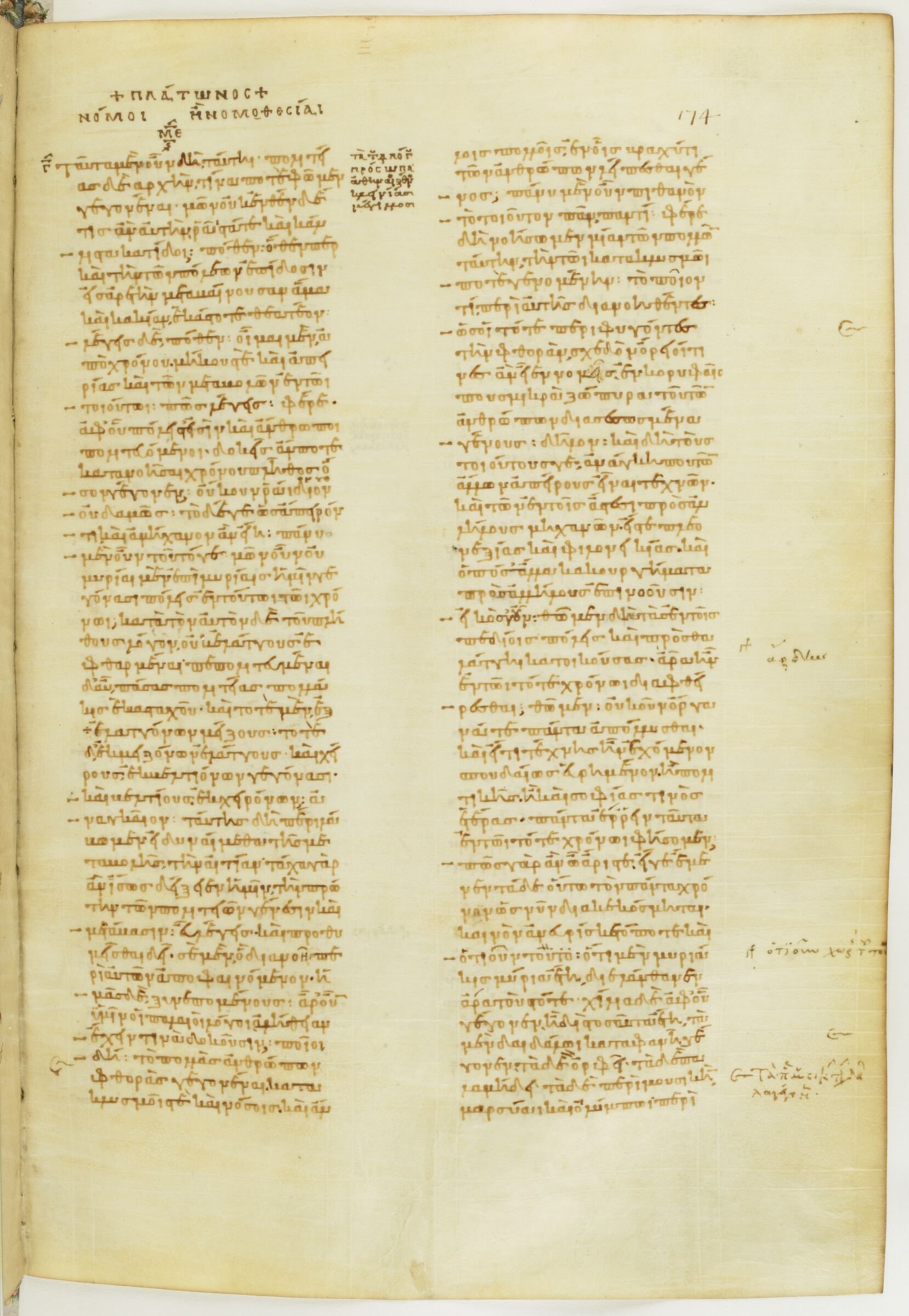
676a is on fol. 174r col. a. Fol. 174r: the title 'πλάτωνος νόμοι ἢ νομοθεσίαι με´' stands over column a, which begins 'ταῦτα μὲν οὖν δὴ ταύτῃ· πολιτείας δὲ ἀρχὴν' (676a) and ends in 677a '...κατακλυσμοῖς τε καὶ νόσοις καὶ ἄλ-'; column b begins '-λοις πολλοῖς, ἐν οἷς βραχύ τι τῶν ἀνθρώπων' and ends in 677d '...Μαρσύᾳ καὶ Ὀλύμπῳ, περὶ'. Checked on the image. Viewer: https://gallica.bnf.fr/ark:/12148/btv1b8419248n/f357.item
676a[ΑΘ.] ταῦτα μὲν οὖν δὴ ταύτῃ· πολιτείας δὲ ἀρχὴν τίνα ποτὲ φῶμεν γεγονέναι; μῶν οὐκ ἐνθένδε τις ἂν αὐτὴν ῥᾷστά τε καὶ κάλλιστα κατίδοι; [ΚΛ.] πόθεν; [ΑΘ.] ὅθενπερ καὶ τὴν τῶν πόλεων ἐπίδοσιν εἰς ἀρετὴν μεταβαίνουσαν ἅμα καὶ κακίαν ἑκάστοτε θεατέον. [ΚΛ.] λέγεις δὲ πόθεν; [ΑΘ.] οἶμαι μὲν ἀπὸ χρόνου μήκους τε καὶ ἀπειρίας καὶ
676a[Ath.] So much for that, then! Now, what are we to say about the origin of government? Would not the best and easiest way of discerning it be from this standpoint? [Clin.] What standpoint? [Ath.] That from which one should always observe the progress of States as they move towards either goodness or badness. [Clin.] What point is that? [Ath.] The observation, as I suppose, of an infinitely long period of time
Where on the image
676b is on fol. 174r col. a. Fol. 174r: the title 'πλάτωνος νόμοι ἢ νομοθεσίαι με´' stands over column a, which begins 'ταῦτα μὲν οὖν δὴ ταύτῃ· πολιτείας δὲ ἀρχὴν' (676a) and ends in 677a '...κατακλυσμοῖς τε καὶ νόσοις καὶ ἄλ-'; column b begins '-λοις πολλοῖς, ἐν οἷς βραχύ τι τῶν ἀνθρώπων' and ends in 677d '...Μαρσύᾳ καὶ Ὀλύμπῳ, περὶ'. Checked on the image. Viewer: https://gallica.bnf.fr/ark:/12148/btv1b8419248n/f357.item
676bτῶν μεταβολῶν ἐν τῷ τοιούτῳ. [ΚΛ.] πῶς λέγεις; [ΑΘ.] φέρε, ἀφʼ οὗ πόλεις τʼ εἰσὶν καὶ ἄνθρωποι πολιτευόμενοι, δοκεῖς ἄν ποτε κατανοῆσαι χρόνου πλῆθος ὅσον γέγονεν; [ΚΛ.] οὔκουν ῥᾴδιόν γε οὐδαμῶς. [ΑΘ.] τὸ δέ γε ὡς ἄπλετόν τι καὶ ἀμήχανον ἂν εἴη; [ΚΛ.] πάνυ μὲν οὖν τοῦτό γε. [ΑΘ.] μῶν οὖν οὐ μυρίαι μὲν ἐπὶ μυρίαις ἡμῖν γεγόνασι πόλεις ἐν τούτῳ τῷ χρόνῳ, κατὰ τὸν αὐτὸν δὲ τοῦ πλήθους
676band of the variations therein occurring. [Clin.] Explain your meaning. [Ath.] Tell me now: do you think you could ever ascertain the space of time that has passed since cities came into existence and men lived under civic rule? [Clin.] Certainly it would be no easy task. [Ath.] But you can easily see that it is vast and immeasurable? [Clin.] That I most certainly can do. [Ath.] During this time, have not thousands upon thousands of States come into existence, and, on a similar computation, just as many perished?
Where on the image
676c is on fol. 174r col. a. Fol. 174r: the title 'πλάτωνος νόμοι ἢ νομοθεσίαι με´' stands over column a, which begins 'ταῦτα μὲν οὖν δὴ ταύτῃ· πολιτείας δὲ ἀρχὴν' (676a) and ends in 677a '...κατακλυσμοῖς τε καὶ νόσοις καὶ ἄλ-'; column b begins '-λοις πολλοῖς, ἐν οἷς βραχύ τι τῶν ἀνθρώπων' and ends in 677d '...Μαρσύᾳ καὶ Ὀλύμπῳ, περὶ'. Checked on the image. Viewer: https://gallica.bnf.fr/ark:/12148/btv1b8419248n/f357.item
676cλόγον οὐκ ἐλάττους ἐφθαρμέναι; πεπολιτευμέναι δʼ αὖ πάσας πολιτείας πολλάκις ἑκασταχοῦ; καὶ τοτὲ μὲν ἐξ ἐλαττόνων μείζους, τοτὲ δʼ ἐκ μειζόνων ἐλάττους, καὶ χείρους ἐκ βελτιόνων γεγόνασι καὶ βελτίους ἐκ χειρόνων; [ΚΛ.] ἀναγκαῖον. [ΑΘ.] ταύτης δὴ πέρι λάβωμεν, εἰ δυναίμεθα, τῆς μεταβολῆς τὴν αἰτίαν· τάχα γὰρ ἂν ἴσως δείξειεν ἡμῖν τὴν πρώτην τῶν πολιτειῶν γένεσιν καὶ μετάβασιν. [ΚΛ.] εὖ λέγεις, καὶ προθυμεῖσθαι δεῖ, σὲ μὲν ὃ διανοῇ περὶ αὐτῶν ἀποφαινόμενον, ἡμᾶς δὲ συνεπομένους.
676cAnd have they not in each case exhibited all kinds of constitutions over and over again? And have they not changed at one time from small to great, at another from great to small, and changed also from good to bad and from bad to good? [Clin.] Necessarily. [Ath.] Of this process of change let us discover, if we can, the cause; for this, perhaps, would show us what is the primary origin of constitutions, as well as their transformation. [Clin.] You are right; and we must all exert ourselves,—you to expound your view about them, and we to keep pace with you.
Where on the image
677a is on fol. 174r col. a-b. Fol. 174r: the title 'πλάτωνος νόμοι ἢ νομοθεσίαι με´' stands over column a, which begins 'ταῦτα μὲν οὖν δὴ ταύτῃ· πολιτείας δὲ ἀρχὴν' (676a) and ends in 677a '...κατακλυσμοῖς τε καὶ νόσοις καὶ ἄλ-'; column b begins '-λοις πολλοῖς, ἐν οἷς βραχύ τι τῶν ἀνθρώπων' and ends in 677d '...Μαρσύᾳ καὶ Ὀλύμπῳ, περὶ'. Checked on the image. Viewer: https://gallica.bnf.fr/ark:/12148/btv1b8419248n/f357.item
677a[ΑΘ.] ἆρʼ οὖν ὑμῖν οἱ παλαιοὶ λόγοι ἀλήθειαν ἔχειν τινὰ δοκοῦσιν; [ΚΛ.] ποῖοι δή; [ΑΘ.] τὸ πολλὰς ἀνθρώπων φθορὰς γεγονέναι κατακλυσμοῖς τε καὶ νόσοις καὶ ἄλλοις πολλοῖς, ἐν οἷς βραχύ τι τῶν ἀνθρώπων λείπεσθαι γένος. [ΚΛ.] πάνυ μὲν οὖν πιθανὸν τὸ τοιοῦτον πᾶν παντί. [ΑΘ.] φέρε δή, νοήσωμεν μίαν τῶν πολλῶν ταύτην τὴν τῷ κατακλυσμῷ ποτε γενομένην. [ΚΛ.] τὸ ποῖόν τι περὶ αὐτῆς διανοηθέντες;
677a[Ath.] Do you consider that there is any truth in the ancient tales? [Clin.] What tales? [Ath.] That the world of men has often been destroyed by floods, plagues, and many other things, in such a way that only a small portion of the human race has survived. [Clin.] Everyone would regard such accounts as perfectly credible. [Ath.] Come now, let us picture to ourselves one of the many catastrophes,—namely, that which occurred once upon a time through the Deluge. [Clin.] And what are we to imagine about it?
Where on the image
677b is on fol. 174r col. b. Fol. 174r: the title 'πλάτωνος νόμοι ἢ νομοθεσίαι με´' stands over column a, which begins 'ταῦτα μὲν οὖν δὴ ταύτῃ· πολιτείας δὲ ἀρχὴν' (676a) and ends in 677a '...κατακλυσμοῖς τε καὶ νόσοις καὶ ἄλ-'; column b begins '-λοις πολλοῖς, ἐν οἷς βραχύ τι τῶν ἀνθρώπων' and ends in 677d '...Μαρσύᾳ καὶ Ὀλύμπῳ, περὶ'. Checked on the image. Viewer: https://gallica.bnf.fr/ark:/12148/btv1b8419248n/f357.item
677b[ΑΘ.] ὡς οἱ τότε περιφυγόντες τὴν φθορὰν σχεδὸν ὄρειοί τινες ἂν εἶεν νομῆς, ἐν κορυφαῖς που σμικρὰ ζώπυρα τοῦ τῶν ἀνθρώπων διασεσωμένα γένους. [ΚΛ.] δῆλον. [ΑΘ.] καὶ δὴ τοὺς τοιούτους γε ἀνάγκη που τῶν ἄλλων ἀπείρους εἶναι τεχνῶν καὶ τῶν ἐν τοῖς ἄστεσι πρὸς ἀλλήλους μηχανῶν εἴς τε πλεονεξίας καὶ φιλονικίας καὶ ὁπόσʼ ἄλλα κακουργήματα πρὸς ἀλλήλους ἐπινοοῦσιν. [ΚΛ.] εἰκὸς γοῦν.
677b[Ath.] That the men who then escaped destruction must have been mostly herdsmen of the hills, scanty embers of the human race preserved somewhere on the mountain-tops. [Clin.] Evidently. [Ath.] Moreover, men of this kind must necessarily have been unskilled in the arts generally, and especially in such contrivances as men use against one another in cities for purposes of greed and rivalry and all the other villainies which they devise one against another.
Where on the image
677c is on fol. 174r col. b. Fol. 174r: the title 'πλάτωνος νόμοι ἢ νομοθεσίαι με´' stands over column a, which begins 'ταῦτα μὲν οὖν δὴ ταύτῃ· πολιτείας δὲ ἀρχὴν' (676a) and ends in 677a '...κατακλυσμοῖς τε καὶ νόσοις καὶ ἄλ-'; column b begins '-λοις πολλοῖς, ἐν οἷς βραχύ τι τῶν ἀνθρώπων' and ends in 677d '...Μαρσύᾳ καὶ Ὀλύμπῳ, περὶ'. Checked on the image. Viewer: https://gallica.bnf.fr/ark:/12148/btv1b8419248n/f357.item
677c[ΑΘ.] θῶμεν δὴ τὰς ἐν τοῖς πεδίοις πόλεις καὶ πρὸς θαλάττῃ κατοικούσας ἄρδην ἐν τῷ τότε χρόνῳ διαφθείρεσθαι; [ΚΛ.] θῶμεν. [ΑΘ.] οὐκοῦν ὄργανά τε πάντα ἀπόλλυσθαι, καὶ εἴ τι τέχνης ἦν ἐχόμενον σπουδαίως ηὑρημένον ἢ πολιτικῆς ἢ καὶ σοφίας τινὸς ἑτέρας, πάντα ἔρρειν ταῦτα ἐν τῷ τότε χρόνῳ φήσομεν; πῶς γὰρ ἄν, ὦ ἄριστε, εἴ γε ἔμενεν τάδε οὕτω τὸν πάντα χρόνον ὡς νῦν διακεκόσμηται, καινὸν ἀνηυρίσκετό ποτε καὶ ὁτιοῦν;
677c[Clin.] It is certainly probable. [Ath.] Shall we assume that the cities situated in the plains and near the sea were totally destroyed at the time? [Clin.] Let us assume it. [Ath.] And shall we say that all implements were lost, and that everything in the way of important arts or inventions that they may have had,—whether concerned with politics or other sciences,— perished at that time? For, supposing that things had remained all that time ordered just as they are now, how, my good sir, could anything new have ever been invented?
Where on the image
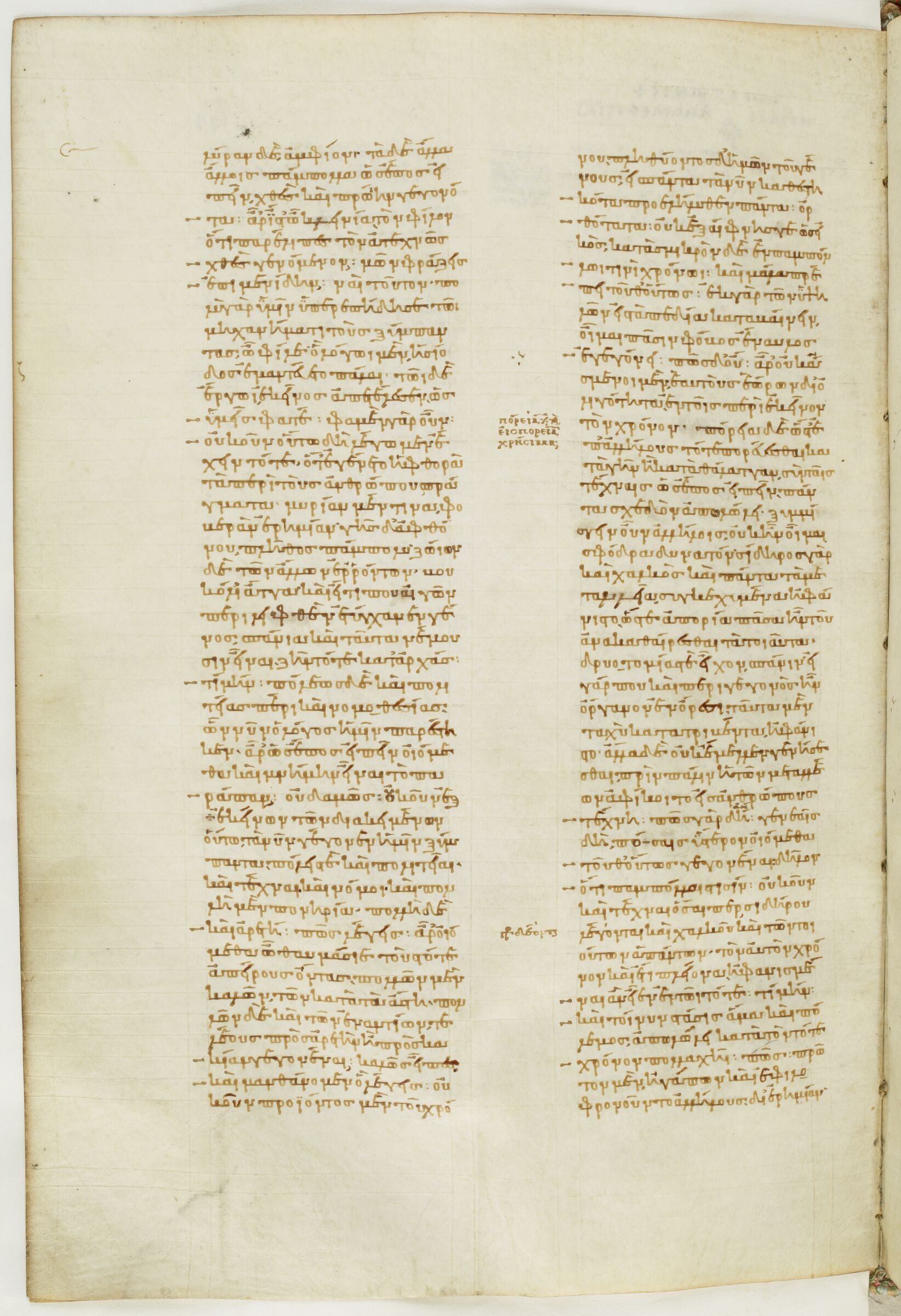
677d is on fol. 174r col. b and fol. 174v col. a. Fol. 174r: the title 'πλάτωνος νόμοι ἢ νομοθεσίαι με´' stands over column a, which begins 'ταῦτα μὲν οὖν δὴ ταύτῃ· πολιτείας δὲ ἀρχὴν' (676a) and ends in 677a '...κατακλυσμοῖς τε καὶ νόσοις καὶ ἄλ-'; column b begins '-λοις πολλοῖς, ἐν οἷς βραχύ τι τῶν ἀνθρώπων' and ends in 677d '...Μαρσύᾳ καὶ Ὀλύμπῳ, περὶ'. Fol. 174v: column a begins 'λύραν δὲ Ἀμφίονι' (677d) and ends in 678b '...οὐκοῦν προϊόντος μὲν τοῦ χρό-'; column b begins '-νου, πληθύοντος δ’ ἡμῶν τοῦ γένους' and ends in 678e '...ἐφιλοφρονοῦντο ἀλλήλους δι’ ἐρημίαν'. Checked on the image. Viewer: https://gallica.bnf.fr/ark:/12148/btv1b8419248n/f357.item
677d[ΚΛ.] τοῦτο ὅτι μὲν μυριάκις μύρια ἔτη διελάνθανεν ἄρα τοὺς τότε, χίλια δὲ ἀφʼ οὗ γέγονεν ἢ δὶς τοσαῦτα ἔτη, τὰ μὲν Δαιδάλῳ καταφανῆ γέγονεν, τὰ δὲ Ὀρφεῖ, τὰ δὲ Παλαμήδει, τὰ δὲ περὶ μουσικὴν Μαρσύᾳ καὶ Ὀλύμπῳ, περὶ λύραν δὲ Ἀμφίονι, τὰ δὲ ἄλλα ἄλλοις πάμπολλα, ὡς ἔπος εἰπεῖν χθὲς καὶ πρῴην γεγονότα. [ΑΘ.] ἄριστʼ, ὦ Κλεινία, τὸν φίλον ὅτι παρέλιπες, τὸν ἀτεχνῶς χθὲς γενόμενον. [ΚΛ.] μῶν φράζεις Ἐπιμενίδην;
677d[Clin.] Do you mean that these things were unknown to the men of those days for thousands upon thousands of years, and that one or two thousand years ago some of them were revealed to Daedalus, some to Orpheus, some to Palamedes, musical arts to Marsyas and Olympus, lyric to Amphion, and, in short, a vast number of others to other persons—all dating, so to say, from yesterday or the day before? [Ath.] Are you aware, Clinias, that you have left out your friend who was literally a man of yesterday? [Clin.] Is it Epimenides you mean? [Ath.] Yes, I mean him. For he far outstripped everybody you had, my friend, by that invention of his of which he was the actual producer, as you Cretans say, although Hesiod had divined it and spoken of it long before.
Where on the image
677e is on fol. 174v col. a. Fol. 174v: column a begins 'λύραν δὲ Ἀμφίονι' (677d) and ends in 678b '...οὐκοῦν προϊόντος μὲν τοῦ χρό-'; column b begins '-νου, πληθύοντος δ’ ἡμῶν τοῦ γένους' and ends in 678e '...ἐφιλοφρονοῦντο ἀλλήλους δι’ ἐρημίαν'. Checked on the image. Viewer: https://gallica.bnf.fr/ark:/12148/btv1b8419248n/f358.item
677e[ΑΘ.] ναί, τοῦτον· πολὺ γὰρ ὑμῖν ὑπερεπήδησε τῷ μηχανήματι τοὺς σύμπαντας, ὦ φίλε, ὃ λόγῳ μὲν Ἡσίοδος ἐμαντεύετο πάλαι, τῷ δὲ ἔργῳ ἐκεῖνος ἀπετέλεσεν, ὡς ὑμεῖς φατε. [ΚΛ.] φαμὲν γὰρ οὖν. [ΑΘ.] οὐκοῦν οὕτω δὴ λέγωμεν ἔχειν τότε, ὅτʼ ἐγένετο ἡ φθορά, τὰ περὶ τοὺς ἀνθρώπους πράγματα, μυρίαν μέν τινα φοβερὰν ἐρημίαν, γῆς δʼ ἀφθόνου πλῆθος πάμπολυ, ζῴων δὲ τῶν ἄλλων ἐρρόντων, βουκόλιʼ ἄττα, καὶ εἴ τί που αἰγῶν περιλειφθὲν ἐτύγχανεν γένος, σπάνια καὶ ταῦτα
677e[Clin.] We do say so. [Ath.] Shall we, then, state that, at the time when the destruction took place, human affairs were in this position: there was fearful and widespread desolation over a vast tract of land; most of the animals were destroyed, and the few herds of oxen and flocks of goats that happened to survive afforded at the first but scanty sustenance
Where on the image
678a is on fol. 174v col. a. Fol. 174v: column a begins 'λύραν δὲ Ἀμφίονι' (677d) and ends in 678b '...οὐκοῦν προϊόντος μὲν τοῦ χρό-'; column b begins '-νου, πληθύοντος δ’ ἡμῶν τοῦ γένους' and ends in 678e '...ἐφιλοφρονοῦντο ἀλλήλους δι’ ἐρημίαν'. Checked on the image. Viewer: https://gallica.bnf.fr/ark:/12148/btv1b8419248n/f358.item
678aνέμουσιν εἶναι ζῆν τότε κατʼ ἀρχάς; [ΚΛ.] τί μήν; [ΑΘ.] πόλεως δὲ καὶ πολιτείας πέρι καὶ νομοθεσίας, ὧν νῦν ὁ λόγος ἡμῖν παρέστηκεν, ἆρʼ ὡς ἔπος εἰπεῖν οἰόμεθα καὶ μνήμην εἶναι τὸ παράπαν; [ΚΛ.] οὐδαμῶς. [ΑΘ.] οὐκοῦν ἐξ ἐκείνων τῶν διακειμένων οὕτω τὰ νῦν γέγονεν ἡμῖν σύμπαντα, πόλεις τε καὶ πολιτεῖαι καὶ τέχναι καὶ νόμοι, καὶ πολλὴ μὲν πονηρία, πολλὴ δὲ καὶ ἀρετή; [ΚΛ.] πῶς λέγεις;
678ato their herdsmen? [Clin.] Yes. [Ath.] And as to the matters with which our present discourse is concerned—States and statecraft and legislation,—do we think they could have retained any memory whatsoever, broadly speaking, of such matters? [Clin.] By no means. [Ath.] So from those men, in that situation, there has sprung the whole of our present order—States and constitutions, arts and laws, with a great amount both of evil and of good? [Clin.] How do you mean?
Where on the image
678b is on fol. 174v col. a-b. Fol. 174v: column a begins 'λύραν δὲ Ἀμφίονι' (677d) and ends in 678b '...οὐκοῦν προϊόντος μὲν τοῦ χρό-'; column b begins '-νου, πληθύοντος δ’ ἡμῶν τοῦ γένους' and ends in 678e '...ἐφιλοφρονοῦντο ἀλλήλους δι’ ἐρημίαν'. Checked on the image. Viewer: https://gallica.bnf.fr/ark:/12148/btv1b8419248n/f358.item
678b[ΑΘ.] ἆρʼ οἰόμεθα, ὦ θαυμάσιε, τοὺς τότε, ἀπείρους ὄντας πολλῶν μὲν καλῶν τῶν κατὰ τὰ ἄστη, πολλῶν δὲ καὶ τῶν ἐναντίων, τελέους πρὸς ἀρετὴν ἢ πρὸς κακίαν γεγονέναι; [ΚΛ.] καλῶς εἶπες, καὶ μανθάνομεν ὃ λέγεις. [ΑΘ.] οὐκοῦν προϊόντος μὲν τοῦ χρόνου, πληθύοντος δʼ ἡμῶν τοῦ γένους, εἰς πάντα τὰ νῦν καθεστηκότα προελήλυθεν πάντα; [ΚΛ.] ὀρθότατα. [ΑΘ.] οὐκ ἐξαίφνης γε, ὡς εἰκός, κατὰ σμικρὸν δὲ ἐν παμπόλλῳ τινὶ χρόνῳ.
678b[Ath.] Do we imagine, my good Sir, that the men of that age, who were unversed in the ways of city life—many of them noble, many ignoble,—were perfect either in virtue or in vice? [Clin.] Well said! We grasp your meaning. [Ath.] As time went on and our race multiplied, all things advanced—did they not?—to the condition which now exists. [Clin.] Very true. [Ath.] But, in all probability, they advanced, not all at once, but by small degrees, during an immense space of time.
Where on the image
678c is on fol. 174v col. b. Fol. 174v: column a begins 'λύραν δὲ Ἀμφίονι' (677d) and ends in 678b '...οὐκοῦν προϊόντος μὲν τοῦ χρό-'; column b begins '-νου, πληθύοντος δ’ ἡμῶν τοῦ γένους' and ends in 678e '...ἐφιλοφρονοῦντο ἀλλήλους δι’ ἐρημίαν'. Checked on the image. Viewer: https://gallica.bnf.fr/ark:/12148/btv1b8419248n/f358.item
678c[ΚΛ.] καὶ μάλα πρέπει τοῦθʼ οὕτως. [ΑΘ.] ἐκ γὰρ τῶν ὑψηλῶν εἰς τὰ πεδία καταβαίνειν, οἶμαι, πᾶσιν φόβος ἔναυλος ἐγεγόνει. [ΚΛ.] πῶς δʼ οὔ; [ΑΘ.] ἆρʼ οὐχ ἅσμενοι μὲν ἑαυτοὺς ἑώρων διʼ ὀλιγότητα ἐν τοῖς περὶ ἐκεῖνον τὸν χρόνον, πορεῖα δέ, ὥστʼ ἐπʼ ἀλλήλους τότε πορεύεσθαι κατὰ γῆν ἢ κατὰ θάλατταν, σὺν ταῖς τέχναις ὡς ἔπος εἰπεῖν πάντα σχεδὸν ἀπωλώλει; συμμίσγειν οὖν ἀλλήλοις οὐκ ἦν οἶμαι σφόδρα δυνατόν· σίδηρος γὰρ
678c[Clin.] Yes, that is most likely. [Ath.] For they all, I fancy, felt as it were still ringing in their ears a dread of going down from the highlands to the plains. [Clin.] Of course. [Ath.] And because there were so few of them round about in those days, were they not delighted to see one another, but for the fact that means of transport, whereby they might visit one another by sea or land, had practically all perished along with the arts? Hence intercourse, I imagine, was not very easy.
Where on the image
678d is on fol. 174v col. b. Fol. 174v: column a begins 'λύραν δὲ Ἀμφίονι' (677d) and ends in 678b '...οὐκοῦν προϊόντος μὲν τοῦ χρό-'; column b begins '-νου, πληθύοντος δ’ ἡμῶν τοῦ γένους' and ends in 678e '...ἐφιλοφρονοῦντο ἀλλήλους δι’ ἐρημίαν'. Checked on the image. Viewer: https://gallica.bnf.fr/ark:/12148/btv1b8419248n/f358.item
678dκαὶ χαλκὸς καὶ πάντα τὰ μεταλλεῖα συγκεχυμένα ἠφάνιστο, ὥστε ἀπορία πᾶσα ἦν τοῦ ἀνακαθαίρεσθαι τὰ τοιαῦτα, δρυοτομίας τε εἶχον σπάνιν. εἰ γάρ πού τι καὶ περιγεγονὸς ἦν ὄργανον ἐν ὄρεσι, ταῦτα μὲν ταχὺ κατατριβέντα ἠφάνιστο, ἄλλα δὲ οὐκ ἔμελλεν γενήσεσθαι, πρὶν πάλιν ἡ τῶν μεταλλέων ἀφίκοιτο εἰς ἀνθρώπους τέχνη. [ΚΛ.] πῶς γὰρ ἄν; [ΑΘ.] γενεαῖς δὴ πόσαις ὕστερον οἰόμεθα τοῦθʼ οὕτως γεγονέναι;
678dFor iron and bronze and all the metals in the mines had been flooded and had disappeared; so that it was extremely difficult to extract fresh metal; and there was a dearth, in consequence, of felled timber. For even if there happened to be some few tools still left somewhere on the mountains, these were soon worn out, and they could not be replaced by others until men had rediscovered the art of metal-working. [Clin.] They could not. [Ath.] Now, how many generations, do we suppose, had passed before this took place?
Where on the image
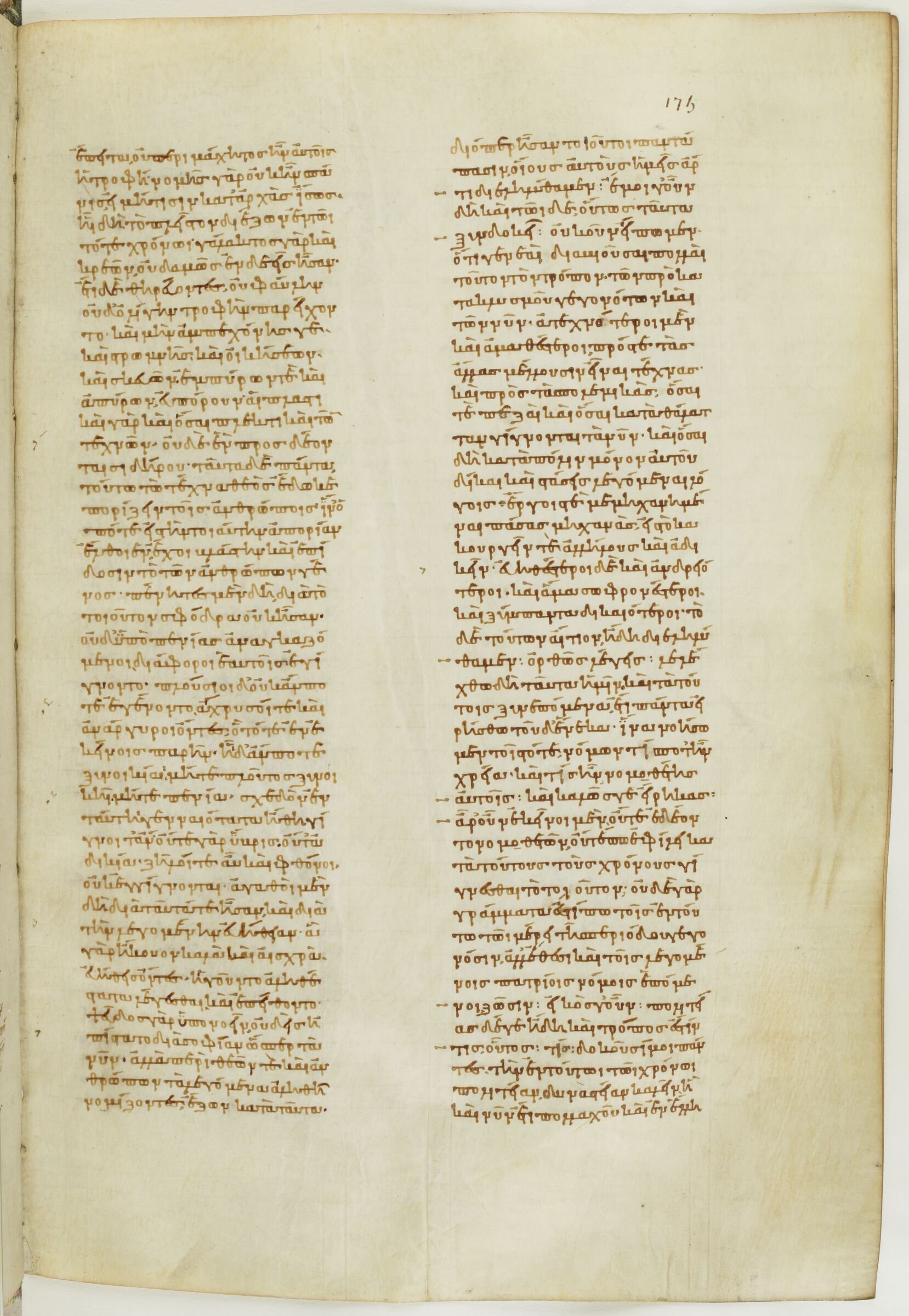
678e is on fol. 174v col. b and fol. 175r col. a. Fol. 174v: column a begins 'λύραν δὲ Ἀμφίονι' (677d) and ends in 678b '...οὐκοῦν προϊόντος μὲν τοῦ χρό-'; column b begins '-νου, πληθύοντος δ’ ἡμῶν τοῦ γένους' and ends in 678e '...ἐφιλοφρονοῦντο ἀλλήλους δι’ ἐρημίαν'. Fol. 175r: column a begins 'ἔπειτα οὐ περιμάχητος ἦν αὐτοῖς ἡ τροφή' (678e) and ends in 679c '...ἀληθῆ νομίζοντες ἔζων κατὰ ταῦτα'; column b begins 'διόπερ ἦσαν τοιοῦτοι παντάπασιν' and ends in 680b '...καὶ νῦν ἔτι πολλαχοῦ καὶ ἐν Ἕλλη-'. Checked on the image. Viewer: https://gallica.bnf.fr/ark:/12148/btv1b8419248n/f358.item
678e[ΚΛ.] δῆλον ὅτι παμπόλλαις τισίν. [ΑΘ.] οὐκοῦν καὶ τέχναι, ὅσαιπερ σιδήρου δέονται καὶ χαλκοῦ καὶ τῶν τοιούτων ἁπάντων, τὸν αὐτὸν χρόνον καὶ ἔτι πλείονα ἠφανισμέναι ἂν εἶεν ἐν τῷ τότε; [ΚΛ.] τί μήν; [ΑΘ.] καὶ τοίνυν στάσις ἅμα καὶ πόλεμος ἀπωλώλει κατὰ τὸν τότε χρόνον πολλαχῇ. [ΚΛ.] πῶς; [ΑΘ.] πρῶτον μὲν ἠγάπων καὶ ἐφιλοφρονοῦντο ἀλλήλους διʼ ἐρημίαν, ἔπειτα οὐ περιμάχητος ἦν αὐτοῖς ἡ τροφή.
678e[Clin.] A great many, evidently. [Ath.] And during all this period, or even longer, all the arts that require iron and bronze and all such metals must have remained in abeyance? [Clin.] Of course. [Ath.] Moreover, civil strife and war also disappeared during that time, and that for many reasons. [Clin.] How so? [Ath.] In the first place, owing to their desolate state, they were kindly disposed and friendly towards one another; and secondly, they had no need to quarrel about food.
Where on the image
679a is on fol. 175r col. a. Fol. 175r: column a begins 'ἔπειτα οὐ περιμάχητος ἦν αὐτοῖς ἡ τροφή' (678e) and ends in 679c '...ἀληθῆ νομίζοντες ἔζων κατὰ ταῦτα'; column b begins 'διόπερ ἦσαν τοιοῦτοι παντάπασιν' and ends in 680b '...καὶ νῦν ἔτι πολλαχοῦ καὶ ἐν Ἕλλη-'. Checked on the image. Viewer: https://gallica.bnf.fr/ark:/12148/btv1b8419248n/f359.item
679aνομῆς γὰρ οὐκ ἦν σπάνις, εἰ μή τισιν κατʼ ἀρχὰς ἴσως, ᾗ δὴ τὸ πλεῖστον διέζων ἐν τῷ τότε χρόνῳ· γάλακτος γὰρ καὶ κρεῶν οὐδαμῶς ἐνδεεῖς ἦσαν, ἔτι δὲ θηρεύοντες οὐ φαύλην οὐδʼ ὀλίγην τροφὴν παρείχοντο. καὶ μὴν ἀμπεχόνης γε καὶ στρωμνῆς καὶ οἰκήσεων καὶ σκευῶν ἐμπύρων τε καὶ ἀπύρων ηὐπόρουν· αἱ πλαστικαὶ γὰρ καὶ ὅσαι πλεκτικαὶ τῶν τεχνῶν οὐδὲ ἓν προσδέονται σιδήρου, ταῦτα δὲ
679aFor they had no lack of flocks and herds (except perhaps some of them at the outset), and in that age these were what men mostly lived on: thus they were well supplied with milk and meat, and they procured further supplies of food, both excellent and plentiful, by hunting. They were also well furnished with clothing and coverlets and houses, and with vessels for cooking and other kinds; for no iron is required for the arts of moulding and weaving,
Where on the image
679b is on fol. 175r col. a. Fol. 175r: column a begins 'ἔπειτα οὐ περιμάχητος ἦν αὐτοῖς ἡ τροφή' (678e) and ends in 679c '...ἀληθῆ νομίζοντες ἔζων κατὰ ταῦτα'; column b begins 'διόπερ ἦσαν τοιοῦτοι παντάπασιν' and ends in 680b '...καὶ νῦν ἔτι πολλαχοῦ καὶ ἐν Ἕλλη-'. Checked on the image. Viewer: https://gallica.bnf.fr/ark:/12148/btv1b8419248n/f359.item
679bπάντα τούτω τὼ τέχνα θεὸς ἔδωκε πορίζειν τοῖς ἀνθρώποις, ἵνʼ ὁπότε εἰς τὴν τοιαύτην ἀπορίαν ἔλθοιεν, ἔχοι βλάστην καὶ ἐπίδοσιν τὸ τῶν ἀνθρώπων γένος. πένητες μὲν δὴ διὰ τὸ τοιοῦτον σφόδρα οὐκ ἦσαν, οὐδʼ ὑπὸ πενίας ἀναγκαζόμενοι διάφοροι ἑαυτοῖς ἐγίγνοντο· πλούσιοι δʼ οὐκ ἄν ποτε ἐγένοντο ἄχρυσοί τε καὶ ἀνάργυροι ὄντες, ὃ τότε ἐν ἐκείνοις παρῆν. ᾗ δʼ ἄν ποτε συνοικίᾳ μήτε πλοῦτος συνοικῇ μήτε πενία, σχεδὸν ἐν ταύτῃ γενναιότατα ἤθη γίγνοιτʼ ἄν· οὔτε
679bwhich two arts God gave to men to furnish them with all these necessaries, in order that the human race might have means of sprouting and increase whenever it should fall into such a state of distress. Consequently, they were not excessively poor, nor were they constrained by stress of poverty to quarrel one with another; and, on the other hand, since they were without gold and silver, they could never have become rich. Now a community which has no communion with either poverty or wealth is generally the one in which the noblest characters will be formed;
Where on the image
679c is on fol. 175r col. a-b. Fol. 175r: column a begins 'ἔπειτα οὐ περιμάχητος ἦν αὐτοῖς ἡ τροφή' (678e) and ends in 679c '...ἀληθῆ νομίζοντες ἔζων κατὰ ταῦτα'; column b begins 'διόπερ ἦσαν τοιοῦτοι παντάπασιν' and ends in 680b '...καὶ νῦν ἔτι πολλαχοῦ καὶ ἐν Ἕλλη-'. Checked on the image. Viewer: https://gallica.bnf.fr/ark:/12148/btv1b8419248n/f359.item
679cγὰρ ὕβρις οὔτʼ ἀδικία, ζῆλοί τε αὖ καὶ φθόνοι οὐκ ἐγγίγνονται. ἀγαθοὶ μὲν δὴ διὰ ταῦτά τε ἦσαν καὶ διὰ τὴν λεγομένην εὐήθειαν· ἃ γὰρ ἤκουον καλὰ καὶ αἰσχρά, εὐήθεις ὄντες ἡγοῦντο ἀληθέστατα λέγεσθαι καὶ ἐπείθοντο. ψεῦδος γὰρ ὑπονοεῖν οὐδεὶς ἠπίστατο διὰ σοφίαν, ὥσπερ τὰ νῦν, ἀλλὰ περὶ θεῶν τε καὶ ἀνθρώπων τὰ λεγόμενα ἀληθῆ νομίζοντες ἔζων κατὰ ταῦτα· διόπερ ἦσαν τοιοῦτοι παντάπασιν οἵους αὐτοὺς ἡμεῖς ἄρτι διεληλύθαμεν.
679cfor in it there is no place for the growth of insolence and injustice, of rivalries and jealousies. So these men were good, both for these reasons and because of their simple-mindedness, as it is called; for, being simple-minded, when they heard things called bad or good, they took what was said for gospel-truth and believed it. For none of them had the shrewdness of the modern man to suspect a falsehood; but they accepted as true the statements made about gods and men, and ordered their lives by them. Thus they were entirely of the character we have just described.
Where on the image
679d is on fol. 175r col. b. Fol. 175r: column a begins 'ἔπειτα οὐ περιμάχητος ἦν αὐτοῖς ἡ τροφή' (678e) and ends in 679c '...ἀληθῆ νομίζοντες ἔζων κατὰ ταῦτα'; column b begins 'διόπερ ἦσαν τοιοῦτοι παντάπασιν' and ends in 680b '...καὶ νῦν ἔτι πολλαχοῦ καὶ ἐν Ἕλλη-'. Checked on the image. Viewer: https://gallica.bnf.fr/ark:/12148/btv1b8419248n/f359.item
679d[ΚΛ.] ἐμοὶ γοῦν δὴ καὶ τῷδε οὕτως ταῦτα συνδοκεῖ. [ΑΘ.] οὐκοῦν εἴπωμεν ὅτι γενεαὶ διαβιοῦσαι πολλαὶ τοῦτον τὸν τρόπον τῶν πρὸ κατακλυσμοῦ γεγονότων καὶ τῶν νῦν ἀτεχνότεροι μὲν καὶ ἀμαθέστεροι πρός τε τὰς ἄλλας μέλλουσιν εἶναι τέχνας καὶ πρὸς τὰς πολεμικάς, ὅσαι τε πεζαὶ καὶ ὅσαι κατὰ θάλατταν γίγνονται τὰ νῦν, καὶ ὅσαι δὴ κατὰ πόλιν μόνον αὐτοῦ, δίκαι καὶ στάσεις λεγόμεναι, λόγοις
679d[Clin.] Certainly Megillus and I quite agree with what you say. [Ath.] And shall we not say that people living in this fashion for many generations were bound to be unskilled, as compared with either the antediluvians or the men of to-day, and ignorant of arts in general and especially of the arts of war as now practised by land and sea, including those warlike arts which, disguised under the names of law-suits and factions, are peculiar to cities, contrived as they are with every device of word and deed to inflict mutual hurt and injury;
Where on the image
679e is on fol. 175r col. b. Fol. 175r: column a begins 'ἔπειτα οὐ περιμάχητος ἦν αὐτοῖς ἡ τροφή' (678e) and ends in 679c '...ἀληθῆ νομίζοντες ἔζων κατὰ ταῦτα'; column b begins 'διόπερ ἦσαν τοιοῦτοι παντάπασιν' and ends in 680b '...καὶ νῦν ἔτι πολλαχοῦ καὶ ἐν Ἕλλη-'. Checked on the image. Viewer: https://gallica.bnf.fr/ark:/12148/btv1b8419248n/f359.item
679eἔργοις τε μεμηχανημέναι πάσας μηχανὰς εἰς τὸ κακουργεῖν τε ἀλλήλους καὶ ἀδικεῖν, εὐηθέστεροι δὲ καὶ ἀνδρειότεροι καὶ ἅμα σωφρονέστεροι καὶ σύμπαντα δικαιότεροι; τὸ δὲ τούτων αἴτιον ἤδη διεληλύθαμεν. [ΚΛ.] ὀρθῶς λέγεις. [ΑΘ.] λελέχθω δὴ ταῦτα ἡμῖν καὶ τὰ τούτοις συνεπόμενα ἔτι πάντα εἰρήσθω τοῦδʼ ἕνεκα, ἵνα νοήσωμεν τοῖς τότε
679eand that they were also more simple and brave and temperate, and in all ways more righteous? And the cause of this state of things we have already explained. [Clin.] Quite true. [Ath.] We must bear in mind that the whole purpose of what we have said and of what we are going to say next is this,—that we may understand
Notes
- Greek: John Burnet's Oxford text (1907), from Perseus. Speaker names are given in brackets as in the digital edition (ΑΘ. the Athenian, ΚΛ. Clinias, ΜΕ. Megillus). The manuscript's wording differs from the edition in small details.
- English: R. G. Bury's Loeb translation (1926), from Perseus, with the spellings of the printed book restored. Bury's section letters are placed in his margin and do not always fall at the same word as the Greek; the English sections follow Bury's letters.
Cite
Sources
- Source: Paris gr. 1807 (9th c.) via Gallica + Burnet Greek (Perseus) + Bury English (Loeb 1926, Perseus) (holding institution)
- Critical edition: J. Burnet, Platonis opera V (Oxford 1907), via Perseus
← previous · → next · v cycle view · l back to library